 |
 |
The boat docked that morning, and one soldier at least, as he stood on the deck and watched the shores of his native land draw nearer, felt mingling with the thrill of joy at his return a vague uneasiness. He was coming back, it is true, but it had been a long time and a lot of things had happened. For one thing he had lost his foot. That in itself was a pretty stiff proposition. For another thing he was not wearing any decorations save the wound stripes on his sleeve. Those would have been enough, and more than enough, for his mother if she were alive, but she had gone away from earth during his absence, and the girl he had kissed good-bye and promised great things was peculiar. The question was, would she stand for that amputated foot? He didn't like to think it of her, but he found he wasn't sure. Perhaps, if there had been a croix de guerre! He had promised her to win that and no end of other honors, when he went away so buoyant and hopeful; but almost on his first day of real battle he had been hurt and tossed aside like a derelict, to languish in a hospital, with no more hope of winning anything. And now he had come home with one foot gone, and no distinction!
He hadn't told the girl yet about the foot. He didn't know as he should. He felt lonely and desolate in spite of his joy at getting back to "God's Country." He frowned at the hazy outline of the great city from which tall buildings were beginning to differentiate themselves as they drew nearer. There was New York. He meant to see New York, of course. He was a Westerner and had never had an opportunity to go about the metropolis of his own country. Of course, he would see it all. Perhaps, after he was demobilized he would stay there. Maybe he wouldn't send word he had come back. Let them think he was killed or taken prisoner, or missing, or anything they liked. There were things to do in New York. There were places where he would be welcome even with one foot gone and no cross of war. Thus he mused as the boat drew nearer the shore and the great city loomed close at hand. Then, suddenly, just as the boat was touching the pier and a long murmur of joy went up from the wanderers on board, his eyes dropped idly to the dock and there in her trim little overseas uniform, with the sunlight glancing from the silver letters on the scarlet shield of her trench cap and the smile radiating from her sweet face, stood the very same Salvation Army lassie who had bent over him as he lay on the ground just back of the trenches waiting to be put in the ambulance and taken to the hospital after he had been wounded. He could feel again the throbbing pain in his leg, the sickening pain of his head as he lay in the hot sun, with the flies swarming everywhere, the horrible din of battle all about, and his tongue parched and swollen with fever from lying all night in pain on the wet ground of No Man's Land. She had laid a soft little hand on his hot forehead, bathed his face, and brought him a cold drink of lemonade. If he lived to be a hundred years old he would never taste anything so good as that lemonade had been. Afterward the doctor said it was the good cold drink that day that saved the lives of those fever patients who had lain so long without attention. Oh, he would never forget the Salvation lassie! And there she was alive and at home! She hadn't been killed as the fellows had been afraid she would. She had come through it all and here she was always ahead and waiting to welcome a fellow home. It brought the tears smarting to his eyes to think about it, and he leaned over the rail of the ship and yelled himself hoarse with the rest over her, forgetting all about his lost foot. It was hours before they were off the ship. All the red tape necessary for the movement of such a company of men had to be unwound and wound up again smoothly, and the time stretched out interminably; but somehow it did not seem so hard to wait now, for there was someone down there on the dock that he could speak to, and perhaps--just perhaps--he would tell her of his dilemma about his girl. Somehow he felt that she would understand.
He watched eagerly when he was finally lined up on the wharf waiting for roll-call, for he was sure she would come; and she did, swinging down the line with her arms full of chocolate, handing out telegraph blanks and postal cards, real postal cards with a stamp on them that could be mailed anywhere. He gripped one in his big, rough hand as if it were a life preserver. A real, honest-to-goodness postal card! My it was good to see the old red and white stamp again! And he spoke impulsively:
"You're the girl that saved my life out there in the field, don't you remember? With the lemonade!" Her face lit up. She had recognized him and somehow cleared one hand of chocolate and telegrams to grasp his with a hearty welcome: "I'm so glad you came through all right!" her cheery voice said.
All right! All right! Did she call it all right? He looked down at his one foot with a dubious frown. She was quick to see. She understood.
"Oh, but that's nothing!" she said, and somehow her voice put new heart into him. "Your folks will be so glad to have you home you'll forget all about it. Come, aren't you going to send them a telegram?" And she held out the yellow blank.
But still he hesitated.
"I don't know," he said, looking down at his foot again. "Mother's gone,
and------"
Instantly her quick sympathy enveloped his sore soul, and he felt that just the inflection of her voice was like balm when she said: "I'm so sorry!" Then she added:
"But isn't there somebody else? I'm sure there was. I'm sure you told me about a girl I was to write to if you didn't come through. Aren't you going to let her know? Of course you are."
"I don't know," said the boy. "I don't think I am. Maybe I'll never go back now. You see, I'm not what I was when I went away."
"Nonsense!" said the lassie with that cheerful assurance that had carried her through shell fire and made her merit the pet name of "Sunshine" that the boys had given her in the trenches. "Why, that wouldn't be fair to her. Of course, you're going to let her know right away. Leave it to me. Here, give me her address!"
Quick as a flash she had the address and was off to a telephone booth. This was no message that could wait to go back to headquarters. It must go at once.
He saw her again before he left the wharf. She gave him a card with two addresses written on it:
"This first is where you can drop in and rest when you are tired," she explained. "It's just one of our huts; the other is where you can find a good bed when you are in the city."
Then she was off with a smile down the line, giving out more telegraph blanks and scattering sunshine wherever she went. He glanced back as he left the pier and saw her still floating eagerly here and there like a little sister looking after more real brothers.
The next day, when he was free and on a few days leave from camp, he started out with his crutch to see the city, but the thought of her kept him from some of the places where his feet might have strayed. Yet she had not said a word of warning. Her smile and the look in her eyes had placed perfect confidence in him, and he could remember the prayer she had uttered in a low tone back there at the dressing station behind the trenches in the ear of a companion who was not going to live to get to the Base Hospital, and who had begged her to pray with him before he went. Somehow it lingered with him all day and changed his ideas of what he wanted to see in New York.
But it was a long hard tramp he had set for himself to see the town with that one foot. He hadn't much money for cars, even if he had known which cars to take, so he hobbled along and saw what he could. He was all alone, for the fellows he started with went so fast and wanted to do so many things that he could not do, that he had made an excuse to shake them off. They were kind. They would not have left him if they had known; but he wasn't going to begin his new life having everybody put out on his account, so he was alone. And it was toward evening. He was very tired. It seemed to him that he couldn't go another block. If only there were a place somewhere where he could sit down a little while and rest; even a doorstep would do if there were only one near at hand. Of course, there were saloons, and there would always be soldiers in them. He would likely be treated, and there would be good cheer, and a chance to forget for a little while; but somehow the thought of that Salvation lassie and the cheery way she had made him send that telegram kept him back. When a girl with painted cheeks stopped and smiled in his face he passed her by, and half wondered why he did it. He must go somewhere presently and get a bite to eat, but it couldn't be much for he wanted to save money enough and hunt up that lodging house where there were nice beds. How much he wanted that bed!
|
|
|
|
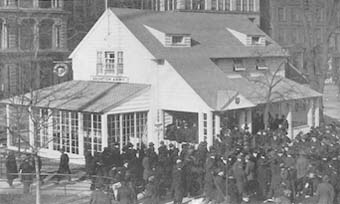
It was quite dark now. The lights were lit everywhere. He was coming to a great thoroughfare. He judged by his slight knowledge of the city that it might be Broadway. There would likely be a restaurant somewhere near. He hurried on and turned into the crowded street. How cold it was! The wind cut him like a knife. He had been a fool to come off alone like this! Just out of the hospital, too. Perhaps he would get sick and have to go to another hospital. He shivered and stopped to pull his collar up closer around his neck. Then suddenly he stood still and stared with a dazed, bewildered expression, straight ahead of him. Was he getting a bit leary? He passed his hand over his eyes and looked again. Yes, there it was! Right in the midst of the busy, hurrying throng of Union Square! He made sure it was Union Square, for he looked up at the street sign to be certain it wasn't Willow Vale--or Heaven--right there where streets met and crossed, and cars and trolleys and trucks whirled, and people passed in throngs all day, just across the narrow road, stood the loveliest, most perfect little white clapboard cottage that ever was built on this earth, with porches all around and a big tree growing up through the roof of one porch. It stood out against the night like a wonderful mirage, like a heavenly dove descended into the turmoil of the pit, like home and mother in the midst of a rushing pitiless world. He could have cried real tears of wonder and joy as he stood there, gazing. He felt as though he were one of those motion pictures in which a lone Klondiker sits by his campfire cooking a can of salmon or baked beans, and up above him on the screen in one corner appears the Christmas tree where his wife and baby at home are celebrating and missing him. It seemed just as unreal as that to see that little beautiful home cottage set down in the midst of the city.
The windows were all lit up with a warm, rosy light and there were curtains at the windows, rosy pink curtains like the ones they used to have at the house where his girl lived, long ago before the War spoiled him. He stood and continued to gaze until a lot of cash-boys, let loose from the toil of the day, rushed by and almost knocked his crutch from under him. Then he determined to get nearer this wonder. Carefully watching his opportunity he hobbled across the street and went slowly around the building. Yes, it was real. Some public building, of course, but how wonderful to have it look so like a home! Why had they done it?
Then he came around toward the side, and there in plain letters was a sign: "Soldiers and Sailors in Uniform Welcome." What? Was it possible? Then he might go in? What kind of a place could it be?
He raised his eyes a little and there, slung out above the neatly shingled porch, like any sign, swung an immense fat brown doughnut a foot and a half in diameter, with the sugar apparently still sticking to it, and inside the rough hole sat a big white coffee cup. His heart leaped up and something suddenly gave him an idea. He fumbled in his pocket, brought out a card, saw that this was the Salvation Army hut, and almost shouted with joy. He lost no time in hurrying around to the door and stepping inside.
There revealed before him was a great cozy room, with many easy-chairs and tables, a piano at which a young soldier sat playing ragtime, and at the farther end a long white counter on which shone two bright steaming urns that sent forth a delicious odor of coffee. Through an open door behind the counter he caught a glimpse of two Salvation Army lassies busy with some cups and plates, and a third enveloped in a white apron was up to her elbows in flour, mixing something in a yellow bowl. By one of the little tables two soldier boys were eating doughnuts and coffee, and at another table a sailor sat writing a letter. It was all so cozy and homelike that it took his breath away and he stood there blinking at the lights that flooded the rooms from graceful white bowl-like globes that hung suspended from the ceiling by brass chains. He saw that the rosy light outside had come from soft pink silk sash curtains that covered the lower part of the windows, and there were inner draperies of some heavier flowered material that made the whole thing look real and substantial. The willow chairs had cushions of the same flowered stuff. The walls were a soft pearly gray below and creamy white above, set off by bands of dark wood, and a dark floor with rush mats strewn about. He looked around slowly, taking in every detail almost painfully. It was such a contrast to the noisy, rushing street, a contrast to the hospital, and the trenches and all the life with which he had been familiar during the past few dreadful months. It made him think of home and mother. He began to be afraid he was going to cry like a great big baby, and he looked around nervously for a place to get out of sight. He saw a fellow going upstairs and at a distance he followed him. Up there was another bright, quiet room, curtained and cushioned like the other, with more easy willow chairs, round willow tables, and desks over by the wall where one might write. The soldier who had come up ahead of him was already settled writing now at a desk in the far corner. There were bookcases between the windows with new beautifully bound books in them, and there were magazines scattered around, and no rules that one must not spit on the floor, or put their feet in the chairs, or anything of the sort. Only, of course, no one would ever dream of doing anything like that in such a place. How beautiful it was, and how quiet and peaceful! He sank into a chair and looked about him. What rest!
And now there were real tears in his eyes which he hastened to brush roughly away, for someone was coming toward him and a hand was on his shoulder. A man's voice, kindly, pleasant, brotherly, spoke:
"All in, are you, my boy? Well, you just sit and rest yourself awhile. What do you think of our hut? Good place to rest? Well, that's what we want it to be to you, Home. Just drop in here whenever you're in town and want a place to rest or write, or a bite of something homelike to eat."
He looked up to the broad shoulders in their well-fitting dark blue uniform, and into the kindly face of the gray-haired Colonel of the Salvation Army who happened to step in for a minute on business and had read the look on the lonesome boy's face just in time to give a word of cheer. He could have thrown his arms around the man's neck and kissed him if he only hadn't been too shy. But in spite of the shyness he found himself talking with this fine strong man and telling him some of his disappointments and perplexities, and when the older man left him he was strengthened in spirit from the brief conversation. Somehow it didn't look quite so black a prospect to have but one foot.
He read a magazine for a little while and then, drawn by the delicious odors, he went downstairs and had some coffee and doughnuts. He saw while he was eating that the front porch opened out of the big lower room and was all enclosed in glass and heated with radiators. A lot of fellows were sitting around there in easy-chairs, smoking, talking, one or two sleeping in their chairs or reading papers. It had a dim, quiet light, a good place to rest and think. He was more and more filled with wonder. Why did they do it? Not for money, for they charged hardly enough to pay for the materials in the food they sold, and he knew by experience that when one had no money one could buy of them just the same if one were in need.
Later in the evening he took out the little card again and looked up the other address. He wanted one of those clean, sweet beds that he had been hearing about, that one could get for only a quarter a night, with all the shower-bath you wanted thrown in. So he went out again and found his way down to Forty-first Street.
There was something homelike about the very atmosphere as he entered the little office room and looked about him. Beyond, through an open door he could see a great red brick fireplace with a fire blazing cheerfully and a few fellows sitting about reading and playing checkers. Everybody looked as if they felt at home.
When he signed his name in the big register book the young woman behind the desk who wore an overseas uniform glanced at his signature and then looked up as if she were welcoming an old friend:
"There's a telegram here for you," she said pleasantly. "It came last night and we tried to locate you at the camp but did not succeed. One of our girls went over to camp this afternoon, but they said you were gone on a furlough, so we hoped you would turn up."
She handed over the telegram and he took it in wonder. Who would send him a telegram? And here of all places! Why, how would anybody know he would be here? He was so excited his crutch trembled under his arm as he tore open the envelope and read:
"Dear Billy (It was a regular letter!):
"I am leaving to-night for New York. Will meet you at Salvation Hostel day after to-morrow morning. What is a foot more or less? Can't I be hands and feet for you the rest of your life? I'm proud, proud, proud of you!
Signed "Jean"
He found great tears coming into his eyes and his throat was full of them, too. It didn't matter if that Salvation Army lassie behind the counter did see them roll down his cheeks. He didn't care. She would understand anyway, and he laughed out loud in his joy and relief, the first joy, the first relief since he was hurt!
Some one else was coming in the door, another fellow maybe, but the lassie opened a door in the desk and drew him behind the counter in a shaded corner where no one would notice and brought him a cup of tea, which she said was all they had around to eat just then. She didn't pay any attention to him till he got his equilibrium again.
She was the kind of woman one feels is a natural-born mother. In fact, the fellows were always asking her wistfully: "May we call you Mother?" Young enough to understand and enter into their joys and sorrows, yet old enough to be wise and sweet and true. She mothered every boy that came.
A sailor boy once asked if he might bring his girl to see her. He said he wanted her to see her so she could tell his mother about her.
"But can't you tell her about your girl?" she asked.
"Oh, yes, but I want you to tell her." he said. "You see, whatever you say mother'll know is true."
So presently she turned to this lonely boy and took him upstairs through the pleasant upper room with its piano and games, its sun parlor over the street, lined with trailing ferns, with cheery canaries in swinging tasseled cages, who looked fully as happy and at home as did the soldier boys who were sitting about comfortably reading. She found him a room with only one other bunk in it. Nice white beds with springs like air and mattresses like down. She showed him where the shower-baths were, and with a kindly good-night left him. He almost wanted to ask her to kiss him good-night, so much like his own mother she seemed.
Before he got into that white bed he knelt beside it, all clean and comfortable and happy like a little child that had wandered a long way from home and got back again, and he told God he was sorry and ashamed for all the way he had doubted, and sinned, and he wanted to live a new life and be good. Then he lay down to sleep. To-morrow morning Jean would be there. And she didn't mind about the foot! She didn't mind! How wonderful!
And then he had a belated memory of the little Salvation Army lassie on the wharf who had brought all this about, and he closed his eyes and murmured out loud to the clean, white walls: "God bless her! Oh, God bless her!"
This is only one of the many stories that might be told about the boys who have been helped by the various activities of the Salvation Army, both at home and abroad.
It would be well worth one's while to visit their Brooklyn Hospital and their New York Hospital and all their other wonderful institutions. In several of them are many little children, some mere infants, belonging to soldiers and sailors away in the war. In some instances the mother is dead, or has to work. If she so desires she is given work in the institution, which is like a real home, and allowed to be with her child and care for it. Where both mother and father are dead the child remains for six years or until a home elsewhere is provided for it. Here the little ones are well cared for, not in the ordinary sense of an institution, but as a child would be cared for in a home, with beauty and love, and pleasure mingling with the food and shelter and raiment that is usually supplied in an institution. These children are prettily, though simply, dressed and not in uniform; with dainty bits of color in hair ribbon, collar, necktie or frock; the babies have wee pink and blue wool caps and sacks like any beloved little mites, they ride around on Kiddie Cars, play with doll houses and have a fine Kindergarten teacher to guide their young minds, and the best of hospital service when they are ailing. But that is another story, and there are yet many of them. If everybody could see the beautiful life-size painting of Christ blessing the little children which is painted right on the very wall and blended into the tinting, they could better comprehend the spirit which pervades this lovely home.
The New York Hospital, which has just been rebuilt and refurnished with all the latest appliances, is in charge of a devoted woman physician, who has given her life to healing, and has at the head of its Board one of the most noted surgeons in the city, who gives his services free, and boasts that he enjoys it best of all his work. Here those of small means or of no means at all, especially those belonging to soldiers and sailors, may find healing of the wisest and most expert kind, in cheery, airy, sanitary and beautiful rooms. But here, too, to understand, one must see. Just a peep into one of those dainty white rooms would rest a poor sick soul; just a glance at the room full of tiny white basket cribs with dainty blue satin-bound blankets--real wool blankets--and white spreads, would convince one.
And what one sees in New York in the line of such activities is duplicated in most of the other large cities of the United States.
Not the least of the Salvation Army service for the returning soldiers is the work that is done on the docks by the lassies meeting returning troop ships. They send telegrams free, not C.O.D., for them, give the men stamped postal cards, hunt up relatives, answer questions, and give them chocolate while they wait for the inevitable roll call before they can entrain. Often these girls will sit up half the night after having met boats nearly all day, to get the telegrams all off that night. It is interesting to note that on one single day, April 20th, 1919, the Salvation Army Headquarters in New York sent 2900 such free telegrams for returning soldiers.
The other day the father of a soldier came to Headquarters with an anxious face, after a certain unit from overseas had returned. It was the unit in which his boy had gone to France, but he had written saying he was in the hospital without stating what was the matter or how serious his wound. No further word had been received and the father and mother were frenzied with grief. They had tried in every way to get information but could find out nothing. The Salvation Army went to work on the telephone and in a short time were able to locate the missing boy in a Casual Company soon to return, and to report to his anxious father that he was recovering rapidly.
Another soldier arrived in New York and sent a Salvation Army telegram to his father and mother in California who had previously received notification that he was dead. A telegram came back to the Salvation Army almost at once from the West stating this fact and begging some one to go to the camp where the boy's Casual Company was located and find out if he were really living. One of the girls from the office went over to the Debarkation Hospital immediately and saw the boy, and was able to telegraph to his parents that he was perfectly recovered and only awaiting transportation to California. He was overjoyed to see someone who had heard from his parents.
A portion of one troop ship had been reserved for soldiers having influenza. These men were kept on board long after all the others had left the ship. A Salvation Army worker seeing them with the white masks over their faces went on board and served them with chocolate, distributing post cards and telegraph blanks. When she was leaving the ship a Captain said to her rather brusquely: "Don't you realize that you have done a foolish thing? Those men have influenza and your serving them might mean your death!"
Looking up into the man's eyes the Salvationist said: "I am ready to die if God sees fit to call me."
The officer laughed and told her that was the first time in his life he had known anyone to say they were ready to die and would willingly expose themselves to such a contagious disease.
"Aren't you ready to die?" asked the girl. "Certainly not," replied the Captain. "Sometimes I think I am hardly fit to live, much less die."
"Don't you realize that there is a Power which can enable you to live in such a way as to make you ready to die?"
"Oh, well, I don't bother about going to church, in fact, I don't bother about religion at all, although I must say once or twice when I was up the line over there I wished I did know something about religion, that is, the kind that makes a fellow feel good about dying; but I don't want to go to church and go through all that business."
"It is possible to accept Christ here and now on this very spot--on this ship--if you'll only believe," said the girl wistfully.
The Captain could not help being interested and thoughtful. When she left, after a little more talk he put out his hand and said:
"Thank you. You've done me more good than any sermon could have done me, and believe me, I am going to pray and trust God to help me live a different life."
Sad things are seen on the docks at times when the ships come into port, and the boys are coming home.
A soldier in a basket, with both arms and both legs gone and only one eye, was being carried tenderly along.
"Why do you let him live?" asked one pityingly of the Commanding Officer.
The gruff, kindly voice replied:
"You don't know what life is. We don't live through our arms and legs. We live through our hearts."
Some of our boys have learned out there amid shell fire to live through their hearts.
One of these lying on a litter greeted the lassie from Indiana, just come back to New York from France to meet the boys when they landed:
"Hello, Sister! You here?"
Her eyes filled with tears as she recognized one of her old friends of the trenches, and noticed how helpless he was now, he who had been the strongest of the strong. She murmured sympathetically some words of attempted cheer:
"Oh, that's all right, Sister," he said, "I know they got me pretty hard, but I don't mind that. I'm not going to feel bad about it. I got something better than arms and legs over in one of your little huts in France. I found Jesus, and I'm going to live for Him. I wanted you to know."
A few days later she was talking with another boy just landed. She asked him how it seemed to be home again, and to her surprise he turned a sorrowful face to her:
"It's the greatest disappointment of my life," he said sadly, "the folks here don't understand. They all want to make me forget, and I don't want to forget what I learned out there. I saw life in a different way and I knew I had wasted all the years. I want to live differently now, and mother and her friends are just getting up dances and theatre parties for me to help me to forget. They don't understand."
Forty miles west of Chicago is Camp Grant and there the Salvation Army has put up a hut just outside of the camp.
During the days when the boys were being sent to France, and were under quarantine, unable to go out, no one was allowed to come in and there was great distress. Mothers and sisters and friends could get no opportunity to see them for farewells.
The Salvation officer in charge suggested to the military authorities that the Salvation Army hut be the clearing place for relatives, and that he would come in his machine and bring the boys to the hut, taking them back again afterwards, that they might have a few hours with their friends before leaving for France.
This offer was readily accepted by the authorities, and so it was made possible for hundreds and hundreds of mothers to get a last talk with their boys before they left, some of them forever.
One day a young man came to the Salvation Army officer and told him that his regiment was to depart that night and that he was in great distress about his wife who on her way to see him had been caught in a railroad wreck, and later taken on her way by a rescue train. "I think she is in Rockford somewhere," he said anxiously, "but I don't know where, and I have to leave in three hours!"
The Ensign was ready with his help at once. He took the young soldier in his car to Rockford, seven miles away, and they went from hotel to hotel seeking in vain for any trace of the wife. Then suddenly as they were driving along the street wondering what to try next the young soldier exclaimed: "There she is!" And there she was, walking along the street!
The two had a blessed two hours together before the soldier had to leave. But it was all in the day's work for the Salvation Army man, for his main object in life is to help someone, and he never minds how much he puts himself out. It is always reward enough for him to have succeeded in bringing comfort to another.
One of the Salvation Army Ensigns who was assigned to work at Camp Grant hut had been an all-round athlete before he joined the Salvation Army, a boxer and wrestler of no mean order.
The fame of the Ensign went abroad and the doctor at the Base Hospital asked him to take charge of athletics in the hospital. He was also appointed regularly as chaplain in the hospital. Every day he drilled the five hundred women nurses in gymnastics, and put the men attendants and as many of the patients as were able through a set of exercises. Thus mingling his religion with his athletics he became a great power among the men in the hospital.
The Salvation Army asked the hospital if there was anything they could do for the wounded men. The reply was, that there were eighty wards and not a graphophone in one of them, nothing to amuse the boys. The need was promptly filled by the Salvation Army which supplied a number of graphophones and a piano. Then, discovering that the nurses who were getting only a very small cash allowance out of which they had to furnish their uniforms, were short of shoes, the indefatigable good Samaritan produced a thousand dollars to buy new shoes for them. The Salvation Army has always been doing things like that.
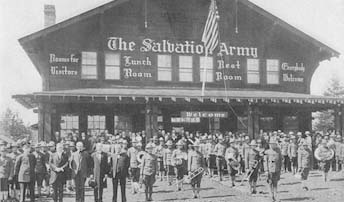
The Salvation Army built many huts, locating them wherever there was need among the camps. They have a hut at Camp Grant, one at Camp Funston, one at Camp Travis, San Antonio, one at Camp Logan, Houston, Texas, one at Camp Bowie, Fort Worth, one at Camp Cody, Deming, New Mexico, one at Camp Lewis, Tacoma, a Soldiers' Club at Des Moines, a Soldiers' Club with Sitting Room, Dining Room, and rooms for a hundred soldiers just opened at Chicago. There is a charge of twenty-five cents a night and twenty-five cents a meal for such as have money. No charge for those who have no money. There is such a Soldiers' Club at St. Louis, Kansas City, St. Paul and Minneapolis. All of these places at the camps have accommodations for women relatives to visit the soldiers, and all of the rooms are always full to the limit.
In Des Moines the Army has an interesting institution which grew out of a great need.
The Federal authorities have placed a Woman's Protective Agency in all Camp towns. At Des Moines the woman representative of the Federal Government sent word to the Salvation Army that she wished they would help her. She said she had found so many young girls between the ages of fourteen and sixteen who were being led into an immoral life through the soldiers, and she wished the Salvation Army would open a home to take care of such girls.
With their usual swiftness to come to the rescue the Salvation Army opened such a home. The Brigadier up in Chicago gave up his valued private secretary, a lovely young girl only twenty-four years old, to be at the head of this home. It may seem a pretty big undertaking for so young a girl, but these Salvation Army girls are brought up to be wonderfully wise and sweet beyond others, and if you could look into her beautiful eyes you would have an understanding of the consecration and strength of character that has made it possible for her to do this work with marvellous success, and reach the hearts and turn the lives of these many young girls who have come under her influence in this way. In her work she deals with the individual, always giving immediate relief for any need, always pointing the way straight and direct to a better life. The young girls are kept in the home for a week or more until some near relative can be sent for, or longer, until a home and work can be found for them. Every case is dealt with on its own merits; and many young girls have had their feet set upon the right road, and a new purpose in life given to them with new ideals, from the young Christian girl whom they easily love and trust.
So great has been the success of the Salvation Army hut and women's hostel at Camp Lewis that the United States Government has asked the Salvation Army to put up a hundred thousand dollar hotel at that camp which is located twenty miles out of Tacoma. The Salvation Army hut at this place was recently inspected by Secretary of War Baker and Chief of Staff who highly complimented the Salvationists on the good work being done.
A Christmas box was sent by the Salvation Army to each soldier in every camp and hospital throughout the West. Each box contained an orange, an apple, two pounds of nuts, one pound of raisins, one pound of salted peanuts, one package of figs, two handkerchiefs in sealed packets, one book of stamps, a package of writing paper, a New Testament, and a Christmas letter from the Commissioner at Headquarters in Chicago.
No Officer in the Salvation Army has been more successful in ingenious efforts to further all activities connected with the work than Commissioner Estill in command of the Western forces. He is an indefatigable and tireless worker, is greatly beloved, and his efforts have met with exceptional success.
It was a new manager who had taken hold of the affairs of the Salvation Army Hostel in a certain city that morning and was establishing family prayers. A visitor, waiting to see someone, sat in an alcove listening.
There in the long beautiful living-room of the Hostel sat a little audience, two black women-the cooks-several women in neat aprons and caps as if they had come in from their work, a soldier who had been reading the morning paper and who quietly laid it aside when the Bible reading began, a sailor who tiptoed up the two low steps from the café beyond the living-room where he had been having his morning coffee and doughnuts--the young clerk from behind the office desk. They all sat quiet, respectful, as if accorded a sudden, unexpected privilege.
 |
 |
The reading was a few well-chosen verses about Moses in the mount of vision and somehow seemed to have a strange quieting influence and carried a weight of reality read thus in the beginning of a busy day's work.
The reader closed the book and quite familiarly, not at all pompously, he said with a pleasant smile that this was a lesson for all of them. Each one should have his vision for the day. The cook should have a vision as she made the doughnuts--and he called her by her name--to make them just as well as they could be made; and the women who made the beds should have a vision of how they could make the beds smooth and soft and fine to rest weary comers; and those who cleaned must have a vision to make the house quite pure and sweet so that it would be a home for the boys who came there; the clerk at the desk should have a vision to make the boys comfortable and give them a welcome; and everyone should have a vision of how to do his work in the best way, so that all who came there for a day or a night or longer should have a vision when they left that God was ruling in that place and that everything was being done for His praise.
Just a few simple words bringing the little family of workers into touch with the Divine and giving them a glimpse of the great plan of laboring with God where no work is menial, and nothing too small to be worth doing for the love of Christ. Then the little company dropped upon their knees, and the earnest voice took up a prayer which was more an intimate word with a trusted beloved Companion; and they all arose to go about that work of theirs with new zest and--a vision!
In her alcove out of sight the visitor found refreshment for her own soul, and a vision also.
This is the secret of this wonderful work that these people do in France, in the cities, everywhere; they have a vision! They have been upon the Mountain with God and they have not forgotten the injunction:
"See that thou do all things according to the pattern given thee in the Mount"
But the stories multiply and my space is drawing to a close. I am minded to say reverently in words of old:
"And there are also many other things which these disciples of Jesus did, the which if they should be written every one, I suppose that even the world itself could not contain the books that should be written;" but are they not graven in the hearts of men who found the Christ on the battlefield or the hospital cot, or in the dim candle-lit hut, through these dear followers of His?
My Dear Miss Booth:
You may be sure that your telegram of November fifteenth warmed my heart and brought me very real cheer and encouragement. It is a message of just the sort that one needs in these trying times, and I hope that you will express to your associates my profound appreciation and my entire confidence in their loyalty, their patriotism, and their enthusiasm for the great work they are doing.
Cordially and sincerely yours,
Woodrow Wilson.
Nov. 30, 1917.
My Dear Miss Booth:
I am very much interested to hear of the campaign the Salvation Army has undertaken for money to sustain its war activities, and want to take the opportunity to express my admiration for the work that it has done and my sincere hope that it may be fully sustained.
(Signed) Woodrow Wilson.
The President of the United States of America.
Commander Evangeline Booth,
Paris, 7 April, 1919.
122 W. 14th Street, New York, U.S.A.
I am very much interested to know that the Salvation Army is about to enter into a campaign for a sustaining fund.
I feel that the Salvation Army needs no commendation from me. The love and gratitude it has elicited from the troops is a sufficient evidence of the work it has done and I feel that I should not so much commend as congratulate it.
Cordially and sincerely yours,
Woodrow Wilson.
British Delegation, Paris, 8th April, 1919.
Dear Madam:
I have very great pleasure in sending you this letter to say how highly I think of the great work which has been done by the Salvation Army amongst the Allied Armies in France and the other theatres of war. From all sides I hear the most glowing accounts of the way in which your people have added to the comfort and welfare of our soldiers. To me it has always been a great joy to think how much the sufferings and hardships endured by our troops in all parts of the world have been lessened by the self-sacrifice and devotion shown to them by that excellent organization, the Salvation Army.
Yours faithfully,
W. Lloyd George.
General J. J. Pershing, France.
The Salvation Army of America will never cease to hail you with devoted affection and admiration for your valiant leadership of your valiant army. You have rushed the advent of the world's greatest peace, and all men honor you. To God be all the glory!
Commander Evangeline Booth.
Commander Evangeline Booth, New York City.
"Many thanks for your cordial cable. The American Expeditionary Forces thank you for all your noble work that the Salvation Army has done for them from the beginning."
General Pershing.
With deep feeling of gratitude for the enormous contribution which the Salvation Army has made to the moral and physical welfare of this expedition all ranks join me in sending heartiest Christmas greetings and cordial best wishes for the New Year.
(Signed) Pershing.
Salvation, New York.
Paris, April 22, 1919.
The following cable received, Colonel William S. Barker, Director of the Salvation Army, Paris: My dear Colonel Barker--I wish to express to you my sincere appreciation, and that of all members of the American Expeditionary Forces, for the splendid services rendered by the Salvation Army to the American Army in France. You first submitted your plans to me in the summer of 1917, and before the end of that year you had a number of Huts in operation in the Training Area of the First Division, and a group of devoted men and women who laid the foundation for the affectionate regard in which the workers of your organization have always been held by the American soldiers. The outstanding features of the work of the Salvation Army have been its disposition to push its activities as far as possible to the Front, and the trained and experienced character of its workers whose one thought was the well-being of its soldiers they came to serve. While the maintenance of these standards has necessarily kept your work within narrow bounds as compared to some of the other welfare agencies, it has resulted in a degree of excellence and self-sacrifice in the work performed which has been second to none. It has endeared your organization and its individual men and women workers to all those Divisions and other units to which they have been attached and has published their good name to every part of the American Expeditionary forces. Please accept this letter as a personal message to each one of your workers. Very sincerely,
John J. Pershing.
Marshal Foch, Paris, France:
Your brilliant armies, under blessing of God, have triumphed. The Salvation Army of America exults with war-worn but invincible France. We must consolidate for God of Peace all the good your valor has secured. Commander Evangeline Booth.
193 F8 PZ FRANCE 31
EVANGELINE BOOTH
COMMANDER SALVATION ARMY
IN AMERICA NEW YORK
TRÈS TOUCHÉ DU SENTIMENT ÉLEVÉ
QUI A INSPIRÉ Vôtre
TÉLÉGRAMME JE VOUS ADRESSE AINSI QU'À VOS
ADHÉRENTS MES
SINCÈRES REMERCIEMENTS
MARECHAL FOCH
I am deeply touched by the high sentiment which inspired your cablegram, and I tender you and your adherents sincere thanks.
MARSHAL FOCH
Letter from Sir Douglas Haig
Just before leaving London on Thursday for his provincial campaigns, General Booth received the following letter from Field Marshal Sir Douglas Haig. The generous tribute will be read with intense satisfaction by Salvationists the world over:
General Headquarters, British Armies in France.
March 27, 1918.I am glad to have the opportunity of congratulating the Salvation Army on the service which its representatives have rendered during the past year to the British Armies in France.
The Salvation Army workers have shown themselves to be of the right sort and I value their presence here as being one of the best influences on the moral and spiritual welfare of the troops at the bases. The inestimable value of these influences is realized when the morale of the troops is afterwards put to the test at the front.
The huts which the Salvation Army has staffed have besides been an addition to the comfort of the soldiers which has been greatly appreciated.
I shall be glad if you will convey the thanks of all ranks of the British Expeditionary Forces in France to the Salvation Army for its continued good work.
D. Haig, Field Marshal,
Commanding British Armies in France.
The Following Message from Marshal Joffre:
Miss Evangeline Booth,
Apr. 9, 1919.
New York City."President Wilson has said that the work of the Salvation Army on the Franco-American front needs no praise in view of the magnificent results obtained and remains only to be admired and congratulated. I cannot do better than to use the same words which I am sure express the sentiments of all French soldiers. "J. Joffre."
From Field Marshal Viscount French.
"Of all the organizations that have come into existence during the past fifty years none has done finer work or achieved better results in all parts of the Empire than the Salvation Army. In particular, its activities have been of the very greatest benefit to the soldiers in this war."
June 16, 1918.
Colonel Theodore Roosevelt, writing from Oyster Bay, Long Island, under date of April 11, 1918, has the following to say to the War Work Executive of the Salvation Army:
"I was greatly interested in your letter quoting the letter from my son now with Pershing in France. His testimony as to the admirable work done by the Salvation Army agrees with all my own observations as to what the Salvation Army has done in war and in peace. You have had to enlarge enormously your program and readjust your work in order to meet the need of the vast number of soldiers and sailors serving our country overseas; and you must have funds to help you. I am informed that over 40,000 Salvationists are in the ranks of the Allied armies. I can myself bear testimony to the fact that you have a practical social service, combined with practical religion, that appeals to multitudes of men who are not reached by the regular churches; and I know that you were able to put your organization to work in France before the end of the first month of the World War. I am glad to learn that you do not duplicate or parallel the work done by any other organization, and that you are in constant touch with the War Work Councils of such organizations as the Y. M. C. A. and the Bed Cross. I happen to know that you are now maintaining and operating 168 huts behind the lines in France, together with 70 hostels, and that you have furnished 46 ambulances, manned and officered by Salvationists. I am particularly interested to learn that 6000 women are knitting under the direction of the Salvation Army, and with materials furnished by this organization here in America, in order to turn out garments and useful articles for the soldiers at the Front.
"Faithfully yours,
"(Signed) Theodore Roosevelt."
April 21st, 1919.
Commander Evangeline Booth,
120 West 14th Street, New York, N. Y.
Dear Commander Booth:
I have known the Salvation Army from its beginning.
The mother of the Salvation Army was Mrs. Catherine Booth, and her common sense and Christian spirit laid the foundations; while her husband, General William Booth, in his impressive frame, fertility of ideas, and invincible spirit of evangelism always seemed to me as if he were closely related to St. Peter, the fisherman--the man of ideas and many questions, of the Lord's family.
General William Booth was of a discipleship that kept him always on the "long, long trail" with a self-sacrificing spirit, but with a cheerfulness that heard the nightingales in the early mornings that awakened him to duty and service. He was never tired. The Salvation Army under the present leadership of your brother, Bramwell Booth, has "carried on" along the same roads, and with the same methods, as the great General who has passed into the Beyond.
The Salvation Army has been itself true to the spirit of its mighty originator during the present war. No work was too hard; no day was long enough; no duty too simple, no self-denial was too great.
Prom my personal knowledge, the Salvation Army workers were consecrated to their work. Just as the brave boys who carried the Flag, they were soldiers fighting a battle, to find comforts, and a song to put music into the hearts of the noble fellows that now lie sleeping on the ridges of the Marne, with their graves unmarked save with a cross.
The sleepless vigilance of the Salvation Army extended from their kitchens where they cooked for the boys, to the hospitals where they prayed with them to the last hour when life ended in a silence, the stillest of all slumbers.
The Armies of every country in which they labored have a record of their faithfulness and devotion which will be sealed in the hearts of the many thousands they helped in the days of the struggle for peace.
The question is, what can we do now to perpetuate the Salvation Army and its work, and my reply is, that there is nothing they ask or want that should be refused to them. They are worthy; they are competent; they can be trusted with responsibility; and their splendid leader seems to have almost a miraculous power for management in the work which her father committed to her so far as America is concerned.
Very sincerely yours,
(Signed) John Wanamaker.
Cardinal's Residence, 408 Charles Street, Baltimore.
April 16, 1919.
Hon. Charles S. Whitman, New York City.
Honorable and Dear Sir:
I have been asked by the local Commander of the Salvation Army to address a word to you as the National Chairman of the Campaign about to be launched in behalf of the above named organization. This I am happy to do, and for the reason that, along with my fellow American citizens, I rejoice in the splendid service which the Salvation Army rendered our Soldier and Sailor Boys during the war. Every returning trooper is a willing witness to the efficient and generous work of the Salvation Army both at the Front, and in the camps at home. I am also the more happy to commend this organization because it is free from sectarian bias. The man in need of help is the object of their effort, with never a question of his creed or color.
I trust, therefore, your efforts to raise $13,000,000 for the Salvation Army will meet with a hearty response from our generous American public.
Faithfully yours,
James, Cardinal, Gibbons.
Commissioner Plenipotentiary of the United States of America.
Paris, April 7th, 1919.
My Dear Commander Booth:
Those of us who have been fortunate enough to see something of the work of the Salvation Army with the American troops have been made proud by the devotion and self-sacrifice of the workers connected with your organization.
I congratulate you and, through you, your associates, and I wish you the best of fortune in the continuance of your splendid work.
Very sincerely yours,
L. M. House.
Commander Evangeline Booth, Salvation Army.
Evangeline Booth,
Salvation Army Headquarters, New York.
I have seen the work of the Salvation Army in France and consider it very helpful and valuable. I trust you will be able to secure the means not only for its maintenance but for the enlargement of its scope. It is a good work and should be encouraged.
Leonard Wood.
Camp Funston, Kansas.
Brigadier-General Duncan wrote to Colonel Barker the following letter:
December 7, 1917.
The Salvation Army in this its first experience with our troops has stepped very closely into the hearts of the men. Your huts have been open to them at all times. They have been cordially received in a homelike atmosphere and many needs provided in religious teachings. Your efforts have the honest support of our chaplains. I have talked with many of our soldiers who are warm in their praise and satisfaction in what is being done for them. For myself I feel that the Salvation Army has a real place for its activities with our Army in France and I offer you and your workers, men and women, good wishes and thanks for what you have done and are doing for our men.
G. B. Duncan, Brigadier-General.
The Salvation Army is doing a great work in France and every soldier bears testimony to the fact.
Omar Bundy, Major-General.
Headquarters First Division,
American Expeditionary Forces.
France, September 15, 1918.
From: Chief of Staff.
To: Major L. Allison Coe, Salvation Army.
Subject: Service in Operation against St. Mihiel Salient.
1. The Division Commander desires me to express to you his appreciation of the particularly valuable service that the Salvation Army, through you and your assistants, has rendered the Division during the recent operation against the St. Mihiel salient.
2. You have furnished aid and comfort to the American soldier throughout the trying experiences of the last few days, and in accomplishing this worthy mission have spared yourself in nothing.
3. The Division Commander wishes me to thank you for the Division and for himself.
CK/T. Campbell King, Chief of Staff.
CABLEGRAM.
Paris, December 17,1917.
Commander Miss E, Booth, 120 W. 14th St., New York.
I am glad to be able to express my appreciation of the work done by the Salvation Army in the way of providing for the comfort and welfare of the Command. I think the efforts of the Salvation Army are admirable and deserving of appreciation and commendation, and I consider the effort is made without advertisement and that it reaches and is appreciated by those for whom it is most needed.
L. P. Murphy, Lieut.-Colonel of Cavalry.
CABLEGRAM.
Paris, December 17,1917.
Commander Miss E. Booth,
120 W. 14th Street, New York City.I wish to express my most sincere appreciation of the work of your organization with my regiment. Your Officer has done everything that could be expected of any organization in carrying on his work with the soldiers of this command, and has surpassed any such expectations. He has assisted the soldiers in every way possible and has gained their hearty good will. He has also shown himself willing and anxious to carry out regulations and orders affecting his organization. As a matter of fact, all the officers and soldiers of this command are most enthusiastic about the help of the Salvation Army, and you can hear nothing but praise for its work. The work of your organization, both religious and material, has been wholesome and dignified, and I desire you to know that it is appreciated.
J. L. Hines,
Colonel, Sixteenth Infantry.
In sending a contribution toward the expenses of the War Work, Colonel George B. McClellan wrote:
Treasurer, Salvation Army, July 24, 1918.
120 West 14th Street, New York City.Dear Sir:
All the Officers I have talked with who have been in the trenches have enthusiastically praised the work the Salvation Army is doing at the front. They are agreed that for coolness under fire, cheerfulness under the most adverse conditions, kindness, helpfulness and real efficiency, your workers are unsurpassed.
Will you accept the enclosed check as my modest contribution to your War Fund, and believe me to be
Yours very truly,
Geo. B. McClelland Lt.-Col. Ord. Dept., N. A.
CABLEGRAM.
Paris, December 17,1917.
Commander Miss B. Booth,
120 West 14th Street, New York City, N. Y.I have carefully observed the work of the Salvation Army from their first arrival in Training Area First Division American Expeditionary Force to date. The work they have done for the enlisted men of the Division and the places of amusement and recreation that they have provided for them, are of the highest order. I unhesitatingly state that, in my opinion, the Salvation Army has done more for the enlisted men of the First Division than any other organization or society operating in France.
F. G. Lawton,
Colonel, Infantry, National Army.
To Whom It May Concern:
The work of the Salvation Army as illustrated by the work of Major S. H. Atkins is duplicated by no one. He has been Chaplain and more besides. He has the confidence of officers and men. Major Atkins, as typifying the Salvation Army, has been forward at the very front with what is even more important than the rear area work.
Theodore Roosevelt.
The following letter was sent to Major Atkins of the Salvation Army:
Headquarters, 1st Battalion, 26th Infantry,
France, December 26, 1917.I wish to thank you for the great work you have been doing here among the men of this battalion. You have added greatly to the happiness and contentment of us all; giving, as you have, an opportunity for good, clean entertainment and pleasure.
In religious work you have done much. As you know, this regiment has no chaplain, and you have to a large extent taken the place of one here.
For myself, and on behalf of the officers stationed here, I wish to express my appreciation of the work that you have been doing here, and the hope that you can accompany the battalion wherever the fortune of war may lead us.
Wishing you a very happy and successful New Year, I am
Yours sincerely,
(Signed) Theodore Roosevelt, Jr.,
Major (U.S.R.), 26th Infantry.
When Captain Archibald Roosevelt was lying wounded in Red Cross Hospital No. 1 he wrote the following letter to the same officer:
Red Cross Hospital No. 1.
July 10, 1918.
"You have, by your example, helped the men morally and physically. By your continued presence in the most dangerous and uncomfortable periods, you have made yourself the comrade and friend of every officer and man in our battalion. It is in this way that you have filled a position which the other charitable organizations had left vacant.
"Let me also mention that, perfect Democrat that you are, you have realized the necessity of discipline, and have helped make the discipline understood by these men and officers.
"If all the Salvation Army workers are like you, I sincerely hope to see the time when there is a Salvation Army officer with each battalion in the camp."
Before leaving France for the United States, two Salvation Army lassies received the following letter:
I was very sorry to hear that you had been taken from this division, and desire to express my appreciation of the excellent assistance you have been to us.
In all of our "shows" you have been with us, and I wish that I knew of the many sufferers you have cheered and made more comfortable. They are many and, I am positive, will always have grateful thoughts of you.
I have seen you enduring hardships--going without food and sleep, working day and night, sometimes under fire, both shell and avion--and never have you been anything but cheerful and willing.
I thank you and your organization for all of this, and assure you of the respect and gratitude of the entire division.
J. I. Mabee, Colonel, Medical Corps,
Division Surgeon.
CABLE.
January 17, 1918.
The Salvation Army, New York:
As Inspector General of the First Division I have inspected all the Salvation Army huts in this Division area and I am glad to inform you that your work here is a well-earned success. Your huts are warm, dry, light, and, I believe, much appreciated by all the men in this Division. To make these huts at all homelike under present conditions requires energy and ability. I know that the Salvation Army men in this Division have it and am very willing to so testify.
Conrad S. Babcock, Lieut.-Colonel,
Inspector General, First Division.
"The Salvation Army keeps open house, and any time that a body of men come back from the front lines, in from a convoy, there is hot coffee and sometimes home-made doughnuts (all free to the men). I was in command of a town where the hut never closed till 3 or 4 in the morning, and their girls baked pies and made doughnuts up to the front, under shell fire, for our infantrymen. A Salvation Army lassie is safe without an escort anywhere in France where there is an American soldier. That speaks for itself. I am for any organization that is out to do something for my men, and I think that it is the idea of the American people when they give their money. What we want is someone who is willing to come over here and do something for the boys, regardless of the fact that it may not net any gain--in fact, may not help them to gather enough facts for a lecture tour when they return home."
Headquarters, Third Division,
September 5,1918.
My Dear Mr. Leffingwell:
Your letter of July 22d just received. It has, perhaps, been somewhat delayed in reaching me, owing to the fact that I have recently been transferred to another division. I only wish things had been so that I might have granted you or a representative of the Salvation Army an interview when I was in the States recently, but, being under orders, I could wait for nothing. Whatever I may have said, in a casual way, of the work of the Salvation Army in France, I assure you was all deserved. Your organization has been doing a splendid work for the men of my former division and other troops who have come in contact with it. I have often remarked, as have many of the officers, that after the war the Salvation Army is going to receive such a boom from the boys who have come in touch with it over here that it will seem like a veritable propaganda! Why shouldn't it? For your work has been conducted in such a quiet, unostentatious, unselfish way that only a man whose sensibilities are dead can fail to appreciate it. I have found several of your workers, whose names at this moment I am unable to recall, putting up with all sorts of hardships and inconveniences, working from daylight until well into the night that the boys might be cheered in one way or another. Your shacks have always been at the disposal of the chaplains for their regimental services. Whether Mass for the Catholic chaplains or Holy Communion for an Episcopalian chaplain, they always found a place to set up their altars in the Salvation Army huts; and the Protestant chaplains, also the Jewish, always, to my knowledge, were given its use for their services. I have found your own services have been very acceptable to the boys, in general, but perhaps your doughnut program, with hot coffee or chocolate, means as much as anything. Not that, like those of old, we follow the Salvation Army because we can get filled up, but we all like their spirit. More than on one occasion do I know of troops moving at night--and pretty wet and hungry--that have been warmed and fed and sent on their way with new courage because of what some Salvation Army worker and hut furnished. And as they went their way many fine things were said about the Salvation Army. I am sure, as a result of this work, you have won the favor and confidence of hundreds of these soldier lads, and, if I am not terribly mistaken, when we get home the Salvation tambourine will receive greater consideration than heretofore.
I am glad to express my feelings for your work. God bless you in it, and always!
Sincerely yours,
Lyman Bollins, Division Chaplain,
Headquarters, Third Division, A. E. F., via New York.
At the Front in France, June 12, 1918.
Commissioner Thomas Estill,
Salvation Army, Chicago.
My Dear Commissioner:
We are engaged in a great battle. My time is all taken with our wounded and dead. Still I cannot resist the temptation to take a few moments in which to express our appreciation of the splendid aid given our soldiers by the Salvation Army.
The work of the Salvation Army is not in duplication of that of any other organization. It is entirely original and unique. It fills a long-felt want. Some day the world will know the aid that you have rendered our soldiers. Then you will receive every dollar you need.
Your work is also greatly appreciated by the French people. I have never heard a single unfavorable comment on the Salvation Army. They are respected everywhere. Their unselfish devotion to our well, sick, wounded and dead is above any praise that I can bestow. God will surely greatly reward them.
I heartily congratulate you on the class of workers you have sent over here. I pray that your invaluable aid may be extended to our troops everywhere. God bless you and yours,
In His name,
(Signed) Thomas J. Dickson,
Chaplain with rank of Major,
Sixth Field Artillery, First Division, U. S. Army.
An appreciation written concerning the first Salvation Army chaplain that was appointed after the war started:
Camp Cody, New Mexico,
January 16, 1918.
Major E. C. Clemans,
136th Infantry, Camp Cody, N. M.Commissioner Thomas Estill, Chicago, Ill.
I have been associated with the chaplain now for nearly four months. I have found him a Christian soldier and gentleman. He is "on the job" all the time and no Chaplain in this Division is doing more faithful and effective work. He is thoroughly evangelistic, is burdened for the souls of his men and is working for their salvation not in but from their sins. He is a "man's man," knows how to approach men and knows how and does get hold of their affections in such a way that he is a help and a comfort to them. He brings things to pass.
The Salvation Army may be well pleased that it is so well represented in the Army as it is by Chaplain Kline.
Sincerely yours,
(Signed) Ezra C. Clemans,
Senior Chaplain, 34th Division.
July 11, 1918.
I have been familiar with the work of the Salvation Army for years, and the organization from the beginning of the war has been doing a wonderful work with the Allied forces and since the entering of the United States into the struggle has given splendid aid and coöperation not only in connection with the war activities at home but also with our forces abroad. Their work is entitled to the sincere admiration of every American citizen.
Major Edwin F. Glenn.
To Whom It May Concern:
It gives me the greatest pleasure to testify to the very excellent work of the Salvation Army as I have seen it in this division. I have seen the work done by this organization for ten months, under all sorts of conditions, and it has always been of the highest character. At the start, the Salvation Army was handicapped by lack of funds, but even under adverse conditions, it did most valuable work in maintaining cheerful recreation centres for the men, often in places exposed to hostile shell-fire. The doughnut and pie supply has been maintained. This seems a little thing, but it has gone a long way to keep the men cheerful. All the Salvation Army force has been untiring in its work under very trying conditions, and as a result, I believe it has gained the respect and affection of officers and men more than any similar organization.
Albert J. Myers, Jr., Major, National Army.
1st Div., A. E. F. (Captain, Cavalry, U.S.A.)
Extract from letter from Captain Charles W. Albright:
Q. M., R. C., France.
"As to the Salvation Army, well, if they wanted our boys to lie down for them to walk on, to keep their feet from getting muddy, the boys would gladly do so.
"From everyone, officers and men alike, nothing but the highest praise is given the Salvation Army. They are right in the thick of danger, comforting and helping the men in the front line, heedless of shot, shell or gas, the U. S. Army in France, as a unit, swears by the Salvation Army.
"I am proud to have a sister in their ranks."
An old regular army officer who returned to Paris last week said:
"I wish every American who has stood on street corners in America and sneered at the work of the Salvation Army could see what they are doing for the boys in France.
"They do not proclaim that they are here for investigation or for getting atmosphere for War romances. They have not come to furnish material for Broadway press agents. They do not wear, 'Oh, such becoming uniforms,' white shoes, dainty blue capes and bonnets, nor do they frequent Paris tea rooms where the swanky British and American officers put up.
"Take it from me, these women are doing almighty fine work. There are twenty-two of them here in France. We army men have given them shell-shattered and cast-off field kitchens to work with, and oh, man, the doughnuts, the pancakes and the pies they turn out!
"I'm an old army officer, but what I like about the Salvation Army is that it doesn't cater to officers. It is for the doughboys first, last and all the time. The Salvation Army men do not wear Sam Browne belts; they do as little handshaking with officers as possible.
"They cash the boys' checks without question, and during the month of April in a certain division the Salvation Army sent home $20,000 for the soldiers. The Rockefeller Foundation hasn't as yet given the Salvation Army a million-dollar donation to carry on its work. Fact is, I don't know just how the Salvation Army chaplains and lassies do get along. But get along they do.
"Perhaps some of the boys and officers give them a lift now and then when the sledding is rough. They don't aim to make a slight profit as do some other organizations.
"Ever since Cornelius Hickey put up 'Hickey's Hut,' the first Salvation Army hut in France, they have been working at a loss. I saw an American officer give a Salvation Army chaplain 500 francs out of his pay at a certain small town in France recently.
"The work done in 'Hickey's Hut' did much to endear the Salvation folks to the doughboys. When a letter arrived in France some months ago addressed only to 'Hickey's Hut, France,' it reached its destination toute de suite, forty-eight hours after it arrived.
"The French climate has hit our boys hard. It is wet and penetratingly cold. Goes right to the marrow, and three suits of underwear are no protection against it. When the lads returned from training camp or the trenches, wet, cold, hungry and despondent, they found a welcome in 'Hickey's Hut.'
"Not a patronizing, holier-than-thou, we-know-we-are-doing-a-good-work-and-hope-you-doughboys-appreciate-it sort of a welcome, but a good old Salvation Army, Bowery Mission welcome, such as Tim Sullivan knew how to hand out in the old days.
"Around a warm fire with men who spoke their own language and who did not pretend to be above them in the social scale the doughboys forgot that they were four thousand miles from home and that they couldn't 'sling the lingo.'
"I saw a group of lads on the Montdidier front who had not been paid in three months, standing cursing their luck. They had no money, therefore, they could not buy anything.
"The Salvation Army had been apprised by telegraph that the doughboys were playing in hard luck. Presto! Out from Paris came a truck loaded with everything to eat. The truck was unloaded and the boys paid for whatever they wanted with slips of paper signed with their John Hancocks. The Salvation Army lassies asked no questions, but accepted the slips of paper as if they were Uncle Sam's gold.
"And one of the most useful institutions in Europe where war rages is one that has no publicity bureau and has no horns to toot. This is the Salvation Army. In the estimation of many, the Salvation Army goes way ahead of the work of many of the other war organizations working here. I see brave women and young women of the Salvation Army every day in places that are really hazardous."
First Lieutenant Marion M. Marcus, Jr., Field Artillery, wrote to one of our leading officers:
October 9, 1918.
"If the people at home could see the untiring and absolute devotion of the workers of the Salvation Army, in serving and caring for our men, they would more than give you the support you ask. The way the men and women expose themselves to the dangers of the front lines and hardships has more than endeared them to every member of the American Expeditionary Forces, and they are always in the right spot with cheer of hot food and drink when it is most appreciated."
Extract From Letter.
"Away up front where things break hard and rough for us, and we are hungry and want something hot, we can usually find it in some old partly destroyed building, which has been organized into a shack by--well, guess --the Salvation Army.
"They are the soldier's friend. They make no display or show of any kind, but they are fast winning a warm corner in the heart of everyone."
"I feel it is my duty to drop you a few lines to let you know how the boys over here appreciate what the Salvation Army is doing for them. It is a second home to us. There is always a cheerful welcome awaiting us there and I have yet to meet a sour-faced cleric behind the counter. One Salvation Army worker has his home in a cellar, located close to the front-line trenches. He cheerfully carries on his wonderful work amid the flying of shells and in danger of gas. He is one fine fellow, always greeting you with a smile. He serves the boys with hot coffee every day, free of charge, and many times he has divided his own bread with the tired and hungry boys returning from the trenches. In the evening he serves coffee and doughnuts at a small price. Say, who wouldn't be willing to fight after feasting on that?
"In the many rest camps you will find the Salvation Army girls. They are located so close to the front-line trenches that they have to wear their gas masks in the slung position, and they also have their tin hats ready to put on. The girls certainly are a fine, jolly bunch, and when it comes to baking pies and doughnuts they are hard to beat. The boys line up a half hour before time so as to be sure they get their share. I had the pleasure of talking to a mother and her daughter and they told me they had sold out everything they had to the boys with the exception of some salmon and sardines on which they were living--salmon for dinner and sardines for supper. They stood it all with big smiles and those smiles made me smile when I thought of my troubles.
"In the trenches the boys become affected with body lice, known as cooties. A good hot bath is the only real cure for them. While on the way to a bath-house a Salvation Army worker overtook us. He was riding in a Ford which had seen better days. The springs on it were about all in and it made a noise like someone calling for mercy. The Salvation Army worker pulled up in front of us and with a broad smile on his face said: "Room for half a ton!" We did not need a second invitation and we soon had poor Henry loaded down. I thought sure it would give out, but the worker only laughed about it and kept on feeding the machine more gas as we cheered until it started away with us.
"I want to tell you what the Salvation Army does for the moral side of the soldier. The American soldier needs the guidance of God over here more than he ever did in his whole life. Away from home and in a foreign land in every corner, one must have Divine guidance to keep him on the narrow path of life. If it was not for the workers of God over here the boys would gradually break away and then I'm afraid we would not have the right kind of fighters to hold up our end. Of course, prayers alone won't satisfy the appetite of the American soldier, and the Salvation Army girls get around that by baking for the boys. They believe in satisfying the cravings of the stomach as well as the craving of the soul and mind. I always enjoy the sermons at the Salvation Army. A good, every-day sermon is always appreciated. The Salvation Army helps you along in their good old way, and they don't believe in preaching all day on what you should do and what you shouldn't do. The girls are a fine bunch of singers and their singing is enjoyed very much by all of the boys. It is a treat to see an American girl so close to the front and a still better treat to listen to one sing.
"The Salvation Army does much good work in keeping the boys in the right spirit so that they are glad to go back to the trenches when their turn comes. There is no Salvation Army hut on this front. I often wish there was one on every front. I believe the Salvation Army does not get its full credit over in the States. Perhaps the people over there do not understand the full meaning of the work it is doing over here. I want the Salvation Army to know that it has all of the boys over here back of it and we want to keep up the good work. We will go through hell, if necessary, because we know the folks back home are back of us. We want the Salvation Army to feel the same way. The boys over here are really back of it and we want you to continue your good work."
"There is just one thing more I wish to speak of, and that is the little old Salvation Army. You will never see me, nor any of the other boys over here, laugh at their street services in the future, and if I see anyone else doing that little thing that person is due for a busted head! I haven't seen where they are raising a tenth the money some of the other societies are, but they are the topnotchers of them all as the soldiers' friend, and their handouts always come at the right time. Some of those girls work as hard as we do."
"The Salvation Army over here is doing wonderful work. They haven't any shows or music, but they certainly know what pleases the boys most, and feed us with homemade apple pie or crullers, with lemonade--a great big piece of pie or three crullers, with a large cup of lemonade, for a franc (18-1/2 cents).
"These people are working like beavers, and the people in the States ought to give them plenty of credit and appreciate their wonderful help to the men over here." "We were in a bomb-proof semi-dugout, in the heart of a dense forest, within range of enemy guns, my Hebrew comrade and I. We were talking of the fate that brought us here--of the conditions as we left them at home. There was the thought of what 'might' happen if we were to return to America minus a limb or an eye; we were discussing the great economic and moral reform which is a certainty after the war, when through the air came the harmonious strumming of a guitar accompanying a sweet, feminine voice, and we heard:
Lead, Kindly Light, amid the encircling gloom;
Lead Thou me on;
The night is dark and I am far from home,
Lead Thou me on.
Keep Thou my feet; I do not ask to see
The distant scene--
One step enough for me."It was the Salvation Army! In a desert of human hearts, many of them wounded with heartache, these brave, brave servants of the Son of David came to cheer us up and make life more bearable.
"In our outfit are Greeks, Italians, Bohemians, Irish, Jews--all of them loyal Americans--and the Salvation Army serves each with an impartial self-sacrifice which should forever still the voices of critics who condemn sending Army lassies over here.
"Those in the ranks are men. The Salvation Army women are admired--almost worshipped--but respected and safe. Men by the thousands would lay down their lives for the Salvationists, and not till after the war will the full results of this sacrifice by Salvation Army workers bear fruit. But now, with so many strong temptations to go the wrong way, here are noble girls roughing it, smiling at the hardships, singing songs, making doughnuts for the doughboys, and always reminding us, even in danger, that it is not all of 'life to live,' bringing to us recollections of our mothers, sisters, and sweethearts, and if anyone questions, 'Is it worth while?' the answer is: 'A thousand times yes!' and I cannot refrain from sending my hearty thanks for all this service means to us.
"A few miles in back of us now, a half dozen Connecticut girls representing the Salvation Army are doing their bit to make things brighter for us, and say, maybe those girls cannot bake. Every day they furnish us with real homemade crullers and pies at a small cost, and their coffee, holy smoke! it makes me homesick to even write about it. The girls have their headquarters in an old tumble-down building and they must have some nerve, for the Boche keeps dropping shells all around them day and night, and it would only take one of those shells to blow the whole outfit into kingdom come."
In a letter from a private to his mother while he was lying wounded in the hospital, he says of the Salvation Army and Red Cross:
"Most emphatically let me say that they both are giving real service to the men here and both are worthy of any praise or help that can be given them. This is especially so of the Salvation Army, because it is not fully understood just what they are doing over here. They are the only ones that, regardless of shells or gas, feed the boys in the trenches and bear home to them the realization of what God really is at the very moment when our brave lads are facing death. Their timely phrases about the Christ, handed out with their doughnuts and coffee, have turned many faltering souls back to the path and they will never forget it. 'Man's extremity is God's opportunity' surely holds good here. You may not realize or think it possible, but a large majority of the boys carry Bibles and there are often heated arguments over the different phrases.
"I have just turned my pockets inside out and the tambourine could hold no more, but it was all I had and I am still in debt to the Salvation Army.
"For hot coffee and cookies when I was shivering like an aspen, for buttons and patches on my tattered uniform, for steering me clear of the camp followers; but more than all for the cheery words of solace for those 'gone West,' for the blessed face of a woman from the homeland in the midst of withering blight and desolation--for these I am indebted to the Salvation Army."
CABLEGRAM.
Paris, December 17, 1917.
Commander Miss E. Booth,
120 W. 14th Street, New York, N. Y.Being a Private, I am one of the many thousands who enjoy the kindnesses and thoughtful recreation in the Salvation hut. The huts are always crowded when the boys are off duty, for 'tis there we find warmth of body and comradeship, pleasures in games and music, delight in the palatable refreshments, knowledge in reading periodicals, convenience in the writing material at our disposal, and other home-like touches for enjoyment. The courtesy and good-will of the hut workers, combined with these good things, makes the huts a resort of real comfort with the big thought of salvation in Christ predominating over all. Appreciation of these huts, and all they mean to the soldier in this terrible war, rises full in all our hearts.
Clinton Spencer,
Private, Motor Action.
"I just used to love to listen to the Salvation Army at 6th and Penn Streets, but I never dreamed of seeing them over here. And when I first saw four girls cooking and baking all day I wondered what it was all about.
"But I didn't have long to find out, for that night I saw these same girls put on their gas masks at the alert and start for the trenches. Then I started to ask about them. I never spoke to the girls, but fellows who had been in the trenches told me that they came up under shell fire to give the boys pies or doughnuts or little cakes or cocoa or whatever they had made that day. I thought that great of the Salvation Army. And many a boy who got help through them has a warm spot in his heart for them.
"You can see by the paper I write on who gave it to us. It is Salvation Army paper. Altogether I say give three hearty cheers for the Salvation Army and the girls who risk their own lives to give our boys a little treat."
"I am going to crow about our real friends here--and it is the verdict of all the boys--it is the Salvation Army, Joe. That is the boys' mother and father here. It is our home. They have a treat for us boys every night--that is, cookies, doughnuts or pie--about 9 o'clock. But that is only a little of them. The big thing is the spirit--the feeling a boy gets of being home when he enters the hut and meets the lassies and lads who call themselves the soldiers of Christ, and we are proud to call them brother soldiers. We think the world of them! So, Joe, whenever you get a chance to do the Salvation Army a good turn, by word or deed, do so, as thereby you will help us. When we get back we are going to be the Salvation Army's big friend, and you will see it become one of the United States' great organizations."
"My life as a soldier is not quite as easy as it was in Rochester, but still I am not going to give up my religion, and I am not ashamed to let the other fellows know that I belong to the Salvation Army. Sometimes they try to get me to smoke or go and have a glass of beer with them, but I tell them that I am a Salvationist. There are twenty fellows in a hut, so they used to make fun at me when I used to say my prayers. Once in awhile I used to have a pair of shoes or a coat or something, thrown at me. I used to think what I could do to stop them throwing things at me, so I thought of a plan and waited. It was two or three nights before they threw anything again. One night, as I was saying my prayers, someone threw his shoes at me. After I got through I picked up the shoes and took out my shoe brushes and polished and cleaned the shoes thrown at me, and from that night to now I have never had a thing thrown at me. The fellow came to me in a little while and said he was sorry he had thrown them. There are four or five Salvationists in our company--one was a Captain in the States. The Salvation Army has three big huts here among the soldier boys. We have some nice meetings here, and they have reading-rooms and writing and lunch-rooms, so I spend most of my time there."
Letter of Commendation RE Salvation Army.
U.S.S. Point Bonita, 15 October, 1918.
Miss Evangeline Booth, Commander,
Care of Salvation Army Headquarters,
14th Street, New York City.Dear Miss Booth:--
We want to thank you for presenting our crew with an elegant phonograph and 25 records. We are all going to take up a collection and buy a lot of records and I guess we will be able to pass the time away when we are not on watch.
We have a few men in the crew who have made trips across on transports and they say that every soldier and sailor has praised the Salvation Army way-up-to-the-sky for all the many kindnesses shown them.
We also want to thank you for the kindness shown to one of our crew. The Major who gave us the present was the best yet and so was the gentleman who drove the auto about ten miles to our ship. That is the Salvation Army all over. During the war or in times of peace, your organization reaches the hearts of all.
We all would like to thank Mr. Leffingwell for his great kindness in helping us.
The undersigned all have the warmest sort of feeling for you and the Salvation Army.
Many, many thanks, from the ship's crew.
"I was down to the Salvation Army the other day helping them cook doughnuts and they sure did taste good, and the fellows fairly go crazy to get them, too. Anything that is homemade don't last long around here, and when they get candy or anything sweet there is a line about a block long.
"Notice the paper this is written on? Well, I can't say enough about them. They sure are a treat to us boys, and almost every night they have good eats for us. One night it is lemonade, pies and coffee, and the next it is doughnuts and coffee, and they are just like mother makes. There are two girls here that run the place, and they are real American girls, too. The first I have seen since I have been in France, and I'll say they are a treat!
"Hogan and I have been helping them, and now I cook pies and doughnuts as well as anyone. We sure do have a picnic with them and enjoy helping out once in awhile. One thing I want you to do is to help the Salvation Army all you can and whenever you get a chance to lend a helping hand to them do it, for they sure have done a whole lot for your boy, and if you can get them a write-up in the papers, why do it and I will be happy."
From Lord Derby.
"The splendid work which the Salvation Army has done among the soldiers during the war is one for which I, as Secretary of State for War, should like to thank them most sincerely; it is a work which is deserving of all support."
State of New Jersey
Executive Department
Trenton.
My Dear Mr. Battle: December 27, 1917.
I have learned of the campaign of the Salvation Army to raise money for its war activities. The work of the Salvation Army is at all times commendable and deserving, but particularly so in its relation to the war.
I sincerely hope that the campaign will be very successful.
Cordially yours,
(Signed) Walter B. Edge,
Mr. George Gordon Battle, Governor.
General Chairman, 37 Wall Street, New York City.
Governor Charles S. Whitman's Address at Luncheon at Hotel Ten Eyck, Albany, New York, December 8, 1917.
"I take especial pleasure in offering my tribute of respect and appreciation to the Salvation Army. I have known of its work as intimately as any man who is not directly connected with the organization. In my position as a judge and a district attorney of New York City for many years, I always found the Salvation Army a great help in solving the various problems of the poor, the criminal and distressed.
"Frequently while other agencies, though good, hesitated, there was never a case where there was a possibility that relief might be brought--never was a case of misery or violence so low, that the Salvation Army would not undertake it.
"The Salvation Army lends its manhood and womanhood to go 'Over There' from our States, and our State, to labor with those who fight and die. There is very little we can do, but we can help with our funds."
"The Salvation Army is worthy of the support of all right-thinking people. Its main purpose is to reclaim men and women to decency and good citizenship. This purpose is being prosecuted not only with energy and enthusiasm but with rare tact and judgment.
"The sphere of the Army's operations has now been extended to the battlefields of Europe, where its consecrated workers will coöperate with the Y.M.C.A., K. of C., and kindred organizations.
"It gives me pleasure to commend the work of this beneficent organization, and to urge our people to remember its splendid service to humanity.
"Very truly yours,
" Albert E. Sleeper,
"Governor."
Endorsement of January 25, 1918.
Governor Hugh M. Dorsey, of Georgia.
The Salvation Army has been a potent force for good everywhere, so far as I know. They are rendering to our soldiers "somewhere in France" the most invaluable aid, ministering not only to their spiritual needs, but caring for them in a material way. This they have done without the blare of trumpets.
Many commanding officers certify to the fact that the Salvation Army is not only rendering most effective work, but that this work is of a distinctive character and of a nature not covered by the activities of other organizations ministering to the needs of the soldier boys. In other words, they are filling that gap in the army life which they have always so well filled in the civil life of our people.
State of Utah Executive Office
Salt Lake City, January 21, 1918.
"I have learned with a great deal of interest of the splendid work being done by the Salvation Army for the moral uplift of the soldiers, both in the training camps and in the field. I am very glad to endorse this work and to express the hope that the Salvation Army may find a way to continue and extend its work among the soldiers."
(Signed) Simon Bamberg,
Governor.
From a Proclamation by Governor Brumbaugh.
To the People of Pennsylvania:
I have long since learned to believe in the great, good work of the Salvation Army and have given it my approval and support through the years. This mighty body of consecrated workers are like gleaners in the fields of humanity. They seek and succor and save those that most need and least receive aid. Now, THEREFORE, I, Martin G. Brumbaugh, Governor of the Commonwealth of Pennsylvania, do cordially commend the work of the Salvation Army and call upon our people to give earnest heed to their call for assistance, making liberal donations to their praiseworthy work and manifesting thus our continued and resolute purpose to give our men in arms unstinted aid and to support gladly all these noble and sacrificing agencies that under God give hope and help to our soldiers.
[SEAL]
Given under my hand and the great seal of the State, at the City of Harrisburg, this seventh day of February, in the year of our Lord one thousand nine hundred and eighteen, and of the Commonwealth the one hundred and forty-second.
By the Governor:
Secretary of the Commonwealth.
copy/h
The Commonwealth of Massachusetts,
Executive Department,
State House, Boston, February 15, 1918.
It gives me pleasure to add my word of approval to the very noble work that is being done by the Salvation Army for the men now serving the country. The Salvation Army has for many years been doing very valuable work, and the extension of its labors into the ranks of the soldiers has not lessened in any degree its power of accomplishment. The Salvation Army can render most efficient service. It should be the aim of every one of us in Massachusetts to assist in every way the work that is being done for the soldiers. We cannot do too much of this kind of work for them--they deserve and need it all. I urge everybody in Massachusetts to assist the Salvation Army in every way possible, to the end that Massachusetts may maintain her place in the forefront of the States of the Union who are assisting the work of the Army.
(Signed) Samuel W. McCall,
Governor.
Proclamation.
To the People of the State of Maryland:
I have been very much impressed with the good work which is being done in this country by the Salvation Army, and I am not at all surprised at the great work which it is doing at the front, upon or near the battlefields of Europe. It is doing not only the same kind of work being done by the Y.M.C.A. and the Knights of Columbus, but work in fields decidedly their own.
It is now undertaking to raise $1,000,000 for the National War Service and it is preparing a hutment equipped with libraries, daily newspapers, games, light refreshments, etc., in every camp in France.
Now, therefore, I, Emerson C. Harrington, Governor of Maryland, believing that the effect and purposes for which the Salvation Army is asking this money, are deserving of our warmest support, do hereby call upon the people of Maryland to respond as liberally as they can in this war drive being made by the Salvation Army to enable them more efficiently to render service which is so much needed.
[The Great Seal of the State of Maryland]
In testimony whereof, I have hereunto set my hand and caused to be hereto affixed the Great Seal of Maryland at Annapolis, Maryland, this fourteenth day of February, in the year one thousand nine hundred and eighteen.
Emerson C. Harrington.
By the Governor,
Thos. W. Simmons, Secretary of State.
"The Salvation Army is peculiarly equipped for this kind of service. I have watched the career of this organization for many years, and I know its leaders to be devoted and capable men and women.
"Of course, any agency which can in any way ameliorate the condition of the boys at the front should receive encouragement."
(Signed) Frank C. Lowden,
Governor of Illinois.
"I join with thousands of my fellow citizens in having a great admiration for the splendid work which has already been accomplished by the Salvation Army in the alleviation of suffering, the spiritual uplift of the masses, and its substantial and prayerful ministrations.
"The Salvation Army does its work quietly, carefully, persistently and effectively. Our patriotic citizenry will quickly place the stamp of approval upon the great work being done by the Salvation Army among the private soldiers at home and abroad."
(Signed) Governor Brough of Arkansas.
Lansing, Michigan, June 13, 1918.
To Whom It May Concern:
Among the various organizations doing war work in connection with the American Army, none are found more worthy of support than the Salvation Army. Entering into its work with the whole-hearted zeal which has characterized its movement in times of peace, it has won the highest praise of both officers and soldiers alike.
It is an essential pleasure to commend the work of the Salvation Army to the people of Michigan with the urgent request that its war activities be given your generous support.
Albert E. Sleeper,
Governor of the State of Michigan.
Mark E. McKee,
Secretary, Counties Division, Michigan War Board.
State of Kansas
Arthur Capper, Governor,
Topeka
August 8, 1917.
I have been greatly pleased with the war activities of the Salvation Army and want to express my appreciation of the splendid service rendered by that organization on the battlefield of Europe ever since the war began. It is a most commendable and a most patriotic thing to do and I hope the people of Kansas will give the enterprise their generous support.
Very respectfully,
(Signed) Arthur Capper, Governor.
"Best wishes for the success of your work. As the Salvation Army has done so much good in time of peace, it has multiplied opportunities to do good in the horrors of war, if given the necessary means."
(Signed) Miles Poindexter,
Senator from Washington.
House of Representatives
Washington, D. C.
January 8, 1918.
Colonel Adam Gifford, Salvation Army,
8 East Brookline Street, Boston, Mass.
My Dear Colonel Gifford:
I desire to write you in highest commendation of the work the Salvation Army is doing in France. During last November I was behind the French and English fronts, and unless one has been there they cannot realize the assistance to spirit and courage given to the soldiers by the "hut" service of the Salvation Army.
The only particular in which the Salvation Army fell short was that there were not sufficient huts for the demands of the troops. The huts I saw were crowded and not commodious.
Behind the British front I heard several officers state that the service of the Salvation Army was somewhat different from other services of the same kind, but most effective.
With kindest regards, I remain,
Very sincerely yours,
(Signed) George Holden Tinkham,
Congressman.
This Condolence Card conveyed the sympathy of the Commander to the friends of the fallen. Forethought had prepared this some time before the first American had made the supreme sacrifice.
122 W. 14th Street New York
My dear Friend:
I must on behalf of The Salvation Army, take this opportunity to say how deeply and truly we share your grief at this time of your bereavement. It will be hard for you to understand how anything can soothe the pain made by your great loss, but let me point you to the one Jesus Christ, who acquainted Himself with all our griefs so that He might heal the heart's wounds made by our sorrows and whose love for us was so vast that He bled and died to save us.
It may be some solace to think that your loved one poured out his life in a War in which high and holy principles are involved, and also that he was quick to answer the call for men.
Believe me when I say that we are praying and will pray for you.
Yours in sympathy.
(Signed) Evangeline Booth
Commander
" Commander Evangeline Booth:
"The comfort and solace contained in the beautiful card of sympathy I recently received from you is more than you can ever know. With all my heart I am very grateful to you and can only assure you feebly of my deep appreciation.
"It has made me realize more than ever before the fundamental principles of Christianity upon which your Army is built and organized, for how truly does it comfort the widow and fatherless in their affliction.
"Tucked away as my two babies and I are in a tiny Wisconsin town, we felt that our grief, while shared in by our good friends, was just a passing emotion to the rest of the world. But when a card such as yours comes, extending a heart of sympathy and prayer and ferrets us out in our sorrow in our little town, you must know how much less lonely we are because of it. It surely shows us that a sacrifice such as my dear husband made is acknowledged and lauded by the entire world.
"I am, oh! so proud of him, so comforted to know I was wife to a man so imbued with the principles of right and justice that he counted no sacrifice, not even his life, too great to offer in the cause. Not for anything would I ask him back or rob him of the glory of such a death. Yet our little home is sad indeed, with its light and life taken away.
"The good you have done before and during the war must be a very great source of gratification for you, and I trust you may be spared for many years to stretch out your helping hand to the sorrowing and make us better for having known you.
With deepest gratitude,"
" Commander Evangeline Booth:
"I have just seen your picture in the November Pictorial Review and I do so greatly admire your splendid character and the great work you are doing.
"I want to thank you for the message of Christian love and sympathy you sent to me upon the death of my son in July, aeroplane accident in England.
"Without the Christian's faith and the blessed hope of the Gospel we would despair indeed. A long time ago I learned to pray Thy will be done for my son--and I have tested the promises and I have found them true.
"May the Lord bless you abundantly in your own heart and in your world wide influence and the splendid Salvation Army."
" Dear Friends:
"Words fall far short in expressing our deep appreciation of your comforting words of condolence and sympathy. Will you accept as a small token of love the enclosed appreciation written by Professor --------- of the Oberlin College, and a quotation from a letter written August 25th by our soldier boy, and found among his effects to be opened only in case of his death, and forwarded to his mother?
I am
Yours truly,"
Enclosure:
"November 16, 1918.
"If by any chance this letter should be given to you, as something coming directly from my heart; you, who are my mother, need have no fear or regret for the personality destined not to come back to you.
"A mother and father, whose noble ideals they firmly fixed in two sons should rather experience a deep sense of pride that the young chap of nearly twenty-one years does not come back to them; for, though he was fond of living, he was also prepared to die with a faith as sound and steadfast as that of the little children whom the Master took in His arms.
"And more than that, the body you gave to me so sweet and pure and strong, though misused at times, has been returned to God as pure and undefiled as when you gave it to me. I think there is nothing that should please you more than that.
"In My Father's House are many mansions,
I go to prepare a place for you;
If it were not so, I would have told you.
"Your Baby boy,"
(Signed) Paul.
Chatereaux, France.
August, 1918.
N. B.--Written on back of the envelope:
"To be opened only in case of accident."
" Commander Evangeline Booth:
"Permit me to express through you my deep appreciation of the consoling message from the Salvation Army on the loss of my brother, Clement, in France. I am indeed grateful for this last thought from an organization which did so much to meet his living needs and to lessen the hardships of his service in France. I shall always feel a personal debt to those of you who seemed so near to him at the end."
"Miss Evangeline Booth:
"I was greatly touched by the card of sympathy sent me in your name on the occasion of my great sorrow--and my equally great glory. The death of a husband for the great cause of humanity is a martyrdom that any soldier's wife, even in her deep grief, is proud to share.
"Thanking you for your helpful message,"
"Miss Evangeline Booth:
"Of the many cards of condolence received by our family upon the death of my dear brother, none touched us more deeply than the one sent by you.
"We do indeed appreciate your thoughtfulness in sending words of comfort to people who are utter strangers to you.
"Accept again, the gratitude of my parents as well as the other members of our family, including myself.
"May our Heavenly Father bless you all and glorify your good works."
Miss Evangeline Booth,
Commander of the Salvation Army, New York City,
N. Y.
Dear Miss Booth:
I beg of you to pardon me for writing you this letter, but I feel that I must. On the 17th day of March I received a letter from my boy in France, and it reads as follows:
"Somewhere in France, Jan. 15, 1918.
"My Dear Mother:
"I must write you a few lines to tell you that you must not worry about me even though it is some time since I wrote you. We don't have much time to ourselves out here. I have just come out of the trenches, and now it is mud, mud, mud, up to one's knees. I often think of the fireplace at home these cold nights, but, mother, I must tell you that I don't know what we boys would do if it was not for the Salvation Army. The women, they are just like mothers to the boys. God help the ones that say anything but good about the Army! Those women certainly have courage, to come right out in the trenches with coffee and cocoa, etc., and they are so kind and good. Mother, I want you to write to Miss Booth and thank her for me for her splendid work out here. When I come home I shall exchange the U. S. uniform for the S.A. uniform, and I know, ma, that you will not object. Well, the Germans have been raining shells to-day, but we were unharmed. I passed by an old shack of a building--a poor woman sat there with a baby, lulling it to sleep, when a shell came down and the poor souls had passed from this earthly hell to their heavenly reward. Only God knows the conditions out here; it is horrible. Well, I must close now, and don't worry, mother, I will be home some day.
"Your loving son,"
Well, Miss Booth, I got word three weeks ago that Joseph had been killed in action. I am heart-broken, but I suppose it was God's will. Poor boy! He has his uniform exchanged for a white robe. I am all alone now, as he was my only boy and only child. Again I beg of you to pardon me for sending you this letter.
December 10, 1917.
Commander Evangeline C. Booth, New York City.
My Dear Commander:
I have just read in the New York papers of your purpose and plan to raise a million dollars for your Salvation Army work carried on in the interests of the soldiers at home and abroad, and I cannot refrain from writing to you to express my deep interest, and also the hope that you may be successful in raising this fund, because I know that it will be so well administered.
From all that I have heard of the Salvation Army work in connection with the soldiers carried on under your direction, I think it is simply wonderful, and if there is any service that I can render you or the Army, I should be exceedingly pleased.
I have read "Souls in Khaki," and I wish that everyone might read it, for could they do so, your million-dollar fund would be easily raised.
With ever-increasing interest in the Salvation Army, I am, Cordially yours,
(Signed) J. Wilbur Chapman.
Moderator of the General Assembly of the Presbyterian
Church in the U.S.A.
Salvation Army Is the Most Popular Organization in France.
Raymond B. Fosdick, chairman of the War Recreation Commission, on his return from a tour of investigation into activities of the relief organizations in France, gave out the following:
"Somewhat to my surprise I found the Salvation Army probably the most popular organization in France with the troops. It has not undertaken the comprehensive program which the Y.M.C.A. has laid out for itself; that is, it is operating in three or four divisions, while the Y. M. C. A. is aiming to cover every unit of troops.
"But its simple, homely, unadorned service seems to have touched the hearts of our men. The aim of the organization is, if possible, to put a worker and his wife in a canteen or a centre. The women spend their time making doughnuts and pies, and sew on buttons. The men make themselves generally useful in any way which their service can be applied.
"I saw such placed in dugouts way up at the front, where the German shells screamed over our heads with a sound not unlike a freight train crossing a bridge. Down in their dugouts the Salvation Army folks imperturbably handed out doughnuts and dished out the ‘drink.'"
War Department Commission on Training Camp Activities, Washington
45, Avenue Montaigne, Paris.
Commander Evangeline Booth, Apr. 8, 1919.
Salvation Army, New York City.
My Dear Commander Booth:
The work of the Salvation Army with the armed forces of the United States does not need any word of commendation from me. Perhaps I may be permitted to say, however, that as a representative of the War and Navy Departments I have been closely in touch with it from its inception, both in Europe and in the United States. I do not believe there is a doughboy anywhere who does not speak of it with enthusiasm and affection. Its remarkable success has been due solely to the unselfish spirit of service which has underlain it. Nothing has been too humble or too lowly for the Salvation Army representative to do for the soldier. Without ostentation, without advertising, without any emphasis upon auspices or organization, your people have met the men of the Army as friends and companions-in-arms, and the soldiers, particularly those of the American Expeditionary Force, will never forget what you have done.
Faithfully yours,
(Signed) Raymond B. Fosdick.
From Honorable Arthur Stanley,
Chairman British Red Cross Society.
British Red Cross Society
Joint War Committee
83 Pall Mall, London, S. W.,
December 22, 1917.
General Bramwell Booth.
Dear General Booth:
I enclose formal receipt for the cheque, value £2000, which was handed to me by your representative. I note that it is a contribution from the Salvation Army to the Joint Funds to provide a new Salvation Army Motor Ambulance Unit on the same conditions as before.
I cannot sufficiently thank you and the Salvation Army for this very generous donation.
I am indeed glad to know that you are providing another twenty drivers for service with our Ambulance Fleet in France. This is most welcome news, as whenever Salvation Army men are helping we hear nothing but good reports of their work. Sir Ernest Clarke tells me that your Ambulance Sections are quite the best of any in our service, and the more Salvation Army men you can send him, the better he will be pleased. I would again take this opportunity of congratulating you, which I do with all my heart, upon the splendid record of your Army.
Yours sincerely,
(Signed) Arthur Stanley.
Extract from Judge Ben Lindsey's picture of the Salvation Army at the Front:
"A good expression for American enthusiasm is: 'I am crazy about'--this, or that, or the other thing that excites our admiration. Well, 'I am crazy about the Salvation Army'--the Salvation Army as I saw it and mingled with it and the doughboys in the trenches. And when I happened to be passing through Chicago to-day and saw an appeal in the Tribune for the Salvation Army, I remembered what our boys so often shouted out to me as I passed them in the trenches and back of the lines: 'Judge, when you get back home tell the folks not to forget the Salvation Army. They're the real thing.'
"And I know they are the real thing. I have shared with the boys the doughnuts and chocolate and coffee that seemed to be so much better than any other doughnuts or coffee or chocolate I have ever tasted before. And when it seemed so wonderful to me after just a mild sort of experience down a shell-swept road, through the damp and cold of a French winter day, what must it be to those boys after trench raids or red-hot scraps down rain-soaked trenches under the wet mists of No Man's Land?... Listen to some of the stories the boys told me: 'You see, Judge, the good old Salvation Army is the real thing. They don't put on no airs. There ain't no flub-dub about them and you don't see their mugs in the fancy magazines much. Why, you never would see one of them in Paris around the hotels. You'd never know they existed, Judge, unless you came right up here to the front lines as near as the Colonel will let you!'
"And one enthusiastic urchin said: 'Why, Judge, after the battle yesterday, we couldn't get those women out of the village till they'd seen every fellow had at least a dozen fried cakes and all the coffee or chocolate he could pile in. We just had to drag 'em out--for the boys love 'em too much to lose 'em--we weren't going to take no chances--not much-- for our Salvation ladies!'"
Harry Lauder's Endorsement.
In speaking of the Salvation Army's work before the Rotary Club of San Francisco, Harry Lauder said:
"There is no organization in Europe doing more for the troops than the Salvation Army, and the devotion of its officers has caused the Salvation Army to be revered by the soldiers."
Mr. Otto Kahn, one of America's most prominent bankers, upon his return to this country after a tour through the American lines in France, writes, among other things:
"I should particularly consider myself remiss if I did not refer with sincere admiration to the devoted, sympathetic, and most efficient work of the Salvation Army, which, though limited in its activities to a few sectors only, has won the warm and affectionate regard of those of our troops with whom it has been in contact
Mr. David Lawrence, special Washington correspondent of the New York Evening Post and other influential papers, in an article in which he comments on the work of all the relief agencies, says of the Salvation Army in France:
"Curiously enough the Salvation Army is spoken of in all official reports as the organization most popular with the troops. Its organization is the smallest of all four. Its service is simple and unadorned. It specializes on doughnuts and pie, which it gives away free whenever the ingredients of the manufacture of those articles are at hand.
"The policy of the organization is to place a worker and his wife, if possible, with a unit of troops. The woman makes doughnuts and sews on buttons, while the man helps the soldiers in any way he can.
"The success of the Salvation Army is attributed by commanding officers to the fact that the workers know how to mix naturally. In other cases there had been sometimes an air of condescension not unlike that of the professional settlement house worker."
In a recent issue of the Saturday Evening Post, Mr. Irvin Cobb, who has just returned from France, has this to say of the Salvation Army:
"Right here seems a good-enough place for me to slip in a few words of approbation for the work which another organization has accomplished in France since we put our men into the field. Nobody asked me to speak in its favor because, so far as I can find out, it has no publicity department. I am referring to the Salvation Army. May it live forever for the service which, without price and without any boasting on the part of its personnel, it is rendering to our boys in France!
"A good many of us who hadn't enough religion, and a good many more of us who, mayhap, had too much religion, looked rather contemptuously upon the methods of the Salvationists. Some have gone so far as to intimate that the Salvation Army was vulgar in its methods and lacking in dignity and even in reverence. Some have intimated that converting a sinner to the tap of a bass drum or the tinkle of a tambourine was an improper process altogether. Never again, though, shall I hear the blare of the cornet as it cuts into the chorus of hallelujah whoops, where a ring of blue-bonneted women and blue-capped men stand exhorting on a city street-corner under the gaslights, without recalling what some of their enrolled brethren--and sisters--have done, and are doing, in Europe!
"The American Salvation Army in France is small, but, believe me, it is powerfully busy! Its war delegation came over without any fanfare of the trumpets of publicity. It has no paid press agents here and no impressive headquarters. There are no well-known names, other than the names of its executive heads, on its rosters or on its advisory boards. None of its members are housed at an expensive hotel and none of them have handsome automobiles in which to travel about from place to place. No campaigns to raise nation-wide millions of dollars for the cost of its ministrations overseas were ever held at home. I imagine it is the pennies of the poor that mainly fill its war chest. I imagine, too, that sometimes its finances are an uncertain quantity. Incidentally, I am assured that not one of its male workers here is of draft age unless he holds exemption papers to prove his physical unfitness for military service. The Salvationists are taking care to purge themselves of any suspicion that potential slackers have joined their ranks in order to avoid the possibility of having to perform duties in khaki.
"Among officers, as well as among enlisted men, one occasionally hears criticism--which may or may not be based on a fair judgment--for certain branches of certain activities of certain organizations. But I have yet to meet any soldier, whether a brigadier or a private, who, if he spoke at all of the Salvation Army, did not speak in terms of fervent gratitude for the aid that the Salvationists are rendering so unostentatiously and yet so very effectively. Let a sizable body of troops move from one station to another, and hard on its heels there came a squad of men and women of the Salvation Army. An army truck may bring them, or it may be they have a battered jitney to move them and their scanty outfits. Usually they do not ask for help from anyone in reaching their destinations. They find lodgment in a wrecked shell of a house or in the corner of a barn. By main force and awkwardness they set up their equipment, and very soon the word has spread among the troops that at such and such a place the Salvation Army is serving free hot drinks and free doughnuts and free pies. It specializes in doughnuts--the Salvation Army in the field does--the real old-fashioned home-made ones that taste of home to a homesick soldier boy!
"I did not see this, but one of my associates did. He saw it last winter in a dismal place on the Toul sector. A file of our troops were finishing a long hike through rain and snow over roads knee-deep in half-thawed icy slush. Cold and wet and miserable they came tramping into a cheerless, half-empty town within sound and range of the German guns. They found a reception committee awaiting them there--in the person of two Salvation Army lassies and a Salvation Army Captain. The women had a fire going in the dilapidated oven of a vanished villager's kitchen. One of them was rolling out the batter on a plank, with an old wine-bottle for a rolling pin, and using the top of a tin can to cut the dough into circular strips; the other woman was cooking the doughnuts, and as fast as they were cooked the man served them out, spitting hot, to hungry, wet boys clamoring about the door, and nobody was asked to pay a cent!
"At the risk of giving mortal affront to ultradoctrinal practitioners of applied theology, I am firmly committed to the belief that by the grace and the grease of those doughnuts those three humble benefactors that day strengthened their right to a place in the Heavenly Kingdom."
My Dear Colonel Jenkins:
I take pleasure in sending you a copy of my report as Commissioner to France, in which I made reference to the work of the Salvation Army with our American Expeditionary Forces.
I cannot recall ever hearing the slightest criticism of the work of the Salvation Army, but I heard many words of enthusiastic appreciation on the part not only of the Generals and officers but of the soldiers.
I saw many evidences showing that the unselfish, sometimes reckless, abandon of your workers had a great effect upon our men.
I am sure that the Salvation Army also stands in high respect for its religious influence upon the men.
It was pleasant still further to hear such words of appreciation as I did from General Duncan regarding the work of Chaplain Allan, the divisional chaplain of General Duncan's unit. He has evidently risen to his work in a splendid way. It is a pleasure to have this opportunity of rendering this testimony to you.
Faithfully yours,
Charles S. MacFarland,
General Secretary.
The New York Globe printed the following:
Huns Don't Stop Salvation Army. Meeting Held in Deep Dugout Under Ruined Village--Mandolin Supplants the Organ.
By Herbert Corey.
Just behind the Somme front, May 3l.--Somewhere in the tangle of smashed walls there was a steely jingle. At first the sound was hard to identify, so odd are acoustics in this which was once a little town. There were stub ends of walls here and there--bare, raw snags of walls sticking up--and now and then a rooftree tilted pathetically against a ruin, or a pile of dusty masonry that had been a house. A little path ran through this tangle, and under an arched gateway that by a miracle remained standing and down the steps of a dugout. The jingling sound became recognizable. Some one was trying to play on a mandolin:
"Jesus, Lover of My Soul."
It was grotesque and laughable. The grand old hymn refused its cadences to this instrument of a tune-loving bourgeoise. It seemed to stand aloof and unconquered. This is a hymn for the swelling notes of an organ or for the great harmonies of a choir. It was not made to be debased by association with this caterwauling wood and wire, this sounding board for barbershop chords, this accomplice of sick lovers leaning on village fences. Then there came a voice:
"By gollies, brother, you're getting it! I actually believe you're getting it, brother. We'll have a swell meeting to-night."
I went down the steps into the Salvation Army man's dugout. A large soldier, cigarette depending from his lower lip, unshaven, tin hat tipped on the back of his head, was picking away at the wires of the mandolin with fingers that seemed as thick and yellow as ears of corn. As I came in he stated profanely, that these dam' things were not made to pick out condemn' hymn tunes on. The Salvation Army man encouraged him:
"You keep on, brother," said he, "and we'll have a fine meeting for the Brigadier when he comes in to-night."
Taking His Chances.
Another boy was sitting there, his head rather low. The mandolin player indicated him with a jerk. "He got all roughed up last night," said he. "We found a bottle of some sweet stuff these Frogs left in the house where we're billeted. Tasted a good deal like syrup. But it sure put Bull out."
Bull turned a pair of inflamed eyes on the musician.
"You keep on a-talkin', and I'll hang somep'n on your eye," said Bull, hoarsely.
Then he replaced his head in his hands. The Salvation Army man laughed at the interlude and then returned to the player.
"See," said he, "it goes like this----" He hummed the wonderful old hymn.
The floor of the dugout was covered with straw. The stairs which led to it were wide, so that at certain hours the sun shone in and dried out the walls. There were few slugs crawling slimily on the walls of the Salvation Army's place. Rats were there, of course, and bugs of sorts, but few slugs. On the whole it was considered a good dugout, because of these things. The roof was not a strong one, it seemed to me. A 77-shell would go through it like a knife through cheese. I said so to the Salvation Army man.
"Aw, brother," said he. "We've got to take our chances along with the rest."
At the foot of the stairs was a table on which were the few things the Salvation Army man had to sell, up here under the guns. There were some figs and a handful of black licorice drops and a few nuts. Boys kept coming in and demanding cookies. Cookies there were none, but there was hope ahead. If the Brigadier managed to get in to-night with the fliv, there might be cookies.
No Money, But Good Cheer.
"Just our luck," said some morose doughboy, "if a shell hit the fliv. It's a hell of a road----"
"No shell has hit it yet, brother," said the Salvation Army man, cheerily.
Fifteen dollars would have bought everything he had in stock. One could have carried away the whole stock in the pockets of an army overcoat. The Salvation Army has no money, you know. It is hard to buy supplies for canteens over here, unless a pocket filled with money is doing the buying. The Salvation Army must pick up its stuff where it can get it. Yesterday there had been sardines and shaving soap and tin watches. To-day there were only figs and licorice drops and nuts.
"But if the Brigadier gets in," said the Salvation Army man, "there will be something sweet to eat. And we'll have a little meeting of song and praise, brother--just to thank God for the chance he has given us to help."
Here there is no one else to serve the boys. Other organizations have more money and more men, but for some reason they have not seen fit to come to this which was once a town. Shells fall into it from six directions all day and all night long. Now and then it is gassed. A few kilometres away is the German line. One reaches town over a road which is nightly torn to pieces by high explosives. No one comes here voluntarily, and no one stays willingly--except the Salvation Army man. He's here for keeps.
Men come down into his little dugout to play checkers and dominoes and buy sweet things to eat. He is here to help them spiritually as well as physically and they know it, and yet they do not hear him. He talks to them just as they talk to each other, except that he does not swear and he does not tell stories that have too much of a tang. He never obtrudes his religion on them. Just once in a while--on the nights the Brigadier gets in--there is a little song and praise meeting. They thank God for the chance they have to help.
That night the Brigadier got in with his cookies and chocolates and his message that salvation is free. Perhaps a dozen men sat around uncomfortably in the little dugout and listened to him. The man of the mandolin had refused at the last moment. He said he would be dam' if he could play a hymn tune on that thing. But the old hymn quavered cheerily out of the little dugout into the shell-torn night. The husky voices of the Brigadier and the Ensign and Holy Joe carried it on, while the little audience sat mute.
While the nearer waters roll,
While the tempest still is high.Then there was a little prayer and a few straight, cordial words from the Brigadier and then, somewhere in that perilous night outside, "taps" sounded and the men were off to bed. They had no word of thanks as they shook hands on parting. They did not speak to each other as they picked their way along the path through the ruins. But when they reached the street some one said very profanely and very earnestly:
"I can lick any man's son who says they ain't all right."
"I have just received your letter of the 30th of July, and it has cheered my heart to know you take an interest in a poor Belgian prisoner of war.
"Since I wrote to you last we have been changed to another camp; the one we are now in is quite a nice camp, with lots of flowers, and we are allowed more freedom, but it is very bad regarding food. We have so very little to eat, it is a pity we can't eat flowers! We rise up hungry and go to bed hungry, and all day long we are trying to still the craving for food. So you will understand the longing there is in our hearts to once again be free--to be able to go to work and earn our daily bread! But the one great comfort that I find is since I learned to know Jesus as my Saviour and Friend I can better endure the trials and even rejoice that I am called to suffer for His sake, and while around me I see many who are in despair--some even cursing God for all the misery in which we are surrounded, some trying to be brave, some giving up altogether--yet to a number of us has come the Gospel message, brought by the Salvation Army, and I am so glad that I, for one, listened and surrendered my life to this Jesus! Now I have real peace, and He walks with me and gives me grace to conquer the evil.
"When I lived in Belgium I was very worldly and sinful--I lived for pleasure and drink and sin. I did not then know of One who said, 'Come unto Me, all ye that labor and are heavy-laden, and I will give you rest.' I did not know anything about living a Christian life, but now it is all changed and I am so thankful! Salvation Army officers visit us and bring words of cheer and blessing and comfort. You will be glad to know that I have applied to our Commissioner to become a Salvation Army officer when the war is over. I want to go to my poor little stricken country and tell my people of this wonderful Saviour that can save from all sin!
"On behalf of my comrades and myself, I want to thank the American nation for all they have done, and are still doing, for my people. May God bless you all for it, and may He grant that before long there will be peace on earth!
"I remain, faithfully yours,
" Remy Meersman."
The "Stars and Stripes" Speaks from France for The Salvation Army.
A copy of the "Stars and Stripes," the official publication of the American Expeditionary Forces published in Prance by the American soldiers themselves, just received in Chicago, contains the following:
"Perhaps in the old days when war and your home town seemed as far apart as Paris, France, and Paris, Ill., you were a superior person who used to snicker when you passed a street corner where a small Salvation Army band was holding forth. Perhaps--Heaven forgive you--you even sneered a little when you heard the bespectacled sister in the poke-bonnet bang her tambourine and raise a shrill voice to the strains of 'Oh death, where is thy sting-a-ling.' Probably--unless you yourself had known the bitterness of one who finds himself alone, hungry and homeless in a big city--you did not know much about the Salvation Army.
Well, we are all homeless over here and every American soldier will take back with him a new affection and a new respect for the Salvation Army. Many will carry with them the memories of a cheering word and a friendly cruller received in one of the huts nearest of all to the trenches. There the old slogan of 'Soup and Salvation' has given way to 'Pies and Piety.' It might be 'Doughnuts and Doughboys.' These huts pitched within the shock of the German guns, are ramshackle and bare and few, for no organization can grow rich on the pennies and nickels that are tossed into the tambourines at the street-corners of the world. But they are doing a work that the soldiers themselves will never forget, and it is an especial pleasure to say so here, because the Salvation Army, being much too simple and old-fashioned to know the uses of advertisement, have never asked us to. You, however, can testify for them. Perhaps you do in your letters home. And surely when you are back there and you pass once more a 'meeting' at the curb, you will not snicker. You will tarry awhile--and take off your hat."
We have received a letter from Mr. Lewis Strauss, Secretary to Mr. Herbert Hoover, who has just returned from France, and he says that Mr. Hoover's time while in Europe was spent almost wholly in London and Paris, and that he had no opportunity for observing our War Relief Work at the front. The concluding paragraph of the letter, however, is as follows:
"Mr. Hoover has frequently heard the most complimentary reports of the invaluable work which your organization is performing in invariably the most perilous localities, and he is filled with admiration for those who are conducting it at the front."
The Chicago Tribune (May 17, 1918), Quoting from the Above, also Speaks Editorially.
The acid test of any service done for our soldiers in France is the value the men themselves place upon it. No matter how excellent our intentions, we cannot be satisfied with the result if the soldiers are not satisfied. Without suggesting any invidious distinctions among organizations that are working at the front, it is nevertheless a pleasure to record that the Salvation Army stands very high in the regard of American soldiers.
The evidence of the Salvation Army's excellent work comes from many sources.
It has been truly said that within four days after the German Army entered Belgium, another Army entered also--the Salvation Army! One came to destroy, the other to relieve distress and minister to the wounded and dying.
The British Salvation Army furnished a number of Red Cross Ambulances, manned by Salvationists when the Red Cross was in great need of such. When these arrived in France and people first saw the big cars with the "Salvation Army" label it attracted a good deal of attention. The drivers wore the Red Cross uniform, and were under its military rules, but wore on their caps the red band with the words, "Salvation Army."
There is a story of a young officer in sportive mood who left a group of his companions and stepped out into the street to stop one of these ambulances:
"Hello! Salvation Army!" he cried. "Are you taking those men to heaven?"
Amid the derisive laughter of the officers on the sidewalk the Salvationist replied pleasantly:
"I cannot say I am taking them to heaven, but I certainly am taking them away from the other place."
One of the good British Salvationists wrote of meeting our American boys in England. He said:
"Oh, these American soldiers! One meets them in twos and threes, all over the city, everlastingly asking questions, by word of mouth and by wide-open trustful eyes, and they make a bee-line for the Salvation Army uniform on sight. I passed a company of them on the march across London, from one railroad station to another, the other, day. They were obviously interested in the sights of the city streets as they passed through at noon, but as they drew nearer one of the boys caught sight of the red band around my cap among the hate crowning the sidewalk crowd. My! but that one man's interest swept over the hundred odd men! Like the flame of a prairie fire, it went with a zip! They all knew at once! They had no eyes for the crowd any more; they did not stare at the façade of the railway terminus which they were passing; they saw nothing of the famous 'London Stone' set in the wall behind its grid on their right hand. What they saw was a Salvation Army man in all his familiar war-paint, and it was a sight for sore eyes! Here was something they could understand! This was an American institution, a tried, proved and necessary part of the life of any community. All this and much more those wide-open eyes told me. It was as good to them as if I was stuck all over with stars and stripes. I belonged--that's it--belonged to them, and so they took off the veil and showed their hearts and smiled their good glad greeting.
"So I smiled and that first file of four beamed seraphic. Two at least were of Scandinavian stock, but how should that make any difference? Again and again I noticed their counterpart in the column which followed.... It was all the same; file upon file those faces spread out in eager particular greeting; those eyes, one and all, sought mine expecting the smile I so gladly gave. And then when the last was past and I gazed upon their swaying forms from the rear I wondered why my eyes were moist and something had gone wrong with my swallowing apparatus. Great boys! Bonny boys!"
The Salvation Army was founded July 5, 1865, as a Christian Mission in East London by the Reverend William Booth, and its first Headquarters opened in Whitechapel Road, London. Three years later work was begun in Scotland.
In 1877 the name of the Christian Mission was altered to the Salvation Army, and the Reverend William Booth assumed the title of General.
December 29, 1879, the first number of the official organ, "The War Cry," was issued and the first brass band formed at Consett.
In 1880 the first Training School was opened at Hackney, London, and the first contingent of the Salvation Army officers landed in the United States. The next year the Salvation Army entered Australia, and was extended to France. 1882 saw Switzerland, Sweden, India and Canada receiving their first contingent of Salvation Army officers. A London Orphan Asylum was acquired and converted into Congress Hall, which, with its large Auditorium, with a seating capacity of five thousand, still remains the Mammoth International Training School for Salvation Army officers, for missionary and home fields all over the world. The first Prison-Gate Home was opened in London in this same year.
The Army commenced in South Africa, New Zealand and Iceland in 1883.
In 1886 work was begun in Germany and the late General visited France, the United States and Canada. The First International Congress was held in London in that year.
The British Slum work was inaugurated in 1887, and Officers sent to Italy, Holland, Denmark, Zululand, and among the Kaffirs and Hottentots. The next year the Army extended to Norway, Argentine Republic, Finland and Belgium, and the next ten years saw work extended in succession to Uruguay, West Indies, Java, Japan, British Guiana, Panama and Korea, and work commenced among the Lepers.
The growing confidence of the great of the earth was manifested by the honors that were conferred upon General Booth from time to time. In 1898 he opened the American Senate with prayer. In 1904 King Edward received him at Buckingham Palace, the freedom of the City of London and the City of Kirkcaldy were conferred upon him, as well as the degree of D. C. L. by Oxford, during 1905. The Kings of Denmark, Norway, the Queen of Sweden, and the Emperor of Japan were among those who received him in private audience.
On August 20, 1912, General William Booth laid down his sword.
He lay in state in Congress Hall, London, where the number of visitors who looked upon his remains ran into the hundreds of thousands.
His son, William Bramwell Booth, the Chief of the Staff, by the appointment of the late General, succeeded to the office and came to the position with a wealth of affection and confidence on the part of the people of the nations such as few men know.
77 Motor ambulances manned by Salvationists.
87 Hotels for use of Soldiers and Sailors.
107 Buildings in United States placed at disposal of Government for war relief purposes.
199 Huts at Soldiers' Camps used for religious and social gatherings and for dispensing comfort to Soldiers and Sailors.
300 Rest-rooms equipped with papers, magazines, books, etc., in charge of Salvation Army Officers.
1507 Salvation Army officers devote their entire time to religious and social work among Soldiers and Sailors.
15,000 Beds in hotels close to railway stations and landing points at seaport cities for protection of Soldiers and Sailors going to and from the Front.
80,000 Salvation Army officers fighting with Allied Armies.
100,000 Parcels of food and clothing distributed among Soldiers and Sailors.
100,000 Wounded Soldiers taken from battlefields in Salvation Army ambulances.
300,000 Soldiers and Sailors daily attend Salvation Army buildings.
$2,000,000 Already spent in war activities.
45 Chaplains serving under Government appointment.
40 Camps, Forts and Navy Yards at which Salvation Army services are conducted or which are visited by Salvation Army officers.
2184 War Widows assisted (legal and other aid, and visited).
2404 Soldiers' wives cared for (including medical help).
442 War children under our care.
3378 Soldiers' remittances forwarded (without charge).
$196,081.05 Amount remitted.
600 Parcels supplied Prisoners of War.
1300 Cables sent for Soldiers.
275 Officers detailed to assist Soldiers' wives and relatives; number assisted, 275.
40 Military hospitals visited.
360 Persons visiting hospitals.
147 Boats met.
324,052 Men on board,
35,845 Telegrams sent.
24 Salvationists detailed for this work.
20 Salvationists detailed for this work outside of New York City.
Salvation Army Work in United States of America.
1218 Buildings in use at present.
2953 Missing friends found.
6125 Tons of ice distributed.
12,000 Officers and non-commissioned officers actively employed.
11,650 Accommodations in institutions.
68,000 Children cared for in Rescue Homes and Slum Settlements.
22,161 Women and girls cared for in Rescue Homes.
30,401 Tons of coal distributed.
175,764 Men cared for in Industrial Homes.
342,639 Poor families visited.
399,418 Outings given poor people.
668,250 Converted to Christian life.
984,426 Jobs found for unemployed poor.
1,535,840 Hours spent in active service in slum districts.
6,900,995 Poor people given temporary relief.
40,522,990 Nights' shelter and beds given to needy poor.
52,674,308 Meals supplied to needy poor. Constituency reached with appeal for Christian citizenship.
132,608,087 Out-door meeting attendance.
134,412,564 In-door meeting attendance.
National War Board.
Commander Evangeline C. Booth, President.
East.
Peart, Col. William, Chairman.
Reinhardsen, Col. Gustave S., Sec'y and Treas.
Damon, Col. Alexander M.,
Parker, Col. Edward J.,
Jenkins, Lt.-Col. Walter F.,
Stanyon, Lt.-Col. Thomas,
Welte, Brigadier CharlesFrance
Estill, Commissioner Thos., Chairman
Gauntlett, Col. Sidney,
Brewer, Lt.-Col. Arthur T.,
Eynn, Lt.-Col. John T.,
Dart, Brigadier Wm. J., Sec'y.France.
Barker, Lt.-Col. William S., Director of War Work.
As indicated in the above list, the National War Board functions in two distinct territories---East and West---the duty of each being to administer all War Work in the respective territories. The closest supervision is given by each War Board over all expenditure of money and no scheme is sanctioned until the judgment of the Board is carried concerning the usefulness of the project and the sound financial proposals associated therewith. After any plan is initiated, the Board is still responsible for the supervision of the work, and for the Eastern department Colonel Edward J. Parker is the Board's representative in all such matters and Lieut-Colonel Arthur T. Brewer fills a similar office in the Western department. Each section of the National Board takes responsibility in connection with the overseas work, under the presidency of Commander Evangeline C. Booth for the raising, equipping and sending of thoroughly suitable people in proper proportion. Joint councils are occasionally necessary, when it is customary for proper representatives of each section of the Board to meet together.
The National Board is greatly strengthened through the adding to its special councils all of the Provincial Officers of the country.