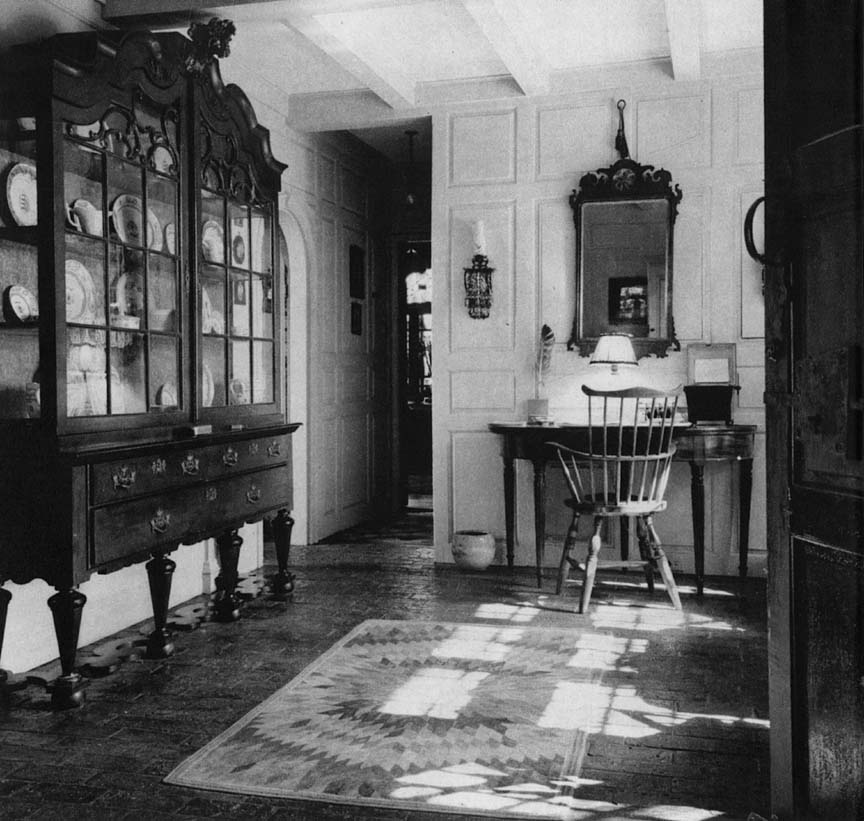
| Here is where we enter, where Beauport began its growth around panelling from the William Cogswell House in nearby Essex. The notable trumpet-leg cabinet (left) houses Chinese Export porcelain made for a Portuguese noble, from Mrs. McCann's collection. A harlequin hooked rug softens the waxed-brick floor. |
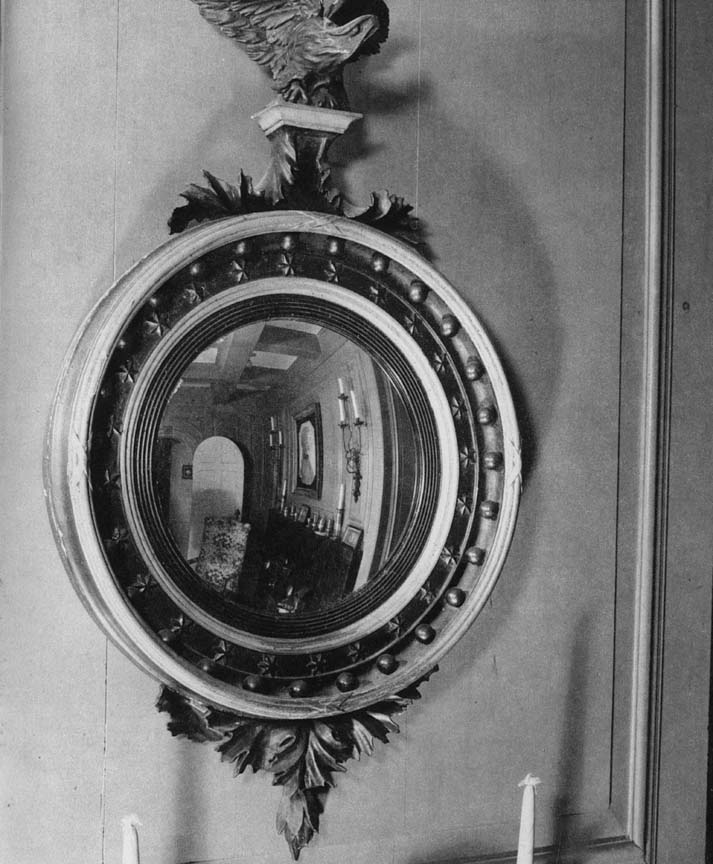

| All woodwork in this "first dining-room" is painted the green of the back of a laurel leaf, the floor is dark waxed-brick. The graceful Adam mirror picks up the copper on the ledge of the east wall. |
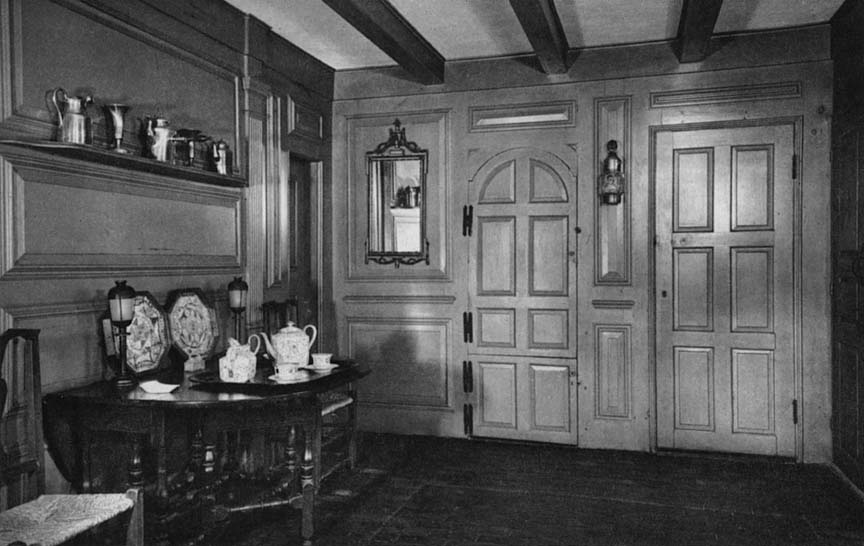 On the gate-leg table: a double-octagon framed fantasy of a million sea-shells, twin lamps, dark lacquer tray, rare sprigged tea set. The arched door opens on a shell-cupboard loaded with collector's china. |
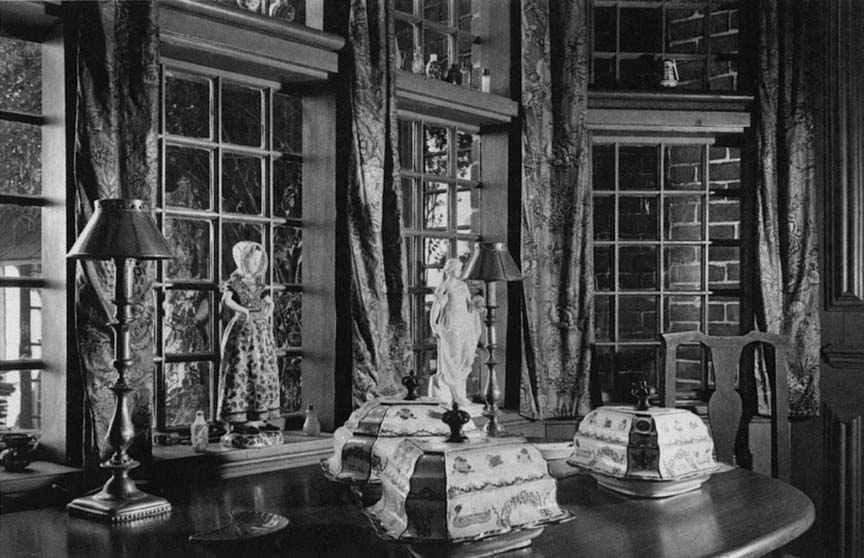 Ceramic ladies and pewter lamps preside over three examples of the amazing McCann collection of Chinese Export porcelain now shared by the Boston Museum of Fine Arts, and New York's Metropolitan. |
 Wrought iron torch-candles repeat the flicker of the fire in the black brick grate. The arch-door (right) opens from the Cogswell Room, echoing the arch of the china cupboard we just saw. |
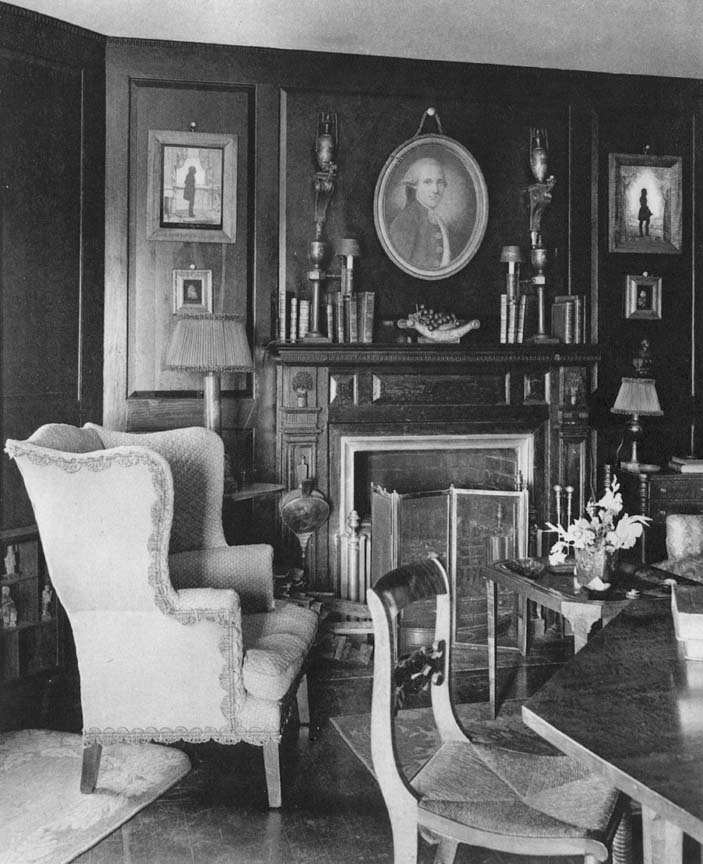
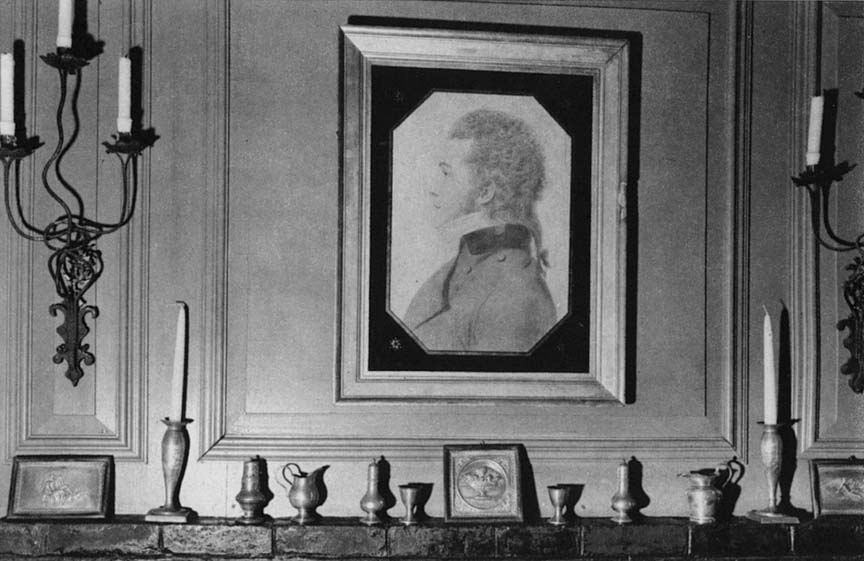 A sharp note of colour contrast to the cool green is this handsome glass-matted, gold-framed sanguine portrait by Saint Memin, fringed on the black ledge by a sifting of pewter and two green role candlesticks. |
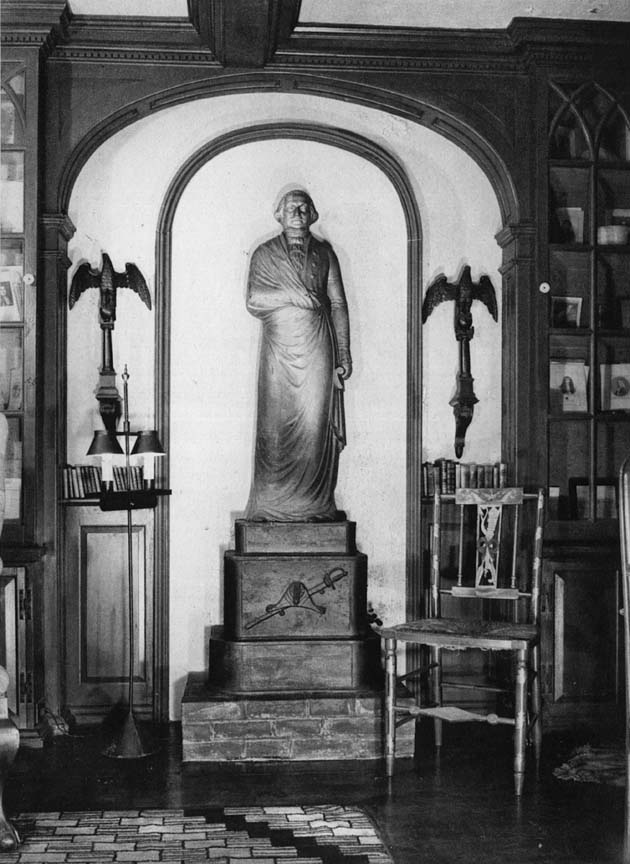
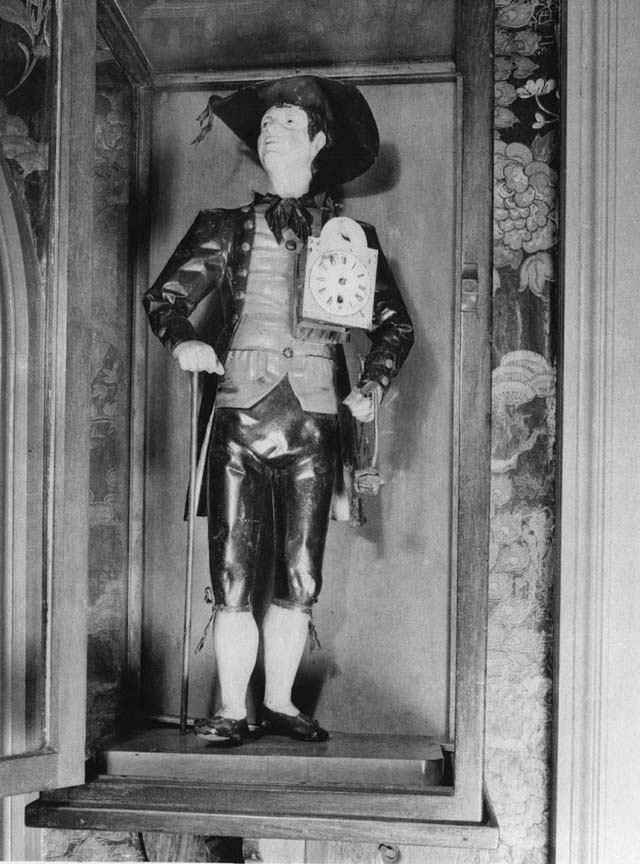
| General Washington, hollow, complete with toga, scroll, hat and sword, is an old Albany stove of most realistic warmth. His escorting eagles are repeated on the painted chair-top. |
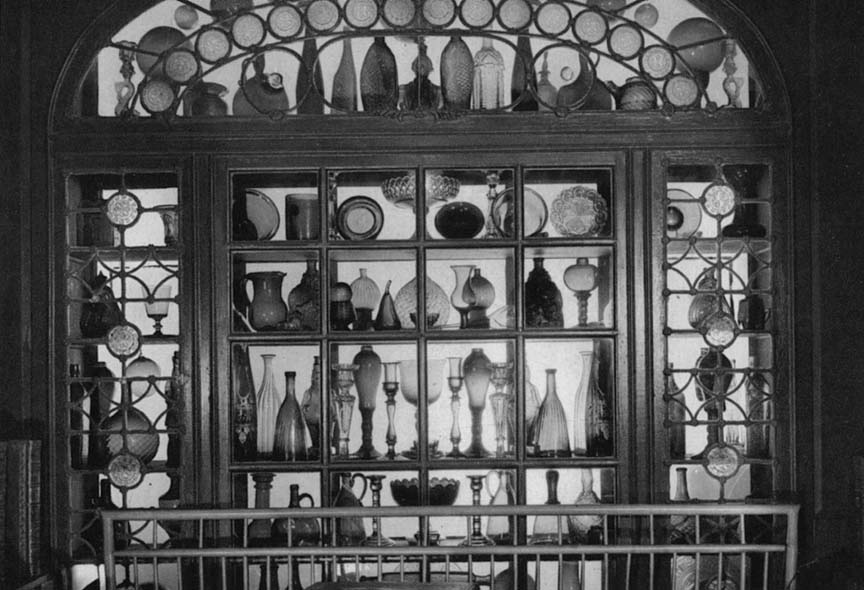 A Connecticut doorway set bodily in the wall displays 130 specimens of brown and amber glass, the light playing through their tapestry from ground glass. The "bulls eyes" are 24 Sandwich cup-plates. |
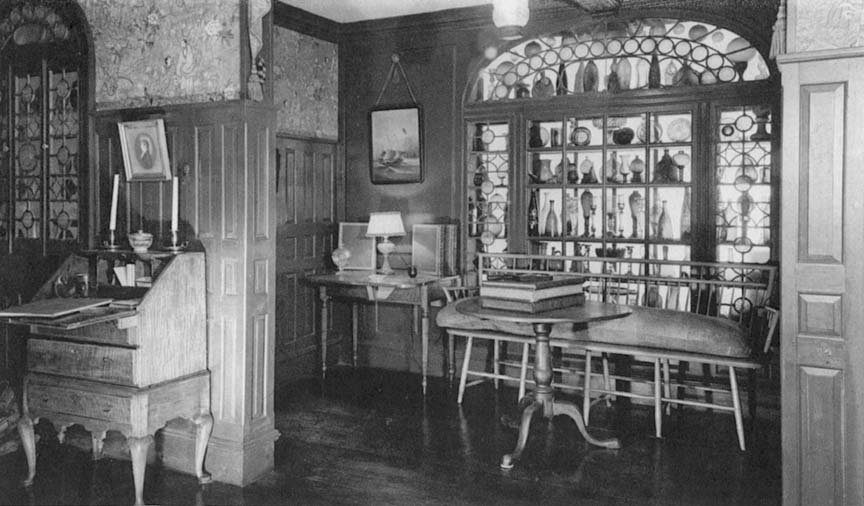 As if one doorway were not enough, a second (left) becomes a cabinet for more old glass, lavender and green and pink. The desk is of curly maple. The panelling is made of old window blinds. |
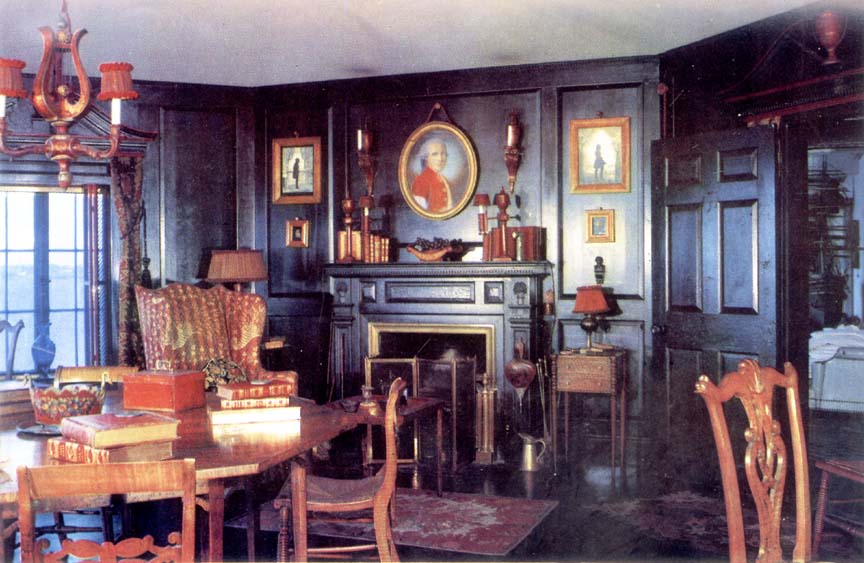
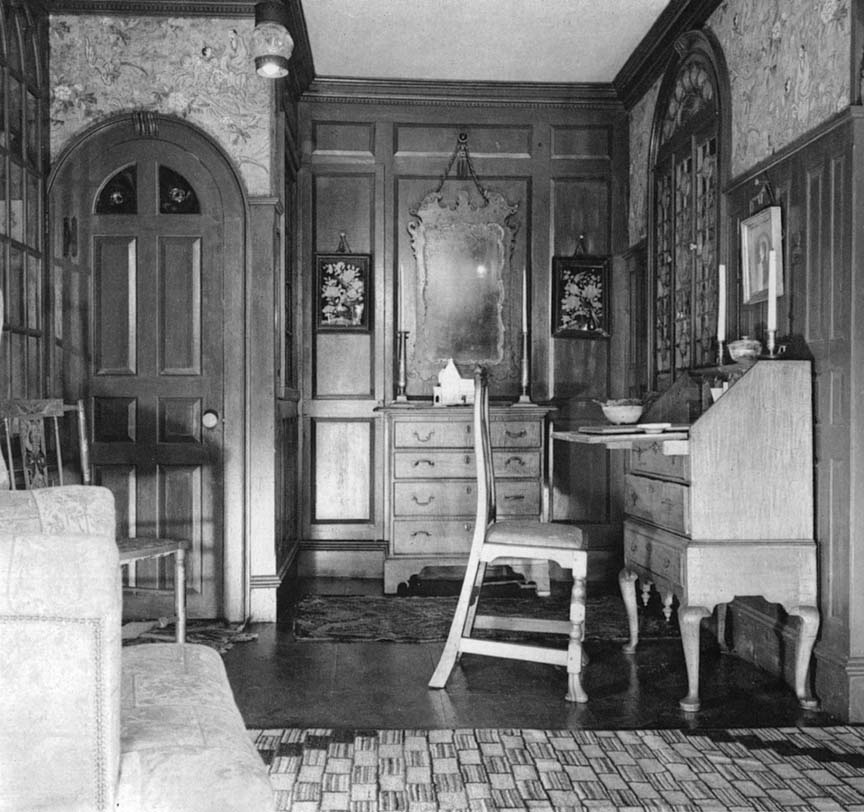 The woodwork is all a juicy cocoa brown; the wallpaper a Chinese arabesque, light flowers on cocoa. The floor is finely spattered. A Chippendale mirror and glass-paintings above a four-drawer maple chest brighten the alcove. |
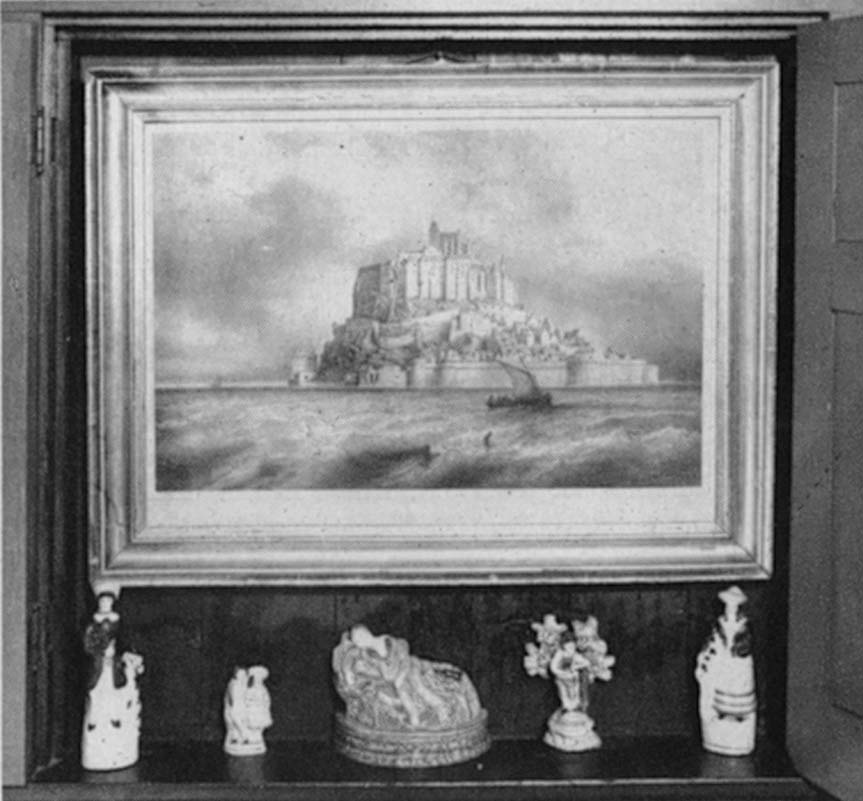 A one-turn staircase leads up to the Strawberry Hill, Byron, and Nelson Rooms. At a wall-niche on the landing you pause to inspect an unusual early coloured engraving of Mont St. Michel, and to covet, below it, a group of romantic Staffordshire figurines, one of whom is a sailor, reclining, fatigued, upon a mossy bank. |
 |
 |
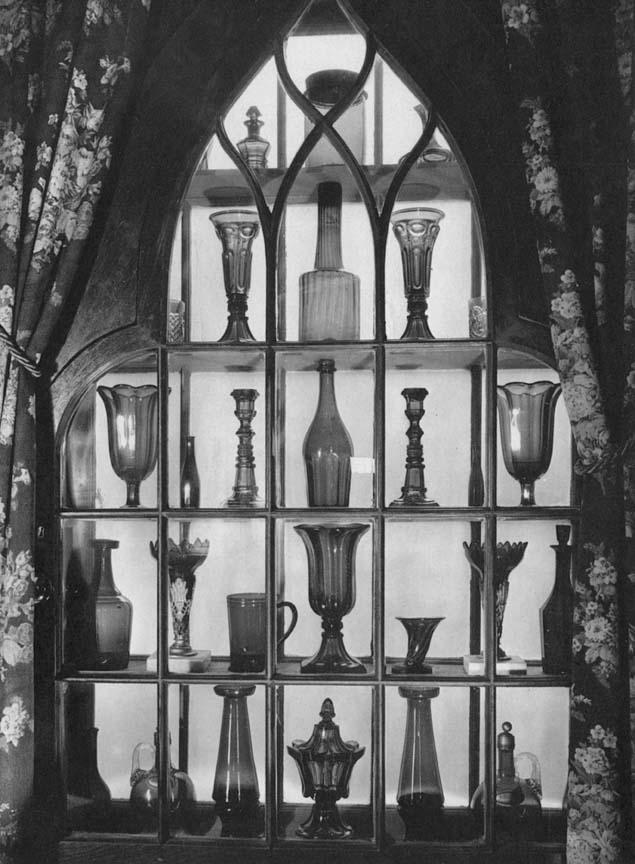 The background of this pointed window is ground glass. Its shelves and mullions frame thirty pieces of amethyst glass, from lightest lavender to deepest Concord-grape. |
THE OCTAGON ROOM |
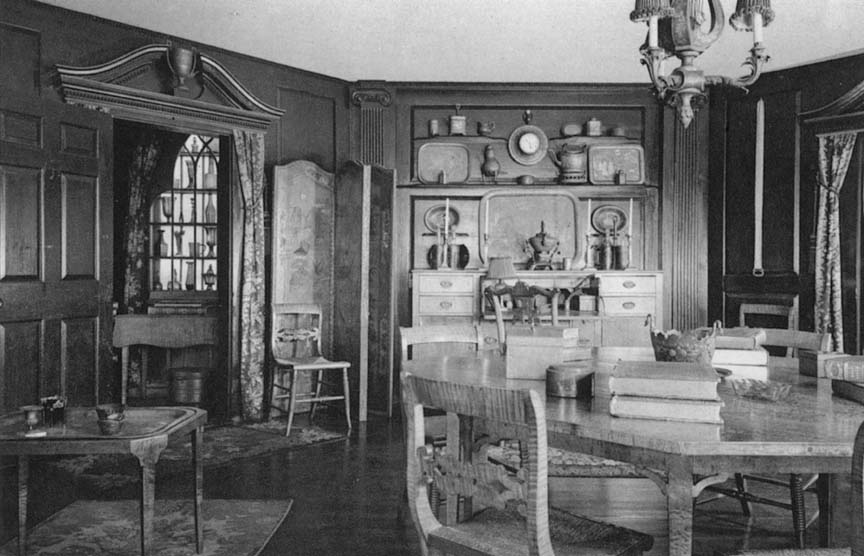 Left to right: Doorway and window (p. 24) ; floral Portuguese wool draperies; tall red-lacquer screen; great square-front maple sideboard, against a vivid pattern of sparkling scarlet tôle-ware. |
 The noble sideboard commands this view; across the octagonal center-table we glimpse the pantry-passage filled with role and red-and-blue glass. Colour fairly sings against the plum-black walls. |
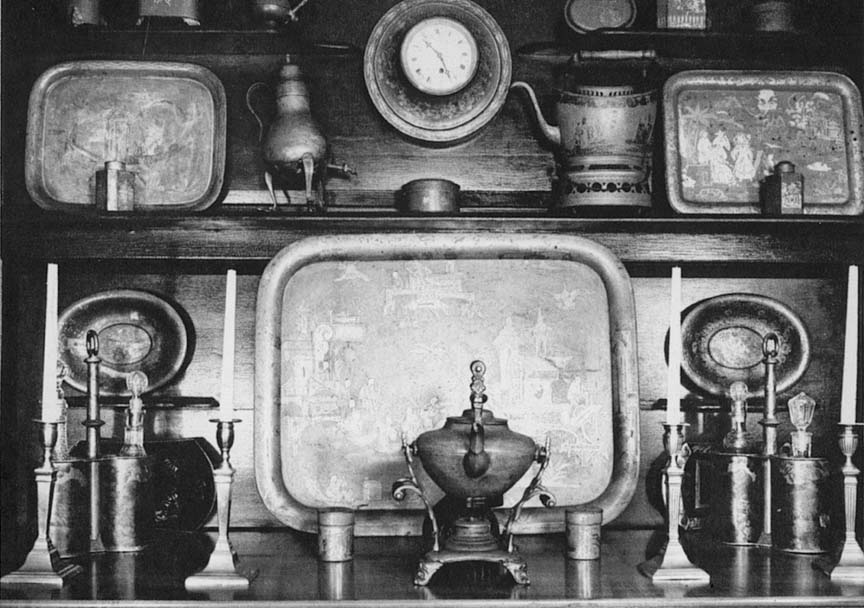 Nowhere is shape and symmetry in arrangement of variety better "mapped" than on the sideboard in the Octagon Room. Whether you collect teacups or toy fire engines this use of wall-space must be an inspiration. |
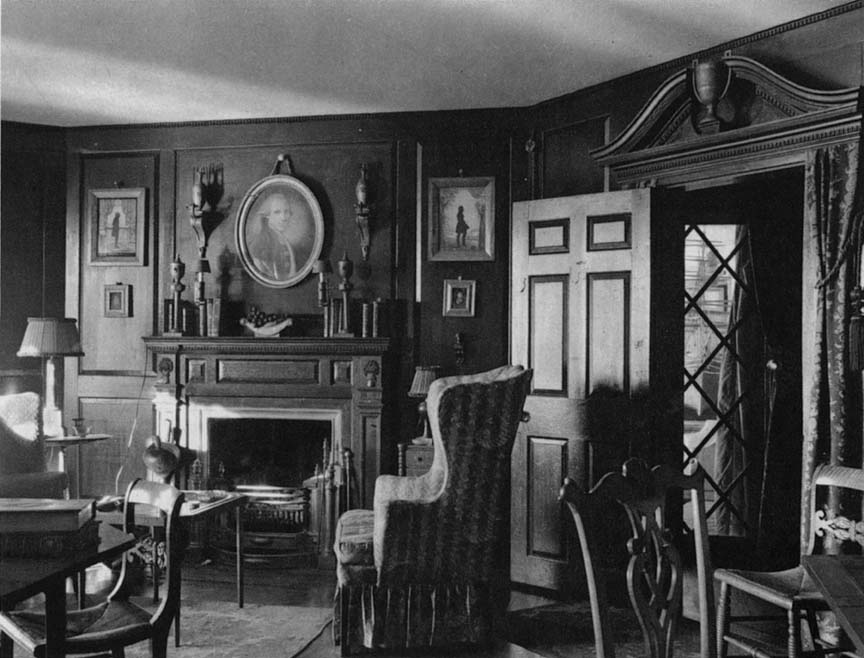
 The fireplace (black, with brass) supports another perfect pattern: oval pastel portrait, silhouettes, vermilion bindings, lobster-red tole candles and brackets, and urns. |
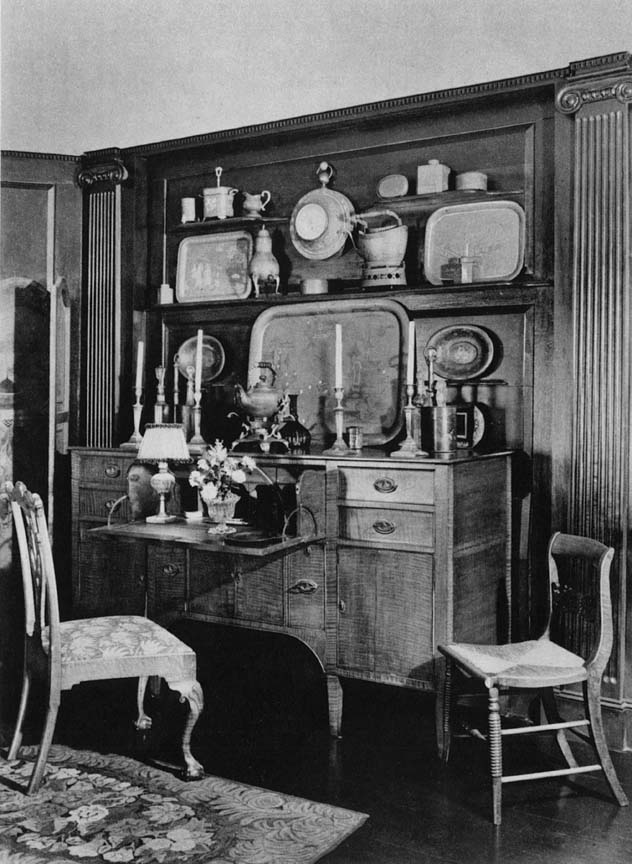 The amber-gold of striped maple, the plum-black of all woodwork (lightly lined in lacquer-red), floral fabrics and rugs, vermilion in bindings and tôle-ware: that is the warm, rich colour-scheme. |
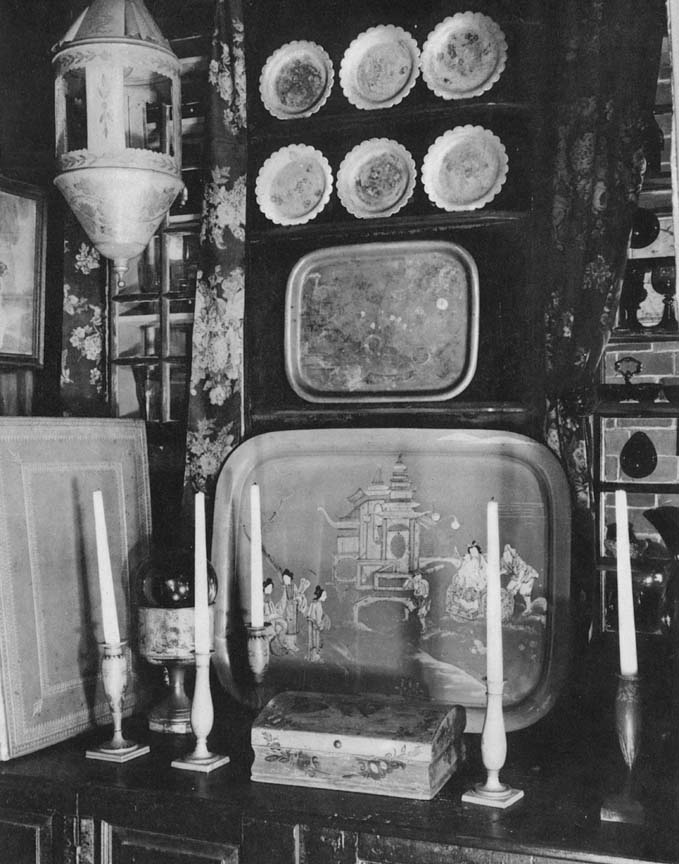 Each room you enter echoes the one you leave: This pantry passage is bright with the Octagon's red-but its windows stage two rich batteries of glass, not only red but deep blue, for transition to the cooler light beyond. |
 |
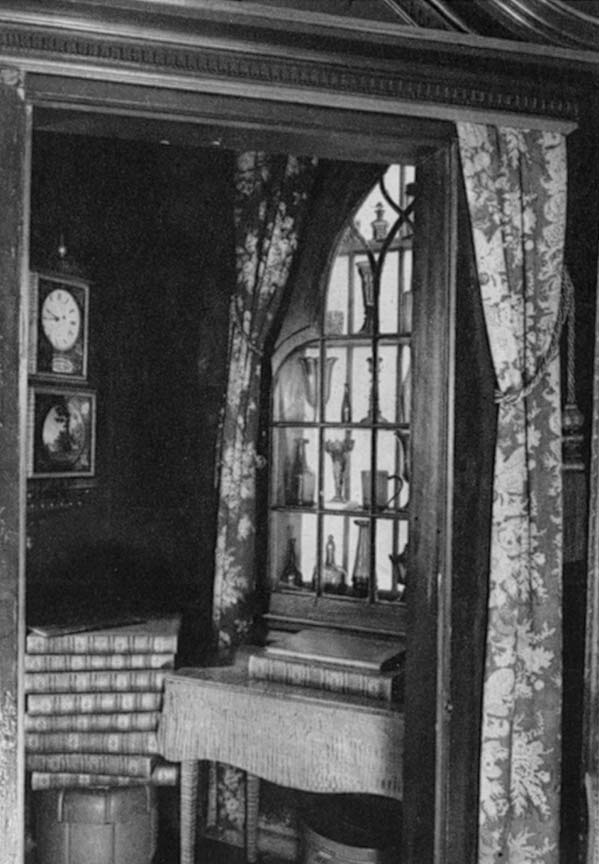 |
| Similarly, the sharp transition to the white Golden Step Room is prepared for you by the amethyst glass window and (right) the "echoing" morocco volumes. Note the uncommon Aaron Willard clock on the passage wall. | |

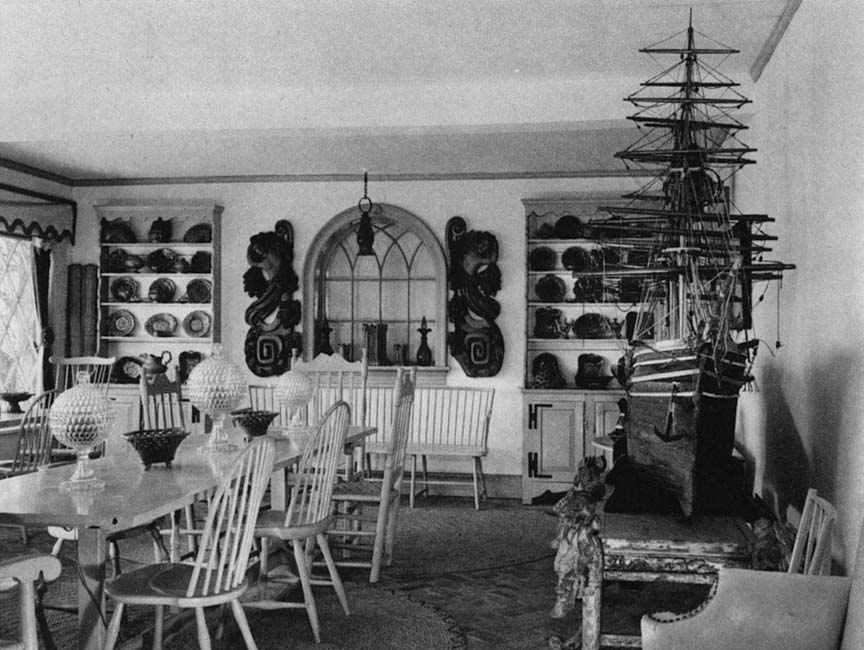 Dominated, nay christened, by this walloping model of the square-rigger Golden Step, this white-walled, cool indoor terrace is the perfect summer dining-room. Its shelves bear green Wedgewood and English majolica. Two long white dining-tables with Windsor and tallback chairs are of the simplest carpenter-dignity. The window-side table commands a 180-degree view of the harbour. |
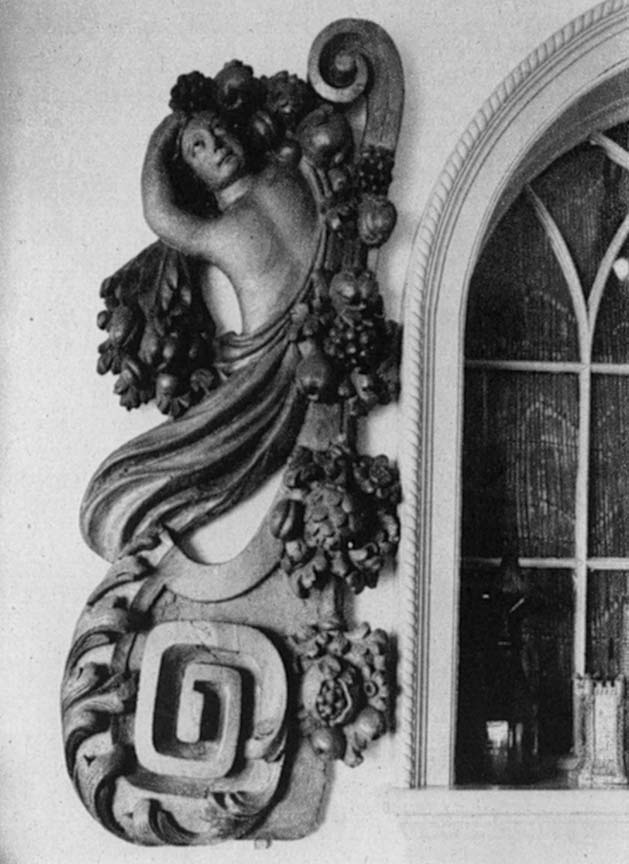 The arched blind window is flanked by ship carvings of mermen wrestling with tropical fruit. |
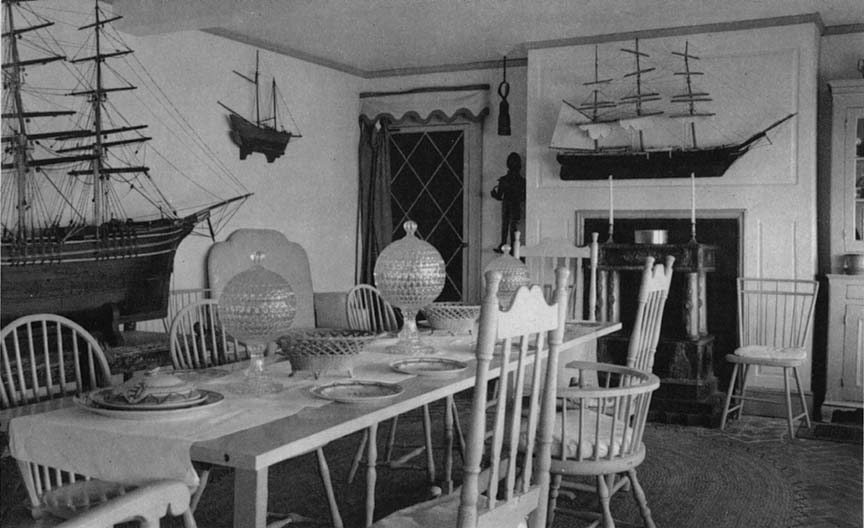 Yonder is the door through which we entered --- screened, for the windows slide down on fresh days. A Gloucester "pinky" perches high on the wall and a wooden-sailed half-model sails above the firebreast. |
 The globes hold aquamarine "witch balls" and coloured glass marbles. In the cabinet, gilt tableware. The Golden Step sits on an ancient Chinese bench. The iron blackamoor by the door rings a bell, quite loudly. |
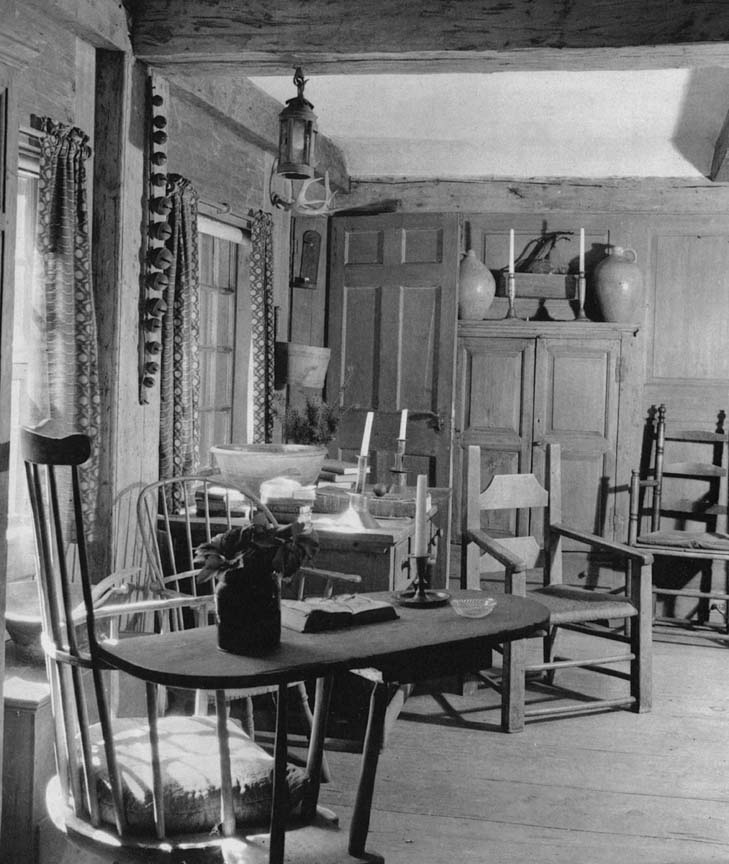
 |
 |
| Probably nowhere on earth will you find a more sympathetic
reconstruction of the heart of the pioneer home, family, community,
than here in the room which Sleeper reassembled from the oak-and-pine
house of his forebears at Pembroke---after it had been dispersed
at auction. The heart of the room is its huge and hospitable working
hearth, its hand-made utensils racked above.
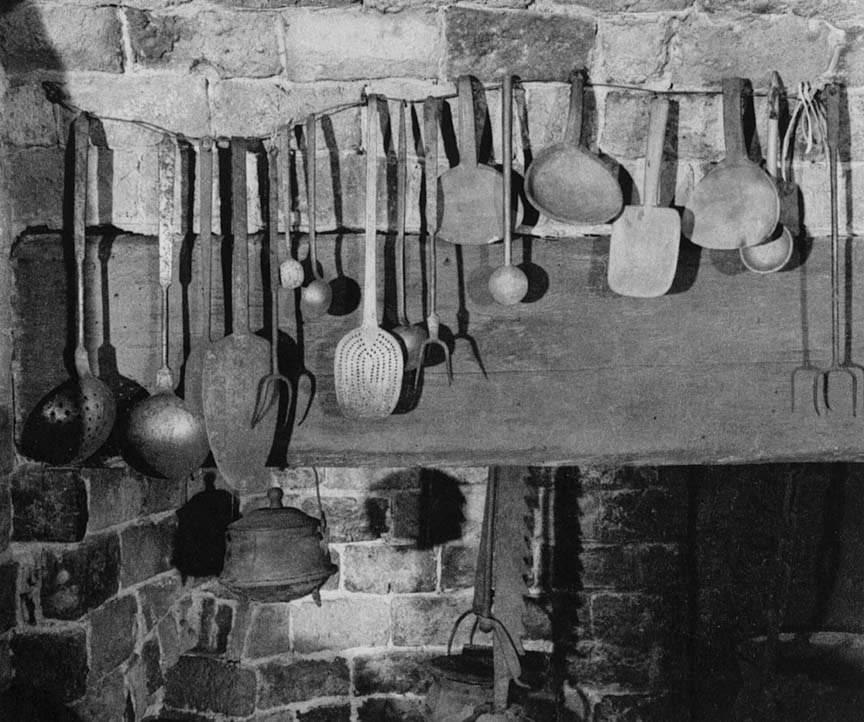
The tall fireside settle (left) curves inward to trap warmth and toast shins. Oak posts and beams, pine walls, and chimney brick are the room's basic materials. Deep in the fireplace are ovens and warming-ledges. On a crane hangs a noble iron kettle. |
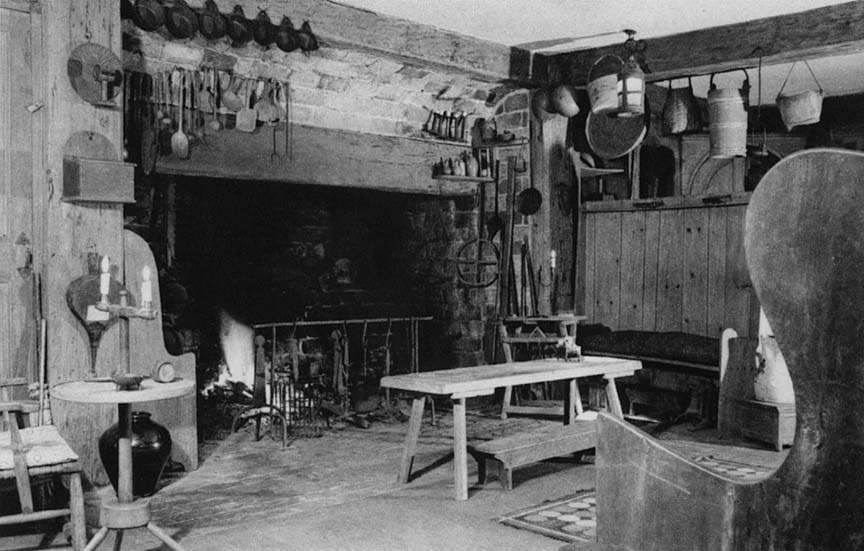 At the left is the tripod candlestand for reading the Scripture. Spices on the shelf, bellows and salt-box, buckets and bowls and fire-irons. .. each in its proper place. |
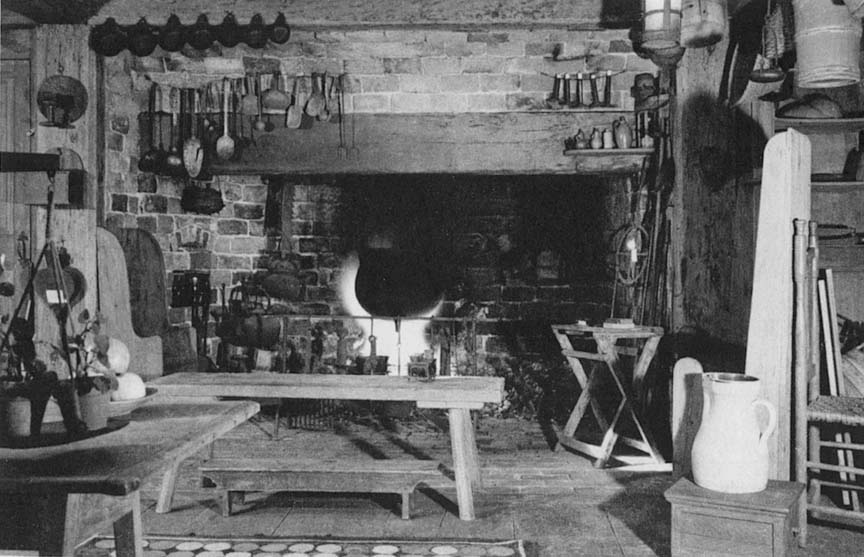 Here, nearly three centuries ago, gathered the typical Yankee family --- here in winter its children were born, its meals prepared year-round, its courtin' eavesdropped, its neighbors welcomed, its prayers said. |
 The Pembroke Room is L-shaped. The view above follows the staff of the ell past the fireplace to a dining-table, backed by a tall pine sideboard filled with Colonial earthenware. Note the graceful sweep of the solid pine wing-chair, mercifully cushioned with homespun pillows. |
 Two of the earliest chairs of their type are gossiping. Those who proclaim that Puritans never knew rocking-chairs will be reminded that this room accumulated new and different utilities over a span of 250 years---and kept its character. There is probably a patriotic lesson in that fact. |

 Warm, faintly rose-amber pine walls; austere hardwood chairs and table; broad pine floors -and for colour, two gay martial painted roller-shades, and small-pattern narrow madder and yellow chintzes. |
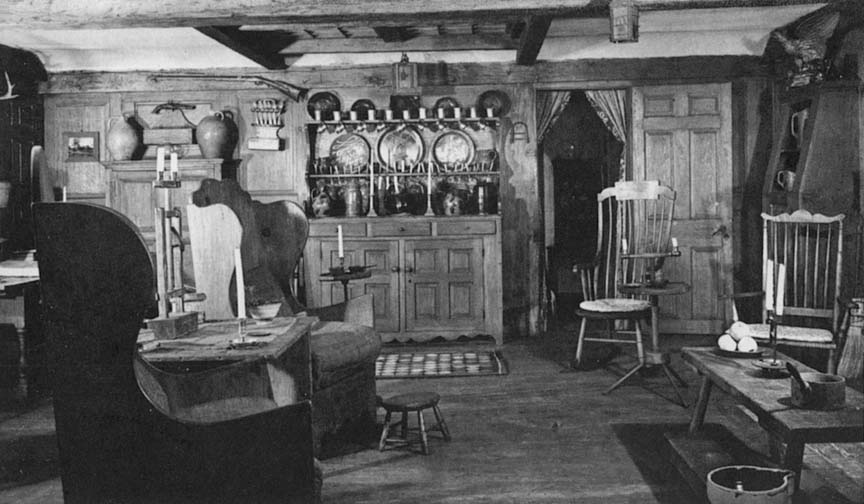 Facing the sideboard is another with pewter cups gleaming against early glazed earthenware of coppery brown. An eagle perches on the slant-front cupboard (right). Pistol and musket are handy. |
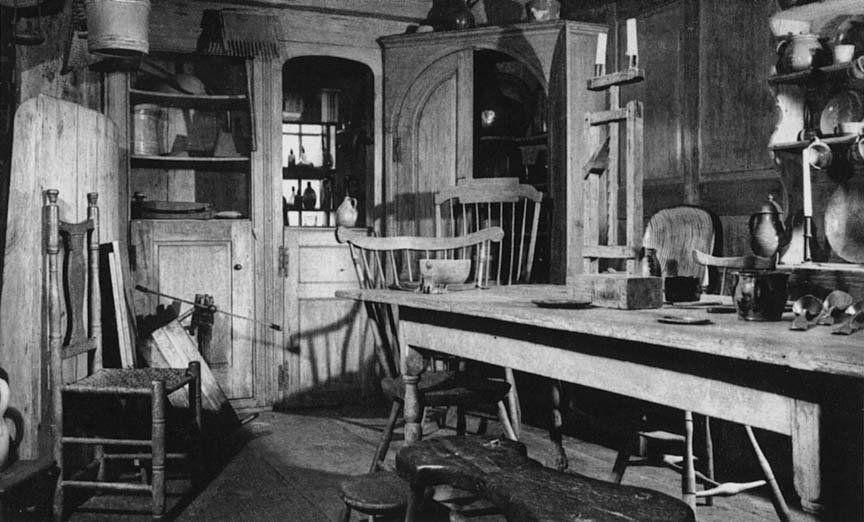 The half-door is the bar of the taproom where riders, Plymouth-or-Boston-bound, relaxed with a drink not too soft. A cranberry rake hangs above it and a mammoth pine corner-cupboard stands next to it. |
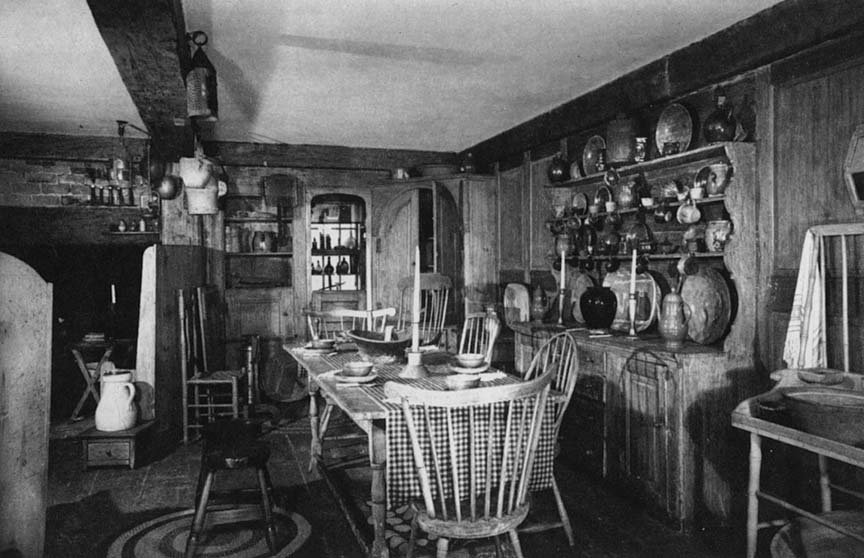 The long view west along the foot of the ell. The table is set. A saddler's bench will do for one chair. A tidy Windsor wash-handstand (right) was useful before mealtime if the cranberry bog was muddy. |
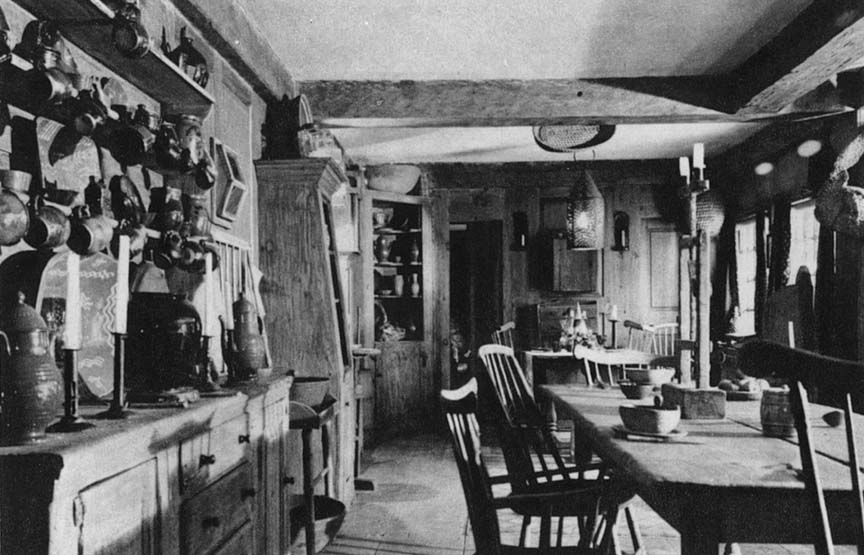 Another view of the foot of the ell. A children's table is at the far end. Above the wash-stand at the left is an unusual mirror for both tall and short. The door at the left leads to the Franklin Room. |
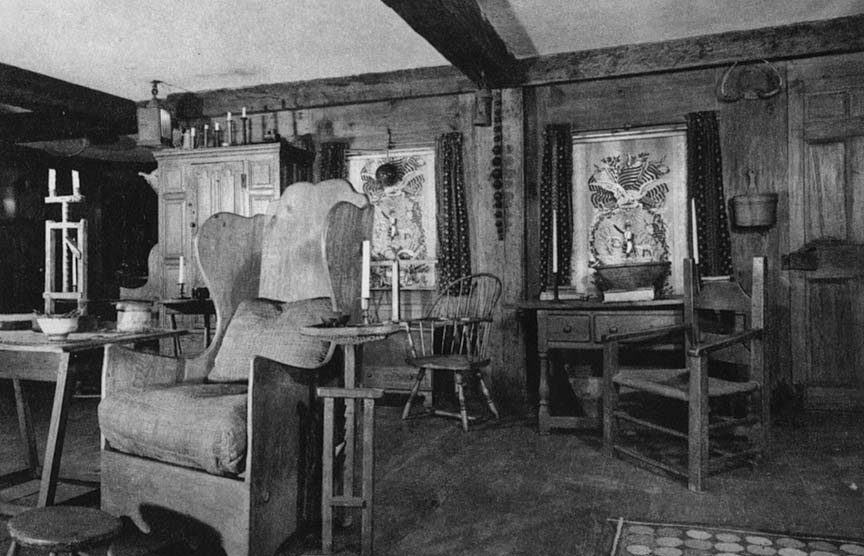 This wing chair, designed by Mr. Sleeper, was built of fragrant "punkin" pine by the patriarch Poole over in Gloucester ... said he "didn't believe in worm holin'" . . . said, "my worms all went on strike." |
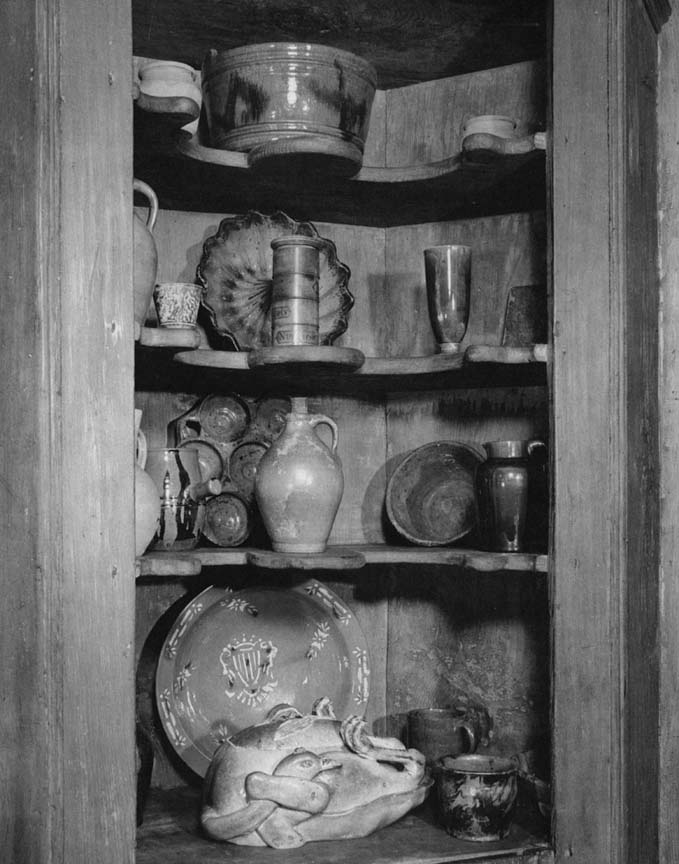 A study in textures: a corner cupboard in the Pembroke Room, and its collection of working pottery, including an acrobatic goose. |
 The "children's table" for intimate meals, is lighted by a tin-cone candelabrum and from above, a nail-pierced lantern. Two more patriotic shades strike a Yankee Doodle note. |
 The same table, as it is set for luncheon, with warm sun streaming in from the garden. |
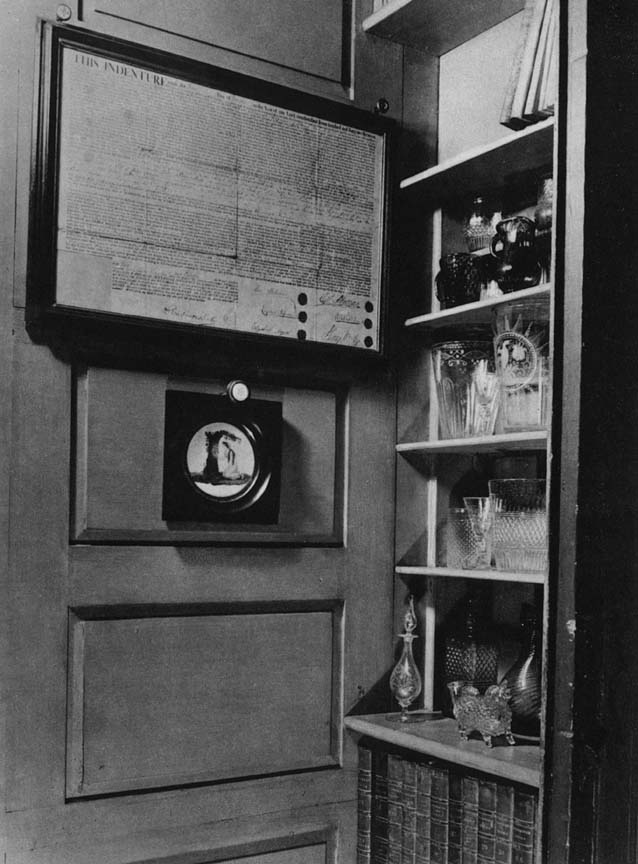 In the (literally) 2 x 4-foot passage from Pembroke to Franklin hangs this framed indenture concerning Stiegel and his glass. It is only fitting that the glass in the narrow shelves is Stiegel's. |
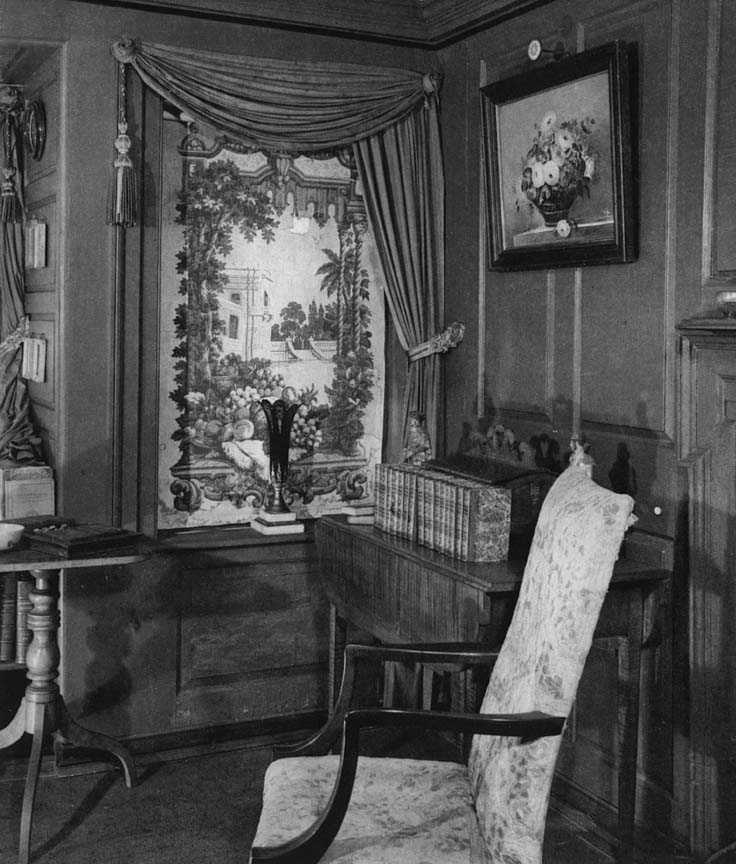
 The walls, ochre brown; window hangings, turkey red calico, tied with brass; the floor cheerful with rugs. Benjamin Franklin's own-made stove is yonder, with his bas-relief cast into it. |
 The opposite view, across the checker table. Gold and black painted chairs, an ivory yarn-reel, swagged and tasseled curtains, painted shades, mahogany tables, composed in Franklin's own "who-cares" idiom. |
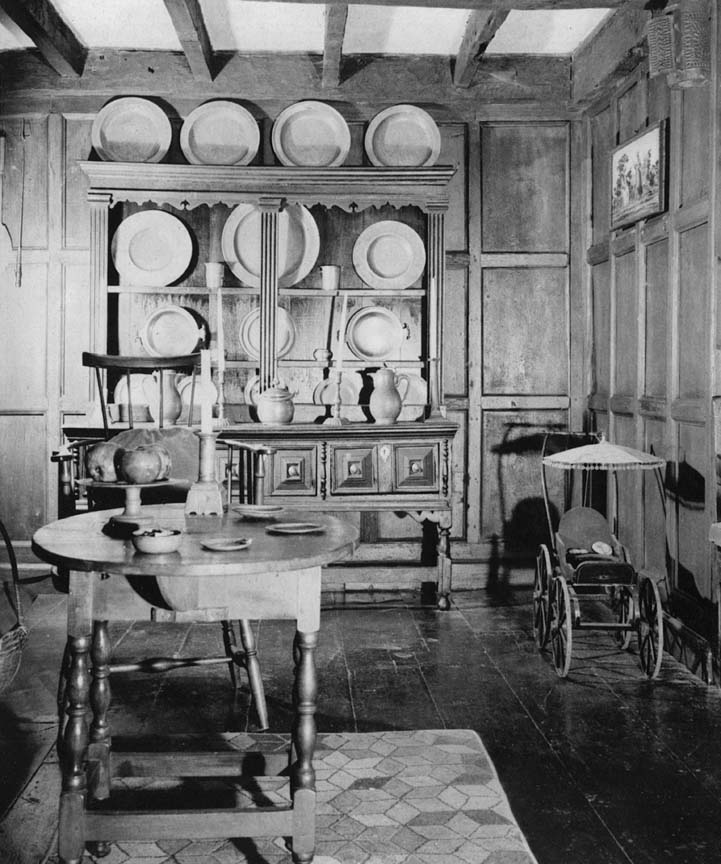
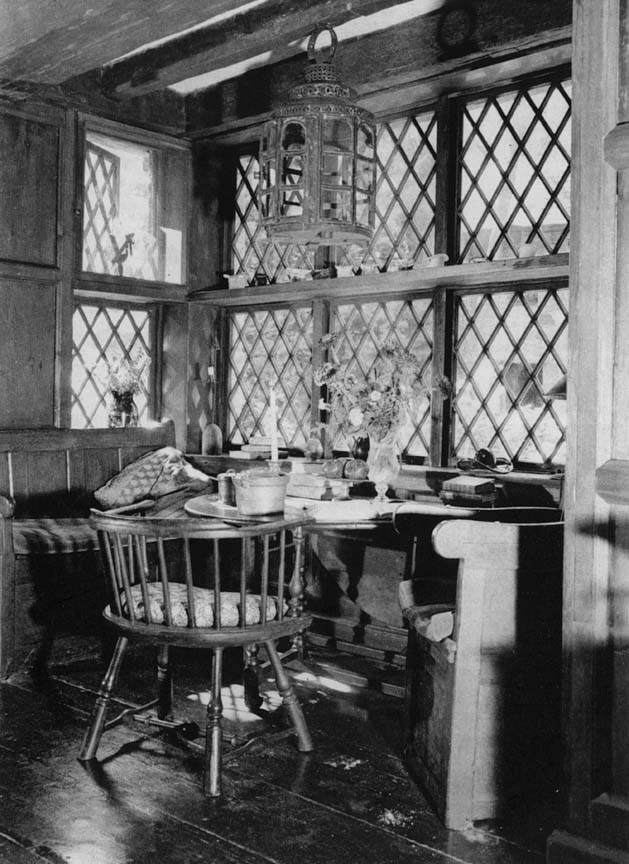 An ample drop-leaf table in the bay window reflects the diamond sunshine that lights this impressive dark-oak room of the "witchcraft" mood. |
 The long view of the Jacobean Room: pale pewter forms a silvery constellation in the dresser. The far narrow panel hides the fugitive witches' secret spiral staircase. The early Victorian doll-carriage is where doll carriages most often are---out of place, and underfoot. |
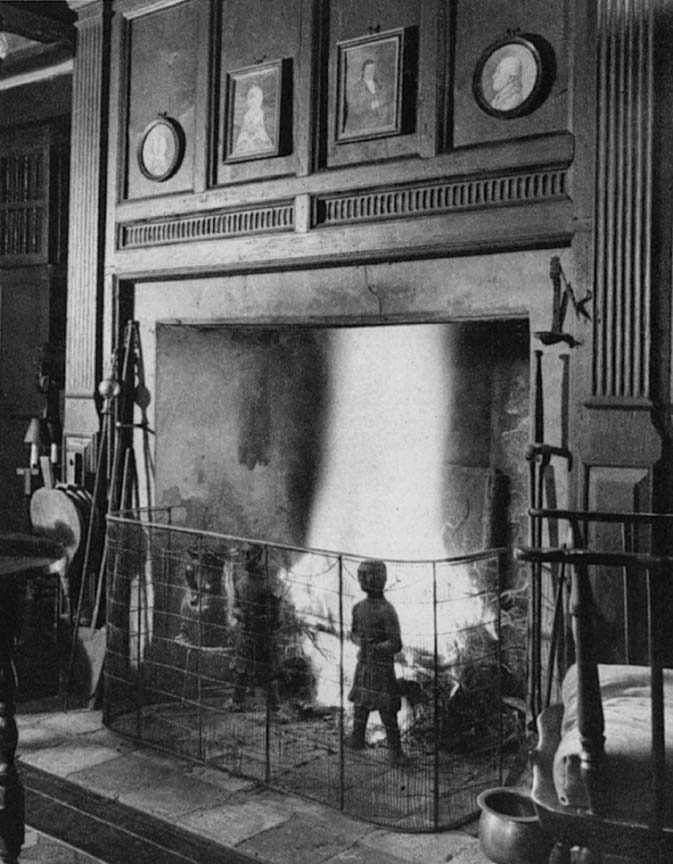 Two cast-iron Redskins warm themselves at the blaze. |
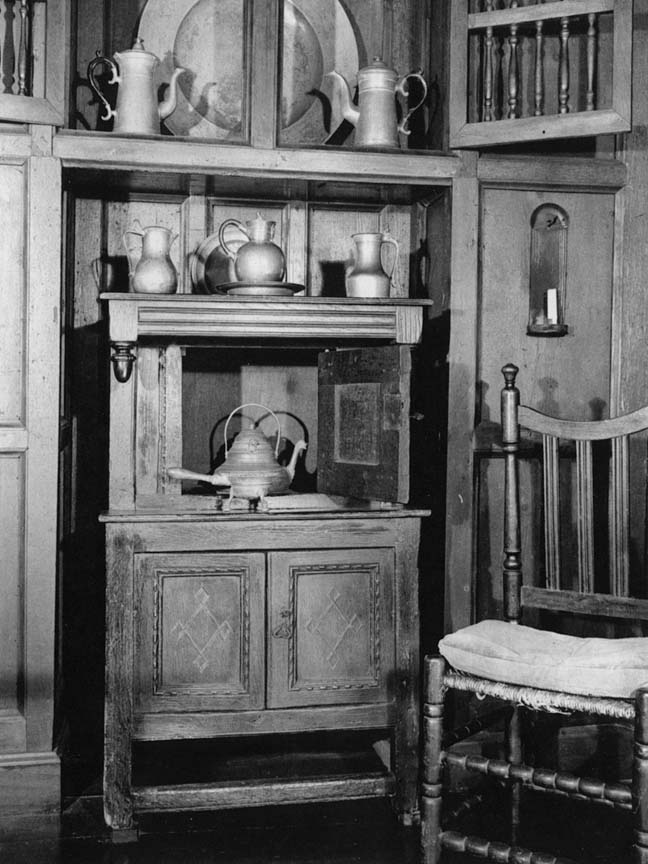 A splendid little oaken Jacobean cabinet (in an alcove dictated by steampipes) holds good pewter; a gate-cupboard above it holds still more. The chair is unique---but your "little man" could copy it. |
 |
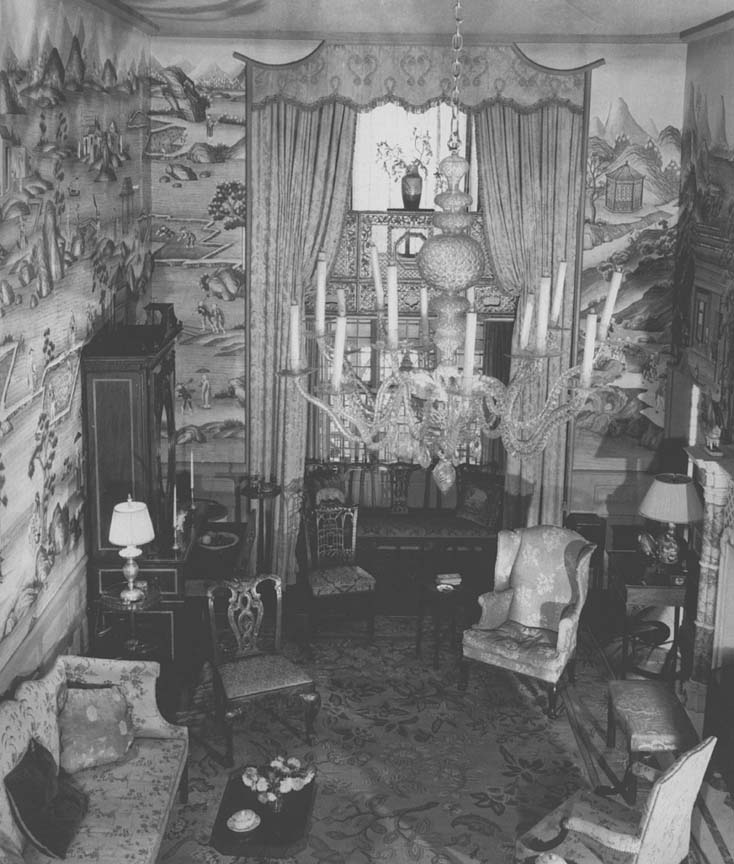 |
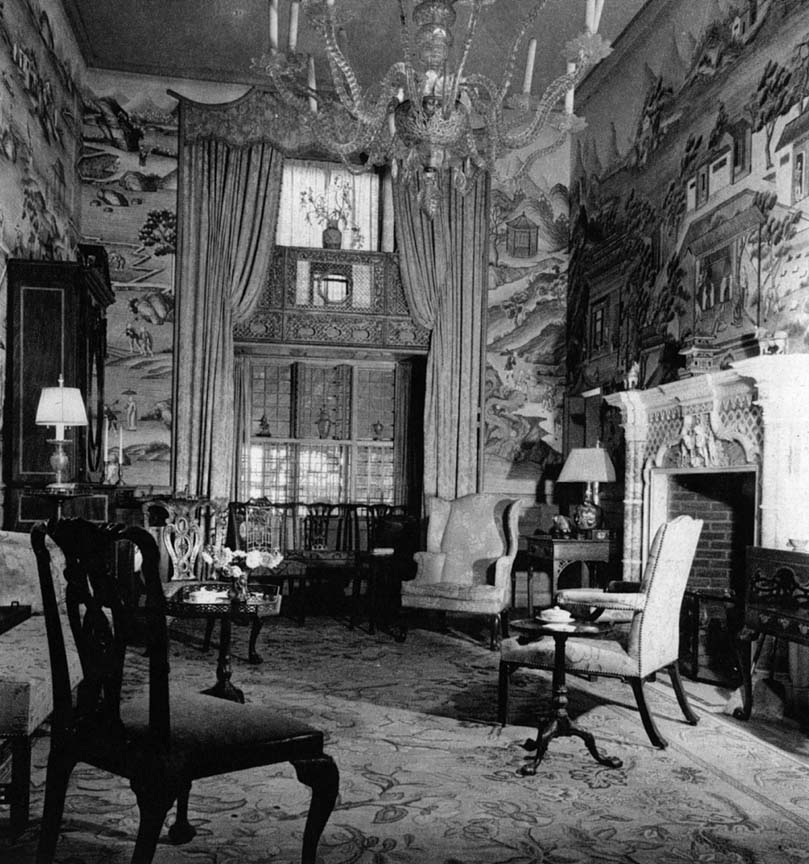 |
| Mrs. McCann transformed this extraordinary room from its next-earlier incarnation (still earlier it had been a chapel), into the opulent Georgian-Chippendale drawing room you see here. It is "keyed" by a unique hand-painted Chinese paper imported, but unused, for the mansion of Lewis Morris, the 'Signer.' It lay fresh and hidden in the attic of a Marblehead house for over a century. The furniture today is of English pedigree. Carved and pierced gold screens serve as rails for the twin galleries at either end. The ceiling curves in-and-upward to the rooftree, as in a pagoda. The chandelier is of fairly unbelievable Waterford. |
 The wide view, looking towards the glazed window cabinet with its fretted shelves. Details of the wallpaper depict, in bright colours on a bluish ground, the arts and sciences of China. |
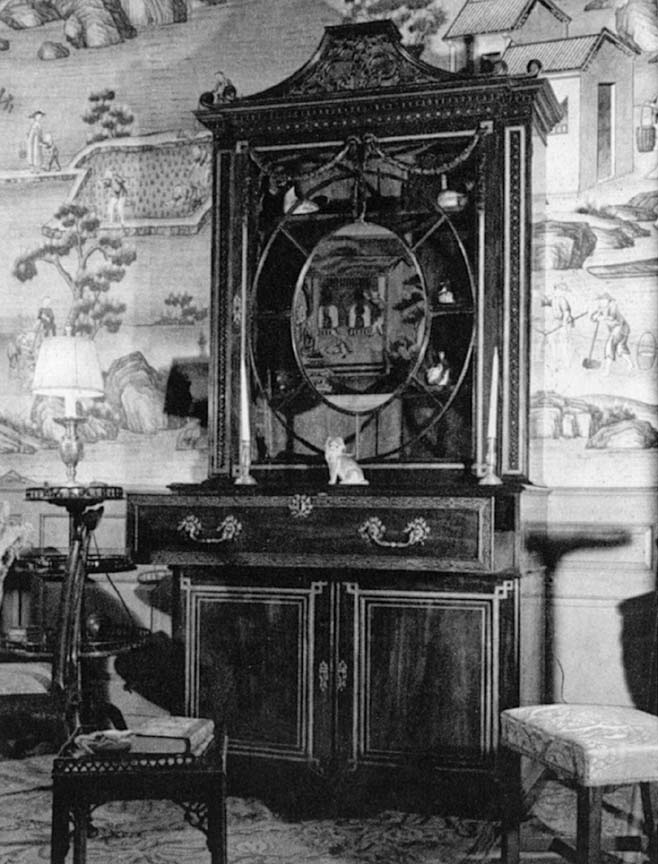 This English secretary proves to be a superb example of the harmony between things western and eastern. |
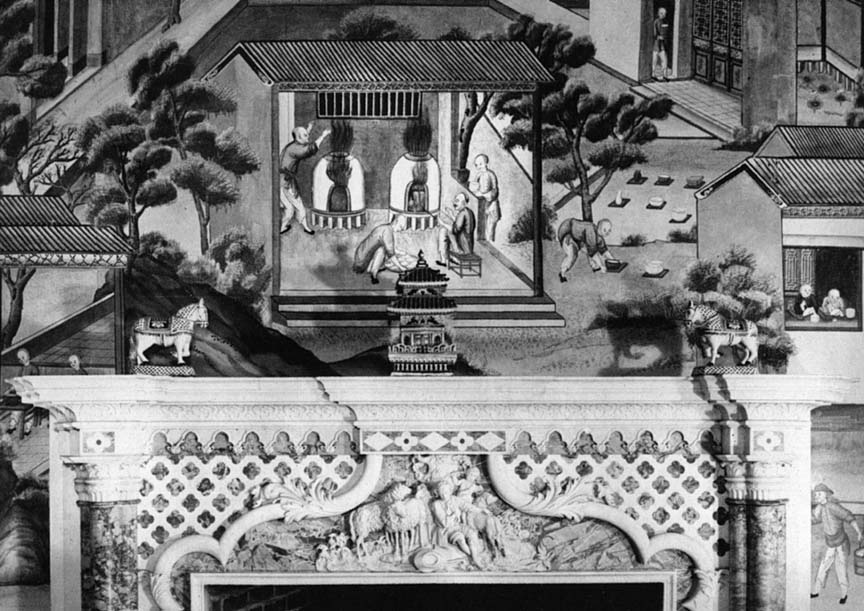 Years---perhaps the lifetimes of many Chinese painters---went into this famous wallpaper, of which we see here a five-foot detail. It is a document of record in classic antique books. The overmantel scene shows potters making ceramics at their furnaces. |
 The enlarged detail depicts the growing, reaping, and threshing of rice. |