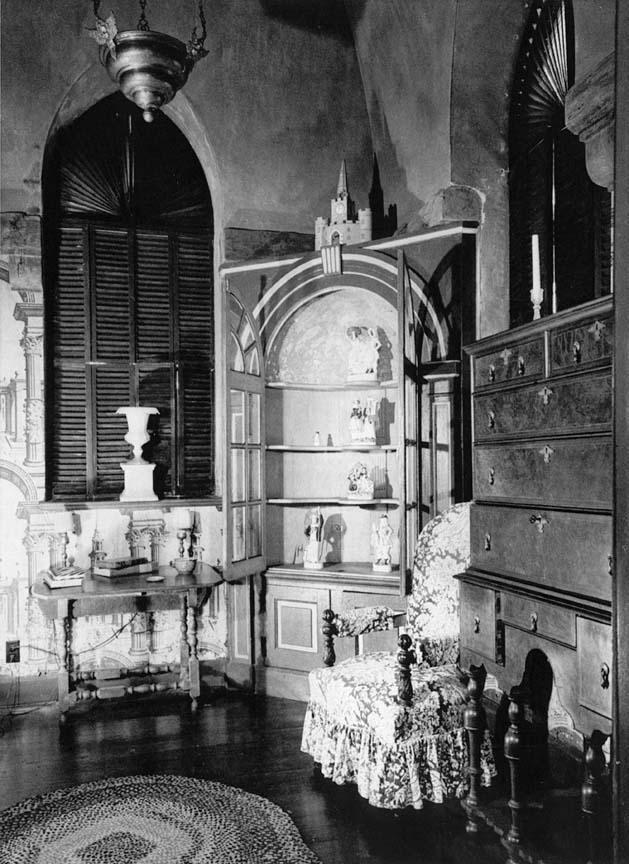
| Sleeper's collection of Paul Revere silver, now in the Boston Museum, once filled the cabinet. The paper is from Paul Revere's house in Boston. |

| On a satinwood and mahogany Sheraton table is this incomparable symmetry of black glass urns, red volumes glinting gold, two dear-glass candy jars, three Stafford busts, a gold lyre clock with eagle panel from Currier & Foster's vanished shop in Salem. The classic engravings are in colour; the panelling of the whole room is painted the brown of the skin of a good pumpkin pie. It's a long, sunny room, facing the harbour through a festoon of parti-coloured witch globes. |
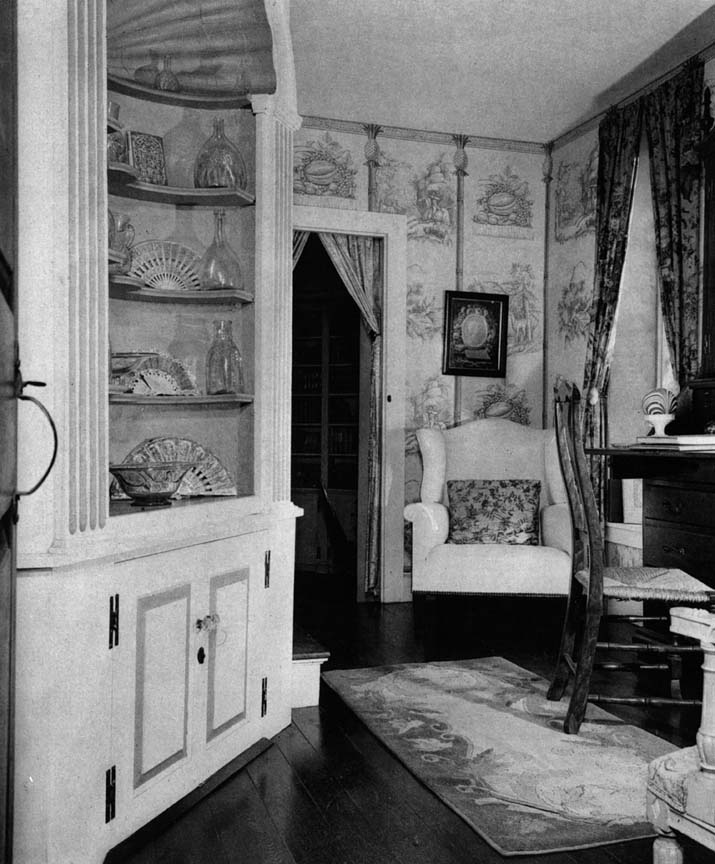
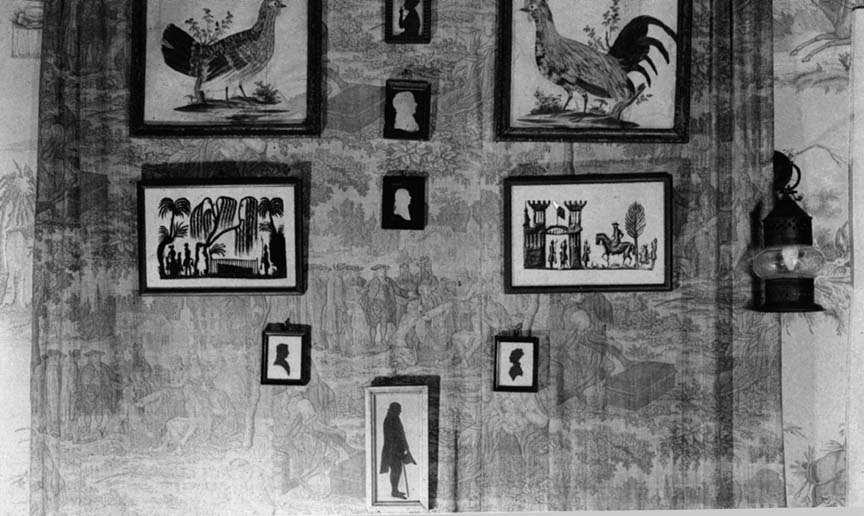
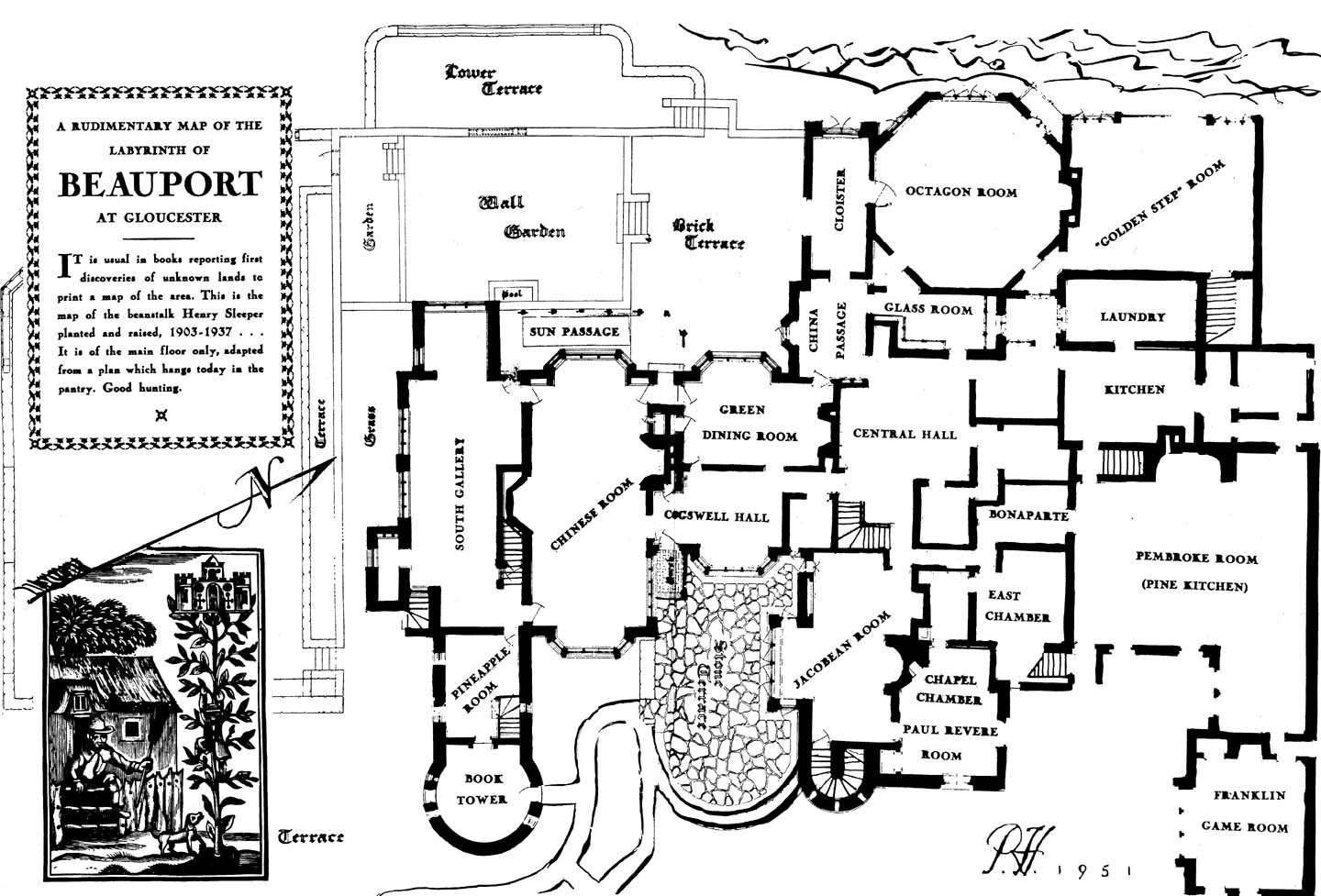
| In the passage that links the South Gallery and the Tower Library one pauses to inspect and sigh. The wallpaper, in the lightest possible viridian on white, shows fruit-groups and animal landscapes divided by bamboo poles supporting each a pineapple. On one wall the Contriver hung a toile-de-Jouy showing William Penn making a deal with the Indians. Upon it are displayed two framed pre-Audubon birds, and a cross of positive and negative silhouettes. |

| In this setting are such items as a tall secretary, and (left) a shell-cupboard in white, lively with pale bottles against green-against ladies' fancy fans. |

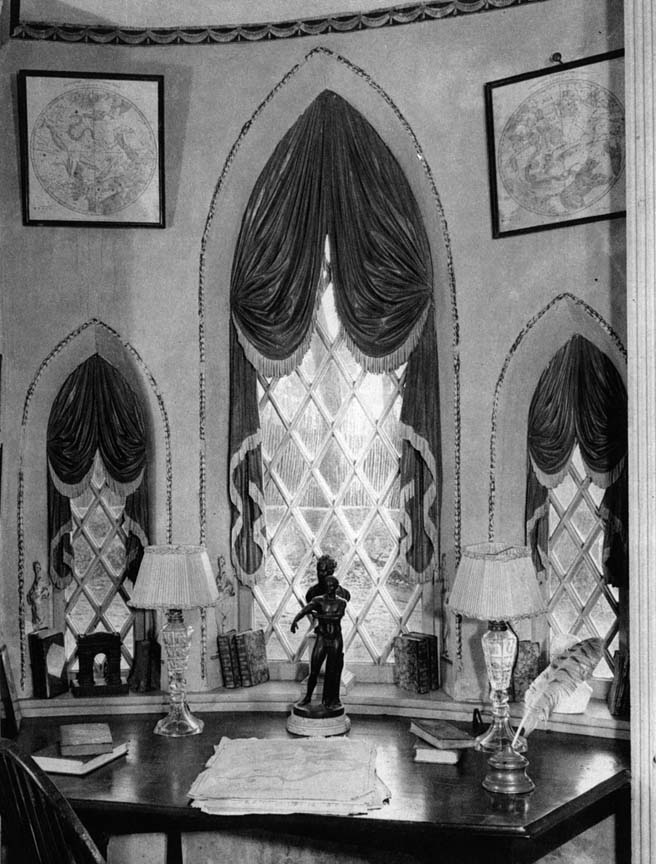
| These are the carved wooden hearse-curtains that "caused" this whole cylinder of books, 12 feet wide, 16 tall. A hidden stair sneaks up to the balcony, with its Pine Tree flag. A round hooked rug is on the floor. |
 |
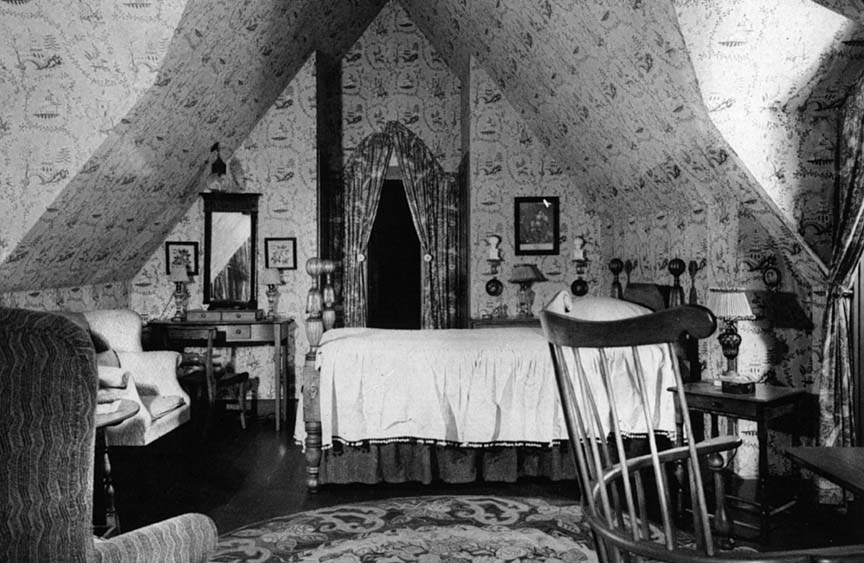 |
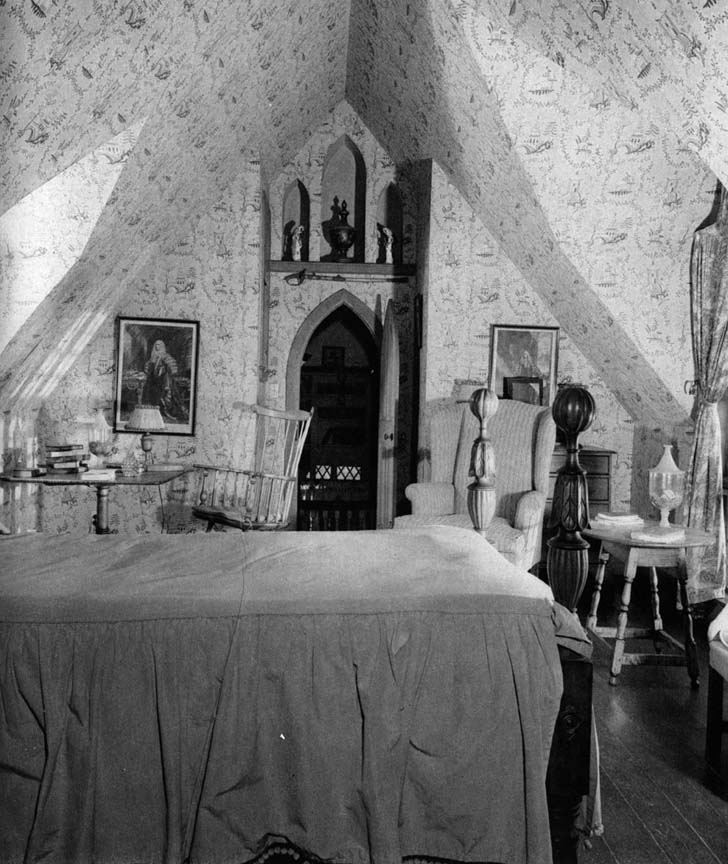
| What to do with an attic: paper it all-over oyster-white traced in faint lavender. Use mulberry window-chintzes, a lavender bedspread on the four-poster. Cut a pointed triptych into the gable. Toss a few Concord-grape-colour books around. If you're a lady who loved Shelley too much (Sleeper said this room was for her) put a bunch of magenta zinnias in a purple vase. |
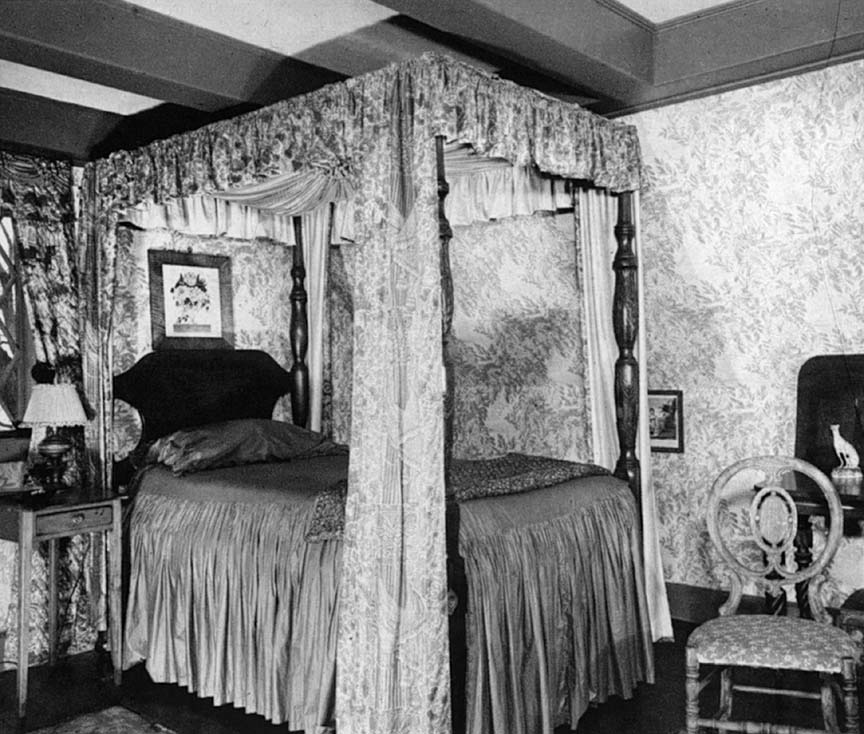
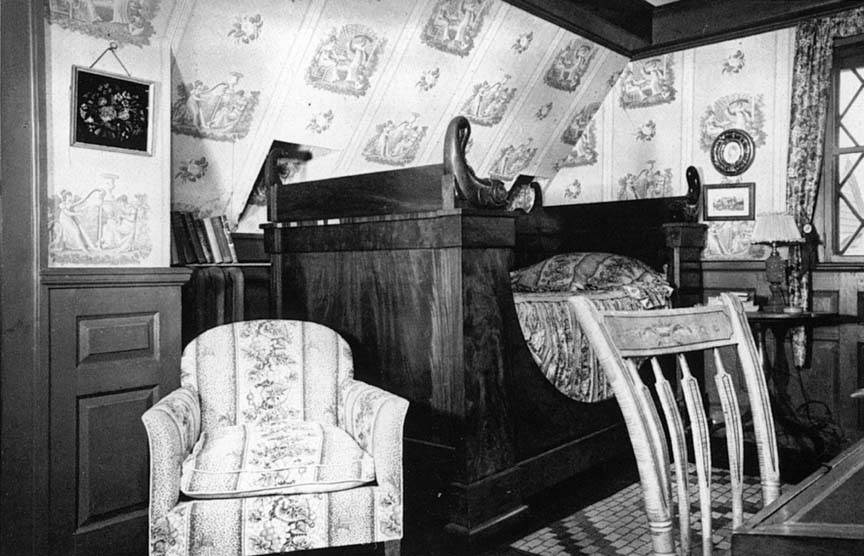 ---From the door you see Lord Byron's own bed, from Newstead Abbey, let into the slope of Beauport's roof. The paper is a genteel pastoral of brown-and-yellow on white. |
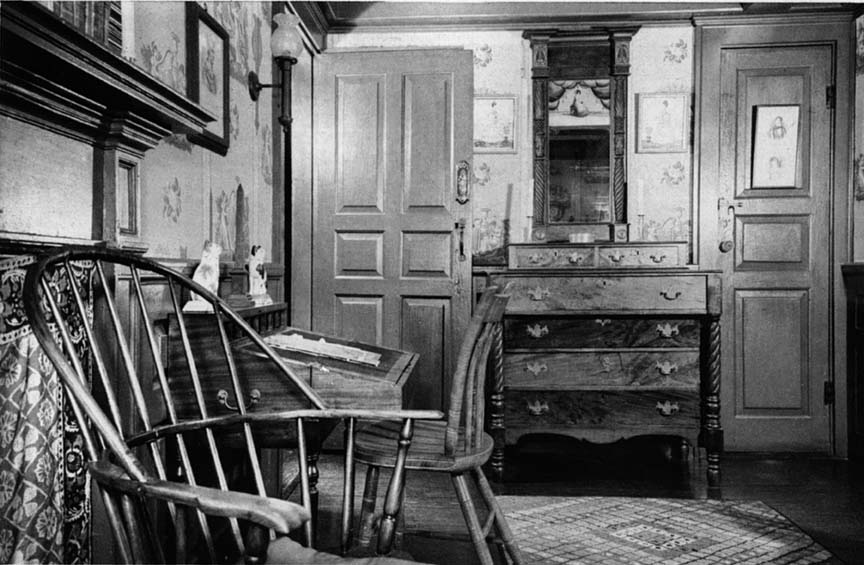 Facing the door we came in: a mahogany dresser, gold Federal mirror, geometrical hooked rug and a sea-captain's travelling folding desk. The panelling is ochre-brown. |
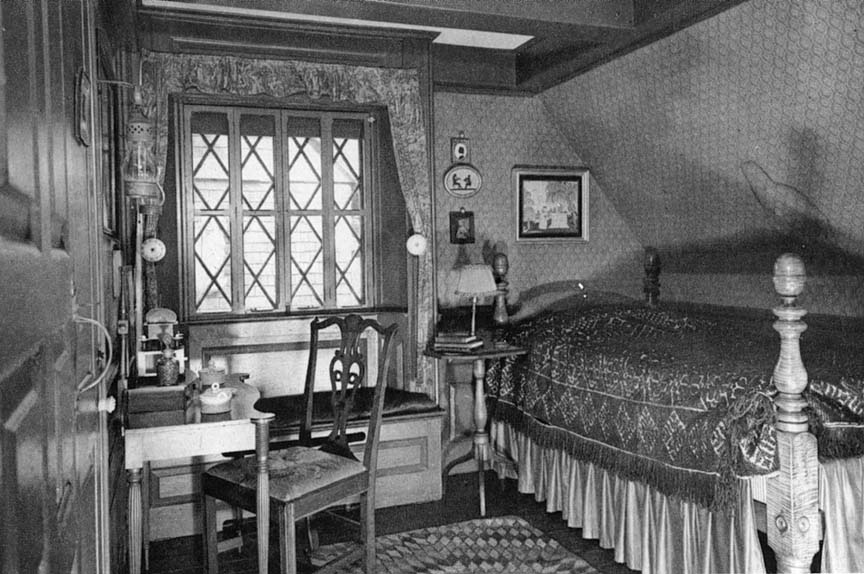 Toile framing the window above shows Marie Antoinette "cutting up," and in exactly the right place, over Nelson's bedside lamp is a miniature of Lady Hamilton. The wallpaper is a quiet diamond pattern in brown on ivory. The panelling is painted a darker brown |
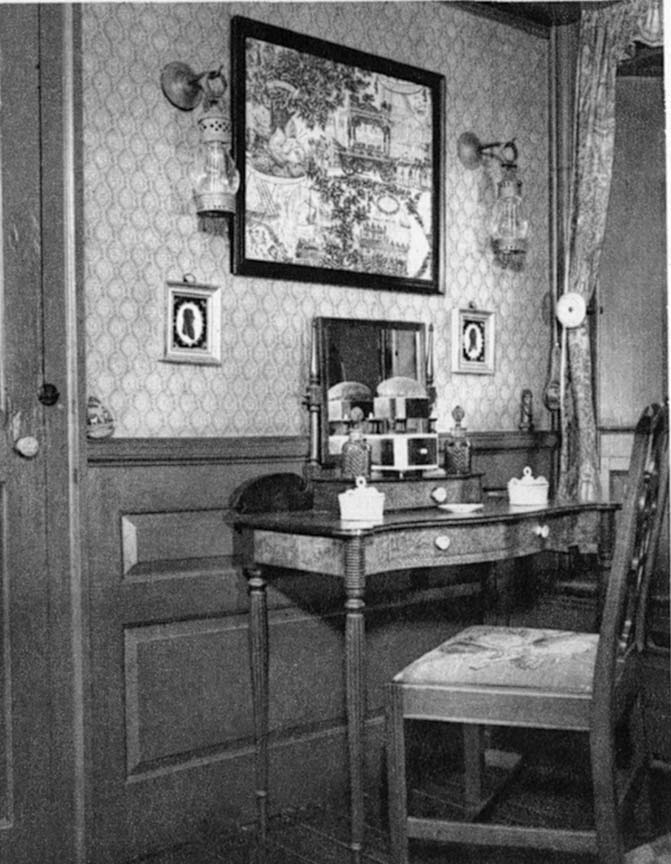 On so simple a premise as a square of toile-de-Jouy depicting Lord Nelson's funeral cortege, this charming snug bedroom became a "personage." The toile hangs above the satinwood dressing table. |
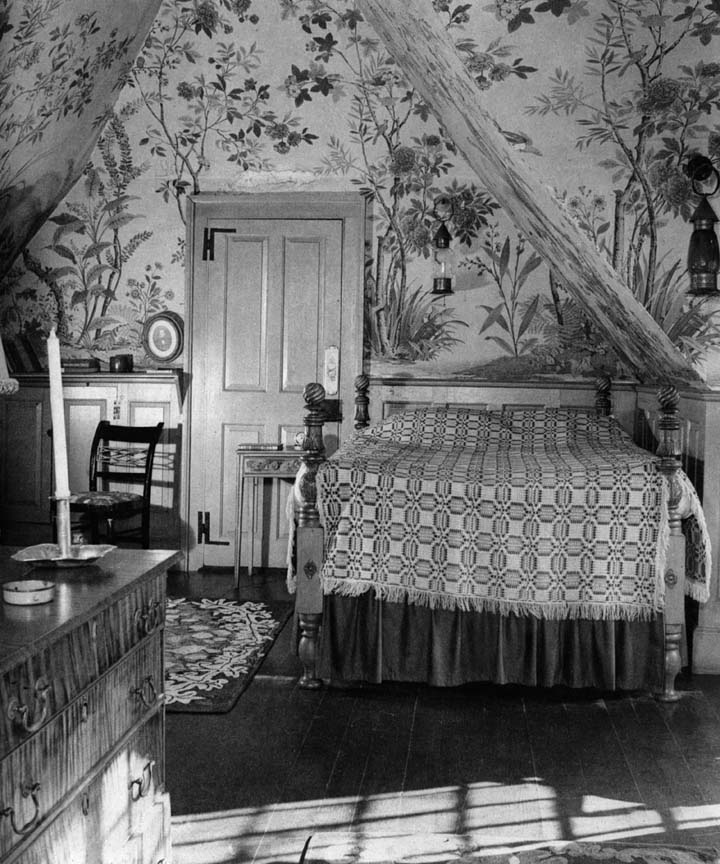
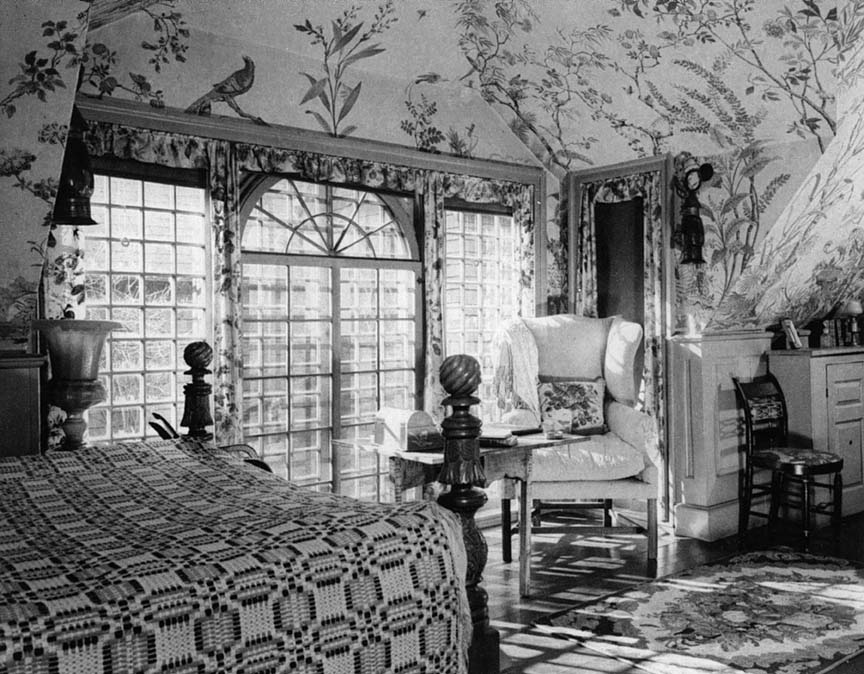 Splashing dancing morning sunlight makes lace on the spattered floor and floral rug as Chinese vines and flowers climb the green bird-cage walls of this bower. Bouquets of garden flowers accent the white chintz at four windows. Bed, dresser and dressing table are of striped maple, of course. A door-panel hides an ample closet. |
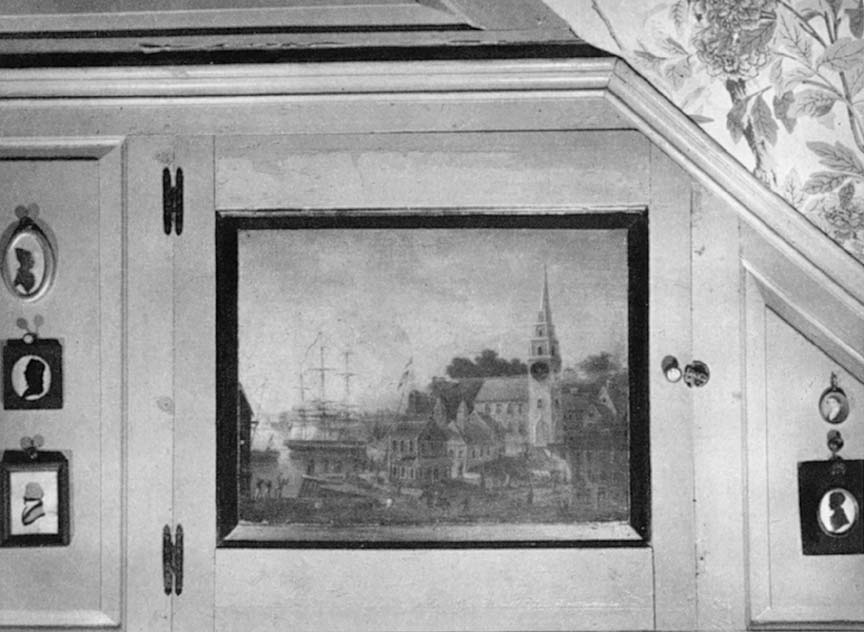 Need a mirror? Just push the knob on this painting of a seaport belfry. The panel opens wide on an ample glass. |
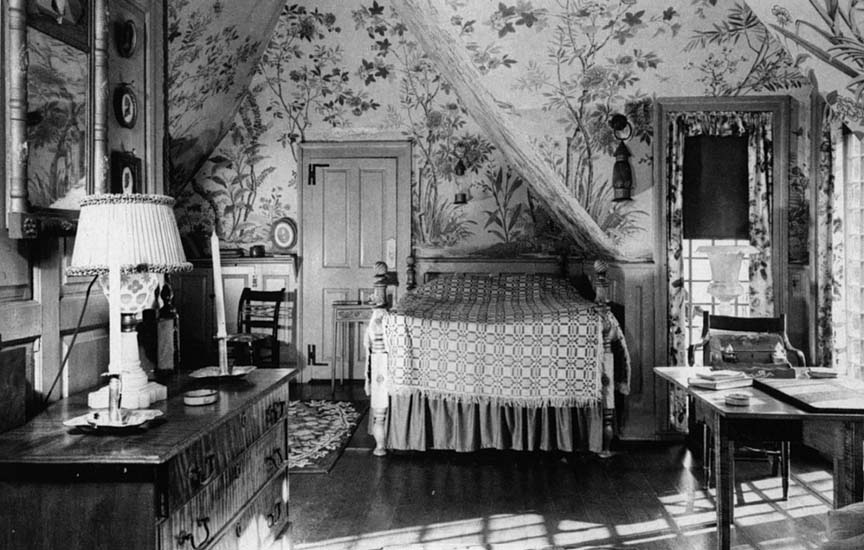 The four-poster snuggles under the gable, with plenty of headroom, and a reading-lantern hangs at exactly the right point overhead. The bedspread is of a pedigreed woven design, which you may copy. |
 A perfect example of what to do with "angles you can't do anything with": into a sharp low gable fits a maple dresser, a gilt-and-black mirror, a row of favorite books, and a conviction of your own personality. |

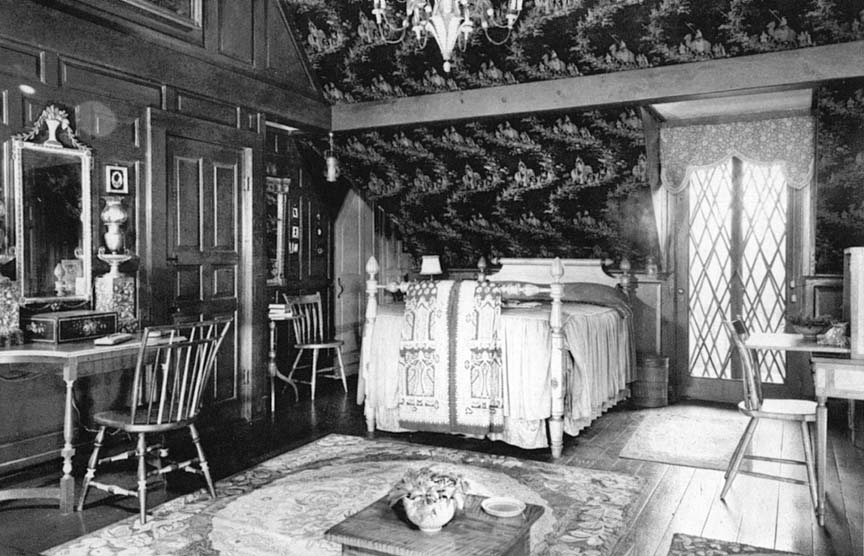
| In Haiti they build half-houses; why not a half-room? This is your view from your bed to the door that leads into the equally fabulous Strawberry Hill Room, a dark-green contrast to your light-green tent. |

 |
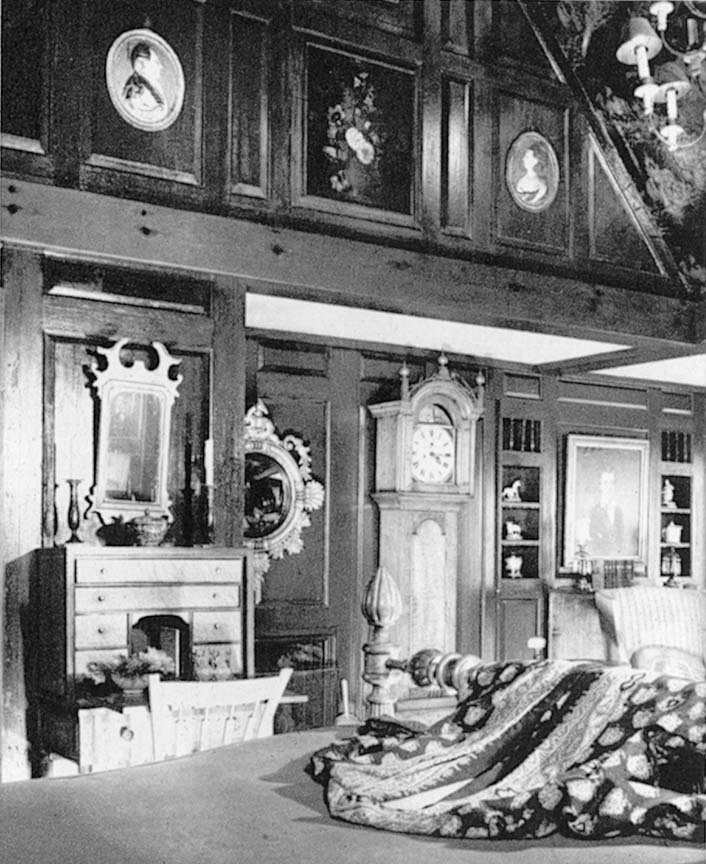 |
| On the preceding page we were looking back into the Belfry Room, through the vertical half-door. Here once more two walls climb to a ridge-pole papered, in this instance, with a dark rich lacquered pattern inspired from Strawberry Hill. Its story is an endless pageant of elephants and kings and camels. Here we see the gable ends of the room, painted a dark, dark brown picked out in red. Left, William confronts Mary. Right, a maple bureau, a girandole, a tall maple clock and a portrait share honours. The four-post bed sports a Paisley gown on its footrail. The rug is a pot pourri of blossoms. | |
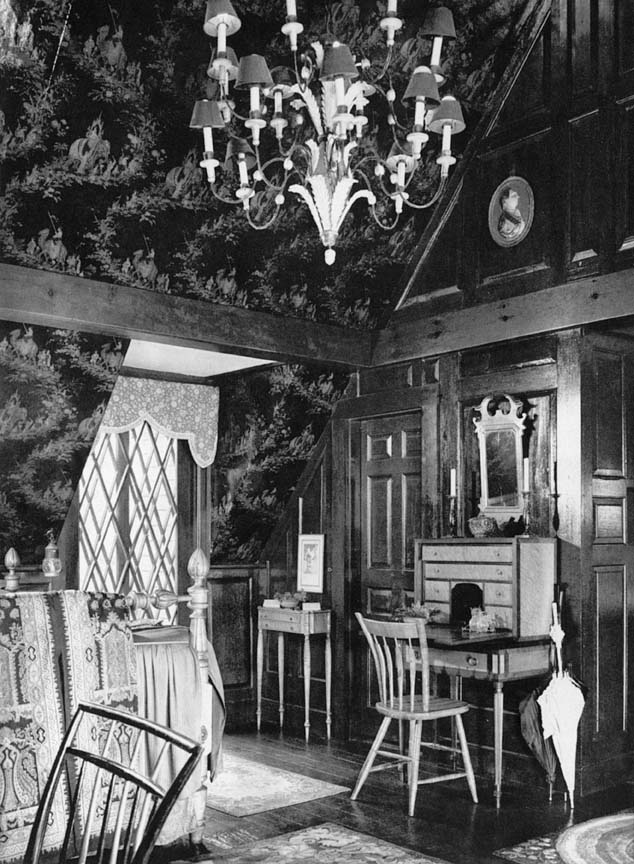 The corner holds a delightful little table of exquisite craftsmanship. The blue-and-white tin chandelier overhead makes twilight fireworks. (Better take your parasol.) |
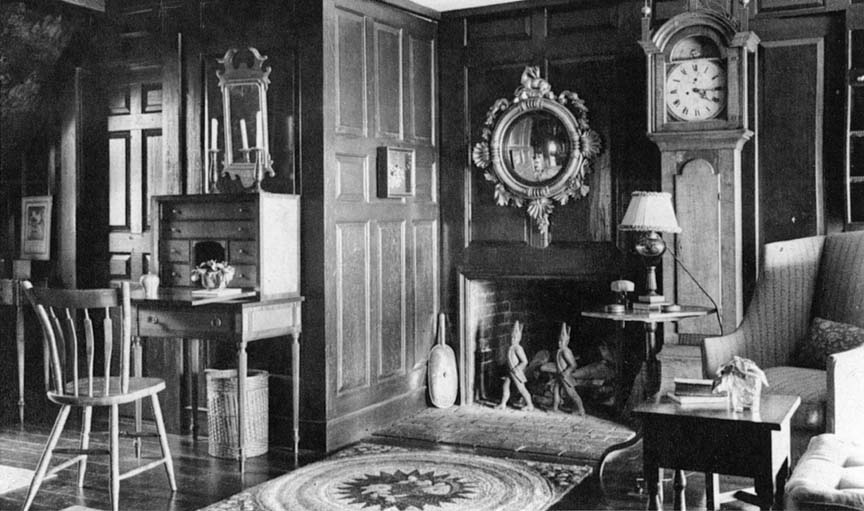 No room without its heat, or diversion. A greyhound tops this convex mirror, not disturbed by the Hessian andirons, nor the warming pan. The slim panel at the right of grandfather's clock conceals a large hidden closet of ancient costumes and a stair which leads up exactly nowhere at all. |
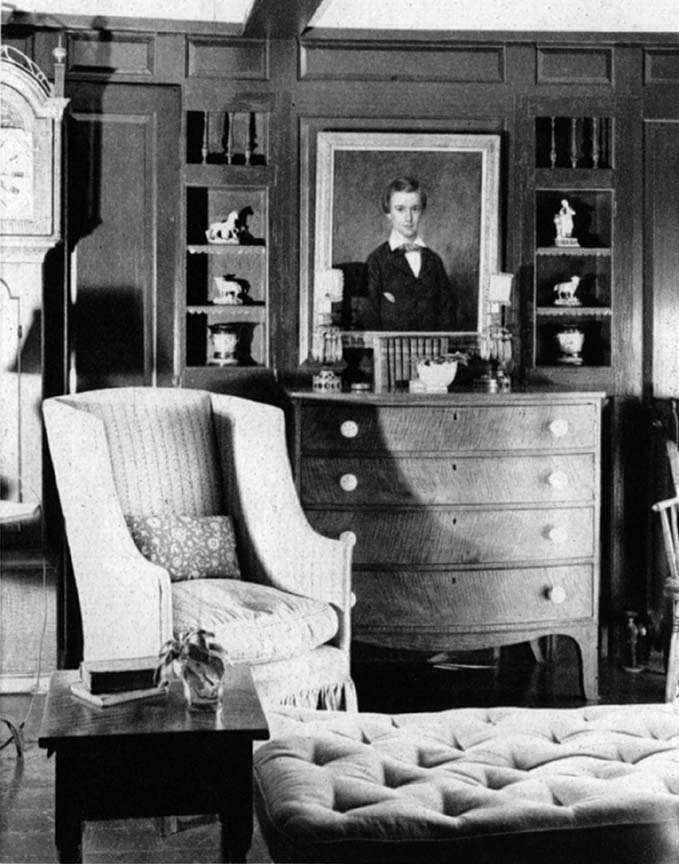 Turn right now and regard the pattern of the dresser-top arrangement, the Stafford in the red-fringed shelves, the tinkle-lamps, and the admirable portrait of a good-looking school boy supposed always to have been young Harry Sleeper, but affectionately claimed as kin by several other estimable visitors. |
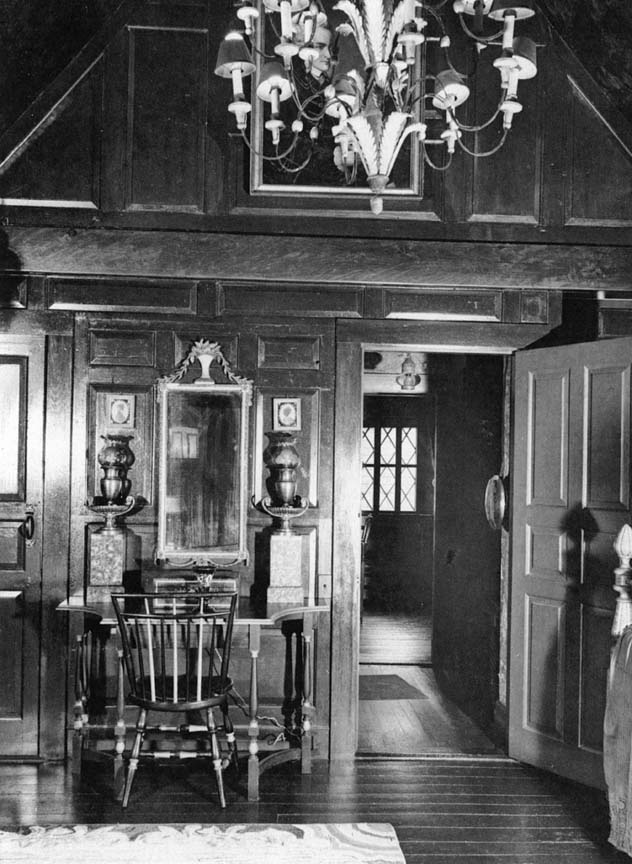 The little dressing-table is black, lined in yellow; its sidelights are brass lamps with etched cranberry glass globes on marbleized-bases. Horace Walpole, himself, peeps through the tracery of the chandelier. |
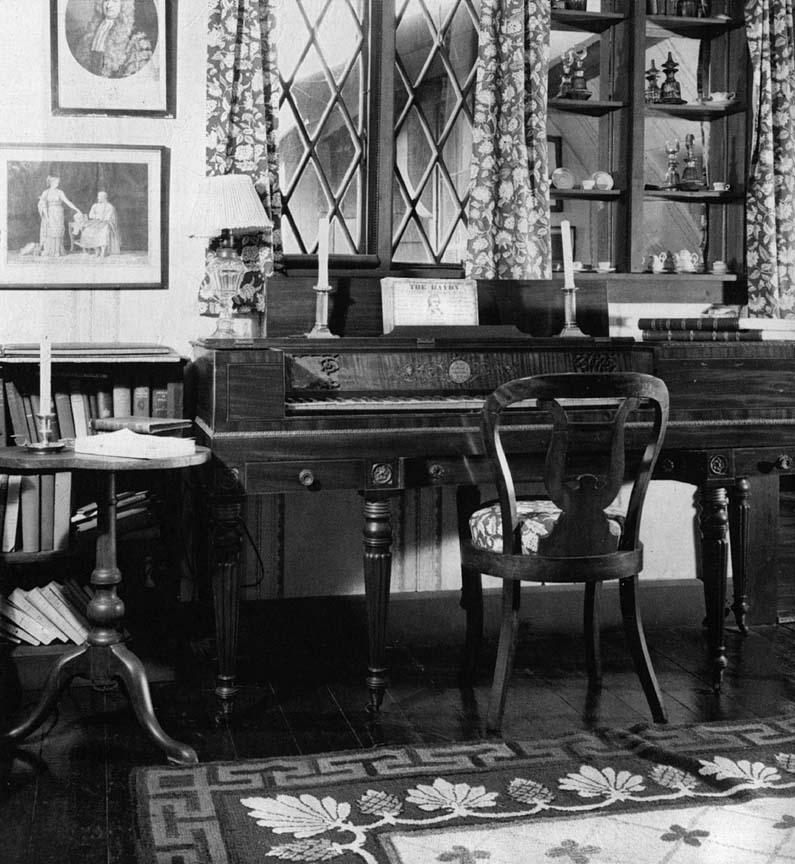
| In a tiny sitting room next to Strawberry Hill is a saucy satinwood and mahogany square piano, by Hayes Babcock and Appleton of No. 6 Milk Street, Boston. A clear Sandwich lamp lights the music, which is The Haydn. A nearby bookshelf holds a casual sixty volumes of The Edinburgh Review of the early 1800's. The French and English prints are in colour---as is the glass. The wallpaper is quietly striped. |
 |
 |
| Let's be frank: there isn't a house, large or small, that hasn't some such casual wall as this, and some sort of dresser, chest and a pair of decent chairs, and some pleasant prints (or a thrifty print shop nearby). This simple arrangement can be anyone's, and to his personal taste or hobby. Add a few timely flowers for the finger-vases, or your own, and the whole becomes a picture you painted yourself. Get to work. |
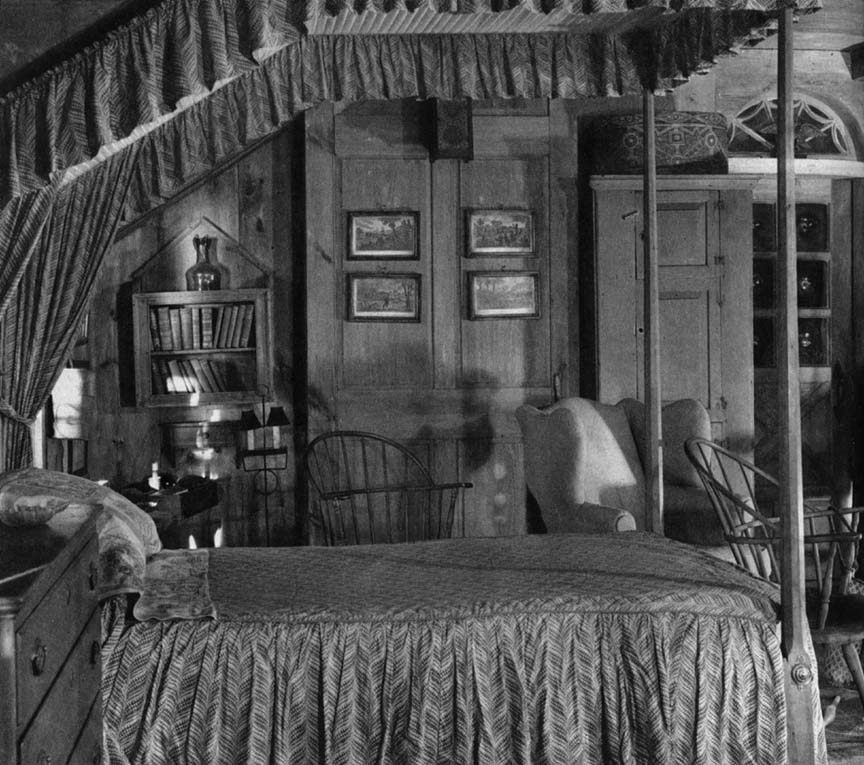
| Real architectural complexity is reduced to simplicity by the fact that floor, ceiling, walls and furniture are of "natural" wood-colour, weathered and waxed, and that the few fabrics compose in tone to the subtle, bland whole. The canopies of the twin-poster beds were tailored to the roof-line to save floor space (which is generous). Everything that belongs out of sight is hidden. Everything in sight is an object of interest. Item: Framed Bill of Sale of the Negro Boy "Mink," 1804. (Mink died 1863). Items: (they're on that wall) Four prints of Robinson Crusoe. Item: The first print of America's first railroad. Engine named John Bull, Albany-Schenectady run, scared hell out of the cows. Item: An 8 x 10 pink and blue floral hooked rug, oval, and scalloped. Item: Gloucester sea chest, labelled the property of A. Marchant. And so on. |
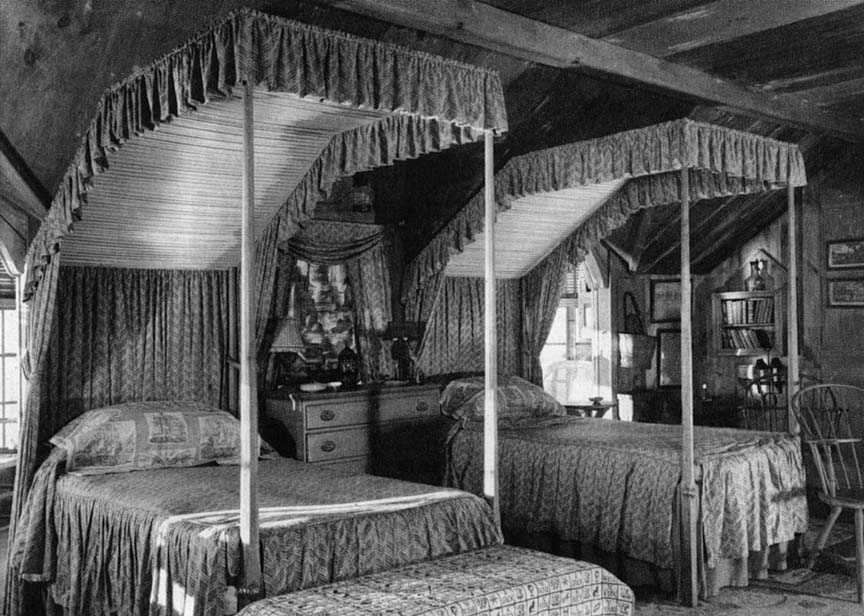 Between the beds a low maple dresser for two holds reading lamps against a painted roller-shade. The frills and spreads are a cocoa-brown printed in feathers on off-white; the roof broods protectively. |
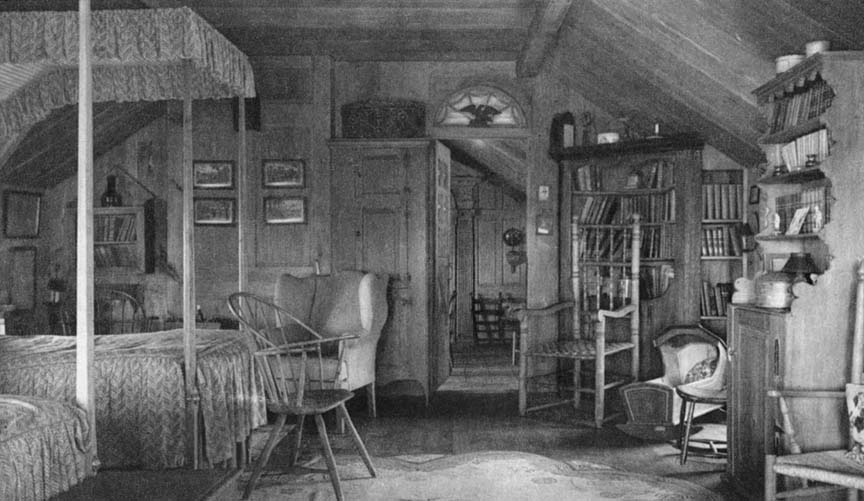 Open the cupboard beside the door to the Mariner's room and you'll find two shelves of primitive wooden pioneer toys of the beasts they loved best---the barnyard folk, in wood. The cradle is for a guest. |
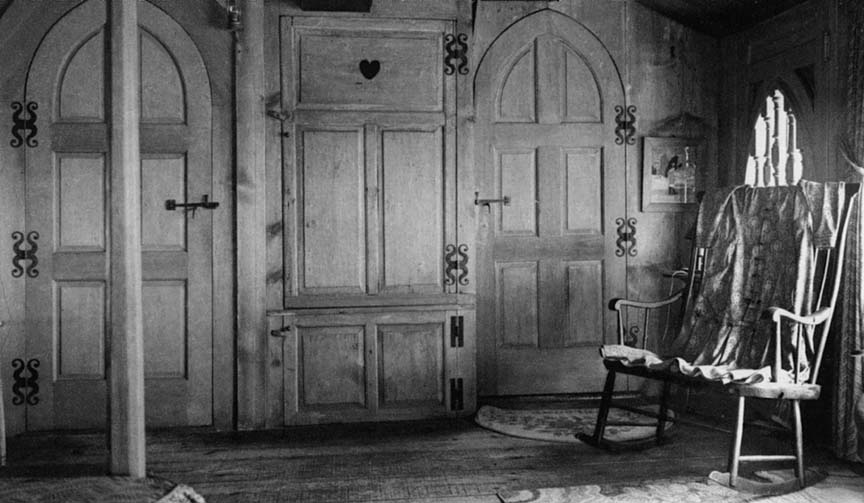
| Lie in bed and rest facing this calm design: plain virgin pine, wearing fleurets of wiggling hinges. The double-rocker (right) is said to have been for sparkin' couples. Sort of rumble-seat, early model. |
 |
 |
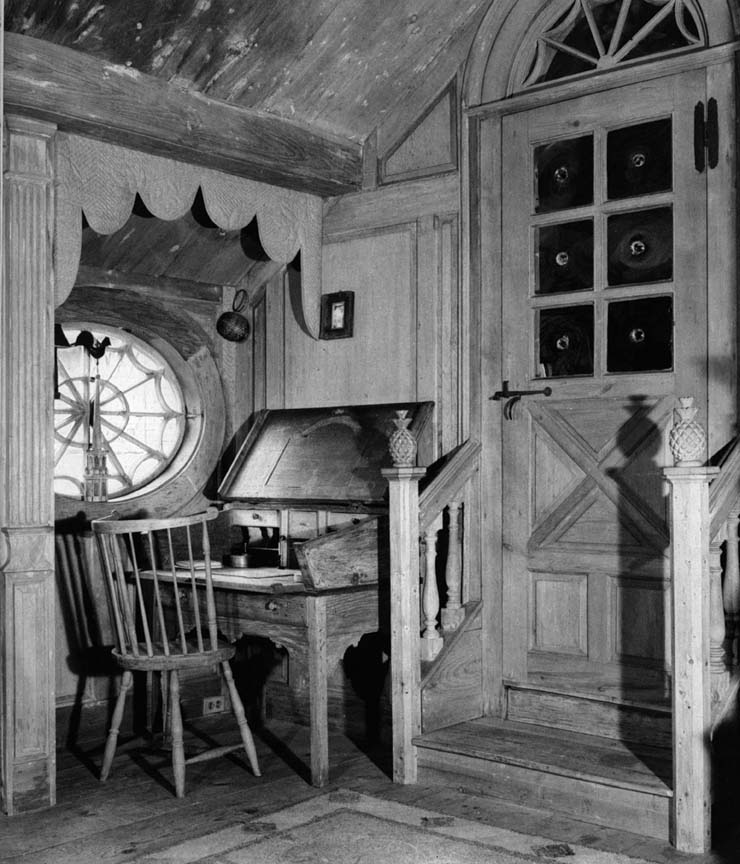
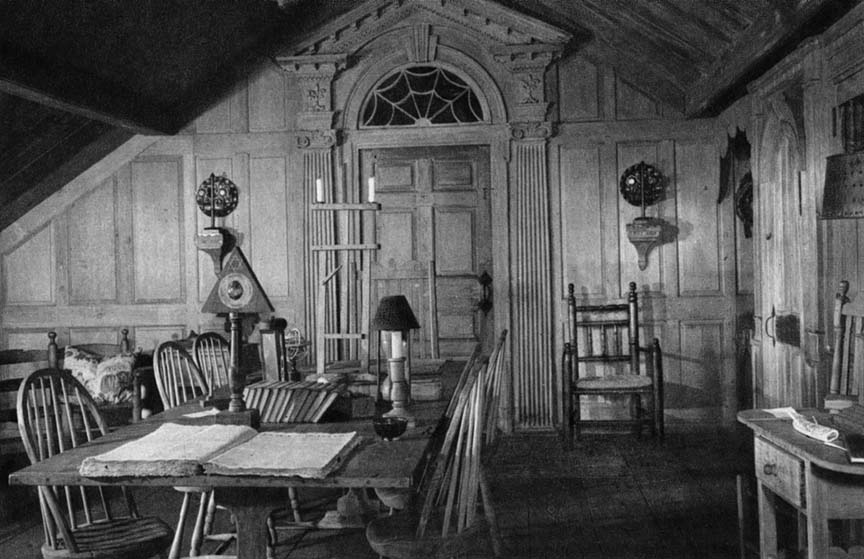 We just came down those steps on the previous page, almost missed the pine desk, the pickwick, the steeple-model in the oval window, the half-written letters, the blue-homespun valance. For we face this (above): a full-panoplied Rhode Island doorway, long table, open on it a copy of the Essex paper with a full front-page story of the Battle of Lake Erie (issue of Sept. 10, 1814, or Don't Give Up The Ship). Bright rippled tin candle-sconces flank the door. As in the Indian Room, the 'finish" of the wood is none but time and wax. |
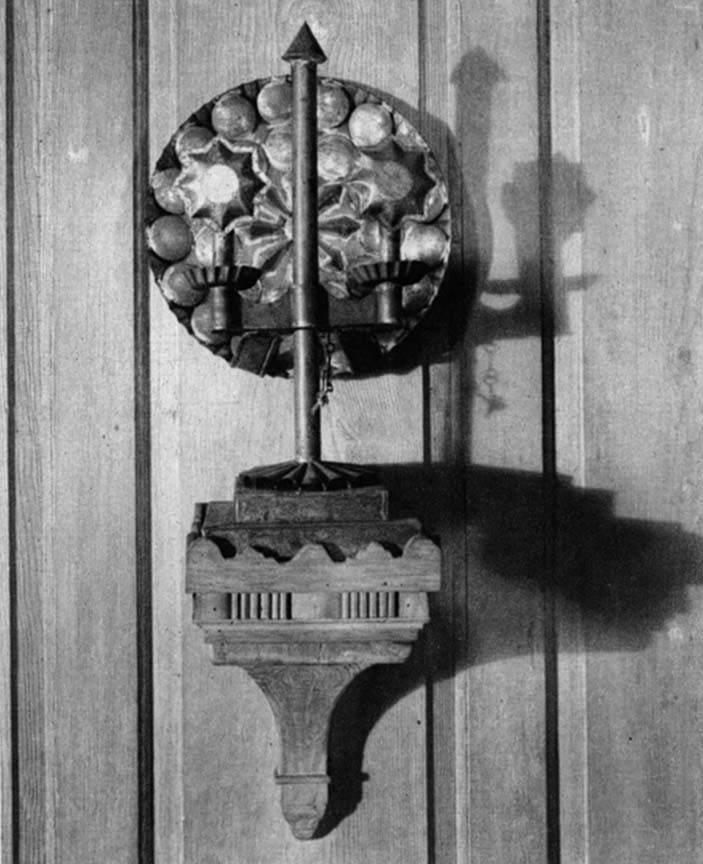 To be sure, the pine brackets are harmonious, and you can make them, and yours will look well another 200 years. |
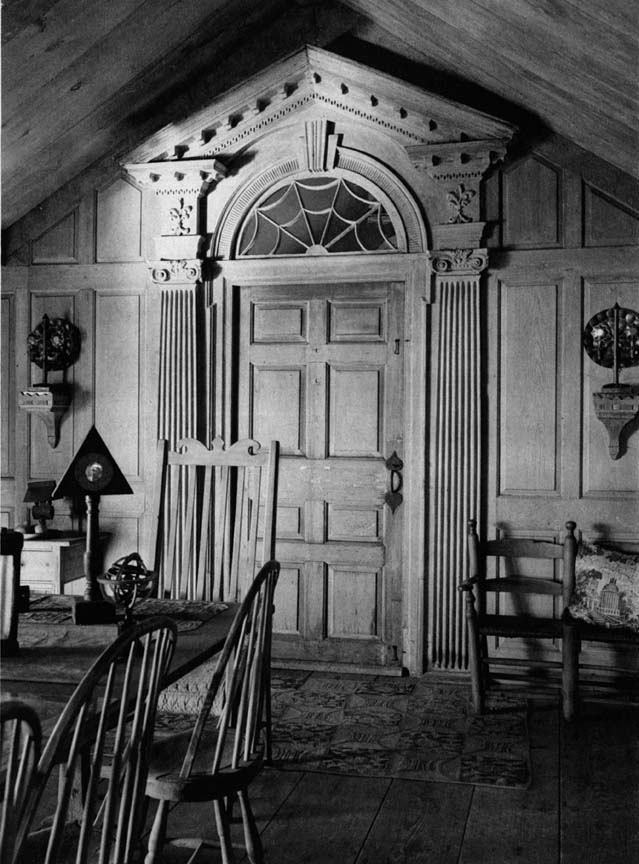 A close-up of the rhythm and line of the far doorway in the Mariner's Room. |
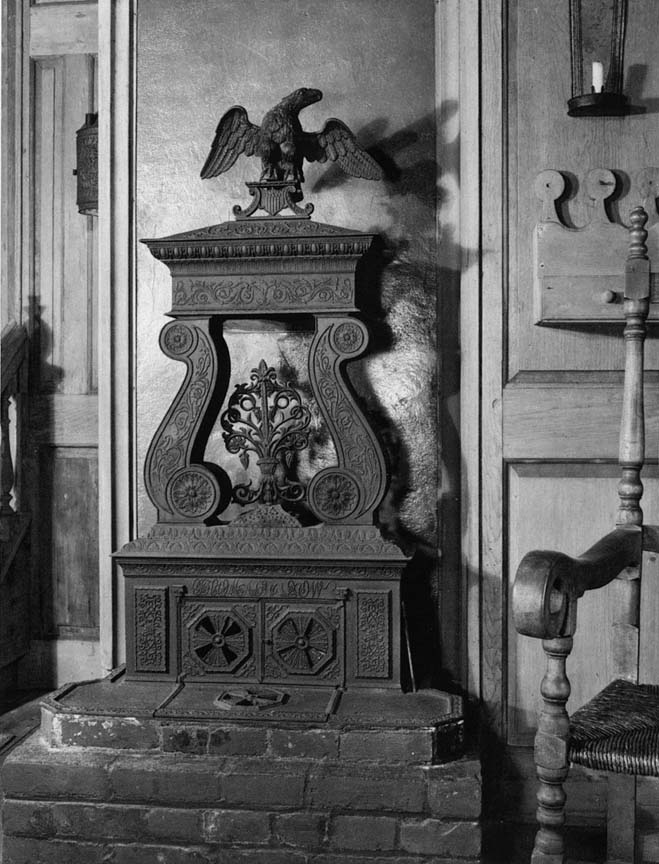 If Washington can get hot downstairs, so can this lyre-and-eagle stove cast by Groma and Low. (Washington is represented by a hexagonal plaque in the gable-panel above, but we can't see him.) |
 You'll not overlook on the table the compass, or the scrimshaw marlinspike, or the scrimshaw cribbage board . . . nor, on the round table, the quadrant, nor the astronomical gadget that looks like an egg-beater. A spy-glass lies there too, for looking out for Gloucestermen overdue. They may not, in fact, come home at all. |
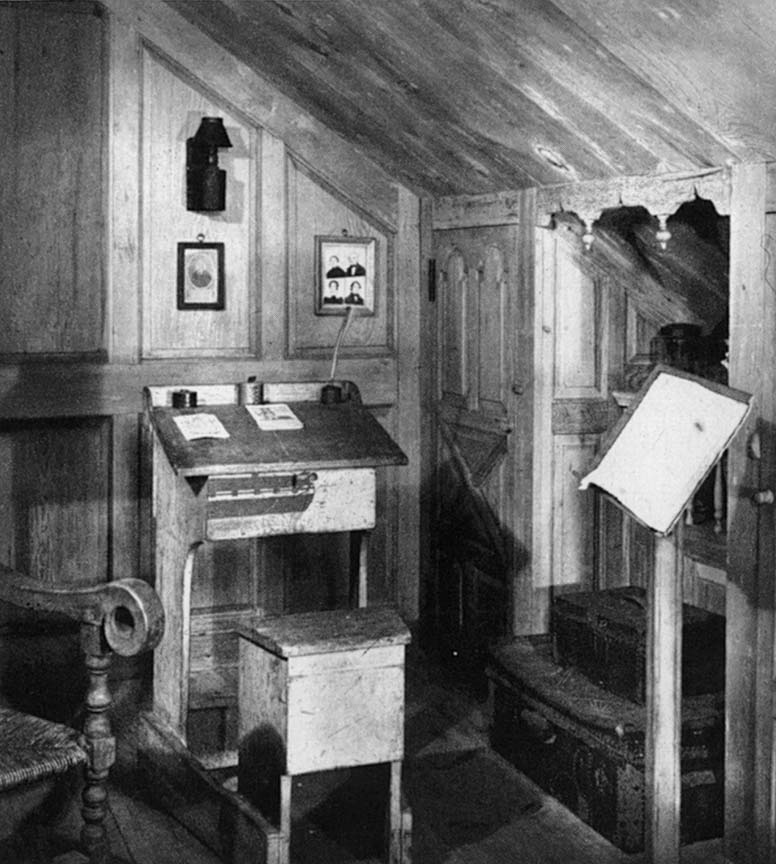 Formal corner desk for learning to keep strict account, a pine school-desk. Good sailing is sound schooling. |
 In the cupboards beyond the Mariner's long table (above) you may discover a collection of carved and painted Indians, a foot high, twenty carved miniature birds, one carved speckled trout, and a wooden figure of an English marine carved in China, in 1840. Among other matters you'll inspect Andrew Jackson's passport to a New Bedford ship (1837), a sextant made by Spenser Browning and Rust in London for Sam'l, Emery in Salem, facsimiles of Washington's account books of the Revolution, a box of German toy blocks with the card of J. Henry Sleeper, 1840. . . and some Reward-of-Merit cards, awarded to Harry Sleeper by an admirer. He deserved them. |
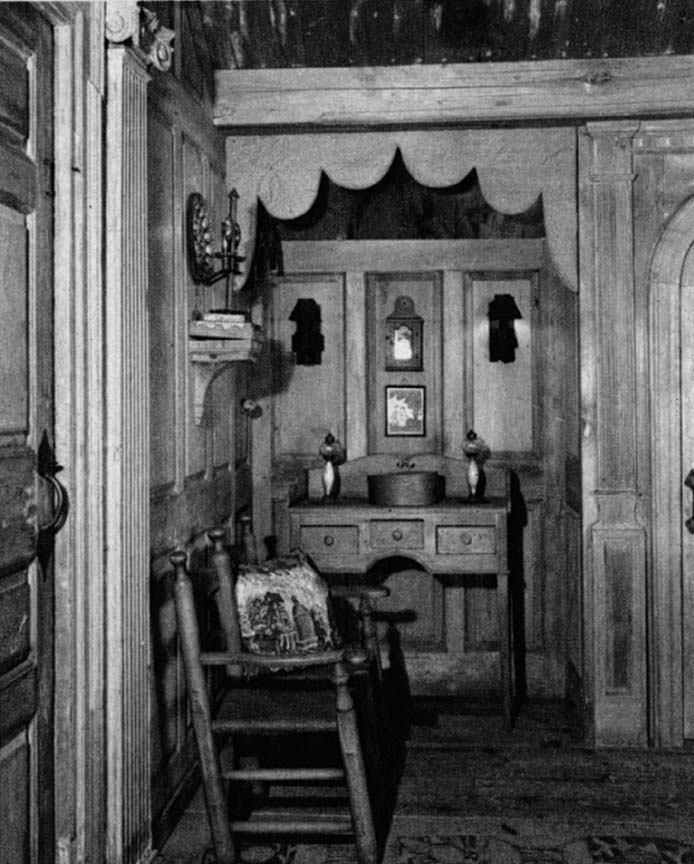 A feminine touch in this seaman's room is suddenly revealed in the little niche (left) with its carriage bonnet and blue boxes. |
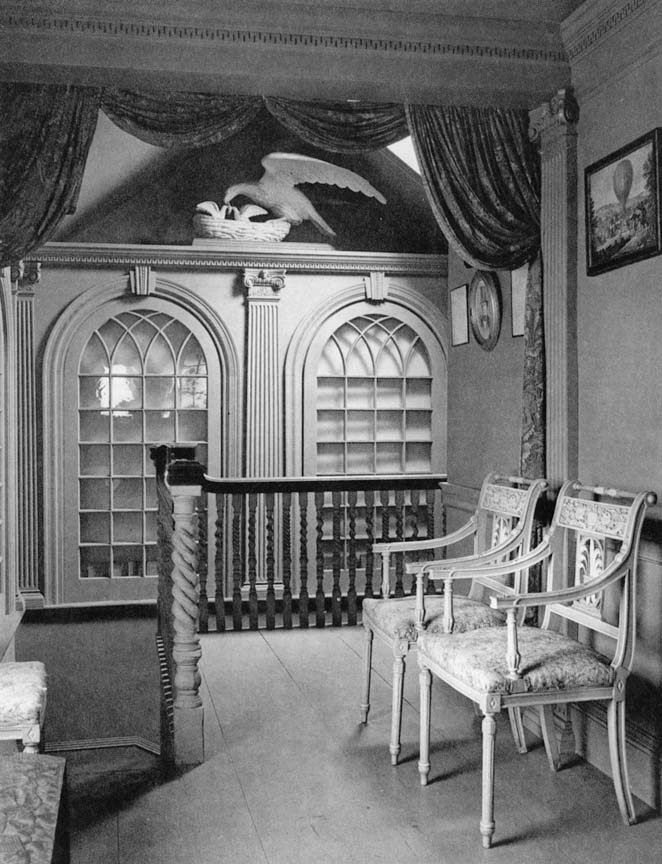
| Gallery? Yes. The shelves of the cases are filled, pane by pane, with exquisite little books open to colour prints of birds, beasts, flowers. The pilasters wear heads of Washington, Lafayette, Franklin, Jefferson. A mother eagle feeds her young. Chairs of the type Jerome Bonaparte brought here stand under Montgolfier's balloon ascension in Paris---which Franklin witnessed. |