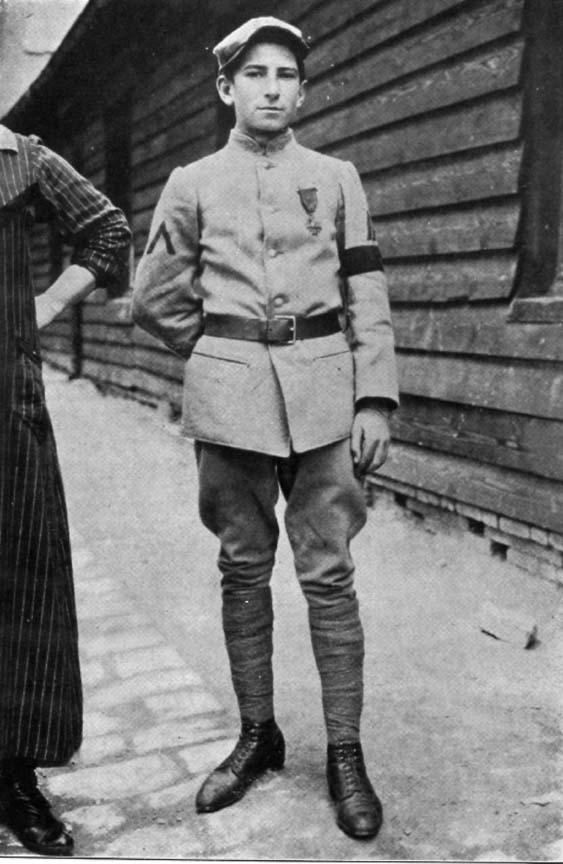
WE were in the barracks of the Eighth Regiment of Artillery. They have been converted into a home for refugees, but the old insignia of famous victories still adorn the walls. We were talking with Madame Derlon. She is a refugee from Pont-à-Mousson, widowed by German severity. But unlike so many women of Lorraine whom I met, she still could look to her line continuing. For while she sat, slightly bent over and tired, Charles, her fifteen-year-old son ("fifteen and a half, Monsieur"), stood tall and straight at her side. While the mother told me her story, I looked up from her and saw on the wall the escutcheon of the Regiment, and I read in illuminated letters the names of the battles in which it had fought:
"Austerlitz----1805. Friedland---1807 Sebastopol--- 1854. Solferino---1859."
At the beginning of the war, her husband was ferryman of the Moselle, she said. He carried civilians and soldiers across. Their little son, then thirteen years old, liked to be near him, and watch the river and the passing of people. The boy had discovered a cellar under the bridge---a fine underground room, well-vaulted, where boy-like he had hidden tobacco and where he often stayed for hours, dreaming of the bold things he would do when his time came, and he would be permitted to enlist. His day was closer than he guessed. A cave is as wonderful to a French boy as it was to Tom Sawyer. Sometimes he made a full adventure of it and slept the night through there.
During the early battles, the bridge had been blown up. So Father Derlon was kept very busy ferrying peasants and stray soldiers from bank to bank. One day three German patrols came along. Charles was standing by the bridge, watching his father sitting in the ferry. The boy stepped down into his underground room to get some tobacco. He was gone only five minutes. When he came back, the three Germans said to him:
"Your father is dead."
It was so. They had climbed the bridge, and fired three times; one explosive bullet had entered the ferryman's head, and two had shattered his arm.
The Germans said he had been carrying soldiers across, and that it was wrong to carry soldiers.
"The little one came home crying," said Madame Derlon. "Since that moment, the little one left home without telling me. He did not send me any news of himself. I searched everywhere to try to find a trace of him. Monsieur Louis Marin, the Deputy, told me he had seen a boy like my little one following the soldiers. Actually he had been adopted by the 95th Territorial Regiment."
He told the soldiers that he had just seen his father killed by the Germans. One of the captains took him under his protection. The boy insisted on becoming a lighter. He was brave and they made him Corporal. He fell wounded in action, winning the Croix de Guerre.
Charles Derlon, the little Corporal of the 95th Infantry, has a bright open face, but it is a face into which has passed the look of responsibility. In one moment, he became a man, and he has that quiet dignity of a boy whom older men respect and make a comrade of. He holds himself with the trim shoulders and straight carriage of a little soldier of France.
One of us asked him:
"And weren't you afraid, my boy, of the fight?"
"It is all the same to me," he replied, "when I get used to it."
"And why," we pressed him, "did you run away without going to your mother? Didn't you think she might be anxious?"
"Because I knew very well," he said, "that she would not want to let me go."
"And you are away from the army now, 'on permission' we asked.
Very proudly he answered:
"No, Monsieur. I am on leave of convalescence for three months. I have been wounded in three places, two wounds in my arm, and one in my leg."
WHAT was true of Joan of Arc is true to-day. There is no leadership like the power of a holy spirit. It lends an edge to the tongue in dealing with unworthy enemies. It gives dignity to sudden death. Religion, where it is sincere, is still a mighty power in the lives of simple folk to lift them to greatness. Out beyond Rheims, at the front line trenches, the tiny village of Bétheny is knocked to pieces. The parish church is entirely destroyed except for the front wall. Against that wall, an altar has been built, where the men of the front line gather for service. Over the altar I read the words:
In that name many in France are working. Such a one is Paul Viller, curé of Triaucourt. The burning of the village is the world's end for a peasant, because the village was his world. When the peasants of Triaucourt saw their little local world rocking, they turned to the curé. He was ready.
"It is better to run," said the Mayor; "they kill, those Germans."
As the curé said to the German lieutenant who tried to force him up the bell-tower, "That ascension will give me the vertigo," so he felt about running away: his legs were not built for it. He would like to "oblige," but he was not fashioned for such flights.
Curé Viller is 55 years old, short and ruddy and sturdy. In his books and his travel, and well-grounded Latin education, he is far removed from the simple villagers he serves. But he has learned much from them. He has taken on their little ways. He has their simplicity which is more distinguished than the manners of cities. With them and with him I felt at home. That is because he was at home with himself, at home in life. His house was full of travel pictures---Brittany fishermen and nooks of scenery. He had the magazine litter, scattered through all the rooms, of a reading man who cannot bear to destroy one printed thing that has served a happy hour. His volumes ranged through theology up to the history of Thiers. His desk was the desk of an executive, orderly, pigeon-holed, over which the transactions of a village flow each day. A young priest entered and stated a case of need. The curé opened a little drawer, peeled off five franc notes from a bundle, and saw the young man to the door.
It was as clean-cut as the fingering of a bank-cashier. The only difference was the fine courtesy exchanged by the men.
The curé talked with us about the Germans. We asked him how the peasants felt toward them, after the burning and the murders.
"I will tell you how the village electrician felt," replied he.
"He came back after the troops had left and took a look about the village. 'If I ever get hold of those Germans, I'll chew them up, he said to me.
" 'Some of them are still here,' I replied.
" 'Show them to me quick,' he demanded.
" 'They are in the church---grievously wounded.'
"We went there. A German was lying too high on his stretcher, groaning from his wound and the uncomfortable position.
" 'Here, you, what are you groaning about?' thundered the electrician. He lit a cigarette and puffed at it, as he glared at his enemy.
" 'Uncomfortable, are you! I'll fix you,' he went on, sternly. Very gently he eased the German down into the softer part of the stretcher, and tucked in his blankets.
"'Now, stop your groaning,' he commanded. He stood there a moment in silence, then burst out again angrily:
'What are you eyeing me for? Want a cigarette, do you?'
"He pulled out a cigarette, put it in the lips of the wounded man and lit it. Then he came home with me and installed electric lights for me. That was the way he chewed up the Germans.
"As for me, I lost twenty pounds of weight because of those fellows. After they have been in a room, it is a chaos: men's clothing, women's undergarments, petticoats, skirts, shoes, napkins, cloths, hats, papers, boxes, trunks, curtains, carpets, furniture overturned and broken, communicants' robes---everything in a mess. I have seen them take bottles of gherkins, cherries, conserves of vegetables, pots of grease, lard, hams, everything they could eat or drink. What they couldn't carry, they destroyed. They opened the taps of wine casks, barrels of oil and vinegar, and set flowing the juice of fruits ready for distillation.
"The official pillage of precious objects which are to be sent to Germany is directed by an officer. He has a motor car and men. I have sometimes asked for vouchers for the objects, stolen in that way. The vouchers are marked with the signature of the officer doing the requisitioning, and with the stamp of the regiment. But who will do the paying, and when will they do it? The plunderer who takes bottles of wine gives vouchers. I have seen some of them which were playfully written in German, reading:
"'Thanks, good people, we will drink to your health.'
"They don't always have good luck with their pillage. A Boche, who is an amateur of honey, rummages a hive. The valiant little bees hurl themselves on the thief and give him such a face that he can't open his mouth or his eyes for a couple of days. A Boche once held out to me a handful of papers which he took for checks of great value. They were receipts filched from the drawers of Madame Albert Fautellier. The biter was well bitten.
"When the Germans entered my house they held revolvers in their hand. It is so always and everywhere. If all they are asking of you is a match, or a word of advice, the Boche takes out his revolver from its holster, and plunges it back in, when he has got what he wishes. With a revolver bullet he shoots a steer, and knocks down a pig with the butt of his rifle. The animals are skinned. He doesn't take anything but the choice morsels. He leaves the rest in the middle of the street, or a court or garden, the head, the carcass and the hide."
No man in France had a busier time during the German occupation than this village curé. He went on with his recital:
"On Sunday morning, the Germans set our church clock by German time, but the bell was recalcitrant and continued to sound the French hour, while the hands galloped on according to their whim. While they were here, the hour didn't matter. We lost all notion of time. We hardly knew what day it was. My cellar is deep and well vaulted. I placed there a pick-ax, spades and a large shovel. Every precaution was taken. I placed chairs, and brought down water. Wax tapers, jammed in the necks of empty bottles, gave us light enough. That Sunday and the days following I had the pleasure of offering hospitality to 76 persons. My parishioners knew that my home was wide open to them. When you are in numbers, you have less fear.
"The men went into the garden to listen and see whether the battle was coming closer. I recited the rosary in a loud tone. The little children knelt on their knees on the pavement and prayed. Cavalry and infantry passed my door in silence. Once only, I heard the Teutons chanting; it was the third day of the battle: a regiment, muddy and frightened, reentered Friaucourt chanting.
"The hours go slowly. Suddenly we saw to the East a high column of smoke. Can that be the village of Evres on fire! I think it is, but to reassure my people I tell them that it is a flax-mill burning, or the smoke of cannon. At night we sleep on chairs. The children lie down on an immense carpet, which I fold over them, and in that portfolio they are able to sleep.
"Monday was a day of glorious sunshine. Nature seemed to be en fête. After I had buried seven French and German dead, and was walking home, I saw coming toward me Madame Procès, her daughter Hélène, in tears, a German officer and a soldier. The officer asked me:
"'Do you know these ladies?'
" 'Very well,' I answered, 'they are honest people of my parish.'
" 'All right. This soldier has not shown proper respect to the young lady. He will be rebuked. If he had gone further he would be shot.'
"The officer then reprimanded the soldier in my presence. The man, stiff at attention, listened to the rebuke in such a resentful, hateful way that I thought to myself there is going to be trouble. The soldier, his rifle over his shoulder, went toward the Mayor's office.
"About twenty minutes later I heard firing from the direction of the Mayor's office, two shots, several shots, then a regular fusillade. The sullen soldier had gone down there, clapped his hand to his head, said he was wounded, and fired. When I heard the first firing, I thought it was only one more of their performances. I had seen them kill a cow and a pig in the street by shooting them.
"But at the sound of these shots the Germans ran out from the houses and the streets, rifle and revolver in hand, shouting to me:
" 'Your people have fired on us.'
"I protested with all my power, saying that all our arms had been put in the Mayor's office, and that no one of us had done the firing. But they only shouted the louder:
" 'Your people have fired on us.'
"Flames broke out in the homes of Mr. Edouard Gand, and Mr. Gabriel Géminel. We saw the Boches set them on fire with incendiary fuses. Later on, we found the remnants of those fuses.
"Women began running to me, weeping and saying:
" 'Curé, save my father.' 'My child is in the flames.' 'They are killing my children.'
"The shooting went on. The fire spread and made a hot cauldron of two streets. Cattle and crops and houses burned.
"Then a strange thing happened. Some Germans aided in saving clothing and furniture from two or three of the houses. But most of them watched the destruction, standing silent and showing neither pleasure nor regret. I could tell it was no new sight for them. In two hours, there was nothing left of the thirty-five houses on two streets.
"Our people ran out, chased by angry Germans who fired on them as if they were hunter's game. Jules Gand, 58 years old, was shot down at the threshold of his door. A seventeen-year-old boy named Georges Lecourtier, taking refuge with me, was shot. Alfred Lallemand hid himself in a kitchen. His body was riddled with bullets. We found it burned and lying in the rubbish, eight days later. He was 54 years old. Men, women and children fled into the gardens and the fields. They forded the river without using the bridge which was right there. They ran as far as Brizeaux and Senard. My cook ran. She had a packet of my bonds, which I had given her for safe-keeping, and she had a basket of her own valuables. In her fear she threw away her basket, and kept my bonds.
"The daughter of one of our women, shot in this panic, came to me and said:
" 'My mother had fifty thousand francs, somewhere about her.'
"The body had been buried in haste, with none of the usual rites paid the dead, of washing and undressing. So no examination had been made. We dug the body up and found a bag.
'Is that the bag?' I asked the daughter.
'It looks like it,' she replied. It was empty.
"A day later we found another bag in the dead woman's room, and in it were the bonds for fifty thousand francs. That shows the haste and panic in which our people had fled, picking up the wrong thing, leaving the thing of most value.
"It was in the garden of the Procès family that the worst was done. It was Hélène Procès, you remember, who was insulted by the German soldier: The grandmother, 78 years old, Miss Laure Mennehand, the aunt, who was 81 years old, the mother, 40 years old, and Hélène, who was 18, ran down the garden. They placed a little ladder against the low wire fence which separated their back yard from their neighbor's. Hélène was the first one over, and turned to help the older women. The Germans had followed them, and riddled the three women with bullets. They fell one on the other. Hélène hid herself in the cabbages.
"That same evening some of the villagers went with me to the garden. The women looked as if they were sleeping. They had no trace of suffering in the face. Miss Mennehand had her little toilet bag, containing 1,000 francs, fastened to her left wrist, and was still holding her umbrella in her right hand. Her brains had fallen out. I collected them on a salad leaf and buried them in the garden.
"We carried the three bodies to their beds in their home. In one bed, as I opened it, I saw a gold watch lying. From Monday evening till Wednesday morning, the bodies lay there, with no wax taper burning, and no one to watch and pray. By night the Germans played the piano, close by.
" 'Your people fired on our soldiers,' said a Captain to me next day. 'I'll show you the window.'
"He led me down the street, and pointed.
" 'It is unfortunate you have chosen that window; I replied to him; 'at the time you started burning our village the only person in the house was a paralytic man, who was burned in his bed.'
"It was the house of Jean Lecourtier, 70 years old.
"In front of the Poincaré house, I met a General, who, they said, was the Duke of Württemberg. He said to me:
" 'I am glad to see you, Curé. I congratulate you. You are the first chaplain I have seen. Generally, when we get to a village, the mayor and the Curé have run away. We officers are angry at what has taken place here. You have treated us well.'
" 'Perhaps you will be able to stop the horror,' I said to him.
" 'Ah, what can you expect? It is war. There are bad soldiers in your army and in ours.'
"The next day I saw him getting ready to enter a magnificent car. His arm was bandaged.
"'You are wounded, General ?' I asked him.
" 'No, not that,' he answered.
" 'A strained ligament (entorse) ?' I asked.
"'No,' he said, 'don't tell me the French word.' He opened a pocket dictionary with his unhurt hand, wetting his finger and turning the pages.
"'It is a sprain (luxation),' he said.
"That is the way they learn a language as they go along.
" 'You are leaving us ?' I asked.
"Yes, I am going to my own country to rest!
The afternoon had passed while we were talking. We rose to make our good-bys.
"Come with me," said the curé. He led us down the village street, to a small house, whose backyard is a little garden on the little river. All the setting was small and homelike and simple, like the village itself and the curé. A young woman stepped out from the kitchen to greet us.
"This is the girl," said Father Viller. Hélène Procès is twenty years old, with the dark coloring, soft, slightly olive skin, brown eyes, of a thousand other young women in the valley of the Meuse. But the look in her eyes was the same look that a friend of mine carries, though it is now twelve years since the hour when her mother was burned to death on board the General Slocum. Sudden horror has fixed itself on the face of this girl of Triacourt, whose mother and grandmother and aunt were shot in front of her in one moment.
She led us through the garden. There were only a few yards of it: just a little homely place. She brought us to the fence---a low wire affair, cheaply made, and easy to get over.
"The bullets were splashing around me," she said.
The tiny river, which had hardly outgrown its beginnings as a brook, went sliding past. It seemed a quiet place for a tragedy.
TWO persons came in the room at Lunéville where I was sitting. One was Madame Dujon, and the other was her granddaughter. Madame Dujon had a strong umbrella, with a crook handle. Her tiny granddaughter had a tiny umbrella which came as high as her chin. As the grandmother talked, the sadness of the remembrance filled her eyes with tears. Her voice had pain in it, and sometimes the pain, in spite of her control, came through in sobbing. The little girl's face was burned, and the wounds had healed with scars of ridged flesh on the little nose and cheek. The emotion of the grandmother passed over into the child. With a child's sensitiveness she caught each turn of the suffering. Troubled by the voice overhead, she looked up and saw the grandmother's eyes filled with tears. Her eyes filled. When her grandmother, telling of the dying boy, sobbed, the tiny girl sobbed. The story of the murder tired the grandmother, and she leaned on her umbrella. The little girl put her chin on her tiny umbrella, and rested it there.
Madame Dujon said:
"I will try to tell you the beginning of what I have passed through, Monsieur, but I do not promise that I shall arrive at the end. It is too hard. The day of the twenty-fifth of August, which was a Monday."
As she spoke her words were cut by sobs. She went on:
"When the Germans came to our house, my son had to go all over the house to find things that they wanted. I did not understand them, and they were becoming menacing. I said to them:
" 'I am not able to do any better. Fix things yourself. I give you everything here. I am going to a neighbor's house.' "
She went with the tiny grand-girl, who was three years old, her son, Lucien, fourteen years old, and another son, sixteen. The Germans came here too, breaking in the windows, and firing their rifles. The house was by this time on fire. The face of the little girl was burned.
"My poor boys wished to make their escape, but the fourteen-year-old was more slow than the other, because the little fellow was a bit paralyzed, and he already had his hands and body burned. He tried to come out as far as the pantry. I saw the poor little thing stretched on the ground, dying.
"'My God,' he said, 'leave me. I am done for. Mamma, see my bowels.'
"I saw his bowels. They were hanging like two pears from the sides of his stomach. Just then the Germans came, shooting. I said to them:
"'He has had enough.'
"The little one turned over and tried to get the strength to cry out to them:
" 'Gang of dirty----" ("Bande de sal---")
"Every one called to us to come out of the fire. The fire was spreading all over the house. I did not want to understand what they were saying. I went upstairs again where the little girl was, to try to save her (see still the marks which she received).' I succeeded, not without hurt, in carrying away the little girl out of the flames.
"I had to leave my boy in the flames, and, like a mad person, save myself with the little girl.
"I have two sons-in-law, of whom one is the father of this little girl here. Look at her face marked with scars."
"Yes. They burned me," said the tiny girl. She held up her hand to the scars on her face.
"My other little boy escaped from the fire. He was hidden all one day in a heap of manure. He did not wish to make me sad by telling how his brother had cried out to die."
Madame Dujon sobbed quietly and could not go on for a moment. The little girl put her chin on her little umbrella, and her eyes filled with tears. The Mayor of Lunéville, Monsieur Keller, said to us:
"Madame has not told you---the Germans finished off the poor child. Seeing that he was nearly dead, they threw him into the fire and closed the door."
WHEN I went across to France there was one man whom I wished to meet. It was the Prefect of the Meurthe-et-Moselle. I wanted to meet him because he is in charge of the region where German frightfulness reached its climax. Leon Mirman has maintained a high morale in that section of France which has, suffered most, and which has cause for despair. Here it was that the Germans found nothing that is human alien to their hate. When they encountered a nun, a priest, or a church, they reacted to the sacred thing and to the religious person with desecration, violation and murder. But that was only because there were many Roman Catholics in the district. They had no race or religious prejudice. When they came to Lunéville there was a synagogue and a rabbi. They burned the synagogue and killed the rabbi. As the sun falling round a helpless thing, their hate embraced all grades of weakness in Lorraine. In Nomeny they distinguished themselves by a fury against women. In some of the villages they specialized in pillage. Others they burned with zeal. Badonviller, Nonhigny, Parux, Crevic, Nomeny, Gerbéviller---the list of the villages of Meurthe-et-Moselle is a tale of the shame of Germany and of the suffering of France.
But not of suffering only. At no place is France stronger than at this point of greatest strain. The district is dotted with great names of the humble---names unknown before the war, and now to be known for as long as France is France. Here Sister Julie held back the German Army and saved her wounded from the bayonet. Here the staunch Mayor of Lunéville and his good wife stayed with their people through the German occupation.
Leon Mirman is the Prefect of all this region. He was Director of Public Charities in Paris, but when war broke out he asked to be sent to the post of danger. So he was sent to the city of Nancy to rule the Department of Meurthe-et-Moselle. The Prefect of a Department in France is the same as the Governor of a State in America. But his office in peace is as nothing compared to his power in time of war. He can suspend a Mayor and remove an entire population from one village to another. The morale of France for that section is dependent on the reaction he makes to danger and stress.
The answer of the ravaged region to the murder and the burning is a steadiness of courage, a busy and sane life of normal activity. Beautiful Nancy still lifts her gates of gold in the Place of Stanislaus. The lovely light of France falls softly on the white stone front of the municipal buildings, and from their interior comes a throbbing energy that spreads through the hurt district. The Prefect's houses for refugees are admirably conducted. School "keeps" for the children of Pont-à-Mousson on a quiet country road, while their mothers still live in cellars in the bombarded town, busy with the sewing which has made their home famous. They are embroidering table cloths and napkins, and Americans are buying their work. They are not allowed any longer to be happy, but they can go on creating beauty. None of their trouble need escape into the clean white linen and the delicate needle-work, and the Bridge of Pont-à-Mousson embosses the centerpiece as proudly as if the town had not been pounded by heavy shells for two years.
But the parents were agreed on one thing: it was no place for children. So these and other hundreds of little ones have been brought together. The Prefect means that these children, some of whom have seen their homes burned, their mothers hunted by armed men, shall have the evil memory wiped out. He is working that they shall have a better chance than if the long peace had continued. The simple homely things are going on, as if the big guns could not reach in.
I attended the classes of domestic science, where little girls plan menus for the family meal. Overhead, the aeroplanes spot the sky. Three times in my days in the district they came and "laid their eggs," in the phrase of the soldiers. Sometimes a mother is killed, sometimes a sister, but the peaceful work goes on. The blackboard is scribbled over with chalk. Piping voices repeat their lesson. I saw the tiny boys at school. I saw the older boys working at trades. Some of them were busy at carpentry, remaking the material for their own village, bureaus, tables and chairs. We talked with boys and girls from Nomeny, where the slaughter fell on women with peculiar severity. These children had seen the Germans come in. Wherever I went I met children who had seen the hand grenades thrown, their homes burning. I visited many hundreds of these children at school. They are orderly and busy. It will take more than fire and murder from unjust men to spoil life for the new generation of France. For that insolence has released a good will in a greater race than the race that sought to offend these little ones.
And the same care has been put on the older refugees. I saw the barracks of the famous Twentieth Army Corps---the Iron Divisions---and of the Eighth Artillery used for this welfare work. Mirman has taken these poor herds of refugees and restored their community life in the new temporary quarters. Here they have a hospital, a church and a cinema. He is turning the evil purpose of the Germans into an instrument for lifting his people higher than if they had known only happiness. Beyond the great power and authority of his office he is loved. The Prefect is a good man, simple and high-minded.
He has given me the statement that follows for the American people. Let us remember in reading it that it comes from the highest official in France in charge of the region where systematic atrocity was practiced in an all-inclusive way. On this chance section of the world's great area, a supreme and undeserved suffering fell. Monsieur Mirman makes here the first official statement of the war on the subject of reprisals. There is something touching in his desire for our understanding. France hoped we would see her agony with the eyes she once turned toward us. She still hopes on, and sends this message of her representative:
"I wish you to understand in what spirit we began the war in France, and especially in this district. It was our intention to follow the rules of what you call in English 'Fair Play.' We wished to carry on the war as we had carried on other wars, to our risk and peril, with all the loyalties of fighting men. But from the start we have been faced with men whom we are unable to consider as soldiers, who have conducted themselves in a section of our Department as veritable outlaws. You are not going, unfortunately, to Nomeny, which is a town of this Department where the Germans have committed the worst of their atrocities. At least you will go to Gerbéviller, where they burned the houses, one by one, and put to death old men, women and children.
"Mention is often made of these two townships where the inhabitants suffered the most severely from the invasion of the enemy, but in many other townships, a long list, the Germans acted in the same way. They burned the streets, they killed men, women and children without cause. Always they gave the pretext, to excuse themselves, that the civilian population had fired on them. On that point, I bring you my personal testimony: I say to you on my honor that this German allegation is absolutely false.
"At my request I was appointed the Prefect of Meurthe-et-Moselle on August 9, 1914. In all the townships of this Department, on my arrival, I requested in the most urgent terms that the inhabitants should not give way to restlessness, and should not resort to a single act which I called an unruly act, by themselves taking direct part in the war. I made those requests in perfect agreement with all the population, approved by the most ardent patriots. I held inquiries, frequent and detailed, to find out if my instructions had been respected. Not once have I been able to establish the fact that a civilian fired on the Germans.
"If isolated instances of that sort did take place, they could not be admitted as justifying the total of systematic crimes committed by the Germans, but I have not been able to lay hold of a single instance.
"I will cite two incidents which will mark out for you, in a clear-cut way, what I believe to be "the French method."
"At the beginning of the war a German aviator threw bombs on a town near Nancy. The Mayor, revolted, went to the town-hall, where the arms had been deposited, and took a hunting rifle and fired at the aviator. It is clear that the German aviator was committing a crime contrary to all the laws of war, but I held that the Mayor of that town, by himself firing in that way on a criminal, was disobeying the laws of his country. I proceeded to disciplinary measures against the Mayor: I suspended him from office for many weeks.
"Another incident: In the first days of August, 1914, the Germans entering Badonviller, exasperated perhaps by the resistance which our soldiers of the rear-guard gave them, or simply wishing to leave a token of their Kultur, and to terrorize the population, burned part of the village, and fired on the inhabitants as if they were rabbits.
"I arrived the next day. The French troops had reëntered Badonviller and had taken some German soldiers prisoner. The prisoners were being led to the town-hall. The fires had not yet been put out, and the women whom the Germans had murdered were still unburied.
"The Mayor had seen the terrible spectacle. He had seen his young wife murdered at his doorstep in front of her little children. He himself had suffered violence. But he had stuck to his post, and had continued to carry on the affairs of his town. While the prisoners were being led along the inhabitants of Badonviller, who had seen these crimes, recognized the prisoners and surrounded them, threatening them and crying out against them. The Mayor threw himself resolutely between the prisoners and his people. This Mayor, who had had his own flesh and blood murdered and his heart torn, declared with emphasis that those prisoners, no matter what crimes they had committed, were protected by the law, and that it was not permitted to any civilian to touch a hair of their head.
"Because he had called to order some of his people whose anger was natural enough, because he had respected the law under trying conditions, I asked that this Mayor should be decorated, and the French Government decreed for him the cross of the Legion of Honor. He was rewarded in this way, not for having carried out criminal violence according to the German method, but on the contrary for preventing, by coolness and force of will, reprisals made against enemy prisoners.
"By these examples, and I could cite many others, you will be able to estimate the ideas with which the French began the war.
"The French in more than one instance have run against, not armies, but veritable bands organized for crime. I say 'organized,' and that is the significant fact. In a war when individual accidental excesses are committed, tragic situations, to be sure, arise, but we ought not to conclude that we have found ourselves face to face with a general organization of cruelty and destruction.
"In the townships of which I am speaking, it is by the order of the heads that the crimes have been committed. They are not the crimes of individuals: there has been a genuine organization of murder. It is that which will be thrown into the light by the testimony which you will gather---notably at Gerbéviller. Then I call your attention to what the city of Nancy has suffered in violation of the laws of humanity since the beginning of the war.
"From the beginning of August, 1914, Nancy has been empty of troops, the numerous barracks have been converted into hospitals; some were used as asylums for our refugees. Nothing remained at Nancy, nothing has come since then. You won't find at the present time a single cannon, a single depot of ammunition, no fortification, no military work. For a garrison there are some dozens of old territorials, barely sufficient in number to keep order.
"On the Fourth of September an enemy aviator threw bombs on the square where the Cathedral stands, killing a little girl and an old man.
"A few days later, knowing that they were not going to be able to enter Nancy, furious at the thought that they would soon be forced to retire and that they must give up their cherished dreams, in the night of the ninth and tenth of September, those unfortunate men advanced two pieces of artillery under cover of a storm, bombarded our peaceful city, and ripped to pieces houses in various quarters of the town, murdering women and children.
"A military point to that bombardment? I challenge any one to state it. Act of cruelty, simply, an act of outlawry.
"Ever since then acts against Nancy are multiplied. The list is long of victims stricken in Nancy by the bombs of Zeppelins, of aeroplanes, and by the shells of the 380, shot for now many months by a long-range gun. All the victims are civilians, mostly women and children. I repeat to you that the city of Nancy is empty of soldiers.
"And what I say of Nancy is true of the other towns, particularly at Lunéville, where a bomb falling in the full market killed 45 persons, of whom 40 were women.
"Adding childishness to violence, with a craving for the histrionic, obsessed by the desire to strike the imagination (or let us say more simply having the souls of 'cabotins'), these outlaws have conceived the bombardment of Nancy by a 380 cannon on the first of January---New Year's, the day of gifts---and on the first of July. In that New Year bombardment they so arranged it that the first shell fell on Nancy at the last stroke of midnight. I will show the little furnished house which that shell crushed, killing six persons, of whom four were women.
"For a long while we were content to suffer those crimes, protesting in the name of law. We did not wish to defend ourselves. We shrink from the thought of reprisals. But public opinion ended by forcing the hand of the Government. Unanimously the nation has demanded that, each time an undefended French town is bombarded by the Germans by aeroplane, Zeppelin or cannon, a reply shall be made to that violation of the laws of war and of the rights of humanity by the bombardment of a German town.
"I wish to say to you, and I beg you to make it known to your noble nation: it is not with serenity that we see our French soldiers do that work. It is with profound sadness that we resign ourselves to those reprisals. Those methods of defense are imposed upon us. Since all considerations of humanity are to-day alien to the German soul, we are reduced for the protection of our wives and our children to the policy of reprisals and to the assassination in our turn of the children and the women in Germany. The Germans have vociferously rejoiced in the crimes committed by their soldiers; they have made an illumination for the day of the Lusitania crime; they have delighted in the thought that on the first of January the children of Nancy received, as New Year's presents, shells from a 380 cannon. The acts of reprisal to which we are forced do not rejoice us in the least; they sadden us. We speak of them with soberness. And we have here reason for hating Kultur all the more. We French hate the Germans less for the crimes which they have committed on us than for the acts of violence contrary to the laws of war which they have forced us to commit in our turn, and for the reprisals on their children and their women.
"I thank you for having come here. You will look about you, you will ask questions, you will easily see the truth. That truth you will make known to your great and free nation. We shall await with confidence the judgment of its conscience."
BURNED villages are like ruins of an ancient civilization. To wander through them was as if I were stepping among the bones of a dead age. Only the green fields that flowed up to the wrecked cottages and the handful of sober-faced peasants---only these were living in that belt of death that cuts across the face of France, like the scar from a whip on a prisoner's cheek. French soil is sacred to a Frenchman. I saw a little shop with pottery and earthenware in the window: vases, and jars, and toilet cases. The sign read:
"La terre de nos Grés---c'est la même terre que défendent nos soldats dans les tranchées."
("The earth which made these wares is the same earth which our soldiers defend in the trenches.")
I want the people at home to understand this war. So I am telling of it in terms that are homely. I asked the authorities to let me wander through the villages and talk with the inhabitants. What a village suffers, what a storekeeper suffers, will mean something to my friends in Iowa and Connecticut. Talk of artillery duels with big guns and bayonet charges through barbed wire falls strangely on peaceful ears. But what a druggist's wife has seen, what a school-teacher tells, will come home to Americans in Eliot, Maine, and down the Mississippi Valley. What one cares very much to reach is the solid silent public opinion of the smaller cities, the towns and villages. The local storekeeper, the village doctor, the farmer, these are the men who make the real America---the America which responds slowly but irresistibly to a sound presentation of facts. The alert newspaper editor, the hustling real-estate man, the booster for a better-planned town, these citizens shape our public opinion. If once our loyal Middle Westerners know the wrong that has been done people just like themselves, they will resent it as each of us resents it that has seen it. This is no dim distant thing. This is a piece of cold-planned injustice by murder and fire done to our friends in the sister republic. I should like a representative committee from South Norwalk, Conn., Emporia, Kansas, and Sherman, Texas, to see Gerbéviller as I have seen it, to walk past its 475 burned houses, to talk with its impoverished but spirited residents. I should like them to catch the spirit of Sermaize,. building its fresh little red-brick homes out of the rubble of the wrecked place.
I had thought that I had some slight idea of French spirit. I had thought that five months with their soldiers at Melle, Dixmude, and Nieuport had given me a hint of France in her hour of greatness. But I found that not even the cheery first line men, not even the democratic officers, are the best of France. They are lovable and wonderful. But the choicest persons in France are the women in the devastated districts. They can make or break morale. What the people back of the trenches are feeling, the talk that they make in the village inn---these are the decisive factors that give heart to an army or that crumble its resistance. No government, no military staff can continue an unpopular war. But by these people who have lost their goods by fire, and their relatives by assassination, the spirit of France is reinforced. The war is safe in their hands.
The heaviest of all the charges that rests against Germany is that of preparedness in equipment for incendiary destruction. They had not only prepared an army for fighting the enemy troops with rifle, machine-gun and howitzer. They had supplied that army with a full set of incendiary material for making war on non-combatants. Immediately on crossing the frontier, they laid waste peaceful villages by fire. And that wholesale burning was not accomplished by extemporized means. It was done by instruments "made in Germany" before the war, instruments of no value for battle, but only for property destruction, house by house. Their manufacture and distribution to that first German army of invasion show the premeditation of the destruction visited on the invaded country. On his arm the soldier carried a rifle, in his sack the stuff for fires. He marched against troops and against non-combatants. His war was a war of extermination. The army carried a chemical mixture which caught fire on exposure to the air, by being broken open; another chemical which fired up from a charge of powder; incendiary bombs which spread flames when exploded; pellets like lozenges which were charged with powders, and which slipped easily into the bag. These were thrown by the handful into the house, after being started by match or the gun. When the Germans came to a village, where they wished to spread terror, they burned it house by house. I have seen their chalk-writing on the doors of unburned houses. One of their phrases which they scribbled on those friendly doors was "Nicht anzünden." Now "anzünden" does not mean simply "Do not bum." It means "Do not bum with incendiary methods." Wherever a spy lived, or a peasant innkeeper friendly with drinks, or wherever there was a house which an officer chose for his night's rest, there the Germans wrote the phrase that saved the house. The other houses to right and left were "burned with incendiary methods." That phrase is as revealing as if in a village where there were dead bodies of children with bayonet wounds upon them, you discovered one child walking around with a tag hung round her neck reading "Do not murder this little girl by bayonet."
That military hierarchy which extends from the sergeant to the Emperor, controlling every male in Germany, came down upon Belgium and France, prepared to crush, not alone the military power, but every spiritual resource of those nations. I have a bag of German incendiary pastilles given me by Jules Gaxotte, Mayor of Revigny. On one side is inked
6.0.25.
On the other side
6. 10.10.111 R. 12/1,
indicating the company and the regiment and the division. The pellets are square, the size of a fingernail. They burn with intensity, like a Fourth of July torch. That little bag has enough bits of lively flame in it, to burn an ancient church and destroy a village of homes. Packets like it have seared the northern provinces of France. Not one of those millions of pellets that came down from Germany was used against a soldier. Not one was used against a military defense. All were used against public buildings and homes. All were used against non-combatants, old men, women and children. The clever chemist had coöperated with the General Staff in perfecting a novel warfare. The admirable organization had equipped its men for the new task of a soldier. In their haste the Germans left these pellets everywhere along the route. The Mayor of Revigny has a collection. So has the Mayor of Clermont. Monsieur Georges Payelle, premier president de la Cour des Comptes, and head of the French Government Inquiry, has a still larger collection. These three gentlemen have not told me, but have shown me this evidence. The purpose of the German military can be reconstructed from that one little bag which I hold.
But not only have the Germans dropped their scraps of evidence as they went along, as if they were playing hare-and-hounds. They have put into words what they mean. The German War Book, issued to officers, outlines their new enlarged warfare.
Madame Dehan of Gerbéviller said to me:
"A high officer arrived this same day (when she was prisoner) and said:
'It is necessary to put to death the people here. They must be shot. This nation must disappear.'"
Monsieur Guilley of Nomeny told me how Charles Michel, a boy of seventeen, was killed. He said: "A patrol of scouts, composed of six Bavarians, said: 'We are going down there to kill, yes, kill all the people of Nomeny.'
"Arrived at Nomeny, they asked where the farm was. They then came along the side of the farm where there was a little door. Three entered there, the other three came around by the big door. We were ready for supper, sitting around a table. We heard blows on blows of the bayonets before the doors, with cries and exclamations in German. They came into the place where we were sitting to eat, and placed themselves facing us, with nothing to say. They took all that they wanted from the table. Five of them left, going by a way in front of the farm. The sixth stayed there, ruminating and thinking. I believed that he was meditating to himself a crime, but I thought to myself, 'They wouldn't kill a man as they would kill a rabbit.'
"We went into the kitchen. The man was always there. I closed the door. Two men of my farm were eating in the kitchen. Now, from the kitchen leading into the stable there was a door. The little Michel went out by this door. He did not see the German who was there. The soldier fired at him. I heard the rifle shot go. Then I saw the man following the same way that the others had taken, to rejoin them at a trot."
"How long did he remain there thinking before he accomplished his crime?" we asked.
"Plenty long, a good quarter of an hour. He was a Bavarian, big and strong."
I find that strange racial brooding and melancholy in the diary of a sub-officer of the Landwehr. On September 3, 1914, he writes:
"It is well enough that Germany has the advantage everywhere up to the present; I am not able to conquer a singular impression, a presentiment that, in spite of all that, the end will be bad."
In his case it is accompanied by horror at the wrong-doing of his comrades, a noble pity for wasted France. But in others, that brooding turned to sudden cruelty. Any act, however savage, is a relief from that dark inner burden.
Madame Dauger of Gondrecourt-Aix (Meuse) said to me:
"On the night of Christmas, 1914, with fixed bayonets they came to get us to dance with them---the dances were entirely unseemly. Ten persons were forced out to dance. We danced from five in the evening till half past six."
"Were they soldiers or officers?"
"Only officers; and when they were 'sufficiently drunk, we made the most of that advantage to save ourselves."
It was Christmas night-the time to dance. So they chose partners, by the compulsion of the bayonet, with the women of an invaded and outraged race. The same rich, childlike sentiment floods their eyes with tears at thought of the mother at home. Cruel, sentimental, melancholy, methodical, they are, a race that needs wise leadership. And they have not received that. They have been led by men who do not believe in them. Every evil trait has been played upon, to the betrayal of the simple rather primitive personality, which in other hands would have gone gently all its days. But the homely goodness has been stultified, and we have a race, of our own stock, behaving like savages under the cool guidance of its masters.
The next piece of testimony was given me by a woman who was within a few days of giving birth to a child by a German father. I withhold her name and the name of her village.
"I was maltreated by them, Monsieur. They abused me. Last year in the month of October, 1915, they arrived. I was learning how to take care of the cattle, to help my father, who already had enough with what the Germans required him to do outside in the fields. My father had not returned; I was entirely alone. I was in the bottom of the barn; my children were in the house with my mother. They were upon me; I did not see them. They threw me down and held me. They were the soldiers who lodged with my parents. I cried out three or four times for some one to come, but it was finished. I got up from the straw."
"Have you told your parents or any one!"
"No. Never to a person, Monsieur. I am too much ashamed. But I always think of it. My eldest child is eleven years old, the next seven years, the third six years, and the last I have had since the war. The one I wait for now, of course, I do not count on bringing up."
Monsieur Mirman, the Prefect, replied:
"Since you must have him, you will tell me at the time, so that I may take action and give you assistance."
Through the courtesy of Mrs. Charles Prince, I spent an afternoon with a French nurse, Marie Louise Vincent, of Launois, in the Ardenne.
The Germans came. She was on the road, one hundred yards away, when she saw this:
"I saw an old French beggar, whom everybody knew, hobbling down the road. He passed through our village every week. He was called "Père Noël" (Father Christmas) because of his big beard. He was seventy-five years old. It was the 29th of August, about 8 o'clock in the morning. Officers ordered twelve men to step out from the ranks. They took the old man and tied him to a tree. An officer ordered the men to shoot. One or two of the sous-officers fired when the men fired. So they shot Père Noël. The villagers found thirteen bullet holes in him.
"That day the soldiers burned the first four houses of our village. They made a big blaze, and if the wind had turned the whole village would have burned.
"The commander came to our hospital. He patted me on the cheek and said he had a big daughter at home like me, and she was in Red Cross work like me.
"He said he was very thirsty. I gave him three glasses of water. I had good wine in the cellar, but not for him. He talked with the doctor and me. He asked for the Burgomaster. We said he had gone away. He asked for those next in authority to the Burgomaster. We said they had gone away.
"'Why! Why?' asked the commander. 'The Belgians have told you we are barbarians, that is why. We have done things a little regrettable, but we were forced to it by the Belgians. The colonel whose place I took was killed by a little girl, fourteen years old. She fired at him point-blank. We shot the girl and burned the village.'
"Then the French doctor with me asked the commander why his men had burned the four farmhouses. They were making a bright blaze with their barns of hay. We could see it.
"'Why, that---that's nothing,' said the commander. ('Ce n'est rien. C'est tout petit peu.')
"A sous-officer came in to our hospital. He showed us a bottle of Bordeaux which he had taken from the cellar of one of our houses. He said:
" 'I know it is good wine. I sold it myself to the woman a couple of months ago. I thought she wouldn't have had time to drink it all up.'
" 'You know France?' asked the doctor.
" 'I know *it better than many Frenchmen,' replied the officer. 'For eight years I have been a wine agent in the Marne district.'
"'At Rheims?'
" 'At Rheims.'
"'For the house of Pommery ?'
" 'No, no. Not that house.'
"After the fighting of August 27 and 28, some of the peasants began to come back to their homes. Near us at the little village of Thin-le-Moutier a few returned. Nine old men and boys came back on the morning of the 29th. The Germans put them against a wall and shot them. I saw traces of blood on the wall and bullet marks. The youngest boy was too frightened to stand quietly against the wall. He struggled. So they tied him to a signpost. I saw traces of his blood on the post. The old sacristan of the village church was forced to witness the shooting. The bodies were guarded by a sentinel for three days. On the third day, August 31, a German officer ordered an old man and his wife, of the Place, to bring a cart. They carried the bodies to the graveyard. The officer had the two old people dig one deep hole. The old man asked permission to take out the bodies, one by one. But the officer had the cart upturned, and the bodies, all together, dumped into the hole. A few days later a poor woman came along the road, asking every one she met if anybody had seen her boys. They were among the nine that had been shot.
"A sous-officer, a Jew named Goldstein, a second lieutenant, came to our hospital. While our French doctor was held downstairs Lieutenant Goldstein took out the medical notes about the cases from the pocket of the doctor's military coat. I protested. I said that it was not permitted by international law.
"'What do you make of the convention of Geneva!' I asked him.
" 'Ah, I laugh at it,' he answered. He was a professor of philosophy at Darmstadt."
With all the methodical work of murder and destruction the figure of the officer in command is always in the foreground.
The Curé of Gerbéviller said to me:
"They ordered me to go on my knees before the major. As I did not go down on the ground, an officer, who was there, quickly gave me a blow with the bayonet in the groin.
" 'Your parishioners are the traitors, the assassins; they have fired on our soldiers with rifles; they are going to get fire, all of your people,' the major said to me.
"I replied, No, that was not possible, that at Gerbéviller there were only old men, women, and children.
"'No, I have seen them; the civilians have fired. Without doubt, it is not you who have fired, but it is you who have organized the resistance; it is you who have excited the patriotism of your parishioners, above all, among your young men. Why have you taught your young men the use of arms?'
"Without giving me time to respond, they led me away. They took me to the middle of the street in front of my house, with five of my poor old ones. A soldier was going to find a tent cord and tie us all together. They did not permit me to go into my house. They brought out afterwards before me five other of my parishioners, as well as three little chasseurs à pied that they were going to make prisoners. We waited there an hour. I saw passing a group of five of my people tied. I thought: What is going to happen to them?
" 'At that moment a captain on horseback arrived in front of us, reined up his horse in excitement, pulled his foot out of the stirrup and kicked our chasseurs in the groin. One of my people who was with me cried out: 'Oh, the pigs . . . ' "