I HAVE told in these chapters of the peasants of Northern France, and I have given their life in war in their own words. I want to tell here how this material was gathered, because the power of its appeal rests on the recognition of its accuracy. A small part of the testimony I followed in long hand as it was spoken. The rest, three-quarters of the total testimony, was taken down in short-hand by one or the other of two stenographers. I have used about one-fifth of the collected material.
My companions were the well-known American writers, Will Irwin and Herbert Corey. Other companions have been Lieutenant Louis Madelin, the distinguished historian, whose work on the French Revolution was crowned by the French Academy; Lieutenant Jules Basdevant, Professor of International. Law at the University of Grenoble; Lieutenant Monod, once of Columbia University, and always a friend of our country; Captain Callet, Professor of Geography at Saint-Cyr, now of the Etat-Major of the Third Army; and the Baron de la Chaise. I don't wish to imply that the French Army is exclusively composed of scholarly gentlemen with an established position in the world of letters. But it happened to be the good pleasure of the French Minister of War and of the Foreign Office to make of our trips a delightful social experience. Most important, these men are worthy witnesses of the things I have seen, and the statements I have recorded.
In the civil world the corroborating witnesses are equally authoritative. I was accompanied, for much of the territory visited, by Leon Mirman, Prefect of the Department of Meurthe-et-Moselle.
It is no easy job to penetrate the war zone, wander through villages at leisure, and establish relations of confidence with the peasants. The whole experience would have been impossible but for the help of Émile Hovelaque. This distinguished essayist, Director of Public Education, went with us to all the villages. The success of the visit was due to him. He understands American public opinion more accurately than any other man whom I have met abroad. His human sympathy wins the peasants. A woman brought me her burned granddaughter, five years old. A mother brought me the cap of her fourteen-year-old son, and the rope with which the Germans had hanged him. A woman told me how her mother, seventy-eight years old, was shot before her eyes. I could not have had their stories, I should not have been permitted to enter these secret places of their suffering, if it had not been for Monsieur Hovelaque.
The pain it cost them to tell these things I shall not forget. There was one decent married woman, within a few weeks of the birth of her child by a German father, who had been outraged by German soldiers. She had never before told her story, because of the shame of it. She had not told her parents nor her sister. I cannot forget that she told it to me. I cannot rest easily till her suffering and the suffering of the others with whom I have been living for two years means something to my people at home. I have kept all personal feeling out of my record. It would have been unforgivable if, in rendering the ruin of Lorraine, I had given way to anger. But this I have not done. I have only added many days of detailed work on evidence that was already conclusive. But this coolness of reporting does not mean that I think these details of cruelty should leave us detached spectators.
Let us remember these peasants when the Allies advance to the Rhine. Let us remember them when Belgium is indemnified, when Alsace and Lorraine are cut loose, when the German military power is crushed, when the individual officers who ordered these acts are singled out for the extremity of punishment. We must teach our memory not to forget.
Certain German officers must be executed. General Clauss must be executed. He has left a trail of blood. The officers in command of the 17th and the 60th Bavarian Regiments, who slaughtered the women, the children and the old men of Gerbéviller, must be executed. The officers of the 2nd and 4th Regiments of Bavarian Infantry, who murdered fifty men, women and children of Nomeny, in a cold, methodical hate, with a peculiar care for the women, must be executed.
In the closing passages of Browning's "Ring and the Book," the aged prelate, about to go before his maker, is confronted with the task of giving judgment. Count Guido, intelligent and powerful, had murdered Pompilia and her parents. He did it by the aid of four assassins. Pope Innocent, eighty-six years old, is called on to decide whether the five guilty men shall be killed for their evil doings. Friends urge him to be merciful. The aged Pope replies:
How it trips
Silvery o'er the tongue. "Remit the death I
Forgive
Herein lies the crowning cogency
That in this case the spirit of culture speaks,
Civilization is imperative.
Give thine own better feeling play for once!
Mercy is safe and graceful . . .
Pronounce, then, for our breath and patience fail."
"I will, sirs: but a voice other than yours
Quickens my spirit. Quis pro Domino?
'Who is upon the Lord's side?'"
So he orders that Count Guido and his henchmen be killed on the morrow.
"Enough, for I may die this very night And how should I dare die, this man let live?"
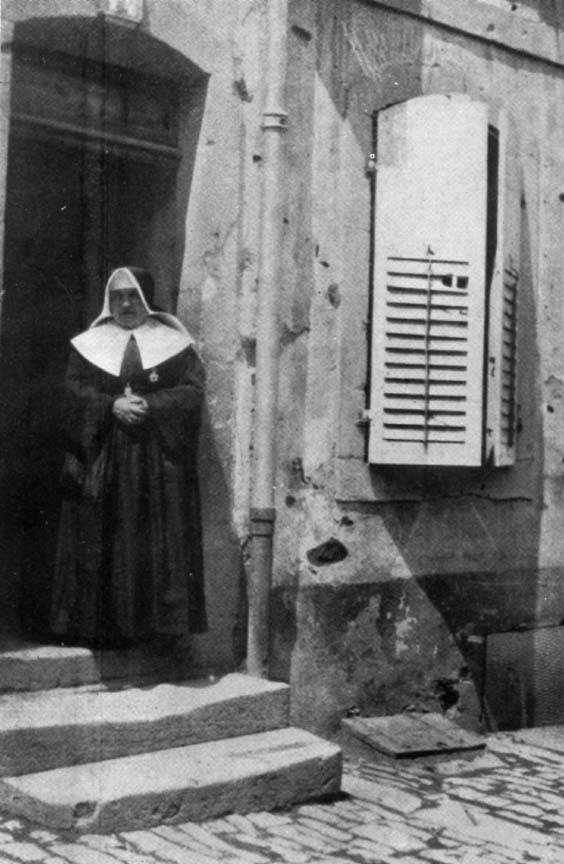
THIS is the story of Sister Julie. The Germans entered her village of Gerbéviller, where she was head of the poor-house and hospital. As they came southward through the place they burned every house on every street, 475 houses. In a day they wiped out seven centuries of humble village history. In her little street they burned Numbers 2, 4, 6, 8, 10, and 12, but they did not burn Number 14, the house where Sister Julie lived. There they stopped, for she stopped them. And the twenty houses beyond her hospital still stand, because that August day there was a great woman in that little village. They killed men, women and children throughout the village, but they did not kill the thirteen French wounded soldiers whom she was nursing, nor the five Roman Catholic sisters whom she directed as Mother Superior. Outside of a half dozen generals, she is perhaps the most famous character whom the war has revealed, and one of the greatest personages whom France has produced: even France in her long history. The last days of Gerbéviller live in her story. I write her account word for word as she gives it. Her recital is touched with humor in spite of the horror that lay heaped around her. She raises the poignard of the German Colonel: you see it held over her head ready to strike. By pantomime she creates the old paralytic men, the hobbling women, the man who went "fou."
Because she remained through the days of fire and blood, and succored his troops, General Castelnau cited her in an Order of the Day. The Legion of Honor has placed its scarlet ribbon on the black of her religious dress. The great of France---the President and the Premier, senators and poets---have come to see her where she still lives on in the ruins of the little village.
The first woman of France: the peasant Sister Julie, wearing the ribbon of the Legion of Honor. She held up the German Army and saved the wounded French in her hospital.
Amélie Rigard, whose religious name is Sister Julie, is a peasant woman, sixty-two years old, belonging to the Order of Saint Charles of Nancy. She is of the solid peasant type, with square chin and wide brown eyes. Everything about her is compact, deep-centered, close-growing; the fingers are stubby, the arms held closely to the body, and when the gesture comes it is a strong pushing out from the frame, as if pushing away a weight. Whenever she puts out power, she seems to be delivering a straight blow with the full weight of the body.
With Sister Julie it is not only a genius of simple goodness. She carries a native shrewdness, with a salient tang. She knows life. This is no meek person, easily deceived by people, thinking every one good and harmless. She reads motives. Power is what I feel in her---direct, sheer power. The wonder is not that she rose to one of the supreme crises of history, and did a work which has passed into the consciousness of France. The wonder is that she remained hidden in a country village for sixty-two years. Her gift of language, her strength of nature, had vitality enough to burn through obscurity. The person she made me think of was that great man whom I once knew, Dwight Moody. Here was the same breadth of beam, the simplicity, the knowledge of human nature, the same native instinct for. the fitting word that comes from being fed on the greatest literature in the world, and from using the speech of powerful, uneducated persons. When she entered the room, the room was filled. When she left, there was a vacancy.
Here follows the account in her own words, of the last days of Gerbéviller. The phrase that speaks through all her recital is "feu et sang," "fire and blood." The Germans said on entering that they would give "fire and blood" to the village. The reason was this: A handful of French chasseurs, about sixty in number, had held up the German Army for several hours, in order to give the French Army time to retreat. This battle had taken place at the bridge outside the village. When at last the Germans broke through, they were irritated by the firm resistance which had delayed their plans. So they vented their ill-will by burning the houses and murdering the peasants.
The Germans reached the Lunéville road at the entrance of Gerbéviller at 10 minutes after seven in the morning. They saw the barricades, for our troops had built a barricade, and they said to a woman, Madame Barthélemy:
"Madame, remove the barricades." As she waited undecided for a few seconds, they said:
"You refuse. Then fire and blood."
They then began to set fire to all the houses and they shot six men. They threw a man into an oven, a baker, Joseph Jacques, a fine fellow of fifty years of age, married, with children. It was necessary to eat, even at Gerbéviller, and it was necessary to work out a way to make bread. The former baker had been mobilized, and his good old papa was infirm and unable to work. So Monsieur Jacques was busy at this time with the baking. They killed him when they came. It was about eight o'clock in the morning. The fires of the oven had already started. For a long time I did not believe it, but I have had a confirmation since. You will see how by what follows. When there was an attack in Champagne, a youth of Gerbéviller, Florentin, whose father was the gardener at the château, found himself in front of certain Germans who wished to give themselves up as prisoners. He looked at them, and said:
"You are not 'Comrades' ('Kamerade' is the word the German calls out when he surrenders). You know what you did at Gerbéviller. So don't call yourselves 'Comrades.' "
A German said to him, "It was I who flung the man into the oven. I was ordered to do it, or else I should have been 'kaput."' (This is slang for a "dead one").
A search was then made, and in the oven was found the thigh bone of the unfortunate baker.
I have seen many other things. I have seen a man, Barthélemy of Chanteheux. I have seen that man spread out spitted on the ground by a bayonet.
Here is what they have done. It was half-past six in the evening. I heard their fifes. Our little chasseurs had retreated. The Germans had made fire and blood all the day long. I saw them and watched them well in this street. I was at the door. Yes, there were six of us at this door. They put fire to the houses, house by house, shouting as they burned them. Picture to yourself a human wave, where the bank has been broken down. They poured into the street precipitately, with their "lightning conductors," which shone brilliant in the sun (the point of their helmets). They sat down, seven and eight in front of a house. They kept going by in great numbers, but these who were ordered remained behind in front of each house. There these sat before the houses, while those others went past with out a word. They put their knapsacks on the ground. They took out something that looked like macaroni. They hurled it into the house. There wasn't a pane of glass left in our windows, because of the pom-pom of cannon on the Fraimbois road. I saw them ordered to go on with their work of firing the houses, when they coolly stopped for a tiny minute to talk. Then, afresh, I saw them look in their knapsacks, and next I heard a detonation. But it was not a detonation like that of the report of a rifle or revolver. This was like the crackle of powder priming, of crackers, if you prefer. They were incendiary pastilles which they had thrown into the fire to hasten the destruction. At the end of a few minutes the fire picked up with greater intensity, and directly the roofs broke in one after the other with a crash. Many of our people did not see the burning, because they stayed in the cellars, lying hidden there, frightened, under the rubbish. In one of the burning houses a woman was living in her room on the first floor. Two Germans came to our house and said:
"My sister, come quick and look for a woman who is in the fire."
The woman was Madame Zinius. It is our sisters who went there at their risk and peril.
The Germans had their destruction organized. In all the well-to-do houses they began by plundering. They did not burn these as they passed.
A few minutes later we saw five or six vehicles draw up, the "Guimbardes," vans, for plundering and carrying away the linen and the clothing. Women came with these vans, young women, well. dressed, rich enough. They were not "bad."
[When the Germans captured a town, their organization of loot was sometimes carried out by women, who brought up motor lorries, which the soldiers filled with the plunder from the larger houses, and which the women then drove away. Sometimes these women were dressed as Red Cross nurses. I can continue the proof by other witnesses elsewhere than in Gerbéviller. The organization of murder, arson and pillage is participated in by German men and women.]
Monsieur Martin had at his place many sewing machines, with the trade-mark Victoria. The Germans carried them away.
I have told you that they threw persons into the fire. Monsieur Pottier was forced back into the fire.. His wife moaned and called for help.
"Help me get my husband out of the fire," she cried.
"Go die with him," they answered her, and she, too, was pushed into the flames.
"They" kept coming on, playing the fife. We awaited them at the door. Only thirteen wounded French soldiers had stayed with us. They had been scattered through the different rooms. But we put them up in one room in order to simplify the service and give them a bit of "coddling."
We saw four officers on horseback approach. They dismounted in front of our town-hall, twenty meters away. They entered the building, and there they put everything upside down. They tumbled out all the waste paper, the entire office desk, determined to find the records.
They remounted and rode up in front of our house. They sat there looking at us for a moment. They had the manner guttural and hard, which is the German way. They began speaking German. When they showed signs of listening to my reply, I said to them:
"Speak French. That is the least courtesy you can show me. Speak French, I beg of you, and I will answer you."
"You have French soldiers hidden in your house with their arms," said one of them.
And he tramped hither and thither like a madman, and he sputtered and clattered. (Et il se promenait de long en large comme un fou, et il bavait et degoisait.)
I answered:
"We have no French soldiers here---"
The German: "You have French soldiers."
"Yes, we have French soldiers, but they are wounded. They have no arms."
One of them, mighty, with a truculent air, pulled out his sword.
"They have their arms," he shouted, and he brandished his sword.
"They won't hurt you. Enter," I said.
A Lorraine to say to a German "Enter," that means mischief. (Un Lorraine dire à un Allemand "Entrez": Que cela fait mal!)
Two of the officers dismounted. Each of them hid a dagger somewhere in his breast. That thought that they could harm my poor little wounded men made me turn my look a few seconds on the action. And as they took out their revolvers at the same time, I did not see where they had hidden the daggers.
The finger on the trigger, they nodded their head for me to go on in front of them. I went in front and led the way into this room where there was nothing but four walls, and no furniture except the thirteen beds of my wounded. I entered by this door, not knowing in the least what they wanted to do. Imagine this room with the first bed here, and then the second here, et cetera, et cetera. I went automatically to the first and, more involuntarily still, placed my hand on the bed of wounded Number One, a dragoon wounded by a horse.
See, now, what took place: the imposing one of them walked in with his dagger in his left hand (son poignard, la gauche); the other man with his revolver was there, ready. With his dagger in his left hand, the first man stripped the bed for its full length, lifting the sheet, the coverlet and the bedclothes. He looked down in a manner evil, malevolent, ill-natured (méchante, malveillante, mauvaise).
No response from the wounded men.
He did not say anything when he had seen what he wished to see. He stepped up to the head of the wounded man. I made a half turn toward him. I was separated from him by our wounded man who was between the two of us.
He said to my poor unfortunate, with a harsh gesture:
"You and your men, you make our wounded suffer on the battlefield. You cut off their ears. You put out their eyes. You make them suffer."
Still no response. (Pas réponse encore.)
When I saw the state of mind he was in, I went round at once on the left side of the wounded, and I said:
"This is a wounded man, and this place is the Red Cross. Here we do well for all and ill for none, and if you mean well, do not hurt us. Leave us in peace as you do everywhere else. We will nurse your wounded and nurse them well."
He had turned around to watch the smoke of the fires which was pouring into the room through that opening, and he stood there several seconds with set face.
My little wounded men hardly ventured to breathe. Seeing that calm, that brooding which did not bode anything good, I exerted myself to repeat once more:
"If you mean well, do not hurt us. We will nurse your wounded."
And, at last, to help him come out of his speechlessness:
"See, there, everything is on fire over there."
He answered me:
"We are not barbarians. No, we are not barbarians. And if the civilians had not fired on us with rifles, we should not have had any burning here."
"Those were not civilians. Those were soldiers."
"Civilians," he said.
"No. No. No. Soldiers."
"Civilians," he repeated; "I know well what I am saying. I saw them."
He made a gesture to show me that men had fired, while he cried in my ears with all his might "Civilians."
He went in front of me, and stripped the second bed. I feared that he might speak to my wounded, and I thought I should do well if I placed myself at the head of each of the beds as he uncovered them. I stepped between the two beds, and I feared what would come of it all. In this way I made the round of the room with them, standing at each of the thirteen points, always placing myself at the pillow of each wounded man, while "they" advanced bed by bed, and cautiously.
I did not know how they had arranged their weapons, but it seemed to me that they always had their finger placed on the trigger.
The second man with his revolver held his gun a little low.
I followed them, shutting the door, when they went to the Infirmary of the old men. They did not say anything and they did not promise that they would not set fire to us. How should I go about getting that promise?
A third time I asked them:
"It is clearly understood that we shall nurse your wounded, and that you will not burn this house."
"They" start to leave, and go toward the door, walking slowly. When the chief was just leaving, I said again to him:
"It is clearly understood that you will not harm us nor burn our house."
"No, no."
I looked to see if he gave the order to any of his soldiers. I didn't see that, but I noticed one of our sisters who was drawing a wheelbarrow with an old man in it, who weighed at least seventy-five kilos and who was paralyzed.
"Where are you going!" I asked her.
"Over there; the soldiers tell me that they are coming to set fire to the hospital," she replied. "One of our old men cried out to me, 'My sister, do not make us stay here. Let us go and die in peace, since they are killing everybody here. We would rather leave and die of hunger in the fields.' So I said, 'Come along, then."'
For the moment I am all alone in this room with my thirteen wounded men. I said to myself, "My God, what will become of me all alone in the midst of fire and blood."
I stood a few seconds in the doorway and then went in to see our little soldiers.
"My poor children, I ask your forgiveness for bringing in such a visitation, but I assure you that I thought my last quarter hour had come. I thought they were going to kill us all."
"My sister, stay with us," they said; "stay with us.
"I will bear the impossible, my children, to save your life."
I remained there a few minutes, and then two German soldiers presented themselves with fixed bayonets. I stepped down the two stairs; see what an escort was there for me!
"Why is this house shut up? There are French in it, lying hidden with their arms."
"The owner has been mobilized, and so has gone away. His wife and children have gone away."
They kept on insisting: "The French. Hidden. In there."
They indicated the place with a gesture.
I thought to myself, What is happening? What will they do! Here are the men who will set fire to the house.
"Why will you set fire to this house?" I asked. "Your chiefs don't wish it. They have promised me that they won't burn here. You want to set fire here out of excitement (par contagion). Will you put out the fire?"
I said again to them:
"It is wicked to set fire here, because we shall nurse your wounded."
While this was going on, our sisters upstairs were not able to subdue the poor father Prévost. He is an old man of eighty-eight years, partly paralyzed in leg and arm. I was at the doorway. I heard him call out:
"They shoved me into the fire. They have gone away and left me. I am going to fall out of the window."
I climbed to the fourth floor of the house where he was, to try to attract him away, but he did not wish to come. He was foolish. I knew that he was fond of white sugar. I went up to him and showed him the sugar. I took his jacket and put his snowboots on him, so that he could get away more quickly. You know those boots which fasten by means of two or three buckles, very primitive, and which are so speedily put on. At last I led him to the edge of the doorway here.
The Germans saw him and said: "It is a lunatic asylum, don't you see?" so they said to each other. "They want to kill the sisters. There is no need of going into that house. It is a lunatic asylum."
That is the reason, I believe, why they didn't come into the house during the night. They entered the chapel of the hospital.
While I was with the Germans, some of their like had come to our Infirmary to say:
"You must leave here because we are going to set fire."
They then said to the old people:
"We have orders to burn the Infirmary."
Among the number we had the poor mother André, Monsieur Porté, who walked hobbling like this; Monsieur Georget, who is hung on only one wire, and Monsieur Leroy, who isn't hung on any (qui ne tenait qu'à un fil, Monsieur Leroy qui ne tenait plus non plus).
[Sister Julie limped across the room. She bent her back double. She went feeble. In swift pantomime she revealed each infirmity of the aged people. She created the picture of a flock of sick and crippled sheep driven before wolves.]
At four o'clock they were led away to Maréville. Those of whom I tell you died in the course of the year. Death came likewise to seven others who would not have died but for that.
The next morning we had German wounded. No one to care for them. What to do? I said to a wounded Lieutenant-Colonel:
"You have given us many wounded to tend. Where are your majors?"
See what he answered me. "They have abandoned us."
That evening this Lieutenant-Colonel said to me in a rough voice:
"Some bread, my sister."
"You haven't any bread?" I said. "You have burned our bakery and killed our baker in it. You have burned our butcher shop with our butcher in it. And now you have no bread and no meat. Eat potatoes as we have to."
He was hit in the calf of the leg, but the leg bone was not touched, nor the femur; it was not a severe wound. He unrolled his bandage and showed me his treatment, assuming an air of pain.
"Aie! Aie!" he cried.
Ah! "They" are more soft (douillets) than our poor little French. I began to dress his leg.
"It is terrible, my sister, this war. Terrible for you and for us also. If the French were the least bit intelligent, they would ask for peace at once. Belgium is ours. In three days we shall be at Paris."
The bandage tightened on his wound. "Ah," he said.
I replied to him: "It is your Kaiser who is the cause of all this."
"Oh, no. Not the Kaiser. The Kaiser. Oh, the Kaiser." As he pronounced the word "Kaiser," he seemed to be letting something very good come out of his mouth, as if he were savoring it.
The bandage went round once more. "Ah," he said.
"It is then his son, the Crown Prince, who is responsible?" I continued.
"Not at all. Not at all; it is France."
"France is peace-loving," I replied.
"It is Serbia, because the Austrian Archduke was killed by a Serbian."
The 29th or 30th of the month shells fell occasionally over our roof. My famous wounded German was frightened.
"My sister, I must be carried to the cellar at once."
"There's no danger. The French never fire on the Red Cross," I said to him.
"I am a poor wounded man. So carry me to the cellar."
I gave in. I carried him to the cellar, and he stayed there some days.
DURING the days of fire and blood Sister Julie was acting mayor of Gerbéviller. It was no light job, for she had to steer an invading army away from her hospital of wounded men, and she was the source of courage for the village of peasants, who were being hunted and tortured. Many months have passed, and nothing is left of those days but crumbled stone and village graves and an everlasting memory. But she is still the soul of Gerbéviller. Pilgrims come to her from the provinces of France, and give her money for her poor and sick. The village still has need of her. I saw her with the woman whose aged mother was shot before her eyes, and with the mother whose little boy was murdered.
She went on with her story:
SISTER JULIE'S STORY As soon as the Germans came they began their work by taking hostages, the same number as that of the municipal councilors. They led them all away to the end of town by the bridge, on the road which leads to Rambervillers. A German passed, and when he saw them he shouted out:
"See the flock of sheep. They are taking you away to be shot." And he pointed out to them with his fingers the place of their torment.
In the morning four or five officers arrived to hear testimony from some of the men. It was Leonard, the grocer, who told me that four persons were questioned.
"Stand there, "They" said to them.
"Which is the one who lives next door to the hospital ?" an officer asked.
Leonard stepped forward.
"Is it not true that the Lady Superior of the Hospital organized her people for the purpose of firing on our wounded with rifles!"
Leonard replied:
"I am sure that it is not so. And even if she were to order it, they would not obey."
"Do you know what you are in danger of in telling lies ? We have seen the bullets come from the hospital. We are sure. Go write your deposition."
"I can't do it," answered Leonard.
He was forced to write his deposition. When he had finished it, he presented it to the chief.
"Sign it, and follow me. I am sure that I saw bullets come from that part of the street. Certainly men were there who fired on our chiefs."
They also said to him that our chasseurs had fired on them from the chateau of Madame de Lambertye, and they themselves went to get a statement at the spot to see if it was possible to hit a man from the chateau and kill him.
I had seen the turrets of the chateau of Lambertye burning about half-past nine in the morning and all the upper part. That was by incendiary bombs. The day after the fires we saw empty cans, about sixty of them, the kind used for motor-car gasoline, lying about in the garden of the chateau.
Besides all that, there are still the bodily indignities which must not be passed over in silence. The twenty-fourth and twenty-fifth, "they" used fire and blood. The following days "they" amused themselves by teasing everybody. The poor Monsieur Jacob, who makes lemonade, was struck and thrown to the ground. Then they spit in his face, and threatened to shoot him, without any reason.
They were drunk with the wine of Gerbéviller, if one is to judge from their helmets, which had lost their lightning conductors.
The sacred images of the church were not respected. It was the evening of the twenty-ninth. A soldier-priest, Monsieur the Abbé Bernard, went to see a tiny bit of what was taking place.
"Do you know, My sister, what has been done to the ciborium (sacred vessel for the sacrament) ?"
I went with him. We came to the church. We entered with difficulty. A bell blocked us from passing, and shells had broken down the vaulting in many places. We went on our way, but always with difficulty. We saw the crucifix which had the feet broken by blow on blow from the butt-end of rifles. We still went on, and saw the pipes of the organ lying on the ground. We came in front of the tabernacle (the box which holds the sacred vessels). There we counted eighteen bullet holes which had perforated the door around the lock. The displacement of air produced by the bursting of the bullet had forced the screws to jump out. "They" had not thought that this little dwelling-place was a strongbox and that it had flat bolts, both vertical and horizontal. We were now agitated to see if anything else had taken place in the tabernacle.
Monsieur, the Abbé Bernard, took a hammer, and as gently as he could he succeeded in making a little opening just large enough for one to see that there was something else inside. With the barrel of an unloaded gun, he then made a full opening. The ciborium, the sacred vessel, was uncovered and had been projected against the bottom. The cover, fallen to one side, had a number of bullet marks, as the ciborium itself had.
The bullets in penetrating the front of the tabernacle had made everywhere little holes, and these holes were in a shape nearly symmetrical around the lock. At the rear there were many much larger holes.
Monsieur, the Abbé, took those sacred things and the cover of the altar and carried them to the chapel.
The 17th and the 60th Bavarian Regiments were the ones that did this work. One-third at least of these men were protestant, and among them were many returned convicts.
One of our sisters saw a book of a German officer who was nursed here, and noticed that he was from Bitsch.
(Bitsch is a Roman Catholic town in Lorraine which long belonged to France, and which held out against the Germans almost to the end of the Franco-Prussian War).
"How is this?" she asked. "You are from Bitsch, and yet it is you who dare to do the things that you have done."
"We are under orders," he answered. "The further we go into France, the worse we shall do. It is commanded. Otherwise we shall be killed ourselves."
Let us return to the Germans who were applying fire and blood. They led away fifteen men, old men, to a shed at about quarter past ten. Later they made them leave the shed. General Clauss, who was in command of two regiments, was sitting under the oak tree which you will be able to see on your return trip. He was in front of a table charged with champagne, and was drinking, during the time that his soldiers were arranging the poor unhappy old men, getting them ready to be shot. They had bound them in groups of five, and they shot them in three batches. They now lie buried in the same spot.
The General said: "When I have filled my cup and as I raise it to my lips, give them fire and blood."
We said good-by to Sister Julie. I walked down the street to the ruins of the chateau of Lambertye. Sister Julie has told of the empty gasoline cans that were left in the garden of the chateau. They had served their purpose well: I stepped through the litter that was once a beautiful home. But there was one work which flaming oil could not do. I went into the garden, and came to the grotto of the chateau. It is a lovely secret place, hidden behind a grove, and under the shadow of a great rock. It glows red from the fundamental stone of its structure, with jewel-like splinters of many-colored pebbles sunk in the parent stone. Fire, the favorite German instrument for creating a new world, could not mar the stout stone and pebbles of the little place, but such beauty must somehow be obliterated. So the careful soldiers mounted ladders and chipped to pieces some of the ceiling, painfully with hammers. The dent of the hammers is visible throughout the vaulting. The mosaic was too tough even for their patience, and they had to leave it mutilated but not destroyed.
Several times in Gerbéviller we see this infinite capacity for taking pains. The thrusting of the baker into his own oven is a touch that a less thoughtful race could never have devised. When they attacked the tabernacle containing the sacramental vessel of the Roman Catholic church, Sister Julie has told how they placed the eighteen bullets that defiled it in pattern. The honest methodical brain is behind each atrocity, and the mind of the race leaves its mark even on ruins.
Finally, when they shot the fifteen white-haired old men, the murders were done in series, in sets of five, with a regular rhythm. I can produce photographs of the dead bodies of these fifteen old men as they lay grouped on the meadow. We stood under the oak tree where the officer sat as he drank his toasts to death. We looked over to the little spot where the old men were herded together and murdered. Leon Mirman, Prefect of Meurthe-et-Moselle, said to us as we stood there:
"I, myself, came here at the beginning of September, 1914. Fifteen old men were here, lying one upon the other, in groups of five. I saw them, their clothes drooping. One was able to see also by their attitude that two or three had been smoking their pipes just before dying. Others held their packets of tobacco in their hands. I saw these fifteen hostages, fifteen old men, some ten days after they had been killed; the youngest must have been sixty years of age.
"We shall set up here a commemorative monument which will tell to future generations the thing that has taken place here."
For centuries the race has lived on a few episodes, short as the turn of a sunset. The glancing helmet of Hector that frightened one tiny child, the toothless hound of Ulysses that knew the beggar man---always it is the little lonely things that shake us. Vast masses of men and acres of guns blur into unreality. The battle hides itself in thick clouds, swaying in the night. But the cry that rang through Gerbéviller does not die away in our ears. Sister Julie has given episodes of a bitter brevity which the imagination of the race will not shake off. It is impossible to look out on the world with the same eyes after those flashes of a new bravery, a new horror. I find this sudden revelation in the lifting of the cup with the toast that signed the death of the old men. The officer was drinking a sacrament of death by murder. It is as if there in that act under the lonely tree in the pleasant fields of Gerbéviller the new religion of the Germans had perfected its rite.
That rite of the social cup, held aloft in the eyes of comrades, has been a symbol for good will in all the ages. Brotherhood was being proclaimed as the host of the feast looked out on a table of comrades. At last in the fullness of time the rite, -always honored, was lifted into the unassailable realm of poetry, when one greater man came who went to his death blithely from the cup that he drank with his friends. There it has remained homely and sacred in the thought of the race.
Suddenly under the oak tree of Gerbéviller the rite has received a fresh meaning. The cup has been torn from the hands of the Nazarene. By one gesture the German officer reversed the course of history. He sat there very lonely, and he drank alone. The cup that he tasted was the death of men.
It is no longer the lifting of all to a common fellowship. It no longer means "I who stand here am prepared to die for you": pledge of a union stronger even than death. It is suddenly made the symbol of a greater gospel: "I drink to your death. I drink alone."
IN the month of November, 1915, the "American Hostels for Refugees" were founded by Mrs. Wharton and a group of American friends in Paris to provide lodgings and a restaurant for the Belgians and French streaming in from burning villages and bombarded towns. These people were destitute, starving, helpless and in need of immediate aid. The work developed into an organization which cares permanently for over 4,000 refugees, chiefly French from the invaded regions. A system of household visiting has been organized, and not even temporary assistance is now given to any refugee whose case has not been previously investigated. The refugees on arrival are carefully registered and visited. Assistance is either in the form of money toward paying rent, of clothing, medical care, tickets for groceries and coal, tickets for one of the restaurants of the Hostels, or lodgings in one of the Model Lodging Houses. Over 6,000 refugees have been provided with employment.
There are six centers for the work. One house has a restaurant where 500 meals a day are served at a charge of 10 centimes a meal, and an "Ouvroir" where about 50 women are employed under a dressmaker, with a day-nursery, an infant-school, a library and recreation room. Another center is a Rest-house for women and children requiring rest and careful feeding. Young mothers are received here after the birth of their children, and children whose mothers are in hospital. Sixty meals a day are served here with a special diet for invalids. Another center contains a clothing depot, which has distributed nearly 100,000 garments, including suits of strong working clothes for the men placed in factories; layettes, and boots. In the same building are Dispensary and Consultation rooms. Twenty to thirty patients are cared for daily at the Dispensary. Another house contains the Grocery Depot, and another the office for coal-tickets. An apartment house, and two other houses have been made into lodging houses. The apartment lets out rooms at rents varying from 8 to 15 francs a month. One of the houses contains free furnished lodgings for very poor women with large families of young children. These three houses have met the need of cheap sanitary lodgings in place of damp, dirty rooms at high rents, where sick and well were herded together, often in one filthy bed.
Such is the work of the "American Hostels for Refugees." The present cost of maintaining all the branches of this well-organized charity is about five thousand dollars a month.
Mrs. Wharton has also established "American Convalescent Homes for Refugees." Many refugees come broken in health, with chronic bronchitis and incipient tuberculosis and even severer maladies. Seventy-one beds are provided. There is also a house where 30 children, suffering from tuberculosis of the bone and of the glands are being cared for. Four thousand dollars a month should be provided at once for this work.
At the request of the Belgian Government Mrs. Wharton has founded the "Children of Flanders Rescue Committee." The bombardment of Furnes, Ypres, Poperinghe and the villages along the Yser drove the inhabitants south. The Belgian Government asked Mrs. Wharton if she could receive 60 children at 48 hours' notice. The answer was "yes," and a home established. Soon after, the Belgian Government asked Mrs. Wharton to receive five or six hundred children. Houses were at once established, and these houses are under the management of the Flemish Sisters who brought the children from the cellars of village-homes, from lonely farmhouses, in two cases from the arms of the father, killed by a fragment of shell. Lace-schools, sewing and dress-making classes, agriculture and gardening are carried on. Seven hundred and thirty-five children are cared for. The monthly expense is 8,000 francs.
One of the most important charities in which Mrs. Wharton, Mrs. Edward Tuck, and Judge Walter Berry are interested, is that for "French Tuberculous War Victims," in direct connection with the Health Department of the French Ministry of War. Nearly 100,000 tuberculous soldiers have already been sent back from the French front. They must be shown how to get well and receive the chance to get well. One hospital is already in operation, and three large sanatoria are nearing completion, with 100 beds each. The object is not only to cure the sufferers, but to teach them a trade enabling them to earn their living in the country. Tuberculous soldiers are coming daily to the offices of this charity in ever-increasing numbers asking to be taken in. The answer will depend on American generosity.
A group of Americans, headed by Mrs. Robert Woods Bliss, whose husband is First Secretary of the American Embassy in Paris, have instituted and carried on a "Distributing Service" in France. The name of the organization is "Service de Distribution Américaine." It was established on its present basis in December, 1914, and grew out of personal work done by Mrs. Bliss since the beginning of the war. The purpose has been to supply hospitals throughout France with whatever they need. By the end of 1916, the results were these:
| Number of towns visited | 11,290 |
| Number of hospitals inspected and supplied | 3,026 |
| Number of articles distributed | 4,839,902 |
The Director of the organization is Russell Greeley, the secretary of Geoffrey Dodge. The service has a garage outside the gates of Paris with ten cars and a lorry. All the staff, except the stenographers and packers, are volunteers.
This work for the French is connected with the American Distributing Service for the Serbians, which was begun by sending the late Charles R. Cross, Jr., to Serbia as a member of the American Sanitary Commission headed by Dr. R. P. Strong, in the spring of 1915. Mr. Cross made an investigation of the situation in Serbia at that time from the, point of view of the American Distributing Service.
In January, 1916, Mrs. Charles Henry Hawes of the Greek Red Cross, wife of Professor Hawes of Dartmouth College, Hanover, being on her way to Italy and Greece for the purpose of conveying relief into Albania through Janina, offered her services to the Distributing Service for the convoying and distribution of supplies. Mrs. Hawes's offer was accepted and she was furnished with a small fund for the purpose of supplies. Events forestalled her, but she succeeded in landing and distributing to the last Serbians leaving San Giovanni di Medua, a thousand rations. At the same time she took an active part in relief work at Brindisi, and distributed about a thousand dollars' worth of supplies to the Serb refugees passing through that port.
Meanwhile the French Army Medical Service had created the "Mission de Coordination de Secours aux Armées d'Orient" for the purpose of distributing relief supplies to the Serbian and other Allied armies in the Balkans. A member of the Distributing Service was appointed a member of the Mission, and a fund of 100,000 francs placed at the disposal of the Distributing Service which thenceforward coöperated actively in the work of the Mission. Urgent representations of the need of help in Corfou having been made early in February to the Mission by the French Army Medical Service, Mrs. Hawes, representing the Distributing Service and the Mission jointly, was sent to Corfou where she established a soup kitchen and did other valuable relief work at Vido. She was later joined at Corfou by Countess de Reinach-Foussemagne, Infirmière Déléguée of the Mission. Through these two agents the Distributing Service sent to Corfou and distributed 197 cases of foodstuffs, clothing, and various articles needed, 5 cases of medicines and 40 tins of paraffine. The Service disbursed for similar purposes through Mrs. Hawes and Countess de Reinach, fifteen thousand francs in cash. It was also instrumental in erecting a monument at Vido to the Serbs who died there.
When the crisis at Corfou was at an end the field depôt of the Mission was moved to Salonica. There the Service distributed to Serbians various shipments of relief and hospital supplies: A total of 454 cases.
The Distributing Service now has ready and is preparing to send forward for the Serbian Army a laundry outfit, a disinfecting outfit and a complete field surgical outfit (portable house for operating room equipment and radiograph plant). A shipment is also going forward for Monastir where the field depôt of the Mission was established on November 22nd, of 5,000 francs' worth of foodstuffs and other urgently needed materials, and a larger quantity is being accumulated to be sent forward without delay.
In addition, the Distributing Service has sent about 2,000 kilos of hospital supplies to the Serbs in the Lazaret of Frioul, off Marseille, and a similar quantity of material to the hospitals at Sidi-Abdallah (Tunis), and elsewhere in Tunisia and Algeria, given over to the treatment of Serbians.
Mrs. Bliss and her friends have also conducted a work for "frontier children," dating from August, 1914, which has cared for French, Belgian and Alsatian children to the number of 1,500
THIS book is only a sign post pointing to the place where better men than I have suffered and left a record. For those who wish to go further on this road I give sources of information for facts which I have sketched in outline.
The full authoritative account of the American Ambulance Field Service will be found in a book called "Friends of France," written by the young Americans who drove the cars at the front. It is one of the most heartening books that our country has produced in the last fifty years. Much of our recent writing has been the record of commercial success, of growth in numbers, and of clever mechanical devices. We have been celebrating the things that result in prosperity, as if the value of life lay in comfort and security. But the story of these young men is altogether a record of work done without pay, under conditions of danger that sometimes resulted in wounds and death. Their service was given because France was fighting for an idea. Risk and sacrifice and the dream of equality are more attractive to young men than safety, neutrality and commercial supremacy.
Those who wish to assure themselves that a healthy nationalism is the method by which a people serves humanity will find an exalted statement in Mazzini's "The Duties of Man." A correction of his overemphasis is contained in "Human Nature in Politics," by Graham Wallas. Valuable books on Nationality have been written by Ramsay Muir and Holland Rose. Lord Acton's essay on Nationality in his "The History of Freedom and Other Essays" should be consulted. He shows the defects of the nation-State.
On the American aspects of nationality, Emile Hovelaque and Alfred Zimmern are the two visitors who have shown clear recognition of the spiritual weakness of our country, and at the same time have pushed through to the cause, and so offered opportunity for amendment. Hovelaque's articles in the Revue de Paris of the spring of 1916 I have summarized in the chapter on the Middle West. From Zimmern I have jammed together in what follows isolated sentences of various essays. This is of course unfair to his thought, but will serve to stimulate the reader's interest in looking up the essays themselves.
"There is to-day no American nation. America consists at present of a congeries of nations who happen to be united under a common federal government. America is not a melting pot. It does not assimilate its aliens. It is the old old story of the conflict between human instincts and social institutions. The human soul can strike no roots in the America of to-day. I watched the workings of that ruthless economic process sometimes described as 'the miracle of assimilation.' I watched the steam-roller of American industrialism---so much more terrible to me in its consequences than Prussian or Magyar tyranny---grinding out the spiritual life of the immigrant proletariat, turning honest, primitive peasants into the helpless and degraded tools of the Trust magnate and the Tammany boss. Nowhere in the world as in the United States have false theories of liberty and education persuaded statesmen on so large a scale to make a Babel and call it a nation."
And the remedy?
"Those make the best citizens of a new country who, like the French in Canada and Louisiana, or the Dutch in South Africa, bear with them on their pilgrimage, and religiously treasure in their new homes, the best of the spiritual heritage bequeathed them by their fathers."
Alfred Zimmern is the author of "The Greek Commonwealth," contributor to the "Round Table," and one of the promoters of the Workers Educational Association. Those who wish to get his full thought on Nationality should consult the pamphlet "Education and the Working Class," the volume "International Relationships in the Light of Christianity," and the Sociological Review for July, 1912, and October, 1915.
The most penetrating recent articles on the American democracy as opposed to the cosmopolitanism of the melting pot were written by Horace M. Kallen in issues of the New York Nation of February, 1915. Dr. Kallen is a Jewish pupil of the late William James, of outstanding ability, the spiritual leader of the younger generation of Jews. He has touched off a group of thinkers on the American problem, of whom one is Randolph Bourne.
Those interested in the interweaving of French and early American history should read the book by Ambassador Jusserand, called "With Americans of Past and Present Days."
A careful investigation of the myth-making machinery used by nations in war-time is given by Fernand van Langenhove in "The Growth of a Legend"---a study based upon the German accounts of francs-tireurs and "wicked priests" in Belgium. It is made up of German documents.
A fuller study of the German letters and diaries is contained in the pamphlets of Professor Joseph Bedier, the books of Professor J. H. Morgan, and the volumes by Jacques de Dampierre "L'Allemagne et le Droit des Gens" and "Carnets de Route de Combattants Allemands." After an examination of these German documents, no student will speak of German atrocities as "alleged." The most careful collection of testimony by eye-witnesses is that contained in the report of the French Government Commission, "Rapports et Procès-Verbaux d'Enquête." I have personally examined several of the witnesses to this report. They are responsible witnesses. Their testimony is accurately rendered in the Government record. I trust that some American of high responsibility, such as Professor Stowell, of the Department of International Law at Columbia University, will make an exhaustive study of the German documents held by the French Ministry of War.
For the peasant incidents in the last section of my book, I refer to the book by Will Irwin, "The Latin at War," as independent corroboration.
CERTAIN points in my testimony have been challenged by persons sitting in security, three thousand miles away from the invaded country, where at my own cost and risk I have patiently gathered the facts on which I have based my statements.
I have built my testimony on three classes of evidence.
First: The things I have seen. I have given names, places and dates.
Second: The testimony of eye-witnesses, made to me in the presence of men and women, well-known in France, England and America. These eye-witnesses I have used in precisely the same way in which a case is built up in the courts of law.
Third: The diaries and letters written by Germans in which they describe the atrocities they have committed. I have seen the originals of these documents.
It is noticeable that the specific fact has never been challenged. The date has never been found misplaced, the place has never been confused, the person has never been declared non-existent. The denial has always been in blanket form.
The New York Evening Post says: After the spy came the invasion, and after the invasion came the 'steam roller,' flattening out Belgium. This is all given in a general way."
It is given with exact specifications.
Clement Wood, in the Socialist paper, The New York Call, writes: "This book attempts more of a summing up of German offenses, and, being written to sustain an opinion rather than to give impartially the facts, correspondingly loses in interest and persuasiveness. Its usefulness to the general reader or the person who desires an unbiased understanding of the conflict is slight." He speaks of "the alleged German atrocities in Belgium."
My statements do not deal with opinion but with things seen. Apparently it is an offense to take sides on this war. One is a truthworthy witness if one has seen only picturesque incidents that do not reveal the method of warfare practiced by an invading army. One is fair-minded only by shutting the eyes to the burned houses of Melle, Termonde and Lorraine, and the dead bodies of peasants; and by closing the ears to the statements of outraged persons. One is judicial only by defending the Germans against the acts of their soldiers, and the written evidence of their officers and privates.
The Independent says: "He saw the wreck of the convent school, but learned none of the sisters had been harmed."
The critic selects that portion of my testimony on the convent school which relieves the Germans of the charge of rape. As always, I have given every bit of evidence in favor of the Germans that came my way. I have told of the individual soldier who was revolted by his orders. I have published the diaries of German soldiers which revealed nobility. But is that scrupulous care of mine a justification to the Independent for omitting to tell the humiliations visited on that convent school?
My testimony of bayonetted dying peasants is "credible in so far as no testimony from the other side was obtainable."
"Mr. Gleason also saw the ruins of bombarded Belgian cities."
Is it fair of the Independent to be inaccurate? My evidence is not of bombarded Belgian cities. It is of Belgian cities, burned house by house, with certain houses spared where "Do not burn by incendiary methods" was chalked on the door.
"Otherwise his evidence is at second or third hand mainly."
On the contrary, I have quoted witnesses whom I can produce.
The Times, of Los Angeles, says: "He is quite rabid. He writes with the frenzy of a zealot."
I do not think the colorless recitation of facts, fortified by name, place and date, is rabid or frenzied.
The Literary Digest says: "Of the 'atrocities' in Belgium, we find reports of a 'friend,' or a 'friend's friend,' or what 'some one saw or heard.'"
I have told what I myself saw and heard.
"Fair-minded readers will be inclined to reserve judgment."
But in the light cast by eye-witnesses and German diaries, we have reserved judgment too long. Our American Revolution would have been a drearier affair, if the French had reserved judgment. In a crisis the need is to form a judgment in time to make it tell for the cause of justice. Truth-seeking is a living function of the mind.
Another critic says: "By careful reading one sees that, while it pretends to give real evidence, there isn't any that is real except where not essential. Mr. Gleason attempts to belittle the stories of priests inciting girls to deeds of violence."
I do not attempt to belittle those stories. I disprove them on the evidence given by German generals, whose names I cite. Because I defend Roman Catholic priests from slander does not mean that I am anti-Protestant. Because I prove that Belgium and France have suffered injustice does not mean that I am anti-German. I went over to find out whether Belgian and French peasants, old men, women and children, were a lawless, murderous mob, or whether the German military had sinned in burning their homes and shooting the non-combatants. Neutrals can not have it both ways---either the peasants were guilty, or the German Army was guilty. I found it was the German Army that had sinned.
This critic goes on to say: "Only a few years ago the entire world was shocked by the horrible atrocities carried on in the Congo."
Evidently those atrocities were proved to his satisfaction. But was the case not established by the same process I have used---personal observation, documentary proof, and the testimony of eye-witnesses ?
The Post-Dispatch, of St. Louis, says: "Gleason in trying to make out a strong case against Germany goes too far. He is too venomous. It will be a hard thing to convince neutral Americans that German soldiers maliciously ran their bayonets through the backs of girl children. The volume would be of much greater historical value if Gleason had used his head more and his heart less." Dr. Hamilton, in The Survey, makes the same point.
In my testimony I detail my evidence, and they who deny it rest, on general statements. I assure them it is not in lightness that I record these conclusions about the German Army. I have gone into the zone of fire to bring out German wounded. I have taken the same hazards as thousands of other men have taken to save German life. Does venom act so ?
I find in these criticisms an underlying assumption, a mental attitude, toward war, and therefore toward facts about war. Some of these periodicals are sincere pacifists. In the cause of social reform, in their several and very different ways, they have served the common good., But because they believe war is the worst of all evils, they assume that both sides are equally guilty or equally foolish. It is not a mental attitude which leaves them open-minded. I want to ask them on what body of facts they base their criticism. Were they present in Belgium at the moment of impact? Has the German Government provided them with detailed documentary proof that in the villages I have mentioned, on the dates given, the persons I have named were not burned, were not bayonetted? Have they examined the originals of the German diaries and found that I have omitted or altered words? Have they spent many days in Lorraine taking testimony from curé and sister and Mayor and peasant? Has that testimony shown that the destruction and murder did not take place? Has Leon Mirman, Prefect of Meurthe-et-Moselle, given them a statement in which he retracts what he said to me?
Several of these critics happen to be personal friends. It would be impossible to write in resentment of anything they say. I am not interested in making out a case for myself. But I am very much interested in inducing my fellow countrymen to accept the facts of the present world struggle. My books about the war have been written with one purpose only---to bring home to Americans the undeserved suffering of Belgium and France. To do that I need the help of all men of good will. I ask them not to break the force of the facts which I have patiently collected, by the carelessness which calls systematically burned cities "bombarded" cities, and by the mental attitude which finds me "rabid," when I have given every favoring incident to German soldiers that I could find. I have spent nearly two years in observing the facts of this war. Against my desires, my pre-war philosophy, my hopes of internationalism, I was driven by the facts to certain conclusions.