
Germany uses three methods in turning a free nation into a vassal state. By a spy system, operated through years, she saps the national strength. By sudden invasion, accompanied by atrocity, she conquers the territory, already prepared. By continuing occupation, she flattens out what is left of a once independent people. In England and North America, she has used her first method. France has experienced both the spy and the atrocity. It has been reserved for Belgium to be submitted to the threefold process. I shall tell what I have seen of the spy system, the use of frightfulness, and the enforced occupation.
It is a mistake for us to think that the worst thing Germany has done is to torture and kill many thousands of women and children. She undermines a country with her secret agents before she lays it waste. In time of peace, with her spy system, she works like a mole through a wide area till the ground is ready to cave in. She plays on the good will and trustfulness of other peoples till she has tapped the available information. That betrayal of hospitality, that taking advantage of human feeling, is a baser thing than her unique savagery in war time.
During my months in Belgium I have been surrounded by evidences of this spy system, the long, slow preparedness which Germany makes in another country ahead of her deadly pounce. It is a silent, peaceful invasion, as destructive as the house-to-house burning and the killing of babies and mothers to which it later leads.
The German military power, which is the modern Germany, is able to obtain agents to carry out this policy, and make its will prevail, by disseminating a new ethic, a philosophy of life, which came to expression with Bismarck and has gone on extending its influence since the victories of 1870-'71. The German people believe they serve a higher God than the rest of us. We serve (very imperfectly and only part of the time) such ideals as mercy, pity, and loyalty to the giver of the bread we eat. The Germans serve (efficiently and all the time) the State, a supreme deity, who sends them to spy out a land in peace time, to build gun foundations in innocent-looking houses, buy up poverty-stricken peasants, measure distances, win friendship, and worm out secrets. With that information digested and those preparations completed, the State (an entity beyond good and evil) calls on its citizens to make war, and, in making it, to practise frightfulness. It orders its servants to lay aside pity and burn peasants in their homes, to bayonet women and children, to shoot old men. Of course, there are exceptions to this. There are Germans of the vintage of '48, and later, many of them honest and peaceable dwellers in the country which shelters them. But the imperial system has little use for them. They do not serve its purpose.
The issue of the war, as Belgium and France see it, is this: Are they to live or die? Are they to be charted out once again through years till their hidden weakness is accurately located, and then is an army to be let loose on them that will visit a universal outrage on their children and wives? Peace will be intolerable till this menace is removed. The restoration of territory in Belgium and Northern France and the return to the status quo before the war, are not sufficient guarantees for the future. The status quo before the war means another insidious invasion, carried on unremittingly month by month by business agents, commercial travelers, genial tourists, and studious gentlemen in villas. A crippled, broken Teutonic military power is the only guarantee that a new army of spies will not take the road to Brussels and Paris on the day that peace is signed. No simple solution like, "Call it all off, we'll start in fresh; bygones are bygones," meets the real situation. The Allied nations have been infested with a cloud of witnesses for many years. Are they to submit once again to that secret process of the Germans?

The French, for instance, want to clear their country of a cloud which has been thick and black for forty-three years. They always said the Germans would come again with the looting and the torture and the foulness. This time they will their fight to a finish. They are sick of hate, so they are fighting to end war. But it is not an empty peace that they want---peace, with a new drive when the Krupp howitzers are big enough, and the spies in Paris thick enough, to make the death of France a six weeks' picnic. They want a lasting peace, that will take fear from the wife's heart, and make it a happiness to have a child, not a horror. They want to blow the ashes off of Lorraine. Peace, as preached by our Woman's Peace Party and by our pacifist clergy and by the signers of the plea for an embargo on the ammunitions that are freeing France from her invaders, is a German peace. If successfully consummated, it will grant Germany just time enough to rest and breed and lay the traps, and then release another universal massacre. How can the Allies state their terms of peace in other than a militant way? There is nothing here to be arbitrated. Pleasant sentiments of brotherhood evade the point at issue. The way of just peace is by "converting" Germany. There is only one cure for long-continued treachery, and that is to demonstrate its failure. To pause short of a thorough victory over the deep, inset habits and methods of Germany is to destroy the spirit of France. It will not be well for a premier race of the world to go down in defeat. We need her thrifty Lorraine peasants and Brittany sailors, her unfailing gift to the light of the world, more than we need a thorough German spy system and a soldiery obedient to commands of vileness.
Very much more slowly England, too, is learning what the fight is about.
It is German violation of the fundamental decencies that makes it difficult to find common ground to build on for the future. It is at this point that the spy system of slow-seeping treachery and the atrocity program of dramatic frightfulness overlap. It is in part out of the habit of betraying hospitality that the atrocities have emerged. It isn't as if they were extemporized---a sudden flare, with no background. They are the logical result of doing secretly for years that which humanity has agreed not to do.
Some of the members of our Red Cross unit---the Hector Munro Ambulance Corps---worked for a full year with the French Fusiliers Marins, perhaps the most famous 6000 fighting men in the western line. They were sailor boys. They covered the retreat of the Belgian army. They consolidated the Yser position by holding Dixmude for three weeks against a German force that outnumbered them. Then for a year, up to a few months ago, they helped to hold the Nieuport section, the last northern point of the Allied line. When they entered the fight at Melle in October, 1914, our corps worked with one of their doctors, and came to know him. Later he took charge of a dressing station near St. George. Here one day the Germans made a sudden sortie, drove back the Fusiliers for a few minutes, and killed the Red Cross roomful, bayoneting the wounded men. The Fusiliers shortly won back their position, found their favorite doctor dead, and in a fury wiped out the Germans who had murdered him and his patients, saving one man alive. They sent him back to the enemy's lines to say:
"Tell your men how we fight when you bayonet our wounded."
That sudden act of German falseness was the product of slow, careful undermining of moral values.
One of the best known women in Belgium, whose name I dare not give, told me of her friends, the G------'s, at L------ (she gave me name and address). When the first German rush came down on Belgium the household was asked to shelter German officers, one of whom the lady had known socially in peace days. The next morning soldiers went through the house, destroying paintings with the bayonet and wrecking furniture. The lady appealed to the officer.
"I know you," she said. "We have met as equals and friends. How can you let this be done?"
"This is war," he replied.
No call of chivalry, of the loyalties of guest and host, is to be listened to. And for the perpetrating of this cold program years of silent spy treachery were a perfect preparation. It was no sudden unrelated horror to which Germans had to force themselves. It was an astonishing thing to simple Belgian gentlemen and gentlewomen to see the old friendly German faces of tourists and social guests show up, on horseback, riding into the cities as conquerors where they had so often been entertained as friends. Let me give you the testimony of a Belgian lady whom we know. She is now inside the German lines, so I cannot give her name.
|
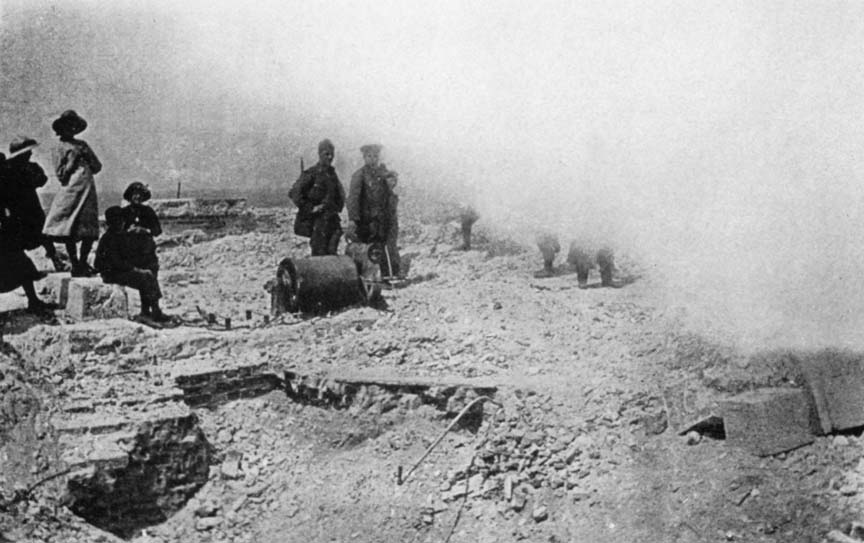
He had a deep gun foundation, concealed by tiling, motors, hydraulic apparatus---a complete fortification inside his villa. [This photograph would have been better if it had not been developed in the ambulance of one of the American Field Service, but it shows the solid construction of the hidden flooring, the supporting pillars, one of the motors and one of the gas pipes.] |
"When the German troops entered Brussels," she states, "we suddenly discovered that our good friends had been secret agents and were now officers in charge of the invasion. As the army came in, with their trumpets and flags and goose-stepping, we picked out our friends entertained by us in our salons---dinner guests for years. They had originally come with every recommendation possible---letters from friends, themselves men of good birth. They had worked their way into the social-political life of Brussels. They had won their place in our friendly feeling. And here they had returned to us at the head of troops to conquer us, after having served as secret agents through the years of friendly social intercourse."
After becoming proficient in that kind of betrayal the officers found it only a slight wrench to pass on to the wholesale murder of the people whose bread they had eaten and whom they had tricked. The treachery explains the atrocity. It is worth while to repeat and emphasize this point. Many persons have asked me, "How do you account for these terrible acts of mutilation?" The answer is, what the Germans did suddenly by flame and bayonet is only a continuation of what they have done for years by poison.
Here follows the testimony of a man whom I know, Doctor George Sarton, of the University of Ghent:
"Each year more Germans came to Belgian summer resorts; Blankenberghe, for instance, was full of them. They were all very well received and had plenty of friends in Belgian families, from the court down. When the war broke out, it immediately became evident that many of these welcomed guests had been spying, measuring distances, preparing foundations for heavy guns in their villas located at strategical points, and so on. It is noteworthy that this spying was not simply done by poor devils who had not been able to make money in a cleaner way---but by very successful German business men, sometimes men of great wealth and whose wealth had been almost entirely built up in Belgium. These men were extremely courteous and serviceable, they spent much money upon social functions and in the promotion of charities, German schools, churches and the like; they had numerous friends, in some cases they had married Belgian girls and their boys were members of the special corps of our 'National Guard.' ... Yet at the same time, they were prying into everything, spying everywhere.
"When the Germans entered into Belgium, they were guided wherever they went by some one of their officers or men who knew all about each place. Directors of factories were startled to recognize some of their work people transformed into Uhlans. A man who had been a professor at the University of Brussels had the impudence to call upon his former 'friends' in the uniform of a German officer.
"When the war is over, when Belgium is free again, it will not be many years before the Germans come back, at least their peaceful and 'friendly' vanguard. How will they be received this time? It is certain that it will be extremely difficult for them to make friends again. As to myself, when I meet them again in my country---I shall ask myself: 'Is he a friend, or is he a spy?' And the business men will think: 'Are they coming as faithful partners, or simply to steal and rob?' That will be their well deserved reward."
One mile from where we were billeted on the Belgian coast stood a villa owned by a German. It lay between St. Idesbald and Coxyde Bains, on a sand dune, commanding the Channel. After the war broke out the Belgians examined it and found it was a fortification. Its walls were of six-foot thickness, of heavy blocks of stone and concrete. Its massive flooring was cleverly disguised by a layer of fancy tiling. Its interior was fitted with little compartments for hydraulic apparatus for raising weights, and there was a tangle of wires and pipes. Dynamite cleared away the upper stories. Workmen hacked away the lower story, piece by piece, during several weeks of our stay. Two members of our corps inspected the interior. It lay just off the excellent road that runs from St. Idesbald to Coxyde Bains, up which ammunition could be fed to it for its coast defense work. The Germans expected an easy march down the coast, with these safety stations ready for them at points of need.(1)
A Belgian soldier rode into a Belgian village one evening at twilight during the early days of the war. An old peasant woman, deceived because of the darkness, and thinking him to be a German Uhlan, rushed up to him and said, "Look out---the Belgians are here." It was the work of these spies to give information to the marauding Uhlans as to whether any hostile garrison was stationed in the town. If no troops were there to resist, a band of a dozen Uhlans could easily take an entire village. But if the village had a protecting garrison the Germans must be forewarned.
Three days after arriving in Belgium, in the early fall of 1914, a friend and I met a German outpost, one of the Hussars. We fell into conversation with him and became quite friendly. He had no cigarettes and we shared ours with him. He could speak good English, and he let us walk beside him as he rode slowly along on his way to the main body of his troops. The Germans had won the day and there seemed to be nothing at stake, or perhaps he did not expect our little group would be long-lived, nor should we have been if the German plans had gone through. It was their custom to use civilian prisoners as a protective screen for their advancing troops. Whatever his motive, after we had walked along beside his horse for a little distance, he pointed out to us the house of the spy whom the Germans had in that village of Melle. This man was a "half-breed" Englishman, who came out of his house and walked over to the Hussar and said:
"You want to keep up your English, for you'll soon be in London."
In a loud voice, for the benefit of his Belgian neighbors, he shouted out:
"Look out! Those fellows shoot! The Germans are devils!"
He brought out wine for the troops. We followed him into his house, where he, supposing us to be friends of the Germans, asked us to partake of his hospitality. That man was a resident of the village, a friend of the people, but "fixed" for just this job of supplying information to the invaders when the time came.
During my five weeks in Ghent I used to eat frequently at the Café Gambrinus, where the proprietor assured us that he was a Swiss and in deep sympathy with Belgians and Allies. He had a large custom. When the Germans captured Ghent he altered into a simon pure German and friend of the invaders. His place now is the nightly resort of German officers.
In the hotel where I stayed in Ghent the proprietor, after a couple of days, believing me to be one more neutral American, told me he was a German. He went on to say what a mistake the Belgians made to oppose the Germans, who were irresistible. That was his return to the city and country that had given him his livelihood. A few hours later a gendarme friend of mine told me to move out quickly, as we were in the house of a spy.
Three members of our corps in Pervyse had evidence many nights of a spy within our lines. It was part of the routine for a convoy of motor trucks to bring ammunition forward to the trenches. The enemy during the day would get the range of the road over which this train had to pass. Of course, each night the time of ammunition moving was changed in an attempt to foil the German fire. But this was of no avail, for when the train of trucks moved along the road to the trenches a bright flash of light would go up somewhere within our lines, telling the enemy that it was time to fire upon the convoy.
Such evidences kept reaching us of German gold at work on the very country we were occupying. Sometimes the money itself.
My wife, when stationed by the Belgian trenches at Pervyse, asked the orderly to purchase potatoes, giving him a five-franc piece. He brought back the potatoes and a handful of change that included a French franc, a French copper, a Dutch small coin, a Belgian ten-centime bit, and a German two-mark piece with its imperial eagle. This meant that some one in the ranks or among the refugees was peddling information to the enemy.
In early October my wife and I were captured by the Uhlans at Zele. Our Flemish driver, a Ghent man, began expressing his friendliness for them in fluent German. After weeks of that sort of thing we became suspicious of almost every one, so thorough and widespread had been the bribery of certain of the poorer element. The Germans had sowed their seed for years against the day when they would release their troops and have need of traitors scattered through the invaded country.
The thoroughness of this bribery differed at different villages. In one burned town of 1500 houses we found approximately 100 houses standing intact, with German script in chalk on their doors; the order of the officer not to burn. This meant the dwellers had been friendly to the enemy in certain instances, and in other instances that they were spies for the Germans. We have the photographs of those chalked houses in safe-keeping, against such time as there is a direct challenge on the facts of German methods. But there has come no challenge of facts---we that have seen have given names, dates and places---only a blanket denial and counter charges of franc-tireur warfare, as carried on by babies in arms, white-haired grandmothers and sick women.
In October, 1914, two miles outside Ostend, I was arrested as a spy by the Belgians and marched through the streets in front of a gun in the hands of a very young and very nervous soldier. The Etat Major told me that German officers had been using American passports to enter the Allied lines and learn the numbers and disposition of troops. They had to arrest Americans on sight and find out if they were masqueraders. A little later one of our American ambassadors verified this by saying to me that American passports had been flagrantly abused for German purposes.
All this devious inside work, misusing the hospitality of friendly, trustful nations, this buying up of weak individuals, this laying the traps on neutral ground---all this treachery in peace times---deserves a second Bryce report. The atrocities are the product of the treachery. This patient, insidious spy system, eating away at the vitality of the Allied powers, results in such horrors as I have witnessed.
When the very terrible accounts of frightfulness visited on peasants by the invading German army crossed the Channel to London, I believed that we had one more "formula" story. I was fortified against unproved allegations by thirteen years of newspaper and magazine investigation and by professional experience in social work. A few months previously I had investigated the "poison needle" stories of how a girl, rendered insensible by a drug, was borne away in a taxicab to a house of ill fame. The cases proved to be victims of hysteria. At another time, I had looked up certain incidents of "white slavery," where young and innocent victims were suddenly and dramatically ruined. I had found the cases to be more complex than the picturesque statements of fiction writers implied. Again, by the courtesy of the United States Government, Department of Justice, I had studied investigations into the relation of a low wage to the life of immorality. These had shown me that many factors in the home, in the training, in the mental condition, often contributed to the result. I had grown sceptical of the "plain" statement of a complex matter, and peculiarly hesitant in accepting accounts of outrage and cruelty. It was in this spirit that I crossed to Belgium. To this extent, I had a pro-German leaning.
On September 7, 1914, with two companions, I was present at the skirmish between Germans and Belgians at Melle, a couple of miles east of Ghent. We walked to the German line, where a blue-eyed young Hussar officer, Rhinebeck, of Stramm, Holstein, led us into a trap by permitting us to walk along after him and his men as they rode back to camp beyond Melle. We walked for a quarter mile. At our right a barn was burning brightly. On our left the homes of the peasants of Melle were burning, twenty-six little yellow brick houses, each with a separate fire. It was not a conflagration, by one house burning and gradually lighting the next. The fires were well started and at equal intensity in each house. The walls between the houses were still intact. The twenty-six fires burned slowly and thoroughly through the night.
These three thousand German soldiers and their officers were neither drunk nor riotous. The discipline was excellent. The burning was a clean-cut, cold-blooded piece of work. It was a piece of punishment. Belgian soldiers had resisted the German army. If Belgian soldiers resist, peasant non-combatants must be killed. That inspires terror. That teaches the lesson: "Do not oppose Germany. It is death to oppose her---death to your wife and child."
We were surrounded by soldiers and four sentries put over us. Peasants who walked too close to the camp were brought in and added to our group of prisoners, till, all told, we numbered thirty. A peasant lying next to me watched his own house burn to pieces.
Another of the peasants was an old man, of weak mind. He kept babbling to himself. It would have been obvious to a child that he was foolish. The German sentry ordered silence. The old fellow muttered on in unconsciousness of his surroundings. The sentry drew back his bayonet to run him through. A couple of the peasants pulled the old man flat to the ground and stifled his talking.
At five o'clock in the morning German stretcher bearers marched behind the burned houses. Out of the house of the peasant lying next to me three bodies were carried. He broke into a long, slow sobbing.
At six o'clock a monoplane sailed overhead, bringing orders to our detachment. The troops intended for Ghent were turned toward Brussels. The field artillery, which had been rolled toward the west, was swung about to the east. An officer headed us toward Ghent and let us go. If the Germans had marched into Ghent we would have been of value as a cover for the troops. But for the return to Brussels we were only a nuisance. We hurried away toward Ghent. As we walked through a farmyard we saw a farmer lying at full length dead in his dooryard. We passed the convent school of Melle, where Catholic sisters live. The front yard was strewed with furniture, with bedding, with the contents of the rooms. The yard was about four hundred feet long and two hundred feet deep. It was dotted with this intimate household stuff for the full area. I made inquiry and found that no sister had been violated or bayoneted. The soldiers had merely ransacked the place.
One of my companions in this Melle experience was A. Radclyffe Dugmore, formerly of the Players Club, New York, a well-known naturalist, author of books on big game in Africa, the beaver, and the caribou. For many years he was connected with Doubleday, Page & Co. His present address is Crete Hill, South Nutfield, Surrey.
At other times and places, German troops have not rested content with the mere terrorization and humiliation of religious sisters. On February 12, 1916, the German Wireless from Berlin states that Cardinal Mercier was urged to investigate the allegation of German soldiers attacking Belgian nuns, and that he declined. As long as the German Government has seen fit to revive the record of their own brutality, I present what follows.
A New York physician whom I know sends me this statement:
"I was dining in London in the middle of last April with a friend, a medical man, and I expressed doubt as to the truth of the stories of atrocity. I said I had combatted such stories often in America. In reply, he asked me to visit a house which had been made over into an obstetrical hospital for Belgian nuns. I went with him to the hospital. Here over a hundred nuns had been and were being cared for."
On a later Sunday in September I visited the Municipal Hospital of Ghent. In Salle (Hall) 17, I met and talked with Martha Tas, a peasant girl of St. Gilles (near Termonde). As she was escaping by train from the district, and when she was between Alost and Audeghem, she told me that German soldiers aimed rifle fire at the train of peasants. She was wounded by a bullet in the thigh. My companion on this visit was William R. Renton, at one time a resident of Andover, Massachusetts. His present address is the Coventry Ordnance Works, Coventry.
A friend of mine has been lieutenant in a battery of 75's stationed near Pervyse. His summer home is a little distance out from Liège. His wife, sister-in-law, and his three children were in the house when the Germans came. Peasants, driven from their village, hid in the cellar. His sister took one child and hid in a closet. His wife took the two-year-old baby and the older child and hid in another closet. The troops entered the house, looted it and set it on fire. As they left they fired into the cellar. The mother rushed from her hiding place, went to her desk and found that her money and the family jewels, one a gift from the husband's family and handed down generation by generation, had been stolen. With the sister, the baby in arms, the two other children and the peasants, she ran out of the garden. They were fired on. They hid in a wood. Then, for two days, they walked. The raw potatoes which they gathered by the way were unfit for the little one. Without money, and ill and weakened, they reached Holland. This lady is in a safe place now, and her testimony in person is available.
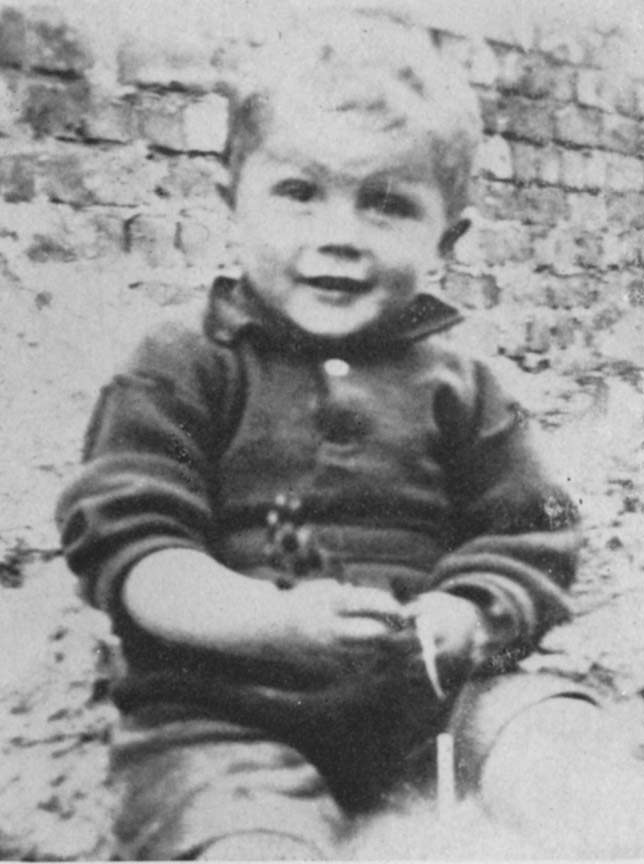
The apologists of the widespread reign of frightfulness say that war is always "like that," that individual drunken soldiers have always broken loose and committed terrible acts. This defense does not meet the facts. It meets neither the official orders, nor the cold method, nor the immense number of proved murders. The German policy was ordered from the top. It was carried out by officers and men systematically, under discipline. The German War Book, issued by the General Staff, and used by officers, cleverly justifies these acts. They are recorded by the German soldiers themselves in their diaries, of which photographic reproductions are obtainable in any large library. The diaries were found on the persons of dead and wounded Germans. The name of the man and his company are given.
On Sunday, September 27, I was present at the battle of Alost, where peasants came running into our lines from the German side of the canal. In spite of shell, shrapnel, rifle, and machine fire, these peasants crossed to us. The reason they had for running into fire was that the Germans were torturing their neighbors with the bayonet. One peasant, on the other side of the canal, hurried toward us under the fire, with a little girl on his right shoulder.
On Tuesday, September 29, I visited Wetteren Hospital. I went in company with the Prince L. de Croy, the Due D'Ursel, a senator; the Count de Briey, Intendant de la Liste Civile du Roy, and the Count Retz la Barre (all of the Garde du General de Wette, Divisions de Cavalerie). One at least of these gentlemen is as well and as favorably known in this country as in his own. I took a young linguist, who was kind enough to act as secretary for me. In the hospital I found eleven peasants with bayonet wounds upon them---men, women and a child---who had been marched in front of the Germans at Alost as a cover for the troops, and cut with bayonets when they tried to dodge the firing. A priest was ministering to them, bed by bed. Sisters were in attendance. The priest led us to the cot of one of the men. On Sunday morning, September 27, the peasant, Leopold de Man, of No. 90, Hovenier-Straat, Alost, was hiding in the house with his sister, in the cellar. The Germans made a fire of the table and chairs in the upper room. Then, catching sight of Leopold, they struck him with the butts of their guns and forced him to pass through the fire. Then, taking him outside, they struck him to the ground and gave him a blow over the head with a gunstock and a cut of the bayonet, which pierced his thigh all the way through.
"In spite of my wound," said he, "they made me pass between their lines, giving me still more blows of the gun-butt in the back in order to make me march. There were seventeen or eighteen persons with me. They placed us in front of their lines and menaced us with their revolvers, crying out that they will make us pay for the losses they have suffered at Alost. So we march in front of the troops.
"When the battle began we threw ourselves on our faces to the ground, but they forced us to rise again. At a certain moment, when the Germans were obliged to retire, we succeeded in escaping down side streets."
The priest led the way to the cot of a peasant whose cheeks had the spot of fever. He was Frans Meulebroeck, of No. 62, Drie Sleutelstraat, Alost. Sometimes in loud bursts of terror, and then falling back into a monotone, he talked with us.
"They broke open the door of my home," he said, "they seized me and knocked me down. In front of my door the corpse of a German lay stretched out. The Germans said to me: 'You are going to pay for that to us.' A few moments later they gave me a bayonet cut in my leg. They sprinkled naphtha in my house and set it afire. My son was struck down in the street and I was marched in front of the German troops. I do not know even yet the fate of my son."
Gradually as the peasant talked the time of his suffering came on him. His eyes began to see it again in front of him. They became fixed and wild, the white of them visible. His voice was shrill and broken with sobs.
"My boy," he said, "I haven't seen him." His body shook with sobbing.
At my request the young man with me took down the statements of these two peasants, turning them into French from the Flemish, with the aid of the priest. In the presence of the priest and one of the sisters the two peasants signed, each man, his statement, making his mark.
Our group passed into the next room, where the wounded women were gathered. A sister led us to the bedside of a very old woman, perhaps eighty years old. She had thin white hair, that straggled across the pillow. There was no motion to the body, except for faint breathing. She was cut through the thigh with a bayonet.
I went across the room and found a little girl, twelve years old. She was propped up in bed and half bent over, as if she had been broken at the breast bone. Her body whistled with each breath. One of our ambulance corps went out next day to the hospital---Dr. Donald Renton. He writes me:
"I went out with Davidson, the American sculptor, and Yates, the cinema man, and there had been brought into the hospital the previous day the little girl you speak of. She had a gaping wound on, I think, the right side of her back, and died the next day."(2)
Dr. Renton's address is 110 Hill Street, Garnet Hill, Glasgow.
The young man who took down the record is named E. de Niemira, a British subject. He made the report of what we had seen to the Bryce Committee. These cases which I witnessed appear in the Bryce Report under the heading of "Alost." Of such is the Bryce Report made: first-hand witness by men like myself, who know what they know, who are ready for any test to be applied, who made careful notes, who had witnesses.
"Why do the Germans do these things? It is not war. It is cruel and wrong," that is a remark I heard from noblemen and common soldiers alike. Such acts are beyond the understanding of the Belgian people. Their soldiers are kindly, good-humored, fearless. Alien women and children would be safe in their hands. They do not see why the Germans bring suffering to the innocent.
A few understand. They know it is a scientific panic which the German army was seeking to cultivate. They see that these acts are not done in the wilful abandon of a few drunken soldiers, beyond discipline, but that they belong to a cool, careful method by means of which the German staff hoped to reduce a population to servitude. The Germans regard these mutilations as pieces of necessary surgery. The young blond barmaid of the Quatrecht Inn told us on October 4 that a German captain came and cried like a baby in the taproom on the evening of September 7, after he had laid waste Quatrecht and Melle. To her fanciful, untrained mind he was thinking of his own wife and children. So, at least, she thought as she watched him, after serving him in his thirst.
One of the sentries patted the shoulder of the peasant at Melle when he learned that the man had had the three members of his family done to death. Personally, he was sorry for the man, but orders were orders.

I spent September 13 and September 23 in Termonde. Ten days before my first visit Termonde was a pretty town of 11,000 inhabitants. On their first visit the Germans burned eleven hundred of the fifteen hundred houses. They burned the Church of St. Benedict, the Church of St. Rocus, three other churches, a hospital, and an orphanage. They burned that town not by accident of shell fire and general conflagration, but methodically, house by house. In the midst of charred ruins I came on single houses standing, many of them, and on their doors was German writing in chalk---"Nicht Verbrennen. Gute Leute wohnen hier." Sometimes it would be simply "Nicht Verbrennen," sometimes only "Gute Leute," but always that piece of German script was enough to save that house, though to the right and left of it were ruins. On several of the saved houses the name of the German officer was scribbled who gave the order to spare. About one hundred houses were chalked in the way I have described. All these were unscathed by the fire, though they stood in streets otherwise devastated. The remaining three hundred houses had the good luck to stand at the outskirts and on streets unvisited by the house-to-house incendiaries.
Four days after my first visit the Germans burned again the already wrecked town, turning their attention to the neglected three hundred houses. I went in as soon as I could safely enter the town, and that was on the Wednesday after.
As companions in Termonde I had Tennyson Jesse, Radclyffe Dugmore, and William R. Renton. Mr. Dugmore took photographs of the chalked houses.
"Build a fence around Termonde," suggested a Ghent manufacturer, "leave the ruins untouched. Let the place stand there, with its burned houses, churches, orphanage, hospital, factories, to show the world what German culture is. It will be a monument to their methods of conducting war. There will be no need of saying anything. That is all the proof we need. Then throw open the place to visitors from all the world, as soon as this war is over. Let them draw their own conclusions."
|
In Wetteren Hospital, Flanders, the writer saw Cain slew only a brother, And Judas was kindly and pleasant, She heard you sing on the high-road, She saw the sun on your helmets, Then you gave her death for her laughter, You were not frenzied and angry; You stabbed her deep with your rifle: Something impedes your advancing, Your singing is sometimes broken The little peasant has tripped you. |
The Steam Roller, the final method, now operating in Belgium to flatten her for all time, is the most deadly and universal of the three. It is a calculated process to break the human spirit. People speak as if the injury done Belgium was a thing of the past. It is at its height now. The spy system with its clerks, waiters, tourists, business managers, reached directly only some thousands of persons. The atrocities wounded and killed many thousands of old men, women, and children. But the German occupation and sovereignty at the present moment are denationalizing more than six million people. The German conquerors operate their Steam Roller by clever lies, thus separating Belgium from her real friends; by taxation, thus breaking Belgium economically; by enforced work on food supplies, railways, and ammunition, thus forcing Belgian peasants to feed their enemy's army and destroy their own army, and so making unwilling traitors out of patriots; by fines and imprisonment that harass the individual Belgian who retains any sense of nationality; by official slander from Berlin that the Belgians are the guilty causes of their own destruction; and finally by the fact of sovereignty itself, that at one stroke breaks the inmost spirit of a free nation.
I was still in Ghent when the Germans moved up to the suburbs.
"I can put my artillery on Ghent," said the German officer to the American vice-consul.
That talk is typical of the tone of voice used to Belgians: threat backed by murder.
The whole policy of the Germans of late is to treat the Belgian matter as a thing accomplished.
"It is over. Let bygones be bygones."
It is a process like the trapping of an innocent woman, and when she is trapped, saying,
"Now you are compromised, anyway, so you had better submit."
A friend of mine who remained in Ghent after the German occupation, had German officers billetted in his home. Daily, industriously, they said to him that the English had been poor friends of his country, that they had been late in coming to the rescue. Germany was the friend, not England. In the homes throughout Belgium, these unbidden guests are claiming slavery is a beneficent institution, that it is better to be ruled by the German military, and made efficient for German ends, than to continue a free people.
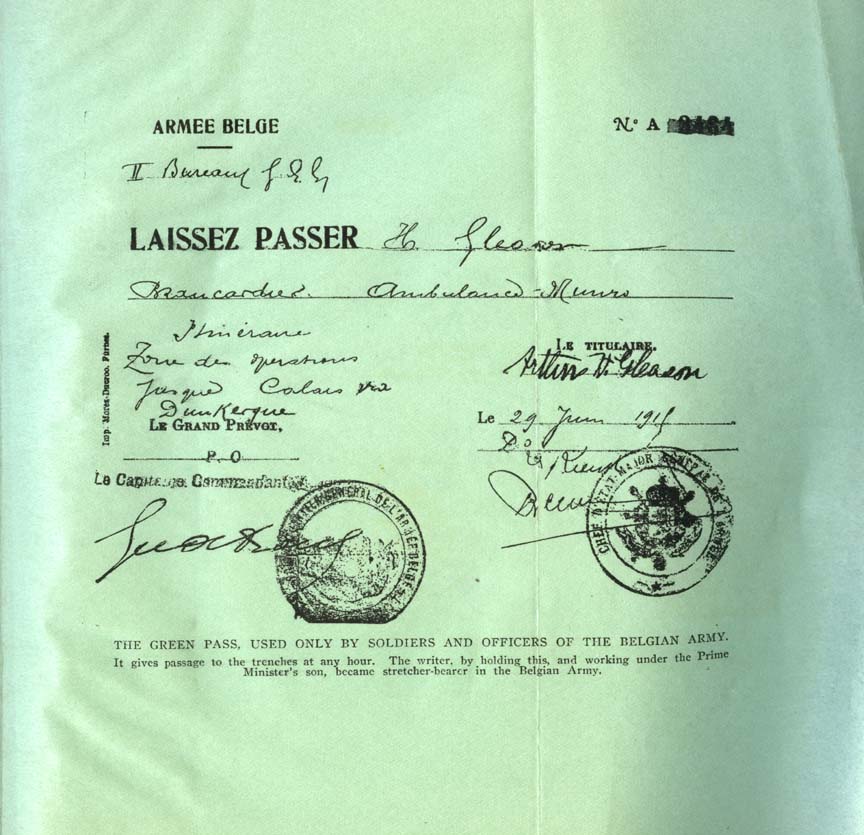
For a year, our Red Cross Corps worked under the direction and authority of the Belgian prime minister, Baron de Broqueville. The prime minister in the name of his government has sent to this country an official protest against the new tax levied by the Germans on his people. The total tax for the German occupation amounts to $192,000,000. He writes:
"The German military occupation during the last fifteen months has entirely prevented all foreign trade, has paralyzed industrial activity, and has reduced the majority of the laboring classes to enforced idleness. Upon the impoverished Belgian population whom Germany has unjustly attacked, upon whom she has brought want and distress, who have been barely saved from starvation by the importation of food which Germany should have provided---upon this population, Germany now imposes a new tax, equal in amount to the enormous tax she has already imposed and is regularly collecting."
The Belgian Legation has protested unavailingly to our Government that Germany, in violation of The Hague Conventions, has forced Belgian workmen to perform labor for the German army. Belgian Railway employees at Malines, Luttre and elsewhere refused to perform work which would have released from the transportation service and made available for the trenches an entire German Army Corps. These Belgian workmen were subjected to coersive measures, which included starvation and cruel punishments. Because of these penalties on Belgians refusing to be traitors, many went to hospitals in Germany, and others returned broken in health to Belgium.
After reading the chapter on the German spy system, a Belgian wrote me:
"That spying business is not yet the worst. Since then, the Germans have succeeded in outdoing all that. The basest and the worst that one can dream of is it not that campaign of slander and blackmail which they originated after their violation of Belgium's neutrality? Of course they did it---as a murderer who slanders his victim---in the hope to justify their crime."
It is evil to murder non-combatants. It is more evil to "rationalize" the act---to invent a moral reason for doing an infamous thing. First, Belgium suffered a vivisection, a veritable martyrdom. Now, she is officially informed by her executioners that she was the guilty party. She is not allowed to protest. She must sit quietly under the charge that her sacrifice was not a sacrifice at all, but the penalty paid for her own misbehavior. This is a more cruel thing than the spying that sapped her and the atrocities practised upon her, because it is more cruel to take a man's honor than his property and his life.
"If the peasants had stayed in their houses, they would have been safe."
When they stayed in their houses they were burned along with the houses. I saw this done on September 7, 1914, at Melle.
"The peasants shot from their houses at the advancing German army."
I saw German atrocities. The peasants did not shoot. It is the old familiar formula of the franc-tireur. That means that the peasant, not a soldier, dressed in the clothing of a civilian, takes advantage of his immunity as a noncombatant, to secrete a rifle, and from some shelter shoot at the enemy army. The Bishop of Namur writes:
"It is evident that the German army trod the Belgian soil and carried out the invasion with the preconceived idea that it would meet with bands of this sort, a reminiscence of the war of 1870. But German imagination will not suffice to create that which does not exist.
"There never existed a single body of francs-tireurs in Belgium.
"No 'isolated instance' even is known of civilians having fired upon the troops, although there would have been no occasion for surprise if any individual person had committed an excess. In several of our villages the population was exterminated because, as the military authorities alleged, a major had been killed or a young girl had attempted to kill an officer, and so forth.... In no case has an alleged culprit been discovered and designated by name."
This lie---that the peasants brought their own death on themselves---was rehearsed before the war, as a carefully learned lesson. The army came prepared to find the excuse for the methodical outrages which they practised. In the fight in the Dixmude district, a German officer of the 202e Infantry had a letter with this sentence on his body:
"There are a lot of francs-tireurs with the enemy."
There were none. He had found what he had been drilled to find, in the years of preparedness. The front lines of the Yser were raked clear by shell, rifle, and machine-gun fire. The district was in ruins. I know, because I worked there with our Red Cross Corps through those three weeks. The humorous explanation of this is given by one of the Fusilier Marin Lieutenants---that the blue cap and the red pompon of the famous fighting sailors of France looked strangely to the Germans, who took the wearers for francs-tireurs, terror suggesting the idea. But this is the kindly humor of Brittany. The saucy sailor caps could not have looked strangely to German eyes, because a few weeks earlier those "Girls with the red pompon" had held the German army corps at Melle, and not even terror could have made them look other than terribly familiar. No. The officers had been faithfully trained to find militant peasants under arms, and to send back letters and reports of their discovery, which could later be used in official excuses for frightfulness. This letter is one that did not get back to Berlin, later to appear in a White Paper, as justification for official murder of non-combatants.
The picture projected by the Great German Literary Staff is too imaginative. Think of that Army of the Invasion with its army corps riding down through village streets---the Uhlan cavalry, the innumerable artillery, the dense endless infantry, the deadly power and swing of it all---and then see the girl-child of Alost, and the white-haired woman, eighty years old---aiming their rifles at that cavalcade. It is a literary creation, not a statement of fact. I have been in villages when German troops were entering, had entered, and were about to enter. I saw helpless, terror-stricken women huddled against the wall, children hiding in their skirts, old men dazed and vague.
Then, as the blue-gray uniforms appeared at the head of the street, with sunlight on the pikes and helmets, came the cry---half a sob, "Les Allemands."
The German fabrications are unworthy. Let the little slain children, and the violated women, sleep in honor. Your race was stern enough in doing them to death. Let them alone, now that you have cleared them from your path to Paris.
Doctor George Sarton, of the University of Ghent writes me:
"During the last months, the Germans have launched new slanders against Belgium. Their present tactics are more discreet and seem to be successful. Many 'neutral' travelers---especially Americans and Swiss---have been to Belgium to see the battlefields or, perhaps, to get an idea of what such an occupation by foreign soldiers exactly amounts to. Of course, these men can see nothing without the assistance of the German authorities, and they can but see what is shown to them. The greater their curiosity, the more courtesy extended to them, the more also they feel indebted to their German hosts. These are well aware of it: the sightseers are taken in their net, and with a very few exceptions, their critical sense is quickly obliterated. We have recently been shown one of the finest specimens of these American tourists: Mr. George B. McCellan, professor of History at Princeton, who made himself ridiculous by writing a most superficial and inaccurate article for the "Sunday Times Magazine".
"When the good folks of Belgium recollect the spying business that was carried on at their expense by their German 'friends,' they are not likely to trust much their German enemies. They know that the Germans are quite incapable of keeping to themselves any fact that they may learn---in whatever confidential and intimate circumstances---if this fact is of the smallest use to their own country. As it is perfectly impossible to trust them, the best is to avoid them, and that is what most Belgians are doing.
"American tourists seeing Belgium through German courtesy are considered by the Belgians just as untrustworthy as the Germans themselves. This is the right attitude, as there is no possibility left to the Belgians (in Belgium) of testing the morality and the neutrality of their visitors. The result of which is that these visitors are entirely given up to their German advisers; all their knowledge is of German origin. Of course, the Germans take advantage of this situation and make a show of German efficiency and organization.---'Don't you know: the Germans have done so much for Belgium! Why, everybody knows that this country was very inefficient, very badly managed ... a poor little country without influence.... See what the Germans have made of it.... There was no compulsory education, and the number of illiterates was scandalously high,' (I am sorry to say that this at least is true.) 'They are introducing compulsory and free education. In the big towns, sexual morality was rather loose, but the Germans are now regulating all that.' (You should hear German officers speak of prostitution in Antwerp and Brussels.) 'The evil was great, but fortunately the Germans came and are cleaning up the country.'---That is their way of doing and talking. It does not take them long to convince ingenuous and uncritical Americans that everything is splendidly regulated by German efficiency, and that if only the Belgians were complying, everything would be all right in Belgium. Are not the Belgians very ungrateful?
"The Belgians do appreciate American generosity; they realize that almost the only rays of happiness that reach their country come from America. They will never forget it; that disinterested help coming from over the seas has a touch of romance; it is great and comforting; it is the bright and hopeful side of the war. The Belgians know how to value this. But, as to what the Germans are doing, good or not, they will never appreciate that---what does it matter? The Belgians do not care one bit for German reforms; they do not even deign to consider them; they simply ignore them. There is one---only one---reform that they will appreciate; the German evacuation. All the rest does not count. When the Germans speak of cleaning the country, the Belgians do not understand. From their point of view, there is only one way to clean it---and that is for the Germans to clear out.
"The Germans are very disappointed that a certain number of Belgians have been able to escape, either to enlist in the Belgian army or to live abroad. Of course, the more Belgians are in their hands, the more pressure they can exert. They are now slandering the Belgians who have left their country---all the 'rich' people who are 'feasting' abroad while their countrymen are starving.
"The fewer Belgians there are in German hands, the better it is. The Belgians whose ability is the most useful, are considered useful by the Germans for the latter's sake. Must it not be a terrible source of anxiety for these Belgians to think that all the work they manage to do is directly or indirectly done for Germany? It is not astonishing that she wants to restore 'business, as usual' in Belgium, and that in many cases she has tried to force the Belgian workers to earn for her. Let me simply refer to the protest recently published by the Belgian Legation. But for the American Commission for Relief, the Belgians would have had to choose between starvation and work---work for Germany---starvation or treason. Nothing shows better the greatness and moment of the American work. Without the material and moral presence of the United States, Belgium would have simply been turned into a nation of slaves---starvation or treason.
"If I were in Belgium, I could say nothing; I would have to choose between silence and prison, or silence and death. Remember Edith Cavell. An enthusiastic, courageous man is running as many risks in Belgium now, as he would have in the sixteenth century under the Spanish domination. The hundred eyes of the Spanish Inquisition were then continually prying into everything---bodies and souls; one felt them even while one was sleeping. The German Secret Service is not less pitiless and it is more efficient.
"The process of slander and lie carried on by the Germans to 'flatten' Belgium is, to my judgment, the worst of their war practices. It is very efficient indeed. But, however efficient it may be, it will be unsuccessful as to its main purpose. The Germans will not be able to bow Belgian heads. As long as the Belgians do not admit that they have been conquered, they are not conquered, and in the meanwhile the Germans are merely aggravating their infamy. It was an easy thing to over-run the unprepared Belgian soil---but the Belgian spirit is unconquerable.
"Belgium may slumber, but die---never."
When men act as part of an implacable machine, they act apart from their humanity. They commit unbelievable horrors, because the thing that moves them is raw force, untouched by fine purpose and the elements of mercy. When I think of Germans, man by man, as they lay wounded, waiting for us to bring them in and care for them as faithfully as for our own, I know that they have become human in their defeat. We are their friends as we break them. In spite of their treachery and cruelty and cold hatred, we shall save them yet. Cleared of their evil dream and restored to our common humanity, they will have a more profound sorrow growing out of this war than any other people, for Belgium and France only suffered these things, but the great German race committed them.
When I went to Belgium, friends said to me, "You must take 'Baedeker's Belgium' with you; it is the best thing on the country." So I did. I used it as I went around. The author doesn't give much about himself, and that is a good feature in any book, but I gathered he was a German, a widely traveled man, and he seems to have spent much time in Belgium, for I found intimate records of the smallest things. I used his guide for five months over there. I must say right here I was disappointed in it. And that isn't just the word, either. I was annoyed by it. It gave all the effect of accuracy, and then when I got there it wasn't so. He kept speaking of buildings as "beautiful," "one of the loveliest unspoiled pieces of thirteenth century architecture in Europe," and when I took a lot of trouble and visited the building, I found it half down, or a butt-end, or sometimes ashes. I couldn't make his book tally up. It doesn't agree with the landscape and the look of things. He will take a perfectly good detail and stick it in where it doesn't belong, and leave it there. And he does it all in a painstaking way and with evident sincerity.
His volume had been so popular back in his own country that it had brought a lot of Germans into Belgium. I saw them everywhere. They were doing the same thing I was doing, checking up what they saw with the map and text and things. Some of them looked puzzled and angry, as they went around. I feel sure they will go home and give Baedeker a warm time, when they tell him they didn't find things as he had represented.
For one thing, he makes out Belgium a lively country, full of busy, contented people, innocent peasants, and sturdy workmen and that sort of thing. Why, it's the saddest place in the world. The people are not cheery at all. They are depressed. It's the last place I should think of for a holiday, now that I have seen it. And that's the way it goes, all through his work. Things are the opposite of what he says with so much meticulous care. He would speak of "gay café life" in a place that looked as if an earthquake had hit it, and where the only people were some cripples and a few half-starved old folks. If he finds that sort of thing gay as he travels around, he is an easy man to please. It was so wherever I went. It isn't as if he were wrong at some one detail. He is wrong all over the place, all over Belgium. It's all different from the way he says it is. I know his fellow-countrymen who are there now will bear me out in this.
Let me show one place. I took his book with me and used it on Nieuport. That's a perfectly fair test, because Nieuport is like a couple of hundred other towns.
"Nieuport," says Herr Baedeker, "a small and quiet place on the Yser."
It is one of the noisiest places I have ever been in. There was a day and a half in May when shells dropped into the streets and houses, every minute. Every day at least a few screaming three-inch shells fall on the village. Aëroplanes buzz overhead, shrapnel pings in the sky. Rifle bullets sing like excited telegraph wires. If Baedeker found Nieuport a quiet place, he was brought up in a boiler factory.
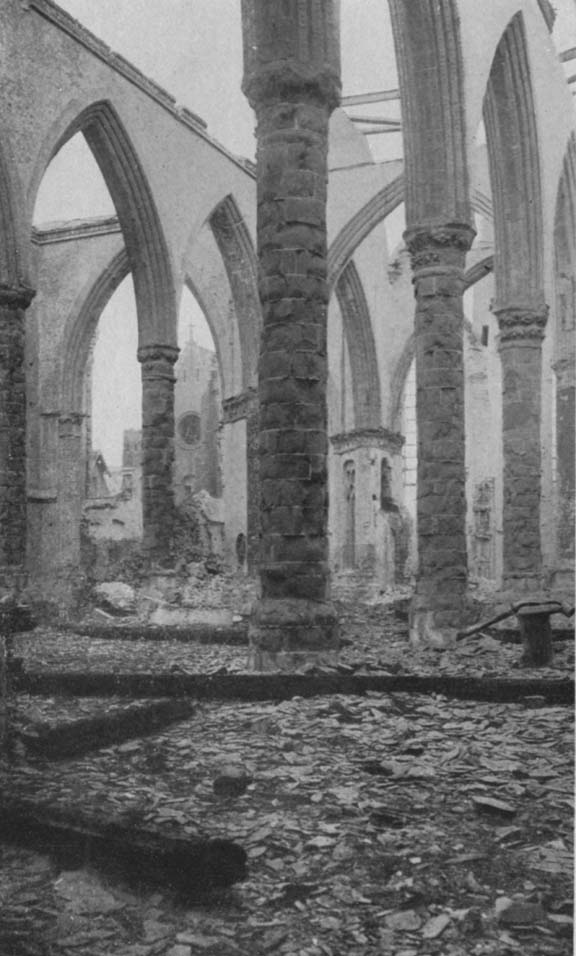
Baedeker, the distinguished German writer, states that this Fifteenth Century Gothic
church in Nieuport has "a modern timber roof." We looked for it.
His very next phrase puzzled me---"with 3500 inhabitants," he says.
And I didn't see one. There were dead people in the ruins of the houses. The soldiers used to unearth them from time to time. I remember that the poet speaks of "the poor inhabitant below," when he is writing of a body in a grave. It must be in that sense that Baedeker specifies those 3500 inhabitants. But he shouldn't do that kind of imaginative touch. It isn't in his line. And it might mislead people.
Think of a stranger getting into Nieuport after dark on a wet night, with his mind all set on the three hotels Baedeker gives him a choice of.
"All unpretending," he says.
Just the wrong word. Why, those hotels are brick dust. They're flat on the ground. There isn't a room left. He means "demolished." He doesn't use our language easily. I can see that. It is true they are unpretending, but that isn't the first word you would use about them, not if you were fluent.
Then he gives a detail that is unnecessary. He says you can sleep or eat there for a "franc and a half." That exactitude is out of place. It is labored. I ask you what a traveler would make of the "1-1/2 fr. pour diner," when he came on that rubbish heap which is the Hotel of Hope---"Hotel de l'Espérance." That is like Baedeker, all through his volume. He will give a detail, like the precise cost of this dinner, when there isn't any food in the neighborhood. It wouldn't be so bad if he'd sketch things in general terms. That I could forgive. But it is too much when he makes a word-picture of a Flemish table d'hôte for a franc and a half in a section of country where even the cats are starving.
His next statement is plain twisted. "Nieuport is noted for its obstinate resistance to the French."
I saw French soldiers there every day. They were defending the place. His way of putting it stands the facts on their head.
"And (is noted) for the 'Battle of the Dunes' in 1600."
That is where the printer falls down. I was there during the Battle of the Dunes. The nine is upside down in the date as given.
I wouldn't object so much if he were careless with facts that were harmless, like his hotels and his dinner and his dates. But when he gives bad advice that would lead people into trouble, I think he ought to be jacked up. Listen to this:
"We may turn to the left to inspect the locks on the canals to Ostend."
Baedeker's proposal here means sure death to the reader who tries it. That section is lined with machine guns. If a man began turning and inspecting, he would be shot. Baedeker's statement is too casual. It sounds like a suggestion for a leisurely walk. It isn't a sufficient warning against doing something which shortens life. The word "inspect" is unfortunate. It gives the reader the idea he is invited to nose around those locks, when he had really better quiet down and keep away. The sentries don't want him there. I should have written that sentence differently. His kind of unconsidered advice leads to a lot of sadness.
"The Rue Longue contains a few quaint old houses."
It doesn't contain any houses at all. There are some heaps of scorched rubble. "Quaint" is word painting.
"On the south side of this square rises the dignified Cloth Hall."
There is nothing dignified about a shattered, burned, tottering old building. Why will he use these literary words?
"With a lately restored belfry."
It seems as if this writer couldn't help saying the wrong thing. A Zouave gave us a piece of bronze from the big bell. It wasn't restored at all. It was on the ground, broken.
"The church has a modern timber roof."
There he goes again---the exact opposite of what even a child could see were the facts. And yet in his methodical, earnest way, he has tried to get these things right. That church, for instance, has no roof at all. It has a few pillars standing. It looks like a skeleton. I have a good photograph of it, which the reader can see on page 69. If Baedeker would stand under that "modern timber roof" in a rainstorm, he wouldn't think so much of it.
"The Hotel de Ville contains a small collection of paintings."
I don't like to keep picking on what he says, but this sentence is irritating. There aren't any paintings there, because things are scattered. You can see torn bits strewed around on the floor of the place, but nothing like a collection.
I could go on like that, and take him up on a lot more details. But it sounds as if I were criticising. And I don't mean it that way, because I believe the man is doing his best. But I do think he ought to get out another edition of his book, and set these points straight.
He puts a little poem on his title page:
Go, little book, God send thee good passage,
And specially let this be thy prayer
Unto them all that thee will read or hear,
Where thou art wrong, after their help to call,
Thee to correct in any part or all.
That sounds fair enough. So I am going to send him these notes. But it isn't in "parts" he is "wrong." There is a big mistake somewhere.