
At times in my five months at the front I have been puzzled by the sacrifice of so much young life; and most I have wondered about the Belgians. I had seen their first army wiped out; there came a time when I no longer met the faces I had learned to know at Termonde and Antwerp and Alost. A new army of boys has dug itself in at the Yser, and the same wastage by gun-fire and disease is at work on them. One wonders with the Belgians if the price they pay for honor is not too high. There is a sadness in the eyes of Belgian boy soldiers that is not easy to face. Are we quite worthy of their sacrifice? Why should the son of Ysaye die for me? Are you, comfortable reader, altogether sure that Pierre Depage and André Simont are called on to spill their blood for your good name?
Then one turns with relief to the Fusiliers Marins---the sailors with a rifle. Here are young men at play. They know they are the incomparable soldiers. The guns have been on them for fifteen months, but they remain unbroken. Twice in the year, if they had yielded, this might have been a short war. But that is only saying that if Brittany had a different breed of men the world and its future would contain less hope. They carry the fine liquor of France, and something of their own added for bouquet. They are happy soldiers---happy in their brief life, with its flash of daring, and happy in their death. It is still sweet to die for one's country, and that at no far-flung outpost over the seas and sands, but just at the home border. As we carried our wounded sailors down from Nieuport to the great hospital of Zuydcoote on the Dunkirk highway, there is a sign-board, a bridge, and a custom-house that mark the point where we pass from Belgium into France. We drove our ambulance with the rear curtain raised, so that the wounded men, lying on the stretchers, could be cheered by the flow of scenery. Sometimes, as we crossed that border-line, one of the men would pick it up with his eye, and would say to his comrade: "France! Now we are in France, the beautiful country."
"What do you mean?" I asked one lad, who had brightened visibly.
"The other countries," he said, "are flat and dirty. The people are of mixed races. France is not so."
It has been my fortune to watch the sailors at work from the start of the war. I was in Ghent when they came there, late, to a hopeless situation. Here were youngsters scooped up from the decks, untrained in trenches, and rushed to the front; but the sea-daring was on them, and they knew obedience and the hazards. They helped to cover the retreat of the Belgians and save that army from annihilation by banging away at the German mass at Melle. Man after man developed a fatalism of war, and expressed it to us.
"Nothing can hit you till your time," was often their way of saying it; "it's no use dodging or being afraid. You won't be hit till your shell comes." And another favorite belief of theirs that brought them cheer was this: "The shell that will kill you you won't hear coming. So you'll never know."
These sailor lads thrive on lost causes, and it was at Ghent they won from the Germans their nickname of "Les demoiselles au pompon rouge." The saucy French of that has a touch beyond any English rendering of "the girls with the red pompon." "Les demoiselles au pompon rouge" paints their picture at one stroke, for they thrust out the face of a youngster from under a rakish blue sailor hat, crowned with a fluffy red button, like a blue flower with a red bloom at its heart. I rarely saw an aging marin. There are no seasoned troops so boyish. They wear open dickies, which expose the neck, full, hard, well-rounded. The older troops, who go laggard to the spading, have beards that extend down the collar; but a boy has a smooth, clean neck, and these sailors have the throat of youth. We must once have had such a race in our cow-boys and Texas rangers---level-eyed, careless men who know no masters, only equals. The force of gravity is heavy on an old man. But marins are not weighted down by equipment nor muffled with clothing. They go bobbing like corks, as though they would always stay on the crest of things. And riding on top of their lightness is that absurd bright-red button in their cap. The armies for five hundred miles are sober, grown-up people, but here are the play-boys of the western front.
From Ghent they trooped south to Dixmude, and were shot to pieces in that "Thermopylæ of the North."
"Hold for four days," was their order.
They held for three weeks, till the sea came down and took charge. During those three weeks we motored in and out to get their wounded. Nothing of orderly impression of those days remains to me. I have only flashes of the sailor-soldiers curved over and snaking along the battered streets behind slivers of wall, handfuls of them in the Hotel de Ville standing around waiting in a roar of noise and a bright blaze of burning houses---waiting till the shelling fades away.(3)
Then for over twelve months they held wrecked Nieuport, and I have watched them there week after week. There is no drearier post on earth. One day in the pile of masonry thirty feet from our cellar refuge the sailors began throwing out the bricks, and in a few minutes they uncovered the body of a comrade. All the village has the smell of desolation. That smell is compounded of green ditch-water, damp plaster, wet clothing, blood, straw, and antiseptics. The nose took it as we crossed the canal, and held it till we shook ourselves on the run home. Thirty minutes a day in that soggy wreck pulled at my spirits for hours afterward. But those chaps stood up to it for twenty-four hours a day, lifting a cheery face from a stinking cellar, hopping about in the tangle, sleeping quietly when their "night off" comes. As our chauffeur drew his camera, one of them sprang into a bush entanglement, aimed his rifle, and posed.
I recollect an afternoon when we had word of an attack. We were grave, because the Germans are strong and fearless.
"Are they coming?" grinned a sailor. "Let them come. We are ready."
We learned to know many of the Fusiliers Marins and to grow fond of them. How else could it be when we went and got them, sick and wounded, dying and dead, two, six, ten of them a day, for many weeks, and brought them in to the Red Cross post for a dressing, and then on to the hospital? I remember a young man in our ambulance. His right foot was shot away, and the leg above was wounded. He lay unmurmuring for all the tossing of the road over the long miles of the ride. We lifted him from the stretcher, which he had wet with his blood, into the white cot in "Hall 15" of Zuydcoote Hospital. The wound and the journey had gone deeply into his vitality. As he touched the bed, his control ebbed, and he became violently sick at the stomach. I stooped to carry back the empty stretcher. He saw I was going away, and said, "Thank you." I knew I should not see him again, not even if I came early next day.
There is one unfading impression made on me by those wounded. If I call it good nature, I have given only one element in it. It is more than that: it is a dash of fun. They smile, they wink, they accept a light for their cigarette. It is not stoicism at all. Stoicism is a grim holding on, the jaws clenched, the spirit dark, but enduring. This is a thing of wings. They will know I am not making light of their pain in writing these words. I am only saying that they make light of it. The judgment of men who are soon to die is like the judgment of little children. It does not tolerate foolish words. Of all the ways of showing you care that they suffer there is nothing half so good as the gift of tobacco. As long as I had any money to spend, I spent it on packages of cigarettes.

When the Marin officers found out we were the same people that had worked with them at Melle five months before, they invited my wife and three other nurses to luncheon in a Nieuport cellar. Their eye brightens at sight of a woman, but she is as safe with them as with a cowboy or a Quaker. The guests were led down into a basement, an eighteen foot room, six feet high. The sailors had covered the floor and papered the walls with red carpet. A tiny oil stove added to the warmth of that blazing carpet. More than twenty officers and doctors crowded into the room, and took seats at the table, lighted by two lamps. There were a dozen plates of patisserie, a choice of tea, coffee, or chocolate, all hot, white and red wine, and then champagne. An orderly lifted in a little wooden yacht, bark-rigged, fourteen inches long, with white painted sails. A nurse spilled champagne over the tiny ship, till it was drenched, and christened. The chief doctor made a speech of thanks. Then the ship went around the table, and each guest wrote her name on the sails. The party climbed out into the garden, where the shells were going high overhead like snowballs. In amongst the blackened flowers, a 16-inch shell had left a hole of fifty feet diameter. One could have dropped two motor cars into the cavity.
Who but Marins would have devised a celebration for us on July 4? The commandant, the captain, and a brace of lieutenants opened eleven bottles of champagne in the Café du Sport at Coxyde in honor of our violation of neutrality. It was little enough we were doing for those men, but they were moved to graceful speech. We were hard put to it, because one had to tell them that much of the giving for a hundred years had been from France to us, and our showing in this war is hardly the equal of the aid they sent us when we were invaded by Hessian troops and a German king.
Marins whom we know have the swift gratitude of simple natures, not too highly civilized to show when they are pleased. After we had sent a batch of their wounded by hospital train from Adinkerke, the two sailors, who had helped us, invited my American friend and me into the estaminet across the road from the station, and bought us drinks for an hour. We had been good to their mates, so they wanted to be good to us.
When we lived in barraquement, just back of the admiral's house, our cook was a Marin with a knack at omelettes. If we had to work through the night, going into black Nieuport, and down the ten-mile road to Zuydcoote, returning weary at midnight, a brave supper was laid out for us of canned meats, wines, and jellies---all set with the touch of one who cared. It was no hasty, slapped-down affair. We were carrying his comrades, and he was helping us to do it.
It was an officer of a quite other regiment who, one time when we were off duty, asked us to carry him to his post in the Dunes. We made the run for him, and, as he jumped from the car, he offered us a franc. Marins pay back in friendship. The Red Cross station to which we reported, Poste de Secours des Marins, was conducted by Monsieur le Docteur Rolland, and Monsieur Le Doze. Our workers were standing guests at their officers' mess. The little sawed-off sailor in the Villa Marie where I was billetted made coffee for two of us each morning.
Our friends have the faults of young men, flushed with life. They are scornful of feeble folk, of men who grow tired, who think twice before dying. They laugh at middle age. The sentries amuse them, the elderly chaps who duck into their caves when a few shells are sailing overhead. They have no charity for frail nerves. They hate races who don't rally to a man when the enemy is hitting the trail. They must wait for age to gain pity, and the Bretons will never grow old. They are killed too fast. And yet, as soon as I say that, I remember their rough pity for their hurt comrades. They are as busy as a hospital nurse in laying a blanket and swinging the stretcher for one of their own who has been "pinked." They have a hovering concern. I have had twenty come to the ambulance to help shove in a "blessé," and say good-by to him, and wave to him as long as the road left him in their sight. The wounded man, unless his back bound him down, would lift his head from the stretcher, to give back their greetings. It was an eager exchange between the whole men and the injured one. They don't believe they can be broken till the thing comes, and there is curiosity to see just what has befallen one like themselves.
When it came my time to say good-by, my sailor friend, who had often stopped by my car to tell me that all was going well, ran over to share in the excitement. I told him I was leaving, and he gave me a smile of deep-understanding amusement. Tired so soon? That smile carried a live consciousness of untapped power, of the record he and his comrades had made. It showed a disregard of my personal feelings, of all adult human weakness. That was the picture I carried away from the Nieuport line---the smiling boy with his wounded arm, alert after his year of war, and more than a little scornful of one who had grown weary in conditions so prosperous for young men.
I rode away from him, past the Coxyde encampment of his comrades. There they were as I had often seen them, with the peddlers cluttering their camp---candy men, banana women; a fringe of basket merchants about their grim barracks; a dozen peasants squatting with baskets of cigarettes, fruit, vegetables, foolish, bright trinkets. And over them bent the boys, dozens of them in blue blouses, stooping down to pick up trays, fingering red apples and shining charms, chaffing, dickering, shoving one another, the old loves of their childhood still tangled in their being.
So when I am talking about the sailors as if they were heroes, suddenly something gay comes romping in. I see them again, as I have so often seen them in the dunes of Flanders, and what I see is a race of children.
"Don't forget we are only little ones," they say. "We don't die; we are just at play."
Where does the comfort of the trenches lie? What solace do the soldiers find for a weary life of unemployment and for sudden death? Of course, they find it in the age-old things that have always sufficed, or, if these things do not here altogether suffice, at least they help. For a certain few out of every hundred men, religion avails. Some of our dying men were glad of the last rites. Some wore their Catholic emblems. The quiet devout men continued faithful as they had been at home. Art is playing the true part it plays at all times of fundamental need. The men busy themselves with music, with carving, and drawing. Security and luxury destroy art, for it is no longer a necessity when a man is stuffed with foods, and his fat body whirled in hot compartments from point to point of a tame world. But when he tumbles in from a gusty night out of a trenchful of mud, with the patter from slivers of shell, then he turns to song and color, odd tricks with the knife, and the tales of an ancient adventure. After our group had brought food and clothing to a regiment, I remember the pride with which one of the privates presented to our head nurse a sculptured group, done in mud of the Yser.
But the greatest thing in the world to soldiers is plain comradeship. That is where they take their comfort. And the expression of that comradeship is most often found in the social smoke. The meager happiness of fighting-men is more closely interwoven with tobacco than with any other single thing. To rob them of that would be to leave them poor indeed. It would reduce their morale. It would depress their cheery patience. The wonder of tobacco is that it fits itself to each one of several needs. It is the medium by which the average man maintains normality at an abnormal time. It is a device to soothe jumping nerves, to deaden pain, to chase away brooding. Tobacco connects a man with the human race, and his own past life. It gives him a little thing to do in a big danger, in seeping loneliness, and the grip of sharp pain. It brings back his café evenings, when black horror is reaching out for him.
If you have weathered around the world a bit, you know how everywhere strange situations turn into places for plain men to feel at home. Sailors on a Nova Scotia freight schooner, five days out, sit around in the evening glow and take a pipe and a chat with the same homely accustomedness, as if they were at a tavern. It is so in the jungle and at a lumber camp. Now, that is what the millions of average men have done to war. They have taken a raw, disordered, muddied, horrible thing, and given it a monotony and regularity of its own. They have smoked away its fighting tension, its hideous expectancy. They refuse to let mangling and murder put crimps in their spirit. Apparently there is nothing hellish enough to flatten the human spirit. Not all the sprinkled shells and caravans of bleeding victims can cow the boys of the front line. In this work of lifting clear of horror, tobacco has been a friend to the soldiers of the Great War.
"I wouldn't know a good cigarette if I saw it," said Geoffrey Gilling, after a year of ambulance work at Fumes and Coxyde. He had given up all that makes the life of an upper-class Englishman pleasant, and I think that the deprivation of high-grade smoking material was a severe item in his sacrifice.
Four of us in Red Cross work spent weary hours each day in a filthy room in a noisy wine-shop, waiting for fresh trouble to break loose. The dreariness of it made B------ petulant and T------ mournfully silent, and finally left me melancholy. But sturdy Andrew MacEwan, the Scotchman with the forty-inch barrel chest, would reach out for his big can of naval tobacco, slipped to him by the sailors at Dunkirk when the commissariat officer wasn't looking, and would light his short stocky pipe, shaped very much like himself, and then we were all off together on a jaunt around the world. He had driven nearly all known "makes" of motor-car over most of the map, apparently about one car to each country. Twelve months of bad roads in a shelled district had left him full of talk, as soon as he was well lit.
Up at Nieuport, last northern stand of the Allied line, a walking merchant would call each day, a basket around his throat, and in the hamper chocolate, fruit, and tobacco. A muddy, unshaven Brittany sailor, out of his few sous a week, bought us cigars. The less men have, the more generous they are. That is an old saying, but it drove home to me when I had poor men do me courtesy day by day for five months. As we motored in and out of Nieuport in the dark of the night, we passed hundreds of silent men trudging through the mud of the gutter. They were troops that had been relieved who were marching back for a rest. As soon as they came out of the zone where no sound can be made and no light shown, we saw here and there down the invisible ranks the sudden flare of a match, and then the glow in the cup of the hand, as the man prepared to cheer himself.
A more somber and lonely watch even than that of these French sailors was the vigil kept by our good Belgian friend, Commandant Gilson, in the shattered village of Pervyse. With his old Maltese cat, he prowled through the wrecked place till two and three of the morning, waiting for Germans to cross the flooded fields. For him cigarettes were an endless chain that went through his life. From the expiring stub he lit his fresh smoke, as if he were maintaining a vestal flame. He kept puffing till the live butt singed his upturned mustache. He squinted his eyes to escape the ascending smoke.
Always the cigarette for him and for the other men. Our cellar of nurses in Pervyse kept a stock of pipes and of cigarettes ready for tired soldiers off duty. The pipes remained as intact as a collection in a museum. The cigarettes never equaled the demand. We once took out a carful of supplies to 300 Belgian soldiers. We gave them their choice of cigarettes or smoking tobacco, and about 250 of them selected cigarettes. That barrack vote gives the popularity of the cigarette among men of French blood. Some cigars, some pipes, but everywhere the shorter smoke. Tobacco and pipe exhaust precious pocket room. The cigarette is portable. Cigars break and peel in the kneading motion of walking and crouching. But the cigarette is protected in its little box. And yet, rather than lose a smoke, a soldier will carry one lonesome cigarette, rained on and limp and fraying at the end, drag it from the depths of a kit, dry it out, and have a go. For, after all, it isn't for theoretical advantages over larger, longer smokes he likes it, but because it is fitted to his temperament. It is a French and Belgian smoke, short-lived and of a light touch, as dear to memory and liking as the wines of La Champagne.
Twice, in dramatic setting, I have seen tobacco intervene to give men a release from overstrained nerves. Once it was at a skirmish. Behind a street defense, crouched thirty Belgian soldiers. Shrapnel began to burst over us, and the bullets tumbled on the cobbles. With each puff of the shrapnel, like a paper bag exploding, releasing a handful of white smoke, the men flattened against the walls and dove into the open doors. The sound of shrapnel is the same sound as hailstones, a crisp crackle as they strike and bounce. We ran and picked them up. They were blunted by smiting on the paving. Any one of them would have plowed into soft flesh and found the bone and shattered it. They seem harmless because they make so little noise. They don't scream and wail and thunder. Our guns, back on the hillocks of the Ghent road, grew louder and more frequent. Each minute now was cut into by a roar, or a fainter rumble. The battle was on. Our barricaded street was a pocket in the storm, like the center of a typhoon.
Yonder we could see the canal, fifty feet away, at the foot of our street. On the farther side behind the river front houses lay the Germans, ready to sally out and charge. It would be all right if they came quickly. But a few hours of waiting for them on an empty stomach, and having them disappoint us, was wearing. We wished they would hurry and have it over with, or else go away for good. Civilians stumbling and bleeding went past us.
And that was how the morning went by, heavy footed, unrelieved, with a sense of waiting for a sudden crash and horror. It was peaceful, in a way, but, at the heart of the calm, a menace. So we overlaid the tension with casual petty acts. We made an informal pool of our resources in tobacco, each man sharing with his neighbor, till nearly every one of us was puffing away, and deciding there was nothing to this German attack, after all. A smoke makes just the difference between sticking it out or acting the coward's part.
Each one of us in a lifetime has a day of days, when external event is lively, and our inner mood dances to the tune. Some of us will perhaps always feel that we spent our day on October 21, 1914. For we were allowed to go into a town that fell in that one afternoon and to come out again alive. It was the afternoon when Dixmude was leveled from a fair upstanding city to a heap of scorched brick and crumbled plaster. The enemy guns from over the Yser were accurate on its houses.
We received our first taste of the dread to come, while we were yet a little way out. In the road ahead of us, a shell had just splashed an artillery convoy. Four horses, the driver, and the splintered wood of the wagon were all worked together into one pulp, so that our car skidded on it. We entered the falling town of Dixmude. It was a thick mess into which we rode, with hot smoke and fine masonry dust blowing into the eyes. Houses around us crumpled up at one blast, and then shot a thick brown cloud of dust, and out of the cloud a high central flame that leaped and spread. With the wailing of shells in the air, every few seconds, the thud and thunder of their impact, the scattering of the shattered metal, it was one of the hot, thorough bombardments of the war. It cleared the town of troops, after tearing their ranks. But it left wounded men in the cellar of the Hotel de Ville. The Grand Place and the Hotel were the center of the fire. Here we had to wait fifteen minutes, while the wounded were made ready for our two cars. It was then we turned to tobacco as to a friend. I remember the easement that came when I found I had cigars in my waistcoat pocket. The act of lighting a cigar, and pulling at it briskly, was a relief.
There was a second of time when we could hear a shell, about to burst close, before it struck. It came, sharpening its nose on the air, making a shrill whistle with a moan in it, that gathered volume as it neared. There was a menace in the sound. It seemed to approach in a vast enveloping mass that can't be escaped, filling all out-doors, and sure to find you. It was as if the all-including sound were the missile itself, with no hiding place offered. And yet the shell is generally a little three-or-four inch thing, like a flower-pot, hurtling through the scenery. But bruised nerves refuse to listen to reason, and again and again I ducked as I heard that high wail, believing I was about to be struck.
In that second of tension, it was a pleasant thing to draw in on a butt---to discharge the smoke, a second later, carelessly, as who should say, "It is nothing." The little cylinder was a lightning conductor to lead away the danger from a vital part. It let the nervousness leak off into biting and puffing, and making a play of fingering the stub, instead of striking into the stomach and the courage. It gave the troubled face something to do, and let the writhing hand busy itself. It saved me from knowing just how frightened I was.
But what of the wounded themselves? They have to endure all that dreariness of long waiting, and the pressure of danger, and then, for good measure, a burden of pain. So I come to the men who are revealing human nature at a higher pitch than any others in the war. The trench-digging, elderly chaps are patient and long-enduring, and the fighting men are as gallant as any the ballad-mongers used to rime about.
But it is of the wounded that one would like to speak in a way to win respect for them rather than pity. I think some American observers have missed the truth about the wounded. They have told of the groaning and screaming, the heavy smells, the delays and neglect. It is a picture of vivid horror. But the final impression left on me by caring for many hundred wounded men is that of their patience and cheeriness. I think they would resent having a sordid pen picture made of their suffering and letting it go at that. After all, it is their wound: they suffered it for a purpose, and they conquer their bodily pain by will power and the Gallic touch of humor. Suffering borne nobly merits something more than an emphasis on the blood and the moan. To speak of these wounded men as of a heap of futile misery is like missing the worthiness of motherhood in the details of obstetrics.
It was thought we moderns had gone soft, but it seems we were storing up reserves of stoic strength and courage. This war has drawn on them more heavily than any former test, and they have met all its demands. Sometimes, being tired, I would drop my corner of the stretcher, a few inches suddenly. This would draw a quick intake of the breath from the hurt man and an "aahh"---but not once a word of blame. I should want to curse the careless hand that wrenched my wound, but these soldiers of France and Belgium whom I carried had passed beyond littleness.
Once we had a French Zouave officer on the stretcher. He was wounded in the right arm and the stomach. Every careen of the ambulance over cobble and into shell-hole was a thrust into his hurt. We had to carry him all the way from the Nieuport cellar to Zuydcoote Hospital, ten miles. The driver was one more of the American young men who have gone over into France to pay back a little of what we owe her. I want to give his name, Robert Cardell Toms, because it is good for us to know that we have brave and tender gentlemen. On this long haul, as always, he drove with extreme care, changing his speed without the staccato jerk, avoiding bumps and holes of the trying road. When we reached the hospital, he ran ahead into the ward to prepare the bed. The officer beckoned me to him. He spoke with some difficulty, as the effort caught him in the wound of his stomach.
"Please be good enough," he said, "to give my thanks to the chauffeur. He has driven me down with much consideration. He cares for wounded men."
Where other races are grateful and inarticulate, the French are able to put into speech the last fine touch of feeling.
My friend kept a supply of cigarettes for his ambulance cases, and as soon as the hour-long drive began we dealt them out to the bandaged men. How often we have started with a groaning man for the ride to Zuydcoote, and how well the trip went, when we had lighted his cigarette for him. It brought back a little of the conversation and the merriment which it had called out in better days. It is such a relief to be wounded. You have done your duty, and now you are to have a little rest. With a clear conscience, you can sink back into laziness, far away from noise and filth. Luck has come along and pulled the pack off your back, and the responsibility from your sick mind. No weary city clerk ever went to his seashore holiday with more blitheness than some of our wounded showed as they came riding in from the Nieuport trenches at full length on the stretcher, and singing all the way. What is a splintered forehead or a damaged leg compared to the happiness of an honorable discharge? Nothing to do for a month but lie quietly, and watch the wholesome, clean-clad nurse. I am not forgetting the sadness of many men, nor the men hurt to death, who lay motionless and did not sing, and some of whom died while we were on the road to help. I am only trying to tell of the one man in every four who was glad of his enforced rest, and who didn't let a little thing like agony conquer his gaiety. Those men were the Joyous Wounded. I have seldom seen men more light hearted.
Word came to my wife one day that several hundred wounded were side-tracked at Furnes railway station. With two nurses she hurried to them, carrying hot soup. The women went through the train, feeding the soldiers, giving them a drink of cold water, and bringing some of them hot water for washing. Then, being fed, they were ready for a smoke, and my wife began walking down the foul-smelling ambulance car with boxes of supplies, letting each man take out a cigarette and a match. The car was slung with double layers of stretcher bunks. Some men were freshly wounded, others were convalescent. A few lay in a stupor. She provided ten or a dozen soldiers with their pleasure, and they lighted up and were well under way. She had so many patients that day that she was not watching the individual man in her general distribution. She came half way down the car, and held out her store to a soldier without looking at him. He glanced up and grinned. The men in the bunks around him laughed heartily. Then she looked down at him. He was flapping the two stumps of his arms and was smiling. His hands had been blown off. She put the cigarette in his mouth and lit it for him. Only his hands were gone. Comradeship was left for him, and here was the lighted cigarette expressing that comradeship.
The man was an old-time friend. In the days of our youth, we had often worked together. He was small and nervous, with a quick eye. He always wore me down after a few hours, because he was restless and untiring. He was named Romeyn Rossiter---one of those well-born names. We had met in times before the advent of the telescopic lens, and he used a box camera, tuned to a fiftieth of a second. Together we snapped polo ponies, coming at full tilt after the ball, riding each other off, while he would stand between the goal-posts, as they zigzagged down on him. I had to shove him out of the way, at the last tick, when the hoofs were loud. I often wondered if those ponies didn't look suddenly large and imminent on the little glass rectangle into which he was peering. That was the kind of person he was. He was glued to his work. He was a curious man, because that nerve of fear, which is well developed in most of us, was left out of his make-up. No credit to him. It merely wasn't there. He was color-blind to danger. He had spent his life everywhere by bits, so he had the languages. I used to admire that in him, the way he could career along with a Frenchman, and exchange talk with a German waiter: high speed, and a kind of racy quality.
I used to write the text around his pictures, captions underneath them, and then words spilled out over the white paper between his six by tens. We published in the country life magazines. They gave generous big display pages. In those days people used to read what I wrote, because they wanted to find out about the pictures, and the pictures were fine. You must have seen Rossiter's work---caribou, beavers, Walter Travis coming through with a stroke, and Holcombe Ward giving a twist delivery. We had the field to ourselves for two or three years, before the other fellows caught the idea, and broke our partnership. I turned to literature, and he began drifting around the world for long shots. He'd be gone six months, and then turn up with big game night pictures out of Africa---a lion drinking under a tropical moon. Two more years, and I had lost him entirely. But I knew we should meet. He was one of those chaps that, once in your life, is like the motif in an opera, or like the high-class story, which starts with an insignificant loose brick on a coping and ends with that brick smiting the hero's head.
It was London where I ran into him at last.
"Happy days?" I said, with a rising inflection.
"So, so," he answered.
He was doing the free-lance game. He had drifted over to England with his $750 moving-picture machine to see what he could harvest with a quiet eye, and they had rung in the war on him. He wasn't going to be happy till he could get the boys in action. Would I go to Belgium with him? I would.
Next day, we took the Channel ferry from Dover to Ostend, went by train to Ghent, and trudged out on foot to the battle of Alost.
Those were the early days of the war when you could go anywhere, if you did it nicely. The Belgians are a friendly people. They can't bear to say No, and if they saw a hard-working man come along with his eye on his job, they didn't like to turn him back, even if he was mussing up an infantry formation or exposing a trench. They'd rather share the risk, as long as it brought him in returns.
When we footed it out that morning, we didn't know we were in for one of the Famous Days of history. You never can tell in this war. Sometimes you'll trot out to the front, all keyed up, and then sit around among the "Set-Sanks" for a month playing pinochle, and watching the flies chase each other across the marmalade. And then a sultry dull day will suddenly show you things....
Out from the Grand Place of Alost radiate narrow little streets that run down to the canal, like spokes of a wheel. Each little street had its earthworks and group of defenders. Out over the canal stretched footbridges, and these were thickly sown with barbed wire.
"Great luck," said Rossiter. "They're making an old-time barricade. It's as good as the days of the Commune. Do you remember your street-fighting in Les Miserables?"
"I surely do," I replied. "Breast high earthworks, and the 'citizens' crouched behind under the rattle of bullets."
"This is going to be good," he went on in high enthusiasm. The soldiers were rolling heavy barrels to the gutter, and knocking off the heads. The barrels were packed with fish, about six inches long, with scales that went blue and white in the fresh morning light. The fish slithered over the cobbles, and the soldiers stumbled on their slippery bodies. They set the barrels on end, side by side, and heaped the cracks between and the face with sods of earth, thick-packed clods, with grass growing. The grass was bright green, unwilted. A couple of peasant hand-carts were tilted on end, and the flooring sodded like the barrels.
"Look who's coming," pointed Rossiter, swiveling his lens sharply around.
Steaming gently into our narrow street from the Grand Place came a great Sava mitrailleuse---big steel turret, painted lead blue, three men sitting behind the swinging turret. One of the men, taller by a head than his fellows, had a white rag bound round his head, where a bullet had clipped off a piece of his forehead the week before. His face was set and pale. Sitting on high, in the grim machine, with his bandage worn as a plume, he looked like the presiding spirit of the fracas.
"It's worth the trip," muttered Romeyn, grinding away on his crank.
There was something silent and efficient in the look of the big man and the big car, with its slim-waisted, bright brass gun shoving through.
"Here, have a cigarette," said Rossiter, as the powerful thing glided by.
He passed up a box to the three gunners.
"Bonne chance," said the big man, as he puffed out rings and fondled the trim bronze body of his Lady of Death. They let the car slide down the street to the left end of the barricade, where it came to rest.
Over the canal, out from the smoke-misted houses, came a peasant running. In his arms he carried a little girl. Her hair was light as flax, and crested with a knot of very bright red ribbon. Hair and gay ribbon caught the eye, as soon as they were borne out of the doomed houses. The father carried the little one to the bridge at the foot of our street, and began crossing towards us. The barbed wire looked angry in the morning sun. He had to weave his way patiently, with the child held flat to his shoulder. Any hasty motion would have torn her face on the barbs. Shrapnel was sailing high overhead between the two forces, and there, thirty feet under the crossfire, this man and his child squirmed their way through the barrier. They won through, and were lifted over the barricade. As the father went stumbling past me, I looked into the face of the girl. Her eyes were tightly closed. She nestled contentedly.
"Did you get it, man? Did you get it?" I asked Rossiter.
"Too far," he replied, mournfully, "only a dot at that distance."
Now, all the parts had fitted into the pattern, the gay green grass growing out of the stacked barrels and carts, and the sullen, silent, waiting mitrailleuse which can spit death in a wide swathe as it revolves from side to side, like the full stroke of a scythe on nodding daisies. The bark of it is as alarming as its bite---an incredibly rapid rat-tat that makes men fall on their faces when they hear, like worshipers at the bell of the Transubstantiation.
"She talks three hundred words to the minute," said Romeyn to me.
"How are you coming?" I asked.
"Great," he answered, "great stuff. Now, if only something happens."
He had planted his tripod fifty feet back of the barricade, plumb against a red-brick, three-story house, so that the lens raked the street and its defenses diagonally. Thirty minutes we waited, with shell fire far to the right of us, falling into the center of the town with a rumble, like a train of cars heard in the night, when one is half asleep. That was the sense of things to me, as I stood in the street, waiting for hell to blow off its lid. It was a dream world, and I was the dreamer, in the center of the strange unfolding sight, seeing it all out of a muffled consciousness.
Another quarter hour, and Rossiter began to fidget.
"Do you call this a battle?" he asked.
"The liveliest thing in a month," replied the lieutenant.
"We've got to brisk it up," Rossiter said. "Now, I tell you what we'll do. Let's have a battle that looks something like. These real things haven't got speed enough for a five-cent house."
In a moment, all was action. Those amazing Belgians, as responsive as children in a game, fell to furiously to create confusion and swift event out of the trance of peace. The battered giant in the Sava released a cloud of steam from his car. The men aimed their rifles in swift staccato. The lieutenant dashed back and forth from curb to curb, plunging to the barricade, and then to the half dozen boys who were falling back, crouching on one knee, firing, and then retreating. He cheered them with pats on the shoulder, pointed out new unsuspected enemies. Then, man by man, the thirty perspiring fighters began to tumble. They fell forward on their faces, lay stricken on their backs, heaved against the walls of houses, wherever the deadly fire had caught them. The street was littered with Belgian bodies. There stood Rossiter grinding away on his handle, snickering green-clad Belgians lying strewn on the cobbles, a half dozen of them tense and set behind the barricade, leveling rifles at the piles of fish. Every one was laughing, and all of them intent on working out a picture with thrills.
The enemy guns had been growing menacing, but Rossiter and the Belgians were very busy.
"The shells are dropping just back of us," I called to him.
"Good, good," he said, "but I haven't time for them just yet. They must wait. You can't crowd a film."
Ten minutes passed.
"It is immense," began he, wiping his face and lighting a smoke, and turning his handle. "Gentlemen, I thank you."
"Gentlemen, we thank you," I said.
"There's been nothing like it," he went on. "Those Liège pictures of Wilson's at the Hippodrome were tame."
He'd got it all in, and was wasting a few feet for good measure. Sometimes you need a fringe in order to bring out the big minute in your action.
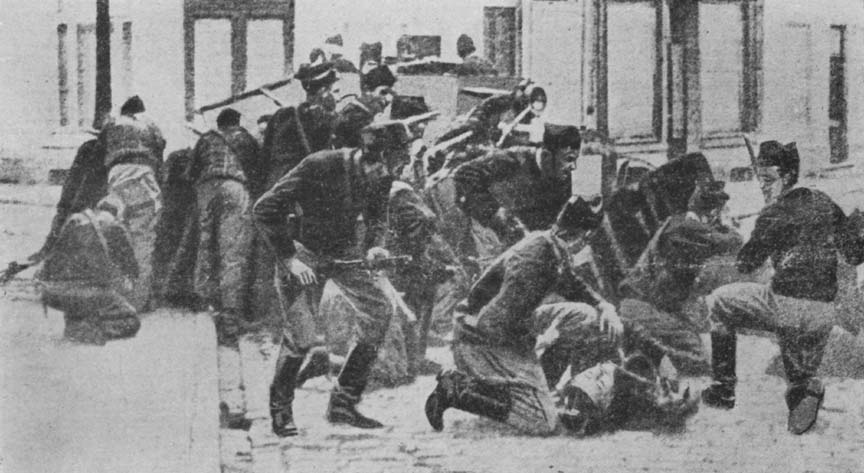
Suddenly, we heard the wailing overhead and louder than any of the other shells. Louder meant closer. It lasted a second of time, and then crashed into the second story of the red house, six feet over Rossiter's head. A shower of brown brick dust, and a puff of gray-black smoke settled down over the machine and man, and blotted him out of sight for a couple of seconds. Then we all coughed and spat, and the air cleared. The tripod had careened in the fierce rush of air, but Rossiter had caught it and was righting it. He went on turning. His face was streaked with black, and his clothes were brown with dust.
"Trying to get the smoke," he called, "but I'm afraid it won't register."
Maybe you want to know how that film took. We hustled it back to London, and it went with a whizz. One hundred and twenty-six picture houses produced "Street Fighting in Alost." The daily illustrated papers ran it front page. The only criticism of it that I heard was another movie man, who was sore---a chap named Wilson.
"That picture is faked," he asserted.
"I'll bet you," I retorted, "that picture was taken under shell fire during the bombardment of Alost. That barricade is the straight goods. The fellow that took it was shot full of gas while he was taking it. What's your idea of the real thing?"
"That's all right," he said; "the ruins are good, and the smoke is there. But I've seen that reel three times, and every time the dead man in the gutter laughed."
Here at home I am in a land where the wholesale martyrdom of Belgium is regarded as of doubtful authenticity. We who have witnessed widespread atrocities are subjected to a critical process as cold as if we were advancing a new program of social reform. I begin to wonder if anything took place in Flanders. Isn't the wreck of Termonde, where I thought I spent two days, perhaps a figment of the fancy? Was the bayoneted girl child of Alost a pleasant dream creation? My people are busy and indifferent, generous and neutral, but yonder several races are living at a deeper level. In a time when beliefs are held lightly, with tricky words tearing at old values, they have recovered the ancient faiths of the race. Their lot, with all its pain, is choicer than ours. They at least have felt greatly and thrown themselves into action. It is a stern fight that is on in Europe, and few of our countrymen realize it is our fight that the Allies are making.
Europe has made an old discovery. The Greek Anthology has it, and the ballads, but our busy little merchants and our clever talkers have never known it. The best discovery a man can make is that there is something inside him bigger than his fear, a belief in something more lasting than his individual life. When he discovers that, he knows he, too, is a man. It is as real for him as the experience of motherhood for a woman. He comes out of it with self-respect and gladness.
The Belgians were a soft people, pleasure-loving little chaps, social and cheery, fond of comfort and the café brightness. They lacked the intensity of blood of unmixed single strains. They were cosmopolitan, often with a command over three languages and snatches of several dialects. They were easy in their likes. They "made friends" lightly. They did not have the reserve of the English, the spiritual pride of the Germans. Some of them have German blood, some French, some Dutch. Part of the race is gay and volatile, many are heavy and inarticulate; it is a mixed race of which any iron-clad generalization is false. But I have seen many thousands of them under crisis, seen them hungry, dying, men from every class and every region; and the mass impression is that they are affectionate, easy to blend with, open-handed, trusting.
This kindly, haphazard, unformed folk were suddenly lifted to a national self-sacrifice. By one act of defiance Albert made Belgium a nation. It had been a mixed race of many tongues, selling itself little by little, all unconsciously, to the German bondage. I saw the marks of this spiritual invasion on the inner life of the Belgians---marks of a destruction more thorough than the shelling of a city. The ruins of Termonde are only the outward and visible sign of what Germany has attempted on Belgium for more than a generation.
Perhaps it was better that people should perish by the villageful in honest physical death through the agony of the bayonet and the flame than that they should go on bartering away their nationality by piece-meal. Who knows but Albert saw in his silent heart that the only thing to weld his people together, honeycombed as they were, was the shedding of blood? Perhaps nothing short of a supreme sacrifice, amounting to a martyrdom, could restore a people so tangled in German intrigue, so netted into an ever-encroaching system of commerce, carrying with it a habit of thought and a mouthful of guttural phrases. Let no one underestimate that power of language. If the idiom has passed into one, it has brought with it molds of thought, leanings of sympathy. Who that can even stumble through the "Marchons! Marchons!" of the "Marseillaise" but is a sharer for a moment in the rush of glory that every now and again has made France the light of the world? So, when the German phrase rings out, "Was wir haben bleibt Deutsch"---"What we are now holding by force of arms shall remain forever German"---there is an answering thrill in the heart of every Antwerp clerk who for years has been leaking Belgian government gossip into German ears in return for a piece of money. Secret sin was eating away Belgium's vitality---the sin of being bought by German money, bought in little ways, for small bits of service, amiable passages destroying nationality. By one act of full sacrifice Albert has cleared his people from a poison that might have sapped them in a few more years without the firing of one gun.
That sacrifice to which they are called is an utter one, of which they have experienced only the prelude. I have seen this growing sadness of Belgium almost from the beginning. I have seen thirty thousand refugees, the inhabitants of Alost, come shuffling down the road past me. They came by families, the father with a bag of clothes and bread, the mother with a baby in arms, and one, two, or three children trotting along. Aged women were walking, Sisters of Charity, religious brothers. A cartful of stricken old women lay patiently at full length while the wagon bumped on. They were so nearly drowned by suffering that one more wave made little difference. All that was sad and helpless was dragged that morning into the daylight. All that had been decently cared for in quiet rooms was of a sudden tumbled out upon the pavement and jolted along in farm-wagons past sixteen miles of curious eyes. But even with the sick and the very old there was no lamentation. In this procession of the dispossessed that passed us on the country road there was no one crying, no one angry.
I have seen 5000 of these refugees at night in the Halle des Fêtes of Ghent, huddled in the straw, their faces bleached white under the glare of the huge municipal lights. On the wall, I read the names of the children whose parents had been lost, and the names of the parents who reported a lost baby, a boy, a girl, and sometimes all the children lost.
A little later came the time when the people learned their last stronghold was tottering. I remember sitting at dinner in the home of Monsieur Caron, a citizen of Ghent. I had spent that day in Antwerp, and the soldiers had told me of the destruction of the outer rim of forts. So I began to say to the dinner guests that the city was doomed. As I spoke, I glanced at Madame Caron. Her eyes filled with tears. I turned to another Belgian lady, and had to look away. Not a sound came from them.

When the handful of British were sent to the rescue of Antwerp, we went up the road with them. There was joy on the Antwerp road that day. Little cottages fluttered flags at lintel and window. The sidewalks were thronged with peasants, who believed they were now to be saved. We rode in glory from Ghent to the outer works of Antwerp. Each village on all the line turned out its full population to cheer us ecstatically. A bitter month had passed, and now salvation had come. It is seldom in a lifetime one is present at a perfect piece of irony like that of those shouting Flemish peasants.
As Antwerp was falling, a letter was given to me by a friend. It was written by Aloysius Coen of the artillery, Fort St. Catherine Wavre, Antwerp. He died in the bombardment, thirty-four years old. He wrote:
Dear wife and children:
At the moment that I am writing you this the enemy is before us, and the moment has come for us to do our duty for our country. When you will have received this I shall have changed the temporary life for the eternal life. As I loved you all dearly, my last breath will be directed toward you and my darling children, and with a last smile as a farewell from my beloved family am I undertaking the eternal journey.
I hope, whatever may be your later call, you will take good care of my dear children, and always keep them in mind of the straight road, always ask them to pray for their father, who in sadness, though doing his duty for his country, has had to leave them so young.
Say good-by for me to my dear brothers and sisters, from whom I also carry with me a great love.
Farewell, dear wife, children, and family.
Your always remaining husband, father, and brother.
Aloys.
Then Antwerp fell, and a people that had for the first time in memory found itself an indivisible and self-conscious state broke into sullen flight, and its merry, friendly army came heavy-footed down the road to another country. Grieved and embittered, they served under new leaders of another race. Those tired soldiers were like spirited children who had been playing an exciting game which they thought would be applauded. And suddenly the best turned out the worst.
writes the poet of Flanders; but the song is no earthly song. It is the voice of a lost cause that cries out of the trampled dust as it prepares to make its flight beyond the place of betrayal.
For the Belgian soldiers no longer sang, or made merry in the evening. A young Brussels corporal in our party suddenly broke into sobbing when he heard the chorus of "Tipperary" float over the channel from a transport of untried British lads. The Belgians are a race of children whose feelings have been hurt. The pathos of the Belgian army is like the pathos of an orphan-asylum: it is unconscious.
They are very lonely, the loneliest men I have known. Back of the fighting Frenchman, you sense the gardens and fields of France, the strong, victorious national will. In a year, in two years, having made his peace with honor, he will return to a happiness richer than any that France has known in fifty years. And the Englishman carries with him to the stresses of the first line an unbroken calm which he has inherited from a thousand years of his island peace. His little moment of pain and death cannot trouble that consciousness of the eternal process in which his people have been permitted to play a continuing part. For him the present turmoil is only a ripple on the vast sea of his racial history. Behind the Tommy is his Devonshire village, still secure. His mother and his wife are waiting for him, unmolested, as when he left them. But the Belgian, schooled in horror, faces a fuller horror yet when the guns of his friends are put on his bell-towers and birthplace, held by the invaders.
"My father and mother are inside the enemy lines," said a Belgian officer to me as we were talking of the final victory. That is the ever-present thought of an army of boys whose parents are living in doomed houses back of German trenches. It is louder than the near guns, the noise of the guns to come that will tear at Bruges and level the Tower of St. Nicholas. That is what the future holds for the Belgian. He is only at the beginning of his loss. The victory of his cause is the death of his people. It is a sacrifice almost without a parallel.

And now a famous newspaper correspondent has returned to us from his motor trips to the front and his conversations with officers to tell us that he does not highly regard the fighting qualities of the Belgians. I think that statement is not the full truth, and I do not think it will be the estimate of history on the resistance of the Belgians. If the resistance had been regarded by the Germans as half-hearted, I do not believe their reprisals on villages and towns and on the civilian population would have been so bitter. The burning and the murder that I saw them commit throughout the month of September, 1914, was the answer to a resistance unexpectedly firm and telling. At a skirmish in September, when fifteen hundred Belgians stood off three thousand Germans for several hours, I counted more dead Germans than dead Belgians. The German officer in whose hands we were as captives asked us with great particularity as to how many Belgians he had killed and wounded. While he was talking with us, his stretcher-bearers were moving up and down the road for his own casualties. At Alost the street fighting by Belgian troops behind fish-barrels, with sods of earth for barricade, was so stubborn that the Germans felt it to be necessary to mutilate civilian men, women, and children with the bayonet to express in terms at all adequate their resentment. I am of course speaking of what I know. Around Termonde, three times in September, the fighting of Belgians was vigorous enough to induce the Germans on entering the town to burn more than eleven hundred homes, house by house. If the Germans throughout their army had not possessed a high opinion of Belgian bravery and power of retardation, I doubt if they would have released so widespread and unique a savagery.
At Termonde, Alost, Balière, and a dozen other points in the Ghent sector, and, later, at Dixmude, Ramscappelle, Pervyse, Caeskerke, and the rest of the line of the Yser, my sight of Belgians has been that of troops as gallant as any. The cowards have been occasional, the brave men many. I still have flashes of them as when I knew them. I saw a Belgian officer ride across a field within rifle range of the enemy to point out to us a market-cart in which lay three wounded. On his horse, he was a high figure, well silhouetted. Another day, I met a Belgian sergeant, with a tousled red head of hair, and with three medals for valor on his left breast. He kept going out into the middle of the road during the times when Germans were reported approaching, keeping his men under cover. If there was risk to be taken, he wanted first chance. My friend Dr. van der Ghinst, of Cabour Hospital, captain in the Belgian army, remained three days in Dixmude under steady bombardment, caring unaided for his wounded in the Hospital of St. Jean, just at the Yser, and finally brought out thirty old men and women who had been frightened into helplessness by the flames and noise. Because he was needed in that direction, I saw him continue his walk past the point where fifty feet ahead of him a shell had just exploded. I watched him walk erect where even the renowned fighting men of an allied race were stooping and hiding, because he held his life as nothing when there were wounded to be rescued. I saw Lieutenant Robert de Broqueville, son of the prime minister of Belgium, go into Dixmude on the afternoon when the town was leveled by German guns. He remained there under one of the heaviest bombardments of the war for three hours, picking up the wounded who lay on curbs and in cellars and under debris. The troops had been ordered to evacuate the town, and it was a lonely job that this youngster of twenty-seven years carried on through that day.
I have seen the Belgians every day for several months. I have seen several skirmishes and battles and many days of shell-fire, and the impression of watching many thousand Belgians in action is that of excellent fighting qualities, starred with bits of sheer daring as astonishing as that of the other races. With no country left to fight for, homes either in ruin or soon to be shelled, relatives under an alien rule, the home Government on a foreign soil, still this second army, the first having been killed, fights on in good spirit. Every morning of the summer I have passed boys between eighteen and twenty-five, clad in fresh khaki, as they go riding down the poplar lane from La Panne to the trenches, the first twenty with bright silver bugles, their cheeks puffed and red with the blowing. Twelve months of wounds and wastage, wet trenches and tinned food, and still they go out with hope.

And the helpers of the army have shown good heart. Breaking the silence of Rome, the splendid priesthood of Belgium, from the cardinal to the humblest curé, has played the man. On the front line near Pervyse, where my wife lived for three months, a soldier-monk has remained through the daily shell-fire to take artillery observations and to comfort the fighting men. Just before leaving Flanders, I called on the sisters in the convent school of Furnes. They were still cheery and busy in their care of sick and wounded civilians. Every few days the Germans shell the town from seven miles away, but the sisters will continue there through the coming months as through the last year. The spirit of the best of the race is spoken in what King Albert said recently in an unpublished conversation to the gentlemen of the English mission:
"The English will cease fighting before the Belgians. If there is talk of yielding, it will come from the English, not from us."
That was a playful way of saying that there will be no yielding by any of the Western Allies. The truth is still as true as it was at Liège that the Belgians held up the enemy till France was ready to receive them. And the price Belgium paid for that resistance was the massacre of women and children and the house-to-house burning of homes.
Since rendering that service for all time to France and England, through twenty months of such a life as exiles know, the Belgians have fought on doggedly, recovering from the misery of the Antwerp retreat, and showing a resilience of spirit equaled only by the Fusiliers Marins of France. One afternoon in late June my friend Robert Toms was sitting on the beach at La Panne, watching the soldiers swimming in the channel. Suddenly he called to me, and aimed his camera. There on the sand in the sunlight the Belgian army was changing its clothes. The faithful suits of blue, rained on and trench-worn, were being tossed into great heaps on the beach and brand-new yellow khaki, clothes and cap, was buckled on. It was a transformation. We had learned to know that army, and their uniform had grown familiar and pleasant to us. The dirt, ground in till it became part of the texture; the worn cloth, shapeless, but yet molded to the man by long association---all was an expression of the stocky little soldier inside. The new khaki hung slack. Caps were overlarge for Flemish heads. To us, watching the change, it was the loss of the last possession that connected them with their past; with homes and country gone, now the very clothing that had covered them through famous fights was shuffled off. It was as if the Belgian army had been swallowed up in the sea at our feet, like Pharaoh's phalanx, and up from the beach to the barracks scuffled an imitation English corps.
We went about miserable for a few days. But not they. They spattered their limp, ill-fitting garments with jest, and soon they had produced a poem in praise of the change. These are the verses which a Belgian soldier, clad in his fresh yellow, sang to us as we grouped around him on a sand dune:
|
EN KHAKI I Depuis onze mois que nous sommes partis en guerre, Refrain Regardez
nos p'tits soldats, II Maintenant sur toutes les grand's routes vous pouvez voir III Nous sommes tous heureux d'avoir le costume des Anglais Refrain Vous les verriez nos
p'tits soldats, |
Outside the window stretched the village street, flat, with bits of dust and dung rising on the breaths of wind and volleying into rooms upon the tablecloth and into pages of books. It was a street of small yellow brick houses, a shapeless church, a convent school---freckled buildings, dingy. Up and down the length of it, it was without one touch of beauty. It gave back dust in the eyes. It sounded with thunder of transports, rattle of wagons, soft whirr of officers' speed cars, yelp of motor horns, and the tap-tap of wooden shoes on tiny peasants, boys and girls. A little sick black dog slunk down the pavement, smelling and staring. A cart bumped over the cobbles, the horse with a great tumor in its stomach, the stomach as if blown out on the left side, and the tumor with a rag upon it where it touched the harness.
Inside the window, a square room with a litter of six-penny novels in a corner, fifty or sixty books flung haphazard, some of them open with the leaves crushed back by the books above. In another corner, a heap of commissariat stuff, tins of bully beef, rabbit, sardines, herring, and glasses of jam, and marmalade. On the center table, a large jug of marmalade, ants busy in the yellow trickle at the rim. Filth had worked its way into the red table-cover. Filth was on every object in the room, like a soft mist, blurring the color and outlines of things. In the corners, under books and tins, insects moved, long, thin, crawling. A hot noon sun came dimly through the dirty glass of the closed window, and slowly baked a sleeping man in the large plush armchair. Around the chair, as if it were a promontory in a heaving sea, were billows of stale crumpled newspapers, some wadded into a ball, others torn across the page, all flung aside in ennui.
The face of the man was weary and weak. It showed all of his forty-one years, and revealed, too, a great emptiness. Flies kept rising and settling again on the hands, the face, and the head of the man---moist flies whose feet felt damp on the skin. They were slow and languid flies which wanted to settle and stay. It was his breathing that made them restless, but not enough to clear them away, only enough to make a low buzzing in the sultry room. Across the top of his head a bald streak ran from the forehead, and it was here they returned to alight, after each twitching and heave of the sunken body.
In the early months he had fought a losing fight with them. The walls and ceiling and panes of glass were spotted with the marks of his long battle. But his foes had advanced in ever-fresh force, clouds and swarms of them beyond number. He had gone to meet them with a wire-killer, and tightly rolled newspapers. He had imported fly paper from Dunkirk. But they could afford to sacrifice the few hundreds, which his strokes could reach, and still overwhelm him. Lately, he had given up the struggle, and let them take possession of the room. They harassed him when he read, so he gave up reading. They got into the food, so he ate less. Between his two trips to the front daily at 8 A.M. and 2 P.M., he slept. He found he could lose himself in sleep. Into that kingdom of sleep, they could not enter. As the weeks rolled on, he was able to let himself down more and more easily into silence. That became his life. A slothfulness, a languor, even when awake, a half-conscious forcing of himself through the routine work, a looking forward to the droning room, and then the settling deep into the old plush chair, and the blessed unconsciousness.
He drove a Red Cross ambulance to the French lines at Nieuport, collected the sick and wounded soldiers and brought them to the Poste de Secours, two miles back of the trenches. He lived a hundred feet from the Poste, always within call. But the emergency call rarely came. There were only the set runs, for the war had settled to its own regularity. A wonderful idleness hung over the lines, where millions of men were unemployed, waiting with strange patience for some unseen event. Only the year before, these men were chatting in cafés, and busy in a thousand ways. Now, the long hours of the day were lived without activity in thoughtless routine. Under the routine there was always the sense of waiting for a sudden crash and horror.
The man was an English gentleman. It was his own car he had brought, paid for by him, and he had offered his car and services to the Fusiliers Marins. They had been glad of his help, and for twelve months he had performed his daily duty and returned to his loneliness. The men under whom he worked were the French doctors of the Poste---the chief doctor, Monsieur Claude-Marie Le Bot, with four stripes on his arm, and the courteous, grave administrator, Eustache-Emmanuel Couillandre, a three-stripes man, and a half dozen others, of three stripes and two. They had welcomed him to their group when he came to them from London. They had found him lively and likable, bringing gossip of the West End with a dash of Leicester Square. Then slowly a change had come on him. He went moody and silent.
"What's the matter with you?" asked Doctor Le Bot one day.
"Nothing's the matter with me," answered the man. "It's war that's the matter."
"What do you mean by that?" put in one of the younger doctors.
"The trouble with war," began the man slowly, "isn't that there's danger and death. They are easy. The trouble with war is this. It's dull, damned deadly dull. It's the slowest thing in the world. It wears away at your mind, like water dripping on a rock. The old Indian torture of letting water fall on your skull, drop by drop, till you went raving crazy, is nothing to what war does to the mind of millions of men. They can't think of anything else but war, and they have no thoughts about that. They can't talk of another blessed thing, and the result is they have nothing to say at all."
As he talked a flush came into his face. He gathered speed, while he spoke, till his words came with a rush, as if he were relieving himself of inner pain.
"Have you ever heard the true inside account of an Arctic expedition?" he went on. "There's a handful of men locked up inside a little ship for thirteen or fourteen months. Nothing to look out on but snow and ice, one color and a horizonful of it. Nothing to dream of but arriving at a Pole---and that is a theoretical point in infinite space. There's no such thing. The midnight sun and the frozen stuff get on their nerves---same old sun in the same old place, same kind of weather. What happens? The natural thing, of course. They get so they hate each other like poison. They go around with a mad on. They carry hate against the commander and the cook and the fellow whose berth creaks every time he shifts. Each man thinks the shipload is the rottenest gang ever thrown together. He wonders why they didn't bring somebody decent along. He gets to scoring up grudges against the different people, and waits his chance to get back."
He stopped a minute, and looked around at the doctors, who were giving him close attention. Then he went on with the same intensity.
"Now that's war, only war is more so. Here you are in one place for sixteen months. You shovel yourself into a stinking hole in the ground. At seven in the morning, you boil yourself some muddy coffee that tastes like the River Thames at Battersea Bridge. You take a knife that's had knicks hacked out of it, and cut a hunk of dry bread that chews like sand. You eat some 'bully beef out of a tin, same tinned stuff as you've been eating ever since your stomach went on strike a year ago. Once a week for a treat, you cut a steak off the flank of a dead horse. That tastes better, because it's fresh meat. When you're sent back a few miles, en 'piquet, you sleep in a village that looks like Sodom after the sulphur struck it. Houses singed and tumbled, dead bodies in the ruins, a broken-legged dog, trailing its hind foot, in front of the house where you are. Tobacco---surely. You'd die if you didn't have a smoke. But the rotten little cigarettes with no taste to them that smoke like chopped hay. And the cigars made out of rags and shredded toothpicks---"
"Here, have a cigarette," suggested the youngest doctor.
But the man was too busy in working out his own thoughts.
"The whole thing," he continued, "is a mixture of a morgue and a hospital---only those places have running water, and people in white aprons to tidy things up. And a battle---Three days under bombardment, living in the cellar. The guns going off five, six times to the minute, and then waiting a couple of hours and dropping one in, next door. The crumpling noise when a little brick house caves in, like a man when you hit him in the stomach, just going all together in a heap. And the sick smell that comes out of the mess from plaster and brick dust.
"And getting wounded, that's jolly, isn't it? Rifle ball through your left biceps. Dick walks you back to the dressing station. Doctor busy at luncheon with a couple of visiting officers. Lie down in the straw. Straw has a pleasant smell when it's smeared with iodine and blood. Wait till the doctor has had his bottle of wine.
"'Nothing very much,' he says, when he gets around to you. Drops some juice in, ties the white rag around, and you go back to your straw. Three, four hours, and along come the body snatchers---the chauffeur chap doesn't know how to drive, bumps into every shell hole for seven miles. Every half mile, drive down into the ditch mud, to get out of the way of some ammunition wagons going to the front. The wheel gets stuck. Put on power, in jumps, to bump the car out. Every jerk tears at your open sore, as if the wheel had got stuck in your arm and was being pulled out. Two hours to do the seven miles. Get to the field hospital. No time for you. Lie on your stretcher in the court, where the flies swarm on you. Always flies. Flies on the blood of the wounded, glued to the bandage. Flies on the face of the dead."
So he had once spoken and left them wondering. But that whirling burst of words was long before, in those earlier days of his work. Nothing like that had happened in weeks. No such vivid pictures lighted him now. The man slept on.
There was a scratching at the window, then a steady tapping, then a resounding fist on the casement. Gradually, the sleeping man came up through the deep waters of unconsciousness. His eyes were heavy. He sat a moment, brooding, then turned toward the insistent noise.
"Monsieur Watts!" said a voice.
"Yes," answered the man. He stretched himself, and raised the sash. A brisk little French Marin was at the window.
"The doctors are at luncheon. They are waiting for you," the soldier said in rapid Breton French; "today you are their guest."
"Of course," replied the man, "I had forgotten. I will come at once."
He stretched his arms over his head---a tall figure of a man, but bent at the shoulders, as if all the dreariness of his surroundings had settled there. He had the stoop of an old man, and the walk. He stepped out of his room, into the street, and stood a moment in the midday sunshine, blinking. Then he walked down the village street to the Poste, and pushed through the dressing-rooms to the dining-room at the rear. The doctors looked up as he entered. He nodded, but gave no speech back for their courteous, their cordial greeting. In silence he ate the simple relishes of sardines and olives. Then the treat of the luncheon was brought in by the orderly. It was a duckling, taken from a refugee farm, and done to a brown crisp. The head doctor carved and served it.
"See here," said Watts loudly. He lifted his wing of the duckling where a dead fly was cooked in with the gravy. He pushed his chair back. It grated shrilly on the stone floor. He rose.
"Flies," he said, and left the room.
Watts was the guest at the informal trench luncheon. The officers showed him little favors from time to time, for he had served their wounded faithfully for many months. It is the highest honor they can pay when they admit a civilian to the first line of trenches. Shelling from Westend was mild and inaccurate, going high overhead and falling with a mutter into the seven-times wrecked and thoroughly deserted houses of Nieuport village. But the sound of it gave a gentle tingle to the act of eating. There was occasional rifle fire, the bullet singing close.
"They're improving," said the Commandant, "a fellow reached over the trench this morning for his Billy-can, and they got him in the hand."
Two Marins cleared away the plank on which bread and coffee and tinned meat had been served.
The hot August sun cooked the loose earth, and heightened the smells of food. A swarm of flies poured over the outer rim and dropped down on squatting men and the scattered commissariat. Watts was sitting at a little distance from the group. He closed his eyes, but soon began striking methodically at the settling flies. He fought them with the right arm and the left in long heavy strokes, patiently, without enthusiasm. The soldiers brought out a pack of cards, and leaned forward for the deal. Suddenly Watts rose, lifted his arms above the trench, and deliberately stretched. Three faint cracks sounded from across the hillock, and he tumbled out at full length, as if some one had flung him away. The men hastened to him, coming crouched over but swiftly.
"Got him in the right arm," said the Commandant.
"Thank God," muttered Watts, sleepily.
It was the Convent Hospital of Furnes. There was quiet in the ward of twenty-five beds, where side by side slept the wounded of France and Germany and Belgium and England. Suddenly, a resounding whack rang through the ward. A German boy jumped up sitting in his cot. The sound had awakened memories. He looked over to the tall Englishman in the next cot, who had struck out at one of the heavy innumerable flies, who hover over wounded men, and pry down under bandages.
"Let me tell you," said the youth eagerly, "I have a preparation---I'm a chemist, you know---I've worked out a powder that kills flies."
Watts looked up from his pillow. His face was weary.
"It's sweet, you know, and attracts them," went on the boy, "then the least sniff of it finishes them. They trail away, and die in a few minutes. You can clear a room in half an hour. Then all you have to do is to sweep up."
"See here," he said, "I'll show you. Sister," he called. The nurse hurried to his side.
"Sister? You were kind enough to save my kit. May I have it a moment?"
He took out a tin flask, and squeezed it---a brown powder puffed through the pin-point holes at the mouth. It settled in a dust on the white coverlet.
"Please be very quiet," he said. He settled back, as if for sleep, but his half-shut eyes were watchful. A couple of minutes passed, then a fly circled his head, and made for the spot on the spread. It nosed its way in, crawled heavily a few inches up the coverlet, and turned its legs up. Two more came, alighted, sniffed and died.
"You see," he said.
Next day, the head of the Coxyde Poste motored over to Furnes for a call on his wounded helper.
"Where does all that chatter come from?" he asked.
Sister Teresa smiled.
"It's your silent friend," she said. "He is the noisiest old thing in the ward."
"Talking to himself?" inquired the doctor.
"Have a look for yourself," urged the nurse. They stepped into the ward, and down the stone floor, till they came to the supply table. Here they pretended to busy themselves with lint.
"Most interesting," Watts was saying. "That is a new idea to me. Here they've been telling me for a year that there's no way but the slow push, trench after trench---"
"Let me say to you," interrupted the Saxon lad.
"You will pardon me, if I finish what I am saying," went on Watts in full tidal flow. "What was it I was saying? Oh, yes, I remember---that slow hard push is not the only way, after all. You tell me---"
"That's the way it is all day long," explained the sister. "Chatter, chatter, chatter. They are telling each other all they know. You would think they would get fed up. But as fast as one of them says something, that seems to be a new idea to the other. Mr. Watts acts like a man who has been starved."
Watts caught sight of his friend.
"We've killed all the flies," he shouted.