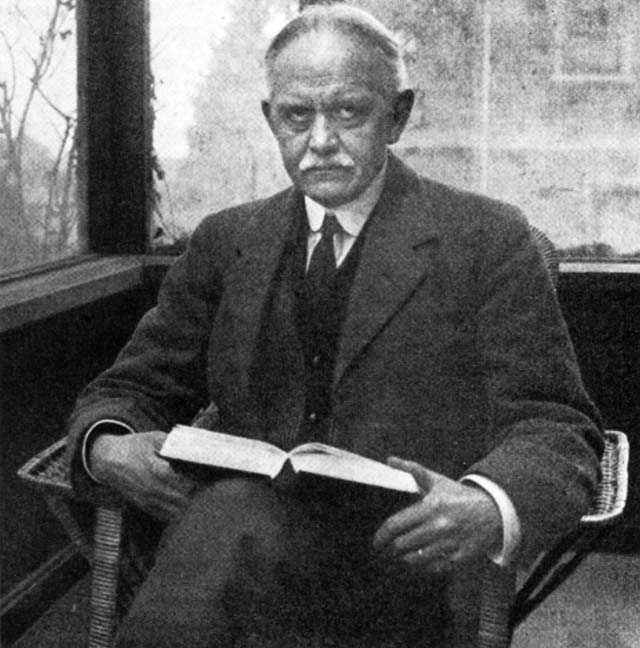
BUSY AND FULL of achievement as the last seventeen years had been, the next five years---the years of the Great War---were to find Gayley compressing within them an activity easily twice what he had put into a previous period over three times as long. The pace was hard, especially for a man going from his fifty-sixth to his sixtieth year. The fruits of these five years were that he emerged from scholarly pursuits to become one of the foremost war leaders in California, that he shared with two other men the presidential office and duties of the University, that he received marked recognition from France, England, and his own country for the services he performed, that his health was broken, and that at the culmination of the Allied victory he suffered, as an effect of the war, the saddest, most tragic experience of his life.
More than one of his former acquaintances have suggested that the history of his contributions to the Allied cause should be a carefully restrained and muted account, for more than one had been shocked by the enthusiasm and audacity of their academic colleague, or, looking dispassionately upon the human tragedy, had been unable to see in it that significant struggle which he saw, and so had judged his convictions and his leadership adversely. But these men had not been imaginatively and emotionally nurtured, as had he, by the great books of the past; had not passionately identified themselves, as he had, with the best that has been known and thought in the past; had not seen in London at the beginning of the struggle, as he had, the fiendish and obscene episodes of modern war, so absolute in their contradiction of all the best aspirations of the human race. Colder spirits than his could curiously balance and distribute blame among the nations on both sides of the tragically absurd conflict. They could figure while civilization burned. But Gayley was not of these spirits. In the war he saw humanity and the humanities at stake, and, noble humanist that he was, he could do no other than he did. To give a muted account of his services, to belittle his spirit and vision, to whittle down his convictions, would be unfaithful both to him and also to those thousands who loved and admired him not the less, but the more, for his dauntless and magnanimous audacity.
The academic year 1914-1915 was his third sabbatical. He had to remain in Berkeley until October, 1914, to complete preparations for publishing his Beaumont. Mrs. Gayley, Mary, and Betty---the two girls aged respectively twenty-one and twelve---left in July, visited two weeks in Detroit, and sailed for England on the 1st of August. Gayley, fearing war would result from the Austrian ultimatum (July 23) to Serbia, but uncertain, had first telegraphed them not to leave America, then that they should go. A third telegram to Julian Harris, Mrs. Gayley's brother---"For God's sake don't let them sail"---arrived too late, when they were already on the boat.
The day they sailed, Germany declared war against Russia; two days later, against France. Tuesday, August 4, while they were on the high seas, England entered the War. The women on the ship were not told of England's decision until Thursday, but they noted that there were no lights on deck and that cardboard had been placed over the portholes. The ship was chased by a German cruiser. The crossing took fourteen days.
Mrs. Gayley and the girls stayed at Stratford-on-Avon, waiting for Gayley. They lived quietly and happily. One day they walked out to Clifford Chambers, an old Elizabethan house, and fell in love with it. Shortly afterward a note came from the owner of the house, Mrs. Douty (née Wills), now Mrs. Grahame Rees-Mog. "I hear you like my house," she wrote, inviting them to tea. And so began a friendship. Records in the house prove that Shakespeare stayed there more than once. In Stratford they were invited also into a house that once had belonged to Dr. John Hall, son-in-law of Shakespeare. In making over the house for the present occupant, the walled-up surgery of Dr. Hall had been discovered.
In October Gayley arrived, and in January they all went up to London and had their first realization of the war. They settled at Morley's Hotel in Trafalgar Square---always the very heart of London, but especially so in those days of feverish public meetings in the Square and harangues from the plinth of the Nelson Column. The entire family plunged into war work of one sort or another. Americans who lived in England during the early period of the war, and who witnessed the prodigious sacrifices of all classes, and the common exaltation that was never entirely dimmed by weariness and sorrow, were swept along by the heroic fervor. The ruin, the bereavement, the anguish, and a fortitude quite equal to them, were everywhere visible. Every day, indeed every hour, brought some new trial, some new test of endurance. Each day for seven months Gayley saw the grim participation of the common people. Besides, he was constantly in personal contact with men and women of distinction in the literary, business, and political worlds. From their wider information and further vision he gained a deep awareness of all that threatened a free civilization. The ruthless invasion of Belgium had raised him to white heat. The devastating effects of the first air raids filled him with indignation, rage, and horror. The holocaust of Neuve Chapelle and of the Second Battle, or "gas attack," of Ypres, and the terrific human waste of the Allies' spring offensive of 1915, came very close to him there in London. Then there was the German submarine warfare on merchant ships, the sinking of the Lusitania, and continual news of similar tragedies. From every side, from France, from the Dardanelles, and most of all from the Eastern Front, where the Russian armies were in retreat, came almost in regular relay news of the Allies' failure and defeat, so that the spring and summer of 1915 were indeed a dark time for England. Gone was any hope of a short war, of any early, decisive offensive against the enemy. The colossal character of the convulsion and its tragic threat to civilization, and the tremendous need and duty of America's participation, fastened upon Gayley's mind in fullest realization. He knew that the nations would be bled white, that the gloomiest days were yet to come, that every possible effort must everywhere be made to strengthen the cause. When he came back to far-away Berkeley, his friends could scarcely understand the fire that was consuming him. He seemed a portent. They were amazed, and at first they were a bit suspicious of his ardors.
But in London he was soon at work revising the manuscripts of the second volume of his Literary Criticism, and composing two poems, "Easter Day" and "Rupert Brooke." The book firm of Macmillan put at his disposal a room in its offices in Leicester Square, and there he was accustomed to work from about eleven in the morning until four in the afternoon. At the same time, he was engaged in research relative to Shakespeare's connections with the Virginia Company of London, in preparation for his book, Shakespeare and the Founders of Liberty in America.
Presently he was put up for honorary membership at the Savile Club by Gerald Duckworth, the London publisher, and at the Athenaeum by Henry James and Sir Charles Villiers Stanford. These memberships were renewed from month to month as long as he remained in England. In these two famous clubs he had opportunities of meeting and dining and talking with many of the notable men of the day, including Rudyard Kipling, Sir William Orpen, Sir Ray Lancaster, Robin H. Legge, musical critic of the Daily Telegraph, Lord Sydenham, Major-General J. B. Sterling, the son of Carlyle's John Sterling, Sir Sidney Lee, Douglas Ainslie, the translator of Croce, Sir Henry Trueman Wood, secretary of the Royal Society of Arts, Sir Charles Waldstein, Arthur Bourchier, F. R. Benson, Charles Graves, brother-in-law of Sir Edward Grey, Edward Marsh, private secretary to Winston Churchill and a friend of Rupert Brooke, Professor Stanley Lane-Poole of Trinity College, Dublin, Sir William Christie, formerly Astronomer Royal, Lord Mersey, John Francis, proprietor of The Athenaeum, James R. Thursfield, leader writer for The Times, Jacombe Hood, the artist, who had accompanied King George to the Durbar in India, and many others, including men from the War and other government Offices, and members of the House of Commons. In such company he every day heard well-considered and well-informed talk about the war; and he, in turn, was listened to with attention, particularly when the conversation veered, as it did continually, to puzzled discussion of America's attitude and of the policy of President Wilson. Accounts of pro-German sentiment constantly came over from the States, and Wilson's, temporizing notes added to the British amazement. After the sinking of the Lusitania, early in May, the discussion of Wilson's intentions grew acute. Again and again Gayley was called upon to explain and if possible defend the ambiguous part being played by his country. At both clubs, and particularly in the billiard room of the Savile, he was always the center of animated conversation. He himself, of course, was both puzzled and deeply annoyed. But he took some comfort from the frankly pro-British attitude of Ambassador Page, with whom he had talked on the 12th of March. At any rate, his heartfelt eloquent support of the Allies was always an encouraging note. His conviction that American ideals demanded and eventually would produce American participation did something to promote Anglo-American amity in the not unimportant circles in which he moved.
But his circle of acquaintances was not bounded by the Savile and the Athenaeum. With Henry James, resuming the acquaintance begun in Berkeley, he was particularly intimate. During one of their walks in St. James's Park, James poured out his heart concerning his plan to renounce his American citizenship and become a naturalized Englishman. "Gayley, what can I do? I have lived all these years with them. They have shown me such affection!" One morning the papers printed the news of James's determination. The Gayleys read it at breakfast. Mary, who like her father had responded immediately and wholeheartedly, single-mindedly, to the Allied Cause, burst into tears. "Oh, Daddy, in America we need all our finest men at a time like this---to wake up America to what is really happening." She, moreover, like her father, was one to put convictions into practice. She was intensely assiduous in such war work as she could find to do in London. Eventually, responding to her call, she was to give her life.
Other friends afforded pleasant diversions in the midst of those gloomy days. With Ben Greet, relations the most intimate and charming were at once established, which in turn became the key to many new acquaintances and experiences. Greet was continually dining with the family, taking some or all of them to various theaters and concerts, and inviting them to his own performances at the Old Vic and other places.
Of course, there were many invitations from others, which cannot be chronicled here, such as those of Miss Naomi Royde-Smith's to her evenings in Kensington, where there was always good company and famous talk. Then there were trips to Cambridge, where Gaillard T. Lapsley, a former Berkeley friend, was host; and to Oxford, where Gayley dined again at Lincoln and renewed his friendships with Dr. Munro, Percy Gardner, and others. At Cambridge the family saw the award of degrees at Congregation in the Senate House, and at lunch with Lapsley and afterward met a number of Cambridge men. At Oxford, Gayley ran across another former Berkeley friend, Professor J. L. Myres, and was invited by him to dine at New College. Myres also got them seats at New College for the University sermon preached by Dean Inge, whom they had already heard at St. Paul's. By the courtesy of Holcombe Ingleby, M.P. for Lynn, another Savile Club acquaintance, they were admitted to the Distinguished Strangers' Gallery of the House of Commons, where they listened to Asquith, Balfour, McKenna, Lord Robert Cecil, Sir John Simon, Tennant, Runciman, and others. Afterwards there was tea in the House, with various introductions. By all these and yet other means, Gayley's acquaintance in England and Scotland widened steadily in representative circles. As a result of his visits in 1897, 1907, and now in 1915, he became indeed well known in England. During his last visit, in 1924, he was to cement these relationships and establish many more. His acquaintanceship, like his spirit and his life history, was cosmopolitan. He thought and felt in a cosmopolitan and international habit of mind.
A stimulating opportunity was offered by Sir Israel Gollancz, president of the Shakespeare Association, who invited him to address the Association in place of Alfred Noyes, who had cabled from Princeton University that he could not be present to deliver a promised lecture upon "Shakespeare and the Sea." Gayley accepted, and on the 9th of July spoke at King's College on "Shakespeare and the Stage." The lecture went off well, and was favorably reported in the Westminster Gazette, July 10, 1915. At the same time he was made a permanent vice-president of the Association. It was no little honor thus to have his name associated with such other vice-presidents as A. C. Bradley, Henry Bradley, A. Brandl, E. K. Chambers, R. W. Chambers, W. A. Craigie, A. Feuillerat, Edmund Gosse, W. W. Greg, C. H. Herford, J. J. Jusserand, G. L. Kittredge, Sir Sidney Lee, J. M. Manly, Alfred W. Pollard, and Harold V. Routh, not to mention others of equal note.
At last the time for leaving England drew near. A final excursion, through Wiltshire, Devonshire, and Cornwall, preceded departure, and Gayley, July 22-25, made a quick trip to Ireland, over a Channel infested with German submarines, for the purpose of visiting the scenes of his boyhood at Hollymount and seeing the Rutherfords once again at Turin. On Saturday, July 31, 19'5, the entire family sailed for America. On the 16th of August they arrived in Berkeley.
After his vivid preoccupation with England's war efforts and with her heroic and tragic fortitude, Gayley found it hard to put up with the comparative lukewarnmess, the dull unrealization, of the people at home; harder yet to suffer the pacifist, the anti-British, the pro-German opinions in America, in California, in Berkeley, in the University itself. In his understanding of the meaning of the war both to the Allies and to the United States, he was three years ahead of many of the people he now met. He realized that eventually he could by no means shirk the opportunity of exerting all his influence toward educating public opinion as to the significance of the conflict, the implication of American honor and rights, and the duty of the country to aid the Allies in every possible way. But President Wilson was then intent upon a policy of neutrality, and had appealed to the public for support. That Gayley himself, in answer to the President's appeal, tried to restrain his ardor, and that he realized the danger of too impetuous an utterance, is indicated by his reply to many requests that in his public lectures on Great Books he would give some account of his experiences abroad. Repeatedly he answered that so many diverse national sympathies were represented in those large audiences that whatever he could in honesty say would provoke only discord. He believed that with time public opinion would change.
For more than a year he devoted most of his efforts to what he believed would be, for him as a scholar, a characteristic contribution toward Anglo-American amity---his book, Shakespeare and the Founders of Liberty in America. But since this work was not published until after we had entered the war, its notice may be postponed to the date of its appearance. He was also occupied with certain duties incident to his appointment, 1915-1918, as a member of the Executive Council of the American Association of University Professors.
But, at the same time, he was preparing for the moment when the cause of the Allies could be advocated publicly in all force and wisdom. He drew into informal association a band of kindred spirits from within and without the University, men of prominence and influence from various walks of life. To give the complete list of these associates would require more space than is here available, but several who were in especially close coöperation with his ideals and hopes may be mentioned: W. B. Bourn, Alfred Holman, T. A. Rickard, and Warren Gregory, from without the University; David P. Barrows, Morse A. Cartwright, Ralph P. Merritt, Deans T. M. Putnam, F. H. Probert, and H. R. Hatfield, and Professors L. J. Richardson, Edmond O'Neill, John Galen Howard, J. B. Cross, A. G. Brodeur, and G. M. Stratton, from within the University. And, of course, Gayley had at once become a member of The Friends of France, a society founded by Bruce Porter and W. B. Bourn, December 13, 1915. Eager as were all these men and their many associates to promote the cause of the Allies, and various as were the practical means by which they served this end, public opinion had to be ripened gradually by their efforts and yet more by the events of the war, especially by the attacks of Germany upon American commerce, before public advocacy from the platform could hope to be successful. But the change in public sentiment was growing apace, thanks primarily to Germany itself.
One of Gayley's first public utterances bearing upon the war was an address in memory of Rupert Brooke, delivered in 1915 before a University Meeting. His unstinted praise of Brooke's splendid devotion of his life to the cause, was itself a clarion call to heroism.
Two years before, in September, 1913, Brooke, then twenty-five, had visited the Gayley home in Berkeley and had made an extraordinary impression. Brooke's love of the classics, old and new, and of the Elizabethan poets, in itself was a key to Gayley's heart. Here was, indeed, "a grateful child of tradition" who was also engrossed in the dubieties of modernity. Gayley must have seen much of his own youthful spirit in this joyous and forceful young man, profound and curious after knowledge natural, political, historical, and metaphysical; dissatisfied with conventional conservatism; eager to explore contemporary problems in the light of the best to be known from the past. Brooke was one of the younger school of Georgian writers, an associate and friend of Masefield and Abercrombie, Wilfrid Gibson and Drinkwater, J. E. Flecker and James Stephens. He was in touch with the more advanced thinkers of Cambridge and Oxford; and with the practical world, through his intimacy with the Asquiths and the Churchills. For a fortnight or more he lived near the Gayleys, and was frequently at their house. Then he left for Tahiti and Samoa. On his way back he visited them again. At the outbreak of the War he went to Antwerp in the R.N.V.R. and, after distinguishing himself for bravery, was invalided home. When Gayley reached London he asked the editor of the Gazette where Brooke was. "At 10 Downing Street, in Asquith's own best bedroom." Then, with the two young Asquiths, he set out, February 28, 1915, for the Dardanelles. On Easter Sunday, May 4, in St. Paul's, Gayley listened to Dean Inge and recognized as Brooke's a poem read in the course of the sermon. Nineteen days later Sublieutenant Rupert Brooke of the Royal Naval Volunteers in the Expeditionary force for the Dardanelles, lay dead of sunstroke, at twenty-seven, on an island of the Aegean, in a "corner of a foreign field that is forever England." Gayley, heart-stricken, then began his poem on Brooke. Shortly afterward he met Edward Marsh, a friend of Brooke, and presently received from him Denis Browne's letter of April 25, giving a detailed and beautiful account of Brooke's funeral on the island of Scyros.
All these details, and more, Gayley poured into his memorial talk at the University Meeting. He concluded with such a tribute to the serene courage and gallant patriotism of the soldier-poet that everyone in the large audience had some momentary realization of the terrible ordeal, so magnificently borne, through which Great Britain was passing. A breath of England at its best breathed in old Harmon Gymnasium. It was a noble speech, on so high a level of thought and feeling that not even any German sympathizer could cavil.
During 1915 local interest was largely directed toward the Panama-Pacific International Exposition, which was then in full swing. A series of celebrations in honor of the foreign nations exhibiting in the fair was held. The "slumbering neutrality," which by the Exposition's unwritten law had been effective during all the former celebrations, was suddenly forgotten on November 27, the day of the French-Belgian ceremonies. William B. Bourn was one of the speakers of the day. Long before, his friends had known just where he stood in relation to the duty of America in the World War. But it was not until this day that he spoke his convictions vividly in public. Before a huge audience gathered in front of the French Pavilion, he spoke to the topic, "France and America." His eloquence touched a match to the smoldering emotions of the crowd. "France," he said, "is fighting not for her country and her homes, so much as for humanity. . . . With civilization and humanity bleeding as it is, let every American search his heart and soul to see where he stands." Then he hurled at the audience the question, "Are we neutral?" With one accord the thousands rose to their feet and shouted "No! No!" Turning to the French and Belgian commissioners, Bourn continued: "America is not neutral. Go where you will and feel the heart of the people of America, and you will know that America can never be neutral." At that moment thousands of San Franciscans heard the convictions of their innermost hearts publicly delivered. They knew they had found a leader. It was a great day in California for the Allies---the beginning of an ever-increasing tide of public advocacy.
Gayley spoke briefly on "The Contribution of France to the Realm of Thought." The key to his speech, as well as to all his convictions concerning the verities and values threatened by the war, is found in a phrase or two he applied to Bergson. Bergson, he pointed out, taught "how in creative evolution 'the life of the body is on the road to the life of the spirit,' and how in our spiritual life 'the past has not perished, the future is being made.'" This was the core of Gayley's thought, thoroughly consistent with his own experience and repeated testimony as a "grateful child of tradition," with his continual support of the classical humanities, with his constructive vision of the high values to be preserved and extended and supplemented in this modern world of novel and perplexing problems, with all that he had exposed and taught in all his college work, nowhere more notably, perhaps, than in his 'Great Books.' One begins to understand what that title and that course really meant to him as a humanist and as a publicist. 'Great Books' and "the glory of a lighted mind"! Is that noble contiguity to be meanly obscured by a blinding emphasis upon the failures of human nature in the course of its pursuit of the 'life of the spirit'---by a blind emphasis absurdly miscalled 'realistic'? Today the cause of freedom is more dangerously threatened than during the First World War. Would Gayley were alive in these days, that his voice once again might make audible to California that nobler vision and higher faith, and determination in resistance and fortitude in suffering, to which we have risen!
Just a week before the speech at the Exposition, he had delivered, before the Mayflower Society, in the Civic Auditorium, San Francisco, another talk that tended to remind his listeners of the historic connections between the Allies and America. This was an account of the "English Homes of the Pilgrims," given in connection with the 295th anniversary of the signing of the Compact in the cabin of the Mayflower. The material for it had been gathered on the recent visit abroad. That Compact, with its emphasis upon civil liberty and order, was a fit text for a persuasive talk on the naturalness of British and American amity.
Early in 1916 the University memorial exercises for John Morton Eshleman, Lieutenant-Governor of California, afforded another opportunity to combat the belief that nothing but realistic selfishness counts in the long run for the individual or the state. Gayley's memorial speech was in effect a protest, though there was no specific mention of it, against the "Realpolitik" of Germany. In April he added his signature to the "Address of Sympathy to the People of the Allied Nations."
On the evening of April 21, in Hearst Hall, under the auspices of the Department of English, a commemoration of the Shakespeare Tercentenary was held. The feature of the program was Gayley's poem, "Shakespeare-Heart of the Race," later read as the Phi Beta Kappa poem at the University of Michigan, and published in the same year in London, in Sir Israel Gollancz's Book of Homage to Shakespeare. It was printed also in the University of California Chronicle (Vol. XX, No. 2), and in the Detroit Saturday Night (May 13, 1916). The very title reveals the patriotic intention of the poem: its reminder of a common, noble heritage of all English-speaking peoples making for amity and coöperation in the great struggle; its protest against the German deification of force and sanctification of the "ape of Necessity." Because it is one of the best, perhaps the very best, of his poems, it is quoted here. The Westminster Gazette (May 13, 1916), in reviewing the English Book of Homage, after especially commending the prose articles of Sir Sidney Lee, Henry Bradley, and others, passes to the poets---some fifty in number---and singles out for special mention and commendation the "Heart of the Race."
In April, too, came the invitation to be one of the principal speakers at the Shakespeare celebration in which the Universities of Chicago, Minnesota, and Wisconsin combined. The exercises began April 26. In May he lectured at various Middle Western universities on the Common political traditions and ideals of England, France, and America, thus extending beyond the confines of his own state his earliest, characteristic appeal to popular opinion.
In the fall of 1916 he undertook two war projects of a concrete and important nature: the founding of the American League of California and the organization of the University of California Corps for the American Field Service Volunteers for France. These engagements were carried on simultaneously and with some interconnection, but they must be spoken of separately.
Gayley's own words, taken from his manuscript, "Reminiscences of W. B. Bourn in Time of War," written December 19, 1921, give a clear and intimate account of the inception and progress of the American League of California:
For some months before the end of 1916 I had been of the opinion that the formation of a group of prominent San Franciscans---absolutely dedicated to the cause of the Allies---was essential to the dissipation of apathy in California and to the shaping of right thought concerning American duty and honor in view of the peril of German militarism and German domination. Several men, Mr. Bourn among them, had indicated their willingness to join such a group. But it was not until January, 1917, that I turned to Mr. Bourn for specific leadership in launching the movement. I had been spending the night at his home in the country. The next morning we sat in his library and before noon his swift administrative mind had fused our ideals of patriotic effort into concrete and practical form. Before noon the plan of campaign was outlined, an executive committee was selected, and day, hour, and place for a preliminary meeting of colleagues had been decided upon....
An office was established in San Francisco and an executive secretary was appointed. A large part, if not all, of the expense was defrayed by Mr. Bourn. Thenceforward the League continually apprised President and Congress of the state of sentiment in California, and in many telegrams called for speedy coöperation with the Allies. It received from President and Senators inquiries concerning matters of national import both before and after war was declared against Germany. These the League answered. It organized branches in many towns of the State, built up a large membership, and sent out bulletins of patriotic information and appeal. After April 6, 1917, it gave its active support to the principles and measures advocated in the President's war message to Congress and insisted upon universal military service. The activities of the League continued till the Armistice was signed, November 11, 1918.
The war services performed by this enthusiastic and wisely directed organization fully realized Gayley's hopes. Instituted at a psychological moment, shortly before severance of relations with Germany, and reaching its greatest effectiveness after the declaration of war, April 6, 1917, it brought him into close contact with such leading patriots of the State as Bourn, C. P. Eells, W. H. Crocker, Guy C. Earl, Jerome Landfield, Ogden Reid, Alfred Holman, and Osgood Putnam. These men realized and used his powers both as an organizer and also as a popular speaker and leader.
But of all his war services the one closest to his heart was the organizing of the University of California Ambulance Corps. On February 2, 1917, the evening before the severance of relations with Germany, the Friends of France assembled in the ballroom of the Palace Hotel, San Francisco, for a dinner and leave-taking in honor of the First Friends of France Ambulance Unit, made up of students of Stanford University. Seven days later, as a result of Gayley's initiative, a mass meeting of California students was held on the Berkeley campus in Harmon Gymnasium, for the purpose of organizing a Friends of France California Unit. The humanity and neutrality of this volunteer service were pointed out. Regent Crocker said that he was "happy to see that the University of California has at last decided to take part in the work."
Gayley in a stirring impromptu speech recalled the long, historical friendship between France and the United States, and emphasized the need that the men chosen for the Corps should not only be willing workers but also entirely loyal to France and her cause. He raised the audience to a pitch of generous enthusiasm. Forthwith one hundred and ten men signed pledges signifying their willingness to take part in this humanitarian service.
Even so, there were not a few criticisms of the anti-German tendency of the meeting---some from timid souls who desired to postpone as long as possible the formation of a public opinion that would carry the country into war, some from men of avowedly pro-German sentiment. But the outspoken patriotism of the meeting and the general hearty approval of it marked a turning point in the sentiment of the campus. From now on a man dared to declare his pro-Ally convictions in public.
The meeting was held on a Friday. The following Monday, Gayley's gift of $1,000, to head the subscriptions, was announced, with a statement to the effect that since he himself could not go to France and had no sons to send, he wished to lead the list of contributions. The same day the students were canvassed for subscriptions, and the work of collecting the necessary sum was continued for nearly a fortnight. In the University the chief sponsors of the movement were Gayley, Dean T. M. Putnam, and Professor Gilbert Chinard. Gayley was indefatigable in planning and promoting the campaign for funds. At various meetings, from the 12th to the 20th of February, he spoke for funds, always stressing Germany's ruthless offensive against American rights and the fact that President Wilson by severing diplomatic relations with Germany had "spoken the heart of Americans and unsealed their lips." Technically the nation was still neutral; really it was plunging toward war. On every hand the interest and practical response were most gratifying. Campus subscriptions from students, faculty, and their friends brought the fund to something over $14,000. The war sentiment, ringing in the slogan of the student collectors, "California at the front," was promoted and defined by this practical undertaking, the University's first corporate contribution to the war. Gayley wrote to W. B. Bourn, asking the Friends of France to contribute $7,000, which would complete the amount necessary. With the generous assistance of Bourn and W. H. Crocker, the Friends of France raised the required sum. A total of about $25,000 was subscribed.
Yet other students volunteered. Of course, it was necessary to obtain parents' consent to the pledges. Eventually a double unit of forty-two men was carefully selected, and enlisted for a term of six months to end November 19, 1917. One of their number, J. H. Brown, was appointed chief of the Corps. The spirit of the men was admirable. Gayley was active in sifting the applicants, and then in personally counseling and inspiring the members of the Unit. The boys came to look upon him and Bourn and Crocker as the ever friendly fathers of the Corps. At the same time, he was busy making the necessary arrangements for equipment and transportation. Henry Sleeper, of the Boston office of the American Ambulance Field Service, was most helpful in obtaining the approval of the War Department at Washington, in providing hotel expenses for the Unit in New York, in arranging for uniforms, and in many other ways. Unlike later units under American authority and financed by the government, the California double unit was selected by a local committee and equipped and financed by private subscription.
By the end of April, preparations were complete. In the meantime, on the 6th, America had declared war. The last worn thread of neutrality had been snapped, as Gayley and his patriotic friends had anticipated. On Tuesday, April 24, the Friends of France, in coöperation with the recently organized American League of California, at the initiative of President Bourn, Gayley, and their intimates held a farewell meeting at the Civic Auditorium in San Francisco. More than 12,000 persons participated in the leave-taking tendered not only to the California Corps, but also to the second Stanford Corps, which was now ready. The meeting was in the afternoon, from four to six. Twenty-five hundred Berkeley students (of whom fifteen hundred were uniformed cadets, ordered out for the occasion), one thousand Stanford students, and detachments from the United States Army and Navy (signifying the nation was now at war), marched from the Ferry to the Auditorium. San Francisco saw its first military demonstration of the war. At the Auditorium every seat was filled. The aisles in the balcony were banked three deep with persons who stood through the whole of the two-hour program. The audience felt that behind the ceremonies lay great ideas---the idea of political liberty, and the idea of the body advancing on the road to the spirit, of the spirit of the past being resurrected, and the future being made. The music, the strains of "America," of the "Marseillaise," and of the "Star-Spangled Banner," reverberated that feeling. The flags symbolized those ideas. Ovations of applause greeted the speakers. Special ovations greeted Mrs. Herbert C. Hoover, representing the work her husband was doing in the Commission for Relief in Belgium, and Julien Neltner, the French consul general, the representative of France.
Among the speakers were David P. Barrows, Dean of the Faculties of the University of California, who presided; James Rolph, Jr., mayor of the City and County of San Francisco; Julien Neltner and Mrs. Hoover; Dr. Ray Lyman Wilbur, president of Stanford University; W. B. Bourn, president of the Friends of France; Brigadier General W, L. Sibert, U.S.A.; Père Thierry, of the Church of Notre Dame des Victoires; and representatives of the California Unit.
The young volunteers were presented with brassards by the Friends of France, and Père Thierry pronounced a solemn benediction. Then, to the music of fife and drum, the banners of the Allies were carried up the aisles by Boy Scouts. On the platform, American flags---which were the gift of the American League of California, and which were to be taken by the volunteers, under the service of and with the authority of the War Department, to the battle fronts of Europe---were delivered and dedicated. To Gayley had been reserved the honor of presenting the flags, in recognition of his devotion to the cause of the Allies, his initiative in raising the California Corps, and his deep bond of friendship with the students from whom the unit had been drawn. His speech was as follows:
It is my high privilege on behalf of the American League of California to present you, noble volunteers for Ambulance Service in France from the two Universities of our State, with the American Flags which consecrate you to the sacred cause of charity and humanity in the war now waged for righteousness and enduring peace.
You, Stanford, have already sent one unit to France---one unit already winning golden opinions at the front, and you are organizing another soon to go. You, California, today send two units---forty-two boys of your best.
My dear and noble boys of the University of California, you who leave your Alma Mater tomorrow, and to whom we now bid farewell, you go not to destroy life but to save it.
With the cross of mercy and healing---the cross of Christ---you bear also the banner that has always floated for Unity and Freedom, whose colors now glorified and dedicated to the crowning crusade of history are the red of duty and sacrifice, the white of humility and clean intent, and the blue---our hope of a world reborn: the field of blue whose stars are not only the symbol of American union but the constellation, we pray, of a chastened and purified and unified mankind.
Today for the first time in history this flag of a glory made new by higher, holier sacrifice, floats side by side with the colors of Great Britain on the victory tower of Westminster. Today for the first time in history it hangs side by side with the Union Jack before the altar in St. Paul's Cathedral---in the temple of the race from which so many of you draw your blood, your sense of justice and democracy. Before that altar the twin flags hang. Above that altar float battle-torn banners, sacred to the Revolution in which your fathers asserted their Anglo-Saxon heritage of freedom---banners that stir the pulse of twin-born nations in this climactic hour of sympathy and common effort for the right.
Already in the trenches of France and on her fields scarred by treacherous invasion and in her skies, gleam Stars and Stripes, side by side with the Tricolor of the nation, unconquerable and magnanimous, that assisted our fathers to achieve our liberty a hundred and forty years ago. But you, boys of the University of California, shall be the first since America entered this war to bear her flag to the land of her ancient allies, nay, the first in history to bear the Stars and Stripes to a European battlefield.
You will bear it with loyalty and reverence, with prayer that you may, though among the least, stay the hearts and alleviate the sufferings of the brotherhood of free peoples; and you shall serve with the motto of the American League of California upon your lips: Duty to God and Country.
The California Corps left Berkeley, May 2, 1917, a little more than eleven weeks after Gayley had sounded the first call in Harmon Gymnasium. From New York they sent back to their 'Chief' an engrossed and illuminated testimonial. At its head, surmounted by the American eagle, is a coat of arms bearing the lilies of France, the stars of America, and the crest of the University of California, with the University's motto, Fiat lux. Underneath is the motto of the American Ambulance Field Service: Amare et servire. Then come the inscription and signatures:
| For your unselfish efforts which have been our constant inspiration, we, the members of the California Corps of the American Ambulance Field Service wish to express our sincere appreciation. Our hearts are steadied by the realization that in spirit you are with us in our undertaking. May 19, 1917. |
| J. HERBERT BROWN | HERBERT R. KENDALL | ROBERT L. SMYTH |
| LE ROY F. KRUSI | J. MC MORROW | HERBERT H. HOPE |
| JOHN B. MACKINLAY | JACKSON H. PRESSLEY | RAYMOND K. BONTZ |
| JOHN B. WHITTON | RAY FOX | G. PARKER VAN ZANDT |
| TRAVIS P. LANE | RICHARD D. SIAS | E. RONALD FOSTER |
| GUY C. CALDEN JR. | W. A. ELLIOTT | HENRY T. HOWARD |
| EARL DONALD KEEFER | PHILIP A. EMBURRY | RICHARD ASHE MC LAREN |
| E. GEOFFREY BANGS | LLOYD R. WILSON | ERNEST R. DE CHENNE |
| CHAS. H. GRANT | WARREN LEE PIERSON | LAWRENCE D. HIGGINS |
| GARDNER CRAFTS | DONALD W. SEARLES | RALPH A. FROST JR. |
| MATTHEW F. DESMOND | W. B. CHAMPLIN | LEON J. LE TOURNEAU |
| HOWARD T. WHEELER | AUBRY F. HOLMES | PAUL WEAVER PENLAND |
| HARLAN H. HOWARD | NORMAN W. FORD | WHITNEY B. WRIGHT |
| F. B. LA MOINE | B. H. BURTON JR. | PERRY J. PATTON |
This testimonial was one of Gayley's most prized possessions. He valued it above all his honorary degrees and all the other recognitions of his attainments as a scholar. It hung always, after it came into his hands, on the left of the fireplace in his library, close to his desk. It was the only framed certificate of honor to be seen in his home. Being what he was, valiant and farseeing in all that pertains to the best in humanity, he could have coveted no better honor. It came from such young men as he loved so well and guided so powerfully to the noblest values in life.
The Corps were royally entertained in New York, where they arrived the afternoon of May 8. At the Waldorf-Astoria Hotel they were the guests of California alumni and the American Ambulance Field Service. On the evening of May 11 the alumni gave them a banquet, at which former President Roosevelt and other notables were present. Jane Cowl gave them a theater party. Californians in New York supplied the boys with pocket money, gave them dances and receptions galore, and provided the Corps with forty-two ambulances. The New York newspapers of May 11 reported that for ambulances $45,000 was raised in twenty minutes.
The unit left on the French liner Chicago and arrived in France May 31, and on the 2d of June was sent to the front at the Rheims-Soissons sector. But instead of acting as an ambulance unit, it was attached to the munitions transport service, becoming a part of the crack Mallet Reserve of the French army. The boys were delighted at the change, for naturally enough the French, who had given to the front lines every young man with even half the vigor of these athletic Americans, and had put their women and old men in the light service of driving ambulances, tended to regard the healthy, young, American ambulance drivers as not deeply engaged in the conflict itself. But now, clad in khaki, engaged in transporting munitions of war, they were welcomed with open arms and every sign of the highest esteem. The French people regarded them as the first of Pershing's troops. The California Corps was received and advertised throughout France as the first combat outfit of the American nation to serve at the front. As Gayley had said in his speech, these California boys were the first to bear to the front an American flag authorized by the American government, "the first in history to bear the Stars and Stripes to a European battlefield." They were, in effect, a little vanguard of the army of the United States. They were in France several months before any American troops arrived.
From letters and photographs the boys sent Gayley, a vivid idea of their life can be gained. But this, perhaps, is hardly the place to give those pictures in detail---pictures of their struggles and their fun, of their daily routine, of forages for food, of German shells dropping near-by on a plainly marked hospital or dropping uncomfortably close as the boys drove their trucks to the trenches and back, of a merry party when one of their members married a French girl, of happy fraternization with the "poilus," of visiting the Lafayette Escadrille and getting acquainted with Spad motors and Yankee pilots, of being entertained at dinner by the officers in a French aerocamp, of many sights humorous or pathetic or tragic---a series of pictures, all underwritten by the expressed determination of the men to stay in France after their six months were up, and enter some branch of active service.
Gayley, in turn, answered their letters affectionately, paternally, with words of hearty admiration and infectious encouragement,---personally interested in each and all. At Christmas he and Mrs. Gayley and Mary and Betty made up boxes of scarves, socks, and various comfits and delicacies, for each of the men. Every man in the Corps looked upon the Gayleys as personal friends.
During the six months of their original enlistment, the boys served in the campaigns of Chemin des Dames and Craonne, during the summer and fall of 1917. They also carried men to Cambrai in the Soissons sector. The larger towns near the front, through which their route lay in delivering shells to the batteries in rear of the trenches, were Soissons, Rheims, Fismes, Villers-Cotterêts, and Château-Thierry. The permanent camp of the unit was near Braisne, at a little town called Jouaignes.
When the American army took over the Mallet Reserve in November, 1917, these Californians went into various services, thirty-five into the American forces, four into the French, and three into the American Red Cross. Of the thirty-five in the United States forces, eleven were in aviation, eight in artillery, eight in motor transport, one in the navy, and seven. in miscellaneous services. Thirty-two became commissioned officers; three, noncommissioned officers. The four in the French army were commissioned in the artillery. Of the entire original unit, seven received the Croix de Guerre. one man, Ben Burton, was killed in action; another, William Elliott, died of pneumonia. Eight were wounded, two of them seriously. All the men received the Field Service Medal from the French ministry of war.
In August, 1917, war having been declared during the previous semester, Gayley felt free to do what he had long wished, to turn 'Great Books' into a new course, 'Books on the Great War.' This change, moreover, was his answer to Bulletin 5 (June 22, 1917) of the National Bureau of Education, which had called upon university professors throughout the land to instruct their audiences in the principles for which the country was fighting.
Thus, each week, he was able to instruct his audience in the facts and ideals of the war. The audiences grew in size enormously, so that soon every Friday afternoon he was lecturing in the Greek Theatre to from 3,000 to 7,000 students and visitors. The course became a rallying point of war thought and war spirit, and further marked Gayley as the war leader of the University.
In the meantime, he was trying to finish the book on Shakespeare which he had begun in 1915. Its preparation was protracted by his many war activities. But in the book itself he made, in lasting memorial, a patriotic connection between his literary scholarship and the tragic turmoil in human affairs.
The preface to this work, Shakespeare and the Founders of Liberty in America, is dated November 3, 1917; the book was published before the close of that year. Every page is alive with reference, explicit or implicit, to the world tragedy. The chief reference consists in interpreting one of Shakespeare's utterances as a sort of prophecy of the universal war. In the following passage from Troilus and Cressida (1, iii, 119-124) Shakespeare develops the principle that lawless will to power produces general disaster.
Then everything includes itself in power,
Power into will, will into appetite:
And appetite, an universal wolf,
So doubly seconded with will and power,
Must make perforce an universal prey,
And last eat up itself.
Even so the "Realpolitik" which asserted that right is might did "make perforce an universal prey, and last eat up itself."
The purpose of the book is to prove that Shakespeare's political philosophy, from which these lines from Troilus and Cressida are distilled, was that of the founders of liberty in America, was that of the Declaration of Independence; and thus to remind America of its heritage in the Elizabethan, Shakespearean tradition of political and spiritual law and liberty. It is a tradition so noble in vision and so pure in heart that beside it the politics of Versailles does indeed seem blind and selfish---the negation, and self-imposed loss, of much of that for which we fought.
Incidentally, Gayley becomes again the literary detective. His discovery that in composing The Tempest Shakespeare must have had access to an important letter circulating privately among the members of the Virginia Company was a result of his characteristic thoroughness and independence in research. Ever since Malone, about 1809, noted a similarity of The Tempest to certain pamphlets published in 1609 and 1610, which refer to a tempest which wrecked part of a Virginian expedition upon the Bermudas, scholars have been lazily content to examine imperfectly these supposed sources and to confuse them with the private letter, which was not published for some years after The Tempest was written. But now, as a result of Gayley's exactness and independence in research, we know that Shakespeare must have derived his suggestions primarily from this letter while it was in private circulation, and we know more exactly the extent of his dependence upon it. This incidental discovery is one of the chief contributions in more than a century to our knowledge of the sources of The Tempest.
This was the last work of literary scholarship he had time or strength to finish without the aid of others. From now on, through the remainder of 1917 and through 1918 and 1919, his time was more and more taken up with war speeches and war activities. He had already become one of the chief war leaders in San Francisco and its neighboring cities. As he extended his work throughout the State and into neighboring states, he proved his right to the title of the dean of California's patriots. He gave himself lavishly, incessantly, to the cause, far beyond the limits of health. He delivered hundreds of speeches outside the University. He continued each week to talk on "Books about the War" to huge audiences in the Greek Theatre. A few of these many addresses can be mentioned, very briefly
They may well be prefaced by his confession of what he deemed to be the duty of the American teacher during the war, which was incorporated in a brief address, November 15, 1917, before the Berkeley Teachers' Association, at the Frances Willard School in Berkeley. It was the duty of each teacher, he said, to know the truth and to teach the truth about the ideals of the Republic, the doctrines upon which American democracy was founded, the Monroe Doctrine, government by the consent of the governed, the doctrine of the freedom of the seas, and the doctrine of arbitration. He should teach the fact that these doctrines came to us from Great Britain. They did not cease in 1776. From America, in part, France got her ideal that inspired her Revolution. He must teach the truth that these principles and doctrines are at stake in the war. It is not enough to go into the material purposes of the war; there is greater need to inform the public of the spiritual purposes. Finally, the teacher should understand and impart the character of the enemy, the autocratic, militaristic character and the ruthless practices of the German state.
Such was his confession of war faith, spiritual and political. On Thanksgiving Day, November 29, he spoke, as he always did, in accordance with it, but in a special and exceptionally telling fashion. Before the united congregations of the churches of Berkeley he spoke on the common foundations of English, French, and American liberty, and concluded with a marvelous prose hymn of thanksgiving for the awakened moral spirit of America. He touched eloquently upon phases of America's preparation, in a series of paragraphs each beginning with a phrase of thanksgiving, each informed with a spiritual intensity and solemnity. As his bell-like, sonorous voice pealed forth, one seemed to be listening to some glorious ode: the significant passion inexhaustible, ever gathering strength as its utterance progressed, always beautifully and nobly ordered. The reader may find it in the San Francisco Argonaut for December 8, 1917. How deeply it affected not only those who heard it, but also those who read it, may be judged from three letters of appreciation. Nicholas Murray Butler wrote: "I have been reading in the Argonaut your admirable Thanksgiving Day address, and write to congratulate you upon it and to thank you for it." Henry S. Pritchett, President of the Carnegie Foundation for the Advancement of Teaching, wrote: "In the Argonaut I have read your Thanksgiving address, which has not only suggested causes for thankfulness which had not occurred to me, but has also aroused my hearty approval. There are times when a professor of English is a handy man to have around." Associate justice F. W. Henshaw, of the Supreme Court of California, wrote: "I read with profound emotion and pleasure your exquisite Thanksgiving Day address. I am pretty old for that sort of thing, but it brought tears to my eyes." Gayley, veritably, could teach. He could teach even such men as these!
The year 1917 was fittingly closed and commemorated by his ode, "America to England: 1917," which appeared in the Argonaut December 29. The poem both celebrates the great accomplishment of the year, America's war alliance with Great Britain, and also answers the question in many American minds, "Why should we now be allied with a country from the oppression of which our fathers escaped only by war?" His reply is that the Revolutionary War was fought for the very principles of freedom which the Colonies inherited from England, which the best English minds of that day so fully recognized that they opposed the war, which have been the making of another Anglo-Saxon state, and which, finally, in the hour when those principles were threatened by Germany, brought the two states of common political faith, Great Britain and America, to stand shoulder to shoulder.
In January, 1918, the Hearst newspapers, unsupported by the responsible officials of the governments of America and the Allies, were attempting to launch a movement for the permanent reconstruction of French towns and cities reconquered from the Germans. They were asking for popular subscriptions. They were strongly playing up the sentimental aspects of the scheme. But common sense discerned fatal weaknesses in the plan, inasmuch as these towns in the varying fortunes of war might pass again into German hands and any improvements that might be made would then accrue to the benefit of the enemy. Besides, such action would discharge Germany's indebtedness to restore what it had destroyed. Moreover, at this moment the country was being canvassed for subscriptions to the Third Liberty Loan, and it was exceedingly important that all available funds be subscribed for the prosecution of the war. On January 16, a two-day conference of the San Francisco Patriotic Liberty Loan Committee, in charge of arrangements for promoting the loan, was concluded with a dinner at the Commercial Club to honor the campaign directors of seven western states. Some six hundred and fifty members of this committee of one thousand were present. Gayley had been invited to speak at the close of the dinner. He was the last speaker to be introduced. He began:
Mr. Speaker and Gentlemen: It is growing late, and I was told not to talk about Liberty Bonds, but to say something patriotic. But the fact is that Mr. Piper has stolen all my thunder and he has said these patriotic things much better than I could say them; consequently, you will be spared ten minutes of speech and hear but five minutes of impromptu remarks.
Restore the ruins wrought by the Kaiser in France, or smash him so that his work never can be done again,---which?
The six hundred and fifty staid business men, swept with enthusiasm, leaped to their feet and thundered their choice,
"Smash the Kaiser." So the audience gave a title to this impromptu speech. He spoke his convictions forcefully and fearlessly, straight from the shoulder, mincing no words, serving none but his conscience. His words tumbled over themselves. Few of his sentences were finished. The audience interrupted them with continual applause. Never before in the war audiences of the State had such a pitch of enthusiasm been reached. The "Smash the Kaiser" speech became famous overnight, much to the disgust of pacifists, Laodiceans, and pro-Germans.
On February 12 he delivered an attack, "A Peace of Shreds and Patches," against a spirit of defeatism that was then rife. For the Allies the opening of the year 1918 was the darkest moment of the war. Russia had collapsed. Italy had been defeated and her armies were demoralized. The British 1917 offensive in Flanders had bogged down. The French under Nivelle had failed miserably. Defeatism and mutinies in the French armies had barely been overcome by Pétain. Both British and French armies were short of men. American troops had arrived in France, but they could not take their place at the front before the middle of summer. It was known that the Germans were preparing a great spring offensive on the Western Front. Many faint souls in the United States felt that the Germans were invincible, that now was the time to try appeasement, sue for peace, and bring the holocaust to an end at all costs. In reply, Gayley pointed out that talking peace would only prolong the war, sap our strength, divide our energies; that the enemy's plans for vast conquests and dominations in eastern Europe, the Near East, Africa, and South America had long since been matured, and that a peace of shreds and patches at this moment would only serve to permit Germany to recuperate her power for the accomplishment of this Pan-German dream. Then he reminded his hearers of how in 1807 Russia and Prussia, exhausted by the struggle against Napoleon and discouraged by the victories at Eylau and Friedland, had concluded the Peace of Tilsit with the unbroken dominator of Europe. That war was thus prolonged for eight years. England held on with bulldog tenacity until the victory of Waterloo was achieved. In 1862, in our own Civil War, the North went through a similar experience. At the Second Battle of Bull Run the whole Federal army was near to being overwhelmed. Pope was outgeneraled and completely defeated by Lee and Jackson. The horror of Fredericksburg followed. It was a year of dire disaster. In 1863 many said, "The South can never be conquered." Volunteering fell off. If a patched-up peace had been made then, the whole problem between North and South would have had to be fought again, later. Instead, the draft was established and Grant came to the fore. Now, today, there are those who say, "Germany can never be conquered." But this is the time to redouble our efforts. Lincoln, in his First Inaugural Address, said: "Why should there not be a patient confidence in the ultimate justice of the people? Is there any better or equal hope in the world?" Now, instead of timorously talking peace, we need a new dedication to the faith of our fathers.
In March he was appointed official speaker of the Twelfth Federal Reserve District in Arizona, and in April he conducted in Arizona an inspiring campaign of information concerning the war. The titles of some of his Arizona speeches reveal his purpose of disseminating the information that was so badly needed: "Facts about the War," "Why the United States Stands with Its Allies," "The War and Our Part in It."
In each speech, the appeal for action and fortitude in maintaining American ideals on a high level of purity and decency was an inference drawn from some review of historical and contemporary facts. He had that rare combination of scholarly study and inference with eloquent and convincing expression which impresses men powerfully and permanently. It was, indeed, a time when this particular professor of English was "a handy man to have around." "Professor of English"---he vitalized that title and extended its meaning!
Soon after returning from Arizona, he received a letter, dated April 18, 1918, from the secretary of the Board of Regents of the University, notifying him that President Wheeler had appointed him, in company with Professor Henry Morse Stephens and William Carey Jones, the veteran dean of the Law School, to an Advisory Committee to consult with the president on all matters of University policy. The next day, Gayley was made Dean of the Faculties, the highest academic and administrative post after that of the presidency.
These appointments grew out of unsavory rumors of pro-Germanism in the University. For months this talk had been growing. The regents, with such men as W. H. Crocker and Guy C. Earl among them, decided that something ought to be done to scotch the rumors and put the University in unequivocal relation to the national effort. Gayley, as the acknowledged war leader of the University, as one of the chief war leaders in the West, and as a personality beloved by students and alumni, was the obvious man to put the rumors to rest. At the same time, William Carey Jones was made Dean of the Graduate School, and Henry Morse Stephens was appointed Dean of the College of Letters and Science. The press of the State and various patriotic societies eagerly welcomed these changes and applauded the choices. At once, a fine spirit of high devotion permeated the University
On the evening of the day he was appointed Dean of the Faculties, Gayley was the guest of honor at a dinner at the Pacific Union Club of San Francisco, one of the foremost clubs of the West. The purpose of the dinner was to welcome him to the honorary membership to which the Club had unanimously elected him. This was an unprecedented compliment. Some time before, justice F. W. Henshaw had addressed the following communication to the "President and Board of Directors" of the Club:
GENTLEMEN: Permit me to ask your favorable consideration of the suggestion which prompts the writing of this letter. That suggestion is that you make Charles Mills Gayley an honorary member of this Club. It is not because he is Professor of English at our University, it is not because of his services to education, great as those services are; it is not because of his own eminence in literature, high as that eminence is---that I feel that this Club will honor itself in honoring Professor Gayley. It is because of his tireless, fearless patriotism---displayed when and where it is most needed. It is because of the inspiration of his words and deeds, which has been of incalculable value to the State and to the Nation in these days of stress and peril. It is because, in my opinion, the suggested recognition of his services would be more highly valued by Professor Gayley than anything else which could be done for or tendered to him.
In no ambiguous fashion Gayley thus received from men foremost in the business and professional life of the State a well-earned accolade of leadership.
From now on, for twenty-one months, he was to carry an almost terrifying triple load of work: his professorial duties as lecturer and as head of his department, his many activities in connection with the war and with the discussions growing out of the peacemaking at Versailles, and his administrative duties in the University. He had passed his sixtieth birthday. The load was too heavy for any man who, like him, poured all his heart as well as mind into his work.
The duties of the deanship were onerous and almost constantly of a troublesome and delicate nature, requiring a degree of wisdom and diplomacy, of honorable obligation united with kindly consideration, that called up all his patience, ingenuity, and courage. The problems primarily grew out of the misunderstandings which in those hectic days arose so easily and grew so portentously within the University, especially in the faculty. One of these involved the dismissal of an allegedly pro-German professor, on grounds which many believed unjust. An impartial study of all the documents in this protracted case reveals that Gayley, in view of the accumulated evidence, endeavored to secure reconsideration of this regrettable and unhappy affair.
In addition, there were the endless minutiae with which such an office is always plagued, each of which has to be handled with full inquiry and careful judgment. Besides, during his tenure, several proposals of far-reaching academic importance were long and bitterly debated by the faculty.
Even at this time Dean Gayley had little hope of an early end of the war. Ludendorff, from the end of March to the middle of July, was hurling his huge and tactically successful offensive upon the British lines in Flanders and the French lines in the Aisne sector. In March and April the British had lost about half a million men. Foch was hurriedly sending his reserves from one threatened front to another. In the United States there was continual fear lest the Germans break through and achieve a strategic victory. Again and again Gayley endeavored to impress upon his audiences the need of the uttermost effort to bring the whole power of the United States into action at the earliest possible moment.
At San Francisco, June 18, before the seventy-ninth regular meeting of the American Society of Civil Engineers, he read one of his most carefully prepared efforts, "The Pan-German Dream and the Crisis of the War." With a wealth of documentary evidence he outlined the Pan-German movement, begun as early as 1895, enlarged and more definitely directed in 1911, which had for its object the German conquest or domination of the western provinces of Russia, seven-eighths of western Europe, the richer regions of Africa from Tripoli and Cairo to Cape Colony, the important harbors and richest sections of China, the islands of the Indian Ocean, the Dutch East Indies, the strategic islands of the Pacific, the more important West Indies, all of South America, and the islands of the eastern Atlantic. In 1912, Von Bethmann-Hollweg told some hundred or more German capitalists the time had come to begin commercial activity aiming definitely toward German domination of the world. To each capitalist was assigned a foreign field to develop, government funds were made available to him, and to each was promised political control over the section in which he worked. They were told the great war would begin in the middle of 1914, that Paris would be captured in two months, and that Great Britain and all her dominions would be subjugated within a year and a half. England and India, Canada and Australia, and other coveted territory were doled out to these men for exploitation. It was against this plan that the Allies were fighting; it was for national freedom everywhere that they were fighting. To make the Allied power superior to Germany every possible effort in the quickest possible fashion must be made by America.
This brief summary gives no adequate impression of the detailed information of the paper, the cogency and force of the argument, and the power of the appeal. The facts and the inferences set hard-headed men thinking again. It is a notable matter of record that in not one of his war speeches did he make use of the atrocity stories of the Bryce Report. The atrocities which he did repeat were those of the Lusitania and other victims of the ruthless German submarine warfare, and the major atrocity of the Pan-German plot for world domination. The address was delivered repeatedly, before various organizations. It surely was one of the most notable utterances of the day in America. In reality, however, the German position was far less strong than was commonly thought; just a month after Gayley had first delivered this speech, the turning point of the war was reached.
On August 25, seventeen days after the smashing victory of the Australian and Canadian corps at the salient facing Amiens, he presided at a patriotic gathering of eight thousand people in the Greek Theatre. The fervor of that vast audience was a sign, at last, that the people whom Gayley had labored so long to inform and to inspire were now thoroughly aroused. The reception they gave him was proof that they recognized him as their leader in opinion and action.
Then, on the 6th of October, in the same Theatre, introducing Père Cabanel, Chaplain of the Chasseurs Alpins (the 'Blue Devils of France'), he was at last able to celebrate the victories of the cause. He spoke, briefly, his paean for the victories---for the unparalleled victories which in ten weeks, since Foch's sudden counteroffensive of July 18, at Soissons, had changed the face of the Way.
His [Foch's) Belgians and British are clearing the coast of Flanders; his British and Americans and French have smashed the Hindenburg line and encircled Lens, Cambrai, St. Quentin, and La Fère ... ; his Americans, from Château-Thierry to the Aisne, from the Meuse to the Argonne, from St. Mihiel to the Moselle, have borne the Stars and Stripes to glory; and Metz is in sight, and the swooping of American eagles beclouds the alien air.
Thirty-six days later, November 11, 1918, at four in the afternoon, a mass meeting was held at short notice in the Greek Theatre to celebrate the armistice, the flight of the German "All Highest," and the fall of Germany. It was the most memorable assembly in the history of the University. Every seat was occupied and hundreds of men, women, and children stood during the entire program. American flags flew bravely and beautifully. A rooting section in khaki and a yell leader, T. W. Nelson, '20, in the uniform of the United States Navy, led the cheering. In the absence of President Wheeler, Dean Gayley presided. Excitement over the sudden, unexpected news of Germany's surrender was at fever pitch. The vast audience, seething with desire for some mass expression of its enthusiasm, rose to sing the "Star-Spangled Banner" to the accompaniment of the military band of the Student Army Training Corps, as it had never before been sung to the echoing hills. Then Gayley became the mouthpiece of the crowd, with his magnificent speech, "How art thou fallen, O Luciferl" As those words rang through the Theatre in Gayley's trumpet voice, the emotions of the audience were suddenly raised to a truly imaginative pitch.
Fellow citizens of the University of California, of the city of Berkeley, of the true-blue State of which we are grateful sons and daughters, today we gather to celebrate the most historic victory that mankind has ever known, the victory of the peoples embattled for right over the peoples embattled for wrong;---the victory of mercy, justice, and liberty over the tyranny, savagery, and force of the powers of evil banded together to make of God a mockery and earth their footstool.
Long ago, centuries ago, more than two thousand years ago, apostrophizing an Assyrian conqueror of the Hebrews who had met his doom, an inspired poet sang: "Lucifer, son of the morning, how art thou fallen from heaven! For thou hast said in thy heart, "I will ascend into heaven; I will exalt my throne above the stars of God; I will sit upon the mount of the congregation in the sides of the north; I will be the Most High.' Yet thou shalt be brought down to Hell, to the sides of the pit."
On the thirty-first day of July, 1914, at midnight, a Prussian autocrat, aspiring to the domination of the world, said in his heart: "I will exalt my throne above the stars of God; I will be the Most High. The heavens will I deluge with fire, the earth and the seas beneath with treachery and the blood of the innocents." Where art thou today, William of Hohenzollern? ... Thee and thine the earth has spewed forth. May God, tenderer of heart than man, have some superhuman mercy upon thee!
Was ever a literary allusion more appropriate? Everything that had stirred the world in its passionate and dogged opposition to the paranoiac dreams of Germany's rulers was in those few words. A professor of literature who was a possessor of it had found the right words for the present in an imaginative utterance of the remote past. While he spoke, past and present for a moment burned and melted together in the hearts of his listeners. If one who heard in 1918 the thunderous applause that greeted this denunciation of the representative of German ruthlessness revisits today the Theatre, he seems to hear the surrounding hills becoming vocal again with the echoes of that immense cheering.
He concluded this speech with a note of warning for the immediate future---a warning soon to be expressed by many, but in vain:
The victory in the field is won.... It remains for us to subdue individual and national self-seeking and jealousy---the conflict of class with class and government---and to win for the world the political, industrial, economic, moral, and spiritual victories of good will....
These final wise words revealed the heart of the man no less than did the first indignant words of denunciation. The victory having been won, his mind turned immediately toward the humane binding up and healing of the wounds given and received, toward the yet greater victories of international good will. He entertained hopes of a great good about to be realized in the world, as a result of the World War,---of a splendid amity of the nations in a new freedom. Those hopes were doomed to disappointment.
Now, at the close of this account of noble and audacious effort, and at the close of this year, 1918, of the victory of the cause to which he had given far beyond his strength---a year in which from University and city and State he himself had received the accolade of leadership,---the story of Gayley's bereavement must be told.
A brief entry in his diary, under the date February 22, 1918, reads: "My birthday---sixty years old---very happy." Under Monday, the 25th of the next month, he wrote, evidently at some later date: "Sallie and our darling Mary left for the East. I said goodbye at the corner of College and Charming. The last time I saw Mary before her fatal illness of December, 1918!"
Mary's devotion to war services was the feminine complement of her father's. Their hearts, always in extraordinary communion, had been perfectly at one in all that pertained to the war. She was, indeed, the heart of his heart. From the beginning, when together they witnessed the marvelous endurance and sacrifice of the English in 1915, she had been intensely active in discovering and grasping opportunities of usefulness. She had keenly desired to drive an ambulance or go to the front as a nurse, or, at least, to serve in the hospitals in France. She had gloried in her father's various activities. She had constantly supported him with her own courage, comforted him with her perfect understanding. She founded the Berkeley Branch of The Fatherless Children of France, an organization for alleviating the sufferings of French children orphaned by the war. She succeeded in securing support for one hundred and twenty-eight children. Twenty-three of these were cared for by the fraternities of the University. Many of the subscriptions were renewed two or three times, so that, as the direct result of her efforts, one hundred and twenty-eight children received assistance for periods varying from one to five years.
But continually she importuned her parents to be sent to France. At last they agreed that she should go to New York to undertake a course in occupational therapy, in preparation for work in the reconstruction hospitals. She began the course in October. In December she was down with influenza, which suddenly developed into pneumonia. When the first news of her illness arrived, nothing serious was anticipated. Then, on a Wednesday, came a telegram that started the parents east immediately, on the heel of Gayley's reply telegram: "Darling Mary, Mother and I coming. Grit your teeth, and pray to God." Arriving Sunday in New York, the parents went at once to the Rockefeller Military Hospital, reaching her bedside scarcely a day before her death. She died, verily, in the service of her country, on the 24th of December, at the age of twenty-five, after some ten days of illness. Christmas Eve, and Christmas Day and Night, her body lay in the chantry of St. Thomas' Church, wrapped in the flag of the United States. Near her, similarly wrapped, lay the body of Lieutenant Harold Nixon Matthews, another young patriot who had died on the 22d of the same affliction, leaving a wife and an infant son. He had been an instructor in gunnery at Fort Monroe, Virginia. On the 26th a funeral service for Mary was held in St. Thomas' Episcopal Church. Her parents brought her body to Berkeley. On the 1st of January another service was held in the family home. Among Dean Gayley's papers, after his death, were found the following penciled and uncorrected lines, heartbroken, but testifying to his faith in some persistence of the soul after death.
The zenith of my days,
And she is gone!
All that I did was for her
And to make her glad.
And she is gone!
Nay, not for her, but for her joy
Of something done for men
Not for applause or senseless pride
But for her crowning sympathy
In something done worth while.Unless she live, it all is nothing worth.
For if she live not, then
They live not now, nor shall they live,
For whom our work was done,---
She lives not and they live not
And I live not; and our work
Were but a futile sacrifice,
The offering of a futile life
For futile lives that are but bubbles
On the errant fringes of a futile dream.
Mr. and Mrs. Matthews, parents of the young soldier who lay beside Mary that Christmas Day in St. Thomas', sent the Gayleys a note: "Our son so loved companionship that it was most comforting to us Christmas Night to feel that he was not alone. We hope that you have other children. We have not, and to feel bereft of youth makes us very lonely, though we believe that for our loved boy life has opened out in splendor." In Mary's Latin notebook, where years before she had written her daily exercises in translation and composition, were found the following words, in Gayley's handwriting.
Dearest Mary: This is what I wrote yesterday to Mr. and Mrs. Edwin Scott Matthews .... whose son Lt. Harold Matthews lay dead beside you in St. Thomas' Chapel. Mrs. Matthews' note to us is enclosed.
My dear Mr. and Mrs. Matthews: We, too, take great comfort in the memory that your dear one and ours, both dying for God and country, were privileged to keep each other company that Christmas Eve and Christmas Day and Night in St. Thomas' chantry; and we know that Mary was proud to be lying wrapt in the flag she loved, near your gallant soldier son draped likewise with the symbol of the cause for which he gave his precious earthly life. We take genuine pleasure in the thought that the God of all goodness and mercy and wisdom has brought their spirits together in that realm where there is neither marrying nor giving in marriage, but the comfort and inspiration of saintly companionship and unabated effort and undimmed vision in the continuing service of the Father "of the spirits of all flesh, in whose embrace all creatures live."
The knowledge of their sweet and loyal lives, so nobly rounded in a few years of this world's experience, is an abiding possession; and those who have suffered a like affliction tell us that it will be, as time passes, some consolation for our earthly loss, for the lack of their immediate presence and the sudden emptying of the interests and hopes that were full of them. But after all, what we grieve for most is not our own deprivation, is it, but the loss which we naturally imagine our dear children have sustained in leaving the promise and fulfilment of their mortal existence? If that is our prime source of grief---and I am sure that our love says it is---then there is more satisfying comfort in the fact that not gray hairs but wisdom and righteousness are the evidence of souls already perfected so far as may be by what this world had to offer; and we are ready to advance to the supreme consolation, that this existence here is but a human fraction of the spiritual development which goes on unfolding itself in the kind and unwearying purpose of the Father who created spirits in His own image not that they might be extinguished by what we call Death, but that they might glow with even fuller warmth and radiance, living in Him to will and to do of His own good pleasure. The only stay and comfort is in the faith that they have found, as that noble prayer of Gladstone puts it, "sweet employment in the spacious fields of eternity."
Is it not clear that his loss strengthened his faith in a spiritual reality? Someone had once asked him, years before, "Do you believe in the life of the spirit?" He had answered, "I believe. Lord, help Thou mine unbelief." By death he was made certain, even as his mother had been in those tragic days of 1862 in far-away Teng-chau. He reached the certainty his father had reached when, lying on his deathbed, Samuel Rankin Gayley had turned to his wife and said, "Is this what they call death?" "Yes, dear," she replied, "I think it is." He said, then, "It is different, in some respects, from what I thought. There is no sudden cessation. It's just living right on."