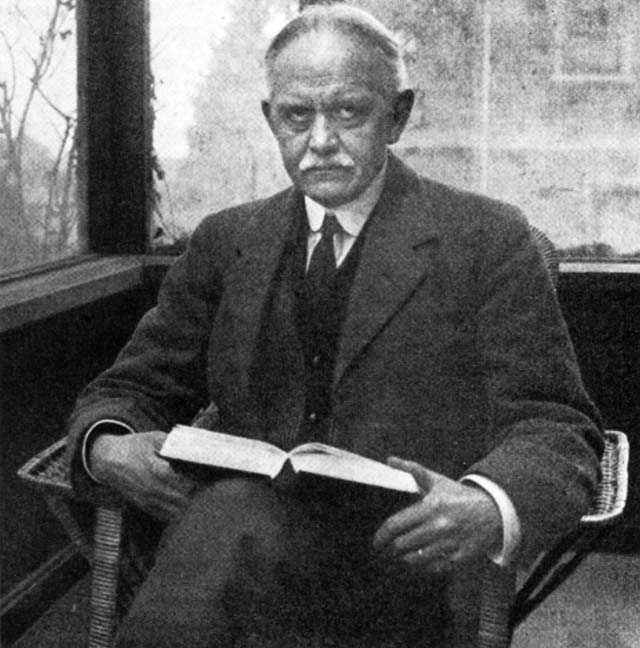
GAYLEY SPENT his ninth academic year, 1897-1898, abroad, on leave of absence. He had long desired to read in the old libraries of England, where he could put the finishing touches to a "Grundriss" of literary criticism upon which he was engaged in collaboration with Fred Newton Scott of Ann Arbor. Besides, early in 1896 the American publishing house of Macmillan had made him editor-in-chief of a series of English comedies it intended to publish in some four volumes, and during the year 1896-1897 he had been busy outlining the project. Now it became necessary to go to England to secure a number of British scholars as editors of some of the plays in the series. Accordingly, in the summer of 1897 he and his wife and their little daughter, Mary, aged four, arrived at Oxford.
It was the year of the Diamond jubilee, the sixtieth anniversary of Queen Victoria's coronation. For this festival of the British Empire, chief officials of all the self-governing colonies and drafts of troops from every British colony and dependency were brought to London to join in the Jubilee Procession in June. The crowds were huge and their enthusiasm was extraordinary. London and its vicinity were filled not only with visiting Englishmen, Scotsmen, Irishmen, Welshmen, colonials, and Americans, but also with picturesque natives, black and yellow and brown, from the remote reaches of the Empire. "There were Hausas from the Niger and the Gold Coast, colored men from the West Indies regiments, zaptiehs from Cyprus, Chinese from Hong Kong, and Dyaks from British North Borneo; native princes from India, and their Imperial Service troops, and splendid detachments of Sikhs." The Queen, though she was seventy-eight, held her place in the procession for four hours. London and the great provincial towns were illuminated, and the hills from Ben Nevis to the South Downs were crowned with bonfires. The Queen held a great review at Aldershot; and a fleet of one hundred and sixty-five vessels of war drawn up in four lines, extending altogether to a length of thirty miles, was reviewed by the Prince of Wales at Spithead. The Gayleys were invited by the new American ambassador at St. James's, John Hay, to come to his home in Carlton House Terrace to watch the Procession.
But what interested Gayley most of all during this festival of self-adulation was the publication in The Times, July 17, 1897, of Rudyard Kipling's "Recessional." Here was the voice of England's conscience keeper, nobly lifted to call Englishmen back to their senses, reminding them of the duties, the noblesse oblige, imposed upon builders of empire. For Gayley, this poem was the greatest moment and sanest utterance of this festive time.
In the midst of the jubilee excitement, the family found it difficult to obtain satisfactory quarters. For a while they stayed at Oxford's famous hotel, the Mitre, while day after day they looked in vain for lodgings. The streets were full of strange crowds. Everywhere high brick walls protected the privacy of the citizens of Oxford. It seemed the family would never get to know anyone. But Gayley had a happy way of making friends. One night he remembered that Louis Dyer, a Harvard man, and a Fellow and former Lecturer in French and German at Balliol College, who six years before had published his delightful Studies of the Gods in Greece, was married to one of the Macmillans of the publishing house that had contracted for the series of comedies. Snatching at this straw, he obtained Dyer's address and called a cab. It was nine o'clock in the evening. Dyer was in his study. "Mr. Dyer," said Gayley, "I have come to you for help." From that time on, thanks to the kindliness which so endeared Louis Dyer to all who knew him, Oxford proved a second home. Dyer got them lodgings, introduced them to the people behind the high brick walls, and became their devoted friend. Later, in 1900, when lecturing at Berkeley, he was entertained in their home.
Gayley was now very happy in Oxford. He was busy working on the "Grundriss" and the comedies. He spent most of his time at the Bodleian and in the colleges. He met all the 'Oxford Dictionary crowd, 'who were Scottish and humorous. He had the signal distinction of being admitted to that famous debating club, the Oxford Union. He was elected an honorary member of the Senior Common-Room (or Tutors', Professors' and Fellows' Body) of Lincoln College. His rooms, formerly John Wesley's, thenceforth were always at his disposal. He dined in the Hall almost every night. He met many of the Lincoln men, including the Rector, William Walter Merry, and Dr. Munro, who later became Rector; he became acquainted with Percy Gardner, the well-known Oxford professor of classical archaeology, and with Edward Caird, who in 1893 had succeeded Benjamin Jowett as Master of Balliol; and he and his wife came to know well the widow and two daughters of one of Oxford's most famous men, Edward Augustus Freeman, Regius Professor of Modern History. Gayley's interest in people was unlimited. His ready sympathy and infectious enthusiasm, his wit and wisdom, the easy distinction of his bearing and manners, and his golden voice won him friends and admirers on every side.
Nor was he forgotten in Oxford during the nine years that intervened between this first sabbatical and the next one, in 1907. As late as the summer of 1906, Professor Walter Raleigh at Oxford told a story about him. In speech, manner, and physique Raleigh was astonishingly like Gayley. Perhaps he had divined this fact from what he had heard. At any rate he was curious about the American professor and loved to tell this story. "You know," he said, with the very twinkle of the eyes that characterized Gayley, and in a vivacious tone startlingly like Gayley's---"You know, I remember being in some company where the conversation ran like this. 'By the way, have you met a man by the name of Gayley? A marvellous chap! Everybody is talking about him.' 'No. Who is he?' 'American, I believe, but distinguished. A professor of something.' 'Oh yes [from someone else], a professor of history, I take it. At any rate, he talked history to me for an hour or more.' 'No [from yet another], I believe he professes politics or economics. At any rate, he talked that way, most interestingly and informingly, for a whole afternoon.' Then someone else, on similar evidence, said he must be a professor of literature, either English or French. And so on! I wish I could meet him." Unfortunately, they never met.
While the talk is about men whom Gayley resembled, another anecdote may be suffered. In that same summer of 1906 a Bach Festival was held one afternoon in the Crystal Palace. During the intermission, the huge crowd milled about the nave. One slender figure, moving slowly, with an air of remote abstraction, loomed head and shoulders above the crowd. For a second, so the story goes, the large, kindly face, brown and handsome, with the dark eyes potent even in repose, seemed Gayley's, until Balfour was recognized. There was, indeed, something similar about the two heads. Those who had seen both men remarked upon the resemblance. And both had invincible charm and distinction, though the American's manner was more lively and effervescent, with an inalienable touch of something Irish. Balfour's charm could hypnotize a nation, even the United States, to say nothing of the House of Commons. Political opponents dreaded that charm, and perhaps it was too easily assumed and dispensed. Gayley's charm, however, was never a cloak to be put on or off. It was the whole man in action. The story of how these two met will be told later, in its proper place. Now we must return to the year 1897-1898.
There are many anecdotes of this year abroad. Most of them turn on Gayley's happy adventurousness and audacity, or on his extraordinary power of making lifelong friends. But one of his recreations was learning languages, for which, like his mother, he had a natural aptitude. He spoke French rather fluently, and his German was easy and remarkably pure. At Oxford, he took up Danish. Later, at Rome, in his intense desire to acquire at first hand a speaking knowledge of Italian, he always rode in front with the cab driver. Every afternoon, too, at five he had in a man to teach him the language in less inconsequential fashion.
On his return to Berkeley, he resumed his interest in debating. The 1899 Carnot debate was held on February 3, in the evening. At a student rally late in the afternoon of that day he spoke amid repeated applause. Ten years ago, he said, it would have been impossible to gather a corporal's guard to attend a meeting in the interest of debating. Even six years before there was but little enthusiasm. Later all this had changed, and now practically the entire student body was keen about this intellectual contest.
The debaters for California were A. J. Cloud, Willsie M. Martin, and Carl Warner. Warner won the medal. The subject, in the light of recent events, is noteworthy: "Resolved, that it is for the interest of France to form a close alliance with Italy."
Toward the close of his speech at the rally, Gayley, fresh from his experiences at Oxford, enthusiastically proposed that something on the model of the Oxford Union should be started at Berkeley---a student society and debating club, housed in its own building, with library, club rooms, etc. The suggestion aroused much interest, which was further developed by his article, "A Suggestion from Oxford to California," contributed to the February (1899) number of the University of California Magazine. He stressed the possibility of making the Union a potent center of significant, intellectual intercourse. This suggestion bore some fruit. A joint committee was appointed, representing the faculty, the alumni, and the students. For a while expectations ran high. The regents conferred with the committee, and it was hoped that the new president, Benjamin Ide Wheeler, who was soon to take up his duties, would favor the project. But under the paramount need of new buildings for the rapidly growing University, this proposal languished and died, though years later it was resurrected, in quite another form, and in that changed form was realized in what is now known as Stephens Union.
Two months after the proposal of the Union, the intercollegiate debate with Stanford was won by a California team consisting of Willsie M. Martin (now minister of the Wilshire Methodist Episcopal Church in Los Angeles), Carl Warner, and 1. Golden. The Carnot medal was brought to Berkeley in 1900 by Willsie M. Martin, in 190l by William A. Morris, in 1903 by Max Thelen, in 1904 by Joseph Lucey. Other debaters who by their victories attained position in those days upon the Honor Roll of Wranglers were George F. McNoble, James W. Clarke, Joseph O'Connor, F. H. Dane. George Clark, and A. J. Dannenbaum. Thus continued at Berkeley the palmary days of debating. At every debate the rafters rang with cheers for Gayley and Flaherty. At many of them Gayley himself presided. Banquets were held for the teams, both before and after the contest, and Gayley would make speeches emphasizing the fact that California's successes were the result of getting down to the bottom of the question and maintaining superiority in logical discourse, in hard, consistent argument. For flashy, demagogic appeal, for insincere titillation of the prejudices of the audience, for popular gags and slogans, for the vulgar sophistries which nowadays thrive in some college departments of public speaking, he had no patience. Fundamental brainwork, to the utmost of each individual's capacity, united to a truly distinguished, dignified, and sincere delivery, was the ideal and the practice he always inculcated. In turn, among the debaters themselves he enjoyed something far deeper than popularity; he won their lifelong gratitude and veneration.
In an interview in the Daily Californian, February 14, 1902, he remarked on another advantage to be gained in debating: "I think that the influences of most value to a young man in his college life are the opportunities given him of mastering some subject and expressing his mastery,---that is to say, the chances of probing a subject to its core and of making the knowledge sure and useful by putting it into the best form of language written or spoken."
His support of debating was one of the most considerable benefits he conferred upon the University. He never lost interest in the subject; but as time went on, as his commitments in research increased, and as the English department expanded in size, it became impossible for him to give of his time as he would have liked. In 1914 his department was so large that a separate department of Public Speaking was established, headed by Martin Flaherty. From this time on the responsibility of promoting debating was in other hands. However, by means of one of his most notable courses, Oral Debates upon Literary Topics, which has already been described, but which was first set up in 1899-1900, he kept in contact with debating, for into this course came always the best talent that the new department developed.
Among his other contributions to the intellectual life of the students, his literary lectures, of course, were widest in influence. The quality of this performance and the impression it made upon the University public have been noted in the previous chapter. During this period his power and fame as a lecturer steadily increased. The size of his classes in Shakespeare and Nineteenth Century Poetry grew enormously. To continue the account of these courses would be repetitious. But two new ventures are to be chronicled: his remarkable readings and interpretations of Kipling's poetry, and his course in Great Books.
On February 28, approximately three weeks after his speech at the 1899 Carnot rally, he read in the morning paper that Kipling was ill. First reports indicated that this illness might be fatal. Gayley thought the poet's death would be a national calamity, for he still regarded Kipling as England's conscience keeper. He still felt that the "Recessional," daring in the midst of the imperialistic adulation of the Queen's Jubilee to speak against a people drunk with power and loosing "wild tongues" in foolish boasting, was a necessary reminder of national humility and moderation. Toward the gospel of the "white man's burden" he was cool; but he believed, nevertheless, that Kipling was a mouthpiece of all that is best in British character. He was dismayed, therefore, by the morning's account of the poet's illness. That afternoon he met one of his classes. Suddenly he began an extemporaneous lecture on the poet who had tried to call England back to her senses. He spoke with such deep and powerful conviction that news of the lecture spread rapidly. Within a fortnight he was called upon to repeat it in San Francisco, both before the Charming Auxiliary and at Temple Emanu-El; and during the rest of his service at Berkeley he was repeatedly requested by various student organizations to read and comment upon Kipling's poetry. "Did you hear Gayley on Kipling?" was the beginning of many a conversation in Berkeley. And since Henry Morse Stephens was eloquently reading Kipling to many audiences at the same time, a vogue for Kipling swept the campus.
As the years passed, he more and more made use of that noble parable, "The Palace," which Kipling wrote in 1902. Upon many a company of young men, gathered at a meeting of the Golden Bear Society or on a Sunday evening about his own fireside, his reading of this poem made an indelible impression. The parable is of a young man's best dreams and of what becomes of the dreams when he reaches maturity---a parable of that which is deeply hidden in the heart of each man's heart. Gayley's interpretation ran somewhat as follows. Whatsoever you dream of building during the little reach of your life, in pursuit of your idea of what is best for your fellows and yourself, you will have the experience of Kipling's Mason-King. At first, in the flourish and pride of youth, you will deem former attempts of the same sort of little wit or worth. But with the years some failure, greater or less, to materialize the dream and ambition, will teach you how the earlier builders, like you, dreamed, tried, and failed of full accomplishment. Your building, like theirs, will become the spoil from which yet others in their turn will try to build. All you have wrought must then be "abandoned to the faith of the faithless years"; and you, like the Mason-King, will cut on the timber and carve on the stone,
To these men, when they were young, Gayley's reading was for each an intimate prophecy, from the lips of one they held in near-worship because he was so obviously and gloriously a man among men. To these men, now that in a thousand ways, during the years, their dreams have suffered unwelcome change or sorrowful diminution, the full realization of the truth of the prophecy is profound for each. Perhaps, in all his life as a noble publicist, Gayley made no more lasting contribution than that he made when he read Kipling's "Palace" for some thirty years to successive groups of college men. Leadership? Yes, we hear so much about it at university commencements and other exercises, as though every collegiate were destined to be a public leader,---whereas it is almost equally important to learn that not all collegiates should dare to rush into a public leadership where archangels fear to tread, and that for most the best leadership is that of heroic sincerity and self-dependence. At any rate, Gayley's talk about leadership was no superficial advertisement of impulsive and personal ambition. It began where ambition totters, in the dream unfulfilled, and pointed the way to the corporate immortality of the best that the race, through the centuries of its building, has thought, and said, and done. Not a dismayed cynicism, but a thoughtful and heroic meliorism, was his magnanimous answer to the problem of the human adventure, his solution of the wistful puzzle of Fitzgerald's Omar.
Fresh from his enthusiasm for Kipling's poetic publicism, Gayley filled two of his own poems with protests against contemporary events at home and abroad. At the annual meeting of the Berkeley branch of the Phi Beta Kappa Society, in May, 1899, he read a poem entitled "The Chosen of the Lord," directed against the lawlessness of Negro-lynching, against demagogic incitement in the ranks of labor, and against red-handedness in general. Under the title, "The Flouting of the Law," it was published, March 4, 1900, in the San Francisco Examiner, and was widely copied and commended in America. In the same number of the Examiner, Bailey Millard fervently welcomed it as a proof that in the University there was at least one scholar who could speak in ringing verse upon vital topics of the hour. The other protest, "When the Queen Was Young," was written November 1, 1899, directly after the news of the defeat of the British by the Boers at Nicholson's Nek, and was first printed in the San Francisco Examiner, November 5, 18gg, and again, in revised form and in the same place, December 17 of the same year. It was copied in many papers of the country. The poem is an attack upon what the author then considered the British oppression of the Boers. In the Examiner for the 12th of November, Ambrose Bierce made a bitter and personal attack upon Gayley and upon the sentiments of the poem. In quoting from the poem, he changed the capitalization and omitted a line in order to give a semblance of nonsense. A minor literary squabble ensued, with Richard Walton Tully making a mordant counterattack upon Bierce, in the California Occident of November 22. To 1899, also, belongs another poem of protest, directed against the bullying of the smaller by the larger nations. It was published in the San Francisco Chronicle under the title of "The Nations," and was reprinted in many other daily papers. Its indignant arraignment of the so-called Christian nations for extending their power by force and thus "crucifying afresh the very Son of God," is another attempt to supplement Kipling's poetic publicism. Indicative of all this interest in the poetry of protest and reform is his article, "The Poetry of Social Reform," published in the University of California Chronicle (Vol. III [1900-1, pp. 373-386).
The course in Great Books began in 1901. The idea behind it he was always preaching. Like his convictions concerning the value of debating, this idea derived from his own experience at Blackheath, Belfast, and Ann Arbor. In those early years his own mind had been illuminated by the constant reading of the world's greatest literature. He knew that an acquaintance with the best the world has thought and said is of saving importance. He realized that perusal of great books furnishes a mind with many more patterns of noble and various living than it is apt to discern in the narrow confines of contemporary experience. He argued that a mind so enriched is less apt to accept unthinkingly the idols of the marketplace, served slavishly on every side.
To stimulate such reading, to rescue reading from subservience to the professional technique of a narrow scholarship, and especially to develop such reading among students in the colleges of applied sciences, he instituted a one-hour course in Great Books. He lectured briefly and stimulatingly upon selected masterpieces, while the students were reading them. Campus gossip was aroused by this novel offering. One rumor was that, having overheard some vivid 'cussing' in the 'Mining Push' he at once decided that such fertile imagination would accomplish wonders if guided into proper channels. And there was a story of some venturesome engineers who discarded jumpers and overalls, washed the laboratory grime from their hands, and sallied forth to a literary lecture room, only to find it so crowded with girls, women, coeds, pelicans, old maids, and females of every other sort and description, that they fled back to their hill fastnesses. As a matter of fact, to keep the new course for the students in the applied sciences and in commerce, it became necessary to limit the attendance of women. This limitation aroused such a storm of protest, in which the lecturer was repeatedly accused of being a woman-hater, that the course was given one term for the men of the University and the alternate term for all and sundry. Until this device was invented, there was trouble enough. Visitors had to be excluded, and students had to show their registration cards at the door. Once the hall was so crowded with women that the men gallantly surrendered their seats. But Gayley, with all the grace he could summon for the occasion, requested the young ladies in turn to surrender their chairs, so that those for whom the course was designed might enjoy it in comfort. The request was startling, but the women complied with good grace. Even then a large number of men had to stand outside and listen through the windows.
'Great Books' met for the first time in a room in North Hall, Tuesday, January 15, 1901. No room in the building could hold the crowd, which increased at each lecture. Townspeople began to attend as visitors, and as visitors hundreds of students attended regularly. The class was shunted to the auditorium in Stiles Hall, to the lecture room in the Observatory, to 101 California Hall, to Hearst Hall, and finally, in 1909, to the Greek Theatre, where the audience frequently amounted to a thousand and more. The lectures, from year to year, ranged over all literature. Students, inspired by the lecturer's enthusiasm, read the epics of ancient India, of Greece, and of Rome; the books of Job, Ruth, Song of Solomon, Ecclesiastes, Esther, and Tobit; the tragedies of Aeschylus, Sophocles, and Euripides; the comedies of Aristophanes and Molière; works of Theocritus, Plato, Epictetus, Marcus Aurelius, and Seneca, of Rabelais, Calderón, and Cervantes, of St. Augustine, Dante, Montaigne, and Malory; Goethe's Faust and Shakespeare's plays; the works of such contemporaries as Kipling, Masefield, Stephen Phillips, Yeats, Shaw, Chesterton, Noyes; and many other books, ancient and modern. The lectures were reported at length in the Daily Californian. One of the attractions of the course was that again and again the announced sequence of talks would be suddenly interrupted. Gayley would appear, boiling over with enthusiasm for something he had been reading during the week, and with flashing eyes would plunge into rapid, eloquent praise of it before his enthusiasm had a chance to settle. It was an excellent device, for it was a vivid, illustration of that absorption in reading which the lecturer coveted for his students. Once, for example, he inserted a lecture on Stephen Phillips between Job and the Mahabharata; Sienkiewicz suddenly appeared between Plato's Republic and Epictetus.
Year after year this famous course was given, even to the year of Gayley's retirement from teaching. Its influence for good was incalculable. Of course, there were slurs upon it, as when even a president of the University referred to it as the course in which Gayley made little books out of great books. A course so popular inevitably had its drawbacks, but these in comparison with the place given to great books in the consciousness of the crowds who listened each week, were negligible. 'Great Books' put literature on the University map as it never had been there before---or has been since. Taken in conjunction with the solid work Gayley did for debating, it rounded out a supreme service to the students of the first quarter of the century.
Yet these were not the only ways in which he displayed his vital interest in students. He believed that "no more powerful bond of student interest could be created than that which comes from the singing of good, soul-stirring college songs," and that poetry set to music and sung by thousands of enthusiastic young voices is profoundly moving. Therefore, in November, 1902, he was glad to become chairman of a committee to gather material, new and old, for a University of California Song Book. Preparation, for various reasons, dragged well over two years. Had it not been for him, the book would not have appeared when it did, in February, 1905. Among his own contributions was a University hymn. He was never satisfied with "O God, Our Help in Ages Past" as a University hymn. Once he spoke forcefully to President Wheeler: "My God, Wheeler, we stand up and sing 'O God,' and nothing happens, and then we sit down again." He also contributed nine other songs. His interest in this phase of college life, his ambition to write successful college songs, his gladly given labor in compiling songbooks, were a very happy and engaging expression of his many-sided humanity.
Of Gayley as a founder of the Golden Bear Society, and of his paramount influence therein, nothing, unfortunately, can be said, since secrecy is of the essence of that organization. But, because it is a matter of public record, it may be permissible to chronicle one fact. At a banquet of this society in 1905, he made the suggestion that, since it had proved impossible to provide a California Union as a center for all undergraduate life, at least a simple hall for the senior class might be supplied. Committees were appointed and the task of obtaining funds for a building was begun. Henry Morse Stephens was particularly helpful. Students, alumni, and faculty rallied to the aid of the project, and on the evening of September 18, 1906, the little log cabin in Strawberry Canyon was dedicated as "Senior Hall." Thus a notable step was taken toward bringing together in a definite way the interests of the students.
One of his chief delights was his fraternity, Psi Upsilon. This organization, strong in the East, had made a vow never to cross the Mississippi. Soon after his arrival (1889) at Berkeley, an agitation for a Californian chapter was began, without success. In 1898 Alpha Psi was organized as a local fraternity, but admittedly with a view to petitioning for a Psi U. charter. Solely for the purpose of securing it, he went east in the summer of 1900. He went from college to college, visiting every chapter of Psi Upsilon, endeavoring to convince them that California should be admitted. He came back triumphant. On the evening of August 18, 1902, the Epsilon chapter was installed at the California Hotel, San Francisco, by Dr. George Henry Fox, of New York. There were thirty-four charter members. A banquet followed the installation, with Gayley acting as toastmaster. Among the speakers were Francis S. Bangs, Dr. Fox, T. R. Bacon, L. J. Richardson, George H. Fitch, J. S. Ryason, Willsie Martin, Raymond Carter, the Rev. J. D. Hammond, and Edward Mills Adams. In the faculty there were several members of the fraternity, including E. J. Wickson, Thomas Sanford, C. W. Wells, Martin C. Flaherty, and B. A. Etcheverry. Gayley's interest in the chapter never waned. Many are the stories that are told of his witty speeches at the chapter's dinners, of his stiff but humorous 'lectures' when the chapter's rating in scholarship fell low, and of his wise, personal counsel aptly given. Today this chapter's admirable spirit and scholarship, which he so wisely and genially fostered, would seem to him, if he were here, the realization of one of his dearest dreams. Though his fraternity was one of the smallest groups upon which he made his mark, yet in force and intimacy of effect his efforts here were vitally successful.
This account of his relations with students may be concluded with a humorous anecdote. To 1904 belongs the episode of the Giggling Girls. It happened thus. Gayley, on March 18, lecturing to a class in poetry, was reading an extract from the work of some modern poet. He was annoyed by the persistent whispering and giggling of a few women students. Finally, after a number of reproving glances in their direction, he abruptly thundered: "If God Almighty or the Archangel Gabriel had written this poem it would not interest you. You are a lot of giggling girls. You should be made to pay for your education. Class dismissed." He threw his books in his bag and left the room. For a few moments the class sat in stupefied silence. Then the storm and the story broke together, raced over the campus, made the front page of the campus Daily Californian, and thence were copied and enlarged upon by papers all over the country. The story got into European papers. The Düsseldorfer neuesten Nachrichten (April 15, 1904) printed it with humorous exaggeration under the headline, Die Gänschen" von Kalifornien. Editors praised and blamed, tea tables chattered, fraternities laughed, sororities debated. Gayley smiled gleefully: it had been a grand invective!
In the management of his department during the period 1897-1914, three major movements are discernible. First, the organization which had been attained before his sabbatical leave was continued, and was extended by the addition of new courses, including some in American Literature and a larger number in Public Speaking, by setting up a series of final examinations that must be passed as a condition of graduating with a major in English, and by a progressive expansion of the graduate division. Second, under the influence of President Wheeler's administration, and following the lead of Harvard, Yale, and other eastern universities, the freshman work in English composition was signally emphasized and developed. In the fall of 1901, Chauncey W. Wells was brought from Yale to organize the Freshman and Upper Division courses in writing. Third, the personnel of the department was increased. By 1914 there were twenty-one professors and instructors, and a number of Teaching Fellows, including, among others, George R. Noyes, Victor Henderson, J. A. Winans, Charles D. von Neumayer, Clinton K. Judy, Frederic T. Blanchard, Herbert E. Cory, Harold Bruce, George R. McMinn, Leonard Bacon, Lucy Sprague, Newton B. Drury, Joe G. Sweet, Morse A. Cartwright, and John L. Schoolcraft. The department had become one of the largest of its kind in the country.
Its affairs were managed in a spirit of gentlemanly coöperation, largely at dinners either at the Gayley home or at some restaurant in San Francisco. These gatherings, patterned upon the faculty dinner meetings described in a previous chapter, but less given to extended debates, established a certain "Gemüthlichkeit" as a tradition in the department. Gayley presided with a courtesy, and with a kindly consideration for even the youngest and newest recruit, that set the tone. Enthusiastic and outspoken as he was by nature, on these occasions he refrained from injecting his own convictions into the discussion. He never made the mistake of trying to impose his ideas. He listened, he encouraged each man to say his say, he kept good humor paramount, he promoted sincerity and frankness, and he was content to take the decision of the department. He was a benevolent and magnanimous chief, not a partisan leader. Nor did he ever act save on the advice either of the department as a whole or of the smaller group of senior professors. Perhaps one of his most successful and endearing methods of management, if it can be called that, was his way of meeting a new appointee, making him feel at home at once, and by the force of his personality inducting the stranger immediately into the gentlemanly tradition of the department. The story, for example, of how he welcomed Leonard Bacon is told by Mr. Bacon himself in "Teaching at Berkeley," in Harpers Magazine (March, 1939). It is a typical story. It illustrates the way in which Gayley's young men became personally devoted to him--looking upon him, indeed, as upon a generous and understanding friend to whom they could take any problem, sure of his deep interest and prompt aid. In the matter of promotions he struggled assiduously in behalf of each and every man, so that if ever men were disappointed (and of course some were) they could at any rate be sure that the 'Chief' had done his utmost in the president's office. During all his tenure an amazing amount of general good spirit obtained in the department. No cliques existed; no minorities felt themselves aggrieved or 'out of power.' It was a rare and ill-informed individual who did not believe that Gayley was always governed by constant fidelity to honorable obligation and kindly consideration.
But during the ten years from 1897 to 1907 his most consuming task was that of making his mark in literary scholarship, for he was not one to rest well satisfied with the fame gained from local achievements as teacher, lecturer, leader of student opinion, and departmental administrator. To solid achievement as a scholar he drove himself mercilessly and successfully. It was his busiest, most productive period of publication. Some five books and about three dozen articles and other short items were the result. Not all of them were scholarly publications in the narrower sense of the term, but in the broader sense they all were the publications of a scholar. By 1907 he was known throughout American and English universities as a literary scholar distinguished for accuracy of information, clearness of method, sensitiveness of critical taste, breadth of comment, and vigor of expression.
He made his first reputation as a scholar with An Introduction to the Methods and Materials of Literary Criticism, Volume 1, The Bases in Aesthetics and Poetics (Boston, Ginn & CO., '899, xii + 587 pp.), in the preparation of which he had for collaborator Fred Newton Scott, Professor of Rhetoric in the University of Michigan. This is the "Grundriss," to the preparation of which reference has been made earlier in this chapter. The purpose of the work is to place before the critical student of literature an inventory of the materials in the fields of criticism and theory. Literary encyclopedias previously published, such as the eighteenth-century works of Quadrio and Sulzer-Blankenburg, or the nineteenth-century work of Boeckh, were different in scope and plan. Here was no dogmatic formulation of principles, but a systematic presentation of the problems to be solved and of the information available for the process. The volume filled a need at the very time that systematic literary studies were coming into favor. For well over a quarter century it has maintained its place as an indispensable aid to research. It is not too much to say that it is one of the most helpful of American contributions to its field. To revise it and bring its bibliographies up to date would be a welcome extension of its service.
It met with a most flattering reception. It was welcomed by such scholars as Henry Sweet, Edward Dowden, F. York Powell, Sir James A. H. Murray, Edward Caird, and Francis B. Gummere. Wetz gave it a very favorable review in the "Beiblatt" to Anglia (July, 1904), and an equal enthusiasm informed many other reviews in the learned periodicals of Great Britain and the United States.
It was always Gayley's habit to throw off one or more books of minor importance while he was engaged upon a more ambitious task. Now, while he was preparing the first volume of his Representative English Comedies, he was publishing not only several poems, addresses, and articles, but also, in collaboration with Martin Flaherty, an annotated anthology entitled Poetry of the People (Boston, Ginn & Co., 1903, xx + 439 pp.). The poems were selected to illustrate the history and national spirit of England, Scotland, Ireland, and America. In the words of the Preface, the book contains "poems that were household words with our fathers and mothers, and lay close to the heart because of the heart." Many a harassed teacher welcomed this collection that actually fitted the mind-bodies of her young barbarians at play. The reading of these poems, simple in meaning, popular in feeling, stirring in rhythm, became a sort of play that was a little higher in kind than the play of the schoolyard, yet close enough to the latter to make the transition from yard to schoolroom easy and natural. Schiller's theory of art as play, always dear to Gayley, was given a simple, pedagogical application. When Gayley saw a need, it became to him an opportunity, and his fertile mind elaborated a plan.
In March, 1903, appeared the first volume of his most extensive undertaking in historical-critical research, Representative English Comedies, originally planned for five volumes, but finally completed in the posthumous fourth volume of 1936. From 1897 to 1903 he had been hard at work on the first volume. Among the assistant editors of the series were Sir A. W. Ward, A. W. Pollard, Henry Bradley, Ewald Flügel, G. P. Baker, F. B. Gummere, G. E. Woodberry, Edward Dowden, C. H. Herford, J. W. Cunliffe, J. M. Manly, H. B. Clarke, George Saintsbury, Henry A. Beers, Harold S. Symmes, Alexander Beljame, Brander Matthews, Alwin Thaler, George R. Noyes, Tucker Brooke, and three Berkeley colleagues, A. F. Lange, G. A. Smithson, and Herbert E. Cory.
It seems better to speak here of this work as a whole than to notice each volume separately as it appeared. Between the first volume (1903) and the second there was a lapse of ten years. The third was published in September, 1914. The lapse of ten years is explained not by any lagging or cessation of scholarly effort, but by the very contrary, for during this decade he followed his bent for carrying on and publishing other work while engaged upon a major project. Five volumes and over a dozen shorter things were printed in this interval. In the same year (1914) that the third appeared, his Beaumont, the Dramatist, was published. Then came the World War, his tremendous expenditure of time and energy in connection with it, the sudden increase in his executive duties in the University, his executive office in the British Division of the American University Union, a host of other engagements (to be noted in their proper place) and, finally, under this mountainous accumulation of duties and burdens his failing health and death. These circumstances, taken together, explain the belated appearance of the fourth volume twenty-two years after the third. The unexpected prolongation of the task in comedy came, indeed, to be regarded as a bit comic in itself, especial by some of his assistant editors whose long-since-prepared texts and introductions reposed in the keeping of the editor-in-chief. But to Gayley himself the delay after the third volume was a never-ending source of worry and mortification, though those who knew the circumstances realized that the protraction was unavoidable.
The history of English comedy had not been separately treated with any thoroughness during the nineteenth century. With the twentieth-century movement for separate histories of the various literary types, a history of comedy was bound to be undertaken. He set himself this pioneer's task. The nearest previous approach is found in scattered sections and remarks on comedy in Ward's three-volume History of English Dramatic Literature to the Death of Queen Anne. The new undertaking was not so much to discover and collect texts and detect sources as to determine quality and development in comedy, and to isolate the type from tragedy and history-play. The general plan of documenting the progress of comedy by critical texts of representative plays, of joining to each play an introductory essay constructed upon these bases and upon exhaustive research in the comedies not selected for printing, was particularly admirable in view of the unsatisfactory state of the pertinent knowledge at the opening of the century. But it had the disadvantage of cutting up his own historical survey into parts hidden away in small print in the successive volumes. The combined introductions of the first three volumes, carrying the history from the beginnings to the closing of the theaters in 1642, and amounting to an ordinary volume of upwards of three hundred pages, was the first attempt of comparable size and thoroughness to trace the history of English comedy by itself. The primary documents to 1642 comprise the many miracle and moral plays, the interludes, and 435 comedies besides Shakespeare's.
In the course of his studies the editor independently discovered what Professor Pollard had already glimpsed---our first great comic dramatist, the anonymous Wakefield Playwright of the Towneley Cycle. So ingeniously and convincingly did he display the qualities and achievement of this anonymous poet that the Wakefield dramatist therewith made his entry into the recognized history of English comedy, notably in the first chapter of the fifth volume of the Cambridge History of English Literature, where to Gayley, conjointly with Pollard, is assigned the honor of discovery. In recognition of this contribution, he was asked to write chapters on the drama for the Cambridge History; but, feeling the task would too much interrupt the one he had already set himself, he declined.
To particularize adequately his other contributions in this series of volumes would require more space than is available. A few remarks must serve. His training in aesthetics made it impossible for him to restrict himself solely to historical research, and supplied to his criticism a wealth of significant categories, or, at least, queries. If one compares his work with that of his assistant editors, one is struck with the omnipresence, variety, and penetration of his criticism. His highly original review of the medieval beginnings of comedy culminates inductively in a brief but far-reaching statement of the nature and function of comedy. In each introductory essay and in each account of a play he chose to edit himself, he is at pains to keep track of romantic and realistic tendencies, of the merely typical in character and of the individualized type, of the artistic management of the tragicomic, of the interrelation of humors and manners, self-deception and intrigue, farce and true comic conflict, and of the adequacy of the adjustment of the conflict. He never neglects to observe the stage history of a play as an indication of popular approval and therefore a criterion of dramatic worth. He reveals an intimate knowledge of the judgments of previous critics, but he is not dependent upon them. His understanding is of the heart as well as of the head. Honest in moral indignation but disposed to tolerance, emotionally sensitive yet robust, quick to react to imaginative appeal, never forgetting to smile with the comedy while he judges it seriously, he always strengthens the reader's grasp of the human quality of the play. Nor is he at all averse to speaking out against time-honored traditions. For example, he ingeniously makes his estimate of the 435 comedies turn upon Swinburne's too superb praise of the dramatic poetry of 1590 to 1640, and too ready jibe at our apathetic ignorance of it. Examination shows that the popular judgment of these plays, as reflected in their stage history, is in agreement with Gayley's critical estimate of their significance for thought and feeling and conduct, namely, that not more than a dozen of the 435 are "absolute literature." And these twelve are the work of three or four men. The apathetic ignorance of the ordinary student, therefore, "is not immoderately to be deplored." This conclusion is perhaps as disappointing as independent and surprising. But, to say the least, it cannot be cited as an example of what Matthew Arnold feared----and is too often the fact---that the historical student is apt to overestimate the aesthetic worth of the author pinned under his industrious microscope.
Among his papers is a copy of a review of the third volume of the Comedies, written by the poet and critic Walter de la Mare, and published in the Saturday Westminster Gazette, May 1, 1915. A marginal note, in Gayley's hand, reads: "This passage is one of the kindest appreciations I have ever received. If anybody ever 'sums me up' I hope this passage will be quoted." The passage he marked is as follows:
This third volume of Dr. Gayley's "Representative English Comedies" is one more monument of Anglo-Saxon scholarship.... To the six comedies six critical essays are attached and as many informative appendices. ... Above and beyond all this, the student is presented with "A Comparative View" of no less than eighty-seven closely printed pages, which, like an orchestra of an unprecedented variety of instruments, ushers in the actual meats. Dr. Gayley's is indeed a prodigious and bewildering manifestation of life and light and learning. To have read, marked, digested, to have searched, sifted, compared the heterogeneous mass of 435 extant English comedies written in the half-century between 1590-1642 must have been a piece of gruelling galley-work such as even a Hyrian Prussian would hesitate to call down from heaven upon the head of an Englishman. An ignorance, only just not modest enough to consider itself "apathetic," may brood dismayed on the achievement. But in Dr. Gayley's eyes such a feat, so far as the literary historian is concerned, is all in the day's march. He must "of course, wade through"---rock, shallow, and quicksand---though it be honesty alone that lures him on, not love. ... In the countenance of Atlas one hardy expects to perceive a smile. Yet the first and last impression of Dr. Gayley derived from his exact, elaborate, Argus-eyed disquisition is just such a one as might be discerned in the bearing of an average student burdened with nothing more arduous than some such chance-won floweret. He wears his learning lightly. He is imaginative, vivacious, enheartening. Confident in the complete knowledge of what he is writing about, he keeps his mind free from mere bookishness, and his eye clear and ready for the least spark of life. The drear dustiness of much of his dead matter daunts him no more than the muck in which it perishes. He never forgets essentials. His utmost diligence may have been spent on disentangling the all but indistinguishable handicraft of one collaborator from that of another; he never wearies of the exactest analysis and classification; but he sympathizes with the novice and entreats him very kindly. He will---once in a while---cordially acknowledge that "it is as well to fall back upon the method of old-fashioned, judicial criticism, and ask, Is this art?" And yet he is not in the least dismayed at the frequency with which it isn't. Rowley's humor, he agrees, for example, "does not reside above the waistband, he is a third-rate dramatist at the best," but even Rowley has his niche. And as if to add the last fine flourish to the fastidious "p's" and "q's" of a scholar, he has even edited his editors, blandly but firmly disagrees with them when necessary, in some particular worth an instant's scrutiny.
To 1903, the year in which the first volume of the Comedies appeared, belongs also an article, "What Is Comparative Literature?" in the Atlantic Monthly (Vol- XCII [1903], pp 55-68), which is an expansion of his presidential address before the Pacific Coast Division of the American Philological Association. Here he recurred to an interest already manifested in a chapter of his Methods and Materials of Literary Criticism (1899), and yet earlier in his proposal, "A Society of Comparative Literature," printed in The Dial, August 1, 1894. The article in the Atlantic constituted, up to its time, one of the best reviews and criticisms of what had come to be called "comparative literature," though what was meant by the term was the comparative method in studying literature. After defining its field, methods, and aims, and reviewing ancient and modern anticipations of it and the then present practice of it, he wisely objected to the ambiguous misnomer "comparative literature," and proposed, instead, the term "literary philology." Giving up his original proposal of a special society for its prosecution, he pointed out that as a purpose and method it is actually and inalienably the possession of all departments of literary study and cannot be the sole concern of one department. If literary history is ever to have a definite meaning and method, and become a "subject" as well as a method, it must learn, like other social sciences, to supplement description with normative comparison, and both with induction of principles of growth. Once again, in 1904, when he was appointed chairman of the English Section of the St. Louis International Congress of Arts and Science, he recurred to this "literary philology," in his perspicuous paper, "The Development of Literary Studies during the Nineteenth Century." Here again we find him insisting upon the mutuality of speculative and inductive studies. After describing what he calls the reconstructive, the romantic and encyclopedic, and the historico-philosophical trends in nineteenth-century literary study, he brings them all to a focus in the present-day attempt to develop a literary philology. It seems that he always had in mind a vital scientific vision and method---that vision which speculatively sets up working hypotheses, and that inductive, comparative method which is ever employed in modifying or rejecting hypotheses, until, the right one found, a principle is ascertained. Always he realized that to amass description while timorously avoiding hypothesis is to collect confusing piles of chaff along with some wheat, to put a premium upon pedantry, to foster indifference and quietude, to commit intellectual suicide.
In 1904, also, appeared The Principles and Progress of English Poetry, written in collaboration with Clement C. Young, later Governor of California, but at this time head of the English department in Lowell High School, San Francisco. Intended both for the general reader and for high school students, it combines in one volume a digest of literary criticism, a brief history of English poetry, biographical sketches, complete texts of some of the most important poems (aside from epic and drama), and critical and explanatory notes to the poems. Gayley's chief contribution was an Introduction on the principles of poetry. Into something less than one hundred pages he managed to compress a discussion ranging from the relation of art to nature, through the various kinds of poetry and the definition of critical terms, to the details of prosodic technique. Scarcely anything so good of its kind, within such narrow compass, had appeared before.
In the International Quarterly for 1904 (Vol. X, pp. 108-129) and 1905 (Vol. XII, pp. 67-88) he published two popular articles, "The Earlier Miracle Plays of England." These accounts were preludes to one of his most fascinating books, both popular and scholarly, Plays of Our Forefathers (1907), published both in America and in Great Britain. Written with zest and with an intimate combination of knowledge and sympathy, and handsomely illustrated by reproductions of many old woodcuts, it is a singularly stimulating and informing account of the beginnings of English drama. The purpose of the book is best imparted by the author's own words: "To laugh and weep, to worship and revel for a season, in the manner and spirit of our ancestors, were indefinitely more pleasing than the pride of controversy or the pursuit of scientific ends. If I have sometimes used mere reverence, fellow-feeling, and imagination to reconstruct these plays and times, I trust the scholar will sympathize and condone; if I have in places turned source-hunter and advocate, I know the genial reader will skip."
But "genial readers" skip little in this charming work. Many have chuckled over the author's vivid way of indicating the comic effect of the liturgical dramatization of Balaam and his ass: "Once the donkey thrust his head within the church-door, liturgy, festival, and drama were lost in the stupor of his ears or the bathos of his braying." It was Balaam, and especially his ass, who modified solemnity with riotous humor. Where the ass ambled, comedy flourished. The whole story---the plays and their times---passes in vivid review, so that the reader easily identifies himself imaginatively with the medieval crowd that so simply enjoyed in the old performances the naïve, earthly mingling of reverence and fun, mystery and parody. Nor have scholars stopped with sympathy and condonement. They have pondered and praised the work. Sir A. W. Ward, for example, speaks of the "two very notable chapters" (XI and XII) in which the Wakefield Playwright and his work are vividly reconstituted; and the Cambridge History of English Literature, in connection with a chapter by the veteran Creizenach, calls the work "a singularly illuminating survey."
Plays of Our Forefathers was written very happily, with plenty of elbow room to combine literary research with interpretative criticism. After writing it, he turned first to the preparation of a revised and enlarged edition of his Classic Myths in English Literature and Art (1911), and then to the narrower task of editing the next two volumes of his Representative Comedies and providing historical introductions for them. But once again, according to a habit become inveterate, he prepared another book by the way. While working on the third volume of the Comedies, he became so absorbed in the personality and art of Francis Beaumont that he paused to make a literary portrait of him. In this work, Beaumont, the Dramatist: A Portrait, he added to his other scholarly enjoyments the absorbing interests of the literary detective. By a species of minute genealogical and biographical research he managed vividly to reconstruct the circle of Beaumont's relatives, friends, and associates in the various settings of home life with its privacies, of the Inns of Court with their dramatic revels, of the theaters with their popular excitement, and of the Elizabethan and Jacobean courts with their aristocratic visions of national life and letters. The Elizabethan-Jacobean milieu comes startingly alive. We seem actually to walk London streets, bowing to Shakespeare and John Donne, to Ben Jonson and Chapman and Marston and William Crashaw, and to Beaumont and Fletcher strolling arm in arm; to the clerical Spenserians, Giles and Phineas Fletcher, younger cousins of the dramatist; to Tom Coryate and Cotton and Selden; to the actors Richard Burbage and John Heming; to Dekker, Webster, Gerard, and other famous suspects of the Gunpowder Plot, including Beaumont's own Vaux cousins. The Sidneys and the Sackvilles and the Cecils and the Bacons come alive at court; the dramatists and players, at the Mermaid Tavern or Mitre Inn. We go to the playhouses to see first performances of the plays of Shakespeare and Ben Jonson, of Beaumont and Fletcher. If one would like to live in the London of Shakespeare, rubbing shoulders with the passing crowd of these glorious persons in the streets, the taverns, the Inns of Court, and the royal court itself, the Beaumont is his time machine to take him back alive to those marvelous days.
But his literary detection not only rediscovers those days; it also succeeds in dissociating Beaumont from Fletcher, both as man and artist. After reading this work we can no longer talk of Beaumont and Fletcher as inseparable literary twins, or read the plays of their joint authorship without noticing the qualities peculiar to each. Justice was at last done to the young poet of whom his contemporaries thought so highly that he was buried in the "Poet's Corner" of Westminster Abbey, when only Chaucer and Spenser had preceded him there.
From the many cordial tributes paid to this book it is pardonable to quote these carefully considered words of Sir Sidney Lee: "The work seems not only most complete and erudite, and on doubtful points most prudent and convincing, but it is also to my thinking very interesting and thoroughly readable from cover to cover. Literary students are already under much obligation to the author. He now has given them a new and very substantial cause for gratitude." In recognition of his contributions in the Elizabethan field, Gayley was elected, in 1914, an honorary member of the Elizabethan Club of Yale University.
In September of the same year, 1914, that the Beaumont appeared, the third volume of Representative Comedies was published. With these two publications the more purely scholarly contributions of the period covered by this chapter come to an end.
But a by-product of his scholarship must be noted. In the fall of 1903 Ben Greet was presenting in the San Francisco Bay region the fifteenth-century moral play, Everyman. He had come to Berkeley with letters to Gayley. It was the summer vacation. Mrs. Gayley was supposed to protect her husband, busy upon his Comedies, from all interruptions. Greet inquired at the University registrar's office how he might get into touch with the professor. He was too shy to telephone, so someone at the office volunteered to call the professor's house. Mrs. Gayley answered. She said, "Mr. Gayley isn't speaking to anybody." The message was relayed to Greet, and he said, "The old cat!" To which the man who was telephoning replied, "Why, she isn't an old cat at all." Mrs. Gayley heard all this, and was so amused that she finally permitted Greet to speak with her harassed husband. When they met, they took to each other at once. Another lifelong friendship was begun. Their mutual interest in early English drama culminated in Greet's giving Everyman on the campus, in the old Harmon Gymnasium, on the evening of the 1st of September. On the afternoon of the same day, Gayley gave a public lecture, "Moral Plays and Everyman," by way of introduction to the performance. The lecture was scheduled for his usual room, 18 North Hall, but the audience was so large that a sudden shift to the Gymnasium was necessary.
Greet eventually asked his new friend to prepare for him a miracle play that could be produced alongside the moral play, Everyman. To rescue the miracle plays for a modern audience was a task quite in the line of Gayley's ever-present impulse to make the literature of the past a vivid force in the present. He amalgamated several plays from the old Miracle Cycles in such fashion as to retain so far as possible the text, conditions, and atmosphere of the quaint originals. It was necessary to make changes in the original sequence, and in not a few words and lines; and to invent some scenes to join the parts. By these means a Christmas play, called The Star of Bethlehem, was built around the birth of the Christ child.
On the night of January 25, 1904, Charles Frohman presented the Ben Greet players in Chickering Hall, Boston, in the first performance of The Star of Bethlehem. The latest previously recorded performance of the old miracle plays had taken place at Coventry in the year 1580. The Star was a pronounced success from the start, second in fame only to the Everyman performance by the same company. Some critics found the miracle more impressive than the moral play. It was offered for a week, and each performance drew a larger audience. It was played in other American centers in 1904. It has been performed at numerous universities, colleges, and schools, both in America and in England. For many years it was an established institution at the Old Victoria Theatre, London, for the two Christmas weeks. In 1904 it was brought out in book form by Fox, Duffield and Company, of New York, with a popular introduction, by Gayley, on the miracle plays, their nature, distribution, mode of acting, etc. Here and there, some scholar, more wedded to the letter of his texts than to their poetic life, has feebly protested against Gayley's audacity in amalgamizing and modifying the texts. But audiences and critics of the performances have uniformly testified to the deep effect of the play.
We have considered thus far Gayley's influence upon student life during this middle period at Berkeley, his executive work as head of his department, and his contributions to literature and scholarship. Certain events and anecdotes which fall more or less outside these considerations may now be followed in chronological order.
In July, 1899, at a convention of the National Educational Association, held in Los Angeles, he was chosen to represent the association at the King Alfred Millennial in London, 1901. In November he was made a member of the American Social Science Association; in December, a member of the executive committee of the Philological Association of the Pacific Coast. In 1900 he was elected an Associate of the National Institute of Arts, Sciences, and Letters. In the same year Kenyon College (Ohio) honored him with the degree of Litt.D., in recognition of "original work in the sphere of literature."
During 1900 and 1901 he continued to answer the demand for public lectures. Up and down California and Oregon he spoke repeatedly upon Kipling, Walt Whitman, Poe, Lanier, Emerson, and various contemporary poets, and many other subjects. All these talks, each running the gamut from fiery denunciation to eloquent praise, elicited attention and discussion. Most of all, they set people to reading the writers he had blamed or praised. The Portland Oregonian said that here was a new sort of college professor, who united to a fresh enthusiasm for all sound scholarship a desire to bear a part in the public life of today, to come into closer contact with the masses, to meet the common man on his own ground, and to become a spiritualizing as well as an intellectual force. "In all the lectures delivered by Mr. Gayley, this past week, mere literary details were thrust aside as insignificant in comparison with the spiritual interpretation of the message that the author wished to convey."
During the summer of 1901, while he was engaged in some literary research at Oxford and in an investigation of the English secondary-school system, he received his first LL.D. degree, from the University of Glasgow. It was this degree that entitled him to wear the scarlet gown and cap that became him so well and gave a special emphasis of color to many an academic procession at Berkeley. He had been appointed to represent the University on the occasion of the ninth jubilee of the Scottish university, the four hundred and fiftieth anniversary of its founding. The commemoration took place in old St. Mary's Cathedral, where John Knox had preached and Oliver Cromwell had been rebuked. In attendance were many of the most famous men of the day, including Lord Balfour of Burleigh, General Sir Archibald Hunter, Sir Ian Hamilton, Sir Archibald Geike, the Comte de Franqueville, Sir James Reid, Sir Henry Roscoe, Andrew Carnegie, Professors York Powell and Pelham of Oxford, Jackson and Mayor of Cambridge, Baldwin of Princeton, Seymour of Yale, Farlow of Harvard, and a host of others, many of whom were "capped" on the day succeeding the commemoration.
At Glasgow he stayed with the Macmillans. Earlier, he had received from Professor George Saintsbury an invitation to share the Saintsbury home in Edinburgh, and after the celebration he went on to Edinburgh and spent some time with the Saintsburys. Through them he met John Dowden, Bishop of Edinburgh and older brother of Edward Dowden, the Irish critic, poet, and professor. This was the beginning of a lifelong friendship with the Saintsburys and Dowdens.
Beside the tale of the academic celebration at Glasgow it is pleasant to mention one of the gentlest tributes he ever paid a human being, his edition of the poems of Ralph Erwin Gibbs, class of 1898. This young man, who had been his "Reader," had met death on a tranquil afternoon in the spring of 1902, when he rushed from his study to save his dog from a falling tree. Gibbs's modesty, his quiet friendliness, his unassuming love of beauty, and his gift for composing in deft verses a simple philosophy of joy and contentment, endeared him to many, to none more than to his friend and 'Chief,' Gayley. The latter paused long enough in his many engagements to edit Gibbs's poems and write a wise and generous tribute by way of introduction. The book, Songs of Content, appeared in 1903.
In 1902 another honor came to him, his election as President of the Pacific Coast Division of the American Philological Association. But on October 4 an event occurred that was far more important than the writing of books, the reception of honorary degrees and other public recognition of his growing fare---the birth of his second daughter, Elizabeth Alston Pickett Gayley.
Clearly, all this man's public accomplishment sprang from and was directed toward highmindedness. Yet no one better than he realized that a healthy body is a condition of mental vigor. The ever-present, need of bodily exercise he always preached, and he practised what he preached. Golf, as has already been said, was his favorite exercise. Hence he welcomed the opportunity to join with other members of the faculty and with a number of prominent citizens of Berkeley, Oakland, and Alameda in founding the Claremont Country Club, which occupies an exceptionally beautiful site a little more than a mile south of the University. Here for years he regularly played his Tuesday and Thursday afternoon games of golf. It used to be said that he allowed nothing short of sudden death to interfere with these games. Many a University officer and professor, from the president's office down, has been amazed, even shocked, or amused, at Gayley's vivid refusal to join in any work or meeting that was scheduled for those precious hours. Sometimes in a simple, matter-of-fact way, sometimes in holy indignation, he would reject a call for his presence elsewhere. Many stories spread concerning his words and deeds on the Claremont green. He had a habit of conversing incessantly while a game was played, much to the confusion of his opponent's drives, though he always let up a moment while he calculated his own shot. It is a poor shot, he used to say, that doesn't please someone.
In 1904 he was gratified to receive from his alma mater, the University of Michigan, the degree of LL.D. In June his name was mentioned prominently in connection with the presidency of a Southern university.
In the fall of 1904 he purchased a lot at the corner of Durant Avenue and Piedmont Way, and here in the course of the following year his spacious home was built. But it was in the old Palmer home, where the family lived in 1903 and 1904, that yet another lifelong friendship was begun---that with Henry James. Another amusing contretemps occurred. James was coming to lunch, and his host had gone down to the railway station to meet him. Gayley waited in vain, train after train, and then came home desperately, only to find the guest comfortably installed in the library. Anson Blake had somehow managed to meet James in the crowd at the station and had promptly taken him to the Palmer house. Gayley and James were in many ways opposites, including their manner in conversation: one so impulsive and ardent, the other so slow and deliberate. There is a story of the two men walking along, with Gayley waiting courteously, with unaccustomed patience, for James to discover only after great care the precise word and for its utterance the precise tone. Later, in London, this friendship was renewed and happily extended.
In August, 1905, he was United States delegate to the International Congress at Liège for the Reproduction of Manuscripts, Coins, and Seals. To meet the needs of American scholars he had conceived in 1897 a plan for the photographic reproduction of the unique treasures of British and European libraries. Upon his return to Berkeley, after his first sabbatical leave, he drew up and circulated a scheme for the organization of what he proposed to call "The Inter-University Re-publication Association." In various ways, for several years, he endeavored to bring this scheme to the attention of universities, and of wealthy men who might be persuaded to give it financial support. Then, on the night of January 25, 1904, occurred the disastrous fire which gutted the rich and irreplaceable treasures of the National Library of Turin. The scholarly world was aghast. In October, Guido Biagi, prefect of the Laurentian and Riccardian Libraries at Florence, presented to the attention of the St. Louis Congress of Arts and Science the need of making photographic duplicates of unique manuscripts as a precaution against the occurrence of such a disaster at other European libraries. On the 1st of November Gayley sent a long letter upon the subject to the New York Evening Post. The Post published this letter, pledged its support, and printed commendatory letters from foremost American librarians. Gayley now proposed an American organization which would solicit the coöperation of foreign libraries in allowing photographic reproductions of their literary treasures, and which would circulate facsimiles to subscribing universities and libraries throughout the world. No such comprehensive plan had as yet been advanced. The Post continued to print letters upon this proposal in its issues of November 26 and December 3 and 10; and on May 10, 1905, added a letter of approval and practical suggestion from Guido Biagi. In the meantime, Salomon Reinach had cordially supported the project in the March-April number of the Revue Archéologique.
But while this project was being discussed in the United States, a somewhat similar movement was in progress in Europe. Several proposals proved abortive. Then, in March, 1904, Jules de Trooz, the Belgian minister of the interior and of public instruction, addressed a letter to a number of interested persons, directing their attention to the need of reproductions, and announcing the intention of the Belgian government to convoke in 1905, at the Liège exposition, an international congress to consider the problem. A commission of organization was appointed, in May, with Godefroid Kurth, of the University of Liège, as president. Through Reinach and Biagi, Kurth learned of Gayley's analogous enterprise in America. In the published transactions of the Liège Congress, the statement is made that as soon as Gayley heard of the Liège plan he wrote to the Commission of Organization, promising his active support. When the Commission requested the United States to appoint delegates, Gayley and five others were selected. He, however, was the only American delegate in attendance. The Commission requested him to address the Congress on the "Organization of an International Bureau for the Reproduction of Manuscripts, from the American Point of View." He was immediately elected one of the active vice-presidents of the Congress, along with six others: the Vicomte B. de Jonghe, president of the Société Royale Belge de Numismatique; A. Gaillard, Archiviste-Générale du Royaume Belgique; Henri Hymans, Director of the Bibliothèque Royale de Belgique; Godefroid Kurth, professor at the University of Liège; Salomon Reinach, member of the French Institute and Custodian of the Musée des Antiquités Nationales, Saint-Germain-en-Laye; and Von Weech, Director of the Archives of the Grand Duchy of Baden. With some of these, and with other members of the Congress, Gayley easily established friendly relations.
The plan he presented at one of the meetings of the Congress was substantially the same as that already published in his letter to the Evening Post. It was cordially received, and in fact took the Congress by storm. A letter from Reinach, who was unable to attend in person, heartily seconded Gayley's project and suggested resolutions in its support. Finally, in general assembly, the Congress voted its approval of the American attempt to organize a bureau for the reproduction of manuscripts, coins, and seals, and designated an International Committee to continue the study of the various questions discussed in the Congress. This committee comprised MM. Brambach of Carlesruhe, S. de Vries of Leyden, Fr. Ehrle of the Vatican Library, Gaillard of Brussels, Gayley, Karabacek of Vienna, Lange of Copenhagen, Nicholson of the Bodleian Library, Omont of Paris, Putnam of the Congressional Library, Reinach of Paris, Traube of Munich, and Van den Gheyn of Brussels. On his return to America, after spending the rest of the summer at the Bodleian and British Museum Libraries, Gayley published a report on the Liège Conference , in the New York Evening Post of September 9, 1905, and in the Annual Report (1905, Vol. 1, pp. 131-'42) of the United States Commissioner of Education. A complete account of the Congress, including his speech, is contained in the Actes du Congrès International pour la reproduction des manuscrits, des monnaies et des sceaux (Bruxelles, 1905).
His efforts to further his scheme in the United States occupied his attention for several years, but to gain the necessary financial support proved far more difficult than he had anticipated. However, at the Twenty-fifth Annual Meeting of the Modern Language Association of America, held at Ohio State University, Columbia, Ohio, December 26-28, 1907, Professor J. W. Cunliffe proposed the appointment of a committee for the promotion of such a purpose, with reference particularly to photographic reproduction of the earlier English texts. A committee was named, consisting of Cunliffe, Gayley, J. M. Manly, H. A. Todd, and G. L. Kittredge. From this beginning developed the Association's undertaking of photographic reproductions. But today the use of microfilms has superseded all these plans.
In 1907 came a very flattering invitation to head the departments of English Philology and English Literature in Cornell University, at a very considerable advance in salary. There was much heartfelt dread in Berkeley that Gayley might accept. The offer was declined.
In 1907, also, his connection with the Society of Mayflower Descendants began. The California branch of this society was organized upon the initiative of Herbert Folger of Berkeley. Its charter was granted on October 17, 1907, and Gayley was elected Governor at the first meeting, January 11, 1908. He continued as Governor for twenty-four years, until his death. His title to membership lay in his descent, through his mother, Sarah Sophia Mills, from Thomas Rogers, eighteenth signer of the Mayflower Compact.
For the academic year 1907-1908 he was granted his second sabbatical leave. He took his family abroad. Mary was fourteen years old; Betty was five. Mary's interests and Betty's sayings constituted a large part of the pleasure of that rather arduous trip. There were fourteen separate pieces of baggage. At each remove, Gayley found himself anxiously and with more or less suppressed profanity counting all fourteen pieces. He could be very eloquent on such occasions, and no one enjoyed his eloquence more than himself. September was spent in England. Oxford acquaintanceships were renewed. The children were taken to see the sights of London. Betty, apropos of nothing, in the heart of Hammersmith inquired, "Are there any cows in heaven?" and being answered in the negative, continued, "Then where do the angels get their milk?" But in October the family began its real peregrinations, through Holland, Belgium, France, Switzerland, and Italy---very much on the go until August of the next year. Part of the time, however, Gayley spent at various European libraries. He also visited the Second Peace Conference at the Hague, and was disappointed that the problem of excessive armaments was shelved, even as it had been at the 1899 Conference, because of the opposition of the German delegate. His brief, rough diary of those months in Europe consists of long lists of pensions and railway timetables, delightfully interspersed with humorous anecdotes and surprisingly accurate observations of the color effects of streets, countrysides, skies, and paintings. In Holland, everyone seemed independent, including little boys of ten smoking cigarettes in the most matter-of-fact way. Even the cows frisked in Dutch independence. Paris was the prostitute's heaven and the cab horse's hell. French matches were the worst in the world. French cigarettes were also of the devil. And so on and on, from the Hague to Naples, though the thumbnail sketches become rarer and rarer as the arduosities of the fourteen baggage pieces increase. At any rate, the sketches display a pleasant side of Gayley's nature that was not known to everybody---his humorous interest, now affectionate, now vituperative, in the characteristic minutiae of daily life.
From these excursions of mixed blessings---the only time he ever "did" Europe---he returned to Berkeley a rather tired and somewhat exasperated spirit. But one of the most satisfying and exciting adventures of his life was now to be experienced. While he was busy preparing the second and third volumes of Representative English Comedies, President Angell invited him to deliver the chief address at the sixty-fifth commencement at Michigan. Angell was retiring from the presidency. This was to be his last commencement. Of late there had been a certain amount of rather mean criticism of Michigan's "Grand Old Man." Angell wished to select as speaker someone he could trust to manage the situation tactfully. Gayley he had known personally as a brilliant undergraduate and astonishingly successful young professor at Michigan. He had followed his career at Berkeley with interest and approval. He had crowned that career with Michigan's LL.D. He knew that Gayley was devoted to him. Gayley's mother had been very close to Mrs. Angell. To the students he would be persona grata, for he was the author of their song, "The Yellow and Blue." Moreover, he could be trusted to give an address at once significant, powerful, and popular. Angell had always been an excellent judge of men. His invitation was another and final example of that good judgment. Angell wrote: "You will be sure of a royal welcome, especially from the thousands of students and graduates who have been singing your songs for years.... Kindle up your fires and come on."
The actual address happily exceeded all expectations. Many declared it was the best oration ever delivered at Michigan. June 24, 1909, the day of the exercises, was one of Ann Arbor's hottest days. One of the newspapers, reporting the occasion, said: "The day was swelteringly hot; but the moment Professor Gayley arose, all that was forgotten. The usual rustle of fans was stilled; and for an hour and a half he held the vast audience spell-bound." His topic was "Idols of Education." It was a brilliant and witty and scathing exposé of the weaknesses of the American educational system and an eloquent plea for more logical and constructive ideals and methods. Into it he poured the accumulation of years of experience and reflection, the fruits of his study of the English secondary-school system, his varied first-hand acquaintance with British and American universities, the wealth of his own many-sided interests, the enthusiasm of his own constructive visions, his deep convictions as a conscientious publicist, and his gift for humorous vituperation. At the close of each batch of biting criticisms he briefly pointed out that President Angell in his Annual Reports to the Michigan Regents had foreseen each of the dangers: during the thirty-nine years of his presidency, Angell had raised his voice against all of them. The audience was mightily responsive to the straight hitting, the vivid but humorous objurgations, the graceful tributes, the deep earnestness and splendid vision of the speech. It was curious to see how the audience would every now and then catch up with a joke or a witty epigram when Gayley was in the middle of the next sentence (for he went rather fast), and then would burst into a roar of laughter, so that he had to stop, and even beg them to remember that he had only an hour. But Angell said, "Don't mind the time. Go on!" At the end, when without any notes he spoke his tribute to the aged president, the audience nearly mobbed him with applause. Over and over again he had to get up to bow his acknowledgments, until Angell got them to quiet down and sing "The Yellow and Blue" in honor of the speaker. Thus the son of Michigan who as an undergraduate had by turns charmed and convulsed his fellows and instructors with his speeches in class, came home again to prove that during the intervening thirty-one years his gift for speaking had developed in power, in human understanding, and in magnanimity. As an immediate result of his success, he was prominently mentioned as Angell's successor. Eventually a definite and enthusiastic effort was made by a number of prominent men to put his name in nomination. Gayley himself, when asked for his advice, supported two of his old friends, both of them sons of Michigan.
But perhaps the chief fruit of this satisfying adventure was the revision of the address for publication in book form, under the same title, Idols of Education (Doubleday, Page & Co., 1910; another edition, 1916). Thus the famous philippic, terse and vivacious, became public property. It was one of the most favorably received and widely read of his essays. The reading public, already critical of the American educational system, welcomed this ungloved handling of the problem, laughed at its sparkling humor, and applauded its witty audacity. The book was quoted far and wide. Some of its chapters were reprinted in collections of modern classics for reading by university students. References to it occurred in British as well as American treatises upon education. In this essay one may still enjoy and ponder the trenchant but urbane attack upon those "idols of the academic marketplace" which have been gradually substituted for the true ideals of education.
In the meantime he had continued to answer, though of necessity less often, demands for his services as a public lecturer. He spoke at various cities and towns in the State, such as Los Angeles, Fresno, Stockton, Sacramento, Modesto, and Santa Cruz. Several courses on Great Books, Dramatists, the Poets of Today, etc., were given at the Hamlin School in San Francisco. His happy, hyperbolical oration, "The Irish Influence in Civilization," delivered in San Francisco at the annual banquet, March 17, 1909, of the Knights of St. Patrick, roused such a roar of Gaelic laughter that a stenographic report of the speech, in answer to popular demand, was printed in the Monitor, April 3, 1909, and in the University of California Chronicle (Vol. XI, No. 3). Whenever he permitted himself to speak on the Irish he let himself go all out, regardless of academic constraint, for he knew his audience would properly understand his wildest asseverations. With what delight, therefore, they would greet his own reminder, cast somewhere in the very middle of his hyperboles, "After all, we mustn't claim everything in the universe for the Irish." Yet there were some German-bred scholars who felt aggrieved, and professed to be scandalized. He got even by persuading the Knights to ask one of them to talk at a banquet. That scholar was never invited a second time; but Gayley was importuned annually, and in turn importuned the Knights to support at the University a chair in Irish Language and Literature.
In August, 1909, he was elected an overseas member of the Authors' Club of London, to which belonged many of the principal men of letters of the day, including Alfred Austin, Hall Caine, S. R. Crockett, Sir A. C. Doyle, Lord Dunsany, George Meredith, Frances Gribble, H. Rider Haggard, and others. In 1910 he became a member of the Malone Society (London). From 1911 to 1915 he was a member of the Executive Council of the Modern Language Association of America. From 1912 until his death he was a vice-president of the International Society of the Apocrypha (London) and of the Irish Texts Society (London).
Mention, too, should be made of his song, "The Pilgrims," written for the eightieth anniversary of Psi Upsilon and sung by a chorus of five hundred men at the anniversary dinner, November 24, 1913, in the banquet hall of the Waldorf-Astoria Hotel in New York. At a signal, Gayley's photograph was flashed upon a large screen at one end of the room, and the first stanza of the song was sung. The assemblage rose and joined in. Throughout the country, at the various dinners celebrating the occasion, the song was also sung, and everywhere it was hailed with delight. The original manuscript was sent to be hung in the hall of the Phi chapter at Ann Arbor.
Thus comes to a close the story of the seventeen years of this chapter---an exceedingly busy period, well filled with a remarkable variety of significant achievement. Many a university professor would be well content to have published in such a length of years as did Gayley, some ten volumes of research and some eighteen learned articles, reviews, and addresses. But besides these were scores of speeches before various University organizations and at various towns and cities from one end of the State to the other; several poems ringing with a noble public-mindedness, as well as formal odes for special, notable occasions; the keen interest and arduous support given to collegiate debating and dramatics; the weekly offering of lectures to large classes, for which he always prepared carefully; timely planning for a California Union, for the Order of the Golden Bear, for the Songs of the Blue and Gold, and for his own fraternity; the task, wisely and justly performed, of directing and developing an ever-growing department of English; the writing of the Star of Bethlehem; the attendance at the Liège Conference, with all the effort that preceded and followed that attendance; four trips abroad, including two sabbatical leaves; the chairmanship of the English Section of the St. Louis International Congress; the duties as a bank director, and as chairman or president or vice-president of many organizations, from the Mayflower Society to the Apocrypha Society and the Irish Texts Society; a host of minor engagements which cannot be mentioned here; and, last but indeed not least, a continuous, helpful, time-giving interest in individual students and in members of his own department---a story that never can be told adequately. Greater than the honors that came to him during these years, greater than the reputation he achieved in seventeen years as one of the half dozen most notable American scholars in his field, were, both in his own estimation and in that of those who knew him best, the gratitude and veneration of thousands of young men who owed to him a new vision of what it is to be a Man.