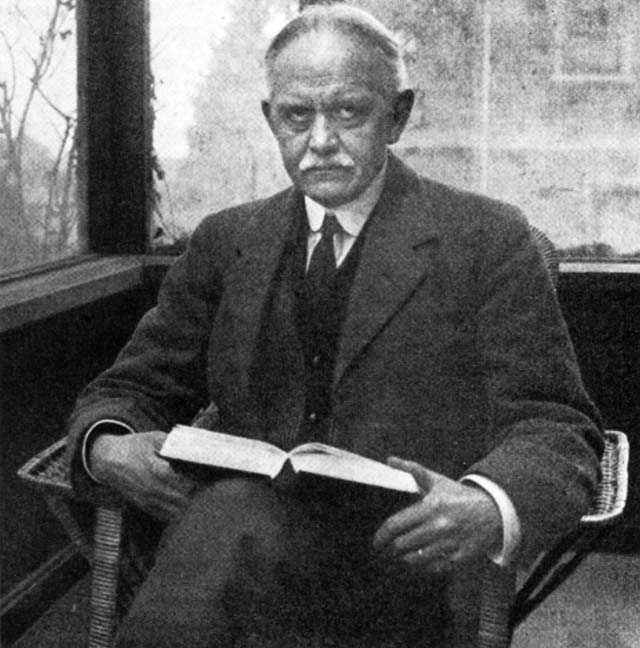
IT WAS the dying wish of Samuel Gayley that his wife and their surviving son should return to America. The grief-stricken young mother of twenty-four would have preferred to remain with her relatives and friends in China, which now had become home. The Chinese house in Teng-chau was the dearest place of all. But her husband's wish was her law. She decided to go by way of England and Ireland, so that she might visit her husband's family. The Doolittles were stationed at Tien-tsin. Charles and Rose remained in the home at Teng-chau. On October 14, 1862, she sailed from Chi-fu, reaching Shanghai five days later. There she remained three weeks. Some friends among the merchants raised a sum of money and invested it in a lease that would give her for life an income of about five hundred dollars a year. Her immediate worries about supporting herself and her child were lightened. But she still expected to find some sort of work, probably teaching. This income, at any rate, would always be something to fall back upon, and later it could be used for her son's education. Comforted by this unexpected kindness, and by the sympathy of the missionaries in Shanghai, she sailed for Fu-chau on the 8th of November. After a week there, she left, November 23, for London, on the Lunda, a fine and commodious ship. Charlie, only four, was agog with excitement over the long trip and the prospect of seeing the America of which he had heard so much. It was a long voyage of ninety-four days, yet short for that time: down the China Sea, across the Indian Ocean, around the Cape, up the west coast of Africa, through the Bay of Biscay, to London. The weather was fair. Memories of the fun he had as the pet and playfellow of the ship's officers always remained with Charles Gayley; and his sad and beautiful young mother, with her singular charm, must have attracted many a kind attention. But it was a voyage not without fear and danger. Circuitous courses had to be planned carefully, to avoid a danger of which everyone was aware, of. which everyone talked.
The Civil War was raging in America. One of the most romantic phases of that war was the activity of several Confederate cruisers, preying upon Yankee commerce. On the 30th of December, 1861, the first of them, the littler Sumter, under Captain Raphael Semmes, had sighted some thirty-five ships somewhere near the Azores. From eight in the morning until four in the afternoon the Sumter gave chase, overhauling sixteen ships of various nationalities and making them show their papers. On January 3, another vessel was chased toward Gibraltar. On the 18th of the same month, two ships going from Cadiz to Gibraltar were chased and one of them was burned. At Gibraltar the Sumter was blockaded by a Yankee man-of-war, and eventually was laid up there. In the meantime, the second of these famous cruisers, the Florida, was being built at Liverpool. In the spring of 1862 she carried on what the Sumter had begun, always remaining in Atlantic waters. The third and most famous of the cruisers, the Alabama, on July 29, 1862, the very day Samuel Gayley lay dying in Teng-chau, made her way to the North Atlantic, under Captain Semmes. On the 24th of the next month, she started her first cruise. She crisscrossed the Atlantic, came back toward the Azores, in August, 1863, arrived at the Cape of Good Hope, was at Singapore in December, was back at the southern tip of India in January, 1864, and was on her way through the Arabian Sea and then south again to the Cape of Good Hope, thence north and west, and east again, until she arrived at Cherbourg, France, June, 1864, off which she was sunk by the U. S. S. Kearsarge. Wherever these cruisers operated, always where the main arteries of commerce interlaced, the ocean was lit up with the burning of United States merchantmen. After the cargoes had been rifled, the vessels were set on fire. Passengers and crews were taken off, to be set ashore later at the convenience of the captain.
In the midst of these maraudings, while exaggerated rumors of all sorts filled the seven seas, the Lunda made her way over three oceans, and a little boy in his play won the hearts of everyone on shipboard. That was the first of many travels for Charles Mills Gayley.
London was reached February 28, 1863. In that vast city Sallie, not knowing a soul, was lonelier than she had ever been before. She was ill, and she longed for China, which now seemed far more familiar than anything in this western world. One of the first things she learned was that death had struck the Gayley family twice again. Between July, 1857, and April, 1858, her husband's father, younger brother, and youngest sister had died. Now Sallie heard that her husband's mother, from whom she had expected a warm welcome and deep sympathy, had died October 29, 1862, three days before the news of the death of Samuel had reached his family in Ireland. In Media, Uncle Samuel M. Gayley, who had been like a second father to her husband, had died, December 19, 1862, while she was at sea. For six sad weary days she remained in London. But several warm letters came from Alexander Gailey, a tea merchant in Liverpool, first cousin to her husband, inviting her and Charlie to visit in his home. On the 7th of March she went on to Liverpool. There she remained for about a fortnight, much comforted by a very cordial welcome. Near the end of the month she went over to Ireland, to visit the various Gaileys in county Tyrone, intending to remain there until about the middle of July, and then to go on to America. Her address was Magheracriggan, Castlederg, and it is probable that she stayed most of the time with her husband's elder and only surviving brother, Andrew.(5) He and numerous other Gaileys at once took the young widow and her son to their hearts, and very much wished to keep them in Ireland.
The country around Castlederg was charming. The green fields, and the hedgerows golden and blue with violets and primroses, were a pleasant sight for the eyes of the wanderers from China, though it took some time to become accustomed to the continual rain. To Sallie it seemed strange to be with the relatives and among scenes her husband had so often described. Many places she could recognize just from his description. At length, gradually, the missionary work in China came to seem a part of another life, but in all the sorrow it had brought her she never regretted, nor had her husband ever regretted, that they had obeyed the call.
She was eagerly planning her return to the United States: a visit to the Pennsylvanian Gayleys, another to her brother Calvin in New York, and to Mrs. Lowrie, who now lived near there, another to Uncle Henry W. Rogers in Buffalo, and, finally, one to the Spencers in Erie. Uncle Henry wrote to offer her a home, but she dreaded the constant round of gaiety in the Rogers household. However, the news concerning the Civil War was not favorable to her plans, and her brother-in-law wanted to keep her and Charlie in the family clan. He stressed the advantages of a home in Ireland. Her health was greatly improved. She looked ten years younger. There were many children in her brother-in-law's family, and they followed the lead of all the Gailey relatives in becoming greatly attached to the romantic young widow from overseas. Thus family affection, on which Sallie always throve, surrounded her and her little son.
In this large circle of relatives, Sallie met the Rev. Andrew Brown, one of her husband's first cousins, to whom the memory of Samuel Rankin Gayley was very dear. For Samuel's widow, Mr. Brown soon developed a tender regard. The Gaileys were exceedingly eager to promote a marriage, so that Sallie and her son could be cared for, and be kept close to their Scottish-Irish kin. Sallie would have been better pleased if the proposal had been withheld at least another year, but she regarded it as a dispensation of providence, and the relatives encouraged her not to delay a new union because of what the world might say about her taking another husband so soon after Samuel's death. She believed that those who really knew her would not accuse her of heartlessness. So she consented, and was married, August 26, 1863, one month and three days after the first anniversary of her first husband's death.
Andrew Brown was a son of Samuel R. Gayley's Aunt Martha Gailey, who had married a widower, David Brown, in 1812. David Brown had five children by a previous marriage, and nine children by Martha Gailey. Andrew Brown was the third and eldest surviving of these nine. The Brown family had migrated from Scotland before the three Gealy brothers had removed from the island of Bute. As we have noted, one of these Gealy brothers settled in the parish of Ardstraw, county Tyrone, in the first half of the eighteenth century, married a daughter of a Mr. Brown of Creevy, received through her the lands of Cavnabun, and became the direct ancestor of Samuel Rankin Gayley. Thus Samuel's widow, in marrying Andrew Brown, of the same Brown family, was for a second time uniting the Gailey and Brown families. This marriage, therefore, which to the world might seem rather precipitate, gave great satisfaction to two families that for well over a century had been in close alliance. That a second alliance should now be made, and that this alliance should provide a much needed home for the young widow and her son, seemed peculiarly appropriate.
The Rev. Andrew Brown was nearly twenty-two years older than Sallie; he had been born November 20, 1815. After completing his studies at Belfast College, he labored from 1851 to 1854 as a Protestant missionary at Newpark, county Sligo. He was licensed to preach the Gospel by the Connaught Presbytery at Sligo, September 9, 1851; in September, 1854, he was ordained minister of Turlough and missionary in the district of Castlebar. Six months before his marriage, he had accepted a call to become minister to the Presbyterian congregation at Hollymount, county Mayo. At the time of the marriage, he was close to forty-eight, Sallie was nearly twenty-six, and Charles Mills Gayley was five and a half.
Brown was a staid clergyman, conservative in doctrine, austere in manner. His affiliations in the church were notable. Also he was very much the scholar: a first-rate Latinist. From Protestant Ulster he took his bride, her vivacity now restored but mellowed by suffering and sorrow, to Catholic Mayo, where Protestants, few and far between, were mostly of the upper and more prosperous class. Even today, about 97 per cent of the population in county Mayo is Catholic and rural Mayo, moreover, has had its Catholic miracles. In 1879 the village of Knock, in the southeast, became famous, and was the resort of many pilgrims, because it was believed that the Virgin Mary had appeared in its church.
The hamlet of Hollymount is situated in a rolling terrain, upon the Robe River, which pours into Lough Mask. The village is some thirty-five miles, air-line, from one of the most romantic seacoasts of Ireland. The streams and lakes of the region afford good fishing, but the soil is poor. The holdings are so much subdivided that sustenance is precarious, and the peasantry are still among the most wretched in Ireland.
Andrew Brown was very poor. His church was tiny, capable of seating about fifty people, who were mostly Scotch. But there was little religious bitterness in this neighborhood. The Catholics fraternized with the few Presbyterians and Church of England believers. Brown, who had had some medical training, contributed to the good feeling by generously giving medical service to the peasants, without charge. His wife soon won the affection of her new neighbors, and was beloved throughout the county. Here she remained for twenty-four years, giving birth to nine children: David Henry (1864-1917); Lucy Sophia (1866-1869); Andrew Allen (1867-1906); Martha Emily (1869-1873); Samuel Rogers (1871-1888); Sarah (Sara) Spencer (1873-), who married Shirley W. Smith, later vice-president and secretary of the University of Michigan; Maggie Emeline (1875-1878); and the twin brother and sister, John Calvin and Sophie Rosana (1879)- Sophie Rosana died in 1880. These nine children were the half brothers and half sisters of Charles Mills Gayley. From the dates just given, it will be seen that five of the children died within one to seven years of their birth. Sallie was a woman acquainted with sorrows.
At Hollymount the little boy from China lived a happy life. His stepfather was a soul essentially sweet and kind, though severe in matters religious and moral. He did not hesitate to give the boy a memorable thrashing for bouncing a ball on Sunday. But in numberless ways he won the lifelong gratitude, affection, and admiration of his stepson. He encouraged the boy's habit of omnivorous reading. He taught him Latin, rigorously and relentlessly. In far later years Professor Gayley often said, "I owe all my scholarship to my stepfather." There at Hollymount, at any rate, in his own home, he got his first experience of scholarly accuracy and thoroughness. He liked it. He throve on it. Could anyone who saw in Berkeley his mature habits of painstaking scholarship have known those Latin lessons beside the Robe River, he would have said: "Here works the spirit of Andrew Brown."
But there was glorious play in that hilly district of county Mayo. Close by, at Turin Castle, lived a wealthy Protestant family, the Rutherfords, with five daughters and two sons. The boy spent much of his time there, with horses to ride, with hunting, fishing, walking, swimming, and all sorts of 'parties' to fill up the days and months and years. The Rutherfords raised hunters and sold them in Scotland. Mrs. Rutherford herself was a famous huntress.
Young Gayley also visited frequently at another Protestant home, that of the Fitzpatricks. One of the Fitzpatrick girls became Mrs. Cornwallis West, the mother of the Princess of Pless. Lady Mary Fitzpatrick's home was called Hollymount House. There, too, the boy had many happy days.
The austere and more restricted life of the Presbyterian parsonage was relieved by the gaiety and freedom of these great houses. Thus, in his most impressionable years, Gayley came into intimate association with aristocrats---in the old and proper sense of the term. From them he must have learned much of that fine and distinguished, but natural, bearing which he carried so charmingly throughout his life, and which always was one of his chief attractions. To all these people he became very dear. He had inherited his mother's vivacity, her quick, sympathetic understanding, and her indescribably magnetic charm and sweetness. He won all hearts, as his mother always did. But behind his animation and impetuosity were solid seriousness and solid intellectual achievement and solid habits of concentration, nurtured by his stepfather. You liked the boy's high spirits, his enthusiasm and contagious joyousness. You admired his substratum of intellectual concentration. You loved the charm which grew from the union of these traits. That was the way the Rutherfords and Fitzpatricks felt toward the boy. And from this famously happy intercourse sprang lifelong friendships, so that in later years Professor Gayley continued to be as welcome to these houses as he was himself eager to return to them.
Then, too, in Ireland the boy must have been infected with the Irish national traits: the humor and wit, the imaginative audacity, the emotional ardor, the gallantry in noble causes. His mother's son, inheriting her New England 'Irishness,' took to those traits like a native, so much so that always he felt himself by spirit and adoption, if not by blood, an Irish of the Irish. In later years, one of his most famous expostulations was addressed to a well-known Irishman who had been trained cautiously in the law: "Sir, you are the most un-Irish Irishman I have ever met."
As the boy grew older, his mother became more and more devoted to him. The memories of that dreadful fortnight at Teng-chau must have sanctified her love for the one remaining human link with her first married life. The boy was equally devoted to her. The tie was close indeed , a realized ideal. Mother and son must have seen themselves in each other. When, in his ninth year, it became advisable to send the boy to a London school, the pain of parting was intense.
Then followed, annually, returns in joy and partings in sorrow. The boy would be gone for a year, to come back in the summer for the long vacation. All his half brothers and half sisters and other relatives would welcome him. The fun at the Rutherfords and Fitzpatricks would be resumed, and the old servants at Turin Castle would shout, "Master Charlie has come back." In the fall would ensue another parting, with tears raining in plenty from both mother and son. Those partings were exceedingly damp affairs. The mother would accompany the boy to the little railway station, Claremorris, some fifteen miles by the road from Hollymount. Both wept all the way. She would send him on with his little white wooden tuck box, bound in iron, filled with jam, cakes, and other goodies. Those little tuck boxes are yet used in England, and can be bought at the Army and Navy Store in London. Little boys of seven, eight, or nine still go their annual long journey to school quite alone, with their tuck boxes. Still the housekeeper at the school receives the tuck boxes, and during the long year doles out the sweets to the young owners.
At Dublin the boy was met by a Gailey cousin or other relative. Perhaps he would spend the night with his cousins, or he might at once be put on the boat at Kingston for Holyhead, Wales, whence by train, in care of the guard, who knew him, he went across Anglesea and via Bangor and Chester up to London. The school was, and is, a school for the sons of missionaries and ministers. It is at Blackheath, in the southeast of London, on an elevated open common crossed by the Roman Watling Street from Kent. Blackheath is rich in historical associations. Here Wat Tyler in the fourteenth century rallied his followers; here Jack Cade, and Audley, leader of the Cornish rebels, rallied theirs in the fifteenth century. Here the London citizens greeted Henry V on his return from Agincourt, and here the army of the Restoration met Charles II. And, curiously, this is where what was to become Professor Gayley's favorite game, golf, was traditionally introduced into England, in 1608, by King James I and his Scottish followers. The Blackheath Golf Club is said to be the oldest existing golf club in the world. Blackheath Common adjoins Greenwich Park. The Thames is about a mile away, where it curves around the Isle of Dogs. Sydenham, and, until it was burned, the Crystal Palace, opened in 1854, were a few miles to the southeast.
From 1867 to 1874 young Gayley was at Blackheath. Louis DuPont Syle, the son of missionaries whom the Gayleys had known in China, also attended the school. Charles at this time was a rather delicate, wistful-looking youngster, yet he was full of fun. Once, having been caught in a pillow fight, he was punished by being made to stand for hours in a bitterly cold corridor. A stubborn pneumonia was the result, with many weeks at home in bed, and a wheezing and coughing that lasted for months.
During his last two years he led the school in scholarship, thanks to his native gifts, disciplined by his stepfather. He attained the highest honors in Classics and in English. He was known as "the Dux."
In the meantime, death had descended again upon the relatives in Teng-chau. Charles Mills's wife, Rose, died of pleurisy, February 3, 1874, and was buried on that wildly beautiful ledge overlooking Pe-chi-li, beside her brother-in-law, Samuel Gayley, and her little son, Samuel Gayley Mills. Charles Mills was left a very lonely widower, with three children---Calvin, Charles, and Rose---who had been born after the tragic year of 1862.
From Blackheath, in 1874, at the age of sixteen, Charles Mills Gayley proceeded to the Royal Academical Institution at Belfast, the Rugby of Ireland, where he was close to his Tyrone relatives. Here, as at Blackheath, he secured high rank in the various English studies and in the Classics. In Belfast he was surrounded by those Presbyterian influences which always had been of paramount importance not only in his own life, but in the lives of a line of Presbyterian ancestors. It was natural, therefore, that he should look forward to following his father and stepfather into the ministry. By the time he had completed a year at Belfast, he had matriculated for Cambridge, being the honors man in the senior local examination. He was ready to enter Cambridge in the fall of 1875, to prepare himself to be a Presbyterian clergyman.
But at this moment something happened that was to change the entire course of his life.
Henry W. Rogers visited his favorite niece, Sallie, at Hollymount. Never really happy over her first marriage, because it had taken her so far from her home on an adventure he could not wholly approve, he was also disappointed in her second marriage, because it isolated her in a poor and remote corner of Ireland. But, for better or worse, her life was now fixed at the parsonage at Hollymount. In her son, Charles, however, he found the charm that had always attracted him in Sallie, united to a remarkable intellectual gift already disciplined and obviously full of promise. He conceived the plan of taking Charles back with him, rescuing him from the clergy, and educating him for the law. "This boy," he said to Sallie, "is an American citizen. He should come home." After much argument the poor mother at last consented.
By this time Henry W. Rogers had given up a very profitable and distinguished law practice in Buffalo, New York, and had retired, in 1871, to Ann Arbor, Michigan, where he lived in a fine old house surrounded by lovely gardens and beautiful trees. Ann Arbor is the seat of the state university of Michigan. Rogers was one of the college town's most prominent citizens, a leader in its political, religious, and social life. In his home he entertained important people of the day, and his fine presence, sagacity, shrewd common sense, good humor, and unfailing courtesy and kindness brought him no slight social prestige. To this distinguished home in Ann Arbor, therefore, Charles was brought in 1875, at the age of seventeen. He entered the university as a sophomore, to be graduated in 1878. Thus the boy who had been born in China and had grown up in Ireland, and who had intended to follow his father into the Presbyterian ministry, came back to the native country of his mother and adopted country of his father, to study for the law. His own words concerning this change may be quoted: "In the early fall of 1875, fresh from eight years' schooling at Blackheath, near London, and the Royal Academical Institution, Belfast, and very green in the ways of my motherland, I presented myself for the Latin entrance examination."
Young Gayley was not the only protégé of the Rogers family. The Rogerses contributed financially to the support and education of some sixteen or seventeen nephews and nieces, many of whom lived with them. They had also put through college a cousin of Charles Gayley, Henry Wade Rogers, in later years professor in the Law School at the University of Michigan, president of Northwestern University, dean of law at Yale, and later still, a federal judge. The interest in the law which Charles Gayley imbibed in this household remained with him all his life, and in later years an ever-increasing proportion of his friends were men of law. In the Rogers home his vivacity and contagious enthusiasm at once made him a favorite. Where young Gayley was, there was action and joyousness. In a letter concerning him, Miss Josephine Adams Rathbone, vice-director of the School of Library Science, Pratt Institute, says: "We moved to Ann Arbor when I was twelve years old, and for a year Charles Mills Gayley and I were members of the patriarchal household of his great-uncle and my great-aunt, Mr. and Mrs. Henry W. Rogers, the year that he was a senior in college. He made, I remember, a great pet of my younger sister; but I, then in the awkward betwixt and between age, did not come in for much of his attention, nor was I interested in him,---a tall gangling impetuous youth called by the older young lady cousins 'the Wild Irishman.'"
When Gayley entered the University of Michigan, he was one of some 1200 students, 476 of whom were enrolled in the division of literature, science, and arts. In attendance, Michigan was then the second largest university in America; in scholarship it ranked among the half dozen best universities in the country. Its annual expense account ran a trifle under $100,000. Under the presidency of Henry P. Tappan (1852-1863) it had emerged from an obscure, half-starved college, originally called a Catholepistemiad, into a position of preeminence, at the head of the list of state universities. Notable scholars had been and were on its faculty: Asa Gray, the botanist, Brunnow in astronomy, Henry S. Frieze, Albert H. Pattengill, Elisha Jones, and Martin L. D'Ooge in the classics, Calvin Thomas in German, Edward L. Walter in modern languages, Andrew D. White and Charles Kendall Adams in history, Thomas M. Cooley and Henry Wade Rogers in law, Moses Coit Tyler in English literature, and others. In 1871 James B. Angell had become president. The year before, after it had been a college solely for men for twenty-nine years, the University had opened its doors to women, with much misgiving. But by 1875 coeducation had proved a success. At that time 117 women were enrolled, 66 of them in the department of literature and science. Gayley, therefore, had entered a coeducational institution of the foremost rank among American universities.
From a brief diary he kept during his first year at college, it is possible to reconstruct the sort of life he led, as well as the sort of young man he was. His social life was, as he so often called it, a very jolly one. In the Rogers home there was a continual round of entertainment, with much dancing and many pretty girls. Besides, there were teas and informal visitings, at which he met the president and the faculty and their wives informally. He attended dancing school regularly, with a great deal of pleasure. Then there was singing in the home, in which he bore his part well; and every week there was choir practice in the church, and walking home afterward with the girls. He had an eye for a pretty girl, but it was roving eye. There is no sign of that self-consciousness and half-unwilling restraint in female company which plays a large part in his father's college diary. Probably a greater freedom among the sexes tended to make him really less susceptible than his father had been as a young man. Uncle Rogers, more of the older school in such matters, did not readily understand this new freedom, and worried Charles with repeated cautions against falling in love. But the girls only added to the social gaiety of dancing parties and choir practice, of theater parties, concerts, lectures, and sleighrides, and graced the inevitable sets of croquet. In college sports, Gayley took to boxing and to rowing. Proudly he watched his muscles grow. Walking out into the pleasant countryside of green, tree-covered hills, through which the Huron River flows crookedly, was a favorite diversion. But when a circus came to town and the college boys stirred up a huge hullabaloo in the tent, and Forepaugh retaliated and the students in return wrecked some of the equipment, until the police were called in and there was subsequent trouble with the faculty, Charles got into serious difficulty with his uncle over the affair, was roundly and repeatedly scolded, even though his own part in the fracas was quite negligible. Finally, he went to the president, voluntarily confessed his participation, and was presidentially complimented upon his sense of honor. But for a while he had a very unhappy time, which well prepared him, perhaps, for those occasions in later years at Berkeley, when, understanding youth so well, he staunchly stood up for some young culprit before an enraged faculty or prejudiced president. But unhappy times were rare interruptions. He was 'socially adapted' to a remarkable degree. It says much for him that though in that house his high and restive spirit was under a tight avuncular rein, he never balked, or jumped the traces. Instead, he was deeply sensitive of his uncle's kindness.
His religious life was deep and genuine, without being too definitely patterned, and there was no such succumbing to piety as had distinguished his father. He attended both the Presbyterian and the Episcopalian church, and each Sunday noted the text of the sermon in his diary; but, unlike his father, he did not enter long summaries of sermons. Characteristically he was content to declare that the sermon was powerful, or was not. Sometimes, though, conscience-stricken, he resolved to lead a more religious life. He taught a Sabbath class, and had the usual trouble with noisy boys. Occasionally he led a prayer meeting of some of his classmates, and was deeply impressed with the reality of the spirit. There are no signs of falling into bad habits. He was too well balanced and too self-respecting and too conscious of a duty to his uncle and benefactor, to live heedlessly; nor had his early experiences in the religious households of his father and stepfather been so restrictive of the natural impulses of a fun-loving boy as to store up dangerous repressions. Indeed, he developed a singular habit of self-control, much of which he owed to those habits of serious application to study which his stepfather had so well nurtured. After listening to one of J. B. Gough's temperance sermons, he made a covenant with his aunt and uncle not to touch liquor of any sort until he reached the age of fifty! He said, however, that it was for him an easy pledge, with the trifling exception that now he must give up the one alcoholic beverage he enjoyed---cider. It will be seen that his religious life was genuine, sometimes solemn, but never puritanical.
By correspondence he kept in touch with his family in Ireland and his relatives in China. To his mother he wrote long racy letters, though he alternated them with the convenient postcard. He exchanged letters with his Uncle Charles Mills, who was still in Teng-chau. And there were rarer letters to some of the Pennsylvanian Gayleys. Fanny Spencer he had met on his way to Ann Arbor, and he showed his appreciation of her friendship for his mother by writing her every now and then. His Blackheath chum, Louis DuPont Syle, was now at Trinity College, Hartford, Connecticut, and letters were exchanged that kept the friendship very much alive. Justus Doolittle, however, actually came in person to Ann Arbor, to deliver a lecture on China, and Charles made him welcome in the Rogers home, talked with him about China, and helped him set up his pictures and curios in the lecture room of the church.
In the first long vacation, he visited his father's relatives in Philadelphia and Parkesburg, was amazed at their number, and was as much delighted with them as they were with him. One day, by chance, he ran into Louis Syle. There was a rapturous interchange of memories of Blackheath. One Sunday, he sat under the eye of John Wanamaker, in the famous Sabbath class of that famous Philadelphia merchant. Another day, he paid his first visit to a synagogue, and, much puzzled, realized that here was a contemporary culture of which he knew next to nothing. On his way back home he met hosts of his mother's relatives, in New York State. All in all, it was a happy three months, filled with that heartwarming excitement which intoxicates a candid young man when he first visits the relatives of whom afar, for years, he has heard much, and discovers how generously they open to him their hearts and homes. Of course, the ardent young man from China and Ireland, who had now come back to his own America and his own American relatives, must have been a welcome, romantic figure in the eyes of his many cousins, uncles, and aunts in Pennsylvania and New York.
But in college studies he found the main business of his life. He was an assiduous student, but never a mere 'dig.' There were times when he went to class unprepared, and rejoiced mightily if he had the luck not to be called upon, or felt unfaithful if, being called upon, he failed to bluff it out. But usually he was well prepared, and always, except in mathematics, he caught fire from his studies, and he stood high in the regard of his instructors. He rejoiced in Latin and Greek, though Greek accents were a nuisance. Latin was his first love, always. Yet in both languages he did so well that Professor D'Ooge put him ahead a year in Greek, and Professor Frieze a year in Latin. Into the Homeric Question he plunged headforemost, gallantly. For a while all other college work suffered an eclipse, until he had delivered himself in a debate, which he lost---a rare experience for him, for in debate he shone to advantage. He prepared his orations and debates with great care, and practised delivering them in the parlor before uncle, aunt, and cousins, in the garret before trunks and portmanteaus, on the front lawn before an appreciative old dog, and on the way to class, much to the astonishment of passers-by. One of his first orations was on "The Misery of Ireland," concerning which he spoke eloquently. In all his work he displayed humor and wit, and he thought his effort well spent if he could make class and professor laugh aloud. Even in these early days he could bring down the house. Once he was horribly vexed because he couldn't help laughing at his own jokes. Not even his Latin compositions escaped his good spirits, and once, to tickle Professor Elisha Jones into consulting a dictionary, he slipped into a Latin theme a sesquipedalian argentiexterebromides.
Charles Kendall Adams, in history, was one of his greatest teachers, as well as his personal friend and adviser. His own tribute to Adams, written many years later and found among his miscellaneous papers, would seem to indicate that from Adams he learned some of his own classroom methods; for the tribute, which follows, might just as well have been written about Gayley by one of his own students at Berkeley:
I knew him in 1875, when I entered the University as a sophomore. He was an intimate friend of my great-uncle, Henry W. Rogers .... The geniality, kindliness, wisdom, and dry wit of Professor Adams, his ready fund of information, his willingness to impart it, to guide a young lover of history and the classics,---the utter absence of pedagogic superiority or of pose on his part;---won me from the outset. I took every course he gave, and in none could I possibly stint the utmost effort. His commendation was no formality; it was an expression of unconcealed joy. His correction was a fresh stimulus.
Under Professor Moses Coit Tyler, whom he thoroughly admired he did much of his work in literature. Tyler was then in his early forties, and was at work on his History of American Literature during the Colonial Time, which appeared in 1878. He was a member of the English department at Michigan from 1867 to 1881, when he was called to Cornell.
From Shaw's Manual of Literature and Day's Rhetoric, the latter of which he enjoyed but found rather "metaphysical," Gayley got his first college training in literature and rhetoric---a solid, logical discipline, without frills of feminization. In the round of orations and debates, which developed an earnest rivalry to excel in clear and forceful expression, lay much of the tough, intensive literary training of those days, when the emphasis was not so much upon quantity of facts learned as upon power in thinking and communication. It is little wonder that one of the first tasks Gayley set himself in Berkeley was the development of college debating. For the. rest, in the diary, there is much evidence of those informal, never-to-be-forgotten talks in collegiate 'rooms,' often late protracted, those "noctes, coenaeque deum of history and poetry and philosophical discourse" which Gayley was years later to praise so gratefully in his Idols of Education, and to the resuscitation of which he devoted his famous Sunday-evening talks at his fireside in Berkeley.
On March 2 3, 1876, as a result of attending a performance of Romeo and Juliet, the young collegian experienced his first enthusiasm for Shakespeare. Hitherto, he wrote, he had had "a warm but not altogether heartfelt admiration of Shakespeare." But now, discovering qualities of splendor and excitement he had ignored before, he began reading Shakespeare anew, and longed to attend other performances of other plays. Thus began that vivid interest, that heartfelt admiration, that deep acquaintance with the tears, and the laughter, too, of Shakespeare, which he was destined to impart so contagiously to thousands upon thousands of students when it should come his time to teach. In 1878 he was studying Shakespeare under Professor Tyler, and an extract from a paper on Macbeth, written for Tyler's seminar, was published in January, 1884, in the first volume of Shakespeariana.
One of his most intimate undergraduate friends was Theodore Swift, who later resided in Berkeley, California. Mr. Swift has told how their friendship began. Gayley came to Ann Arbor well prepared in the classics, but behind in mathematics. Swift was strong in mathematics, but weak in the classics. Gayley fell into a habit of going over to Swift's rooms to study Greek and Latin in exchange for help in algebra and trigonometry. He was by far the best scholar in Latin and Greek in their class; but he had very bitter things to say about logarithms, made bad puns about them, thought the long algebraic equations a lot of "humbug," and sometimes did his geometry by inspiration.
The friendship continued and ripened. It was Swift who pledged Gayley "Psi U." The circumstances were unusual. Henry Rogers had his peculiarities, and could be something of a martinet. Often he was very strict with his nephews and nieces. Among other things, he didn't want Gayley to join a fraternity. Swift was eager to get his friend into Psi Upsilon. It was not until his nephew's senior year that Rogers at last gave in.
Miss Caroline Pattengill, daughter of Judson Pattengill and niece of both Albert Pattengill and Elisha Jones, has very kindly contributed a letter which many years later Gayley wrote her, concerning his own memories of his experiences at Ann Arbor. Elisha Jones, she says, was undoubtedly the outstanding influence in Gayley's formative college and early teaching years; next came Albert H. Pattengill, though Judson Pattengill, principal of the Ann Arbor High School and a most remarkable teacher of Latin, exerted no small influence in an entirely different way. In writing to Miss Pattengill, July 1, 1925, from the American University Union, London, Gayley confessed a faintness of memory in relation to these early days.
I have no memory for details of my own life, except of the happenings that have lifted me unforgettably to heaven or cast me to hell. My memory of acquaintances, even of friends, is rarely of details. My memory of reading is good. But of people---except those in my immediate family---it is only too generally an impression of personality and of my reaction to it. I suppose this comes of the fact that I have been always preferably absorbed in the present and the future. A bad state of affairs, this, because I have to turn to my family or friends for the facts of the past. A good state of affairs in only one particular: disagreeable details are sloughed off and, with them, retention of personal agony as well as of animosity.
But of Elisha Jones his memories always remained vivid, as this extract from another letter to Miss Pattengill bears witness.
My recollections of personal contact with Professor Jones during my freshman year are, on the one hand, of a corrective process, by no means flattering, of which the apparent intent was to prune my youthful exuberance; on the other hand, and later on, of an incident, still vivid, that won me his approbation. He had called for an essay from each of us on some aspect of the De Amicitia, or of the De Senectute. I wrote mine in Latin. I shall never forget---for he was chary of praise---the pleasure that he expressed and the encouragement that he gave me. I think it was then that the dear man began in some fashion to adopt me. Soon afterwards he told me that the Latin and Greek departments had arranged to push me forward a year. From that time until my graduation, in 1878, our relations grew in intimacy.
Pruning his youthful exuberance, and then becoming his intellectual parent: such was the part Elisha Jones played. How much one is reminded of Quintilian's wise words in the second book of the Institutes of Oratory! "The remedy for exuberance is easy; barrenness is incurable by any labor....pupils are to love their tutors not less than their studies, and to regard them as parents ... of their minds. Such affection contributes greatly to improvement, for pupils, under its influence, will not only listen with pleasure ... but will desire to resemble their instructors." And how fortunate Gayley was to come under an instructor who was not content, as are so many, merely and coldly to reprove ardent and daring invention; but who pruned gently, proud that there was something to prune, and then supplemented the pruning by affectionate encouragement! From Elisha Jones, Gayley learned more of the pedagogy he himself was to use so gloriously and generously in his own teaching.
One day in June, 1878, just as he was finishing his college course, two men called upon him at Henry Rogers's house.
One of them was C. L. Houseman, superintendent of schools at Muskegon, which is pleasantly situated in western Michigan, on the shore of Lake Muskegon, about four miles from Lake Michigan. The other was a young man from Muskegon, A. C. McLaughlin, later the well-known professor of history at the University of Chicago. Houseman was looking for a principal for the high school in Muskegon. Gayley was appointed. This vivid young man, his enthusiasms well grounded in classical scholarship, evidently impressed the superintendent, who must have been a good judge of promising material. At any rate, he put a young man of twenty at the head of his school. Gayley held the position for two years. Mr. McLaughlin says that, though at the time he himself was in college at Ann Arbor, he nevertheless had opportunities to see something of Gayley during those two years, and to discover that the young principal became a very successful and stimulating teacher, filled with fresh and contagious eagerness in the pursuit of learning and life. His pupils were his friends. Some of them were his companions. All of them at once felt that anything in life or letters to which such a man could be devoted must indeed be worth while. So it was, always, throughout the many years of his teaching. The personality of the man commanded the unbounded admiration of his students, and persuaded them beforehand that the learning he loved so nobly must be of the true riches of the world.
With the first money the young man earned he paid back what his great-uncle had expended upon him.
In 1880, at the age of twenty-two, he was called back to his alma mater as Instructor in Latin. Then his distinguished career as a university teacher began. In his first class in freshman Latin was Walter Miller, who later rose to be professor of classical languages and archaeology, and dean of the graduate school, in the University of Missouri. Dean Miller has filled a letter with his memories of that first semester's course, and of later work in Latin under Gayley:
The first year that Mr. Gayley came as instructor in Latin, I was a freshman in his classes, four hours each semester. Though I was young, I recognized that in him I had one of the most thorough and inspiring teachers that it would ever be my good fortune to have. Accordingly, the next year, instead of taking the regularly assigned sophomore courses in Latin, I persuaded Gayley to let me take an advanced course, the first time he offered Catullus. In that course I learned what real study and appreciation of literature mean. It was in connection with that semester's work that Gayley made the beautiful poetical translation of Catullus LXIV, so much of which appears in his Classic Myths. In my last year at Michigan it was my privilege to have a course in Horace's Odes with him. This put the cap-sheaf on my studies in Latin poetry. it was one continuous delight. in the second semester of our freshman year Gayley introduced us to Roman comedy. He had so much fun with it, and we had so much fun, that he conceived the idea of bringing out a play of Terence (the Adelphi) in Latin. It was a brilliant success. It would be hard to decide whether Gayley was a better teacher of Latin than of English. He was supreme in both. And he was a great teacher of English when he was teaching Latin.
Other members of those early Latin classes were Winthrop B. Chamberlain, who became Associate Editor of the Minneapolis Journal; John M. Zane, now a Chicago attorney, of the firm of Zane, Morse, Zimmerman, and Norman; Fred Newton Scott, for so many years the professor of rhetoric at Ann Arbor, and Arba S. Van Valkenburgh, now a retired judge of the United States Circuit Court of Appeals, Eighth Circuit. From several of these has come further testimony to Gayley's qualities as a teacher of Latin. He was a mental and physical dynamo. He was always alert, enthusiastic, and witty; quick and incisive in speech. His charming and engaging personality so far broke down the formal barrier between instructor and students that the hour passed in a fine spirit of intellectual comradery. He overcame the dull slavery to grammar and the lexicon, and made Latin not a dead language, but a living idiom, almost as though it were a mother tongue. A poet himself, he imparted the poetic quality and re-created the humanity of the classics. He bore a torch of living flame.
In the Michigan Alumnus for October, 1932, which appeared after Dean Gayley's death, is Mr. Chamberlain's description of the preparation and performance of the Adelphi in the spring term of 1882. This, I believe, was the first performance of a Latin play in the original by American university students. Shortly before, the Oedipus Rex of Sophocles had been presented in Greek at Harvard. The parts were assigned to various students in Gayley's classes. The indefatigable and versatile young instructor in Latin had his hands full. He rehearsed the cast with the pertinacity of a football coach, striving to give each actor such an understanding of the character he was to impersonate as might bring out the humanness and humor of the comedy. He superintended the painting and setting up of the scene on a narrow stage in old University Hall. Somehow he got money to buy lengths of varicolored cotton flannel, to drape around his actors. The undergarments didn't matter. The 'coeds,' who had not been invited to take parts, because the ancients used boys in female roles, did the needlework on the himatia. Gayley also made an English translation of the play, and had it printed opposite the Latin text, so that the audience could follow the lines. He had the ancient white bone tickets of the Romans reproduced in white pasteboard, which the audience bought at the ticket office. The attendance was very large. Everybody was pleased and proud. The Oracle of the class of 1884 paid a good deal of attention to the performance. But, most of all, the occasion displayed the sort of Latin instructor Gayley was, the lively, creative, full-blooded, humorous interest he could impart to the age-old study of the classics. Those days in his classes must indeed have been rare days, the memories of which his students carried gladly and gratefully through subsequent years, two score and ten, or more. It was his own shining humanity that made for his students whatever he taught a lifelong memory.
Elisha Jones continued to be the intellectual parent of the young instructor in Latin. In the same letter to Miss Pattengill which has been quoted above, Gayley bore witness to this continued interest.
When I was called from the school at which I was teaching to an instructorship in Latin at the University, Frieze and Jones began to shape me in earnest for a career in their chosen field. I cannot begin to rehearse what Elisha Jones did for me during this period (1880-1884) of aspiration and experiment. Save when it was misapplied, he did not discourage a propensity (probably of his own planting) to stress the up-to-date implications of both the language and the literature. I made a stab---especially in the Terence classes---at conducting the review of the preceding lesson in conversational Latin. Far from squelching the effrontery, he applauded....
One lucky morning, while I was still teaching Freshmen, Elisha Jones steered me through the Latin alcoves of the Library to the writers not then systematically included in the curriculum, and bade me browse. "Sample them," he said, "and read for pleasure. Do not translate; divine from the context. You will never get at the literary flavor and the heart of these men unless you read the Latin as they wrote it for their contemporaries." The advice was a priceless boon.
... Veterum libris ... et inertibus horis,
Ducere solicitae jucunda oblivia vitae,became a habit, enduring at least through my Latin years at Michigan. There resulted a scrappy, but delectable, acquaintance not only with Catullus, Tibullus, and Propertius, but with Petronius, Lucan, Valerius Flaccus, Statius, Aulus Gellius, Claudian, and others whom I might have missed for many a year or altogether. Out of this experience grew elective courses, entrusted to me in later years by Elisha Jones and Dr. Frieze. The courses may not have been very learned. But with me, at any rate, they left an abiding sense of the modernity of the authors studied and, of course, of the greater classics. That I owe in the first instance to Professor Jones.
Meanwhile, March 1, 1881, Uncle Henry W. Rogers had died in his seventy-fifth year, bringing to a close a long and distinguished career and a life generously devoted to the welfare of others. Three years later, in 1884, Gayley, at the age of twenty-six, was promoted to an assistant professorship in Latin, in definite recognition of the remarkable success of his teaching. He seemed fairly launched on his life's work, and he continued his teaching and his omnivorous reading with ever-increasing delight. Frieze hoped that he would succeed him as head of the Latin department. But his interest in English poetry and his own poetic temperament continued to emphasize a literary, rather than a linguistic, approach to the classics.
He was attempting to write original verse, and he was happily surprised when the Atlantic Monthly accepted one of his poems, an address to Horace, which it published in August, 1886. At this time, also, he wrote the Michigan college song, "The Yellow and Blue," which Michigan's Glee Club has made known so favorably, far and wide. It was written in competition for a prize offered by a student publication, and Professor McLaughlin remembers how the young professor came to his rooms one day seeking for a tune or air to which words could be written. Gayley's own account of the composition of this famous song is given in a letter, May 19, 1925, to Karl F. Zeisler, which was published in the Michigan Chimes, October 11, 1925.
Some far-seeing editors of The Palladium, lovers of the University, had offered a prize . . . for a college song, to be composed by a student or alumnus, which might be adopted by the University. I entered the competition, decided first upon the conception and image to be expressed in the song, then selected what I regarded as an inspiring and not too hackneyed air, that of the Pirates' Chorus from one of Balfe's operas, and wrote, as all songs should be written, my words to the air.... The prize was awarded to "The Yellow and Blue." It was at once taken up by the students of the University. It circulated in leaflet form until about 1889. ... It has always been a great joy to me, revisiting Ann Arbor, to hear the song still sung in fraternity houses, and on the Campus in the twilight.... I have heard it in mid-ocean, on the streets of Florence and Rome, and hither and yon as I have travelled about the world. A song written in the days of one's youth, if it by good luck expresses the devotion and enthusiasm of succeeding generations of young men and women, is a thousand times more worth while than many books of learning.
But one of the happiest results of the appointment at Ann Arbor was that he could afford to go back to Ireland in the long vacations, to see his mother and stepfather, and his beloved half brothers and half sisters, and to visit again the Rutherfords at Turin Castle, the Fitzpatricks and Mrs. Cornwallis West (niece to Lady Fitzpatrick) at Hollymount House. Such a visit he made in the summer vacation of 1885.
His relations with the Brown family were very close, for all the family felt that the cousinship between Andrew Brown and Samuel R. Gayley doubled the tie between the children. The vacations when "Charlie came home" were gala days. Little Sara, the only girl in a family of five brothers, was Gayley's special pet, and she worshiped him, finding him very handsome and charming. Once he brought her two presents which she thought were very characteristic of his interest in her: a manicure set and a copy of Agnes Repplier's In the Dozy Hours. This nice mingling of suggestions for improving both body and mind made a deep impression upon her. They were a singing family, and many were the delightful hours spent in song, the mother accompanying them on the piano, Gayley's really fine baritone breaking out in the old hunting songs. Sara, now Mrs. Shirley W. Smith, describes one of these occasions.
I recall his singing "The Yellow and Blue," and telling me that he had won the prize of ten dollars offered by a Michigan publication for a Michigan song. As I often nowadays see and hear the song sung by thousands of loyal Michigan men, bareheaded at football games, in our great stadium, my mind goes back to the first time I heard it in our little parlor at Hollymount, and I see myself as an adoring little sister full of pride in her brother, asking him how he ever came to write such a wonderful song, and hearing his hearty laugh as he answered, "Well! I needed the ten dollars."
Moreover, these happy relations had a practical side. As soon as Gayley was able, he sent for his brother, David Brown, and later for the next eldest, Andrew, and put them through college at Ann Arbor. For a while he and David lived together in lodgings at Mrs. Cagney's near the Rogers home, and supported themselves on Gayley's salary of only nine hundred dollars a year. He was, indeed, a devoted son and brother. The many sacrifices he made for his family are notable instances of the stability and strong self-denial which always tempered and balanced him. He always commanded confidence. He had a generous passion to be of help to others; and his helpfulness began at home.
The college year 1886-1887 he spent abroad. Much to the consternation of his Ulster relatives and his stepfather, he stumped the Irish countryside for Home Rule. He had always had an intense sympathy with the hard life of the Irish tenant. It will be remembered that one of his first orations as an undergraduate at Ann Arbor had been "On the Miseries of Ireland." In the winter of 1879-1880, Parnell, visiting America to raise a popular subscription in aid of tenants who suffered by eviction, had obtained the support of the Clanna-Gael, a revolutionary organization of Irish-Americans. Parnell was elected to parliament on a platform of one plank, National Independence. In 1885 he was reëlected from Cork, and in January, 1886, by throwing his support to the Liberals, he defeated the Conservative administration of Lord Salisbury. Gladstone then formed a Liberal government committed to some degree of Home Rule for Ireland. In April, 1886, he introduced a bill for Home Rule, which disrupted the Liberal Unionist party and thus brought about the defeat and resignation of his own ministry in July, 1886. It was in connection with the 1886 campaign for Home Rule that Gayley made his speaking tour, an adventure which cemented his lifelong enthusiasm for the Irish.
A speech which he had made at a mass meeting in University Hall in June, 1886, favoring Gladstone's Home Rule Bill, was brought to the attention of the Irish liberals. Some friends of his, members of the Irish National League in America, conceived the idea of sending the witty and eloquent young man to the land of his fathers, in the conviction that his temperament would indeed be at home in that fiery campaign. On the 4th of July he landed at Plymouth, and the afternoon of the next day he visited the Parliament offices of the Parnellites in London. Somewhere on Bridge Street he mounted two flights of stairs, turned to the right down an ill-lighted corridor, and several doors farther on, entering a short passageway, found himself in what was hardly better than a den: a private room---a small square chamber with two windows. Table and desks were possessed of some half-dozen scribbling patriots. Pamphlets, manifestoes, records, letters, newspapers, and telegrams were piled everywhere, in genuine dusty Irish confusion. Huge maps and bookcases and lockers, against the walls; more patriots, with their elbows upon the cases, momentously conversing. Brady, the secretary of the League, was rapidly throwing off telegrams from shorthand notes. Young Kenny of Mid-Tyrone was consulting timetables. Clancy, the member from North Dublin, whom Gayley had met on the train coming up to London, spruce in black coat and vest, and nether garments of a glorious check, was one of the busy talkers. After a while, a tall, handsome, middle-aged man, inclining to portliness, walked in quietly. "Well, anything new?" he inquired. His voice was clear, not loud. He spoke with a very slight Irish accent. His dress was exceedingly neat and unostentatious, of some grayish color. He had a fine, square forehead. He was clean-shaven except for a closely clipped mustache. He conveyed the impression of the typical Irishman of culture. He carried with him the spirit of business and order. Without glancing about the room, he sat down, replied quietly to half-a-dozen questions, dictated several telegrams in answer to demands for speakers, conferred on the feasibility of running or withdrawing certain candidates, glanced at a newspaper, and, catching sight of a stranger across the room, came over to extend his greetings. Thus Gayley met Thomas Power O'Connor, affectionately known to his friends---and, later, to the world at large---as "T. P." At this moment he was one of the ablest litterateurs of the Irish party, Member of Parliament for the Scotland Yard Division of Liverpool, and Parnell's lieutenant for England. He had married an American woman, and his home was open to her compatriots. So he welcomed this young recruit from America cordially, engaging him in easy conversation. Presently the two strolled over to the Houses of Parliament, talking as they went. That night, after receiving instructions from T. P., Gayley gathered his traps, took train, and set his face toward the Irish Channel.
The next few weeks, he was stump-speaking in West Belfast, South Tyrone, South Derry, and county Monaghan, in company with John Redmond, Tim and Maurice Healy, William O'Brien, Thomas Sexton, Dr. Tanner, and other leaders of the Irish Home Rule party. Thus he came to know Dr. Tanner, who effervesced with hatred, popped his opinions like champagne corks, and spat defiance like a cat; Tim Healy, the barrister of the party, at whose every speech in the House of Commons the Members both wept with laughter and howled in rage; and William O'Connor, the vitriolic editor of United Ireland, the boldest and bitterest paper in Great Britain. He met the uncompromising, the bitter, the self-depreciatory, the tender-hearted darling of the party, the jolly Joe Biggar. He was overcome by the conversational wizardry of the orator of the party, Sexton, in a pleasant parlor, No. 13, of the Linen Hall Hotel at Belfast. As Sexton sat lazily in his chair, his cigar between his fingers, his dark eyes gleaming, and talked and talked, Gayley felt that scarcely ever before had he listened to such a mastery of language. "Sexton was gentle, and like a poet enthusiastic and fascinating, a man of sweetness and fire, an exquisite friend, fitted to stir the ambitions of youth, instinct with glorious hope, appreciative of true praise; wise and modest to a degree. His logic was as keen as its vesture of words was beautiful." This description is Gayley's own. But to the young men of the California Ambulance Corps who, thirty-one years later, in 1917, gathered about Gayley himself, listening to his words of farewell as they left to take part in the Great War, it would have served perfectly as a description of their own beloved Chief.
At Carrickmore, in the open air, Gayley himself made a speech. Two tables, borrowed from an inn, did duty as platform. Father O'Flynn, fat, round, and red as Bacchus, preceded him with much geographical eloquence concerning the constitutions of the world, from Norway to Madagascar, while the tables toppled and groaned beneath His Reverence, and the learned and appreciative audience yelled at each erudite pause. In conclusion the Father introduced Gayley to the crowd, as a Protestant. Then Gayley scrambled upon the tables, removed his silk hat amid uproarious cheers for his religious complexion, and began, "Gentlemen, I am a Protestant, and a Presbyterian, the son of one Presbyterian minister and the stepson of another; from the county Mayo, God bless us." And that took the 'street,' for it is proverbial that never a man from county Mayo but supplements the name of his poverty-stricken home with a prayer for its blessing. So he got on with his address, mingling humor with sense, enthusiasm with facts, while contradictions and applause punctuated every paragraph ("generally applause, for the Irish is polite, if you agree with him"), and from all quarters rose suggestions how he should get on with his speech.
The tour was full of adventure. Often a deluge would have been preferable to the prevailing weather. Some days were wondrous fair. There were long, hard drives in carriages and sidecars, over hills and through dales, by rutty roads sloping on either side to fern-clad, cowslip-blooming ditches, or winding through woods of ash and elm. There were near-riots, and constant heckling of the speakers. Perhaps there was more vituperation than argument, yet the mobs listened carefully to statistics of taxation, of waning population, of peasant proprietorship, and of other matters, interlarded with ribald personalities, fierce denunciation, and caustic wit. It was always a mob of Irishmen and Irishwomen, penniless, happy-go-lucky, warmhearted, and tremendously interested. Gayley's last meeting was at Clones. He entertained the audience with Hebrew anecdotes apropos of the greed of the Conservative party. He had just finished that story of Little Jacob, who, having swallowed a gold dollar, was submitted to the operation of a stomach pump and responded to the suction with only a quarter dollar, when someone in the crowd asked, "Sure and are you an Irishman?" "Sure an' he is," cried another, "Don't you see the map of Ireland in his face?" "Indade I do," said a third, "but it is in the sound of his spache that I'm afther beholdin' it." "Yes, gentlemen," replied Gayley, "I thank you for the compliment you pay me, and I hope that even if I have not the seal of Ireland on my visage, I have the pulse of Ireland in my heart." And as he got down from the seat of the brake, where he had been addressing the crowd, a country girl's voice said, "Shtay wid us in Monaghan, Sir!" That unvarnished homage he accepted, he always used to say, as the utterly satisfying reward of his labors in the campaign.
Later in the summer he met Timothy Harrington, Michael Davitt, and Parnell himself. Parnell he met in the corridor of the House of Commons. Parnell was nervous and weary, flushed from the excitement of a debate, but he was affable and kind as he extended cordial thanks to his young American recruit and spoke feelingly of the indebtedness of the Irish Nationalists to American support. He spoke calmly of the gloom that then overhung Irish hopes in Westminster. But he was still indomitable, and in the conversation he displayed his faculty of making a young man feel that every reasonable effort for the good of the cause, even though made by an inexperienced and untried ally, was appreciated and---what was better---was important in the total effect. Gayley felt that here was a great leader for a great constitutional cause, and that, if the Fates allowed, a future of work under his guidance were a thing to be desired. Indeed, Parnell proposed to launch him upon a political career as an Irish Home Rule Member of Parliament. But Gayley rated his American citizenship and his duty to his family as of prior importance.
The next six weeks were spent partly at the Manse in Hollymount, and partly on the island of Achill, where he wrote a report on the conditions of landholding and of the fishing industry, for the information of the Irish Home Industries Association.
But his chief reason for spending the year abroad was that of pursuing graduate studies in some German university. It had long been a Michigan tradition that those of its graduates who were headed for academic careers should accomplish the greater part of their graduate work in Germany, especially at the University of Leipzig. Thither went, for example, Martin L. D'Ooge, Albert Pattengill, Calvin Thomas, Walter Miller, and also Edward L. Walter, who was a great friend of Gayley's and exerted much influence upon him. On the advice of Professor Charles K. Adams and President Andrew D. White, Gayley had obtained leave of absence in order to qualify for a doctor's degree in Germany. In September he went to the University of Giessen, Hesse-Darmstadt, where he studied medieval and modern (principally French) history under the personal guidance of Professors von der Ropp and Wilhelm Oncken. From Giessen he proceeded to Halle, in February, where he made modern history his chief study (Professor Droysen); and pursued economic and political science (Conrad) and philosophy (Erdmann and Haym) as subsidiaries. At Halle, he lodged with a Frau Bonza, a highly educated and cultured German woman, who exerted a great deal of influence upon him, and under whom he rapidly learned to speak German with proficiency and an excellent pronunciation. His doctoral thesis was to have been entitled "Zur Kritik der Memoiren Richelieus." Most of his leisure for the preceding three years had been given up to this investigation, and now in Germany all his time was given to it, except for a few weeks in the spring of 1887, when, at the request of the Countess of Aberdeen and under the guidance of Professor Conrad, he prepared for the Irish Home Industries Association a monograph on "The Cottage Industries of the Thuringian Forest." By September of this year, under the direction of Droysen, two-thirds of the materials afforded by the Petitot Collection had been subjected to historical and stylistic analysis for the policies of state indubitably to be accredited to the cardinal, and the findings had received Droysen's approval. But just then, because of the collapse in health of his stepfather in Ireland and the necessary removal at once of the family to America, he was compelled to drop his studies and accept an opportune call to the position of assistant professor in English at Ann Arbor. Droysen's ejaculation, "Ach, Gayley, zu verlassen die Schwerigkeiten der Geschichte für die Süssigkeiten der Literatur!" was unforgettable.
But, though the "Richelieu" had to make way for other studies and responsibilities, the training was never wasted, nor were the austerities of history forsworn. He had achieved acquaintanceship at first hand with the spirit and methods of German scholarship at its best. This acquaintance he was by no means backward in displaying during his earlier years at the University of California, though he never followed the tradition so blindly as to approve laborious doctoral dissertations throwing light or darkness upon some obscure and negligible corner of erudition. His indebtedness to the unflagging interest, the authoritative and resourceful guidance, of that great scholar and teacher, Gustav Droysen, and to the discipline in methods of historical investigation imparted by Droysen, he always gratefully acknowledged. In Germany, too, he picked up that interest in methodical poetics and aesthetics which presently bore fruit in his own courses at Berkeley, in several of his earliest publications, which will be noticed in their place, and in the organization of the English department, of which he became the head.
In August, 1886, when he was visiting his family at Hollymount, county Mayo, he had already eagerly planned for their removal to America. Mr. Brown, grown old and feeble, was considering the advisability of resigning his congregation. Gayley thought it would be a comfort to his mother and stepfather to spend their remaining years with their sons, David and Andrew, who were now at Iron Mountain, in northern Michigan. His mother for nearly thirty years had been dreaming of going back to America. In 1863 she had stopped in Ireland, on the way home, for what she had expected would be a brief visit. She had stopped there, in the village of Hollymount, for twenty-three years. Now that at last, with her son's promotion at Michigan, the opportunity came to complete that long-interrupted voyage home, she dreaded uprooting her life in Ireland, and feared the trip might try her husband's failing health too severely. But at length it was decided that the family would make the change and go to America after Charles had returned to Ann Arbor from his year's leave in Europe.
And now may be told the story of how Gayley at Michigan went over from Latin into English. For some years, 1880-1886, the courses in freshman and sophomore English had been conducted about as unsatisfactorily as college courses could be conducted. The salvation of these courses was a worrisome problem. One evening, while Gayley was abroad, Elisha Jones and another member of the faculty were discussing the problem at the former's home. Jones remarked, "What can we do to save freshman English?" Instantly the other replied, "Put it into Gayley's hands, if you can get him to take it." Jones stood close to the administration. Within a short time Gayley was offered, and he had accepted, an assistant professorship in English. Into this difficult work Gayley stepped when he returned in the fall of 1887. For the next two years the lower courses in English were taught as they never had been taught before, and the English situation was saved.
As one looks back upon these early years of teaching it becomes evident that Gayley in accepting the new post was really entering at last the field to which he properly belonged. His own poetic temperament, his continual reading in literature, the literary emphasis in his teaching of Latin, all pointed in this direction. The very fact that when he went abroad he was deliberately planning to write a literary and historical biography that would have involved years of toil and investigation is evidence that his interests were divided. In Germany he discovered methods of studying literature that gave to the discipline both a solid content and a noble horizon, while his studies in philosophy, particularly aesthetics, afforded a view of the profound bases upon which literary criticism should be built. It would seem to have been only a matter of time and opportunity until he found himself in his proper field. The opportunity had now arrived.
Among the men who sat under the new assistant professor of English were: Henry M. Bates, now dean of the Law School at Ann Arbor; Edwin Francis Gay, now professor emeritus of economic history at Harvard; Benjamin P. Bourland, now professor of romance languages in the graduate school of Western Reserve University; Leon J. Richardson, now professor emeritus of Latin and director emeritus of the Extension Division in the University of California; James R. Angell, now president emeritus of Yale University; and Thomas B. Cooley, now chairman of the Council of the American Pediatric Society. Professor Richardson in many a conversation has been especially helpful in reconstructing those first years of Gayley's work in English. From his memories and those of Dr. Cooley, Professor Bourland, and Dean Bates, the following account has been compiled.
Gayley, they say, was a fine-looking man, slender and tall, with large, brown, flashing eyes. His complexion was swarthy, like that of Englishmen in whose veins some Spanish blood still flows. He wore his hair rather long. His clothes had an English and sophisticated air, and in other ways, too, he seemed more a man of the world than did his colleagues. His appearance was romantic, yet splendidly masculine. His voice was rich, melodious, and vibrant; his enunciation clear, like that of the North of England. His clerical connections may have had some influence upon his exceptionally distinguished but never affected utterance. His manner was extraordinarily magnetic and attractive, full of the joy of living, with a fascinating blend of distinction, vivacity, and impulsive friendliness. In the classroom he displayed no mannerisms; for the most part he stood quietly, but occasionally he moved about as his mind glowed with enthusiasm.
In his classes he fostered vivid debates, formal and informal, oral and written. He led the way in long and eager arguments on etymology and on the proper use of words, on spelling and pronunciation, on the logic of discourse, and on effective delivery. Now and then, to keep the fire burning, he humorously added the fuel of his own leaning toward Irish sources, usages, and methods. Students forgot the classroom in their eagerness to prevail. He read poetry goldenly, and interpreted literature by his manner of reading it aloud as well as by his vivid comments. As a lecturer he had not yet reached the proficiency he attained later, but frequently he rose to the pitch of eloquence. He strongly recommended the memorization of great passages of poetry, averring that in their later years his students would bless him for this encouragement.
His English courses at Ann Arbor, 1887-1889, comprised freshman, sophomore, and advanced courses, under the following titles: Composition and Speeches, Rhetoric, Forensics, English Literature (Early Modern and Modern), Rhetorical Criticism, and Seminar in Rhetoric and Principles of Literary Criticism. The Seminar was based upon Aristotle's Poetics. Once a week there was a lecture pertaining to the philosophical bases of literary criticism. In a two-hour session, also once a week, the students practised the application of principles to the literature itself, by means of prepared essays and extemporaneous discussion. A description of the course was printed by Isabella M. Andrews in the Century Magazine (January, 1891), with a view to exemplifying a vital method of literary study.(6)
But then, as always, much of his best work as teacher was done outside the classroom. He had a gift for getting into friendly personal relations with his students, without ever sacrificing dignity to loose familiarity. He made a practice of inviting students to walk with him. On such a walk he would talk with the student as an equal, taking the man into his confidence, encouraging him to talk about himself, speaking, in return, of his own work, and asking advice and criticism, and through it all conveying an impression that he expected the man to do great things. The talk was intellectual, but natural, significant, with interludes of fun or of consultation over college affairs. Moreover, he sought opportunities to talk to students about their eccentricities. He had the heart and the daring to tell them kindly of their personal peculiarities of dress, manners, and speech.
He was accessible to students. He even went to their dancing parties, and always had a good time. At the Junior Hop of 1886 he danced with a remarkably beautiful girl from Detroit, Sallie Pickett Harris, daughter of the Episcopalian bishop of Michigan. They were a very striking pair, and there was premature gossip of an engagement.
In September, 1887, Gayley's half brother, David Henry Browne,(7) went down from Iron Mountain, Michigan, to New York City, to meet Sallie Gayley Brown and the Rev. Andrew Brown and their three children, Samuel Rogers, Sara Spencer, and John Calvin. At long last Sallie Mills stepped once more upon her native shores, after the years in China and Ireland, after having lost her first husband, Samuel Rankin Gayley, and two of their children, in China, and after losing in Ireland five of her nine children by her second husband. She had wandered far and long, with not a little tragedy, with an ever-undaunted courage and strong resignation, carrying a brave banner of love and sympathetic helpfulness wherever she went.
The family left New York at once for Iron Mountain, but stopped for a day or two in Ann Arbor to see the eldest son, Charles Mills Gayley. They settled as best they could in Iron Mountain, a seven-year-old mining town of some seven thousand inhabitants, mostly foreign-born. Within three months, the Rev. Andrew Brown, though he had withstood the voyage better than his wife had hoped, was dead. A second time Sallie Mills had become a widow. Of the twelve children she had borne, six were left; but one of the six, Samuel Rogers Brown, died March 1, 1888, about two months after the death of his father.
Her next move was to Ann Arbor, where on the 9th of September, 1888, she settled in a newly finished house, No. 56, South University Avenue. Charles Gayley and David, Sara, and John Calvin Brown were with her. David had become an instructor in chemistry at the University. A young assistant professor of history, Andrew C. McLaughlin, was boarding with the family. Though the neighbors were very kind, Sallie felt herself a lonely stranger in this new-old land of hers whither the fates of death had followed.
Yet within an amazingly short time she became one of the best known and best loved women at Ann Arbor. She and Mrs. Angell, the president's wife, soon were fast friends, and to them the university students, especially the girls, constantly turned for friendship and advice. From now on she was known as "Mrs. Gayley Brown"; and it is high time, in this account of her and her distinguished son, that the affectionate "Sallie" should be replaced by this name by which she was so well known at Ann Arbor. Her ever-present charm, which the years had not dimmed, but had strengthened with understanding; her vivacity, her rich talk; her impulsive, warm-hearted friendliness; her experience of the world in many and widely different places; her courage, and her quick, intuitive grasp of the problems of other people, made her a tower of strength among the students. She mothered the lonely first-year girls, and lovingly followed their fortunes during the rest of their college careers. She had a skill in shaping social occasions. She and Mrs. Angell were in constant demand, not only as chaperones at such formal affairs as the junior Hop, but as friendly visitors at numberless smaller social meetings. Mrs. Gayley Brown took her duties very seriously. She called the women students "my girls," as her son Charles came to call his students "my boys." The solid comfort and deep happiness she spread so richly among her 'girls' remained for years thereafter a tradition at the University of Michigan.
She, like Mrs. Angell, was a large, full-bodied woman. Though Charles Gayley inherited her impulsive charm and vivacity, the only facial resemblance was in the sparkling eyes they had in common. She had a fuller face. The outlines of Charles Gayley's head, as already has been said, were nearer those of his father's.
Through Mrs. Gayley Brown the Brown and the Angell families became intimates, and in that circle, widened by many friends among the faculty and always brightened with an admixture of Mrs. Brown's 'girls' and her son's 'boys,' Charles Gayley moved in ever more accustomed ease. His eminently social instincts, which had realized themselves so finely when he was a boy at Turin Castle and Hollymount House, now grew in power and attraction in the most notable company at Ann Arbor. The president, James B. Angell, was a man of the very first quality and of impressive personality. He was an excellent public speaker, and a wise, considerate administrator. He thought highly of his young assistant professor of English, and Gayley always spoke of him with friendly admiration. Angell had once (1880-1881) been United States minister to China, and that experience fitted in with Mrs. Gayley Brown's experiences abroad, affording some community of interest.
The president accustomed the university to meeting and hearing men of importance in a wide variety of fields of achievement. He made a practice of inviting such men to address the university in general assembly. He would introduce the speaker by giving a very full account of the latter's work, so that the students came to learn not a little concerning what were the important things that were being done in the world. Then the guest was called upon to tell the students something further about his interests. As a result of this wise method, the guest was prevented from floundering in general or platitudinous remarks or in autobiography. He was forced to speak intimately on some detail, some special experience or problem. Thus the meetings were uniquely significant affairs, commanding the interest of students and faculty. In those meetings, as well as in the lively cosmopolitanism of the Angell-Brown circle in which he moved, Gayley's natural interest in the larger affairs of the world was nurtured, though the distribution of his own life in three continents was in itself enough to incline him toward international consciousness. So many circumstances and influences united to make him a man of the world!
One day in the spring of 1889, while Andrew C. McLaughlin was staying in the Gayley-Brown household, a bolt fell from a clear sky. Gayley received from the University of California an invitation to become the head of its English department, at about double the salary he received from Michigan. Professor McLaughlin, who was present when this surprising offer arrived, says that Gayley was naturally and justifiably elated and didn't hesitate ten seconds to accept it. An offer to take a position of Latin at Michigan, vacated by the death of Elisha Jones, was not accepted. Michigan salaries, owing to the niggardliness of the state legislature, were small---about $2,200 for full professorships. The California salary was considerably more. There was not much chance of promotion in Michigan's English department, because to it was assigned only one full professorship, held by Professor Isaac Demmon. The big increase in salary was an important factor for Gayley, whose financial burden was large because he had to bear a heavy share of the expense of his mother's household, and he realized he must continue giving financial aid for several years.
What had happened was that Horace Davis, president at California, feeling a need of fresh life in his English department, which had become rather stiff and stuffy, had asked President Charles Kendall Adams of Cornell University to recommend a wide-awake scholar and inspiring teacher for the head of the department. Adams, as has been said above, had known Gayley as a student in his history classes at Michigan, and with interest he had followed the young man's remarkably successful career in Latin and English. Gayley seemed the very man for California. What he had done for English at Ann Arbor was what needed to be done at Berkeley. Besides, since Michigan was the leading state university of the time, other universities were in the habit of turning to it when they sought to replenish their faculties. Adams recommended Gayley very highly. Professor McLaughlin remarks, "I have always supposed the authorities at Berkeley were shrewd enough to discover that Gayley was a sure bet."
In the Chronicle of the University of Michigan, this parting tribute appeared:
Professor Gayley is not only a poet, a thinker, an educator of remarkably broad culture and original methods, and a man of affairs; but he is, also, from the students' point of view, a thorough "good fellow." Generous, warmhearted, and sympathetic, surcharged with life and spirits, able to enter to the full into all student interests without stiffness and without loss of dignity, he has, by his influence and example, exerted a strong and lasting impulse toward manliness and the virtues of a healthy and vigorous Christianity upon all with whom he has come in contact. By a large portion of our students, Professor Gayley is regarded with a sense of friendship and esteem that borders on devotion.
So Charles Mills Gayley, at the age of thirty-one, left an assistant professorship of English in the University of Michigan to enter upon his new duties, in the fall of 1889, as professor of English language and literature, and as head of the department, in the University of California. From China to Ireland and England, to Michigan, to California---it had been a much interrupted course, from 1858 to 1889. He was born on one side of the Pacific. He was now to live his best years on its opposite shores.