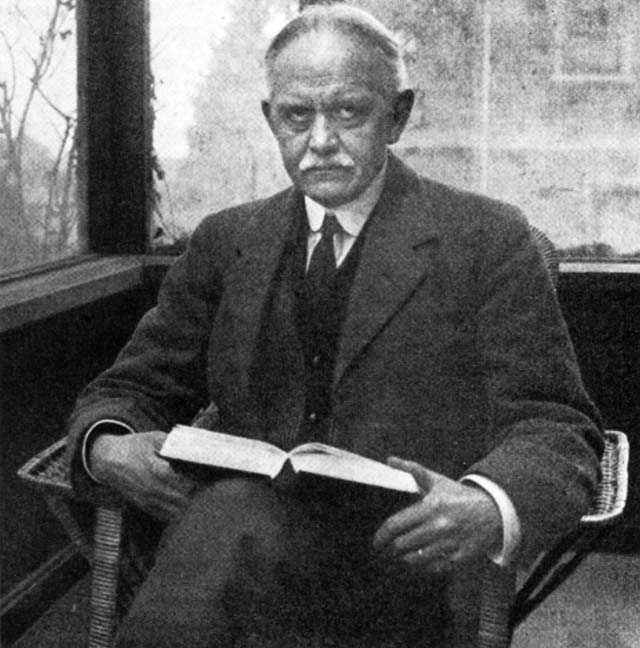
HIS FATHER hoped that Charles Mills Gayley would become a missionary. That hope was realized in noble measure, though not in the specific manner the father had in mind. The son became a missionary not of the Christian religion, but of great books. The spiritual subject of his ministry was the humanism of the ages. Irrespective of their creed, or time, or place, he was dedicated to the spirituality of those greatest minds whose writings are beacons in this dark, confused, and ignorant world. The great-mindedness, the spirit, of these writings illumined the mind of Charles Mills Gayley and shone always through all his teaching whether in spoken or in written word. He was an apostle of the world's great books.
He was, nevertheless, or perhaps therefore, a man of many interests, all of which he followed with his characteristic combination of salient enthusiasm and painstaking study.
The family that nurtured him, and the far-separated lands he knew in his boyhood and youth, go far to explain his vocation, his variety of interests, his gallant enthusiasm, and his habit of scholarly concentration.
It was in the summer of 1845 that the horrible potato blight (Phytophthora infestans) spread famine and pestilence in Ireland. "On an Irish air long heavy with the smell of dung heaps, peat bogs, and the personal reek of an ill-kempt and poverty-ridden citizenry, a new and more awful odor arose. Sulphurous, acrid, 'like the smell of foul water in a sewer,' it came from the almost ripened potato plants, lay so thick that in some places it was visible as a whitish cloud above them. Where it appeared, leaves turned first purplish brown, then black; stems withered, so that they broke at the touch, oozing a pus-colored liquid; the potatoes, when dug, were soggy and black with putrescence, rank-smelling .... To the half-savage, wholly uneducated peasantry, it was known simply as 'the Blight,' and was regarded as a hellish, heaven-sent scourge. Holy water and incantation were the only remedies invoked against it. Its onset marked the beginning of perhaps the most bitter famine in postmedieval European history. Ridden by heavy taxes and a feudal system of landlordism, pinched by the British corn laws .... the Irish had been reduced to practical subsistence on the potato, and when that crop failed whole counties were left literally foodless."(1) By 1851 close to a million Irish had perished, and from 1846 on developed that tide of emigration, chiefly to the United States, which in fifty years cut Ireland's population of eight millions in half.
Toward the beginning of this emigration, a certain Samuel Gailey set out for the United States, leaving Ireland, "the land of misery," to come to America, "the land of plenty"---to use the young man's own words, uttered three years later when he heard from his father that two cousins, John and Joseph Gailey, were on their way across the sea. Later yet, but on yet another soil, this young Samuel became the father of Charles Mills Gayley.
Samuel Gailey (as the name was then spelled[2]) at baptism had been formally dedicated to God; for it was the hope and faith of his father, Andrew, that the child would some day become a missionary. As we shall see, the hope and prayer were nobly fulfilled.
The grandfather, Andrew Gailey (1790-1857), was a farmer in county Tyrone, Ireland---a farmer of the first class, locally renowned for his piety and thrift. The family was justifiably proud of its record in uprightness of spirit and of its more than a century of unsullied reputation.
In the parish of Ardstraw, at Creevy, near Magheracriggan, Samuel Rankin Gailey was born, October 18, 1828. The child was carefully instructed in the Scriptures and in the catechism of the Presbyterian Church, and at an early age was introduced to the study of Latin and Greek, in which he made rapid progress. In his father's household the family altar was carefully maintained. One who visited the family in those days, Joseph M. Wilson, once the publisher of the Presbyterian Magazine (Philadelphia), has left this picture of the family at worship. "The whole scene comes up vividly before recollection. Upon the summons being given 'to worship' the members of the family, servants included, assemble and solemnly take their seats, all the adults and each of the children who were able to read being furnished with a Bible and Psalm-Book. A psalm is sung, a portion of Scripture is read from 'the big ha' Bible,' and they kneel in prayer. It is evident that the whole exercise is no mere routine duty, but a felt privilege, where the father carries to the mercy-seat the spiritual interests of all his children, and prays for a blessing upon family instruction, and that God would make them all the subjects of converting grace."
Under these influences Samuel Gailey spent his boyhood. His mind was ineffaceably impressed with a spiritual reality. In his boy's heart there welled up a sacred love of the Divine Savior. He believed himself the recipient of grace. During a severe illness, his religious feelings deepened mysteriously, and were fixed for life. As he grew in adolescence his sense of God ripened as from the blade to the ear, and then to the "full corn in the ear."
It was in his eighteenth year (1847), and after he had taught school for a short time, that he decided to accept an invitation to come to the United States to be with his uncle, the Rev. Samuel M. Gayley. Many of his relatives had preceded him to America: toward the close of the eighteenth century a great-uncle and a great-aunt; between 1816 and 1845, five uncles, an aunt, and some seven cousins. His sister, Matilda Gailey Doak (b. 1832), also came, and, later than Samuel, several more cousins.
Samuel left his father's house May 29, 1847, and on June 2 embarked at Londonderry. He arrived at Philadelphia July 10, 1847, and was at once taken to the house of his Uncle James Gayley, where he met his "Cousin Dr." James Gayley. Leaving Philadelphia within the week, he visited his Uncle Daniel Gealy at Parkesburg, Chester County, forty-five miles from Philadelphia. By these uncles and their families he was warmly welcomed and made to feel at home in the new and strange country. On August 28 he went on to his uncle, the Rev. Samuel M. Gayley, who lived at Mantua, near Wilmington, the county seat of Newcastle, in northern Delaware. This uncle conducted a boys' school, the Wilmington Classical Institute, and he had invited his young nephew to become an assistant teacher. The school had been opened in 1832, and it continued until it was burned down in 1854, when another, the Media Classical Institute, was started in Media, in Delaware County, Pennsylvania. While the nephew taught others, he continued his own studies in preparation for college.
His life at Mantua and Wilmington was very pleasant. The boys and girls in the family, his new-found cousins, welcomed him gladly, and his Cousin Tom (Thomas Gardner Gayley) became his chum. But another and more important friend of these days was Charles Rogers Mills (1829-1895), from Buffalo, New York, who had come to the Institute to prepare himself for college and, eventually, the Presbyterian ministry. Charles was a serious, diffident, conscientious youngster, with a deep inclination toward the holy profession. In a printing shop in Buffalo, the "profanity and ungodly conduct" of his shopmates had made him uneasy and discontented, and he was very much aware of a world living in darkness. "A vast multitude in heathen and Christian lands are famishing for want of the Bread of Life, and ever and anon, I have heard a voice, like that saying to him of olden time, in solemn tones, 'What doest thou here, Elijah?"' By the end of November, 1848, he was settled in the Institute, and was sending to his older brother Calvin (1824-1912) letters of exhortation to forsake a worldly life and join the church. He was a born missionary, at least so far as zeal and confidence are concerned. He soon became Samuel Gayley's roommate, looking up to that young gentleman as "just such a character as I would wish to be."
Charles Rogers Mills, thus introduced into Mantua, was to become Samuel Rankin Gayley's lifelong friend, brother-in-law, and co-worker in the missionary field in China. Samuel's first child was named Charles Mills Gayley after this devoted friend.
The accommodations at Mantua were of Spartan simplicity, and the course of study was arduous, of the good old-fashioned sort which required that art of severe application now so noticeably missing in our 'improved' common schools. The students arose about six in the morning, studied, attended family prayers, breakfasted at eight, walked to town and back for exercise, began lessons at nine, dined at noon, went back to the classroom from one to four, had an hour or two before supper for study and recreation, after supper studied again until family worship at eight, and then read or studied, or attended lectures in town, until bedtime at ten. Greek and Latin, mathematics, geography, history, 'natural' and 'moral' philosophy, and modern languages by the "Ollendorf New Method," were the staple subjects. The school was full of students, some of whom came from as far away as Georgia and New Orleans, Canada and Cuba, England and Ireland, Mexico, Barbados, and Poland. Principal Gayley was famous for his piety and his scholarship, for his large private library, and for his outstanding ability as a teacher of young men. Young Gayley and Charles Mills were conscientious workers. Their letters are filled with plans for ever "harder work to more purpose."
In April, 1849, the Presbytery of Newcastle received Samuel in its care as a prospective candidate for the ministry. At the beginning of his twenty-third year, accompanied by Charles R. Mills (aged 22) and by his cousin, Thomas Gayley, he entered the sophomore class of Lafayette College, a small Presbyterian institution in Easton, fifty-four miles north of Philadelphia. Easton, an ancient Indian garden spot, is situated in the pleasant hill country at the confluence of Lehigh River and Bushkill Creek with the Delaware. At this time Easton had a population of about ten thousand. The college is on the brink of a precipitous rocky bluff to the north of the Bushkill, commanding a fine view of Easton, the beautiful countryside, and the rivers.
There were only nineteen students that semester, thirteen in the college and six in the preparatory school. The two Gayley boys, Mills, and Samuel S. Kennedy constituted the sophomore class. The faculty consisted of three professors and the president. The Rev. Samuel M. Gayley was a trustee of the college.
Samuel's heart-searching religious life is revealed in page after page of his diary, especially after he has heard a sermon. He prays for needed grace; for aid in overcoming that sink of iniquity, his hypocritical heart. After reading four books of Paradise Lost, he instructs his soul to flee from sin to God. But when he sits at the Lord's table in Communion he is ravished with the grace and love of his Savior, expects and often attains a deep emotional experience, which he regards as the mainspring of his intellectual life. It is clear that this young man is genuinely god-conscious, and that peace of mind for him can lie only in following a holy vocation. All the imaginative, constructive movements of his mind are already concentrated in the religious life, with so literal a belief in inspiration and revelation that he attributes nothing to his own fancy, but, on the contrary, writes himself down to his friends as one quite lacking in imagination. Two well-known dangers are ahead for this type of personality: fanaticism in his vocation, and dour stiffness in his relations with his fellows.
But these dangers Samuel escapes. His naturally affectionate, Scottish-Irish temperament is always ready to respond quickly to the genuine amenities of social life; and the warmth of his little society of many aunts, uncles, and cousins, who have taken him to their hearts so generously, is continually calling for responses of love and gratitude. Moreover, the sincere regret with which he contemplates his own shortcomings keeps him modest about his own gifts and sympathetic toward the frailties of others. All his life this man, one can foresee, will use the clichés of Christian belief: he will never plan the simplest future action without saying 'God willing' or 'D. V.'; every decision will be referred to God in prayer; each difficulty, each worry will be 'cast upon the Lord'; disappointments and deprivations will be minimized in a comparatively quick reconciliation to them as expressions of the 'will of God.' But, whereas in others these phrases may really mean a selfish simplification of the emotional life, even to the point of more or less unconscious hypocrisy, and may be rather obvious methods of escape and of 'defense mechanism,' with him they will always be deep verities, core of his character, soul of his soul. In him they will be a sure spiritual strength upon which others will instinctively lean. This man will command the confidence of his fellows.
And as the days went on at Easton, variety of experience gradually removed some of the adolescent stiffness of this overserious mind. There were reminders of the natural spirits of youth. Some were rather grave: the suspension of a classmate for drunkenness; the deviltry of the boys in his Sabbath School, which gave him a peck of anxiety. Others were casual: the levity of the students, frequently making for madcap pranks. On the eve of a Fourth of July, James Latta DuBois, of the Doylestown DuBoises, a great-uncle of the writer of these lines, and Tom Gayley were leaders in the escapade of locking the entrance to the belfry and at midnight they rang the college bell deliriously in celebration of the holiday. The town constables were summoned by the faculty, and Professor Burrowes in wrath broke open with an axe the room of four students in his search for the culprits. On another Fourth an assembly listening to a patriotic declamation of the Declaration of Independence was thrown into confusion by a mad raid of whooping youngsters got up as Indians. Circuses came to town. Each year, cherry and apple orchards were raided. Upon these amusements, young Samuel comments without disapproval, but he never got his own cherries and apples without permission from the farmer. More fun crept into his life.
But most important, perhaps, was his change of attitude toward 'young ladies.' He was, in fact, a bit susceptible, with that idealized susceptibility which goes with a serious and sensitive disposition. He began to find pleasure in 'fine female company.' He enjoyed walks on which the boys and girls divided into pairs and larked to see which couple could keep to the rear of the procession. He had, now, a Sabbath School class of girls, who, evidently, hung on every word of the handsome young collegian. His pleasure in this class was so great that he began to suspect its real cause, and therefore became the more evangelical in his attentions to the girls. Then, of course, he had his college romance---with a girl he met in Easton. She went to New York, and he wrote in his diary, September 9, 1852: "This evening I wrote Miss -----, N. York, the first letter I have ever written to a young lady not related to me. I esteem her highly and would like to hear from her occasionally." Soon he was hearing every week. And soon he was writing an essay, "On the Influence of the Female Character," which he delivered before the Franklin Literary Society. She returned to Easton. They saw each other very frequently. There was more walking in couples. When she got back to New York again she received letters concerning her spiritual welfare, and replied that she was ready to have her soul saved. So there was an engagement. But by the end of 1853 their vows had died a slightly uneasy death.
Early in his Easton life Samuel became interested in foreign and domestic missions. At one time he seriously considered a vocation to 'save' the Indians of Michigan (where some twenty-eight years later his son was to be graduated from the state university at Ann Arbor), and talked it over with one of his professors, who advised him first to complete a course in a theological seminary. Six months later he made up his mind, 'D. V.,' to attend a seminary, probably the one close at hand, at Princeton, New Jersey. His uncle Samuel M. Gayley, thoroughly approved. Thus his call to the sacred ministry, toward which all his life had been directed, grew immediately out of his natural interest in missionary service.
At Easton, he graduated first in his class. He delivered the Latin Salutatory. Charles Mills gave the Valedictory.
Today the name Gayley is remembered at Lafayette College not so much for the young man of that name who pronounced the Salutatory in 1853, but for his first cousin once removed, James Gayley (1855-1920), son of the Rev. Samuel A. Gayley, grandson of Daniel Gealy of Parkesburg, and brother of Samuel's "Cousin Dr." James Gayley. This James Gayley was the donor (1900) of Gayley Hall, the chemistry building, which was dedicated in 19o2. He had taken a large part in the formation of the United States Steel Corporation, and was one of the thirty partners of Andrew Carnegie.
In September, 1853, Samuel Gayley and Charles Mills proceeded to the Princeton Theological Seminary (Princeton, New Jersey), a conservative Presbyterian college of the Old School, founded in 1812. Samuel's interest in the foreign missionary field developed steadily. Finally, as a result of the remarks of a Dr. Hodge, at a conference, he heard a definite call to enter the field. In the winter of 1854-1855 he applied to the Board of Foreign Missions of the Presbyterian Church for an appointment, designating North China as the field of his choice. During his last year at the Seminary, the call and the sense of dedication to it must have seemed to him the divine fulfillment of the destiny his father had hoped and prayed for, and of which he himself had been profoundly conscious since childhood. He was warned by one of his relatives, a physician, probably "Cousin Dr." James F. Gayley, that his constitution could not withstand the climate of Shanghai. He respected the advice; but the call was clear, the duty imperative. All his life, once his duty was clear, his decision was prompt.
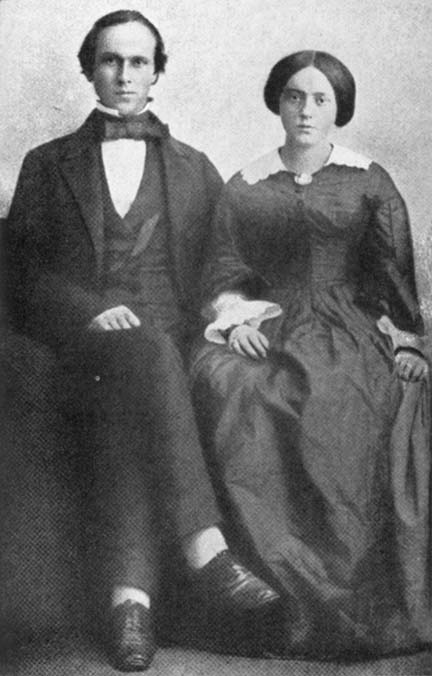
Another important event took place while he was enrolled in the Seminary. From Charles Mills he had for years heard so much of the latter's family that he long since had felt he knew them well, though he had had no opportunity of meeting them. He had become particularly interested, afar, in Mills's youngest sister, Sarah ("Sallie") Sophia Mills. In September, 1855, Mills wrote that he intended to visit his family, and invited Samuel to join him. The latter was received very kindly by the uncle, Squire Rogers, by Mills, and Mills's sisters, Lucy and Sallie. Lucy, who had mothered the family since the death in 1850 and 1852 of the father and mother, at once noticed that the guest was partial to her younger sister. So, pumping Charles, she learned that Gayley had come with the purpose of getting acquainted with Sallie, and was now indeed strongly attracted. Lucy next talked with Sallie, not intimating that she knew Samuel's state of mind. The girl confessed she already was so much in love with him that she would be willing to follow him to China, but she did not think he cared for her particularly. Whereupon Lucy had a heart-to-heart talk with Samuel, who expressed his desire to take the first opportunity of declaring himself. Sallie, after consulting with her brother, said "Yes." On this same vacation, Charles had become engaged to Rose McMaster of Buffalo, a school friend of Sallie's. Rose was another young woman who was content to follow a husband to China; for Charles, too, had turned missionary.
Sarah Sophia Mills was born at Guilford December 1, 1837, the daughter of Calvin Mills (1793-1850) and Sophia Roxana Rogers (1791-1852). On her father's side, her ancestry extended back through men who had been soldiers in the American Revolutionary Army. Her grandfather, Deacon Samuel Mills, Jr. (1754-1837), once a member of Benedict Arnold's expeditionary force against Canada, in the winter of 1805 had moved by ox sleigh from Norfolk, Connecticut, to Guilford, New York, taking ten days to go two hundred miles. On her mother's side, her ancestry went back to Joseph Rogers (d. 1677) and his father Thomas Rogers (d. 1621), both of whom came over in the Mayflower. Thomas Rogers was the eighteenth signer of the Mayflower Compact. Joseph Rogers was a lieutenant in the colonial militia under Captain Miles Standish.
So Sarah Mills was of New England, to the backbone. She was not Irish. But she had all the vivacity and charm, the gayety and high spirits and sweetness, of the proverbial Irish gentlewoman. Perhaps it was some memory of such gentlewomen in that Ireland where he had been born and spent his youth, that inclined the serious young Samuel toward Sarah Mills, though no such farfetched cause is necessary to understand how any man, young or old, serious or otherwise, would have fallen in love with her. Throughout her life, with all its hardships, she retained an unbroken spirit of singular power and attractiveness. About her there was something unpremeditated, spontaneous, affectionately impulsive; but nothing superficial, untrustworthy.
Lucy, immediately after Sallie's engagement, conceived of her own accord the plan of accompanying the young people to China. "Perhaps," she said, "my willingness to go was more from dread of a separation from those I loved, than for the good of souls." Yet she believed she could make herself very useful, if the Board of Foreign Missions would employ her.
For Samuel, 1856 was a year of momentous changes. Sometime between March 26 and April 1, at Philadelphia, he became a naturalized citizen of the United States. In May he graduated from the Seminary, having finished his preparatory studies for the Gospel Ministry. Later, he was accepted as their missionary by the Presbyterian Board of Foreign Missions. On July 1 he was solemnly ordained evangelist by the Presbytery of Newcastle.(3) On the 20th of July he was stricken with bilious dysentery and came close to death.
Sallie, unconscious of the tragic irony of her concluding sentence, wrote him thus: "My dearest, very dearest Samuel, may God watch over us and keep us through every trial and every sorrow and I do pray that my faith may be strengthened to bear all which He may send upon me. Is it not strange that when He sends joys and pleasures to our lot we fail to remember our indebtedness, but when the trial comes it sends us right to Him for comfort! But I fear this letter will distress you; you will think me so very miserable. But do not think of that. You don't know what a heroine I can be." God, or fortune, was to take her at her word before long.
During his convalescence, Samuel had another indescribable mystical experience, even as he had had during a boyhood illness in Ireland. It was an overwhelming sense of the divine love---such as "I never before experienced," he said; for him, a direct meeting with his Savior. He was extraordinarily eager to develop his power to attain this mystical experience. "This state of mind," he wrote to Sallie, "can be cultivated. It has been attained. And there are provisions in God's Word for its attainment. It would be heaven on earth begun. Oh, for grace to attain it."
It was at the time of this illness that Lafayette College conferred on him the degree of M.A. On the 20th of August he was married at Buffalo. There was a double wedding: Samuel and Sallie, Charles Mills and Rose McMaster. At ten in the morning of Saturday, the 11th of October, after a seven weeks' round of farewell visits to their numerous relatives in New York, Pennsylvania, and Maryland, a happy little company of five---the two newly married couples and the devoted Lucy---sailed from New York for Shanghai, in the clipper ship Contest, 1100 tons, which for four years had been in the China trade.
The Contest was a fast sailer. The voyage from New York across the Atlantic, around the Cape of Good Hope, through the Indian Ocean, and up the Pacific to Shanghai, was made in 119 days: a long time at sea, with never a landing, but a quick trip for those days. For the five young evangelists time raced by very pleasantly. The men read Macaulay aloud while the women sewed sheets and pillowcases. They all wrote letters and diaries. They explored the ship. They walked the deck some two miles a day; they saw the officers taking the sun and the sailors heaving the log. They watched each least change in the wind and the weather. They were as much interested in the daily run as if they had wagered on it. They crossed the equator and looked for the Southern Cross. Birds and fish of which they had only read, they now saw for the first time: Mother Carey's chickens, boobies and sea hens, Cape pigeons, and the lordly albatross; flying fish and the Portuguese man-of-war, dolphins, porpoises, whales, and miles upon miles of blackfish. Sometimes at night the wake of the ship was a phosphorescent shimmer as they passed through vast shoals of some small effulgent marine animal. They watched the "Corpo Santo," a ball of fire, climb up and down the mainmast. They hurried on deck at the fateful cry, "Man overboard!" Landfalls were infrequent, and therefore very exciting, especially when the ship sailed so close to a tropical island that they could see feathery palm trees, smell the spice-laden air, and have glimpses of a light in a window near the shore. As in a dream, they sailed the burnished colored waters of the Indian Ocean, gazing at such sunrises and sunsets as they had never even imagined. Now and then some Dutch trader or French or other freighter was sighted, even bespoken---always the occasion of a feeling of strangeness that other souls should also be voyaging in these remote, occult longitudes. In the midst of it all they conducted their prayer meetings and Sabbath worship, with minds fresh to the wonders of the world, with faith stimulated by the mystery of those wide and solemn reaches of sea and sky.
Thanksgiving Day, Sallie's nineteenth birthday, and Christmas, came and went, with due and happy festivities. The weather throughout the four months was singularly mild.
On a cold Wednesday afternoon, as they were sailing up the mouth of the Yang-tze Kiang, there came aboard a Chinese clad in several pairs of white stockings, several of short, wide pantaloons, and several jackets. This was the pilot who was to guide them up the Yang-tze and the Wu-sung River to Shanghai. As he strutted the deck importantly, the five Americans smiled at his queer clothes, his thick-soled, colored shoes, and his hair braided about his head. But they found him fine-looking, intelligent, and courteous. He could speak enough broken English to make himself understood. He was the first of the "multitude of heathen" to be seen close at hand. As they sailed up the flood turbid with the reddish brown mud brought from the remote inland mountains, and caught their first glimpse of the low, muddy shores, bare except for a few scattered trees, they were very conscious of the "multitude of heathen" awaiting their ministration; and as they listened to the guttural gibberish of the Chinese pilots shouting from ship to ship, they wondered whether they ever could learn enough of this barbaric tongue to make themselves and the word of their God understood.
On a Saturday evening in February, 1857, off Shanghai, the three women were hoisted one by one over the bulwarks of the Contest on a chair attached to a pulley, and were lowered into a sampan, where they were joined by the two men. Presently they were landed at Shanghai, in the dark. Reuben Lowrie, a Presbyterian missionary, a son of the Hon. W. Lowrie, of New York, guided them to his house. The women were carried in covered chairs; the men followed on foot. The streets were deep in mud. As they passed from the Foreign Settlement into the Chinese quarters, they entered dirty alleys eight to ten feet wide, lined with rickety houses the upper half-stories of which projected overhead. These mean passages were crowded with shuffling Chinese. The only light came from lanterns carried by some of the jostling crowd. The little caravan of Americans seemed lost in the shadows, pushing deviously right and left through a maze of unseen streets, stumbling across narrow stone bridges over the numerous canals, twisting through the dense mass of strange humanity. Vile odors were everywhere. The meanest part of the meanest city they had ever seen was as nothing compared with this nightmare of filth. Lowrie's house was near the South Gate of the walled Chinese city, some three miles from the Settlement, in the very heart of the suburbs of the native city.
Next morning things looked better. Lowrie's home, where all five of the "new missionaries" were to stay for four months, was a twelve-room house of two stories, built of brick plastered to imitate stone, with verandas on both stories in front, facing south on a wide cultivated plain. Across the way was another foreign-built house, occupied by brother missionaries, the Blodgets. The Blodgets were the only other whites within a mile. The surrounding alluvial plain, stretching as far as the eye could reach, was studded with miserable Chinese farmhouses and hamlets, set in the midst of growing onions, beans, peas, and other greens. In every direction the little gardens were criss-crossed with small canals and ditches, fed by the river when the tide backed up its waters. When the tide fell, the ditches became dry. Then they stank horribly. Scattered everywhere were small grassy mounds, graves of the innumerable dead, piously unmolested though they took much space in this overpopulated land, where every square foot was jealously cultivated. In a few weeks the mission garden was in full bloom. Beneath three varieties of flowering peach, one pure white, another dark crimson, the third variegated crimson and white, flowers and rose bushes blossomed luxuriously. A grapevine climbing over an arbor, which Samuel pruned, reminded him of his uncle's home in Media. Beyond, wheat came into ear, or rice spread its brilliant green. Pear, cherry, and almond blossomed in season. Sallie had expected to live in some sort of bamboo hut, in an odoriferous village. The contrast amazed her, as she gazed from her flower-filled second-story room.
But when they passed through the South Gate into the six-hundred-year-old native city, the impressions of that first night's confused journey were revived. Again, the narrow, crooked alleys, paved crosswise with slabs of stone; again, the dilapidated houses nearly meeting overhead; again, the pushing, crushing crowd of yellow-hued natives. In some places, curtains of matting were drawn to shade the streets and gilded shops, where all the flimsy wares of China were exposed for sale. Canals intersected the city. Pools of stagnant water, teeming with noxious life, poisoned the air. Noisy courtyards, crumbling temples, defaced deities, coffins waiting by the hundred for an auspicious day of burial; hawkers of birds and birdcages and sweetmeats; water carriers; milkmen leading the milch buffalo with the milking stool hung over her horns, which the purchaser uses when he draws for himself whatever quantity of milk he wants; street kitchens, indescribably filthy; diseased and ragged beggars like walking mummies; the swaying sedan chairs of those who could afford them; the noisy, jostling, intimate confusion of a Chinese city of two hundred thousand souls swallowed them up completely. Yet they walked there unhampered by anything more than the curious staring of the Chinese crowds. And every now and then, through some half-opened door in a high wall, they would catch a glimpse of gardens rarely beautiful with peonies and chrysanthemums, and with old porcelain flower pots, huge and richly colored.
At the teeming heathen, so industrious, so preoccupied with the mere practical business of living, yet so patient and good-humored in their daily grind of hard work, the five Americans at first looked aghast. But gradually they became accustomed to this new life, until, at length, it was hard to find things strange enough about which to write home. Not for some time, however, did they overcome their reluctant yet fascinated interest in the thousands of idols of all sizes, shapes, and colors, which on every hand they saw men worshiping. They were astonished at the number of temples and worshipers. Yet in these temples, accessible to natives and foreigners alike, they often found an opportunity for sowing the seeds of their own religion. One evening, as Lowrie was conducting them past a temple, seeing it lit up, they entered. A crowd gathered; mouths and eyes opened with curiosity. Lowrie, thinking it a good opportunity to bear witness to the true God, and following a custom common with the missionaries at that time, preached a long Christian sermon within the temple, speaking fluently in the local dialect.
Mr. and Mrs. Lowrie were like new-found brother and sister, measurably taking the places of the all-too-silent relatives beyond the oceans. Early in June, 1857, to escape overcrowding in the Lowries' home during the hot weather, the two new families moved to a large, airy house in a suburb of the Settlement, near the United States consulate, about three minutes' walk from the Whampo River. There was a fine view of the harbor; they could see the ships come in. They were surrounded by the Episcopal mission and its schools. The new neighbors were very kind and attentive. In fact, here the exiles from South Gate saw more foreigners than Chinese.
But the summer was hard on the health of the missionaries. The heat and humidity were intense. Illness began to show itself. Eyes and throats suffered. Bilious fevers, chills and fever, and dysentery appeared, and disappeared, and reappeared. Several friends succumbed to dysentery or smallpox. The Millses and Gayleys, however, managed to weather these difficulties, while they kept up their studies of the language, and visited and were visited. They listened to the naval bands of the ships, and were serenaded by one of the bands.
In this home, just at noon of February 22, 1858, while the United States vessels in port were firing a salute in honor of the anniversary of Washington's birthday, the subject of this biography, Charles Mills Gayley, was born. Sallie suffered for eighty-four hours, the last twelve of them intensely, but she did not utter a word of impatience or repining. Some people strongly recommended that the child be named George Washington Gayley, in honor of the day. Thanks to his father, that patriotic intention was scotched. Samuel said there were enough George Washingtons in the United States to carry a state election. Others recommended 'Samuel' or 'Andrew.' But again the father demurred, on the ground that these names had already become so numerous in his family that 'Samuel Gayley' and 'Andrew Gayley' "might be reckoned among what grammarians call common nouns." So the child was named Charles Mills, after his mother's brother, the long-devoted friend of his father.
The name, Charles Mills Gayley, therefore, signalizes the beautiful and faithful intimacy of four young people---a brother and his two sisters, and the brother's friend, husband of one of the sisters---who were serving their God in far-away Shanghai and points beyond. It brought to a focus lines of kinship that stretched back through the American Revolution, through the founding of Connecticut; and back, beyond the Atlantic, by means of the Mayflower, to England; and, more recently, to Bute and the Firth of Clyde in Scotland, and to county Tyrone in Ireland. From England and Scotland, to Ireland, to America, to China! Perhaps it should be said that Charles Mills Gayley was after all no more of an international product by birth and ancestry than thousands of other Americans, all inheriting deviously from European forebears, or than some fewer thousands whose ancestry goes back to European sources by way of the heroes of the American Revolution and of the first settlers in New England. But this child was to become a man who consciously profited from these rich ancestral sources, who explored them and was faithful to them, who by reason of them felt himself at one with many times and peoples, grateful inheritor of their cultures, and in gladness duty-bound to live a life of wide, international sympathies and achievement. Somehow, in the remote forces which came to a focus in him, there was something that energized him to become, in the best sense, a true man of the world, even as his father had been a true man of God. Both felt a call to service. Both heeded the call. And years later, in Ann Arbor and Berkeley, in London and in Paris, young men gladly and gratefully heeded the spiritual call of one whom they immediately recognized to be in mind and in manner and in achievement veritably a man of the world.
Sallie, describing her baby in a letter, wrote: "He is a big boy, and weighed when he was born eleven pounds. He has large dark eyes, which will probably be black when he is older, and he opens them to their fullest extent. His nose, we think, is ... somewhat on the turn-up order. He has brown hair ... He is perfectly well and hearty, which is a great comfort, and sleeps at night with Lucy, waking up but once to be nursed. How long these good habits will continue, I do not know: probably not long, for he can't be expected to sleep all the time." The proud father was less circumstantial in a letter to his Aunt Gayley in Media, Pennsylvania: "In regard to the personal appearance of the child I have little to say, for the simple reason that I have never yet been able to see that one infant-child differed from another in appearance; and that they are all homely little things. However, if you allow me to give you the opinion of those who profess to be connoisseurs in the art, I would say, he is a fine looking baby, with dark eyes and brown hair. Some say he favors his mother, others, that he favors me." Certainly, later years proved that the large eyes and most of his disposition came from his mother; but the shape of his face, his chin, and his lips, and his powers of application, were inherited from the father. Sallie was a trifle over twenty when she gave birth to her first child.
At the end of four months, the child weighed nineteen pounds, was a happy little fellow, needing only a word or smile now and then to lie content on the floor for an hour at a time, kicking and crowing at the top of his voice. Yet when occasion demanded, such as the coming of the first tooth, "I can hardly tell you how cross he can be when he tries," wrote his mother. "He takes after his mother in that respect, doesn't he? But then he is so good when he isn't cross that it makes up for all the badness."
The next summer, 1858, was very hot, almost more than could be borne. Again, friends and acquaintances were dying of cholera. Toward the middle of August the Gayleys moved to their new house, beside the Lowrie's near South Gate, leaving Charles and Rose Mills at the house on the Whampo. On the first Sunday in the following month Samuel essayed his first sermon in Chinese. That day, in his opinion, marked an epoch in his life. From this time on he preached more and more frequently, presently twice a week and oftener, then every day, fulfilling his heart's deepest desire. In November, Sallie had a short attack of dysentery. Then, January 11, 1, 1859, her sister Lucy married the Rev. Justus Doolittle, a missionary of the Presbyterian Board, stationed at Fu-chau, to the south, in Fu-kien province. He was a widower, with a little son. The admirable, self-sacrificing Lucy had found favor in his eyes, after due deliberation and prayer on his part. She had been a mainstay to her sister and brother-in-law, and to her brother Charles Mills and his wife. She had always had the highest possible opinion of Samuel from the day she first met him, and time had more than ratified that admiration. Her letters bear witness to Samuel's utmost devotion to Sallie, to the marital happiness of Sallie and Samuel, to the tenderness of heart and strength of mind and to the patience and good humor that won Samuel friends and admirers and followers wherever he went. With heavy hearts the two married couples bade farewell to Lucy and her husband as they sailed south for Fu-chau; but they rejoiced that at last she was to make and have a home of her own.
Presently, Samuel was attacked again with bilious fever, but slightly. Then a throat affection began to interfere with preaching. But the boy, Charles, grew apace, fat and healthy. He became full of fun and mischief. "If he is not watched, he is one minute revelling in the mysteries of the coal scuttle, and after getting nicely blackened, he tries poking the fire for amusement; and, should the hall door have been carelessly left ajar, he soon finds his way to be staircase, and starts on a journey upwards.... Not that he is so very bad, above the ordinary degree of childish badness, for if we say, 'No, no, Charlie,' and shake the head, he will even leave the coal scuttle. But he is a mischievous boy." Sallie wondered where he got it all. She thought it might be Scottish-Irish. But her husband seemed to think there might be a Yankee strain in it. Brother Charles told her of the man who had a stuttering child: "He couldn't t-t-tell whom the ch-ch-child t-took af-f-fter."
In the summer of 1859 illness came upon the Gayleys once again, but this time with almost fatal results. About the middle of July Sallie was seized with that violent affection of the bowels which was known as 'the consumption of China,' so weakening and debilitating were its effects. Once it became chronic, the only remedy was to leave China, and even that often proved unavailing. Sallie's attack had lasted about a fortnight when Samuel was attacked with intermittent fever.
Both took to their beds. Sallie tried to get up to take care of her husband, but only made herself worse. Charles Mills came over to nurse them.
Just as Samuel's health was beginning to improve, a dangerous local disturbance arose. The Chinese began to attack and even kill foreigners. The alarm in the Settlement rose to a high pitch, English marines and cannon were landed, and many of the whites took refuge on the ships. The United States consul sent word to the Americans at South Gate that they should immediately repair to the Settlement, since he could not protect them so far away. Sallie was in bed. But they got her dressed and with great difficulty obtained a sedan chair. Samuel was very weak, but no chair could be had for him. He had to walk some four miles under a broiling sun. They made their way through Chinese calling "Kill the foreigners," but arrived safely. The next morning Samuel came down with a severe attack of that same dysentery which had brought him so close to death just before he sailed from America. The disease could not be checked. Again he was very close to death, too weak even to think, let alone talk. Sallie got out of bed and nursed him. She suffered untold agonies of body and mind. At length the disease was checked, and Samuel, though fearfully reduced, slowly began to improve. At this moment their little son, Charlie, was laid low, growing thinner and thinner. The heat continued intense. The Mills's house was crowded with three families. The Chinese were rioting furiously, attacking churches and foreigners. Charles Mills saw to the moving of the Gayley's valuables from South Gate to the Episcopal mission. A house in that mission was taken for them, into which they moved as soon as Samuel's weakened condition permitted. After a while, when quiet was restored, the Gayleys moved back to South Gate. Sallie said that never in her life had anything looked half so pleasant as her own dear home, which she had feared she would never see again.
All this time Sallie was approaching her second confinement. On August 29, 1859, at South Gate, her second son, Andrew James Gayley, was born. Almost immediately afterward her husband came down with a severe cold and a very sore throat and a cough, just when she needed his care the most. On the 1st of September Rose gave birth to a son. Just as Sallie was beginning to think of sitting up, another fever came on, setting her back a great deal. The fever was outworn, but she was left very weak, and subject to chills and fever. From a ruddy, well-fleshed young woman she was reduced to that thin, pasty, worn, anemic, and prematurely aged appearance characteristic of so many of the women missionaries in China. But through these trials, such as this girl of twenty-one had never before known, her religion had been her comfort and support. By their sufferings, indeed, the religious life of the Gayleys was profoundly deepened. Their trials brought them only closer to their God, and made the promise of eternal life the sweeter. Such heroism and such deep faith lay behind those pasty faces and weakened bodies one used to see whenever he came in contact with missionaries in China.
By October, Charlie was getting well again, with an enormous appetite. He thought his little brother the prettiest plaything he ever had had, and loved him dearly. Andrew James, "little Andie," was a beautiful, fair-haired, fair-skinned, light-eyed baby, fat and hearty, of an extraordinarily happy disposition. Charles and Rose Mills named their son Samuel Gayley Mills, thus returning the compliment extended them by the Gayleys when they named their elder son Charles Mills Gayley. Again those lines of ancestry had come to a focus in a child. The two little cousins, Charles Mills Gayley and Samuel Gayley Mills, were devoted to each other, carrying forward the mutual devotion of their young parents.
By the opening of the new year, 1860, Charles Mills had brought his family to the Blodget house, opposite the Gayley's new house, at South Gate. Charlie Gayley was always eager to go across the way to his Uncle Charles's home to see his cousin, Sammie Mills, who was growing fast and taking after his mother in looks. Andie, whose hair was turning red ("auburn," his father insisted), was chubby with health, and his ever ready merriment kept the households smiling. Charlie was at the stage of learning his prayers, in which he displayed a consuming interest, refusing to take even his afternoon nap without them. But he was developing a streak of obstinacy which required correction. In March he was greatly excited at the opening of a missionary box. Standing on a chair by the table, and peering into the "bang, bang," as he called the box, because of the noise of opening it, the first thing he saw was a toy horse. His crowing set the company laughing, and they began again when he danced up and down with joy over a mug someone had sent him. Those "box days" were great events, with the entire family and invited friends in attendance on the grand opening. In the meantime, December 22, 1859, Lucy, too, had been made happy by the advent of a little daughter, to whom she had given her own name, Lucy.
Mr. Gayley was sick in bed again when this box arrived, but he had been preaching four times a week, much to his satisfaction, and the attendance of the Chinese was increasing. Their great friend, Mr. Lowrie, however, was seriously ill. Sallie was with him almost to the moment of his death, which occurred April 26, the day after his wife had given birth to their second son, a third child. This death affected Sallie deeply. Everywhere she looked she was reminded of some act of kindness this more than a brother had done her. Into the Lowrie household she and her husband had been received in gladness when they arrived in this far, strange land. There for months they had lived happily, while they grew accustomed to their new life. Now the household was a place of deepest grief.
In July Sallie and her husband were ill again. "Cousin Dr." James Gayley's prophecy concerning the effect of the Shanghai climate was proving all too true. Now, also, Samuel's work was interrupted by the close approach to Shanghai of the famous Tai-ping Rebellion, which was finally crushed, in 1864, by the "Ever Victorious Army" under Major Charles George Gordon, "Chinese Gordon" At this moment, however, Shanghai was crowded with 20,000 refugees, who needed closest attention. Between this interruption and the continual trouble with his throat, Samuel's ministry was suffering sadly. In August, the rumors of the approach of the Tai-ping army became so acute that barricades were put up in the Settlement and English soldiery were stationed at the gates of the native city. The missionaries who were isolated at South Gate were deemed in greatest danger, and were strongly advised to seek shelter in the Settlement. The Gayleys took refuge in the house of a fellow missionary, where they remained till near the first of October, when they returned to South Gate to find that as a measure of protection all the Chinese huts outside the Gate had been burned, so that the three missionary houses stood alone.
In the midst of these alarms little Andie fell ill with dysentery in its most violent form. After five weeks of horrible paroxysms and extreme suffering, culminating in inflammation of the brain, he died in his mother's lap on a Sabbath morning, November 18. She herself had got up from a sickbed to hold the child, who had no comfort of any kind except when he was in her arms. "Then I washed and dressed his precious body for the last time, and laid him on the bed for his last long sleep."
Twenty-three days after Andie's death, on December 11, 1860, Sallie gave birth to a daughter, who was named Frances ("Fannie") Spencer, after a faithful friend in Erie, Pennsylvania. Charlie, who, not yet three years old, was constantly astonishing his parents with his command of the English language, said that God took his little brother Andie home to Heaven and gave him a little sister Fannie.
Sallie, herself, was feeling and looking like an old woman, though she had just turned twenty-three. And little wonder. It was long since she had known what it was to feel strong and well. During the last two years there had been scarcely two months during which all the family at one time was free from sickness. At length Samuel and Sallie definitely decided the climate at Shanghai was more than they could stand. They laid plans, therefore, to leave before the summer of 1861, to find a more healthy location and to establish a new mission. The venture was the more dangerous because the Civil War in the States threatened seriously to diminish, if not completely destroy, the financial support for foreign missions. The hearts of the American missionaries were depressed by the tragic strife at home, and their future in their chosen exile was dark and threatening. Soon some of them were forced to give up their work and go into business, because their salaries were not paid.
In April, 1861, the Gayleys sailed north some five hundred miles. Their new station was at Teng-chau, in the province of Shan-tung, about fifty miles northwest of Chi-fu, on the Strait of Pe-chi-li, opposite Port Arthur and Darien. Teng-chau was a comparatively clean and healthy Chinese city, with a population of about 100,000. When, after a stormy three-weeks voyage, they landed at Chi-fu (the native city was called Yen-tai), they found smallpox in the Holmes's family, where they had expected to stay. So they quickly pushed on. The hilly, well-wooded country was a welcome change from the muddy plains of Shanghai. At Teng-chau the only foreigners were a missionary, Mr. Hartwell, and his wife, members of the Baptist Board. There, after hunting temples to be used as homes, the Gayleys eventually were established in a Chinese house, next door to the Hartwells. On three sides were hills. On the fourth, the sea beach was within ten minutes' walk, and they could ride and stroll, and amuse themselves picking up shells and pebbles.
Here Charles throve, playing out of doors from morning to night. His cheeks gained color, and he shot up rapidly, discarding petticoats for jacket and pants. When he first put on the new clothes, his parents used to say, "Here comes little Mr. Gayley." So now he called himself "little Gayley," and wanted never again to be "little Tarly" in petticoats. Fannie was now a bundle of fat, at seven months weighing a trifle more than twenty pounds. She had the same merry, lively disposition Andie had had. Sallie rode horseback nearly every day. She was still thin, but her health was coming back rapidly. As for Samuel Gayley, he was another man, gaining vigor constantly. At last the lines of this much harried little family seemed to have fallen in pleasant places. Samuel was busy distributing the Bible to the literary candidates who visited Teng-chau, making missionary tours into the surrounding country, confidently laying plans for the future, and cheerfully looking forward to a long and successful life in his chosen field of work. Moreover, the Gayleys were now joined by two recruits, missionary Nevins and his wife, who lived with them for two months, until separate quarters were secured. Thus there was at Teng-chau a little community of three families, the Hartwells, the Gayleys, and the Nevinses. In the autumn, word came that Charles and Rose had had a second son, whom they called Charles Hugh Mills.
But not everything was color of the rose. Sallie's household duties were exacting. Teng-chau was far removed from any center of European life in China. For many needful things it was necessary to send all the way to Shanghai. There was no doctor here, and that spelled danger. Several friends died at Yen-tai. A robber band, the Northern Rebels, overran the country, and murdered Mr. Holmes and another missionary. For two weeks the gates of Teng-chau were closed, and the city was filled with a crowd of refugees clamoring to be fed from the rapidly diminishing food supply. Samuel himself, on a journey from Yen-tai, through the rebel-infested countryside, barely escaped with his life, and had to be drawn up by a rope over the city wall, leaving his horse outside. These and other things kept the Gayleys very much aware of the precarious isolation in which they dwelt. They were a little lonely, perhaps. Yet the time, on the whole, passed happily, and Sallie and Samuel rejoiced in the returning health of the entire family. By March, 1862, Charlie, at four, was "large enough to be seven years old." Finally, about the end of April, much to the Gayleys' joy, they were joined by the Doolittles, Lucy and her husband, and their two children, Henry and Lucy.
To disrupt this pleasant drama, to destroy three of its actors, and to disperse two others half round the globe, in the summer of 1862 came one of the ever-recurring epidemics of cholera. On the 20th of July, Samuel Gayley received a letter from his brother-in-law, Charles Mills, with the information that Mills and his family were in Chi-fu. The Millses were on their way from Shanghai to reinforce the mission at Teng-chau. Both families had looked forward to a happy reunion, anticipating the pleasure of seeing the six little cousins together. These little cousins were Charles Mills and Frances Spencer Gayley, Samuel Gayley and Charles Hugh Mills, and Lucy and Henry Doolittle. But just before Charles and Rose left Shanghai, their baby Hugh, nearly nine months old, had died, July 1, after only one day's illness. On the way to Chi-fu, Rose Mills had been seized with cholera, and was several times at the point of death. They were at Chi-fu, in the midst of the pestilence there, Mrs. Mills too weak to be moved. Though he and his wife dreaded the risk of infection, Samuel Gayley, seeing his duty, started for Chi-fu the next afternoon, Monday, July 21, leaving his wife, Charlie, and Fannie behind. His mind was filled with a foreboding that the disease would lay its hand upon his family. His wife was in horrible anxiety, almost crazed at the thought of losing him. He wrote her twice daily, reporting the state of his health. Tuesday morning he met on the road a messenger bringing another letter from Mills, with word of two more deaths among the missionaries at Chi-fu. In a note, written after he had reached Yen-tai, he told of the death of yet another missionary in that plague-ridden city, and said that he had succeeded in sending Charles, Rose, and their boy to the Episcopalian mission at Chu-ki, three miles from Yen-tai, on the way toward Teng-chau. The next morning, Wednesday, he joined the Mills family at Chu-ki. just as they were all ready to go on, a little rain delayed them. Suddenly the boy, Sammie, was taken sick. It was decided to stop a half day, or more if necessary. By five o'clock it was clear that Sammie had an obstinate case of cholera. Thursday morning, July 24, at half-past four, he died in great pain. Charles and Rose were childless. An hour and a half later, Samuel was writing this latest tragedy to Sallie, adding: "I can hardly dare to hope that we shall not be called to suffer in our own family before the summer is over. Let us pray to be prepared for what God has in store for us. The most I can hope for now is that we may be spared to meet in the flesh."
The next morning, Samuel, Charles, and Rose began the journey to Teng-chau, carrying Sammie's body with them.
It was a glorious day. Gayley was quite well. There were three litters, each borne by two mules. Rose Mills, Mrs. Holmes, who was an invalid, and a native Chinese were in the litters. Gayley and Mills were on horseback. Far ahead, they could see four men carrying the little corpse across sunlit hills. At three in the afternoon, Gayley took to a litter. They spent the night at Chin-sen-li-poo, eighteen miles from Teng-chau. Gayley was slightly indisposed. At daybreak the journey was resumed. An hour before noon they were home. As he got down from the litter, Samuel Gayley appeared very pale and ill.
The rest of this sad story can best be told in the words of Sallie Gayley's letter to Fannie Spencer, dated Teng-chau, August 22, 1862:
I had him get right onto the bed, and found he had scarcely had any sleep since he left me.... He wished to be treated as he knew his cousin, Dr. Gayley in Philadelphia, treated cholera with great success, that was, large doses of calomel. So we gave him calomel. This checked the dysentery at once, and we were very happy. We thought God had thoughts of mercy towards us. Little Sammie's body had been brought up here for burial, and I went the day before up to the hillside cemetery and chose a place for it to be laid. It was in a little plot of ground separate from the rest Of the cemetery, nearer the sea. I remember saying to Mr. Nevins who went with me, that would be large enough for both our families. I little thought that in less than two weeks three would lie there. His body, Sammie's, had been carried directly up there, and we had a little burial service at our house.... Mr. Gayley continued better all day Sunday and Monday, and we scarcely had any more fears. But Monday night about eleven, he began to vomit, and from that time his life seemed to go fast out of him. We worked with all the energy of love and despair. Nothing could stop the purging. At four Tuesday morning I felt convinced he could not live. Soon after, he turned over and said he felt very easy. He had been suffering dreadfully from nausea before this and could not speak. He said to me, "You have been up all night. Won't you lie down beside me and get a little rest?" "Not now," I said, "I'd rather wait awhile." "Well," he said, "just as you like." He said he felt perfectly easy and in a delightful frame of mind. He felt it to be a great struggle between life and death, but he was perfectly resigned and willing, whatever be the issue. I said, "Is there anything you would like to say to me if you should be taken away?" He said, "Live for Jesus, train up the children for Him. Don't be afraid, God will take care of you and the children. You have been a good wife to me, better than I deserved. We have had more domestic happiness than most people." I asked him, if he would wish me to go home or stay out here. "Go home, by all means." "But," I said, "I've no home to go to. Where shall I go, dear?" "Go to the Spencers, they'll receive you," he said.
Then he spoke to several of his friends, including the Chinese nurse who had been with them so long a time. He spoke an affectionate and solemn farewell to his son, Charlie, hoping that he, too, would be a man of God, and perhaps a missionary. The dying father spoke to them all, gathered around his bed, "Never be afraid of death." His wife answered, "You never had many fears, had you?" He said, "Oh, yes, I have had fears and doubts, but they are all gone now." Then, turning to his wife, he said, "Is this what they call death?" "Yes, dear," she replied, "I think it is." He said, then, "It is different, in some respects, from what I thought. There is no sudden cessation. It's just living right on." Mr. Nevins said, "It is the expanding of spiritual life into the eternal." " Yes, Yes," he said, "that is just it."
In later years, his son, Professor Charles Mills Gayley, used to say that his earliest memory was of being with a Chinese nurse in a courtyard, and of looking through a window upon his father lying dead.
Samuel Rankin Gayley died just as the clock struck noon, Tuesday, July 29, 1862, in the thirty-fourth year of his age, when his son was four years and five months old. That evening, by twilight, while there was yet a yellow glow on the horizon, he was buried on the hill overlooking the Strait of Pe-chi-li, beside little Sammie Mills, his namesake.
But this is not all of the sad tale. just one week later his daughter Fannie was laid beside him, after nine and a half hours of illness. Her suffering was very sharp, but short. Sallie, in her grief, wrote: "Papa, Andie, and Fanny are all together, and I'm sure they must be watching and waiting for Mama and Charlie to come and complete again the happy family.... One month ago I was a happy wife, and the mother of two dear children. Now God has written me a widow, with one child."
A month later, September 7, the little niece, Lucy Doolittle, was also laid there. A fifth victim, Willie Green, son of another missionary, was buried on the Cheng-tau bluff on the 12th of August. Charlie Gayley and Henry Doolittle were also stricken, but both recovered.
From the top of a hill a rocky slope extends to a bold cliff which rises from the sea directly below. A little way down the slope is a flat ledge, some seventy feet long and about twelve feet wide, separated from the summit by a crumbling wall ten feet high. Wild pink, bluebell, and thyme used to grow there. Side by side, on the ledge, are the graves of Samuel Rankin Gayley and the four children. Wild roses and arbor vitae were planted over the graves.
Samuel Gayley was a man of great but quiet strength of mind, highly self-disciplined. His self-control was immense. His judgment was keen and sure. He commanded the confidence of those who met him. With his best friends and in his family he was merry and full of life. He had a keen sense of humor. He was a gentleman and a scholar. He was a very tender and devoted husband and father. He rejoiced in his relatives, near and far in blood or space. He was a staunch friend. The deepest thing in him was his awareness of a spiritual reality, and its call for his service. He was a man of God.
The origin of the name Gayley is uncertain. That it may derive from the Gaelic geal, light, is rendered not improbable from the fact that the earliest known spelling of the family name was Gealy. Perhaps the termination -ly comes from the Anglo-Saxon leah, a piece of ground, whence our lea, a meadow. If these etymologies are pertinent, the name Gayley, i.e., Gealy, signifies a light open place, such as a meadow.
As a place name, distinct from a family name, it appears in the North of England, in Scotland, and in Ireland. In England there are Gailey, a hamlet eight miles south of Stafford; Gailey cum Hatherton, an ecclesiastical district in West Staffordshire; Gayle, a hamlet adjoining Hawes in the North Riding of Yorkshire; Gayle Beck, at the headwaters of the Ribble, in the West Riding of the same shire; and Gayles, a village in the North Riding. In Scotland there are Gailes, in the northwest of Ayrshire, and Gaylet Pot, which is a cauldron-shaped cavity communicating with a large sea cavern on the coast of Forfarshire three miles northeast of Arbroath. In Ireland there are Gaile, in Tipperary, five miles southwest of Thurles; Gaile House in the same county, three miles south of Holycross; Galey Parish, in county Kerry, on the river Galey; and a Galey in county Roscommon, where Gáile (Gaul-ya) means a creek or inlet. Whether or not all these place names are etymologically related, it is difficult to determine, as is, also, their relation to the family name, Gealy. But it very much looks as though the name originally denoted a light, or open, space; unless the Gaelic gaul-ya, a creek, is to be preferred.
The family preserves an interesting, fallacious folk etymology which purports to explain the name. According to this story, the Gealys descended from a Scottish highland clan, the chieftain of which was named Buchanan. "But from the success of one of the family in a tournament, and the flowery profusion of the spot on which the victory was achieved, they were henceforth called by the name of Gay-Lea or Gealy."(4)
In 1714, George I, the first King of the present reigning family of Hanover-Windsor, ascended the throne of Great Britain and Ireland. The adherents of the Scottish Stuarts were at that time numerous and influential in Scotland. When the rebellion of 1715 broke out, under the Earl of Mar, which had for its object the placing of Prince James, son of James II, on the Scottish throne, the Gealys were living on the island of Bute, in the southwest of Scotland, on the Firth of Clyde, opposite the Isle of Arran. As staunch Presbyterian Whigs, they supported the house of Hanover and the Protestant succession, and opposed the claims of the Stuarts and the schemes of the Jacobins. Near the beginning of the reign of George I, perhaps as a result of the disturbed state of Scotland at that time, three Gealy brothers crossed the North Channel to Ireland. One settled in Donegal near Letterkenny, and the two others in county Tyrone, in the north, or Ulster, region, one at Killenure, near Omagh, the other in the Parish of Ardstraw, on the river Derg, northwest of Newton-Stewart. This Ardstraw Gealy married the daughter of "Mr. Brown" of the "townland" of Creevy, and through her received the homestead of Cavnabun, in the general district of Magheracriggan and Castlederg. The Browns also had come from Scotland, but at an earlier period. The only known issue of this union was a John Gealy, who married a Martha Love (d. 1783).
From this point on, the Gealy genealogy becomes complex. John and Martha Gealy had six children, of one of whom, John, Jr., nothing is known except that he died in America in 1784. He seems to have been the first of many members of the family who emigrated to North America. His sister, Betty, who married David Cuthbertson of Ardstraw, also came to America, in 1797; and a nephew, Thomas Forbes, also emigrated. The second of this generation, the Rev. Daniel Gealey, seems to have written his name with an ultimate e. But we are concerned with the eldest of the six children, Andrew Gealy (1746-1813 or 1814), who married Margaret Crawford, of another Scottish-Irish family, in 1779. Their children began to spell the name Gailey. Andrew and Margaret had ten children, of whom six, Daniel (Gealy), Robert, James, Mary, the Rev. Samuel M., and Thomas, migrated to America---Robert to Canada (d. unmarried), the other five to the United States. The eldest son, Daniel Gealy (b. 1780), married twice and had nine children, of whom five followed their kin across the Atlantic. Later, Daniel Gealy also emigrated and settled at Parkesburg, Pennsylvania. One of his sons, James Gayley, practised medicine in Philadelphia, and another, the Rev. Samuel A. Gayley, settled in Maryland. The seventh son of Andrew and Margaret, the Rev. Samuel M., settled eventually in Wilmington, Delaware. He initiated the American spelling of the name, Gayley. The sixth of the ten children of Andrew and Margaret Gealy was Andrew Gailey (b. March 26, 1790, at Cavnabun; d. July 1, 1857). He married Eleanor Rankin (d. 18 6 2) of Glenswilly, in 1818. They had seven children, Andrew (b. 1819), Elizabeth (1821), Margaret (1824), the Rev. Samuel R. (1828), John James (1829), Matilda (1832), and Eleanor (1836).The fourth of these, the Rev. Samuel Rankin Gailey (later Gayley), was the father of Charles Mills Gayley.
The appended table displays the direct descent of Charles Mills Gayley, in the fifth generation, from the Ardstraw Gealey.

Thus, there have been and are many Gayleys, or Gealys, or Gealeys, or Gaileys, in Scotland, England, and Ireland. Many of them came to America between 1750 and 1850, and there have been nests of Gayleys in Maryland, Delaware, and, particularly, in Pennsylvania. The name is well known among Presbyterians in Ireland and in the United States, for to the Presbyterian church the family has furnished several ministers and foreign missionaries. The family has enjoyed a reputation for honorable integrity, high morality, and intelligent piety.