
| New View of the Disabled --- The Vocational Rehabilitation Law --- Cooperates with the Department of Labor--- Experience of European Countries --- Five Recognized Forms of Disability --- Places Where Treatment is Given --- Cure for the Mind and the Will---Illustrated in the Reeducation of the Blind ---The Keynote in Cure---Fields Open to the Blind ---Training in France and England ---Red Cross Institute for Crippled and Disabled Men --- Home Service in Reeducation --- Treatment of the Tuberculous --- Institute for the Blind---Hospital for Shell-Shock Patients --- General Résumé. |
INJURED men have been an inevitable residuum of wars since wars began. To militant rulers of old they were merely an item in the wastage and were left to fate and their own powers of recuperation.
The aim of modern science and of sociology is not only to leave nothing undone for our crippled soldiers that will make them productive members of society, but to go a long step further, while mending their bodies, and lift them forthwith out of the ruck of dependency and give them standing as co-equal workers in the working world.
It would be at once foolish and insincere to pretend that this is a small undertaking. With its obstacles and its inevitable corollaries it presents a heroic problem. It is the unhappy testimony of history that after the first outburst of emotional gratitude the consideration shown to crippled veterans loses grace and spontaneity. The madness of popular appreciation --- vocal at first in free-handed proffers to the home-coming soldier --- dwindles as the war recedes and the concentration of business intensifies.
So far as the disabled soldier is concerned there are two principal elements involved in making a new man of him: one is the extent to which surgical science and reeducation can restore his efficiency. But the first and primary essential is the will of the man to profit by his assistance, his ambition, his desire to be a doer rather than a dependent. We must season our gratitude to the wounded soldier with common sense, that it may not evaporate in the violence of its initial warmth. If we treat this wounded soldier like a man and a brother he will be one --- for he has proved his quality.
People "by-and-large" will scarcely credit the advance that has been made physically in the restoration of the disabled and their refitment for work. In order that every use may be made of the world's learning and invention in this field, and that the work may be pursued to its conclusion without interference, Congress enacted, and the President approved, the Vocational Rehabilitation Law, embodying a national plan which provided not only for the reduction of a man's disability to its lowest terms by surgical and medical treatment, but, also, when this shall have been accomplished, to furnish him with the most perfect artificial limbs and appliances obtainable to render his injury in some degree inconspicuous, but primarily to restore locomotion and manual ability.
Upon this follows reeducation to whatever extent may be necessary to assure substantial earning power and, finally, the procurement of employment for him in the trade or business for which he has been equipped. Wise provision has been made in the law that this acquirement of profitable occupation shall not reduce his pension, but shall supplement it to an extent which will enable him to live on a parity of comfort with other men pursuing similar lines of industry.
In charging the Federal Board for Vocational Education with the mobilization of resources for all necessary courses of training, the Government places at its disposal all the employment facilities of the Department of Labor.
It is intended and provided that there shall be complete coöperation between the Army and Navy Medical Boards and all other departments that in any way contribute to the plan; that the work, curative and educational, be so coördinated and combined that rehabilitation shall constitute one uninterrupted process, beginning in the base hospital and ending only when the disabled men, restored, equipped, and trained to the point of industrial efficiency, shall be definitely and permanently placed in lucrative employment. The upcoming generation will not see so much of the paupered veteran soldier, forced by his disability to depend on a precarious and ever diminishing charity, all too thinly veiled by the purchase of lead pencils on a street corner.
In making large provision for this work, the Government took lesson from the experience of European countries. Plans are already under way for the creation of large centers, specially located, designed, and equipped to meet the problem.
The schedules contemplate, with some latitude for complications and minor variations, five general forms of disability: (1) Surgical, involving primarily the loss of one or more limbs; (2) Blind; (3) Shell-shock, including the various phases of psychoneurosis; (4) Tubercular; (5) Deaf. In the reception hospitals at ports of debarkation, the men were classified and distributed to various general hospitals where provision had been made for specific treatment, surgical, medical, and occupational. The following institutions have been designated and equipped: General Hospital No. 2, Fort McHenry, Maryland; General Hospital No. 3, Colonia, New Jersey; General Hospital No. 4, Fort Porter, New York; General Hospital No. 6, Fort McPherson, Georgia; General Hospital No. 7, Roland Park, Baltimore, Maryland; General Hospital No. 8, Otisville, New York; General Hospital No. 9, Lakewood, New Jersey; General Hospital No. 11, Cape May, New Jersey; General Hospital No. 16, New Haven, Connecticut; General Hospital No. 17, Markleton, Pennsylvania; General Hospital No. 19, Azalea, North Carolina; United States Hospital, Waynesville, North Carolina; Army and Navy General Hospital, Hot Springs, Arkansas; Walter Reed General Hospital, Takoma Park, Washington, D. C.; Letterman General Hospital, San Francisco, California; Fort Bayard, New Mexico; Plattsburg Barracks, Plattsburg, New York; St. Elizabeth's Hospital, Washington, D. C.; Whipple Barracks, Arizona.
The establishments at Fort McHenry, Colonia, Lakewood, Walter Reed, Letterman, Fort McPherson, and Hot Springs are for general reconstruction. Blind cases in which surgery is required are treated at Cape May, but all reëducational work with the blind is carried on at Roland Park, Baltimore. Otisville, New York; New Haven, Connecticut; Markleton, Pennsylvania; Waynesville, North Carolina; Fort Bayard, New Mexico; and Whipple Barracks, Arizona, are reserved for the tuberculous. Deafness is treated at Cape May, and insane cases are taken to Fort Porter, Plattsburg Barracks, and St. Elizabeth's, Washington. The Indian School at Carlisle, Pennsylvania, has also been made available for reconstruction work.
It was the custom in former times to discharge immediately from the Army all men who developed chronic disease or physical disability. At present, under the War Department's ruling, no member of the service disabled in the line of duty will be discharged until he has attained the fullest measure of recovery possible.
In the treatment of these forms of disability there is involved a wide range of medical and surgical skill. The infinite complexities of physical derangement tax to their last resource the ingenuity of physicians and surgeons; they bring into service the latest fruits of scientific development and research. But in one sense all are alike. Their successful management, the attainment of right results in the end, had a common basis and background --the mind and will of the patient. The victim of war, from the moment his life is assured, becomes the object of care and attention with a view to making him useful to the world he lives in.
A perfect illustration is the man blinded, from whatever cause. If in the first stage of hospital treatment it is thought possible that his vision will be permanently lost, the work of reeducation begins without his knowledge. From that time on,---even while he is yet ignorant of the truth,--- the doctors are "teaching him to be blind." While his eyes are still covered with an unnecessary bandage, perhaps, he is taught to do for himself things that the blind do, such as shaving and finding his own way about. It is one of the everlasting marvels of life that dormant nerves and muscles and brain cells, waked by necessity, learn in so short a space to do their work. By the time the blinded man discovers the truth the crushing force of the blow has been broken. From that point onward,---on the journey home and at every stage he must pass before the last hope of saving his sight is abandoned,---he, unconsciously, is being trained in the rudimentary lessons of blindness.
With other forms of injury the same general theory is pursued, though perforce more slowly and in less degree. But back of all the physical problems still stands the mental one. In the first days, weeks, or months after realization, there comes the hard, incessant fight against depression, discouragement, relaxation of hope. The winning of this battle is the most vital factor in the work of reconstruction, in the remaking of the man's life. This mental infection of despair is the malady that requires most skillful medicine, and that if uncured may make all the drugs and surgery of no avail.
It is a labor requiring infinite patience and tact and most delicate intuitions. But it can be done. The key note of the majority of cases has without doubt been struck in a letter written by a teacher, himself a cripple, to the Surgeon General: :--
"You must," he says, "not only fit a man to become a wage-earner, but fully as important you must fit him to enjoy the wages he has earned with his fellows . . . . Unless you prove to the cripple that there is joy ahead, you cannot help him. When a man is wounded and crippled the realization of the crippling comes upon him at a time when the nervous system is least able to bear the additional shock which the realization brings . . . . The mental suffering is very acute, though the doctors and nurses may not know of it . . . . Couple with a shattered nervous system weeks of inactivity, with the idea of helplessness, with the idea of life abnormal, outside the pleasures of the world; it is wonderful that all cripples are not helpless. You must kill the idea of helplessness almost as soon as it is born, for in a few weeks it becomes very strong. You must show moving pictures of men who are crippled enjoying themselves in normal ways, dancing, skating, paddling a canoe, swimming, playing billiards, and hundreds of things they cannot or do not know about. I could multiply these things a thousandfold, things which you would refuse to believe. But they must be 'put across' to the men early, and it must be done by men who have had experience first hand."
An industrial engineer in the Government employ, whose business it is to make surveys for the purpose of finding fields open to the blind, states as a result of tests and investigations that approximately three per cent of the manufacturing industries involve work which blind men can do satisfactorily. It has, in fact, been found that in some branches of work blind men are more efficient by reason of their closer concentration and that the sense of touch, when developed to requisite nicety, is often more alert and more discriminating than sight.
Fortunately for the work of reeducation in this country, France and England faced the problem before us. In their experience the perfection of mechanical arms with a "chuck" for holding work or tools has opened to armless men occupations in which they would at first sight have been accounted helpless. One-armed men, and even blind men, develop incredible skill in the operation of a typewriter from dictaphones, the shift key being worked by pedal. The running of lathes, agricultural tractors, drills, and other machinery, carpentry, tool making, the manufacture of surgical instruments and tools of precision, watch-making, telegraphy, photography, typesetting ---all these have been found possible. At the École Joffre, near Lyons, which the French established early in the war, accounting and commercial work are taught, also toy making, bookbinding, shoemaking, mechanical drafting, woodwork, tailoring, wood carving, gardening, and machine tool work. It has been found here that industrial drafting and design attract the greatest number of pupils. The National Institute in Paris teaches tailoring, shoe and harness making, tinsmithing, cabinet work, accounting, and the operation and repair of farm machinery.
Both in England and France there is a decided trend among the disabled men toward agricultural pursuits, particularly the raising of poultry. It is the aim of the reeducators in America to fit many men for agricultural life in some form. English schools teach carpentry and cabinet making, carving and gilding, frame, toy, and basket making, metal work, building and construction, decorating and electrical fitting. At Roehampton and Brighton are the greatest centers of training for the amputation cases. It is found that both in England and France the disabled men have proved expert in the making of artificial limbs. This is a specialty in this country, which produces the best appliances of this sort.
In anticipation of the task which lay ahead, the Red Cross established in 1917, with funds made available by gift, the Red Cross Institute for Crippled and Disabled Men, in New York City. The purposes of the Institute are chiefly experimental and in the line of surveys. It has compiled and republished papers setting forth the results of the best reëducational work in Europe; it has made a census of the cripples resident in New York City, with records of their accomplishment in various occupations; and it has begun experiments in vocational training in a large number of trades to determine what the cripple may derive from them. Teams of disabled persons, thoroughly trained, are put at work side by side with the sound to determine their relative capabilities. In some lines of work, the cripple has proved the better of the two. It is essential that after the classroom work is advanced the beginner in a new trade should have experience in shop practice, and in securing such facilities from employers these surveys will be of service.
In selecting a trade for the disabled man the most thorough search is made into his past history, his business or industrial record, his home life, into every detail, in fact, which may have weight in the planning of his future. It is desired, wherever possible, to return the man to his own town and to his own home and to select for him some branch of industry in which the place affords employment and a promise of permanence. The conditions of the home, its atmosphere, the mental attitude of members of the family and neighbors, the opportunity extended for further study and for helpful social relations are of the utmost importance as bearing on the encouragement which is so necessary to him. In all these lines of investigation, in preparing a man's family to be a help rather than a hindrance to him, the Red Cross Home Service is organized and equipped, by the very nature of its mission, to carry on a wide and helpful work. In looking after the welfare of the soldier's family it has established a relation with them as it has with the soldier himself during his training and transportation, at the front and on the way home, which makes for confidence and trust. In what reëducators call "follow-up work,"---seeing the man well along on his new adventure in life and giving him a lift when he needs it,--- the Red Cross, represented everywhere as it is by the Chapters, is "on the ground" the whole country over. It saw the soldier off and it welcomed him home. It is merely sticking by him now.
The records thus far available indicate that the wounded, and especially those who have lost limbs, are in relatively small proportion of the total number engaged, and the blind, even a smaller number. Medical cases outnumber the surgical, while tuberculosis is chargeable with a particularly large share of the discharges. Fortunately, the United States had developed before the war thorough practice in the treatment of tuberculosis; and in planning its work for returning soldiers the Government has made preparation for them. There were nearly six thousand beds available in the hospitals already set aside for tuberculous patients. The function of the Red Cross in this work was to prevent, through its connection with the families of soldiers, the withdrawal of the man from treatment before his restoration should be complete and he cease to be a menace to the well-being of others.
As an aid to the work of the blind, the Red Cross has established in Baltimore an Institute for the Blind, of which the medical officer responsible for the Army program for the blind is the director. The institution is situated conveniently near to the General Hospital. It provided quarters for the relatives of soldiers who come to visit the hospital. In this, and in furnishing transportation for such relatives where necessary, it is helping to overcome the first and, perhaps, the most serious obstacle to reeducation,--- the listlessness or discouragement of the men themselves.
Of all the American soldiers returned from France, it is recorded that twenty-five per cent are suffering from some phase of "shell-shock" or nervous disorder. The treatment of these, in many cases, is extremely difficult and requires time, patience, and extensive equipment of appliances for electric treatment, baths, etc. The special center for these cases is the hospital at Plattsburg Barracks, which includes in its personnel only those who have had to do with treatment and care of similar cases in civilian life.
Medical authorities estimate from the British Army records that the great majority of all men discharged will return to civil life with but little more need for medical care than might be expected in the case of a man of somewhat more advanced age in ordinary surroundings; but for the "disabled," the provision that is being made is broad and liberal, in the highest degree human and kindly, and governed by intelligent counsels. If understood and wisely availed of by the men for whose benefit it is devised, a great part of the poverty, demoralization, and unhappiness which, in other times, have followed long in the wake of war, will have been done away with and comfort and contentment exist in lives which, at first, may seem to have been utterly blighted.
| Workers at Every Point in the Red Cross Service to the American Soldier --- A Gap in the Continuity of This Service --- Cooperation with the Army Medical Corps --- Research Bureau Maintained --- Work of Communication Bureau --- Picture of a Canteen --- Rest Stations --- Girl Heroes --- Mobility of Red Cross Formations --- The Narrative of Compiègne --- The Hospital at Annel --- The Rolling Canteen --- Extract from The Washington Post --- The Ambulance Drivers --- Ambulance Sections Absorbed in the Army Medical Corps --- Hospital Service in the Army --- Appropriation for Ravitaillement Service --- Hospital Supply Service --- Fifty Base Hospitals Furnished to the Army --- Examples of Special Efficiency --- Scientific Triumphs --- The Cause of Trench Fever Discovered --- Diversions in Hospitals --- Comforts Furnished --- Letter Writing for the Boys --- American Wounded in French Hospitals ---Searchers for the Bureau of Communication --- Searchers and Help for Prisoners --- Care for the Dying and Dead. |
THE hugeness of the war and the detailed awfulness of it will never be told. For those, like myself, who touched the edges of it, there can, of course, be no telling of it save that each recite his vision of the little fragment that was his lot to see. It is written in the Book of Ages, and military science will analyze its strategy, but before the tragedy in its entirety can ever be fixed in human record the waters of God-forgiven-forgetfulness will have washed away a great part of it.
It is better that it is so. The hope of mankind lies in the revelation of inborn human kindness; the task of mankind is to heal the scars that the war has left. Fortunately, as the horror has grown so has grown the unremitting cry of sympathy and pity. And certain it is that men of vision have never ceased to believe that the world will be saved and that hope's patient litany will save it.
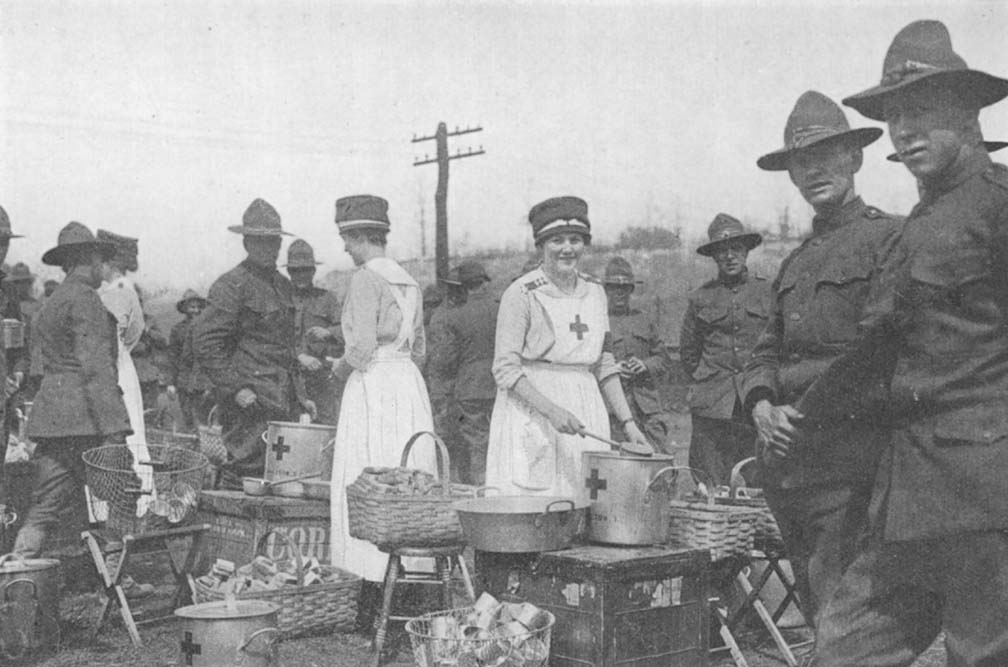
For the soldier, the Red Cross had workers in the field at every point where they could by any chance serve him: at the port where he landed, in the stations through which he passed on his way to camp, at the camp itself, at the stations between the camp and the trenches, and, finally, at the very front. The canteen convoyers brought up supplies of hot food for him despite the weather, shells, or gas. They were ready through the cold, rainy night to comfort him; while a little back from the lines was the canteen where he could wash off the mud in which he might have been standing for nights, where his clothes could be disinfected, and where he could sleep if he had a few hours to wait. In short, it was our intention that the soldier should never be without anything that could express the appreciation of his country and lessen his sacrifice. Unfortunately, however, in a war that has to be told in fragments, it was all too easy, as will be seen presently, for gaps to appear in the continuity of this service.
"It is absurd," said a French soldier who had just come out of the trenches, "to talk about Red Cross work. It has not existed . . . . How could it? A few litter carriers went with us on some of our expeditions but they were soon shot down. . ."
For the wounded the Army Medical Corps provided the best and quickest care. Alacrity in this department was the essence of effectiveness. An hour might have meant the difference between life and death. That hour was saved by mounting on wheels everything conceivable so that the wounded might be met at the nearest possible point. The Red Cross contributed ambulances and operating equipments, dental operating rooms, ophthalmological ambulances, plants to make ice to pack head wounds, heating plants, and disinfecting plants. In the American Medical Service there was surgical skill that is not surpassed in the world; and to supplement the medical work the Red Cross, with Army coöperation, maintained a research bureau, the value of which has been recognized by all medical authorities. For operations there was a plant manufacturing nitrous oxide gas which, otherwise, could only be obtained in France after long delay. There were shops to manufacture artificial limbs; there was a department --- the Communication Bureau --- which searched for the missing man and gave his family news concerning him and which, like the Home Service in the home camps, straightened out a thousand tangles and did a multitude of things that were seldom twice alike.
All the permanent or semi-permanent Red Cross plants in France,---following the practice of the Army,---were built and equipped for future requirements. The French onlookers had a thought in reserve when they saw the preparations that were being made for debarkation of the American armies --- the unconscionably huge buildings, the ponderous railroad equipment and hundreds of miles of rails; they looked dubiously, too, at the preparations of the Red Cross and wondered if the finished fabrics of accomplishment would ever fit their vast foundations. But within eighteen months they saw two million soldiers walk off these same docks and move forward promptly to business over the iron pathways; they saw incalculable stores of everything under the sun following in uninterrupted procession, food and raiment, engineering supplies and building material, and all the paraphernalia of war.
A well-known Liberty Loan speaker upon returning from France, referring to the big line of stations, said: --
"I didn't know what a canteen was like. I didn't know, whether you rolled it or kept it back in the kitchen somewhere; but here is what it's like: if you took one of those piers in the North River that you tie a big steamship up to and converted it into a business enterprise to rest and feed and sleep and wash people, that is about the size of the proposition. The kitchen came first ---a huge room full of caldrons and chopping blocks and meats and things --- and next was a lunch-counter affair with some tables where they could probably feed five hundred at a clip. Next was the living room where the soldiers could throw off the accouterments of war and rest themselves and write letters. Outside they had some very pretty gardens which had been decorated by the camouflage artists of France. Next came a large theater,--- mostly moving pictures,--- I was told, but occasionally the men got up entertainments of their own. Next came a place where I suppose 2500 men could sleep, and they had baths and ways to make their clothes sanitary and things of that kind, all very essential.
"The women workers in this same outfit are entitled to some kind of a memorial, if it is nothing more than in our hearts and minds. They are doing a wonderful work. There is a group of women over here taking care of about seven or eight thousand soldiers every day. It is at a railroad center where they transfer off the trains and are redistributed. That thing is done twenty-four hours a day in three shifts of eight hours."
The American soldier interpreted "Rest Station "with its subtle and more or less elusive course dietary of the French ---as something more or less like home and the good old dishes of childhood. Home, therefore, became the keynote in all the buildings and furnishings of the Red Cross way-stations on the road to war. There was the home flavor in the seasoning of the food, and a home atmosphere in the chintzes and various commodities at hand, such as soap, towels, reading matter, and phonograph records. The facilities which the Rest Stations afforded for writing letters back home made the censor of one section, who had to handle them, old before his time, and brought forth a plaintive, if humorous, protest against the stimulation of correspondence.
It was not easy work that these women did. As a matter of truth it involved the hardest kind of physical labor. Moreover, they were accomplishing unconsciously, perhaps, what even they did not realize at the time---the keeping uppermost in his mind the home idea of women.
Thus, until the day came when the trains of wounded began rolling back to the coast, the soldier's journey was not such a bad journey, after all. And when he got within sound of the trouble he was clean and fit. That was what the Red Cross aimed to make him.
The war has brought to light many heroic deeds. However, not all heroes were men: there are girls who went out in all humility to lend what help they could in the service of the Red Cross canteens and who came home with the Croix de Guerre; there are girls who stayed at their posts of duty in the canteens while the soldiers were at the front and when the windows of their huts cracked from shellfire, and the roof fell in pieces --stayed through nights of tumult and danger where their lives were worth scarce a penny whistle; and, again, when on the jammed roadways in the great advance, where the crowding thousands of troops were choked and stayed by ambulances and trucks with their hundreds of wounded, these Red Cross girls were there to help dislodge the tangle so that the great currents could flow normally on their way. This, surely, was getting into the road and makeshift of war.
"We feed 4000 to 5000 soldiers a day, and our canteen is never closed," wrote a Red Cross canteen girl. "All of our boys on this line of communication stop and rest and have meals and refreshments. After every battle and at intervals we see them coming back. Over 1500 came in lately and practically none had ever had first-aid service. Blood-soaked, weary, but oh, how brave! With shell-wounds and bayonet-wounds, they will tell you quickly, 'I can wait, look after Jim, here.'"
It was a long hard grind with existence always in the balance and with no rest or change other than the precipitate retreat or advance as ground was lost or gained. The pictures did not vary except in minor details and in intensity. The canteens were located in all sorts of places, --- any shelter, almost, that would keep out the rain, served the purpose,---but the vital creature comforts were there. The worn, mud-marked, often bloody faces of war-weary men swarmed in out of the night. There was no light save candles or a guttering lamp. They did not eat, --- they fed, gulping the hot coffee, munching ravenously. They were spent, but the urge and rush of battle was still on them. The great guns punctuated the talk and the clatter; there was the sibilant half-moaning whistle of the German shells and the muffled roar of their breaking; one had the sense of being depersonalized, or the dual feeling that comes of hasheesh. And yet, for all its awful reality and nearness, it seemed like a dream. The last exchanging columns having passed away into the night the canteeners slept -- these men of varying age and calling who, with gray in their hair but with youth's dreams still weaving in their hearts, were keeping Mercy's outposts on the borderland of doom. And the evening and the morning were another day with a flight to the cellar when an air-raid began or when the rangefinder picked up the little area where the canteen was situated.
In times of violent action, when the lines changed under the weight of new forces, the mobility of these Red Cross formations was invaluable. In the broken chronicles of the great German drive in 1918, there were thrilling stories of the quick shifts made by hospital and canteen workers: a sudden gathering of food and equipment, of medicines and instruments, and that heaviest of all known impedimenta, the wounded men under treatment; a swiftly executed move rearward, trucks loaded with gear and personnel and wounded, but never farther than was absolutely necessary; the establishment of new quarters and the quick resumption of work, for men's lives spelled victory and delay was death.
The narrative of Compiègne, where 100,000 men a day poured forward and back as through a narrow gateway, is a moving picture. It started on the morrow of the great German attacks of March, 1918, when French Grand Headquarters had been moved away to Tevlis and the civilian population had fled; away back in the days when Lloyd George was cabling President Wilson to send men ---and send them quick; away back before the main American Armies came. In a big hotel, long abandoned, the Red Cross took lodgment, threw open the doors and never closed them for two weeks, intent on its work of general relief. It was indeed a world cast from its moorings! Soldiers were lost,---separated from their commands,--- foodless, shelterless, cold, and wet; and the streets held crowds of refugees. There were doctors and nurses, executives and handy men of every nationality and every faith, who gathered in this center and joined in its work. The kitchen held streaming stew-pots which were never empty. On the floors of the great reception-room and ball-room, soldiers of all armies slept side by side. The city's stores were opened and dry food given away to the crowding refugees. The truck drivers, with aerial bombs falling all around them, gathered terror-stricken people from their houses and making their way over bridges that were under vicious fire hauled them away to safety. In the railroad stations an improvised infirmary was established where doctors dressed the wounds of fifty to a hundred soldiers a day---wounds that had been inflicted two days before.
In the hospital at Annel, six miles from Compiègne, in an old château, were two American doctors who had stayed on the night of March 25, 1917, after seeing the wounded carried away by canal boats. The artillery near at hand thundered on with scarcely a pause. It was a night when the Germans were hammering at Noyon and threatening to break through any hour and start down the main road to Paris. But the American ambulance drivers, from force of habit, kept coming with loads of wounded. The American doctors stayed on and worked over the tables for two days or more. Five Red Cross trucks arrived with supplies and their drivers administered anæsthetics while these two American doctors operated on poilus, Tommies, or whoever came along.
Some canteen women came in from Compiègne, and with the big German planes soaring overhead and the grumble of the battle drowning speech, these two lion-hearted Americans remained at their posts. This was the sort of courage and the sort of faith that carried the American wherever his job lay in the hurly-burly of war.
After the fighting became open --- after the second battle of the Marne and alter the Germans started moving toward the Rhine --- the rolling canteen proved the prime solution of the quick-lunch question.
In the zone of war the Red Cross workers did not think of safety beyond the sane precautions of the soldier. The Red Cross man offered his life as a gift to his country and to the cause of humanity.
The picture of the ambulance drivers and their venturous task has become more or less familiar. Their peril was incessant. On the other hand, considering their numbers, the forbearance with which death passed by their charmed ranks since the day the first American units went over in 1914, has been a wonderment of the war. Trying as these young ambulanciers did to get the wounded from the most forward point possible, they carried their cars through raining shells and bombs, through gas, through every menace that the fire zone knew. In and out, journey after journey, waiting the summons always by night as well as by day, there is a long record of their courage and their ungrudging devotion to one of the most trying duties of the war.
This letter from a Red Cross ambulance driver at Verdun, in the awful summer of 1916, merits preservation as a picture grimly faithful of the scenes in which these non-combatant heroes played their part, and a pathetic record as the agony by which France made good the promise, "Ils ne passeront pas." (They shall not pass;)
MY DEAR---:
To-night I am sitting in a small underground cellar of one of the public buildings of the town, acting as a sort of timekeeper or starter for the cars going up to our most dangerous post and handling the reserve cars for wounded in the town itself. I wish I could describe the scene as it is before my eyes,---for the whole world is passing here---French, American, living, wounded, dying.
A long heavily arched corridor, with stone steps leading down to us; two compartments off to one side lined with wine-bins, where our reserve men and a few French brancardiers (stretcher-bearers) are lying on their stained stretchers, some snoring; beyond a door that leads into a small operating room, and to the left another door that leads to a little sick ward, the most pathetic little room I have ever seen -with four beds of different sizes and kinds on one side and six on the other, taken evidently from the ruined houses near by --- and one tired infirmier (hospital attendant) to tend and soothe the wounded and dying.
In the bed nearest the door, a French priest, shot through the lungs---with pneumonia setting in---his black beard pointed straight up, and whispering for water. Next to him, a little German lad, hardly nineteen and small, with about six hours to live, calling, sometimes screaming, for his mother, and then for water. Next to him a French captain of infantry with his arm off at the shoulder and his head wounded, weak, dying, but smiling; and next to him a tirailleur in delirium calling on his Colonel to charge the Germans. The infirmier is going from one to the other, soothing and waiting on each in turn. He asks what the German is saying, and I tell him he is calling for his mother. "Ah, this is a sad war," he says, as he goes over to hold the poor lad's hand.
A brancardier comes in with a telephone message,-" A blessé" (wounded man) at Belleville -"very serious." This is a reserve car call, so one slides out and is gone like a gray ghost down the ruined street, making all the speed its driver can---no easy matter---with no lights. In twenty minutes he is back. The brancardiers go out---they come in again bearing the wounded man on a stretcher and place it on the floor beside the little stove. One of them, who is a priest, leans over him and asks his name and town; then in answer to what his wife's name is, he murmurs: "Alice"; while on the other side another brancardier is slitting the clothes from his body and I shiver at the pity of it, the sight I saw.
The surgeon comes out of his little operating room. Weary with the night's tragic work --- after so many, many other tragic nights, he douses his head in a bucket of water. Then he turned to the wounded man. He looked long at him, gently felt his nose and lifted his closed eyelids. Then, at his nod, the stretcher is again lifted and the wounded man carried into the operating room, and soon after into the little room of sorrows.
In answer to my eager question the surgeon shook his head. Not a chance.
A brancardier and I gathered the soldier's belongings from his clothes to be sent to his wife, but even we had to stop a few minutes after we saw the photograph of his wife and their two little children.
An hour later, as our night's work was slacking down and several cars had driven up and been unloaded, the infirmier came in from the little room and said something to the brancardiers. Two of them got a stretcher and in a moment "the blessé from Belleville" came past with a sheet over him. They laid him down at the other end of the room and another brancardier commenced rolling and tying him in a burlap for burial. As you looked he changed to shapeless log. Then out to the dead wagon with it.
Soon after I went into the little ward again to see how the others were coming through the night, and was glad to see them all quieted down; even the little German seemed less in pain, though his breathing still shook the little bed he lay on.
Through a chink I saw that day was beginning to break, and as I noticed it I heard the Chief's car coming in from the "Sap" and I knew the night's work was over.
In France after the American Army began going over in volume, the ambulance service, in common with that of the hospitals and early work with the wounded generally, was militarized almost as completely as the fighting forces themselves. Many of the ambulance sections which, previously, had been allied with the Red Cross, were absorbed into the Army in the same manner as the nurses and base hospitals: In all, the Red Cross organized forty-seven ambulance units which operated under Army management and as parts of the Medical Corps of the Expeditionary Force; it maintained its ambulance units in the nature of reserves, engaged in transporting wounded men, who were on the way to recovery, from base hospitals to the convalescent establishments maintained by the Red Cross in all parts of France; it also maintained service for the Marine Hospital at the port of debarkation.
The line of demarcation established in general Pershing's forces between the Red Cross ambulance service and the units definitely identified with the Army itself had a measurable degree of elasticity, which made all Red Cross force and equipment available for the service in advanced territory in case of need. At the Château-Thierry fight when the flood of wounded was overtaxing the space and the Army machinery for their removal after treatment, Red Cross ambulances were called into service, carrying their unhappy burden of injured straight from the front to Paris.
This official relation of the Red Cross to the Army --- a supplementary and coadjutant one---was through the whole field of military activity, whether in the supply of materials or of service. In a sense, it is for this purpose that the people of the United States maintain the Red Cross as a quasi-government institution and for this ultimate purpose that it was nationalized.
In the average mind, confused in contemplation of the war's swiftly moving picture, it is doubtful if there exists any clearly defined idea of the perfectly regulated system by which the Army effected immediate removal of its casualties, and the continuous and progressive treatment of their injuries while, at the same time, relieving any congestion that hampered the steady back-flow of wounded from the fighting lines.
Under the Army system there were in hospital service three parallel zones --- somewhat roughly defined, and varying with conditions --- in which it was intended that all the elements involved shall be of the Army service and not voluntary. In a mobile Army each division had four companies, each company twelve ambulances, with dressing station equipment. These stations were set up in some sheltered place, if such could be found, and to them the wounded were brought. They were provided with a certain amount of equipment, food, and supplies, such as could be easily carried and would suffice for initial treatment of injuries. Back of these --- marking the second zone --- were four field hospitals under canvas, each capable of caring for 216 patients. There were beds but no cots. These stations carried operating equipment and adequate kitchen outfits. At the next stage --- the head of the line of communication --- was the first evacuation hospital. The capacity here was double that of the field hospitals, since the transportation facilities farther up might in time of intense action be overtaxed. This was a more or less permanent station, usually located in some suitable existing building. It was not mobile in the sense that it had no transportation equipment. The wounded were dispatched by ambulance or by hospital trains. It was equivalent to what in the British Army was known as the Casualty Clearing Station and was, usually, located in the nearest town. Its function was to clear the field hospital for future emergencies and was permanent save in cases of retreat. If an advance was made, a new evacuation station would be set up in the acquired ground, thus shortening the distance from the mobile area.
From this point the patient, when in fit condition, was removed to the base hospital. Back of this lay the so-called "home zone." From the base, progress was to the convalescent hospitals in Paris or other parts of France, some of which were maintained by the Red Cross.
This, in short, was the process by which the soldier caught up in the instant of his injury, or as soon after as possible, was passed along on the way to his recovery with progressive medical and surgical treatment. Outwardly, and in its operation and control, it was exclusively an Army organization, but the function of the Red Cross, other than in crises where the system was overloaded and the Army service needed reënforcement, was still an important one. The largest single appropriation of the Red Cross for the United States Army in 1917-1918 was $4,330,760, for what is known as ravitaillement service. Under this title the Red Cross furnished all sorts of things contributory to the proper and convenient care of the wounded, to the end not only of humanity but of military effectiveness. It included portable kitchens, heating and lighting plants, laundries, baths and disinfecting outfits, dental ambulances, and material for what are called mobile complementary hospitals; also it furnished huts, barracks, and miscellaneous supplies for the purpose of facilitating restorative work among the wounded and maintaining such work in the advanced territory at the points of greater availability. Under the advice of Army Medical authorities the Red Cross established two plants, one in France and one in America, for the manufacture of nitrous oxide gas for the purpose of anæsthesia in cases where the patient was in too critical a state for ether. The total normal capacity was over 25,000 gallons a day.
The hospital supply service, to both American and French hospitals --- and the latter are nearly 4000 in number --- was very wide. It was operated by having agents call at the various hospitals and obtain from them lists of needed articles not regularly supplied by the Army, such as special surgical instruments and apparatus, convalescent garments, bandages and slings for special operations. These were delivered from the Hospital Supply Service. There was a diet-kitchen service maintained to supply invalid foods for wounded men. Large stores of these foodstuffs were held in Red Cross warehouses, subject to requisition by the Army. These, in a way, were emergency contributions to the wounded man's welfare. The organization of base hospitals, of which the Red Cross furnished fifty to the Army Medical Service, at a cost of over $2,000,000, was most fundamental in its character and value.
The Marne fighting of July afforded striking illustration of the importance of the Red Cross supply system in supplementing the work of the Army hospitals. In one shipment seven tons of surgical dressings and five tons of diet foods were dispatched to the front for use in evacuation hospitals for American wounded. The Red Cross medical officer's storehouses and pharmacies were open and busy day and night throughout the counter offensive. On July 18 the chief of the medical section arrived from the front and started back at three o'clock the following morning with a load of emergency supplies, including fifty gallons of alcohol; 2000 doses of tetanus antitoxin; surgical instruments; several gross of surgical needles; and dressings and operating material of all kinds. There are no speed laws in war, and the means that are quickest and nearest at hand were taken for every service. Drugs or hospital equipment needed in a hurry have been rushed to the front by motorcycle. There is a record in Paris of the establishment and preparation of evacuation hospitals behind the front, which makes all previous performances look painfully slow. A hospital officer left Paris with ten nurses and ten tons of equipment. They found a desirable building, rented it, equipped it with everything needed, including operating room and X-ray outfit, and were receiving patients within three days.
Thus through every phase and department of hospital work the Red Cross sought in greater or lesser degree, as opportunity served, to upbuild and maintain the most effective and most modern service for the healing and restoration of the wounded man. The millions of dollars of popular subscriptions that were placed at its disposal have not only worked in every possible direction to insure his comfort, but the Army's shoulders were lightened of a time-consuming load and the paramount business of saving lives has been sped.
The war signalized more than one triumph which was not of arms. One of the most conspicuous of these was the conquest that medical and surgical science achieved over scourges which devoured man power in the armies of the past. In July, 1918, the Red Cross mobilized in this country a six months' supply of the bacillus Welchi serum for the cure and prevention of gas gangrene, amounting in all to 120,000 doses. Tetanus had been mastered, but the decimation of forces by the cruel agency of poison-gas was not overcome until by exhaustive research the immune serum was discovered. The Red Cross assumed responsibility for dispensation of it to the Allied armies. The providing of splints, of the six types now developed for confinement of injured members in cases of fracture, became another large-scale activity of the Red Cross. The boys of the Junior organization acquired high proficiency in their manufacture and produced them in volume. The Red Cross also maintained five factories for the purpose in Paris, with a total output of 16,000 splints each month.
At the American base hospitals the Red Cross installed various forms of diversion, which shortened the weary journey of the soldier back to health. A little garden enterprise was started at one of the bases which proved of such benefit that the Red Cross sent to America for men and equipment to extend the work to all the base hospitals. These little farms proved a perfect medicine for the "shell-shocked" men, and furnished tons of vegetables toward the food supply of the institutions.
In 1917, the Red Cross had provided funds for a Yule party and entertainment in every base hospital, and a Christmas tree in every ward where a soldier or sailor lay. There were 1,750,000 Christmas cheer packages distributed at home and abroad, which cost approximately one dollar each, and which contained socks, handkerchiefs, tobacco, chewing gum, cigarettes, and other useful things. In 1918, the Red Cross, complying with the Army rule that permitted each soldier to receive only one package of specified dimensions, supplied the cartons and distributed them. Just to make sure that each soldier received one it prepared and filled several thousands of these packages for those who might be overlooked.
During the war the Red Cross furnished each wounded man --- who in the stress of the battle lost all his belongings with a comfort bag that contained toilet articles, razors, handkerchiefs, and many other necessities. These were especially appreciated by the soldiers. A toothbrush was often the first thing a wounded doughboy would ask for on arrival at the hospital.
"These things," said General Pershing, "bring the soldier to remember that the people at home are behind him. You do not know how much they mean to the soldier who is over here carrying the flag for his country."
With a view to centralizing the activities of relief organizations overseas, and to facilitate the work with the Army, General Pershing designated the Red Cross as the only relief society to work in locating and administering to American wounded who had been removed to hospitals in France. There were 4500 hospitals. To simplify the task it was conducted on a zone system and wounded Americans convalescing in France were enlisted to carry it on.
The work of giving information regarding soldiers to their relatives was organized under the Bureau of Home Communication. Primarily, this work consisted in gathering full and detailed information as to casualties and for this purpose "searchers," both men and women, were sent to France, their numbers increasing with the numbers of overseas troops. It was the duty of the War Department to give notices of casualties to families, but these notices were necessarily laconic and businesslike. No War Office in the world could be asked, in the multiplicity of its duties, to write families detailed reports, but there was need of just this thing. Families sending their boys overseas could not understand why, when their son was wounded, he should not come home immediately or why the mother should not go out to nurse him. Here was a new opportunity for the Red Cross to be of service. It placed women in the hospitals abroad to write letters or reports about the young men who were ill or wounded or dying, and these were transmitted by the Bureau of Communication in Washington to the families. Sometimes these women were overwhelmed with work, as, for example, in some of the evacuation hospitals where the wounded passed through in a steady stream. They could not report on all the cases, but they tried to report on the more serious cases and to write to the families a personal letter about those who had died. With the divisions near the front there were men searchers. Their business was, in the first place, to answer the inquiries forwarded from America concerning men who had not been heard from or who had troubles which might be assisted by word from home. Sometimes they, too, reported on casualties without any request. Such a ease as the following occurred very often: in the Château-Thierry drive the wounded men were poured into a hospital, the most seriously wounded to be treated, the others to be sent on. The searcher had to give most of his time to assist the stretcher-bearers and the surgeons. He still had time, however, to lie on the ground beside some seriously wounded man and to jot down the last message he wanted sent to his family. It was impossible that a searcher, under circumstances of this kind, could talk with all of the wounded or even a large proportion of them, but the few who were seen made the whole work worth while in that it brought one ray of comfort to a few bereaved families.
All the information collected abroad was sent to the Paris office where it was classified and forwarded to the Washington office. The little group of letter writers was rapidly augmented and it was always the plan to send the families letters which gave the facts as completely and as kindly as possible. There was also kept a card file of all casualties, which file finally grew to contain some 400,000 cards giving, so far as possible, on each card the history of the case. The Army was thoroughly coöperative in that it realized the need and understood that the Red Cross could be of service not only to the families but to the military authorities. The files at the Central Records Office were always open to the Red Cross workers stationed there and much of the information received outside was checked by the official reports. The only work under the general supervision of the Bureau of Communication which did not actually go through the Washington office was that of keeping families informed concerning men sick in the camps and cantonments in this country. Here, also, men were placed to send out the so much needed information and probably many thousands of letters went daily to families from these camps and cantonments in addition to the thousands concerning the troops overseas which went out from the Washington office.
But to return to the work abroad: particular attention was given to all cases of missing men or prisoners. In addition to its search work the Bureau received through the International Committee at Berne, Switzerland, a list of American prisoners in Germany, officially provided by the German government. After announcement to the relatives, the prisoner's case was transferred to the Bureau of Prisoners' Belief. The Red Cross supplied to each prisoner, for account of the given unit, twenty pounds of food. As a matter of record, there was return receipt card for proof that this food was delivered.
And so to the last possible notch the Red Cross followed the way of the soldier. If he was wounded and came round fit and went back, as he was always restless and eager to do, well and good. His family knew it and he didn't go back hungry or in need. If his injuries unfitted him for further service and he was sent home, then Red Cross men or women met him at the home port and stayed at his side until he reached the hospital to which he had been assigned. And, finally, there remains the one last service---the saddest of all: it was to watch over the brave souls who had given all for their country and for humanity; to stand by them to the brink; and to soften, in whatever way possible, the sorrow of those who mourned.* If there be any service in the world that is nobler, more faithful, or more inspired by love than this, I do not know of it.
*Through the Department of Communication the Red Cross has a corps of photographers, working under the Graves Registration Service in France, whose task it is to take photographs of all identified graves and these, as soon as received, will be sent by the Red Cross to the families of the dead.