| The American Red Cross in France --- First Request --- Pioneer Work to Find Families and Keep Them Together --- Belgians in France --- Coöperation with the French Government --- Cooperative Union with English and American Society of Friends --- Coöperation with Other Relief Organizations --Dispensaries --- Purchasing in France --- Warehouses Secured Assistance to the French Army---Acknowledgment to the French Government and French Officials. |
ONE of the first things I was told when I arrived at our headquarters in Paris was that the French people had said that the American Red Cross came to France so silently that they did not know it had come. It was a particularly graceful way, wholly French in its subtlety, of paying a compliment to the newly arrived Commission and, needless to say, was much to the liking of men almost overwhelmed with the magnitude and strangeness of their mission. For, although men may have gone on greater missions,---and even that is doubtful,---surely none could have been stranger than that which left the United States in June, 1917,---two months after the declaration of war,--- with only the vaguest idea of what they would be able to do in the way of all kinds of relief. Nor was the full meaning of their undertaking revealed to them until they touched French soil and had become eye-witnesses of the great havoc caused by three years of valiant wrestling with the huge and, at times, all but overwhelming labor of maintaining an unbroken front against the invader.
That the ranks of soldiery had been terribly depleted, there were signs on every hand; nor were there evidences lacking of the acute suffering among the civilian population, where whole families found themselves separated: fathers were in the trenches, mothers worked in munition factories, while the children were adrift in a world of disorder; in short, there was not a man, woman, or child that was not a vital factor in the situation!
The crying need, therefore, was not only to keep up the morale of the soldier but also to build up and maintain the spirit of the people behind the line,---something which could not alone be accomplished by the first handful of American soldiers that went over to take the assurance to the military authorities that America was in the war. Early, it had been demonstrated that weeks and months must, necessarily, elapse before the American Army could find her place on the battlefield. So it was not mere soldiery that would serve to hearten the French people, but something that would tell them that the soul of America was, and would be, with them in all their multifarious needs, to the depth of her universal strength and the length of her great resources.
From a purely practical viewpoint it was argued that every particle of strength and confidence which America could give to the French people, would be a real contribution not only towards relief but towards shortening the war. Furthermore, that all care for her sick and wounded and all relief for her destitute people would tend to reduce the number of killed and wounded among Americans in France. So, from the utilitarian as well as from the humanitarian side, the work of the Red Cross in France, in those early days, was altogether worth while.
With the American passion for reducing every project to a business formula, the Commission built in advance on the old Red Cross basis of military and civilian relief, thinking that the work would readily divide and subdivide itself under these heads for purposes of organization and development; but its calculation went for naught. What it did was to begin relief first and work out the organization afterward.
It took counsel with the men who were controlling the soldiery of France. General Pétain went down the lines and put it up to his poilus: "What is wanted more --- care for yourselves or your families?" To a man, they answered: "Forget us --- look after our families."
Before the Commission had been in France a fortnight it cabled a request for food, clothing, hospital supplies, and lumber to help the refugees and begin relief in the devastated regions in the north of France --- that long strip of country from which the Germans had been driven out and which they had left shattered, polluted, and stripped of everything that might be of beauty or of use.
On July 12, the War Council set aside $1,000,000 for the relief of sick and wounded French soldiers. And when, on July 16, word came by cable of the immediate need of doctors and nurses, especially those expert in the treatment of children's diseases, the War Council engaged at once the foremost pediatrist of the country who, with a staff of child specialists and a corps of nurses, took ship for the other side where he and others established a most extraordinary series of homes.
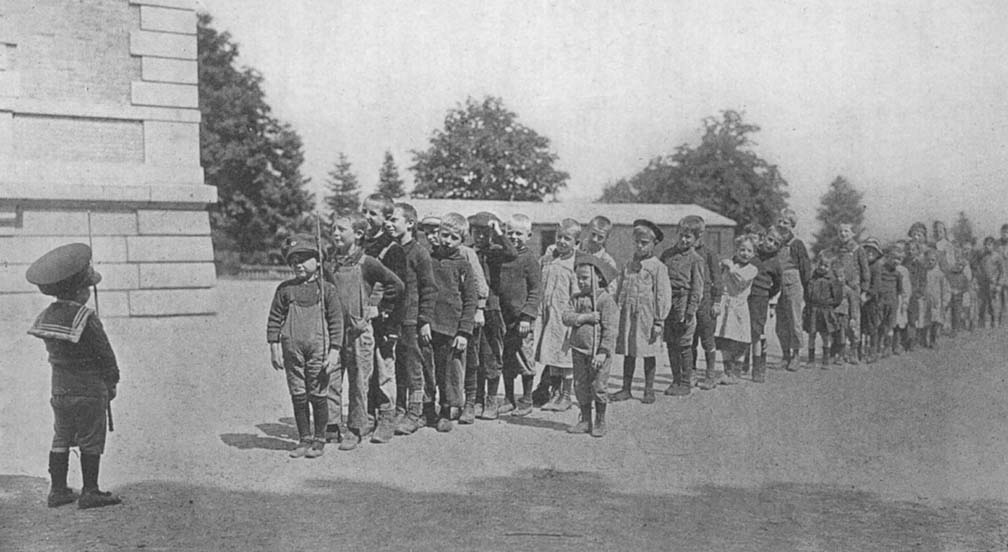
So they began with the children,---the most pitiful as well as the most numerous refugees,--- and at Toul established a refuge for them, one of many that has been set up between that day and this. Toward the end of 1917, there were at Nesle a thousand little broken down Belgian children under treatment, while preparations were being made for taking in other thousands to be cleaned and braced up and placed somewhere in comfortable homes. From this, the natural advance was to the refugees of larger growth. Work was started in Paris, where the congestion was most acute, and carried out into other cities and towns of the devastated departments.
For the refugees, as for everybody else, the work was done in coöperation with the French Government, which had a system of its own with which it had been trying vainly to stem the tide. It consisted of a Department Committee in Paris, theoretically with a member from each of the eighty odd departments, but actually with only two or three represented, who passed on the applications for relief and the identification papers of the applicants. The Government turned over the task to the American Red Cross, which enlarged the organization so that each of the invaded districts, whose outcasts thronged the rest of the country, had a committee at work. But at best it was hopeless to endeavor to meet such a problem with the Bureau. There were only phantom meals to give away, the supply of clothing was not a fraction of what was needed --- for these people had been practically blasted out of their homes and had hurried to the highway with German shells bursting behind them. With distress and tragedy written in their faces and their souls, they headed for the centers with the love that misery has for company, and Paris was the Mecca of the great pilgrimage. The result was inevitable. There were families of six, seven, and eight herded in one room, and thousands that had no roof over them at all save as the chance of a night might offer. By converting great public buildings and unused structures of every sort into "apartment houses," by supplying stoves and furniture and other requisites, the American Red Cross set out to move twenty-five thousand families into comfortable quarters before the advent of cold weather.
In handling this multitude of the homeless the Red Cross did not have normal people to deal with. The adults, like the children, were worn to the bone by their vicissitudes, broken in strength, in nerves, and almost in hope. A great part of them were ill, some shattered in mind, while the tubercular were an army in themselves. It was not alone the misery of these last that called for abatement: it was the menace they presented to the future of France. The Red Cross took over, by courtesy of the French Government, and also in some instances from private organizations, already established hospitals which, for lack of funds or of forces, were unable to maintain maximum operation; it completed half-finished buildings, refurnished abandoned barracks, papered, painted, and put in glass solaria and partitions to make private rooms for those victims who were near the end of the struggle; it singled out from the battalions of the homeless and exhausted many upon whom the "white death" had set its mark, and even those whose physical depletion might render them easy victims; it established for such, both old and young, preventoria, where by careful treatment and nourishment the doom might be turned aside.
Health,--- health and strength were the things needed, not only for the fighting which was to come but for the peace which was to follow the fighting. France, with her decline in birth rate, representing a huge net annual loss, with her sacrifice in war, with the future all black before her, could not neglect any means of saving life if she was to remain nation and enjoy the freedom she had worked for so valiantly. And, with the back-breaking burden of the war's expense still piling up, to permit this increasing multitude to settle down as absolute dependents, inactive and unproductive and consuming the food of idleness, spelled ruin so plain that the blind might read. Gradually the solution of these composite puzzles began to outline itself. Taking the cue from the French Government, whose efforts had all been directed toward the return of the refugees to their provinces, so far as the conditions might permit, and availing itself of the consuming love of home which is ingrown in the nature of the French race, the Red Cross combined its efforts for the care of the refugees with a broad and carefully evolved plan to start them on the way to self-maintenance. To this coherent purpose it added provision for the maintenance of health and sanitation, and the instruction of its new wards in the ways of hygienic living.
Little by little the situation began to unfold and the way of progress to reveal itself. The work gathered speed and volume. The machine, now increasing its scope and strength, began to register. Every ship that passed the German sharks brought new additions to the Red Cross forces, both men and women; and every day saw fresh details of them moving out to some new field, pioneers of pity, soldiers of the new creed.
The refugees from the farming country were keenest of all to go back to the home acres. And the French committees, by way of stimulating this tendency, withdrew a moiety of their assistance and promised to refund, after the War, whatever the land tillers would expend for their own rehabilitation. So the stream began to move northward into the territory the Germans had left. On ahead of them, at their side and behind them, moved the columns of the Red Cross, ready with food, with lumber, and other materials for reconstruction, with seeds and tools for the restoration of the land, with labor provided by a coöperative union with the English and American societies of Friends, who had done heroic work from the beginning of the War. There are long records in the Red Cross archives in France showing in detail what roof was replaced upon this farmer's barn, what glass put in the windows of another's farmstead, and endless other repairs to fit the places for human habitation and rural industry. There was an amazing shipment of pumps, for it is well to remember that what the German apostle of Kultur could not carry away he smashed and what he could not smash he fouled.
Like homing birds, these French farmers settled down among the ruins to resume the tenor of their placid lives. The like of it could not happen elsewhere in the world! The Red Cross was with them, ready to lend a hand at anything they needed; it showed them short cuts in agriculture and rebuilding; it taught the lessons of modern sanitation. It established dipensaries, with doctors and nurses and facilities for transit, and the sections mapped off with medical routes after the fashion of Rural Free Delivery.
All up and down the districts established behind the lines, away to the valleys and sloping mountains of the Vosges, the Red Cross set up dispensaries to do the work of the village doctors who had gone away to war. There was scarcely a community in France that had not suffered in health, and for the good of all concerned, particularly of the American Army that was to come, it was imperative they should have the ounce of prevention. In fair and foul weather these American doctors and their assistants traveled the roads of France, visiting the villages and holding office hours in some public building or going from house to house where more serious sickness existed. There were maladies of all sorts, and in some cases incipient epidemics. There were children with mumps, measles, and other things; there were the aged, weary with years, upon whom the War had laid the final straw of pain, and others who never lived to see springtime renew the green of their home hillsides. All through the winter, staying neither for wind nor weather, these Red Cross doctors went toiling over the snow-drifted and wind-swept highways of France, "practicing medicine" with an assiduity which was not inspired by hope of gain, and helping far more than they knew to win the War.
Like the agents of empire in far places of the world, these "struggling" doctors in the "listening posts" of health never knew of the great drama of relief which was being enacted elsewhere. By this time in France the people had begun to dismiss all doubt and incredulity, and had come to the realization as to what the American Red Cross really meant. They saw the cloud of miserable refugees dissolving from the city streets. By day and by night the trucks and trailers of the Red Cross motor corps roared along the roads of France or through the streets of the cities, burdened with the material of relief. It was providential that there already existed in France so many relief organizations whose members were familiar with the field and its difficulties. With each of these, when possible, the Red Cross promptly struck partnership in the common cause; and lacking at first personnel sufficient to handle the mass of detail, that so vast a problem presented, it shared in the burden of their work. By November, 1917, it was financing and assisting seventy-five of them. To the French Red Cross, struggling with the awful labor of service to the Armies, the American organization gave liberal sums of money for supplies and, indeed, furnished upon demand any and all drugs and equipment of which there was lack. The Civil Affairs Department took over the varied activities of the Tuberculeux de la Guerre, established by Mrs. Edith Wharton, of the Secours Américain at Amiens, and the American Society for the Relief of French Orphans. In other cases, such as that of the American Hostels for Refugees and the Vestaire l'Accueil Franco-Américain, the Red Cross assumed financial responsibility, leaving the administration in the hands of the former governing boards. In all, 397 grants of money were made in the first six months to 322 institutions, whose work had been an immense contribution to the aid of suffering France.
The French, when they came to know us better, coined a complimentary name for the American Red Cross which, even now, is current: "The Godmother of Good Works."
But the Godmother of Good Works was an overtaxed fairy when it came to the delivery of her benefactions. Time was of the very essence of the situation. The lack of everything was so intense, the Atlantic so wide, the ships so few compared with the huge load there was to carry of munitions and inter-Allied supplies, of advance materials for the housing of our Armies and the building of the transportation system, that the Red Cross Commission accordingly found it wiser to buy in France, Spain, and England the many thousand-and-one commodities that were instantly required, than to wait for the long process of purchase and shipment from the United States. It was supplying the French Army with hospital appliances and drugs; to the refugees it was furnishing caps and pinafores and other articles of children's wear; to the societies in the devastated region went clothing, implements, and even animals; and to the organizations in Paris the multitude of indispensable things for making homes. Buying in advance of requirements the Red Cross enumerated on its sheets 470 standardized classes of articles, many of them with numberless sub-classifications. The greater part was stored in Paris, where a dozen warehouses were established. As the calls came, these things were requisitioned and started on their way in the motor transport, the formation of which had been begun early in the campaign. It will shed some interesting light on the scope of these operations to reproduce here the requisition slips of one day,---thirty-six in all,---which was less than the daily average. They represent grants of 4009 articles sent far and near to nineteen organizations. An "article" may mean anything from a poster to four hundred yards of flannel.
Woolen caps, mittens, coats and capes, scarfs, condensed milk, jam, sugared cocoa, meat juice, cheese.
Tapioca, lemons, checkers, backgammon, croquet, playing cards, face towels, kitchen towels, bedside tables, bedcovers, armchairs, chaise longues, bowls, candles, candlesticks, undervests, woolen socks, house slippers, woolen pajamas, phonograph records.
Books (Dumas, Verne, Hugo, Daudet, Mérimée, Loti, Anatole France).
Galoshes, blouses, underskirts, stockings, sabots, finger bandages, beans, hams, sugar, canned meats, wool, posters, roller toweling, serum, drugs, folding beds.
Blankets, pillows, sheets, wardrobes, stock pots, saucepans, enamel saucepans, small dishes, basins, roasting pans, children's blankets, eiderdowns, straw mattresses, dust cloths, tea cloths.
Earthenware, hot water bottles, wash-basins, sterilizers for milk, sheeting, bath toweling, flannelette, calico, white flannelette, apron print, gray wool for stockings, flannel.
Soup ladles, tablespoons, butcher knives, peeling knives, kitchen knives, chopping knives, large coffee pot, roasting pans, graters, fiat pans, serving pans, black sateen.
Girls' drawers, stockings, handkerchiefs, shoes, stove to cook for sixty persons. Assorted boxes clothing, nightgowns, shirts, part wool, long drawers, girls' bloomers, boys' pants, shirts, girls' dresses, woolen sweaters.
A diversified business, such as this fragmentary list indicates, called for sheltering places. Facilities for handling and shipment were imperative, and there was always the bogie of future growth in volume, which it was now clear would be swift and enormous. The warehouse of the American Relief Clearing House was soon outgrown, even for existing business. Three more of much larger capacity were at once secured with railroad connection, and the Red Cross cleaned up and installed modern equipment. One establishment was leased, cleaned, altered, and ready for business in forty-eight hours despite the fact that labor was the scarcest thing in Paris. The Red Cross employed soldiers on leave. French, red-fezzed Moroccans, and Indo-Chinese; with them as laborers a system of transportation was built up of light and heavy trucks which balked at no burden of traffic to any part of France.
In one room of a Paris warehouse there were thirty tons of tobacco; in another wing foodstuffs were stored in quantities to tax belief. Three hundred tons of coffee for example, a greater tonnage of beans, and everything else in proportion. It was not a storage; it was a gate, through which this volume of supplies flowed in a ceaseless stream. Attached to the warehouses were garages where repairs and reconstruction were done upon the hundreds of machines which were employed. Even in September of 1917, the motor transport was up to handling in and out of the Paris warehouses 150 tons of freight a day. Even American threshing machines were set in motion. In all the districts back of the lines were divisional warehouses to which the goods were carried for distribution. One of these was an old seminary which, when the Red Cross took possession, had fifty-two shell-holes in its walls. Most of these warehouses were overrun in the German drive of 1918. After the armistice they were replaced by a chain of depots, extending from Lille to the eastern border, from which supplies were issued to the people returning to the devastated regions.
To the French Army the American Red Cross lent every possible form of assistance. It set up spacious rest and recreation canteens in Paris and at several of the great intersection points along the railway lines, where thousands of French soldiers were made comfortable; it established rolling canteens behind the lines; and in conjunction with the French Government, after it got under way, it furnished hot meals to almost a million soldiers every month in huge canteens like lumber-camp barracks, where the weary poilu could not only eat and sing and forget his troubles, but bid good-by to his cooties, treat himself to a shower bath, a clean bunk and go away a happier human and once more fit to associate with his family.
The story of the work of the American Red Cross in France for the French people and the French soldiers can never be correctly told without acknowledgment to the French Government and French officials everywhere for the hearty and never-failing coöperation in every endeavor. The Paris Temps, commenting on the Red Cross gifts and on Red Cross accomplishments in France, in December of 1917 said: "We find proof in it that the German does not wholly monopolize, as he pretends, the secret of organization; and that other nations can demonstrate, with ours, their energy in work and at the same time their powers of methodical application and disciplined labor."
Such was the beginning of the Red Cross accomplishment in France.
| The France of To-morrow---The Army of Refugee Children ---Methods of Work ---- The Call from Toul ---- The Work Reaches Dinard ---- Help in French Schools ---- Health Centers in Munition Districts ---- Children's Wards in Tuberculosis Hospitals ---- The Red Cross Flag at Nesle ---- A Traveling Dispensary ---- Evian ---" The Gateway of a Hundred Sorrows "---Hospitals and Refuges---Child Welfare Exhibit at Lyons---German Policy in the Discharge of Refugees through Evian---French System in the Care of Refugees ----- Particulars of American Red Cross Assistance. |
IF the old adage holds true that the boy is father to the man then one need have little fear for the future of France. It is to this France of the future, the new generation that is growing up in a sense of comradeship with the millions of our own, that my thoughts now turn. And how near we of America are to these children of France is best told in the following letter from a fourteen-year-old schoolgirl to the American Red Cross: ---
"It was only a little river ---- almost a brook ---- it was called the Yser. One could talk from one side to the other without raising one's voice, and the birds could fly over it with one sweep of their wings. And on the two banks there were millions of men, the one turned toward the other, eye to eye. but the distance which separates them was greater than the stars in the sky---it was the distance which separates right from injustice.
"The ocean is so vast that the sea-gulls do not dare to cross it. During seven days and seven nights the great steamships of America, going at full speed, drive through the deep waters before the lighthouses of France come into view ---but from one side to the other hearts are touching."
It was the effort of the Red Cross to still the cries of the children that went straight to the heart of France. If all the rest had been beyond our power, this one thing would have won for us undying gratitude. For France, the saving of the children meant their future and their world.
"There can be no real victory," said a Marseilles newspaper, "unless we can successfully combat child mortality. If we consider the enormous adult death rate for the war period, we can only conclude that after the war nothing will be left of France but a glorious skeleton ---glorious in name but depleted in substance. The American Red Cross has come to aid us in the fight for our children. Because of this, if for no other reason, we owe the Society a debt of unbounded gratitude and affection."
"If the Germans," wrote Alphonse Seche, "have changed the idea of war, the Americans are in process of changing the idea of alliance. The war being everywhere, menacing the race, our Allies have decided to be everywhere, in the front and in the rear; shoulder to shoulder with our soldiers, standing side by side with our mothers over the cradles, for the preservation of our race."
The pictures of Toul and Evian, of Nesle and Lyons, of Pinard and Dieppe, of Caudebec and Barenton and Issy-le-Molineaux, are etched into the very soul of France. They are a sage and cautious people these, who do not wear their hearts upon the sleeve. The vivacity which is their form of expression, the politeness which is their philosophy, the good manners which a wise man has said the French invented,---these are not France. They are merely the habiliment of its civilization.
In America not all the children are clean; not all have enough to eat. The great East Side finds some occupation still for the welfare worker, but I do not believe America has yet any conception of the magnitude of the child problem that existed in France. The condition was far worse than even the French people or its government had time in the tumult and stress of war to know. And it was growing even worse as the war progressed. There was the awful accumulation of refugee children from all the departments of the north and from Belgium and the shifting fortunes of war; the pitiless rush of the Huns; the increasing destruction from the air and the hungry shells, always ranging farther, leaving more and more little ones orphaned or maimed or shaken in understanding and memory. This was the greater company, the orphaned and the destitute, those whose fathers were dead or at the front, whose mothers were gone, and who had none to care for them.
Added to all these was the army of repatriated children ---including a host from Belgium ---who, like the adults who came over the border, were suffering from the varied ills of malnutrition, if from nothing worse. That was not the whole story. Even the health of the children who had homes was running down. Epidemics of local character could not be checked. The average of doctors in America is one to 500 people; in France, where the call for nurses and physicians at the front had been incessant for three years, the ratio in 1917 was one to several thousand. That should tell its own story to people who have children of their own. The necessary lack of care and the scarcity of proper food made easy the progress of disease. With all the other crying needs that confronted the Red Cross at that moment, this peril to the child life loomed high. Much of the misery and disease was only too obvious, but there was a tremendous number of children needing treatment whom it was hard to reach or even to discover. And, to begin with, it was found necessary to rid the French people of the fixed idea that the American had come to deal solely with the soldier. It took time to do that, yet every moment of delay was courting more and more danger.
To accomplish results, the Red Cross had to provide suitable places for operation and get the children together to examine and sort out the tuberculous and contagious cases, to provide nurses, labor, and medical supplies, dentists and attendants and artisans to make requisite repairs at a time and in a land where every man who could carry a rifle was needed at the front. What all of this child army needed first was to get clean and to be fed, for the vast majority of them were hungry, and food of any kind was not plentiful,---much less the kind of food they needed. In the devastated regions, the Germans left nothing! They had destroyed even stoves and water systems, so that in the districts back of portions of the lines the first desiderata of sanitary or medical activity were lacking.
Numberless little charities, organized by nuns or by kindly women who were heartsick at the spectacle of so much misery, were trying in the cities to do something to stem the tide. To these, the Red Cross made haste to lend aid. Many of them, such for example as the refuge founded at the Hotel Biron by Madame Viviani, wife of the former premier of France, developed into a stronghold of good. In Mouffetard, Paris, Mlle. de Rose conducted another charity, which was founded by Mlle. de Perignan, a granddaughter of Lafayette, comprising a social center, a home for working girls, a modern tenement, a vacation home in the environs of Paris, and agricultural schools in the country. It lacked a health center, which the Red Cross supplied together with a dispensary and clinics for children and mothers; it helped every governmental effort to cope with the problem. These charities were chiefly in the cities. But along the highways and in the little towns there was great need and no ray of hope. Then out of obscurity rose the virile personality of the Préfet Mirman, who, when he shall have died and gone to the glory that is his due, will be the patron saint of the department of the Meurthe-et-Moselle. Without Préfet Mirman, Toul would have been as it has been for centuries, ever since Roman times, merely the rock-bound gate that has barred the invaders of many wars from the rich and industrious town of Nancy. But the Préfet, having faith added to hope and charity, believed the Americans meant what they said, and he gave to Toul a fame that will never die.
When Nancy was under fire, life there was not worth a whisper, but the artisans of the town had to stay at their work for France needed them. They are a rugged folk, these workers of Nancy. In 1917, when the gas shells exploded they had been trained to gas masks and worked on, although the children, in panic, smothered and died in agony. They had no guard against that ghastly death. On July 26, the Préfet sent a classic telegram to the Committee of the American Fund for French Wounded, begging for nurses and doctors. They went to the Red Cross offices just opened; that night the chairman of the Secours aux Blessés left the Red Cross station in Paris with three camion loads of supplies and eleven doctors and nurses.
As they rumbled into Toul in the gray of the dawn, there were five hundred women and children swarming the barracks which the French soldiers had abandoned. All was confusion; dirt and vermin were over everything. In the Caserne de Luxembourg,---a group of barnlike structures on the sheltered plateau over Toul,--- these women and doctors swept and scrubbed and scoured, installed beds and chairs and tables, and business began.
It was slow work luring the confidence of the Lorrainers, but the ice was broken; and until the spring of 1918, when the Huns pushed forward again, Toul was a lighthouse of mercy and health and happiness to the children of the north. From that the work was established until it reached Dinard. It would have made the old-time spendthrifts who dined and wined and danced and flirted in the great hotel Royal open their eyes to see the swarm of refugee children who, in charge of the Red Cross doctors, took up life there in the wake of the soldiery that had used it as a barracks. They were doctored and brought back by care and nourishment to sturdy health; they went on with the schooling that is the reigning passion of the French child. The waifs,---the fatherless and motherless from the crowded wards of Paris, and the wasted repatriés from the receiving station at Evian---were sent to find in the salt air and water healing a cure from the curse of bone tuberculosis. There was clean, pure life there, a sowing of kindness that will some. day yield a perpetual harvest of understanding and good will.
Once having set out on children's relief, there was no turning back. More doctors and more nurses, more teachers and welfare workers kept coming from America. The Red Cross saw the necessity for help in some of the French schools, so work was begun in them. "Unless we can start a canteen up here," wrote the doctor who conducted the children's clinic, "in the Nineteenth arrondissement of Paris and give these children some food, this children's work is not going to get anywhere, because what these children need is nourishment and I can't do much till I can put something in their stomachs."
The school luncheons had been cut down, but the Red Cross dietitians figured out the calories in what was left and found that there was need for wheat and sugar, so they built a Red Cross cake and added it to the ration.
Rapidly the child welfare problem grew into one of the most extensive branches of Red Cross work. Health centers were opened in two munition districts just outside Paris, with welfare workers, Red Cross doctors, clinics, and visiting nurses who reached within a very short time three hundred families. It was very sorely needed. The population of the district had increased greatly; two hundred munition factories had risen like mushrooms overnight, with 110 new buildings erected for the workmen to live in. The congestion was terrible and the spread of disease likewise menacing when the Red Cross came to the rescue.
A large area of Paris was covered in the same way. There was so much tuberculosis among the children that child welfare was combined with the tuberculosis service, and children's wards were established in all the tuberculosis hospitals. In high, healthy country districts, the Director had farm schools established where weak children could be built up and taught to make things grow. The cardinal test of any project was what it promised for the future of the children of France. Boys were taught trades and girls were taught sewing; and among the denizens of the poorer quarters were promulgated the magic of the toothbrush and the rules of health --- for which dentists came overseas with all their tools.
Nesle was another of the northern towns in the track of war which, after the "strategic retirement" of the Germans, suffered bitterly. In four towns about it not a house or building of any nature had been left with one stone on another. When the Germans moved away, they destroyed everything that could be of service in any act of life. When the Red Cross doctors arrived in the old Hôtel de Nesle it was stripped bare. From the outlying country, the children began drifting in, sullen, dazed, stunned by the horrors they had seen and suffered. And none smiled. A Red Cross woman, who worked at Nesle, said that the far horror in the eyes of the children was as if they were looking beyond the things of this earth and into the gates of Judgment.
Here again was a work for Hercules, and it practically wore them out. Throughout the first week all the patients of the clinic were Red Cross workers. There was no heat, and for a day or two no gauze or bandages or dressings; but there were twelve hundred children who needed care and the Red Cross toiled away to give it. It goes without saying that it cost much hardship to raise the Red Cross flag at Nesle!
The Red Cross designed, and built in Paris, a traveling dispensary --- an automobile hospital, with drugs and supplies of all sorts and an outside seat on which a nurse could transport a sick child to the hospital. With this mercy wagon, the workers went from town to town about the district. Through the countryside, the children were afflicted with skin diseases and with strange forms of blood ailment, caused largely by malnutrition.
This working for the children of France was a day to day and an all day and all night dealing with the plain animal facts of sick and ill-nourished bodies. There were women fighting the good fight of the Red Cross against the miseries of Europe who, perhaps, have never found the glory that they longed for; but they found what was better ---their own mother hearts that they had never known.
Someone has called Evian les Bains the "Gateway of a Hundred Sorrows." It was here, as the war wore on and the food supply began to dwindle, that Germany, balancing up her efficiency schedules, turned back into hungry France the sorry army of French and Belgian civilians who had been taken from the devastated country in the north in the first onrush of 1914, and since held in bondage. In the summer of 1917, this wretched jetsam of the German war was herded over the frontier at the rate of a thousand or more a day. Daily, for a long time, two trains, morning and night, rolled in from the German border. A woman who watched their debarkation day after day said in a letter at that time: "The curtain never falls at Evian." It was so. In the drama that France lived behind her roaring battle lines, there was no more somber scene than Evian. Here, again, as at Dinard, and other one-time resorts on the northern coasts, was a gruesome contrast with the ancient atmosphere of fashion, wealth, and idleness. Nestling on the hills above exquisite Lake Geneva, Evian was the last setting to be chosen for so woeful a spectacle.
From forty to sixty per cent of these cast-offs were children, by far the greater part of them under twelve years of age. A great number were dying from tuberculosis, many far advanced; but all were unutterably dirty, half clad, worn to emaciation with sorrow and hunger and slavery. They were moribund. Germany could wring no more unpaid labor from them. They had given to the uttermost pfennig's worth. The people beyond the Rhine picked out those who seemed past hope and sent them to France to be cared for. They were a multitude,---and these children were not riffraff. Many of them had known luxury and the tenderest care.
It was all one wretched, miserable story after another; and yet, from the gray monotony of it, two cases seem to stand out in the memory of those who saw them for the reason that they proclaim more clearly than others, perhaps, two salient phases of German brutality: one was a wisp of a girl, just turned fourteen, who bore in her arms a year old boche baby; and the second, only a little older and marked with tuberculosis, had for three years worked twelve hours a day in a German coal mine. It is manifestly impossible to tell all the stories of the unfortunates of Evian; but thousands of them are recorded in the files there against the day when the world may know the depth of German iniquity.
When the train wound its way up the grades into the famous old watering place there was a band playing the Marseillaise, and the French and Belgian flags were waving. There were the Mayor and half the town crying welcome to them --- welcome back to France --- and still they did not smile. French and American stretcherbearers boarded the trains to take out those that were too crippled or too weak to help themselves, and there were Red Cross ambulances there to carry these helpless ones away to the old Casino, which had been converted into a hospital. There were these heart-breaking processions every day, at morning and evening, hundreds of children and aged people at a time, ambling on toward rest and kindly care, with faces haggard and drawn but singing out of numb hearts their homeland songs; and men and women with hearts torn at the picture, stood in crowds by the wayside with tears raining down their faces at the misery and the glory of it, and were not ashamed.
"The scene," says the Chief of the Children's Relief, in his professional report, "is indescribably emotional."
The story of Evian cannot be told. Mothers and children met there who had been lost to each other ever since the Germans surged over Belgium. It was a great, overpowering drama of mingled sorrow and happiness, of death --- yes, and of resurrection. These children were marked for death, but they were caught in the very nick of time. And even so, there were sad little funerals now and then wending through the village streets. But as an institution it went with a mathematical precision, by every means that science or sentiment could devise, bringing health to sick and exhausted bodies; and smiles to faces that one might have thought could never smile again. There were children who came to Evian, marked for death in a thousand ways, but who, through the ministrations of mercy there, will go singing their way on to the end of their poor little blasted lives.
From all the touching records of the station which are held in the archives of the Red Cross, I take almost at random this paragraph which, like a ray of sunlight, reveals the other side of the picture: --
"He was crippled, horribly crippled. Only his hands and his eyes seemed to be alive, but he said proudly that the Germans would never have let him through if they had known how many pairs of stockings he could make in a day on his knitting machine, which we have given him to make him forget"
Among the many hospitals and refuges which were established all over France to receive this wreckage, there are several in the vicinity of Lyons, chief of which is the Château des Halles, built by Mangini, the great French railroad builder, whose widow gave it to the French government for use during the war. Lyons is a child town; and the Red Cross, with a broad idea of starting in France a general movement for child hygiene, selected it for the scene of its first child welfare exhibits. The timid said it wouldn't go. It was early in April, 1918, the great drive was on and two hundred miles to the north men were dying under the German guns. Who could think of expositions? But in the week that it was in progress more than 100,000 persons between eight in the morning and ten at night crowded into the hall. There is no doubt it was an American show; but by the same token it had at its opening session twelve hundred doctors, lawyers, government officials, founders of hospitals, and the best citizens of Lyons. For the first time in the memory of man there sat on the same platform the Cardinal Archbishop of Lyons, the Préfet of the Rhone, the Military Governor, and the Mayor of the town. Neither Church nor State could shut its eyes to the patent fact that here was the path to the salvation of France. And it was a great show! It was a veritable field day for the toothbrush, and an American dentist operated while his assistant preached the gospel of dentifrice.
There was, also, a great demonstration of the sterilization of milk; and outside, in the square, there was a playground with equipment for basketball, swings, slides, sandboxes for babies, and all such means of outdoor exercise for the making of strong, sturdy children.
In a glass "greenhouse" in the center of the hall at regular intervals each day, Red Cross nurses washed French babies; the Lyons mothers watched the whole process down to the sanitary and scientific disposition of the last towel.
On the last day of the show, a poilu was found by one of the nurses copying the dietaries from a poster.
"I can fight no more," he said; "when I went to the front I had a wife and seven children. My wife was killed by an air bomb, and the children had no one to care for them ---so four of them died. I am réformé, but I can work for them, and now I know what to feed them to make them grow strong. That is the main thing."
These are simple, homely things. They seemed small in the vast tumult and upheaval of a world at war, but out of the sum total of them, and the French know it well enough, is coming that second army which, now that the cannon are silent, is to win for France the battle for her place among the nations and so complete the victory over the Hun.
By January 1st, over fifty thousand of these people had passed through the little station, and Evian had become not only a tragedy but a real menace to the health and future of France.
Analyzed from the German standpoint, there were three great primary purposes served in the holding and the final discharge of these people: First, the labor which they contributed was of a cheapness which, otherwise, would have been impossible. They cost nothing but the bare food to keep them alive, and, as their condition showed, received far less than they needed. They were driven by every form of terrorization and abuse to do all their wrecked bodies could endure; second, when by reason of inevitable exhaustion and disease their labor no longer showed in the German accounting a balance of profit, the efficiency experts of Berlin converted them into an active military force,
This is not purely figurative. The plaintive picture of these broken people at Evian does not at first blush suggest anything of military value; they could not operate artillery or machine guns nor charge trenches, but there were deadly injuries which, properly utilized, they might inflict upon their own country. Germany figured that the unloading of these people on France would make a serious draft upon physicians and nurses, money, hospital supplies, clothing, and transportation. In all of these France was seriously reduced; third, and far the more serious purpose, was to undermine for all future time the strength of France by weakening her child population and distributing throughout her borders the carriers of disease.
France could not know the extent of Germany's supply of this deadly ammunition. The number of military prisoners taken by the Germans was passably well established in the Allied countries, by the army records; but of the great population of Belgium and northern France that had simply vanished into the tempest --- there was no means of estimating how many of these had died, how many remained to be used as an instrument against the welfare of France. And the reserve forces for meeting it at this time were in the worst possible condition.
What the Germans did not reckon on was the assistance which in this crisis came to France from the American people. The American Red Cross was the x quantity in the equation; and it was here that with the short vision which in the crucial things has seemed to be a German failing, the plans of the Prussian strategists went awry.
Before the coming of the American Red Cross, the French government, realizing its danger, had made well-planned efforts to offset it.
The French government, the Comité de Service des Repatriés d'Evian de Thonon d'Annemasse, and the Comité de Secours aux Repatriés de Lyon had worked out a system of caring for the repatriates, which was prosecuted with what vigor and thoroughness was possible. A physician boarded each convoy train at St. Jingolph, on the Swiss border, to single out such of the company as were too ill to be taken from the station to the Casino. Upon the arrival of the train these were removed at once to the hospital, those badly exhausted to the rest-house, and the remainder were taken either on foot or in ambulances to the Casino. The first effort at Evian was to restore the repatriates to a mental state which would facilitate the work of their handling and distribution. After being fed and cheered up, they were arranged in the great hall in alphabetical groups, and full personal details taken. An elaborate system of card indexes was established for the purpose of fixing the identity of each man, woman, and child, residence, remaining family, so far as known, and their whereabouts.
Telegraphic inquiries were instituted to ascertain if the repatriate had friends or relatives remaining to whom he could be sent. It there were none, he was forwarded to some préfecture in the center, west, southwest, or south-east, to be located permanently by the préfet. Houses vacated by the war were used for this purpose, as well as for housing of refugees, the government making an allowance for maintenance. A system of colored tags such as is used in America for immigrants was employed to facilitate distribution. Only in some such way could these swarms be handled. The sick were housed according to the nature of their illness, and on recovery the children whose friends could not be found were sent to institutions, chiefly those near Lyons. Old persons, not claimed, were dispatched to formations created by the Ministry of the Interior.
It was obvious, however, that with the continuance of these deliveries, the facilities for their disposal would soon be overtaxed, and the repatriates would become what Germany had intended --- an unbearable burden and a menace both to France and to our army.
So the Red Cross set about assisting the French in the development of further hospital facilities and transportation for patients, and the provision of dispensary service at the Evian Casino, so that every repatriate could receive prompt medical inspection and care; also, of the establishment of convalescent hospitals for those recovering after treatment. A large hotel was converted into a hospital, and then the beautiful Château des Halles was taken over from the city of Lyons, to which it had been given by its owner for use as a children's convalescent hospital.
The dispatch of the tuberculous was attended with some difficulty but was soon satisfactorily adjusted. Meantime, largely through the aid of the Lyons committees, the expansion of the convalescent system was continued. The people of Evian objected to any permanent hospitals in their neighborhood, particularly for the tuberculous. Evian was, and remained, a clearing house in which the whole solution of the repatriate problem of France had its center.
For what reason the German government chose to make its deliveries of repatriates intermittently has never been disclosed; but there were intervals when for a fortnight these deliveries were wholly discontinued. These were of the greatest importance, as in every instance they chanced to coincide with the requirements of the Red Cross organizers for time to get their equipment in order, and gave the French Committee breathing space to enlarge its facilities for handling the repatriates both at Evian and at the second stage in the orphanages and hospitals at Lyons. In the interval from October 15th to November 5th, the staff of Red Cross nurses from Paris and new supplies of hospital equipment and materials were taken to Evian, and the hospitals received a large number of cases and were in good running order before convoys were resumed.
With the advent of the Red Cross forces came a great increase in the speed and efficacy of the work at Evian. The medical service was combined with social welfare work, and repatriate mothers, who awaited children under treatment, were organized into a working force. What impressed the French was not alone the rapidity and thoroughness of the American staff in handling their cases, which quickly ran into thousands, but the range of their efforts. When a sick repatriate child went out of Evian, he had not only been far advanced toward cure of his ailment, but every physical tendency had been charted, his teeth fixed up, his dietary and exercise prescribed, and his mother instructed in the essentials of hygiene and sanitation and provided with a manual of simple instruction. The new and, obviously, vital factor in all this work, as shown in the French Committee's report, was the tact and sympathy of the American workers, from the doctors down, but the system was severely thorough. At the request of the French authorities, parents were permitted to visit children in isolation hospitals, but they were supplied with caps and gowns, and were compelled to wash their hands and faces in antiseptic solutions before leaving.
If there be any doubt concerning the contribution that the American people has made through its commission to the Red Cross, Evian with its correlated hospitals and rest places, its competent medical work and its correlated demonstration of the value of hygienic methods among the French working people, would be sufficient to dispel it.
| International Committee at Geneva --- International Agency for Prisoners of War --- Swiss Activities in the Interest of Prisoners --- Reports on Prison Camps --- Great Scarcity of Food and Supplies in Switzerland --- Gift of the American Red Cross to the Swiss --- Food for American Prisoners Sent through the Red Cross --- Receipt Cards --- Communication Service Enlarged through the Committee at Berne---Red Cross Commission to Switzerland --- Hospital for Tuberculous Serbian Officers --- The Swiss Evacuée Problem --- Italian Problems in Switzerland --- Help for Belgian Children---Number and Isolation of Prison Camps ---Process of Locating Prisoners and Providing for Them Thoroughly Systematized --- Money Sent Prisoners Paid in German Prison Scrip. |
NOTWITHSTANDING that our experience in the past war, with its imperious demands for big things to be done in a hurry, for unheard-of production both of men and materials, has given us an accurate measure of what we can accomplish when our brains and hands are fairly put to the test, I am not at all sure that it would not be a good thing for some millions of self-satisfied Americans to discover that there are some remarkable people in the world besides themselves. Take the Swiss people, for instance: Switzerland, as we all know, was the parent of the Red Cross throughout the world, and when the storm broke the International Committee at Geneva, with no resources other than its own, struggled bravely with a problem which was great at best but the magnitude of which was doubled by its nearness.
For Switzerland entertained no doubts regarding her position in the war. There was, to be sure, the great natural barrier of the Alps, but living as she did in the very middle of the war, with cannon echoing on all her borders, it was absolutely necessary that she keep an army of half a million men in a high state of preparedness, a compulsory service that cost her not a few million francs.
None the less, there was no phase of Red Cross activity in which the Swiss were not engaged with all the determination and foresight that they possess to so great a degree. It is not possible, of course, to discuss all their efforts. Lest, however, our Red Cross should be inclined to boast of the successful attempt we made to care for our prisoners of war in Germany, it will be salutary to know that the Swiss Red Cross began the formulation of the system and laid its groundwork in 1914. Its own view of its achievement has been modestly recorded thus: 1914, improvisation; 1915-1916, organization; 1917, coördination. Consequently, when the United States finally came into the war, the International Agency for Prisoners of War was a well-run and well-equipped organization. And that same year the Prix de Vertu Charrau and the Nobel Peace Prize were awarded to the International Committee in recognition of its work in the cause of humanity and charity.
Despite the obstacles that stood in the way, a complete file was kept --- always open for consultation --- of evacuated, repatriated, and deceased prisoners. There was an Entente Department with a section for Greece which forwarded correspondence to prisoners at Gorlitz; a section for France concerning itself chiefly with search for the dead and the missing; another for Russia working through the German Red Cross into Poland; and still another for Great Britain which sent money to British prisoners in enemy countries. Besides these, there was correspondence with occupied Serbia, not to mention a department for the Central Empires.
At the same period, the Bureau International de la Paix was handling some 350 letters a day to and from prison camps and all parts of the field of war, seeking the missing, finding the burial places of the dead, and sending to sorrowing people the only small comfort they could ever hope for.
Here is a paragraph from a report of one of their members:
"I cannot refrain from adding an optimistic note to this account of our efforts to mitigate so much sadness and suffering. And having opened hundreds of letters from German families, after filing thousands of letters from French, English, and Belgian families, I arrive at the conclusion that the mentality of the great masses who are passing through the anguish of doubt and despair is of moral quality much more elevated than one could have believed. It goes without saying that we have strange revelations, to say no more, about the private life of certain families. It remains none the less true that in the uncouth letters of ignorant women, peasants and working women, whether they come from the mountains of Bavaria or those of Auvergne, from the coast of Flanders or that of Scotland, one often finds expressions of gratitude, of serenity, of confidence, which moisten the eyelids, even though they are the eyelids of an old practitioner. It is still among the humble and the disinherited of this world that the Carpenter of Nazareth has disciples after his own heart."
As far back as 1917 delegates from Switzerland had been sent to Germany, Austria, Belgium, France, Spain, Denmark, England, Sweden. Egypt, and India to inspect and report on the prison camps. Arrangements were made for correspondence with the occupied regions of France, Alsace, Belgium, and Rumania and for the repatriation of women, children, the aged, and the sick, that they should no longer be repatriated in groups, but that each case must be taken up individually.
The International Committee overlooked nothing for which warrant existed in the articles of the convention or the rules of war in its care for the interests of imprisoned men; and, as a result of many complaints, following the visits of its delegates to the prison camps, it made insistent demand upon the belligerents for recognition of the right of imprisoned men to a decent allotment of space and adequate measure of exercise to maintain health. Moreover, it urged upon all the countries at war the wisdom of permitting their officers, when imprisoned, to give their parole as justification for freedom of movement. And that the attitude of the Swiss throughout the trying period of the war was most admirable and ideally neutral, is shown in the statement from the "General Catalogue covering the Benevolent Work of Switzerland during the Present War": " Switzerland gave to French prisoners 250,000 kilos of bread, while nearly 4,000,000 letters for prisoners of war were handled in August, 1916 . .. ." (The Swiss post-office had become a benevolent institution.)
A fairly accurate idea of the extent of Swiss activities follows: for the forwarding of letters and the transfer of money to prisoners, they went to not a little pains to perfect their system; they fought for changes in the postal regulations of warring countries which should simplify and expedite the process of transfer; they placed freely at the disposition of the belligerents every service that Switzerland's government or its civilian population, for that matter, could render looking to prisoners' relief; in conjunction with the Danish Red Cross,---which early in 1918 sent a delegate to Geneva,--- the International Society moved for the establishment at Paris of a bureau analogous to that founded by the Danish Red Cross at Berlin. Its object was to provide mental relief to prisoners by means of books, games, and sports; to secure admission to personal relation with the prisoners; to look after the food supplies and the inspection of camps; and it secured the promise of this arrangement in behalf of German prisoners on condition of complete reciprocity by Germany.
The reports on the prison camps were thorough and enlightening.
In January, 1918, the Society had been obliged to abolish the delivery of food packages to the section camps because the expenses were growing with the increase of prisoners. Assistance was lacking; food was scarce; and the reserves had been used up. Moreover, there were more and more French arriving and they did not receive the packages sent ---in many cases not even so much as one a month. Complaint was made that the sanitary condition of the camps was bad. There was plaintive cry for help to enable the Society to render assistance to sick prisoners. Away back in 1917, the Committee had been fighting against the. growing meagerness of the food supply. The reflection of conditions in the German and Austrian camps, from the Committee's reports, was not cheerful. A fund was urged to secure food with reasons as follows: ---
"The prisoners suffer more and more from hunger. The food they receive from Germany and Austria is insufficient. Their rations are the same as those allowed the civil population but do not equal those of the armies. Some of the causes for increased mortality among prisoners might be successfully combated if it were possible to get food. In Rumania the mortality has increased three hundred and forty-five fold above normal."
Everywhere war and war makers were consuming the supplies. The civilian populations were taking in their belts. Societies of women in every country in Europe were scraping little supplies of food together, but daily these dwindled. The French and English prisoners lived almost exclusively on food sent from France and overburdened little Switzerland, and prayed that it might not fail. Supplies were sent from Switzerland to the Belgians; the interned Italians had little save the Swiss donations; while great numbers of Russian prisoners ---held in the part of France occupied by the Germans---were slowly starving to death, although Switzerland was sending them a share of its victuals. Imprisoned Rumanians had fifty kilos of food a month from Sweden and there were 79,000 of them,--- all of which distribution resolved itself into a mathematical problem of no small proportion.
"It is absolutely impossible," said the Swiss Committee, to get the necessary food in Europe. In Asia and China it is equally impossible. It is, therefore, necessary that the supplies for the prisoners of war must come from either North or South America; it is also of equal importance that the question be settled before the coming winter, when new restrictions governing the work of neutrals shall be in force and whereby the prisoners will receive less and less from the Austro-Germans."
To say the least no more dismal outlook is conceivable than that which Switzerland, the innocent bystander, faced with pockets and granaries alike empty. She was fairly mothering the multitudinous waifs of Serbia, whose sufferings under the bitter Austrian onslaught had passed all power of description. In Geneva and Berne there were bureaus organized to give the Serbians help, but the transportation was hard and uncertain, and the Serbs went on dying. The Swiss cities were full, as was France, of Serbian officers and men who were sick and penniless and dying of tuberculosis; but, for all that, they were happy in their estate when contrasted with the wretched remnants elsewhere. The cantons were overrun with the sick and homeless of all the world. The cities were crowded with representatives of every country till in Berne and Geneva there was not a house to be had for love or money.
The picture that had been painted of prisoners' life in the German and Austrian prison camps had made them more than a thing of dread than even the cannons or the gas. The subterfuge of food, which Kultur spat upon before it was proffered, the filth, the crowding, the merciless labor, the cold and the brutal usage --- these were the softest forms of vengeance that the repatriate prisoners of Allied nations reported when they came back from their confinement.
Facing such possibilities, the heavily handicapped Swiss organization for prisoners' relief was as the shadow of a great rock in a weary land. The American Red Cross gave the Swiss $125,000, to assist in work among their own destitute Swiss population and the Allied troops and civilians in transit from Germany and Austria. There were at the opening of the war only about 75 Americans interned in Germany, chiefly the members of merchant crews from American vessels. But as the American soldier began to take his place in the French battle line the number slowly grew. In the spring of 1918 the Red Cross, through the International Committee in Berne, was supplying food, clothing and other needed things --for account of the Government --- to 230 Americans scattered among the detention pens of Germany. The Red Cross box weighed ten pounds,---four of which went to every man each fortnight,--- and contained two and one half pounds of corned beef, two pounds of bread, one pound of biscuits, one pound of sugar, three quarters of a pound of pork and beans, one-fifth of a pound of cocoa, one pound of coffee, a pound of oleomargarine, half a pound of soap, and fifty cigarettes. 'While this list was standard it was varied from time to time.
The Swiss Committee had devised a system of receipt cards upon which the prisoner himself acknowledged receipt of the delivery. If the card did not return, investigation was started through the German and Swiss Red Cross or through the Spanish embassy at Bénin. There was also space on the card for the recipient to indicate any articles of which he might stand in need. Letters received from the prison camps showed that American prisoners lived wholly on the food sent by the Red Cross and turned over their prison rations to the unfortunates of other countries. In a year the Red Cross had sent to the stores in Berne for distribution to American prisoners tons upon tons of supplies which included food, clothing, tobacco, soap, mending outfits, toilet cases, stationery, pencils, shoe laces, brushes, and other useful things too numerous to mention.
Incidentally, the Quartermaster's Department was unable to help as much as was expected. Upon our entry into the war it was prepared to furnish supplies of food to last 10,000 men six months; but the burden of ocean trafic was so great in the transport of men and military materials that only in the spring of 1918 were these supplies beginning to arrive in Switzerland.
It was early in the year that the Red Cross decided to increase the scope of its communication service. Organized, primarily, to maintain a source of dependable information for relatives concerning men in army service, to search for the missing, to find in the haystack of war's confusion the needles of fact for which anxious families at home were waiting regarding their men at the front, the service was now expanded to furnish information, through the Committee at Berne, concerning American prisoners and to establish, where possible, communication between them and their families. The Bureau was also licensed as the sole agency for the transmission of money to American prisoners in Germany. It undertook to maintain communication between persons in this country and their relatives or friends in every territory. But it was not until June, 1918, that the United States Government arranged through the Swiss Government and the Spanish Embassy in Berlin to intern American invalid prisoners in Switzerland.
As easily as can be imagined, the rapidly growing numbers of American soldiers in Europe made it necessary to provide fully for the care of such as might be taken prisoners; and with this purpose in view the Red Cross in June of 1918 appointed a Commission to Switzerland to superintend all relief work for both American and Allied prisoners, and citizens of Allied powers resident in Switzerland, and to aid the Swiss in their efforts to relieve the universal suffering. The budget of the Commission for this work to December 31st, called for a total of $1,972,323.75. Up to that time the Red Cross expenditure had been only $200,000, of which $75,000 was for the care of the interned Russians.
I have already said that the position of Switzerland was desperate. Stripped of food by the flood of people that either passed through her territory or were quartered upon her, she was between the upper and nether millstones: Germany was in a position to shut off her supply of fuel, and France could forbid her food. Meantime, the tourists, who were her chief source of revenue, were absent and in their stead came a tremendous inflow of hungry, half-clothed people from everywhere,--- a vast army of mouths for which, in the name of common humanity, food must be found.
To relieve Switzerland herself was part of the task of the American Red Cross Commission, which proceeded to adjust the supply and storage system for prisoners by the establishment of houses at a small town, near Lausanne, and at Bümpliz in the outskirts of Berne, where new buildings were erected; the Commission, also, made a review of the difficulties besetting the Swiss organization, which resulted in a contribution of 500,000 francs to be used solely for the Swiss Red Cross work among the Swiss population and for the relief of Allied troops or Allied civilians in transit from Germany and Austria. This action, suspending as it did the drain on the Swiss organization, caused great happiness among the Swiss people, while there was strong disapproval in Berlin. Definite arrangements were also made for distribution of relief to the destitute Russians.
At Leysin, the Commission found a concrete house containing seventy-five rooms, each having an outside sleeping-porch, which it proceeded to take over and prepare for a hospital for tuberculous Serbian officers. Medical attendance was provided by the Swiss and the Red Cross made a per diem allowance for each patient. This work, I wish to add, was planned with the coöperation of the Serbian minister.
Switzerland, too, had its repatriate problem, or rather évacués problem. The poor wretches ---women, young children, and old men, whom the Germans had taken from their homes in northern France --- were coming into Swiss territory at the rate of 1200 a day. Many of them had walked miles to the train, and their feet were bruised and swollen. All had ridden for two or three days, unfed, unwashed, uncared for. With only brief notice Germany had begun unloading these sorry folk at Basle in November of 1917. A local committee had provided 225,000 francs toward caring for them, which began with facilities for washing in the railway station and a small infirmary such as the Red Cross maintains at its canteen stations in America. There was a room for feeding the wanderers, a special car for bathing and dressing babies, and a storeroom for clothing and necessities. The Swiss Government fed them, while other necessities, including clothing, were provided by charity. As at Evian in France, an elaborate card index system of information was maintained by volunteer women for the purpose of securing information which might assist in reuniting families. It was the same old picture of sickness, dirt and misery that we have seen in France, repellent but heartbreaking in its appeal.
From Bouveret these wayfarers were distributed through southern France, and 10,000 of them passed weekly through the confines of Switzerland on their way to homes that were far away and that would only be accessible when the Germans should be beaten back.
There was an Italian problem, too. Indeed, there was no problem that Switzerland did not have! At Buchs, where 2500 Italian soldiers poured through each month on their way back into Italy, the American Red Cross established a canteen. These returning Italians were sorry pilgrims,---many of whom were badly wounded while others were tuberculous, lacking in underclothing, stockings and, in many cases, were without shoes. Moreover, most of them were half starved, or worse, since almost every train had its quota of those who had been unable to stand the ordeal of the journey and had died on the way.
In addition there was a great army of interned soldiers in Switzerland who were looked after by the officers of the Swiss army. The minds of many of them had been shaken by the shocks of war and the deprivations and maltreatment of the Teuton prison camps, and with nothing to occupy their minds or engross their attention they were a great and growing menace. Various societies were formed to furnish them with employment in workrooms, in the manufacture of leather goods, glassware, beadwork, portable houses, furniture, and various other things. In many instances these men were barely fit to work; while others had been idle so long that they had lost the faculty of working. The output of these ateliers was sent to America and found immediate sale. The first problem was raw material, for the Swiss resources were no longer able to provide for them or to pay the freight of the products to the American market. The Red Cross devoted 750,000 francs to the establishment of these workrooms and training-schools for soldiers interned in Switzerland and founded a bureau for the sale of their products in America. Over $40,000 worth of these things were sold within a year.
Two workrooms for making hospital and relief supplies were added by the Red Cross. The places were reconstructed and re-equipped for extended production of regular standard Red Cross supplies, needy women being employed in their manufacture. Much of the product, such as underwear for women and children, was used immediately at Basle. In Geneva there was an American Red Cross Chapter conducting workrooms at the Palais Eynard. The Commission planned to establish units of Americans at Zurich, St. Gaul, and Lucerne who might be relied upon for assistance when American soldiers should come to be interned in Switzerland.
But it did not end there: at Fribourg there were 2000 Belgian children who had been under the protection of the American Red Cross Commission of Belgium, and their numbers grew steadily with successive evacuations; Switzerland was full of tuberculous, of all ages and races and degrees of helplessness. Swarms of civilian Serbs were crying for help from desolate Serbia whose sufferings at that time were terrible! The Red Cross proposed the sending of a Swiss-American relief force to Belgrade to establish a dispensary and distribute relief. There was trouble over the Italian prisoners in Austria for whom Italy could not care. Italian societies were ready to relieve them, but food and clothing were unobtainable. There was no doubt of their appalling condition. Those who passed through Buchs gave proof enough that all the harrowing tales were true. Innumerable packages, sent by friends from Italy and from the two Americas, never found their destination or were worthless from bad packing. There was undoubtedly an improvement in the whole prison camp situation in the German and Austrian territory --- more prompt and certain delivery of food shipments. Upon packages sent to American prisoners form Berne the record showed that the system functioned perfectly. Ninety-five per cent of these were delivered without interference, and the condition of the camps where Americans were detained was reported as good. Food conditions in Germany were stringent. Returning prisoners said that where the packages were received the prisoners fared better than their keepers.
There were in Germany twenty-seven prison camps, of which Tuchel near Danzig was selected to be the chief place of detention of Americans. In nearly all the twenty-seven centers, among them Tuchel, Berlin, Ravelberg, Parchim, Brandenburg, Cassel, Langensalza, Cologne, Siegburg, Aachen, Limburg, Mainz, Giessen, Darmstadt, Heidelberg, Karlsruhe, Villingen, Rastatt, Bayreuth, and Landshut, there were American captives in June, 1918, either captured soldiers or seafarers who had been collected from submarined ships. There were reports from 231 men, and to all of them packages were being sent from the warehouses at Berne by the Red Cross, acting as distributing agent for the Army or Navy which provided the supplies. Villingen was the camp for the officers.
Data obtainable in midsummer indicated that there were about 200 more captured Americans who had not yet been located permanently. There was food enough then stored up in Berne to last 22,000 prisoners for half a year if required. Three American prisoners in Tuchel had been appointed a Red Cross Relief Committee,---custodians of liberal supplies sent there for the use of prisoners when they should arrive,- --and similar supplies were ready for immediate distribution to other camps. When it became apparent that the Germans were slow to give notice of the transfer of prisoners from one camp to another, heads of the French Relief at Berne and the Prisoners' Depots at Paris and Lyons issued orders to French Committees in all the German camps to supply new American arrivals with whatever they required.
Arrangements had been made that all, or nearly all, of the German prison camps should be stocked with similar emergency supplies, in anticipation of the wants of those who were unfortunate enough to fall into the hands of the enemy. There were approximately 200 main prison camps in Germany and some 10,000 prison groups, counting the small detachments of prisoners sent out to do farm labor. The American Red Cross laid plans to supply all these work camps with the regulation food parcels as well as others where American prisoners were held.
The process of locating prisoners and providing for their comfort was thoroughly systematized. Immediately on receipt of the German lists the Central Prisoners of War Committee in Berne wired them to General Headquarters of the American Expeditionary Force in France, which in turn cabled them to Red Cross Headquarters in Washington. Food packages were immediately dispatched, every item of which was accounted for on the receipt card. Shoes, hats, and clothing could be ordered. Officers' uniforms were made to measure in Berne from cloth stored there for the purpose, and the rank insignia accompanied them when shipped. The Red Cross notified a prisoner's relatives of his capture, and letters could be sent either direct or through the central bureau at Berne.
The prompt provision of clothing is important, since a man captured in battle is apt to be pretty badly disarranged before he is taken. Individual packages shipped by friends and relatives at home were also forwarded, as well as money remittances. The practice of sending food and clothing from America had been discouraged, but there is a human side to it which was considered in the framing of the program and its regulations. With customary Teutonic caution, the German authorities paid over moneys sent to the prisoners not in German currency but in prison scrip, which was good at the prison-camp canteens but outside of which would purchase nothing. From the communications received from American prisoners it was indicated that the cruelties of the early years, reported to have been permitted and even encouraged in the Austro-German camps, were not practiced so largely in the treatment of American captives.