
PARIS, February 24, 1917.
It is probably not necessary to tell you about the Hospital St. Nicholas, 66 rue Ernest Renan-Molineaux. This is where Doctor Barthe de Sandfort is doing his wonderful work with ambrine. The world knows the wonders which ambrine is doing for these horrible burns from liquid fire, and I had heard through a doctor that they were in need of many things which would make their work easier if they had funds.
Early this morning I motored out and found the hospital very clean and comfortable, but as it is simply a temporary hospital, and at one time a primary school, it was very simple and primitive compared to our modern ideas of a hospital. The doctor in charge of the service de l'ambrine was most cordial, and appreciated my interest in wishing to see something of this almost miraculous work which is being done. Although it was perfectly logical from his point of view to start at the operating-room where these poor souls are received, and end at the ward where they are well and happy, it was a little strenuous and things did not come very gradually from my point of view.
The condition these poor fellows arrive in is indescribable; their appearance is far from human. As you know, ambrine is applied in the form of vapor, and after the first there is no more suffering. From the receiving-room I went into the operating-room where the treatment is given. I do not want to describe too vividly, but I cannot tell you the feeling it gave me to see what I did. There were men on the operating-table, perfectly conscious. It was hard to believe that they were not suffering. One man had the most ghastly intestinal shell-burn to which they were applying a second application. I wondered how he could live, and he was lying there, as calm and peaceful as though nothing had happened.
Another man was sitting up on the operating-table, watching the treatment to his frozen feet. The foot had more than half dropped away, although there were three or four little so-called toes on each foot. The doctor said, "Pardon, un moment," slipped on a pair of rubber gloves, took a little pair of scissors from the forceps of the nurse, who was apparently waiting for him, and snipped off all the little toes, while the man sat up gazing at what he once could call feet. The others I will not describe but I told you of these so that you could really know that after the first treatment there is absolutely no suffering. I asked this doctor, as we came out into his office, what they were in need of, and he told me many things to make the place easier for their work.
When I told him that I had a gift for them, he said it would be a pleasure for Doctor de Sandfort, the discoverer of ambrine, to receive the gift in person, and that he would go and get him. I found him one of the most fatherly Frenchmen in the world, and, having seen what he had discovered for humanity, I could hardly refrain from greeting him in the true French fashion,---a kiss on one cheek and then on the other. He said that he had been working on it for sixteen years, and although he did not know why all these terrible burns healed so quickly, and all without a scar, or a mark of any kind, they just did, and that was sufficient.
|
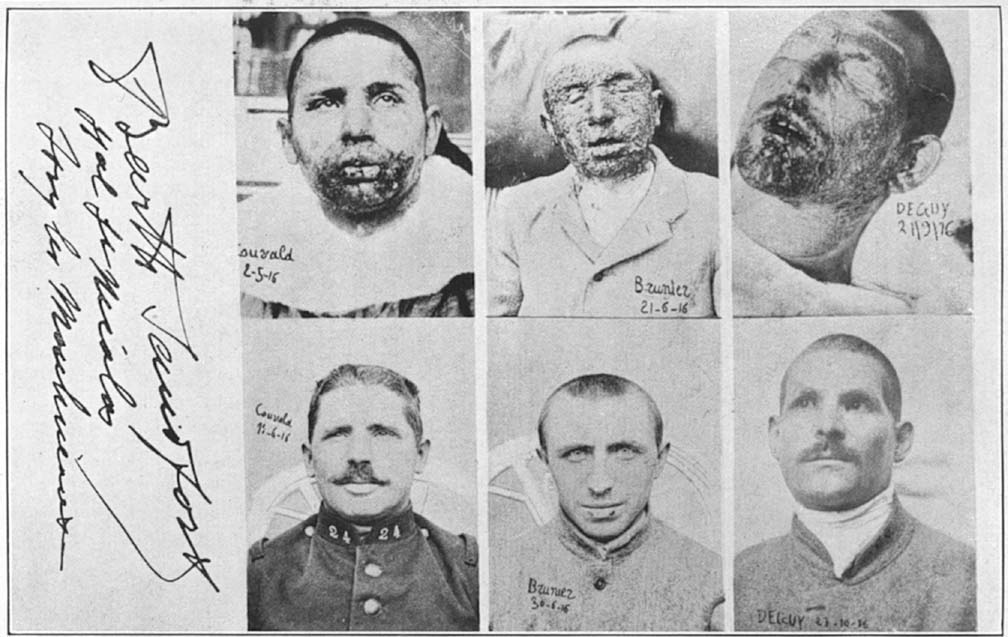
The photograph in the upper left-hand corner was taken May 2, 1916; the one below it shows the same man, after ambrine treatment, June 1, 1916. "He said that he did not suffer a single thing after the first and that he loved to have it dressed each day." The two middle photographs were taken June 21, and June 30, 1916, and the two at the right, September 21, and October 27, 1916. |
He has given the formula to the French government, but, after the war, the world can have it. I told him of my pleasure in meeting him and the debt of gratitude humanity owed him. I had the pleasure of giving him the money and he said, "Thank your friend for me from the bottom of my heart, as well as all the other Americans who have done so much to help my people."
He said that he would like to have me see some special cases and their photographs taken before treatment. One man, with his face pink and white like a baby's, had had all the skin burned from his face just one month, less two days, before and not one scar did he have. He said that he did not suffer a single thing after the first and that he loved to have it dressed each day. He took me to see another man, Fancon by name, whose picture I sent you; from the dates on the picture you will see what was accomplished in twenty days, and to-day his skin is as clear and perfect as though nothing had happened.
Some time ago, I was happy to receive a gift of five dollars for my French soldiers. I have been tempted many times to part with it, but when Saturday last came, and I assisted in giving and arranging an Easter concert and supper for eighty-five men, the five dollars went a very long way.
We arranged the concert and Easter party at the supper hour at Mme. Destray's canteen, where I go one night a week to serve supper, --- a canteen in which I am very much interested. The place, which ordinarily is rather forlorn and dark, in a little room off a courtyard, on rue Luxembourg, was gay with French and American flags, side by side, both standing for right and humanity.
Thanks to each one who has sent money for my "fund," the ordinary canteen supper was turned into a real party, with French pastries and fruit. Of course they are all most grateful and appreciative of the soup and vegetable stew, which they have each night. But they are like children, when they have something unexpected and appealing, their pleasure is so sincere. The men who can get papers to allow them to have their meals at this little place are either men on eight days' permission, who are from the invaded country, or men discharged from the hospitals who are not quite able physically to go back to the front and yet who have no family or friends in Paris. Most of the supplies are donated by the market-women of Paris, who, like everyone else, are doing their share towards giving these men, who are sacrificing their lives, what comforts they can. There are always some leaving each day for the front, and the men who left Sunday carried with them happy memories. The woolen socks I received I have given, each pair personally, to the men, and I wish it were possible to tell about the circumstances of each soldier.
I have given them all to men who are still fighting for France and civilization, and not to men who have a certain amount of comfort in hospitals or who are convalescing. The men in the cold, wet, snowy trenches needed them the most. The types I reached varied from the poor poilu from the invaded territory, who has no one to give him anything, or any family who even know where he is, to a man with a title, who before the war possessed a beautiful château in Northern France but who now has his château only as a memory, because everything in the world that he had has been taken by the Germans. He was mobilized as a chauffeur for a supply truck; he has experienced frightful exposure and is now threatened with tuberculosis. When I was asked if I had any warm socks for him, it was a great pleasure to be able to answer yes. But my pleasure was as nothing to the comfort he received from the warm things he needed so much these last desperately cold days, as he drove his supply truck to the front.
I wish I could tell about each man, for to me they are all so individual, but they were all alike, in their gratitude to the good. American women who had remembered them and believed in the principles for which they were fighting.
PARIS, March 1, 1917.
You are quite right when you imagine that we are stirred up about the U. S. A. I just don't dare to think ahead. France is so thrilled, and Bordeaux busy entertaining the Orleans and Rochester men.
To-night Clemence's cousin came in from the front on his permission. You see they are all told it is their last, for after a certain date the spring drive will be on, and there will be no permission for a long time.
He is in the Belgian army. Poor soul, he has a wife and little girl but he has n't heard a word, or been able to send them a word, since the war began. Two years and a half, --- is n't it awful?
Yesterday I had such a perfect time over at my "gassed" hospital. I took over comfort bags which the A. F. F. W. gave me. There are about eighty there now so it was a regular Christmas in each ward! If you hear of anyone asking what to put in, ---they adore harmonicas and puzzles, pipes and tobacco-pouches, and knives, aside from the strictly useful things.
After they had taken out all their things and had a jolly time over them, I had to go around to each bed and let each one show me himself just what he got, make the ones who had harmonicas play and stick the little American flags up on the heads of the beds. Many times I had to tell them what they were for, and I even had to demonstrate what to do with chewing gum!
I had a perfect afternoon and as much fun as they had, but there were four of them who were on the verge of tears, for they wanted a pipe so badly and no pipe was there in their bags. I was so disappointed for them, but I took some of your relief money and bought them each a pipe and a package of tobacco, wrote them a note and sent the maid over with them this morning. In just such ways as this I love to give them pleasure by such little things which mean so much happiness for them. When I have the generosity of my good family and friends to draw on, I can do so much more than I could with just my own pocket-book.
PARIS, March 4, 1917.
This looks very much like Inauguration Day to me, and it reminds me that four years ago we spent the day at our nice window and table at Harvey's. I was surprised and delighted to get a letter from Marlborough to-night, stampless and sector-postal-marked, as he said, "just like all your other poilus." He is having a wonderful experience, and is happy in mud up to his neck, with a gas-mask hanging on his belt, and a blue steel trench-helmet on his head, but I shall be more comfortable next week when it is an experience of the past.
Last night, when I turned in around midnight, you could distinctly hear the cannon in the distance, but to-day I was told that that was very common when the wind was directly north, as it was last night. After one has seen results as I have, to hear cannonading even in the distance makes a pretty vivid mental picture.
I have been thinking a lot to-day how I would love to drop in and have a good chat with you, and give you lots of good advice. Advice sounds rather flat, but since I have been here in Paris, and seen how conditions can change, a good long look into the future will be the wisest thing you all can do. When I came here every shop, market, and street vender had everything, and when people said, "I am buying this, that, and the other thing," it seemed too flat to me. I always laughed and said, "We will live on macaroni." And now I doubt if there is any to be had. I went into Ferrari's, the Italian shop down by the Opéra, on my way home to-night, stood in line until I got discouraged, and then left.
Potatoes are as scarce as hen's teeth; flour is getting scarce, and this morning's paper said that presently there would be bread cards. The bread is a light brown already, but to prevent waste of any kind they were to issue cards soon. I trust that the allowance is liberal. The sugar allowance amounts to three lumps per person per day, for tea, coffee, and cooking!
So my advice to you is, having land, to shove the ground full of seeds, for all kinds of vegetables and eating things, you can. I know you will say, "Who is going to look after them?" Of course much will have to be more or less neglected, but, if war comes to America, the same things you will experience, without doubt, and it is no joke, but a long thought ahead will take you over difficulties. And if I were you I would raise all the vegetables I could, and can and preserve every vegetable and fruit I had that I couldn't eat. If war is declared I advise your first purchase to be Mason jars, before they go sky-high with everything else. You all will probably have a good laugh over this, but as it comes from one who as you know is not an alarmist, or under ordinary circumstances very fore-handed, you may feel that it is worthy of consideration. You will have everything for awhile, and it will seem as if you were going to have everything, but suddenly you will find the railroads used for troops, supplies, etc., and you eat what you can buy around you, but when everybody is doing it, there is an end to many things. But if you have things to eat in your garden and in your store-closet, you are that much more comfortable.
PARIS, March 6, 1917.
I sent things to-day to Hospital aux. 15, Clermont, Oise, from the contribution of the Andover Red Cross. It is a very interesting hospital, right behind the front. The infirmaire wrote that the hospital was just like a gulf, where the wounded flowed through by the thousands, and although the A. F. F. W. was able to send a big shipment, yours filled in where theirs ran short. I tried to tag each shirt with a little word, "Pour mon brave soldat," etc. and an address, so that some day you may hear from it. The infirmaire wrote that they were so near the firing line that they could burn nothing but candles, so that writing was almost out of the question.
I had a letter from Marlborough this morning, saying he was living in a dugout and was very thankful for the six feet of railroad iron, sandbags, etc., which were over him. He said that at midnight the night before his little hole in the hillside shook like a pasteboard house and there was a horrible crash right overhead. He thought of course that Hindenburg was after him, but discovered they were French guns protecting their infantry. He is having a wonderful time and one every artilleryman would give a lot to have, and I am so happy for him, but it makes me so nervous to sit here and write, hearing the sound of the guns in the distance and knowing that he is out there somewhere.
I received a long and most cordial letter from Dr. Casseus, the Haytian doctor at the Leyoden Dispensary; he was most appreciative of all I had done for him by making his work easier and he said he was having an interesting operation on a tumor at half past two to-day and would be honored if I would and could accept his offer and assist at the operation. He assured me the patient would be completely etherized and the operation would not be very horrible.
That without exception is the worst invitation I have ever received. I hastily wrote him a profuse note expressing my appreciation of his willingness to have me see him operate, but that I must decline as those things unfortunately affected me rather unpleasantly. If giving ether as a gift calls forth these invitations, I will never give another can! As one of the girls at work said, "How could one ever return an invitation like that! "
To-morrow I am investigating a hospital where I understand there are endless amputation cases and not half enough crutches, and if it proves to be so, I will go and buy some, thanks to you. I feel rather selfish having relief money in my hands so long, but I try to do the most with it. Anybody can give money here and there and it is naturally needed everywhere, but I wait until a particularly needy case is brought to me.
Miss Dagmar told me to-day that she had been to one of the blind hospitals and they were still talking about the blind concert your money gave and said they never could forget how good the cakes and wine were. Months afterwards it is delightful to hear these things which assure you that your money was spent in the right direction.
It is very touching to me to have so many of your friends in Andover willing to have me use my judgment in placing their generous gifts. Thank them all for me a thousand times; I hope that they may never see their country suffering as poor France is.
PARIS, March 14, 1917.
Marlborough came back at midnight Saturday, looking quite like the magazine picture of the poilu, with his bag, bedding roll, trench crooked stick, and all the mud he could bring out of Champagne. He had a wonderful trip, was present at, and experienced, his first real fight. The battery he was with fired eighteen hundred rounds in one day, and the captain of the battery was wounded by a fragment of shell going through the calf of his leg. The army corps he was with fired thirty thousand rounds one day, so you see it was not a perfectly quiet day!
Well, the grippe I thought I was going to have Monday didn't arrive, but I did stay away from all work, ---the first day in just six months I had missed at the A. F.F.W.
You are so wonderful to continue to get money for me, and if people ever have any suggestions as to type of relief work they want it used for, do tell me, for as I do all that kind of relief work personally, and apart from funds or red tape, I can place it anywhere. But before I spend any of the precious money you have collected, I go personally and see for myself, and then, if I can't get the needed things through the A. F. F. W. or clearinghouse, I do things myself.
The other day I wrote to you that I was getting disturbed about the lack of crutches in a little hospital, but I have been able to beg these, without buying them, which is a great relief. So my little hospital gets crutches, and I will have money for the next emergency.
PARIS, March 16, 1917.
You probably read of our second Zeppelin alarm. I was enjoying a perfectly good night's sleep, when about four o'clock "bedlam" was let loose, the fire-engines, buglers, and, for the first time, sirens all over the city, as well. There was no question what it was; it was those Zeppelins again! Fortunately Mollie did not wake up. There was nothing to do but to close any steel shutters which were not closed, and wait for a bomb on the head! The air patrol got up very quickly, and overhead aeroplanes were so thick that they sounded like great flocks of ducks. No guns were fired in Paris, and about six o'clock the "danger past" signal was given.
We were all happy to hear in the morning that they had brought down one of the Zeppelins in Compiègne. I didn't have quite as many palpitations as I had the first time, but undergoing an air raid would never be a favorite pastime with me.
Our days of peace with Germany seem numbered and it really looks as if war were inevitable now.
To-morrow Marlborough goes to an experimenting place, and, with a gas mask on, experiences all the different kinds of gas attacks, as well as learning the different kinds of masks. It is a most unpleasant thought, but an instructive experience.
PARIS, March 30, 1917.
A week ago the news of the German retreat filled our hearts with joy, which grew each day, as we read of more villages evacuated. This joy was turned to horror on Sunday, when Mme. Carrel came in from Compiègne and told us of conditions in the evacuated territory.
She was in her hospital at Compiègne when the news of the German retreat from Noyon reached her. At once she ordered out her ambulance and filled it with what supplies she had, and started, and was in Noyon a little more than twenty-four hours after the last German had moved out. Most of the houses she found destroyed, and all the furniture had either been taken away or made useless. There was not one pane of glass in the town or a stitch of clothing or household utensil left of any kind.
In the city of seven thousand inhabitants she found over twelve thousand, as they had crowded in from the surrounding villages. Those who were in cellars gradually came out and told tales of horror too terrible to relate. Every girl between the ages of fourteen and thirty had been carried away by the Germans, and the younger women left are all about to become mothers of Boche babies. In the cellars many have died, and the mortality among the children has been terrific. Those who died were kept among the living for five days before they were allowed to be buried.
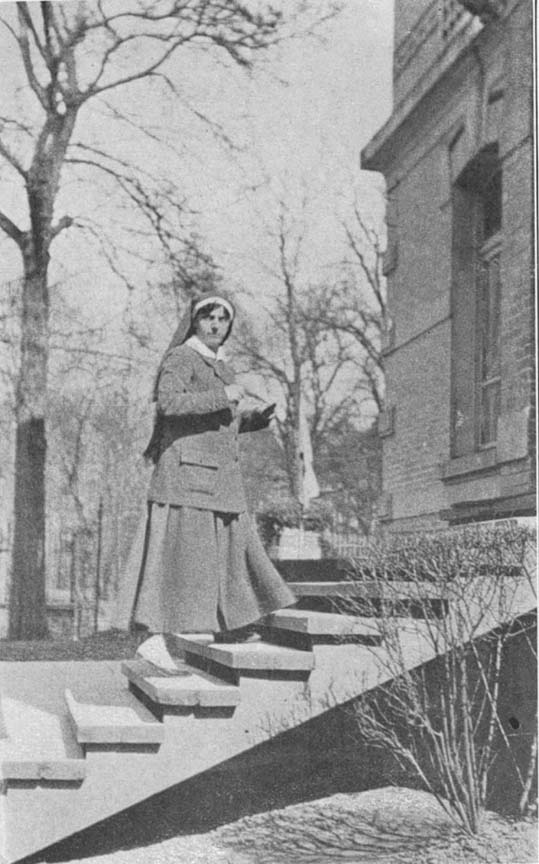
In a little room in an orphan asylum, children were found in a condition that can scarcely be imagined. They had not been allowed to go out or wash, and had slept in their clothes, without mattresses, pillows, or coverings, since last December.
The French civil population had not had any meat of any kind for seventeen months, and had had nothing but black bread and rice to eat. The French wounded in the hospitals had not been cared for, and they were skin and bones, with their open, infected wounds filled with vermin.
The joy of seeing the men in blue was too pathetic for words. Most of them had no idea that they would not see their soldiers in the famed red trousers, and when the French finally did come in, the people did not know them at first.
These conditions are only some of what she found, but they are enough to make you realize the necessity of immediate action. I gave the hundred dollars the Boston Farmington Society sent me to the A. F. F. W. fund, for I knew they were to take immediate action, and, in twenty-four hours, four camions which had been requisitioned, started with food and clothing. It was the first relief to leave Paris for the evacuated district.
PARIS, April 2, 1917.
The other morning I was out on "delivery," and when I came back to the Alcazar I was told that Marcel, a poor blind man who was here at your concert, had been to see me. It seems that he has been quite ill all winter, and they had been able to have him transferred to a hospital in Nice, where he could get out more, the weather being so much better there. He told the girl who did see him and talk with him that he did n't want to go away without seeing me, and telling me that if it hadn't been for the new grasp he got on himself and life, he never would have wanted to live through his illness this winter. But the old joy and pleasure of being alive had come back to him with such force, the afternoon he was here at your concert, he had thought of nothing else all the time he was ill. And he wanted to tell me this before he went away!
To-day I took one hundred blankets to the Gare du Nord to the canteen for the women and children who are coming in from the evacuated territory. There were only about fifty there this morning, mostly women and children but a few very old men. They were pathetic. They had not heard anything from their families or friends since the war began. But they were cheerful in that they always said, "I don't know where my husband is, for I have n't heard of him since the war began, but I know he is the trenches fighting for France." They never said or intimated that he might have been killed. They are a wonderful people and an example to the world in hopefulness, courage, and cheerfulness.
I was so glad to see the little children looking so well and almost fat, and the women were in much better condition than I imagined, but of course their faces showed what they had been through. At the canteen they are fed, and given a place to lay their heads at night, and if they have friends whom they can find or anyone who will promise to look after them, they can go to them. Otherwise the Government sends them to Brittany, and they are boarded by the Government in the poor families there. The Government has to care for them, but by this arrangement the poor in Brittany are helped as well, and it seems an excellent arrangement.
Yesterday morning, it being Mollie's vacation, I took her to the Gare du Nord to see a train off, and she loved it. I served the coffee and she gave them sandwiches, and then we both gave them cigarettes.
To-night I took over two hundred more cigarettes to Mme. Destray's canteen, where I go to serve supper Tuesday nights. There were about sixty-five there, and among them I found a nice little Englishman in the Foreign Legion. He had been in Paris four months, most of the time in a hospital recovering from wounds. He came up to me after supper to talk, and to shake hands and say good-bye, for he was leaving for the front to-morrow.
A poor little French Colonial came to me, and wanted to know if I could get him some shoes and socks before he went back to the front on Friday. I am going to send him to a place where they will give him shoes, and he is coming to the Alcazar to-morrow morning to receive two pairs of your socks and a knitted scarf. He was just like a child when I told him I would give him these things, he was so happy. All warm things are still a blessing here, for it is still cold, and each day for a week it has snowed hard some time during the day, and here it is April!
To-day I have been buying clothing for the A. F. F. W. to be sent to the evacuated country. I went out with five thousand francs and purchased one hundred women's dresses, shawls, children's dresses, underclothes, boys' suits, towels, handkerchiefs, hair-pins, etc.
PARIS, April 9, 1917.
France is jubilant over her new Ally. The good old Stars and Stripes are all over the place and you have no idea how good it looks. Marlborough is working day and night. Last night, although we went to the same dinner, he arrived after I did, and left for the office the minute dinner was over, and worked until after midnight. Just what or where he will do or be we have no more idea than you have.
I feel perfectly bewildered but shall probably come out of my fog one of these days. I just keep on at my work, and try not to worry about all the things that might happen. Naturally we are all wondering what America is going to do, ---whether she will send any troops over here. Speculating about it does n't help a bit; the only thing to do is to wait and see.
Moll is still having vacation, and having a beautiful time with an engagement every day. This afternoon she is playing tennis at the St. Didier Club, with tea at the France and Choisel Hotel afterwards. I call her some sport, but you have no idea what a joy and relief it is to have someone about who is just having a good time.
PARIS, April 13, 1917.
I can't tell you how sorry I was that I couldn't write a letter in time to get off in the mail to-day, but I simply did n't have a chance to sit down and write. My work has been changed a bit, as the A. F. F. W. are starting relief of the evacuated districts, on rather a large scale, and I have been made purchaser or buyer, whichever you want to call it, --- I have forgotten what it is called on paper. Although it is not quite like being buyer for Paquin's it is no child's play.
There is nothing that an infant, child, man, or woman wears or has to use that I do not have to purchase,---and by the hundreds. I have to buy them all in French, and aside from the language, the French have no idea of hustle and business methods. It takes me hours to get the proper receipts, etc., to give to the treasurer.
They have turned over one section in the Alcazar to me, and I have to arrange a shop complete there, so that they can work from there filling demands, as they come in. At the same time we have opened a "branch store," or vestiaire, at the Gare du Nord, where the refugees are fitted out as they come in on the trains. As I had all the buying, planning what should be bought, etc., and opening of that place, I have been nearly crazy.
Many cases of old clothing have been received for that work, and before ten in the morning when that vestiaire is opened, I have had to go down there and take an inventory of all the articles, and see what sizes of things are getting low. From there I go to my Alcazar store and do all the routine paper work, and attend to the needs there; then off buying all day, and, when I finish, back to the Alcazar to put purchases of the day in place there, get things for the Gare du Nord listed, and put in big hampers to be taken the next morning.
As a result I have n't had one minute, but when I get it on its feet it will not be so hectic. The vestiaire at the Gare is wonderfully interesting; yesterday when I was working there alone --- it is in a little room in the cellar, but with a nice electric light ---the gendarme came in and said a family of seven had arrived from Rheims.
As they were to be sent by train to Brittany before the hour for the vestiaire to open, could I fit them out?
So from grandmother to a one-month baby, I fitted them out with things they needed. As you know Rheims is being heavily bombarded, and they left without one thing excepting what they had on their backs. Their tales were hideous of the terrific bombardment of the city, everything falling and in flames, and people escaping with their lives and nothing more. One man, and a dear, said he and his family had been taken by the French soldiers to live in their abri for the past three days, and when word came that all civilians must leave, he told of dashing with his family of seven from one street to another, and from one apparent shelter to another, wondering if all could be saved from the shot and shell of the terrific bombardment which was going on. They all got out safely, but they looked pretty cold and forlorn as they sat lined up on a bench in that dark cellar room, waiting for me to fit them out in turn. But they seemed to me more dazed than discouraged.
One man you would have adored, --- a man of about sixty, I should say, with his well-cared-for trowel in his hand, beaming, --- for he was a gardener by trade, --- because he had saved his pet trowel, which he hoped to use when he got to Brittany, where the Government were sending him. Some of my " fund" purchased a complete corduroy suit for him. His comfort and happiness were complete; it will be a suit he can wear the rest of his life, and do all the gardening he wants to in. He was in desperate need of it, and I was so happy to think that I had the money which I could use to start him in life again, at least warm and comfortable. The dear old thing sat there in the canteen while I went up town and bought the suit and a flannel shirt, and brought them back to him. However such little things on the side are very time-consuming, and days simply fly by, with more things piling up to do all the time.
Those peaceful days in Oklahoma seem a thousand years ago, and I am afraid it will be many years before we know the fun and peace of those army post days. Now I can only be thankful that Marlborough is still here in Paris with me. Since war has been declared he has left the house about seven in the morning, and returns about midnight or after. But occasionally I have luncheon with him, when we talk over things that are happening.
I feel as if I had written very little of our ideas and plans since war was declared. But our ideas are not worth anything to anyone else and the little we know about things in general is nothing we can write about. Yet you may be sure that, if you hear nothing, we are simply sitting in Paris, busy and well; we shall keep you informed if any change comes for us. There are so many possibilities I do not dare to think of one.
If this letter is a little dull it is because I have overdone eating pastries and cakes; this is to be the last day the law allows either to be made in Paris, so I have eaten for months to come!
Next week one meatless day starts, and after May first no meat on Thursday and Friday. But all these things are no real hardship; the trying effect is that it makes crackers, etc., hard to buy and frightfully expensive. And meatless days will put vegetables and eggs up and, of course, fish, if there is such a thing as its getting any higher.
If I had to do all the marketing I should probably lose my mind; as it is Clemence has all that trouble and gets what she can, and we are grateful for whatever she gets, and everything she cooks always tastes delicious, so why worry about things we can't have? There is always the same answer, "C'est la guerre." However, we love to sit and think of all the things we are going to have when we get back to America. Moll still has an ice-cream soda uppermost in her mind, and now she thinks that when she does go home she will ask someone to bring one to the boat for her! Marlborough has decided not to eat anything after landing until he gets to The Maples, and has a breakfast of tripe and baked potatoes, and both without any limit as to quantity, while I am prepared to founder on hot rolls!
It is still cold here, but for a day or two hasn't snowed, but it is always busy raining. We are all very well, and the house most comfortable, for the central heating is still going on.
Mollie is back in school, using all her spare time in playing tennis at the St. Didier Club, and is tennis mad.
PARIS, April 22, 1917.
I have been almost over my depth in work the past week, and have had to give up everything else, for I have been "on the job" from nine o'clock until six, and often it has been seven before I have left the Alcazar. Organizing, buying, and arranging two stock-rooms, one at the Alcazar and one at the Gare du Nord, has taken every bit of my gray matter! The responsibility of having all the money as well as the work turned over to me, to make good or to fail, has been no trifle. I am given a free hand, with no one to consult on the subject of buying or deciding as to needs, which, although probably easier in the end is, at first a tremendous responsibility. Now that I have both "stores" running, I feel sure that there can be no serious hitches.
The Gare du Nord is cared for by two girls each day, and I simply have the buying, and the daily task of keeping that place stocked, with the records to keep of chat I have sent there. I have my desk and "department store" on the outside gallery of the Alcazar, next to the Ambassadeurs. I am quite proud of it, and if there is ever a pleasant day I will take a picture of it. Here I reign alone, interview merchants, and keep my records and my stock. And I have done everything so far myself, bought the goods, made and arranged my store out of packing-boxes, and have almost reached the point of sitting down, putting my heels on my desk and admiring it.
I have the Boston camion at my disposal, with nice Miss D----- as chauffeur, so I do not have to dash around Paris stores and commission houses on foot. This is quite a change from my previous work for the A. F. F. W., for this carries a big money responsibility, and is not plain physical labor. I like it a lot however, and when it gets warmer it will be a joy being out all the time. At present I wear sweaters, gloves, etc., to keep warm, --- I mean partially warm; I have forgotten what it is to be really warm.
So although it has been a long day, and I know I have to be at the Alcazar at eight-thirty in the morning, I do not feel tired in the least. Consequently you can see that you must not waste any sympathy on me.
Work like everything else is a habit, and it is just as easy now to work all day as it used to be to dance all night. However, what I should like is peace, and a few nights of dancing and frivolity, but things do not look as if I should have it in a hurry.
PARIS, April 29, 1917.
I think I last wrote on Monday. On Tuesday afternoon about four o'clock it was sprung on me that I was to leave Thursday morning at dawn, by camion, for Compiègne, the camion to be filled with supplies to be sent on to evacuated villages. I asked for the list of articles they wished taken and was told that that was for me to do, to make a list, as well as to purchase everything. As I did n't wish to deplete my store at the Alcazar, I hopped into the motor I have at my disposal and made a tour of the wholesale houses, etc. As everything closes at six o'clock my time was short.
Wednesday I bought all the things, packed them in sacks, and, when I finished about seven that night, everybody had left, and Dorothy A----- and I had to load the camion! It was so almost impossible to do that it was killingly funny, and we laughed ourselves almost sick over it. But we managed to get everything on, --- nine big sacks of clothing we could barely move, two crates of macaroni, two big wooden boxes of bouillon cubes sent from America, and two big basket crates of lemons. And we had clothing complete for sixty women, sixty girls, forty boys, twenty-five men, and a dozen babies.
We left the Place de la Concorde at eight o'clock. I had on a blue flannel shirt just like a poilu, sweater, suit, and Marlborough's polo coat, so you can see it is not very springlike yet.
All our red-tape papers were made out to take a certain route, and the sentries along the way, who examined the papers, saw to it that we took no other. We went up through Chantilly, which is a heavenly spot; you probably went to the races there! All I did was to go through on a camion!
Then we went through Senlis, which the Germans had for eight days early in the war. Some fighting took place there, and some of the streets are nothing but ruins.
We arrived at Compiègne about noon. At two o'clock we went to Madame Carrel's hospital, which in other days was "Hôtel du Rond Royal." It is delightful, and delightfully situated, and Madame Carrel is charming. I never saw anyone so filled with energy; you feel that she could do anything. She took us all over the hospital, where we dispensed cigarettes. We had thirty-five comfort bags which we gave in the wards where she considered they were suffering most. One man she found in a hospital. when she first went into Noyon, and his condition was almost unbelievable. The combination of his wounds, loss of blood, lack of care, and lack of nourishment is too dreadful.
We left our load with Madame Carrel to be distributed by her in the evacuated villages the next day. We started back at half-past four and were in Paris before eight o'clock.
Three more cases from the Andover Red Cross were at the Alcazar on my return; it is fine to have all these supplies now coming in, for now the offensive is started the wounded are piling in again. It is all too terrible!
PARIS, May 6, 1917.
I bless the Andover Red Cross for the three cases I unpacked to-day, with all the nice pajamas, pillows, fracture pillows, etc., and to have this personal supply just as the wounded are pouring into Paris again is wonderful. Of course the French are going forward, but not without frightful losses. The English are doing wonderfully well, and although their losses may be as great, their wounded do not come this way.
This work is fascinating beyond words, and you can do so much that the horrors are not depressing, where they would be if you had to sit by and see and do nothing but think about them.
This past week I had a pathetic letter from Hospital 38, Poissy (Seine et Oise) asking for chaise-longues, so that they could get their convalescents out in the garden these sunny days; the men begged to be taken out, and yet were not able to sit up. So I took some of my "fund" money, and the chairs will be sent out on Tuesday.
PARIS, May 15, 1917.
Each day I fear that I shall hear something has come up to cause Marlborough to leave Paris for "Somewhere in France"; but I have decided that there is enough anxiety in uncertainties without borrowing trouble. And the wonderful Frenchwomen are a lesson to the world.
Do not worry one bit about my overdoing. I am very fit, and the more you do the more you want to do, and you get absolutely absorbed. But work is one's salvation. To-day, for instance, I worked from nine-thirty until six, with about an hour and a half out for luncheon, which I had with Marlborough. At six I went to my canteen and served supper to sixty-six men, came home and had dinner with Mollie at eight, and all the evening I have been working over my shipping lists of things which have to go out to-morrow morning at eight-thirty to Noyon. As usual Marlborough is at the office, but as it is about midnight he will be in shortly.
PARIS, May 21, 1917.
We were delighted and so happy to get letters from you all this week, and I wish I could tell you what a joy letters are; I read them over and over, whenever I have a little spare time.
Another case from Andover Red Cross, with the cut-out pictures, scrap-books, pajamas, etc., arrived to-day, and I was delighted. I have just promised Mme. Lyeoty, wife of the general, many supplies for one of the Hôpitals des Invalides where all the paralyzed patients are. They are in need of everything, and I knew the things from Andover would be a joy to them. Everything you have sent has been perfect, and couldn't have been better.
Do not worry about my needing a vacation; I wouldn't know what to do with one if I saw it. One works from force of habit here, and there is so much to be done, you do not become worn out trying to see it finished; that is impossible, so you just keep at it steadily.
I try not to get too tired, for that is stupid; it is not up to any of us to ruin our health, to say nothing of our dispositions. If you are tired and nervous you are hardly a person to bring cheer to the suffering and forlorn. Of course I get interested and often do more than is wise for one's health, but I never mean to, for there is too much ahead to be faced with anything but the best of health.
Paris is lovely now, with all the shrubs in flower, and all the trees wonderful, and the weather just comfortable. And I have every inch of every box E----- has sent stored here in the house, so when the cold days come we shall have more than our imaginations to keep us warm.
I am particularly happy in having been told yesterday to go and get all my papers to be sent up to Noyon. I am naturally delighted; the chance is worth all the hard work I have put in on refugee relief. I expect to be back the next day, but this is the real chance I have been longing for.
PARIS, June 1, 1917.
I brought this paper to work with me this morning, planning to take the noon hour to write to you, rather than bother with lunch. But Marlborough appeared and wouldn't allow it, so I have had a nice luncheon with him, and have but a few minutes before everybody returns to work.
I have so much to write about it is tantalizing, but I won't spoil my trip by giving you a poor idea of it I will simply say that I was out at the front three days, and never in my life did I even ever dream I should be allowed such privileges. I have been four kilometers from St. Quentin, where shells were bursting, with a geyser of dirt thrown into the air. And I was told by many French officers that I could count the women on less than one hand who have ever had that chance. To-day forty-five thousand Germans hold St. Quentin! I was so near I felt I could all but see the color of their eyes! It was beyond any words! I will write you about it more fully soon.
But in a general way I will tell you the places I went to, so you can see on the map: Compiègne, Noyon, Tracy le Val, Tracy le Mont, Vic-sur-Aisne, Soissons (here the bombarding cracked louder than any Fort Sill target practice!), Château le Coucy (wonderful), Epagny, Nouvron, Blerancourt, Cuts, Chauny (terrible), Bois-de-l'Abbé (Eitel Friedrich Tower), Serancourt, Ham, Guiscard; my nearest spot to St. Quentin was Roupy. This will give you work enough to find on a map until my next letter arrives telling about it.
I have been in French trenches and in evacuated German trenches, where I was tempted to bring home mahogany tables, gilt frames, etc., but contented myself with a few military souvenirs.
Marlborough and Mollie got along perfectly during my trip to the front, and I was fortunate in being able to send Marlborough a message through Army H. Q. at Compiègne, that I had a wonderful chance to be out three days, and not to expect me in until Sunday night, when I turned up about twelve.
Last night was a perfect Gare du Nord party. There were three hundred poilus, and about twelve Marlborough came for, me, and they all were so excited. The Frenchman running it said many complimentary words, and the piano struck up the national air(?) Yankee Doodle! And the men all said, "Vive l'Amérique" and "Mon Capitaine."
When I came in Sunday I was thrilled and too happy for words to find E-----'s wonderful box of candy, as fresh as it was the day it was made, and the five-pound box of sugar. I have never seen so much sugar!
June 3, 1917.
I can never do justice to the wonderful experience I have had. As you know since the Germans began evacuating some of the French towns a few weeks ago, I have been busy day and night planning and executing the relief work which the A. F. F. W. were able to do, with money sent especially for that purpose.
It was finally decided that we could do more direct work by establishing a base at Noyon. So I packed up the wonderful "department store " I had arranged at the Alcazar, and everything was taken to Noyon. Two days after the big trucks with the cases left, Dr. Eleanor Kilham, Miss Brent, and Dorothy Arnold (chauffeur) planned to go to Noyon to stay, doing the work from there. As this was my department of work I was fortunate in being allowed to take the trip with them, with Ruth Casparis, head of the motor service, to drive me and bring me back. I was as delighted as a child over her first party at the prospect of going.
The afternoon before I left Colonel and Mrs. Collardet had tea with us, and I told them of the wonderful trip before me. Colonel Collardet was leaving the next day for America, having been made assistant military attaché to Washington; until now he has been chief-of-staff of the army. He promptly said, "You are going up into my country; I will give you a little note to Colonel Destekeer, the present chief-of-staff, with headquarters at Vic-sur-Aisne; do present it, for I know he will do all he can for you." Fortunately I had Vic-sur-Aisne on my pass, so I treasured up the little note.
At eight o'clock Friday morning we started in two cars, the camion and the Buick. It was a glorious morning and our spirits were high. We motored to Compiègne through Chantilly and Senlis, and Chantilly was just as enchanting as it was when I motored through a few weeks ago, only the forests were all carpeted with lilies-of-the-valley.
Our road to Noyon led through Bailly, and before we reached that place we were in the midst of everything that pertained to war.
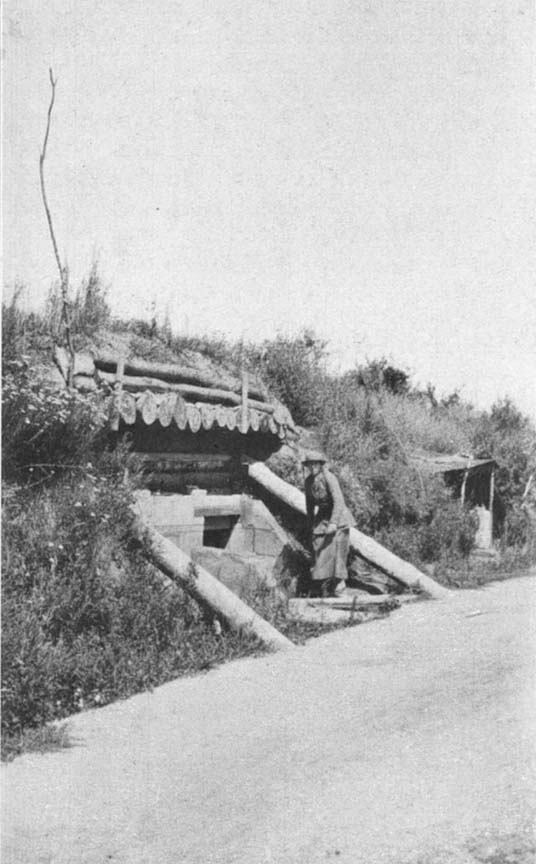
The world seemed nothing but trenches and barbed wire, and wonderful abri, and miles of little narrow-gauged railroad for ammunition transportation. Here we were in lines the Germans held for two years and a half and had left but a few weeks ago. And how comfortable they had made themselves! My inclination was to go into every trench and abri, but I had to satisfy myself with a few, and we were warned to be very careful in the German trenches, for they have filled them full of traps, -that is if you picked up something, or tripped over a wire, it might start things, and the whole trench would blow up. There have been some horrible accidents of this kind.
In the woods I went into one wonderful abri, with a beautiful carved lion over the door, a wonderful half of a round mahogany table, big chairs, and big gilt frames minus the glass. I tried to find this same abri the next day when Miss Casparis and I were alone, for I wanted to bring home the table, but we could not locate it.
We passed one German cemetery, well laid out, the stones beautifully carved; many graves bore date of but a few weeks ago.
Bailly and every small town are just wrecks, --- every building down, and not one sign of life.
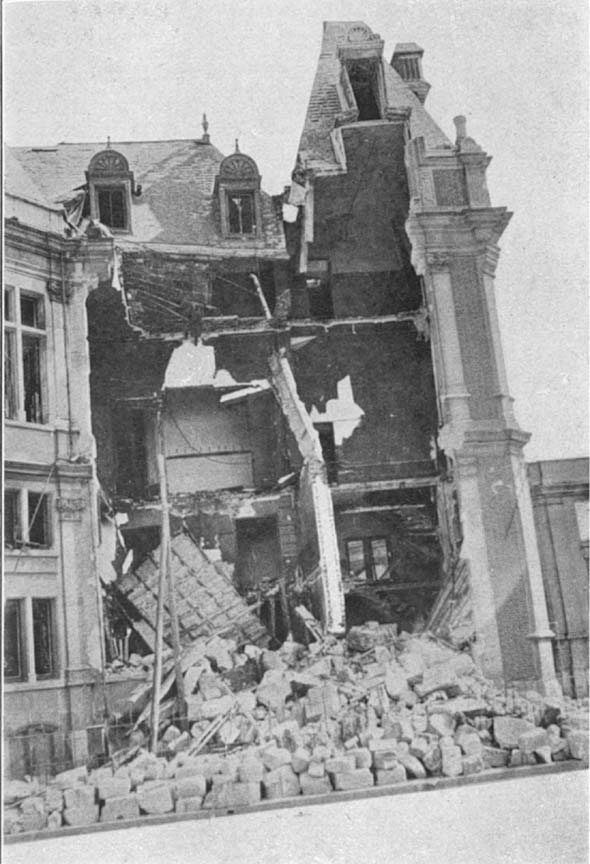
We arrived in Noyon about two o'clock, and in this large place I should say one-fourth of the buildings are standing; when I say standing, I do not mean with roofs on and window-glass, but the walls standing. In the Place de la Ville, where the Mairie (town hall) stands, most of the buildings are standing. And over the door of the Mairie "Old Glory" was flying. A store in this Place is what the French government has turned over for our warehouse. We deposited our things there, and some went to find a place to leave the cars, while others went for permits to live in the town. I went to find a woman to clean and cook for them, for they planned to live over the store.
I wandered down one street, and into what was at one time a café, and found a woman trying to start it up again. I sat down and talked with her, and asked her if she knew of anyone who could help these Americans; she seemed to think there was no one. I asked her if she had a stove, and whether, if they brought her the food, she would cook it there for them. Not in a discouraged way at all, but only curious, she said, "What could I cook?" I was very prompt with my answer, "Vegetables." " There are n't any vegetables," she said. I was not stupid enough to think she could find meat, so I said, "Eggs, then." "Oh! There are no hens here." So at once the question of having a cook or a stove seemed solved, ---both were superfluous.
I wandered farther and found a woman about to open the hotel. The hotel had not all its roof on, and the furniture had all been removed by the Germans, but she was sure if the Americans could bring their furniture and linen she could make them comfortable. It looked to me like their making themselves comfortable. Stores with canned things were opening up, and with a can-opener she was going to be able to give them something to eat. But she could not get any bread for them until they had their bread cards, so she could not be ready for them until the following day. The sadness and terribleness of Noyon was relieved by these humorous little touches.
How can these poor people begin to live again, with all their sorrows and privations in these masses of ruins?
We all motored back to Compiègne for the night, going back by Tracy le Val and Carleport. Such desolation! The villages stand out like ghosts, and there is so much destruction nothing seems real. After a good night's sleep, we started out about nine in the morning for Noyon again, Miss Casparis and I helped them straighten out things and left about noon. Then we went by ourselves to Vic-sur-Aisne to find the headquarters of the army, and present my note from Colonel Collardet.
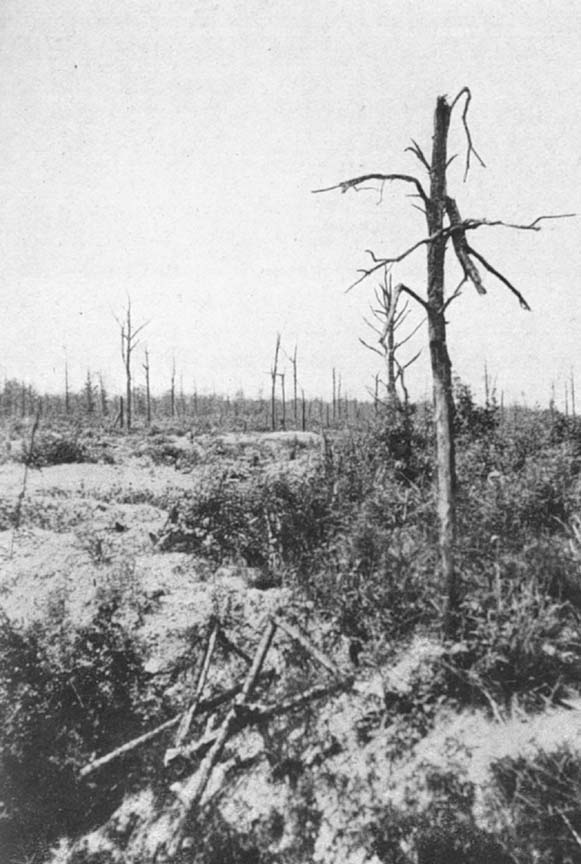
The road from Noyon to Vic-sur-Aisne by Carleport is over a terrible stretch of land by way of desolation. Every village is practically razed to the ground, and only occasionally is there any village to be seen. The whole world seems a maze of trenches and barbed wire, the trees just trunks, which stand shattered. There is no vegetation; it all looks like a desert of desolation.
Yet here at one point the German and French trenches were but about forty-five yards apart for two years. What tales of horror that forty-five yards of "No Man's Land" could tell! The whole place is a sea of barbed wire; one could not believe there was so much wire in the world. We stopped on this road and went into many of the trenches, where I couldn't resist picking up a few little souvenirs. ---I could not but think of the souvenir hunters and Cook's tourists in years to come, and how a few things which were real would seem then. Yet with everything there and tons of everything, souvenirs did not seem very precious.
We found this stretch of road so crowded with interest it was hard to press on towards Vic-sur-Aisne. However, we arrived at Army Headquarters about two o'clock, and found them in a beautiful chateau. With certain formalities we were taken into the colonel's office, and greeted most cordially. He was delighted to see any friend of Colonel Collardet's. We told him our mission in the zone of the army was in view of relief work. He at once said, "What can I do for you?" So we told him how far our passes allowed us to go. But that was not the question; it was now where we would like to go, and how many days we had. It was Saturday noon, and although we had intended to go back to Paris that night, I knew that if he offered something worth while we did not have to get back to "work" until Monday morning.
|
"The whole world seems a maze of trenches and barbed wire, the trees just trunks, which stand shattered. There is no vegetation; it all looks like a desert of desolation." See page 201. |
To be facetious I said, "Colonel, my one desire is to get as near St. Quentin as possible, and I should also like to go to Soissons."
He walked over to his map on the wall and said, "Bon, you can go to Soissons this afternoon."
Miss Casparis in a half apologetic voice said, "Could we go to Le Château Coucy?"
"Certainly, if they are not shelling there this afternoon."
From then on things began to look and feel very thrilling. So after planning out two days for us he said he would get our permits and send an officer of his staff with us. He came back with the papers, and the information that the general of the army would like to be presented. His office was in a wonderful room in the château, and the whole thing seemed like a drama on the stage.
Soon with our wonderful permit and nice French officer we were on our way to Soissons.
That place is pathetic, shelled from one end of the town to the other, the wonderful French cathedral more than half in ruins, most of the glass gone, and all the stone arches and columns shattered and fallen. The most pathetic part is that one end of a small nave is still being used, although sand-bags are piled high at the end, and tons of stone and masonry lie in heaps on the floor. We had been there but a short time when there came the crack! crash!! of the big guns, and the few French soldiers about said, "Ah, the bombardment has begun." By the sound I thought they were at least bombarding the cathedral itself, but of course it was simply the afternoon bombardment of some place, but not of Soissons.
After leaving poor shattered Soissons our objective was Coucy, and Château Coucy. This was over pretty flat country, and the right side of the road for miles and miles was screened from the enemy. All types of screening seemed to be used, the thick brush, netting with bunches of grass tied in so as to fill each hole, and miles and miles of what we would call burlap two widths stretched from tree to tree where there were trees, or poles or trees put in for the purpose. The cloth was punched with small holes so that it could not catch the wind, and come down.
A short way from Soissons the road guard came out from his abri (these guards live in the funniest little holes in the side of the road) and he asked for our papers. The French officer with us asked if the road to Coucy was safe. The guard said, "They have not begun to shell it to-day, but dépêchez-vous." We hurried all right! And for one who had not been to war before it was thrilling.
We arrived in Coucy only to see more destruction; in fact there seemed to be nothing with four walls and roof on the same building, but in pieces of houses soldiers were making themselves as comfortable as possible.
There is not a stick of furniture in the houses, but to a poilu, these days, a wall or a roof is a good deal. The old castle ruins stand out picturesque upon the hill, compared to the hideous devastation the Boches have wrought.
From Coucy we went to Epagny and Nouvron, to Chauny, and crossed the Oise on an excellent bridge that is being constructed. The bridge destruction is also most complete from the German point of view, for every bridge large and small is destroyed, and the ends dynamited in a way to make the next bridge necessarily longer.
There is not one building standing at Nouvron, and as this was German headquarters for a long time, all the signs, all the warnings, were in German. There were a temporary German Red Cross dressing-station, a maze of German trenches and abri, endless hand grenades, cans for generating gas for the gas attacks, and every implement of war one could imagine. The road to this place was almost impassable, the shell-holes were so many and so deep. The country on either side of the road was so filled with huge shell-holes, you could n't tell where one began and the other left off.
Each place we came to seemed worse than the one before, but as Chauny was a city with factories (there were large mirror works there), the ruins of this city had a different appearance. The whole city has practically gone, but here and there rise tons of machinery in rusty, shattered heaps, a silent reminder that at one time Chauny was an industrial town of no small size.
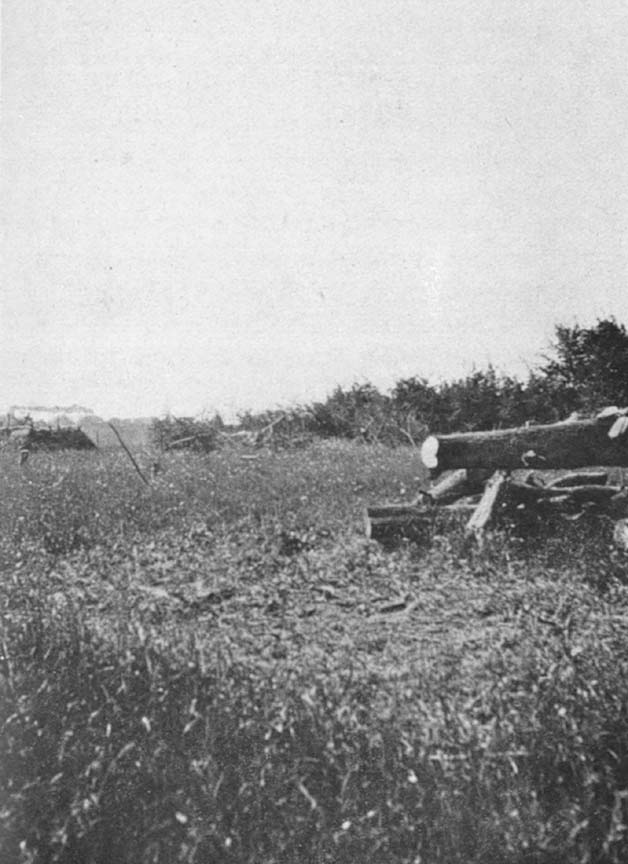
From Chauny we went up through endless ghosts of what were villages to the Eitel Friedrich Tower, in the Bois-de-l'Abbé. Of course from this tower we could look into St. Quentin well, with glasses, but the day was not clear enough to see it well otherwise. From here on was the terrible destruction of the fruit trees, all cut and neatly cut, and so systematically that none escaped. It was really too hideous to see mile after mile of trees lying just where they fell, and to realize that the poor people are deprived of what little fruit they might have had.
The road from Serancourt to Roupy was to me almost like a dream. The line of sausage balloons which are up for observation were behind us, aeroplanes were scooting around overhead, and we passed droves of tiny, dusty donkeys which are used to carry ammunition into the trenches, and St. Quentin with its forty-five thousand Germans was only about four kilometers away before us!
In front of us to the left, but in front of the city, shells were bursting and dirt and débris were thrown up like geysers. They were shells from the French artillery on our left, disturbing the Germans in front of St. Quentin. We could only stop the motor for a few minutes on this road, for the officer with us was afraid the motor on that road might draw the German fire, which would be pretty hard on the poor poilus who were in that sector after we had scooted by.
From Roupy we went to Ham, and as Major P----- at Compiègne had given me a letter to an American aviator in the Lafayette Escadrille, we went to the aviation field and examined the various types of planes, and incidentally had a delightful time.
Ham is another large city; it is practically demolished, but they have cleaned the streets of the débris very nicely, and one can get through anywhere in a motor. From there we came down through Guiscard, Noyon, Cuts to Vic-sur-Aisne, where these nice French officers urged us to dine at their mess, for it was nearly eight o'clock when we reached there. But as we had to reach Paris that night, we had to decline and bid farewell to the officer who had made this trip with us. So we continued on our way, arriving in Paris at midnight, having had three memorable days, and an experience few others have had.
|
"From here on was the terrible destruction of the fruit trees, all cut and neatly cut, and so systematically that none escaped." See page 207. |
PARIS, June 4, 1917.
We unexpectedly received letters from each of you yesterday, and a great surprise it was, for there has not been a French boat in, so they must have wandered in through England. I can't tell you how welcome they were and I was so glad you had been to see Joffre.
Day before yesterday Marlborough had, with Major L-----, a private interview with Joffre. He sent for them to talk over the situation, and he is extravagant in his praises of America. Apparently the dear old man had the time of his life.
Yesterday Marlborough came into the Alcazar about five o'clock and said that he was leaving for London at eleven. Captain D----- came home to dinner with him, and they left for Bologne at eleven. They were to cross the Channel on a transport this morning, and their mission is to meet, as the world will know to-morrow, General Pershing.
At present no one knows why he went, nor does the public know that General Pershing is arriving. I am glad that Marlborough had this detail, even with its risks, for it will be interesting in itself, and he can learn first hand just what America's plans are. They will be several days in England so I shall not expect him until the end of the week or the first part of next.
I forgot to tell you in my letter written after I returned from the front that I came home to find Marlborough with a perfectly good Renault limousine, and a French soldier chauffeur. So each morning his stunning limousine with its looped-back gray curtains awaits him. In he hops, and I a moment later (for appearances only) walk out and keep on walking three blocks, and stand on one foot and then the other waiting for the tram, and then am liable to ride second class! Of course no woman can ride in a military car, but I think a little less than nothing of that law.
We are still enjoying the last of the candy Esther sent, and the sugar I am hoarding. Did Mollie write you that she had to take a little box of sugar to school and keep it there for her own strawberries? The boxes are put on trays, each labeled, and each girl uses only her own.
Sunday morning Mollie and I went down to the trains. We saw three off within an hour, and, in all, the gendarme said between seven and eight thousand men. It was a sight, and we gave out cigarettes as fast as we could. As Mollie said, they swarmed around us like bees, and so many hands stretched out almost made us dizzy.
PARIS, June 10, 1917.
The A. F. F. W. has given up the refugee relief work by the Fund, and this caused the base shifting to Noyon. For from there they do hospital work for the Fund, and relief work from money from private sources, not through the Fund. So I have now a position too confining and too responsible, if one wishes to do anything else. However, at present they seem to think there is no one else, so I said I would do it for awhile. It is called head of the warehouse.
This is the work. I have to be at my desk at nine-thirty every morning. All lists of demands from hospitals come to me. As the printed forms have the number of beds in the hospital, which of course varies from twenty-four to seven thousand, I set down the number of each article that they can have. I put these out in big baskets to be packed, type an address with shipping number to be painted on each bale. When there are cases of things to be sent, I go to the theater, find the cases, and put on the tags and numbers. I have to turn in all the numbers of cases sent that have been unpacked to a receiving clerk, and at three-thirty turn over to a shipping clerk a list of things ready to be shipped the next day. Consequently I am at it from nine-thirty until six or seven, with an hour out for luncheon. It is not hard, but you have to keep your head, or you would tie up the whole place. I shall not do it after Mollie's vacation, but just now it does not make any difference, and the busier I am the better, for life here is very tense anyway.
Two more cases from the Andover Red Cross turned up yesterday, one of old clothes, which will go straight out to the evacuated country. As soon as I saw a suit of clothes in the package I sent Miss B----- out with it to a blind réformé who could not go out and learn a trade for he did not have a suit fit to wear. The man was so happy, and his little children danced around him, and said that a fairy had come and given their father some clothes, and they wondered if some day the fairy would come and give him back his eyes.
Mollie went out into the country for Sunday, so happy, for she was the only girl who had parfait at Cour this week, and in these French schools that means a lot. Cour days are examination or, at least, reviews of everything you have had during the week, but by another teacher, and to get parfait, you can only miss once.
I am delighted to know that General Pershing is as far as England all right and shall be glad when they are across the Channel. The English are doing good work on the front now but France certainly needs more men, and I shall be thankful when our troops get here, hard as it is to think of it.
PARIS, June 19, 1917.
It would be so wonderful if I could drop in and talk, and tell you of all the happenings of this past week. It was a relief and a joy to have Marlborough back from England, where he had the pleasure, and honor as well, of being sent to meet General Pershing. Of course I was too happy for words when he came back with his gold oak leaves.
He arrived from London a day before the General, and on account of the Germans knowing just when he was coming, the censor kept everything from the public. Not until noon did France know that Pershing was arriving at six o'clock at the Gare du Nord.
I went with some friends in their car, and we couldn't get anywhere near the station, for it was a sea of humanity. As Joffre's car plowed through it, they were wild with enthusiasm. We decided to go back down the Boulevard, and there we had a wonderful place.
Presently it was "Vive l'Amérique," and the excitement was tense. General Pershing was so dignified and serious, yet, as roses were showered upon him all along the way, he smiled and acknowledged it all in a very sweet way. We followed his car to the Crillon where he is staying, and it was wonderful to see and feel that the American army was arriving on French soil, and soon would be in shape to go and help these people who so sorely need them.
Sunday afternoon I asked the four or five officers and their wives who have been here all winter, a few French officers, General Pershing and his staff, Mr. Thackara, the consul-general, and a few navy people to come in at five o'clock, in honor of Marlborough's promotion.
The apartment was lovely with pink roses, which are just in their prime now. There were about five women and forty officers, and although it was my own party, it was a success! I really did not expect General Pershing himself to come, but about five-thirty in he came with his aides and chief-of-staff. And dear old General Pelletier with his one arm appeared. He is a dear old French general, who has been put on duty with General Pershing.
General Pershing was so nice and so delightfully informal. Outside the street was packed with big gray war cars, all with French soldier chauffeurs; for they had all been assigned cars by the French government.
Saturday night the Opéra-Comique gave "Louise" in honor of General Pershing. The chief-of-staff asked Marlborough and me to sit with him in his box, next to the general's. The Opera House was packed and the people showed great enthusiasm, and we had much Star-Spangled Banner and Marseillaise.
PARIS, June 20, 1917.
I am now busy getting through a deal for rabbits and goats which Mrs. I-----'s money is being used for! The question of food for the evacuated districts has been a problem in my mind ever since I was up there. It is all right to take cases of macaroni, etc., but all that is temporary. Chickens and cows require food, so that is out of the question. Goats can live on nothing, and the milk and the cheese is most nourishing. And rabbits multiply so rapidly, that they can afford to eat them continually, and I guess they can scratch around and live on next to nothing. I am going to try to take the rabbits out myself, but I think I will ship the goats! Can't you see me with a hundred rabbits in the Buick?
I have rather neglected my little hospitals recently, but I just do all I can, no one can do more. I have lots of lovely things from Andover to take them, and long to see a Sunday afternoon free.
The letters telling us of the May breakfast made our mouths water. Could anything be more wonderful than brown bread, hot or cold! We are having all we need to eat and more, but there are naturally things which seem wonderful to think about eating.
We are all well. Marlborough goes to the English front to-morrow for a few days.
PARIS, June 24, 1917.
I received another box from you yesterday with pajamas, comfort pillows, and fracture pillows, and I was so glad to see them all. And to-morrow on my way home from work, I am going to stop in at the Russian hospital, which is in the Astoria on the Champs Elysées, for they are most urgently asking for pajamas and fracture pillows. I met one of the night nurses in the receiving ward, and she was so happy when I told her I could help her out.
Marlborough wrote to you awhile ago about the necessity of saving tonnage, for there is so much which must be sent from America, to put an end to this horrible war. But now there seems the probability of many more ships. In which case don't stop your good work, unless you have to.
You asked for suggestions concerning things you make. I would suggest making the pajamas out of light-colored Canton flannel rather than the gray. In the first place the men love the light pink and blues, and the appearance in a hospital bed is better. And I think the psychological effect on the man is worth a great deal. The Louisville Committee have sent all light-colored ones lately, and the men have been crazy over them. They loved the light pink and blue nightshirts you sent in the winter.
The comfort bags do send me, address American Relief Clearing-House for Mrs. M. C., A. F. F. W., for I can take them to the station some night to a "party." We went down one night this week and took four hundred bags, and that was not enough, and you feel as sorry for the men who don't get them as you would for a child at a party where the ice-cream gave out before he had any.