
PARIS, July 11, 1917.
I have not had a chance to write you since my rabbit trip a week ago. It was wonderful, although motoring with seventy rabbits is not all a joy. Miss Casparis, my chauffeur, and I started soon after ten o'clock Saturday night, in a drizzling rain. We reached Compiègne shortly after midnight; the sentries on the road were so good and recognizing the car, did not stop us for papers. It was so late, cold, and rainy that we decided to leave the rabbit cases piled in the Buick as they were, and turn in for a night's sleep ourselves.
This we had without any trouble, and we were up and off again the next morning shortly after eight. We missed our road so had a nice little tour out by Soissons. I am sure we passed hundreds, and, it seemed, millions of machine guns, and ammunition all drawn by little mules, and the dear old poilus trudging along beside. Then came regiments of artillery, and, walking in a little company behind the kitchens, were a lot of German prisoners. They looked very healthy and happy, and I suppose were being taken along to dig trenches and do the dirty work.
We found so much of the country, particularly between Vic-sur-Aisne and Noyon, changed. All lumber used in abris and trenches had been taken out and piled in neat piles on the side of the road; barbed wire was being rolled up, and all the metal that could be used again put in big piles. In fact they were clearing up that wonderfully interesting place that was just as the Boche had left it when we saw it a month ago. The amount of material they can find under ground to bring up and use again is colossal. But I am so thankful that I saw it as it can never be seen again, in its original state.
We arrived in Noyon before noon, where Dr. Eleanor Kilham and Miss Arnold gave us a warm welcome. We had luncheon with them in the so-called hotel in which they live. Most of the walls are standing, with an occasional shell-hole here and there, and the place is far from a modern hotel. All the plumbing had been put out of commission by the Boche before leaving Noyon. There is no windowglass, and no furniture excepting what we brought out for them before. But you have no idea how comfortable they have made themselves, and they are doing a big work.
After a nice luncheon of sardines, an omelette, and some fruit which we took up to them, we left with our rabbits for Brouchy. This is a dear little settlement, only partly destroyed, and trying to live again. We went to the office of a French captain who is ravitaillement officer; he had been notified that I was arriving with seventy rabbits. He had the names of all the families where they could care for them, and he went with us from house to house. The dear little old women and children were wild with enthusiasm, and ran after the machine from house to house as we went along. The people who received a pair of rabbits had to sign a Government paper that it was "défendu" to eat the original pair within a year.
One poor little woman whose name was not on the list followed us from place to place, hoping there might be some left for her. I would have given her a pair at once, but the captain did not seem disturbed; he just politely told her that her name was not on the list, but that another time she might have one.
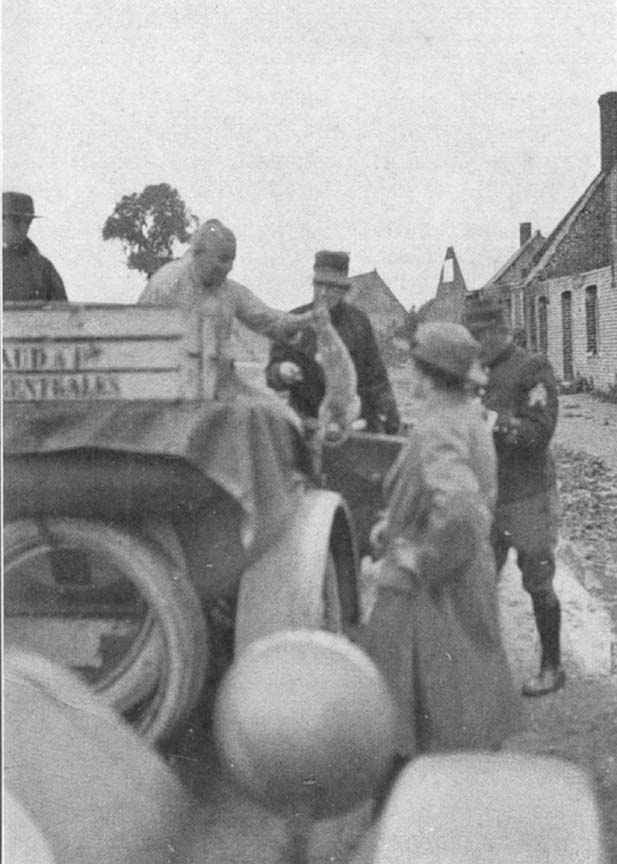
I took up about a dozen picture books made from the pictures the South Church Junior Endeavor sent me, and the children adored them. I also bought dozens of balls for the little boys from some of my "fund" money.
It was a wonderful experience, and a marvelous trip, and I wish you could have shared some of the joy I had.
PARIS, July 17, 1917.
Sunday morning at nine I started for Noyon again. I fortunately have a pass which is good for a week longer. It was a glorious morning, and to me it is always thrilling to get beyond Compiègne. We took a little trip on the side through Olincourt, Bailly, Tracy, etc., and went through endless French trenches and abris. They are so wonderful, and it so thrilling to wander down in the earth and see miles and miles of these trenches and abris, just as the soldiers left them.
We had a wonderful day, and, when we reached Noyon, found Doctor Kilham, who is in charge of a depot for relief work there, who greeted us most cordially. We also found that the car we went to get was not ready to be taken out of the repair shop, so we spent the night at Noyon, at the so-called, but unfurnished, hotel I have written about before. Each time I see it, it seems more like a stage-setting than a reality. But my night, sleeping in a chair (a chaise-longue), was more of a reality than a dream. Unless you bring your bed to this hotel, you don't find such a luxury.
Fortunately Doctor Kilham had a chaise longue and a blanket, and so with a comfort pillow which some dear American made for a blessé, I was most comfortable. I was sorry there was not a note attached to the pillow, for I should have had lots of fun acknowledging it.
There was precious little gunfire to be heard, and, thank goodness, no air raids during the night. However, the town, what there is left of it, has been carefully canvassed and on the outside of each house is a sign saying how many people can be housed in the cellar, in case of an attack.
After a quiet and peaceful night we got up early, expecting to start back, but as usual there was something else which ought to be fixed on the car and it couldn't be used for another day. I could n't be away from Marlborough when I did n't have to, so I came down by train. The way they have cleared up the débris of war and destruction in that part of the country is marvelous.
To-day I worked until after seven, with only a short time out for lunch. To-morrow I am going to take a day off that is not Sunday, and am going by the eight o'clock train from the Gare du Nord for Noyon. I shall get up there before noon and motor down. This is positively my last appearance in that wonderfully fascinating war zone, for my pass runs out on Saturday. I have had wonderful chances, and I feel that what I have been able to do financially in the way of relief, has repaid the French government for the privileges they gave me.
We are all very well, and it is quite cool and rainy for summer. In fact, it is hard to believe it is the middle of the summer. Marlborough is still in Paris, I am thankful to say, but we all know that General Pershing will send some of his staff out soon. Naturally Marlborough hopes to be included in that part of the staff, so I shall not be selfish about it. But there is nothing about duty at the front that is over-cheerful, from my point of view.
However, this war must be fought and won, so I guess it is up to us all to "trust in God, and fight like the devil."
PARIS, July 22, 1917.
Yesterday we received a letter from you written July Fourth, and I felt badly to read in it that you would be so interested to hear about the Fourth here, for I knew I never had written about it. At the time I purposely did n't write about it, fearing that I might not give the impression that it was a wonderful day for France. For to me the day was overwhelming, seeing our American troops, so young and strong, about to face the Boche, thinking of the many lives to be sacrificed, and of how America was about to begin to realize what this terrible war means.
I took Mollie to the gallery of the Court des Invalides, where the presentation of the flags took place. And such a setting for the impressive ceremony! The French troops were drawn up on one side of the Court, and the American battalion of infantry on the other.
When General Joffre and the other distinguished French officers came in, the United States band played the Marseillaise, and when General Pershing and his staff officers came into the hollow square formed by the troops, the French band played the Star-Spangled Banner.
Then they reviewed the troops, and I assure you that when General Pershing walked down in front of his first line of American troops in France, one felt that the "Vive l'Amérique" which went up from the crowd could be heard across the water. At the same time tears were rolling down the cheeks of nearly everybody. Of course many of those infantrymen will see the end of the war, but not a man or a woman who looked upon them did n't realize the sacrifice that the first troops that go in have got to make. Naturally the part of the line the American forces are to take is being kept very quiet. But there is not the slightest doubt but that the Germans know, and I fear their first blow will try to be a crushing one to America. However, we have got to keep our heads up, and face the future cheerfully.
I hope, and am glad to hear, that the training is going on so well at home, for we must have a trained army to replace our regular army when needed. This hideous war must end, and we all know what ending it must have.
Thursday the general told Marlborough that he was needed to work on things of his own branch of the service. And he has been given the training of aerial observation in connection with field artillery. The world knows that aviation and field artillery are two big factors in this war, and I have said all along that the man who had the organizing and training of artillery observers from the air was one of the luckiest men in the field artillery, at the same time always saying to Marlborough, "but thank goodness you don't fly."
He has been flying as observer a good deal lately, however, and I have got over my silly notion in regard to flying. And I assure you flying-machines in France are not like American machines. He is tremendously interested in it, and although it may take him all over the place, the big aviation training places are near Paris, so I think he is bound to be in or near Paris part of the time.
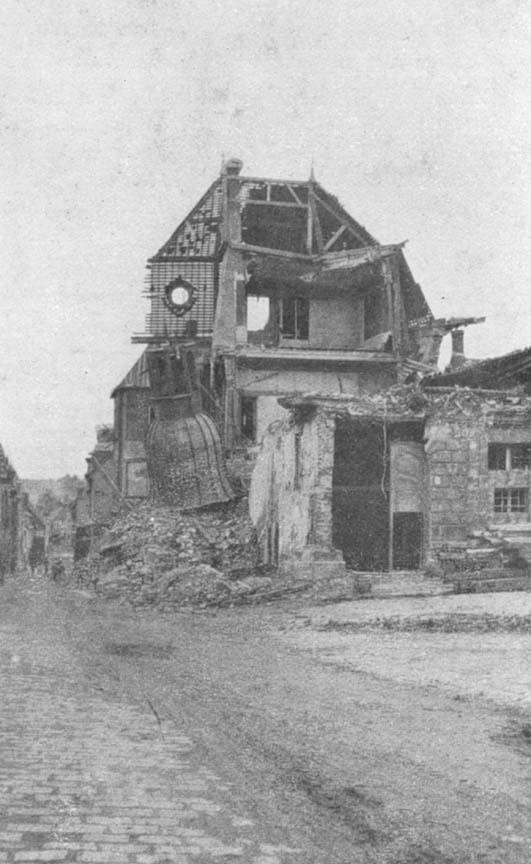
The day I left for Noyon at eight, we arrived about noon, found the camion ready, and, after getting so-called lunch there, we left for Avricourt. This place is very much in ruins, but the saddest spot was in the grounds of the once beautiful Château d'Avricourt,. Prince Eitel Friedrich had this place for his abode and before retreating took all the beautiful things from it and sent them back to Germany; then he blew up the château. It was a mass of ruins, but the horrible wreck was being cleared up by a large gang of German prisoners.
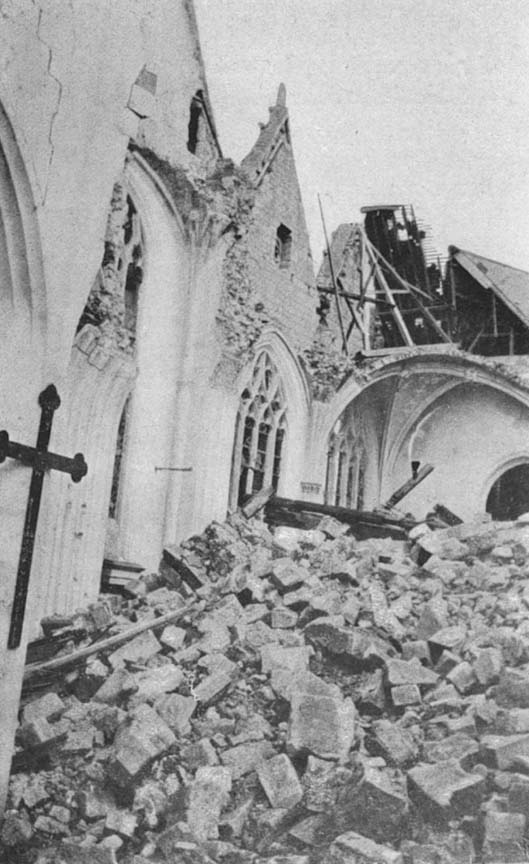
We then motored up to Roye. We found Roye very much in ruins. The cathedral must have been a most beautiful one.
From Roye we went to Montdidier, then down to Senlis and Paris. Before reaching Montdidier we went through many absolutely ruined towns, and such shell-holes! We could barely get the motor through. The trenches and abris we went into were more temporary looking than the ones we had seen before, but oh, all so interesting!
I have had wonderful experiences and wonderful opportunities. For a time, my trips to the evacuated district are over, but through my many generous friends I feel that I have been able to bring sufficient help to warrant every trip I have taken.
PARIS, July 29, 1917.
Probably O----- has told you all the news of Paris, and how as a farewell from Paris they were treated to an air raid. Moll and I sat on her window-sill, in our wrappers, from eleven-thirty until after one, watching the endless aeroplanes. It was certainly spectacular, but a spectacle I could live without. It seems they were not Zepps, but a flock of German aero planes. The few bombs they dropped didn't do any damage, but they had the places spotted pretty well.
Last night I was invited to motor out to the Trianon Palace Hotel, at Versailles, for dinner. I accepted at once, and it was too heavenly down there, --- a glorious moonlight night, and the war really seemed a million miles away, and almost forgotten. We motored home the long way, and I didn't get back to the apartment until about midnight. I had barely put my light out, and settled down for a nice night's sleep, when the sirens, bugles, and fire-engines were turned loose again, and another raid was on. Two nights in succession seemed a little too much. Fortunately Moll did n't wake up until the "all over" bugles sounded.
It has been rainy to-day, and I think is fairly cloudy to-night, so I guess all will be quiet. I certainly hope so!
Marlborough has been away since Friday, up on the English front. He motored to Dunkirk, and is up where that terrific battle is going on. He went purposely during these terrific days of battle to see how they used their air service, with the artillery, and with what results. I am getting used to his constant flying. He likes his pilot very much, but to me days when he had Jinny to ride, and the gray horse and the little red cart to drive, seem less nerve-racking than the present days, when he has a big Renault car, and his own Farman 'plane. However, I guess he is just as safe as I am in a taxi!
To-day word came in from Nancy that they were evacuating, and that there were hundreds of babies and young children who were in urgent need of clothes and milk, and must be removed at once, for they were all too small to wear gas masks, and gas bombs were being used extensively in that sector. We sent three camions of things, as well as nurses from the Red Cross, directly to Toul. I was so glad that I had personally hoarded fifty cans of condensed milk for just such an emergency.
I think that America, and particularly little Andover, Massachusetts, did wonderfully well for the War Relief Fund.
It is so heathenish to think one country appropriates all it can for engines of war and ammunition, while another gives what it can for the relief of the suffering. I am strong for peace, and wish they would all cease ruining lives and property.
PARIS, August 5, 1917.
Marlborough had a wonderful time at the English front in Flanders, and what do you suppose he did while he was there? Last Saturday night several Hauley-Paige 'planes were going on a bombing raid on the German gares, ammunition dumps, etc., and he was asked if he wanted to go along. I am afraid I should have found important business to attend to, but not Marlborough, ---he went.
They flew about thirty kilometers back of the German lines, dropped bombs on railroad stations, ammunition stations, etc. The Germans put their searchlights on them, which Marlborough said was the only uncomfortable time, --- to be suddenly thrust in the lime-light. There were no shots which came uncomfortably near, he said, but I assure you a bombing trip over the German lines is a thrilling experience, is n't it?
The household is a bit upset to-day, for Sophie's brother left last night for the front; he is in the Foreign legion, and by the looks of her eyes she spent the night in tears. But to-day she is in tears of joy, for she has heard from her father for the first time since the war began. He and her two sisters are all right and all well. When one is resigned to no news, the sudden joy of even good news is upsetting. Really what people can go through and are going through, in this war, is a revelation.
PARIS, August 7, 1917.
We were so happy to-day to receive letters from you all. You never say the same things, and if you did we wouldn't mind. You are apparently canning everything in sight, but you won't regret it. You are probably sick of the sight of a Mason jar or a jelly tumbler, but I know just how much like a million dollars they will look one of these days. I hate to think of your doing it in all the heat, and your prophecy that it was probably hotter in Paris was wrong. It is cool and rainy, and I guess we are not going to have any warm weather. As Moll and I have both used our silk puffs on our beds practically every night, I begin to wonder what we can do when winter comes. I see where we shall have to have two apiece then!
You have asked what Moll was doing this vacation, and I don't wonder you ask. Until to-day some of the girls have been in town, and it is either having some of the girls for luncheon, and tennis at St. Didier Club in the afternoon, or spending the day with the girls. And if there has been a free morning or afternoon she has come to the Alcazar and has done some good work. Although it is not even warm, I know she should have a change. It is hard for me to make up my mind to leave Marlborough, but next time he goes out perhaps I can get away for a few days. Sundays we try to get away for the day, and it really means a real rest, for then we are out of call of our good friends, and from all work and writing, and must relax.
If it does not rain this Sunday we are going to try and spend the day and possibly Saturday night at Fontainebleau. And one Sunday we are going to Sceaux, where the cafés are up in the trees. That idea pleases Moll a lot, and it delights my soul not a little.
We had one Sunday in a lovely garden out beyond Auteuil, and down by the quai. These days out of doors, when we can all shake our work and all be together, mean everything to me.
You asked if food was higher and harder to get. It is quite a bit higher than last winter, for instance, but there is plenty of it, certain things are harder to find, but you forget them, and just have something else.
Paris is simply bristling with Americans; land knows where they all come from, or how they get here, but they are all here, and most men in uniform of some description.
HOULGATE, CALVADOS, August 14, 1917.
As you see, the bird has flown, and I am not in Paris, but up here in Normandy, in a wonderful seashore spot, Houlgate. Last week Marlborough found he would be away from Monday until Friday of this week, so that seemed like a wonderful chance to give Moll some sea-bathing.
Although I know no one here, I heard the beach was fine and only six hours from Paris. Moll and I spent three hours Sunday afternoon going from one commissaire de police to another, to get our papers, and left Paris at eight o'clock yesterday morning. It was a delightful day, and as we had only two people in our carriage part of the time, the time passed very quickly, and, after a fine luncheon on the train, we arrived at two o'clock.
The hotel is large, and all but sitting on the beach; the Casino and the hotels on the beach are now hospitals. Our room is very comfortable and the table is very good; as it is an expensive place they both should be good.
After signing all papers here to register with the police, we went at once to the beach, where we reveled in the sand all the afternoon until about five, when we went in for a swim. The water was perfect, and we hated to come out, and have both decided that the Channel is a fine place to bathe. But it was queer to bathe with two huge Taubes floating in the heavens above.
We sat around and watched these funny French people after dinner, and then had a nice night's sleep. This morning we were in the water again at eleven. I can't tell you how funny it seems to loaf, for since September 15 last year I have only missed one day from the Alcazar, excepting the days I had near the front. I thought I would bring bunches of letters to answer; then I decided as I had but four days to be away I would get more rest if I did absolutely nothing.
The beach is huge and wonderful, and our bathing-suits would almost shock the Shack styles. They consist of short trousers, not bloomers, and a short Russian blouse, and the best part of all no stockings. Moll is loving it all, and it is such pleasure to do this for her. After the wonderful year she put in at school, she deserves a fine time. With her new striped silk sweater and cane, she is quite the smartest thing on the beach.
This afternoon we walked by the beach to Dives-sur-Mer, the next place, where I purchased two platters at a very small price, to replace two which have been broken, at a big Normandy pottery place.
Then we ran across a fascinating spot, a hotel, or at least an inn, the home of William the Conqueror. The inn and the wonderful things in it and the garden one could never describe. We had tea here, and incidentally a thunder-shower!
We shall be here two more days, then back to Paris Friday, when Marlborough will get back. He is out all along the "to be" American line, and seeing what the opportunities for his work at headquarters will be. I have visions of his leaving Paris for headquarters about the middle of the month, although nothing has been said yet. But I know that is the reason we are not summering any longer, and I am sure you will quite understand. Do not think that we are suffering with the heat in Paris; it has been cool all the time and hard to realize that it is summer. Why it is I don't know but this place is really summer-like; light clothes look and feel all right.
To go back, --- Thursday night we dined with the American consul-general, and had a delightful time, for he is a dear. Then came Marlborough's birthday, and a nice little birthday dinner by ourselves at Tour d'Argent.
Sunday night we dined with General Pershing. He had a dinner of about twenty-five, and out of the twenty-five about eight women. General Joffre was expected at the dinner, but at the last moment something turned up to prevent his coming. I am sorry it did, for I should have loved to meet him that way.
PARIS, August 20, 1917.
Here I am back in Paris again, after five perfect days at the shore. We arrived about eight Friday night, and found Marlborough here; he had arrived about an hour before. His trip had been very successful, and delightful as well. I quite envied him the trip to Rheims, for that is one place I would love to go. I think he was surprised to see so much of the Cathedral standing, for they are constantly dropping shells in there, and you wonder there is anything left.
I was delighted to find letters from you all waiting for me, and a box of sugar from you. Thanks a thousand times, for that means we can ask people in for tea without the fear of lack of sugar. And as one of my co-workers, who has just gone home, gave me a couple of pounds she had, I feel rich in sugar.
You asked if I liked the sugar, or what we would like. Of course the sugar is wonderful, and a tremendous help, and if I could have a box about every three months, our guests could always have sugar. I would love another box about December. Moll and I often think about the gum-drops you sent, but they are hardly a necessity! They really arrive better than hard candies, for some reason, for some of the hard candies showed the effect of sitting in a hot place on the way.
The only idea for us all to have at present is to beat the Boche. Marlborough said when he went along the line where the American troops are, the appearance and military discipline made an excellent impression. They all looked in fine shape physically, and ready for what 's before them.
You say you know nothing about troops leaving America; we know the same, nothing, about their arriving in France. I heard yesterday that certain artillery regiments had arrived. I imagine few of the original people are still in those regiments, and as they don't come to Paris, it takes some time to hear who is here. How I should love to sit on the dock and see everybody as they land! Canteen work at the American Base was terribly tempting, but you can't do everything, although you want to.
PARIS, August 26, 1917.
Marlborough has been away for a few days but came back last night, and to-day received the news that he was a lieutenant-colonel in the National Army. Colonel Churchill seems too wonderful, and naturally I am perfectly delighted. My card plate is wearing thin, changing titles so often. I have just received the Major and Mrs. Churchill cards!
The colonel leaves for the front Thursday, and it is hard to realize that he will be at the front until this terrible war is over. His work, I hope, will bring him back occasionally. All the courage and cheerfulness I have learned from these wonderful French people this past year helps as I face this none too cheerful future. Although I am terribly proud to have him out there doing his part, I assure you the fighting on this western front is something one can't conceive of.
Yesterday came a letter from Ham from Doctor Kilham, asking whether, if I could get a hundred more rabbits, she could have them. It was so gratifying to have the money for them from my "fund" and to know that fifty families are to be made happy. I sent for my rabbit man, and notified the doctor to send a camion down: the rabbits leave Paris at six this morning. As I was also engaged in buying a wooden leg yesterday, you see my duties vary.
PARIS, September 4, 1917.
Well, the hard break has come and past, Marlborough is at the front, and I am adjusting myself to life here without him. It was not easy to have him go, as you well know, and this war is n't a simple thing for anyone to face, but everything is by comparisons. And compared to the suffering about me, I have not a thing to even speak of, in simply separation, when we are all well, and all busy. He left Saturday morning early, and to-day is Tuesday, and I received my first letter this afternoon, which one of his associates brought in.
I am not worrying about his discomforts, for I think he is about to live in a marvelous château! In the note I received he said he saw practically everybody we know in the army, and when he goes to artillery headquarters I hope to hear particulars of everybody.
Life is certainly a curious thing these days. I am happy that we can feel our Government has been on the job, since we came into this fray, and the best part is they have certainly guarded a great deal from the press. They have said little, but evidently things are happening all the time, and our first big force is under intensive training at the front here.
I am still at my old job, and shall stick to it as long as they need me, and as long as the work goes on in the same way. The Red Cross has not taken it over as yet, and work is going on there in full force, yet handicapped by lack of girls, for until we know whether the Red Cross is to take it over, we cannot send for girls from this end. To-day came a rush order for two hundred cases of dressings for Roumania, so with the regular work it has been rather an exciting day.
When I came home for luncheon, I found that my maids were in a great state of excitement. A few days ago my cook heard that her niece, sixteen years old, had been left in some little town which the Germans had recently evacuated. It has been impossible for us to get into communication with her, to tell her where her mother was, and that her father was still fighting for France, and well. Although we couldn't reach her by letter, we could write to her father that she had been found, although nothing has been heard of her sister.
Yesterday the father was liberated from service and sent back to work in the mines, for he was a miner by trade. He happened to go through Lyons, and while there, just passing through, he heard his daughter had just been sent to Lyons by the Government; he went where the refugees were and found her, and brought her here to Clemence. So, when I came in, the poor old father and daughter were sitting in the kitchen, neither able to do much more than weep, their joy was so great. The girl had absolutely nothing in the world but the few clothes she had on, so I knew I must find a coat and hat for her, at least. My own wardrobe is a "war wardrobe," which I assure you is pretty nearly bare necessities. However, I did have two suits, which hardly seems extravagant, for one cannot stay in bed while one suit is being pressed! But when Moll said, "Mother, that girl needs it more than you do," that was enough. So with the suit and a small black hat and a pretty white blouse which I had given Moll but which she said was too large for her, we made the girl very happy.
One could n't really grasp what a horror the last three years must have been to that child. Death cannot be half as hard to bear as the mental agony and heartache for those whose children have been carried away. With the few sous a day the French poilu gets, and the child penniless, you can imagine the amount of money they had between them! They had a nice luncheon here in the kitchen, and the poor old man had only one other idea besides weeping, and that was to take the child to the mother. So, thanks to my fund, I gave him some money, and they left this afternoon for a little town out near Belfort.
PARIS, September 9, 1917.
I was perfectly delighted yesterday to have Marlborough call me up from "Somewhere in France"; it was fine to hear his voice and to know that he was all right. It seems that he had not received any letters from me, excepting a couple that I had sent out by men going out; he had telegraphed asking if all was well, and had had no reply. That telegram I have n't seen yet! So you can see the front is not a very easy place to communicate with. Just where the letters have gone that I have mailed daily to him, I know not. But the nicest part of all was to hear that he would have to come in some day this week, on business.
We are still working like beavers; yesterday Mrs. Lathrop told me that two thousand cases would arrive to-day, which does n't suggest a day of loafing.
Just how long they are going to continue to come no one knows. I hope the comfort bags from Honolulu are in this lot of cases. Have the Farmington comfort bags been sent? If they are all on the way, I think I shall make a collection for Christmas morning at the train.
Moll and I went down to the two trains this morning as we did last week Sunday, and had a beautiful time. There, were not more than two thousand men this morning, and most of them were in very good spirits.
Friday night we went to Mme Destray's canteen, where we gave the men a party, it being the third anniversary of the battle of the Marne. There were about eighty there, and they had a glorious time, eating, singing, and smoking their heads off. When you know what their daily life is, and the sadness and sorrows many are carrying in their hearts, I can't tell you the pleasure I have in helping them relax and for a few hours have a jolly time and forget the war.
There is so much sadness, as well as agony, in this heathenish war, that I think it is up to all of us to be as cheerful as we can, and give as much pleasure as we can. The other day after Marlborough left, and I felt as if the bottom had dropped out of life, but knew I had to go on facing the unknown future cheerfully, I know I walked down the Champs Elysées with a long face, for life looked pretty serious.
Before I reached the Alcazar, I passed a dear young poilu, with both arms off above the elbow. He was alone; he had a cigarette in his mouth, and was as cheerful as a May morning, walking along with almost American energy. At once I was ashamed of the sad feelings I was trying to walk off and realized I had nothing to be sad over.
When I reached the Alcazar there was a cheerful, jolly Colonial, in his little red fez and baggy trousers, with both arms gone at the shoulder; he just thought he would like to see the work there, for he had received such nice things from there, when he was in the hospital. When he apologized for not saluting but, as he said, had given his arms for France, that was enough. So people who have health, and have not met sorrow in this war, ought to be taken out and shot at daylight, if they make themselves, and everybody around them, miserable, worrying about what might happen. Be cheerful for those who have nothing left in life to be cheerful over is my motto.
PARIS, September 14, 1917.
How could I write you anything nicer than to tell you that Marlborough is sitting here doing some work on his typewriter.
Yesterday he reached me on the long-distance from the front, saying that he was obliged to come to Paris on business, with General K-----, and that they would both be in for dinner about eight. Almost on the minute they appeared, and although the two weeks he had been gone was nothing in these times, it was and is such a joy to know that he is going to be able to come in sometimes, and what is more will have to, on business!
And now that this first break is over it will be much easier, although life at the front is not one you would choose. It is not that he is living in the front-line trenches, far from it, for he is at present in a delightful and historic château. But with German bombing raids, there are places safer than headquarters. It seems the Huns thought they had made a ten-strike the other night and even had the general's house, but it was the next town, which from the air looked the same, --- statues in the square and all. A miss is as good as many miles.
I know you have been roasting to death this summer, and I hope have cooled off now. I have been warm twice this summer, and only one of those days would it have been more comfortable without a coat. And as for the coming winter I am well provided for in wood; yesterday I received 140 francs' worth of wood, and stored it in my cave in the cellar, so don't give me a thought, and I also have the wood from many boxes sent to me. I know the joy of a box-cover fire in the bed-room, but I can't believe it is all but time for such things again, not having any summer.
PARIS, October 1, 1917.
I have been to see the work being done for the re-education of the mutilés at the Grand Palais. The entire building is now a huge military hospital, and in the courtyard are many little shops where the convalescents are allowed-to learn a trade fitted for artificial arms, or maimed and helpless hands, some work which will give them employment during the period of convalescence, or fit them for a new trade in their maimed condition.
I have been especially interested in a little shop where the men were making and dressing dolls. It is most complete. They take a bit of pulp and place it in molds and presses, and it shortly turns into arms, legs, and heads for dolls; they put them together, and paint the faces and arrange the clothes and hair with the utmost interest and care.
These men are either convalescing to go back to the front, or to be discharged and sent out into the world to find employment, crippled in body for life. There were many of these men about to be discharged, and there seemed to be no way of fitting them out with warm clothing. So some money from my" fund " was put into good warm underclothing and socks, and their gratitude was almost pathetic. To-day I received a couple of dolls for "the kind American ladies who sent them the clothes." The costume of the one I send you was surely a special effort. Bless their hearts, these poor poilus have such courage, one could never do better than try to follow their wonderful example.
PARIS, October 2, 1917.
These days are naturally crowded with important work. I hate to be pessimistic about any phase of it, but with Russia practically out of the running, what is to prevent Germany from putting her entire force on this western and Italian front? I think we all realize that we have got to go the limit in preparation to save the lives of as many of our men as we can. Dear little old France is still pegging along and I feel that her hardest winter was last winter. I think that this one will be easier, for the English troops are in fine form, and the American troops are on French soil and can be in shape to help soon..
Marlborough is busy. He is, by the way, a lieutenant-colonel in the Regular Army now. I can't follow all the changes in rank of all our good army friends. I want to see them all do their part in putting down the Hun --- quick!
Last night the heavens were so full of aeroplanes one couldn't do any dreaming. I was turning in about twelve when Moll opened her door, and said, "The aeroplanes are making such a noise they woke me up." And I didn't wonder, for the noise was exactly like the sawmill which used to "sing" so constantly when we lived in Elm Square. So with the pink satin puff about her and the blue one about me, we hung out of her window. The heavens were full of aeroplanes. With their lights they are the prettiest things in the world. After a while we went to bed, but I guess the noise went on all night. The Boches are getting active in the air now; they will bear careful watching. England is getting her share of annoyance from them, but I hope she will continue to keep them under control. The Germans are busy all the time, whether they are in the trenches, under the sea or in the air.
Of course losing Riga, and having Russia practically out of the game is no joke. England, however, is doing wonderfully well and her strength to-day is superb. She may have taken three years to build her army, but she has arrived with it now.
PARIS, October 14, 1917.
I am wondering if letters with you are as irregular as they are at this end. I received one of September fifth and one of the twenty-third at the same time. They are a joy to get, so I don't care when they come.
I went to my little canteen Friday evening, and a Frenchman on permission in Paris, who was a noted opera singer and head of music of some division, had promised to sing. P----- went with me and thought the whole thing was one of the most impressive things he had ever seen. This man sang most divinely; you never heard anything more wonderful. It was he who stood up and sang at Rheims when the Cathedral was being bombarded; for this he was afterwards decorated.
I know that you will be entertained when you hear that I am now in uniform. There are so many women arriving in Paris that the A. F. F. W. thought it best to protect the young girls working for them by having a uniform. Consequently it was up to the old workers to get their uniforms at once. The motor service have always been in uniform, so we adopted their summer type, --- a covert cloth, with dark-blue collar and sleeve ornament, the Sam Brown belt, and I adopted the leather buttons in preference to the Red Cross buttons, which look much smarter. The shoulder straps have A. F. F. W. in dark blue.
My hand is so cold I can't write more, so I must go to bed to get warm. I think that until November 1 we shall be having some of our most uncomfortable days, for we can't have heat until then.
PARIS, October 19, 1917.
We are all so pleased over the bagging of the bunch of Zepps day before yesterday, and naturally it gives one a feeling of confidence in French anti-air gunnery. The one which came down intact, and surrendered, is within a few kilometers of Marlborough.
The alarm was given in one section of Paris by the Gare du Nord, but not up in this part of the world. As this was at two o'clock, and the "danger past" not until five, I am glad I was spared.
Moll and I are well, and she is so interested in a Halloween party she is going to, she can think of nothing else. She must go as a black cat; it is an awful thing when the next generation have the same ideas you have had. She was much amused when I told her that I went as a cat once. So in our odd moments we are constructing a cat!
By the way, if you can get another box of sugar started to me for December I should be awfully grateful. I still have one box untouched, and it may be enough, for I know I shall not have to use any of it this month. But our sugar allowance has been cut down a third, allowing half a pound per person a month, and that allowance has been struck off for the month of December on our card. No one can buy ahead, for you can only get your allowance anyway. It does not bother me a bit, for I don't think we need it. Clemence's filleul, who is a Belgian, was in last week on permission, and he said there was lots of sugar at the front, and that he would send her a kilo in December for cooking. So I know we shall probably have plenty, but if it is not hard for you to get, I think another box started for us would be wise.
Milk is also hard to get now; you can't get milk after eight o'clock in the morning. In a private house that means nothing, but last week when P----- was up, he said he ordered his coffee about eight-thirty at the hotel, and they said it would have to be without milk at that hour. And you can't get milk anywhere with afternoon tea any more. As Moll said, what is to prevent the cows from giving milk, even if it is war? But the truth of the matter is the cattle are being consumed by the army, and the lack of men results in lack of care for breeding, therefore there is much less milk.
We are all delighted to-day over the good results of the Aisne offensive, and it is such a help to have this little bit of cheer come now. Every inch of ground gained, I feel like getting out and waving the flag. 1 don't believe in America one can realize what a fighting machine Germany is.
PARIS, November 2, 1917.
The news from Italy, coming just now, is too disheartening, and so unexpected. Whether the Hun means to get into the heart of Italy, or pass through and hit at France in a new spot, remains to be seen, but we shall see pretty quickly. And those poor Italians have done so well, and under such difficulties.
This is All Saint's day, and a real holiday for me, as far as the Alcazar is concerned, which is quite wonderful. But a holiday not only means no Alcazar work, but a grand chance to do some of the other million things I like to do.
At present I am tremendously interested in a mother and daughter who have been sent out as refugees from St. Quentin. During these years of the war they had been hiding in their house the son, who was not strong physically, from the iron hand of the Germans. The husband and father was taken at once, and sent somewhere to work in field or factory for the Germans. His fate they never knew. But for over two years they kept the boy hidden in the cellar, until, a few days ago, they were told to evacuate, and the boy was discovered. Naturally his fate is unknown to them now.
This mother and daughter are people of very comfortable circumstances ordinarily, but now suffer the same fate as every other refugee. Mlle. Fritsch secured work for them both, and her gave them a garret room, with nothing else, for she had nothing to give. I told Mlle. Fritsch that if she would find a couple of rooms for them, which they could call their own, I would (out of my, "fund ") pay their rent for a year, and through other people get them a few necessities. At the end of that time, both being able to work, they could get on their feet, and take care of themselves. We have found the place for them, and last night they came up, and we fixed up the papers, and paid down the first three months' rent. I never saw such courage in my life as they have, and such gratitude.
To-morrow, after work, I am going to get them a bed (someone has given them a mattress). Mrs. R----- is going to give me a table and two chairs for them, and some sheets and towels, she brought with her. I asked them if they had anything, and the woman told me of the promise of the mattress, and said they had towels, for they did a few clothes up in towels to bring out by hand. And not wishing to take from me anything which they had themselves, she said, "If you have towels don't give them to us, for we have four; give them to those less fortunate who have n't any." And to see them, one would never suspect they needed anything; for that reason it is more difficult for them, but they have literally nothing.
Yesterday they saw someone who left St. Quentin after they did, who told them that everything in their house had been taken or demolished by the Germans, and if St. Quentin were evacuated to-morrow they would find nothing of what was home to go back to.
It is impossible to imagine what one's feelings would be, under such circumstances, but their courage is something wonderful to see. And they never show any bitterness, or wish they could be spared facing the future. Instead they show tremendous gratitude for any assistance, and face conditions with the realization there are others less fortunate than they are.
PARIS, November 3, 1917.
Yesterday morning a dear little French lady, with a little black bonnet and a tight-fitting, jetted cape, came into my office and brought me a diplôme de belle action from the French Comité National Central, voted at their meeting of October 7 in recognition of my kindness to the poor soldiers blessés et tuberculeux. Naturally I am terribly pleased to have it and will send it to you to keep for me, for it will interest Moll to have it après la guerre. The society was founded before the war, for the relief of suffering.
Until two days ago this house was so cold that my hand refused to make even signs after a couple of hours of writing. Now that the heat is turned on we are blissfully comfortable.
We have sent pink pajamas and a pair of hospital socks to Moll's filleul, who has written that he is in a hospital in Flanders, not wounded, but having a lot of trouble with his right leg. We have not seen him for some time, for he was sent from Verdun to Flanders at a time when there was too much activity for permissions, but she is still faithful.
I still have the refugee here in the house, Clemence's niece. She is normal now, and, poor child! I would gladly do anything for her, and Moll is so good to her. Moll had a Victor given her, and Eugenie builds a fire in Moll's room for her, and takes in, her tea, and is absolutely happy if Moll will start the Victor and let her stay and hear it. And Mollie never tires of hearing of her life with the Germans.
Marlborough just appeared! And I am too happy to have him back here again. He brought a huge piece of the L 49, one of the Zeppelins that were brought down.
PARIS, November 7, 1917.
Yesterday afternoon I met a charming English colonel who has just returned from Italy. He was telling of conditions there, which are none too cheerful, and his remark, "This is some war," fully, yet simply, expressed the feeling we all have.
If you could see the pile of letters I have before me you would be sorry for me. All the women and girls I know at home, who are not over here, have written asking me to send for them. They'd better stay where they are, and keep up their good work at that end, and prepare for what is before them, in caring for our own convalescent, blind, and mutilated. That has got to come, and the work of that kind will not all be here in France. They'd best leave their share of food here for some man who has to be here. It is appalling when you think of the number of men in France to-day from all the Allied countries.
Thousands of women are arriving, and such a collection. Many have never stirred from their home towns before, and I think it is a crime the way all these young girls are flocking over here. What their parents are thinking of I don't know.
I have received the letter written my birthday, and in it you said you sent off a box of Christmas jokes. How could you? I can't even think of a joke. After reading that I nearly sprained my brain trying to think of something funny, but nothing came! You know, I am getting queer, in Paris for the fifteenth month and cannot even think of anything funny!
PARIS, December 5, 1917.
I recently received a case from E----- in fact two cases, which contained men's clothing and endless perfect woolen gloves for children, and boys' and men's caps. As everything seems to arrive at the right moment, these cases did the same. I sent the men's caps and suits at once to Mme. Destray, for her réformés and refugees, and although I did n't have a chance to go over that night, I heard that my sack of clothing went in one door and by pieces walked out of the other, each article on, and making some man more comfortable and happy. The children's gloves I sent at once to a little orphanage, which has fifteen little girls and is supported by the income of the dear little woman who runs it. She is seventy-two, and at the present moment very ill, but will, I think, get well. Just one other woman looks after all fifteen children, and if Mme. Anderson should die no one knows what would happen to her orphanage.
On Christmas this dear little old lady always asks all the poor old beggars of her Quartier for a Christmas dinner, consisting of soup and meat-and-vegetable stew. They are all welcome, and can have all the soup and stew they can eat. The fact that she was lying in bed and could do nothing this year was not helping her convalescence, but was making her very unhappy. So Miss Dagmar and I decided we could slip that Christmas party in with the other things we are trying to do. She is going to be responsible for the poor thing's dinners, and I am going to give the orphans a Christmas tree and hot chocolate and cakes. Miss Dagmar went to see the dear little lady the other day to tell her for Christmas Day she would be the grandmère, as the poor all call Mme. Anderson, in her arrondissement. She was so happy and relieved that her poor and orphans would not be forgotten, that she could do nothing but weep!
This last week I have had the joy of giving personally to men who were suffering with the cold, and about to return to the trenches, each a sweater, scarf, and socks, knit by your good workers in Andover. Yesterday a nice little French soldier came into the Alcazar to help with the cases, and was so glad to see me; he said he was at Mme. Destray's canteen last Christmas, and remembered me. He is now just out of a hospital, the third time wounded, and his joy was inexpressible that his month's convalescence would not be up until after Christmas, and that he could go to our canteen party again this year.
He was so neat, and such a well-set-up chap, yet he came to me and showed me that his negligé shirt was all he had on under his blouse. He didn't have an undershirt or a sweater, but had a scarf, which was doing all a scarf is expected to do and more. I gave him an Andover Red Cross sweater that I had kept for an emergency case in my desk drawer, and a nice flannel shirt. Needless to say the man was happy, and I know he was warmer.
To-night before I left my office they said an Arab, Mohammed Ab Something, was there, with a note officially stamped, saying that he would die of the cold if warm clothes couldn't be procured for him. My desk was piled high with work, and, knowing I had nothing there for him (the A. F. F. W., you know, is just for hospitals and wounded), I could only send word that if he would come in the morning I would give him a sweater, socks, trench shirt, etc., which I could bring from here from your Andover work. They said he was almost on his knees in gratitude, and asked if he could n't come in and kiss my hand! They told him he had better wait until morning, when I gave him his things, for I was very busy! So I have the Arab's gratitude to you in store for me in the morning.
This started to be a Christmas letter but, as usual, I have wandered. But I did want to thank you all for making my work possible, and I know you will understand if my evenings must be spent with some of the million things I have undertaken for Christmas and my letters for a few weeks rather brief.
I simply cannot help in the work of filling comfort bags for our own men, so Mollie is going to the Lyceum Club every Thursday afternoon until Christmas to do this. One of us I felt should share in this work, and I couldn't send a better substitute than dear old Moll.
I had a nice letter from Marlborough, who is well. My Christmas letter, queer as it is, must go now as it is! It carries all my love, and every wish for a Merry Christmas and a Happy New Year, and the hope that before another Christmas season we may know what peace is, and may all be spared to enjoy it together. Our thoughts of you all will be foremost on Christmas Day, and may you receive this before the Fourth of July!!!
Your foreign "home folk."
PARIS, December 13, 1917.
Until after Christmas I must snatch a moment here and there to write, and every now and then call it a letter and mail it. It seems to me never was there more I wanted to say, or never was I so full of gratitude to the Andover Red Cross. Two cases through the Red Cross turned up to-day, which gives me more for my hospitals' Christmas, and four boxes by mail from Mrs. G----, some from Honolulu, and some from New York. Twenty of Mrs. G-----'s children's bags I am going to use for my orphanage, and the others I gave to Miss Brent to-day; she will take them to Nancy to the children's Infirmerie there, for she is to be there for Christmas. Nothing ever arrived more opportunely: now I shall not have to get little things for the orphanage, just the useful things.
The collection of things I have bought would fill a book. Mollie took to school to-day two dresses, caps, scarfs, and black aprons that I had bought for her for two orphans who had just appeared. on the scene, and were coming to her school tree for orphans, but would get there so late that there would be nothing for them.
Mollie and I could n't think of that, so that is attended to.
The father and mother of my little refugee girl, the one here in the house, I am sending blankets to, and my St. Quentin refugees two pillows and a carpet rug. So you can see there is nothing that I do not buy. We are all doing what we can, and you will realize it when I tell you that a dear old poilu without any legs is trying to get French tobacco for me, for my hundred bags, for my canteen party. Not one cigarette of French tobacco or any packages of tobacco has one been able to buy in Paris for two weeks at least. And this dear old soul thought he had an inside track somewhere, and could get me some. I hope he has, and it only shows that there is not anyone who is not glad to lend a hand in bringing comfort and cheer to those who are fighting this war for us.
To-day I had a wonderful example of that, when Miss Davidson, who does so much for the blind, brought in a most charming Frenchman to see me, a most perfect type of gentleman in the real sense, most refined and highly educated. Both his eyes were gone. He said, "No one knows how hard it is for me to do nothing, when I have friends and comrades in the trenches. If I could only take the place of some man in an office, and free him for the front, I should be happy." He wants a position taking dictation on the typewriter. He can take either French or English, and speaks four languages perfectly. But to see this tall, well-built, good-looking, wonderfully turned-out Frenchman, with eyes bandaged and two black patches, standing before you, saying, "I know I am a mutilé, but I can still serve my country in some capacity; I must do something, I can't sit here in the dark and let others do it all!" Poor dear --- as though he. had n't given his life for the cause! I am naturally going to do my best for him. You can never know what these men are like until our own men who have got to meet this fate go home, to be re-educated and fit themselves for their life in darkness. This blindness is too awful.
This morning Mollie had a note from her filleul from a hospital in Boulogne. It seems he has been gassed, and it has affected his eyes; at times he cannot see at all, and again he is all right. He was most cheerful, saying his eyes were to be operated upon the following day, when he hoped to be all right. I do hope he will be, for he has done so much, and been through so much, that we felt that nothing could happen to him. This new gas, like everything else, is more awful than the old.
A wire from Marlborough this morning says that he will pass through Paris next Tuesday. These visits to Paris I make the most of, for he is about to go back into the artillery. He is on Major-General March's staff as Chief of Artillery Operations. Major-General March is in charge of all the artillery over here. It will take him to another spot entirely, and away from all work which will bring him to Paris. But we have worlds to be thankful and grateful for, and although the next few months are far from easy to face, I am here, and that is everything in these days.
PARIS, December 22, 1917.
To-night was the first Christmas party, and it was such a success, thanks to you and the many good people who sent you the money for my use at Christmas. With this and Miss Dagmar's untiring efforts to get good musicians and plan the entertainment, and the hundred comfort bags the Boston Farmington Society sent to me, the party was complete. It even topped off with an air-raid alarm before I got home! As I had Mollie with me, and Marlborough was not in Paris, and I was too tired to get disturbed, it was just an added touch to the holiday season.
The party was at Mme. Destray's canteen, and there were one hundred and fourteen men there, some of them so happy to be back for their second Christmas in the same canteen. Their supper was excellent, as it always is, ---soup, stew, and vegetables, ---and we added wine, cold ham, salad, cake, oranges, and sweet chocolate.
Miss Dagmar fortunately saved up enough French cigarettes for the occasion. And through a good friend I secured enough tobacco for the hundred comfort bags. The place was in holiday attire, with holly and greens, and the songs and music which they had during supper were delightful.
Much of it was jolly and cheerful, although the poilu really appreciates good music and always sits spellbound. I fear the average American soldier is far behind his poilu brother in appreciation and knowledge of music. Towards the end of supper Mollie went about distributing the cigarettes and then gave them the comfort bags which had been piled on a table; in the center of this table was a dear little Christmas tree.
The bags were splendid, thanks to the good people who worked over them, though many of them had evidently been tampered with on their way over. But with my Christmas fund I was able to add to them, and they each had pad, pencil, envelopes, toothbrush, tooth-paste, socks, French-blue handkerchief, pipe, tobacco, and either checkers or dominoes. Many had names inside, but I knew a poilu could never read American writing, so I addressed an envelope and put a 25-centime stamp on it, and put one in each bag. I do hope some of the Farmington Society hear from them, but if not, they will have to accept from me the appreciation and the pleasure I had in seeing the joy it brought to the men.
Towards the end of the evening, after supper and after the men had finished examining their bags, the doors into the courtyard were thrown open, and seventy-five or a hundred Americans, headed by Doctor Cabot of Boston, sang Christmas carols. It was beautiful! And to see these hundred poilus, one by one, grasp the meaning and one by one stand facing the darkness where these voices came from and take off their caps or trench helmets, and stand spellbound, was most impressive. It was a wonderful sight and one I shall never forget.
After the carols were over and the ones who had taken part had left, it began to feel like a pretty serious and triste ending of the evening. But this was all over quickly when they asked for the American national air, with many a "Vive l'Amérique." And if anything is ever funnier than a handful of people who do not pretend to sing bursting forth in their most patriotic manner with "Oh, say can you see," usually pitched in high C, I am sure I do not know what it is! But our intentions were excellent, and a too solemn ending averted, and the party finally ended with a glorious roof raising Marseillaise. If you could only hear a hundred or a thousand poilus, in the midst of this too horrible war, throw themselves into the Marseillaise as they sing it, I should be happy. One could never make you understand what it is like; it is beyond what mere words can describe.
After the party was over, although only about half-past eight, Mollie and I were very hungry, so we decided that the quickest way to get back was to take the metro to Passy. We had hardly come out of the metro at Passy, when "bedlam" was let loose, all the sirens in the world screeching, and fire engines dashing by.
The night was glorious, with a full moon, and it was hard to tell aeroplanes from stars. While we waited for the tram, and walked from the end of the line, our gaze was all skyward, you may feel sure. Nothing happened, and now it is two hours after, the "danger past" signal has been given, and everything is as calm as a May morning. I have sent off my eleven poilu packages, and most of them contained some of your good Andover sweaters, socks, and mufflers, but not a cigarette! They send so much tobacco to the front, hospitals, etc., where there is a daily allowance, that not one bit of French tobacco have I been able to get in Paris for a month. A thousand thanks to all the good people who sent me money, and made these parties possible.
PARIS, December 29, 1917.
I must tell you about my orphanage Christmas party. I have written to you of Mme. Anderson's little orphanage of twenty girls, between the ages of seven and fifteen, and I told you that she was very ill, so Miss Dagmar and I told her we would attend to their Christmas.
Some surprise bags for children which Mrs. G----- sent me from Honolulu came to me just at the right moment, and they were lovely, and all quite different, and she had marked the appropriate age on the outside. And with my ever-delightful Christmas fund, I purchased a soft, warm, real wool cache-nez for each child. In our part of the world we would call them mufflers plain and simple, but as they always wind up in them until the nose is hidden, the name is appropriate. We had sweet chocolate tied up in bright ribbons, paper caps (we hope not made in Germany), and a shining new franc piece for each. And we gave them hot chocolate and cakes to eat. You would have laughed if you could have seen me getting there, the taxi filled with these things, and by my side a Christmas tree, with all its little trimmings, that we had had on our own table Christmas night.
Some of the girls went over to help us, but above all to be audience, for these poor little things had learned songs to sing and pages upon pages of poetry to recite. I wish you could have seen the faces of these little souls when they saw their table laden with cakes, and the Christmas tree in the center with all its little candles burning. My idea was to let them begin and enjoy it at once, but no, their songs must be sung and their poetry recited before anything as frivolous as eating could begin. Although I appreciated their efforts, I was a bit absorbed in whether my candles would last and whether the tree would catch on fire in the usual fashion. This did not happen, and such a thing should really go on record!
Before the children came in, and while we were arranging things in the kitchen, the brother of the one woman who cares for the children appeared. He had recently lost his wife and child, and felt that he must see some children enjoying Christmas. So we decided he should be Santa Claus, I mean Père Noël, and bring in the presents. He arranged a long white beard from some cotton I had brought over for snow, and with a blue cape, with hood turned up, and the gifts in a large pillow-case on his back, to say nothing of his cape and pointed hood covered with real snow, he was as good a Père Noël as one could wish for The children adored it, and he entered into their fun, and contributed tremendously towards making the party a success.
Although I shall always remember the Christmas tree for the children, on the after deck of a transport in the middle of the Pacific Ocean, as being an interesting experience, nothing could make the deep impression the simple little Christmas we gave to these twenty little orphans made. It seemed so strange to have Santa Claus look like Santa Claus, and yet speak the language of Père Noël!
PARIS, January 5, 1918.
I have had such a perfect ten days with Marlborough here, and although we were both busy all day long at our work, we were able to have lunch together somewhere every day. And we also have been able to have the evenings together at home, which is wonderful.
Last week came the news that he was to go back to the artillery. It means, of course, that my chances for seeing him so often are a thing of the past. But we are both so happy over the fact that he is with the guns again, and just where he wanted to be, that we are like a couple of kids.
It takes him absolutely away from duties connected with Paris, but during the past four months, with his many trips to Paris, we have much to be thankful for. I can hear from him, and I imagine the letters will not be more than a week old. It takes five days from general headquarters now. We can wire, and oft and on I shall see people coming and going to his spot, so you see I can keep very much in touch. Lucky me, to be this side of the Atlantic!
I was rather a shirker on work on New Year's Day, for we had a holiday at the Alcazar, and I had planned to go to Mme. Anderson's orphanage and help Miss Dagmar serve dinner to the beggars of that neighborhood. Mme. Anderson does this each year, for the paupers in her district, but this year she was not able to do anything on account of being ill. But Marlborough was here, and his time was limited, so I just did n't go, but, thanks to my Christmas fund, I sent a new two-franc piece for each, sixty in all. Miss Dagmar said that as she pressed the shining bit into each hand as they departed, it was a study to see their expressions. Their joy was almost pathetic.
I am thankful for each day that I have Marlborough here, and I expect each one to be the last.
I hope our cable went through to you on Christmas, but apparently, for weeks, the mail and cable have been all tied up in double knots. I don't care as long as the men down the line, who are, many of them, away from home for the first time, get their mail. They need it, to keep in the best shape. And think of the tons of it there must be, and with few facilities to handle it. One cannot expect anything like regular service for several weeks yet.
My one idea these days is to hustle through work, so as to get home by the time Marlborough does. This business of being a working-girl, and having a husband on permission, is a fearful combination.
One has to be neglected, and you may be sure it is my work!
PARIS, January 8, 1918.
To-day we received a lot of papers, among them the Townsman, which we read from cover to cover. The Andover boys' letters I adore. But the nicest things in the world are the letters I am receiving in appreciation of my Christmas remembrance to them here, all filled with such genuine appreciation of hearing from someone so near them who calls Andover home. One boy whom I heard from last night said, "I did n't think that I had any lady friend so near me in France, especially one who calls Andover home. It is Home Sweet Home to me, and I wish that I was there now." Mollie seconds all his sentiments, and she is sure he is a fine lad.
Our last letters were dated Thanksgiving, but I know many are on the way, and when I think of the size of the trans-Atlantic mails these days, I wonder we ever get anything.
The winter is cold with lots of snow, but a real winter that you don't mind, --- nothing like the rainy, wet, chilly dampness of last year. My apartment is most comfortable all the time, and I have lots of wood from the cases in my cellar for days when the heat gives out.
Marlborough left early on Sunday morning, and these first few days with him away until spring, if not longer, are hard to settle down to mentally, but days are so full that one has n't time to think of her own troubles. Work is one's salvation, but there are times when you feel inclined to blow up, if it didn't stop for five minutes!
Yesterday when I came home I found Mollie holding court in two languages. The filleul had arrived unexpectedly from the hospital in Pas de Calais, and the other was Paul J------ , who is a captain of engineers. It seems she would talk with one, and then pass the conversation on in another language.
The filleul has come to Paris for his twenty-day convalescence. He is looking very well, and after three operations his eyesight is all right, but at times he has a good deal of pain in his eyes, which he says is getting less all the time. He stayed and dined with the maids, and then came in and played checkers with Moll until her bedtime. He had written her he was the checker expert in the hospital, so Moll, being from Missouri, wanted to see him play.
This afternoon Mollie took Sophie and her brother, who is in the Foreign Legion, and here on permission, to the cinema. When he goes back, he is in the next lot to "go over the top," and he told Moll that all who lived got the croix de guerre. The Foreign Legion is certainly not spared. Fortunately, like all men made of the real stuff, he has every confidence that nothing can happen to him.