
PARIS, November 17, 1916.
I hope a boat will sail from Bordeaux this week. None sailed last week and letters were sent by way of England, which always takes ages.
The sugar supply is getting terribly slim, and you can't buy even your pound, unless you make some other purchase, and you can't get it anyway unless they know you. And all day long there is a line outside of Potin's --- the best grocer here --- extending more than a block.
And now the question of heat and light is being met. The lights are turned off in every store at six o'clock. It surely adds to the dimness of Paris. Last night when I walked home about six o'clock, the whole place looked mediæval, --- a little candle burning here and there in a store. To go to a drug-store and have them search for a tube of paste by the flickering light of a candle is too odd. Certain sections of the city have n't had any lights the past week. I have bought some common candles at large prices to be ready in case we had to do without lights altogether some night. It is cold out of doors here now. There is no sunshine. Our apartment is comfortable so far.
Wednesday, when I was at the Ambulance and saw the nurses and orderlies carrying many of the "Blessés" downstairs in their arms, I couldn't think what had happened.
They were having a concert downstairs, and as they have been without electricity in Neuilly for several days, the elevators were not working, so the only way to get the poor things down to the concert was to carry them. And they had to go by the big open doors of the canteen where I was serving tea to the doctors and nurses. Coming down seemed a task, but to see the procession on the way upstairs and back to bed, all by the light of a few candles, was a sight.
Night before last I had the most wonderful experience you could imagine. Eight of us decided that we would go down to the canteen in the Gare du Nord and give the men a "party." The canteen is a big room in the cellar of that big railroad station and run by Mme. Courcelle, a Frenchwoman. Here men just in from the front without friends or money can get a bunk for the night.
They come to this room, a guard checks, as it were, their equipment, so all responsibility of that is gone, and they are given a bunk. There is a long narrow table the entire length of the room, and two rows of bunks on either side, two hundred in all. The bunk is simply a blanket and pillow on a frame a couple of inches off the floor. Many just reach their bunks and sleep the sleep of the dead. If they have to take a night train they are wakened. The joy of a place to sleep, with all responsibility gone, and no danger of being killed the next minute, is heaven to them.
We provided sandwiches, coffee, red and white wine, cigarettes and candy for our "party," and had a piano sent there. I went down about nine o'clock and the table had the appearance of a party, with carnations scattered down the center, which the men adored. There were about a hundred and sixty there then, each man sitting on the end of his blanket waiting to see what was going to happen. No one else but Mme. Courcelle had arrived, and even she does n't speak one word of English. She told me the others would arrive shortly, but I could wait for no one to arrive to open the party, when I had enormous boxes of cigarettes. So I started on the joy of giving cigarettes to them all, and putting a box into the pockets of those who were asleep.
They were like children in their joy and appreciation. A few had some pretty pathetic stories, but as a lot they were very jolly. Shortly the others arrived with more cigarettes, candy, etc., and the party began. They all sat at this one table, and we were kept busy pouring wine and coffee for them, and listening to their chatter.
Very early the singing began. They began naturally with the Marseillaise, and they all stood up with trench helmets in their hands and sang it with every bit of lung power they had. I thought the roof would come off the station. It was the most wonderful thing I ever heard, and in the most impressive surroundings. Many with the horror of war only a few hours behind them, and many to be back in the trenches in the morning, yet all singing the Marseillaise as though the victory for France was all they asked.
They adored the singing as much as we did, and I am sure they sang everything that has ever been written in French. Many asked if they could sing solos, having been on the stage, or in the opera before the war, so each was given a chance to do his parlor trick. About eleven o'clock at the door appeared a Russian general and his staff. The men all rose and sang in curious words the Russian National Hymn. They came in and they were a marvelous-looking lot of men, all about six feet or more. The general asked for the Marseillaise, so again the men sang it from beginning to end.
While they were there, in came General Pau and his staff. At this the men nearly blew up! --- for Pau is very popular, and no one but Papa Joffre could have given them more joy. He is a dear-looking little man with white hair and moustache and his right arm gone, and the merriest twinkle to his eyes. If you use your imagination to its limit, you can in no way do justice to the way they sang the Marseillaise for Pau. It was wonderful and I shall never forget it.
Presently the Russian ambassador and four men with him came in, so our humble soldier party had a very distinguished appearance. The Russian general was going from one spot on the front to another and was waiting for a train, and heard of our canteen party. Pau and his staff had come to the station, as did the Russian ambassador, out of courtesy to this Russian general. So we had the pleasure of meeting them all, and they added to the men's pleasure.
At midnight the party broke up and I came home having had one of the most wonderful times I ever had in my life. The appreciation of the men was pathetic and you only wished you had the strength and the money to do it every night.
PARIS, November 23, 1916.
Moll was interested to hear from you that someone wanted a filleul. I can get one for her, and for anyone else who will be good enough to write to the poor souls and send them a few things they need once in a while and things they don't need but like. And if she or anyone else who will take one thinks it easier they may do the letter writing and send me a few dollars once in a while and I will send packages for them. They can send me articles, too, that they would like put in the packages. These packages are all carried free of postage here; they have to be sewn up in white cloth which I will have attended to. And if they can't write the letters in French, I can (don't laugh!) and will get my French teacher to correct them before I send them.
Last week Mollie had such a nice letter from her filleul near Verdun, thanking her "a million times" for the last package we sent, with socks and thin rubber chaussettes which go over the socks and, we hoped, would keep him warmer and dryer, for they are suffering with the cold and with frozen feet.
In this letter he told her that in the middle of the night before their cantonment had been shelled by the Germans, and when he went to that part of the trench where his horses were, they came to him for protection, and he stopped to "kiss them on the head." He, like every other artillery driver, is devoted to his horses and he loves to write Mollie about them, for they are both American horses. The day after this letter came, another arrived, saying, "At six o'clock this morning a German aeroplane flew over our line and dropped a bomb twenty-five meters from my baraque (hut for horses) ; the baraque is no more and both of my horses are blessés" (wounded). We all felt as if something had happened to our own private stable. We do not know how seriously they were wounded, but are glad he is all right. He comes in on permission in about two weeks, and we shall have to use all our spare sous in making his days here happy ones.
Financially a filleul can amount to what you want it to, but on an average a dollar and a half a month, done carefully, is what it amounts to.
PARIS, November 28, 1916.
Yesterday when Marlborough and I returned home we found Mollie and her filleul in the petit salon, talking like magpies! Out of a clear sky he had appeared at three o'clock! He is a nice-looking fellow, only twenty-six, but he looks older, with his dark hair and moustache. He had on a brand new uniform, new shoes, leggins, and hat, which his captain had issued to him to go on permission.
He got his permission unexpectedly and didn't have time to write Mollie, and I was so glad she was at home. She had talked with him four hours when we arrived, and knew everything he had ever done, so she must have understood everything he had said to her.
He had had tea with her. How I wish I had seen them! Although she had cakes, she asked him if he would like some bread and butter. This had pleased him to death, and Mollie said, " Mother, I guess there isn't any more bread and butter in the house, for he had n't had butter since 1914!"
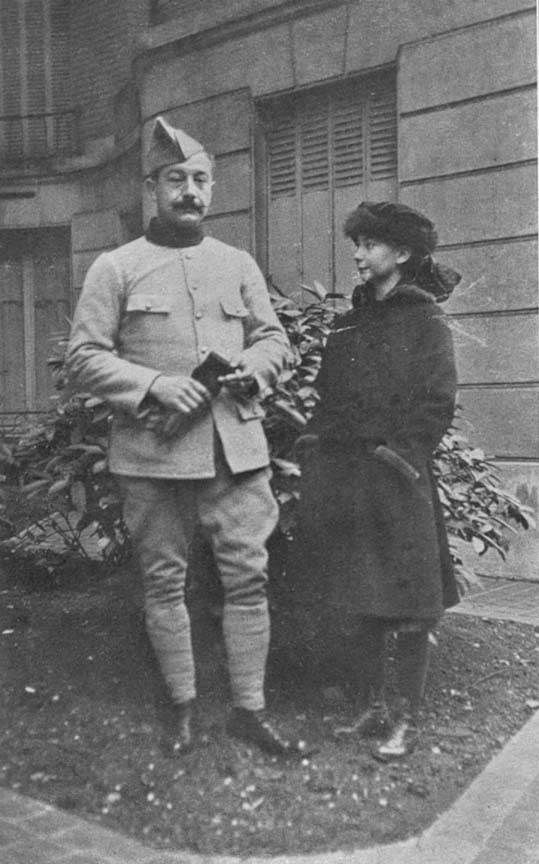
Marlborough found him very well informed and interesting, and we were both delighted with his most courteous manners; yet how could he have them when he has been living in the trenches for two years and a half?
He was so grateful for what Mollie had done for him, and she had made him tell her what he liked and needed most, and had asked him what he wanted to get in Paris. He told her that he wanted to get the three service stripes, for his two and a half years at the front, put on his new uniform, so Mollie said, "I told him to get it done and I would pay for it, and it made him so happy."
The French soldiers are paid four sous, or four cents, a day, so unless they have families to do things for them, their marraines are a god-send. He looks upon Mollie as a fairy godmother.
After dinner Mollie gave him some money to spend in Paris, and after she had gone to bed he stayed here until eleven o'clock telling us most interesting things.
He is staying at a canteen in Rouilly which is for men from the invaded country, so it is not any expense to him or to us. He comes here for tea with Moll and Marlborough to-morrow; it is my day at the Ambulance. We shall send him to the cinema in the evening. The poor fellow said it was so odd not to hear guns all the time, for he has been at the Verdun front since last May, and not one day away from it.
PARIS, December 1, 1916.
We thought of you all many times yesterday, recalling where we were last Thanksgiving and wondering where next year would find us. We let Moll decide what she would do --- have a dinner at home or go to any café she might choose. We nearly died laughing when her choice was to go to the Italian restaurant on the Boulevard and have macaroni! So Marlborough and Moll came down to the A. F. F. W. for me and we all went to the Italian restaurant, where Moll and I had a delicious mushroom omelette and tons of macaroni, while Marlborough ate tripe! Now you know that is a most original Thanksgiving dinner.
I am wondering what your papers are saying of conditions here in France. It is hard to see some of the optimism I have found prevalent here now giving way to a certain amount of pessimism. Roumania's defeat is a calamity which everyone recognizes. And if Russia should break away from the Allies and offer a separate peace---France and England seem terribly small! And France has sacrificed so large a part of her man-power already.
We are still absolutely comfortable as to everything but can see that different times are near at hand. The two meatless days will never bother us, for there is always macaroni! The regulation about these two days goes into effect soon, and they are talking about forbidding the making of all cake and pastry. But with eggs $1.20 a dozen, butter seventy-five cents a pound, and sugar hard to get, what encouragement has one to make cake? All the laundresses had advanced their charges ten per cent, and there is talk about closing all the laundries on account of lack of coal. If they do we shall have to wear black. The lights in Paris are now not enough to speak of and last night at eight it looked like a city at three o'clock in the morning.
PARIS, December 4, 1916.
It has been freezing here, but when I think of the thousands suffering in the trenches not many miles from here, cold out of doors, when you have a warm house, is nothing to complain of.
I had a most interesting motor trip to-day, going to Villiers-sur-Marne to take things to a big tubercular hospital there. The hospital, I believe, was more pathetic than the hospitals for wounded, for all the poor souls seemed to be there waiting to die. I know many are cured, but nothing but a miracle would cure any of the poor fellows who were occupying the hundred and sixty beds in the hospital I visited to-day.
This has been a busy day, ending with the departure of Moll's filleul to-night. We have given him, I know, a happy eight days, and now he is back to Verdun again. It made Moll very happy to do things for him, and to-night when he left she gave him a pacquet to take back with him, with socks, tobacco, cigarettes, crackers, jam, and conserves, etc.
Yesterday we took Moll with the filleul to Luna Park, to a "Fair pour le Soldat," and we did everything there, including the cinema and the concert, and Moll enjoyed it all as much as he did. And she bought him an electric pocketlight which made him perfectly happy.
I hated to have him go back. He goes as far as a place called Dugny by train, and to get to his battery he has to walk six miles from there, over a road that is continually being shelled, for it is the road on which all supplies and ammunition are taken to Verdun.
PARIS, December 8, 1916.
You ask for suggestions about what to send. I can only say: everything will be welcomed. And if you are making just one kind of garment, let your shipment be just that; it does n't have to be a mixed box. Anything and everything warm will be wonderful for the next three months. If they have any big drive in the Vosges, think of the warm things needed. Canton-flannel pajamas and hospital shirts they are always short of, --- and "gilets," which are gray Canton-flannel sleeveless shirts and, I should think, easy to make. If you can get hold of gauze by the bolt they like it that way a lot. And if you can make part of a shipment rubber goods, it would be excellent: rubber sheeting, tubing, gloves, hot-water bags, and ice-bags. In the pockets of garments that have pockets you can put a handkerchief and a picture-postcard with a word and some name and address; the men adore them. If your things happen to be cotton instead of Canton-flannel, they are just as much needed, but at this time of year are sent farther---Salonica, for example --- and will probably take longer to hear from.
Things like socks --- things with personal work in them---you might mail to me, for when I go to the railroad stations and canteens I always find many poor fellows who are in need of another pair of socks or something warm, as they are going out to stand in cold mud and water, and so many of those gifts are more or less personal and it is hard to buy things of real wool here.
Both of my maids have filleuls, cousins, and friends they are constantly getting letters from and sending things to and I try to get them the warm things which they can't afford to buy to give them for their relatives and friends. Sophie, the second maid, a young, good-looking, pink-cheeked girl, is from the invaded district and has n't heard a word from her family for two years and a half. She fortunately has a sister in Paris so that is a comfort, but you know what a strain she must be under.
PARIS, December 11, 1916.
To-day has been a busy one, but so much to do it has flown. I was at my "shop"---the A. F. F. W. --- all the morning, with a half hour out for luncheon, and at it again until five. At five-thirty I went to a French canteen in the Latin Quarter to help serve supper, and arrived home at about eight.
I just wish you could have seen this canteen. It all seemed like the French Revolutionary times, and a sight I shall never forget. It is run by a Madame Destray on rue Luxembourg and the soldiers on permission who are from the invaded country, or haven't any place to go to are given tickets which allow them to get two meals a day here, without any expense to them. All the money to run it is begged, and every morning French shop-girls before going to work go down to the big market with big baskets, and beg any and all the vegetables and stew-meat they can get.
The canteen is a big, dingy, grimy room, just off a cobbled courtyard, and has three long tables, each seating twenty-five men.
And such a collection of pathetic humanity was there this rainy night! French, Belgians, Zouaves from Morocco, and a couple of black men from the Soudan. They each get a bowl of hot soup, then a plate filled with a vegetable stew, --- all kinds of vegetables stewed together, --and on top a piece of stew-meat, and bread, a bowl of beer, and about a tablespoonful of apple sauce.
Mme. Destray had someone to help her take the stuff from the caldrons and put it on the plates, and my companion and I worked like beavers feeding the seventy-five starved men. They ate so much I should have thought they would have popped, but it was nothing to them.
My good, bad, and indifferent French seemed to be welcomed by those poor souls who were glad to say a few words before they left. One pathetic Zouave chasseur came to me and wanted to know if I would be his "godmother," poor soul; he looked as though he had never had anyone give him anything in his life. He looked cold and poorly clad, but I had to tell him I had all I could do and keep up with, but that I would try to get a marraine for him. If I had only had a pair of the socks that mother knits up my sleeve, or on my feet, to give to him, it would have made him so happy.
One of the two burly black men from the Soudan spoke perfect English; he said he had learned it in school before he learned French, but that he did n't have much "opportunity " to talk English and thought his French was better. With all his big words his English was better than my French, so I gave him a chance to talk English.
I had to go to another room across the court for extra bread, where refugees were being fed. A motley crowd of women and children were packed into a big room which was like a cellar and were given bowls of soup.
The whole thing was something I shall never forget and I hope to go again some time.
PARIS, December 20, 1916.
I was so interested to hear, in your letter of Thanksgiving Day, about the box you were to send, and I know beforehand how fine it is going to be, and I know how hard you have worked to get it together and off.
The twenty-five comfort bags I shall try to get hold of to distribute myself, and am quite sure I can, and I am already planning to send some to one or two pathetic men I know about. And there are some men in hospitals I would like to give one to. Although the Fund is for wounded, the comfort bags are very often given to men who are going out,---men from the invaded country who have no one to give them anything.
As for the blankets, sheets, rubber goods, and clothes, I can't begin to tell you what relief they are going to bring to many poor suffering souls. I have every reason to believe that I shall be able to follow up the things you send and I shall be most impatient until they arrive, and let's not consider the thought that they may go to the bottom.
To-day I went to the Gare du Nord again to see a train off. It was so thrilling and so wonderful and yet particularly sad to see them all going out right on the eve of a holiday season. Eighteen hundred men went and there were just the two of us and Madame Courcelle of the canteen, who is always there.
This time I started 'way up by the engine and had the idea of working my way to the end during the hour I had. The minute I appeared with my cigarettes, men, trench helmets, and packs, all came tumbling out of the coaches, crying, "Vive l'Américaine" and "Avez-vous cigarettes pour les poilus!" I had a perfect time and it was a joy to give the four hundred packages of cigarettes that I had, but I hated to see the other fourteen hundred men.
Then came the fun of assisting Madame Courcelle with the hot coffee, bread, and mandarins. She had a truck, with huge tankards of hot coffee and baskets of bread and fruit, and trimmed with flags. The men pile around fifty deep, with their own tin cups, and you give them coffee and bread. And to those who cannot get near enough you toss mandarins to over the heads of the others. They loved it, and laughed and joked over the American "bombs" and "grenades." Poor souls, ---many of them in a few days will meet bombs and grenades of another kind! I am so thrilled when I go down to those trains, and I hope to get permission for Marlborough to go some day. But one can't take anyone else along, without endless red tape. When I have my pass to go, I do not want to run the risk of losing it by asking favors. So I just thank my lucky stars that I have one, and go ahead alone. If it ever does anything but rain here I am going to see if a camera is allowed, but it has rained for six weeks straight and not since September has there been a day with real sun.
All the spare moments I have had, I have been trying to think how we can meet the new economical conditions which were published to-day, to go into effect December 26. Gas in all households is to be limited to one cu. meter per day and electricity to three hectowatts. We burn as little as possible anyway, but I find my bills average about seven cu. meters of gas a day and nine hectowatts of electricity.
Cutting down on electricity will be just an inconvenience, for we shall have to save it for the kitchen and for writing in the evenings, and for plain eating, sitting, and going to bed shall use candles.
The cook said the gas allowance would only do for hot water and breakfast, and possibly luncheon. Just what dinner is to be cooked on the Lord only knows. Coal you can't get, and is like diamonds when you do get it, but I think there are briquettes, or something like that, which can be had in tiny quantities and don't cost quite a million.
But you have no idea what a funny feeling it is, to be told that you can't use something which could be used by just turning it on, but if your meters read over your allowance they cut your gas and electricity off entirely. This is certainly an experience, living in a country at war, and it is strange how comfortable you can be, and how things that seemed necessities really are not.
PARIS, December 24, 1916.
These days are busy ones. We had a number of guests to dinner Friday evening, and Friday noon had Captain and Mrs. R----- for luncheon at the Café de Paris. He is a Belgian aviator. He was leaving the next day for the front again, and she was going to Dunkirk to live, so as to be near him.
She was good enough to ask me to come and see her, and if I could ever get a permit to go, I should certainly love to get that much nearer. But about the only thing you can do is to sit in the spot which you and the police call home, and ask for nothing. The police know where all strangers are, and it simplifies matters if you stay there.
Last evening---the Saturday evening before Christmas--- Marlborough and Mollie went with me to Madame Destray's canteen for the Christmas party and supper. There were about seventy-five soldiers there and we had the place quite festive with holly and flags, and the dismal canteen looked quite Christmaslike.
The men were given a good substantial supper, and Mollie enjoyed giving them the seventy-five packages of chocolate she had tied up with tricolor ribbon. Four or five American Ambulance boys sang and played, and several other people sang or did their parlor trick. And the party ended with the men standing with caps, trench helmets, etc., off, singing at the top of their voices the Marseillaise. Before each one left, we gave him a comfort bag. To go around among them as they look over the contents of the bags is a joy. They get so excited and so thrilled over the most trifling things, and the pleasure it gives them is infinite.
Mollie thoroughly enjoyed it, and as you well know was as helpful as a grownup. One man collapsed at the table and had to be carried out, but it was only caused by a wound in his head breaking open. I feared more for Mollie than the man at the time, but fortunately she thought it was just too much Christmas and went about her business.
PARIS, Christmas Morning, 1916.
After breakfast to-day Marlborough and I went down to the Gare du Nord to see a train off. None of the girls wanted to promise to get there Christmas morning, so I said I would go, for I thought it would be a grand chance to take Marlborough. And it worked perfectly. I got him through without any trouble, and he was as thrilled as I.
We decorated each coach door where there is an iron bar with a bunch of mistletoe and a French flag. It was the prettiest thing you ever saw, and it made the eighteen hundred men so happy, and it gave the train such a festive Christmas appearance. We took several hundred pieces of chocolate and eight hundred cigarettes, and we both worked like beavers until the train pulled out, and then stood and waved until the last coach was around the bend. It was wonderful, and I wouldn't have missed it for anything in the world, and it never fails to give you a thrill as nothing else does. And the day was one of gorgeous sunshine, a thing we had n't had for months.
PARIS, January 1, 1917.
There is so much to do here, and so much that can be done, that you don't know which way to turn. And there are always the special hospitals, which are interesting, the jaw hospitals, the one-eye hospitals, the tubercular, and the hospitals for those burned by liquid fire. The trouble is that the days are n't long enough, and likewise the pocket-book.
Saturday morning I went to a pathetic little hospital on rue Pouchet, off boulevard de Clichy, which as you know is in the poorest part of Paris. The A. F. F. W. gave each of the workers who had been there a certain length of time fifty comfort bags to distribute at New Year's in any hospital they wished. I wanted to go to a really poor one and I guess I found it.
There was just one big room, with no windows, but a glass-effect roof, so it was very light, and fifty-three beds. It looked as if it might have been a garage at one time. There were two nuns running it. I asked who supported it and was told that it was principally supported by the poor people in that section of the city, and that they knew of more than one family who sent their beds and were now sleeping on the floor.
Those same poor people sent bedclothes, etc., and the forlorn place looked, pretty grimy and needy. When the men saw me appear with a big sack filled with the fifty bags they were so excited that I felt quite sure a visitor was a rare thing.
I went to each bed and gave them their bags, and I can't tell you what joy was in their faces as they opened the bags and examined each little thing. As always I had my big box of cigarettes and made my second round with those. This was a long process, for they all wanted to show me what they had in their bags, and always to read the address they found within. And the ones who did n't find any address almost wept. A line written with an address is the most personal letter to them, as most of them have n't had a letter since the war began, and they almost blow up with excitement.
It was a dreadful thing to be three bags short, but I am going to take them the first
spare moment I have.
The money you collected and cabled has just come. You are all dears and 1 thank you from the bottom of my heart. It will begin to bless endless hearts in endless ways and I am only sorry that you can't be here and see it all, but I will write to you of it.
I am looking for the arrival of your first shipment and only hope that at the Boston office of the A. F. F. W. a green ticket was put on designating it for me, for then no time is lost in my getting hold of it. I have no end of places where I want to send the things.
If some of the youngsters you know would collect pictures for scrap-books and give a Saturday morning or two to pasting them in, or if they can't find time to paste them in books would send them as they are ---any time you are sending a box--- I can get some soldiers in the hospitals to paste them in books for me and then I will get them to the homes where there are hundreds of little refugee children and war orphans. They long for scrap-books. And when it is a case of magazine pictures it seems a shame not to send them.
PARIS, January 10, 1917.
This past week has seen many things go up in price, among the most common articles milk, which is now ninety centimes; or eighteen cents a quart. And there is no longer a ten-centime or two-cent postage in Paris, or France, for that matter; it is fifteen centimes, or three cents.
The papers say we are about to have sugar tickets, the allowance one pound a month per person, but that has n't struck yet. But all these things are the same for all, so you do the best you can. Cigarettes also have mounted in price, but for the French ones, which are soldier ones, we understand it is only a temporary advance. The other day I could n't get any place to sell me more than one box of a hundred; so this shortage bothers me more than any.
In my last letter I told you of going to the little poor hospital on rue Pouchet with New Year's surprise bags. One day last week Mrs. C----- had a box of things arrive from Boston, and she was good enough to give me some sheets, hospital shirts, etc.; I took her with me and we went to visit the pathetic place again.
It was nice to have the poor souls remember me, and as I went from bed to bed, giving them cigarettes, they would reach for their surprise bags and say they had n't forgotten me. As Mrs. B----- was so sweet and good as to send me $25, and perfectly willing to have it spent in cigarettes, my first expenditure of my "fund," as I call it, was a dollar for this poor place, where a few cigarettes are like a million dollars in the cheer they give. So I told them "une amie Américaine" sent them and they loved it. I am quite sure if Mrs. B----- had been with me she would have wept like a child to see the pleasure her first dollar gave. Not only do they adore cigarettes, but to be remembered by someone gives them a little cheer for the day.
There was one pretty sick boy who had just arrived from Salonica the day before, the color of saffron and too weak to speak; he didn't look as if be could last long. The nurse said to put some cigarettes on his little table, although he couldn't move and was probably too sick to notice it, but if he was conscious she didn't want him to feel that he had been overlooked.
I put them there and said they were for him, and in a husky whisper the poor soul murmured "Merci," and tried to smile.
I went into another hospital on rue Lemercier, which is in the Clichy part of Paris, and found one of the nuns spoke English, and came from Norwalk, Connecticut, originally. She had only about forty in her little place, and they all seemed well cared for. One poor youngster was sitting up in bed, and although he was bound up to sort of a frame, he seemed jolly and happy. He said he was so well cared for, and "I never had so much in my life." The nurse turned to me and said, "Don't you call that courage, for both his arms are gone and both shoulders blown off?"
I had a Miss Dagmar here for luncheon to-day. She is a Swede and an opera singer, has been in grand opera for years. I wanted to talk with her about a party I am about to give.
I have n't done anything for the blind since I have been here, for until I got here I did n't realize that an absolutely perfect knowledge of French was necessary. You have got to talk to them for amusement every minute and you have to devote yourself to an individual; for unless you are talking with someone personally, you might as well be down town shopping for all the good you do him, whereas in a visit to a hospital ward you can say a word here and there, and they are entertained watching you with the others.
So I have had doing something for the blind on my mind, and of course music is their only entertainment. And now that I have a "fund," thanks to you all, I am going to have a concert here for the blind a week from Sunday. I can easily seat in my salon, hall, and dining-room, which all open up together wonderfully, a hundred and fifty, and I am going to invite a hundred blind.
Miss Dagmar said she would get all the artists for me, and they would all be professionals, including a Russian pianist. It will be hard to have them manage cups and saucers, so I am going to give them red wine, rolls, cakes, and cigarettes. One poor soul who is coming is blind and has n't any arms; in fact, many are mutilated as well as blind. The ones who are just blind are principally liquid fire cases.
Don't you think it will be wonderful? And I can't tell you how happy I am to have the money to do it. I think to give a hundred blind mutilés something besides their misfortune to think about will be a joy.
PARIS, January 11, 1917.
I have just put my first experience in a Zeppelin raid behind me, and right here let me tell you it is, without exception, the most helpless and horrible sensation you can imagine, and may I never know another!
I came in about six-thirty, and about seven came the horrible fire-engines through the streets, preceded by- bugles, which only means one thing,---put out your lights, the Zeppelins are coming! Never can I describe the helplessness of my sensations. All my iron shutters were closed but those on the kitchen, and these the maids shut at once, so no lights from our windows could be seen. At the same time the telephone central turns a buzzer on all the wires and in an instant "tout le monde" knows the "Zepps" are arriving.
I tried to be as matter of fact as possible, but I was petrified. Moll said, "I wish there never was such a thing as war; I wish we weren't so far from home." Personally I would have gladly been in Ballardvale. About seven-thirty Marlborough and Major L----- came in, stayed for awhile and then both departed for town to observe from some spot which was open any anti-aircraft shooting which might take place.
They wanted Moll and me to go with them, but it is a very cold night, and I knew both Moll and I were extra cold from nervousness, and feared one or the pair of us might take cold or get sick, and knew that right here was the best place for both of us. Before nine o'clock the bugles sounded in the streets again, which is the "all out," "danger past," signal. So I put Moll to bed, after we had dinner. I can't say that expecting a bomb any moment is a help towards enjoying dinner!
PARIS, January 17, 1917.
Moll is delighted that five dollars of the money you sent is for her filleul. She is going to save it until he comes in again, which will be at the end of next month. I will send him some more socks when the ones arrive that you have sent. This minute I feel like putting them all on myself! It happens to be a very cold, sloppy day, but we manage to keep warm, and although our gas is very much cut down, we can have an open fire by ordering a sack of wood. You order wood one day --- you can get only a small amount at a time --and you get it two days later, a bagful that you could easily carry under your arm. But even that is a luxury and a joy.
I often wish you were all over here, for there is work here which suits you all, but there is also a certain amount of comfort in being in a country which is not harassed by war. And when I thought I had a Zeppelin on my roof, I wished I had never heard the word war, and as "wonderful experiences" I thought nothing of them.
Yesterday it was snowing and " slushy" and a bitter day, so I took ten francs of my "fund" and with my cigarettes went to the Gare du Nord. There were sixteen hundred men leaving for the front and a dismal day it was to return to the trenches. I made my four hundred cigarettes go as far as possible and then I gave hot coffee to hundreds of them. And as the wind and snow blew down those tracks, I assure you that a cup of hot coffee was something of a comfort.
A couple of North African cavalrymen came along, looking half-frozen, and when I offered them coffee, and then gave them cigarettes, one poor soul put down his pack, and took out a pathetic little purse, and was about to pay me for what he had had. And when he discovered it was a gift, he said he never would forget me, and shook my hand in farewell as though I had saved his life. After only giving them two or three cigarettes apiece hundreds stop and shake you by the hand.
It did strike me as curious yesterday, as the train pulled out, and around the bend, hundreds were hanging out of windows and doors, and there I stood alone, waving a big empty blue cigarette box in each hand, and, as each coach went by, calling out, "Bon chance!" As the last coach pulled round the bend, and I found myself in the wind and snow, with the excitement gone, and I walked down towards the station, it struck me what a funny thing it was, ---a foreign country, and all speaking a foreign language, and not one of them knowing who I was, or I who they were, and yet the whole thing seemed so personal!
Mme. Courcelle, who has charge of the Gare du Nord French canteen, is always there at the train, but she was called away just before the train left yesterday. She is wonderful, so bright and cheerful; she tries to give them all a jolly send-off, and I think she always succeeds.
In the afternoon I was at the Ambulance, and it was such a bad day that no one else turned up to help, so I did the Child's restaurant act with both hands and both feet. Afterwards there were so many cakes left that I went up through the corridors with a huge platter of cakes in each hand, and gave one to each blessé I met. Some were without legs, arms, and lower jaws, and yet if they had one hand left they got a cake from me.
My concert for the blind is coming along well and to-day I had a blind man whom Mrs. N----- is interested in come and tune my piano; she hires a small boy to take him about. She has a one-legged man she is helping, and as soon as he can use his wooden leg well enough, she is going to hire him to take the blind one around. Sunday this blind one is coming to the concert.
PARIS, January 23, 1917.
In all my spare moments last week I was planning for my concert for the blind which I had Sunday afternoon.
I had hoped to have a hundred of the blind, but one hospital did n't want to allow theirs to come, as the authorities do not like to have many seen at a time on account of the effect on the people at large, which is, of course, quite all right. Ten blind men in your house at one time seem many, but I was perfectly happy in having forty-seven blind here, and about a hundred people in all. It was really a wonderful experience, and I would have given a great deal if you could have looked in on our party, and could have seen the happiness which thirty dollars was giving.
The first man arrived half an hour early. Of the forty-seven there were all kinds and descriptions, --- African cavalry with their red fez, chasseurs, men in red and men in blue; many were without one arm, but all had both legs. One Moroccan about seven feet tall, with his head all bandaged up, and with hardly a square inch on his face which wasn't a big dent, made by fragments of shell, was beaming with happiness. And Miss P-----, who brought him, told me the next morning that he had been looking forward to leaving the hospital and going to a little place outside of Paris, to learn a trade, but going back to the hospital in the taxi from here, he said, "I don't believe I want to leave Paris, now, I did n't know there was a place where I could enjoy so much."
And Mrs. I-----, who brought one from Val de Grace, went to see him the next morning and he said, "Please tell madame for me that I feel thirty years younger. For the first time since I lost my eyes I felt that life was worth living. I did n't know I ever could enjoy anything again; I am a new man."
It was satisfactory beyond words to see them here, and I hope you can realize the joy you gave with your money for my "fund."
Four came in from the Ambulance. O----- brought two of them, and Mrs. H----- two. One of these had an entirely new face from the eyes down and, although he looks curious, he doesn't look deformed; it is wonderful what surgery has been done in this war.
The rugs had been taken up, all the furniture removed, and a hundred small chairs hired for the occasion. There was plenty of room, and the scanty furnishings of our apartment were for once an advantage.
The men of course got the best seats, and everyone else stood at the rear of the dining-room or in the hall. In addition to the real opera singers, there was a quartet of British boy scouts, and a violinist who is now a private in the clerical part of the medical department, but who must have been a very well-known man before the war.
I won't try to describe anything, except to say that everyone was fine and pleased the men immensely. The violinist seemed to us ignorant Americans about the finest we had ever heard, and even the musical people present gave him a big ovation and insisted on his playing again after the programme was finished. Most of the music was either classical or patriotic except that of the last performer, who was a little white-faced, ex-vaudeville artiste, with short hair and a wise old head on her young shoulders. She was singing at a café-concert in Belgium at the beginning of the war and lost clothes, job, and everything else. Her main idea was to sing and recite what the men liked. It was too slangy for us to get, but Miss Dagmar laughed and said, "The reputation of the house is gone now!" But it did no harm and made the afternoon end in a laugh from those poor fellows who have so little to laugh at now that their light has failed.
Halfway through the programme we served a glass of vin ordinaire (which now costs twenty cents a quart!) and a bit of a cake to each soldier, --- little cakes which were not messy and which the poor fellows could handle neatly. It was a privilege to ask them if they would have some, hear their polite reply, and see the pleased expression come over their mutilated faces. Then it was another privilege to guide their fingers to the stem of the wineglass and place the cake in their other hand---if there was another hand. Several of them made a little ceremony of drinking the wine, and said, "A votre santé, Madame," or " A l'Amérique," as they raised their glasses. A few did n't want any at all, but asked for lemonade. When they were told that there was also tea, they said, "We are French, not English!"
There are not words enough to tell you half of the pathos and tragedy crowded into our little apartment that afternoon or half the many ways in which we tried to make at least one day less dark to those men whose light has gone out. But I cannot pass over one couple who came in --- a middle-aged man who had recently married a seventeen-year-old girl. She told us that her brother-in-law, of whom she was very fond, had died that morning and that she was broken-hearted, but that she had n't spoiled her husband's day by telling him about it yet because he had been looking forward to the concert ever since he had been invited and because it would have broken him all up not to come. Many thoughtless Americans here comment on the fact that they are doing so much while the French women apparently are not doing their share. I think that they forget that they have come over here expressly for relief work, that they are free and often are wealthy and that they have no griefs of their own. Many of the French women are bearing double or triple sorrows like the seventeen-year-old wife of the blind man, and everyone of them has given someone to France. Moreover they have the practical problem of feeding and clothing their children which the American relief workers know nothing of. It is a many-sided question which no one is big enough to comprehend in all its aspects.
When the programme was finished and the wonderful violinist had played a second time we again served wine and cake to the men and tea to the others. The men were at last allowed to smoke, which pleased them a lot, as the singers had requested that they refrain during the singing on account of their fifty-thousand-dollar throats.
Then began the best part of the afternoon. Those poor souls actually began to talk amongst themselves, to tell tales of the war, to describe how they were wounded, to tell about their hospitals, their nurses and their marraines and families, and to ask about their regiments and the luck of their comrades. I think that the warmth and the music and the welcome made them this way, for before the singing began they had hardly said a word.
They lingered for at least half an hour and did n't seem to want to go then, but the people who had them in charge were naturally anxious to get them safely back before dark.
As each man left I bade him "Goodbye "and handed him a surprise bag which had come into the A. F. F. W. There was n't a man who did n't thank me politely and most sincerely for the bag, the good time, and the American sympathy behind it all.
Mollie was very grown up and helpful and tactful. Her knowledge of French helped her understand what the men said and wanted. If you could have seen her you would have been very proud of her.
PARIS, January 27, 1917.
I must sit down and tell how much M-----'s first eight dollars did to help those who were in most trying need.
I received a letter from a Mrs. Butler who is a Frenchwoman, married to an Englishman who has been killed. In this letter she said she was a nurse at a temporary dispensary where the wives and children of the men at the front could go and receive medical and surgical attention free. You see all the hospitals which were hospitals before the war are filled with men, and naturally all the temporary ones are simply for military purposes. So the poor women and children had nowhere to go.
Several French women opened this free dispensary in the "Pavillon Ledoyer," which is directly across the Champs Elysées from my "Shop," and like mine was a café before the war. The great present need seemed to be for towels and it was a pressing need. I inquired whether I could get some from the A. F. F. W., but couldn't, for they were women and not French wounded. So I took a taxi and went to the Gallery Lafayette, and with eight dollars of my "fund" purchased five dozen small and poor towels, and then up I went with Marlborough to the "Polyclinique Ledoyen."
Mrs. Butler's gratitude was very real; she said, "There isn't a towel in the place." It sounded a little exaggerated, but we listened to her profuse gratitude. I told her that I had been able to get them with some money that had been sent me. She disappeared with the large package, in search of the wonderful doctor who would be so grateful. This doctor, she said, was considered remarkable, and she said how wonderful she thought it was for him to give up his practice and devote every minute to relief work, either at that place or in hospitals.
Presently she came and announced that the doctor was ready to receive us in his office, and you can imagine our sensations as we walked into his office to find he was as black as the ace of spades! He is from Hayti, tall and really very handsome, immaculate in his hospital garb, spoke English perfectly, and had the manners and courtesy of a gentleman of royal birth.
I asked all about the work he was doing, and told him I would try to help them out in getting supplies from time to time, for they are doing a tremendous work and having a pretty hard time to get things. He thanked me profusely for the gift of towels and said they never needed anything so badly. And shortly he took us over the place, and, as he opened the door into the operating-room, I could see that a young boy about Mollie's age was on the operating table having his shoulder dressed. There were three or four nurses in attendance.
The package of towels I had just brought was lying opened on a chair, and already several of them in use. We were not expected in there, but to see with our own eyes what we had taken put right into use, made us realize that there was no exaggeration in their gratitude, and that their need was beyond words.
The doctor said that the soldiers had been appreciative of what had been done for their families; and often a man on permission would go to see the doctor and thank him for what he had done for his family.
It was wonderful to be able to do this for them, and I thank my "fund" contributors from the bottom of my heart. I am spreading out as carefully as possible and trying to help the most needy with the money you all so generously sent me at Xmas time. And I am trying to do a little in some of the various things which are so appealing, as well as to give the soldiers who are well and still fighting a little joy.
I appreciate more than I can tell you the money you all sent to me, for I am able to do so much more. I had to do what I could financially, then stop until the next month. Now, I have a real emergency fund! But not a day passes that something so appealing does not turn up. To-night Mollie came home filled with the story of a little refugee who came to her school to-day. The principal had taken her in, given her a bath and food, and a few warm things, and was going to keep her for the present. It is freezing cold and the child did n't have any hat or anything warm. The children were asked to bring something for her to-morrow, if they had anything. So Mollie has done up a package with some underclothes, a pair of woolen gloves, and her brown velour hat. And she said, "Is n't it wonderful to actually see these people who need your things?"
This past week I have had several letters from the families of the blind men who were here last Sunday, and their appreciation of the afternoon here was pathetic. That afternoon is really wonderful to look back upon.
Our minds really are on nothing but the preparations which are being made for an early spring drive. I fear it is coming early, and I hate to think of the thousands who are at the front now, who will never come back.
PARIS, January 31, 1917.
To-day I have had a strenuous day. I worked until eleven and then went to the Gare du Nord with a couple of dollars in the form of four hundred cigarettes.
It is a short hour's strenuous work giving hundreds and hundreds of poor cold soldiers a final cup of coffee in Paris, from the canteen truck which goes right to the platform of the train. And when the coffee and bread have gone, then comes the fun of giving away the cigarettes, going from coach to coach.
This morning, in the midst of handing to French, Belgium, Senegalese, and Colonials, and using my limited French, which at the train always seems extensive, for the time is so limited, a little fellow said, in plain English, "Thank you for your coffee. I like your coffee." This last remark I promptly followed up with many English remarks, but he understood nothing, so I turned on my limited French and he was filled with replies, among them, "That is all I know" (of course this in French). Before the train started I dashed down the platform hoping to see him again, and, sure enough, hanging out of the window he was, and he said in French, "I thought I might see you again."
I gave him some cigarettes in the two hands he held out, saying, "These are from a friend in America," and as the train pulled out, he was back to his phrase in English, but this time it was, "Thank you for your cigarettes. I like your cigarettes."
I love to go to the trains, although it is rather depressing. To-day there was n't time to do anything but get a hasty lunch in town before going to the Ambulance to pour tea. From the amount of tea and coffee I have poured to-day, I don't feel like seeing either for some time.
Yet to go to the station and see hundreds and almost thousands off to the front, and turn around and go to a huge military hospital and see hundreds of human wrecks, makes the terribleness of this whole weigh upon you.
Marlborough writes he is having a most interesting and instructive time at Fontainebleau, and with an open fire and burning wood he feels like a king. I am hoping he will bring a bundle of the wood back with him. If he does n't, the day E-----'s cases turn up at the Alcazar, I shall bring the cover home by hand to luncheon with me, build a fire, and have a real time. However, the cold seems to agree with us, for we all are in fine shape; but I feel that my style is cramped a bit, when I write, eat, and live in the petit salon, and when I go to bed put on everything but my hat and furs. I thought seriously of getting up and getting my muff the other night, my hands were so icy!
To-day when the girls went on their daily walk in the Bois from school, they attempted to pick up the little tiny sticks to bring home, but Mollie said the gendarme drove them off.
To-night we are thrilled for we hear we can get the wood we ordered weeks ago by the last of this week. We shut the doors to-night in the petit salon and burned the two old Atlantic Monthlies you sent and found them quite hot stuff. It is the strangest sensation in the world not to be able to buy or get a stick of wood. We have coal for a few days.
A thousand thanks to those who so generously sent money for my relief work. Everybody is so good, and if I could only in some way give you any idea what a little cheer and personal help means to these poor souls, you would all feel repaid for the sacrifices you make in sending it. But I seem to get all the pleasure as well, for I have the pleasure of receiving the money and the keen joy of seeing all the pleasure it brings to them.
PARIS, February 7, 1917.
We are all well and shall try to keep so, and shall all stay on dry land. So do not worry one little bit about us if there are long spells without letters; simply know that they are written and that lack of transportation is the one reason why they will not arrive as usual. If there is anything we particularly want you to know we will cable.
Last Sunday our military attaché in London and some others lunched with us. After luncheon some people came to call, filled with the news that America had broken off diplomatic relations with Germany. Needless to say, it was thrilling and my luncheon guests deserted me for the Embassy.
It is wonderful to see the American flag displayed with the French flag in many streets to-day. Just what all this will lead to no mortal can tell. I am not allowing myself to think of all the possibilities of war, although at times it seems pretty near.
The latest economy is that all trams, the metro, etc., stop at ten o'clock at night, to save coal and electricity. This Tuesday and Wednesday were the first " no cake or pastry" days. On the fifteenth sugar tickets are issued. As Moll says, "What's the use of issuing tickets when you can't get any sugar anyway?"
PARIS, February 9, 1917.
To me this has been just like Christmas to-day, and much better, for what has come to-day for me and the poilus is better than any Christmas gift ever was.
When I went to work, I was greeted by the good news that case 8136 with seventeen army blankets had arrived for me. And before I left at noon case 8134 with seventeen more had arrived. Unfortunately, but perhaps you don't feel that way about it, there is a tremendous call for blankets in the hospitals at the front, and what I had planned, as I wrote Esther, to give them to Madame Courcille at the Gare du Nord, for more beds, --- a blanket is a bed there, --- does not seem so madly urgent as suffering hospitals to-night, but I am going to decide in the morning.
I wanted to get my one single one off to a young boy in a German prison through his family. This I did, and then I called a taxi and brought one case home with me. After my lunch by myself, I opened the case, and with half of the cover I had an open fire in my petit salon, and purred; nothing ever was so wonderful!
I know the case should have been used to re-pack in, but "by heck," whatever that is, when there has n't been a sliver of wood in this house for three weeks, and no signs of any, every nick of wood on your cases is going to be used for home consumption by the Churchill family.
I had a French lesson at four-thirty so the rest of the cover was sacrificed to make this room comfortable for dinner and to write in this evening.
The blankets are perfect, and I shall keep two in the house, fearing Marlborough may have need of them. And tonight I sent Sophie to the Embassy with the pouch mail, and she brought home no letters, but her arms full of packages! Books there were, a package of four mufflers and two wristers, which are perfect, and a package of a sweater and socks for Moll. Moll and I were thrilled. We have planned to send the sleeveless sweater and scarf to the filleul.
A scarf, wristers, and socks to Corporal Paul Peretti, who is in the Somme. He is a friend of Marlborough's. When Marlborough was in Corsica he took a picture of a dear old lady whose sons were all in the war, and it came out well, so he sent her one. It reached her when her son Paul was home on "permission," so he wrote a most appreciative letter of thanks. Here in Paris, at the "Salon des Armées," they are exhibiting everything, passed by a committee, which show the soldier's art. This Paul Peretti made rings and napkin-rings, and on one he put a large M. C. monogram in honor of Marlborough. So of course we have been to see it, and we tried to buy it, but found he had asked to have it given to Marlborough after the exhibit closed.
I have always intended to send him a package, but haven't, so now he will get the nice muffler, socks, and wristers. Another muffler goes to a cute little Colonial whose picture I will send when I get his letter of thanks. The other scarf I shall save to send to the balloonist, M-----'s filleul. I am getting a little anxious about him for I should hear from him. I hope nothing has happened to him, just when he was beginning to have someone take care of him. And the pair of hospital socks I am going to wear on my own feet this night! So whoever knit those with the little red top and toe, please tell her that my appreciation is a hundredfold, and when I part with them, I shall feel that I am making a personal gift.
You see what a wonderful day we have had, and crowned by an open fire! Tonight I see in the papers that all big emporiums are to close one day a week and all theaters are closed four days a week. The wash-lady hasn't turned up for the clothes this week, and to-morrow being Saturday I guess she is not coming, ----probably no coal and frozen water, poor thing.
PARIS, February 11, 1917.
I took twenty dollars of my "fund" and sent some medical supplies to the Dispensary for women and children of the men at the front, which I wrote you about. I had had several letters from them, and had talked with one of the nurses, and their needs were pretty urgent, particularly with this cold weather and sickness, and some things were expensive for them to buy and hard to get. So I sent them some ninety per cent alcohol, which is hard to get and about two dollars a quart, ether, iodine, glycerine, vaseline, hypodermic syringes, and six good platine hypo-needles, aspirin, quinine, sulphate of soda, etc.
I know that the gift was a needed one. The things were sent yesterday afternoon and if I hear from it in the morning, I will enclose the letter. The day I went there and took the towels I had bought with the money you sent, I knew I shouldn't be happy until I had done a little more for them to put them on their feet. Their work is so admirable, and without the glamor of working with the soldiers, yet being, indirectly, for their families it is the same. And all these children must grow up strong and husky if France is to have any future.
It is still cold but with E-----'s case we have had a perfect day and toasted by the open fire, and there is still the bottom of the case and one side, and five or six more cases to come! Our outlook is of the best, and I feel like a multi-millionaire.
PARIS, February 12, 1917.
Your box No. 8056 turned up to-day, with your note of December 1 inside. The letter was sent in to me from the receiving department, and the box opened but not touched. As there were many things in it, besides the box itself, that I wanted, I let it stay all day, until I left about five-thirty, and brought it home with me on a taxi. The things are perfect, and could not be nicer, and I shall take real pride in giving them where I see the need.
I can't tell you how nice it was to get your letter enclosed, and it did make me feel that the box was very personally prepared. Although I am filled with ideas for all these things, it is best not to tell you what I am going to do until I do it. Then you can patch the letters together and have a complete history of your wonderful gifts
The first hot-water bottle, with its nice warm cover, is reposing at Moll's feet this minute! About two weeks ago hers broke after she was well tucked in bed.
Another one is going to repose at my feet, so if your conscience bothers you, kindly charge up my account with two hot-water bottles, but we couldn't resist them. They are scarce, very poor and expensive, so two beautiful bags and covers went to a couple of Americans, Mrs. M. Churchill and daughter, who send you no end of sincere gratitude, and many thanks for the comfort of many nights to come. Some day I will try and get you a picture of them taken with their gift to show you their appreciation.
Four hot-water bags and two rubber sheets to the Leyoden Dispensary. Twenty blankets went to-day to Hospital Benevole, 163 bis, Arcachon, Gironde, La Poupinere. It was a very urgent call, so I said I knew you would gladly meet it, and packed up twenty of your thirty-four which have arrived, and got them off to-night. Although I am only the "middle man," I can't tell you what it is to have something to give when the call from real suffering comes.
I know I never can tell you what some of these hundreds of hospitals are like. I mean of course the temporary ones. They simply make the most and best with what they have, which many times is simply a big, dismal store-room. I went to one at Charenton Saturday afternoon, which was almost beyond words. I had received letters asking if in any way I could procure for them a sterilizer for their instruments and compresses; also instruments. So I decided to go there and see for myself what they needed, and in some way try to get through the clearing-house what they needed. After motoring through Vincennes and the Bois de Vincennes, I arrived at this small hospital; it had only fifty beds, in three dingy store-rooms; blessés in two, and the malades in the other.
What they needed was soap and water, and I felt that anything in the way of apparatus was simply something more for them to care for and keep clean. And the poor things looked as if they needed cheering up as much as anything, so I am going to take surprise bags and cigarettes down to them on Washington's birthday. But the whole place is rather typical of the poorer places.
The sleeveless sweater I am going to send to Paul Peretti, Corporal 229th Regiment, 13th Company. So when I send you his letter of thanks you will know who knit the sweater, for there was just one in the shipment. The sweater by mail went to Moll's filleul.
PARIS, February 22, 1917.
To-day has been a wonderfully interesting day. I started out on" delivery" early this morning, first by carrying an enormous laurel wreath to the Washington monument in Place d'Iéna. Our ambassador and other notables were there and there were speeches. Then some of us went in a motor car to four different hospitals in Charenton, where we personally gave the men sacs surprise, and told them that it was an American fête day.
Hospital 2 on avenue de la Liberté is a fascinating-looking place in gray stone, on a hill, with a high gray wall all around it. Formerly it was a convent school. There were only about a hundred and eighty men there but most of them were grand blessés. They were getting along all right although it made your heart sick to see some of them.
Hospitals 211 and 205 were both interesting, well run, and clean, and it was a pleasure to see the happiness the bags brought. Hospital 170 was the last one in Charenton; it was the one I wrote you about. The dirtiest place ever made, but I hope through the clearing-house to get them a sterilizer for their instruments, compresses, etc., and so kill a few of the germs which must be running riot there.
Two of the men had been decorated there to-day, but there is something even more pathetic to see a Croix de Guerre pinned at the head of a man's bed, when he is lying there a physical wreck, than if there is nothing of the kind to make you realize more than you ordinarily do what he has. sacrificed for France.
After luncheon I went on a delivery to a big hospital of about four hundred beds on rue des Récollets, near the Gare de l'Est.
Marlborough left this morning for the front; he will be out two weeks anyway. He has taken a sleeping-bag and all, and has gone out to live right with the artillery. It is a wonderful chance for him, and I am of course happy each time he gets a chance to do something worth while from a professional point of view. But this awful war has so many points of view, that I shall be relieved to get him home again.
Albert Laurent, who wrote and thanked you for the scarf, is really pathetic. He is a boy of nineteen --- my cook's nephew --and my other maid has taken him for her filleul. He has been all through the Somme, and his courage is beginning to break a little, but I hope when the weather is better he will cheer up a bit.
I got a lot of things together for him when he went back, sent him to the cinema, with the maids, and tried to give him a little happiness. Before he left, I was glad to receive a box of shirts and towels; I promptly gave him one of the shirts, and it made him so happy, and an address in the pocket was a delight.
Day before yesterday they said there was a package for me; I opened it and there was E-----'s accordion. Little did I think I should ever play her accordion in Paris! I promptly took it out of the box and made many bum notes on it, but it gave the Alcazar a little gayety. Someone came dashing downstairs to say that she knew a man who was pining for an accordion---so I have sent it.
The other day I went to an adorable little hospital on rue de Vaugirard where there are all "gassed" men. There are sixty-three there at present, and all are getting along so well, but great care from the cold air has to be taken, so they are pretty much shut in in their little wards.
It is a little place run by the Sisters, with lots of small rooms accommodating eight or ten men on three floors. The men were all so happy and so nice and appreciative even of my French that I got rash with my cigarettes and they gave out before I got to the third floor. I am going again Tuesday to see them, and will start at the top!
I took over some of my books and pictures to paste in, and it delighted them, and they told me to come again soon and bring some more. The Sisters asked me when I left if there was any way I could get handkerchiefs for them, for they were destitute. The A. F. F. W. was extremely low on handkerchiefs, so I took some of my "fund" and bought five dozen military French blue ones.
On the cakeless and candyless days, of course, you feel as if you had to have something sweet, so the other day I went to a grocery shop for a box of fancy crackers, thinking that they would answer the purpose. I found that not a cracker could they sell on cakeless days. A little jam on bread for tea fixed me finely.
Monday the New York Herald was only a single sheet; this to save paper, and it is to be that way every Monday. We are getting along beautifully with light by being very, very careful. We find we can burn a light at night to write by as late as we want to, but of course there is never a light in the house excepting when you are right with it!
You ask about our heat and light; I am thankful to say that the terribly cold weather is a thing of the past. The central heating plant in the apartment is still working and now that it is not very cold, just rainy, that heat is enough. By enough, I mean that you can go to bed without really needing your muff. And with great effort on Clemence's part we can get a handful of coal every now and then for the range, so with this and our allowance of gas we get along all right for the cooking.