Thursday, August 13.
Twelfth day of mobilization. Hot, sultry weather with faint northeasterly wind. Thermometer at five P.M. 30 degrees centigrade.
Breakfasted to-day at the restaurant Paillard and met there M. Arthur Meyer, M. Max-Lyon, Maitre Charles Philippe of the French Bar, and Mr. Slade, manager of the Paris branch of the Equitable Trust Company. War! War! War! was the subject of the conversation, but no real news from the front except of outpost fighting, with success for the French and the Belgians. Gabriele d'Annunzio's flaming "Ode for the Latin Resurrection," published to-day in the Figaro, is evidently intended to excite Italians to seize an opportunity to abandon neutrality and join France and the Allied Powers against Austria, and thereby win back the "Italia Irredenta." D'Annunzio invokes the Austrian oppression of bygone days in Mantua and Verona, calls Austria the "double-headed Vulture," and summons all true Italians to take the war-path of revenge. "Italy! Thine hour has struck for Barbarians call thee to arms! Vae Victis! Remember Mantua!"
After lunch I met Mrs. Edith Wharton, who had made some valuable mental and written notes of what she has seen in Paris. She is about to leave for England.
So sure were the Germans of advancing rapidly into France that they had decided to complete their mobilization on French territory. According to the Figaro, an Alsatian doctor, who came to France on the outbreak of hostilities, had been ordered to join the German army at Verdun on the third day of mobilization. A German tailor, living in Paris, had instructions to join at Rheims on the thirteenth day.
Although the early closing hour of all cafés and restaurants causes some inconvenience, it is being taken in good part by Parisians. It has not the slightest effect on the habits of the city as far as keeping late hours is concerned--no power on earth could make the Parisian go to bed at nine o'clock.
People cannot spend their evenings in the cafés, so they spend them either strolling or sitting about in the streets, smoking and chatting for hours. But the new closing hour has had the effect expected by the authorities. It has made Paris the most orderly city in the world. The police are, however, kept very busy, for the regulation as to carrying papers is being rigorously enforced, and the belated pedestrian is invariably challenged by a cavalry patrol or by the ordinary police. If his answers are unsatisfactory, he undergoes a more searching examination at the police station.
Paris has become a paradise for cyclists. Owing to the lack of transportation facilities, hundreds of Parisians have taken to using bicycles as a practical mode of locomotion, and the city now swarms with them. This state of things is not, however, likely to last very long, for every day brings more vehicles back to the capital, and every day brings a further step towards a more normal situation.
Some cars requisitioned will hardly be returned,---as is evidenced by the experience of Mrs. Julia Newell and her sister, Miss Josephine Pomeroy, two Americans just returned to Paris.
Before the war broke out, Miss Pomeroy left Frankfort by automobile, but in passing through Metz her $5,000 Delaunay-Belleville machine was confiscated by the Germans, and her footman and chauffeur, who were Frenchmen, were put into prison. All her luggage was lost. No attention was paid to her protests that she was an American citizen.
Friday, August 14.
Thirteenth day of mobilization. Another hot, stifling day with thermometer (centigrade) 31 degrees at five P.M.
Lunched at the Cercle Artistique et Litteraire, Rue Volney. Only the old servants remain. The club is no longer open to non-member dinner guests. The price of meals is reduced to three and a half francs for lunch, and to four francs for dinner, including wine, mineral water, beer, or cider. There is great scarcity of small change. To alleviate this, ivory bridge or poker counters, marked fifty centimes, and one franc, are given in change and circulate for payment of meals, drinks, etc.
Greater military activity is noticed in the streets than for some days past. Many movements of troops took place all day, and long convoys of the ambulance corps, including several complete field hospital staffs, were seen driving and marching through the city.
This was due to the fact that within the last few days large bodies of the territorial forces had concentrated in the environs, notably at Versailles, from whence they left for the front.
Early this morning certain districts of Paris literally swarmed with soldiers of the territorial reserve.
Although most of them are married men and fathers, they display as fine a spirit as their younger comrades. They may, perhaps, show less enthusiasm, but that they are quite as calm is shown by the fact that a number of them spent the last hours before their departure fishing in the Ourcq Canal.
A detachment of naval reserves has been brought to Paris to assist the police and the Municipal Guards in assuring order in the capital. The men wear the uniform of fusiliers marins, and correspond to the marines in the British navy. They will be placed under the orders of the Prefect of Police.
Mr. A. Beaumont of the Daily Telegraph has had a very narrow escape from being shot as a spy. He is a naturalized American citizen, but was born in Alsace. When the present war broke out, he started in a motor-car to the front without the necessary passes and permits. He circulated about and obtained good and useful news for his paper. The other day, however, he was brought to a standstill in Belgium and was arrested. The Belgian authorities asked at the French headquarters: "What shall we do with him?" The reply was: "Send him on here to headquarters, and if he proves to be a spy he will be court-martialed and shot." This arose from the confusion of names. It seems that the doings of a German spy named Bremont, of Alsatian birth, had become known to the military authorities in France and Belgium. Beaumont stoutly asserted that he was the victim of mistaken identity, and only after very great difficulty, and with the exceptional efforts of Mr. Herrick and of Sir Francis Bertie, the British Ambassador, was he able to establish his true identity, when he was released by the French Headquarter Staff, and handed over to the Ministry of Foreign Affairs.
Arrivals of detachments of German prisoners continue to be reported from various parts of France. A Prussian officer, speaking French fluently, was among a convoy of prisoners at Versailles yesterday. The officer, on seeing some French territorials march past, singing the "Marseillaise," remarked to his guard: "What a disillusion awaits us!"
Saturday, August 15.
(Feast of the Assumption.)
Fourteenth day of mobilization. Heavy thunder storms set in at three A.M. Showers followed until one o'clock; cloudy afternoon with variable wind. Thermometer at five P.M. 22 degrees centigrade.
Huge crowds lined the streets leading from the Gare du Nord to the British Embassy, to welcome Field-marshal Sir John French, Commander of the British expeditionary force, who came to visit President Poincaré before taking command of his army. At quarter to one, three motor-cars rapidly approached the Embassy. In the second I could get a glimpse of Sir John in his gray-brown khaki uniform. His firm, trim appearance and his clear blue eyes, genial smile, and sunburnt face made an excellent impression, and he was greeted with loud cheers. He had a long talk with M. Messimy, Minister of War.
I am having a very busy time trying to obtain permission for American war correspondents to accompany the French armies in the field. Mr. Richard Harding Davis and Mr. D. Gerald Morgan have arrived in London on the Lusitania from New York to act as war correspondents in the field with the French forces. As president of the Association of the Foreign Press, and as Paris correspondent of the New York Tribune, I made special applications at the Ministry of Foreign Affairs and at the War Office for authority for them to act as war correspondents for the New York Tribune. These applications were endorsed by Ambassador Herrick, who also did everything possible to secure permission for them to take the field.
The official regulations for war correspondents are much more severe, however, than those enforced during the Japanese and Turkish wars. In the first place, only Frenchmen and correspondents of one of the belligerent nationalities, that is to say French, British, Russian, Belgian, or Servian, are allowed to act as war correspondents. Frenchmen may represent foreign papers. All despatches must be written in the French language and must be sent by the military post, and only after having been formally approved by the military censor. No despatches can be sent by wire or by wireless telegraphy. No correspondent can circulate in the zone of operations unless accompanied by an officer especially designated for that purpose. All private as well as professional correspondence must pass through the hands of the censor. War correspondents of whatever nationality will, during their sojourn with the army, be subject to martial law, and if they infringe regulations by trying to communicate news not especially authorized by the official censors, will be dealt with by the laws of espionage in war time. These are merely a few among the many rigid prescriptions governing war correspondents.
I talked with several editors of Paris papers on the subject, notably with M. Arthur Meyer of the Gaulois, Marquis Robert de Flers of the Figaro, and M. Georges Clemenceau of the Homme Libre. They one and all expressed the opinion that war correspondents would enjoy exceptional opportunities, enabling them to get mental snap-shots of picturesque events and to acquire valuable first-hand information for writing magazine articles or books, but that from a newspaper standpoint there would be insurmountable difficulties preventing them from getting their "news to market," that is to say, in getting their despatches on the wires for their respective papers. However, Mr. Herrick is doing everything he can to obtain all possible facilities for Mr. Davis and for Mr. Morgan.
Almost every day brings some fresh measure in the interest of the public. Yesterday the Prefect of Police issued an order forbidding the sale of absinthe in the cafés under pain of immediate closure, and again called the attention of motorists to the regulations which they are daily breaking.
The sanitary authorities, too, have their hands full. So far, however, the present circumstances have had no influence on the state of health in Paris. The weekly bulletin published by the municipality shows that the death and disease figures are quite normal.
Mr. Bernard J. Schoninger, chairman of the committee which has recently been formed by the American Chamber of Commerce in Paris with the object of settling difficult questions which may arise in Franco-American commercial relations, states that his committee is collaborating with the ladies' committee founded by the wife of the American Ambassador to assist wounded soldiers. In a few days this committee collected one hundred and seventy-five thousand francs. His own committee has issued an appeal to all Chambers of Commerce in the United States, and he trusts that considerable funds will be forthcoming for the ambulance corps created under the auspices of the American Hospital in Paris. The Minister for War has granted the use of the Lycée Pasteur, where it is hoped to establish an ambulance of two hundred beds, which may later be increased to one thousand.
The committee has also taken up the question of the payment of customs duties on American imports into France, and Mr. Schoninger states that he has met with the greatest kindness and that the French customs authorities have agreed to accept guarantees from various commercial syndicates instead of actual immediate cash payments. This will obviate difficulties occasioned by the refusal of French banking establishments, acting under the terms of the moratorium, in handing over funds which they have on deposit.
Sunday, August 16.
Fifteenth day of mobilization. Gray, cloudy day with occasional showers and westerly wind. Thermometer at five P.M. 17 degrees centigrade.
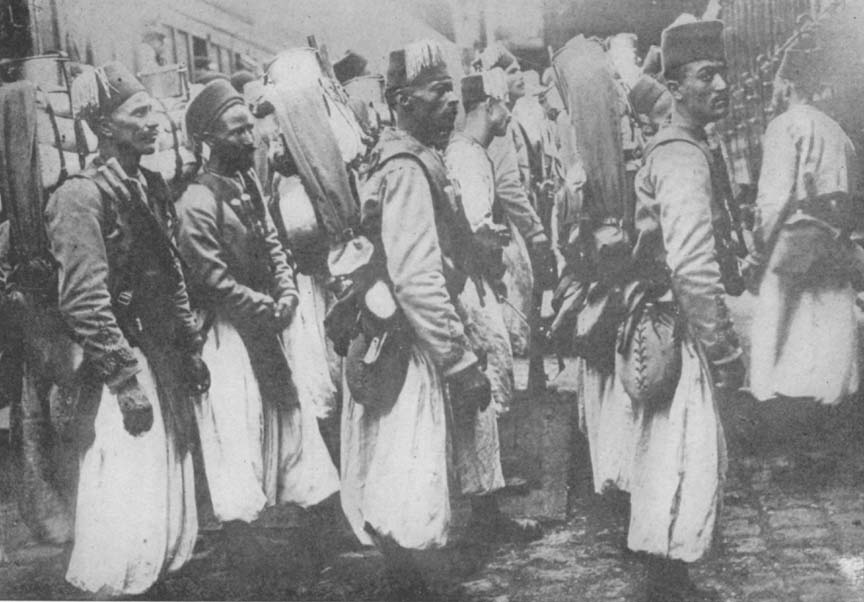
I drove out in the Bois de Boulogne after lunch with the Duc de Loubat. The Bois was rather deserted; only a few couples were strolling about or seated on benches reading newspapers. Went to the Cercle des Patineurs, where fences were being put up on the lawns to enclose sheep and oxen to provision Paris. In the tennis court we saw about two hundred Kabyles from Algeria, who had been found astray in Paris. They sleep on straw beds in the tennis court and are provided with rations. They are all men, and will be drafted into the Algerian reserves.
Madame Waddington, formerly Miss King of New York, and widow of the late William Henry Waddington, senator, and member of several French Cabinets, and one of the French delegates to the Berlin Conference in 1878, remains in Paris, and is stopping with her sister, Miss King, at her apartment in the Rue de La Tremouille. Madame Waddington was a great friend of the late King Edward VII, who never passed through Paris without calling to see her and lunching with her and her family. Madame Waddington, who is in excellent health and spirits, told me that the feeling was so strong against the Austro-Hungarian Ambassador, Count Szecsen de Temerin, during the last few days of his stay here after hostilities had begun with Germany, that one evening, as he was about to sit down to dinner with his fellow diplomatist, M. Alexandre Lahovary, the Roumanian Minister, at the Cercle de l'Union, which is one of the most select and restricted clubs of Paris, the secretary of the club requested M. Lahovary to announce to the Austrian Ambassador that the committee of the club expressed the wish that he should no longer take his meals at the club nor appear on the premises, because his presence under prevailing political conditions rendered the Austrian Ambassador an "undesirable personage." The Austrian Ambassador, who had just ordered an excellent bottle of Mouton Rothschild claret for his dinner, at once left the club.
Parisians flocked in thousands to-day to the basilica of the Sacré Coeur of Montmartre, where special services were held. This church was planned and built in expiation of the war of 1870. It was finished only a few months ago, and was to have been definitely "inaugurated" next month.
A detachment of about four thousand men of the Naval Reserve, most of whom are Bretons, is encamped to the north of Paris at Le Bourget, and there have been stirring scenes in the little church there. It has been crowded with sailors and soldiers at every service, for Bretons are among the most religious of all peoples of France.
Abbé Marcade, the cure of Le Bourget, has had magnificent congregations. On the Feast of the Assumption the Abbeacute; decided to hold Mass in the open air. An altar was accordingly set up in a large field beside a haystack. Thirty-five hundred soldiers attended. At the end, the Abbé, standing on a table, preached a sermon in the falling rain.
These military services at Le Bourget have been strikingly picturesque. The Abbé's sermons are interrupted from time to time by cheers, as if he were making a political speech. His words on patriotism and soldiers' duty have been greeted with shouts of "Vive la France." Loudest of all was the applause when he declared that feelings of party were now drowned in love for the country. In the evening, after the service at which this sermon was preached, the Abbé dined with the officers of the regiment and with the socialist mayor of the commune, a thing which would have been impossible in ordinary times. The war has made Frenchmen stand together in closer unity than they have ever done before.
One of the strangest changes brought about by the war is that of the fashionable race-courses of Auteuil and Longchamp. These have been turned into large grazing farms for sheep and cattle requisitioned by the military authorities. Another curious requisition is that of all French military uniforms in the wardrobes of the Paris theaters.
Mobilization orders to rejoin his regiment at Rheims on August 7 have been found in the possession of a wounded German soldier in hospital at Brussels. The man stated that several of his comrades had received orders to join the colors at other French towns on specified dates. This shows how the German plans were upset by the resistance at Liège.
Field-marshal Sir John French slept at the British Embassy last night, and after a rousing reception left Paris at seven o'clock this morning in an automobile for an "unknown destination."
Every man in France is envying the young dragoon officer, Lieutenant Bruyant, who has been given the first Cross of the Legion of Honor in the war. The lieutenant with six men was scouting near the frontier, when suddenly he saw a number of horsemen moving a good way off, and made them out to be a patrol of twenty-seven Uhlans. Shots were exchanged and a German fell. Then the Uhlans cantered away. They were four to one, but did not care to fight.
The French followed up resolutely, but the Germans kept their distance. When the dragoons trotted, the Uhlans trotted too. Now the former would gallop across a bit of open country, and the Germans would gallop away just as quickly. Evidently they were making for shelter.
Soon Lieutenant Bruyant saw that they were trying to reach a wood, where they could take cover. No time was to be lost. He knew that if they got there they would escape him. Now was the moment to unchain the ardor of his men. He gave the orders "Draw swords!" "Charge!"
The seven spurred their horses and fell upon the twenty-seven with shouts of defiance. The shock demoralized the Germans, who made no stand at all. One was killed by a lance thrust. The officer in command was drawing his revolver when Lieutenant Bruyant cut him down with his sabre. Six more were wounded and knocked off their horses. The rest fled in disorder.
Monday, August 17.
Sixteenth day of mobilization. Gray, cloudy weather with northerly breezes. Thermometer at five P.M. 17 degrees centigrade.
The first trophy of the war, the flag of the One Hundred and Thirty-second German Infantry Regiment (First Regiment of Lower Alsace), arrived in Paris this morning, having been brought by motor-car from the front, where it was captured at Sainte-Blaise by the Tenth Battalion of Chasseurs-à-Pieds (riflemen), a corps which distinguished itself in the Franco-Austrian war of 1859 by capturing the first Austrian flag at Solferino. In 1840, the Tenth Chasseurs-à-Pied were commanded by Patrice de MacMahon, then a major and afterwards Marshal of France and Duc de Magenta, and whose name is remembered by the corps in their march song:
"L' dixiem' batallion,
Commandant Mac-Mahon,
N'a pas peur du canon,
Nom de nom!"
The captured flag is of magenta colored silk, with a white St. Andrew's cross, on which the imperial eagle and the regimental insignia are embroidered in gold. The news that a German flag was being shown spread rapidly, and a large crowd gathered. There were no insulting remarks, merely quiet observation. Among the first to see the trophy were some school-children headed by their master, who explained the significance of the capture. The flag was taken to the Elysée Palace and shown to President Poincaré, who is himself a major of chasseurs-à-pied. It was afterwards placed in the Invalides.
General Michel, the Governor of Paris, has notified all places of public entertainment that their programmes must henceforth be submitted to the censors under pain of closure of the establishment.
Except for trifling drawbacks, inevitable in times like the present, Paris has little to complain of. There are everywhere signs of a gradual return to normal conditions. Among these is the reappearance of flowers on the costermongers' carts and at the kiosks. In the early stages of the mobilization, when many thousands of families were saying good-by to their men, no one had the heart to buy flowers, even had any supply been available. The conveyance to Paris of flowers grown in the neighborhood of the capital has now been reorganized, and roses and carnations are being sold on the main thoroughfares at normal prices.
Women and girl newspaper-sellers have become familiar figures in Paris, and their number is increasing steadily as the needs of the army are depriving more and more families of their bread-winners. A pathetic figure seen on the Boulevard des Italiens yesterday afternoon was a woman toiling along under the weight of a sleeping child about five years old, and calling her newspapers gently, so as not to wake him.
Tuesday, August 18.
Seventeenth day of mobilization. Cloudy weather with occasional patches of blue sky. Thermometer at five P.M. 17 degrees centigrade. Light northeasterly wind.
It is now for the first time officially announced that the British expeditionary force has safely landed in France and in Belgium. The transportation has been effected in perfect order, promptly on schedule time, and without the slightest hitch or casualty. British troops were everywhere received with immense enthusiasm. Not only have they landed at Ostend, Boulogne, and Havre, with all their field transports, but they have been taken up the Seine in steamers to Rouen, whence they were entrained on the strategic lines for Belgium. M.J.A. Picard, a young Frenchman, and his wife arrived from New York and reached Paris via Boulogne. M. Picard will join the army to-morrow as a reservist employed in the general staff. His wife will act as a correspondent of the Tribune in France. M. Picard said that Boulogne was full of British troops. They marched through the narrow streets of the city wearing their khaki uniforms, thousands upon thousands of them, roaring as they pass the new British war slogan: "Are we downhearted? No-o-o-o-o! Shall we win? Ye-e-e-e-e-s-s-s!" Then came an Irish regiment with their brown jolly faces beaming with fun, and singing: "It's a long way to Tipperary ... It's a long way to go!" A Welsh battalion followed, whistling the "Marseillaise." The prettiest girls in every town throw flowers and kisses to these stalwart British lads. As soon as the order to break ranks is given, bevies of smiling lasses surround the troops, offering them sandwiches, fruit, wine, and flowers, and even kisses. There would be thousands of jealous girls in England, Scotland, Ireland, and Wales to-day if they could but witness the reception. Highland regiments wearing the kilt have stupendous success with the blushing young women of France.
From the seat of war in Belgium, and also in the North Sea, the same awful silence continues, and Parisians manifest growing impatience for the inevitable great battle. I went to the Ministry of War with M. and Mme. Picard, but no news of military importance was communicated.
Wednesday, August 19.
Eighteenth day of mobilization. Fine summer weather, with light northerly wind. Temperature at five P.M. 17 degrees centigrade.
Absolute silence concerning military movements in Belgium. No official communication was made to-day at the Ministry of War. Parisians feel that momentous events are about to take place but look forward with calm confidence.
I called upon my old friend, M. Rene Baschet, manager of the Illustration, which is the only illustrated weekly paper in France to continue its issue. I hastened to tell M. Baschet that I had received a private telegram from Rome announcing that the Pope was so ill that his physicians, and above all Monseigneur Zampini, did not think that His Holiness could live through the night. M. Baschet paid genuine tribute to Lord Kitchener's instructions "to every soldier of the British expeditionary forces," and said that the British War Minister showed himself at once "heroic and hygienic," and cited the passage: "You may find temptations, both in wine and women. You must entirely resist both temptations, and while treating all women with perfect courtesy, you should avoid any intimacy."
At the Ministry of Foreign Affairs, I met M. Jules Cambon, French Ambassador at Berlin, who after being treated discourteously by the Germans and dealt with practically as a prisoner, reached Paris by way of Denmark and England. It would have been indiscreet to ask M. Jules Cambon to disclose diplomatic secrets, but after conversing with persons who accompanied him, it seems certain that there had been complete understanding between Germany and Austria about the sending of Austria's ultimatum to Servia. It is true that German diplomacy had not accepted the exact terms of the ultimatum communicated to Servia on July 23 and had asked for certain modifications in the text, which Austria refused to make. M. Cambon drew an important distinction between German diplomacy, and the German military clique. The former were willing only to go so far as risking a war, while the latter seized the opportunity to bring on the war and to attack France. The discussion lasted two or three days, and the military caste, receiving the strong personal encouragement and support of Emperor William, became omnipotent, and from that moment war was inevitable. In regard to France, Germany constantly repeated the formula: "Put strong pressure upon Russia, your ally, to prevent her from helping the Servians!" To this France replied: "Very good, but you yourself should put strong pressure upon Austria, your ally, to prevent her from provoking a catastrophe!" To this Germany rejoined: "Ah! But that is not the same thing!" Thus it was in this "cercle vicieux" that the diplomatic conversation continued, which, under the circumstances, and especially owing to the attitude of Emperor William, could end in nothing else but war.
Thursday, August 20.
Nineteenth day of mobilization. Ideal summer weather. Light northerly breezes. Temperature at five P.M. 16 degrees centigrade.
Good news of further French advances in Upper Alsace and the recapture of Muelhausen make Parisians cheerful. The death of the Pope during the present tension is scarcely noticed. All thoughts and expectations are centered on Belgium, where the great battle is impending.
It is announced at the Ministry of War that it was not the Tenth but the First Battalion of Chasseurs-à-Pied that captured the German regimental flag now hung in the Invalides. The French tobacco factories are working night and day to supply the armies with tobacco, for in all countries soldiers and sailors are ardent devotees to "My Lady Nicotine." In honor of the Belgians, a special cigarette, La Liégeoise, has been produced, which is naturally tipped with cork (liège). The stock of "Virginia" has run short for supply to the British soldiers. The "Virginia," being slightly scented, is known in France as tabac à la confiture, but large quantities are being imported from Liverpool expressly to satisfy Tommy Atkins.
I met at the War Office, M. Pegoud, inventor of "looping the loop," who was being congratulated by M. Messimy, Minister of War. He came here to get a new aeroplane, his own having been riddled through the wings by ninety-seven bullets and two shells when he was making a raid of one hundred and eighty miles into German territory. He naturally did not tell me where he went, but simply said he crossed the Rhine with an official observer and blew up, by means of bombs, two German convoys. "Captain Fink," he stated, "destroyed the Frascati airship shed near Metz, where there was a Zeppelin which was wrecked. He also destroyed three Taube aeroplanes, which were also in the shed."
General Bonnal, formerly professor of strategy at the Ecole Militaire, says: "The greatest piece of good fortune for France that can be expected, is that Emperor William will take personal command of all the German armies. This is now an accomplished fact, and it gives us all immense encouragement."

Friday, August 21.
Twentieth day of mobilization. Threatening weather with overcast sky. Northwesterly wind. Temperature at five P.M. 19 degrees centigrade. No clouds prevented the eclipse of the sun from being seen in Paris. Most people however were profoundly indifferent to the celestial phenomena.
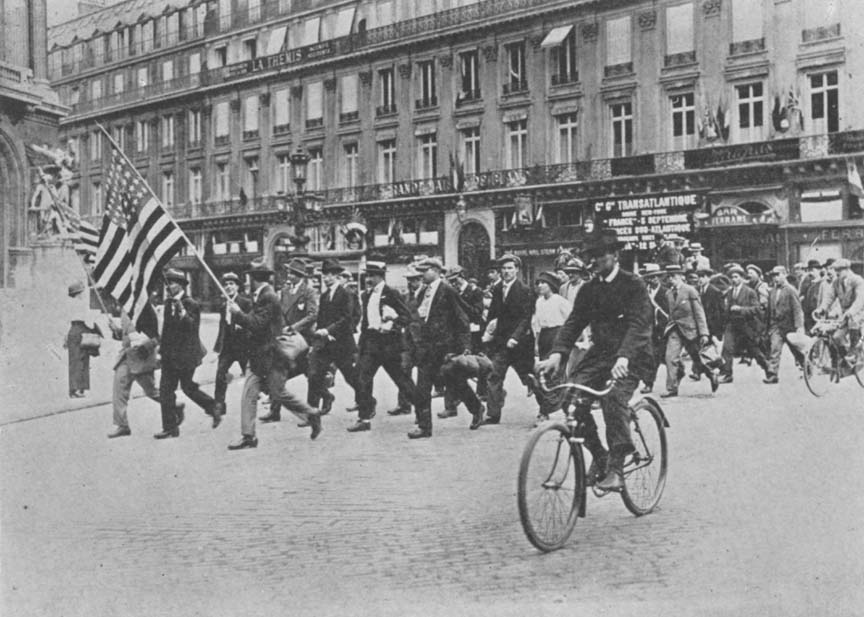
Thousands of foreign volunteers assembled on the Esplanade des Invalides this morning to offer their services for the war. These young foreigners are mostly strong, active youths and have all received more or less military training. They marched through the streets in detachments of from two to six hundred, grouped together according to nationalities, bearing French flags alongside flags of their own countries. There were about five thousand Russians, five thousand Italians, two thousand Belgians, numerous Czecs, Slavs, Roumanians, and Armenians, together with smaller contingents of Americans, British, and Greeks. Mr. Arthur Bles and his second in command, Mr. Victor Little, are busy organizing the "Rough Riders" in a riding-school in Rue Avenue des Chasseurs.
M. Geissler, manager of the Hotel Astoria, who was recently reported as having been shot as a spy for arranging disks on the roof of his hotel to interfere with the French wireless telegraphy, was tried today, not by court martial, but by a civil judge, M. Tortat, to whom the court martial had referred the matter for further evidence. It appears that M. Geissler had been denounced on insufficient grounds by a clerk in his employment. His innocence was established, this morning, and he was released from the Santé prison and handed over to the military authorities, who will probably let the matter drop.
Saturday, August 22.
Mobilization is now completed. This is the nineteenth day since the declaration of war (August 3). A sultry day with light northwesterly breezes. Thermometer at five P.M. 22 degrees centigrade.
"All that I can say to you is that the battle has begun. That is all I know," is the statement made by M. Malvy, Minister of the Interior, as he stepped into his motor-car at the Elysée Palace on his way home this evening after the meeting of the Council of National Defence. Remarkable, impressive silence prevails everywhere. If people speak, it seems to be in a whisper. Never before was Paris so full of motor-ambulances, all driving hurriedly hither and thither, bearing nurses or Red Cross attendants, but never a wounded. The whole of the Rue Francois-Premier is lined on both sides with Red Cross motor-cars. The railway stations have an unusual appearance, with hundreds of wooden booths forming a sort of barrier to approaches. The calm, confident, silent, patriotic expectation augurs well for the future and vividly contrasts with the noisy, braggadocio spirit of 1870. Paris at the present moment is the most orderly, well-behaved city in the world.
I met at the Café Napolitain, a favorite resort of journalists, my friend Laurence Jerrold, chief Paris correspondent of the London Daily Telegraph. We spoke of the stories showing the amazing ignorance in which German officers have been kept regarding the situation. Mr. Jerrold told me that a relative of his, who is a French officer, saw yesterday two Prussian lieutenants, who, as prisoners of war, were being taken around Paris, to a town in western France. Both spoke French perfectly. At Juvisy station, where the train stopped, they said to the French officer: "Of course, we know why you are taking us around Paris and not into Paris. Paris is in a state of revolution, and you don't want us to see what is going on there." Argument followed; the Prussian officers persisted that Paris was in revolt, that France stood alone, that England had declared neutrality, that an Italian army had already crossed the French frontier and had invaded the department of Haute Savoie, etc. The French officer rushed to the waiting-room, bought all the newspapers he could find, and brought them back to the Prussian prisoners, who fell aghast and read them in silence, as the train proceeded.
The curator of the Louvre Museum has taken every possible precaution to ensure the safety of the works of art under his care. The Venus of Milo has been placed in a strong-room lined with steel plates---a sort of gigantic safe---+and stands in absolute security from any stray Zeppelin bombs. The Winged Victory of Samothrace is also protected by armor plates. Mona Lisa once more smiles in darkness. The Salle Greque, containing masterpieces of Phidias, is protected by sand bags. Many unique treasures of statuary and painting are placed in the cellars. Similar precautions are taken at the Luxembourg and at other museums. The upper stories of the Louvre, which are roofed in glass, are being converted into hospital wards, and thus the collections of the national museum, which belong to all time and to all nations, enjoy the protection of the Red Cross flag.
I made a brief trip to Versailles, which has been transformed into an arsenal and a vast supply depot for food and forage. Troops of the military commissariat train are cantoned in the parks and shooting preserves of Prince Murat and of Mr. James Gordon Bennett. The attractive little summer residence of Miss Elsie de Wolff and Miss Elizabeth Marbury is occupied by cavalry officers. Versailles is the mobilization center or assembly for the southwestern military regions, and over fifty thousand men have been equipped here and sent on to their destinations at the front. Herds of cattle and flocks of sheep are grazing contentedly on the lawns and meadows of the chateau.
The membership of the executive committee of the women's committee of the American Ambulance has been increased by the addition of Mrs. Robert Woods Bliss, Mrs. Cooper Hewitt, and Mrs. Barton French.
Among the American women who have volunteered to serve as nurses in the hospital now being established in the Lycée Pasteur, in Neuilly, are the following: Mrs. H. Herman Harjes, Mrs. Frederick H. Allen, Mrs. Laurence V. Benet, Mrs. Whitney Warren, Mrs. Charles Carroll, Miss Ives, Miss Edith Deacon, Mrs. Barton French and Miss Treadwell.
Sunday, August 23.
Twenty-first day of the war. A hot sultry day, with southerly wind. Temperature at five P.M. 25 degrees centigrade.
The fourth Sunday of August finds Paris silently awaiting news from the great battle going on for a distance of one hundred and five miles extending from Mons to the Luxemburg frontier, and which is expected to rage for several days. Parisians receive with enthusiasm the news communicated by M. Iswolski, the Russian Ambassador, announcing that three of the five army corps which Germany has in East Prussia have been defeated by the army of General Rennekampf, near Gumbinnen.
I drove to-day with the Duke de Loubat, who is a close friend of Cardinal Ferrata, now spoken of as foremost favorite among the Papabili Cardinals. Monseigneur Ferrata enjoys great popularity not only at Rome but abroad, and is a warm friend of the United States. He has also a keen sense of humor. Not long ago a distinguished member of the French parliament lunched with Monseigneur Ferrata and remarked: "How is it that the Church requires such a long lapse of time before pronouncing a decree of nullity of marriage?" "Well," replied Cardinal Ferrata, "before the end of the ten years' delay, it is usually found that one of the three dies or disappears, and that the petition consequently is no longer pressed!" A great change is noticeable in the Paris churches. They have been more crowded since the war than for many years past. I entered the Madeleine to-day and found, to my surprise, an unusually large proportion of men among the congregation. Most of them were reservists called to arms. In other churches the congregations were almost entirely composed of women and children.
Our Ambassador, Herrick, is a sort of guardian angel for Americans in Paris. I saw him to-day working with Mr. Robert Woods Bliss, first secretary of the Embassy. He rose at six in the morning, and except for a brief repose for breakfast and dinner, is constantly ready to give advice to Americans or to attend to intricate diplomatic duties that crop up here at every turn. Our Ambassador also has on his shoulders the affairs of all the Germans and Austrians who remain in France. Some of our countrymen are very hard to please. Everything possible is being done for those who wish to return home, and money, when necessary, is advanced to them for the purpose. But they strongly object to waiting in line for their turn, whether at the Embassy, the Consulate, or at the Transatlantic Company, where, owing to the crowd of applicants, there is some necessary delay in attending to them.

A number of complications have arisen by discharged servants filing statements against their former employers, denouncing them as "probable spies." Several examples of this have already occurred with prominent American ladies who permanently reside here. I spoke with M. Hennion, the prefect of police, on the subject, and he said that "such malicious accusations"---and he showed me a pile of denunciations nearly a yard high---"were never acted upon, unless under really suspicious circumstances."
One of Mr. Herrick's callers at the American Embassy was Mme. Henri de Sincay, a grand-daughter of General Logan, of Civil War fame. She is the wife of a French army officer and when the war broke out was living in a chateau near Liège. She fled to Brussels with her child, and then, leaving the latter there with her sister-in-law, came to Paris to say good-by to her husband, who is attached to the aviation corps near Versailles. Now Mme. de Sincay cannot return to her child, but she is not worrying over the situation and has offered her services to the American Ambulance here in Paris.
The earnest, practical way in which General Victor Constant Michel, Military Governor of Paris, carries out his work, is admirable. General Michel has quietly despatched large numbers of the unruly youths of Belleville, Montmartre, and Montparnasse,---known as the "apaches"---to the country, in small gangs, to reap the wheat harvest, and he also employs them in the government cartridge and ammunition factories. In Paris, they have completely vanished from sight. The prohibition of the drinking and sale of absinthe, not only in Paris, but throughout France, was also due to the foresight of the Military Governor. General Michel, although a rigid disciplinarian and a masterful organizer, is extremely affable and agreeable. He was born at Auteuil in 1850, and after graduation from Saint-Cyr, the French West Point, served in the war of 1870-1871 as second lieutenant of infantry. In 1894 he was made colonel of an infantry regiment and showed such proficiency during the manoeuvers that he became general-of-brigade in 1897. He was made general-of-division in 1902; he is member of the Supreme War Council, and in 1910 was awarded the high distinction of Grand Officer of the Legion of Honor.
Monday, August 24.
Twenty-second day of the war. Hot day with bright blue sky and southeasterly wind. Thermometer at five P.M. 27 degrees centigrade.
Terrific night and day fighting continues on the Sambre and Meuse. The French attack seems to have been repulsed. The allies remain on the defensive, awaiting further German attacks. The losses on both sides are terrible. Some days yet must elapse before the final result of the great battle can be known. Meanwhile, Paris waits with patriotic confidence. Russian victories in East Prussia, the Japanese bombardment of Tsin-Tao, in Kiao-Chow, the advance of the Servians, and the increasing probability of Italy claiming eventually her "irredenta" territory, are all encouraging factors in this world-wide war.
The American volunteers mustered to-day at their recruiting offices in the Rue de Valais and marched to the Invalides, where they passed the French medical test prior to enrolment in the French army. The men are wonderfully fit, and their splendid muscular, wiry physique was greatly admired as they marched through the streets. Out of the two hundred present, only one was not passed by the army surgeons, and even he was not definitely refused. The corps will proceed to-morrow to the Gare Saint-Lazare for entrainment. They will be sent, at first, to Rouen.
M.F.A. Granger, a young Frenchman, arrived to-day in Paris from New York, where he left his wife and family. He sailed on the Rochambeau with many of his countrymen, coming, like himself, to join the colors. M. Granger tells me that he saw near Lisieux a train of German prisoners, mostly cavalrymen, some of whom had been wounded by lance thrusts. They seemed resigned to their fate, without enthusiasm, and on the whole rather pleased at the prospect of being confined and fed in France, instead of remaining at the front. They said that they had no idea that England and Belgium were fighting against them, until they crossed swords with the Belgian cavalry, which they at first supposed were French.
Tuesday, August 25.
This is the twenty-third day of the war. Another warm, sunny day, with northwesterly breezes. Thermometer at five P.M. 24 degrees centigrade.
Better news from the front this morning. The great battle that has been raging for three days from Mons to Virton, during which the French and British attacks were repulsed, has been resumed, and renewed German attacks have been checked. Considerable anxiety as to the result nevertheless prevails. My concierge, Baptiste, for instance, shakes his head in a mournful way and says: "Ah! Monsieur, there is already terrible loss of life. My brother-in-law, who left Luxemburg three weeks ago to join his reserve regiment in France, is without a cent in the world, and what will become of his wife and two little children---the Lord only knows! Their little farmhouse, with all their belongings, has been burned, and nothing is left."
I breakfasted to-day at the restaurant Champeaux, Place de la Bourse. Two agents-de-change (official members of the Paris Stock Exchange) took very gloomy views of the situation. It seems, however, that the French rentes maintain their quotation of seventy-five francs. Mr. Elmer Roberts of the Associated Press and Mr. Hart O. Berg sat at our table. Both thought that the war would be much longer than at first expected and would depend upon how long Germany could exist, owing to the impossibility of obtaining food from abroad. "Eight months," said Mr. Berg.
After lunch I went with Roberts to see the departure of the first contingent of American volunteers from the Gare Saint-Lazare. These youths are a tall, stalwart lot, marching with a sort of cowboy swing. They were not in uniform, but wore flannel shirts, broad-brimmed felt hats, and khaki trousers. They carried a big American flag surmounted with a huge bouquet of roses, and alongside this a large French flag. They were loudly cheered as they were entrained for Rouen, where they will be drilled into effective shape.
I met Mrs. Edith Wharton, who remains in Paris, and is doing good work with her ouvroir, or sewing-circle, which, with Mrs. Thorne, she has organized in the Rue Vaneau. This ouvroir is to supply work to unmarried French women and widows. Among those who have liberally subscribed to this are Mrs. William Jay, Mrs. Elbert H. Gary, Mrs. Beach Grant, and Mrs. Griswold Gray.
I went in the afternoon to see Madame Waddington at her ouvroir, 156 Boulevard Haussmann. Madame Waddington makes an appeal by cable to the New York Tribune, calling upon all American women and men to aid her indigent French sewing-women, who are employed in making garments for the sick and wounded, for which they receive one and a half francs (thirty cents) and one meal, for a day's work. Madame Waddington wore a gray linen gown, with a red cross, and was working away very merrily, distributing materials to the women. She told me that her son had joined the colors as a sergeant in an infantry reservist regiment and was at the front.
M. Maurice Maeterlinck, the Belgian writer and philosopher, is living at his quaint Abbaye de Sainte-Wandrille, on the Seine near Caudebec. The author of La Vie des Abeilles has been helping the peasants gather the wheat harvest.
After three weeks, during which relief funds have been advanced to Americans at the Embassy, the demands for money continue to be as heavy as ever. Paris is a human clearing-house, into which new arrivals are now coming every day from Switzerland and elsewhere. Although many tourists have been helped and started on their way for the United States, new ones take their places before they are fairly out of the way.
Thus, although the Embassy hoped that it had succeeded in getting the persons in most urgent need off to America on the Espagne, the departure of that vessel has caused no let-up in the demand for funds, and some individuals who have already been helped once are now coming back for further assistance.
One of the negro song and dance artists, who was given some money a couple of weeks ago and who was supposed to have left on the Espagne, presented himself and asked for further funds after that vessel steamed. When asked how it happened that he did not go, as arranged, he replied: "'Deed, Ah overslept mahself."
"Considering that the boat train left at six o'clock in the evening," remarked Major Cosby, who has charge of the administration of the relief fund, "he would seem to be a good sleeper."
In the case of all persons who are helped, the stipulation is made that they must take the earliest possible means of transport to America. The Government has no intention of financing tourists who desire to visit Europe at this time. The sole object of the relief fund is to get them back to the United States as soon as possible.
In addition to the ordinary relief fund, one hundred and seventy thousand francs have been paid out at the Embassy this week by cable orders against funds already deposited with the Department of State. This is a purely business transaction, the Government having already received the full amount of the payment made, but it has been a source of much relief to many travelers.
Wednesday, August 26.
Twenty-fourth day of the war. Dull, cheerless weather, with a Scotch drizzle in the afternoon and heavy rain in the evening. Southwesterly wind. Temperature at five P.M. 20 degrees centigrade.
The great battle on the Sambre and Meuse continues with frightful slaughter on both sides. The allies have been partially forced back but resist with dogged determination.
Mrs. Hermann Duryea, a family relative of mine, and whose husband's horse "Durbar" won the English Derby this spring, has come to Paris for a few days from their country place near Argentan in Normandy, and is stopping at her apartment in the Avenue Gabriel. Mrs. Duryea's chauffeur, who is a young Frenchman, says that Belgian chauffeurs have reached Normandy from the north, telling harrowing tales of the brutality and cruelty of the Germans, and announcing that the "German cavalry and armored motor-cars would soon prevent people from leaving Paris." Mrs. Duryea, who is an exceedingly cool-headed, plucky woman, came to me for advice. I told her that there was no probability at present of communication from Paris to the westward being interfered with. She sent some of her servants home to the United States and made arrangements to rejoin her husband at Bazoches-en-Houlme, near Argentan. The chateau has, through the generosity of the Duryeas, been turned into a Red Cross hospital.
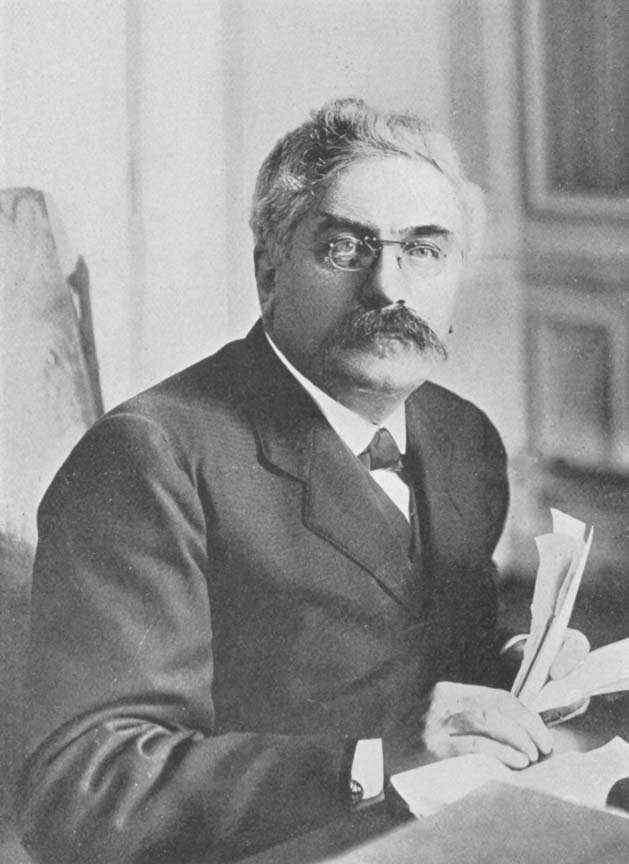
President Poincaré has taken a leaf from Great Britain, and Premier René Viviani has reconstructed a new Cabinet with eminent men, representing all political parties, making a government of national defence. Since the outbreak of the war, the Cabinet has been taking advice from statesmen such as MM. Millerand, Delcassé, Briand, and Ribot. These men now form part of the Ministry, the formation of which was announced to a group of journalists at 11.30 this evening at the Ministry of War, when we assembled there for the usual nightly communiqué. The new Cabinet is made up as follows: Prime Minister (without Portfolio), M. René Viviani; Vice-President of Council and Minister of Justice, M. Aristide Briand; Interior, M. Malvy; Foreign Affairs, M. Delcassé; War, M. Millerand; Navy, M. Augagneur; Finance, M. Ribot; Agriculture, M. Fernand David; Public Works, M. Marcel Sembat; Labor, M. Bienvenu-Martin; Commerce, M. Thomson; Public Instruction, M. Albert Sarraut; Colonies, M. G. Doumergue; Minister without Portfolio, M. Jules Guesde.
M. Etienne Alexandre Millerand is an illustrious member of the Paris Bar, who has been several times a cabinet minister. As head of the War Department, two years ago, he did more than any living Frenchman towards the reconstitution of true esprit militaire in the French army. He prepared the way for the three years' service, and reorganized the forces of the nation that had grown rusty during the decade that preceded the alarm caused by the German Emperor at Agadir. It is quite probable that M. Millerand will prove to be the Lazare Carnot---"The Organizer of Victory"---of the present war. With M. Theophile Delcassé as Minister of Foreign Affairs, French diplomacy cannot be in better hands. In calling upon M. Jules Guesde, socialist deputy for Lille, and upon M. Marcel Sembat, a red-hot socialist---both unified socialists and trusted friends of the late Jean Jaurès, the Government is assured of the hearty support of the extreme "revolutionary" parties.
MM. Guesde and Sembat can certainly do the Government less harm inside the Cabinet than they might do outside of it. No better evidence that all bitterness of political parties is now in the melting-pot can be found than in the comment of the reactionary, ultra-Catholic, royalist Gaulois, which says: "We are to-day all united in the bonds of patriotism in face of the common enemy. We place absolute confidence in the men who have assumed a task, the success of which means the salvation of France and the triumph of civilization." M. Georges Clemenceau was offered a place in the Cabinet, but declined to accept it.
The appointment of General Joseph Simon Galliéni as commander of the army of Paris, and military governor, in succession to General Michel, means that France is resolved to put Paris in a thoroughly efficient state of defence, and to be ready for the worst possible emergencies. General Michel is an admirable organizer and administrator, but he has not had the vast military experience of General Galliéni, who is, by the way, a warm friend and comrade of the former military governor. Moreover General Michel will now serve under General Galliéni's orders.

General Galliéni, as a strategist, enjoys the same high reputation as the commander-in-chief, General Joffre. He was born on April 24, 1849, at Saint-Béat in the department of the Haute Garonne. He entered the Saint-Cyr military academy in 1868, and was appointed a sub-lieutenant in the Third Regiment of Marine Infantry two years later, and he fought with his regiment through the war of 1870. Since then he has distinguished himself in Tonkin, Senegal, and Madagascar. Everywhere he has shown exceptional qualities, both as a soldier and administrator. His brilliant career finally led to his appointment as a member of the Higher Council of War, and, in acknowledgment of his great services, he was maintained on the active list after passing the age limit. He is a Grand Cross of the Legion of Honor.
President Poincaré to-day confers further extraordinary powers upon General Joffre, authorizing him to exercise the almost sovereign right of promoting officers on the spot, just as Napoleon did, by simply naming them to the posts where he thinks they may be most useful. Thus, General Joffre can make a captain a colonel or a full-fledged general-of-division, by word of mouth. This privilege was not even granted by Napoleon to his marshals. These promotions are, however, only provisional during the war, and when peace is made, must be ratified by Parliament. This renders it possible to replace general officers, killed or wounded, by officers selected on the battlefield, and above all enables important commands to be filled by young officers, who give proof of their qualities in face of the enemy.
An idea of the infinite tragedy of war was brought home to many Parisians by a visit to the Cirque de Paris, where twenty-five hundred Belgian refugees, men, women, and children, have been provided with at least a temporary shelter.
The vast building, where so many famous boxing-matches have taken place, is now completely transformed. The ring has been cut in two, and hundreds of fauteuils have been placed in small groups so arranged as to form substitutes for beds. The boxes have been reserved for the many women with infants in arms.
Hardly were they installed, and hardly had the news spread in Paris of their miserable plight, than hundreds of Parisians visited the Cirque de Paris, all bringing gifts of food, drink, or clothing. It was a pathetic and at the same time a cheering sight to watch the refugees hungrily eating the midday meal which their French sympathizers had helped to provide. These refugees, many of whom carry babies in arms, will probably be sent into Normandy and Brittany to be cared for.
Thursday, August 27.
Twenty-fifth day of the war. Rain, severe thunderstorm at noon, northwesterly wind. Temperature at five P.M. 17 degrees centigrade.
The huge German army, making its desperate struggle to invade France at many points from Maubeuge to the Vosges, is still held in check. Meanwhile the hand of fate, in the shape of the gigantic "Russian steam-roller," steadily advances in East Prussia. Cossacks have penetrated to within two hundred miles of Berlin.
Minister of War Millerand has revived the daily meetings of heads of departments at the War Office. To-day the defensive condition of Paris was discussed. Work already in progress, under the supervision of General Galliéni, is pushed forward rapidly and methodically, and obstructions to artillery fire are being cleared away in the suburbs.
I rambled this morning through the so-called German quarter of Paris around the Rue d'Hauteville and between the main boulevards and the Rue Lafayette. All the German and Austrian teutons shops and places of business are closed. The brasseries, where the best Munich or Pilsener beer, with wiener Schnitzel or leber-knoedel suppe could be obtained until the end of July, are invisible behind signless iron shutters. The "intelligence section" of the German general staff had for years obtained precious military information through the enterprising, affable German commercial agents, restaurant keepers, commission merchants, waiters, and hotel errand boys (chasseurs) who thrived in this thrifty quarter.
A wounded sergeant of a Highland regiment, in talking yesterday with an American friend of mine at Amiens station, bitterly denounced the German practice of concealing their advance by driving along in front of them numbers of refugee women and children. The Scottish sergeant said: "Our battalion was badly cut up. We were using our machine guns to repel a German advance. Suddenly we saw a lot of women and children coming along the road towards us. Our officers ordered us to cease firing. The refugees came pouring through our lines. Immediately behind them, however, were the German riflemen, who suddenly opened fire on us at short range with terrible effect. Had it not been for this dastardly trick of shoving women and children ahead of them at the points of their bayonets, we might have wiped out this German rifle battalion that attacked us, but instead of that, we were driven back. Damn these Germans!" With these words the Scottish sergeant, his right arm shattered from shoulder to elbow, climbed into the train of British wounded and was carried off towards Rouen.
A number of French wounded soldiers from the Northern Army arrived in Paris during the night and were sent to the Military Hospital, Rue des Recollets, to the Hospital of Saint-Louis, and to a hospital installed in the Collège Rollin. Among them were a number slightly wounded, but very few severely. Their spirit seems excellent, and all agree that few were killed considering the number of wounded.
All promise to obey orders more closely when they are well and back in the firing line, and not to be too rash. Rashness and too great anxiety to get at the foe seem, indeed, to have been the cause of a great many casualties.
Friday, August 28.
Twenty-sixth day of the war. Bright, clear weather with northeasterly breezes. Temperature at five P.M. 20 degrees centigrade.
I saw, in the Rue Franklin, M. Georges Clemenceau, the veteran demolisher of cabinets, and former Prime Minister, who in his youthful days was a mayor of the eighteenth arrondissement of Paris, the turbulent Montmartre quarter. M. Clemenceau severely criticizes the new Viviani Cabinet. "Viviani," said he, "asked me twice to form part of it. I declined because, in addition to personal reasons, the Ministry did not seem to me to realize the elements of power and action required by this war. Having this opinion, it would not be fair either to Viviani or to myself to enter into a combination where I should have to assume the responsibility for acts that to my mind would not adequately meet the emergency. Under the circumstances, there are only three ministers that count for anything; those of war, foreign affairs, and finance." M. Clemenceau said: "There must be something wrong with the mobilization scheme, because when our troops were outnumbered at the front, there were great quantities of young officers and men who for ten days had been awaiting, at their various points of assembly, orders to join their corps, and at the last moment were told to go home."
On the other hand, M. Millerand, Minister of War, has visited General Joffre at the army headquarters and returned to Paris to-night "very satisfied with the situation."
I took a spin in an automobile to-day to Versailles, and thence to Buc with its red brick aerodrome tower, sheds, and long rows of hangars. Here were groups of airmen in the rough, serviceable French sapper uniform--loose-fitting blue coat, blue trousers with a double red stripe, blue flannel scarf about their necks, as if they had all got sore throats, and blue pointed forage caps. Here is Chevillard, that wonderful gymnast of the air. There is Verrier, and here, driving a sporting-looking car, is Carpentier, whose more familiar costume is a pair of white slips and a pair of four-ounce gloves. For Carpentier has been mobilized, too. Instead of making thousands of dollars this month by his fight with Young Ahearn, and possibly other matches with Bombardier Wells and Gunboat Smith, he, too, is on the pay list of the army at next to nothing a day. He is attached to the flying center as a chauffeur, and that car he is driving is his own, only he cannot take it out without orders now.
Morning and evening they fly at Buc. They are constantly testing new machines, and then, when they have tested them, they fly off to the army on the eastern frontier, or to Amiens, perhaps. The other day a pilot even flew to Antwerp right across the German lines over the heads of the German army, but so high up that they never even guessed he was there. Then they practise bomb-dropping, too, and they are always on the alert for a possible Zeppelin raid on Paris. The other night a wireless message reached the Eiffel Tower from the frontier that one had started. It was midnight, and instantly the alarm was given at Buc. The airmen sleep in the hangars there, and in five minutes they had their machines wheeled out.
By the light of lanterns you could see mechanics running to and fro. The airmen themselves were hurriedly putting on helmets and woollen gloves and leather coats, for it is cold work hunting airships at midnight. Their little armory of bombs was quickly overhauled, and the belt of the machine gun that the man in the passenger's seat uses---the "syringe" as they call it---was filled, and the engines were set running to see that they were all right. But it was a false alarm after all, for, although a close lookout was kept everywhere between Paris and the frontier for the adventurous Zeppelin, and a hundred guns were craning up into the sky ready for her if she hove in sight, she never came, and the tired airmen turned in again to snatch a little sleep before morning parade.
Constantly airmen fly off to the front. Those who have been there say that the supply trains and the whole service is working splendidly. They have organized a new sport among the air-scouts. Every day, at the end of the day's reconnoitring, the airmen count the bullet-holes in the wings and body of their machines. The aeroplane that has the most is the cock machine of the squadrilla---six in the squadrilla---and holds the title until some one gets a bigger peppering and displaces him. They are very jealous of this distinction, and the counting has to be very carefully carried out by an impartial jury, for the cock aeroplane has the honor of carrying the mascot of the squadrilla.
Saturday, August 29.
Twenty-seventh day of the war. Sultry weather, with light northerly breezes. Temperature at five P.M. 26 degrees centigrade.
"Hold tight!" Such is the watchword given by the French Government, and French and British soldiers are holding tight for all they are worth against the slowly advancing German armies. Heavy fighting all along the lines from the Somme to the Vosges continues without a break. The Prussian Guard Corps and the Tenth German Army Corps have been driven back to Guise, in the department of the Aisne (one hundred and ninety kilometers from Paris), but on the French left the Germans have fought their way to La Fère (northwest of Laon, about one hundred and forty kilometers from Paris). In the eastern theater of the war, Koenigsberg has been invested by the Russians under Rennenkampf, who continue their advance towards Berlin.
Paris begins to realize that the war is coming closer to them, by the following official announcement:
The Military Governor of Paris, in view of the urgent military requirements, has decided:
1. Within a delay of four full days, starting from August 30, all proprietors, occupants, and tenants of all descriptions of houses and buildings situated in the military zone of old and new forts must evacuate and demolish the aforesaid houses and buildings.
2. In the event of these instructions not being fulfilled within the prescribed delay, these houses and buildings will be immediately demolished by military authority and the materials taken away.
The Military Governor of Paris, Commander of the Armies of Paris.
(Signed)
GALLIÉNI.
General Pau, the gallant one-armed general who commands the French Army of the East, arrived in Paris at four o'clock this afternoon, but the reason for his visit is naturally kept secret. He had a conference at the Ministry of War with M. Millerand. He called for a few moments at his residence in the Boulevard Raspail. General Pau's son, a sub-lieutenant of infantry, is lying wounded at the hospital at Troyes. General Pau had an informal conversation with President Poincaré at the Elysée Palace, and leaves again for the front to-morrow morning.
Refugees from Belgium and northern France continue to pour into Paris. But the authorities, having had time to organize, are sending them on with very little delay to various places in the west and south of France.
It is impossible to prevent these frightened people from taking refuge in Paris, which they regard as a place of safety, and the only course open is to send them on as soon as possible.
Among the financial victims of the war are a number of Chinese students who have found their supplies of money from home suddenly cut off. A body of about sixty went to the Chinese Legation in the Rue de Babylone on Friday evening, and clamored for money.
The Minister, Mr. Liu Shih-shen, was out but, to the great disgust of the staff, the students invaded the dining-room and kitchen and commandeered the dinner which was being prepared for the Minister.
A message was sent to his Excellency, who dined at a restaurant. Meanwhile the students, having dined, began to gamble, and several made preparations to spend the night in the Legation. They were, however, expelled by the police.
At the meeting of the women's auxiliary of the American Ambulance at the Embassy this afternoon, many details in connection with the establishment and maintenance of the hospital in the Lycée Pasteur were discussed.
A committee was appointed for the special purpose of supplying with clothing such wounded soldiers as may be brought to the hospital.
It was announced that Miss Matthews will succeed Miss Cameron as the chairman of the sewing committee, the latter having been called to America by her brother's illness.
Mrs. W.K. Vanderbilt has offered to contribute many articles needed in the installation of the hospital, particularly such things as window curtains and other furnishings designed to make the institution as comfortable as possible for the sufferers.
For just four weeks now the American Government has been advancing money to citizens in need of it at the Embassy, and still the stream of applicants continues in about the same proportions as ever.
The undiminishing demand for funds is due largely to the fact that there are new arrivals in the city every day, but Major Cosby, who is in charge of the distribution of the money, believes that with the departure of the Rochambeau and the Flandre there will come a gradually lessening demand for assistance.
So far about five hundred persons have received money, and the total paid out for the four weeks is 62,100 francs. This represents about one hundred and twenty-five francs, or twenty-five dollars, apiece.
In addition to the Government fund, which is paid only to persons who accept it as a loan, about twenty-seven thousand francs, raised here in Paris, has been given outright to persons who for various reasons could not be assisted out of the Government fund.
Captain Brinton has also paid out from sixty to seventy thousand dollars to various persons upon cable orders from the Department of State in Washington. This represents a purely business transaction, as the money has first been deposited with the Government by friends in the United States. It has, however, been an exceedingly practical means of helping persons who otherwise might have had to fall back on the relief funds.
Sunday, August 30.
Twenty-eighth day of the war. Sunny, but sultry, August Sunday. Light northerly breeze, thermometer at five P.M. 26 degrees centigrade.
No let-up in the fighting. The Germans continue with wonderful tenacity their favorite tactics of rolling up their forces on their right, and then enveloping and striving to turn the Anglo-French left. The French left, as officially announced at the War Office, has been forced to yield ground. But the result of the gigantic battle in the department of the Aisne near La Fère, Guise, and Laon, on the road to Paris, still hangs in the balance.
It seems pretty certain that the French armies were concentrated too far to the east. The temptation to enter Alsace, where strong force is needless, was too great for the then war minister, M. Messimy, to withstand. France is paying for this now. For over twenty years it was an open secret among military authorities that the main German attack upon France would burst in through Belgium and the northern departments of France, which seem to have been left without adequate fortifications. Here is France's vulnerable point. For France to be now outnumbered in this theater of the war is strong evidence of her also being out-generaled. While the French have wasted needless troops in futile excursions beyond the Vosges and in the Ardennes, they seem to have been blind to the tremendous concentration of German fighting strength in the north. Had it not been for the solid, heroic resistance of the British army under Field-marshal Sir John French, on the extreme French left at Mons and Cambrai, it is very likely that the French would have sustained a crushing defeat. That the French should be outnumbered on the lines near La Fère seems incomprehensible and requires satisfactory explanation from the Ministry of War. Further proof of this primary fault is forthcoming in the proclamation issued to-day, calling to the colors the 1914 class, some two hundred and fifty thousand young men of twenty, due to join the army in October. Moreover, those classes of the reserves of the territorial army called up when the general mobilization order was issued and for some unaccountable reason actually sent home again, have also been recalled.
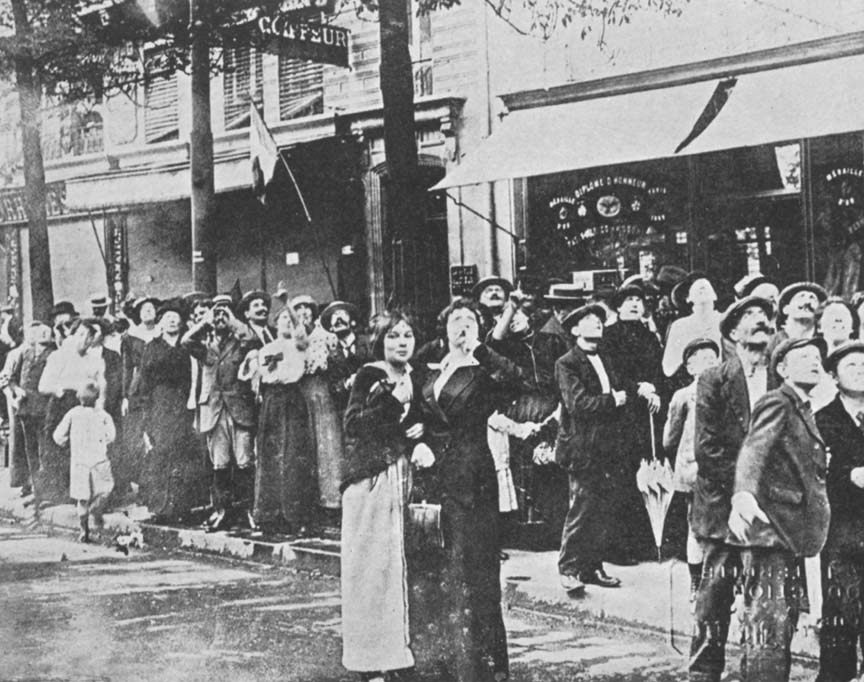
In broad daylight, at 1.15 this afternoon, the Germans left their first visiting-card in Paris. This came in the shape of three bombs dropped from a German aeroplane, that made a curved flight over the city at an altitude of two thousand meters. The first bomb fell at the corner of the Rue des Vinaigriers and the Rue du Marais, another in the Rue des Recollets, and a third near an asylum for aged workmen on the Quai Valmy. The airman also let fall an oriflamme, two and a half meters long, bearing the black and white Prussian colors, ballasted by sand in an india-rubber football, attached to which was a letter, written in German, which ran as follows: "The German Army is at the gates of Paris. The only thing left for you to do is to surrender! (Signed) LIEUTENANT VON HEIDSSEN."
The first bomb wounded two women, one of whom died of her injuries at the hospital shortly afterwards. She was concièrge of the house Number 39 Rue des Vinaigriers. No other damage was done. There were thousands of Parisians promenading the streets at the time. The news spread like wild-fire, but no panic, nor even undue excitement, ensued; the people of Paris are totally different to-day from what they were in 1870. Of course the intention of these aeroplane bomb-throwers, of whose exploits we shall probably hear a great deal, was to create a panic and demoralize the inhabitants, and especially to terrify women and children. This utterly failed. After dropping the three bombs and his carte de visite, the German aeroplane vanished towards the east. It seems strange that the flotillas of air-craft at Buc were thus caught napping and allowed the German air-lieutenant to escape.
I called in the afternoon upon Madame Waddington and her sister, Miss King. Madame Waddington was anxious about her grandchildren, who are at their country place not far from Laon, where the battle is now raging. Madame Waddington says that Mr. Herrick, whom she saw this morning, told her that if worse came to the worst, the seat of government would probably be transferred to Bordeaux.
A large sum in gold coin, it is said, has been taken from the vaults of the Bank of France and sent to Rennes. Sharp comment is elicited by an incident at the Travellers Club, a somewhat select resort of Americans, English, and other foreigners, in the former hotel of the famous beauty of the Second Empire, Madame de Paiva, in the Champs-Elysées. It appears that a wealthy and prominent German by birth, but naturalized American, Mr. X., casually remarked one day at the club that he did not intend to trouble himself to get a permis de séjour (permission to reside in Paris), because "when the German troops arrived in the capital, these papers would no longer be needed." Mr. X. was told that if he persisted in expressing such views, offensive to the members of the club and to the hospitable city in which the club was situated, his resignation would be forthwith accepted by the house committee. Mr. X. paid no attention to the warning, but when next he entered the club---a few days after the incident---he was informed that his name had been stricken from the list of members.
M. Adrien Mithouard, President of the Municipal Council, states that arrangements were made months ago to store a large quantity of flour in the city, so as to provide the civilian inhabitants with bread. This flour is in the hands of the military authorities, who have a considerably larger supply than was originally intended, and are still adding to it.
There will be no lack of coal. The army has accumulated enormous quantities, and the Gas Company has enough coal for five months. M. Mithouard also says he recently made a personal investigation of the water supply, and found that, even if the aqueducts were cut, the city would have two hundred and sixty thousand cubic meters of filtered water available every day from the Ivry and Saint-Maur waterworks; and even without these, Paris could still have two hundred and sixty thousand cubic meters a day chemically purified.
The Municipal Council has also approved a proposal to buy up certain provisions to be added to the necessaries of life for the civilian population.
M. Georges Clemenceau, the "parliamentary tiger," who, although remaining outside the Cabinet, is one of the greatest personal forces of France, has made a stirring statement to Mr. Somerville Story, editor of the Daily Mail. M. Clemenceau said:
"Yes, their guns are almost within sound of Paris. And what if they are? What if we were yet to be defeated again and again? We should still go on. Let them burn Paris if they can. Let them wipe it out, raze it to the level of the ground. We shall still fight on.
"This is not my personal resolve alone. The Government, too, is just as grimly determined. Do you know, it is strange that one should have been able to come to feel like this, but the Germans could destroy all these beautiful places that I love so much; they may blow up the museums, overthrow monuments---it would only leave me still determined to fight on.
"France may disappear, if you like. It may be called Frankreich, if you like. We may be driven back to the very Pyrenees. It will not abate one fraction our vigor and our decision.
"And in this terrible war we must all realize how unutterably great are the stakes. It is we in France and our friends in Belgium who are doomed to suffer the most bitterly. England will be spared much that we must endure. But we must all make sacrifices almost beyond reckoning. We are fighting for the dignity of humanity. We are fighting for the right of civilization to continue to exist. We are fighting so that nations may continue to live in Europe without being under the heel of another nation. It is a great cause; it is worthy of great sacrifices.
"I say this to convince you of the unbreakable spirit of the French nation.
"But the situation is not yet so grave. We knew our frontier would be invaded somewhere. We have many troops in reserve for the big battle that will follow this one.
"The Germans cannot besiege or invest Paris. Its size is too vast. Its defence will be assisted by the armies now fighting on the Oise, seventy miles away.
"The fortifications of Paris are by no means the feeble things they were in 1870. From the Eiffel Tower we can control the movements in co-operation with our armies in the provinces of France.
"The situation is in no way desperate, although the Germans have invaded France. France will fight on and on until this attempt to establish tyranny in Europe is overthrown."

Monday, August 31.
Twenty-ninth day of the war. Hot, somewhat hazy, summer weather, with faint northerly wind. Thermometer at five P.M. 27 degrees centigrade.
Kaiser William, who it appears was on the field during the battle of Charleroi, is pressing forward in hot haste, regardless of consequences, on the road to Paris, close behind the steel-tipped elite of his vast armies, consisting of the Royal Prussian Guard Corps and the famous Third Army Corps. To-morrow will be the anniversary of the Battle of Sedan. The "Mailed Fist" is doing his best to celebrate it by leading his legions to Paris. It is daredevil desperation that spurs him on, for nowhere, as yet, have the Franco-British armies been broken through, and they continue to present successive stone walls to the Teuton invasion, and oppose every inch of ground with dogged tenacity. The allied left wing has been forced---always by the traditional enveloping tactics on their right---to retreat, but they do so sullenly and in good order, making the Germans pay dearly for every step gained. The battle is raging continuously, and much depends upon which side first receives strong reenforcements to fill up the gaps made by tremendous losses. The Russian advance in East Prussia, according to accounts from Brussels, has already forced the Germans to send back to Berlin from their center at least one army corps.
There is hurry and skurry all day long among Parisians and foreign residents to get away from Paris to more peaceful towns in the south and west. The railway stations are so crowded that it is almost impossible, at the Gare of Saint-Lazare or at the Quai d'Orsay to get anywhere near the booking office. Motor-cabs are being hired at extravagant prices to convey families to Tours, Orleans, Le Mans, or Bordeaux. The bearing of the public however by no means resembles that of "nerves," and less still a panic.
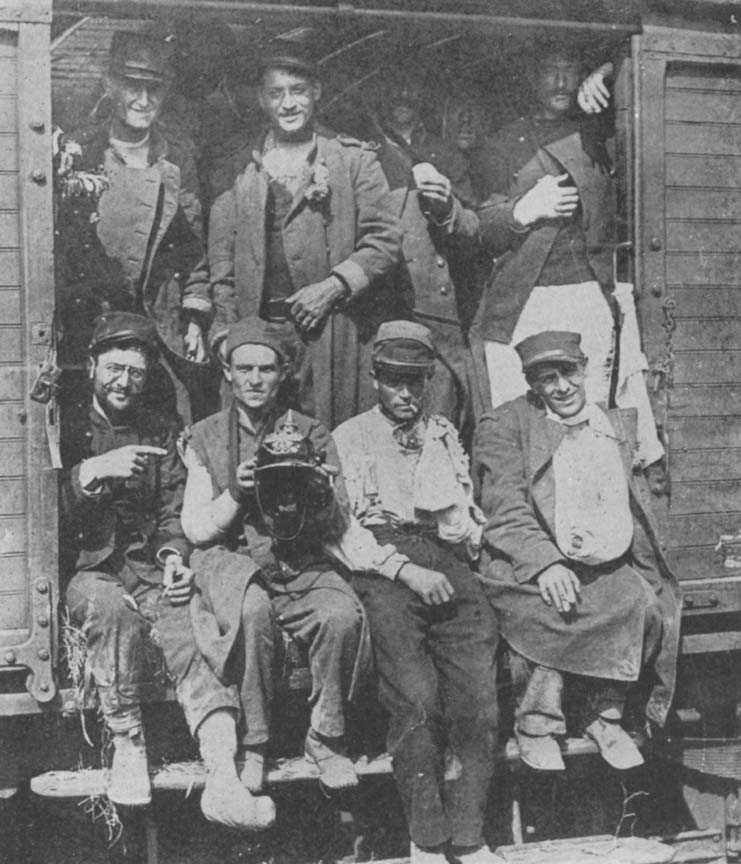
I lunched to-day with Mr. Hulme Beaman, correspondent of the London Standard, and his charming wife, who live just across the way from me, in the Boulevard de Courcelles. Mr. Beaman passed Sunday at Poissy, where he usually goes fishing for gudgeon. At Achères, the junction of the lines from Picardy and Belgium, he saw train after train filled with wounded French soldiers, who seemed in good spirits and who, in spite of their suffering, were burning to get back again to the front.
Another German air-lieutenant made a flight over Paris this afternoon and dropped two bombs near the Notre Dame Cathedral, but caused no damage; one of the projectiles fell into the Seine. The airman also tossed into Paris a German flag, to which was tied a postal card calling upon Paris to surrender. Groups watched the aeroplane, which never came lower than fifteen hundred meters, and women and children seemed rather amused at the sight.
A fugitive from Belgium, who was at Louvain shortly before the wilful destruction of the once beautiful university town, tells a curious story of a Dutchman who had a thrilling escape on the arrival of the Germans. He rushed for the Dutch flag, which, in his nervousness, he hoisted outside his door upside down. This then represented the French flag, and the Dutchman, who spoke no German, was immediately seized by the enemy and ordered to be shot. He was placed upright against a wall and was about to be riddled with bullets when his employer rushed up and told the Germans that they were going to shoot a Dutchman, which saved his life.
General Galliéni, Governor of Paris, has issued a decree prohibiting newspapers to publish "spread-head" lines extending over two columns in width. The news vendors are not allowed to shout out the news, or even the names of the papers on the streets. The type of headlines must not be of alarming size. In fact, a worldwide war was required to check the march of the sensational Paris "yellow" press.
The Minister of War has suppressed sauf-conduits for travelers leaving Paris by rail, but they must be provided with proper identification papers. The laisser-passer, delivered by the Prefecture of Police, is still required however for all who leave Paris by automobile.
The American committee, in a circular to Americans, signed by Judge Elbert H. Gary, chairman, and H. Herman Harjes, secretary, gives a warning against sensational reports about the "imminent occupation" of the city by the Germans, but expresses the opinion that "it would be wise for Americans who cannot be of special service during the war, or who are not required to remain by their business or professional interests, to leave the city in an orderly and quiet way, whenever reasonable opportunity is offered."