
Tuesday, September 1.
Thirtieth day of the war, and forty-fourth anniversary of the Battle of Sedan. Oppressive sultry weather, with northeasterly wind. Thermometer at five P.M. 23 degrees centigrade.
The War Office communiqué to-night states that: "on our left wing, in consequence of the enveloping movement of the Germans and with the object of not entering into a decisive action under bad conditions, our troops have fallen back, some towards the south and others towards the southwest. The action which took place in the district of Rethel has enabled our forces to stop the enemy for the time being. In the center and on the right (Woevre, Lorraine, and the Vosges), there is no change in the situation."
This means that Emperor William is hacking his way still nearer to Paris. The failure however to realize his boast that he would celebrate the anniversary of Sedan by appearing within striking distance of the French capital may indicate that the turning point of this phase of the war is near at hand.
The allied troops north of Paris have established themselves in a fighting position more favorable than that into which an attempt was made to draw them. The dam still holds good, and breaches are being repaired.
The people of Paris are quite calm, in spite of false rumors and of pyrotechnics aloft executed by the German taubes.
At quarter past five this afternoon, I was walking across the Place de la Bourse to file a cable message to the New York Tribune. I heard a loud explosion, followed by clashing of broken glass. A projectile had fallen a hundred yards distant and hit the top of a house in the Rue de Hanovre. The pompiers were on the spot within three minutes, having been summoned by the fire-alarm box near the Bourse. No serious damage was done, but little lead pellets were found in profusion. When I heard the explosion, I looked up and saw an aeroplane at an altitude of about fourteen hundred meters vanishing towards the northeast. It was pale yellow, and white near the after part. It was a German taube. A sand-bag with a German Uhlan's pennant was dropped, bearing a card reminding Parisians that it was "the anniversary of Sedan, that they would soon be obliged to surrender the city, and that the Russians had been crushed on the Prussian frontier." Another bomb had been dropped on the roof of Number 29 Rue du Mail and broke into an empty room, but did not explode. A third bomb fell on a schoolhouse in the Rue Colbert; ricochetting off the wall, it fell into a courtyard, where it exploded and made a hole in the ground. Other bombs were dropped in the Rue de Londres and in the Rue de la Condamine; the last one injured a woman and a little girl, who were hit in the chest and head by fragments of the projectile. As the taube passed over the Pepinière barracks, and the Place de l'Opéra, at an altitude of perhaps twelve hundred meters, some soldiers fired at it with their rifles, but without effect. The German air-lieutenants have so far avoided the Eiffel Tower, where machine guns are placed.
The War Office announces that a flotilla of armored aeroplanes provided with machine guns has been organized to attack the German aeroplanes that fly over Paris. Spectacular sights are thus in store for us.
The American committee, constituted by the American Ambassador and including some of the most eminent Americans residing in Paris on the day of the declaration of war, has requested the Minister of War to supply it with formal proofs of the fact that the bombs which have fallen in Paris were thrown from a German aeroplane.
M. Millerand, in response to this request, has submitted to the American Ambassador and two delegates from the committee the complete "dossier."
The Ambassador, after having examined the evidence submitted to him, and to the members of the committee, decided to cable a report to his Government concerning these methods of warfare, which are not only acts against humanity, but, further, are in absolute violation of The Hague Convention, signed by Germany herself.
The committee has also decided to ask the American Government, while remaining loyal to its declaration of neutrality, to make a strong protest to the German Government.
The Minister of War has issued a decree calling up territorial reservists of all classes in the north and northeastern districts of France, not yet with the colors.
The French "left wing," which, as foreseen more than twenty years ago, must be the vulnerable spot in the defence of Paris, will very likely be forced to retire still nearer to the capital. In that case, a battle would be likely under the shelter of the Paris forts, which encircle the city at from thirty to forty kilometers from the Notre Dame. This belt of forts, connected by three lines of formidable entrenchments and rifle pits, now being dug, not only by the troops, but by thousands of Paris workmen out of regular employment, make a circumference of two hundred kilometers, or about one hundred and twenty-five miles. This line of defence would protect Paris and also a field army with all its own resources, and probably make it impossible for the Germans to completely invest the city, as they did in 1870. Meanwhile the allied armies outside of Paris would be able to keep the rest of the German armies "busy," and threaten the long line of German communications. Paris would thus be able to hold out for a long time. The Germans would obtain food supplies from the rich country that they occupy, but their supplies of ammunition, and of men to fill gaps in the fighting units of the first line, must become precarious. Meanwhile the Russian "steam-roller" is moving towards Berlin.
At six o'clock this evening the following decree was issued by the Prefecture of Police:
"By order of the Military Governor of Paris, no civilian automobile carriage will be allowed to leave Paris from today. This order has been immediately enforced."
Streams of people from the regions to the north of Paris within the sphere of the German operations are swarming into Paris, bringing their belongings with them. I saw a train pull slowly into the Gare du Nord laden with about fifteen hundred peasants---old men, women, children---encumbered with bags, boxes, bundles, fowls, and provisions of various kinds. The station is strewn with straw, on which country folk fleeing from the Germans are soundly sleeping for the first time in many days. These refugees are being shunted on to the chemin de fer de la ceinture and proceed around the city to other stations, from which they are transported towards the south.
Tens of thousands of Parisians throng the railway stations, seeking their turn to buy tickets to points outside the city. At the Gare de Lyon, Montparnasse, d'Orsay, d'Orleans, people are standing in lines ten abreast and a quarter of a mile in length, waiting for hours and hours to book for Bordeaux, Biarritz, Brest, Rennes, or Nantes. Some of these people have waited from seven in the morning until three in the afternoon to obtain tickets.
If matters get worse, President Poincaré and the Ministry will establish themselves at Bordeaux. Ambassador Herrick intends to remain in Paris, as Minister Elihu Washburne did in 1870. He will delegate a secretary to represent the United States Embassy at the seat of government. Perhaps Mr. Sharp, the newly appointed Ambassador, might be utilized for this purpose.
A convoy of one hundred and forty British soldiers, wounded in the recent fighting in the Aisne Department, arrived at nine o'clock this morning at the Gare du Nord.
Most of them were shot in the legs and arms, but in spite of their sufferings, none of them showed the least sign of being broken in spirit. As they were transported from the train, there were touching demonstrations of sympathy from the crowd, which the wounded men acknowledged to the best of their ability.
By a pretty little attention on the part of the Red Cross workers in Chantilly, all the men wore a flower and had been the recipients of refreshments and fair words of encouragement.
There was quite a procession of wounded of various nationalities at the station, and scenes were witnessed which caused the tears to start in many eyes. A group of Belgian soldiers, including several wounded, encountered the British convoy on their arrival, and hearty handshakes were exchanged.
Half an hour after the arrival of the British wounded, a party of thirty Turcos wounded in the battle of Guise came in and were in turn accorded an ovation. According to one of the men, they fought for nine days and nights without a break, but were gratified in the end by beating back the enemy. With one voice they declared that they are impatient to get back again into the fighting line.
A British private, wounded in the leg by a German shell, described the fighting around Mons on Sunday week as "terrific." They first got the German shell fire quite unexpectedly near the railway station. Two of their battalions marched through the streets of Mons and were fired on from house windows by the Germans. Some of the German shells, he said, were filled with broken glass and emitted a suffocating gas when they exploded.
Mr. Elbert H. Gary, chairman of the American Committee, left to-day by automobile for Havre, whence he expects to start for New York on Saturday on the France. It was decided at the meeting of the committee yesterday afternoon that Mr. Gary should, though absent, retain the chairmanship, with Mr. H. Herman Harjes, the secretary, acting as presiding officer. Mr. Lazo, the assistant secretary, becomes secretary in Mr. Harjes' place.
Mr. F. E. Drake, Major Clyde M. Hunt, Mr. Henry S. Downe and Mr. W. H. Ingram were added to the membership of the committee.
Wednesday, September 2.
Thirty-first day of the war. Beautifully clear weather, cloudless sky, northeasterly wind. Temperature at five P.M. 25 degrees centigrade.
German prisoners declare that Emperor William has made it known to every soldier that his orders are to "take Paris or die." A German cavalry division came into contact with British troops yesterday in the forest of Compiègne. The British captured ten field guns. But the right wing of the German army, which ever since the battles of Charleroi and Mons has enveloped and turned the allied left, continues its advance. The allied troops have retired partly to the south and partly to the southwest. A great battle must consequently take place within the range of the Paris forts. Work on the entrenched lines connecting the forts is actively carried out and is said to give every satisfaction. The positions, believed to be impregnable, are strengthened by ingenious arrangements of barbed wire. It is reported that some of this barbed entanglement contains live wires fed by the electric batteries of the defence.
In a stirring editorial in his newspaper L'Homme Libre, M. Georges Clemenceau frankly faces the situation now that "the Germans are close to Paris." He adds: "We have left open the approach to Paris, while reserving to ourselves flank attacks on the enemy. If the forts do their duty, this move may be a happy one. From what we have seen of him, General Joffre belongs to the temporizing school. At this moment there are no better tactics. The supreme art will be to seize the instant when temporization must give way to a carefully prepared offensive movement. I have full confidence in General Joffre."
Lord Kitchener made a rapid incognito visit to Paris yesterday, where he met Field-marshal Sir John French. As far as can be ascertained, Lord Kitchener went to the front and had a conference with General Joffre. There seems to be no doubt but what General Joffre's plans have the heartiest approval and support of Lord Kitchener. French troops from the eastern theater of the war are being brought up rapidly, so as to attack the German lines of communications, possibly near Rethel. Reenforcements are coming in rapidly from England, and a large new army has formed, at Le Mans, and will soon be ready to take the field with great effect.

The usual six o'clock serenade of the German air-lieutenants this afternoon drew forth a few rifle shots from roofs of Paris houses, and even a quick-firing gun was discharged at one of these taubes. But the distance was too great, and the two German aeroplanes vanished shortly before seven in a northerly direction.
This evening President Poincaré and the French Government removed the seat of government from Paris to Bordeaux, and the following proclamation was issued:
Frenchmen, For several weeks, during desperate fighting, our heroic troops have struggled with the enemy's army. Our soldiers' valiance has brought them marked advantages on several points. But to the north the advance of the German forces has compelled us to draw back.
This situation imposes on the President of the Republic and the Government a painful decision. To safeguard the national salvation, the public powers have as a duty momentarily to leave the city of Paris.
Under the command of an eminent leader, a French army, full of courage and zest, will defend the capital and its patriotic population against the invader. But the war must be pursued at the same time over the rest of the land.
Without peace or truce, without halt or faltering, the sacred struggle for the honor of the nation and the reparation of violated right will be continued.
None of our armies is cut into. If some of them have undergone losses--too great losses---the vacant places have been immediately filled by the depots, and the call of the recruits ensures for us for to-morrow further resources of men and energies.
Fight and stand firm---such must be the watchword of the allied armies, British, Russian, Belgian, and French.
Fight and stand firm; while on the sea the British help us to cut our enemy's line of communications with the outside world.
Fight and stand firm; while the Russians continue to advance to strike the decisive blow in the heart of the German Empire.
It is the duty of the Government of the Republic to direct this stubborn resistance.
Frenchmen will rise on every side for the sake of independence. But in order that this formidable struggle shall be conducted as efficaciously and with as much spirit as possible, it is essential that the Government should be left free to act.
At the request of the military authorities, therefore, the Government will be temporarily transferred to a point in French territory where it can remain in constant relations with the whole of the country.
The Government requests members of Parliament not to remain too distant from it, in order that, in conjunction with them and with their colleagues, they may be able to form a solid core of national unity in the face of the enemy.
The Government leaves Paris only after having assured, by every means within its power, the defence of the city and the entrenched camp.
It knows that there is no necessity to recommend the admirable population of Paris to remain calm, resolute, and self-possessed. Every day the people show that it is equal to this highest duty.
Frenchmen, Let us be worthy of these tragic circumstances. We shall win the victory finally.
We shall win it by untiring will, endurance, and tenacity.
A nation which is determined not to perish, and which recoils neither before suffering nor sacrifice, is sure to conquer.
* * * * *
This proclamation had a good effect on the population.
The wife of my concierge voiced the popular sentiment when she said this evening: "Ah! Monsieur! We may have some pretty bad quarts d'heures here, but we have such confidence that all must end well, that my husband's old mother and our little children will remain in Paris with us." This remark was made five minutes after a German air-lieutenant had flown over the roof of the houses in my street, Rue Théodule-Ribot, and had dropped near the Parc Monceau a bomb that made a terrific noise, but did no damage.
Thursday, September 3.
Thirty-second day of the war. Dazzling sunshine, cloudless sky, and light northeasterly wind. Thermometer at five P.M. 27 degrees centigrade.
The forward movement of the Germans, the "Paris or Death" rush of the Kaiser, seems, for a moment at least, to have come to a standstill. Although precautions had been taken in expectation of a German attack from the region of Compiègne-Senlis, no contact, says the French official communiqué, occurred to-day. In the northeast all is reported quiet.
Disappointed Parisians scanned the sky in vain for their five o'clock taube. A marchand-de-vin on the famous "Butte" of Montmartre arranged a Tribune with numbered seats commanding a splendid view of the city. Field-glasses were on hand for hire. Orchestra stalls were paid for at the rate of ten cents a seat. The performance was announced to begin at half-past five. This worked very well yesterday, when the evolutions of the two German air-lieutenants, accompanied by pyrotechnic display, netted a lucrative harvest. To-day, however, the enterprising theatrical manager was forced by his public to return the money at the "box office;" this was promptly done, the performance "being postponed." The postponement was due to the appearance of several French aeroplanes, which evidently had been sighted by the Germans.
Now that the French Government has gone to Bordeaux and temporarily transferred the capital to Gascony, the only heads of the diplomatic corps remaining in Paris are the American Ambassador; the Spanish Ambassador, the Marquis de Villa Urrutia; the Swiss Minister, M. C. Lardy; the Danish Minister, M. H.A. Bernhoft; and the Norwegian Minister, Baron de Wedel Jarlsberg.
That American property may be safeguarded, in the extremely improbable event of an occupation of the city by the Germans, Ambassador Herrick requests all American citizens owning or leasing houses or apartments in the city of Paris or its vicinity to register their names, with descriptions of their dwellings, at the Embassy. If worse comes to the worst, notices will be posted on American dwellings, giving them the protection of the American flag.
Mr. Robert Bacon, former Ambassador to France, is stopping at the Hotel de Crillon in the Place Vendome. He lunched to-day with Mr. Herrick, and both express optimistic views of the situation from military, diplomatic, and financial standpoints.
My servant, Felicien, telephoned me from Aubervillier, some ten kilometers from Paris, saying that he, together with four men of his squadron, had become separated from his regiment, the Thirty-second Dragoons. They had lost their horses in the marshes and woods near Chantilly during a cavalry engagement and had been instructed to make their way to Paris and rejoin their regimental depot at Versailles. The party was in charge of their sergeant, who explained that the regiment had at first been sent towards Metz, where they took part in the daily fighting all along the line there, and that suddenly they were entrained and rushed across country to Péronne, to check the advance of the Germans in their march upon Paris. This seems to indicate that the French generals did not fully appreciate until too late the really vital importance of the concentrated rush upon Paris of the right wing of the German armies, where all their strength had been assembled. The dragoons seemed pretty worn out, but were in good spirits and anxious to get back again in the fighting line. But they must go to Versailles to obtain their remounts. Sophie made a succulent lunch for them in the kitchen. They ate beefsteak, potatoes, cabbage, fruit, rice, and cheese, washed down with half a dozen bottles of light claret.
Every one seems to be trying to get away from Paris. It is a sort of exodus. I watched my opposite neighbors, Baron and Baroness Pierre de Bourgoing---the latter better known as Suzanne Reichenberg of the Comédie Française--getting into their motor-car at half-past five this morning, accompanied by a maid and a pet dog. Baron de Bourgoing was in the uniform of a captain of territorials. He will go with his wife as far as the outer fortifications in the direction of Versailles.
The news of the election of Cardinal Jacques della Chiesa as Pope, with the title Benoit XV, does not arouse as much public interest here as does the nomination of M. Emile Laurent as Prefect of Police, in place of M. Hennion who, on account of ill health, retires at his own request. M. Laurent has for twenty-three years been secretary-general of the Prefecture of Police. He was born in 1852. He is thoroughly familiar with every phase of Paris life. He is a man of great energy and of prompt decision. He is a very kind-hearted man and has done much toward relieving misery in the capital. The appointment is a very popular one and gives general satisfaction.
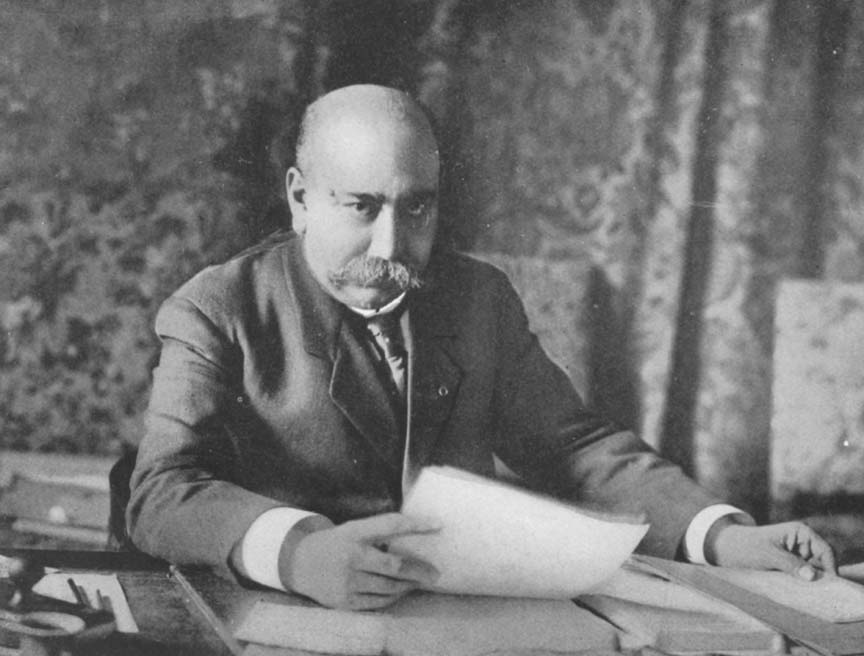
Friday, September 4.
Thirty-third day of the war. Hot, sultry day with light northeast wind. Thunderstorm, with heavy rain in the evening. Temperature at five P.M. 28 degrees centigrade.
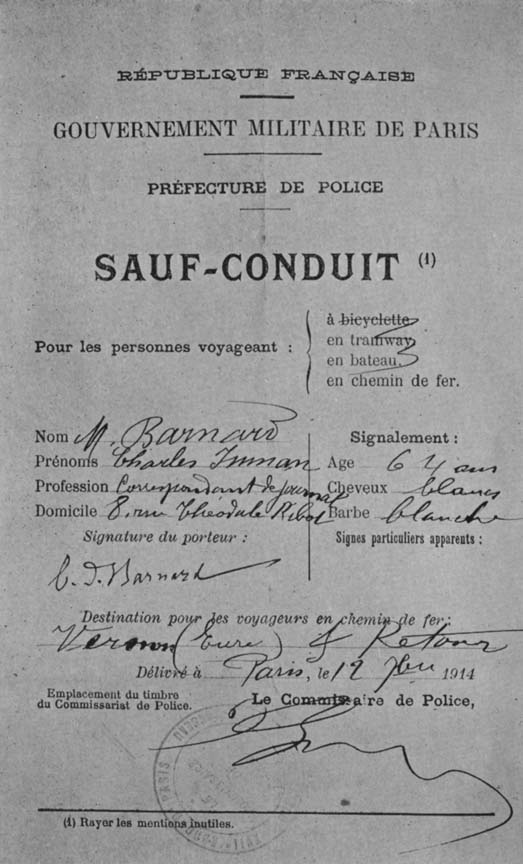
Americans still left in Paris were very busy to-day registering their addresses at the chancellery of the Embassy in the Rue de Chaillot. They had to have their leases with them. I registered for my little place at Vernon and also for my apartment in the Rue Théodule-Ribot. Among well known Americans whom I saw at the chancellery were Messrs. James Gordon Bennett, De Courcey Forbes, Julius and Robert Stewart, William Morton Fullerton, Mrs. Duer, formerly Mrs. Clarence Mackay, Dr. Joseph Blake, and about a hundred others. All sorts of wild rumors about the approaching Germans were current. One tremulous little lady said that "when the Germans entered the forest of Compiègne, the French set fire to the woods, and then shot down the Germans like rabbits as they fled from the burning thicket!"
I met here Mr. Robert Dunn, war correspondent of the New York Evening Post, who is the only newspaper man I have talked with who really saw the fighting near La Cateau and Saint Quentin. Mr. Dunn went on a train with his bicycle last week, provided only with a laisser-passer for Aulnay in the Department of the North. The train was brought to a stop near Aulnay, and the passengers were informed that German cavalry occupied the line a couple of kilometers further on. Every one got out. Mr. Dunn jumped on his bicycle and wheeled off to La Cateau. Here he met the British retreating in good order. He remained with them as they retired toward Saint Quentin. He saw them spread out in thin lines and pick off the German gunners by their splendid marksmanship. Most of the British were wounded by shells. Very few of them had bullet wounds. At Saint Quentin a few Highlanders came limping along, thoroughly exhausted with their five days' continuous fighting. But although pale and hungry, their jaws were set with determined grit. Their superb pluck impressed Mr. Dunn immensely. As they were sitting at a café, some French soldiers led away a German spy, with a towel wrapped around his eyes. The man was executed.
I met a British staff officer at Brentano's bookstore, as he was buying maps of the environs of Paris. I told him that Lord Kitchener had been to Paris and had conferred with M. Millerand, the French Minister of War. The officer said: "I am glad to hear of that, because at a certain phase of the fighting in the north, the French completely failed to support us."
I called upon Mr. William G. Sharp, the newly appointed United States Ambassador, and upon Mr. Robert Bacon, the former United States Ambassador. Both are stopping at the Hotel de Crillon. The Paris newspapers seem highly pleased at this "strong diplomatic manifestation"---the American Ambassador of yesterday, the American Ambassador of today, and the American Ambassador of tomorrow---constituting a delegation from the United States to see that the rights of universal humanity are respected. Parisians salute the Star Spangled Banner as it floats over the American Embassy as the symbol of the "World's Vigilance against Barbarity,"---such are the words of La Liberté. M. Gabriel Hanotaux, writing in the Figaro, attaches equal importance to the attitude of the United States as interpreted by its three representatives, saying: "Mr. Herrick is very happily not leaving us. He has followed the whole course of events which led to this fatal war, watching with a just and noble spirit. He has kept his Government accurately informed of all, and he will continue at the head of the Embassy."
The Matin says, "that of all the diplomatists accredited to France, it was Mr. Herrick who took the gallant initiative to remain in Paris, and Parisians deeply appreciate this. In making this choice, Mr. Herrick said that he regarded Paris not only as the capital of France, but as that 'Metropolis of the World' spoken of by Marcus Aurelius. He feels that he is the American Ambassador to both these cities. In his eyes this 'Metropolis of the World' possesses a Government, invisible doubtless, but perpetually present, and one with which he wishes to remain in touch. It is at one and the same time to Paris, in its period of trial, and to the fatherland of the human race, that Mr. Herrick wishes to give the pledge of his affection. Thus he is remaining as a link between those of his compatriots who are residing among us and the citizens of the free Republic across the sea that has more than once declared itself the sister Republic and which professes as much love for our 'traditions' as we ourselves esteem the passion for 'progress', of which it gives the example."
Saturday, September 5.
Thirty-fourth day of the war. Hazy autumnal morning, clear and hot in the afternoon, with light northerly breeze. Thermometer at five P.M. 26 degrees centigrade.
Germans appear to have evacuated the Compiègne-Senlis region, and are apparently moving towards the southeast, thus continuing a movement that began on Friday. General Cherfils, the military critic of the Gaulois, taking a very optimistic view of the situation, thinks the movement may be to assure a retreat by some route other than by a return through Belgium. General Cherfils says: "This rush of the German right wing upon Paris is the last bluff of terrorism of the last German Emperor! The Kaiser thought that he could frighten us and induce France to make peace. After which he would be free to return with his armies against Russia."
Mr. d'Arcy Morel, the financial correspondent of the London Daily Telegraph, came to see me to-day. He lives at Reuil, in the military zone northwest of Fort Mount-Valerian. He had been up all night, getting his belongings to Paris, and had just sent his little daughter to Dieppe on her way to England. Mr. Morel said that the night trains out of Paris at the Gare Saint-Lazare were filled to overflowing. No lights were permitted in the cars, and a dozen soldiers with loaded rifles were placed in a car just behind the locomotive, and a dozen more soldiers at the rear end of the train. These trains stop at every station and take about ten hours to reach Dieppe, instead of four hours as usual. Precautions of guarding the trains are made because several German armored motor-cars had been signalled dashing about near Marly and Pontoise. The gardener of my little place at Vernon, which is on the western line of the Seine, at a point where it is intersected by a strategic line between Chartres in the south and Gisors and Beauvais in the north, seems to be confident that Vernon will not be occupied by the Germans, for he managed to send me today a big basket full of peaches, pears, string beans, and green corn.
To-day the first oysters make their appearance! This event, trivial in itself, is significant as showing that the Paris central markets are able to supply Parisians not only with necessities but with luxuries. The mute oyster that comes in with the months having the letter "R" in their names bears eloquent testimony to uninterrupted communications.
I looked in for a few moments this afternoon at the National Library in the Rue de Richelieu. No signs of war here! A score of inveterate bookworms were pondering over dusty volumes, inquisitive writers were exploring literature bearing upon the war of 1870, seeking precedents and parallels for coming events; a few ladies were looking up files of old newspapers and fashion plates. The National Library seemed exactly as in the most peaceful days.
I lunched to-day at the restaurant Beauge, in the Rue Saint-Marc, a favorite resort of journalists. The manager told me that it would be closed that evening. It seems that he had received a "third warning" not to keep open after half-past nine. As he could never pluck up courage to eject his customers while enjoying succulent repasts, he decided to shut up his place altogether. The suggestion made by an Irishman, Mr. Sullivan of Reuter's Agency, to employ a London "chucker-out" did not at all appeal to his notions of the traditions of Parisian gastronomic hospitality.
I met to-day another British officer buying books at Brentano's. He gave me a picturesque description of the German method of advance. "It is the scientific development of the wild, fanatic, life-regardless, condensed rush of the Soudan dervishes," he said. "The Germans mass together all their big field guns. They close in around them serried infantry, goaded on by their wonderful, machine-made, non-commissioned officers, who prick them with sword bayonets, and whenever, from wounds or from sheer exhaustion, men fall out, they are shoved aside, to die by the roadside, or to be trampled under foot, like mechanical tools that have become useless. The German officers and non-commissioned officers are utterly regardless of life. The German flanks are protected by quantities of machine guns placed so close together that their gunners jostle one another. This strange engine of modern warfare creeps on like a monster of the apocalypse, carrying all before it. Aeroplanes hovering over the fronts of the columns direct movements by signalling. The dense, serried mass of infantry offers a splendid target. The losses must have been frightful---exceeding anything recorded in modern war. The German infantry are poor marksmen. They don't know how to shoot. Scarcely any of our men were wounded by bullets. Nearly all the wounds were inflicted by shells."
The Marquis de Valtierra has been appointed Spanish Ambassador to the French Republic, in place of the Marquis de Villa Urrutia, who has resigned. The new Ambassador, who has presented his credentials to President Poincaré at Bordeaux, and who is expected to arrive in Paris to-morrow, has not followed a diplomatic career. He is a captain-general --a title corresponding with that of an army corps commander in France---and until a few days ago was in command of the military region of Burgos.
News that the representatives of France, Great Britain, and Russia have signed an agreement in London not to make peace without previous understanding with the others, meets with popular approval here, and is taken as further evidence that the allies are determined to fight the war to a finish.
Sunday, September 6.
Thirty-fifth day of the war. Ideal September weather, with light easterly wind. Temperature at five P.M. 24 degrees centigrade. The moon is now full.
Instead of making a ferocious attaque brusquée on Paris, the four army corps composing the German right wing are moving southeastward, in a supreme effort to crush the left flank of the French center, which is reported to be engaged with the main German forces near Rethel, striving to cut off and surround the French center, and thus achieve a second, but far more gigantic, Sedan. In any event, the Germans are certainly moving away from Paris to the southeast.
Paris assumes a holiday aspect. Thousands of people made excursions to the suburbs of the city, and particularly to the Bois de Boulogne, to see something of the preparations for the defence. Boys and girls from boarding-schools, under care of their teachers, were among those who watched gangs of men digging wide and deep trenches, while trees that obstructed the ground in the vicinity were being cut down. The daily crop of Paris newspapers is becoming beautifully less. The Temps published its last Paris issue on Friday and has transferred its headquarters to Bordeaux. M. Georges Clemenceau's Homme Libre has ceased to appear. So also have the Gil Blas and Autorité. The Daily Mail has migrated to Bordeaux. Most of the newspapers that remain are published on a single sheet. The veteran Journal des Débats announces that for one hundred and twenty-five years it has appeared in Paris, being interrupted only at rare and brief intervals when provisional governments, resulting from violence, by brute force prevented publication. Le Journal des Débats will continue to be printed and published in Paris "so long as it is materially possible to do so." M. Arthur Meyer, editor and proprietor of Le Gaulois, announces that he will "remain in Paris in 1914 as he did in 1870." He will continue to edit and publish the Gaulois in Paris, having around him "a small family of editors and reporters, who replace my own family, now, Alas! far away!" The Echo de Paris continues to publish each day an edition of four pages. So also does Le Figaro. The Matin and Liberté appear on single sheets.

The European edition of the New York Herald appears every day on its nice white glazed papier de luxe, in a four-page edition Sundays, and on a single sheet on week days. The Paris Herald, as it is familiarly called, is printed half in English and half in French. The war has not frightened away the venerable "Old Philadelphia Lady," who daily continues, as she has done since Christmas eve, 1899, to put the following question:
I am anxious to find out the way to figure the temperature from Centigrade to Fahrenheit and vice-versa. In other words, I want to know, whenever I see the temperature designated on Centigrade thermometer, how to find out what it would be on Fahrenheit's thermometer.
OLD PHILADELPHIA LADY.
Paris, December 24, 1899.
Monday, September 7.
Thirty-sixth day of the war. Hot September weather, with brisk east wind. Temperature at five P.M. 24 degrees centigrade.
The great battle begun Sunday morning continues with slight advantages obtained by the allies and extends over a front of one hundred and thirty miles, from Nanteuil le Haudoin, on the allied left, to Verdun. The allies occupy very strong positions. Their left is supported by Paris, their right by the fortresses of Verdun, and their center by the entrenched camps of Mailly, just south of Vitry-le-Francois.
About thirty American and English newspaper men met at lunch to-day at the restaurant Hubin, Number 22 Rue Brouot. Among those present were Fullerton, Grundy, MacAlpin, Williams, Knox, Reeves, O'Niel, Sims, and others. Every one was in fine spirits, the trend of feeling being that Paris was the most interesting place to be in just now, and that perhaps the best story of the war may yet be written in Paris.
I drove in a cab with MacAlpin to the Gare du Nord to meet a train of British wounded that was expected to arrive there. We found the station almost deserted. A reserve captain of the Forty-sixth Infantry, whose left forearm had been smashed by a shell, arrived and was very glad to get some hot soup provided by the railroad ambulance women. Saw a brigadier-general and his staff going full speed in a motor-car to the east. Artillery firing was heard this morning to the east of Paris, but was no longer audible after eleven A.M. While sitting at a café opposite the Gare du Nord, I noticed the huge statues of "Berlin" and "Vienna" over the front of the building, and wondered if they would remain intact during the war. Driving to the Gare de l'Est, we saw gangs of workmen with entrenching tools, going into trains, under the direction of engineer officers, to dig rifle pits.
The sanitary condition of Paris is excellent. No epidemic of any kind is reported. There were several cases of scarlatina, but the number is insignificant.
The board of governors of the American Hospital has turned over its responsibility to the American Ambulance Committee, which will manage the Hospital service for the benefit of the French army, at the Lycee Pasteur, Neuilly. The committee is composed of William S. Dalliba, honorary chairman, Reverend Doctor S.N. Watson, chairman, Messrs. Laurence B. Benet, Charles Carroll, F.W. Monahan, and I.V. Twyeffort.
I met in the Rue de la Paix two Irish cavalry soldiers, who had become detached from their squadron during the operations north of Paris. "The last place we remember fighting at was Copenhagen," said one of the men. But on being further questioned, it turned out that Copenhagen was Tipperary dialect for Compiègne.
The Herald has decided to remain in Paris, but its price will be twenty-five centimes instead of fifteen centimes. The reasons for the increased price are that advertisements, the main source of revenue for a newspaper, have almost completely disappeared. The Herald at present is being run at a loss of thirty-five thousand francs a week. As the editor points out: "This may be journalism, but it is not business." The increased price will probably diminish the weekly loss.
Tuesday, September 8.
Thirty-seventh day of the war. Cloudy weather with rain in the afternoon. Brisk southeasterly wind. Thermometer at five P.M. 22 degrees centigrade.
The allied armies are more than holding their own on the vast line between the Ourcq and Verdun. Meanwhile all precautions are being taken by the Military Government of Paris for an eventual siege. The Bois de Boulogne resembles a cattle ranch. The census of the civil population of the "entrenched camp of Paris," just taken with a view of providing rations during a possible siege, shows that there are 887,267 families residing in Paris, representing a total of 2,106,786 individuals of all ages and both sexes. This is a decrease of thirty percent since the last census in 1911. The health of the city is excellent. The census sheets notify inhabitants that gas during a siege must be used exclusively for lighting purposes and never for cooking or heating. This will cause some tribulation in the small ménages, where the cheap, popular, and handy gas-stove has replaced the coal or charcoal ovens and ranges.
The rain came on this afternoon at four, while a large crowd of Parisians stood in the square in front of the church of Saint-Etienne du Mont, beside the Pantheon, but it failed to disperse the faithful, who were taking part in the outdoor service of homage to Sainte-Genevieve, the protectress of Paris, whose remains are buried in this small church of the Gothic-Renaissance period (1517-1620), one of the most beautiful of all the sacred edifices of France.
Those who recently hastened away from Paris in search of a place of refuge, quiet, and safety, have met with many disappointments. The roads to Tours are blocked with vehicles of every description, many of them filled with refugees who have turned them into temporary dwellings. Automobiles are brought to a standstill for lack of benzol. Everything on the way from Paris to Bordeaux is requisitioned. At Orleans, people wander about vainly seeking a place in which to sleep. The town is filled. People buy ham and sausages, which they eat in cafés or in the streets. At Blois, the citizens offer to lodge refugees and travelers at the rate of five francs a day. The Blois people are very hospitable and do not seek to unduly profit by the situation. The Grand Hotel is of course overflowing, but the prices remain the same as in ordinary times. At Tours, the inhabitants are less hospitable and more avaricious. One of the biggest hotels in the town asks fifty francs (ten dollars) for a simple armchair in which to pass the night. Three special trains yesterday carried away to Provence the inmates of the insane asylums of Bicêtre and Charenton. It was a weird sight to see these men and women, utterly unconscious of the war, gazing with nervous uncertainty upon the strange scenes through which they were conducted to the Orleans Station, somewhat like helpless flocks of sheep.
Shortly after leaving the large room at Number 31 Boulevard des Invalides, where the official communiqués are now given out to the French and foreign press, I met a sergeant of an infantry regiment who had been wounded during the fighting between Coulommier and Ferté-Gaucher. "At daybreak on Sunday," he said, "we were sent forward to prevent the German infantry from making their favorite turning movement on our left wing. Our orders were to hold on to the enemy and prevent his advance until the allied troops near Meaux had repulsed the German attack being made in their direction. Early in the afternoon, the Germans retired from Meaux before the allied divisions. We advanced and drove them north of Ferté-Gaucher. The fighting lasted all night and became very severe on Monday morning, but shortly afterwards the Germans offered but slight resistance. For thirty kilometers we followed up two German infantry regiments, supported by their cavalry and a section of artillery. During their retreat, the Germans did not fire a single shot. We soon succeeded in cutting off a detachment of infantry and in capturing seven field guns and two machine guns. One of the prisoners, an infantry sergeant, admitted that his men were short of ammunition, and that their orders were to use as little of it as possible. It was during the last combat that I was wounded in the thigh by a Prussian officer, who cut me with his sword as I was trying to disarm him."
A wounded French infantry lieutenant says that the German troops seem "fatigued and fagged out." Another officer says that in the trenches near Coulommier, a dozen German infantry soldiers were found dead, having been killed by French .75 millimeter shells, and were in the same attitudes of firing that they had taken at the moment when they had been "crisped" by death. An Algerian Turco was found dead, grasping his rifle, the bayonet of which had pierced and killed a German soldier. Both were corpses, but stood in grim death like a group of statuary.
I received to-day a letter from my gardener at Vernon. He says that the roads are filled with refugees, who are being sent on to Brittany by way of Louviers. Motorists along the roads say that they have passed continuous lines of refugees, sometimes seventy kilometers in length. The Château de Bizy is transformed into a hospital and so also is the Château des Penitents at Vernonnet. Most of the injured have slight wounds in the arms or legs. Many of them, after five days' treatment, are able to go back to the front.
Wednesday, September 9.
Thirty-eighth day of the war. Somewhat cooler weather, with cloudy sky and with south to southwesterly wind, at times blowing in sharp gusts. Thermometer at five P.M. 21 degrees centigrade.
The air is still overcharged with uncertainty as to the result of the great battle along the front of one hundred and twenty miles between the Ourcq and Verdun. Will the Germans succeed in forcing their tremendous wedge through the French center near Vitry and separate the allied armies to the west and around Paris, from the great French armies to the east and around Verdun?
A German repulse means a German tragedy. But if they succeed in their bold move on the center, and separate the allied armies, they will gain a very great strategic success and can then turn their attention to the investment of a segment of the fortifications of Paris.
Meanwhile the official communiqués given out at three P.M. and at eleven P.M., at the Military Government of Paris, are, to say the least, hopeful. Every attempt to break through the French lines on the Ourcq has failed. No change noted on the center and on the allied right.
At two this afternoon I saw a small, low, dusty motor-car come spinning along the Boulevard des Invalides, containing four soldiers, who had with them two German flags, captured this morning during the fighting near the Ourcq. They were bringing their trophies to General Galliéni, who conferred the Military Medal---the highest French distinction for valor in action---on the reserve infantry soldier Guillemard, who captured one of these flags in a hand-to-hand encounter. The flag belonged to the Thirty-sixth Prussian Infantry Regiment, the Magdeburg Fusiliers, and had been decorated with the Iron Cross in 1870.
One of the French biplanes that scour the sky daily in search of German taubes met with sad disaster yesterday while flying over the Bois de Vincennes. The aeroplane contained a lieutenant and a corporal of the aviation corps. A violent gust of wind capsized it, and it fell to the ground, burying the occupants in a heap of debris. When extricated, both were dead. A few moments after the biplane struck the earth, either its motor, or the bombs that it had on board, exploded, and four passers-by were killed by flying fragments. Two of them were ten-year-old lads. A little girl and several other persons were more or less bruised. It so happened that I had watched this biplane from the Boulevard de Courcelles as it soared over Paris at a height of fifteen hundred meters. It was very steady in its movements and was going in an easterly direction. This must have been some ten minutes before the catastrophe.
The committee of the National Society of Fine Arts held a meeting today at the Grand Palais, to render aid to painters, sculptors, and artists in need of assistance, without regard to nationality, passed resolutions of indignation at the injury of works of art in France and Belgium committed by the German armies, and at the destruction of the objects of art solicited by Germany and entrusted by France to the International Exhibition at Leipsic, and unanimously voted to strike from the list of members the names of all artists of German nationality.
The art critic of the Gil Blas, M. Louis Vauxelles, whose scathing criticisms of the "classic" pompier academic school of painting and of sculpture, and whose intelligent censure of the extreme "futurist" clique elicit the hearty approval of all true lovers of art, in the United States, as well as in France, is serving as a simple soldier in an infantry regiment, but finds time occasionally to write to the Intransigeant picturesque descriptions of military life.
I received a letter from a friend at Tours, where the refugees are becoming less numerous, but the hospitals on the contrary are nearly full of wounded. Comtesse Paul de Pourtales is doing splendid work there as the head of the Red Cross, and M. Gaston Menier, the popular senator, a warm personal friend of Mr. Andrew Carnegie and the owner of the great chocolate works, has turned his Château of Chenonceaux into a perfectly organized hospital with a corps of surgeons and professional nurses, which he maintains at his own expense. Nearly a hundred French wounded are already being cared for in the Chenonceaux hospital. As soon as they get well enough, they are sent back to rejoin their regiments. All the villas in the neighborhood of Tours are already leased to families that have gone away from Paris.
In accordance with the notices of the Military Governor of Paris, I was vaccinated against smallpox to-day, together with all those now living in the house---in all twelve persons.
Mr. William G. Sharp, who has been appointed to succeed Mr. Myron T. Herrick as American Ambassador in France, remains here with his son, George, and is preparing to make himself familiar with the situation, so that when the proper time comes, he may take over his office. Mr. Sharp is already making headway with his somewhat theoretical knowledge of French. He told me that the war had upset many diplomatic and other precedents. "It is quite obvious," he said, "that at this critical period, Mr. Herrick could not desert his post, where his knowledge and experience have been so valuable." Mr. Sharp added: "It is needless to say that there will be no change of policy with my arrival as Ambassador to France. The friendship between the United States and France was never firmer than it is to-day. Personally, I am a fervent admirer of France, of French art, culture, and science.
"Probably no country in the world is more universally admired for its high degree of civilization than France. But it is my duty, as the future representative of the United States, to be absolutely neutral in everything concerning the present conflict. It cannot be too strongly stated that the United States Government will not swerve from its attitude of strict neutrality. The more impartial we remain, the stronger our position will be, and the better it will be, indeed, for all the belligerents when the time comes for discussing the conclusion of peace.
"For I shall not be indiscreet if I give voice to the thought held by many people that the role of the United States is bound to be a most important one at that moment.
"President Wilson's recent offer," he said, "was timely, and although every one knew that it could not then be accepted, yet it had the effect of setting men's minds thinking.
"What nation could be more fitted than the United States to take the lead in the peace negotiations?" asked Mr. Sharp. "In our nation are amalgamated all the races now at war. Our sincerity is undoubted. Our natural position of impartiality and neutrality is such that America's voice would be surely listened to at the opportune moment."
Mr. Sharp himself belongs to several peace organizations in America. He believes that after the present war there will be a complete revulsion of public opinion throughout the world in favor of peace. Never, he said, will there have been a riper moment for some scheme of general disarmament.
Mr. Sharp would like to see the United States a party to an epoch-making treaty sealing such an international accord. In this respect he believes that, atrocious as this European conflagration is, good will be the outcome for all nations, whoever the victors may be, if Europe reaps a lasting peace.
Mr. Sharp comes to Paris with a general knowledge of international political affairs, having served as a member in the United States Congress for three terms, and holding position of ranking member of the Foreign Affairs Committee at the time of his appointment.
Thursday, September 10.
Thirty-ninth day of the war. Cloudy weather, with a brisk shower and some thunder at three this afternoon. Afterwards fine. Southerly wind. Temperature at five P.M. 22 degrees centigrade.
Favorable news was communicated at eleven o'clock this evening at the headquarters at the Invalides. After four days of steady fighting, the allied left wing has crossed the Marne near Charly and driven back the enemy sixty kilometers, the British taking many prisoners and machine guns. Near Sézanne, the Prussian Guard Corps has been driven back, north of the marshes of St. Gond. No change is noted in relative positions on the allied center and right, where fighting still continues with great violence.
I went to the official press bureau at three this afternoon and met there M. Arthur Meyer, the genial and venerable editor of the Gaulois, and about forty French and foreign journalists. M. Arthur Meyer, as "dean" of our calling, had a pleasant word and smile for all. Just before the official communiqué, the director of the Press Bureau, Commandant Klotz, former Minister of Finance, instructed his assistant to notify all present that "any reproduction of or even allusion to the interview published in an American morning paper (the Paris Herald) with an American diplomatist would not pass the censor if handed in at the telegraph or cable offices, and also that its appearance in any French newspaper was prohibited. The reason for this is that the interview might cause misunderstanding, and that it merely reflected the personal opinions of a private individual who in no way was an accredited representative of the United States."
This "official rebuke" was of course intended for Mr. William G. Sharp, whose interview was printed in today's Herald. According to European custom, diplomacy is a special calling or profession like those of the soldier, sailor, lawyer, or physician. Amateur diplomacy has no place in Europe, and to the French mind, the presence in Paris of an unaccredited, although designated, ambassador, who expresses his personal opinions on every subject, while there is a duly accredited ambassador here, is an anomaly, causing no little annoyance to the authorities, and tending to hamper and discredit the official representative of the United States in Paris.
It is whispered that this "diplomatic indiscretion" of Mr. Sharp may lead to a refusal of the French Government, when the time comes, to grant his credentials. All the more so, because when Mr. Sharp was first spoken of as a possible ambassador to Russia, the Russian Foreign Office notified Washington that Mr. Sharp was not exactly a persona grata, owing to certain public statements attributed to him concerning the attitude of the Russian Government in regard to passports to Jews of American and other nationalities. When Mr. Sharp was nominated as American Ambassador to France, the French Foreign Office discreetly inquired at St. Petersburg whether the Russian Government had any objection to Mr. Sharp being accepted in Paris as the United States Ambassador. The reply from St. Petersburg was that "there were no objections," consequently the usual intimation was given by the Quai d'Orsay that Mr. Sharp would be an agreeable person in Paris. The arrival here of Mr. Sharp, in the midst of the war, and his interview on the situation, however, has not influenced the French officials at the Foreign Office in his favor. Mr. Sharp is unquestionably a patriotic, clear-headed, capable, and highly intelligent representative of our countrymen, and moreover, he is now obtaining diplomatic experience.
Spain has also had some tribulation with its ambassadors to France. When President Poincaré and the French Cabinet decided to transfer the seat of government to Bordeaux, the Spanish Ambassador, Marquis de Villa Urrutia, was about to quit Paris with President Poincaré, but the King of Spain wished his representative to remain in Paris. The marquis, however, to use an American expression, got "cold feet" and expressed a wish to go to Bordeaux. When this news reached King Alfonso, it so happened that Lieutenant-general de los Monteros, Marquis de Valtierra, Captain-general of Northern Spain at Burgos and San Sebastian, was in conference with the king. King Alfonso asked the Marquis de Valtierra where in his opinion would be the proper place in France for the Spanish Ambassador. "Why," was the quick reply, "Paris, of course." "Well," said the king, "that is not the opinion of the Marquis de Villa Urrutia, but it is also my own opinion, and I have now decided to send you to Paris as my ambassador!" Consequently, the Marquis de Villa Urrutia was forthwith replaced by the Marquis de Valtierra, who is already duly installed in the Spanish Embassy in the Boulevard de Courcelles. The new Spanish Ambassador speaks English perfectly, as well as French, and he is a personal friend of Ambassador Herrick.
The condition at the outbreak of the war of some of the French fortresses in the north near the Belgian frontier, as well as around Rheims and Vitry-le-Francois, for which the French Chamber of Deputies refused in 1899 to vote appropriations, is being paid for a thousandfold to-day. In 1885, when experiments made at Malmaison with the newly-invented torpedo shells, then about to be adopted by the German artillery, showed that no forts could resist them unless provided with armor plates and with béton protection for men and ammunition, a new plan of defence was drawn up. As the cost of the new armor and protection for the forts was very great, it was decided to déclasser a number of fortresses, among which were Lille, Douai, Arras, Landrecies, Péronne, Vitry-le-François, and others. It had already been foreseen that the main German attack would some day be made through Luxemburg and Belgium. The fortresses of Maubeuge, Charlemont (Givet), Montmédy, and Longwy then became of supreme importance, for the defence of northern France against an invading army through Belgium. The Chamber of Deputies persistently refused to vote the necessary money, and the result of this want of foresight became painfully apparent during the present war, when the Germans made their broad sweep from Belgium to Compiègne, meeting on their way with no permanent works of defence.
The civil and religious wedding of Mr. James Gordon Bennett, proprietor of the New York Herald, with Baroness George de Reuter took place to-day at the Town Hall of the ninth arrondissement of Paris, and at the American Episcopal Church of the Holy Trinity, in the Avenue de l'Alma. The witnesses of the bride were the Duc de Camastra and Vicomte de Breteuil. Those for Mr. Bennett were the American Ambassador, Mr. Herrick, and Professor Albert Robin, the well-known scientist and member of the French Academy of Medicine. The bride was the widow of Baron George de Reuter, and was formerly Miss Potter of Baltimore. The ceremonies were very simple, the only guests being Mrs. Herrick and the Vicomtesse de Breteuil. The ceremony in the church was performed by the Reverend Doctor Watson. Those present afterwards took tea at the residence of Mrs. Bennett in the Rue de Lubeck. The day before the wedding Mr. Bennett had been confirmed by the Reverend Doctor Watson in the faith of the American Episcopal Church. It will be remembered that Mr. Bennett's father was a Scotch Roman Catholic, while his mother was an Irish Protestant, a combination that seldom occurs, and which often induced Mr. Bennett to playfully remark: "I take after both my father and my mother, for when I find myself surrounded by genial conviviality, I feel that I am an Irishman, but when amidst grave cares and weighty business, I am a Scotchman."
Friday, September 11.
Fortieth day of the war. Overcast sky from dawn to noon, then steady, heavy rain all the afternoon. Southwest wind, blowing in gusts. Thermometer at five P.M. 17 degrees centigrade.
The Germans continue to retire north of the Marne towards Soissons. The British army has captured eleven guns, stores, ammunition, and fifteen hundred prisoners. The German retreat measures seventy kilometers in four days. All seems to go well with the allies. The heavy rain is bad for the German retreat, especially in the swampy ground they must pass through.
All this cheerful news from the front gives renewed confidence to the two millions of Parisians remaining at home, who begin to feel that there is no longer any imminent danger of being besieged.
What might be called a side-issue of the war appeared to-day in the shape of a new English daily newspaper published in Paris, called the Paris Daily Post. It consists of a small single sheet---the Figaro, and the Echo de Paris, are the only papers now printed on double sheets---and in an editorial note declares that its policy is to "preach courage and confidence." It is an unpretentious, lively, amusing little production and may eventually have a brilliant career.
Many of the wounded now coming in to the hospitals are being treated for rheumatism contracted in the trenches during days and nights of exposure to the rain. A man of the East Lancashire Regiment, who had his left arm smashed by a shell, said that when his detachment were attacked at dawn in a village near Compiègne, "the terrified women and children rushed into the streets in their night gowns. Their houses were being smashed like pie-crust. It made us feel badly to see some of these poor women and children blown to pieces by the German shells. We tried to put them in whatever shelter was available."
Professor Pierre Delbet, of the Paris Faculty of Medicine, relates an extraordinary conversation between a young general commanding a division of the Prussian Guard Corps and Doctor Delbet's mother, who is a venerable lady of seventy-seven. Professor Delbet went yesterday to visit his mother at her country house situated in a village on the Grand Morin River, in the heart of the region where the fighting took place a few days ago. Madame Delbet's house is in the center of the village, and on her grounds a small wooden bridge connects the courtyard and flower garden with the vegetable garden on the other bank. There are two public bridges at the ends of the village, but these had been blown up by the French engineer soldiers. Last Friday morning the Germans arrived and smashed open the double gate of Madame Delbet's house. A young general, with an eyeglass fixed to his left eye, approached, while a soldier stood with a loaded revolver pointed at the old lady's head. The general remarked with politeness: "Madame, you will let us pass over your private bridge."
"I have no means of preventing you, but I warn you the bridge is not very solid."
"Ah! we will see to that."
The general gave orders, and in fifteen minutes the rickety bridge was braced up with three strong trusses. Then thirty soldiers were put on the bridge and jumped six times in unison at the word of command. After this test, the passage of troops began, while the pontoniers were repairing the two public bridges. The general approached Madame Delbet and with great courtesy placed two comfortable armchairs in a shady nook of the courtyard, and by an invitation that seemed to be a command, requested her to take a seat and see "the little Prussian review that would surely be interesting." The old lady sat beside the general and witnessed the defilé that lasted seven hours---from 11.30 in the morning to 6.30 in the evening. The general scrutinized his men through his monocle. By and by he had his servant make some tea and toast, which he offered to his "hostess." While sipping tea, the general said: "Madame, when you become a German, as will surely be the case, you will be proud to recollect that you witnessed the passage of my troops over your bridge. I shall have a bronze tablet made and placed over your gate to commemorate the event."
When Madame Delbet protested, the general burst into a hearty laugh, and said: "Why, Madame, that is already settled. You cannot defend yourselves. Oh, yes! you have in mind your friends the English and your friends the Russians. But your good friends the English can only fight on the sea; they are of no value on land. As for the Russians, they don't know what an army is!"
At this moment the cavalry was passing over the bridge three abreast, and a lancer accidentally knocked over a bison's head that was hung in the court as a hunting trophy. The general severely reprimanded the trooper for his carelessness, and ordered the cavalry to cross two abreast. The conversation continued. Madame Delbet said that she thought the Russians had made considerable progress since the Japanese war. "Ah, yes, perhaps, but they have no real army yet!"
The general then remarked: "Now about the French. You, yourself, Madame, must be aware, as you belong to a medical family, that the French are absolutely degenerate. The French have come to the end of their tether! I will let you into one of our secrets. This will be our ultimatum, of which I have already read the text. Voila! We have decided to preserve a selection of the best and healthiest Frenchmen and marry them to well-chosen North German girls of strong shape and build. The result of this cross may be useful children. As to the other Frenchmen who survive the war, we have arranged to export them all to North and South America!"
"But, General," replied Madame Delbet, "we have had at least some success during the war."
"None whatever, Madame!"
"Why! We have captured some flags, anyway!"
"Where did you see that?"
"In the newspapers."
"The French, English, and American newspapers publish nothing but lies. In two days we shall be in Paris."
The general then gave a fresh turn to his eyeglass and called Madame Delbet's attention to the splendid physique, smart appearance, perfect order, method, and discipline of his troops. Madame Delbet admitted that this praise was fully justified, for the troops and horses were quite fresh, their uniforms and equipments were all spick and span, and the officers even wore fresh, unspotted gloves.
On Sunday the general took his departure. As he came to bid Madame Delbet good-by, he said: "I am going to Paris, Madame, and if I can be of any service to you there, kindly let me know." He then mounted his beautiful bay charger and rode away, followed by his staff. A couple of officers and a small detachment were left in the village.
Monday morning a German automobile dashed through the village at fourth speed. A sentry discharged his rifle as a signal. The same troops came trotting back again over the three bridges. One of them, who had been particularly attentive to Madame Delbet's maid, passed through the little courtyard. The maid slyly asked: "Is that the road to Paris?" She received the reply from her admirer: "Plus Paris! Plus Paris!"
Soon afterwards, some French dragoons galloped into the village over the bridges that the Germans had had no time to destroy. Then came two battalions of British infantry, at a double, over Madame Delbet's little garden bridge, and they deployed and opened fire on the retreating Germans. "A Paris!" and "Plus Paris!" are words that Madame Delbet says will always ring in her ears, for these phrases exactly describe the picturesque side glimpse of the war that passed in her pretty little courtyard, lined with rose-bushes, near her rustic wooden bridge. Professor Pierre Delbet vouches for the implicit accuracy of this characteristic conversation between his mother and the young lieutenant-general of the Prussian Guard Corps.
Saturday, September 12.
Forty-first day of the war. Rain and drizzle with southwesterly wind. Thermometer at five P.M. 15 degrees centigrade.
Good news. Six days' steady, hard fighting results in a French victory all along the line of the Marne. The German retreat is general. It is astonishing to see how quietly and calmly Parisians receive the welcome news. They are naturally delighted, but there are no wild outbursts of enthusiasm. They fully realize that this is merely one of the phases of the long, hard struggle.
Both General-in-Chief Joffre, and the German General Staff, foresaw that the great battle of the Marne must be decisive. General Joffre, in his order of the day of September 6, impressed upon his troops that "upon the coming battle the salvation of the country would depend," and admonished his soldiers that "if they should be unable to advance further, they must hold their ground or be killed on the spot, rather than retire." When the French cavalry made a sudden dash into Vitry-le-François and entered the house that had been occupied by the headquarters staff of the Eighth Army Corps, which had been hastily abandoned a few minutes before, they found, signed by Lieutenant-general Tulff von Tscheppe und Werdenbach, a general order which ran as follows:
Vitry-le-Francois, September 7, 10.30 A.M.---The goal pursued by our long and painful marches is reached. The principal French forces have had to accept battle after withdrawing continually. The great decision is undoubtedly near at hand. To-morrow, therefore, the total forces of the German army, as well as all those of our army corps, will have to be engaged all along the line going from Paris to Verdun. To save the happiness and honor of Germany, I expect from each officer and soldier, despite the hard and heroic fighting of the last few days, that he will accomplish his duty entirely and to his last breath. All depends upon the result of to-morrow's battle.
Sunday, September 13.
Forty-second day of the war. Cloudy weather, with strong westerly wind. Temperature at five P.M. 19 degrees centigrade.
I took one of the four daily trains for Havre, leaving the Gare Saint-Lazare, for my little country place in Vernon at 9.33 this morning and met in the same compartment Captain Decker, commander of the U.S.S. Tennessee, and two officers of his ship, which acts as a sort of ferry-boat for Americans stranded in France, carrying them to England. The Tennessee will sail from Havre to-morrow for Falmouth. The United States naval officers were in uniform and were constantly mistaken for British army officers. The military commanders at the stations came on board the train to ask if they could be of any service to them, and they were saluted with enthusiasm whenever they showed themselves. The train, conforming to the war regulations on all the railroads, went at the uniform prescribed pace of thirty miles an hour and stopped at every station, consequently we were four hours, instead of the usual one hour and ten minutes in getting to Vernon, which is only fifty miles from Paris. At Achères, the junction with the northern lines, two carloads of wounded were hitched to our train. I found barricades on the outskirts of Vernon and the beautiful bridge, that had been blown up by the French in 1870 in a vain attempt to prevent the German occupation, was mined, so that it could be instantly destroyed. I found my little garden rather neglected, for the man who looks after it had been "mobilized" and is now lying in a hospital at Bordeaux, getting over a shrapnel wound in the leg. The place nevertheless was full of pears, peaches, figs, green corn, American squashes, beans, tomatoes, and no end of roses, gladioli, tobacco plant, hollyhocks, heliotrope, dahlias, morning-glories, verbena, and sunflowers.
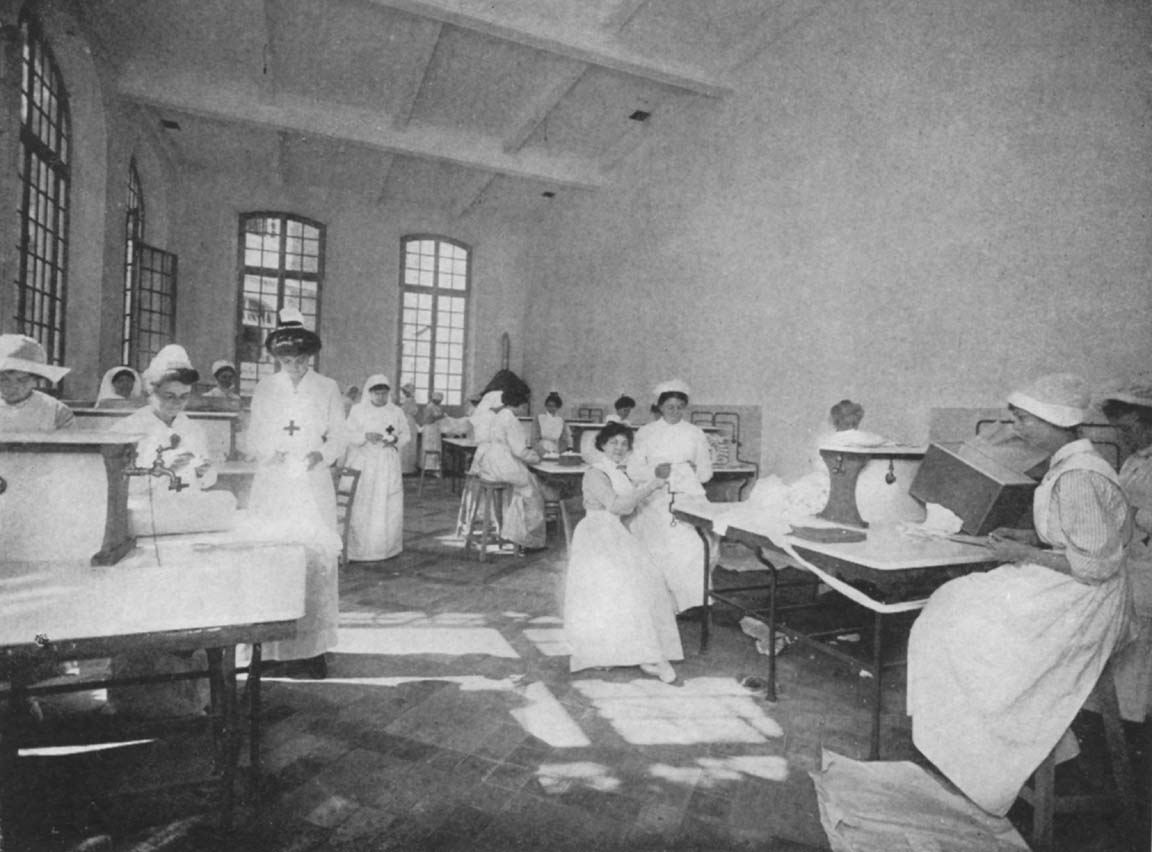
I visited the Red Cross Hospital which, under the direction of Madame Steiner, wife of the mayor of Vernon, is doing splendid work at Vernonnet. There were two hundred wounded officers and soldiers here; among them were a dozen Belgians and a score of "Turcos," Algerian riflemen, who seemed very patient and docile. Some twenty wounded Germans here receive exactly the same treatment as the French. The German soldiers were from Prussian-Polish and Saxon regiments. The officers, five altogether, in a separate ward, were extremely reticent, and it was only with great difficulty that they could be induced to give their names and the numbers of their regiments. Happening to speak German, I acted as interpreter during the inspection by the French Medical Director. These young officers seemed greatly depressed and mortified at finding themselves prisoners.
While strolling about Vernon, I met Frederick MacMonnies, the American sculptor, and his wife, riding on bicycles. They had come from Giverny, some three miles away, where MacMonnies has his studio, not far from that of Claude Monet. MacMonnies told me that his studio was now a hospital with fifty beds, all of which were occupied by French and Belgians. Mrs. MacMonnies aids the surgeons in tending the wounded. During the approach of the Germans towards Beauvais, it was thought that Uhlans would soon appear at Vernon, and orders had been given to evacuate the hospitals. MacMonnies buried his valuable tapestries and rare works of French and Italian Renaissance art and prepared for the worst. Fortunately Vernon, Giverny, Paris, and its delightful neighborhood seems no longer to be in danger from invaders, and the people are recovering their peace of mind.
Monday, September 14.
Forty-third day of the war. Dull morning with slight showers. Sky overcast all the afternoon. Southwesterly wind blowing strong. Thermometer at five P.M. 16 degrees centigrade.
Back in Paris again, after a five hours' ride in a second-class compartment intended for ten, packed with twelve. Most of my fellow-passengers were refugees returning to Creil, Beaumont-sur-Oise, and other places north of Paris, now evacuated by the Germans.
Within living memory Paris has rarely seen so dense and vast a throng as that which assembled on Sunday in the Cathedral of Notre Dame for the special service of "intercession for the success of French arms," when Monseigneur Amette, Cardinal of Paris, preached a stirring sermon, exhorting people to "make extreme sacrifice for their native land." There must have been eight thousand persons in the cathedral. Not only were the five naves densely packed, but all the chapels along the side aisles were crowded with worshippers. An imposing procession was formed, including many religious bodies, associations of young girls, and all the Roman Catholic clergy of Paris. This cortège left the cathedral through the three gates of the great facade and took up its position between the basilica and the exterior railings. Here a temporary platform had been erected, from which Monseigneur Amette addressed the enormous crowd that filled the Rue d'Argonne, the Pont Notre Dame, and the Place Notre Dame, right up to the Prefecture of Police. After the Cardinal had pronounced the benediction, the crowd joined with impressive solemnity in the invocation of Sainte-Geneviève, Saint-Denis, Joan of Arc, and other saints on behalf of the French armies, and afterwards dispersed quietly and reverently.
Tuesday, September 15.
Forty-fourth day of the war. Gray, cloudy day, with occasional glimpses of sunshine. Brisk southwest wind. Temperature at five P.M. 15 degrees centigrade.
The Franco-British armies are close on the Germans' heels, but as everybody in Paris expected, the enemy is inclined to resist along their new lines. They are throwing up defences on the northwest, from the forest of l'Aigle to Craonne, and in the center from north of Rheims and the Camp of Chalons to Vienne-la-Ville on the west fringe of the Argonne.
The outlook seems so encouraging to the Herald that it has returned to ante-bellum conditions and reduced its price to fifteen centimes in France, and twenty-five centimes abroad, and usually appears in double sheet form.
Another American wedding to-day at the Town Hall of the sixth arrondissement. The bridegroom was Mr. John R. Clarke of New York, and the bride was Miss Marion Virginia Goode, also an American. Mr. Clarke went to the front immediately after the wedding, having volunteered in the British army for automobile service. He was arrayed in the regulation khaki uniform, and as he drove to the Mairie in his car just brought back from the Aisne with a number of bullet-holes in it, he was greeted with cheers. The bridal party was accompanied by Mr. Charles G. Loeb, of the American law firm of Valois, Loeb and Company.
The American Ambulance Hospital at Neuilly is doing really effective work. Among the wounded being treated there are French, Belgians, a few "Turcos," British officers and men, and some wounded German prisoners. Mrs. William K. Vanderbilt, who has been entrusted by the French Red Cross Association with the charge of the hospital, is indefatigable in her personal attention and efforts. The organization seems perfect. The funds so far subscribed exceed five hundred and seventy-four thousand francs. During a brief visit to the hospital, I noticed that Mrs. Vanderbilt herself visited the wounded, and with the aid of her experienced staff of trained nurses, prepared them for surgical operations. Mrs. Vanderbilt wore the white Red Cross uniform. Half concealed about her neck was a double string of pearls. Rose-colored silk stockings were tipped with neat but serviceable white shoes, and in this attire she seemed to impersonate the presiding "good angel" of the hospital.
Through the courtesy of a friend who was going to Meaux in charge of a Red Cross automobile to distribute hospital stores to a field hospital near Plessis-Pacy, I had an opportunity to visit the scene of the recent battles along the Ourcq Canal, where General von Kluck's army met its first signal defeat. We came near to the villages of Chambry, Marcilly, Etrepilly, and Vincy---along the road from Meaux to Soissons---and found that the trenches dug by the Germans were filled with human corpses in thick, serried masses. Quicklime and straw had been thrown over them by the ton. Piles of bodies of men and of horses had been partially cremated in the most rudimentary fashion. The country seemed to be one endless charnel-house. The stench of the dead was appalling. Of the fifty odd houses that form the village of Etrepilly, not one remained intact. Some of them had been hit by a shell that penetrated through the roof, falling into the cellar, and by its explosion bringing down from garret or second story all the furniture in one confused mass of ruin. But many other houses had been simply sacked and looted. Cupboards, chests of drawers, and wardrobes were smashed open, and their contents scattered pell-mell in the streets, courtyards, and fields. Here was the portrait of an ancestor ripped to shreds by a bayonet; there was a child's cradle. An old-fashioned grandmother's armchair, with its cushions and ear-laps, lay smashed in fragments in the gutter. The village had fortunately been deserted by its inhabitants at the approach of the Germans, who, furious with rage, had looted, sacked, or wantonly destroyed whatever they found.
How thirsty the Germans were! The roads and fields and trenches were strewn with bottles, full or half-empty. The Germans must have been obliged to retreat suddenly, for heaps of unexploded shells for the three-inch and five-inch German field-guns were abandoned, and in wicker baskets were loads of three-inch unexploded shells, apparently about to be served to the gunners. Wanton, ruthless devastation everywhere! In a field was a wrecked aeroplane, a white and yellow taube, with its right wing reaching into the air, looking like some gigantic, wounded bird. Towards sunset, an automobile passed along the road through this terrible desolate valley of death. In it sat Monseigneur Marbeau, the venerable Bishop of Meaux---the successor of Bossuet, the famous "Eagle of Meaux"---who now and then raised his right finger aloft and then lowered it with the sign of the cross, as he pronounced benedictions on this vast charnel-house. A great number of German killed and wounded wearing uniforms of the Eleventh Prussian Infantry Regiment indicated that this corps had occupied the village of Etrepilly. As there were no civilian villagers noticed in this part of the country, this seems presumptive evidence that the Eleventh Prussian Infantry participated in this looting and wanton devastation.
As we were about to return to Paris, we met a friend of M. Gaston Menier on his way from the latter's country-house near Viller-Cotterets, where the memorable chasses à courre take place in the forest, which, under normal conditions, abounds in deer and stags. The chateau had been used as the headquarters of a brigade of Bavarian infantry. The house was intact, but some valuable furniture of the Louis XV period and some paintings had been destroyed, and the cellar, that had contained over two thousand bottles of excellent wine, including forty dozen bottles of champagne of the admirable vintage of 1904, had been "visited," and only seven bottles remained. The Bavarians, in pursuance of their practice in 1870, carried away all the clocks in the chateau.
Wednesday, September 16.
Forty-fifth day of the war. Sky heavily overcast. Southwesterly wind. Thermometer at five P.M. 15 degrees centigrade.
After the victorious contest of the Marne, we are now to have the gigantic struggle of the Aisne. The battle now engaged, because the Franco-British pursuit has compelled the German armies all along the line to reenforce their rear guards and fight, extends some one hundred and fifty miles in length on one front from Noyon, the heights north of Vic-sur-Aisne, Soissons, Rheims, to Ville-sur-Tourbe, west of the wooded ridge of the Argonne. Another "front," where vigorous defence is made by the German eastern armies, extends from the eastern border of the Argonne to the Forges forest north of Verdun, some fifty miles long.
Now that the Germans are fighting on the defensive, it is not too soon to record the fact that their extraordinary raid of a million of soldiers through Belgium to within twenty miles of Paris has failed. Nothing in military history approaches this avalanche of armies. The German invasion of France and the threat to invest and capture Paris is coming to an end. Yet this war can only be ended by an invasion either of France or of Germany being driven to a triumphant conclusion. The theater of war must soon be transferred from France to the east. The curtain falls upon the German invasion of France, and for the present, at least, Paris is no longer in danger. I see that a change has come over the Parisians, and I can read in their calm, confident faces the brighter phase that the war has assumed. Parisians of every class, from the grande dame of the Faubourg Saint-Germain to the midinette of the Rue de la Paix, or the professional beauty of Montmartre, are subdued and chastened by the sudden change that overtook their bright and exuberant existence. During this first period of the war, Paris assumed the aspect of a Scottish Sabbath. Feverish pursuit of pleasure, earnest hard work, luxury, elegant distinction, thrift, thronged boulevards, crowded theaters, clamorous music halls, frisky supper parties, tango teas, overflowing gaiety, sparkling wit, boisterous fun, and sly humor, have all vanished. The machinery of Parisian life is working at quarter speed. Streets are nearly deserted, except for rapidly flitting automobiles, used mostly for military purposes. The Rue de la Paix is a vacant pathway, where one might play lawn tennis all day long. Probably three fourths of the Paris shops are still closed. The underground trains are as yet few and far between. Now and then a tramway rumbles along the streets, but there is not a solitary omnibus running in the city. The popularity of the bicycle is regained, for well-to-do folk whose motor-cars have been requisitioned now make use of the humble wheel. The quaint, one-horse cab, evoking souvenirs of Muerger, Paul de Kock, and Guy de Maupassant, with venerable cocher, re-appears. There are some auto-taxicabs about, and their slowly increasing number indicates that Paris is beginning to shake off the paralysis imposed by the outbreak of the war. Undisturbed by the turmoil, the forty "immortal" Academicians are continuing their labors on the Dictionary of the Academy. They are approaching the end of the letter "E" and are to-day discussing, with singular actuality, the word "Exodus." May that mean the German exodus from French soil!