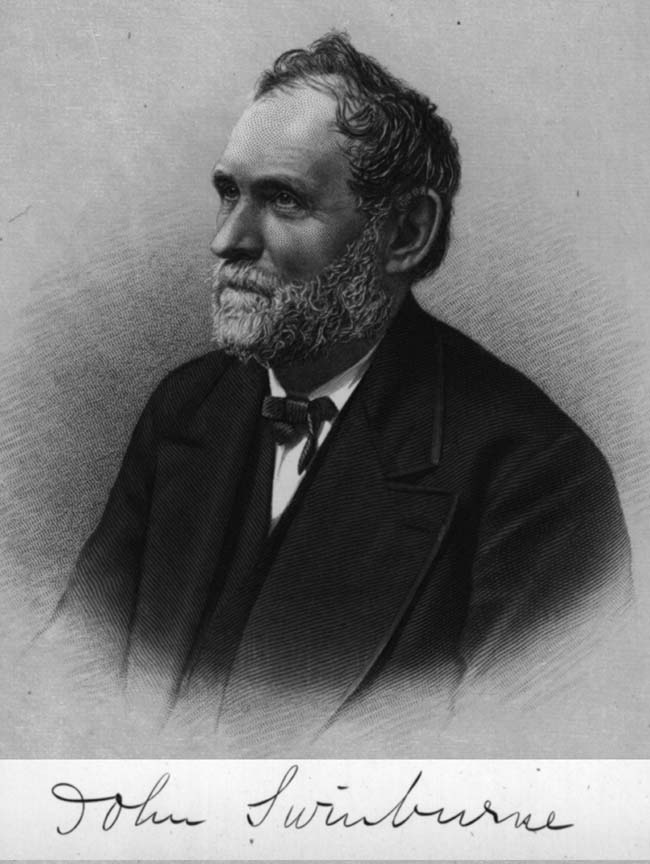
 |
OR INCIDENTS IN THE LIFE OF DR. JOHN SWINBURNE OF ALBANY |
|
|
OR INCIDENTS IN THE LIFE OF DR. JOHN SWINBURNE OF ALBANY |
| Unearthing Corruption. ---Renominated for Mayor.---Why nominated, and why he accepted.---Defamed and defended.---Remarkable Incident in Politics.--- Victorious, and again counted out. --- Return from the West. ---A Magnificent Reception. |
DURING the period that the "Fighting Doctor" was contending in the courts for the mayoralty, developments were made which exhibited the most corrupt and disgraceful state of affairs ever brought to light in the city of Albany: it being clearly demonstrated that nearly three hundred repeaters were used, some of them voting from five to twenty times at the election. It was also brought out that these miserable wretches were the hirelings of corruptionists, most of whom held official positions at the time; and many of them are still in office, some in very high positions. Indictments were found against inspectors, growing out of the investigation; but these have never been prosecuted, and the guilty tamperers with the ballot-box, and fraudulent manipulators of returns, are at liberty to pursue their rascally vocations, and repeat their crimes. It was not the doctor's duty to bring these men to justice, nor to prosecute and send to prison, where they legitimately belonged, the leaders who hired, encouraged, and abetted these fraudulent voters and inspectors. Evidence sufficient was ready to convict them; but these officials, instead of living on prison-fare, are faring sumptuously on public pap, while the superintendent of the penitentiary, and the contractors who employ cheap convict-labor, are becoming rich on the work of dishonest men, to the injury of honest labor. The success of the doctor in fighting the corruptionists, and because of the reform he had inaugurated in the civil government, and the general shaking-up he gave the departments, induced the citizens, in 1884, to renominate him for mayor, notwithstanding the fact that the criminals who worked the frauds at the former election were still in power, and would use even more desperate efforts than before. To oppose the doctor, the Democratic ring must have a candidate who would come down heavy for the corruption fund, and satisfy the "better element" of the party. The "better element" did not mean the honest voters, but that class who believed in caste, and disdained any man who was poor, or sympathized with the poor.
A very natural question with many at that time, even in the city of Albany, was, "How did Dr. Swinburne become persuaded to accept a renomination for mayor, after being cheated out of his election, compelled to undergo the vexation and expense of a litigation for fourteen months to recover the office to which he was elected, as well as being subjected to the abuse of Hale, in whom he placed so much confidence, and who was among the very loudest of his supporters?" The best way to answer this question is by copying an editorial article from the "Press and Knickerbocker" (Independent Democrat) of April 7, 1884. The article is headed, " Swinburne's Nomination," and says,--
"With some it has been an enigma how Dr. Swinburne, after all the annoyance he has been subjected to, consented to make another canvass for the mayoralty. We confess ourselves to have been among the number thus situated, and took the pains to inquire into the matter. We know him to be at the head of a public hospital and dispensary, in charge of a staff of surgeons and physicians, which is constantly thronged with patients of the poorer class, seeking relief without the means of paying for it; we. know him to have a large private practice; and we know his tastes and inclinations were not of a political nature. We therefore took it upon ourselves to inquire into the causes, and found that an appeal had been made to him by leading property-owners and merchants, representing over twenty million dollars' worth of property subjected to taxation, entreating him to take the field. Such an appeal, everybody must admit, it would be hard for any man to resist. It was something more than a compliment: it went straight to the man's heart. These gentlemen knew Dr. Swinburne to be a humanitarian throughout; and they believed if he would listen to the appeals of the maimed, the sick, and the dying, he would not turn a deaf ear to the appeals of the tax-payers of this ring-accursed city. They knew he had the ability, the courage, and the indomitable will to grasp with and throttle the hydra-headed serpent which has the city treasury enfolded in its coils. Hence, in their despair, they turned to him; and he consented to be their candidate. Dr. Swinburne is a man of great executive ability, of immense brain-power. In his profession he has no superior organizer. Fortunately for the interests of the city, he has his free hospital and dispensary organized so fully and systematically that he is able to give all necessary attention to the duties of mayor. He has been an active, hard worker all his life. For month after month he has worked from fifteen to eighteen hours per day; and, in thousands of instances, he has worked constantly, without the respite of half an hour's sleep, for three days."
The nomination by the Citizens' Association was promptly indorsed by the Republicans; and the struggle opened with honesty and fair work on one side, while corruption, intrigue, lying, and deceit were the weapons used on the other. The "Argus," true to its policy to oppose every man, whether Republican, Democrat, or Citizen, who was not an "Argus" (or ring) Democrat, opened its flood-gates of filth, basing all its abuse on the statements of Hale, and a physician who was opposed to the doctor professionally, and asserting the doctor never did any thing for humanity. This was the only paper that would stoop so low as to abuse the doctor personally. This opposition was met by the other papers; the "Evening Journal," in an article, saying, --
"What our esteemed contemporary, the 'Argus,' expects to gain by deriding, vilifying, and insulting Mayor Swinburne is not easy to understand. There is neither logic nor argument in making faces and calling names. No reasonable person will be moved to change his vote by such tactics.
"The 'Argus' may think that its course of action will lead the public mind away from contemplation of important features of the municipal election, but it is mistaken. Mayor Swinburne represents the element that fearlessly antagonized, and finally drove from power, the old and utterly disreputable element that had become a stench in the nostrils of all decent citizens. Who would have the old régime restored? Do we want another Nolan dynasty? Where was the ' Argus' in the fight made under the leadership of Mayor Swinburne for a free vote, a fair count, municipal reform, and the ousting of the city's plunderers? It was against Mayor Swinburne and it is against him now. Where were the people in that memorable conflict? They were with Mayor Swinburne, and against the 'Argus.' That is their position to day, and it is impregnable."
"The Citizen," the independent organ of the Citizens' Association, said of him,---
"Generous John Swinburne. No pen of ours need describe him, for he is too well known by our citizens to need description. Bold, fearless, a lion in combat, and as gentle as a lamb in his compassionate tenderness for the afflicted, he is the noblest type of manhood that ever ventured into the arena of politics. Those who have seen him simply at tending to his professional duties, and, like the ministering angel, scattering on all sides the magic of his great healing art, have no adequate idea of the hero who has devoted his time and his invaluable services to an attempt to ameliorate the condition of his fellow-citizens. He has been eminently successful in his treatment of the physical ailments of the people; and we are sure that, under the penetration of his lancet, the moral condition of the people will be much improved.
"But he is not suffered to pursue his way in peace. The bloodhounds of calumny and slander have been let loose upon his track; and a few machine sheets, aided by a few scalawag lawyers, seek to poison the public mind against him. But who can defame the name of John Swinburne? Who can slander his great reputation as a philanthropist? Not a handful of disappointed lawyers! Not a hundred unscrupulous editors! The name of Dr. Swinburne is engraven on the hearts of the people; and despite the clamor of ring tools, tricksters, and the backbiting of liars, the genial, modest, generous, and valiant reformer will be again placed triumphantly in the executive chair of the city, amid the utmost enthusiasm of all good citizens.
"There may be some persons who will be influenced by what Matthew Hale said about Dr. Swinburne through the columns of a paper called the 'Argus,'---a Democratic organ which seems to think more of party fealty than it does of honest men or good government. That is the only paper in the city which would lend its columns to an abuse of Mayor Swinburne, and it does it on political grounds; while Hale's is a personal matter, which he seeks to make public, thinking it will injure Dr. Swinburne in his candidacy for mayor. Matthew Hale told Dr. Swinburne in the spring of 1883, just before the doctor started on a trip to Kansas, that he thought the best way to raise the money to defray the expense of the mayoralty litigation was by subscription; and he accordingly drew up one, which was signed by Hale & Bulkley and C. P. Williams for two hundred and fifty dollars each, and said to Dr. Swinburne, 'I will have enough raised before your return to pay all expenses.' Does that look as if Hale intended to look to the doctor for the money? What has become of that paper, or how much money was raised, is not known. More than that, a perfectly reliable gentleman says that Hale told him that if Mayor Swinburne had appointed him (Hale) corporation counsel he would not have made any charges for his services. So it seems that the depth of Hale's earnestness was measured by an office; and, because he did not get it, he is found now on the side of the very parties who caused Dr. Swinburne to be defrauded out of his election. Away with such consistency. It's a sham; and Mr. Hale will fall---in the eyes of the community---into the pit he is trying to dig for Mayor Swinburne. Mr. Hale has something to say about Mayor Swinburne hiding behind his wife. Who did Mr. Hale hide behind when the Hon. Henry Smith was defending him in a breach-of-promise suit? Perhaps Mr. Lightbody could throw some light on the subject. Why did Mayor Swinburne convey his property to his wife? Because, when the war of 1861 broke out, he felt it his duty to go into the field to relieve the sick and wounded patriots---many of them from this city---who were enduring every hardship to save our country; and before he left lie made the conveyance to his wife, so that if he should never return she would be provided for. Why, Dr. Swinburne has done more for suffering humanity in one day than Matthew Hale has done in all his life. Then for him, in a sneering manner, to assert that Dr. Swinburne made the said conveyance to get rid of paying his honest debts, is not only contemptible, but false. The sale of Hale's property was like Billings's boots and Billings's gull. The whole matter means persecution, and at a time when they think it will injure the mayor. But in this they will find themselves mistaken; for, the more they, persecute him, the louder are the masses in his praise. The people know Dr. Swinburne; and whatever disappointed office seekers and Democratic-ring henchmen may say derogatory of him, falls flat to the ground.
"One thing more we desire to call the attention of the public to, which shows plainly that Mayor Swinburne is wilfully and maliciously persecuted; and that is the publication at this time of the proceedings of a court instituted to inquire into the private and personal matters of an individual.
"In conclusion, and in order that the people may see for themselves how the patriotism of Matthew Hale oozed out in the short space of fourteen months. we lay before them the following resolution, which was offered, among others, by him while making a speech at the grand indignation meeting held at the old Capitol the night after the last mayoralty election --
"'Resolved, That we pledge ourselves, so far as our means and circumstances may permit, to contribute of our time, of our energies, and our money, to carry out the spirit of this meeting, to defeat the apparent conspiracy against the ballot-box, to vindicate the will of the people, and to punish those guilty of the offences charged, which are the grossest possible crimes against a free government.'
"We will leave it to our readers to judge how Mr. Hale lived up to the spirit of the above resolution, and as to how much of his time, his energies, and his money he contributed to further the cause of honest elections and good government."
The attacks of the "Argus," that Mayor Swinburne had never done any thing for humanity, is answered in the "Press and Knickerbocker" in these words:---
"In the editorial page of the 'Argus' is a statement to the effect that John Swinburne had done nothing for humanity. Was it nothing he did, when, during the War of the Rebellion, he, time and again, of his own accord and at his own expense, hurried away to the scenes of suffering and death to relieve the wounded of our New-York companies; passing through the lines, allowing himself to be made a prisoner of war by the rebels, if haply he might save the lives of our brothers, fathers, and sons? Was it nothing, when, on such occasions, he used to go, and, on his own shoulders, carry provisions for miles to feed the wounded prisoners? Will the fourteen thousand poor and unfortunate who are annually cared for at his dispensary on Eagle Street say that he has done nothing for humanity?
"Let the poor man and the laboring man, when he goes to the polls to-morrow, ask himself this question, 'If accident or disease were to befall my family to-day, to whom would I go for aid, to the silk-stocking, purse-proud Banks, or to the large-hearted man, the people's friend, JOHN SWINBURNE?' and vote accordingly.
"The 'Argus' evidently begins to think 'the better element' will not save the ring, and that, too, after putting on such a hold front; for who ever heard of such a thing before as the leading Democratic daily issuing an extra campaign sheet in a simple charter election, when they have every thing their own way, and a Democratic majority of fifteen hundred at least to back them? We like it; and would willingly pay for an extra edition of the 'Argus' on Monday, because it makes votes for Swinburne. We would like the 'Argus' to attack Mayor Swinburne's official acts, if it dare. It has avoided doing that, and devoted itself to personal attacks; and they have re-acted upon itself disastrously.
"But this election is not on a question of politics: it is one of good government. It is quite the common remark of some of those who to-day arrogate to themselves the title of 'blue-bloods' to say, 'We want one of our own set for mayor.' But the people---the laborer, the merchant, the artisan, and the poor man---will see to it that we have one of the people for that office, not an aristocrat."
It was a remarkable incident in political contests in Albany, that only one paper published in the city had any thing to say against the nomination of Dr. Swinburne; a hearty and cordial support being given him by the two Republican journals, by the "Press" (Independent Democrat) and the 'Post" (Independent), besides the organ of the Citizens' Association, "The Citizen," while the "Times," an honorable Democratic sheet, was silent.
The "Evening Journal" (Republican) said, ---
"The renomination of Dr. John Swinburne for mayor was assured from the day when, after long, vexatious, and obstructive delay, he was given the office by the courts, which he had fairly won at the polls months before. Indeed, so evidently just and proper was this course recognized to be, that at no time have the names of any contestants for the honor and responsibility of the position been mentioned. Even in the unfortunate, and we believe unnecessary, differences which have arisen in the party, there is complete and emphatic accord that Dr. Swinburne deserves and must receive the votes of all Republicans.
"But the votes of Republicans will not be enough to secure an election. They do not accurately measure the extent of the support to which Mayor Swinburne is entitled. His canvass this year rests on higher grounds than partisanship, and appeals to a larger constituency than a party. It may fairly be questioned at any time whether the broad lines on which men divide in National and State politics form time basis of a legitimate division of sentiment on questions relating simply to honest and economical municipal administration. Certainly they have no place in the election to be held in this city a week from to-morrow. Only two questions are to be answered at the polls on that day: first, whether the claim in political equity of John Swinburne to a full term as mayor shall be allowed; and, second, whether the certainty of a ruggedly honest local administration shall be sacrificed to the possibility of a return of the corrupt and extravagant government of the old Democratic ring.
"No fair-minded man can deny the right of Dr. Swinburne to a re-election. For fourteen months he was kept out of the office to which he was chosen. For more than half his term a usurper filled his place. The wrong was finally set right, but less than one the stolen goods were returned. The time for full restitution has now come. The morality of the issue, however, is but one aspect of it. For more than a year Dr. Swinburne carried on an untiring warfare --- at what detriment to himself none but himself can accurately estimate---to secure to the citizens of Albany rights of which they had been forcibly robbed. Others had attempted the same fight; but they had become disheartened and dismayed at the vicious power arrayed against them, and had succumbed in failure. When it seemed that the people of Albany were never again to have their votes counted as they were cast, the unflagging pugnacity of this man, almost single handed and alone, won back for them this primal right of citizenship. It is not in gratitude simply for these exertions that Mayor Swinburne asks the suffrages of the citizens of Albany, which he has almost literally given them. It is further in the belief that by their ingratitude now they will not say to others, should the same emergency again arise, 'we are indifferent to your labor, and careless to our interest which you seek to protect.'
"Even were there no such commanding principles of right and wrong involved in this election, the good government of the city requires the re-election of the present mayor. During his brief administration, every interest of the city has been carefully guarded. Expenses have been reduced, officials have been forced to the performance of long-neglected duties, order and economy have been established in all departments of the city's service."
The "Express" of April 8, said, ---
"True to its character and traditions, the 'Argus,' which called on the Grand Army of the Republic to disband, and asserted that its prominent membership comprised 'loud, brawling men, who went to the war to escape their characters, or because there was money in it,' now attacks a man who was captured a prisoner of war before he would desert the soldiers wounded on the battlefield, the living among whom now wear the badge of that organization. That man was Dr. John Swinburne."
The "Express" (Republican) thus indorsed the nomination :---
"For a long time past it has been apparent that the Republican City Convention would indorse the nomination of Dr. John Swinburne for mayor, as made by the independent Citizens' Convention. There was, indeed, no other candidate for the office on the Republican side. Delegates and others remembered the proceedings of the convention two years ago, when a 'straight' Republican ticket was placed in the field, and the gentleman at the head of it declined to go into the race. They remembered the plucky fight made by Dr. Swinburne against corrupt ring-rule, and the victory he won, without the use of money. They further remember the gallant fight he made against the inspectors, who sought to deprive the people of their just rights by counting him out, and against the man who for several months took advantage of the false count. The people admire pluck: they can forgive a man for wanting in some other qualities, if he has the courage to stand up and fight for his own and their rights.
"So it was a foregone conclusion that Dr. Swinburne would be nominated by the Republicans. He had earned the distinction. All factions into which the party in this city is unfortunately divided were agreed that he should be the candidate. For fourteen months kept out of the office to which he was elected by the people, by an iniquitous combination, it seemed to most right-minded people only fair and just that he should be elected for another term; and the expectation is that he will be by a majority of sufficient proportions to deter dishonest inspectors from making another attempt to count him out.
"Dr. Swinburne's administration of the office of mayor has not, in all things, been to our liking. But it has been a great improvement upon that of his predecessors, and has been thoroughly bold and courageous. Let the 'Fighting Doctor' have the chances which will be afforded by another term. The people have good reason to know that he means to be their friend, not only in the matter of endeavoring to heal such of them as are sick and afflicted, but also in affairs of municipal taxation and expenditure. We know it is alleged that some Republicans will refuse to vote for the doctor. Probably the allegation is true. It was so two years ago ; but he was elected nevertheless. But mark this, for every Republican vote the doctor loses he will receive ten from the other side. The citizens, irrespective of party, are very much in earnest in this matter."
These two articles from the many published in these papers recognized as the organs of the two wings of the Republican party in Albany, the city of political contentions, differences, and jealousies, clearly demonstrate the unanimity of feeling that existed on all sides toward this non-factional Republican and thorough representative of the people. A support such as these gave is made more significant because of the silence of one Democratic paper, and the hearty support given him by another Democratic journal having the largest circulation of any paper published in Albany.
The renomination of Mayor Swinburne was recognized, not only by the respectable Press of the city, as a wise and advanced step in reform and good government, but by the Press of other sections having an interest in seeing fraud and political dishonesty driven out of the civic government of the capital city. Among these was the "Troy Evening Times," which, after watching the administration of Mayor Swinburne, said, in its issue of March 31, --
"The Republicans of Albany have nominated Dr. Swinburne for the office of mayor. He deserves this indorsement.
"He was the only citizen who apparently had the courage and determination to fight the corrupt Nolan-ring government. He won the struggle only after a long and costly controversy before the courts, and to-day the city of Albany is enjoying the fruits of his victory in a better government than it had had for many years before. The chances seem to favor Dr. Swinburne; as his election would best subserve the public interest, and give the people a government wholly freed from ring-rule or grossly partisan administration."
In answering the only attacks that the opponents of Dr. Swinburne could make against him, which were all groundless and of a personal nature, the "Express," in an article published April 5, 1884, under the head of "The Tactics against Dr. Swinburne," said,---
"In the history of local politics in this city and county it would be difficult to recall a more cowardly or dastardly attack upon the character of a political opponent who happens to be a candidate for office than has been made by the enemies of Dr. Swinburne, the Republican candidate for mayor. The columns of the 'Argus' are daily filled with personal abuse of a man whom that journal ought, in most things, to commend. Efforts are constantly made to show that the doctor does not pay his just debts ; but so far nothing in that direction has been proved, except that he has refused to pay the exorbitant bills of certain lawyers who pushed him into the mayoralty contest with Mr. Nolan, organized and addressed 'indignation' meetings over the gross frauds perpetrated at the municipal election of 1882, and were profuse in their tender of services to bring about a correction of the abuses of which they, and good citizens generally, complained of. One lawyer presents a bill of nearly four thousand dollars, which he asks the doctor to pay. Another modestly requests the doctor to hand him over fifteen hundred dollars. There are plenty of working-people in the city, skilled and competent workingmen at that, who would be glad of an opportunity to work three years for the compensation which one of these lawyers demands of Dr. Swinburne for the few days' time lie devoted to the suit brought to vindicate the right of the people to select their magistrates, and to seat them when elected.
"It is a pretty hard thing to ask a man to pay out in lawyers' fees and costs, in an action brought to preserve his own and the people's rights, pretty nearly double the sum he receives for salary for the full term of the office when it is finally awarded to him by the courts. It must require 'cheek,' to say the least, for a lawyer who engages in a case of this nature, from alleged patriotic motives, to send in a bill for his 'services,' amounting to more than a year's salary of the office finally awarded to the plaintiff. In the other contested mayoralty cases in Albany, ---those between Quackenbush and Perry and Judson and Thacher,---the entire expenses of the litigation were borne by the city. This time, although the courts have decided that Dr. Swinburne was fairly elected to the office, he is asked to put his hand into his pocket and pay all the expenses, including the exorbitant lawyers' fees. It is not true, as we understand the facts, that Dr. Swinburne does not pay his 'just debts.' He pays his grocer and his butcher, the dry-goods merchant, the tailor, the coal dealer. His just debts he does pay: there are some which he considers to be of a different nature, which he declines to liquidate. Not every voter in Albany blames him for pursuing that course.
"It is undoubtedly true that Dr. Swinburne is not as rich a man as the Hon. A. Bleecker Banks. He cannot afford to live in as grand style as that gentleman does. Probably he cannot afford to contribute as liberally to the 'campaign fund' as his competitor can. Part of his modest residence is occupied as a dispensary, where the sick and the afflicted are treated, and without charge if they have not the means of paying. The rich and the poor are there treated alike. Only those pay who can afford it. Of course the doctor's enemies say that all this is done for effect. Suppose it is: it is done all the same, and the people reap the advantage. Those who are healed under his care or direction will not be likely to inquire very anxiously about the motive the doctor had in treating them.
"Yes, we suppose Mr. A. Bleecker Banks is much the richer of the two candidates for mayor. But we venture the assertion that in time and money and skill the doctor has contributed to the relief of suffering humanity tenfold as much as his opponent. To attempt to hold up such a man to public execration, to harass him with 'supplementary proceedings' because he refuses to be ground by grasping lawyers, and to daily fill the columns of a newspaper with coarse abuse of one who has done so much good as Dr. Swinburne, is neither manly nor courageous. Perhaps it is just as well for the doctor, for in the end it will re-act. The people are not fond of too much of that kind of opposition."
In this election the candidate opposed to Dr. Swinburne was a gentleman of great wealth and social position, president of a very large corporation, and of whom the Press said, when he was elected mayor in 1876, by a majority of fifteen hundred, "He is a young and rising citizen. He has proved thus far a very available candidate for the Democracy." The Democratic candidate had twice been elected to the State Senate, in 1869 and 1870, by large majorities; and hence the impression that he was an available candidate. He was considered, because of his wealth and social position, again, "a very available candidate." But notwithstanding these strong elements, and a reputed electioneering fund of forty thousand dollars to support the ticket, and all the Herculean. efforts of his party, and the practice of their political tactics in counting the returns, it required up into the "wee sma' hours" of the morning to figure out an apparent majority against the doctor of two hundred and fifty.
The feeling in the city on the evening of the election was intense; and as messengers were seen hurrying too and from Democratic headquarters, and carriages with the leaders rapidly drove from one section of the city to the other, it was pretty generally believed the ring had been again honestly vanquished by the "Fighting Doctor," and that a forlorn hope was being fought under the darkness of night, and after the poles were closed, to save the ring from complete rout.
The announcement that the ring had succeeded did not surprise the people of Albany; and it was hoped another investigation would take place, and that justice should be done the people. In announcing the result the "Troy Times" said,---
"The Albany city-election yesterday resulted in the defeat of Dr. Swinburne, who had been renominated for mayor by the Republicans, and a victory for the entire Democratic ticket. This result was the finale of a memorable campaign, in which every device that desperation could invent was called into play. An enormous corruption fund was raised, and money flowed like water from the pockets of the politicians. For days the Democrats had poured out upon Dr. Swinburne a deluge of vilification and falsehoods such as few candidates ever encountered, no lie being too monstrous for assertion and circulation. At the polls, yesterday, fraud was freely employed to compass Swinburne's defeat. To combat against all these adverse influences called for Herculean strength on the doctor's part; and, under the circumstances, it is amazing that he should be defeated by less than three hundred."
The "Express," in announcing the results of the election and the count on the morning after, said, ---
"Dr. John Swinburne, the Republican and Citizens' candidate for mayor, is alleged to have been defeated by the meagre majority of two hundred and forty-one, in a poll of nearly twenty thousand votes. The doctor had no money to spend in this election. Such as he has made and saved has been freely expended in the maintenance of a dispensary and hospital, where the poor have been treated without fee or reward, and only those of means asked to pay. That is not a lucrative sort of business, in one sense of the phrase ; but in another sense it pays. Yesterday's vote shows it. With a corruption fund of fifty thousand dollars against him, --- with the members of the State Committee, the chairman and one of the secretaries of the County Committee, and certain prominent Federal office-holders also against him, --- the best showing the opposition to Dr. Swinburne can make is given in the figures printed above.
"Of course it was not an honest count. Of course the courts will be compelled to reverse the figures, as they were in the contest between Swinburne and Nolan two years ago. Frauds upon the ballot-box, as against Dr. Swinburne, were undoubtedly committed yesterday in the eastern district of the sixth, the eastern district of the seventh, in the eighth, in the northern district of the ninth, and in the middle and eastern districts of the sixteenth wards. These frauds will be ferreted out, and this time by lawyers who will not charge exorbitant fees for the performance of alleged 'patriotic' service. The people will see to it, this time, that the rights of the majority are vindicated; and that repeaters, ballot-box stuffers, and dishonest inspectors are not permitted to have things entirely their own way. The doctor has already given evidence that he knows how to fight for his own and the people's rights. He will be quite as ready to make a fight of that kind to-morrow as he was two years ago.
"The city was flooded with Democratic money yesterday. It was as free as water. There was none upon the other side. And yet, notwithstanding this lavish expenditure of Democratic funds, the inspectors are able to count out the doctor by only the bare majority named above. It was a wonderful fight that the workingmen made yesterday against the Democratic candidates and their corruption fund. Mr. Banks, surely, has no reason to feel proud over his alleged 'victory.' Nor have the Republicans and workingmen any reason to feel ashamed over the showing they made yesterday. If they had undertaken to buy the venal and corrupt, not even dishonest inspectors would have had the cheek to endeavor to count them out. But the 'buying' business was left to the 'better element ' yesterday. A day of reckoning is coming, gentlemen. Corruption funds will not always tell. Honest citizens are learning their rights, and, knowing them, will dare maintain them. Political rings and political corruption funds must go."
To accomplish the results claimed by the ring, the most desperate efforts were resorted to during the election, as well as in counting the votes: Republican watchers were brutally beaten at the polls; old men were assaulted, while others were prevented from reaching the polls and depositing their ballots; and open bribery was carried on all day, ---the price paid for votes in some wards being as high as eight dollars a vote.
The "Journal," in commenting on the returns, asserted there had been, unquestionably, fraud and violence practised during the election, and wondered if A. B. Banks would dare to take the office under the circumstances, asserting there was evidence sufficient to establish fraud, in the mind of any fair man, at the returns. The total vote cast at that election was 19,914, an excess of 1,354 over 1882, which was proven to have been greatly increased by fraudulent votes. This increase the "Journal" claimed was not possible in the growth of the city population in that time.
On account of the serious illness of Dr. Swinburne, resulting from overwork and blood-poisoning while performing an operation, he was unable physically to contest the seat to which he was elected, but which was accorded to his opponent, and went West to recuperate his health. A few days before his return to the city it was learned that he was on his way home; and the Citizens' Association, under President William Manson, decided to extend to him a reception on his arrival. This was, at its inception, intended to be confined to the association; but no sooner was the announcement made than it assumed a popular movement, in which the almost entire community expressed a desire to take part. Not the least prominent among those desiring to participate were many who, although having voted against the doctor, believed he had been a second time defrauded, and were willing to so testify. A large number of his political opponents, who always vote the party-ticket, also desired to unite in their personal appreciation of the doctor as a philanthropist and citizen, and in expressing their satisfaction at his returning health and vigor. On the evening of his return, July 24, 1881, although but a few days had elapsed from the time it was known he was to arrive, Albany was the scene of one blaze of enthusiasm, such as it has never before or since accorded any man, whether public or private citizen. From the depot, along the route of march to his residence, the streets were packed with a solid mass of humanity; while the sound of a cheering multitude made the hills around echo, and the heavens were made brilliant with a grand pyrotechnic display. The arrangements, in which several of the Republican clubs and thousands of citizens participated, were under the direction of President William Manson and a committee of the Independent Citizens' Association. In the demonstration a number of physicians of the city and from the surrounding country took an active part. Of this reception, the "Express" (Republican) said, --
"Our ex-mayor, John Swinburne, was the recipient of an ovation last evening, at the hands of his fellow-citizens and admirers, that was not only a pronounced indorsement of his official career, but a personal compliment, carrying with it the evidence of the high regard in which he is held by a very large constituency. The reception was conceived and carried out under the direction of the Independent Citizens' Association. The line was formed at half-past seven P.M., and moved to the Union Depot.
"An immense throng of citizens surrounded the depot; and, as Dr. Swinburne entered his carriage, he was greeted with tumultuous cheers and a blaze of pyrotechnics. The carriage of the ex-mayor was placed between the ranks of the Citizens' Association, and the line of march taken up as follows: Broadway to Hudson Avenue, to Green, to State, to South Pearl, to Hudson Avenue, to Eagle. Along the entire march the doctor was vociferously applauded. The residence of the ex-mayor was brilliantly illuminated, and the trees beautifully festooned with Chinese lanterns. The roadway and sidewalks, for at least a block on each side, were packed with a dense mass of people. After a brief space Dr. Swinburne appeared upon the balcony, accompanied by John T. McDonough, Esq.; and several minutes elapsed before the latter gentleman could make his introductory speech, so prolonged was the welcoming and the hearty cheers. Mr. McDonough, in a brief speech, stated the cause of the demonstration, alluded to the sterling qualities of Dr. Swinburne as an official, a philanthropist, and a citizen, and on the part of the citizens of Albany welcomed him to his home. The doctor responded in a few words, in his characteristic way, and expressed his gratitude for honors shown him. With three hearty cheers for Mayor Swinburne the ovation ended, and the line was dismissed. The demonstration, as a whole, was unique in its way, and one that cannot fail to be always held by the recipient in grateful remembrance."
The "Press and Knickerbocker" (Independent Democrat) said of the demonstration,---
"Ex-Mayor John Swinburne returned from his Western farm at Silver Lake, Shawnee County, Kan., at eight o'clock last evening, having been absent from the city since May 5.
"For the past few days the Citizens' Association had been arranging for a proper reception of the distinguished gentleman. It was found, however, that the public were desirous of cordially co-operating with the movement; and the ovation of last night was a grand recognition of the many acts which have endeared Dr. Swinburne to the hearts of the people.
"Public notice was given that citizens would assemble in front of the headquarters at No. 44 North Pearl Street, promptly at half-past seven o'clock. It was but a few moments after six o'clock when the first gentleman entered the room, and an hour later the apartment was thronged. Citizens gathered on the walks, and the large crowd was augmented by the appearance of Maj. Kenealey with the Albany City Band of twenty pieces. Upon arrival at the Grant Club quarters, the band gave a selection; and, as the melody was heard, the team and carriage of the doctor, in charge of faithful Phil. Albert, dashed around the corner to the depot.
"Lines were then formed, and the procession marched to the depot, where an immense throng was found clustered about the street and approaches. As the train rolled into the depot, and the doctor stepped upon the platform, a score of hands were outstretched, and ringing cheers from the multitude greeted his appearance. There was also a brilliant pyrotechnic display.
"Throughout the entire march there was a very general burning of colored fires, coupled with a profuse display of bunting and the discharge of rockets and candles. The insurance patrol are deserving of very great praise for the artistic combination of colors displayed. Double lines of lanterns arched the street, and the house of the patrol was dotted with the bright lights from many a highly colored shade. Colored fires illumined the scene, and a profuse discharge of Roman candles proved that the protectives were the best of friends with the ex-mayor, and heartily pleased to thus publicly display their feelings.
"As the head of the procession filed into Eagle Street from Hudson Avenue, the street fronting the residence of the doctor was found to be densely packed with people.
"The vast assembly waited but a moment for the greeting between husband and wife, and then shouted for 'Swinburne,' who appeared on the balcony, followed by Mr. J. T. McDonough, who delivered the
ADDRESS OF WELCOME.
"'LADIES AND GENTLEMEN, --- We are here to-night to extend a cordial welcome to our honored and distinguished townsman, Dr. John Swinburne.
"'A few months ago, borne down by the cares of office, the excitement of an unparalleled political campaign, and the overwork of his profession, he sought repose and rest in the seclusion of the Far West. He had scarcely departed when his political opponents rejoicingly reported the news about the city that he had gone to stay. They labored under the delusion that rest meant retirement. The doctor never retires in the face of a foe; and so we have the pleasure of greeting him again to-night, and seeing him hale and hearty and courageous as of old.
"The great respect, the warm affection, we have for him, is evidenced by the vast numbers assembled here to do him honor. And well may we be proud of him,---proud of his marvellous skill, proud of his great and powerful achievements, and proud of his well-earned reputation.
" 'In peace and in war, at the bedside of the sick and suffering, at home and abroad, as well as in the camp of the soldier and on the battlefield, he has devoted his time and energies and strength to healing the sick, relieving the sufferings of the wounded, and consoling the afflicted.
" 'His professional life has been as a benediction to tens of thousands of his fellow-men; and so large have been his charities, so generous have been his offerings to the people, that, not satisfied with devoting his own services to them, he has gone further, and given up to a free dispensary the better part of his own home. Who could do more? Nor has he been less distinguished in public and official life. Through fraud and corruption, and the law's delay, he was unjustly deprived of more than half of the term of office to which he was elected by the people of this city. And yet, during the short time he acted as our chief magistrate, without professing to he a reformer, or pretending to be better than his neighbors, he brought about many valuable reforms, and gave us an honest municipal government.
"'By superhuman efforts, if not by forbidden means, he was deprived of a second term.
"'But neither malicious slander nor malicious prosecution, neither corrupt practices at the polls nor doubtful decisions of courts, have deprived him of the thousands of warm friends who will rejoice at his return tonight, and in whose behalf I now extend him a hearty welcome home.'
"After an appropriate selection by the band, Dr. Swinburne said,---
"'FELLOW-CITIZENS AND FRIENDS, ---I do not feel strong enough at this time to say much. I feel it impossible to thank you for the honor you have conferred in this welcome home after my absence. I am not foolish enough to believe that this is for me alone. It is in favor of good government. I intend to remain with you as a citizen. I was thrown into politics by reason of my work. You know what the result was. The ring deprived us of our privileges. Since my absence I have received hundreds of letters asking what was to be done, what steps I proposed to take. To these I made no response, but I will answer them and answer you now. As a citizen, I am prepared to take hold, and to most heartily help you to right a wrong. If you, the people, wish good government, I am ready to go with you. Two years ago they counted me out by three thousand votes. They did the same thing last year, aided by their corruption fund of forty thousand dollars. I think Gen. Butler hit the nail on the head when he said, "The time for discussion has passed : the time for action has come." With him I believe that the time for action has come. I hope we will meet together, and continue our great work. Gentlemen, I am with you in every movement; and, when my health is fully restored, I trust that we may combine together in the interest of good government. Gentlemen, good-night.'
"Following the speeches the crowd quietly dispersed, and the doctor passed the remainder of the evening with a few intimate friends."
The "Citizen" (Independent) thus described the reception:
"After a prolonged absence from the city, Ex-Mayor John Swinburne returned on Thursday evening last, and was the recipient of an ovation seldom, if ever, accorded to a private citizen of Albany. It was a purely spontaneous gathering of his friends and fellow-citizens, who sought in this manner to testify their appreciation of his worth, and their gratitude to the man who was twice cheated out of the office to which he was fairly elected by the honest votes of the people, by methods which, for downright audaciousness, are without a parallel in the history of the country. His reception was not the result of any cut-and-dried arrangements, but was as unexpected by our citizens generally as it was by Dr. Swinburne, who was utterly taken by surprise at the enthusiastic reception which he received. The arrangements for the demonstration, which it may be said were impromptu, were under the auspices of a committee of the Independent Citizens' Association; and well and faithfully did they perform the duty assigned them, considering the short space of time at their disposal. As early as half-past seven o'clock the clubs which were to participate assembled on North Pearl Street, and together with thousands of well-known citizens proceeded to the Union Depot; and, when the train bearing the champion of the people's rights rolled in, shouts and applause rent the air. The route of march being taken up, the enthusiasm all along the line was spontaneous and tremendous. Handkerchiefs were waved by fair hands at all the windows, and fireworks were almost continuously displayed from one end of the route to the other.
"Dr. Swinburne returns to us much improved in health and appearance, having almost totally recovered from the fit of sickness with which he was prostrated last spring. He comes back to his much-loved city, fresh and with all his old-time vigor, ready and willing to early on the conflict against rings and corruption, now, as of yore; and if the demonstration of Thursday evening may be taken as a criterion, he is sure to find ready allies in the people of Albany to push to completion the good work which he has undertaken to perform. Let us hope and trust that he will long be spared to our citizens, and that he will shortly witness the downfall of the ring-masters and their henchmen, who plotted and planned to rob him of his hard-earned victories."
| A Believer in the Republican Platform. --- Received with Deafening Cheers.---Why Nominated for Congress.---What the Independent Press said. ---All Factions united. --- As Incorruptible as Independent. --- A Brilliant Victory and Disgusted Democrat. |
BELIEVING thoroughly in the principles of the Republican party as enunciated in the platform of the Chicago convention of last year, Dr. John Swinburne believed it his duty to take an active part in the triumph of these principles, and the election of the men the convention had chosen as representing them. He felt it a duty every citizen owed the state and nation to labor for the best form of government, and for the party representing the best interests of the American people at large, and the protection of American industries, and promptly declared his allegiance and active sympathy, which meant aggressive work. No other course was expected from him, as all his labors in times of peace and war had been honestly directed to the perpetuity of republican principles, and for the good of the people at large. On his return from the West, the marshalling of campaign clubs had commenced, and the people were preparing for the bloodless but important battle of the ballot. In no part of the State was a more intense feeling growing than in the capital city, the residence of the Democratic candidate for President, Gov. Cleveland, and the home of the leader of that party, the present secretary of the treasury. In this county, with a Democratic majority of over three thousand, and all the advantages to be derived from the State offices (except one department) being in the hands of the opposition, the Republicans of the district realized they had a hard struggle before them to even hold their own in. the conflict, but determined to make the best fight possible, and wisely looked around for the best man to open the campaign and unite the discordant elements. There was no question as to who that man should be; and, when the first grand rally was decided on, the "Fighting Doctor" was invited to preside. On the evening of Aug. 6 the meeting was held, and addressed by Hon. J. C. Burrows of Michigan and Ex-Gov. W. M. Stone of Iowa. Of that meeting the "Express" said, ----
"As Ex-Mayor Swinburne, who had been selected as the presiding officer, came upon the stage, the immense crowd which filled every available inch of space sent up a deafening cheer which shook the building, the doctor bowing his acknowledgments. The programme at first arranged was for both Hon. J. C. Burrows and Ex-Gov. W. M. Stone to speak in the hall; but the great mass of people who could find no accommodation within the walls of Music Hall, and had assembled outside, clamored so loudly, that Mr. Stone consented to address them, and left the hall for the street. After Sullivan's Tenth Regiment Band, which had secured places in the gallery, had played "Hail, Columbia!" and the "Red, White, and Blue," Mr. Burlingame called the meeting to order, and said, ---
" ' We are met this evening for the purpose, not only of ratifying the nominations of the Republican National Convention for President and Vice-President, but also to give expression to some of the many reasons why those nominees should receive the cordial support of the people in short, to give expression to some of the many reasons why the party that has been in charge of the affairs of the nation for the last four and twenty years, and within that time has written into our national history the grandest achievements of modern times, should be still further trusted and continued; in other words, why the principle that is invoked for civil-service reform, in behalf of individuals who serve the government faithfully, should have the broadest and most complete fulfilment in continuing in power the party that has done all things well. It affords me great pleasure, upon this occasion, to present to you, as your presiding officer, a gentleman well known to you all,---one who has labored in our midst for his fellow-man, and who in his political duties knows only the people's interests. He comes to us to-night, not as a partisan, but as an independent citizen, who with us believes that the true interests of the American people will be best promoted by the election of James G. Blaine for President, and John A. Logan for Vice-President, of the United States. I present to you the Hon. John Swinburne.'
"The applause and cheers greeting the ex-mayor was continued for some minutes, and at its conclusion the doctor said,
"'FELLOW-CITIZENS AND FRIENDS,---For this cordial and enthusiastic greeting I have no words to express my feelings. I thank you for the honor you have done me in calling upon me to preside over this large gathering of our citizens. During my absence in the Far West I have seen an earnest and enthusiastic uprising of the people in favor of the election to the management of our government of those who favor protection to our industries against foreign competition, and the protection alike of all citizens of the United States, wherever born, while in the performance of any lawful duty. I am glad, upon my return, to find a like spirit manifested here ; and, while I shall leave to other and more eloquent tongues the defence of principles and the advocacy of candidates, I congratulate you upon the auspicious signs indicating the election of Blaine and Logan, and the continuance of good government through an honest expression of the people's wishes, unembarrassed by repeaters here or shotguns elsewhere. Again thanking you for your confidence, I await your further pleasure.' "
The "Evening Journal,' in speaking of this meeting at Music Hall, said, ---
"Notably was the reception of Mayor John Swinburne when be made his appearance upon the stage to preside. A storm of applause swept through the vast auditorium, and lasted several minutes. Such a tribute to a citizen was remarkable."
In their former struggles, the citizens remembered how their efforts for good government in local affairs had been frustrated by fraud at the ballot-box, and determined to place their chosen leader in the field, to represent them in national affairs; and hoped the presence of the United-States marshalls at the polls would secure a fair vote and count. They remembered that when they, in 1882, placed Dr. John Swinburne in nomination for mayor, the Republican City Convention, after some hesitation, declined to name a candidate, but recommended Dr. Swinburne for indorsement. They remembered the fraudulent count, the litigation that followed, and the final success. When the ring counted in their candidate, and he assumed the office of mayor, the new city charter, passed but a short time previously, provided that the various offices to be filled by the mayor should be so filled within two months after the commencement of his term of office. Mayor Nolan entered upon the duties of the office which had been awarded him by the canvassing-board on the first Tuesday of May, 1882, and proceeded to nominate or appoint the city officers and heads of the several departments from among his personal and political friends. When, therefore, in the latter part of June, 1883, Dr. Swinburne assumed the duties of mayor, he found all the departments filled with those who had no sympathy with him, or with his economical methods, and a board of aldermen unwilling to co-operate with him in his efforts for municipal improvements and the curtailing of expenditures; the carrying-out of which had been his motive in accepting the nomination to the office of mayor. During his brief term, with the zealous and efficient aid of his chosen counsel to the corporation, the Hon. Henry Smith, Dr. Swinburne was enabled to do much toward a curtailment of the city expenses and the correction of abuses heretofore existing. He caused a thorough investigation of the affairs of the poor department; and, satisfied that these had not been managed either in the interest of the city or the deserving poor, he suspended from office the superintendent thereof, and stated his reason to the commission of aldermen provided by the charter, who failed to sustain his action, evidently more in the interests of their party than of the public good.
One of the abuses long prevalent in the city government was the establishment of the grades of streets by piecemeal, and because of the demands of officials or residents in accordance with their ideas at various times. The result of this course was an uneven and irregular grade of the street within short distances; and the mechanic who had by his industry purchased a lot beyond the paved portion on any of the streets, and built thereon his humble home, conforming his building to the grade of the street below him, would not unfrequently find that when the grade was fixed for his block, is house was either stilted many feet above the street level, or his first floor was depressed far below it, thus destroying he beauty and comfort of his home, and forcing upon him a considerable expense. Dr. Swinburne at once took measures to correct this abuse. He caused grades to be made and established for all new streets for their entire length, so that all those who might build beyond the graded and paved portions might know just where their street-grade would be when improvements where made: he caused, also, complete maps to be made of the sewers and drains of the city, showing their location, size, dip, and of what material constructed. This was a step in the direction of improvement in the system of drainage of the city, followed by earnest, but ineffectual, efforts to secure the co-operation of the city fathers in a plan suggested by him for constructing large main drains in the principal arterial streets, sufficiently ample to carry off the surface waters from the large amount of water-shed west of Eagle Street, during the season of heavy rainfalls; this being desirable, not only for sanitary reasons, but because the large damages so frequently adjudged against the city for overflows consequent upon inadequate sewers, would thus be saved. Since the retirement of Dr. Swinburne, his plans have to some extent been adopted, and a portion of these main sewers have been ordered. Much attention was given by Mayor Swinburne to the question of an ample supply of pure and wholesome water; but here, again, political, professional, and personal jealousies prevented the accomplishment of his wishes, and, in direct opposition to his views, a bill was passed by the Legislature giving to the effete-water board power to expend four hundred thousand dollars for increasing the supply of river-water. So objectionable has this plan appeared to the citizens of Albany, that, in a year after its adoption, aldermen and people were crying with one voice for some relief; and a bill was introduced this year authorizing an expenditure of tell thousand dollars to ascertain if some other plan may not be secured. Well would it have been if the suggestions of Mayor Swinburne had been adopted: that new life be infused into the water-board, that they be empowered to seek other supplies than that from the river, and that all plans adopted by them should first secure the approval of the Common Council before having binding effect.
It fell to the lot of Mayor Swinburne but once to have control over the tax levy; but it will be remembered by all Albanians how wisely he acted upon that occasion, vetoing or reducing extravagant appropriations for parks and other purposes, so that even the Common Council sustained his action, and the tax budget was reduced by twenty-five thousand dollars by his action. This budget, although levied for the support of the city for fourteen months, was nearly sixty thousand dollars less than the one levied for the subsequent year for but twelve months.
Dr. Swinburne held the office of mayor but little over ten months, terminating May 6, 1884. He had, however, so impressed upon the city officers the importance of an economical administration, that the tax levy to provide means for the city expenses from August, 1883, to Dec. 31, 1884, a period of sixteen months, was at the rate of sixty-three thousand dollars per month; while that for the twelve subsequent months was at the rate of seventy-nine thousand dollars per month. It was unfortunate for the citizens and taxpayers that he was not given the certificate of re-election for a full term, to which many believed he was justly entitled by the voice of the people.
The administration of Mayor Swinburne, brief as it was, showed his great power in the management of public affairs; and these, with other considerations, induced the Citizens' Association to nominate him, by acclamation, for Congress.
The "Citizen," in announcing the nomination of Dr. John Swinburne for Congress by the Independent Citizens' Association, said, --
"The convention of the Citizens' Association, held in this city on Wednesday, the 24th inst., was very successful, both in the harmony which prevailed and in the results of its deliberations. Of course, ere this paper has reached the reader the action of that convention has been spread broadcast over the county.
"The nomination by acclamation of Dr. John Swinburne for member of Congress was a moral and political necessity. In his person is represented the reforms inaugurated by the people; and his ceaseless combat against the rings and machines which have controlled municipal affairs has made him a notable figure in the polities of the county. While in the ranks of the Citizens' Association can be found numbers of citizens fully competent to fill any office in the gift of the people, yet it was pre-eminently proper that the tried and trusty champion of the people's battles should again put on his armor, and enter the lists against the contingent of the ring. What need is there of words of praise of Mayor Swinburne? What honest heart in this whole county does not thrill at the mention of his name? Praise of him and of his deeds would be superfluous. The nomination was indeed a well-deserved recognition of the invaluable services he has rendered to the people. No political machine, no cut-and-dried bargain, no scheme of trickery, secured that nomination. It was a natural and spontaneous movement of the people. The man who has devoted the best years of his life to the aid of his fellow-creatures could not be, and is not, forgotten by them. Base, indeed, would be the ingratitude of the community were the name and merits of Dr. Swinburne, even for a moment, overlooked. His nomination at this time is significant, and shows that the same aggressive policy of the people's party is to be adopted. With Mayor Swinburne as a candidate, no other policy is possible. The cliques and gangs, and political machines of all kinds and classes, must take note that they will have to sustain the same vigorous attacks made by him in previous campaigns.
"This time that portion of the county lying outside of the city will be heard from. The farming classes, and the residents of West Troy and Cohoes, will, for the first time, have an opportunity to display their sentiments by heartily sustaining the popular candidate. His name is powerful in those places. His record is as well known to them as to us; and, unless all signs of the times are fearfully deceptive, his vote outside of the city will be unparalleled. We congratulate the Citizens' Association on the wisdom of their nomination. The man who almost alone in the city government attacked the ring, and protected the treasury, will do ample justice to the people at Washington. Reforms instituted here will be carried into the national councils.
"With half an effort our next Congressman will be John Swinburne; and, with a united and systematic support, the election returns will scarcely show that his opponent is in the race. Let the people see to it that their own candidate is borne into a seat in the House of Representatives by an overwhelming majority."
The "Press and Knickerbocker," also Independent, indorsed the nomination in this manner:
"The county convention held by the Citizens' Association, Wednesday, acquitted itself handsomely. It made most excellent nominations, and set an example to the other like conventions, yet to be held, worthy of emulation. The 'Press and Knickerbocker' asks for nothing more than the nomination of such men, believing that the voters will exercise a discriminating judgment, and, despite party lines, elect the right men. In selecting Dr. Swinburne for Congressman, we think we voice the sentiment of the people of this district when we say he is the right man for the place. Firm and inflexible in integrity, with a reputation for honesty so high that professional lobbyists will be unable to overreach him, he would, if elected, fill with credit the place once filled by such men as Daniel D. Barnard, from this district."
In taking these quotations from Independent journals, we desire to add that they were not what was known during the last campaign as Independents in bolting the Republican nominations, and had no affiliation with the then so-called Independents.
In presenting the name of Dr. Swinburne to the Republican Convention for indorsement as the nominee for Congress, Mr. Clifford D. Gregory said, ---
"I rise to exercise a high and valued privilege of nominating a candidate for member of Congress from this district, who, by the pure motives which have actuated him in his 'private life, and the sound and humane principles which have controlled him in his public career, appeals directly and powerfully to the popular heart. I desire to present to your consideration the people's choice, and defrauded mayor, Dr. John Swinburne. With marked ability and unflagging zeal he has presided over this municipality. During his brief term of office he devised many salutary measures of reform, which proved of great economic and sanitary value to the people. One of the most important is the improvement in the system of sewerage. Mayor Swinburne also caused to be established a uniform grade for streets and buildings in the western portion of the city; and, thanks to his administration, a map is now contained in the office of the Common Council, to which all changes in the grades of streets must conform. The absence of such a system has heretofore proved disastrous to property owners in many parts of the city.
"During Swinburne's term of ten months, the expenses of the city parks were reduced several thousand dollars. This was due simply to the rigid application of rules of economy. Did not the parks look as beautiful, and was not the pleasure afforded by them just as great? A competent and reliable Democratic authority has affirmed that never in the history of Albany has there been so great economy and care displayed in the administration of the city as during the too short period that Swinburne directed its affairs."
Notwithstanding the dissentions in the Republican party, both wings recognized the necessity of a strong candidate; and that to overcome the large Democratic majority, the heavy corruption-fund used in the district, and the popularity of the Democratic candidate, they must have as their nominee a gentleman of tried integrity, whose character was above reproach, and who had the confidence of the masses. Under these circumstances, and the necessities of the times, all factional differences were put aside, and by acclamation the "Fighting Doctor" was made the standard-bearer of the party for the nineteenth district, and the political fight opened in earnest, only one paper in the city having any thing to say against him. During this campaign, as well as the preceding canvass for the mayoralty, it was pretty well understood that the very intimate relations existing between the editor of that journal and a certain doctor, with whom Dr. Swinburne had crossed professional swords in previous years, had much to do with the attacks on the Republican nominee; while, in the local department, the abuse in that paper was generally supposed to be actuated because of the relationship existing between the local editor and a physician whom Dr. Swinburne had professionally silenced.
Not only was he supported heartily by all the Republican and Independent papers in the district, but by the Republican and Independent papers in the neighboring counties. The "Troy Budget," edited by Ex-Senator MacArthur said, ---
"Dr. Swinburne of Albany, the 'Fighting Doctor' as he has been not inappropriately termed, is the unanimous choice of the Republicans of the Albany district for Congress; having been nominated by the conventions of both wings of the party there. The doctor has a wonderful popularity in the city of Albany, and the presence of United-States officers at the ensuing election will prevent any repetition of the fraud which resulted last spring in hoisting Mr. Banks into the mayor's chair. Although a Democratic district, there is so much dissatisfaction with the machine tactics practised by Mr. Manning's heelers and Dr. Swinburne has such a large personal following, that, with the Republicans thoroughly aroused and united, there appears to be no good reason why the Republican candidate should not be elected. His labors for reform, his great and unpaid exertions in the cause of humanity, his services to his country in the field, the fact that it is on record in the courts that he was once counted out for mayor, and the strong probability that he was cheated out of that office a second time, --- all give him a strong hold on popular sympathy, and inspire strong hopes of his election."
The "Troy Evening Standard," the independent organ of the workingman, in an article on the nomination of Dr. Swinburne, said, ---
"The doctor has positive ideas; and these are not hidden under a bushel, but are almost as well known as his acts of charity and deeds of philanthropy. His nomination came from the people, because he was of the people. His whole life has been one of continuous study of how to better humanity. In the practice of his profession, his patients have been all classes, from the sumptuous home to the lowly hovel; and so widespread has become his renown, that, on his recent return from the West, his reception by the masses was an ovation such as was never before tendered any man in the city of Albany. The claims of Dr. Swinburne to an election to Congress are greater than those that could be advanced by any other man in the district. Coming to this part of the State, he opened his free dispensary in the city of Albany seven years ago, where the sick, wounded, and disabled have been cheerfully treated, to the number of over sixty-five thousand, besides over thirty thousand poor who did not desire to have their names on the register; and there is not a street in the city where his carriage has not been seen hastening to the call of the suffering, with the same alacrity to the poorest dweller in the southern part of the city as to Ten Broeck Street. A man of quick observation and sympathetic nature, he discerned the corruption of the city government, and the way the people were oppressed, and reluctantly consented to run for mayor. The popular vote, twice electing him to the office, demonstrated how the poorer elements recognized in him a friend, whom neither bribes nor threats could induce them to desert. Again the people have called him to come up higher in affairs of State, and have nominated him for Congress. Can there be a possible doubt as to the duty of workingmen in deciding whether they shall vote for him, opposed as he is and has been by every corrupt political ring in the district, or for his opponent? The great issue before the voters is protection to American industry or free trade to foreign pauper labor. On this issue Dr. Swinburne is a pronounced protectionist, who believes not only in a revenue, but a tariff that will protect the American manufacturer and laborer. He does not believe in a tariff for revenue only; but that, if large surplus over the incidental expenses of government should accrue from a protective policy, it can and should be employed in public works and improvements that would give work to the unemployed in times of distress, and thus elevate the dependent, rather than degrade them by poverty or pauperism. All matters of public policy the doctor is thoroughly conversant with; and, not being an office-seeker, his views are not twisted to suit the caprice of partisanship, but are formed or the best interests of the nation at large. Liberal in views, sound in judgment, honest in his transactions and intentions, patriotic in his motives, and charitable to such an extent that he is hated by the penurious, Dr. Swinburne should be elected. He deserves the votes of all fair-minded men. As he was faithful in the discharge of the duties imposed upon him by the electors of Albany, so will he be faithful in the enlarged sphere of national law-making usefulness."
Of the nomination, the "Press and Knickerbocker" said, ---
"Dr. John Swinburne has accepted the nomination for member of Congress by both the Republicans and the Citizens' Association. His letters of acceptance are brief and to the point. Every voter in this congressional district must know that Dr. Swinburne would make a faithful representative. He fully understands that the people of the country have not been faithfully an truly represented in the House of Representatives, and that they have become dissatisfied and restless."
The Albany "Morning Express" (Republican), in commenting on this extract from the "Press and Knickerbocker," said,---
"This is an unbiased opinion of Dr. Swinburne's qualifications from an independent standpoint. It is also a correct view of the action of the Democratic majority in the last House of Representatives, in making a party issue of the attempt to inaugurate the free-trade policy by the passage of the Morrison twenty-per-cent reduction bill. Four-fifths of the Democrats in Congress voted for that bill. Nothing is surer than that the complete control of the legislative and executive departments of the government by the Democrats will insure the passage of that or a similar measure. This threat to break down our manufacturing interests has already operated disastrously. Capital has been frightened from investment in that class of industries, mills have been closed, and operatives have been thrown out of employment.
"The Democratic majority in the House refused to pass a bill to put our seacoast cities in a condition of defence; because they were so determined that there should be no need for a surplus in the treasury, beyond the ordinary expenses of the government, and consequently no necessity for a protective tariff, that they are willing to leave Boston, New York, Philadelphia, New Orleans, and San Francisco at the mercy of any first-class hostile power, to be battered down by their modern armaments while lying safely beyond the reach of our ancient guns.
"Dr. Swinburne does not belong to that class of statesmen. He believes in the policy of protecting the wages of labor from foreign competition. He believes in the wisdom of putting the country in such condition of defence as to place us at least beyond the contempt of foreign powers, in case of their refusal to redress wrongs inflicted on our citizens abroad, or their attempt to interfere with the rights of independent States on this continent. He has given evidence of his loyalty by his services and sacrifices in the war for the Union; and of his desire for good government by his civil services as chief magistrate of this city. He has endeared himself to the poor and the suffering by his gratuitous professional services. His popularity has twice broken down the Democratic majority of Albany, though cheated out of his office a part of one term and all of another by Democratic frauds in the count. He cannot be thus cheated this time, under the Federal election-laws; and an earnest and united effort by the opponents of the Democratic ring-rule in Albany will insure his election by a decisive majority. Every tax-payer and rent-payer who feels that he has been swindled by the corrupt ring now in control will help to crush it by voting for John Swinburne."
It was well understood throughout the State that there were local differences in the Republican party in Albany, which threatened, as they had often done before, to result in the defeat of the candidates. Of these differences the "Express" said, on Oct. 6,---
"The nomination of Dr. Swinburne for Congress by the Republican Convention, on Saturday, will undoubtedly be indorsed by the convention to be held under the auspices of the other committee. So that, although the Republicans of Albany are divided on a question of organization, they will not be divided on a question of nomination.
"Dr. Swinburne is both a professional man and a working man. The people of Albany know him in both capacities. He is eminent as a physician, but he is equally eminent as a friend of the poor. There is where his phenomenal strength lies. The poor are grateful to him for his unnumbered and unrewarded professional services. He is also a many-sided man, in his adaptability for usefulness ill politics as well as in professional life. He has great executive capacity. Albany never had a better mayor. His honesty was not of that negative character that permitted others to do the stealing. Obstinately honest himself, he enforced honesty on his subordinates. He stopped the leaks in the city treasury wherever his, power reached, and saved the money of the people more guardedly than if it had been his own. He made enemies, for this reason, among the profligates and spendthrifts; but the people became his friends. They will stand by him now. His popularity has broken down the Democratic majority in this city on two occasions, and he will do it again. The citizens of Albany, and the farmers of Albany County, want just this kind of-sturdy economist at Washington. With proper I effort his election is assured."
And on the 11th the "Express" again said, ---
"By acclamation, and by unanimous vote, the 'Fighting Doctor' was yesterday nominated as the Republican candidate for Representative in Congress from this, the nineteenth, district of our State. We had supposed the convention would show that great good sense. The doctor is able, and has shown wonderful popularity in this city, where he has been twice elected mayor, and once accorded the office, notwithstanding the frauds perpetrated by Democratic inspectors, with the expectation of keeping him out. This year, as we remarked yesterday, Federal inspectors will have something to say about the vote cast for Dr. Swinburne for a member of Congress. That business will not be left entirely to the Manning machine inspectors. Every man's vote will be properly counted and properly placed. There will be no foolishness this time. Let Republicans vote as they expressed themselves yesterday, and Dr. Swinburne's election will be assured. The direct choice of two conventions, opposed to the machine and to the machine rule, why should he not be elected?
"That the 'Fighting Doctor' has lost none of the popularity which he has displayed in so marvellous a degree in his two contests for the mayoralty of the city is most evident. Go into the strongest Democratic wards of the city, and you will hear his praises most loudly sounded. Dishonest inspectors of elections, and the money so freely expended by Democratic candidates, prevented the doctor from receiving the certificate of election as mayor last spring; but this fall the election for member of Congress will be conducted under Federal laws. United-States supervisors and marshalls will be at their posts in each election-district, and an honest count will be insured. There will be no fooling with the returns this time. There are hundreds of Democratic voters in this city who can be neither coaxed nor bribed to vote against Dr. Swinburne. He has helped them and their friends in distress, and they are too honest and manly to forget the fact. And this time their votes will be properly counted and scored. The Democratic inspectors of election will not have things entirely their own way in this city next month.
"On the 4th of November next the people of Albany will decide whether or not they desire a continuance of ring-rule. head of the county ticket, it will, indeed, be a strange thing if victory will not perch upon our standard. To accomplish this result, it is necessary, of course, that our brethren should work in harmony, marching upon the enemy's rank with an aggressive, unbroken column. That this end will be attained we have no doubt; and, the battle entered upon under these favorable auspices, we feel confident of victory. Honest, fearless, manly John Swinburne will lead the way."
The nomination again of the doctor was hailed by the people as an omen of coming victory and triumph of right, so far as the county of Albany was concerned; and, although the majority to be overcome seemed to anxious people almost impossible of accomplishing, yet the name of the never vanquished Dr. John Swinburne infused a new hope, and inspired a new life, that once more Albany would do her duty to the nation, as it did in the great struggle of years before. It was a repetition of the feeling of April, 1861, when men doubted how New York would stand in the Rebellion. The nomination of the doctor settled the question for the populace of Albany, as did the appearance of the first regiment in New York on its way to Washington for New York. On that occasion, as the regiment emerged from the Astor House with bayonets gleaming in the spring-day sun, and the column moved to the tune of "Yankee Doodle," a slight murmur of applause was heard, like the whispers of a gentle zephyr, which, in a few moments, had grown to a deafening cheer from the thousands that lined the streets, silencing all other sounds, and driving away all the clouds of doubt which had hung over the possible action of New York in the coming conflict. At the first announcement that the "Fighting Doctor" was in the field, there was a ripple of approval, and the questions were asked, "Is it possible for him to win? How near can he come to victory?" In a short time the rippling stream became a rushing torrent, carrying every thing before it; and, wherever the doctor made his appearance in a public gathering, a spontaneous burst of enthusiasm greeted him, leaving no sound to be heard for a time but its own reverberation. An instance of this popular feeling of hope and confidence was shown at a mass meeting in the Hudson avenue tent on the evening of Oct. 24, when the Hon. Alexander Sullivan, the brilliant Irish orator, was addressing a multitude on the issues of the campaign. The Swinburne Guards had escorted their eloquent countryman to the tent where he was to deliver his address, and then returned for their "boss," as they called the doctor. On arriving at the tent, a cheer rent the air, such as the speaker said he never heard before, and wondered how it escaped without ripping the tent into threads. The cause of this outburst perplexed him for a time, as he had never before seen the doctor.
In speaking of that meeting and the doctor's appearance on the platform, the "Express," on the following morning said,---
"The banker, the broker, the lawyer, and the merchant mingled with the sturdy sons of toil, and all seemed delighted with the incisive aphorisms and unanswerable arguments of the talented and eloquent young leader. We said there were no interruptions. In that respect we slightly erred. There was an outbreak during Mr. Sullivan's address, but it was not a Democratic one. It occurred after the meeting had progressed somewhat, when Dr. Swinburne, puffing from overhaste and exertion, had emerged from the side-wings, and taken a seat in the front of the stage. When his genial, kindly face was recognized, the whole audience rose en masse, and a roar which would have drowned that of a hurricane greeted the war-horse. This, however, was only an episode of the meeting; and, barring that, every thing was conducted in the most orderly fashion."
The interruption consisted of three times three cheers and a tiger for the doctor.
In the issue of Oct. 29, under the head of "A Man to be elected," the "Evening Journal" editorially said, ---
"That high sense of fair play which dwells deep down in the heart of every American citizen should elect Dr. John Swinburne to Congress. Twice he has been a candidate for mayor of Albany. Once he was counted out, and the courts were compelled to give him his due. The second time his competitor was seated by a bare majority, and grave doubts exist to this day if he had any majority at all.
"The brave man --- in fact, the only man --- for the emergency, in overthrowing local misrule, was Dr. John Swinburne. His active mind, his intelligent judgment, and his brave heart led the fight, and conducted it to a successful termination. It is not too much to say that it was a public calamity that he was not seated for a second term. Had he been mayor of Albany, no political organizations of either side would have dared to occupy and to destroy public property. Dr. Swinburne would not have been the partisan that Mayor Banks has proved himself to be. Nor would he have sneered at tax-payers, and snapped his fingers in their faces. Nor would he have promised to right a wrong, and failed to keep his promise. No trifler with the public, no subservient instrument of any politician, or ring of politicians, is Dr. Swinburne. He is as incorruptible as he is independent.
"If Republicans will do their duty faithfully and earnestly, Dr. Swinburne will be elected. His following embraces many men who do not belong to the Republican party, many of whom will throw a Blaine with a Swinburne ticket."
On Nov. 3 the "Press and Knickerbocker" (Indiana) said,---
"The voters in this congressional district can make no mistake by voting for Dr. John Swinburne to represent them in the next Congress. He is a man of the highest integrity. No swindling lobbyist can tamper with him, or swerve him from a faithful discharge of his duties. He is sound on the tariff and the great labor question. All his life he has been the friend of the poor, and has given the best years of his life in service for the amelioration of their condition. He understands fully the wants and the needs of the industrials of the country. His sympathies have always been with the people, as against political rings. He has never been a candidate of theirs for any public office, for the reason that they knew they could not control his action. He is one of the most brainy men ever nominated for that office from any district in this State, and would wield an immense power in Congress. One sentence from him on any public question would have more weight than columns of sophistry from political demagogues. And he would always vote right. In short, he is just the man to send to Congress at this time, when men of integrity and ability are so much needed in that body."
The campaign was one of the most bitter ever contested in the county of Albany. Men holding positions in the State departments, under Democratic officials, were under a system of espionage, where their loyalty was in any degree questioned. Intimidation was resorted to, threats indirectly made, an every effort devised to rob men of their manhood, and reduce them to political slavery. Albany was the home of the Democratic leader, Mr. Manning, who had made Gov. Cleveland the nominee of his party for President. Gov. Cleveland, it was ordered, must have the regular majority increased at any sacrifice. Coming into the capital city with a majority in Albany County in 1882 of 9,432, and having resided there up to the time of election, with all the influence that his patronage was supposed to secure, the Democratic leaders would figure no majority lower than 5,000, and boasted it would be 10,000. For Congress the Democratic nominee was a gentleman with a popularity second to no man in the party in the county of Albany; and so confident were the leaders of the party, that they were willing, the evening before election, to wager odds on his election by a handsome majority.
But the elements of reform were at work in the county; and, by scores and hundreds, men who had always voted with the ring were leaving the party and coming over into the Republican ranks, while hundreds of others, who would vote the head of the Democratic ticket, were determined to and did vote for Dr. John Swinburne for Congress. In one of the strongest wards in the city, the third, was organized the "Swinburne Guards," composed of independent Irishmen, who had always been in the Democratic ranks; and they were seen in every Republican parade, and presented as fine an appearance as any in line, and were proud of the stand they had taken for principles. No other man in the Republican party could have wielded such an influence as did Dr. John Swinburne in that campaign. His name was a magnet that drew men wherever it was pronounced; and the very appearance of his carriage was often the signal for cheers from men and boys, while from the home of the lowly, and the heart of the humblest laborer, came an honest "God bless John Swinburne."
With a united Democratic party aided by free-trade Republicans, and an immense electioneering fund, the victory of Dr. John Swinburne and the Republican ticket on that November day was an eventful page in the history of political contests in Albany County.
The results of the day were the reducing of Gov. Cleveland's majority from 9,482 in 1882 down to 647 in 1884; 1,059 less than Hancock's majority in 1880. The majorities in 1883 for comptroller, of 3,534; for Senator, 3,173; for justice of Supreme Court, 2,939; and for county clerk, 3,162,----were all wiped out, and the Republican county treasurer and coroner elected. The majority given Dr. Swinburne's opponent when the latter ran for Congress in 1882 was 6,398; but this time the people's friend was in the field, and the "Fighting Doctor" saw his system of extension and counter-extension illustrated by the pulling down at one end of the 6,393, and adding at the other 2,504, as his majority for Congress, --- a majority his friends expect to see doubled this fall for him for governor.
As the news came in to a prominent Democratic resort, where a number of leaders were anxiously awaiting the returns, and the final footings showed all the towns for Swinburne, and that every ward in West Troy and Cohoes had gone for the doctor, one of the most prominent politicians cried out, in almost tones of anguish, "My God, can that be so? Well, Swinburne can be elected to any office; and we might as well throw up the sponge on him now."
After the battle, the Republicans of Albany, while regretting that the head of the ticket was not elected, were more than delighted with their success in the county; and they pointed with just pride to their standard-bearer and leader, and felt if one or two other districts had had such a leader, around whom all true citizens could have rallied, the whole ticket would have triumphed.
The "Express," on Nov. 20, said, ---
"What is enthusiasm? It can be explained without a dictionary by the masses who assembled last evening to pay their respects to Dr. John Swinburne, the Congressman-elect from this district. It was a spontaneous exhibition of the people for the worth of one who has done more for the needy poor than any other; who for years has occupied a position of trust among us. Defrauded of the suffrages of a free people, his vote taken from him, and after a sturdy fight installed into an office it was sought to take from him, running again for the office of mayor, defrauded by the use of thousands of dollars, the city officials against him, the work of dishonest inspectors throwing him from a position he was honestly elected to, yet still he stood to the fore; and, while not maintained by others who looked for personal aggrandizement and political favors, he always remained the 'friend of the people.'
"Knowing this, these people have made him their representative in the next (forty-eighth) Congress from this district; and last evening a reception was tendered in his honor by those who stood by him through the heat of a campaign, wherein it was the hope and the speech of henchmen that 'Dan Manning would carry Albany County for Cleveland.' It was carried, we admit, by a plurality of 641 for Cleveland; while Dr. Swinburne went through with a majority of 2,500.
"It was not of his seeking that the reception was tendered him last evening. It was the work of friends. The Capital City Blaine and Logan Club, under a pledge made to the Jacksonìans, a Cleveland and Hendricks campaign club, agreed to act as escort in case the standard-bearer of their party was elected, and it was understood they would fulfil their promise last evening; but, owing to the inclemency of the weather, it was agreed by both commands to postpone the parade until next Tuesday evening. It was the intention of the 'Capital Citys,' after fulfilling the pledge, to serenade the 'Fighting Doctor,' County Treasurer-elect Battersby, and Lansing Hotaling, the elected Assemblyman from the second district; and this they will carry out.
"At eight o'clock citizens generally began paying their respects to the Congressman-elect, they being received without formality in. the parlors on the second floor."
On Nov. 5 the "Evening Journal" said, ---
"Search the returns, by counties, of every State from Maine to California, and not a single one will show so positive, so unexpected, and so decisive a gain as that of Albany.
"There are many reasons why Republicans to-day should rejoice; but there is no matter, we believe, for heartier congratulation than the election of Dr. John Swinburne to Congress. It was a magnificent tribute to the man, unprecedented in the political history of this county, --- a demonstration that of the people of Albany County in a larger measure than has any other man. He will take with him to Washington the same conscientious regard for the interests of the people, and scrupulous zeal in their behalf, which characterized his administration of the affairs of this city."