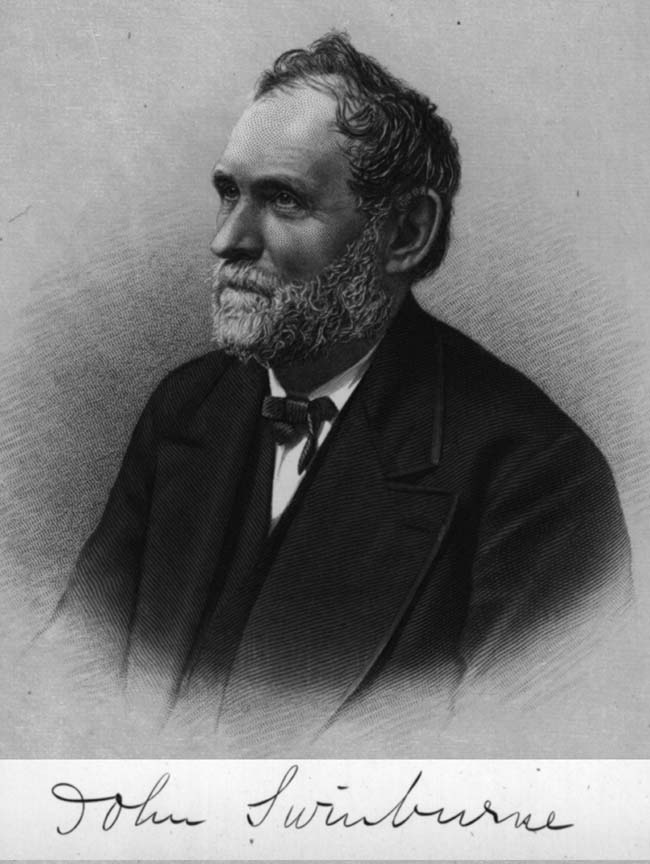
 |
OR INCIDENTS IN THE LIFE OF DR. JOHN SWINBURNE OF ALBANY |
|
|
OR INCIDENTS IN THE LIFE OF DR. JOHN SWINBURNE OF ALBANY |
| Establishing a Free Dispensary. ---Opposed to Deforming the Poor.--- A Conscientious Instructor.---Showing up Malpractice. --- War among the Doctors.---A High-handed Proceeding. ---Esteemed by Students. ---A Committee's Investigations. ---A Name that gave Tone. |
REVOLUTIONS are never backwards, whether in political or scientific economy; and these are, as a general rule, set in motion because of mismanagement by those in authority, protested against by some advanced mind, who, in behalf of humanity, demands a reform in one, and a deeper application to study and the laws of nature in the other. In the rupture between the doctor and the professors of the Albany Medical College, and the establishment of the dispensary in Albany by Dr. Swinburne, the public at large have become better acquainted with the cause of deformities, ---results which they have learned were, in a great degree, due to bad surgical treatment. As the public, ignorant of medical ethics, have had the light thrown to them by one so eminent and learned as Dr. Swinburne, they have been better able to understand these matters; and, in answer to their unmistakable demands, many of the profession have been compelled to attain a better knowledge of medicine and surgery; although but comparatively few in the vicinity of Albany have made any perceptible advance, while a great many remain, professionally, where they were when they received the "sheepskin" from their Alma Mater which entitled them by the laws of the State of New York to practise medicine and hang out the "M.D." This, of course, only applies to those physicians who believe the colleges and tradition teach the only gospel to which they owe allegiance. Deformities and poor results have decreased largely; but this is owing to the fact that very many of the unfortunate maimed, instead of calling in every professing surgeon, insist on their treatment coming from the dispensary, and those who practise the systems there laid down.
The first incentive to establish the dispensary arose from the doctor's earnest desire to save the maimed poor from mutilation and deformity; and to have accomplished this revolution without opposition and sacrifice would have been phenomenal, and a consummation unprecedented in the history of the world since the first and greatest sacrifice for the human race was made on Calvary by the Great Physician and Maker of all mankind; as it appears to be ordained that all efforts to raise men, or to ameliorate the condition of humanity, are only to be attained by sacrifices. The history of the founding of the dispensary, and its work since that time, are peculiar, and a part of the history of Albany.
Dr. Swinburne's connection with the Albany Medical College, as physician to the almshouse, and as consulting surgeon to St. Peter's and the City hospitals, brought to his notice many instances of deformity, where he believed different treatment would have been productive of better results; and he determined, no matter what factions or professional opposition might be aroused, to insist on a more enlightened and advanced system of treating the injured, that the poor, and even pauperism, might, in the name of humanity, be protected from deformity, and a higher order of surgery, with better results and more definite learning, be reached; leaving out the practise of traditional surgery, so that the best results in accordance with scientific laws might be accomplished. Occupying the chair of professor of fractures and clinical surgery in the Albany Medical College, he felt the double responsibility devolving upon him, --- that of the treatment of the people in the future by those who were looking up to him as a teacher, and the duty he owed the students to place before them true surgery, and not malpractice or quackery. This double duty he performed faithfully; and most of his associate professors, instead of gladly availing themselves of his knowledge, preferred he should close his eyes to their apparent ignorance, and be silent to the injuries their practice had inflicted, and not attempt to educate the students in any line not in accord with the teachings they had advanced. To illustrate the evil results of radical, hasty, and ignorant traditional surgery, he did not seek subjects in some foreign clime or among the books; for there was a very numerous class of these from whom to choose in Albany, who had been treated in the hospitals, institutions professionally under the direct supervision of the college, In citing these cases, he drew attention to some treated by members of the faculty, according to a report of the Common Council, without giving the surgeons' names. One of these cases, against which he warned the students not to pursue a similar treatment, was that of a young man, William Lawton, a brakeman on the New York Central Railroad, who had had both legs crushed under a train. He was taken to the hospital, made unconscious with ether, and, against his protest, the right leg amputated above the knee; Dr. Vandeveer, according to Lawton's statement before the committee, declaring he was sure to die of the injuries, and that the leg might as well come off; Drs. Vandeveer, Ward, and Masher performing the operation. They sought also to cut off the other leg, but were prevented by Lawton's brother. For seven months he remained in the hospital under the treatment of Drs. Ward and Mosher; they, with Dr. Vandeveer, declaring the other leg must come off as soon as he became strong enough to bear the operation, Dr. Vandeveer declaring the leg would be of no use. Meanwhile the foot became clubbed, and the toes also so clubbed that, if he ever walked at all, he would have had to do so on their knuckles, being able to put no other part to the ground. After a useless pasteboard case had been put around the limb with some oakum, nothing was done for it by the surgeons. After six or seven months he was discharged from the hospital; though, besides these bad results of the treatment, his leg was bent backward at the broken place, the bones having failed to grow together and overlapped each other. Though Dr. Swinburne was consulting surgeon to the hospital, the case was never brought to his notice while Lawton was therein. When called to see him at his home about a month after his discharge, unhealed, from the hospital, Dr. Swinburne said that there was no need to cut the leg off. He cut the tendons attached to Lawton's foot, bent the foot around to its proper place, kept it there, drew the leg out to its full length, so that the bones fitted together again instead of overlapping, and kept the limb thus extended till the broken ends rejoined and the tendons grew together; all this having to be done to remedy the deformity which had grown up in the hospital, under the surgeons' eyes. When Lawton appeared before the committee, the leg seemed, and he said it was, in good condition; while the crutches on which he came bore mournful evidence of the treatment he had received before Dr. Swinburne saw him. Another case was that of John Dolan, a cartman, who was thrown from his cart by a railroad train, and his right leg broken in three places, one break being near the hip. He was treated by Dr. Vandeveer, who for some time failed to discover the break near the hip. Some time after he pronounced Dolan well enough to leave his bed, and took off the dressing; but the leg thereupon swelled up terribly. About three months later he took the dressings off again; but, as soon as Dolan tried to move, the break at the hip showed itself. The knee was stiff; and the foot was turned out sidewise, so that Dolan could not turn it into the proper position. When Dr. Swinburne was called to see him, he found that the bones had not been joined; that the dressings had been removed, and all efforts to heal abandoned; that the muscles had become hopelessly shortened, and that they had drawn up the foot so that Dolan's leg was six inches shorter than the other. Dr. Swinburne advised that the leg be drawn out, and fastened till the shortening was lessened, and till the broken bones united. The leg was thus made but two inches and a half short. Despite all Dr. Swinburne could do, Dolan is a cripple for life, stiff in the joints, and has a permanent bad swelling near his hip.
For this service Dr. Vandeveer charged two hundred dollars; and collected this sum without Dolan's knowledge, before Dolan was able to go out, from the railroad company, who were to pay Dolan damages. For warning the student against repeating similar errors Dr. Swinburne was removed, so said the report to the Common Council.
Because of these and other instances in which he differed with the faculty, in insisting on proper treatment of patients in the hospital, and a better system of surgery, the chair to which he was appointed in 1876, as professor of fractures, dislocations, and clinical surgery, was abolished. The college was an institution in which the public were interested, and how was this act accomplished? It was a star-chamber arrangement. At eleven o'clock at night, a majority of the faculty, --- having previously agreed among themselves to pass a resolution recommending the trustees of the college to abolish the chair of surgery occupied by Dr. Swinburne,---by a pre-arranged agreement with a majority of the trustees, met, and decided to abolish the chair; and the next day at eleven o'clock the trustees did so.
On Professor Swinburne appearing at the amphitheatre of the college, where he was in the habit of delivering his lectures, and where a large number of students were congregated and awaiting to get in, he found the doors locked against him; and was informed such action was taken by order of the board of trustees. Deprived of the privilege of holding his clinics there, he went to the hospital to hold them, where he found many cases of deformity, some of them congenital, but a much larger number the direct results of bad surgery; and he was then more than ever convinced that the people were too much and too badly doctored by incompetency, and of the necessity of a more enlightened and conservative surgery. But because he was unyielding in his conviction of right and duty, in his determination to save the poor from mutilation, and to educate the students in a better practical and scientific surgery, he was again frustrated by a collusion between the college faculty and the governors of the hospital, and he retired. At that time the hospitals were receiving a large number of patients: and, although professing to be charitable institutions, they were only pseudo-charitable, and not so in fact; as all the poor patients were paid for by the city, while the paying patients were pouring mints of money into the pockets of the doctors.
Finding, on account of his connection with the hospitals, that their business was running behind, and they losing their surgery, these zealous professionals entered into another combination with the city authorities, by which they hoped to have the doctor's skill and labor withdrawn from the poor. But, as usual, their schemes came to naught; and Dr. Swinburne, holding to his motto, "Labor omnia vincit," was more determined than ever to carry out his humane purposes. He, during all this time, sought no conflict with the profession which had solicited him on his return from the Franco-Prussian war, knowing his humane and generous impulses, not to inaugurate any system of relief that would interfere with their professional practice pecuniarily; they promising to adopt the most modern and enlightened system of conservative surgery as practised by him, and to consult with him in all important matters.
Although this was the first conflict between Dr. Swinburne and the college faculty that became a public matter, it was not, in reality, the first. Many years before, when he was a very young man, so skilful was he that he was made demonstrator of anatomy in the college, a position he held for three years. Having, then, settled and positive views as to the branch of the profession it was his duty to present to the students, a difference arose between him and the faculty; and he retired from the chair. He then fitted up a private dissecting-room, and conducted a private school of anatomy, having an attendance of students that outrivalled that of the college class of anatomy.
In 1878 and 1879 the students of the college, strongly impressed with the value of his instruction, passed resolutions, asking the publication of his lectures, in book form, to guide them in their practice. The last resolution, Jan. 15, 1879, reads thus : ---
"That we respectfully and earnestly request Professor Swinburne to publish his work on the 'Treatment of Fractures and Dislocations,' for the benefit of those who have listened with much interest to his lectures upon the subject: and we, judging from the wonderful results we have witnessed at his hands, deem the principles as defined by him the true ones, and the appliances used to carry them out the most consistent, simple, and best that can be adopted."
The action of the trustees of the college in abolishing the chair may have enabled them to carry out what schemes they had in view; but that they had no sympathy from those most interested, ---the students,---is evident by the following article, published in the "Albany Argus," under the head of "Handsome Recognition of Respect":---
"It will be remembered that, at a recent meeting of the faculty of the Albany Medical College, a resolution was adopted declaring the chair of fractures, dislocations, and clinical surgery abolished; the terms of the resolution requiring that the action on the part of the faculty should be ratified by the board of trustees. In accordance therewith the trustees held a meeting, before which the action of the faculty, as above stated, came up; and the resolution was ratified by a vote of eighteen to four. The chair in question was held by Professor John Swinburne; and it is said that more or less comment has been made, not only including the students, but also members of the board of trustees as well.
"The students attending the college, desiring to give expression as to the existing relations between Professor Swinburne and themselves, and desiring also to return thanks for the much valued service rendered them by their professor while occupying the chair of surgery, held a meeting on Wednesday afternoon, on which occasion Mr. Griffin of New York acted as president, and Mr. Spencer of Massachusetts as secretary. The president stated the nature of the meeting; and, on motion, a committee was appointed to draft resolutions suitable to the occasion, and expressive of regret at the loss they had sustained by the abolishment of the chair of fractures, dislocations, and clinical surgery.
"The following is a copy of the resolutions alluded to, which met the hearty approval of the students, and which were unanimously adopted ---
"' Whereas The chair of fractures and dislocations and clinical surgery has been set aside by the recent action of the board of trustees of the Albany Medical College, of which institution we are students, which action removes from the faculty Professor John Swinburne, whose profound erudition in the science of surgery, and universally gentlemanly bearing towards the students, has endeared him to us; therefore be it
"'Resolved, That we deeply regret the severing of his connection with the college, of the faculty of which he was to us a desirable and valued member;
"'Resolved, That through the action of the trustees we are compelled to sustain the loss of much valuable instruction on the subject of fractures, and other branches of clinical surgery;
"'Resolved, That a copy of these resolutions be presented to Dr. Swinburne.
"The lectures on fractures, dislocations, and clinical surgery, by Professor Swinburne, have been held Friday afternoons; and it is said large numbers of the students have availed themselves of the opportunity to be present on those days. The action of the faculty and the board of trustees having been made public, it was a question whether or not, under the circumstances, Dr. Swinburne would deliver his usual lecture on Friday afternoon. But it is said that on the appearance of the professor at the usual hour designated he was received with rounds of applause, and the students generally expressed themselves as being deeply grateful for the many courtesies and valued services rendered. It was probably the last lecture that Professor Swinburne will deliver, as it was learned that he was denied the privilege of holding his usual Saturday clinic yesterday; and, in commenting on the subject, the students have expressed themselves as noted in the resolutions above."
The matter had become public talk, and caused considerable newspaper comment. The city of Albany was a member of the corporation of the college, the mayor and recorder being ex-officio members; and on Feb. 2, 1880, the Common Council, a large majority being Democrats, appointed Thomas B. Franklin, Edwin V. Kirtland, and M. J. Gorman a committee on the affairs of the Albany Medical College, and the removal of Dr. John Swinburne. The committee, after a prolonged investigation, submitted their report, in which they said,---
"Dr. John Swinburne is one of the most eminent citizens of Albany, a man in whose fame every Albanian is entitled to take a just and generous pride. For the four years' instruction given by him in the college, he has received no compensation.
"He is now conducting a practice of about a hundred and twenty patients daily; about a hundred of whom are treated at his office, or in an adjoining dispensary built by him for the purpose last fall. He holds a surgical clinic every Saturday morning, where are treated weekly from twenty to forty patients. These clinics, during the last session of the college, were attended by thirty or forty of its students. From twenty to thirty young men are entered as students in his office, and learn the art of surgery by practice under his direction. Since the first of October last, about two thousand cases have been treated in his practice, without a single failure to heal; a result almost, if not quite, unparalleled in the history of the surgical art. What is perhaps more remarkable still, this immense scientific result has been achieved almost wholly at Dr. Swinburne's own cost. Possessed of means that place him beyond the need of working for his bread, instead of retiring from practice, he continues it with singular energy; instead of seeking practice among the rich, he has repeatedly refused it when offered, and has long and freely given his services in nine-tenths of the cases he has treated, often refusing fees from poor patients when tendered. Leaving to less fortunate brethren the remunerative practice, he has contented himself with dispensing one of the noblest of charities, the use of great professional skill, to aid a mass of sufferers unable to pay for it. Even this, however, has not availed to save him from envy. Some members of his profession, instead of admiring and emulating his generosity, have complained of it as tending to prevent them from getting fees from some of the poor persons whom he has healed without charge.
"He is now consulting surgeon to two hospitals---St. Peter's and the Child's; and, though not a homœopath, surgeon-in-chief to the Homœopathic.
"Things were in this condition, when, on re-assembling after the holiday recess in January last, the students of the college were amazed by the news that Dr. Swinburne had been 'legislated out of office,'---that his chair was abolished; and that they would not be allowed to complete the course of instruction by him, for which they had entered and paid. The public were startled by the news that one of the foremost of their number had been suddenly expelled from a faculty, his membership wherein was a matter of proper civic pride and of city benefit, --- and that the arrangement for the special instruction of the coming physicians of Albany in a most important branch had ceased."
After describing the manner in which the abolishing of the chair was effected, the committee said, ---
"Such in brief is the history of this extraordinary transaction. The city's representatives in the board of trustees, the mayor and recorder, were kept in utter ignorance of the project until it was carried through ; and they severely condemned it when they learned of it. The mayor states that had he known of it the resolution would probably not have passed, and that he deems its passage an outrage. The president of the board, Hon. Amasa J. Parker, strongly disapproved the act, and voted against it. The dean of the faculty, Dr. Thomas Hun, knowing that the act was to be done, refrained from presiding at the faculty meeting, absented himself thence, and avoided all connection with the matter. The secretary of the trustees, Mr. George Dexter, expressed regret at the abolition of the chair, and said if he had to vote on the subject again he should oppose it. Hon. Bradford R. Wood, formerly United-States minister to Denmark, one of the most prominent and respected citizens of Albany, opposed the resolution in the board, and testifies that it was sprung on him without notice, and that he disapproves the entire action. Hon. Joseph H. Ramsey, president of the Albany and Susquehanna Railroad, formerly State Senator from Albany County, testifies that he considers the action unjust, and a grave injury to the interests of the college. President Potter of Union University was not present at the meeting of the board, and seems to have known naught of the affair. Mr. Clarence Rathbone also opposed the abolition.
"The majority of the trustees who voted for the abolition almost unanimously confess that they did so in ignorance of the facts of the case, and in deference to the wishes of the faculty They say that, as laymen, they did not deem themselves competent to decide physicians' disagreements; and that, being informed that there was a want of harmony in the faculty, they thought it a hopeless task to sift the matter, and preferred to dispose of it by letting the member of the faculty go who could not agree with his colleagues. But herein they plainly failed in their duty. As the legal corporation and rulers of the college, they should have ascertained the nature and cause of that 'want of harmony' among the faculty, ---which your committee have found by no means impossible to do,---and should have seen that the interests of the college and of the public were protected, and no injustice done. The custom of the majority ruling has very positive bounds. A majority has no more right to commit injustice than a minority. Your committee are aware that this view---that the man who cannot agree with his colleagues should go out--- obtains in other institutions and places ; but it cannot be too severely condemned. It is a product of laziness, cowardice, and carelessness, and often breeds gross wrong. Under its practical working a man may know, or be the victim of, a great injustice ; and if he will not silently acquiesce or suffer, but dares resist or complain, the appointing power, because he "cannot agree with" those who misconduct, displaces the innocent and retains the misdoers. This puts a penalty on innocence and a premium on wrong. Men who act on such a view as this deserve to be despised. Nor does it seem to have occurred to either trustees or faculty that if any one was to leave the college it should have been those who failed, instead of him who had succeeded where they failed.
"The reason ascertained by your committee for the faculty's recommending that Dr. Swinburne be legislated out of place, --- that he showed his classes failures made by his colleagues. assumes that he was bound to conceal the shortcomings of his colleagues and brother physicians; but this assumption cannot be tolerated an instant. It is a gross violation of that right of free speech which is dear to every American freeman, and which no man worthy the name of freeman will ever yield. Besides, every man must stand or fall on the record he makes: no man has a right to demand that others shall help him to hide his misdeeds; and, to these plain rules of fairness and common sense, physicians are not exceptions.
"But the matter is far more important in another way. The demand that one physician shall aid to cover up the shortcomings of another, aims to keep the incompetent physician employed in treating patients who employ him under a mistaken belief in his skill, and to enable him thus to realize an income he does not deserve. If this is successful, it results in placing the competent and studious physician at a disadvantage, by compelling concealment of his superiority over his less competent brother, and thus defrauding him of repute, practice, and revenue, which are justly his, for the benefit of him who is not entitled thereto.
"Since it became known that he had ceased to be connected with the Albany Medical College, two colleges in New York have offered him chairs. He has also received invitations to treat fractures at St. Vincent Hospital; and has been invited by Dr. J. Marion Sims to go to London, and teach the surgeons of that scientific metropolis of the world how to heal such injuries. Thus the fruit of his removal has been to expose Albany to the risk of the total loss of his skill. He informs your committee that he does not wish to be re-instated in the college.
"It is stated by some of the trustees that the board were informed by Dr. Vanderpoel and others that the faculty stood ready to resign in a body unless Dr. Swinburne was ousted; but every member of the faculty --- a majority---whom the committee have been able to examine flatly denies having taken any such position. Your committee, however, are unable to perceive that had the faculty taken this stand, or been believed to do so, it would justify the hasty action of the majority of the trustees. The latter are supposed to be men competent to act intelligently and justly, and not to be liable to intimidation. Besides, the facts ascertained regarding Drs. Vanderpoel, Vandeveer, Ward, Mosher, Bigelow, and Halles, by no means indicate that had they resigned the interests of the college would have materially suffered.
"Regarding the 'want of harmony' which many witnesses, by evident preconcert, alleged as the cause for abolishing the chair of clinical surgery, Dr. Swinburne testifies that, though experience had given him bad impressions of some of the faculty, he had no ill will toward any of them, and was astonished at their course ; and it does not appear that he ever tried to keep or put any of them out of the college.
"The utter flimsiness of the reason assigned for depriving the college of its most illustrious instructor suggests the existence of other reasons, and these are not hard to find. The abolished chair has been divided between the two men whose failures Dr. Swinburne felt obliged to warn the students against repeating; and it may be expected that those men will instruct future students, and be resorted to by future graduates as consulting surgeons, with consequences to the patients which, in view of those failures, may be imagined.
"Dr. S. Oakley Vanderpoel --- who as temporary presiding-officer of the faculty, and as a member of the trustees took part in the removal of Dr. Swinburne, and who seems to entertain strong objections to investigations--- was, during Gov. Fenton's administration, twice a candidate for the post of surgeon-general, which he had held under Gov. Morgan. Dr. Swinburne, being consulted by the governor on the subject, advised against the appointment. When, on the re-organization of the present college faculty in 1876, it was proposed to make Health-officer Vanderpoel dean, and Deputy Health-officer Mosher registrar, Dr. Swinburne strongly opposed this, and defeated Vanderpoel's election, deeming him unfit. The services courageously rendered by Dr. Swinburne in these matters were such as to entitle him to Dr. Vanderpoel's life-long remembrance. Indeed, Dr. Swinburne seems to be afflicted with an unfortunate propensity, which Lord Chesterfield would have regretted and condemned, a propensity for speaking the truth; and this habit appears to have peculiarly endeared him to others besides Dr. Vanderpoel.
"Besides the reasons already referred to, Dr. Jacob S. Mosher, now registrar of the faculty, who, as well as Dr. Vanderpoel, has placed himself in practical contempt of the authority of the Common Council, by refusing to answer questions about this subject, was, as deputy health-officer under Dr. Vanderpoel, necessarily privy to many of the latter's transactions; and, in the first investigation of his superior's acts, he received one or two severe touches from Dr. Swinburne. For instance, Dr. Mosher swore before the Senate Finance Committee that the running-expenses of the quarantine steamer 'Fletcher,' in 1812, were about five hundred dollars a month: Dr. Swinburne put in evidence the fact that the expenses were just about twice what Dr. Mosher swore they were. The latter, as executive officer of quarantine, swore that the ' Fletcher' was needed to carry the sick, and that he had seen there hundred cases of cholera on her in one year: Dr. Swinburne showed that during the whole of Mosher's administration to that time there were by official report only fifty-two cases of cholera. He also suggested that the Senate Committee inquire whether the deaths of a number of convalescent patients on Swinburne Island was due to Dr. Mosher's introducing a smallpox patient among them. It is true that Dr. Swinburne did none of these things till Dr. Mosher had joined with Vanderpoel in misrepresenting him to the committee. When Dr. Mosher was made registrar, Dr. Swinburne spoke and voted against it, saying he considered him unfit to take charge of the funds. Favors like these are apt to be long remembered. It was Dr. Mosher who pre-arranged the meeting of the trustees at which Dr. Swinburne was removed from the college; and it was Dr. Vanderpoel who, besides falsely informing the trustees that the faculty would all resign unless this abolition took place, also informed the trustees that there was no need of Dr. Swinburne's services.
"Dr. William Hailes, jun., who voted for the resolution to displace Dr. Swinburne, was disquieted by Dr. Swinburne's showing to his class the dislocated shoulder of Mrs. Ann Ballard, which Dr. Hailes, though not a surgeon, had tried to treat, and, after carrying the patient through a month's terribly painful treatment, had wholly failed to replace. Dr. John M. Bigelow, who voted for the same resolution, was annoyed by Dr. Swinburne's showing the students the case of Miss Reilly, whose limbs, under six months of Dr. Bigelow's treatment, became so deformed that she could not move; and whom Dr. Bigelow gave up as sure to die of the rheumatism which deformed her, but whom Dr. Swinburne cured. Dr. Samuel B. Ward, who seconded the resolution looking to Dr. Swinburne's removal, was displeased by that gentleman's comments on his reading a paper before the County Medical Society, and publishing it in 'The American Journal of Obstetrics,' wherein he stated, as facts, things of a very doubtful sort. He was also disturbed by Dr. Swinburne's healing many patients whom he had treated without success.
"Mr. Robert H. Pruyn, who aided in the board of trustees to abolish Dr. Swinburne's chair, and whose refunds of large sums to the Japanese government in a way not precisely voluntary are matters of notoriety, was far from pleased by Dr. Swinburne's expressing the belief that he shared Vanderpoel's quarantine profits, and observing concerning him that 'it was fortunate for Japan that she was anchored.' Mr. H. H. Martin was not exactly gratified at Dr. Swinburne's strictures as an expert on a scheme to supply the city with water, with which scheme Dr. Martin was connected.
"But the financial affairs of the college afford another reason for the desire to get rid of Dr. Swinburne. The latter testifies that the income of the college has never been properly stated, or accounted for, since he entered the faculty in 1876. Professor Balch, chairman of the finance committee of the faculty, testifies that, except in one year, he has never been able to get a sight of the books of account. The mayor and recorder, and nearly every one of the trustees, state that they know naught of the financial state of the institution beyond the debt secured by mortgage; and few of them really know aught of that. One gentleman had to be convinced before he could testify that he was a member of the board: he did not know, nor at first believe, that he was. Very few of the faculty, not even the dean, knew, or could intelligently state, the financial condition of the concern. The registrar, Dr. Jacob S. Mosher, into whose hands the money paid in by the students has gone, was unable when on the stand to state the annual income or expenditure of the college ; and, being desired to produce the books and accounts for the committee's information, committed an additional contempt by refusing to produce them ; giving as an excuse the extraordinary assertion that the finances of the college were a strictly private matter, and that even the trustees, the legal corporation of the college, had no right to examine into the finances of their own institution. Mr. George Dexter, treasurer of the trustees, states that he handles none of the funds, does not see the books, nor know the receipts or expenditures. The reports of the college to the regents of the State University. since the appointment of the present faculty in 1876, have failed to comply with the law since Jan. 31, 1877, having made no statement of the finances of the college."
Dr. Swinburne's withdrawal from the Albany Hospital was a necessary step, demanded by every consideration of professional pride, and the honest protection he felt bound to accord such of his private patients as were in that institution. The particulars of this quarrel are given in an article in the "Albany Morning Express," Nov. 13, 1878, in which that paper mentions Dr. Swinburne as one of the names which gave character, tone, and dignity to the institution. The "Express" said, --
"Yesterday was a day of quiet but intense excitement within the cold walls of the Albany Hospital. Dr. Swinburne, the consulting surgeon, did not put in an appearance. Dr. Russell, the house physician, was in the blues over a snubbing he had received from some of the doctors; and whispers were current that the splendid staff, comprising the leading physicians of the city, was about to dissolve, and that a row was imminent which would cast in the shade all previous quarrels of the doctors. We were aware that the board of governors had held secret sessions, and that the house physician had been on trial for some offence; but it was not until yesterday afternoon that we were enabled to get at the facts of the case, which we now present entire to the readers of the 'Express.'
"It now seems evident that there is to be a break in the ranks, and that some of the physicians will retire. Dr. S. A. Russell, the house physician, is a gentleman who is presumed to be a warm partisan of Dr. Vandeveer, and whom Dr. Swinburne, the consulting surgeon, evidently regards as inimical to his (Swinburne's) interests. Dr. Russell is charged with interfering with the patients of Dr. Swinburne, and has been so persistent in it that the consulting surgeon at last preferred formal charges against him. The ease of the offending doctor has been acted upon by the board of governors, who have acquitted the gentleman with a slight reprimand as will be seen by the following letter, which Mr. Sartell Prentice has forwarded to Dr. Swinburne : --
ALBANY, Nov. 9, 1878.
D. JOHN SWINBURNE,
Consulting Surgeon of the Albany Hospital.
Dear Sir, --- At the meeting of the board of governors of the Albany Hospital last evening, after the retirement of the several members of the hospital staff, who had by visitation favored the board with their presence, the charges preferred by you against the house physician, Dr. S. A. Russell, were taken up for consideration.
After a general and free interchange of views, the following resolution, a copy of which I was instructed to convey to you, was unanimously adopted: ---
Resolved, That this board, having heard the full charges against the house physician, together with his explanations of them, think that the charges should be dismissed; while at the same time they do not think that the house physician should attempt to retain private patients in the hospital, against the desire of the physician attending them. They believe, however, that the house physician acted in good faith, and for what he thought to be the best interests of the hospital, and therefore the charges are dismissed.
I remain very respectfully your obedient servant,
SARTELL PRENTICE, Secretary.
"The trouble, we believe, originated in this way. A Mr. Alexander Sheppard of Rondout visited Dr. Swinburne late last summer. He wished to be treated for some serious difficulty, and was advised by the doctor to remain in town, and enter the Albany Hospital. He agreed to do so, returned to Rondout to arrange his business affairs, and within a month came back, and, at the solicitation of Dr. Swinburne, entered the hospital. He was, it seems, not contented; for he left the institution, and removed to No. 9 Lancaster Street. It is said, and Sheppard verifies it by an affidavit, that there was a quarrel between Drs. Russell and Swinburne, after which Russell spoke against Swinburne, and endeavored to wean Sheppard from Swinburne; and that he (Russell) refused to treat Sheppard as Dr. Swinburne desired. In his affidavit Sheppard says that Dr. Swinburne, in company with Dr. Whitehorne, assistant house surgeon, called to see him on Saturday, Oct. 19, 1878, at about ten o'clock A.M., and before the clinic; that the first words of Dr. Swinburne, upon entering, were, 'Well, old fellow, are you ready for an operation before the students? '---that deponent said, 'No, sir, I will not be operated upon in this hospital; I will go home and bring my wife here, and make some different arrangements; I will get private quarters, and have you operate upon me privately; I will not remain in this institution;'---that Dr. Swinburne thereupon remonstrated with deponent, saying that that would delay deponent another week, and urged deponent to remain in the hospital and go on with the operation that day, as this course would cost him nothing but his board, while the other would cost considerable money; ---that Dr. Swinburne continually praised the said hospital, and urged deponent to remain there, but that deponent, notwithstanding such advice, utterly refused to remain in said institution, for reasons which deponent stands ready to make known to the board of governors of said hospital, if desired. Sheppard further says that he stands at all times ready to answer any inquiries which the board of governors of said hospital may think proper to make.
"Yesterday afternoon we sent a reporter to see Mr. Sheppard at his boarding-house, and he made the following statement. Mr. Sheppard is an intelligent man, and talked in the presence of his wife and child. He said he regarded the present management of the Albany Hospital very bad. 'I was there for two weeks, paying nine dollars per week for board, which was an exorbitant price, considering the poor accommodations and food which I had. In the treatment of my case it was necessary for me to use hot water. I made repeated requests that it be furnished me, but was at last obliged to get out of bed at night, and heat the water in an old coffeepot over my lamp. Dr. Russell called upon me daily, making inquiries how I felt. I told him I was suffering with a severe pain in my head; but he did nothing to relieve it until I told him I would report his neglect to the managers of the hospital. This threat seemed to have the desired result, for he gave me something which eased the pain. During all this time I was attended by Dr. Swinburne. I feel very thankful to him for his care and attendance. My wife and myself are living for a trifle more here than was charged for my board at the hospital, besides having proper food. I will say, however, for the nurses of the institution, that they are excellent, kind, obliging, and well versed in all that pertains to their business. I found I was not getting along as fast as I should under this kind of treatment: so I left. After leaving, Dr. Swinburne performed an operation on me; and so successful was he, that I will recover. I know nothing as to how the other patients are cared for; but, if they receive the same kind of treatment which I did, 1 wonder that any of them ever get well. Dr. Russell was inattentive, and at times impertinent.'
"It seems that Sheppard is not the only one who complains; for, in the trial of Dr. Russell before the board of governors, the following affidavit from another patient was read: ---
CITY AND COUNTY OF ALBANY, SS.
"Bella E. Humphrey, being duly sworn, says that she resides at Salisbury, Herkimer County. N.Y. that she came to the Albany City Hospital on Saturday, the twenty-fourth day of August, 1878, for surgical treatment of the knee-joint; that deponent was treated by Dr. John Swinburne, whom deponent supposed was the regular attending surgeon of the hospital, and has continued under treatment by said Dr. Swinburne up to the present time; that about three weeks since, deponent's knee was operated upon by Dr. Swinburne before the class of students, and has upon several other occasions been before the class for classical instruction; that during the week following such operation, Dr. Russell, house surgeon of the hospital, came to the room of deponent, ---which is No. 20, and is a private room, deponent being a private patient of Dr. Swinburne,---and said to deponent, Bella, if Dr. Swinburne comes here after you to-day, don't you go;" that deponent said, "What do you mean, doctor?" that said Russell then said," Dr. Swinburne and I had a flare-up this morning, and he is coming to take his patients away;" that deponent said to Dr. Russell that she did not mean to go anywhere else to board, but wanted to remain at the hospital, and under the care of Dr Swinburne, until able to go home with safety; that said Russell said that thereafter deponent would be under the care of Dr. Ward or Dr. Vaudeveer, and would receive as good treatment as heretofore. Deponent further says that Dr. Swinburne never advised deponent to leave the hospital, but has continually urged deponent to remain at the hospital until able to return home, and that the treatment by Dr. Swinburne has always been satisfactory to deponent.
BELLA HUMPHREY.
Sworn to before me this sixth day of November, 1878.
A. S. DRAPER,
Notary Public, Albany County."But the board of governors, after hearing this, and conversing with Drs. Ward and Vandeveer and others, retained Dr. Russell, whereupon we believe three members of the staff have retired from the institution, and much bad blood has been engendered throughout the profession generally.
"Yesterday evening a reporter of the 'Express' called at the hospital to see Dr. Russell, and get his statement in the premises. The doctor is a young man, polite, natty, and insinuating. He received the reporter graciously, and, upon being informed of the object of the visit, appeared anxious to make a full statement; but a second thought compelled him to ask to be excused for a moment, while he retired, probably 'for consultation.' In a few minutes he returned, and asked the reporter to accompany him to the office of Rufus W. Peckham, as he evidently did not wish to speak without legal advice. The two then marched down State Street, and saw Mr. Peckham. The lordly gentleman advised 'silence for the present;' and, evidently much against his inclination, Dr. Russell refrains from giving his version of the story."
The position of Dr. Swinburne before the public as a professional man, and the high reputation he had won before this nation during the Rebellion and in this State as a health-officer at quarantine, with the eminence attained by his skill in Europe, was of such an order as to forbid his quietly submitting to the interference of a house physician of the hospital, where, it was generally conceded, political and social favoritism were of more weight than professional ability. In this instance, as in every event of his life, his great incentive was the best possible care of all, without distinction of social standing, whose treatment was in any manner confided to his skill and care. Acting under these impulses, he opened the public dispensary, which has since proven such a boon to both rich and poor, and has become an indispensable blessing to the section of the State in which it is located. A brief outline of the work there done, and the systems practised, is given in the following chapter.
| An Unkept Promise.---What the Dispensary has done.---Great Advance in Science. Treating Tens of Thousands. Remarkable and Interesting Cases. ---Helping Nature. ---An Unequalled Man and Record. |
ON the establishing of the Swinburne Dispensary in the city of Albany, the entire sympathy of the public was with the doctor, and greeted the enterprise and philanthropic undertaking of the founder as one of more than ordinary significance. So strong was popular sentiment with the doctor at the time, that the men who held the political control of the city voluntarily promised the same pecuniary assistance to the dispensary that was extended by the city to other institutions recognized as charitable. The opening of the doors of the elegant residence on Eagle Street, for the treatment of the poor without money and without price, was hailed, as it has proven to be, as the philanthropic event of the age at the capital city; and none more readily saw the benefits the future were to enjoy from it than those in authority, who, then acting on the first or better impulses of their natures, promised the pecuniary assistance. The college faculty and the hospital governors were, however, opposed to the undertaking; some of them, it was reported at the time, going so far as to threaten that if Dr. Swinburne persevered in this course they would ruin him professionally, and drive him from the city. In undertaking to vanquish the man who had proven a Samaritan among them, in binding up the wounds of the afflicted and caring for them, and who purposed to continue that course, they forgot two very important considerations,---first, that the doctor was following the Christian example of one greater than they, who went about curing the sick, and healing the maimed, eighteen hundred years ago; and, second, that the doctor's skill was such as to defy them, professionally, and his individual courage such as would brook no intimidation, and that every threat would but make him the more determined. Through this professional jealousy, and the influence brought to bear on the officials, the aid voluntarily offered was never extended; and even the committee's report, in which the professional controversy was recited in the last chapter, was quietly put out of sight. But the work went on in the dispensary, and tens of thousands have since realized its benefits at an individual expense to the founder of over five thousand dollars per year; and although one entire building has been exclusively devoted to this truly charitable work, with a portion of another, no aid has ever been asked or given, even to the extent that would buy the shoes worn out by the girl attending the door-bell, further than donations of old linen by private individuals. The city government, well aware of the good work being done, not only failed to abate any portion of the taxes, but, on the other hand, the property is assessed for a much larger sum than it would sell for.
Day and night the doors have been open for the treatment of all the diseases and accidents that man is heir to, with a competent staff of assistant surgeons, and physicians, and students always ready and anxious to serve the unfortunate; and it is safe to make the assertion that from the dispensary have gone forth to the world physicians and surgeons who, because of their training there, take a front rank professionally, are equal, and in most cases superior, to those coming from any other institution, where theory has the benefit of practical illustration and practice. It is also safe to make another assertion, that in no institution of medical or surgical training has the same advance been made in these sciences as in Swinburne's dispensary, or any thing approximating thereto, during the years of its existence. The large-brained head of the dispensary, Dr. Swinburne, brought to the institution knowledge gained in a wide field of science; and, having no professional jealousies to encounter from those practising under him, he has solved many problems, and made advances in treatment, known only to those coming directly under his tuition and direction. It is safe to go still further, and make another positive allegation ; i.e., that in no institution in the State has a greater and more difficult variety of diseases and accidents been treated than in and from this dispensary, with results that cannot be surpassed, and it is doubtful if ever equalled.
The system of extension in the treatment of fractures without splints, given to the public and the profession years ago by Dr. Swinburne, has been strictly adhered to and followed out with unequalled success in the practice of the dispensary. During these eight years only two amputations have been performed,---one of the thigh, and one of the leg; and these were so badly crushed as to be beyond all possible hope of saving. During the last six years there have been no amputations, not even of a finger or toe, and no deaths resulting from the injuries treated by the doctor or his assistants, unless they were in cases necessarily fatal at the time they occurred.
In the dispensary every physician and student is trained to conservative surgery, and they become ardent believers in conservation, --- a system the doctor has steadily adhered to all his professional life, amputations never being resorted to or sanctioned by him except in very rare cases, occurring in military or railroad practice: and in no instance has his practice resulted in gangrene; but, whenever the parts were dead, they were so treated that they sloughed off. Three legs have sloughed off near the knee, one hand, several feet, and a large number of fingers and parts of fingers, leaving better stumps than any surgeon could make by amputation; thus avoiding the second shock and hemorrhage, and the attending additional risk to life, besides giving less pain to the patients and allowing the wounds to heal more rapidly. In the treatment of fractures of the long bones, --- thigh, leg, arm, and forearm, -the same conservative system which the doctor has taught and practised for over forty years is followed.
In the over seventy thousand cases (of which at least ten thousand have been accidents) treated by the doctor and his assistants, every form of disease, accident, and deformity the medical and surgical profession are called to treat, has been cared for in that institution; and in no instance in these tens of thousands has there been even an intimation of unskilful practice or bad results. In the treatment of fractures of the wrist (Colles'), of which there have been over three hundred, the system has been so successful as to defy experienced surgeons to locate the place of the explosion. By a method of operation and treatment devised by Dr. Swinburne (known only in the dispensary), hands that had been turned over and deformed by scrofula abscesses, burns, paralysis, and other causes, have been straightened into their natural positions without removing the scars, which have been made as soft and smooth as a glove; while old ulcers have been made to heal at the rate of from an eighth to a quarter of an inch daily. Extensive cicatrices, or scars, of the neck have been made to entirely disappear, and the tissues and skin to assume their normal condition.
In cases of necrosis, or death of the bone, the books teach, and the profession universally practise, the cutting-out of the dead bone. The conservative surgery of the dispensary entirely ignores this system; the doctor doing away with the use of the knife, and simply assisting nature to throw off the dead portions.
In no institution in the State, excepting perhaps in New-York City, has there been a larger practice in gynæcology in the treatment of diseases of women, and in the performance of the delicate and difficult operations connected therewith, than at the dispensary.
Among the corrections and operations constantly being performed at the dispensary are those for curvature of the spine; deformities, congenital or acquired, whether as the result of paralysis, disease, or bad treatment of an injury; single or double club, or "reel" foot; and the removal of tumors, cancers, and hare-lip.
In the treatment of wounds from toy pistols, the results have been equally as satisfactory and remarkable as in any other kind of accidents. These wounds received by those applying to the dispensary for treatment have reached as high as fifty as the result of one Fourth of July; and yet, while lockjaw has been reported in all parts of the State, resulting from these accidents, not a single case of lockjaw has set in among the large number treated at the dispensary.
The success attending the treatment of fractures of the leg, thigh, and long bones is due to Dr. Swinburne's system of treatment by extension, without splints or bandages, with results so perfect that no surgeon can tell the parts that were broken. In order to secure these results, generally, the doctor insists that the profession must abandon the traditional surgery of the books, and get rid of the splints and bandages, and keep the temperature of the injured parts up to blood-heat.. This he insists is done by retaining and adding to the normal heat, and excluding the cold. The compression by plaster of Paris, splints, bandages, or other methods, he holds, constricts the limb, and does mischief because it arrests circulation, interferes with the nerve force and influence, and often produces gangrene or congestion, resulting in inflammation and absorption of poisonous matter, known as septic or pus poisoning, or irritation of the nerves or tetanus. All these sequels as a rule, he maintains, are the results of bad management, or the chilling of the parts injured before proper attention had been given, or before the injury was seen by the surgeon or after, providing proper circulation had not been restored. He holds that in whatever injury done to a limb or to a part of a limb, from which injury death to the part injured has taken place, in the stopping of circulation, and sloughed off, if the residue is properly treated, and restored to good circulation, less bad results will follow this treatment than if amputated, --- a process which does not save from gangrene, lockjaw, or septus inflammation. In fact, he holds that not an instance of these has occurred where the restoration and maintenance of proper temperature had been kept up from the beginning. Out of the thousands and tens of thousands of accidents treated by the doctor and in the dispensary, but three cases of lockjaw, or tetanus, have occurred; and only one of these was seen at an early period, or before the mischief was done.
To demonstrate the efficacy of conservative surgery as practised in the Swinburne Dispensary, where there have been no bad results, and by the doctor outside, a few traumatic and other cases are given, each being typical of a class treated and entered on the register of the dispensary.
Eugene Masterson, a young man twenty-one years old, living at No. 24 Clinton Street, Albany, and employed as a brakeman on the Delaware and Hudson Canal Company's Railroad, was run over in April, 1883, by an engine weighing eight tons, and his limb crushed to atoms half-way to the knee-joint, including the foot. His first words after being picked up were, "Take me to Swinburne's." In this case, had amputation been resorted to, it would have been difficult to find a point near the knee at which to amputate; the tissues were so badly bruised, that the doctor would have been obliged to go up to the middle of the thigh. The condition of the injured man was such, no re-action having taken place, amputation would be sure to result in death. In view of these facts, and his indifference as to whether he lived or died, circulation was restored and kept up; and in one week the injured part of the limb sloughed off between the living and dead part. In four weeks all the loose bone was thrown off the lower end of the stump; and in twelve weeks the wound was healed, with a better stump than any surgeon, not even excepting Dr. Swinburne himself, could make.
Among the first accidents in the building of the new Capitol at Albany was that occurring to a strong, robust young man, named Brown, in charge of a gang of men in the construction department, who fell backwards from a staging to the ground, a distance of about twenty-five feet, striking on his head and shoulders, breaking one of the dorsal vertebrae, and filling his chest with blood, as demonstrated by the aspirator and by percussion, producing paralysis of the lower extremities. Dr. Swinburne, who was summoned on an examination, saw that it was quite evident there was an inequality in the spine and vertebrae, showing a distortion. With the assistance of four strong men, one at each shoulder and leg, in extending the patient, who was laid on his stomach, by manipulation the doctor succeeded in getting the spine back into its place. By restoring circulation none of the blood in the chest, or otherwise, was allowed to devitalize, or clot, but was absorbed with the gradual restoration of motion and sensibility in the lower extremities. This treatment was carried out on a water-bed, to avoid sloughing from undue pressure at any point; and in a few weeks the man was well and walking about, and in four months was back at work, and continued in good health for several years, up to his death about one year ago.
Thomas McAvoy, a young man living at No. 64 Franklin Street, Albany, was also an employé in the construction of the new Capitol. A stone weighing between seven and eight tons fell from the derrick, and in falling caught McAvoy's leg and foot, crushing them into the ground, so that he could not be removed from under the stone without cutting off the leg. The derrick was adjusted to the stone, the man released and taken to his home. When Dr. Swinburne examined the man he found the leg and foot a shapeless mass. They were moulded into position, congestion and inflammation avoided, the bones rapidly uniting; and in twelve weeks he was walking with a good leg and foot, the only evil result being a slightly enlarged ankle-joint; and this is now scarcely perceptible.
Dr. Swinburne is opposed, under any circumstances, to amputation for any injury to, or dislocation of, the ankle-joint. One especial case, where, under the treatment of ninety-nine out of every hundred other institutions or physicians, under the circumstances, amputation would have been resorted to, is noted in the records of the dispensary. An unfortunate woman, while intoxicated, dislocated her ankle-joint, and sustained a compound fracture. In this condition she lay on the street during an entire cold October night. When the doctor first saw her, the limb was terribly swollen, and phlebetis, or inflammation of the veins, had set in, extending up to the pelvis; and the appearances were that the inflammation would extend up to the heart, and result in death. By restoring circulation the inflammation subsided; and the reduction of the ankle being effected, by holding it in position , without compression, the woman recovered, with no perceptible injury or deformity of the limb.
Henry Fitzgerald of Rexfords Flatts, near Schenectady, fell from a high bridge on to the ice, and crashed his ankle joint. The physician who was called to attend him declared it was necessary to amputate. To this Fitzgerald strongly objected, and insisted that Dr. Swinburne be sent for and consulted. When the doctor, with one of his assistants, arrived, the man was found to be in such an extremely nervous condition, that, had amputation been attempted, the operation would have proved fatal; and besides there was danger of blood-poisoning. Through Dr. Swinburne 's treatment, conservative surgery triumphed, and the man recovered with a good ankle.
Mr. Schemerhorn, a driver for an Albany brewery, was thrown from a carriage, and an explosion took place at the ankle-joint, which was dislocated, and the fibula fractured. He was treated from the dispensary, and in a short time was well; and he declared he would not take the world for that ankle.
Timothy Sullivan, a heavy, robust member of the Albany police-force, while jumping at a picnic, dislocated and fractured the ankle-joint, driving the tibia down into the ground. Three hours afterwards he was seen by Dr. Swinburne, who, after cleaning the dirt off the protruding bones, united the parts, and succeeded in getting restoration by the first intention. In twelve weeks Sullivan was out and well, and ready for duty.
On June 25, 1881, John Erringer, a workman employed in the construction of the post-office building in Albany, fell a distance of thirty-seven feet, striking on both feet. In the right ankle the tibia was fractured at the middle third, with a dislocation of the fibula and tibia in the lower extremities, with a fracture of the astragalus, which was dislocated from the smaller tissue and bones. In the left there was a dislocation of the lower extremities of the tibia and fibula, and also of the tarsal bones, the foot turned inward at a right angle to the leg. The lower ends of the tibia and fibula were crushed. Of necessity the wounds were very painful. Through restoration no undue inflammation set in; and, by manipulation and moulding, the bones were restored by Dr. Swinburne as near as possible to their normal condition, and on Nov. 15 he was discharged well. Both feet have been restored almost as good as they were before the accident. A similar case occurred to a man named Young, a workman on the Capitol, who fell a distance of thirty-five feet, and was treated by Dr. Swinburne with the same favorable results.
A man by the name of Lynch, employed as a porter in a large printing-house in Albany, was caught under some machinery and his leg crushed. At his request he was taken to a hospital, where he remained some months. Several unsuccessful attempts were made to unite the broken bones. He was then removed to his home, by his employers, and placed under the treatment of Dr. Swinburne; and in a few weeks his limb was cured, and he was able to walk without a crutch.
Frank Miller, a newsboy on the Delaware and Hudson Canal Company's Railroad, had his head and face crushed between cars. So severe was the wound that he bled from the eyes and ears, one eye being partly knocked out of the socket. Circulation was restored by Dr. Swinburne, and kept up, and the boy recovered; and he was afterwards a brakeman on the same road.
John Healy, brother of a physician, sustained a compound fracture of the skull, in front of the left parietal bone. The wound was about three and a quarter by one and a quarter, inches, the dura mater being injured. Two fragments were removed, the wound trepanned, and the boy recovered.
Alfred Cornell of Oneonta, had his jaw become deformed by an abscess, and twisted around to one side of his head. Dr. Swinburne removed part of the jaw and bone which had been destroyed by mortification, and cut around so as to place it in its normal position, and allowed it to fill with granulation and. bony tissue. The deformity was so far remedied that he has since presented a good appearance, and has been married. A surgeon of large practice, who was present at the operation, declared it was the most difficult and skilful piece of surgery he ever witnessed.
A peculiar case of injury to the hand was that of a man whose fingers of one hand, excepting the little finger, were cut off with a cleaver. He was treated at the dispensary, and the next season laid two hundred and fifty thousand bricks with the injured hand.
On the 4th of August, 1883, William P. Greene of Berlin, Albany County, over fifty-seven years of age, dislocated his shoulder; and four months afterwards came to the dispensary to be relieved. He was put to bed, treated by Dr. Swinburne's system of extension, and in two weeks sent home with a good arm.
M. D. Breene, a gentleman well known in Albany, residing at No. 183 Greene Street, while riding on the cars, his arm resting on the car window, was struck by an open door of a passing freight-car, and all the bones of the elbow crushed into fragments and practically cut off; the only parts left to keep the arm together being the front tissues and a piece of flesh. By the doctor's system of extension the broken bones were united and the arm saved.
Patrick Kelley, a young man, a railroad employé, had his whole hand completely crushed between car bumpers, and applied to the dispensary for treatment. As usual, there was no thought of using the knife or of amputating. The treatment of that institution was followed, and the hand naturally sloughed off at the wrist.
Martin Consandine, of Clinton Heights, Rensselaer County, was struck by a railroad engine, and the top of the scalp of his head lifted off so as to expose the brain substance. Under Dr. Swinburne's treatment he has recovered, although the intellect is somewhat injured.
John Moore, nearly sixty years of age, living at No. 129 Phillip Street, and employed in an Albany coal and wood yard, met with an accident by which several of his ribs were fractured, and crushed into the lungs, producing a marked emphysema from head to foot. The case was a very difficult one to treat, requiring nearly fifty visits from the dispensary before he was fully recovered. It was recognized as an exceedingly interesting case professionally.
John Simmons of Blue Mountain Lake, Hamilton County, had his foot frozen, and about a month afterwards applied to Dr. Swinburne for treatment. Other physicians who had examined the foot declared it would have to be cut off, and he came to Dr. Swinburne to arrange for the operation. The doctor declined to perform the operation, and subjected the man to the treatment pursued at the dispensary. The toes were all blackened, and in time sloughed off; and soon afterwards he returned home with a good foot.
A gentleman residing near Palatine Bridge, while in church, was attacked with a great pain in the lower extremities, from the foot up. He was removed to his home, and a physician summoned. Three days afterwards Dr. Swinburne was called to see him. On his arriving with one of his assistants, and examining the man, no circulation could be discovered in one leg or thigh; and in the other only the slightest pulsation could be discovered in the artery at the groin. The limbs were cold and seemingly lifeless, the man suffering from an embolism; a blood-clot having been crowded down into the pelvis arteries, cutting off circulation. The man anxiously inquired where amputation was to take place; and the doctor quaintly remarked, if amputation were to take place at all, he would suggest that it be performed just behind the ears. Circulation was restored through the small, or capillary, vessels in one limb; and in a few days complete restoration was secured. In the other, circulation was more difficult of accomplishing, and the limb sloughed off just above the ankle-joint.
In the work of Dr. Swinburne and the dispensary many interesting cases occur, not only because of the nature of the wounds, but the circumstances surrounding those treated. One of these was that of Michael Devine, residing at No. 4 Arch Street, Albany, who, while in New-York City, met with an accident, in which the ankle was crushed, and the foot turned completely out of a line with the body. He was taken to a hospital in that city, where the surgeons declared the foot must be amputated. Devine would submit to no such operation until he had seen Dr. Swinburne, and returned to Albany. The doctor, on examining the ankle, declared amputation was not necessary, and demonstrated the superiority of conservative surgery, as a science, over the traditional surgery of the New-York hospital, by removing a large piece of the dislocated and broken bone, and bringing back to its natural shape and saving the foot. Afterwards Devine's wife, who was employed in one of the large shoe factories in Albany, had her arm crushed in a half-inch space in the elevator. She was taken to one of the Albany hospitals, where, according to her statement, amputation in her case, as in that of her husband, was recommended; but, like her husband, she would not submit until Dr. Swinburne said so. She was brought under his treatment, saved from mutilation and from being maimed for life; and through conservative surgery has a good arm, which she has found very useful ever since. Subsequently, Devine's mother fell and dislocated her shoulder. A physician, who was called in, was unable to effect a reduction, and another physician was about to be sent for, when Devine entered, and said, "Never mind, we want no more humbugging: I will run up to Swinburne's, and get somebody who can do that right." He did so, and the injury was repaired.
Another interesting case, in its history, was that of Robert Ibbertson of No. 52 Canal Street, a slate-roofer, who, at various times within three years, had broken his left thigh, right wrist, and both bones of the right leg, besides sustaining a terrible scalp-wound; yet, so perfect was the cure in each case that the limbs are all as good as before they were broken, and only a very careful examination would reveal the fact that he had ever received any of these injuries. At the time that Robert broke his wrist, his father, also a slate-roofer, fell with him from a staging, while at work near Syracuse, and broke his neck, surviving the accident nearly one week. The value of these limbs, which by improper treatment, might have been permanently crippled, is incalculable to this young man, upon whom the support of a large family has thus devolved.
These cases, taken from the records of the dispensary, and the history of which has been learned from the assistants and the parties injured, are but a moiety of the cases treated and on the record, and are given for the benefit of the public, that they may know the nature of the work done at the dispensary by Dr. Swinburne and his assistants, and that they may realize the benefits of a humane and truly scientific method of treatment in what is known as surgical practice. If the profession desire to learn more of this work, with the modes of treatment, we have the assurance of the assistants that they will gladly aid in the work; and we feel satisfied that the doctor, whose only aim in life is to help others, will cheerfully give all the particulars necessary on his return from the West, where he has recently been taking rest and recreation.
Since the opening of Swinburne's dispensary in 1879, up to the close of last year, there have been 824 fractures treated, besides the re-breaking of and re-setting of 34 Colles', or fractures of the wrist, which had been ill-treated by others, resulting in deformity. Of these fractures, 47 have been of the femur, or thigh, --- 43 simple and 4 compound; 4 simple and 2 compound patella, and 12 Potts' elbow-joint, 26 simple and 4 compound; clavicle or collarbone, 92; of the tibia, 78 simple and 7 compound; of the fibula, 51 simple and 5 compound; of the nose, 11 simple and 1 compound; of the humerus, 88; of the hand and ribs, 49 simple and 2 compound; Colles', or fractures of the wrist, 301; and of other fractures, 46. Ninety-three dislocations, unaccompanied by fractures, were reduced. Of these, 55 were of the shoulder, 25 of the arm, 8 simple and 1 double of the jaw, 3 of the legs, and 2 of the knee-joint. In the surgical operations, 61 cases of simple, and 19 cases of double, club-feet have been treated; 72 Tendo Achilles or heel-cord, and 9 other tendons, cut to re-form deformities; and 128 cancers removed; in addition to 51 large operations.
For the year 1885, up to April 28, there had been treated 2,258 cases, of which 76 were fractures and dislocations, 275 other accidents, 286 operations, and. 391 other surgical operations. The total number of surgical cases was 1,028, and medical 1,232.
The applicants at the dispensary for bodily relief are not confined to the residents of New-York State, but come from all portions of the country, particularly from Vermont, Massachusetts, Connecticut, and Pennsylvania. The writer of this has himself seen in the dispensary a young man from New Orleans, who was being treated for deformity, and who presented, when he arrived, a most deplorable sight, being twisted and deformed to such a degree that scarcely any portion of his body was in its natural condition. To many surgeons and others the remedy of these deformities seemed a physical impossibility, and beyond all human skill. Yet a few months demonstrated that it is within the scope of science, combined with a perfect knowledge of the anatomy of man and the methods to be pursued, to prove that few cases of deformity are incurable.
On the records are the names of patients from Illinois, Nebraska, and other Western States, even from the golden shores of the Pacific, who have come to the doctor for treatment. Nor is his fame confined to this nation, but it reaches throughout Canada and out on to the ocean. A newspaper reporter tells of a woman who came to the dispensary with a child in her arms, whose lower limbs were deformed, and who said she had but recently arrived from England. When asked by Dr. Swinburne why she did not have the child treated in one of the hospitals of London, she replied that she had been to the hospitals there, and the doctors told her they could do nothing for the child; that, on the passage over, a lady had told her of Dr. Swinburne, "and I have come to see you." The doctor, after hearing the woman, said, "I guess they did not want to trouble themselves because you were poor; but, never mind, I will make the little one all right," and named a time when she was to present it for n operation, which was afterwards performed, and the child made to assume a natural position, although the deformity was serious and congenital.
A few days before writing this we were shown by one of the assistants a sample letter of the kind he was receiving during the doctor's absence. It was from a member of a large manufacturing firm in Connecticut, in which the writer described the pain and sensation arising from some unaccountable affection of his leg. The gentleman gave the opinions and recommendations of several physicians he had consulted, and whose disagreements in the matter induced him to believe the ease was serious; and hence he wrote Dr. Swinburne to inquire, if he were to come to Albany, if the doctor would treat him. The case, said the assistant, by the contents of the letter, is a serious idiopathic one; but doubtless, on the return of the doctor, he will decide what is the matter, and what is to be done.
Every aim of the doctor in life has been and is to benefit the sick and needy, and to economize the expenses of the afflicted. To accomplish this desideratum, he believes an observance of the laws of nature are the best remedies. Prescriptions are not written at the dispensary, merely for the sake of writing them; but, in most cases, such articles as are found in every household are recommended, and, where necessary to use medicines, the simplest, cheapest, and most efficient remedies are prescribed, thus virtually "throwing physic to the dogs." As a substitute for the costly oil-silk, he has introduced oil-cotton, which will wear four times as long as the silk, and costs only a few cents per yard.
In this dispensary, where thousands and tens of thousands of the poor have been cared for, and where every manner of operation has been performed, from the minor to the most delicate and difficult in surgery, it has been demonstrated that amputation is necessary only in the most rare emergencies; that, in a very large majority of the cases where it is resorted to, it is not only not necessary, but actually cruel, inhuman, and barbarous; and that where the knife has heretofore been used by the profession, and too largely practised now, with fatal results, conservative surgery has accomplished, and is accomplishing, much more favorable results than any other system practised.
The record of this dispensary is remarkable; and there are but few institutions in this country where more patients have been treated in the same period of time, and probably in none have so many accidents occurring on railroads been attended, and in none have the results been so successful. Among the railroad accidents, six have been to the legs, eight to the feet, thirty-two to the hands, and forty to the arms. The results have been remarkable and unequalled in the treatment of these, and have almost revolutionized surgery in this section in treating railroad cases. Among no class of men is the name of Dr. Swinburne held in higher esteem than among those who are constantly subjected to the dangers of railroad life, not even among the poor of Albany, who almost reverence him for his skill, and the many noble qualities of his generous heart, which have caused him to do so much for them.
So widespread has become the fame of the Swinburne Dispensary, and the eminent skill and benevolence of its founder and head, that from every part of the State the unfortunate, rich and poor, have come to him to be treated; and, in many instances, the private resources of the doctor and his staff have paid the board of poor and needy patients while in the city under treatment. One instance was that of a poor patient who had walked all the distance from New York to have an injured wrist treated, which prevented him from earning a living for his family and himself.
The work of Dr. Swinburne and his staff has not been confined to the walls of the dispensary. The calls of any of the physicians of the dispensary for medical attendance, outside of the doctor's private practice, is as great as that of any physician in Albany; and no hour is too late, or weather too severe, to deter them from promptly responding to calls for help. The doctor, whose carriage may be seen daily in front of the homes of the rich and the poor, is a worker himself, and full of human kindness; and no cruel, lazy, or negligent physician or student can remain in the Swinburne Dispensary, where no charges are made for treatment, these being left to the patient's own voluntary impulses, and where, in no instance, are fees received from the really poor.
The cases cited, the methods of treatment pursued, and the results accomplished, as well as the extent of country over which the doctor's healing skill and the blessings of the dispensary have reached, are given as indices of the work of this truly humane institution, where the very poorest are treated with the same care and tenderness as are those upon whom fortune has smiled, and where the poor Lazarus has his sores and wounds dressed and bound by the same methods as does the rich man.
A branch of the dispensary has been established in Troy, and placed in charge of one of the doctor's trusted and efficient assistants. Here, where nearly four thousand cases have been treated during the year, the doctor himself attends once a week, and holds a clinic, examining cases and performing operations.
Such is the work of this eminent physician and surgeon, and tender-hearted humanitarian; and, for these impulses of benevolence, he holds a place in the hearts of the poor, which binds them to him by that sacred cord of love and gratitude no power on earth can sever. In him they see a friend in affliction, with a heart in full sympathy with them, and for whom no sacrifice is too great for him to make. Truly blessed is this work of Dr. John Swinburne, --- the philanthropic act of the age; and long after the bricks of the building have crumbled, and the structure gone to ruin, will his name be remembered as one who lived to make the world better, and left an example, for other generations to follow, in the exercise of the virtues that ennoble the human race, and bring men and women up to the high position which their Creator ordained they should occupy.
| Self-made. ---Incidents in :Early Boyhood. --- A Muscular Teacher.---Hard Life of a Student. --- Entering College and Leading. --- Brief Sketch of a Remarkable Professional Life.---The Friend of the Poor, and an Enemy of Corruption. |
THE brief story of this eminently typical American's life, as detailed in the preceding chapters, stamp Dr. Swinburne as one having scarcely a peer, and few superiors, in this land, so prolific of self-made and remarkable men. Like others of humble origin, he has illustrated the possibilities that are open to courage, industry, and an indomitable will to rise from the surroundings and difficulties always attending the poor, and to attain to eminence. His battle in life, from early boyhood to fame, has been a continuous round of heroic struggles and victorious achievements. Born at Black River, Lewis County, N.Y., on May 30, 1820, he possessed in early boyhood all the qualities, virtues, and robustness which have enabled so many of the natives of New-York State, on entering the arena of public and professional life, to surmount the obstacles always meeting those of humble birth, and to become successful in their contests with others. Of all the successful achievements won by the rugged sons of the North, there are none of which the northern section of the State of New York may feel more justly proud than those achieved by this native of Lewis County.
The death of his father left John Swinburne, at a very tender age, without the strong paternal assistance which would aid him in the conflicts that were to meet him in boyhood, and confront him through his minority up to the age of maturity. His parents were natives of Connecticut, his father, descending from a long line of Irish ancestors. From his father he inherited a quick sense of humor, and a ready response to every appeal of suffering and want, which, combined with the hopeful and spiritual temperament of his mother, have proved a richer heritage than silver or gold. Endowed with brilliant intellectual faculties and superb physical gifts, he has made the alleviation of suffering humanity the governing-principle and study of his life. The grateful testimony of thousands of "the maimed, the halt, and the blind" who have received aid at his hands is abundant evidence of his success.
His earlier or preliminary education was obtained in the public schools of Lewis County, and in the academies of Denmark, Lowville, and Fairfield; although he had but few opportunities of obtaining more than the first rudiments before he was twenty-one years of age, having been compelled, up to that age, to assist his widowed mother in providing for the other bereaved children. His first real victory in his battle of life was during his attendance at the academy. At that time he was a strong, vigorous boy verging on manhood, and uncommonly agile and quick of motion,--- a physical condition which he has preserved, in a large degree, up to the present time, and which has enabled him to continue an active life, to endure hardships, and to perform arduous labors that would have physically broken down most of men. This physical condition and preservation he attributes largely to his observance of the laws of nature, and his habits. His whole life has been one of abstemiousness, and almost absolute abstinence from the use of liquors or tobacco in any form. For this virtue he claims little credit to himself, as it was a forced necessity; because, in his earlier life, he could not afford the luxury of a cigar, and hence formed no taste for smoking: and, although liking the taste of liquors, he has been restrained from using any, because they did not like him; and he never could drink even beer without its making him sick.
While studying at the academy at Denmark, he was asked to take charge of a school for a season in St. Lawrence County. The school was considered the hardest to manage in the county; the seven teachers who in succession had preceded him, and attempted to manage the school, having been driven out by the pupils. The same fate was expected to befall young Swinburne, but he was equal to the emergency. Upon arriving at that hamlet, the committee informed him that they would delay his examination with regard to his qualities as an instructor until he had demonstrated whether or not he possessed the power to control the scholars. A number of the pupils were older, heavier, and stronger than the young teacher, but were lacking in his quickness of motion; and on the first attempt to mutinize, and use him as they had used his predecessors, they discovered that they had, in their new instructor, one to deal with who was more than a match for the best of them, and were promptly taught an example in evolution that laid them on their backs in quick order. He conquered quickly his bellicose and mischievous scholars; and won from them, at first obedience, and then respect. Afterwards, on suggesting to the committee that he was prepared to be examined, they informed him that that course was not necessary; that they had decided to retain him, being fully satisfied that any man who could suppress insubordination in that school must necessarily be a competent teacher. He remained there until the close of the term for which he had been engaged, when he left; his departure being regretted by the people and scholars alike, who believed his like they would never look on again. He was then offered a school in Denmark, which he declined, and came to Albany.
Years before arriving at the age of manhood, and when there were no prospects of his ever being able to obtain the requisite education, except such as he would, under adverse circumstances, be compelled to struggle to attain for himself, he had decided on the practice of medicine and surgery as the profession he would study and practise; and for a year before arriving in Albany, at the age of twenty-one, he had devoted much time to the reading of medical works and the study of anatomy. On his entering the Albany Medical College, from which he graduated in 1846, he was accredited further advanced in a knowledge of therapeutics than many of the students who had been there for two or three years, and was conceded superior in anatomy to students who had attended that institution four years.
During his college and student terms, young Swinburne's life was one of continuous hard work, study, deprivation, and self-denial; he being compelled, from necessity, to sleep on the floor or tables, and often living on an outlay of seventy-five cents per week. For the truth of this statement a lady now living in Albany offers to vouch ; and she further asserts that, when a girl, she has often watched from a back window the young student as he washed his own linen. It was these hard knocks from the fickle Goddess of Fortune, while John Swinburne was travelling the rugged path of his early years, which so well fitted him for the many battles he has since fought and won. The hardships he endured, combined with a naturally tender heart, have enabled him to more fully understand the perplexities and struggles of poverty, and conduced to bring his after-life of usefulness into such close relationship and sympathy with the poor and suffering. As the dark, heavy clouds filled with the roar of heaven's artillery, and rent asunder by the crashing and purifying lightning, pass away, bathing the hillsides in a new verdure, giving to the flowers a brighter hue and more fragrant perfume, putting into the throats of nature's plumed and beautiful warblers a more cheerful song, purifying the atmosphere, and infusing new vigor into all life, so it was with the early life of John Swinburne. When the clouds of adversity that had so long hung over him were dispelled, and the trials that test men were overcome, he came forth the grander and nobler because of the trying ordeal through which he had passed; and in 1847, one year after graduating, he was appointed by the faculty of the Albany Medical College, demonstrator of anatomy in that institution; a position which he held for three years, since which time his civil and military career, as a physician and surgeon, stand without a precedent.
His extraordinary success as a practitioner, and his rare executive ability, have earned for him various positions of responsibility and trust. In 1851 he was appointed almshouse physician: ship-fever was then raging; and, after successfully treating over eight hundred cases, he was himself stricken with the disease. In 1861 he was appointed chief medical officer of the staff of Gen. John A. Rathbone, at the Recruiting Depot in Albany. During a space of three months, only twelve deaths occurred from among 1,470 patients under his care, being less than a half of one per cent of the whole number. On April 12 of the succeeding year, he received an appointment from Gov. Morgan as auxiliary volunteer surgeon, and went to the front. His first step was to establish the hospital at White-House Landing. On June 12, 1862, he was commissioned by Gov. Morgan as medical superintendent of the New-York troops. To render this office more effective, he was indorsed and commissioned by the government as acting assistant-surgeon, United-States Army, --- the only honor of the kind ever bestowed upon a volunteer surgeon. By order of Gem McClellan he was placed in charge of Savage Station, where he made immediate preparations for the relief of the sick and wounded. During the engagements in that section his entire time was spent in the operating-room: his meals were hurriedly dispatched in presence of the wounded and dying, and no thought given to rest or sleep. On the 29th of June, when Porter retreated from Savage Station, Dr. Swinburne voluntarily remained a prisoner with 4,000 sick and wounded men, too weak to be removed. His tenderness and heroism in their behalf won for him the utmost admiration and courtesy from the Confederate officers, who permitted him to pass through their lines on his visits to the hospitals, at all hours, without molestation. For these services he never asked or received any pecuniary compensation from the state or nation.
During his service in the army, he designed a stretcher for the conveyance of wounded men on the field, and for the treatment of fractures by extension, an illustration and description of which is given in a previous chapter. On request of the State Medical Society, he submitted the design to the head of the medical department of the army, that it might be used in the service ; but, from want of knowledge in the proper authorities, it was rejected. Its adoption, afterwards, by the English and French governments have proved it to be of great value.
In 1863 he was elected permanent member of the medical society of New-York State, and has since successively filled the positions of professor of fractures and dislocations and clinical surgery in Albany Medical College, president of the Albany County Medical Society, surgeon-in-chief of the Homœopathic and Children's hospitals (since their foundation), and consulting surgeon at the Albany and St. Peter's hospitals.
In 1864 he was appointed by Gov. Seymour, health-officer of the port of New York, the nomination being unanimously confirmed by the Senate. For the ensuing six years his life was one of incessant activity. In order to more successfully combat the ravages of yellow-fever, ship-fever, cholera, and small-pox while at quarantine, he planned and had constructed two artificial islands in the lower bay, the first of the kind ever built, thereby making the harbor the best and most effective quarantine in the world. He was removed from this position by Boss Tweed, who had no affiliation with men of Dr. Swinburne's stamp. In appreciation for, and recognition of his meritorious services, one of the islands was, by legislative act, named Swinburne Hospital Island.
At the beginning of the war between France and Germany, while travelling with his son in Europe, he received an invitation from Minister Washburne, America's representative to the French Government, to come to Paris, and assume charge of the American ambulance at that place. With his usual ready response to humanity's call, he arrived in Paris, Sept. 16, and remained on duty during the siege. His services there were but a repetition of his untiring devotion to the heroic wounded in our late war. The "Press" of Paris, and the leading journals of England, eulogized his unparalleled success in military surgery and hygiene; and he was made the recipient of the highest honors. The Knights' Legion of Honor, and the Red Cross of Geneva, are included among the ninety decorations that have at various times been conferred upon him. His sympathy and unwearied exertion in behalf of the suffering gave him great popularity among all classes; and Consul-Gen. Reed declared that he had created the most profound impression upon the public of any man in Paris. His practice of conservative surgery was at that time almost an innovation upon the prevalent custom of amputation. In all cases the mutilated member or limb was given the fullest benefit of the doubt; the salvation of the body being, with him, a vital clause in his professional creed. His system speedily commended itself to the leading surgeons of Europe, who to-day follow almost exclusively his method of practice.
A number of years after this professional victory in that foreign nation, an enterprising showman was exhibiting through this country a panorama of the Siege of Paris. In one of his audiences in Chicago was a man suffering from an injury to the leg, of long standing, and for which he could get no relief among the professional men of that city. When the lecturer, in his description of the panorama, arrived at that point where the hospitals were presented, he exhibited, as most prominent, that of the American ambulance, and its head, Dr. John Swinburne, who stood, with sleeves rolled up and arms covered with blood. The lecturer devoted about twenty minutes to a description of the ambulance and the eminent and conceded skilful surgeon. The suffering man listened attentively, as one to whom a great and vital message was being delivered; and, seeing in it relief for him, decided then and there to return to Albany, where he had resided many years before, believing this eminent and skilled surgeon could relieve him. The decision was carried out, and the long sought relief at last secured.
During his professional life in Albany, he enjoyed, in the years that he would accept it, a larger practice in obstetrics than any other three physicians combined, attending as high as a hundred and fifty cases in one year, and performing almost all the surgical operations of females in the city for years.
In the treatment of the diseases of the eye, as an oculist, he was, and is, without a superior. When this branch of the profession was made a specialty by others, he largely relinquished the practice, sending almost all of these cases applying to him for treatment to those who had become specialists; he refusing to treat but very few outside of the really poor.
Dr. Swinburne has contributed many valuable and able articles to the literature of scientific surgery; and has clearly and practically demonstrated that compound fractures of the thigh, from gunshot wounds, can be as successfully treated as any other form of fracture of the thigh. As a medical expert he is widely known, having on many occasions assumed and maintained independent opinions on the diagnosis and treatment of diseases, in contravention to the generally accepted theories of the profession. In the heat of controversy he has at times been unjustly assailed, but his opponents have as often been silenced or convinced by the force of facts too plainly demonstrated in the able hands of Dr. Swinburne.
From the beginning of his professional life, his humanity and benevolence naturally drew to him the poor who could not pay, and to whom no other avenues were open, unless they applied to the city or county as paupers, which many of them would not do, preferring rather to suffer pain and sickness to such humiliation. These virtues also brought him a very large practice from among the mechanics and industrial classes, who did not seek charity, but felt unable to pay the exorbitant charges too often exacted. His reputation as the friend of the poor, added to his acknowledged skill and ability, gave him also a very large and more remunerative practice among the wealthier classes; and hence his patients were among all classes, who equally appreciated his qualities. In June, 1876, the late Charles J. Folger, who became physically exhausted in the discharge of his duties as a judge of the Court of Appeals, and was treated by Dr. Swinburne, wrote him, "Since I had the pleasure and profit of calling upon you in your professional capacity last winter, I have been very much out of the city. I returned in May. I have called at your house several times, but you were not at home."
His success as a practitioner is only eclipsed by his unexampled philanthropic spirit, which has always been attuned to the mute appeals of distress and want. He believes, in his large-heartedness, that no home is too lowly for him to visit, and no surroundings or circumstances strong enough to prevent him from answering the call of a suffering fellow-being. As an instance, we cite the case of a man at one time prominent as an oarsman, and residing in a village near Albany, who had been attacked with disease. He was the father of a large family of small children, and had worked hard to support them by driving a pedler's wagon, after he had become too emaciated and exhausted to work at his trade as a stove-mounter. He had been attended by an Albany physician as long as he had money. As the disease progressed, he became too weak to follow even the occupation of pedler; and the horse and wagon were sold, and the money expended. The physician had no more interest in the case ; and, from that time up to the man's death, he was treated from the Swinburne Dispensary, and visits made as regularly as if he were as rich as the wealthiest. This story was told us at the sick man's bedside a short time before his death.
Perhaps the crowning act of his professional career was the establishment, in 1879, of the dispensary in Albany for the treatment of every form of disease and accident.
Notwithstanding the large amount of work he is doing in the carrying on of the dispensary, and attending to his large private practice, his advice and counsel are being constantly sought by his professional brethren in other parts of the State, as well as in the city of Albany and vicinity. Indeed, one of his assistants declares that if the doctor were to give up every other practice, and attend only the consultations to which he is invited, he would be like a presiding elder of the Methodist Church, --- constantly on the move, and seldom at home. Whenever it is possible with him, he either attends, or writes his opinions, in all cases where his skill is called into requisition, without waiting to inquire to what peculiar or particular school of medicine the parties inviting him may belong. He thinks only of suffering humanity and the victims of disease and pain, and never hesitates to inquire whether the old or new or any other school will approve his action, however lightly he may hold in estimation certain methods of treatment. He holds that greater than all professional ethics is the divine injunction "to love thy neighbor as thyself," and to do unto others as he would have them do unto him.
So generally acknowledged is his skill as a physician and surgeon, that even those of his profession who condemn his great benevolence, and envy his success, are compelled to admit his superior scientific abilities. Said, a physician from a village in another county recently, "There is not a physician in Albany I can call to consult in a critical case I have. In their anxiety to gain reputations in surgery, they are almost entirely neglecting medicines. They all want to be Swinburnes, but will not succeed either as physicians or surgeons." Another said to the writer, in presence of another physician, that if he had done what Dr. Swinburne had done for science, and had his renown, he would be satisfied with the good he had done, and would kick any man to the capital who would undertake to write his life, as they were doing Swinburne's, believing it was only done for political purposes. This physician, who himself seeks notoriety, and desires to be prominent, it is said on good authority, has frequently called on the doctor for advice, and has taken to himself the credit of performing operations where the generous and unselfish surgeon stood by, and directed every movement as it was made in the operation. The would-be kicking doctor, who is in close fellowship with the political ring whom the doctor has so often vanquished, was pertinently informed there would be no occasion for his kicking, as there was no material to write about in his case such as in that of Dr. Swinburne.
The smiles which Fortune have bestowed upon Dr. Swinburne have been widely radiated upon those who are slighted by the erratic dame. His estimate of wealth is in exact proportion to the amount of good which may be conferred by it upon humanity; and his fine turnout is none too good to be placed at the service of his patients. His large, generous heart and kindly disposition symbolize the flag of his country, and is broad enough to take within it all the oppressed, suffering, and unfortunate of every nation. His pleasant countenance in the sick-room is a greater solace than many of the antidotes administered, while his cheerful smile and social deportment among men radiate a light and cheerfulness that dispel all gloom, and reflect an ease and humor wherever he appears. In himself, he is the true embodiment of that democracy which knows no aristocracy except that of worth or merit.
An ardent lover of justice, and a firm believer in the sovereignty of the people, he proved himself equal to maintain their rights in the contest over the mayoralty vote of Albany in 1882, when Nolan was fraudulently declared to be elected by a majority of 188 votes.
During his entire career, both military and civil, in the discharge of duties professionally, or as a private citizen, or in the administration of public trusts, Dr. Swinburne has maintained that errors winked at always grow upon us; and that it is therefore the duty of every citizen who loves his country, at all times fearlessly to call attention to manifest imperfections and mismanagement or wilful misconduct in the administration of any branch of the government, without regard to whose interests or feelings may be affected by the exposure. He is a stanch adherent to the doctrine that the people should rule, and that, when they do in fact, we will have as a nation attained the nec plus ultra that good government will be secured, and the object of a free republic attained. He holds that if the idea once obtains an abiding hold that citizens must wink at or pass silently over demonstrated derelictions, or even indiscretion, in the government or its officials, simply because they are the derelictions or indiscretions of the government or its officers, we surrender at once the right of the people, who are the masters, to hold their servants in office to an accountability for their stewardship.
He insists that an honest administration of the government of the state or nation never can be weakened, but, on the contrary, will be strengthened, by a frank exhibition of its defects; and that that public official who is unwilling to have his attention or that of his sovereigns called to errors in his administration is a dishonest man, and will always be an unsafe and unreliable servant of the people.
Some idea of his popularity, and the estimation in which he is held by the voters of the Nineteenth Congressional District, may be formed from the fact that his strength on the Republican ticket reduced Cleveland's majority in Albany County of 9,819 for Governor in 1882, to 626 for President in 1884. He was elected to the Forty-ninth Congress by 2,504 majority, and this in face of the well-known popularity of his opponent, --- a revolution of public sentiment within two years that resulted in a change of over 7,000 votes.
Such is a brief sketch of this typical American, so eminent as a physician and surgeon, esteemed by the business-men of his county because of his integrity, honored by the soldiers as their friend, and loved by the poor as their benefactor. Possessing all the firmness, executive ability, and integrity requisite in the honest and faithful discharge of any public trust, his friends and fellow-citizens believe he would make one of the best governors the State of New York has ever had, and for that office are desirous of seeing him secure the nomination of his party, believing that, if nominated, he will be elected by a greater majority than any other man in the State can command.