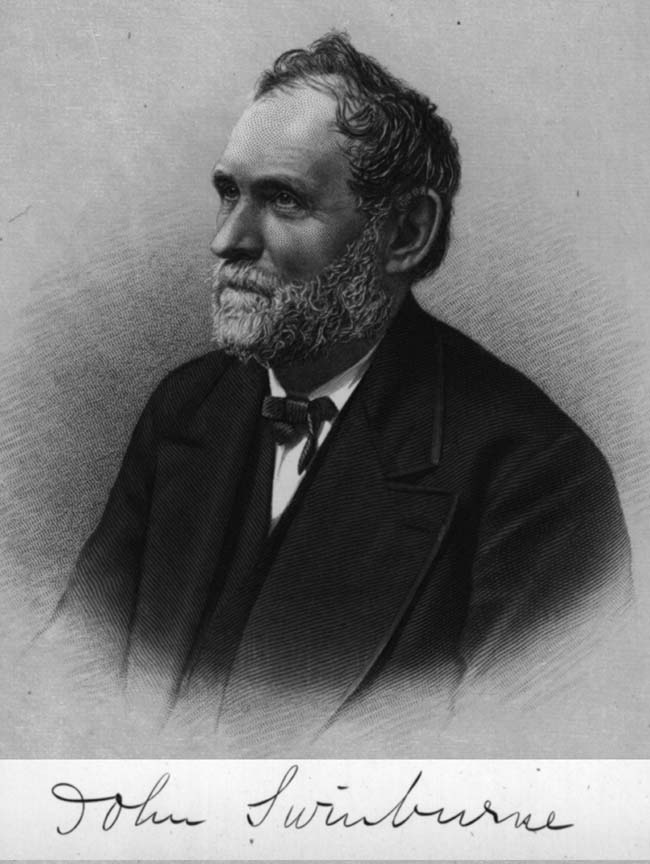
 |
OR INCIDENTS IN THE LIFE OF DR. JOHN SWINBURNE OF ALBANY |
|
|
OR INCIDENTS IN THE LIFE OF DR. JOHN SWINBURNE OF ALBANY |
| A Brigadier-General and Baltimore Editor. ---Driving the Surgeons with a Cocked Pistol. --- Master of Surgery. --- None More Worthy a Soldier's Gratitude. --- What Senator McArthur knew. --- Bloodiest Pictures in the Book. ---Blood-stained Hands. --- Base Libels and a Pseudo-Reformer. |
IN civil life Dr. Swinburne was as outspoken in condemning corruption in local, state, or national government as in military; and having the entire confidence of his fellow-citizens, they looked to him as the physician and surgeon who would cure their political ills, and apply the knife to the rottenness that was infecting the whole body politic, and rout out the disordered members. Of course, this invoked the hatred of his enemies, and involved the doctor in some lively controversies, in which he rose still higher in the minds of the people, and brought to his support many of his old comrades in the civil war, who were ready to defend him against his calumniators. From all parts of the State came letters praising the patriotic doctor.
John Meredith Read, formerly United-States consul-general to France and Algeria, and acting German consul-general, and for six years United-States minister to Greece, writes under date of March last (1885), to a friend, --
"DEAR SIR, -You have referred to my services as consul-general of the United States, and acting German consul-general in France, during the Franco-German war, and particularly to the period when I was shut up in Paris during the siege and the commune.
"Among my most interesting recollections of the siege are those connected with the American ambulance, and especially with its distinguished head, Dr. John Swinburne, who in genius, common sense, executive talents, and the practical success of his theories, surpassed the greatest surgical lights assembled in the beleaguered capital. Dr. Swinburne at that time revolutionized surgery in France to such a degree, that the maimed and wounded French officers and soldiers invariably begged to be carried to him in preference to their own ambulances. The wounded German prisoners were equally outspoken. His unparalleled success in the treatment of the most difficult and dangerous cases inspired an unwavering faith in his judgment, while his uniform kindness implanted an affectionate respect in the hearts of the distressed.
"Dr. Swinburne's work in Paris placed him in the list of international benefactors."
Le Docteur W. S. Mosetig, professeur de chirurgie agrégé à la faculté de Vienne (Autriche), and who was in charge, under Baron Larry, of the Austrian ambulance in Paris during the siege, wrote from Vienna to Dr. Swinburne, as the latter was about to leave Paris, -
"I thank you very much for your amiable letter, and for your kind promise of sending to me some photographs of several interesting cases of your ambulance in Paris. I will accept them with the greatest pleasure. As I do not know our consul in Milan, I beg you to send directly by the post the photographs, to the care of my address. I mentioned your model ambulance in my general report, and will especially write of your excellent surgery.
"I am sorry you are not passing Vienna. Be so kind as to accept, with my friendly compliments, my photograph as a token of mine, and as a remembrance of the good time we passed last winter in Paris.
"Excuse my bad writing, and be assured of my greatest esteem."
On a visit to the American ambulance, Professor Mustig wrote on the register, "We have the best ambulance in Paris, but yours is better than ours."
Before leaving Paris, Dr. Swinburne applied to J. Marion Sims for letters of introduction to some of the leading physicians and surgeons of England. Dr. Sims, who inaugurated the Woman's Hospital in New York, of whom the American profession may justly feel proud, had by his skill, and the practice of the same conservative surgery practised by Dr. Swinburne prior to the war, won a place among the highest in his profession in Europe. He replied, "You require no introductory letters in Europe, your fame is too well known: all that is required is to announce your name, and you will be gladly received." He, however, gave him letters, as requested, the substance of a few of which is appended. he wrote, ---
"To SIR HENRY THOMPSON.
"This will introduce my friend, Dr. John Swinburne of New York, late surgeon-in-chief of the American ambulance at Paris, and one of our most distinguished surgeons. I hope you will be able to show him something of your marvellous operations."
To SPENCER WELLS.
"This will introduce my friend, Dr. John Swinburne of New York. No man in America stands higher as a surgeon. He was in Paris during the siege as surgeon-in-chief of the American ambulance, where he rendered, as you well know, great service. I hope you will have something to show him during his brief sojourn in London."
To BARNARD HOLT.
"Allow me to introduce my friend, Dr. Swinburne of New York, one of our most eminent surgeons, and lately surgeon-in-chief of the American ambulance in Paris. I am sure it will give you pleasure to show the doctor some of your peculiar operations during his short stay in London."
To EARNEST HART.
"Of course, you know all about my friend, Dr. Swinburne, lately surgeon-in-chief of the American ambulance, and one of the most distinguished surgeons in Paris. He will remain, perhaps, a month in London. Let me beg you as a personal favor to place the doctor in proper relations with such of our brethren as he would like to meet."
Dr. Sims was the only other surgeon engaged in the war, besides Dr. Swinburne, on whom the French Government conferred the distinction of knight of the Legion of Honor. In 1876, four years after Dr. Swinburne's return to Albany from Europe, he had a controversy with the faculty of the Albany Medical College because of his charging malpractice in a case attended by one of the faculty, which resulted in the abolishing of his chair in the re-organization. The report of this act reached Europe; and soon after he was invited, through Dr. Sims, to go to London and teach the surgeons of that scientific metropolis of the world how to treat injuries. Two colleges in New York tendered him chairs, and he was also invited to New York to treat fractures in St. Vincent's Hospital. The English surgeons in this instance were like the English judge, who, on hearing one of the bar before him cite the opinions of an American jurist, the late Charles Sumner, interrupted the counsellor to ask if that was the Mr. Sumner who had visited this country (England). On being answered in the affirmative, the judge added, "We will think none the less of the opinion because we have seen and know the man."
Without question, the highest compliment ever paid to the skill of any American surgeon, and to his ennobling characteristics as a man, is contained in a letter from Felix Agnus, late brigadier-general, and now editor of the "Baltimore American," written to a gentleman in Albany. He says, ---
"It was the close of the day, June 27, 1862, and the second day of the seven-days' fight before Richmond. The fight had been hotly contested at Gaines's Mills with terrible effect to our arms. My regiment, the fifth New-York (Duryea Zouaves), as history shows, shared the brunt of the many charges and counter-charges. Near evening I was hit by a rebel sharp-shooter, the ball entering my right breast, ricochetting to the right shoulder, which it completely shattered. As a consequence, I was entirely disabled. Comrades carried me from the field to the hospital at Savage Station, where already the dead and dying were forming a large army. I was handled as tenderly as was possible under the circumstances, and placed in a tent with other officers of my regiment. The comrade to my left was dead, and the one to my right was slowly breathing his last. The terrible sight, together with the recollection of the fight, the recent death of so many valued friends, and the realization of my own almost mortal wound, made me feel that my end was near at hand. I was scarcely twenty-one, but had risen from the ranks to the position of lieutenant in a little more than a year. I was proud of my profession, and, with the feelings natural to a young officer in those stirring times, I felt that if I must die, I would hope to do so with my clothes on.
"While brooding over my situation, a young and inexperienced assistant surgeon came to examine my wound. He did so very carefully. He then asked if I had any friends to communicate with. I at once inferred that the case was hopeless. I dictated a letter to the dear ones at home, and then begged and pleaded that my arm should not be cut off, feeling sure that if it was done my life was lost. He disregarded my request. Other young students gathered around, and they all agreed that the case was too good a one to forego the operation. Weak as I was, the thought of my body being used to practise upon, moved me to desperation; and when they returned, with their instruments and assistants, to sever the much-valued arm, a pistol was pointed at them with the warning that they had better keep away if they valued their lives. I well remember with what haste they vacated the tent; for they saw that the hammer was cocked, and that I was terribly in earnest. I have never regretted my action, for it proved the saving of my life. I was at once reported to the medical director, who proved to be none other than your worthy and distinguished fellow-citizen, Dr. John Swinburne. He came to me in a kindly and cheerful manner, and assured me that no harm should be done. He examined my wound, and assured me that he could save my arm and my life. I could not mistrust his honest face, and I at once placed myself under his care. That night, by candle-light, one of the most skilful operations ever performed, up to that time, was successfully performed on me. Dr. Swinburne, after making a cross-like incision of from six to eight inches long, and after turning the flesh over, carefully sawed off my entire right-shoulder joint and about four inches of the right-arm bone, leaving nothing but the muscle. His prediction came true. I recovered, and to-day I feel that I owe my life and my arm, which is still sound and useful, to this master of surgery.
"From this time began my acquaintance with a man who not only showed his great eminence in a great profession, but whom J, as well as every other soldier who knew him, have held in the highest admiration for his many noble qualities of head and heart. During my convalescence of four months, I grew to know him well, and there is no one I ever met during the whole war whom I consider more worthy of a soldier's gratitude and esteem. He is every inch a man, and his work in the brave struggle of brave men for the preservation of the Union entitles him to every iota of credit and honor and heroism that soldiers win who carry the musket and wield the sabre.
"To show you the vigor and power of that same arm, I subscribe myself,
Yours very truly,
FELIX AGNUS,
Late Brigadier-General U.S. V.
The chirography of this letter is in an off-hand style; and if it were equalled by one-tenth the editorial writers of the press, it would bring joy, if not to the angels of heaven, to the newspaper printers in the upper floors of our daily newspaper-press establishments.
Of a case somewhat similar to this one quoted, the gentleman upon whom the operation was performed, in grateful remembrance, wrote several years afterwards to Dr. Swinburne from Batavia, N.Y., as follows: ---
DR. SWINBURNE, Albany, N.Y.
Dear Sir, ---- It has been many years since we met; and time, which makes so many changes, has perhaps driven me from your memory, but I have reason to remember you. I left the army in 1870, and entered the Medical College at Washington, and am now one of the knights of the scalpel, plying my vocation upon any miserable sinner who may favor me with a call. I am now visiting my good mother at this place, and shall remain until after the election, when I shall return to Washington. Should you still be residing in Albany, and would care to see one of your first "conservative surgical" patients, I will do myself the honor to call on my way to New York, en route for Washington. I don't think you would know me, for ten years has made a great change. I think I would recognize both yourself and Mrs. Swinburne, notwithstanding our short acquaintance.
Very respectfully,
CHARLES F. RAND,
Late Company K, Twelfth Regiment New-York Volunteers, with a resection of head of humerus.
Ex-Senator MacArthur of Rensselaer County, who was a brigade quartermaster during the war, and was at Savage Station at the time of the retreat, and who has watched with interest the course of Dr. Swinburne since that time, gave a very interesting history of the scenes he there witnessed, and also a cutting satire on the course pursued by some of the "stays-at-home," in an article published in the Troy "Budget," of which he is editor and proprietor, on April 6, 1884. The senator, in that article, said, under the head of "What we know of Mayor Swinburne,"---
"When McClellan was fighting his men in front of Richmond, there was a call for volunteer surgeons from the North to assist the medical corps, which had been overworked night and day with attending the victims of Chickahominy fever and rebel bullets, and which corps was not sufficiently strong to minister to the needs of the local sick and wounded soldiers. During the night which closed over the last day's fight at Fair Oaks, the writer hereof, who was flat on his back with Chickahominy fever, received an order to have the wagons of the command under which he served loaded that night with ammunition, rations for the soldiers, and forage for the horses; to burn all the tents and other quartermaster's stores and property in his charge; and to take his wagon-train at once to the James River with all possible speed, and to there await further orders. With the bulk of the enemy in front, the dreaded Stonewall Jackson was menacing, on the north, McClellan's right flank. The writer hereof, not having eaten any thing for two or three days, finding it impossible to keep any thing on his stomach, in the early gray of the morning went over to the headquarters of the medical corps to see Dr. Swinburne, who had come at the call of his country as a volunteer surgeon while one of the Fair-Oaks battles was raging. Arriving at the plateau near the railroad- station, where the medical corps was stationed, the awful sight that met his eyes was one of the 'bloodiest pictures in the book' of battles ever beheld. There were one or two acres of ground covered with surgeons' tables, on which the surgeons had been operating all through the night on the wounded of the Union army who had been stricken down in the last and most destructive battle of the conflict of Fair Oaks, fought on the day previous, the result of which was disastrous to McClellan's army, and which led to his 'change of base,' and retreat to the James River. The canvas flies of wall-tents had been stretched over the operating-tables; but the sides and ends of the tables were open, with no barrier between them and the open air. The tables had been lighted with candles, lanterns, and torches, rudely improvised to light the bloody work which the surgeons had in hand. Many of these lights were still flickering in the early gray of that morning. The surgeons had been operating on the wounded all through that dreadful night. As fast as the wounded, who were constantly being brought in, left the hands of the surgeon, if they were not in imminent danger of soon dying, they were conveyed on stretchers to platform-cars near by, and went by railroad to the White House, on the Pamunkey River, thence to be conveyed to Washington hospitals. Such as could not be thus moved were put in hospital tents near could be under the circumstances. All night long the surgeons were at work with the wounded on each of these one or two of the operating-tables, and all night long the trains of platform-cars were run to the White House with their freights of wounded and maimed soldiers. Many a poor fellow, minus an arm or a leg, was carried off by the wounded train during the night, among them Capt. Arts of the Second New-York Volunteers, with one leg off, and how many more Troy soldiers we don't know. On, about, and under the operating-tables that morning were legs and arms, amputated during the night, and bits of flesh, and ensanguined garments, pools of human blood being absorbed in the earth; and the tables were gory red with the life-streams from loyal wounded soldiers. The scene was ghastly, sickening, and horrid beyond description. That plateau had all the appearances of a vast human slaughterhouse, where soldiers had been dismembered of their limbs, or cut up piecemeal, as if in a butcher's shop. When Dr. Swinburne was found, he was washing his blood-stained hands after an all-night's work at the surgeon's table. He gave the writer some medicine to keep him up until he could take the wagon-train to the James River, spoke words of cheer and encouragement, and, as the Union army was to abandon Fair Oaks and retreat down the peninsula, he said he proposed not to desert the wounded who remained there, and had not been carried to the White House, but to stay, to be taken prisoner by the Rebels, and to do whatever he could to minister to the wants and needs of the wounded. He said this would be at great sacrifice to his private interests at home, but that he could not bear to hand these poor wounded Union soldiers to the 'tender mercies' and care of Rebel surgeons, with no friendly person left to minister to their wants in the dreadful circumstances under which the ill fortunes of war had placed them. And he did stay by them, was taken prisoner, was conveyed with the wounded to Richmond, and never deserted or abandoned them until every man of them was provided for, with as comfortable ease and medical and hospital attendance as could possibly be obtained, under the circumstances, from the Rebel authorities. If we remember rightly, he was assigned as the surgeon having the chief charge of these wounded Union prisoners. Whether he was allowed to return through the Union lines when his mission was accomplished, or whether he was held as a prisoner until exchanged, we have forgotten. For all these patriotic services, Dr. Swinburne never received, if he ever received any pay, any thing like professional compensation. ---At most, he could have received only the meagre compensation of an army surgeon, and we doubt if he ever got that.
"Dr. Swinburne is now the Republican and people's candidate for mayor of Albany. He was elected in 1882, but was counted out in favor of Nolan. At the time, all the decenter portion of Albany was greatly indignant over the Nolan swindle. Lawyer Hale addressed public meetings, and mouthed indignant sentiments against the gross frauds by which Swinburne was cheated out of his office of mayor. According to the 'Express,' he and others 'were profuse in their tender services to bring about a correction of the abuses of which they, and good citizens generally, complained. One lawyer (Hale) now presents a bill of nearly $4,000, which he asks the doctor to pay. Another modestly requests the doctor to hand him over $1,500.' The 'Express' says, --
" ' It is a pretty hard thing to ask a man to pay out in lawyers' fees and costs, in an action brought to preserve his own and the people's rights, pretty nearly double the sum he receives for salary for the full term of the office when it is finally awarded to him by the courts. It must require "cheek," to say the least, for a lawyer who engages in a case of this nature from alleged patriotic motives, to send in a bill for his "services" amounting to more than a year's salary of the office finally awarded to the plaintiff.'
"Hale got judgment for his $4,000 fees; but, as Swinburne's finances are not in a flourishing condition, he couldn't pay. Now just on the eve of the election, Hale has from time to time been annoying and pulling up Swinburne on supplementary proceeding, with the 'Argus' on band to take notes and publish every thing that could be construed into a meanness or humiliation against Swinburne. The 'Argus,' with the facilities thus afforded by Hale, has gathered hints by which it is enabled to taunt Swinburne with being 'an arrant debt-dodger,' and as a man who 'would jump into the assigned carriage, crack the pawned whip, and start up the hypothecated horses, to go through the same performances elsewhere.' If there ever has been any thing meaner, viler, or more despicable, done in a political canvass than the parts being enacted by Lawyer Hale, who claims to be a Republican, and by the 'Argus,' we have never heard of it. A pool of $40,000, of which the Democratic candidate for mayor is said to furnish $8,000, is reported to have been raised to beat Swinburne. While during the war the patriotic Matthew Hale remained vigorously at home in Essex County, Dr. Swinburne was volunteering, and taking chances of losing his life, as we have shown above, and he wasn't charging $4,000 for 'volunteer' services either. The careers of the two men are in striking contrast; and their different records since the war are in equally striking contrast. Dr. Swinburne has been maintaining, at his own expense, a medical dispensary at a great cost, where all the poor who were unable to pay were furnished with medical treatment and medicines without cost. During all this time Lawyer Hale's principal benevolent and patriotic endeavors appear to have been in the direction of piling up $4,000 fee-bills against clients. Quite a difference!
"Every soldier voter, every patriotic citizen, and every lover of fair play, in Albany, it seems to us, ought to support, under the above circumstances, Dr. Swinburne for mayor for patriotic reasons as well as to rebuke those who taunt a public benefactor with his poverty."
At the time Dr. Swinburne tendered his services to Gov. Morgan as a volunteer surgeon, and received his commission, he was possessed of considerable property, and, through a large growing and lucrative practice, was on the road to a fortune. In relinquishing these comforts and inviting prospects, he understood the dangers that were to surround him; that he was not going as a pleasure-seeker, but into the jaws of death; and to provide against any unnecessary litigation or disputes before a surrogate or in a court of equity, in case of his death, he transferred all his property, unembarrassed by any financial claims, to his wife, and children of tender age. Recently, however, the " Albany Argus," a paper that persisted in declaring the unholy war a failure when the doctor was at the front, charged that the property was transferred to avoid the payment of claims against him, --- a most disgraceful libel, and without any foundation, the only real or imaginary financial claim of any description against him being the one now under trial. This is made by a pseudo-reformer, Matthew Hale, a lawyer who sues to recover $4,000 counsel-fees for services in a quo warranto action of John Swinburne against Michael Nolan for the office of mayor of the city of Albany, to which the doctor was elected in 1882, but out of which he was defrauded. The plaintiff lawyer, at the time, was a very loud and apparently enthusiastic Republican reformer, and advocate of good government, and very vehement and positive in denouncing the political ring that ruled Albany, and was afterwards an unsuccessful candidate for Supreme-Court justice. At the last election he was a Democratic reformer, working with the ring he had so denounced as corrupt. Witnesses swear he was a volunteer lawyer in the case; and certain it is he received no retaining-fee as counsel, and did make a speech at an indignation meeting, outstripping all the others present in his protestations of the sacrifices he was ready to make to right this terrible wrong, punish fraud, protect the purity of the ballotbox, and vindicate the rights of the people. After having failed for nearly three-quarters of the term in having the case brought to trial, another lawyer, the late Henry Smith, succeeded in accomplishing in less than one month what Hale failed to do in a year and a half, but for which services the latter demanded $4,000, --- a larger sum than the salary received by Dr. Swinburne as mayor. On this is based the only charge the enemies of good government were able to advance against this loyal citizen in the last congressional campaign.
While Dr. Swinburne was health-officer of the port of New York, his arrangements somewhat interfered with the exclusive privileges of the "New-York Herald" in gathering ship news; for which that journal became very indignant, and, besides resorting to rather questionable means to injure the health-officer, published some scurrilous articles on his administration. These schemes the doctor soon discovered and frustrated; and the" Herald's" venom was expended in vain on the doctor, and re-acted on that journal. An article in the "Rochester Democrat," under date of Aug. 20, 1868, referring to this controversy, said,---
"Amid the various signs which we have of 'hanging the "Herald," ' we occasionally see something in its management which looks like hanging itself. One of these things is its attack on John Swinburne, health-officer of this port. Before the 'Herald' began its attack, it would have done well to take a look at its antagonist. Dr. Swinburne has a well-knit frame, muscular, and full of strength and vitality: he is a small Hercules, with a pleasant countenance, but one so full of purpose and determination that its slightest frown reveals the unconquerable will. We read this in Swinburne when we first saw him, many years ago, and time has only strengthened our conviction. He came to Albany young physician from St. Lawrence County, without friends or patronage, but full of determination. In due time he was called to examine a case of sudden death. A woman who went to bed well was found dead in bed the next morning. Before retiring she had eaten a supper; but the next morning her bowels were empty. The bedroom was found freshly mopped, and the bed in decent order. Her husband, who slept with her, said she died in the night, and he could throw no light on the subject; while his parents, at whose house the couple were living, were equally unable to afford information. John Swinburne immediately saw through the mystery. The woman had been poisoned during the night by her husband, and the parents were in some degree cognizant of it; for the cleansing of the room after the effect of the poison was over proved this. The husband was arrested; and, with that peculiar fatality which attends guilt, he replied, when he learned that a post-mortem examination was to be held, 'They will find no arsenic there.' The stomach was empty, but Swinburne found traces of aconite. On his testimony the man was indicted, and on his testimony he was hanged. A fierce effort was made by the defence to break down Swinburne's professional character. He was cross-examined in the most bewildering manner, and medical testimony was brought to bear against him ; but the lawyers had to learn a new lesson of calm determination as they saw John Swinburne ride through the storm. It was a conflict in which his reputation, as well as the cause of justice, were at stake ; and he triumphed. Such was the famous Hendrickson case; and, now that it is past, no one has ever uttered a doubt of the guilt of John Hendrickson. Had he been matched against any other surgeon, he might have escaped; but in Swinburne's hands his doom was sealed. Hendrickson was a desperate character, and had determined to get rid of a wife whom he had abused, and whom he hated. He resolved on poison, and selected one with which the medical faculty is not generally familiar. This was aconite. The trial was marked by a wide range of false swearing on the part of the prisoner's friends, who were important witnesses, inasmuch as the woman died in their house. But justice penetrated the mystery : the murderer was hanged, and Swinburne was looked on as a new power in the medical world.
"A similar case occurred subsequently in St. Lawrence County. A brutal husband, who had been long notorious for his abuse of his wife, finished his crime by murdering her in a manner more ingenious even than by poison. He choked the woman to death, and then placed her in bed and cut her throat, giving out that she had committed suicide. This theory was accepted by a coroner's jury; but, suspicion being aroused, the theory was upset by Swinburne, who demonstrated its impossibility in the clearest manner.
"During the war, Dr. Swinburne left his practice, and volunteered to visit Richmond in order to attend to the sick prisoners from the Federal armies, ---a service in which several other distinguished surgeons bore part."
The most appropriate conclusion, we believe, with which to close this chapter, is to copy an editorial article from the "Medical and Surgical Reporter" of August, 1862, as follows: ---
"It will be remembered that Dr. John Swinburne of Albany, who had gone to the peninsula on special service, was one of the surgeons who, in the retreat of our army from before Richmond, remained with our wounded. He was on duty; in charge, we believe, of the field hospital at Savage Station. A great many of the wounded, who were captured by the insurgents, and who were exchanged or paroled, have been sent to the hospitals in this city [Philadelphia]. They uniformly speak of Dr. Swinburne, and of the other surgeons, in terms of the greatest admiration and respect for their noble and disinterested devotion to their welfare. In an especial manner they have commended Dr. Swinburne for his conservative surgery. One man exultingly showed us an arm, which he declared would soon be as good as ever, and said, 'If it had not been for Dr. Swinburne, I would have lost that arm, and yet it has been saved in spite of Richmond prisons.' Another told of the doctor's indignation when he found that a limb, on which he was going to perform the operation of resection to save it, had been amputated by a zealous subordinate, while he was attending to pressing duties elsewhere. It would be well for our soldiers if Dr. Swinburne's conservative ideas were more prevalent among our army surgeons."
| Professional Men in Politics---Swinburne the People's Candidate.---Fraud and Corruption. --- Patriotic Lawyers and a Pseudo-Reformer.---An Indignant Populace.---Democratic Eulogy.---Heating Thousands.---A Long Contest and Victory over Corruption. --- Four Thousand Dollars' Worth of Patriotism. --- Dugal Dalgety. |
THE assertion of the politicians when speaking of the fitness of men eminent in the professions for political positions, with whom they do not agree politically, ---that they are excellent surgeons, physicians, or theologians, but because of their education and training are not adapted to manage State affairs,---is no more applicable to those two than it would be to the profession of the law or to journalism. While Dr. Swinburne was mayor of the city of Albany, he exhibited a greater knowledge of the necessities of the people, and a degree of executive ability far superior to many of his predecessors. On this question, the "American Medical Times" has an article that answers fully this objection. It says, ---
"The medical profession is, for the most part, committed to the belief that its duties are limited to the healing of the sick. If a physician directs special attention to any other subject, .he is regarded as departing from his legitimate duties, and in a certain degree abandoning his profession. A known devotion to any branch of the physical sciences or to literature is most damaging; but if he engage, however remotely, in any secular business, he is at once 'read out' of the profession. We lately heard Professor Simpson of Edinburgh pronounced 'lost to the profession' by a half-score of medical gentlemen because he had addressed his class of medical students on their religious interests. But on no subject is there such a unanimous opinion in the profession as that a medical man is lost if he gives his attention to political questions. Medical and political science are regarded as so entirely incompatible, that the pursuit of one is thought to disqualify for the pursuit of the other.
"We believe, however, that a just code of medical ethics would comprehend a much wider field of duties than is generally understood. It should measure the competency of physicians on all questions which concern humanity. Man is the object of all our study: all his interests are within our scope ; every thing that can ameliorate his moral as well as physical condition falls within our domain. Consequently medicine is one of the tributaries of social science or general politics. Times are long passed when we were confounded with barbers and servants, and when army surgeons or physicians were considered little above the mercenaries employed à la suite of armies. Remnants of the humiliation of science in barbarous times can still be traced in the ordinances of European armies. But science is now fast dispelling those clouds, taking a high and most influential position in society and in the State. The question which we wish to urge is, Shall that influence be extended at all times, and under all circumstances, for the advancement of man's social and political as well as physical welfare?
"Virchow, the most distinguished representative of our profession, the leading medical mind of Europe, is a member of the Prussian Chamber of Deputies. He accepted unhesitatingly an election by the people, and is the leader of the liberal party. He has not forsaken his profession, but is as much absorbed as ever in his histological investigations. The medical sciences have not lost an ardent cultivator, while the cause of popular liberty and of human rights has gained an earnest advocate. Nélaton, the distinguished French surgeon, was recently offered a nomination for a seat in the French Parliament by the working-classes, but he declined the honor. He alleges in justification of his conduct that he was only a surgeon, and could not on that account have legislative abilities.
"No liberal mind can doubt which of these two medical gentlemen has done his duty, and accepted all the high trusts which have been committed to his care, whether as a citizen or a medical man. Virchow is adding new lustre to a fame which is already world-wide and of dazzling brilliancy. His name will be recorded high on the roll of those legislators who have advanced the civil and political interests of the people. Nélaton has failed to prove himself endowed with those great qualities of heart which distinguished Virchow. In declining the proffered appointment of the people, he allied himself with the aristocracy, which ignore the claims of the laboring classes.
"We rejoice in the example which Virchow has placed before the profession of Europe, and trust its influence will be felt in the United States. Here, where a republican form of government renders even the humblest talent useful, and gives it a proper weight in the social and political scale, medical men should accept official positions of trust. We cannot too often repeat the instructions of Rush: 'In modern times and in free governments, they (physicians) should disdain an ignoble silence upon public subjects.' The American Revolution has rescued physics from its former slavish rank in society. For the honor of our profession, it should be recorded that some of the most intelligent and useful characters, both in the cabinet and in the field, during the late war, have been physicians."
It was after the return of Nélaton to Paris from Italy, whither he had gone to attend to the wound of Garibaldi, that the working-men of Paris tendered him the nomination as a member of the Chamber of Deputies, which he declined on the ground that he had no taste for politics. They supposed he was in full sympathy with the people in every effort to better their condition. Actuated by the same motives, the people of the city of Albany, groaning under the oppressive taxation and the misrule of a corrupt and heartless ring, saw in the great surgeon the patriotic and fearless citizen, who had in every instance proved his devotion to the masses in his aims for good government in professional and political administration, the man to lead the hosts against the heartless and intrenched enemy. In 1882 they tendered him, as the only man able to lead them to victory, the nomination for mayor of the city of Albany. He had no taste for politics; but, on the persistent pleading of the people that he would be their leader out of the dark land of political corruption in which they were held, he accepted for their sake, in the interest of good government, and entered into the contest with a zeal that won for him the title of "The Fighting Doctor," ---an honorable distinction he has honorably borne out, not as a ring pugilist, but as a fearless denunciator of fraud and corruption. The election resulted in a triumph for the people, and the choice of their candidate, overcoming the majorities given the Democratic candidate of 4,376 in 1878, and 4,693 in 1880. The ring, however, were up to their old tricks, counted out the doctor, and gave his opponent, Nolan, 118 majority; but the doctor, having espoused the cause of the people, determined they should have their rights. A number of gentlemen of the legal profession, and others, volunteered to give their time and efforts to righting the wrong, and punishing the fraud perpetrators. Among the legal gentlemen were N. C. Moak, James W. Bentley, W. F. Beutler, the late Hon. Henry Smith, Andrew S. Draper, Fitch J. Swinburne, Hamilton Harris, and Matthew Hale; the latter, with other gentlemen, at a public indignation meeting immediately after the election, making speeches denouncing the fraud, Mr. Hale offering the following preamble and resolutions, which were unanimously adopted:
Whereas It is charged that an organized and desperate effort was made at yesterday's election in this city to defeat the will of the people by fraudulent and criminal practices, including illegal voting, bribery, ballot-box stuffing, obstructing lawful voters, excluding witnesses from the polls, false canvassing, and falsely certifying results; and
Whereas It is further charged that by such fraudulent and criminal practices Michael N. Nolan, who was defeated, was falsely made to appear to have a majority over John Swinburne, who was lawfully elected, by a large majority of the legal votes cast at said election, to the office of mayor of the city of Albany: it is
Resolved (1) That the fraudulent and criminal practices so charged, and all the persons guilty of the same, and all persons who have instigated, connived at, excused, or justified the perpetrators of such offences, deserve and should receive the detestation and denunciation of every good citizen, of whatever party, and the severest punishment provided for them by law;
(2) That to permit such crimes to go unpunished, and the person or persons in whose interests they have been committed to retain unmolested the offices to which they have not been elected, but to which they have, by the aid of such frauds and felony, been falsely declared to be entitled, would be to renounce popular sovereignty, and to submit to a despotism all the more galling because it is irresponsible, and assumes the mask of democracy;
(3) That such charges should be thoroughly investigated in appropriate criminal and civil proceedings, to be instituted and prosecuted for the purpose, to the end that the legally expressed will of the people may be ascertained and enforced, and that the guilty, whether high or low in position, may be punished
(4) That we pledge ourselves, so far as our means and circumstances may permit, to contribute our time, our energies, and our money, to carry out the spirit of these resolutions, to defeat the apparent conspiracy against the ballot-box, to vindicate the will of the people, and to punish those guilty of the offences charged, which are the greatest possible crimes against a free government.
The resolutions were the sentiments of the people of Albany, represented in the ten thousand gathered at the indignation meeting. The esteem of the masses, and the confidence in which the doctor was held at that time, were no sudden outgrowth, but had taken root years before, and became more deep and intense as the years rolled on. In 1872, Ex-Speaker Callicott, editor of the "Albany Times," had this complimentary notice of the doctor and his abilities: --
"Dr. John Swinburne was born in Denmark, Lewis County, N.Y., in 1821. His father was a large farmer and merchant, and highly respected in that county. His star of progress began in the cold winds of envy and detraction, and wild storms of opposition hedged his pathway. But Dr. Swinburne was a man who grew the faster by opposition. The famous Hendrickson trial brought out Dr. Swinburne in a single-handed fight with the medical profession. The opposition was long and persistent, but he won at last; and with success came fame and fortune. Then came the Budge trial and its famous points of medical jurisprudence, in which he measured swords with the great 'medical head-lights' of the country, and came off victor.
"From this time Dr. Swinburne has been recognized as medical genius a bold and skilful surgeon, and a profound thinker, marking out new paths which are now followed by the foremost men of the profession.
"His administration at quarantine was a grand triumph over all opposition, and placed him among the greatest organizers and managers that had ever controlled sanitary affairs in this country.
"In 1870 he was at the head of the American Ambulance Corps at the siege of Paris, and received the cross of the Legion of Honor for bravery and skill. This was the first time any American ever received such a compliment.
"Dr. Swinburne has shown a great executive ability, as well as scientific skill. His associations with several large enterprises in this city, and in the Far West, reveal the immense activity of the man, and show that he is a man for the people, alive to all their interests.
"In surgical and medical jurisprudence he has introduced important changes, and made discoveries which have now become practical all over the world. As a leader, he has shown intense activity, and a ready perception of men and events, united with a clear comprehension of the exact requirements of the times."
Mr. Callicott is recognized by all who know him as not only one of the ablest, but fairest, editorial writers and journalistic managers in the State, and true to the principles of his party (Democratic). During the last campaign, while giving a loyal support to his ticket, and having one of the very best men in the party on that ticket for Congress, he seemed, like the mass of his fellow-citizens, to have grown in appreciation of the doctor's "great executive abilities," and had. not a syllable to utter against the Republican nominee for Congress, ---Dr. John Swinburne. It was but natural that the Republican organs should contain many flattering panegyrics of their candidate, Dr. Swinburne, which are made the more important because of this commendation from an opposite political editor, of whom the "Express," always a firm Republican paper, said, ---
"Mr. Callicott is unquestionably the most accomplished Democratic editor in this section of the State. He is also very cautious and conservative, and does not make assertions without understanding the subject thoroughly."
In 1,880, when the connection of the doctor with the Albany College terminated, the news went over the land; and several applications were made to him to accept a professor's chair in other cities and institutions of learning, one of them being from London, Eng. He was seriously considering one of these invitations, and had about determined to accept, when the citizens of Albany, learning this fact, became fearful they were to lose the man they had known nearly forty years, and, bestirring themselves to avert such a "misfortune to the community," presented him with the following petition, which was published in the "Albany Journal" of July 22, 1880: ---
TO DR. JOHN SWINBURNE.
Dear Sir, --- Learning that you are considering proposals to engage in the practice and teaching of your profession elsewhere, the undersigned urge you not to accept such proposals, but to remain here. assure you that, whatever impressions you may have received on the subject, the people of Albany know and appreciate your great skill, and the generous use you have made of it to heal, without charge, thousands who could not pay for such service; that your fellow-citizens are proud of your just fame, and of the credit it reflects on our city, and would deplore your departure as a loss to the profession and a misfortune to the community.
Hoping that this expression of our feelings may lead you to remain with us, we are
Sincerely yours,
Matthew Hale, Erastus Corning, Joseph H. Ramsey, Hamilton Harris, Edmund L. Judson, Lyman J. Lloyd, Barclay, Jermain, A. M. Brumaghim, Albert Wing, H. S. Van Santford, Eli Perry, Adam Van Allen, W. Dey Ermand, Charles S. Many, Robert C. Blackall, John H. Trowbridge, John Clemishire, Jacob Messenger, Thomas P. Rudd, E. Countryman, L. M. Van Santvoord, Benjamin Payn, Wm. G. Weed, W. S. Hevenor, A. C. Judson, D. Cady Herrick, Edward J. Boughton, John S. Dickerman, Geo. Dawson, James T. Story, Edwy L. Taylor, Jas. A. Houck, W. Frothingham, Daniel Casey, Thomas H. Ferris, Walter McEwen, Charles D. Rathbone, Sylvanus H. Sweet, Peter Kinnear, William Doyle, E. D. Rouan, Andrew J. Colvjn, Geo. A. Birch, J. W. Mattice, R. R. Thompson, George H. Treadwell, William S. Paddock, Johnston & Reilly, A. S. Draper, John E. Page, Isaac W. Vrooman, Alden Chester, John C. Feltman, J. S. Robbins, J. McCann, H. C. Birch, Abram Van Vechten, Edward J. Meegan, H. Dorr, J. R. Benton, S. G. Rice, H. McBride, John W. Van Valkenburgh, R. M. Griffin, Robert Scott, Lansing Hotaling, Thomas D. Coleman, William H. Haskell, William Thornton, Galen R. Hitt, John H. Farrell, D. L. La Monte, H. P. Prime, Henry T. Bradt, Robert Strain, John Pladwell, William H. Low, Franklin W. Miller, Jonathan Tenney, Isban Hess, George W. Coonley, Charles E. Burgess, Walter S. Brown, John T. Gorman, Peter Snyder, Theodore D. Smith, jun., William Casey, Thomas P. Lynch, Frederick Andes, Richard B. Rock, William A. Donahoe, J. Van Wormer & Co., Jacob H. Ten Eyck, Ignatius Wiley, George Weber, Richard Bortle, A. B. Pratt, George Downing, Frederick U. Bressler, John W. McNamara, and two thousand others.
To this petition the doctor replied, ---
GENTLEMEN, --- In reply to your kind and friendly letter requesting me not to leave Albany, or abandon my work here I have to say it is true that I am considering propositions for the teaching and practice of my profession elsewhere. It is but fair to state the reasons therefor. On my return to this city in 1871, after an absence of seven years, I was warmly welcomed by the profession; and sought to show the great advance that could be made in surgery by the use of conservative modes, preferring to do this in the place where m professional career began: in other words, having long known that it was but rarely needful to cut off an injured limb, that the maimed member could almost always be saved; and feeling that to despoil, deform, or to perpetuate deformity in any patient, however poor, of a limb which could by reasonable means be saved, was wrong, and not in accord with the object of our profession, ---I undertook to prove, on a scale large enough to obtain conclusive results, that this harm could be avoided. I can only say my efforts have been misunderstood. It is needless to refer to the various differences which have arisen between myself and other members of the profession, by which the conclusion to seek broader fields and more liberal minds have been forced upon me. The public know, and can judge for themselves. My work has not been done in the dark, and I leave it to the verdict that time may bestow. I should, in justification to myself, add, that, at the request of some of the profession, I entered upon my work without a desire to obtain a lucrative practice. What has been done, has been done for the poor, without charge to them, but necessarily entailing large expense upon myself. But that very fact alone has been used against me; and notwithstanding results obtained by my methods of treatment, of which I may rightly be proud, my course has been misrepresented, and every endeavor made to retard the work. For these reasons, therefore, I have considered the oft-repeated request to go elsewhere.
Allow me to assure you, gentlemen, of my highest regard for you personally, and, adding my thanks for your letter, to sign myself,
Yours very truly,
JOHN SWINBURNE.
This petition, signed by the leading men of every profession and industry in Albany, prevailed with the doctor; and among the names of those still living are found his truest and warmest supporters, the only exception among them known to express different views from those then entertained being the first to appear on the petition, Matthew Hale. This opposition, it is believed by a large portion of the people, was induced by the appointment of the late Hon. Henry Smith, a lawyer in whom the doctor recognized integrity and ability, as corporation counsel, instead of appointing Mr. Hale.
To decide the questions, whether the purity of the ballotbox should be maintained, the rights of the people vindicated, and fraud punished, criminal proceedings were commenced in the courts the next day, and followed by a civil proceeding in quo warranto, to determine by what authority the "counted-in" mayor held the office. In these proceedings it was generally believed the lawyers in the case were acting pro bono publico; and from the declarations of Mr. Hale, both in public and private, his strong denunciations of the corrupt ring that ruled the city, his protestations as an honorable citizen in favor of good government, and the sending of the fraud perpetrators to prison, he was especially considered a reformer working for the object he professed to have so dear at heart, when he pledged himself, publicly, "to contribute our time, money, and energies, to defeat the apparent conspiracy against the ballot-box, to vindicate the will of the people, and to punish those guilty of the offences charged, which are the greatest possible crimes against a free government." When Mr. Hale made this declaration, and that to submit to the frauds "would be to renounce popular sovereignty, and to submit to a despotism all the more galling because it is irresponsible and assumes the mask of Democracy," it was thought he was speaking as a citizen prompted by patriotism, and not as a lawyer agitating for a lawsuit in which he was to have a four-thousand-dollar fee from a client who was contesting an election in the interests of the people, and not for selfish ends. Yet the sequel to his action, then, ---Mr. Hale's becoming a reformer at the last general election, deserting the party with whom he had worked, or pretended to, for good government; and the overthrowing of the corrupt ring which ruled Albany; and affiliating politically with the very ring whom he declared "deserve and should receive the detestation and denunciation of every good citizen of whatever party, and the severest punishment provided for them by law,"---naturally leads to the conclusion that his patriotic and political professions were all "bumbcomb." The special reference to this action, as a part of the doctor's first political contest, is made because of the false charges growing out of it, which were handled and published as reports of the trial in the organ of the ring,---the mouthpiece of Mr. Hale's new political associates, ---in an attempt to defame the name of Albany's most popular honored, and philanthropic citizen. The history of this action of Hale against Swinburne, as we understand it (and we have generally attended the courts officially, and as one interested in the result, because of the doctor's position as a representative of the people), in brief is this. On the morning after election, a consultation was held between several of the lawyers and the doctor, one of the gentlemen terming it a "council of war." It was decided to institute criminal proceedings, to ferret out the frauds, and procure evidence for a quo warranto action. Before the recorder the criminal proceedings were carried out, and hundreds of voters, who had been summoned, examined; these proceedings occupying several months. Besides this a thorough canvass of the city had been made. These were all preliminary, and necessary to obtain the facts on which to base the quo warranto action. All this work was carried out under the direction of Messrs. Bentley, Beutler, and Fitch J. Swinburne, and were voluntary acts by these gentlemen, none of whom looked for any compensation from the doctor, and were working in the interests of the people ; Mr. Hale only appearing once or twice in these proceedings. When the facts were all accumulated to prove the fraud, the only apparent labor during the entire litigation, an action quo warranto was commenced, Mr. Hale assuming the leading part, it being understood among the other counsel that the papers were to be served at Hale's office, simply as a matter of convenience. After nearly two-thirds of the term had expired, in which the opposing counsel were able, by motions and technicalities, to postpone the trial from time to time, the late Hon. Henry Smith appeared in court; and, when another attempt was made to delay, he succeeded in doing at one session of the court what Mr. Hale failed in having accomplished in the many months, --- that of having the action set for trial on a definite day. Before that day arrived, the incumbent, Michael Nolan, seemingly to avoid a. penalty, resigned. The action went by default; and, under the direction of the Court, the verdict of a jury was taken, awarding the office to Dr. John Swinburne.
It may be pertinent, here, to add, that the doctor and others were led to doubt the sincerity of Mr. Hale in the, matter; as he had written, April 27, 1863, a few days before the action was to be heard in court, in substance, that he was going out of the city, and that the doctor must have some one else prepare the case, as he could not get ready. This, after many months in which he claims to have been engaged in the suit, looked, to be mild in expression, "funny practice."
On assuming the office of mayor of Albany, the doctor appointed the Hon. Henry Smith, long the leader of the Albany bar, corporation counsel. Soon afterwards Mr. Hale presented the doctor with a bill of four thousand dollars, for alleged legal services in this contest; and in the Supreme Court obtained, without trial, a judgment for that amount, the judge deciding that the answer of the doctor was frivolous.
The next point with Hale was to recover the amount; but he failed to find any property, the doctor having, when he entered the army during the Rebellion, transferred his property to his wife, and children of tender years. Supplementary proceedings were commenced; the doctor placed on the stand, and subjected to insult and abuse by Mr. Hale, who, only four years before, said of the doctor, in a public document, "The people of Albany know and appreciate your great skill, and the generous use you have made of it, to heal, without charge, thousands who could not pay for such service." What a burlesque is presented in Hale asking four thousand dollars for alleged services to right a great outrage perpetrated on the public, from a man who healed, "without charge, thousands who could not pay for such service." All the dirt and vilification, and attempts to make the doctor appear dishonest, that could be construed out of this testimony in supplementary proceedings, was dished up in the "Argus," the ring organ.
Dr. Swinburne pays his debts, and liquidates all just claims against him ; but denying any pecuniary obligations, direct or implied, to Hale, he determined to resist what he claimed "extortion." On an appeal to the general term, the decision, that "the answer of Dr. Swinburne was frivolous, was overruled," and the judgment and supplementary proceedings set aside. When the case again came into court, Mr. Hale moved for a reference, alleging that his claim set forth several separate and distinct retainers; that the investigation would involve a long account, and consume much time. On his affidavit and motion, the case was given to three referees. It is, as the case has progressed and facts have been developed, and by the utterances of Mr. Hale himself, becoming a settled conviction in the minds of many, that Mr. Hale knew he had no just claim against Dr. Swinburne, and that he was afraid of a trial in open court before a jury, asserting as his reason that the doctor hoped to get on the jury, if tried in open court, "a sprinkling of his patients and political heelers," as the people were termed by Hale.
Before the referees, Mr. Hale has offered proof of but one retainer, and that the doctor squarely denies. It is admitted that there was no money then paid; and according to Hale, and the testimony of the other gentlemen present, nothing was said about remuneration; the entire consultation being as to how they should proceed, and what steps should be taken. No witness has been able to place a value on any separate service, except Mr. Hale himself, who values the drawing of an offer of reward for the conviction of the perpetrators of the frauds at fifty dollars. He could not, or would not, place a definite value on any other particular or separate service, and all the witnesses he placed on the stand were equally incapable of placing any value on any separate service; but, on hypothetical questions propounded by Mr. Hale, they estimated his services, if they were as he stated, worth four thousand dollars. Two of the lawyers summoned by Hale, who were counsel for Ex-Mayor Nolan, testified there were no questions of law involved in the quo warranto action, as these had all been settled: the question was simply one of fact, to be determined by proof of votes. Another thought, according to Mr. Hale's statement, that his services in the proceedings were worth four thousand dollars: yet it is understood this very lawyer thought fifty dollars was ample compensation for Dr. Swinburne's professional skill and services in attending his (the lawyer's) son, who had been thrown from a carriage, and sustained a fracture of the leg; the doctor saving the limb, and perhaps the life, of the injured young man, as believed by the family. But then, the difference in the value of the service of these men of different professions was, that one was successful in as short a time as possible, while the other was unsuccessful. The doctor, on oath, denied having retained Mr. Hale, or that he was to be in any way responsible to him, and never had any intimation that Mr. Hale hoped to get a fee from him until the case had been in litigation about a year, when, through one of the other counsel in the case, Hale sent word to the doctor that he thought he ought to have a thousand dollars. The doctor then declined to pay any money; but Mr. Hale did not withdraw from the suit. It was understood that the money requisite in the action was to be raised by subscription; and some funds had been raised in that manner, Mr. Hale at one time early in the litigation drawing from the treasurer of the Citizens' Committee two hundred dollars. That this was to be the method of raising money is further proven by the fact that a subscription list was drawn by Mr. Hale for that purpose, with the name of his firm second on the list for two hundred and fifty dollars. When Mr. Hale took the prominent part he did, it is said that he understood there were then two thousand dollars in the hands of the Citizens' Committee for this very purpose. The other counsel named, when asked if they had any bills against the doctor, with one exception replied, "No, we have no bills against the doctor." Mr. Moak, a leading Democratic attorney, cordially took a part in counselling, and was always ready to discharge any duty that he might be called to perform in the action, adding that, while he was Democratic in politics, he believed in good government and. the protection of the purity of the ballot-box. His interests in the matter were, like all the others excepting Mr. Hale, for the rights of the people. It was no party movement, and was supported by able men of both parties. In his charge against Dr. Swinburne, Matthew Hale has but few sympathizers. After his attempt to injure the doctor, the public rendered two verdicts at the polls, --- one defeating Mr. Hale for judge of the Supreme Court; and the other, by electing Dr. Swinburne to Congress by a majority no other man in the country could command, changing the popular vote by over seven thousand. The people believe the doctor is as truthful and firm as he is tender and aggressive. And here it is pertinent to ask a simple question; i.e., If Mr. Hale, in making his application for a reference, swore to the truth as to separate retainers, and could before the referees make no account or swear to but one retainer, did he swear to facts on both occasions? The two statements are contradictory; and, until they are satisfactorily explained, there will exist an impression that there is still need of reformation. A credible and unimpeached witness, a lawyer by profession, testified that Mr. Hale did say, that if Dr. Swinburne had consulted him before appointing Mr. Smith, this suit might never have been commenced.
The only excuse or explanation we deem necessary in placing this matter here, is to illustrate how shrewdly some men can cover up their real designs, and by a smiling countenance deceive the most penetrating; how men anxious to become popular, and see their names in print, are confounded with their own utterances; how the loudest advocates of reform are not at all times to be believed; how rapidly a defeated aspirant for office can change his political creed, and go into full fellowship with the men he had denounced as fraudulent and corrupt, without their changing or improving morally; and how easy it is for the new convert to find only honest jurors among his new associates, where there are no "patients or political heelers," and to expose the "true inwardness" of the only grounds on which the doctor's enemies could draw any thing to say against him in the last campaign, and to indicate how hard it is for a friend of the people to obtain a fair chance to have justice and a public vindication in the courts in a public matter, instead of having the question relegated to the almost absolute secrecy of a referee's room. The case is still in litigation, and the doctor is fighting for an open trial.
In the issue of May 16, 1884, the "Morning Express" said of this action of Hale against Swinburne, --
"The people of Albany will doubtless remember that, in the charter election of two years ago, Dr. Swinburne was elected to the office of mayor; but by means of a corrupt cabal was prevented from at once assuming the reins of city government. A number of patriotic citizens immediately enlisted in his cause, and proffered their time, their means, and their talents to enable him to secure time office to which he was honestly elected. First and foremost among the number was the Hon. Matthew Hale, and none could excel him in his zeal in the cause of righteousness. The case, however, dragged slowly along; and, for fourteen long months, Dr. Swinburne was knocking in vain at the door of the temple of justice. Finally Hon. Henry Smith was taken into the case, and the blind goddess at once smiled more benignly upon the applicants for justice. The suit was brought to a successful culmination, and ere long the 'Fighting Doctor' was duly installed in office. In due time he appointed his faithful advocate to the best office in his gift. Almost simultaneously with that appointment, a suit was inaugurated by the Hon. Matthew Hale against the doctor for services rendered in the mayoralty proceedings. The value set upon these services were such as to cause most of the people to believe that we had again returned to the golden days of Aladdin. The doctor, of course, demurred paying for 'patriotic' services; and returned an answer to the complaint, setting forth the fact, already familiar to all, that the services of Mr. Hale, as well as other gentlemen, were taken up in the interest of law and order, and were of course gratuitous in their nature. Judge Westbrook granted an order of judgment in favor of Mr. Hale, upon the ground that the answer was frivolous; and also denied a stay of proceedings pending an appeal. The public will remember that Dr. Swinburne was then hauled up before a referee, upon an order of supplementary proceedings, immediately before election, and subjected to the grossest sort of an examination, all of which was thoroughly ventilated in certain daily papers of an opposite political faith, with elaborate embellishments added thereto. The examination failed to reveal that Dr. Swinburne was worth four thousand dollars, the sum demanded for the services rendered. Then an order was obtained to bring up Mrs. Swinburne upon supplementary proceedings, the subpoena designating May 29 as the first day for such examination. In the mean time the Hon. Henry Smith appealed the ease to the general term, now sitting at Binghamton; and that tribunal, upon Wednesday last, handed down an opinion reversing the order of Judge Westbrook, and denying the motion of Mr. Hale for the relief demanded. This, of course, supports the position assumed by Mr. Smith; and admits that the answer set forth by him to Mr. Hale's complaint was, in legal parlance, 'good.' All further proceedings of a tantalizing nature, of course, will be dropped, and the case tried upon its merits at time next circuit; and it will then be determined whether or not 'patriotic' services are worth the princely sum of four thousand dollars."
Nearly a year after this article was published in the "Express," the case being still in the courts, the Hon. Ira Shafer of New York having been substituted as counsel for Dr. Swinburne, in place of Henry Smith, deceased, the "Citizen" of April 11, had this to say of the controversy, --
"The irrepressible conflict between the people's friend and genuine reformer, Dr. John Swinburne, and the pseudo-reformer, Matthew Hale, still continues; and the end is not yet. With the merits of this case the public are familiar, and need no repetition, further than to remind them that it was Hale who was so loud in his protestations that justice should be done the people, when the fraudulent ring of this city counted out their candidate for mayor, and counted in Michael Nolan. They remember the indignant countenance of Hale as he faced the thousands assembled at the indignation meeting at the old Capitol, and the emphasis with which he read the resolutions declaring it was the duty of the people to give their time and money to right the great wrong, and bring to justice the abettors and perpetrators of the fraud. Not one man in that audience, we venture to assert, ever dreamed, at that time, that Hale was then playing the lawyer under the garb of a patriot, and deceiving the multitude before him. Yet, if he is to be believed, that was just what he was doing; as he recently, in this action to recover four thousand dollars for the services rendered in the suit that followed, testified that he was retained the morning before the speech was made. The case, the people remember, has had many turns in the legal mill, and has been before referees. Mr. Ira Shafer, counsel for Dr. Swinburne, desires, in the interest of his client, that the case should be taken from the referees, and tried in open court, where the public gaze may be upon the proceedings; feeling, as he says, that no jury would be found to render a verdict in favor of Hale, any more than they would think of awarding four thousand dollars to John Hancock for his patriotic act in signing the Declaration of Independence.
"Mr. Hale, afraid, it appears, of public exposure, and that a just public verdict might be rendered, resists this attempt; and, when last the motion to take it from the referees was argued, the addition to the Albany bar demonstrated his ability to abuse his best friends, who had placed so much confidence in him as to vote to elevate him to the Supreme Bench. Some of whom now think it was the interposition of a wise Providence that caused their votes and labor to be in vain. When Mr. Hale asserted that the object of the doctor in having the motion made to take the case from the referees and tried in open court was that he hoped to have on the jury 'a sprinkling of his patients and political heelers,' and thus prevent justice, he insulted not only the worthy poor, but a large majority of the voters of this country, who, despite the opposition of Mr. Hale and his associates, and the libellous, scandalous, and defaming stories they circulated about the doctor, gave a public verdict of over three thousand in favor of the doctor at the polls. In the Democratic party are thousands of true and honest men; but when Mr. Hale insinuates that in his new political affiliations alone are to be found honest jurymen, he implies something that is false, and deserving of contempt.
"When he charged the doctor with dishonesty, perjury, and fraud, he made a charge that the people of Albany County know is false. No man charged perjury but him; yet if it is true that Mr. Hale, in making a motion for a reference, swore that there were several retainers, and before the referees could only swear to one account, did he swear to the truth on both occasions? With these contradictions as a matter of record, to put it mildly, does it not come with questionable grace from Mr. Hale to insinuate that time doctor is dishonest, or lacking in integrity and truth? The sympathy, not only of the public but of a very large portion of the bar, is with the doctor.
"The real animus of the suit, it appeared to us, was developed before the referees, when a credible witness testified. that Hale said that if the doctor had consulted him before appointing Henry Smith corporation counsel, the suit might ever have been commenced. If that is the real cause of Mr. Hale's fight with the doctor, he should not feel so bad; as he as a number of companions in disappointed hopes of office.
"Really, what an absurd spectacle is presented in this suit! While the men who did the work, and the best counsellors in the case, such as Messrs. N. C. Moak, the late Henry Smith, James F. Bentley, W. F. Beutler, and others engaged in the suit, had no claims to make against the doctor, Mr. Hale, the loudest protestant, asked four thousand dollars for an action on by others, where he failed for fourteen months.
"Will Mr. Hale publicly answer one simple question in this suit? If he expected the doctor to pay the bills, why did he continue in the suit when he said he thought the doctor ought to give him one thousand dollars, which was refused; why did he draw up a petition to raise funds to pay the expenses, heading it with his own firm's name; and why did he send to the treasurer of the Citizens' Committee, Mr. Fort, and draw two hundred dollars for disbursement, instead of sending to the doctor?"
In disposing for the present of this controversy, an article first published in the "Albany Express," in April, 1884, and republished in another paper, under the title of "Matthew Hale, alias Dugald Dalgetty," places the matter so fairly before the public, that it is, we consider, deserving of preservation. that the comparison between these two men may not be forgotten, and is as follows: --
"Two years ago, at the charter election held in this city, Michael N. Nolan and John Swinburne were opposing candidates for the office of mayor. Nolan was the nominee of the Democratic party, while it can hardly be said that Swinburne was the nominee of any party.
"Nolan, as well as the leaders generally of the Democratic party, scorned and laughed heartily at the idea of Swinburne's candidacy. But Swinburne was elected, undoubtedly, by an honest vote of thousands. Yet he was counted out. That this result was accomplished by frauds upon the ballot-box, in every conceivable shape, was freely admitted, and finally abundantly proved; and so fully proved, that Nolan's grip upon the office, after he had clung to it for two-thirds of the term, was wrenched from him. The outrage he had perpetrated upon the people was ended by ignominious resignation; and Swinburne, the rightfully elected, was accorded the place.
"'Bribery,' 'forgery,'' perjury,' were the terms hurled at the villains who had perpetrated this great crime against the ballot-box. Every honest man was in a state of indignant denunciation, and was unselfish enough to be willing to contribute something towards punishing the villains, and helping Swinburne in the fight, not so much his own, as that of a defrauded people. Chief among these unselfish, patriotic citizens, as was supposed at the time, was Matthew Hale, attorney and counsellor-at-law, a recent annex to the profession, in Albany, from Essex County. Matthew Hale should not forget the conspicuous position he occupied in this preliminary fight of patriotic denunciation. He was in the midst of it from the start, and in the hottest. In all his many speeches on the occasion, at the Capitol park and elsewhere, his was the voice most outspoken against the stupendous frauds by which Nolan was counted into the mayoralty chair. He it was who, at the Capitol park, on the very next night after the election, counselled that the fight was not Swinburne's but the people's; that the battle was not so much for Swinburne as it was to secure and uphold the purity of the franchise.
" 'The truth is,' said Hale, 'a crime has been committed against the life of our government. The moment the people sacrifice the principle of an honest ballot, they become slaves, worse than Russian slaves: they become the slaves of money, which buys men to any crime. That crime was illustrated yesterday. When you said you would have Dr. Swinburne for mayor, it was claimed by conspirators that you should not. Will you submit to it? Let us see that it is stopped. Let each of us, as far as in him lies, work for the result.' 'We will not be dictated to,' exclaimed Hale, in excited, stentorious tones, 'by force and fraud.' Not a word in all this that Hale himself would not go into the patriotic fight except for money. He was then playing the rôle of a high-toned patriot; and his own soul seemed to throb with unselfish zeal, which he strove to infuse into the hearts of others. But a change came over the spirit of his patriotic impulses. He was not now, and had not been, battling for justice and a pure ballot. He was now, and had been, fighting for pay, and for pay only. He was become a Dugald Dalgetty; and, Dugald-Dalgetty-like, he would not fight except for pay. And he that would pay most might have his services, and all the fires of his patriotic soul.
"In frankness, Hale should have informed Dr. Swinburne that he had gone back on the patriotic impulses, speeches, and promises, before he went into the fight. The doctor was confiding enough to believe in them; and supposed they were made in sincerity, and from disinterested motives, and not for reward, or expectation of reward of any character, except that reward which springs from the approbation of an exalted conscience.
"Nolan decamped from the ill-obtained office; Swinburne was installed into it; Peckham resigned the office of corporation counsel; Smith was appointed to succeed him by Mayor Swinburne; and Hale soon thereafter commenced edging Dr. Swinburne for pay for services, and finally sued him for four thousand dollars. Who is credulous enough to believe that Matthew Hale would ever have commenced that action had he received the appointment of corporation counsel?
"Well, Hale obtained his judgment because, it seems, Dr. Swinburne did not interpose a sufficient defence. The true defence for the doctor to have interposed was Hale's public speeches and promises.
"They would have established the defence that Hale's services were gratuitous, and publicly offered as such by him in the presence of assembled thousands of witnesses. Hale---discomfited and mad that execution on his judgment for gratuitous services was not collected, had the same returned unsatisfied: and the charter election approaching, and Swinburne likely to be a candidate again for mayor---took supplementary proceedings against him to drive him to payment, by a system of bull-ragging as ungentlemanly as it has been insultingly conducted ; and, if that did not answer, then to force the doctor from the field as a candidate for mayor; or, if he persisted in running, then to defeat him, unless he submitted to pay the extortionate demands of Hale.
"But Swinburne was unscared and rebellious; and, as he stood in the way of Democratic success in the mayoralty contest, the 'Argus' and its reporters have been harnessed in to help Hale in his legal conflict with Swinburne, and defeat him in election. And so the 'Argus' has taken up the work of malignity; and for weeks has been engaged in publishing Hale's interviews and Hale's letters in the matter, proclaiming the dishonesty of Swinburne, and the purity, magnanimity, and disinterestedness of Matthew Hale. When has the testimony of a party in supplementary proceedings been taken by a reporter, and his every word, and nod, and smile, and unrest under insulting and provoking questions, before been given to the public through the columns of the 'Argus '? And how studious and persistent have Hale and the 'Argus' been to have Swinburne's examination forced upon the people before election takes place.
"Matthew Hale has been fortunate in finding in the 'Argus' a coadjutor willing and anxious to spread abroad his venom and his malignity against John Swinburne. The working twain may accomplish the doctor's political death; but they will fail to deprive him of the hushed blessings which daily go forth from thousands of wretched poor whom he has benefited, to whom he has ministered with marvellous skill as physician and surgeon without compensation: these neither Matthew Hale nor the 'Argus' can filch from him. And of one thing Matthew Hale may rest assured, that, as Dr. Swinburne promised his services should be gratuitous to these wretched unfortunates, he will not forfeit his word and his honor by charging them four thousand dollars for such services, or any other sum whatever."
Under date of April 5, 1884, a paper published in Albany had this to say of the man who has been and is still vainly trying to injure the reputation of Dr. Swinburne :---
"Hon. Matthew Hale having, on the old Capitol steps, offered his time, energies, and money to right the wrongs of the people in the charter election of 1882, sued for his services in the sum of four thousand dollars, about ten times their value. This seemed a strange thing, but recent developments show that this thing is chronic with Hale. He (Hale) is president of the board of trustees of the First Presbyterian Church. When securing funds to erect their new church on Willett Street, Mr. Hale liberally subscribed a thousand dollars. In payment therefor, it is said, he handed in a receipted bill for 'legal services' for the same amount.
"This information comes from those connected with that church, who also state that the 'legal services' rendered by Hale would have been amply paid for by twenty-five dollars, and that it was fair to suppose that the president of the board of trustees would not make an exorbitant charge. But Church and State are, alike, free plunder to some of the high-toned legal lights."