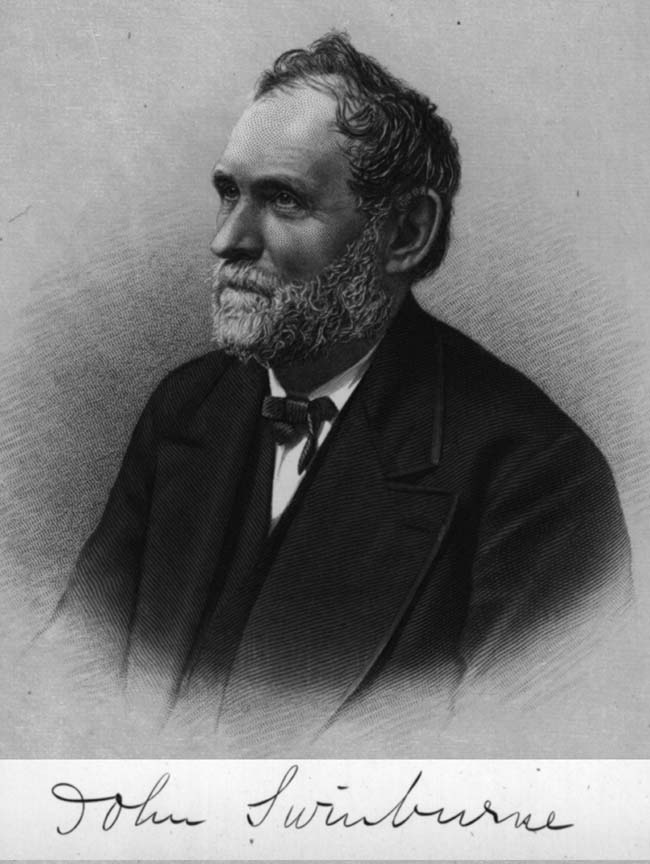
 |
OR INCIDENTS IN THE LIFE OF DR. JOHN SWINBURNE OF ALBANY |
|
|
OR INCIDENTS IN THE LIFE OF DR. JOHN SWINBURNE OF ALBANY |
| Swinburne as an Expert.---Murder by Aconite.---The Young Napoleon.---Now we have You!"---Abortion by Air in Uterine Veins.---A New Discovery.---Wife with Throat cut.---A Preacher tried for Murder.---Expert on Bullet-Wounds.---Not against the Profession. ---What Leading Scientists think. |
THERE are few, if indeed any, physicians in this State who have been summoned to the witness-stand as a medical and scientific expert so often as Dr. John Swinburne, in cases at times involving the most difficult questions known to the profession, and in some instances where not only the liberty, but the lives, of persons depended on the solution of the scientific points involved. In these, neither persuasion, intimidation, social position, nor the opposition of many of the recognized lights in the medical profession, had any weight in preventing him from a fearless and conscientious discharge of that duty he felt he owed the living as well as the dead. He believed that in every instance of death, where the cause was an undecided question, it was a religious duty of science, to whose care the lives and health of the people were intrusted, to ferret it out; and that in so far as the profession failed to discover and reveal the causes of death, where enshrouded in mystery, so far the physician, as a scientist, was a failure; and that the physician who failed, when called upon, to make the proper investigations, and render an unbiased, fearless, and honest verdict, was guilty of a criminal act, and recreant to his high and honorable calling. In many of the cases where he has been called as an expert, he had to encounter a bitter and stubborn opposition from most of the profession; in some of the most important cases having the influence and power of almost the entire profession against him. But a remarkable fact in connection with these investigations has been that circumstances, and the leading men of the profession, both in Europe and this country, demonstrated afterwards that he was correct. For years after graduating, most of his leisure time had been devoted to anatomical research in the dissection of dead bodies; so that, when first called as an expert, he was thoroughly conversant with the anatomy of man, and the nature and effects of mineral and vegetable poisons.
Less than a year after graduating, the young doctor was called to testify in an action for damages before Judge Ira Harris. A man, in passing through a store in Albany, had a box fall on him, injuring the bones of the neck. On the advice of the doctor, the man went to his home in another part of the State, and returned a year afterwards, when his head was so fixed, from the result of these injuries, that he could not turn it to one side or the other without turning the whole body. On the trial, the questions for the medical experts to decide were the injury to and the condition of the neck. On the stand the doctor held that the inflammation following the injury resulted in the seven bones leading from the atlas down to the vertebræ of the chest being anchylosed, and introduced half a dozen specimens analogous to this one to sustain the position assumed. As a result of his testimony in opposition to that of the experts for the defendants, the jury gave a verdict for the amount claimed as damages.
A half-decade in his early career as a physician and surgeon had scarcely passed, when he was suddenly brought prominently before the profession and the world in the trial of John Hendrickson, jun., for the murder of his wife, which was tried before Judge Marvin in the June (1853) term of the oyer and terminer in Albany. The trial lasted three weeks, resulting in the conviction, sentence to death, and final execution, of the prisoner.
Dr. Swinburne had then been in practice less than seven years when this trial took place, which was characterized by Attorney-Gen. Chatfield as a case of more importance than any that had ever occurred in this country, and of as great importance as any that has occurred in the civilized world.
"I do not mean," he said, "to say that one case of murder is any more important than another; but to all its surrounding circumstances, the mystery involved, the novel and stealthy instrument of death, the effect that the introduction of this means of securely murdering would have in increasing crime, the medical and chemical questions which have arisen, --- I repeat, from all these reasons, it is one of greater importance than has ever occurred in this country."
On the 6th of March, 1853, Maria, the wife of John Hendrickson, was found dead in her bed in the town of Bethlehem, Albany County, by her husband, who occupied the bed with her, on his, as he alleged, being awakened by her crowding him. The following day Dr. Swinburne was called by the coroner, Dr. Thomas Smith, to view the body; and the succeeding day, in presence of the coroner and another physician, he held a post-mortem of the remains, and found:---
"Face and anterior portion of the body unusually pale, and apparently bloated, swollen, or puffed, --- the face decidedly so, --- and presenting an almost translucent and watery appearance, though very calm and composed, and no distortion. Eyes and mouth closed; teeth about one-quarter of an inch apart.
"On the inside of the lower lip, a little to one side of the median line, and down near the alveolar process, so that it could not have been injured by the teeth, was a distinct, true ecchymosis as large as a dime; and in this was a cut, of one-quarter of an inch in length, extending through the mucous membrane, and into the tissue beneath. Both were evidently produced at or near the time of death.
"On the posterior part of the body there was extensive suggillation nearly two-thirds of the way round, and extending from the hips to the head. The blood seemed to have all forsaken the anterior, and gravitated to the posterior portion, evidencing its great fluidity.
"Post-mortem rigidity and elasticity were remarkable. The entire voluntary system of muscles was so rigid and elastic as to prevent them from being relaxed The jaws were firmly fixed. The arms and legs would fly back with great force when any attempt was made to flex, extend, or separate them. Upon dissection, the rigidity and elasticity were found to exist only in the muscular structure, and was not, in fact, simple cadaverous rigidity. The neck was so stiff, that, in attempting to bend it, the whole body would be lifted. up. The lips were of a bluish white, and swollen.
"The tongue was extremely white, furred, swollen, and indented on the edges, as if by the teeth. The heart was healthy but empty, except a small clot in the right auricle; lungs healthy and normal (cavas contained about two ounces of dark fluid blood); liver healthy and normal, while the gall-bladder was not more than half full. Spleen, kidneys, and pancreas were healthy and normal. Womb was indurated and enlarged very much, about one inch adhering to the small intestine, while the os was ulcerated; internal cavity twice its normal caliber. The ovaries were enlarged to about twice their normal size, while one of them contained a clot of blood half an inch in diameter near its centre. The blood contained in the above-named organs had so far gravitated to the capillaries of the dependent portion of the body, that during the dissection the hands and instruments were scarcely soiled with blood; while the only blood in these organs was mostly in the cavas, and that in a fluid state.
"The dura mater was more than normally adherent to the skull; the arachnoid presented some opacity near the top of the skull ; the brain was healthy, while upon its surface it was congested, or its veins were full of blood, slightly congested; the base and the spinal cord of the cervical vertebræ were normal and healthy. The peritoneal surface of the stomach and intestines was red and congested. The stomach was contracted to about two inches in diameter (one-third of its normal capacity), and thickened by this contraction to more than twice its normal condition. The mucous membrane was thrown, from the contraction of its muscular coat, into folds, and covered with bloody viscid mucus. This mucous coat was at least five to six inches in diameter; and from this some idea can be formed of its folding or corrugation. The duodenum and all the small intestines were contracted both ways, longitudinally and transversely: its inner coat was highly congested, folded upon itself, and covered with mucus mixed with blood. The jejunum was in a high state of congestion and contraction; its mucous coat covered, like the duodenum, with mucus strongly tinged with blood. The ilium was considerably congested and contracted, but a little less than the jejunum; the mucous coat, covered with viscid matter, and more highly tinged with blood. All these portions of the intestines were contracted to about one-half their normal diameter, while the corrugation was strongly marked.
"The viscid matter had somewhat the appearance of chyle and chyme, while in none of them could there be found anything resembling excrementitious or fecal matter. The cæcum was filled with thin, watery, fecal matter; and the walls in contact with it were considerably congested: in it were lemon, coriander, and other seeds in considerable quantity. The upper part of the colon contained thin and less watery fecal matter than the cæcum; nearer the rectum it became more solid; the lower part was quite dry and hard. The rectum contained fecal matter, dry and hard, as if from extreme costiveness. The bladder was quite healthy and. empty, but contracted to about two inches in diameter, while its mucous coat was thrown into folds, and its muscular coat firm and rigid. Its mucous lining was full four inches in diameter."
The opinion drawn from these facts by Dr. Swinburne was, that the woman did not die a natural death, but that death was induced by the ingestion of poison; while, from the analogy of these post-mortem appearances to a great number of animals poisoned by aconite, he gave the opinion that this was the special agent employed.
Portions of the stomach and intestines were taken to Dr. James H. Salsbury for chemical testing and analysis, who, after testing for all the other poisons, tested for aconitine, and found it.
At the trial Dr. Swinburne was on the witness-stand upwards of two days, and Dr. Salsbury, the chemist, a day and a half, subject to a most skilful cross-examination; for on the breaking-down of their testimony depended the life of the prisoner. To rebut their testimony, and destroy the theory they set forward, that the woman died from the effect of poison, and that that poison was aconite, the defence introduced as expert witnesses, Dr. Barent P. Staats of Albany, who had practised thirty-five years; Dr. Lawrence Reid of Philadelphia, a professional chemist of thirty-five years; and Dr. Ebenezer Emmons of Albany, another chemist. It was a scientific contest between the old practitioners and those of the new school, Dr. Swinburne being only thirty-three years of age, and Dr. Salisbury, twenty-eight.
The counsel for the prisoner, in his argument, attempted to ridicule the two young scientists, terming Swinburne a young Napoleon, and declaring both men without experience, when his witnesses had failed to overthrow their testimony.
During the trial the most intense interest was taken in the case by the public, and more particularly by the medical profession, many of the latter being in attendance in court during the examination of the experts; none of the resident members of the profession undertaking to place their views on the witness-stand in opposition to the two young men, except Drs. Staats and Emmons, although a number of them had positively declared that it was impossible to discover aconite, and that the doctor would fail to maintain his theory; one of these doubting Peters, at whose feet the doctor had sat to learn in his earlier professional training, asserting that the doctor was "going to make a fool of himself, and destroy his prospects for the future." During the examination of Dr. Swinburne and his associate, they gave the nature and results of the various kinds of poisons, and that of aconite in particular, as experimented with by them on cats and dogs, the symptoms and results being such as the post-mortem revealed in the case of Mrs Hendrickson. It was the most difficult of poisons to trace its presence, to be established only by the marks it left behind and by taste. While Dr. Swinburne held that the cause of death was in the stomach, Dr. Staats held that the post-mortem indicated a disease of the brain rather than of the stomach; Dr. Emmons held that he experimented with aconite, and found it acted, not as an astringent, but rather created a swelling; while Dr. Reid, who had, as a professor of chemistry, declared the entire deductions of the two doctors for the prosecution erroneous, was compelled, under the cross-examination, to admit he had read no works on aconite, that he had never seen a case of poisoning from it, had never made experiments with it, and knew of no chemical test that would detect this vegetable poison.
The moral evidence was all circumstantial, the scientific being positive; and on these the jury, after twenty-four hours' deliberation, returned a verdict of guilty. Judge Marvin, in pronouncing sentence, said,
"You employed, for the purpose of accomplishing the deed, a deadly poison, --- an active vegetable poison, peculiar in its character, and difficult of detection; and I greatly fear that he who communicated to you the knowledge of poisoning by aconite, communicated to you also the difficulty of its detection. Relying upon this information, and confident that the instrument of your crime would be forever hidden from human eye, you committed the fearful deed. Empirics and quacks, though they may learn enough to do mischief, and even acquire the requisite knowledge to use as a medicine a deadly poison without always producing fatal results, often fail in acquiring the knowledge which enables men to avoid evil, and to know the force and power of the material which they use.
"I refer thus prominently to the opinion that there are poisons which cannot be detected, because I desire to impress, not only upon you, but upon all, the fact that as science advances---as it unfolds to the student the great storehouse of knowledge, and lets man penetrate into the very arcana of nature --- that as it advances, step by step, it enables its votaries to detect the most subtle poisons, and to trace the very footsteps of crime. Chemists are enabled now, through the wonderful developments of science --- and science detects your crime ---to detect almost all poisons, whether vegetable or metallic; to trace out cases of poisoning, no matter what may be the character of the poison administered, with almost unerring certainty. And it is as dangerous to attempt murder with the most subtle vegetable poison, and as certain to be detected, as if the murder were committed with the dirk or the stiletto. Your case may have its moral effect upon the community in this view of it. The community should understand that the crime of murder cannot be committed in this day of light, in any manner or by any means, without leaving the evidence of guilt; and this evidence always points out unerringly the guilty individual."
Every effort known to the law was resorted to in this case to have the verdict set aside, but failed, both in the Supreme Court and Court of Appeals. These attempts failing, an effort was made for executive interposition, not, as District-Attorney Colvin said in a review of some of the medical witnesses, to save poor Hendrickson, but to save themselves. To their aid they brought Professor Alonzo Clark of New York, who thought Dr. Swinburne abused the confidence with which courts of justice so often compliment men of science, because, without having found the aconite in the blood, stomach, and tissues, he yet ventured to express the opinion that it had been present, --- which Dr. Clark would not have done until after it had been found, although the marks were unmistakable that it had been there, --- but admitted that if the presence of aconite in the blood, stomach, and tissues were conceded, the post-mortem appearances would sustain such admission, ---in other words, that the post-mortem appearances were just such as aconite would produce, --- and then said Mrs. Hendrickson's death was probably caused by urea, a disease generally conceded of long standing, preceded by stupor, and terminating in death after days of sickness. Several other "would-be" authorities were invoked, among them Drs. C. T. Jackson and A. A. Hayes, assayists to the State of Massachusetts, who condemned in toto the scientific processes resorted to by the witnesses for the prosecution.
T. G. Geoghegan, M.D., professor of forensic medicine, Royal College of Surgeons, Ireland, wrote of this case, ---
"Having with much care considered the medical facts in their relative bearings, I have to state that they appear to me to establish clearly that the death of Mrs. Hendrickson was the result of the ingestion of poison, while they afford the strongest presumption that the special substance employed was aconite.
"The absence of any sign of disease, or cause of obstructed venous circulation in the adjacent organs, the empty state of the stomach, and the early performance of the autopsy, sufficiently attest that the appearances in the alimentary canal were not of a pseudo-morbid or cadaveric character. The foregoing considerations, in my judgment, clearly establish that Mrs. Hendrickson's death was the result of the ingestion of a narcotic, acrid poison.
"As respects the special substance employed, the analysis (when collated with the maximum duration of deceased's illness) shows that it was not of a mineral kind. Animal poison is obviously out of the question.
"It therefore but remains to consider what vegetable matters are capable of causing death in four hours; of leaving behind, in the stomach and small intestines, marked signs of mucous irritation; of producing, when applied to the tongue, an acrid taste, followed, after an interval of some minutes, by a sensation of numbness, and when administered, even under unfavorable conditions, to a cat, giving rise to choking efforts to swallow and vomit, muscular twitches, prostration, and well-marked stupor. I know of none but aconite, or its active principle, aconitine.
"The mode in which the case was investigated by the medical and legal authorities reflects much credit on both."
The trial of this cause was most ably conducted for the prisoner by Henry G. Wheaton and William J. Hadley; the effort of Mr. Wheaton being conceded a herculean intellectual and legal defence for his client, and it almost r completely prostrated the able jurist. As he did but little professional work after this trial, it was considered that the effort then made was too great a physical strain, and more than nature could endure.
When an application was made to Gov. Seymour for a stay of the execution of the sentence of death, that official, always desirous of according justice to all, and exercising mercy where it was deemed deserving, asked Dr. Swinburne to write a letter in favor of the stay. To this the doctor replied, "However much I sympathize with the unfortunate man and his relatives, I cannot consistently write such a letter. It would be construed as my doubting the position I took on the trial, which I do not for a moment. You are governor of the State, and must exercise your own judgment in the matter. My testimony is before you and the world for criticism, and you must act without any influence from me." An incident which occurred in the executive chamber that evening convinced the governor of the prisoner's guilt, and caused him to refuse the application.
Years after this trial, Judge Marvin said, "At one time I had doubts of the matter; but these were all dispelled at the trial, and by subsequent events, and I was satisfied before the close that the charge was true and the prisoner guilty." The charge of the judge was an able and impartial one, in which every opportunity to throw a doubt in favor of the prisoner was availed. It was forcibly impressed on the jury that the prisoner was not to be held responsible because the expert witnesses for the defence failed to assign a cause for death, and that the prisoner was not called upon to account for the death.
The termination of this suit resulted in elevating the two young men to a very high position as medical scientist, and provoking natural professional jealousy.
In 1859, Dr. Swinburne, as an expert, made an announcement for which there was no precedent, and was met by one of the leading members of the profession in Albany with the exclamation, "Now we have you!" This case was reported in the "Medical and Surgical Reporter" in 1859. On the 26th of March of that year an attempt at abortion was made by a Mrs. Marston on a young woman at the house No. 40 Franklin Street, Albany, resulting in the death of the patient. On the following day Dr. Swinburne, in the presence of two physicians and two of his students, held a post-mortem examination of the body fourteen hours after death. He found the external of the body natural but very pallid. On cutting through the integuments into the cellular tissues, air was observed to issue from the divided veins in the form of a frothy fluid. On exposing the heart, its right cavities were found to be greatly distended with a spumous mixture of blood and air, and slight compression of the heart was seen to force out bubbles of air from the divided intercostal veins. A thorough examination showed that the jugulars, and the veins emptying into them, even to the small vessels of the brain, were all distended with air. On examining the membranes and their contents, the internal surface of the womb exhibited slight softening of the tissues, several abrasions (evidently not natural), a perforation communicating directly with the uterine sinuses about two inches from the cervix and in the right lateroposterior region: this opening communicated directly with the veins of the broad ligament, and thus with the ascending cava. The os and cervix were open to the extent of two lines, and filled with bloody mucus. The post-mortem appearances, and the description of the young woman's death, the doctor decided could not be accounted for on any other hypothesis than that of air in the veins. Death occurred while the instrument was in the uterus, and was immediate, for the woman mistook death for syncope.
The point of interest in the case was the manner in which the air was introduced. Several deaths had been reported from ingress of air into the large veins of the neck; and he held that even the subclavian was liable to the same thing under favoring circumstances, such as tension upon the vein from the subject's position during surgical operations, or by traction upon a tumor during excision, the vein being temporarily canalized, or prevented from collapsing. Under all the circumstances, he maintained, this canalization of a vein, or its conversion into a rigid tube, is the indispensable condition requisite for the intrusion of air. But this condition, he held, was inadmissible in the case of the uterine veins and ascending cava, from the nature of physical laws which govern the movements of the fluids in the body no less than in organic matter. Under all the circumstances, he was compelled to accept the presumption that the abortionist forcibly inflated the entire venous system by means of the catheter introduced into the uterus, perforating its parietes, and in contact with the lacerated vessels of that organ. The fact of forcible inflation was incapable of proof, there being no third person present at the time of death, and hence no witness. Absolute certainty was only to be arrived at upon the confession of the guilty woman herself.
This was another step in the development of science ; and, as its precedent was not in the books, it was necessarily considered erroneous, and an innovation not to be tolerated, coming as it did from a comparatively young physician; and, as soon as one opponent raised his voice in opposition, there were a large number of others to follow in his wake, just as a drove of sheep would follow a leader over a precipice with out stopping to look where they were going.
But again the young doctor's views and decisions were proven correct by the confession of the woman herself. She had been arrested, tried, convicted, sentenced, and imprisoned in less than four weeks. While in prison, she made a application for pardon to Gov. Morgan, maintaining innocence of the forcible inflation. On her application being refused, she finally confessed to the governor's secretary, Lockwood L. Doty, that she was guilty; and that she blew the air in, hoping to get it between the membranes and the uterus, to the end that it might effect abortion; and that Dr. Swinburne was correct. Thus another scientific victory was won by him in the interests of virtue and the people.(3)
In 1862 he was again employed as an expert in the celebrated trial of the Rev. Henry Budge for the murder of his wife, and again demonstrated that the hours of hardship endured by him as a student, and his close application to study after being admitted to practice, had not been in vain, but developed a mind well stored with medical and anatomical lore. On the morning of Dec. 11, 1859, Priscilla, wife of the Rev. Henry Budge of Lyons Falls, Lewis County, was found dead in her bed, with her throat cut. The same day a coroner's inquest was held, and a verdict of "death by suicide" rendered. Afterwards whispers of domestic differences aroused suspicion that foul play had caused the death of Mrs. Budge, and four months subsequently the body was exhumed by order of the coroner; and, at his solicitation, Dr. Swinburne, assisted by Dr. Porter, held an autopsy. The decision arrived at on this second inquest, from what was revealed at the autopsy, and the evidence adduced before the coroner, convinced the doctor that Mrs. Budge did not meet her death by her own hands, and that the wound in her throat was inflicted after death, or when nearly dead; and, on these developments and deductions, Mr. Budge was held on a charge of murder. The post-mortem revealed an extensive cut from three and a half inches below the lobe of the left ear to three and a quarter inches below the lobe of the right ear, four and a half inches below the chin, the curved length of the wound being five and one-half inches. The depth of the cut was two inches, back to the vertebræ cutting through the periosteum and into the osseous matter of the fifth vertebra, and also shaving off a lateral portion of the transverse process of this vertebra. There was distinct ecchymosis of the tongue on either side, at points opposite the molar teeth. On the left side this covered a surface of one inch in length, and half an inch in a lateral direction. On the right, it was one and a half inches in length; on the upper and wider part, near the base, seven-eighths of an inch, diminishing towards the anterior portion, where it was one-half an inch, and extending through the mass of the tongue, and visible from either side, as was demonstrated by making incisions through its substance, and subsequently soaking it in water. The tip of the tongue was somewhat discolored, but not ecchymosed. The oesophagus, for the space of about two inches near and below the root of the tongue, was of abnormally red or maroon color. The right lung was congested, and engorged with blood, and apoplectic; pleuratic adhesion slight; otherwise healthy. The heart was entirely sound in every particular, while in the chest there was bloody serum in both cavities, --- on the left side five ounces, and on the right eight ounces. The heart and large vessels were empty, while the capillaries of the extremities and dependent portion of the body were full of blood, and all the muscles retained their juicy and florid appearance. The right lung continued to discharge bloody serum, while the microscope distinctly revealed the presence of diffused and circumscribed apoplexy, as well as engorgement of the tissues. The left lung, when placed in a jar of fluid, presented a large amount of débris of broken-down blood in the dependent portion, while the fluid was very much discolored. There was no appearance of disease in the brain; and all the other organs were found healthy, and free from congestion.
Taking these results and the facts as elicited at the first coroner's inquest,---that the bedclothes were undisturbed and carefully tucked in at the foot, and she with her eyes and mouth closed as if asleep; the coverlids carefully turned down on the left side to about the breast, while on the right they were turned down about twelve inches farther; that there were no spurts or spatters of blood on the anterior par of the body, nightdress, or clothing below the cut, nor on the face and neck above the cut, except a slight stain on the under side of the chin, as if some bloody thing had been wiped against it; no blood-stains on the head-board, pillows, bedstead, clothes, walls, or otherwise, except about a quart mug full in the feather-bed, forming a mass of bloody feathers, and a small amount on the pillow, these circumstances were conclusive proof of themselves to satisfy the doctor that the woman had been murdered. This opinion was still further confirmed by the position in which the woman lay, ---on her back, head resting on the pillow and inclined back, with only slight blood-stains on the right cheek and chin, as though ,something bloody had touched them, and no blood on the hands except on the fingers of the right hand, while there was none between the fingers.
The pregnant facts that the wound on the neck leaked from three to six ounces of fluid blood during its cleansing, so that it had to be stuffed with cotton batting, sewed up, compressed, and bandaged, to keep it from bleeding; and that it still continued to ooze blood through the side of the compress; and that four months afterwards, when the dissection was made, the cotton batting, when removed, was saturated with blood, and the parts under the neck also wet with blood,---were held by the doctor to be significant. The position of the body; the character of the cut; the almost bloodless condition of the surroundings; the entire absence of spurts and spatters of blood; the stains of blood from a bloody hand on the pillow and face, when her hands were not bloody, and a spot of blood ten or twelve inches in size on the sheet, and tucked under; the entire absence of a condition in the bed indicative of convulsions (a condition which always accompanies death by hemorrhage) ; the small amount of blood lost (not exceeding a quart) ; the condition of the lungs at the time of death; and other facts, as presented, -convinced the doctor that Mrs. Budge was dead, or nearly so, when her throat was cut, and that after death the cutting was done to cover up the crime of murder. The commencement of this cut, he held, was quite too abrupt for a wound made with the blunt point of a razor; that the extent and character of the tissue cut were quite too great for a delicate woman with one stroke of a razor to complete, and that, too, in a position where the muscular power is so materially impeded. He also held that the position of the blood-stains, and the direction taken by the blood, where it could flow only by gravity when leaving the body, taking into consideration the position of the head (particularly that of a female), rendered the idea of suicide to him quite preposterous, not to say ridiculous.
At the time of her death, as testified by witnesses, a razor was found lying under the arm, nearer the wrist than the elbow, two-thirds open; the blade uncovered, edge lying towards her. Two-thirds of the edge in length, and one-third in depth, or two-ninths of the razor-blade, was bloody. From the position in which the razor was found, and its nearly bloodless condition, Dr. Swinburne held that this was not the instrument with which the cutting was done. If it were, the cut being very extensive and involving the bone, the instrument would have been covered with blood, and its edge probably nicked.
At the second inquest Dr. Swinburne was on the witness-stand twenty-two consecutive hours; and at the conclusion of his testimony the verdict of the first inquest of "death by suicide" was reversed, and Budge committed on a charge of murder.
There were but three cases known to the profession, or recorded in the books, prior to this one, in English or American works, which had any bearing on this case; and in these three cases the evidence was suppressed for political and social considerations, all the parties being titled dignitaries in Great Britain. But, notwithstanding this absence of precedents, the repeated threats and intimidation made toward all parties who would dare to take part in the prosecution, and of the press if they published the proceedings, and the almost unanimous opposition of the profession, the doctor, still a comparatively young practitioner, held to his theory "that Mrs. Budge was murdered;" and the abuse heaped upon him was as powerless to deter him from the discharge of what he conceived to be his duty as would be an attempt to blow down the fortress of Gibraltar with a popgun.
After Budge's first commitment, he was taken before Judge Bacon at Utica on a writ of habeas corpus, and released on the ground that the second inquest was illegal. A month subsequent to this, his case was presented to the grand jury of Lewis County, eleven of whom were in favor of indicting. In September, 1860, his case was again presented to the grand jury of Lewis County, and an indictment of murder found against Budge. In 1861 he was tried before Judge Allen at Rome, Oneida County, when Dr. Swinburne was on the stand for several hours as the most prominent witness for the people, and was sustained by such eminent pathologists and scientists as Professors Valentine Mott of New York, and J. McNaughton of Albany, and others. During the examination, one of the witnesses (Professor Mott), who, in answer to a question by one of the counsel, said he was the only living student of Sir Astley Cooper, was interrupted by the judge while explaining in detail the action of the heart and lungs after the cutting of the pneumogastric nerves. Professor Mott testified that the only work he had ever read on the subject was Beck's, and that in that work it was laid down that instant death followed the cutting of the gastric nerve; and on this authority death was immediate, with perhaps one long respiration. On the professor making this statement, Mr. Conkling moved for the discharge of the prisoner; the judge holding that all the circumstances made out a strong case for judicial investigation, but that from time to time in the trial, qualifying circumstances had been proved, tending to show how the blood might have appeared as it did, how it might have got into the lungs without asphyxia. "It is not for me to say," he added, "that the case shall close: there are circumstances that might be forcibly urged to the jury; but it strikes me, that, as the case stands, it is only a balance of probabilities, in which it would be unsafe to convict; and, in view of the fact that these doubts have arisen, the prisoner is entitled to the benefit of them, and should be released." The case was then sent to the jury pro forma, and by direction of the judge the prisoner was acquitted.
The trial, as far as it proceeded, was a bitterly contested one, and made almost as prominent because of the array of counsel engaged as by the nature of the case. Among the most prominent of the scientific men to oppose the position of Dr. Swinburne was Professor Alonzo Clark, professor of pathology and practice of medicine in a prominent New-York college, and who boasted of three years' standing in Europe as a professor. This eminent gentleman subsequently presented a paper before the New-York Academy of Medicine on this case. Dr. Swinburne was present, by invitation of the members, to discuss the matter; but when his name was mentioned by Dr. Griscom, with the request that he be invited to participate in the discussion, objection was raised by Dr. Detmold, and discussion suppressed, a law of the academy requiring unanimous consent for a non-member to take part in debate. Years afterwards, Dr. Detmold, in explaining to Dr. Swinburne this act of professional discourtesy, said he did it at the instance of Professor Clark, and because he promised to do so.
When the case was so abruptly brought to a close, Dr. Mott, who had been interrupted, it was said, turning to Judge Allen, remarked sotto voce, "I would like to explain." --- "It is too late now," said the judge. ---"But I do not believe that poor woman ever killed herself," said the doctor. --"Neither do I," replied his honor.
The Rome "Sentinel," in commenting on the trial, said, --
"Those who heard the evidence in the Budge trial throughout, can easily see that the weak points of that case lay at the same spot. The village doctor, who was first called in to see the dead body of Mrs. Budge, did not seem to dream that a woman's head could be half cut off by anybody but herself. He actually did not suppose that the coroner would need him as a witness, much less that a judicial investigation might subsequently need his evidence. Instead of taking out his note-book, and carefully noting on the spot every atom of fact in regard to the spots of blood, the quantity, the position of the body, of the marks of blood, and every thing else which could throw a light upon the circumstance of the cutting, this doctor seems to have contented himself with poking cotton batting into the wound, and sewing it up."
As a sequel to this trial, the Rev. Henry Budge instituted an action for libel against the Hon. Caleb Lyon for slander, placing his damages at twenty thousand dollars. The complaint alleged the printing and circulating of the libel in which Lyon charged Budge in verse with the murder of his wife, criminal intercourse with other women, and other charges, which, the plaintiff alleged, held him up to ridicule, and injured his good name and character. In the trial of this case, the array of counsel was formidable, and consisted of the Hons. Messrs. Conkling, Kearnen, Doolittle, and Earle for the defendant, and the Hon. Judge Lyman Tremaine for the plaintiff. The only expert for the defendant was Dr. John Swinburne. In this case all the evidence in the murder trial was introduced, the only defence made by Lyon being justification as to the charge of murder, and nothing as to the other criminal charges. The trial occupied three weeks. Judge Mullen, in summoning up the case, charged the jury, among other things, that "the fact that if the defendant, at the time of publication, had reason, from the facts and circumstances existing at or before the publication, to believe the plaintiff was guilty of the acts charged, he would not be thereby relieved from liability for the damages which legitimately and naturally resulted from the publication, but it would relieve him from any liability which the existence of actual malice would justify, and require the jury to give. If the justification is proved, then the plaintiff is entitled to like damages for the injury sustained by reason of the other charges against him in the libel."
Notwithstanding this charge, and the legal acumen engaged in the prosecution of this libel suit, the jury gave the plaintiff a verdict of one hundred dollars, instead of twenty thousand dollars, as asked, --- virtually, it seems, a verdict declaring him guilty of the charge, where justification was pleaded, and a sufficient sum to repair the damage to hi character by the other charges, in which no defence was made. Among the expert witnesses for the Rev. Mr. Budge were Drs. Coventry, Hogeboom, and Thomas.
A significant incident in connection with these trials was stated by a United-States senator, who said, "When the question of confirming Hon. Caleb Lyon to a territorial governorship was being considered, his confirmation was attempted to be defeated because of his connection with these trials as proving him unworthy the trust. The late Charles Sumner, "a profound jurist and deep thinker, was in possession of a. review of the case published by Dr. Swinburne, and from this review demonstrated the grounds taken by Mr. Lyon as honorable in every particular; and on his construction of the facts the appointment was confirmed."
In the "Proceedings of the Medical Society of the State of New-York, 1862," is a review of this interesting case, covering a hundred pages. In this review is given a synopsis of the evidence, both scientific and moral; the theory and arguments of Professor Clark and Dr. Swinburne, with a full account of the latter's views, and the grounds on which his deductions were made, and a reply to the theories of Professor Clark,(4) with a number of cuts showing how the cutting could be done by another than the unfortunate woman; as well as a report of fifteen cases of suicidal deaths by cutting carotid arteries, the opinions of leading scientists, and other interesting scientific matter.
Among the eminent men whose attention was drawn to this case, and who coincided with the views of Dr. Swinburne, were Alfred S. Taylor, M.D., professor of medical jurisprudence, Guy's Hospital, London, and author of "Taylor on Poisons" and "Taylor's Medical Jurisprudence;" T. G. Geoghegan, M.D., professor of medical jurisprudence, Royal, College Surgeons, Dublin, Ireland; Charles A. Lee, M.D., professor of medical jurisprudence, editor of Guy's "Forensic Medicine," etc.; S. D. Gross, M.D., professor of surgery, Jefferson Medical College, Philadelphia, and author of Gross on Surgery;" S. Weir Mitchell, M.D., the celebrated scientist of Philadelphia; Alfred Stille, M.D., Philadelphia, author of Wharton and Stille's work on medical jurisprudence; J. G. Wormley, Columbus, O., professor of microscopic poisons. Because of the importance of this case, and the prominent positions held by the writers, at the head of their profession, their letters are given in full : ---
CHEMICAL LABORATORY, GUY'S HOSPITAL,
June 30, 1860.DEAR SIR, - I have great pleasure in sending you my opinion of the case of Mrs. B. of G. Dr. Hendee left the manuscripts and drawing at my house during my absence; so that I had an opportunity of reading it, and writing out my views, without having any communication with him. I can perceive that it is a case of great importance. It somewhat resembles that of Lord William Russell, murdered by Courvoisier in London, in 1840, and the case which I have reported under the name of Harrington, in my "Medical Jurisprudence," 6th ed. (English), p. 281.
I am, dear sir, yours faithfully,
ALFRED S. TAYLOR.
DR. SWINBURNE.
* * * [REPORT OF THE CASE OF MRS. B. OF G.] I have read a report of the case of Mrs. B. of G., who died Dec. 10, 1859. This report, with a drawing of position of deceased in bed, has been furnished to me by Dr. J. Swinburne of Albany.
From these documents it appears to me, ---
1st, That the wound in the throat must have been inflicted while the deceased was lying on her back; i.e., in the recumbent posture. There was no blood on the anterior part of the neck below the cut, and there was no blood on the anterior part of the body or nightdress. Considering the blood-vessels divided by the wound in the neck, the fore part of the person and dress, if deceased were sitting up at the time of its infliction, could not have escaped receiving a considerable amount of blood.
The description of the flow of blood being chiefly on each side of the neck is in accordance with the view that the wound was inflicted while deceased was on her back.
The head being deeply embedded in the pillow is also in favor of this view, since, had deceased sat up at the time of infliction, I do not believe that by any accidental fall such an embedding of the head in the pillow could have taken place; and, further, it is not conceivable that the head should have been thrown back as the result of an accidental fall.
2d, Taking the depth, extent, and direction of this wound in the neck, it is not such a wound as a person could inflict on himself or herself while lying on the back in a recumbent posture.
The large blood-vessels on the back side of the neck were divided, assuming that a suicide might have power, after dividing the carotids and jugulars on one side, to carry a razor through the trachea and oesophagus, as well as through the blood-vessels, on the other side.
I am decidedly of the opinion that there would not have been the power to shave off the left transverse process of the fifth cervical vertebra, or penetrate the osseous structure. In the recumbent posture, such an act would require the exercise of a great muscular force at a very great disadvantage in the position of the right arm for using the required force.
Assuming that the incision was made from left to right, the fifth vertebra must have been implicated in the incision before the weapon was carried to the right side at all; and yet it is stated that on the right side of the neck there was a cut in the skin one-quarter of an inch farther than the tissues wounded.
This fact proves to my mind a deliberate withdrawal of the weapon, quite inconsistent with the fact that the blood-vessels on both sides of the neck had been divided, and the periosteum and osseous structure of the fifth cervical vertebra had been cut or penetrated.
3d, On the hypothesis of suicide, a wound of this extent and depth must have been inflicted with tremendous force and with great rapidity. There must have been a sudden and copious loss of blood from the divided blood-vessels of the two sides of the neck.
How came the right hand, only slightly bent, to be in a position by the side of the body, the weapon not grasped within it, but lying on the bed six or eight inches from the wrist? No muscular power would, in my judgment, have remained to enable the deceased to have placed her arm in this position after the infliction of such a wound in the recumbent posture ; and there is no conceivable accident by which it could have assumed this posture, unless the body had been interfered with before it was seen by the medical attendant. The weapon, on the view of suicide, should have been in the grasp of the hand, considering the enormous muscular power which must have been used in an act of cutting which involved the body of one of the vertebra) : if not in the grasp, the part by which the weapon was held should have been close to the palm.
The right hand presented only on the palmar surface a light streak of blood: the left hand is not described as having any blood upon it. Had the right hand of deceased inflicted such a wound as is described, the back of the hand, as well as probably a part of the palmar surface, would have been covered with blood. The presence of a light streak only on the second row of the phalanges of the palm is inexplicable on the presumption of suicide. The weapon must have been grasped and held firmly in the right hand: hence the palmar surface might have escaped, but the dorsal surface, in my opinion, could not escape, receiving some blood from the vessels divided on the left side, and subsequently from those divided on the right side.
The spot of blood twelve or fourteen inches in length, etc., on the bedclothes, and the spots on the pillow to the right, have no communication with the main source of hemorrhage: they must have been produced subsequently to the wound in the neck. There is no conceivable theory by which the deceased could have produced them, or that they could have resulted from any act on her part, on the supposition of suicide.
Taking the attitude of the body, the nature of the wound, and the medical circumstances in reference to the position of the stains of blood and the weapon, I am of opinion that this wound was not inflicted by deceased on herself, but that it must+ have been inflicted by some other person.
A case somewhat similar occurred to me some years since. The assassin, in this case, cut the throat of a woman while asleep. He cut off one of the cotton strings of her night-cap: this was found on the floor. The microscope showed fibres of cotton in the coagulated blood on the razor. The head of deceased was pressed backward on the pillow, and it would appear as if the chin had been raised, or pulled upward, at the time of the act of cutting.
ALFRED S. TAYLOR,
Professor of medical jurisprudence
and chemistry in Guy' s Hospital15 ST. JAMES TERRACE, REGENT'S PARE,
June 29, 1860.* * * [LETTER FROM PROFESSOR T. G. GEOHEGAN] UPPER MARION ST., DUBLIN,
Sept. 10, 1860.MY DEAR SIR, --- I herewith apologize for having so long left your letter unanswered.
I have read your well-drawn report with great interest, and feel quite disposed to concur in the general conclusions you have drawn.
The autopsy was very well conducted. I find it impossible to understand how the division of the great vessels should not have discolored more of the adjacent surrounding surfaces with blood, unless by some such state of the circulation as you suggest, and which latter would explain the result.
The lungs also seem to have been congested, ---a condition not to be expected in death from hemorrhage.
I infer, however, that what was found in the pleura was serum strongly imbued with blood, rather than pure blood, as I have never seen the latter except with a wound. Whilst the bloody fluid is not unusual as the result of the process of putrefaction, especially under the influences of gases accumulated in the blood-vessels, and thus causing exudation; the absence, also, of more than slight stains of blood on the hand,---the division of the transverse process of the cervical vertebræ, and the condition of the tongue, are presumptive of homicide. My best wishes.
Yours very truly,
T.G. GEOGHEGAN
DR. JOHN SWINBURNE, Albany, N.Y.
After transmitting to Dr. Geoghegan some tables embodying the results of experiments, he sends in reply the following able and comprehensive opinion:
DUBLIN, Dec. 18, 1860. DEAR DR. SWINBURNE,---I feel much obliged by your attention in sending me the report of the inquest in Mrs. Budge's case, and the valuable tables embodying the result of your experiments. Some time since, I wrote to you, giving you, I think, a sketch of my views of the matter, the date furnished by yourself.
I quite coincide with you as to the extreme improbability of suicide having been carried out in the present instance; and this for a variety of reasons, which you appear to have estimated very correctly.
I cannot conceive, in the first place, that had the division of the great vessels been the result of suicide, the circulation being ordinarily vigorous, the neighboring objects---as the head of the bed, and walls, bedclothes (i.e., pillows), and doubtless the deceased's face and upper part of the neck---could have escaped being copiously sprinkled with blood, and that part of these marks should have the dotted and interrupted character of an arterial jet; secondly, that the lungs should have been exsanguined, or nearly so, instead of forming characters which lead to the legitimate inference that they were congested at the time of death. The condition of the razor-blade, unstained by blood in a great part of its breadth, seems strongly also to militate against self-murder. I should have further expected that in case of suicide followed by rapid death, and where the extent and character of the injury would indicate a most determined effort, the weapon would have been found grasped in the hand, as it most usually is. Again : suicide by cutting the throat in the recumbent position is most unusual. Nor have I ever seen or read of a case of suicide where a portion of the bone was sliced off. The seat of the wound is unusual for a suicide, being commonly at one side more than the other, and generally above the os hyoides. These latter, however, are not decisive criteria. Lastly, the injuries of the tongue are very significant.
With best wishes, yours very truly,
T. G. GEOGHEGAN.
DR. J. SWINBURNE, Albany.
* * * [LETTER FROM DR. CHARLES A. LEE.] PEEKSKILL, Sept. 28, 1860. DR. CHARLES H. PORTER.
My Dear Sir, --- I am much obliged to you for the opportunity of reading your "report of the case of Mrs. B., who died under suspicious circumstances." I have carefully read it, and given it much consideration.
It is due to you to say that it is a most ingenious, judicious, and satisfactory exposé of the case.
The conclusions at which you arrive appear to me sound and irresistible, and entirely borne out by the facts. There is not a shadow of doubt in my mind that the incision was inflicted after death, and there is as little doubt that death resulted from suffocation.
The depth and extent of the wound argue a determination of purpose, and strength of wrist, possessed by very few suicides, especially females ; and I do not believe it possible that such an incision could have been inflicted by the deceased.
The case, in my judgment, could hardly be strengthened by any collateral circumstances.
If it should appear that the parties lived together unhappily, it would go far with a jury to corroborate your theory.
The supposition of suicide I should not suppose could be entertained at all by any person. But, even under such (insanity) circumstances, I should decidedly coincide with you in the opinions you have expressed in regard to the cause of death; for all the facts point irresistibly to the agency of another hand. I have nowhere read a more interesting case, or one which has been more ably or logically elucidated, where the reasoning throughout is so thoroughly based on science, and established principles of anatomy, physiology, and pathology.
I trust you will allow its publication in some of our medical journals, as it is too important to be lost to science.
Allow me to thank you again for your kindness in sending me your report of the case.
I am very truly yours, etc.,
CHAS. A. LEE.
* * * [LETTER FROM DR. S. D. GROSS, PROFESSOR OF SURGERY.] PHILADELPHIA, Jan. 31, 1882. DEAR DOCTOR, -You ask me in regard to the probable manner of the death of Mrs. Budge, --- whether, in my judgment, it was caused by her own act, or by the act of some one else. After a careful examination of the testimony submitted to me, I have unhesitatingly come to the conclusion that she was destroyed, not by her own hands, but by those of another person. My reasons for this conclusion are the following ---
1st, It is impossible for any person to cut the large vessels of the neck without being inundated with blood. If Mrs. Budge had been alive at the moment her neck was cut, the blood of the carotid arteries would have spurted about in every direction, soiling not only the bed and body clothes, but also the floor, and probably even the wall and ceiling of the apartment. I assume that this circumstance alone is amply sufficient to establish the fact that she had ceased to breathe when her throat was cut. As a surgeon, I cannot conceive of the possibility of such a frightful wound being inflicted without the occurrence of the most profuse hemorrhage, even if life had been destroyed in a few seconds; and the effects of this hemorrhage would unquestionably have exhibited themselves m the manner above indicated. Any one who has ever seen a chicken's head severed knows how long the blood continues to flow in a full stream from the carotid arteries.
2d, If Mrs. Budge had herself inflicted the wound, her hand, face, and chest would necessarily have been covered with blood; which, however, it appears, was not the case.
3d, From the fact that the woman was comparatively thin and feeble, I infer that she could not (even if we suppose she possessed most extraordinary will and determination) have wielded the razor with which the wound is said to have been inflicted, in such a manner and with such force as to shave off the left transverse process of the fifth cervical vertebra, or to divide all the structures in front of the neck, even down to the scalenus muscle. Such a wound as Mrs. Budge's is seldom inflicted by the most robust and courageous suicide.
4th, From the position of the razor, and from the almost entire absence of blood upon it, to say nothing of the peculiar shape of the wound, I cannot suppose that it was the weapon. used to kill Mrs. Budge.
The above facts and considerations are quite sufficient for my purpose. I leave entirely out of the question all the minor points of the case. They establish most irrefragably, in my judgment, the conclusion that Mrs. Budge's neck was not cut until she had ceased to breathe, and consequently that she was not her own murderer.
How she was killed I will not pretend to affirm; but the probability suggests itself to my mind that the act was effected by manual strangulation, and that her throat was cut immediately after. This idea derives plausibility from some of the circumstances revealed during the dissection of the body.
I am, dear doctor, very truly and respectfully
Your friend and obedient servant,
S. D. GROSS.
DR. JOHN SWINBURNE.
* * * PHILADELPHIA, Dec. 8, 1862. JOHN SWINBURNE, M.D.
Dear Sir, --- I have received a copy of "A Review of the People against Rev. Henry Budge," for which I presume that am indebted to you. Its details have interested me very much, and they appear to me to sustain your conclusions. Will you permit me to call your attention to a point which does not seem to me to have attracted your notice? On p. 2 it is stated that "a razor was lying under the arm, two-thirds open." Would it have been possible for a suicide to inflict the wounds described in the evidence with a razor only two-thirds open? Or, supposing that those wounds were inflicted by the razor bent backwards as it is used in shaving, could it have been partially closed by a suicide who had inflicted the wounds described in the evidence? If these questions are answered in the negative, as I think they should be, Mrs. Budge was not a suicide.
I am, very respectfully, your obedient servant,
ALFRED STILLE.
* * * COLUMBUS, O., Sept. 8, 1862. DR. SWINBURNE.
My Dear Sir, --- I am under many obligations for your kindness in sending me your review of the Budge case. I have read it with very great interest, and fully concur in our opinion that it was not a case of suicide.
Very truly yours,
T. G. WORMLEY.
* * * MY DEAR DOCTOR, ---Some one, you I suppose, sent me your wonderful analysis of the Budge case. I read it with he utmost care, and think you have made out a clear case.
As a physiologist, I can find no fault with your biological criticism, which appears to me to be just and well founded. Indeed, I am at a loss to understand how any one can or could take any view of the case but that which you have defended with a logic so convincing as to leave only room for expressions of admiration on the part of any one fitted to follow your argument.
You have added considerably to our knowledge of these cases; and thus much, at least, of good has come of it.
With many thanks, I am very truly yours,
S. WEIR MITCHELL.
1226 Walnut Street.
DR. SWINBURNE.
Nearly twenty years afterwards Budge is heard of in the West, where he was in the ministry, and a great favorite "with certain young ladies." Here he was recognized by a lady from Lowville, who disclosed the affair. Budge called a meeting of the church to explain the matter. "The explanation made the congregation believers in the crime," wrote a prominent physician, "and he was forthwith dismissed. From there he went to Buchanan, and then to Byron, O. Here," he writes, "comes in a sad picture. A Dr. Parsons and his wife were members of the church, and Budge went to visit them. He became more interested with a daughter than with her sick mother. At this point a rumor came that Budge had a wife in Canada. Dr. Parsons warned Budge never to enter his house again. Mrs. Parsons died, and Carrie, the daughter, became insane. They all believe that distraction in love caused this melancholy result." This moral evidence is a circumstance to strengthen the medical position taken by Dr. Swinburne.
The positions assumed in these three novel, unprecedented, and interesting cases, established him, in the judgment of the legal and advanced medical profession, as among the most reliable of medico-legal experts, and resulted in his frequent calls to the witness-stand. Among the other celebrated cases in which he was made prominent was one where the questions raised were entirely different from the cases cited.
On the 5th of June, 1878, in Northumberland, Saratoga County, Mrs. Jesse Billings was shot while sitting in front of her window, and instantly killed, the ball being fired from the outside, and passing through a pane of glass. She died instantly from the effects of the bullet. The bullet entered on the left side of the head, but did not pass entirely through the skull. On the right side a wound was found over the mastoid portion about two inches in length, undoubtedly, as the experts believed, made by a piece of bone cutting its way outwards. At the bottom of this wound, lodged in the upper surface of the petrous portion where it joins the squamous, lay the bullet. In its course, the ball had, in addition to passing through the glass, cut through the facia of the temporal muscles, the superficial facia, and the skin. As the result of the coroner's inquest, her husband, Jesse Billings, jun., was arrested, and held to await the action of the grand jury, by whom he was indicted. He was tried for the murder at the October (1878) term of the oyer and terminer, the trial resulting in a disagreement of the jury, the evidence being exclusively circumstantial and expert testimony. Not being fully satisfied with the autopsy first made, said an expert, in a pamphlet reviewing the case, the people's counsel had the body exhumed, and requested Dr. John Swinburne of Albany to make a further examination of the head. The cause for this act was the claim, on the part of the defence in the first trial, that all the lead fired at the murdered woman was found by the physicians holding the first autopsy, and the people wished to know whether more lead did not remain in the skull. Dr. Swinburne removed the head from the trunk, taking only the bones of the skull, sawing through the external angular processes and the anterior roots of the zygomatic arches. After maceration the skull was cleaned, careful search being made for any particles of lead (none, however, being found), and the broken bones wired together. The skull so prepared was put one side, and produced in evidence at the second trial, which took place in April, 1880. Two important points were raised; i.e., as to the foot-marks found leading from the house to an old unused well, and whether the shooting was done with an old Ballard carbine, found in the well, and which three witnesses swore they believed belonged to Billings, and that they believed it was the same one that had been lying around his store, but which could not be found until the officers drew it from the well. The claim of the defence was, that the bullet was a smaller ball than a "44," and its full weight less than two hundred and twenty grains (about fifty-eight grains) ; that in consequence the Ballard carbine could not have been the gun from which the shot was fired, for it not only called for a "44" ball, but would throw a bullet with such force that it necessarily must have gone entirely through the head; and that the weapon with which the wound was inflicted was a pistol. One of the experts for the defence, Professor Jacob S. Mosher of Albany, did, by actual measurement, fix the size of the ball. Dr. Moslier found what he considered to be, and swore to as, the "lands and grooves," and so distinctly that he could accurately measure them. Dr. Mosher did thus measure, and, when announcing the result, gave first of all the ball to be of 36 or 38 caliber, but, on his attention being called to errors in his calculations, corrected his statement, and admitted the ball was a "44." Although Dr. Mosher, later in the trial, again changed his mind as to size, still his own careful measurement of the "lands and grooves" he could so clearly point out, could only make the ball one that was able to fit and be fired from the Ballard gun.
Among the expert witnesses for the people was Dr. Swinburne, who was on the stand a portion of two days. In his testimony he contradicted the statement of Dr. Mosher, that the excess of loss to a ball in any instance, in firing, would be fifty-eight grains, and held that it would reach a hundred and fifteen grains. He demonstrated this by experiments in firing into a box of bones, and letting all the force be expended therein.
The defence produced a skull upon which an experiment had been tried, the Ballard carbine being the weapon used The description of this experiment from the testimony as given by Dr. Mosher is, "With a gun which was furnished, and understood to be the Ballard gun, called by that name, a cartridge was fired through glass into a head, and the scalp and all the integuments as they were in life attached to the trunk, and containing the brain, care being taken to throw the ball as near as possible to the same place, on the left side, as in the Billings skull."
He testified, that, "after firing, the ball was preserved, and an examination made of the skull to see the kind of injury that the ball had made in passing through it. It had passed through both sides of the skull, and gone out of it, as a 44-caliber ball with an ordinary charge always will."
Upon cross-examination, measurements of the bullet-holes in the skull presented by Dr. Mosher, and in that of Mrs. Billings, were made. These measurements brought out the fact that the ball in the Billings skull entered its full size lower, and nearer the meatus auditorius, than the other: or, in other words, the Billings ball struck more squarely the petrous portion; Dr. Mosher's bullet going mainly through the mastoid portion, merely touching the petrous where its upper edge turns to join the squamous. By measurement, the amount of bone traversed by the two bullets was found to be two and three-eighths inches, scarcely touching the petrous portion in the Billings skull, and less than one-half of an inch in the other, or the skull presented by Dr. Mosher, and ploughing through the entire petrous portion of the temple on the one side, and through a portion on the other, thus accounting for the large loss in the ball.
Mr. Leet of the Union Metallic Cartridge Company testified to the shell taken from the carbine, and the ball taken from Mrs. Billings's head, as, in his opinion, being of the character referred to. Mr. Leet could not find upon the ball the "lands and grooves," or the marks of the rifling of the gun, but, from other characteristics, was positive the ball was a "44 long."
Mr. Hepburn of the Remington Rifle-Works at Ilion, N.Y., testified that he, also, believed the ball a "44." He could not find the lands and grooves; but the heel of the ball, and the lines and scratches upon it, showing a left-handed twist to the barrel from which it was fired, served, in his opinion, to draw the ball taken from Mrs. Billings's head into the Billings carbine, for this left-handed twist is peculiar to this make of rifles.
The experts for the defence testified that the ball from the carbine could not be the one with which the wound was made, as it was larger than the hole in the window. On this discrepancy, and that in the testimony as to the foot-marks, the prisoner was acquitted.
As an addition to this trial, George W. Jones, one of the witnesses for the defence, was convicted of perjury in the following March, in having sworn falsely in the trial of Jesse Billings, jun., for the murder of his wife.
Judge Westbrook, in charging the jury in the trial of John Hughes for the murder of William J. Hadley, an attorney-at-law in Albany, tried at the March (1880) term of the oyer and terminer, said, --
"After receiving these injuries at the hands of the prisoner, which are not denied, and which the counsel for the defence, both in opening and closing, admit to have been inflicted, the deceased was attended by two eminent physicians of this city, Dr. Swinburne and another. I use the word 'eminent,' because I mean precisely what I say. No person who heard those two physicians upon the stand give their evidence, and who noted their intelligence and their knowledge of their profession, could fail to see they were men of eminence and mark in their profession and calling. They did for him, they say, all that was in their power to do. Mr. Hadley was much depressed. They gave him all the nourishment they could administer, in every form and shape; but he grew weaker and weaker, and on the twenty-first day of April departed this life. The body was examined after death by Dr. Swinburne, in the presence of some of his assistants. The postmortem revealed the fact that not only were those wounds upon his person, of which I have spoken, --- the one upon the breast reaching backwards and downwards to the extent of some inches, and the one upon the arm going through and through the arm,---but the seventh rib was separated from the cartilage, and had dropped down. The eighth, ninth, and tenth ribs were also partially loosened, not, as the doctors say, by cutting, but by the force of the blow that had been given, or by the force of some blow upon the person of Mr. Hadley. I said by the force of the blow given, because there is no proof, so far as I can remember (and if I am wrong, your recollection will correct me), of any other blow having been given which could have produced that result. Abscesses had formed in the arm ; and the muscles of the arm, in the language of the physicians, had 'rotted away.' There were also abscesses in the side, showing a most unhealthy condition of the system. Those doctors who were with him from the time of the occurrence down to the close of his life say to you unhesitatingly that those wounds were the cause of his death."
Hughes was convicted of murder in the second degree, and sentenced to imprisonment in Clinton State Prison for life.
Nearly twenty-five years ago a newsboy was passing down Maiden Lane, when he was struck by a wagon belonging to an express company; and afterwards his parents, through the law firm of Hill, Cagger, & Porter, brought an action for damages, claiming that the wheel had passed over and injured him. Several witnesses, employees of the company, swore to seeing the wheel pass over him. Dr. Swinburne as an expert, he having attended the boy, was placed on the stand, and testified that the wheel did not pass over him; that, so far as the witnesses were concerned, it was an optical delusion; that with a wagon weighing over six tons, the weight being equally proportioned, if one wheel passed over him as described, even if the wagon were in a state of inertia, the weight was sufficient to crush him in two, but where the wagon was in motion, as in this instance, the power would be increased, as in the case of a cannon-ball fired from a cannon. He held that, the planks being slippery, the boy was struck by the wheel and suddenly thrown around, and that the only damage sustained was the pain from a bruise on the side, and loss of time. On this testimony, the jury gave a verdict for nominal damages. For this testimony, Mr. Porter for a long time entertained unpleasant feelings to Dr. Swinburne, but subsequently was interested in a case where an inquisition was being held as to the cause of a death in East Albany, where his client was charged with murder. This case was here a man was struck by another, and, falling, was killed. he doctor testified that the fatal wound was caused by the man, in falling, hitting the axle of his head on the flange of a rail. After the discharge of the man, Mr. Porter said, "Doctor, I did not dare to ask you a question. You are right this time, and, in thinking over the other case, I am satisfied your conclusions were reasonable, and that you were right then."
In January, 1878, Asher B. Covill was tried before Judge Potter at Elizabethtown, Essex County, for the murder of his wife near Ticonderoga. At first he claimed that parties had forcibly entered his house, and killed his wife, but subsequently confessed that he murdered her, and that the blow was struck with a large wooden club. On the trial the question was raised as to insanity, and, at the suggestion of the judge, Dr. Swinburne was consulted. The case was laid clearly before the doctor, who knew nothing of the man nor his antecedents. From a description of the man's life and methods of living, remaining away from his wife for months at a time, the doctor said he was neither insane nor demented, as he never had a mind to lose, but that he was an idiot, more fitted for an asylum than a prison. The next day he visited the prisoner; and, in presence of the jailer, the man stated that he had been guilty of the unnatural acts on which the doctor had based his hypothesis. On the doctor's recommendation, the judge and counsel allowed him to withdraw his plea, and plead guilty to murder in the second degree, and he was sentenced to the Clinton State Prison for life. The man had been prominent in the church, and loud in his protestations of religion, and, because of this and the amiable disposition of his wife, the feeling against him was intense; and great indignation was expressed toward the doctor for his recommendation and interposition, the foreman and other members of the jury participating in this feeling. To all these the doctor merely replied, "You will thank me some day for saving you from committing an act you would afterwards regret." Here again he proved his superiority, as it was afterwards learned that some of the prisoner's relations had been insane, while others were idiots.
Dr. Swinburne has been an expert in all the most notable cases tried in this portion of the State, where questions arose which could only be decided by men versed in medical jurisprudence.
In no criminal proceedings where he has appeared as an expert has he ever charged or received a fee, holding, that, if his services were of value in ferreting out crime, it was a duty he, as a citizen, owed the State and society; while, on the other hand, if he appeared for an accused, lie believed he was correct in his conclusion, and owed this duty to innocence. On no other considerations would he appear.
In 1870, he, with two lawyers, were appointed in New York as referees, to whom were submitted the case of Walsh against Sayre, which has become quite noted, and quoted in the law-books. The case was an action for damages, in which it was alleged the hip-joint of the plaintiff, from which secretions issued, had been opened by defendant, and a permanent injury to plaintiff sustained. The case had been up two or three times in the courts; but, owing to the intricate question arising, which could only be intelligently settled by a medical man of known ability, this reference was made. Before the referees, two of the most prominent surgeons of New York testified that twenty-four hours after the alleged operation they found indications that positively demonstrated that the secretions they then found came from the hip-joint. Under the questioning of Dr. Swinburne, they admitted that they had not examined the wound, either by probing or otherwise, except by putting the hand under the clothing. They held in their testimony, that, because the secretion was adhesive and sticky, they were enabled to say conclusively that it came from the hip-joint. Subsequently these two scientific experts were compelled to admit that there were a number of other secretions corresponding in test with this secretion, and hence were forced to withdraw their first decision, and confess it might arise from scrofula or some other cause, and that even the blood or serum itself was as sticky as this secretion. Notwithstanding the testimony of these men, the hip-joint itself at the time of the trial, about three years afterwards, was found in a healthy condition; but the discharge still continued from the alleged as well as other spontaneous openings. In this action Mr. Edwin James, a former queen's counsel and member of the British House of Parliament, was counsel for the plaintiff, and Hon. Ira Shaffer for defendant. Mr. James indignantly withdrew from the case because Dr. Swinburne, as one of the referees, questioned the expert testimony for the plaintiff. The referees, in their decision, rendered in favor of Dr. Sayer, on the ground that the joint was not opened. In this case Dr. Swinburne refused to charge any fee for the time occupied in this suit, because it was a case in which a poor family and one of the medical profession were the parties litigant. Mr. James in this suit claimed that the doctor had no right to question the deductions of the experts, and was bound to accept their conclusions on the questions presented. The doctor maintained that, as a referee to decide the points in litigation, he had a right to know why the experts arrived at the conclusion they announced. He knew some of them were erroneous, and that, if there was union in the first intention, there could be no inflammation, and hence no discharges, within forty-eight hours. It was charged that, as soon as the cut was made, the flow commenced, and continued. The doctor maintained that, if the tissues cut were healthy, no flow would take place, and if there was secretion, it must have been caused by an abscess, or some other gathering.
In no instance has he ever appeared in court as a witness for the purpose of injuring the standing of his professional brethren, but only testifying to what he knew affecting the cases before him. An instance of his testimony in cases where professional men were sued for malpractice was cited to the writer a few days since by Mr. I. M. Lawson, a prominent attorney in the city of Albany. Mr. Lawson said, ---
"I had a case recently, and had Dr. Swinburne as my witness, and he lost the case for me. A woman out in the country sustained a fracture, and was treated by a physician who made a bad job, resulting in a deformity, and loss of the use of the limb. The doctor demonstrated where the treatment was a failure, and why there was no excuse (scientifically) for the failure. When questioned by the other side, he said the physician was not responsible; that no man could be held responsible for what he did not know; that the physician had treated according to the teachings of the books and colleges; and that the colleges, and not the man, should be held responsible for the false doctrine they were teaching."
Mr. Lawson added, -
"I tried to convince the court and jury that physicians, like railroad companies, should be held responsible for all damages resulting, if they did not avail themselves of the most modern and best systems of protection to life and limb. It is surprising the success the doctor has met with. He is a remarkable man ; and it is unaccountable why the profession are not compelled to accept his system, evidently so superior to the others."
The next important case in which Dr. Swinburne appeared as a medical expert was in the matter of Col. Walton Dwight, whose death occurred at Binghamton, Nov. 15, 1878. This gentleman was reported quite rich, his estate being mostly in short-term insurance policies, aggregating over two hundred and fifty thousand dollars. On the 18th Dr. Francis Delafield of New York, representing the Equitable Life-Assurance Company, made an autopsy of the remains in the presence of Dr. Swinburne and thirteen other physicians. He held that, as a result of this autopsy, there was no evidence of the action of any irritant poison, although the conditions of the stomach and intestines did not exclude the possibility of such poison existing; that there existed chronic inflammation of the stomach, but an absence of acute inflammation; that there was no evidence of the existence of malarial poisoning; that the immediate cause of death was paralysis of the heart; that there was no evidence of the existence of mineral poisoning; and that neither the medical history of the case, nor the autopsy, gave evidence of the existence of any but natural causes of death.
Dr. Swinburne was present by request, and acting for Professor Charles H. Porter, who represented the Union Mutual Life-Insurance Company of Maine. Dr. Swinburne held that the autopsy was too hurriedly made, and that, instead of a few hours, two days at least should have been taken in an important case like this, where the question probably was at stake as to whether it was murder, suicide, or natural death. In a case like this, he insisted, the people have a right to demand a most careful and perfect investigation. He held that the autopsy did not account for the death of the person on whose body it was made from natural causes, but, so far as it disclosed a point of death, he believed the person did not die of malarial fever, congestive chills, paralysis of the heart, nor any disease, but, on the contrary, by unlawful means. At this inquest he called the attention of those present to an indentation running around the neck, in which all present concurred. The views of Dr. Swinburne were concurred in by Dr. B. F. Sherman of Ogdensburg, St. Lawrence County.
Because of these deductions of Dr. Swinburne, and a statement by W. F. Winship of Albany, --- who believed Col. Dwight committed wilful suicide, and who deposed that, on visiting Col. Dwight before his death, he (Winship) had his suspicions aroused that Col. Dwight was committing suicide by slow poison, and that he so informed the colonel's wife,---the companies issuing the policies, with one exception, refused to settle, and demanded another autopsy and coroner's inquest, which commenced on April 23, 1879.
At the second inquest, Drs. Burr and Orton, who had attended Dwight during his illness, gave as their opinion from the autopsy and post-mortem, that death was from congestive chills resulting from malarial fever contracted while on a visit West.
Dr. Swinburne's deductions, noting the heavy indentation around the neck, and from the post-mortem, were, that the person on whom the autopsy was held died from asphyxia, and that asphyxia was induced by a cord or fillet around his neck, and thought the cord was drawn moderately around the neck. There are other forms, he held, of asphyxia, but this seems the most probable. In a state of stupidity from drunkenness or from opiates, a wet cloth over the mouth and nose would produce the same result, and about the same post-mortem conditions. The heavy indentation noted and described by Dr. Swinburne in the neck commenced just on the right side, about the point where the os hyoides is attached to the thyroid cartilage, and extending upwards and backwards around to the back of the neck at an angle of forty-five degrees; and it was an indentation that he could put his right thumb in, and was about that size as if made with a curtain cord.
At the second autopsy, and in the actions following in the Supreme Court, the doctor maintained that the coroner's report was not as originally made, and that, although the signatures were maintained, pages in which changes and suggestions were interlined were extracted, and others substituted without these interlinings. In the report of the first autopsy it was stated, ---
"Dr. Swinburne notes a heavy indentation extending upwards and backwards from the os hyoides to right around back of neck, and on left side below the thyroid cartilage, running upwards and backwards at an angle of about forty-five degrees. Drs. Swinburne and Ayre think this is caused by the bending of the head and neck backwards."
This statement, the doctor insisted, was garbled; that he certainly never gave an opinion as to the cause; and, if that was put in afterwards, it was interlined or interlarded, and will be so found in the original copy; but, if it was done at all, it was done after reading. Dr. S. Burr, who kept the record, in explanation said Dr. Ayre first spoke of it (the opinion); and then he saw Dr. Ayre talking with Dr. Swinburne, who nodded his head; and then he (Burr) put in the opinion.
Among the peculiar indications found by Dr. Swinburne was, that, upon opening the chest, the lungs were found to be congested, inflated, and apoplectic; so much so, that they would not collapse when opened. These congestions were found to extend from the lungs up to the larynx and trachea, some of the parts more congested than others. Upon a careful examination, the windpipe, larynx, and trachea were found to be lined and filled with a thick, tenacious mucus, and the membranes reddened, congested, and full of mucus. Notwithstanding this condition of the lungs, trachea, and larynx, a witness, Charles A. Hull, a lawyer, who was watching with the deceased, swore that less than ten minutes before Dwight died, and he did not seem to manifest immediate danger, he said he had a new way of eating crackers, and, as bespoke, reached over and took one. This was a curious condition to reconcile in pathology, as it would be an impossibility for this mucus to gather in that time.
In answer to a question by the coroner, Dr. Swinburne said, --
"I don't believe a healthy person ever died of a chill. Mark what I say, I don't believe a person ever died in a congestive chill which was caught here or in Chicago, as you put it yesterday. I mean a healthy person. They may have complications of disease; but take a healthy person, shown to be healthy, like Col. Dwight, both ante mortem and post mortem, as stated by a great many physicians, now pronounced healthy by the post-mortem by all---I say a person absolutely healthy like that never dies from ordinary ague chills such as you get from Chicago, because they have not had ague at Chicago for many years."
He held that if a man is specially ill, he has a pulse and heat different from what he would have if he were well. Aside from the times, he said that he had what they claimed as these chills. He was never sick, excepting that he had from time to time a sort of bilious vomiting; but that you may regard as not peculiar, when you take into consideration the fact that the post-mortem examination showed Dwight had chronic inflammation of the stomach. As physicians (the jury was composed of physicians), you know perfectly well what that means: no man gets chronic inflammation without he has first had acute inflammation, and no man gets acute inflammation unless he has taken some narcotic or narcotic acid. Inflammation of the stomach is not an idiopathic disease.
Dr. Benjamin F. Sherman of Ogdensburg agreed with Dr. Swinburne. He had been coroner of St. Lawrence County for a number of years, and believed Col. Dwight came to his death from asphyxia from a rope around his neck.
Dr. Elisha A. Bridges of Ogdensburg believed the person on whose body they held the examination came to his death from asphyxia, and that the cause was strangulation with a cord or rope around the neck.
The verdict in this second post-mortem inquest was death from inanition and congestive chills, upsetting completely Dr. Delafield's theory. The investigation and excitement attending this trial was intensified because of the nature of the will, in which, in addition to providing for his relatives and a number of individuals, bequests were made to the four churches of Binghamton for Sunday schools, to the press of that city for annual dinners, for the needy poor of the city, to the Binghamton Library Association, and to the fire department of Binghamton.
During the trial of the suit for the recovery of the policies, the theory that a man could commit suicide by hanging himself while lying in bed, as advanced by Dr. Swinburne, was ridiculed by many of the professional men, and declared an impossibility. Notwithstanding this opinion of these conceited medical savants, the coroner of Broome County, Dr. Johnson, afterwards had two cases of suicide by this method in the jail at Binghamton; the men tying the cord or sheet to the bedpost, and then pressing down in the bed.
In commenting on this case, the Albany "Press and Knickerbocker" said,---
"Drs. Burr and Orton, from the first post-mortem, concluded that Dwight died of malarial and congestive chills, but, from the two post-mortem examinations, they concluded there was no cause of natural death . . . . Dr. Delafield, in his report from notes of the first post-mortem, stated that Dwight did not die from malarial fever and congestive chills, but from paralysis or syncope of the heart . . . . It seems pertinent to ask just here, Could a man die of congestive chills from malarial fever, with a man sitting only a few feet distant, and yet that watcher not know that he was suffering from a chill until the sick man was discovered dying? The papers seem to suppose that, if a cord were used there in any manner for the purpose of hanging Col. Dwight, after he was dead he must have come to life, and taken the rope off and destroyed it. The theory of Dr. Swinburne is fast gaining ground as the correct one, that the gelsemium produced the congestive chills described in the case of Dwight."
In reference to the exhumation and post-mortem, the "New-York Herald's" correspondent said, --
"While the doctors were gazing uninterestedly at the corpse, Dr. Swinburne approached the head, and, pointing with his finger at the neck, said, 'I wish you to take notice of that indentation around the neck: it is very peculiar. You see here it is deep, and it runs at an angle of about forty-five degrees.' Dr. Burr ran his finger in the furrow, and said, 'Yes, there is an indentation, and it runs around to the back of the neck.' Dr. Bridges, one of the medical experts, wrote the following description: 'An indentation of the neck well marked; left side, beginning over hyoid bone, extending at angle of forty-five degrees to back of neck; right side, extending as continuation of this, a little lower down; looks as though made by a clothes-line; indentation one-eighth to one-quarter of an inch deep, and one-fourth to one-half an inch wide.'
"Dr. Swinburne said he desired a plaster cast of the neck. The coroner permitted this to he done, and an excellent representation of the furrow was obtained. The 'Herald' representative inquired of several doctors present what was the theory of the men who brought about these proceedings. They replied that the evidence pointed to the fact that Col. Dwight either hanged himself or was strangled to death. They expect that the plaster cast, in connection with the facts adduced at the autopsy, will establish this. The 'indentation' alluded to is very apparent, and looks as if it had been made with a rope. It seems strange that the fifteen doctors who made the autopsy should have paid so little attention to this, which is apparently of such vast importance now. Wax impressions of the teeth were taken, a portion of the spinal marrow removed, and the old wound in the left thigh explored. The body was then, in its terribly mutilated condition, returned to the casket, and the coroner adjourned the inquest.
"Dr. Swinburne said to a reporter, 'This inquest has only confirmed what I saw before at the autopsy. There was every evidence that the man died from asphyxia. His lungs were full of blood, and his heart was nearly empty. This fact shows that the air was shut off from the lungs before the man died; and the heart, as in cases of suicidal hanging, continued its action, and pumped the lungs full. His doctors said that Dwight died of congestive chills. There is not a case recorded in which death has occurred from congestive chills in this latitude. Besides, the physicians reported on the day he died that his pulse was normal, and that no fever existed. Dr. Delafield gave it as his opinion that Dwight died of paralysis of the heart. The autopsy showed that the heart was nearly empty. If the heart had been paralyzed, it would have been normally full of blood. Instead of that, it contained but little fluid blood. My belief is, and this inquest will show, that Col. Dwight came to his death by asphyxia. If this inquest is fairly conducted, and the coroner permits a full inquiry, this fact will be demonstrated.'"
The case is still in litigation before the courts; the legatees of Dwight simply proving death, and throwing the burden of proving cause on the insurance companies.