 |
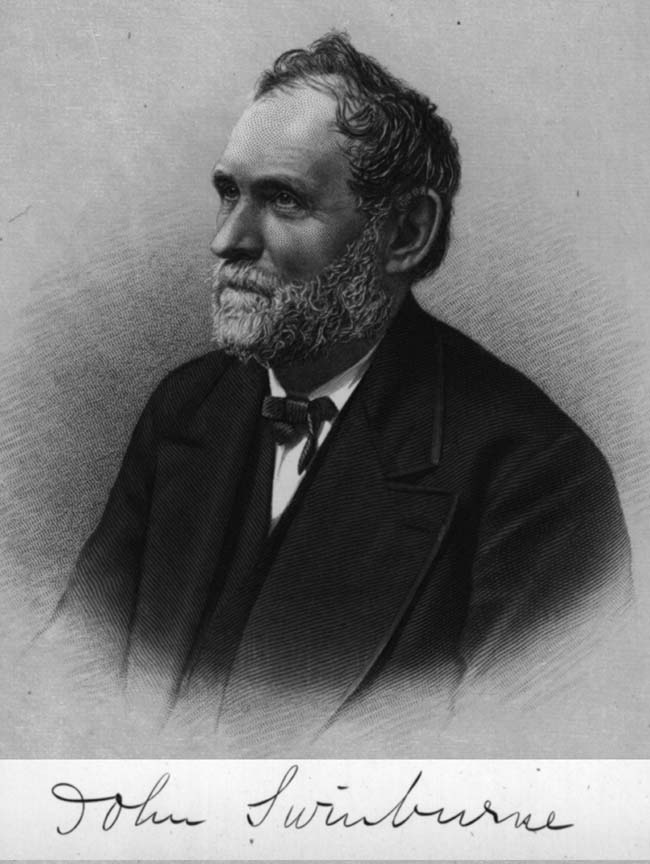
OR INCIDENTS IN THE LIFE OF DR. JOHN SWINBURNE OF ALBANY |
|
|
OR INCIDENTS IN THE LIFE OF DR. JOHN SWINBURNE OF ALBANY |
| Only Advance in Forty Years. Resection of Joints. --- Condemning Amputation for Fractures. --- Ingenuity and Common Sense. --- That Young Surgeon. --- A Challenge not accepted.---No Splints, no Bandages.---Spicy Correspondence.---A Successful Hobby. ---Convincing Proofs.---Humanity's Friend. |
WITH many of the old practitioners in the science of the healing art, every attempt at progress in the philosophy of the profession, counter to what has been published in the books and accepted as established practice, is regarded as reductio ad absurdum; and every new induction or appliance is held as an experimentum crusis. But Dr. Swinburne believed the true physician and surgeon, while always availing himself of the best methods suggested by others, should always be watchful for even better methods, and, using his own practical observations, be enabled to discover in this age of progress some means that may tend better to the accomplishing of the ends aimed at, fully realizing that in this branch of science perfection had not yet been attained. In private and hospital practice he had seen and taken an active part in many steps in advance. But a new theatre of labor had opened, and war gave him a greater opportunity, and again he made use of the knowledge acquired.
That the experience of Dr. Swinburne in conservative surgery in his private practice and in hospitals, as well as in our Rebellion and in the Franco-Prussian war, was productive of good results, better than from any other method, was affirmed by Dr. S. D. Gross, professor of clinical surgery in Jefferson College, Pennsylvania, embodying this treatment in his surgical work; and in one of his lectures before the students, entitled "Now and Then, or Forty Years Ago and Now," he said, in giving the names of men who had made progress in surgery, "that the only progress made in the treatment of fractures during that time had been made by Dr. Swinburne and another." Less than forty years before Professor Gross made that statement, Benjamin Rush, M.D., professor of medicines and clinical fractures in the University of Pennsylvania, published a work in 1835, nearly ten years before Dr. Swinburne commenced the study of medicine, on the diseases of the mind, in which he said, "The objects of fear are of two kinds, ---reasonable and unreasonable. The reasonable are fear of death and surgical operations." He said, "The fear of a surgical operation may be very much lessened by previous company and a large dose of opium. Its pain may be mitigated by the gradual application of the knife, and, in tedious operations, by short intermissions in the, use of it."
In an address before the Albany Medical College in 1874, Dr. Swinburne said, "It is well known that the majority of surgical cases which a young practitioner is called upon to attend are fractures and dislocations. The reduction of the latter has been made very simple; but, with respect to the treatment of the former, I propose to enter into a somewhat detailed history, especially in regard to the progress made in the application of principles. Looking back, we can easily recall with what dread and anxiety all kinds of fractures were once approached by the student of medicine. The danger of bad results, and, more especially, the complicated machinery deemed necessary to accomplish even passable results, were obstacles difficult for him to surmount."
The attention of the profession was more than commonly attracted to conservative surgery during our Rebellion; and in an article treating of surgery on the battle-field, the "Medical and Surgical Reporter" said editorially on Oct. 25, 1862,--
"The temptations to perform capital operations are sometimes very great, and particularly so to the young surgeon on the battle-field during a sanguinary engagement. Under these circumstances, conservative surgery offers its claims under great disadvantages. But a determined will may overcome many seeming impossibilities, and limbs, and life too, be saved by deliberation and care. Where there is a possibility that a limb may be saved, the patient should have the benefit of great deliberation before it is decided to remove it (a right conceded even a criminal) . . . . We have been led into this train of thought partly by witnessing the results of the deliberation and forethought that characterized the management of the United-States Military Field Hospital at Savage Station, Va., while it was under the care of Dr. Swinburne of Albany, N.Y. His praise is on the lips of many of the wounded troops who were in that hospital, and who have since found their way to the hospitals in this city [Philadelphia]. We have seen limbs that were badly wounded, in which amputation seemed almost unavoidable, but which were saved in spite of all the disadvantageous circumstances that followed their dressing. A few days ago we met one man belonging to a New-York regiment, who had the upper portion of the humerus shattered by a minie-ball. How few surgeons on the battle-field would have thought of anything but amputation in this case! Yet exsection of the humerus was performed [by Dr. Swinburne], several inches of bone removed, and dressing applied; and the man passed through all the ordeals mentioned above, and now has an arm that is useful for many purposes. He does not even ask his discharge from the army, but intends going home on a short furlough, and then entering the cavalry service, where he says he can manage his horse with the injured arm, and wield a sword with the sound one. How much better that than amputation at the shoulder-joint!"
In 1862 Dr. Swinburne presented another addition to medical and surgical literature in an able paper on resection of joints, and conservative surgery in place of amputation, where otherwise amputation would be considered necessary. This was published in the "Proceedings of the New-York State Medical Society" of 1863, and largely copied in the medical journals. The "American Medical Journal" of Nov. 4, 1863, said of it,---
"The section on resection of joints, and conservative surgery, is an able defence of exsections as opposed to amputations, and a judicious discrimination of the rules that should be observed in the selection of cases and performing the operation. We most heartily concur in the opinions put forward, and can only hope that they will be widely circulated in the army, where they must be productive of good results. The simple truth seems to be, that, in wounds of the upper extremities, amputations should rarely be performed. Nothing but life can compensate the loss of the arm. Without the overpowering weight of statistics which Dr. Swinburne brings to his aid, we should be prepared to accept his arguments as conclusive."
Of the same paper the "Medical and Surgical Reporter" of Feb. 13, 1863, said, --
"We commence in this number. the publication of one of the most valuable and interesting papers we have ever given to our surgical readers. We refer to Dr. Swinburne's admirable report. The paper is of especial value to surgeons in the army and navy just at this time, and we would call the especial attention of our numerous readers in the public service to it."
In this paper Dr. Swinburne treated of resection of joints; removal of the shattered fragments of the shaft, and sawing off the rough ends of the same; amputation, when and where necessary in preference to resection or excision ; the relative mortality of the two operations as performed on the upper extremities; the cause of so much distrust as to the practicability of exsections in the field; and held that the objections to exsections, partial or complete, on the field, are equally applicable to amputations, or any other severe operation, if not performed at the proper period. With reference to exsections of the upper extremities, he argued that there were no circumstances which weigh against this operation that could not with equal propriety be urged against amputations. In the former operation, in the first or primary stage, the mortality is less than from the second or congestive stage; so that, if either be performed in the congestive stage, the danger of gangrene is at best as great from the latter as the either, if performed in the third or suppurative stage. He claimed that it was not true that exsection predisposes the system any more to an attack of tetanus than does amputation, nor does the performance of either of them exempt the wounded man from this fearful disease: in other words, amputation is as often followed by tetanus as exsection. "Some," he said, "object to this operation [exsection] because it requires so much time. Now, I contend, that, if we are good dissectors, it requires very little more time to excise a joint than to amputate. As instances of the rapidity with which these operations can be performed, I exsected four shoulder-joints, and ligatured the bleeding vessels, in one hour. I trust that this is as rapidly as any one can amputate at the shoulder-joint. In my own operations," he added, "I have the satisfaction of stating to the world that I only amputated two arms, and they were torn off by shells or solid cannon-shot."
He held, as a rule, that excision (in military surgery) should be confined to the upper extremities; the shoulder and elbow being the principal parts upon which that operation should be practised, and never at the shaft. The treatment of compound and comminuted fractures of the thigh becomes a matter of serious consideration, since it involves many important points. "Excision of the shaft is evidently out of the question," he said, "since all die after the operation. The question then arises, Shall we amputate, or shall we treat such cases as ordinary compound fractures? I prefer the latter, and have from the first thought it the most reasonable treatment. The plan I propose is to treat the patient on a bed or stretcher ; extend the limb as near as possible to its normal length without giving too great pain; retain it in that position by fastening to the foot of the bed or stretcher by means of adhesive plaster, as in ordinary compound fractures, as I have on various occasions illustrated; make the counter-extension thereon by converting the bed or stretcher into an inclined plane by elevating the foot, against which the body impinges, fastened to the head of the bed or stretcher. To obviate inversion or eversion of the foot, place bags of sand on each side of the foot. There should be no bandage of the leg or thigh. If collection of matter should follow, free incision may become necessary to relieve constrictions, and to facilitate the discharge of such matter and spiculæe of bone. Irrigation, or the application of cloths wet in cold or warm water, depending on the season of the year, must be continued to the limb until inflammation has passed off."
W. van Steinburgh, M.D., surgeon to the Fifty-fifth New-York State Volunteers, in his report, said, "Out of twenty-one cases of compound and comminuted fractures of the thigh, taken indiscriminately, nineteen recovered with tolerably useful limbs. My plan of treatment has been by simple extension, as taught me by Dr. Swinburne." Of twelve amputations performed by Dr. Van Steinburgh, ten died; and, of thirteen excisions of the shaft, all but one resulted fatally.
In the fifth volume of "Holmes's System of Surgery," by various authors, Carston Holthouse, surgeon to the Westminster Hospital, in a treatise on injuries to the lower extremities, in the section on fractures of the femur, refers to the cases cited by Dr. Van Steinburgh, their treatment and results, and details the methods used. He fails, however, perhaps from professional jealousy, --- a failing with many of the English as well as American surgeons,---to accord the credit of the practice so successfully adopted to Dr. Swinburne; notwithstanding, in the work from which he gleaned his information, Dr. Van Steinburgh was particular to say that the treatment, and mode of operation, were taught him by Dr. Swinburne. The information was taken by Holthouse from an article published by Dr. Swinburne, incorporating Dr. Van Steinburgh's original letter (see "Transactions Medical Society, State of New York," 1864).
In the "Report of the Transactions of the New-York State Medical Society," published in 1864, is another paper by Dr. Swinburne, on compound and comminuted gunshot fractures of the thigh, and the means for their transportation. He introduces a plate of a stretcher for counter-extension without splints. "To my mind," said the doctor, "a little ingenuity and common sense can overcome all obstacles. I have adopted this plan, and have given directions for the management of this kind of fracture (of the thigh) in private practice. I have now treated about fifty patients, using the bed ordinarily met with in practice, instead of the stretcher. I know of many others treated by this plan, and in none have I known of an unfavorable result. In the aggregate, the patients have been able to use the limb at an earlier period than under any other mode of treatment, without any lateral distortion; nor would there be any, even if there were shortenings of the bone, as the extension of the muscles would keep the bone in a straight line." In the report he gives a minute and comprehensive description of the plan and method proposed. On the conclusion of the reading of the paper, by a unanimous vote of the society, Dr. Swinburne was requested to take the manuscript, with the drawings, to the surgeon-general, that he might see the advisability of adopting them in the medical service of the army, the society always manifesting a deep interest in the troops at the front.
The reading and publication of these papers by this young surgeon aroused the comments, favorable and severe, of the profession; the "Medical and Surgical Reporter" editorially saying,--
"It has been well said by a recent writer on fractures, that it is not in the discovery and multiplication of mechanical expedients that the surgeon of this day declares his superiority, so much as in the skilful and judicious employment of those already invented. In no department of surgery has the simplifying of the mechanical requirements been more advanced than in the treatment of fractures; and now it is asserted, and we believe proven, by one of the most practical and ingenious surgeons of this country, that the only correct and philosophic treatment of these injuries is almost absolutely without apparatus. The article by Dr. Swinburne of Albany, on the treatment of fractures of the long bones, as published in this journal, or read before the Medical Society of the State of New York, has attracted the attention of surgeons to the subject, and induced a repetition of his method in numerous instances. Such a revolution as he therein proposes in the treatment of fractures, which would displace from use so many popular contrivances, and require in surgeons the abandonment of so many preconceived notions, could hardly be accomplished in a short period. But time, which proveth all things, has been allowed; and practical and unprejudiced men now adduce their testimony in favor of the logic of the reformer, and attest their experience in corroboration of the results obtained by him . . . . Dr. Swinburne's own experience during thirteen years, in his method of treatment, has been large, and, as he states, invariably successful. The plan has now received many practical tests by surgeons throughout the country, who have decided in its favor. In this city [Philadelphia] it has the approbation of Dr. Gross, Dr. Agnew, and others."
The "American Medical Times," in its editorial correspondence, said, ---
"In regard to Dr. Swinburne's paper on exclusive extension in the treatment of fractures, we would express our appreciation. It is a meritorious and highly practical essay, based upon ample observations. We presume its author would admit, that, in his own treatment of fractures, he actually does secure, either incidentally or designedly, some lateral support for the fractured limb. That point admitted, his views and his practice agree essentially with those of the best surgeons everywhere."
In his thesis, Dr. Swinburne did admit support in this, that the living muscles acted as, and afforded the true and only necessary, support, thus obviating the use of any artificial support.
To the practitioners gathered at the meeting of the society before which these papers were read, and whose practice had been secundum arteni, this novus homo, appearing before them with such advanced scientific ideas, created a sensation, and aroused a prolonged controversy or discussion; some of the older maintaining a perfect silence, but urging younger members to a criticism couched in language more acrimonious than elegant, the sarcasm of one of these being evidenced in a communication to the "Medical Times" afterwards, under the signature of " F. F.," in which he said of Dr. Swinburne, ---
"That young surgeon evidently possesses the proper inventive and mechanical tact for good surgery. It is too manifest, that, so long as conceit boasts itself against accurate knowledge and common experience, lawyers and their deformed clients will surely make game of the best surgeons."
The correspondent said, ---
"The older and more experienced surgeons very kindly reviewed and criticised the peculiar hobby of the paper, and finally its author found it very difficult to defend his exclusive practice of simple extension."
The "older and more experienced" had crossed professional swords with "that young surgeon" once before, and felt, in this case, they were hors de combat. Dr. Bly of Rochester, in discussing what degree of extension or force may be borne without completely separating the fractured ends of a bone, gave his experience of the extensibility of muscular tissues as demonstrated by him on the muscles of a dead sheep, in which he found that the extension amounted to half an inch. This argument was answered by Dr. Swinburne, who demonstrated the absurdity of comparing dead with living muscles. Dr. James Wood said, ---
"I fear the doctor, in his zeal, has not remembered that the muscles leading from one bone to the other are not straight. They are inserted at different angles, hence the force they exert must be in a corresponding direction ; and the only safe way to remedy the deformity which is thus induced is by lateral appliances in the shape of splints, with extension and counter-extension. If a muscle be irritated, it will contract: hence the necessity of keeping it quiet, and applying evaporative lotions until the inflammatory swelling shall have subsided, before the splints are applied with extension and counter-extension. I do not think that the doctor, when he shall have practised this method for some years longer, will feel safe to leave his patient without some such lateral support."
In reply to Dr. Wood, Dr. Swinburne maintained that it was only requisite to draw out the limb to its normal extent, when the natural positions and relations would be restored, and all sources of irritation would be removed. The amount of extension must be in all cases regulated by the feelings of the patient. In regard to the different actions of the several muscles of the thigh, he maintained that when the limb was placed upon the bed, and extension made, all the living muscles were so placed that they acted directly on the long axis of the bone. If any lateral influence was claimed for the abductors, the direction of their forces was certainly altered by the position and action of the perineal pad.
Dr. Wood said that he had never treated a fracture of the os brachii (large bone of the arm) by extension.
Dr. Batchelder referred to a case of a fractured femur, which was made from three-fourths to an inch longer, by extension, than the sound limb. Dr. Swinburne answered, that it was a simple matter to avoid this, and that a proper comparison of the two limbs by measurement would have prevented such an occurrence.
It will not answer, claimed Dr. Wood, in refractory patients; yet Dr. Swinburne had shown that he had treated by extension and counter-extension, successfully, a patient having delirium tremens, which lasted several days.
During the discussion, the doctor was challenged by Dr. Wood to produce a living proof of the success of his method of treatment, and, without any loss of time, accepted the challenge, and brought three cases before the society, they being the only ones that could be summoned on such short notice. These were:
John A. Pitcher, a young German, who fell in January, 1854, a distance of thirty feet, fracturing the femur at its middle, also the left tibia and fibula at their lower third. He was treated by extension by perineal belt and adhesive strips at the lower part of the thigh, just below the patella, strips being also applied to the lower part of the leg. No splints were used, and in less than six weeks the extension was discontinued. Seven weeks after the accident he was cured; and at the time he was presented to the society, seven years after, the limb was so perfect that a most skilful surgeon was unable to detect the broken leg or thigh.
Hon. John Evers sustained an oblique fracture of the femur at upper third by being thrown violently against the curbstone by a run-away horse. Extension, without splints, was continued for six weeks; and in ten weeks he was discharged well, with the limb less than half an inch short, while he himself declared there was no difference.
Richard Hathaway, forty-eight years of age, and weighing one hundred and eighty-five pounds, while engaged in raising a monument on July 20, 1859, had a derrick fall on him, and sustained a compound comminuted fracture, the bone ground, with great contusion of the femur at its upper third. He was treated by Dr. Swinburne by extension and counterextension, without splints; and in four weeks the limb was firm, and in eight weeks he walked with crutches. When this man was presented before the society for examination, the best surgeons present could not say which had been the broken limb, and decided it was the other limb.
Among the number of cases cited was that of James McKenzie, which was peculiar. On Feb. 22, 1854, he was admitted into the hospital with a compound fracture of the left femur through its middle, and treated by extension and counter-extension by perineal belt and adhesive strips to the leg, without splints, by Dr. Swinburne. In consequence of the fact that the other thigh had been fractured previously, and was three-quarters of an inch short, the extension in this case was only made sufficient to accommodate the length of this leg to the other. In less than six weeks the extension was discontinued, and in less than ten weeks he was discharged with legs of equal length.
In addition to the cases presented for the examination of the society, and those cited, the redoubtable doctor, said a gentleman, who was present at the discussion, to the writer, offered to bet five thousand dollars that the methods presented by him were more successful than any other, the winner to donate the money to some eleemosynary institution. But there were none present with sufficient confidence in their systems to accept the wager, and they hedged by simply remarking that they were not in the betting-business. Five thousand dollars was too much for them to risk on a practice that has filled the land with deformities against a man and method where eager and anxious watching had failed to discover a failure.
In the forty cases of fractured thighs cited before the society, and treated by the method laid down by Dr. Swinburne, there were no eversions or inversions of the foot, and no distortions of the thigh, and in but one was there any visible: shortening. These cases were, with a couple of exceptions, taken from his hospital and private practice. Some of the fractures were oblique, some compound, some comminuted (in one case four inches of the bone being crushed in fragments). Two were cases where the thigh and leg were both fractured, and in all the results were considered perfect. Twelve were fractures within the capsular ligament, occurring in patients most of them over sixty years of age, and all treated with this method of extension, with results much better than could be expected, and which it would have been vain to expect under the usual treatment.
The discussion of these papers was not confined to those present at the meeting of the society, but was continued for some time afterwards in the medical journals by the profession. Over the nom de plume of "Splints," in a communication to the "Medical Times," in a garbled report of the discussion, a writer said, --
"Dr. Swinburne's object in thus bringing up the subject of extension in a new form before the profession is a laudable one : he is desirous of simplifying the treatment of fractures; and, for the attempt which he has made to bring about that end, he certainly deserves a great amount of credit. He, however, has, I think, allowed his enthusiasm to lead him into error in regard to the adaptation of his principle to practice; which fact, being assumed, proves to my mind that the principle is erroneous. His honest efforts to prove the opposite state of things only shows how skilfully he can ride his 'hobby.'
"Every good surgeon [he wrote] uses a splint for coaptation of a fractured bone. In relation to the subject of exclusive extension, I must he permitted to make one remark, and that has relation to its use in fractures of the os brachii. Dr. Swinburne must pardon me when I give it as my conviction that he is indeed a bold surgeon to advocate a plan of treatment which is so universally acknowledged to result in non-union. In reference to the good results obtained by his practice as applied to this bone, I can only express my astonishment."
The critic adopting this, to him, euphonic signature of "Splints," under which to cover his individuality, was understood to be none other than Dr. Shrady, then editor of the "Times," and the father of a splint that was said by its author to be the best ever conceived, but which has long since been abandoned.
These are specimens of what the "young surgeon" had to meet with in his attempt to improve the methods of treating fractures; but, as in his practice, he was equally successful in his arguments and theory, as time, "which proveth all things," has shown by the success that has attended him. Nor has the prognostication of Dr. Wood, that the doctor, after he shall have practised this method a few years, will change his views; but, on the other hand, he has been more firmly convinced by years of practice that he was right, and has lived to see his methods triumph.
In "The Medical Times" of April 20, 1881, Dr. Swinburne answers these incognito writers and critics, in which he says, --
"When he ('F. F.') said, upon the question having been raised as to what degree of extension or force may be borne without completely separating the fractured ends of the bone, 'Dr. Bly of Rochester related the results of his experiments on the leg of a dead sheep, and produced extension of the muscles to about one-half inch,' Dr. Bly should have fairly stated the difference between simple extension, on the one hand, and, on the other, of suspending weights until the integrity of the muscle was destroyed; also the difference of dead and living tissue. I expressly say that the extension obtained by a strong man upon a broken thigh will not elongate it beyond its normal condition, and also expressly deprecate the pulleys and uprights, as they paralyze and elongate the muscles, and thereby destroy their usefulness as splints."
In reply to "F. F.'s" assertion "that its author found it very difficult to defend his exclusive practice by simple extension," he said, --
"If good results in the treatment of a hundred fractures of the long bones, and also Dr. Thom's experience as reported from the Marshall Infirmary, is not a good practical defence, then I have found it difficult to defend the exclusive practice of my hobby. His quotation, that I resort to lateral support to the fractured limbs in particular cases, is untrue. I expressly said that, where a lateral splint is used, it is only a means by which the extension is made and perpetuated, and not for lateral support. In the thigh there is no lateral support used; and in the article on extension I said that the treatment adapted to the femur is applicable to any portion of the thigh or leg."
With reference to the remarks of Dr. James Wood, "F. F." said, --
"The remarks of Dr. Wood constituted the most interesting event of the first day's session. Close attention was given to his remarks, which seemed to satisfy the obvious desire of all classes of practitioners, who fear the misapplication of judicial inquiry and prosecution for the correction of faults in surgery."
To this Dr. Swinburne replied, -
"No one could be more pleased than I with the frank, honorable, gentlemanly, and masterly manner in which Dr. Wood discussed the merits and demerits of simple extension. Though I defended what I knew was the true principle of the treatment of fractures, I was, nevertheless, anxious to hear the views of James R. Wood. That I had great confidence in my mode of treatment, is proved when I proposed (in the discussion which occurred between Dr. Wood and myself) to treat alternate fractures in any hospital (by his method), with any surgeon, and I would stake my reputation upon the results by obtaining union in less time, and with better results, than could be obtained by the use of splints as commonly applied. As to the last clause, it surely does not apply in the present instance, as I have never been sued for malpractice, nor has there been any occasion even for the insinuation."
In reply to "Splints," whose almost entire correspondence he characterized an evident perversion of facts and statements, the doctor said, --
"As to the idea that 'he seeks to establish the absurd principle that muscles cannot be extended beyond their natural length,' I maintain that any attempt to extend a muscle beyond its normal capacity not only provokes resistance, but a tearing of its substance (I mean the living, but not the dead tissue). Take, for instance, a fractured thigh: extension on the extremity by a strong man (and not with weights and pulleys) will stretch the muscles to their normal length only; which fact can be shown by the most careful measurement, thus proving that the danger of too much extension is only imaginary."
He quotes from "Splints," -
"I am not aware that Dr. Swinburne claims any originality in the matter; i.e., simple extension. He has, however, allowed his enthusiasm to lead him into error in regard to the adaptation of his principle to practice, which (being assumed) is convincing to my mind that the principle is erroneous: his honest efforts to prove the opposite state of things only show how skilfully he can ride his hobby."
To this the doctor replied, --
"With reference to the first portion of the quotation, the principle of extension is acknowledged by all good surgeons; while, with reference to his 'enthusiasm leading him into error,' I think it is a good error when the results are so perfect that it baffles a good surgeon to discover which of the two thighs had been broken, though the fracture was compound and comminuted, occurring in a man weighing one hundred and eighty-five pounds. What is true of this case is also true of all the others, and equally so of fractured tibia. As to the 'adaptation of his principle to practice,' instead of showing that the principle was wrong, practice only serves to make the principle more fully appreciated, and demonstrates to the world that it is not the kind of splint, but the mode and manner of the application of the principle involved."
One critic thought the doctrines then laid down were dangerous to teach the students; but the doctor, knowing his method was correct, was anxious that the profession, as well as the students, might be benefited by his over twenty years of experience, as he is now always ready to impart his knowledge, acquired after forty years' experience, to all who have in charge or are in training for the care of the sick and maimed; and not only a large number of the college students avail themselves of this privilege, and are constantly in attendance at. his large clinics, eagerly watching and listening to the man who has made no failures, but frequently regular practitioners of 'years' standing are among those who come to learn of him. This paper, covering fifty pages of the Medical Society's report, also treats of fractures in or near the elbow-joint, with or without dislocation, and of the treatment of fractures of the clavicle by simple extension.
Dr. Swinburne's attention was first drawn to the subject of treating fractures by extension, because of the many bad results he had seen from oblique, compound, and comminuted fractures of the leg; and, being astonished at the number, he was led to investigate the cause, and examined specimens in a number of museums containing collections of broken bones, where he found all were more or less distorted, both laterally and longitudinally, with shortened tibias. He believed this was an age of progress, and that there were no results without cause, and that it was an obligation science owed to the people to discover the cause of these bad results. He knew that the first paths over our vast Western country were made by the buffalo, and then followed in by the Indian, but that as civilization, with its compasses and engineering genius, made its way through the country, the long-trodden paths of primeval days, over rugged hills and mountains, were ignored, and more feasible and rapid methods of transport brought into use. In his chosen branch of science, he did not desire to travel in the uncertain and crooked paths of tradition, nor in the clog-carts of more modern science; but, like the traveller who takes the iron horse and easy coach over the steel track of civilization, he was anxious for the most comfortable, safe, and speedy cure of the maimed, leaving others, if they so desired, to travel in the path of the buffalo or the Indian; and for this reason he was satisfied extension would obviate the dangers of lateral distortion, and, as far as the spasmodic contraction of the muscles would permit, overcome longitudinal distortion.
This paper was also incorporated in Professor Gross's "Surgery," and had an unusually wide circulation in this country and was extensively copied from in Europe.
The cases presented and referred to in this chapter were at the time typical cases, treated by means not hitherto employed, and resulting in success not anticipated in previous treatment. They were then considered surprising; but a still greater advance has been made by him in his treatment by simplifying the methods of extension, since that time, with results more surprising, as may be learned by a reference to the work in his dispensary.
This plan for the treatment of fractures of the femur or the other long bones, without splints or bandages, was unknown to the profession at the time the paper was presented by Dr. Swinburne in 1859; and, although it was followed to some extent in our Rebellion, its superiority was not definitely settled in military surgery, on account of the prejudices of the profession, until during the Franco-Prussian war, where it was in every instance in the American ambulance followed by Dr. Swinburne with successful results and good limbs. The profession had never, up to that time, recognized the necessity of extension for the approximation of bones other than the thigh; and this fact was so conceded at a meeting of the Academy of Medicine in New York, as may be seen by reference to the "Medical Times." Nor had they ever dispensed with splints or bandages.
After a lapse of over twenty-five years since the publication of the paper by Dr. Swinburne, it is shown and proved that the theories he then entertained were and are the nearest possible to the true ones; and it is also conceded---because of the unprecedented favorable results in his own practice, daily carried out, as well as by others who have adopted the system --- that the principles then laid down, in 1859 and 1861, for the treatment of fractures of the long bones, --- viz., that any fracture or fractures, of whatever nature or kind, occurring between the elbow and shoulder, or between the ankle-joint and pelvis,---can be, successfully treated by the plan commenced by him in 1848, and which has since its being given to the public, up to the present----been practised by him, as well as his friends and many of the advanced and intelligent practitioners in surgery. In military surgery this treatment of fractures of the thigh, or otherwise as followed in the American ambulance at Paris during the Franco-German war in the winter of 1870 and 1871, was shown to be the superior and most successful, as attested to by the most eminent men of Europe, and quoted in another chapter.
Professor David P. Smith of Springfield, Mass., while visiting in Edinburgh, Scotland, wrote, --
"Fractures will be most successfully treated by those surgeons who are best acquainted with anatomy and physiology, and know by experience what a bruised and perhaps lacerated limb can bear."
As late as the latter part of 1861, the principle of extension and counter-extension in the treatment of fractures found no favor in Europe, Professor Syme of the Royal Infirmary, Edinburgh, maintaining stoutly that the benefits supposed to be gained from the use of extension was a mere delusion; for if extension was employed, he argued, the muscles were roused to resistance, and always overcame such force.
With a large majority of the profession, devotion to established principles is a religious duty, from which it is almost a miracle to have them change. They hold that their principles are right because they are traditional, and founded on facts, as taught them. They forget, or seem to, that in medical and surgical jurisprudence all the advance science has ever made in their or other callings was made by a few enthusiastic utilitarians in any age. In many instances, and indeed almost universally, correct and advanced principles have only been accepted in great emergencies as dernier ressort.
The principle of conservation as applied to the limbs was but little discussed during the first years of our war, except by Dr. John Swinburne and a few others, the principal idea being the discussion of the best means of amputation, the purpose being to change the treatment of fractures from the carpenter-shop to the butcher's table. As an instance of what some of the medical journals contained from their most prominent contributors, we extract from the letters of a surgeon in charge of Fairfax Seminary Hospital, published in 1863:---
"The multitude of amputations below the knee which I have performed, seen, and watched the results of, have convinced me that none of the ordinary methods are the best possible in any surgery . . . . In my remarks I may have seemed to my too much stress upon my favorite method of amputation below the knee. I say emphatically that the advantages which I claim my method alone furnishes must be obtained if recovery is expected to follow."
These were the sentiments of Dr. David P. Smith, who, in asking, "Shall amputation be performed in gunshot fracture of the femur from a conical leaden bullet?" said,---
"From dissection of such injuries after they were removed by such amputation, I was, however, enabled very early to recognize the hopeless nature of such cases if left to themselves."
These statements were made in 1863, after two years' experience in the war, and were answered by John T. Hodgen, surgeon in charge of the St. Louis City General Hospital, who said, --
"Dr. Smith and myself have seen such cases under widely different circumstances,---he on the battle-field, and I in the hospital, after they had been removed thither hundreds of miles. There have been received at this hospital sixty-five cases of gunshot fractures of the os femoris. Of these, eighteen have died, four remain under treatment in a fair way to recovery, and forty-three have recovered, and left the hospital with good limbs. It will be observed that the percentage of mortality is less than twenty-eight, thus giving better results, so far as life is concerned, than amputation of the thigh would do, besides preserving useful limbs. The above statistics are startling to surgeons who have seen the terrible work done by the conical leaden bullet, and they will naturally cultivate a feeling of incredulity; but to my mind these recoveries are not so incredible as that sixty-five men thus wounded should have escaped mutilation at the hands of those humane, patriotic, and time-saving surgeons, who, 'by order' or without it, flock to the battle-fields (some days after the fight), who swarm on transports, and who rush to hospitals to gratify a morbid thirst for capital surgical operations."
At a meeting of the United-States Army Medical and Surgical Society of Baltimore, held in February, 1863, the vice-president, Surgeon Z. E. Bliss, said,---
"The operation of exsection of the joint as a mode of treatment of gunshot fractures involving the shoulder, elbow, and hip joints, has not, as yet, been fully tested; but sufficient facts have been already obtained to prove that this operation often saves life, and preserves a serviceable limb."
That our humane and patriotic fellow-citizen, Dr. Swinburne, performed an active part in introducing conservative surgery into the army, and saving a host of lives and innumerable deformities among those who were gallantly defending the nation, may be drawn from a report of gunshot fractures read before the United-States Medical and Surgical Society of Maryland, and published in 1863. The paper was by Edmund G. Waters, M.D., acting assistant surgeon. He said,---
'On the 21st and 25th of July, 1862, between four and five hundred sick and wounded Union soldiers were received into the National Hospital, Baltimore. Most of the wounded had been shot in the seven-days' fight, and, being taken prisoners, were sent to Richmond. Among them was a number with fractured thighs; and a better opportunity has rarely been afforded to test the several modes of treatment in secondary cases, after this kind of injury, than these presented. The writer regrets that he is not able to give the exact number of amputations performed for this injury, but is able to state positively that only one patient recovered of the many who underwent the operation."
He then gives the history of fourteen other similar wounds. treated conservatively, all of whom recovered. One of these, was a fracture in the neck of the bone.
These wounds were all received in that portion of the field, of battle where Dr. Swinburne was in charge, and where amputations were not practised, but where conservation was the rule. The success of the doctor had, no doubt, much to do with inciting these efforts to save. In these instances cited, there is ample food for reflection by the profession, as well as facts on which to predicate a safe practice, unless they desire to exemplify the truth of Key's assertion, that "amputation is the last resource of the surgeon, at once the shelter and confusion of the surgical art."
Even the best of surgeons seem slow to learn; and it was not until 1863 that De Witt C. Peters said, --
"The era of promiscuous surgery, both in military and civil life, has passed nearly, if not quite, into oblivion. In discussing the important subject of compound fractures of the thigh, too little stress has hitherto been paid by surgical writers to the saving of limbs. Following the teachings of Dupuytren, Baudens, Hennen, Guthrie, and a host of others, we are too ready to admit that amputation is our sole reliance. They would have us believe that the patients who save their limbs, forever remain martyrs to a miserable existence. Others inform us, amputation of the thigh is a dangerous expedient, and in their hands has resulted in the majority of cases fatally; yet they carefully avoid entering into any details of their manner of treating fractures. The wonder to my mind is, that their patients ever recovered when laboring under this species of injury. The indications are to place the parts in a natural position, keep them immovable, and dispense with snug bandages and splints."
This was coming pretty near up to Dr. Swinburne's principle of treating without any splints or bandages, but with extension and counter-extension. One of the best authorities in the army said that no attempt had ever succeeded, that he had heard of, during the war, to conserve a limb where a compound fracture of the thigh had occurred, where proper extension was not used.
Dr. Swinburne, in a paper read before the Albany-county Medical Society at its annual meeting in November, 1874, and published in the Sunday press, said,---
As to the causes which have led to the changes of the methods in the treatment of fractures, they have been wrought principally in accordance with the scientific law of making the muscles the motive power. The knowledge of the principles of the muscles, and their importance in the management of fractures, came by experience in practice and in the dissecting-room. The uselessness and injurious effects of bandages were, at an early period, a matter of firm conviction with me. The results obtained by the old-fashioned, appliances were any thing but satisfactory. The upper parts were compressed to such a degree that all the soft tissues became a conglomerate mass. Muscles, nerves, vessels, cellular tissue, and investing membranes adhered to the bone, and, in time, were consolidated there. Months might, and often did, elapse after the union of the bone, before the soft parts would return---if, indeed, they ever did return---to their normal condition. The state of the muscles, when maddened by the goring, pricking, and tearing of the fractured ends of the broken bone, is one too often observed to necessitate a more than passing mention. The muscles, you will recollect, are thereby thrown into a condition of clonic spasm, which, sooner or later, becomes the cause of more or less longitudinal and lateral distortion.
"The old practice was to overcome distortion chiefly by the appliance of splint and bandages; the modern practice is to extend the limb to its normal length, and to retain it in that position, with as little compression of the parts as possible. The results of the former method, even if favorable, which were rather less frequent than one could wish, were obtained by the complicated processes of the period; the difficulty of dressing, the recurring redressing, and the adjustment of the apparatus and bandages, being incalculable, to say nothing of the pain, suffering, and inconvenience caused to the patient. By the simple method at present in vogue, the most satisfactory results are obtained, with little pain, with no distortion, and with little or no immobility of the soft parts.
"Impressed by some such considerations, I was led, at an early period after graduating, to examine, the subject immediately from the dead body; and this examination clearly demonstrated that some other, simpler, and more efficient method could be devised. Various experiments upon fractured limbs of the cadaver and living subjects satisfied me that there was a principle involved in their treatment, which, being turned to the full extension of all the parts involved, would return the limb to its normal length and condition. It could be kept in place by the application of sufficient counter-extending force, without the use of splints in any shape or manner. This theory was put in practice in 1848, and proved an entire success."
Experience has confirmed the doctor beyond all question, that the system he espoused nearly forty years ago is better than any before or since suggested; and in his practice, both civil and military (in two wars), he has practised it always successfully, and with better results than could be attained with any other method. If the assertion of the "Medical Times," always a great stickler for established rules, made in 1863,---"that practical surgery is evidently, at the present time, thoroughly committed to conservation," --- is proven true, thousands who never saw, and perhaps never heard of, Albany's great physician and surgeon, will have good cause for thankfulness that Dr. John Swinburne lived, and inaugurated a system whereby pain is eased on the sick-bed, and limbs that otherwise would have been destroyed were saved, and deformity avoided. This alone would have been a life of usefulness rarely surpassed.
| Willing to back his Method with Money. --- Preaching False Doctrine. --- More Light wanted. --- A Poor Excuse. --- A Sharp Arraignment |
THE revolution in surgery that the doctor was aiming to bring about for the good of humanity was not only opposed by the lesser lights, but by some who had arrogated to themselves leadership, and, assuming the place of authors, conceived themselves infallible in this great science. But to none of them would the doctor yield a point, or admit superior skill. Among those who criticised his practice and methods was Professor Frank H. Hamilton, the author of several works on surgery. In one of his works he took exception to Dr. Swinburne's system of extension, and was very positively challenged to make a trial, and test methods; but the professor, like Dr. Clarke, was afraid to practically test the skill of Dr. Swinburne, and declined to enter into a competition with one he knew was so aggressive and skilful. The correspondence passing between them demonstrates how slow professional men are, at times, to accept any new or advanced ideas. The professor taught one theory, and the doctor practised another; and the latter, believing results were always the powerful arguments, sought a friendly competition to arrive at the best methods, and to this end challenged the author. The correspondence of the doctor, and the replies, are given as a public matter, and are as follows:
PROFESSOR FRANK H. HAMILTON.
My Dear Sir, --- In the fourth edition of your work on fractures and dislocations, p. 412, you say, in speaking of fractures of the femur, "I cannot think it necessary to do more than allude to the practice of Jobert of Paris, and of Swinburne of Albany, who, rejecting side or coaptation splints altogether, have relied upon extension as means of support, and retention in the case of fracture of the shaft of the femur."
Now, my dear doctor, I have since 1848 practised the plan you so incidentally mentioned for fracture of the thigh, and feel constrained to say that the results not only bear out the treatment, but the patients are far more comfortable, and deformity far less likely to occur, than when dressed in any other manner. Not only have I pressed upon the profession the plans for treatment of the thigh, but also those for treatment of the other long bones; viz., the arm, fore-arm, and leg. Therefore I propose for your consideration the following: that we each deposit with some third party from one thousand to five thousand dollars (the whole amount to go to some eleemosynary institution when the trial is decided), and you taking a given number of fractures of the long bones before mentioned (whether simple, compound, comminuted, or complicated. with luxation or other injuries, makes no difference), and I taking a like number, yours to be treated after your methods, mine after mine; and if I do not get better results in a shorter space of time, with less pain to the patients, I am to be declared the loser; but, if I do gain such success, you to be the vanquished, and, as I said before, the treatment for fractures of the long bones, as advocated by me in several publications and in my lectures, to be advanced, and taught in the schools.
I make this proposition, doctor, for the following reasons: first, for the benefit of those who are to come after us, and to whom will fall the care of these same injuries; secondly, because, living as you do in the metropolis, ample facilities can be obtained for making such a trial; and, thirdly, because in all the works on fractures with which I am acquainted, more or less deformity of wrists, elbows, and fractures in other localities, are spoken of as the attendant evils of such accidents. The minor details we can arrange later, in case you see fit to accept my proposition, and also decide upon impartial judges.
Hoping I may shortly hear from you in regard to this matter, as I now am able to give the necessary time for such a trial,
I remain, my dear sir, yours very truly,
JOHN SWINBURNE.
* * * NEW YORK, Jan. 7, 1879.
PROFESSOR JOHN SWINBURNE.
My Dear Sir,---Having become convinced, after careful observation, that side or coaptation splints are, in a majority of cases of fracture of the shafts of the long bones, essential to the attainment of the best results, I do not think it necessary or useful for me to enter into the friendly contest which you propose.
Very respectfully yours,
FRANK H. HAMILTON.
* * * ALBANY, Jan. 20, 1879.
MY DEAR DOCTOR, --- I regret exceedingly that you should have declined my proposition to test the comparative value of our respective plans for the treatment of fractures of the long bones.
Our methods differ radically, and the results claimed vary so widely as to require some explanation: otherwise but one conclusion remains, that one or the other of us must appear to be preaching false doctrine.
Inasmuch as I am desirous of testing my treatment on a large scale, where competent and impartial judges can decide upon the results of this compared with other methods, I ask if you, as the author of a work on fractures, and a teacher of students, will afford facilities for the trial of a plan which has worked so favorably in my own hands. Inasmuch, again, as it is conceded that more than one-half of the fractures of the elbow result unfavorably, and as you, in the fourth edition of your work on fractures and dislocations, report a large majority of Colles' fractures as imperfect results, it would seem as if some plan, simple and efficient, should be perfected at once, by which the profession would be enabled to obtain good results in all forms of fractures. I ask again if you and your friends are willing to join me in this essay, --- an important step in the reformation already begun, and which is destined to revolutionize the whole treatment of fractures.
The work I began in 1848, in private practice, is now bearing fruit in the treatment of all forms of fracture of the femur; and so the methods of treating other forms of fractures will undergo a complete change at no distant time, despite any efforts to retard or hinder it.
The more intelligent portion of the community are demanding greater light on this subject. They are tired of, and disgusted with, the multiplicity of plans and apparatus for the treatment of fractures, and with the want of an orderly body of clear and simple principles to guide them. They can endure no longer this blind adherence to, and perpetuation of, the quasi-charlatanism which has entered so largely into the subject. The classes of the Albany Medical College have, by a unanimous resolution, asked me to give them a synopsis of the treatment of all forms of fracture of the long bones, which I shall soon undertake to do; but, before doing so, I should like to give you and other surgeons full opportunity of examining in person results as they occur under my treatment. If, therefore, you are disposed to afford me the opportunity, I will gladly avail myself of the privilege.
Yours respectfully, etc.,
JOHN SWINBURNE.
* * * NEW YORK, Jan. 22, 1879.
MY DEAR DOCTOR, I shall be glad to see your practice and its results whenever it may be convenient for you to show them to me; but, as I am alone responsible to my patients for their treatment, I cannot employ, or permit others to employ in their management, methods or forms of apparel which an extended experience and observation have convinced me are not the best. Your error is in supposing that I have not seen fractures treated by the methods you prefer, and that I have no experience as to their results.
Be assured, my dear doctor, I am as much interested as yourself in the improvement of this department of surgery, that I hope to avoid "charlatanry," and that I shall hail with delight any thing which brings with it conclusive or substantial evidence of its utility or superiority.
Yours very truly,
FRANK H. HAMILTON.
PROFESSOR SWINBURNE.
* * * ALBANY, March 18, 1879.
PROFESSOR FRANK H. HAMILTON.
Dear Doctor, --- Your note of the 22d inst. surprised me. It is impossible to show you my "practice and results" in the treatment of fractures, if you are unwilling to come to Albany; for I am debarred by you and your friends from the treatment of fractures in the New-York hospitals. The words of your note are, "I cannot employ, or permit others to employ in their management, methods or forms of apparel which an extended experience and observation have convinced me are not the best. Your error is in supposing that I have not seen fractures treated by the methods you prefer, and that I have no experience as to their results."
Now, I have serious doubts about your having seen fractures properly and scientifically treated after my plan, if, as you say, the majority of the cases resulted badly. In February, 1861, I had the pleasure of showing many fractures of the several long bones to Dr. Sayre and other New-York surgeons, and they pronounced them perfect results. All the cases which I have had before my medical class this and past winters, and all those of my colleague, have also been perfect results. I am in possession of equally favorable reports from other surgeons who follow this method.
To be more definite, let us take a Colles' fracture. In your work on fractures and dislocations, published in 1860, you report nearly seventy per cent of failures in the treatment of these fractures. In the edition of 1871, over seventy per cent of failures are reported. I claim by my method a much better showing than this. To make my statement as concise as possible, I have never had a bad result in the treatment of a Colles' fracture, and have never seen a bad result where my plan was properly applied. Indeed, I have offered a premium of five hundred dollars to any one who will produce a bad result from any form of fracture treated by me.
In your work on the treatment of fractures, etc., you are very frank in confessing to so many bad results, especially while the major portion of the profession, including many professors of surgery, are obtaining equally bad results, without the grace and extenuation of confession. Taking such confession as a criterion, why, I ask, do you not speak out candidly, and warn the profession of the dangers attending certain classes of fracture by my plan of treatment? The mistake you make is in supposing that I desire to attend your private patients: on the contrary, I assume there is plenty of material in the public institutions of New York for a proper test of the efficacy of my plan of treatment. Again: you assume my plan of treatment is productive of bad results. If that is what you mean, I am prepared to put up five thousand dollars, as previously proposed, as a test of our comparative results, to compensate persons in whom bad results may follow my treatment. In this compensation for bad results, to be judged upon the basis laid down in your works, or those of other prominent surgeons, I deem myself safe, after a complete perusal of your published works and occasional writings on the treatment of fractures in private, public, and military surgery, and a consideration of your confessed results.
Yours respectfully,
JOHN SWINBURNE.
* * * NEW YORK, March 20, 1879.
JOHN SWINBURNE, M.D.
My Dear Sir, --- I had supposed that my last reply was sufficiently definite to have assured you that I was not disposed to accept any challenge, or to investigate your mode of treatment any further, except in my own way and at my own convenience.
I will only add, before dismissing this correspondence, that when you say in your letter, "In your work on fractures you are very frank in confessing to so many bad results,"---"to seventy per cent of fractures," ---you convey the idea that those results were "bad," or "failures," which were not recorded as absolutely perfect, and that I intend so to say.
If you will read my books again, or whatever else I have written upon this subject, you will see that this is not my meaning, and that my language has never been capable of such a construction. I speak of results as perfect or imperfect, but imperfect does not necessarily imply bad results, or failures. You have a right, if you choose, to call a result bad, or a failure, which is not in all respects perfect; but I do not. And this is not the fairness which one has a right to expect in a controversialist, where a matter of science is involved, when you say I confess to seventy per cent of bad results, or failures. And, further, it ought not to have escaped your notice---if you have read, as you say you have, all of my published writings, including my treatise on fractures, and especially the preface to my paper on deformities after fractures, published in the "Transactions of the American Medical Association"--- that a majority of the cases referred to in the general summaries were not treated by me, although they had all been examined by me; my purpose being, as I have repeatedly stated, to furnish, as far as possible, a fair estimate of what were the usual or average results in the hands of respectable physicians and surgeons. They are not, therefore, my confessions.
Intending no personal disrespect to you, I wish to say that I do not think it will prove profitable to continue, and I have no time to devote to a further correspondence upon this subject.
Yours truly,
FRANK H. HAMILTON.
* * * ALBANY, April ---, 1879.
PROFESSOR FRANK H. HAMILTON.
My Dear Doctor,--- I regret extremely that you, in your note of the 20th ult., decided on "dismissing this correspondence," because I am sure much good might come out of its continuance. I regret, also, that you should have decided not to investigate my mode of treatment of fractures any further, except in your own way and at your own convenience, because I am quite sure, if you did fully investigate it, your sense of fairness to the profession, and desire to obtain good results, would induce you to accept the true principle, and teach the same.
I am very thankful that you added, before "dismissing this correspondence," that "a majority of the cases referred to in the general summaries were not treated by me, although they had been examined by me." Now, my dear doctor, I did not say they were treated by any one, but only assumed they were not treated by my plan. My statement runs thus: "In your work on 'fractures and dislocations, published in 1860, you report nearly seventy per cent of failures in the treatment of these fractures. In the edition of 1871, over seventy per cent of failures are reported." In this I say nothing as to who attended them. But you say it was your purpose "to furnish, as far as possible, a fair estimate of what were the usual or average results in the hands of respectable physicians and surgeons. They are not, therefore, my confessions." It is presumable that both you, and the "respectable physicians and surgeons " mentioned, made the best results you could in each individual case. If not, why not?
In the above-mentioned note you complain of my saying that you confess to seventy per cent of bad results, or "failures."
In this I may have spoken hastily. I hope to correct the statement by quoting your precise language. In your work on fractures and dislocations (ed. 1871), p. 281, you speak as follows of ninety-five fractures of the lower third of the radius: "Only twenty-six are positively known to have left no deformity, or stiffness about the joint." In this quotation no reference is made as to who was the surgeon, but the inference might be drawn that it was the work of "the author." I am pleased, therefore, to learn from your note that the cases were not yours, because you confess in the next line that "it is probable, however, that the number of perfect results might be somewhat extended." It is pleasant, I say, to hear this; but unfortunately, if we consult the two following pages (pp. 282, 283), the illusion and the pleasure are at once dispelled. Your statements are as follows: "If we confine our remarks to Colles' fractures, the deformity which has been observed most often consists in a projection of the lower end of the ulna inwards, and generally a little forwards. In a large majority of cases this is accompanied with a perceptible falling-off of the hand to the radial side, while in a few it is not. After this, in point of frequency, I have met with the backward inclination of the lower fragment. Robert Smith found this displacement almost constant in the cabinet specimens examined by him; and it is very probable that nearly all of the examples examined by myself would present more or less of the same deviation upon the naked bone."
Again: "The fingers are quite as often thus anchylosed, after this fracture, as the wrist-joint itself, --- a circumstance which is wholly inexplicable on the doctrine that the anchylosis is due to an inflammation in the joints. Indeed, I have seen the fingers rigid after many months, when, having observed the case throughout myself, I was certain that no inflammatory action had ever reached them.
Again, quoting Dr. Mott, and coinciding with him, "Fractures of the radius within two inches of the wrist, where treated by the most eminent surgeons, are of very difficult management so as to avoid all deformity: indeed, more or less deformity may occur under the treatment of the most eminent surgeons; and more or less imperfection in the motion of the wrist or radius is very apt to follow for a longer or shorter time. Even when the fracture is well cured, an anterior prominence at the wrist, or near it, will sometimes result from swelling of the soft parts."
In sixty-six of the ninety-two cases of Colles' fracture, there was "perceptible deformity," or "stiffness about the joint," and only twenty-six had no "perceptible deformity." Is it fair, then, for you to complain of my calling these sixty-six or seventy per cent of Colles' fractures "bad results," or "failures," simply because they were not treated by you, but were the "confessions" of other "respectable physicians and surgeons"?
I judge, however, that you have treated some eases of Colles' fractures: for I find on p. 290 (ed. 1871) a cut of "the author's splint," which seems to be a pistol splint for the inside of the arm, and a plain straight deal splint for the dorsal portion of the arm, with accompanying directions for its use, and the dressings employed by "respectable physicians and surgeons;" viz., compresses, bandages, etc. The advantages which the author claims for this splint are, "facility and cheapness of construction, accuracy of adaptation, neatness, permanency, and fitness to the ends proposed." And still the author does not claim that this apparatus in his hands, or in the hands of any one else, although it possesses all of these qualities, produces any better result than twenty-six out of ninety-two.
In speaking of the treatment of Colles' fractures, "the author" cautions the reader about the use of bandages, splints, etc., and goes so far as to assert, "I have no doubt that very many cases would come to a successful termination without their use, if only the hand and the arm were kept perfectly still in a suitable position until bony union was effected." In this belief I think we are quite agreed; but may I ask, Does "the author's" plan accomplish this without injury to the soft parts? He does not tell us, but only adds that "during the first seven or ten days these cases demand the most assiduous attention, and we had much better dispense with the splints entirely than to retain them at the risk of increasing the inflammatory action."
Again on p. 92: "More than once, indeed, it has occurred that surgeons have been so intent on preserving fractures in their proper position, that the extreme constriction employed has actually caused destruction of the soft parts. A piece of advice which I have frequently given, and which I cannot too often repeat, is to avoid too much tightening of the apparatus for fractures during the first few days of its being worn; for the swelling which supervenes is always accompanied by considerable pain, and may be followed by gangrene." Then follows four pages of history of cases where gangrene supervenes on the use of bandages. With these facts before him, distinctly perceived and acknowledged, the author still persists in employing and recommending bandages, compresses, etc., instead of treating his fractures so that there should be no danger from compression, and gangrene from retarded circulation.
Since writing the above, I have received a letter from a lady of refinement and education, living in Auburn, N.Y., who some time in November, 1878, came to this city from near Philadelphia, and sent for me to redress her broken arm. I found that about three or four weeks previous she had fallen, and produced a Colles' fracture, which had been treated by a "respectable physician and surgeon," before coming here, with the pistol splint. On examination, I informed her that union had taken place perfectly; that the limb was strong, but that it was deformed and almost useless, and would remain so for life. I re-applied the bandages, as before, and told her that the deformity could not be removed except the bone be refractured and united, and that, aside from this, there was no necessity for surgical interference. She paid no regard to this advice, as will be seen from a note of hers, March 29, 1879, in reference to her present condition.
"Some four months have elapsed since I arrived here. You called upon me last November at the Delevan House in Albany, and bandaged my broken wrist. What you told me then about my broken bones I have found strictly true. I cannot shut my left hand: it is swollen on the back (silverfork deformity), and the under part of my wrist near the little finger is also swollen. I am in poverty. I have suffered cold and hunger, and for medical services, since I came here." She adds, "If I had staid in Albany, and placed myself under your care professionally, I should have been well now."
I have no doubt that in this case I could have refractured, and restored the parts to their place. I have accomplished it in similar cases before. A lady in this city came to me with a Colles' fracture, having the following history: About thirteen years since, she fell, and sustained a Colles' fracture. It was treated by one of our most accomplished village surgeons with the usual pistol splint. Months passed before the wrist could be used at all; and from that time it continued deformed and measurably useless, until a few weeks ago, when she fell, and refractured the radius at about the same point (about one inch from the wrist-joint). This I treated by my plan. At the end of three weeks she had good use of the wrist; at the end of six weeks the wrist was as strong and useful as it was before the first fracture, and with no perceptible impediment to motion.
Authors concede that fractures of the elbow-joint are difficult to treat, and that a very large percentage result badly; or rather less than one-half are perfect after such fractures. From my own plan, on the contrary, I know of no cases which have resulted badly, either in my own hands or in the hands of others. This consists in double extension, double counter-extension, and retention of the limb in its normal position; the restoring of circulation, thus avoiding inflammation; the effecting of apposition as much as possible, and retaining such apposition without constriction, thus avoiding excessive callus, or, rather, obtaining union as nearly as possible by the first intention, and thus escaping deformity.
The author's plan is in sharp contrast to this. He seeks to reduce the fracture, and retain it in position by the use of an apparatus which prevents a redisplacement only by excessive constriction, thereby risking gangrene; or, if not sufficiently tight, a redisplacement may result, and a perpetuation of the original deformity. In confirmation of this, I refer to the author's "elbow splint" (p. 252 of the work on fractures and dislocations, ed. 1871). I confess that with me it seems impossible to obtain good results with such an apparatus; for, if the bones are reduced in the first instance, I do not see how they can be held in position without excessive bandaging ---unless, indeed, extension is made use of. It is bandaging, however, which the author recommends; but his recommendation is weakened by a concession of not the best results from this dangerous practice.
In proof of some of my statements, permit me to outline briefly a case which recently came under my observation, in which the patient was treated by one of my colleagues according to my plan. M. C., aged twenty-six, weight a hundred and sixty pounds, height five feet eleven inches, carpenter by trade, fractured his arm through the olecranon and colonoid fossæ. His arm was dressed twelve hours after the accident: it was painful and much swollen. It was redressed only twice during the following three weeks. When the dressings were removed, union was firm: there was some thickening of the soft parts about the joint, but there was no pain on flexion, extension, or rotation. The flexion was perfect. Extension was made to within five degrees of a straight position. Apparatus was not again applied. The patient absented himself from his physician for three weeks; then he came before my clinic, stating that he had recommenced work at his trade four weeks after the accident. One week after the apparatus was removed, he had worked for a fortnight at his trade. At this time he found some soreness in the joint, and some spasms of the biceps from too violent exercise. The motion was as complete as at the expiration of the three weeks. By forced extension, the arm could be carried nearly straight to within not more than three degrees of perfect extension.
With regard to side or coaptation splints. In your note of January you say they "are, in a majority of cases of fractures of the shafts of the long bones, essential to the attainment of the best results," and urge that for this reason it is unnecessary to enter into a contest which designs to test any other method of treatment.
You may remember that in my first note to you I stated that, in the winter of 1848-49, I commenced the treatment of fractures of the thigh by permanent extension alone, and in 1859 1 read before the Medical Society of this State, papers showing the results of my treatment, which were published in the "Transactions of the Medical Society" of that year. My work was begun in private practice, and before any hospital was organized in this city; and I, for this reason, neglected at the first to make notes. The results I speak of, however, were scrutinized by the skilled eyes of Professors Marsh and Armsby; and I could wish for no better evidence of their excellence than the inability of these able men to discover any bad cases or failures.
In your work on fractures and dislocations (ed. 1860, p. 404), in speaking of extension, you say, --
"If we consider the muscles alone as the cause of the displacement in the direction of the long axis of the shaft, the shortening of the limb, other things being equal, must be proportioned to the number and power of the muscles which draw upward the lower fragment. This will vary in different portions of the limb; but nowhere will this cause cease to operate, nor will its variations essentially change the prognosis.
"I have not intended to say that other causes do not operate occasionally in the production of shortening, but only that muscular contraction is the cause by which this result is chiefly determined, and that its power will be ordinarily the measure of the shortening."
In this passage you concede that the muscles are the main cause for the shortening of bone, or its longitudinal deformity, and still you cling tenaciously to the use of the long side and coaptation splint. You introduce (p. 414, ed. 1860) a cut of the treatment of fractures of the thigh by weight and pulley, side and coaptation splints, and state that this is the plan suggested by L. A. Dugas of Augusta, Ga. This was prior to the date at which Dr. Buck of New York commenced his treatment by weight and pulley. Nothing in your work, however, is said or done toward simplification of the treatment of fractures by means of extension alone.
This latter is the prime aim which I have ever had in view. In 1861 I read a paper before the State Medical Society (published in the "Transactions" of the same year), on the treatment of fractures of all the long bones by extension alone. It created a great deal of discussion at the time; but the results shown were so satisfactory, that the treatment has gradually and surely gained ground in the profession. I see, on reference to your edition of 1871, that you have yourself modified, if not changed, your views on this subject; for I find cuts (pp. 272, 238, 239, 487) representing fractures being treated by extension, without side or coaptation splints. The cut on p. 272 again carries out the principle I advanced in 1861 for treatment of all fractures of the fore-arm, except that in the cut, extension is made with elastic bands, and the retention, therefore, is not so sure. It is a decided advance upon the author's treatment of fractures of the fore-arm, because it avoids compression, and longitudinal and lateral distortion, and mortification. The principal objection to it is its complexity. On p. 238 there are no side or coaptation splints indicated as such. This principle is substantially the one advocated by me in 1861. The cut on p. 239 shows extension alone in its simplest form, and would, I doubt not, effect good results, if it could be controlled night and day, so as to avoid too much or too little extension. One can well see that it might be open to the objections made against too much extension in the arm, on the part of those who criticised my paper on extension in 1861. Again: on p. 487 a cut is given for the treatment of gunshot fractures of the thigh by extension alone, without the side or coaptation splint, and, in fact, without any of the appliances before adhered to, and now advocated as necessary for good results. No mention is, made of my plan of treatment for gunshot fractures by extension without splints ("Transactions" of 1864) by improvising a stretcher upon which soldiers could be treated on the field of battle as well as in permanent hospitals. The only difference was, that there was no hole in the canvas on which the soldier was to lie, and the extension was to be permanent. By a vote of the society of the State, I was directed to present a copy of the paper, and a cut of the plan, to the surgeon-general of the United-States army. I complied in March, 1864, and I have no doubt the plan given on p. 487 was taken from my paper ("Transactions," 1864). 1 cannot help thinking that the time will come when you will be induced to accept the plan of treatment of the long bones by extension and retention alone. On p. 407 you have really made a step towards it by giving an exact cut of the plan, given in your edition of 1860 as "Dugas's method," with the exception that the side-splint has sloughed off, and the coaptation dress alone is retained: p. 239 evinces a further advance. But still the plan for extension herein illustrated is defective: it is like a steam-boiler without a safety-valve, or a train of cars without brakes to regulate the motion of the cars.
Stated briefly, then, the difference between our treatment consists in this: you adhere to coaptation splints, bandages, etc., as necessary to good results; whereas I claim, and am prepared to prove, that splints, bandages, etc., are entirely useless per se, even injurious, except only so far as through splints extension may be made to the normal length, and perpetuated. In view of the facts herein set forth, I ask in all fairness, Do not the public, and the honor of the profession, demand a full review of the methods now in use for the treatment of fractures, with a view to simplification and more perfect results? Many men refuse to treat these injuries, as they know not what plan to follow; and the fear of bad results only tends to make them more timid. The public cannot, nor can the physician, have always at hand a surgeon of experience in the treatment of fractures. And as the injured man must, of necessity, trust his limb to his doctor, he has a right to have the best result known to surgery, while the doctor must, in fear and trembling, lean upon the complicated measures laid down in the text-books, and consider himself wonderfully fortunate if a passable result is obtained, sufficient to save him from, mayhap, a ruinous lawsuit, and loss of professional standing.
I can only regret, my dear doctor, that you decline so absolutely to continue this correspondence. It was begun with the desire to simplify and advance the treatment of these classes of fracture; and with that desire I wrote to you as an author, teacher, and authority for the profession on these in juries. May I hope you will reconsider your determination, and that I may shortly hear further from you.
I remain, my dear doctor, ______
Yours very truly,
JOHN SWINBURNE.