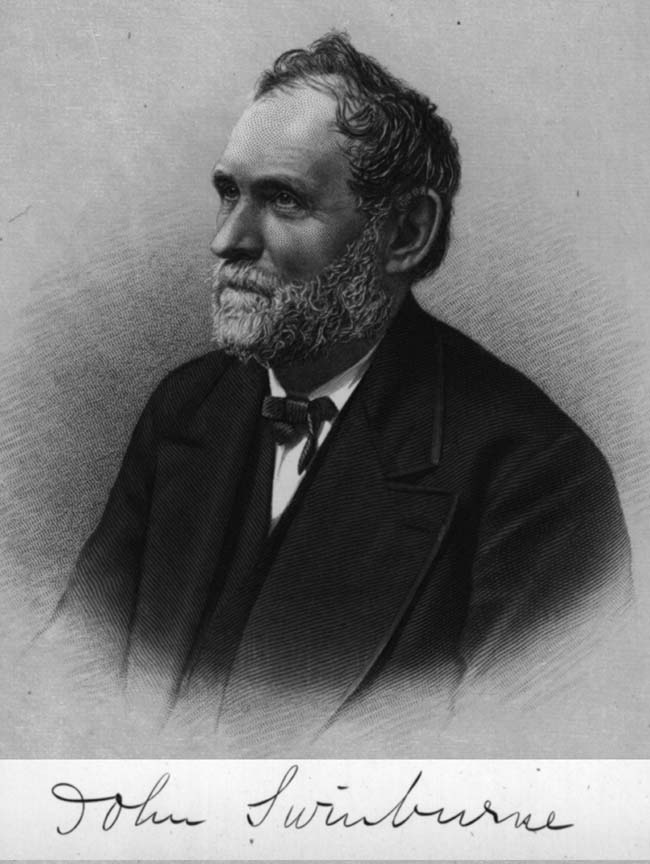
 |
OR INCIDENTS IN THE LIFE OF DR. JOHN SWINBURNE OF ALBANY |
|
|
OR INCIDENTS IN THE LIFE OF DR. JOHN SWINBURNE OF ALBANY |
| Dainty Parisian Dishes. ---The Best in Paris. --- French Soldiers beg to be taken to the American Ambulance.---English Compliments.---Most Popular Men.---Living on Horse, Cat, and Dog Flesh.---French Decorations. |
IT used to be an old proverb that "Good Americans, when they died, went to Paris." It was true, a longing desire existed with a large portion of the American people to visit the gayest city of the world, and enjoy its frivolities and sights for a period. But, at the time our noble-hearted philanthropist was drawn to the French capital, the events were more exciting, and the gay colors of uniformed regiments more imposing, than the traveller usually witnessed. When the iron cordon of the Prussians was drawn around the city, belching forth its fire, and giving to the inhabitants a grand but undesired brilliant pyrotechnic display, the position was not comfortable. When provisions ran scarce, and all the beef had been consumed, and the menu consisted, in part, of horse and dog flesh, whose noxious exhalations, while being cooked, permeated the city, and when "pussy" was a delicate, and delicious dish, it was hardly the place for realizing the celestial aspirations of our pious Americans. But herein this dreamed-of paradise, turned into a purgatory, our humanitarian, Dr. Swinburne, worked with his usual zeal for the good of mankind, without hope of pecuniary reward, as he did during our Rebellion, and by his great skill won a still greater name, even among those who were wont to believe nothing good could come out of the Western Nazareth.
The English press, science, and people were ably represented in Paris during the siege, and while always anxious to believe, and if possible make the world believe, that the best of men came from Britannia, they were at first inclined to underrate the "star" from the West, that had so suddenly appeared to the scientific world. As his works manifested themselves, they became dazzled by their brilliancy, and then charmed, and finally admitted the superior skill of Dr. Swinburne; one English writer asserting that he must be a descendant of the Swinburns of Swinburn Castle, after whom the townships of Great and Little Swinburn, near Hesham, in Northumberland County, were named.
The prompt and efficient work of the American ambulance made such an impression on the correspondent of the "London Daily News," that in writing to his paper in September, after referring to the others, he said, ---
"The English ambulance is now prepared to fulfil requisitions made upon it from any quarter; and it may be of some use, provided the staff have not consumed, in the mean time, all the medical comforts in aiding the sick in the hospitals of the town and in the fortress. But I submit that it is not sufficient for a concern like the English ambulance to take its ease in its inn, and to intimate in a slipshod way, by casual journeys to the front, that it is in a condition to supply requisitions."
In a letter published in the "London Times" Sir J. T. Sinclair said, "Except the Anglo-American ambulance, under an American physician, which is only partially connected with the National Society for Aid to the Wounded, I believe little good has been done by the English surgeons." Capt. Henry Brackenbury in a letter to the same paper, in describing his visit to the English hospital, in charge of Dr. Frank, tells how Dr. May, attached to an American ambulance under Dr. J. Marion Sims, rode back with them in the dark to show to Dr. Frank a peculiar method of using some particular splint. This splint, and the methods of using it, were first introduced into practice by Dr. Swinburne.
A correspondent of the "London News," under date of Nov. 15, said, ---
"The ambulance in Paris which is considered the best is the American (under Dr. Swinburne). The wounded are under canvas; but the tents are not cold, and yet the ventilation is admirable. The American surgeons are far more skilful in their treatment of gunshot wounds than their French colleagues. Instead of amputation, they practise exsection of the bone. It is the desire of every French soldier, if he is wounded, to be taken to this ambulance. They seem to be under the impression, that, even if their legs are shot off, the skill of the Æsculapii of the United States will make them grow again. Be this as it may, a person might be worse off than stretched on a bed, with a slight wound, under the tents of the Far West."
He further adds in another issue, under date of Dec. 23,---
"At the central ambulance of the Société Internationale, the simplest operations are usually fatal. Four out of five of those who have an arm or leg amputated die of pyæmia.. In the American tents four out of five recover."
This compliment to the skill and ability of Dr. Swinburne, the only American surgeon in Paris at the time, and a very flattering reference to the lady assistants and to the American women in general, were republished in the "Diary of a Besieged Resident in Paris."
A Paris clerk of Messrs. Bowles & Brothers, London, who had been one of the corps of the American ambulance, in a private letter to his firm under date of Jan. 10, 1871, said, --
"Of course you have heard of our success,---how the American ambulance is the model ambulance of Paris; and how few our losses are, compared with others. Dr. Swinburne is really the only surgeon in the place. It is no easy work, especially after a battle like Champigny, where we had one hundred and thirty men come in in two days. I brought in the first wagon-load of six at four o'clock, and from that time until the next midnight we were bringing them in. Several were severely wounded, and died that night. Most of the men were severely wounded: we looked for that kind on the field. Dr. Swinburne seemed scarcely to sleep at all and his aids and the ladies worked like Trojans. We had two Prussians: both were mortally wounded, and died soon after, though the last one struggled on three weeks. It was a wonderful case, for his pelvis was literally splintered. Splendid fellows, both of them, and it grieved us to have them die."
The most popular foreign representative in Paris during the siege was the American minister, Washburn, as was Dr. Swinburne the most popular surgeon. Wherever either appeared, they were cordially greeted. On the 27th of September, the "New-York Herald's" correspondent said, "The American ambulance corps and Minister Washburn were loudly cheered on the streets to-day. The crowd was so dense, that the new police appeared on the Champs Elysées, and opened a passage for the ambulance." The same correspondent on the 3d of October, in telegraphing with reference to the battle at Chevilly, said, "Dr. Swinburne describes the wounds of the needle-guns as terrible. The balls are of a larger size than any other used by contending armies. The ambulance went farther into the Prussian lines than into those of the French after the last battle. It was fortunate that the party fell into the hands of intelligent Prussian regiments, or they would not have escaped in safety."
A gentleman named Reed, who had charge of the branch house in Paris of Tiffany & Co. of New York, and who left Paris, with other Americans, on Oct. 25, said in a New-York paper,---
"The American Sanitary Commission is doing a noble work. Several large tents compose its hospitals, and on Oct. 25 they contained fifty-five wounded. The great superiority of the American over the French system in caring for and treating he wounded was clearly illustrated. They are regarded by he French as much better than their own. In case of a battle, the American ambulance men are always first in the field, and go to the front, and even into the lines of the Prussians."
The superiority of the American ambulance is testified to, said the "New-York Tribune" of Nov. 17, by a correspondent writing from Paris, who said, --
"A friend who went out with the American ambulance in the sortie of the 22d ult. says that the wagons came back laden with wounded, among whom were two soldiers belonging to what was not long since one of the finest regiments in the world, ---the Third Zouaves, ---but since dwindled down to seven, of whom three are lying at the American ambulance. One of the principal Paris papers is loud in its praises of this ambulance, and equally severe upon some of the others."
The condition of affairs in Paris was such as to ordinarily render the introduction of any system in the treatment of sick and wounded, different from what had been practised, very difficult of favorable results. Portions of the city, particularly where the American embassy had existed, became so hot from Prussian fire, that Mr. Washburn had to vacate, and retreat to more secure quarters. A most absorbing thought, with many of the correspondents, was something to eat, and the bill of fare of the besieged was at times the burden of their despatches. One of the first announcements in this respect was from a London correspondent, in a telegram to the "New-York Herald" of Oct. 12, which conveyed the intelligence that on the 7th inst. the residents began to slaughter and eat the animals in the menagerie, Jardin des Plantes. This was the forerunner to the famine that followed, and cleared the city of almost all the canine and feline hordes within its walls. The capricious epicurean, whether French or foreign, had to appease his whimsical palate with a dish a New-York street Arab would disdain. Some of the correspondents and ambulance corps, however, under the adverse circumstances, became used to the diet, and indeed became attached to it, declaring as connoisseurs that "kitty," under the manipulations of a French cook, was as tender and delicious as a rabbit.
There was a difference of opinion as to the success of Dr. Swinburne's system of conservative surgery as practised in Paris; but the implied question as to its success was generally given to the world by those who only arrived in Paris after the siege was raised. In no histories of other wars have the hospital treatment of the wounded, and the skill of the surgeons, been brought so prominently forward as during the Franco-Prussian. Scarcely a pamphlet has been issued regarding the war, that there was not a reference to the ambulances.
Archibald Forbes, who arrived in Paris after the raising of the siege, said in his "Experiences of the War between Germany and France," ---
"Half Paris seemed converted into hospitals, if one might judge from the flags. So far as I could learn, the French surgeons in the early days of the siege, when the conditions were favorable, were earnest in the pursuit of conservative surgery. But as the siege progressed, times changed. Circumstances became unfavorable to the recovery of the wounded under any surgical conditions. True, it was possible still, in some favored lazarets, to pursue conservative surgery (a most favorable example was that of the American ambulance, under Dr. Swinburne); but all the receptacles for the wounded manifestly could not share this good fortune. There were crowded and long occupied wards, generating pyæmia, gangrene, and erysipelas; there were overworked orderlies; and there was food of a character inevitably tending to the impoverishment and vitiation of the blood. These conditions presented but a poor field for the successful practice of conservative surgery."
In referring to the excision of the knee and elbow joints, and the establishment of a juncture between the parts on either side of the excised joints, Mr. Forbes said, ---
"The value of such an operation successfully consummated is immense; and under favorable conditions, with skill in the operator, a fair bodily condition in the patient, and sedulous after attention, such an operation is successful in most cases to a pitch which our ancestors did not dream of. The surgeon has to consider the practicability of diminishing the risk to the lowest possible minimum. The dressing is complicated, and the demand on the vital energies that stimulate the healing-power is probably larger. On the other hand, when he amputates, he exposes but one surface, and the other risks are smaller in every way. I fear the success of the operating surgeon has been in no case encouraging: it was hardly in the nature of things that it should have been so."
An historical, fact connected with surgery in the French army during that war, and admitted by the scientific men of England and France, was that the greatest and only successful surgeons were Dr. Swinburne in Paris, and Dr. Marion Sims of the Anglo-American ambulance, outside of Paris, both Americans , and both following the same system of conservative surgery. Had this practice of conservation been followed in the other hospitals and other ambulances, and the operating surgeons understood their work, the eminent English surgeon would not have been called on to record, that, "in the American ambulance in Paris, we had undoubtedly the most favorable results of any."
Three years after Dr. Swinburne left Paris, the following letter was received, dated the United-States Legation, Paris, Oct. 28, 1874, and signed by Minister Washburn : ---
"I learn that the friends of Dr. John Swinburne are anxious to have him appointed professor of surgery. Dr. Swinburne remained in Paris during the siege as chief surgeon of the American ambulance, and acquired great distinction. I think he was regarded as without an equal in any of the military hospitals of Paris. Many of his operations were remarkable, and attracted great attention among the profession. In acknowledgment of his services, the French Government decorated him a chevalier of the Legion of Honor."
"In securing the services of Dr. John Swinburne as surgeon-in-chief of the ambulance," said Dr. Evans in his work, "the committee was particularly fortunate. Dr. Swinburne was a surgeon par excellence, an earnest advocate of conservative surgery, an enthusiast even as regards the conservative treatment of compound fractures, and a skilful operator when operations were required. He possessed a rare and highly valuable quality."
On the 17th of March, 1871, as he was about to leave Paris, " La Vérité," in an article, said, --
"We are happy to learn that Dr. Swinburne, the surgeon-in-chief of the American ambulance, and Dr. Johnson, physician-in-chief of the same ambulance, have just received the Cross of the Legion of Honor. The services rendered during the siege by the American ambulance are known. The devotion exhibited by the members of that ambulance is also known. In the accomplishment of their charitable work, they have recoiled before no effort, before no sacrifice. The distinctions which they may have received are the merited recompense of their zeal and their earnestness to aid those afflicted with the greatest misfortunes. We may add, that long experience and great skill secured to most of the wounded confided to their care cures often unexpected, and that the excellent system of tents, which had already been tested during the secession war, has offered at Paris, as well as in America, the most surprising results. The leaders of the American ambulance have nobly proved their sympathy for France, and they have gained, what is worth more even than honorary distinction, the esteem and the gratitude of all."
The age of chivalry was pre-eminently an age of individualism, and he who had power was ever eager to show the world he possessed it. A knight distinguished for his courage, strength, and skill, added to his honor by the splendor of his equipments. An ostentatious display was eagerly engaged in by them, and every gathering of these valiant knights became a scene of magnificent display. One of the greatest incentives to acts of heroism with them was to receive the smile of a lady, or kiss the hem of a garment woven by her fair hands. In this age of enlightenment and true chivalry, ostentation is ignored by the eminently great, and, like our honored countryman and distinguished physician, their ambition is to perform great acts for humanity, rather than to seek the plaudits of men. In the conviction that he has done his duty to his fellow-beings at home and abroad, Dr. Swinburne takes more pride than in all the official honors or decorations the heads of nations can bestow, although he appreciates these, because they were bestowed on him, not as marks of political favor, but as tokens of appreciation of his unselfish labors. Truly great is the man who in our own Rebellion, and in the French capital when besieged, labored for others so bravely without a dollar's remuneration from the government of either nation.
| Startling Coincidences. --- Differing Doctors. --- Jealousy in the Profession. ---Swinburne on Fractures.---Common Sense in treating the Maimed and Wounded. ---What the Medical Journals think. --- Providential Cure. |
THE study of the history of that portion of science which treats of surgery or chirurgery, affords, even to the general reader, some very interesting incidents, and demonstrates an advance in that branch of science unprecedented, perhaps, in any other scientific research and improvement. All through its history, from the ages when it was enshrouded in ignorance, up to this time, when it ranks among the greatest scientific attainments, every step in its progress has been marked by the same professional jealousies that are manifested at the present time, and the same persecution of those who have led it step by step from its ignorant surroundings up to the high scientific plain it occupies. The reader of history will find much of interest in its perusal, and everywhere will notice the striking coincidence among the learned and the professional bigotry and persecution by those who, having settled into a traditional rut, are still desirous of remaining there, and who are opposed to any methods of treatment not in accord with the lessons taught them by those who lived in generations long since passed away. Formerly surgery was altogether and exclusively practised by the priesthood; and the ignorant masses believed the invocation by these of the help of spirits, good or bad, was the only effective remedy for the amelioration of the sick, maimed, and suffering, who are now treated on scientific and enlightened grounds, as far as possible with the knowledge of the present day. The Council of Paris even went so far, but a few centuries ago, as to pronounce the practice of surgery degrading to the dignity of the sacred office of the priesthood, and beneath the attention of men of learning. History says that Pythagoras was the first to raise it to the dignity of a science, by bringing philosophy to bear upon the practice, he believing that the physician, who had hitherto been considered as one gifted with divine knowledge, must, to be accomplished or successful, possess an intimate knowledge of the principles of surgery, if not with its practice, as it is conceded in this age, that a perfect knowledge of anatomy and physics is absolutely essential in an accomplished surgeon.
In the beginning of the sixteenth century, when surgery was in that condition to which it had retrograded after the efforts of Celsus, Albucasis, Æsculapius, Paulus Ægineta, and Pythagoras to elevate it, and where it had remained for a couple of hundred years, when its practitioners were confined to barbers, farriers, cobblers, and tinkers, France produced the great Ambrose Paré, who did not think it any thing derogatory to have applied to him the title of "barber surgeon," even as our eminent surgeon, John Swinburne, does not feel humiliated at being called the "fighting doctor," because of his contests with professional malpractice and political corruption. Paré's experience in the treatment of gunshot and other wounds on the field of battle, in 1569, naturally directed his attention and investigation to the subject of hemorrhage; and to him was accorded the discovery of the method of arresting bleeding from arteries by ligature. Yet so averse, says a writer on surgery, are mankind to abandon their ancient customs, that the improvements of Paré met with strong and bitter opposition, and were not sanctioned until after much abuse and persecution directed against himself and his discoveries. Indeed, so bitter and, unrelenting were his jealous brethren, that he was compelled, for his own safety, to adduce garbled and incorrect extracts from Galen and other ancients, in proof that to them, and not to him, the invention was to be referred. He was, however, amply repaid by future fame for the opposition which he had at first sustained. He rose to an unparalleled height of popularity afterwards with the army, and was absolutely adored by the soldiers. So great was his influence over them, that on one occasion his presence in a beleaguered city, where the troops were about to surrender, infused among them a new vigor, and the besieging army perished under the walls. His has ever been an honored name in French history, and to him the "Journal Officiel de la République Française," in an editorial on Nov. 27, 1870, enthusiastically compared the American surgeon, M. John Swinburne. The seventeenth century gave to surgery in France Desault and Petit, --- names ever proud in the annals of surgery. These men had to endure the same envious opposition which seems to have been the inevitable fate of nearly all those who have occupied, or now occupy, an advanced and prominent place in the profession. Desault, who improved on the apparatus for fractures, and invented a splint for fractures high in the femur, was, through jealousy, arrested while delivering one of his lectures in the theatre, and cast into prison; where he remained, however, but a few days, when he was released, and he afterwards received many official honors. During the same century, when surgery had made but little advance in the British Empire, England produced Percival Pott, and Scotland, John Hunter, both eminent men. Hunter who at the age of seventeen years was working at cabinet making with his brother, became the very head of surgeon afterwards, and because of an outspoken charge against his colleagues in St. George's Hospital, that they neglected the proper instructions of the students under their care, brought out a very bitter controversy, which was frequently repeated During one of these heated disputes he was taken with one of his old attacks of spasmodic heart-disease, and in a few moments expired. Because of a similar charge made by Dr. Swinburne when professor of clinical surgery, against some of his colleagues in the Albany Medical College, that faculty found it convenient to their own comfort not to remove him, for that they dared not do, but instead abolished the chair he filled. But the doctor did not die, physically or professionally, in the conflict, and has lived to be as a thorn in the sides of ignorant and unskilful surgeons, who are powerless to remove him from his high position, or silence him professionally because of his superior ability.
Pott's attention was more particularly directed to the treatment of fractures, of which he had some painful experience in his own person, having sustained a compound fracture of his leg. His own knowledge led him to believe there was a greater success, with less suffering to the patient, to he attained in this particular branch of surgery; and, as a result of his investigations, another step in advance was accomplished. He achieved a most important beneficial reform in the profession by employing the cutting instruments with greater caution and more reserve, and showing more regard to the laws of nature. As a straw indicates the direction of the wind, increasing from a gentle zephyr to a destructive hurricane, so the most trivial occurrences in life have given us the greatest results. Dr. Swinburne had not received any fractures; but those intimately acquainted with him may have noticed one of the fingers of one of his hands a little shorter than natural, because of having lost one joint; and it is probable that the maltreatment of that finger in his boyhood, trifling as it may seem, may have been one of the incentives to prompt him to devote his talents to surgery, which has given to America one of the greatest surgeons of the age. Of course, like his learned and eminent predecessors, he has been the object of bitter professional persecution, which at one time annoyed him, but now has no more force than a dog barking at the moon, and demonstrates that even the most idiotic prefer to throw stones at the tree which bears fruit, and which they cannot pull down.
The names of Paré, Desault, Petit, Pott, and Hunter all live in history, while those of their envious persecutors have been forgotten, just as John Swinburne's will live in history when the faculty who opposed and endeavored to injure him will be unheard of, as they are now unknown, except to a small and very limited circle, notwithstanding their herculean efforts to obtain newspaper notoriety. Dr. Swinburne, like the eminent men referred to, found time, in addition to the many other labors lie performed, to prepare and contribute to medical literature a number of the most valuable papers of the century on surgery and the treating of diseases, many of these calling forth the highest indorsement from the medical journals; some of his views, like those advanced by his learned predecessors, arousing discussions among the profession, and calling forth captious criticism, which only proved the superior knowledge of the writer.
In the second volume of the "Surgical and Medical Reporter " is a detailed account by Dr. O. H. Young, house surgeon to the Albany City Hospital, of the "Exsection of the. Middle Third of the Fibula," by Dr. Swinburne. On the 5th of June, John Kane, aged forty-five years, was admitted to the hospital. Five years previously he began to be annoyed by a deep-seated pain in the right leg, with exacerbations at night, and otherwise presenting the characteristics of acute periostitis. On June 8 he was rendered fully unconscious by chloroform; and Dr. Swinburne proceeded to operate by making an incision upon the bone about six inches in extent, and crossed above by another about three inches, in the form, of a T. The peroneal muscles and inter-osseous ligament were then dissected off, and the trephine applied above and below the diseased portion, thus separating, with the aid of powerful bone forceps, a section of the fibula measuring four and a half inches in length, including the buttons removed by the trephine, three inches in circumference at one, and three and quarter at the other extremity. This portion of the bone as entirely perforated in its centre, and greatly enlarged,. roughened, and hardened by disease, rendering the use of the trephine a very laborious task. On Aug. 8 the leg was found to be entirely healed, with the exception of a portion about an inch in extent, which was not yet covered with skin. No fistula opening could be found in this ulcer. The patient at that time was hearty and strong, slept well, and had a good appetite ; was entirely free from pain, and walked with much less halt than was to be anticipated so soon after the operation. A few months afterwards he was entirely restored, and, has experienced no return of the pain since.
In the third volume of the "Medical and Surgical Reporter," he contributes an article on the dislocation of the radius (forwards and upwards on the humerus, so as to prevent flexion of the arm to any considerable extent), and fracture of the ulna, with mode of reduction and treatment, nine weeks after the injury. This was the case of a boy belonging in Denmark, Lewis County, N.Y., who fell, and, striking on the left hand, produced a fracture of the ulna at the junction of the second and lower third, accompanied by a distortion which was not reduced. Six weeks after the accident, several physicians and surgeons who were consulted advised non-interference. Two weeks afterwards Dr. Swinburne examined the arm at the seat of the fracture, when he found the ends of the ulna overlapped, and united at an angle of twenty-five degrees, the upper fragment projecting beyond the line of the bone, so as to produce an oblong tumor of an inch in length, and half an inch in width, almost protruding through the skin. With a view to reforming this deformity, and restoring the usefulness of the elbow, the patient was placed under the influence of chloroform, and the ulna seized above and below the fracture, and by steady efforts the union broken up, and the extremities rendered movable. For ultimate success, it was necessary to maintain permanent extension, both to prevent overlapping of the ends of the ulna, and also to reduce and retain the head of the radius in position, as well as by a constant and permanent reductive effort to restore the symmetry of the joint, the bones being constantly forced towards their proper places, the effusion being absorbed by the pressure. To effect these requirements, an apparatus was contrived. A full description of the apparatus is given, and the principle involved, which, he said, may be illustrated very easily by simply placing a bit of board on the fore-arm, from the fingers to the elbow, fixing it at the joint with the other hand, and then flexing, when it will be seen that the splint extends two inches or more beyond the fingers. This splint, or apparatus, was applied Oct. 24; and on the 29th the patient was able to bend the arm to an angle of seventy-five degrees, so that the hand could be carried up to the mouth, with the limb of full length, and the head of the radius in its normal position. When the patient first came to Dr. Swinburne for treatment, the head of the radius rested upon the anterior face of the humerus about one inch, and could not be dislodged till the ulna was broken and extended. Nine days after the splint was applied, the ends of the ulna were in perfect apposition, with perfect freedom of motion in flexion, extension, and rotation; and the boy left for home. In that article he stated that extension could be obtained by two simple boards united by a hinge, and padded so as to be comfortable; so that in cases of emergency an extemporaneous appliance could be readily procured.
In July, 1859, he contributed an article to the "Medical and Surgical Reporter" on the reduction of the dislocation of the humerus (arm-bone) five months after the accident. This was an interesting case. On the 28th of June, Anson Ormsby of Lewis County came under the treatment of Dr. Swinburne, twenty-three weeks and three days after the accident, to be treated for a dislocation of the left humerus from the shoulder by falling. On the day of the accident a physician treated the dislocation who believed he had succeeded in restoring the head of the bone to its socket, and pronounced the joint perfect. Six weeks afterwards the same physician confirmed his former opinion, and volunteered to warrant a complete success. Nearly twelve weeks after the accident the same physician on an examination, declared the shoulder had been re-dislocated, and labored three hours unsuccessfully to reduce it. Six weeks afterwards he went to Brownville and Watertown, Jefferson County, to seek surgical advice, and. was recommended by all whom he consulted to have no more attempts made at reduction, inasmuch as it was considered irremediable after so long a period of time. He afterwards applied to Dr. Swinburne, and the reduction was effected in three-quarters of an hour. The remarkable feature in this case, as set forth in the article, was that the length of time between the date of dislocation and reduction was more than twenty weeks, when it was considered that dislocations are rarely considered reducible after three months, and that the deformity did not appear immediately after reduction, as is always the case in recent dislocations. The doctor, after detailing the methods adopted, asked, "Is it not possible that surgeons may be sometimes in error, in cases of long standing, from this circumstance, and that cases are sometimes abandoned as irremediable because of the impossibility of restoring immediate symmetry, whereas, by securing the parts as accurately and firmly as possible, the deformity may gradually pass away, as absorption of deposited matter progresses, and the head of the bone settles more and more accurately into its natural position?"
In the fourth volume of the same work is an interesting paper by Dr. Swinburne on the reduction of a dislocated humerus after eighteen weeks. On Oct. 13, 1859, William, Sutliff of Brockett's Bridge, Herkimer County, was thrown from his wagon, and the arm near the shoulder-joint fractured. In two months after the fracture had been reduced he had gained the use of his arm, with the exception of utter inability to extend it from him, or raise it to a horizontal position. The attending physician, Dr. Walker, suspected the cause, and, on making a thorough examination on the 1st of January, discovered that the humerus was dislocated downwards and forwards. He was brought under the charge of Dr. Swinburne on the 18th of February, and on the 21st rendered insensible by means of chloroform. The relations of the morbid structures of the shoulder were accurately diagnosed; the head of the humerus lying in the axilla, as in ordinary dislocations, downwards and forwards. The head of the bone was considerably thickened, and there were indications of great deposits of fibrine in and about the axilla; so that the motion of the arm was greatly limited. Efforts were made to reduce precisely as in ordinary recent cases. But, undoubtedly from obliteration of the glenoid cavity deposits, the head of the bone would not remain in situ when the extension and other reductive efforts were relaxed. He then had recourse to permanent and constant means which he had made use of in similar cases with unexpected results. About the 15th of May, Mr. Sutliff returned home under general instructions, and placed himself under the care of Dr. Walker, who afterwards wrote Dr. Swinburne, ---
"I continued the dressing you had applied, re-dressing about every other day, till the 9th of April . . . . I then discontinued all dressing, and advised him to use the arm moderately, which he has been doing; and he is now working some at his trade (boot and shoe making), chopping wood, planting, etc., and, on the whole, regards his case as a providential cure."
This paper, like others by the doctor, gives a minute and comprehensive detail of the case and the treatment, and is of interest to the profession.
There are a number of cases similar to these to be found in the practice of Dr. Swinburne in the county of Albany, and other parts of the State, which would be termed remarkable if published in the books, but which have never been given to the public. As a sample, we give the case of Mr. William Doyle, a stove-manufacturer in the city of Albany, a gentleman weighing over two hundred pounds, as related to the writer by Mr. Doyle himself. In 1857 he was thrown on the Troy road, and the shoulder dislocated downwards, resting on the nerves. A professor in the Albany Medical College was called, and claimed that he had reduced the fracture. For several months afterwards Mr. Doyle suffered the most excruciating pain, with the flesh badly swollen and the skin colored. Unable to bear it longer, he called in Dr. Swinburne, who, on an examination, found that the dislocation had not been reduced; that the joint, instead of being in the socket, was off to one side; and that the bones had grown together in this unnatural position. By the use of rubber extension and counter-extension, Dr. Swinburne tore the parts apart, again, and properly reduced the dislocation to its normal condition, Mr. Doyle saying it required the power of ten men to break it apart. Notwithstanding the pressure was thus removed from the nerves, it was several months before the nerve-power of the hand was restored, or the pain subdued. He considers his ever having the use of his arm still a matter of surprise to him; and although he has the use of his arm and fingers, and can lift with the arm as with the other, owing to the bone having so long rested while out of place on the nerves, he cannot put his hand to the back of his head, or hold it up for any length of time.
Another similar case was that of a Mrs. Jones, who was treated by a professor of the college and another physician for a dislocated shoulder. Months afterwards it was examined by Dr. Swinburne and another physician, and was found to be out of joint, and resting down on the nerve. The dislocation was then reduced; but, owing to the time it had been out of joint., the nerve-power of the hand was destroyed. An action for damages was brought by Isaac M. Lawson against one of the physicians, and a verdict of two thousand dollars recovered.
Another instance where the doctor was called to attend a similar professional error, as told to the writer, was that of a lady over seventy years of age, who had sustained a dislocation of the shoulder, and had been treated by another professor and an assisting physician, who dressed the shoulder in plaster of Paris. A month afterwards they removed the dressing, and declared it had been again dislocated. Six months after this, Dr. Swinburne was called by the lady's friends, and asked to remedy the wrong. Notwithstanding his desire to give comfort and ease to all, owing to the advanced age of the woman, and the length of time that had elapsed, he declined to make the effort.
These are but specimens that might be cited ad infinitum, notwithstanding Dr. Swinburne's assertion "that the reduction of dislocations has been made very simple:" and he suggests the adoption of one of two alternatives; i.e., that those who undertake the reduction of dislocations or fractures, or the treating of the sick or maimed in any manner, should either qualify themselves for the work, or refrain from in any emergency interfering with that most delicate creation of the Maker "so strange and wonderfully made."
In the "Reporter" of December, 1860, he had an article on entomology pins versus metallic and other sutures. In this paper he presented the use of the pins a universal substitute for all other forms of suture when applied to the external surface of the body, not even excepting the metallic thread. They produce, he argued, no irritation of the tissues, and consequently do not interfere with the process of union, though introduced at intervals no greater than a quarter of an inch. The introduction of small entomology pins, he claimed, is attended with but little pain in comparison with that produced by the passage of a needle and thread; and, by the use of the pins, the edges of a wound can be approximated in the nicest possible manner by means of the thread, as used in ordinary harelip operations; so that union by the first intention is more sure to follow than in case of any simple, interrupted, or even quilled sutures. He added, "The advantages of this dressing are particularly manifest when applied to the face and head, obviating the necessity of adhesive plaster and similar appliances, and obtaining the most perfect approximation without special fear of erysipelas, unseemly cicatrices, or, in scalp wounds, the sacrifice of hair. For my own part," he said, "I am in the habit of using this dressing for every operation where it is important or desirable to obtain union by first intention, such as amputations of limbs, tumors, etc.: in fact, wherever the thread-suture is applicable, the pin is equally so. In consequence of its nonirritating character, I am in the habit of applying it where I should deem it imprudent to insert a thread." After treating fully of the benefits to be derived, both surgically and in matter of cost, and giving a minute description of the method of using the pin, he concluded his article by saying, "After one year's constant experience with the pins, I should be loath to resume the use of the old suture."
With that peculiar idiosyncrasy that actuated a portion of the Albany profession at that time, --- a desire to find a flaw in the works or practice of Dr. Swinburne, --- they cried, "Now we have him!" and one of the number, ashamed or afraid to disclose his individuality, rushed into print with the idiom peculiar to them, and, under the cognomen of "Subscriber," said, "the communication was at least five years behind the times." The editor, after publishing "Subscriber's" comments, in a few lines at the end disposed of the criticism by saying, in substance, that, prior to Dr. Swinburne's article, there had been no articles published in which the use of the entomology pins was recommended as a universal substitute for all kinds of sutures, and then dropped the subject on the principle, ex nihilo nihil fit (" nothing comes of nothing").
In the large practice of Swinburne's Dispensary in Albany, no other dressing is used in these wards than pins, where thousands upon thousands have been used; and the doctor has never seen any of the evil results of lockjaw, erysipelas, or other unfavorable results; and, indeed, he has never, in all his extensive practice, had but three cases of lockjaw, and these were the result of dampness and cold in the homes of the patients.
Brief and concise papers of valuable importance to the profession, on other subjects pertaining to medical jurisprudence besides surgery, have been from time to time contributed; among them, treatises on cholera, small-pox, and yellow-fever, and papers on short and displaced femur, the cause of retarded labor, cases of rupture of the uterus, and on errors of diagnosis in cases of pregnancy. On the last thesis he said, "Do not take the opinions of any one of the profession, nor of every person in it, or you will be constantly deceived; do not interfere with a doubtful case of pregnancy, especially where the patient's health is not impaired by the cessation of menstruation."
In 1859 he read a paper before the New-York State Medical Society on the treatment of fractures of the femur by simple extension, ignoring splints and bandages, and related the histories of twenty-five cases, which, in his hands, had resulted better, with more rapid recoveries, and more comfort to the patient, than he had been able to attain by any other means. In 1861 he presented another, in which he advanced the idea that the same method could be applied to the treatment of fractures of all the long bones with equal success; and also that splints and bandages per se were useless, and in many instances worse than useless, if not absolutely injurious, except they are used as media by which the muscles are kept on a stretch, and even then should not be so used as to compress the soft tissues, or retard circulation. These papers attracted universal attention among the profession, and were, in addition to being published in the annual report of the society, republished in the New-York "American Medical Times" and the Philadelphia "Medical and Surgical Reporter." These articles, giving a treatment not commonly known to traditional surgery, aroused the slumbering Rip Van Winkles of the medical profession, who believed the doctrines were erroneous because they were not found in the books; and to their author was the same spirit manifested as to Galileo when he declared that the world, rather than the sun, revolved. Among those to declare their unbelief in these articles, or the mode proposed for the treatment of fractures of the long bones by extension, was O. C. Gibbs, M.D. In these papers, Dr. Swinburne claimed, by actual experience, that the practical surgeon required no appliances for the treatment of fractures of long bones except such as are extemporaneously made; and that the same can be said of the. treatment of fractures occurring in, or in close proximity to, any joint, such as intracapsular fracture of the neck of the femur, Colle's fracture of the radius, those involving the elbow-joint, the surgical neck of the humerus, compound dislocation and fracture of the ankle-joint, compound fracture of the tibia and fibula, etc.; and that the same is true of diseased hip-joint, morbus coxarius, and also incipient kneejoint disease. "It has been said," said the doctor, "that accident makes the man," and then asked, "Would accident make the man if he had not the knowledge to take advantage of the circumstances?" He added, ' I can conceive how accident might give us wealth; but accident developing wealth or social position, and accident developing one's mental and scientific resources, are two things quite separate and distinct."
In treating of the use of splints and the necessity of extension, he said, "All that Nature requires for perfect union of bone is rest and a moderate degree of excited action, while all pressure by splints, bandages, etc., only impedes the process of reparation; and this pressure, in my opinion, is a prolific cause of non-union."
The true use of splints, he held, should be to keep the fractured ends of the bone in apposition by placing the muscles on the stretch, and thereby making them the true splints.
The experiments of Reid and others show that muscles are not susceptible of being stretched beyond their normal capacity; that, when so stretched, they are capable of bearing great lateral pressure without much deflection; and any attempt at undue lateral pressure results in rupture of the muscular substance.
"While Nature," said the doctor, "requires rest for bony union, she requires also perfect apposition for union without deformity. How is apposition to be effected?" he asked. "We start with the knowledge that a living muscle cannot be extended beyond its normal capacity, and that any attempt to go beyond this not only provokes resistance, but a tearing of the muscles. Take, for instance, a fractured thigh: extension on the extremity by a strong man will stretch the muscles to their normal length only, which fact can be shown by the most careful measurement, thus proving that the danger of too much extension is only imaginary. Assuming the position," he said, "that the extended muscles act as permanent adjusters of broken bones, and are in reality the only means by which the fracture is maintained in apposition, I ask, Of what use are all the mechanical appliances and apparatus called 'surgical splints,' if not to effect the above-named results? The splint, beyond this, possesses no practical worth: on the contrary, it is apt, by its too careful adjustment, to impede the reparative process by interfering with the proper circulation of the proper part . . . . Then we may say that in extension the living muscles and other investments of the bone are the true splints, and that there is but little exception to this principle being universally applicable. As for myself, I employ this treatment indiscriminately, and I only ask my professional brethren who have the opportunity to try it, to do the same, and I am sure they will be able and willing cheerfully to bear witness to its entire efficiency, as have my friends, Drs. Thom of Troy, McLean of the Marshall Infirmary, Troy, Whitbeck of West Troy, and Willard of Albany."
He then proceeded at length to demonstrate minutely the ground taken, that fractures of the thigh or leg can be treated effectively simply by a perineal belt, and extension from the foot, and asserted that the method challenges comparison with the results of the most complex machinery of splints and bandages, and proved his deductions from about thirteen years' experience in private practice in the treating of fractures to be correct, in that in over forty cases of fractures of the femur and tibia, by extension, in no instance was there a shortening of over half an inch (and this the result of inattention), while in a large majority there was no shortening at all. He claimed there were many objections to the proposed elastic extending and counter-extending bands with weights and pulleys: among these, that it admits of spasmodic contraction of the muscles; that it presumes all muscular tissues are equal in tone and strength, which he held was by no means the fact; and that, were there to be applied a trifle too much weight, the object would be defeated by absolute separation of the bone.
Up to the time that Dr. Swinburne presented this paper, we have failed to find in any of the medical journals any account of where any surgeon had assumed to use extension for any fractures except that of the thigh, and of no attempts to treat the thigh without some of the long splints and bandages. And even now, with the experience that time has given, only the more advanced scientific men have adopted extension for all the long bones, and the dispensing of splints and bandages, except where plaster of Paris is used. A few years afterwards, in according "honor to whom honor was due," Dr. Louis A. Sayre, professor of surgery in Bellevue Hospital, said, "Dr. Swinburne was the first to introduce the principle of extension and counter-extension in the treatment of fractures before the profession."