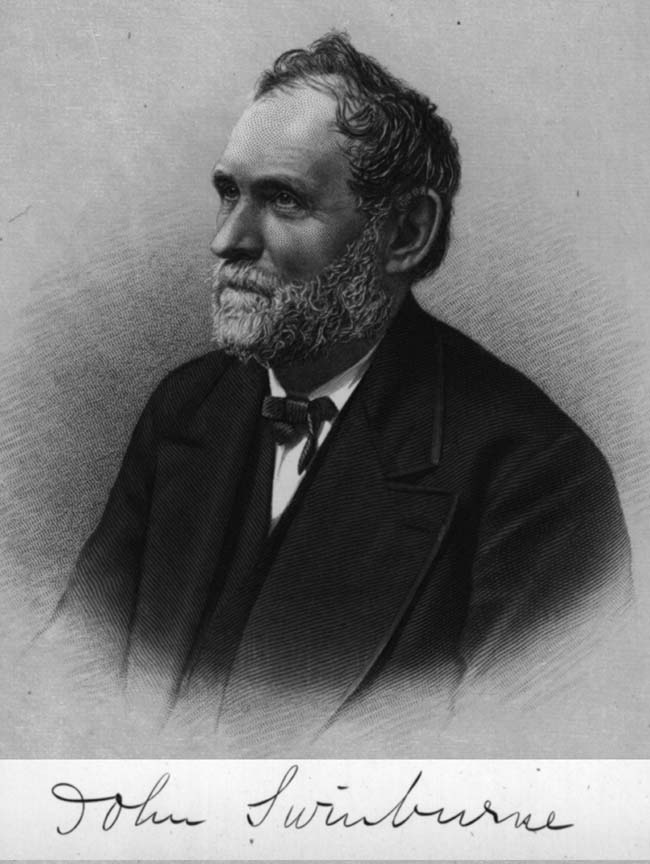
 |
OR INCIDENTS IN THE LIFE OF DR. JOHN SWINBURNE OF ALBANY |
|
|
OR INCIDENTS IN THE LIFE OF DR. JOHN SWINBURNE OF ALBANY |
| Winning Laurels in other Lands. --- Siege of Paris. --- American Ambulance. Only Successful Surgeon. --- A Touching Scene. --- Always at the Front. ---Distinguished Installation. |
THE change of scenes in the great drama of life, in which men and women are the actors, and where only the angels are allowed to be lookers-on, passed so rapidly, and presented in such rapid succession this remarkable and eminent man in the leading rôle, that one is almost persuaded to believe that the presentation is the production, by the dramatist, of a mythical character drawn from the imagination. With a vast majority of human beings, the excitement, philanthropy, and danger attending the career of Dr. Swinburne, as recited in the chapters already given, would have been sufficient, in the life of any single individual of the most thoroughly patriotic, philanthropic, and American impulses, to afford material for a biography replete with thrilling incidents and eminent achievements. But the events following those already recited furnish a still more intensely notable period, eclipsing any previously enacted, and winning again for him a crown of glory in other lands, of which every American may feel justly proud.
Among the galaxy of names adorning the history of this nation in patriotism, science, the arts, and literature, a page is reserved and a niche provided to commemorate, as one of the most brilliant, the fame of Dr. John Swinburne.
Of a clear night, when one turns the eye heavenward, the vision beholds the whole arch above studded with stars, sparkling as so many diamonds, each reflecting a greater or lesser degree of brilliancy. They are all stars, and differ only in their magnitude, while the number is countless; but, of all these constellations and celestial bodies moving around each other, there are but comparatively few sufficiently grand to have specially called the attention of astronomers and the world. Occasionally, among these dwellers in ethereal space, there appears a comet, whose advent is a matter of wonderment, and whose luminous train presents a magnificent track over which it has passed, obscuring the others. More brilliant it grows as it approaches its zenith, and then passes away, leaving an enduring remembrance of its magnitude and beauty. So it is with the dwellers on this terrestrial globe: some reflect no beauty; others, but a scarcely perceptible twinkling; while others are like the swift-darting stars, moving from one point to another, steadfast as the sun, and whose lives on earth leave a course behind them as brilliant as the comet, and as clear as the Milky Way. This class is limited. Only to a very few is it given to attain permanent brilliancy, and to be noted almost simultaneously in many nations and on two continents. Among this class we believe unwritten history for ages to come, both in this nation and in Europe, will enter the name of the man of whose valor on the field of battle for the preservation of his nation, of whose eminence and skill as a physician and surgeon, and of whose scrupulous honesty, executive ability, and superior science in a great official public position, we have been reciting a few incidents taken from actual life, and not drawn from imagination.
Having been taken a prisoner of war, witnessed the misery there endured, and felt all the gnawings of privation and hunger, it would be but natural to suppose that an exercise of discretion, said to be the better part of valor, would prevent him from again placing himself where he would possibly have to re-endure the same hardships. Yet, strange and anomalous as it may appear, this skilled physician and surgeon, with the recollections of his last military campaign as a prisoner of war, from which he had not wholly recovered, and but recently relieved from official duties amidst pestilence and disease, voluntarily enters a city in another nation, whose walls were being surrounded by an enemy, to give by his skill aid to the sick and wounded, with no music but the tramp of armed hosts, the bellowing of cannon, the bursting of shell, and the shrieks of the wounded and dying.
When superseded as health-officer of the port of New York, at the opening of the reign of plunder under which New-York State suffered under Tweed, he returned to Albany, the city of his former residence, where he met with a reception and greeting such as is accorded only the eminent and great. Among the first to give him a cordial greeting was the Albany Medical Society, who, to reflect public sentiment, and to express the honest feeling of the profession of the county at an official meeting on Feb. 7, 1870, unanimously adopted the following preamble and resolution: --
"Whereas This society has been informed that Dr. John Swinburne has purchased his former dwelling-house for the purpose of removing his residence to this city: therefore
"Resolved That the Albany-county Medical Society has heard with pleasure of his intended return, and extends to him a cordial welcome, and that the president and secretary are requested to write him a letter expressive of these sentiments of this society."
At the time of the adoption of this resolution, none better understood the ability, character, and standing of Dr. John Swinburne than this society of medical men, holding all kinds of political views; and, when the letter was received by him, it bore the signature of almost every member of the society.
The active life of constant professional anxiety, of unremitting toil and excitement, which he had passed through during the previous decade, had necessarily strained his nervous system to more than an ordinary tension; and, when the hour of relief arrived, it was natural, at the thought of responsibility being lifted from his mind, that, nature asserting its rights, he should desire relaxation and rest for a time; and, seeking a change of scenes, he left for a trip through Europe. But the fame of the great surgeon and physician had preceded him; and, soon after his arrival in London, he was apprised of the fact that his skilful services in the cause of humanity were as anxiously sought in the Old World as they were in the New. A new theatre of action was opened, upon which he entered, that gave a change of scenes pre-eminently more exciting than he sought, if it did not afford the recreation and rest he crossed the Atlantic to secure.
At this period, war, with all the horrors the doctor so well understood, was spreading over the fruitful valleys and along the beautiful rivers of France; and two nationalities, for whom the great American physician and surgeon entertained a feeling almost akin to that he felt for his own countrymen, were slaying each other in bloody conflict. When the clouds of war were gathering, and the murmurs were portentous of what followed, a large meeting of American citizens residing in Paris was held in that city on July 18, 1870, when it was decided that they as non-combatants would organize a system of "Help for the Wounded of All Nations" on strictly humanitarian grounds, and elected as an executive committee Thomas W. Evans, M.D.(president), Edward A. Crane (secretary), Col. James McKaye, Albert Lee Ward, and Thomas Pratt, M.D. As late as the 26th of August neither the French minister of war nor the representatives of foreign governments would guarantee to recognize the proposed American ambulance at any headquarters, asserting no special passports could be accorded it, and adding that all movements made by the ambulance must be at its own risk and that of its personnel. Besides these obstacles, there was a feeling among the French soldiery that all foreigners not attached to some branch of the French army were Prussian spies. This was the condition of affairs when three members of the committee, indorsed by Minister Washburn, visited London, and solicited Dr. Swinburne to accompany them to Paris and voluntarily take charge of the American ambulance, and introduce, for the sake of humanity, his system of conservative surgery which had proven so great a boon during our civil war. It must, in this connection, be remembered, that every service to be rendered was to be voluntary, each person attached to the ambulance bearing all his individual expenses. Because of discouragements, the zeal in the movement had largely subsided; but on the appearance of the committee in Paris, accompanied by Dr. Swinburne, a new vigor was infused into the movement, and it was restored to its activity. The doctor, when appealed to, did not stop to consider the merits of the questions over which these nations were exercised, and which they were endeavoring to settle by the cruel arbitrament of war: he thought only of the sick and wounded, who would "no longer be soldiers, but men," and, accepting the call, repaired to the gay capital, a city of excitement and communism, to take charge of the American ambulance. From his arrival in Paris on Sept. 7, 1870, to March 18, 1871, during the Franco-Prussian war, he found an ample field for the exercise of his natural promptings of humanity, tenderness of feeling, and skilful abilities, all of which he exercised in such a manner as to win not only the praises of the French themselves, but of their enemies and all Europe, and to be honored with a rank such as few foreigners were ever accorded by the French Government.
During his stay there, times were unusually exciting, even for Paris: the empire was destroyed, and the republic established; the cry of "Vive l'empereur!" turned to bitter curses against the emperor and all his officers; and the air was made to resound with the cry, "Vive la république! A bas l'empereur!" "The gayest city in all the world" became transformed into one of the most extreme suffering, the residents being reduced to the eating of horse-flesh and similar food. In the winter season it was almost impossible to procure fuel, the inhabitants dying of cold and starvation. To these sufferings were added the prevalence of small-pox. No person within the walls of Paris, during that period of suffering, lived without enduring some, if not all, of these hardships, besides being constantly subject to slaughter by a communistic outbreak, or death from the bursting shells constantly falling in the city.
From the closing of the gates on the 18th of September, to the capitulation and surrender in January, the heroic doctor was ever alert and at work. The scenes of want were horrible and beyond description, with no meat or solid food to eat except horse-flesh and fat, the disagreeable odor which it gave out, while cooking, haunting the whole city. Half the northern portion of the city had been transformed into ambulances, and places for the care of the sick and wounded, the Grand Hotel being turned into a huge hospital. The continuous fall of shells in the city, often bursting among the hospitals and ambulances, killing the sick and wounded and their attendants, was a trying ordeal for the non-combatant volunteer American surgeon. The condition of that city where "our" philanthropic surgeon was performing voluntary service such as to excite the wonder of the people, and the admiration of the profession, may be faintly surmised by the state of affairs when the years 1870 and 1871 came together. For the last week in 1870 there were 3,280 deaths in the city, not including those in the hospitals, which were crowded. From 400 to 500 deaths were caused by small-pox weekly, while typhoid-fever and bronchitis were causing an equally great mortality. At that time, for food, the butchers bought large dogs at from 200 to 300 francs each, smaller ones bringing proportionate prices; cats varied in price from 9 to 25 francs each; and a pair of camels sold, for food, for 4,000 francs.
Dr. Swinburne, in the carrying-on of his work of mercy, had the active co-operation of his countrymen residing in Paris, and for his assistants chose men who were wholly ignorant of medicine or surgery, but who were in financial circumstances such as to enable them to devote their entire time to the work, and bear their own expenses. His chosen assistants were Frank M. O'Connell; J. B. B. Cormack, son of the physician in charge of the English hospital, who desired that his son should be trained by the great American surgeon; Louis Winfield, a brother of Lord Powers of Powerscourt, Bray, Ireland; Gilead Peet, a literary student; Joseph K. Riggs, a brother of the then prominent Washington (D.C.) banker, and Frank Riggs, a nephew, and now banker in Washington, D.C.; and the two Bower brothers, proprietors of an establishment for the preparation and sale of chemicals used in laboratories. These gentlemen were absolutely ignorant of the methods to be used and the services to be rendered by them in this new and voluntary field, all of whom rapidly acquired a proficiency in the treating of fractures and gunshot wounds, and the dressing of wounds, thus practically illustrating the theory of Dr. Swinburne in therapeutics, ---that men whose minds were free from the old established rules and ethics of ancient, unenlightened, and traditional surgery, and who had not to exhaust time in unlearning what they had studied, became more easily better assistants. In a few days he had succeeded in making better assistants of these gentlemen than many graduates of the Hôtel Dieu, the greatest and oldest hospital in Paris, after years of training in the dressing of wounds, ---a fact conceded by the French surgeons and the people. Of one of these assistants, Joseph K. Riggs, a writer quoted by Dr. Evans in his "History of the American Ambulance in Paris," said, --
"I never shall forget the surprise I felt on the very day of the affair at Chevilly, at seeing Mr. Riggs in the operating-room, assisting Dr. Swinburne, then engaged in amputating a thigh, and that with all the sang-froid of a veteran surgeon. Daily accompanying Dr. Swinburne in his visits, he soon qualified himself to discharge all the duties of a surgeon's assistant, and became, perhaps, the most expert dresser in the ambulances."
The work performed at the American ambulance was not done in secret, and the eminent surgeon did not put his light under a bushel. He was willing that all who were ready to profit might see for themselves, being particularly willing, the French journals said, to explain to the profession, and those engaged in alleviating pain, this simple yet grandly successful system of conservation in surgery. Among the almost daily visitors to the American ambulance were Minister Washburn, and the consul-general for the United States, Gen. Reed. Gens. Burnside and Sheridan, while in Paris, made frequent visits to the ambulance, expressing the greatest pleasure at the successful work there being done. Almost all the foreign notabilities who were admitted into Paris during the siege, or arrived in the city after the surrender, heard of and visited this ambulance. Among other prominent personages who honored it with their presence was the Archbishop of Paris (Darboy), "who, after expressing his sincere thanks to the skilful surgeon Dr. Swinburne, who performed the operations, and to those who aided him, who brought as much of heart as of science to this generous work, left, after blessing all the tents, and the gentlemen connected with them," says "La Semaine Religieuse de Paris" of Nov. 26, 1870.
So universal had become the renown of the celebrated American surgeon, and the work of the American ambulance, that it seemed all Paris was desirous of paying homage to those engaged there; and it was no uncommon sight to see thousands of people standing in the avenues, looking in wonderment at the row of tents, one eye-witness stating that the Avenue L'Impératrice, eight hundred feet wide and three miles long, was crowded from the Arc de Triomphe to near the Bois de Bologne for nearly two miles every pleasant day, to see what the Americans were doing. So loud were the praises bestowed, that the attention of the government was directed to it, and it became the object of many official visits, one by the military governor of Paris. Of this visit, says "Le Petit Moniteur" of Nov. 6, "Last Sunday Gen. Trochu visited the American ambulance, and expressed his complete satisfaction with the admirable installation of the different services, as well as with the care taken of the wounded."
After the close of the siege, and the declaration of peace between Germany and France, Dr. Swinburne, on March 18, 1871, took his departure from Paris; but the ambulance, and the gentlemen he had trained, remained, and did noble service in the era of blood that followed and deluged that city. Soon after his departure the gates of the city were again closed, and a reign of terror and plunder inaugurated by the nationalists and communistic elements, that continued without cessation until the capture of the city by the government. Men were arrested, and shot in cold blood, as was the Archbishop of Paris, whose only crime was his exalted position; churches were sacked, the services stolen, the images desecrated, and dressed in attire of the most diabolic and wickedly brutal nature ; and priests and the best citizens were thrown into prison. Nothing was wanting but the guillotine to complete the horrors of this barbarous and hellish state of affairs. The city was reduced to a condition of abject terror in which no man was safe in life or property: the prisons were filled, the hospitals crowded with the sick and the wounded, the atmosphere heavy with the shouts of wild and maddened men and women, the streets red with human blood, and the highways and public buildings mined, and prepared for destruction; for the commune had declared its intention to blow up and set fire to Paris rather than surrender. All avenues of escape were closed. Provisions were again running short; and M. Thiers had declared he had shut up the insurgents to perish like rats in their holes, while they, in turn, had declared their resolution to die, if need be, amidst the remains of their beautiful city. One scene in this carnival of death between the forces in the streets of Paris, and the part the ambulance took in the affair, was given in the "London Times," and afterwards incorporated in McCabe's history. The writer said, "I waited in the entry of the ambulance for an hour. I saw for a quarter of an hour one wounded man carried into the one I was near every minute, for I timed the stretchers by the watch. Looking into others, I could see the courtyards littered with mattresses and groaning men."
Through all these scenes of blood and communism, the corps trained by Dr. Swinburne were true to their teachings to save, and continued their work of mercy. It was during this state of affairs that one of his assistants, Frank M. McConnell, at the personal risk of his own life, succeeded in enabling over thirty priests to escape from the city by attaching them to the ambulance, and attiring them as attendants in the ambulance costume; thus enabling them to escape from the city, and thereby saving these Christian men from horrible deaths at the hands of the bloodthirsty mob. He was constantly in attendance on the archbishop up to the time the good man was shot.
What a bright picture this conduct of Dr. Swinburne and his assistants, in working for humanity, presents, compared to the dark and bloody record to blot the fair escutcheon of American citizenship, as made by Cluseret and Whitton, the only two leaders among the insurgents claiming to be American citizens! The first were as that of angels from the regions of the blessed, on a mission of mercy; while the others were as emissaries of destruction, sent from the bottomless pits of Hades.
The history of the work of Dr. Swinburne in Paris was fraught with unprecedented success, causing a just pride among the American residents of Paris, and drew forth universal and honorable comment from those in official position, ---from authors, the press, and scientific men, who heretofore indulged the idea that America, while a great nation, was still, in the developing of science and scientific men, as a "babe in swaddling-clothes." The citizens of the capital city of the great State of New York feel a natural pride in reading these comments of other nations on the achievements of one of their fellow-citizens who is eminently of the people. Believing their perusal will arouse a similar feeling of pride, not only among the members of the profession he has so honored, but in the hearts of every America-loving resident in Dr. Swinburne's native State of New York, we collate and condense a few from the many.
Dr. Evans, in his "History of the American Ambulance," says, --
"Every little coterie was ambitious to have its ambulance, which it could direct and talk about. Hospitals had their lady managers, whose sole qualifications were rank, wealth, and the unconquerable determination to keep at the head of fashion, through whatever singular paths it may lead. In these private establishments the doctor often played only an inconsiderable rôle. He did what he was told; he was obedient and submissive; he was necessary---and so was the scullion.''
In speaking of the successful treatment in the American ambulance, Dr. Evans said,"---
"Dr. Swinburne's highly successful exemplification of the beneficial action of conservatory surgery, and of the re-formation of bone, excited the greatest interest among the medical men who visited the ambulance, in which oakum was employed in preference to lint, on account of its antiseptic qualities, and compresses of hot water were mainly employed for dressing, to the exclusion of many of the usual applications. Of seven cases of amputation of the thigh, only four resulted in death; while, at the ambulance established in the Grand Hôtel, every case of amputation terminated fatally, just as is always the case in one deadly ward of the Hôtel Dieu (the largest and oldest hospital in Paris), where scarcely a patient amputated has ever yet escaped death from gangrene or pyæmia. At the ambulance of the Grand Hôtel the deaths have been said to have exceeded forty-five per cent of the number of cases treated. However this may be, the administration up to the present time (1873) has declined to make public its record. Now, in the far more economically conducted American ambulance, the proportion of deaths before the engagement at Bougert was only three and a third per cent."
A comparison of the results obtained in the American ambulance with those obtained in other ambulances and hospitals show conclusively that the objects those in charge of the American ambulance desired to accomplish were attained, ---that of demonstrating the excellence of their system of surgical conservation, and the superiority of tents over solid buildings in the treatment of wounds, as well as the importance of hygienic conditions as a means of preventing disease and effecting cures, --- essentials so tenaciously insisted on by Dr. Swinburne during his service in our "unpleasantness."
In paying tributes of praise to Dr. Swinburne and the spirit which impelled him and his associates, and in descriptions of the properties and facilities connected with the American ambulance, the press of Paris, official, scientific, religious, and secular, notwithstanding the exciting events that pressed upon their columns, seemed to vie with each other as to which should excel in complimentary notices of the American institution, its surgeon, personnel, and installation, a few of which we incorporate.
In describing a visit to the ambulance, M. Picard, in an editorial in "Electeur Libre" of Oct. 3, 1870, said, ---
"Yesterday we visited the American ambulance. Is it necessary that we should dwell upon the scrupulous cleanliness of this ambulance, or the assiduous care with which our wounded are there treated? It is truly touching to see these foreigners of wealth thus giving themselves up without reserve to this humane work. We have seen these gentlemen assisting the surgeons in their duties, holding the limbs of patients, and engaged in all the details of dressing wounds, under the fire of the enemy, to pick up these same wounded. These generous men would be unwilling to have us give their names to the public. All that we are able to say is, that their benevolent devotion and their indefatigable ardor assure to them the gratitude of France, whose friendship was long since gained by the States of the American nation."
The humanitarian work of Dr. Swinburne and his corps of assistants was gratefully appreciated by the French people; and in reflecting their opinions, "Le Réveil " of October, 1870, said, ---
"Never was a sacred work of sacred humanity better conceived, or better put in practice, than by this band of generous and devoted men, who, able to find security everywhere else for themselves, their families, and their fortunes, have preferred to remain in our midst, to encourage us by their presence, and, with open hearts and open hands, to give us their sympathy, their aid, and their succor-fraternal and so practical --- in the terrible crisis through which we are passing."
The "Journal Officiel de la République Française" (the official journal of the French Republic), on Nov. 27, 1870, said in an editorial article on the American ambulance, occupying two entire pages of the paper, among other things,---
"It is now understood how it is brought about that one may breathe under the tents only an air warm and healthful. And is there occasion for being astonished, that, as a consequence, where the American system is applied, everybody should be absolutely ignorant, or as much as it is necessary to be, not only of what purulent absorption (scientifically called pyæmia) and hospital gangrene may be, but even of the fever, which is not a necessary consequence of a wound?
"Every morning, Dr. Swinburne, a gentleman as modest as he is well informed, accompanied by his aids, attends to the dressing of wounds. Formerly port physician of the city of New York, he was travelling in Europe when the war broke out. His devotion has kept him here, to assume the noble task which he is fulfilling with such admirable skill. Aid Nature instead of affronting her, such is their device; and such is henceforth, we know, that also of our greatest French practitioners. It is forever the admirable and simple expression of our own Ambrose Paré, 'I dress his wounds, God cures him.'
"We hardly need to add, after all this, that at the American ambulance every one is a declared partisan of conservative surgery, that delicate art which is happily also in honor among us.
"And now a word about those who extend these unremitting attentions to our wounded, who generously offer them these effective consolations. Shall they find us indifferent? No. How could we fail to recognize that which they are doing for us, if it was only by showing how singularly practical are the ideas of those excellent surgeons who have come from the other side of the Atlantic to place at our service, with so much generosity, their incontestable science and their indefatigable devotion?(1)
"We shall be excused for having passed over in silence any technical details to which we might have usefully referred; but we should not have accomplished, even now, half our task, had we stopped only to enumerate the new curative expedients, perhaps still unemployed in France,---in a word, the innovations of every sort for which hospital science is indebted to the Americans."
The " Union Médicale" of Feb. 4, 1871, said, --
"Let us hope this new experiment will not be fruitless, and that it may confirm the results already obtained. While the genius of destruction multiplies its ravages, and accumulates ruins, it is a consolation to believe that the genius of conservation ---less powerful, alas! --- has been able at the same time to make a step forward. We shall be happy, if, in the midst of these bloody orgies of force, we have been able to save a lives more than formerly."
This notice of the "Union Médicale," of the conservative surgery practised by Dr. Swinburne for six months in a city where are all the leading surgeons of Europe, is significant, coming as it does from a scientific journal which never draws conclusions, or advances a recommendation of any kind in medical ethics, until it has well tried the subject, and is positive of results.
Early in the siege, this at first called innovation introduced by the American surgeon, John Swinburne, began to draw attention as above the others of the numerous ambulances, and on Oct. 31 the "Paris Journal" said of it, ---
"We soon, however, began to hear it admitted, not only that the Americans were laboring most earnestly in a humane manner, but that unusual successes were rewarding their efforts. The American ambulance established in the Avenue Uhlrich is one of those which, up to the present time, has given the best results in the curing of wounds. After the battle of Chevilly, Dr. Swinburne and his assistants obtained from the Prussians the restitution of a number of wounded French, all severely wounded; and their care has saved them all."
One of the instructions to the ambulance attendants was to bring in the most severely wounded as quickly as possible. That this order was well carried out may be seen by an item in "L'Universe" of Nov. 1: ---
"Upon the Flanders road, deserted and gloomy, obstructed at every step by trees which lay in the way, we met the American ambulance, always at the very front (au premier post) whenever it was a question of comforting courage in misfortune."
La Semaine Religieuse de Paris" said, ---
"Their ambulance may also be said to be a model of its kind. Setting out with the principle that hospital wards, where the sick are commonly heaped together, are, to use the expression of Cabanis, 'magazines of corrupt air,' the Americans have lodged our wounded under tents grouped together in picturesque disorder, yet separate one from the other. The whole medical apparatus is carefully concealed: it only appears when indispensable. There are no herb-teas : these are replaced by wine. The drugs are purchased of the butcher, and the apothecaries are left to advertise."
"Le Nationale" of Dec. 11, 1870, in an article, said, ---
"Among all these ambulances, whether old or new, which exist in Paris, there is one distinguished by its organization, and particularly by its system of installation, --- the American ambulance."
M. Lafarge, in a lengthy article on l'ambulance Américaine, published in "Le Figaro" on Jan. 26, 1871, said, --
"About halfway down the Avenue de l'Impératrice, on the right, you perceive a number of tents ---not a large number, a veritable little city of canvas: it is the American ambulance. You are at first surprised that the wounded can be treated almost in the open air; but if you enter, you will very quickly change your first impression . . . . Let no one fear that bronchitis and other diseases of the respiratory organs have been occasioned by this practice. Facts have settled this question . . . . In the very coldest weather, a sufficient temperature can be maintained inside of the American tents. During the severe weather of December, when the cold was ten or twelve degrees below zero (Centigrade), the temperature was maintained within the tents at from +12° to +15°, and that without forcing the fire . . . . Go and visit the American ambulance: not only will you meet there with the most gracious reception, but you will obtain from the lips of the wounded themselves the expression of their lively gratitude for the intelligent care they are receiving."
Comments like these quoted, all from leading journals and authorities, speak volumes of themselves, and breathe praises such as the French press, always jealous to maintain the highest positions for Frenchmen, never before bestowed on any foreign surgeon. To comment favorably was but natural, under the circumstances, and might be expected from the grateful feelings and naturally complimentary Frenchmen; but placing the American surgeon's system of conservative surgery as eminently above their own, and one they would adopt in the future, was only accorded on pure merit, particularly as the press had their own ambulance, of which they were extremely jealous and proud. These press notices are rendered the more valuable when such eminent literary men as M. Sarcey, and such scientists as M. Desault, go still further in according the palm of excellence to Dr. Swinburne, his corps and ambulance.
| These People are our Masters.---Great Results with Small Means.---Conservative Surgery.---Remarkable Operations. --- Surgeon Par Excellence---Only Success. --- The Field-Stretcher. |
FRANCISQUE SARCEY, a: distinguished literary gentleman, in "Le Temps" of Dec. 21, 1870, and in his work entitled "La Siège de Paris," a book that ran through twenty-four editions in six months, said, --
"I met, a few days since, one of the thousand acquaintances which every Parisian, a little known, has upon the Boulevard,---a physician by profession, distinguished, I might also say celebrated, in a surgical speciality, and who, like most of his confrères, is attached to one of our numerous ambulances. The conversation fell naturally upon the subject of ambulances. He was full of it; and it happened also that I was a little acquainted with it, being very intimate with one of those persons most occupied with the direction of the ambulance of the press. I had also studied with great care the remarkable work by Dr. Chenu, with the intention of making in my turn, and with his facts, a campaign against the organization of the medical service in our armies.
"'You are interested in this?' said he. 'Very well. And you have very probably visited the American ambulance?'
"I confessed that I had not.
"'Then I must take you there. Ah, my friend! those people there are our masters. How simple, ingenious, and practical is every thing connected with its organization ! It is made of nothing, as we should say. Their installation has scarcely cost twenty thousand francs; and they have a hospital the most healthful, the most convenient, and the best furnished, --- the model hospital, --- the hospital of the future. Our most eminent physicians have visited this ambulance. I have met there Nélaton, Record, Jules Guerin, Démarquais, and others. They have pronounced it excellent. Every physician in Paris should go and see, and convince himself with his own eyes of the superiority of the American installation. The public should come to the rescue, that administrative routine may be forced out of its absurd paths by a vigorous and irresistible pressure of public opinion. The medical journals are only read by a profession which it is useless to convince. It is through the ignorant and the humble, through the crowd, that important reforms and great revolutions are effected. What a distance there is between theory and practice! There had been twenty amputations at the Grand Hôtel, and out of these twenty cases there had been twenty deaths. At the Hôtel Dieu never has an amputation succeeded.'
"'Very well,' said I. 'Let them put the amputated somewhere else. Very simple! I see you are still an innocent, my dear fellow. Nothing is simple in administration. A sick man is brought in, and there is an empty bed. The sick man is put in his bed, and he dies; but there is nothing to be said. The number was in its place, good order is preserved, and the register is correct. Every thing is for the best in the best administrations. The hospitals are not for the sick man, but for the doctor.'
"He said to me many other things besides, which I do not remember. The next morning, however, he took me in his carriage to the American ambulance. I had invited one of my confrères to accompany me, M. Armand Gouvien, who was the director of the ambulance of the press. I was very desirous that he should see with me these pretended marvels, and give me his opinion of them.
"We were received by the surgeon-in-chief, M. Swinburne, and by M. M. Brewer (one of the Brewer brothers), who speak our language with the greatest purity, and who gave us answers to all our questions with the. most perfect courtesy; and it would he impossible to accuse them of having had in view, by so doing, any publicity through the press. My name (I confess it very humbly) seemed to suggest nothing to them, and whatever special attentions were paid, were offered, as was proper, to my two friends, who were of the party; and they were in ecstasies over the admirable simplicity, according to them, of certain methods of placing the persons in bed, and of dressing wounds, which Gouvien declared he would have tried for certain cases of fracture in the ambulance of the press. Not being learned in such matters, I must confess that I only half appreciated the ingenuity of these inventions; but that which struck me there was the evident fondness of practical methods in the solution of the most complicated problems of surgery, --- methods which were at the same time convenient and elegant. To do much with little, without trouble and without expense; to employ that which is at hand, modifying it ingeniously to suit the case presented, --- this is the groundwork of their system: no outlay for the apparatus, none for the setting it up. They have no other vanity than that of curing their patients.
"The Americans have given the last blow to the prejudice. The hospital as it exists in France, as routine has constructed and maintains it, must be killed, and we shall reach our end."
The celebrated physician, Dr. Dusart, in "Le Rappel" of November, 1870, says,---
"Under these circumstances, we have been in no wise surprised to find all the wounded with fresh, rosy complexions and cheerful countenances, ---signs of a well-being which all were earnest to announce. All the men whom I questioned affirmed that the only fever they had, occurred during the twenty-four hours immediately following the fight. France will owe to the intelligent and devoted efforts of the American colony the privilege of seeing many of her soldiers returning to the army after a short treatment, while many of the wounded will have preserved their limbs, which anywhere else would certainly have been cut off."
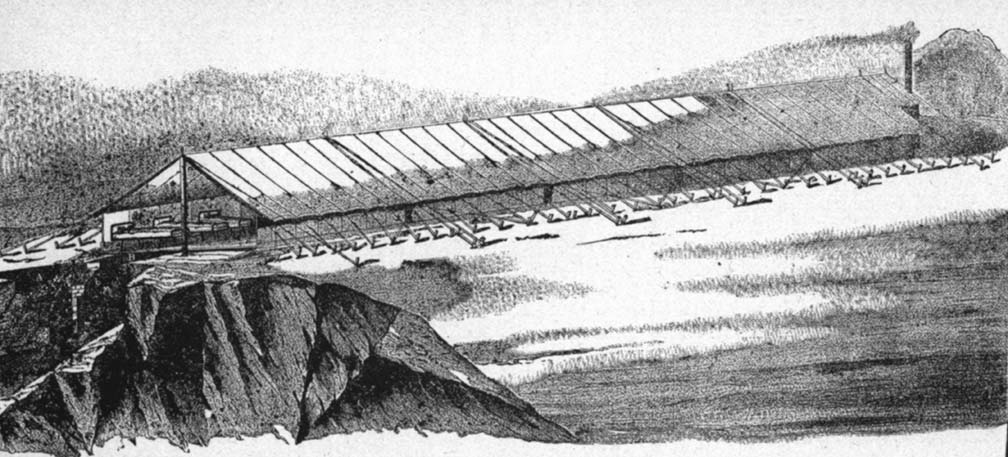
De Rause, editor "Gazette Médicale de Paris," said,---
"American surgeons are accused generally of an over-fondness for operating: on the contrary, we have noted with pleasure the efforts --- efforts crowned with success --- of their conservative surgery. M. Swinburne is the only surgeon of the ambulance."
M. Gustave Mousnereau, in a thesis on the ambulances, said, "I have reserved for the last, as being the most important, the American ambulance," and after giving a detailed system of heating, etc., added, "I feel justified in affirming that the American ambulance is the best of all the ambulances established in Paris. This superiority of the American ambulance has been admitted by the most eminent surgeons of Paris; and an attempt has already been made by Dr. Depaul (clinical professor of midwifery) and Dr. Dubreuil (assistant professor and hospital surgeon) to apply the American system by establishing two similar tent hospitals . . . . At the American ambulance the deaths have been only five per cent; of seven amputations, only three have died; there has not been a single case of hospital gangrene, and not one case of purulent infection. These figures speak for themselves, and suffice to demonstrate the superiority of the American system."
M. Nélaton, one of the most illustrious representatives of French medical science, on a visit to the American ambulance, left on the visitors' book this significant indorsement: "You have here shown what great results may be obtained with small means."
Jules Guerin wrote that he was happy to echo the same sentiment, as did Démarquais; and Baron Larry, before the Academy of Sciences, declared that the American hospital system was most complete and favorable.
M. Nélaton was the celebrated French physician and surgeon called to examine the wound of Garibaldi, and who declared the bullet was still in the wound, indicated the time when it could probably be removed, and predicted a favorable result. This opinion was directly the reverse of that given by the English surgeon, Partridge, who, in his opinion, was supported by the Italian surgeons Porta and Barretti, and afterwards by Pirogoff, the celebrated Russian surgeon. Events proved Nélaton was correct, and his opinion triumphed. By following his views, the physicians attending Garibaldi happily succeeded in removing the projectile. Partridge's visit and blundering surgery cost three thousand dollars; while Nélaton, the true surgeon, went to Italy without fee or reward.
Among the appliances more directly concerned with surgical science, used at the American ambulance, and which found great favor among the surgeons of Paris in the treating of suppurating wounds, the merits of which were previously unknown in France, was the employment of oakum as a substitute for charpie ("lint").
"Indeed," Dr. Evans writes, "the interest taken by the medical profession of Paris in every thing which concerned the ambulance was very great. Scarcely a day passed in which some well-known name was not entered in the list of visitors. No sentiment of professional jealousy was ever exhibited; no exclusive feeling of nationality was ever manifested: there was but one sentiment, but one feeling, among all, --- that inspired alike by an earnest desire that the history of the experiment might tend to the establishment of some new truth to the honor of science and the benefit of mankind from the first-fruits of a New World's experience, brought to the very shrines of venerated oracles, to there compete with the established principles of ancient tradition, and even with the practice of classic surgery."
That these honors and expressions of gratitude from a notably brave and proud people were justly earned, may be realized from the actual results of the surgical treatment by Dr. Swinburne. Most, if not all, of the eminent surgeons had discussed the theory of conservation in the treatment of the wounded, but had failed to enforce it in practice, it was so foreign to the old-school system to which they had been educated. When introduced by the great American physician and surgeon, it was absolutely regarded as an innovation rather than an advance in science. Yet these opinions and comments quoted prove how promptly the great scientific minds of that city availed themselves of the ideas and practices they witnessed, with their good results, and in the interest of science, and for the good of humanity, declared their purpose to adopt them. They believed their surgeons were equally scientific with the great American, and indeed insisted they were more proficient. Yet here were facts; and the truly honest searchers after knowledge knew that theory, when contrasted with facts, vanishes as rapidly as the sparkling dewdrop is kissed away by the rising sun. Here were results upon which these learned men were to decide as to the claims for pre-eminence for conservative surgery, and the simple means adopted in dressing wounds. The comparisons were conclusively convincing. At the American ambulance the most severely wounded were treated, because the corps of stretcher-bearers had specific orders, which were rigidly enforced, to look after these, as they were in need of the earliest possible attention; and the American ambulance corps, being always first to the front, picked up the most seriously wounded. And yet, of the 247 surgical cases treated, only 47 died, of all causes. Of these wounded, 126 received compound fractures, some having two or more comminuted fractures. During the siege, there were but 9 amputations of long bones; 7 of these being of the thigh, 5 of the wounds being through the knee-joint.
The ambulance Rothschild, in charge of Dr. Job, situated on high ground, with all proper ventilation, and considered one of the very best in Paris, was provided with ample nourishment and food for the sick; while in the other hospitals and ambulances it was about all those in charge could effect, when they secured sufficient nourishment to keep life in the patients, some of them failing even in this. Yet at this luxuriantly supplied hospital there were but 56 wounded men treated, 10 of them dying of their wounds. There were but 4 amputations performed, all proving fatal; and in every case but 2, where the bones were involved in the wounds, all died.
At the ambulance of the press, under M. Démarquais, 281 wounded were treated prior to Feb. 1, 1871; and of these, 63 ended in death. Of 16 cases of wounds of the upper extremities, 13 proved fatal.
At the Barracks Hospital at Passey, of the 1,486 wounded treated, 347 died.
To these results the medical profession of Paris, at least the learned, expert, and scientific portion, --- and at that time it embraced eminent men from all portions of Europe,---would not allow prejudice to obscure their better judgment, and were not only willing, but anxious, to adopt this course, and re-learn how to treat the wounded.
Among the celebrated surgeons in Paris during the siege, from other portions of Europe, was Charles Alexander Gordon, M.D., C.B., who was sent to that city by the right honorable secretary of state for war of Great Britain. This celebrated English surgeon was the author of a number of works on military surgery and hygiene. In his work entitled "Lessons on Hygiene and Surgery from the Franco-Prussian War," he quotes from M. Pirogoff, "that the extensive practice of primary amputation has been abandoned, because statistics prove, that, in gunshot wounds of the upper extremity, secondary amputation is as favorable as primary; that the attempt to save the limb is not, therefore, made at the risk of life; and that it is to the honor of modern surgery that but few amputations of the upper extremities were made."
"Such," says Dr. Gordon, "are the views expressed by this eminent surgeon, and they deserve every attention. Perhaps nowhere," he adds, "so much as in the American ambulance, was extensive simplicity of arrangements carried out in the treatment of gunshot fractures: certainly in none were the results more satisfactory. Dr. Swinburne brought to his aid vast experience gained in the war of secession; but the most simple and extemporized apparatus seemed always to have been adopted by him. The appliances made use of depended upon the extent and position of the wounds; but, as a rule, the more simple their construction, the better."
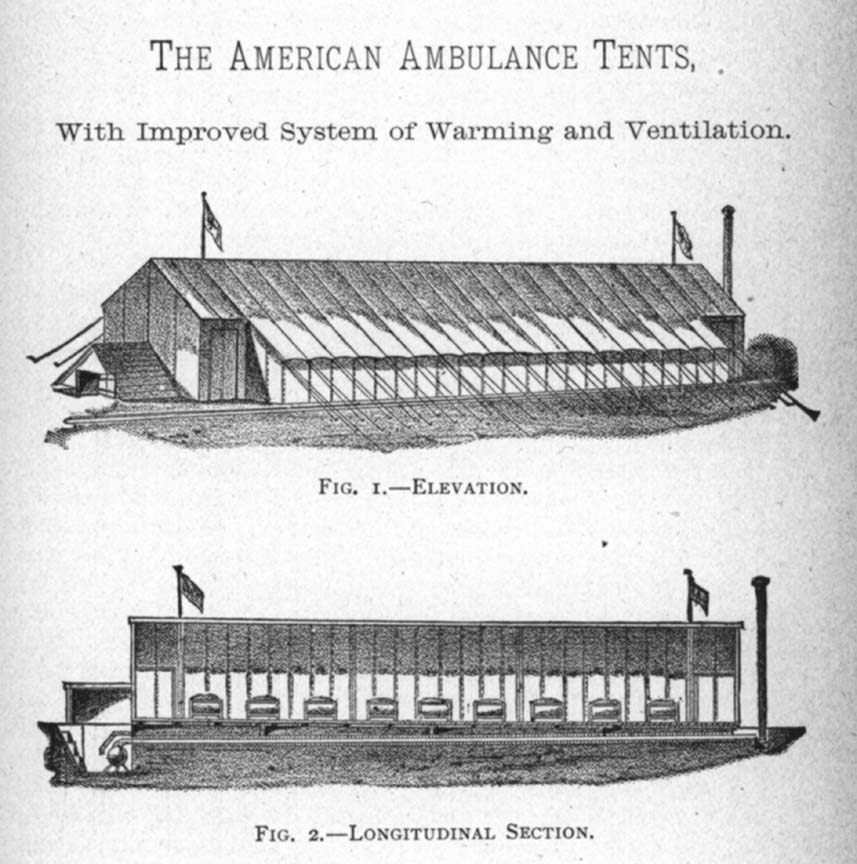
| These cuts of Dr. Swinburne's Ambulance in Paris are taken from Charles Alexander Gordon's Work on "Lessons on Hygiene and Surgery from the Franco-Prussian War." Dr. Gordon is the author of several important works on military hygiene, and was sent to Paris during the Franco-Prussian War by the Right Honorable Secretary of State for War of the British Government. |
This acknowledged eminent scientific authority, in discussing the treatment in dressing the wounded, said, ---
"Whether used as an independent application or not, water had to be used for the purpose of cleansing the surface of wounds. Perhaps it was so to a less extent than in the English hospitals; and, with every respect to our French compeers, there is some room for believing that a more extensive use by them of this simple element would have been to the advantage of the wounded. Moist and hot cloths applied, and covered with oiled silk, were much used in eases of wounds of the long bones or joints, and sometimes to the limbs after amputation. After excision of joints, these, placed along the whole extent of the limb, proved very grateful. Their employment was carried out to the greatest extent in the American ambulance . . . . The degree of ease that such simple means will give is remarkable in the case of a wounded limb."
In his summing-up of the results of treatments in the several hospitals and ambulances of Paris, he said,--
"We had in Paris, however, in the American tent ambulance, undoubtedly the most favorable results of any, taking into account the severity of the cases treated. Thus, out of 247 cases treated, there were 126 of compound fractures, these occurring in 114 individuals; yet the mortality among all was at the rate of 19 per cent."
In commenting on the treatment of gunshot wounds, Dr. Gordon said, --
"It is true that the method of treating gunshot wounds of the chest, as practised by Dr. Swinburne, is condemned by some surgeons. It is beyond question, however, that the results obtained from it in the ambulance (American) in the Avenue de l'Impératrice during the siege were very satisfactory, so far as they went, and of a kind to justify its further adoption. It seems to me, therefore, that in future wars the treatment indicated is this: provided the bullet passes completely through the chest, close the opening, as Dr. Swinburne did, and so treat the patient. In several cases where the missile had passed completely through the chest, and penetrated one lung, recovery took place with comparatively little constitutional disturbance, and with a rapidity that became matter of wonder. Some of the officers and men taken to that establishment (the American ambulance) with wounds of this nature, their respiration oppressed by blood-discharges from the pulmonary wound into the bronchiæ, and with blood and froth issuing from the openings in the chest during expiration, were treated in the simplest possible way, and successfully. The usual treatment adopted by Dr. Swinburne was to hermetically close the outer opening by means of adhesive silk.(2) Little if any medicine was subsequently administered. In cases thus treated from the early periods of the wound, suppuration into the pleural cavities seemed to be averted. The results seemed to indicate that the effused blood was not necessarily a source of danger; that its action was not like that of a foreign body; and that, as recovery progressed, it gradually became absorbed. In none of the cases thus treated were counter-openings made or required."
He then refers to other cases treated on different plans, in which puriform effusions and hectic followed the counter openings, and then death. In one, the bloody liquid with which the chest speedily became filled was pumped out, and the operation described as brilliant, but the patient died ; and in another, empyema occurred, the chest was punctured for the escape of fluid, and the patient also died.
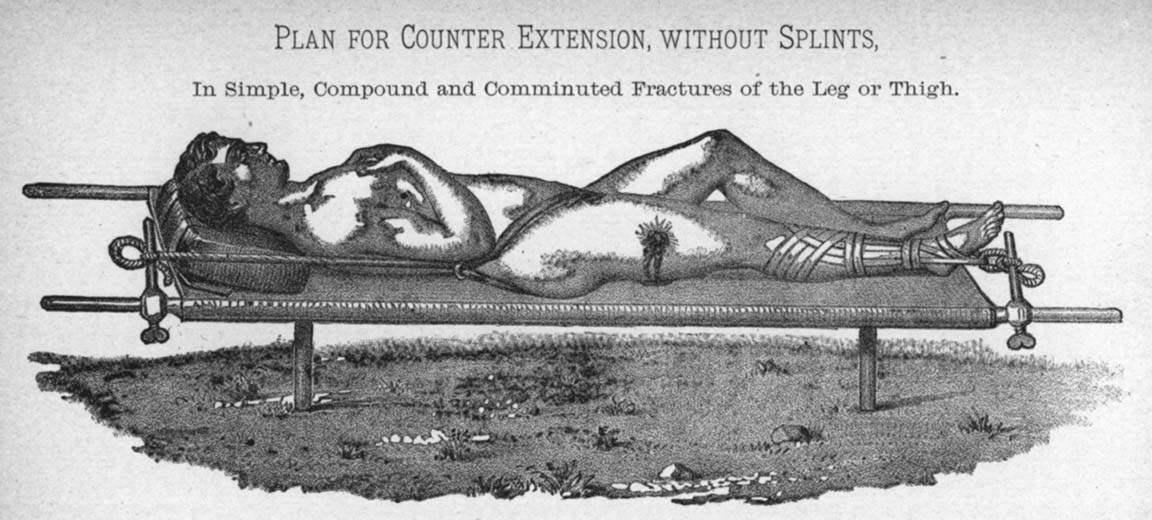
This design for a field stretcher was devised by Dr. Swinburne during the Rebellion, and submitted to the head of the medical department of the army, who refused to adopt it. The English and French governments have both adopted it. The perineal belt, where it comes in contact with the perineum, should be made of a large sheet, in order to equalize the pressure.---[See Gordon's Work on Military Hygiene and Evans' Report on the American Ambulance.]
During this period of which Dr. Gordon writes, there were in and around Paris six hundred and thirty-four ambulances, in addition to ten hospitals, and at least three thousand surgeons from all the nations of Europe, many of them holding the leading places among their professional brethren as physicians and surgeons. It is a remarkable feature in his work, that, out of this multitude of ambulances, he selected the American as the model one in its installation, on which to treat at length; but a still more remarkable feature was his selection of numerous cases treated by Dr. Swinburne, out of the thousands, and the minutiæ with which he described their treatment and results as of the most vital interest to science. In his book he devotes more space to the work of the American surgeon, and cites more of the cases treated by him, than by any other individual, or, indeed, the whole of the other surgeons combined. So necessary does he consider it to be specific in the details of all the methods used by Dr. Swinburne, that he devotes much space to their description, and the appliances and methods used by Dr. Swinburne in placing the patient in bed, and introduces a plate of a common field-stretcher designed and used by the doctor for carrying the wounded from the field, and the treatment of fractures by extension, and upon which they can be treated until well. In describing this stretcher, he says, ---
"By means of a common brancard ("stretcher ") ingeniously arranged by Dr. Swinburne, a soldier or officer with gunshot fracture of the femur can be carried with an advancing army over any extent of country. Upon one of the handles at each end, a bent iron arm, having an eye at one end, was fixed by means of a screw. It admitted of being moved along the handle, or from one end to the other, according to the seat or side of the injury, and, from those at the head and foot of the extension and counter-extension, could readily be used. A mattress adapted to the dimension of the brancard being provided, transport of a wounded man can be readily effected, either by means of two brancardiers ("carriers") or by placing the litter upon a wheeled conveyance. The contrivance is further so suggestive in regard to a convenient method of securing patients with fractured thigh-bones on shipboard, that it is commended to the notice of surgeons at sea. By means of a staple eye secured in the bulkhead, at either end of a bed, immobility of the ends of a fractured femur would readily be insured."
This invention, when first conceived and designed by Dr. Swinburne, was submitted to the medical department of our Government during the Rebellion, and refused, for what reason those at the head of the department at that time only know. It was afterwards adopted and put in use by both the French and English Governments.
Dr. Gordon cites a case as a very remarkable piece of surgery, where a wound was received through the lower jaw, and effectively treated by Dr. Swinburne, showing how such an injury may be treated so as to avert a great deformity.
"A soldier was injured in the lower jaw, involving the front of the bone, by a bullet. The soft tissues were dissected back by Dr. Swinburne. The fragments of bone other than the very small ones, instead of being removed, were ingeniously secured to the existing teeth by means of wires; the ends of these being twisted off, and their ends protected by a case of wax. A frame was then fitted on to the chin, and moulded to its. shape, oiled silk and bandages enveloping the whole. Recovery was progressive, and the deformity scarcely perceptible."
This was regarded by the author as an exceptional and extraordinary case, and one requiring unexceptional skill in its management, and hence was given to the scientific world as an illustration of what great achievements the delicate science of surgery may accomplish. With the surgeon who performed the operation, Dr. Swinburne, it was no new. A number of years before, the late Col. Jackson, formerly of the firm of Townsend & Jackson of Albany, fell from the window of the second story of his residence on State Street to the sidewalk (a distance of fifteen feet), and, striking on his head, crushed and fractured the entire jaw. By the use of the delicate wire, the shattered bone was brought to its place and healed, leaving no deformity. He was afterwards killed in battle.
"The eminent surgeons," said Dr. Gordon, "whom the writer had an opportunity of seeing operate, had several different methods of proceeding, and of performing the subsequent dressing. In amputating the lower third of the thigh, a cut was made from the surface upwards and backwards, through the muscles on the anterior aspect of the part; the posterior flap being afterwards made by transfixing, and cutting from within outwards. The flaps, both of which were equal in length, were retracted by means of a fillet, and the bone sawn across; the vessels were then se-cured by ligature, hand-pressure on the main vessels having been kept up during the operation. It was remarked, however, that a considerable mass of tissue around the vessel was included, and that the double ligatures were generally used, both ends being cut off. The surface of the flaps, after being sponged with cold water or alcoholized water, were brought close together by silver wire and sutures; linge fénétré, soaked in glycerine, was applied ; a large, soft compress to each aspect of the limb supported the flaps; and a bandage applied from above downwards secured the whole. Other surgeons used the interrupted suture; and Dr. Swinburne, in one case of amputation of the thigh, left the anterior flap much longer than the posterior: the line of union was thus quite at the back of the limb, and the stump provided was a soft one."
In treating the merits of primary versus secondary amputation, Dr. Gordon said,---
"So far as the experience within Paris went, it simply confirmed that of former wars, --- that these operations must be performed before suppuration has set in, to give them a chance of success. It is pointed out, however, that primary amputation cannot, under all circumstances, be performed. A wounded man may, as not infrequently was the case on the occasion of the great battles before Paris, be so benumbed by cold from protracted exposure upon the field as to put amputation of a wounded limb out of the question, until such times as the powers of the body are partly restored by stimulants and other means; and, by the time this has been attained, the period for primary amputation has passed. On the other hand, an amputation may, on some occasions, be performed with ultimate success upon a patient in a very great state of weakness."
To sustain this latter assertion, he again referred to an operation performed by Dr. Swinburne as an extreme typical case, and said, --
"A soldier was brought to the American ambulance in Paris, his leg carried away by a shot. Amputation below the knee was performed by Dr. Swinburne while the man was in a state of collapse, and pulseless. The man continued in this state for twenty-four hours after the operation; he then passed into delirium, which continued during four days, the stump being much disturbed in the mean time, the flaps gaping, and the bone projecting. Nevertheless, this man ultimately did well."
The doctor himself, soon after his arrival in Paris, wrote to Dr. Bailey of Albany, ---
"Here I am, within a few rods of the inner fortifications of Paris. I had been in England, Ireland, and Scotland, visiting hospitals and other places of interest, until last week, when I received notice that I was wanted here. With Louis (my son), I immediately left for this place, where the Americans have established a hospital and ambulance corps out of American manufactures, including tents and about two hundred American patent beds, stretchers, etc. You would not blush for America, could you see these arrangements, and compare them with the English, or even the French. In truth, they are the admiration of the place. The soldiers say, if such accommodations were provided them, they would not mind being wounded. I have many things to say to you, on my return, in reference to surgery. Among them is the fact that the surgeons of Great Britain do not amputate for disease of any joint, but, on the contrary, resect. The result is, that more lives are saved, and less mischief results from the diseases, than from the old barbarous mode of amputation. Many a mutilated creature may bless the day that progress has its sway."