 |
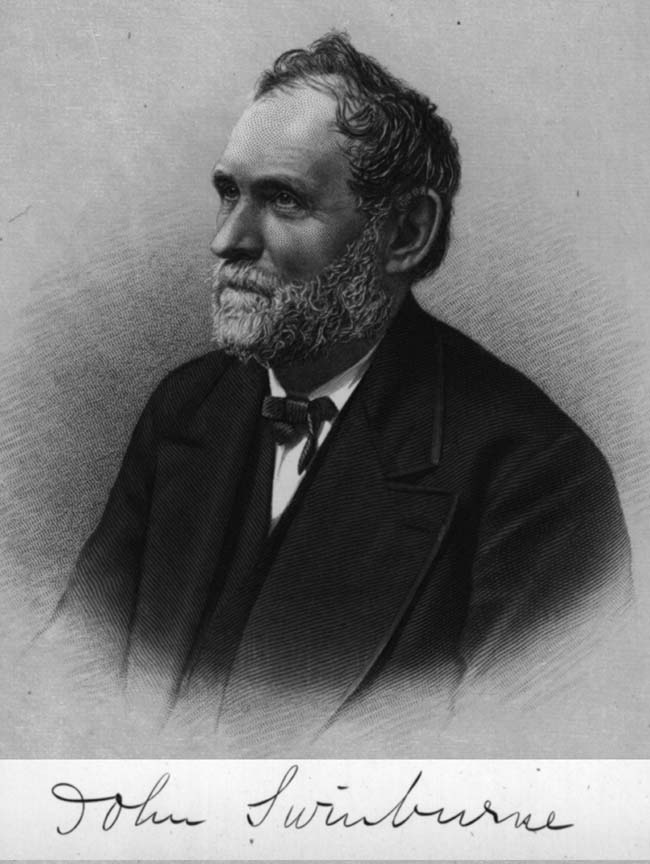
OR INCIDENTS IN THE LIFE OF DR. JOHN SWINBURNE OF ALBANY |
|
|
OR INCIDENTS IN THE LIFE OF DR. JOHN SWINBURNE OF ALBANY |
| Contending with Four Plagues. --- Cholera, Small-Pox, and Yellow-Fever. --- Best Quarantine in the World.--- A Sleepless Official. --- Criminal Consols. |
IN 1866 the trying ordeal began in earnest when we were threatened with four diseases, --- the Russian plague, cholera, yellow-fever, and ship-fever. The officials at quarantine were then like a traveller in a mountainous region, standing on the edge of an abyss so deep and dark and fearful, that he shudders to look down into the chasm; and humanity recoiled at the bare thought of these visitations, so terrible were the devastations they would inevitably cause if once landed upon our shores. The times and circumstances demanded a peremptory policy. The threatened quartet of plagues created a necessity for immediate action, and admitted of no negotiations, postponements, or half-measures. It was then that the experienced scientist, surgeon, and physician proved that he was "forewarned and fore-armed," by assuming that "cholera was a communicable and controllable disease; that its causes are not in the atmosphere that it accompanies human travel and human traffic; that it progresses at the rate of vessels across the ocean, and never precedes them ; that it is transmitted by clothing and effects as well as passengers; that it never appears in a new locality without communication, directly or indirectly, with persons and places; and that it may be arrested, like the plague, by an absolute quarantine of a short duration:" and he recommended a uniform system of quarantine throughout the country as a safe and sure prevention. That his constant searching after knowledge had eminently fitted him for the suppression of the scourge, and that he had arrived at a perfect diagnosis of cholera, were manifested by the establishing in accordance with the principles laid down, and on the recommendation of Dr. Swinburne, of a quarantine, which the commissioners, eleven years afterwards, when Dr. Swinburne was engaged in another field, pronounced "the most extensive and complete quarantine establishment in the world, ---an establishment which, perhaps, properly conducted, affords every guaranty against the inroads of pestilence which human experience and forethought can devise."
Under the act of 1863 there was contemplated provision but for one hospital; and this, between the 1st of April and the 1st of November, was to be appropriated exclusively to the care of persons sick with yellow-fever, and during the remainder of the year might be used for the care of typhus or ship fever. The only direction for the care of cholera patients was, that they "shall be provided for by the commissioners of quarantine in such manner as they may determine, and occasion demand, until permanent provision shall be otherwise made by law." This law gave the commissioners no jurisdiction over any land, and prevented them from exercising any over Staten Island, Long Island, or Coney Island, and over no land contiguous to the harbor except over New-York City. Neither had they money to provide any means for caring for the sick. The law further provided, "In no case shall persons sick with different diseases be put in the same hospital; " and yet there were none others than the one floating hospital, and that was reserved by law for the sick with yellow-fever. This was the condition of affairs at quarantine when "The Atlanta" arrived, Nov. 2, from London, with over five hundred passengers on board, with sixty cases of cholera during the passage, sixteen of which proved fatal. Twenty-two new cases were found on arrival, and twenty-one other cases afterwards. She was detained twenty-eight days at quarantine. Notwithstanding the prevalence of the disease upon the vessel during the passage and after arrival, in consequence of the precautions taken by the health-officer, no cases occurred beyond the limits of the vessel.
Under these circumstances, the health-officer, Dr. Swinburne, was similarly placed to the Polish Gen. Bem in Transylvania during Kossuth's Hungarian war. In that country, Bem found not a single fortress in the hands of the Hungarians ; but, the more he felt their importance, the more anxious he was to gain possession of them. Events proved, that, in Kossuth's selection of Bem to conquer Transylvania, he possessed the discernment to choose the most able man from among the multitude; as did Gov. Seymour, when he appointed Dr. Swinburne health-officer, prove that he understood equally the importance of the task to be undertaken, and who would be the proper man to successfully accomplish the desired end. The simile between these two eminent men ---one of war, and the other of health and preservation, both patriots---is striking. Bem, like the health-officer Dr. Swinburne, was a thorough organizer and strict disciplinarian, making no distinction because of social standing among his troops; and hence it was that the young sprigs of nobility preferred service in other corps, where more consideration was paid to their pedigree. Bem was peculiarly attached to the artillery, and believed in meeting his enemy at as long range as possible, and dealing heavy blows before they came to close quarters. But when the hand-to-hand conflict came, he was ready, as was shown when, at Rothenthurn Pass, with his small army, of which the Polish corps and the German legion were the flower, he drove the Russians in the wildest flight, and routed the four Austrian generals, Puchner, Pfarsman, Graser, and Jovich. His conquering Transylvania justified the confidence of Kossuth, and confirmed the reputation he had won. With Dr. Swinburne, pedigree had no weight; and he, too, believed in meeting his enemies at as long range as possible, and exterminating them. His conquering the four pestilences, and saving the people from their ravages, justified Gov. Seymour's confidence, and confirmed the reputation he had won.
So grand was his success that year, that Gov. Fenton, in his message to the Legislature in 1876, in treating of the cholera epidemic of the previous year, said, --
"Six hundred and fifty-one persons have been treated under quarantine since the facilities were provided. The number of cases on vessels during the passage and after arrival here, is estimated at two thousand ; and of this number, at least one thousand have died. It is believed that few if any cases of cholera have appeared on shore, the origin of which can be traced to the sick under quarantine. This is the highest testimony in favor of the vigilance of the health-officer."
This indorsement from the highest official in the State was a tribute of esteem a less eminent and capable gentleman than the then health-officer would have paraded with unlimited ostentation. It was not only an indorsement by the highest official, but implied the inestimable debt of gratitude every resident of the State, whether in the thickly populated cities or in the smallest hamlets in the extreme northern, western, and eastern sections of the State, was under to the vigilance of the health-officer.
In his report for that year as health-officer, Dr. Swinburne, without any suspicion of self-laudation, again presses the necessity of renewed watchfulness on the part of the people, and the urgent demands for proper quarantine facilities. He said,
"Nearly all agree that cholera is contagious, and can be quarantined at a port of entry, providing the proper precaution as to non-intercourse, isolation, disinfection, cleansing, etc., be carried out. The fact, that, with the very inefficient quarantine facilities now afforded us, we have succeeded in preventing the spread of cholera upon our shores, furnishes no reason for supposing, that, with the same accommodation, we shall succeed as well in like endeavors during the next season. From our knowledge of the history of the migratory conduct of the disease, it is safe to infer that the visitations we received last season from the malady are premonitions sent out like heralds to warn us to prepare for its more severe and powerful approach. As the falling of the smaller stones and light bodies of snow from the mountain-side are but the forerunners of the avalanche which suddenly appears, prostrating wide-spread forests and populous villages in its course, and distributing devastation and death for miles around, so these instances of infected vessels approaching our harbors may be the precursors of such an extended increase of their class, during the coming season, as will require all the improvements which the State can furnish, and all the vigilance and skill which science can supply, to enable us to prevent the due infection from invading our shores, spreading through the land, and visiting every hearthstone with affliction and death. 'Forewarned is fore-armed,' should be an axiom for worthy action in every case. If, after observing it in this instance, the great Providence who is the dispenser alike of life and death should arrest the approach of this terrible destroyer, and turn it from our shores, we shall have yet the consolation of knowing that we have done our whole duty; and if, in his wisdom, he may yet permit it to come upon us, we shall be at least prepared to do all we can to weaken its attack, subdue its effects, and confine its march."
The report of the commissioners for 1863 gave the arrival of eighteen vessels in port infected with cholera. On these, six hundred and two persons were sick on arrival, at or during detention at quarantine, of whom two hundred and forty-two died, --- a mortality much less than that which attended the disease in Europe, and greatly below that which occurred among the passengers of "The England" while under quarantine at Halifax. The commissioners, in speaking of Dr. Swinburne as health-officer in that trying state of affairs, said, --
"The floating hospitals owned by the State would accommodate less than eighty; yet at one time he had to have accommodation for upwards of one hundred and twenty, while over fourteen hundred persons who had been exposed to the disease on shipboard were to be provided for in some more suitable place of detention. In view of the means for the care and treatment of the sick, the commissioners regard the results as truly wonderful, and speak volumes in praise of the health-officer, Dr. Swinburne."
They added, --
"The health-officer, in his report, has paid a truthful and graceful tribute to the services rendered by those who were charged with the care and treatment of the sick, but modestly omitted to state the share which he bore in looking after and alleviating the sufferings of the sick, and affording aid and consolation to the friends of the dead. Charged by law with duties which oftentimes required him to be in attendance upon the Metropolitan Board of Health, or at the office of the commissioners, and at the same time to be at his post at the boarding-station, or among the sick in the lower bay, he seemed almost omnipresent. No duty within his power to perform was neglected, and he looked after all under his care with a sleepless vigilance which seemed to know no fatigue, and experienced no relaxation while any thing remained to be done. What was said of him by a writer in describing the services rendered by Dr. Swinburne as a surgeon during the peninsular campaign in the late Rebellion, might be said of him in reference to his labors under quarantine."
They quoted
"Of this man I cannot speak in terms of too high praise. He was thoughtless of himself, forgetful even of the wants of nature, untiring in his labors, uniting to the highest courage of man the tenderness of a woman and the gentleness of a child. In that terrible hour when other surgeons were worn out and exhausted, no labor appeared to diminish his vigor. After days of toil, and nights of sleeplessness, he was as fresh and earnest as though he had just stepped forth from a night of quiet sleep. And while others became impatient, and had to escape from those scenes to seek repose, he, operating for hours at a time, found relaxation and refreshment in going from tent to tent, counselling the surgeons, advising the nurses, and speaking words of cheer to the wounded and the dying."
The latter portion of that part of the commissioners' report quoted is from a volume of reminiscences by the Rev. Dr. Marks of Pennsylvania, and, although quoted on a previous page, is repeated here simply to demonstrate the high esteem in which he was held by every honest man with whom he came in contact, whether strangers, or acquaintances of years, and because, if the commissioners deemed this tribute from one of another State worthy of incorporation in a necessarily limited report, it is valuable enough to incorporate here.
In 1867 yellow-fever was more destructive and wide-spread than at any previous period. That year two hundred and thirty-five vessels arrived in the port of New York from sixteen ports infected with the disease, and five hundred and seventy-three vessels from infected and doubtful ports were detained at quarantine for examination. During the year, one hundred and fifty-two vessels were quarantined for sickness, with one thousand and thirty cases on board, of which three hundred and eighty-four died. Twenty-eight of these vessels had small-pox on board, to which sixteen thousand six hundred and eighty persons had been exposed. Of these, twelve thousand nine hundred were vaccinated in quarantine; and only four cases of sickness of any kind in the metropolitan district could be traced to infection from this large number of arrivals.
Between the 18th of June and the 5th of November, 1869, two hundred and eleven vessels arrived from infected ports, twenty-seven of which had sickness on board. Nearly all had cargoes of a character calculated to carry and retain the seeds of infection. On board these twenty-seven vessels, ninety-two persons were sick with yellow-fever in the ports of departure, of whom forty-six died. Sixty other cases occurred during the passage, twenty-one of these proving fatal. The same vessels had twenty-five cases of other diseases on board. "These statistics," said the commissioners, "are scarcely without a parallel in the same brief time in the history of quarantine; and, in view of past experience, it seems hardly credible that all of the dangers attending the arrival of so many infected vessels could have been confined to the limits of quarantine. Yet the commissioners are not aware that a single case of yellow-fever occurred on shore during this season; and so little publicity was given to the fact of the arrival of so large a number of vessels from infected ports, that no uneasiness was at any time excited in the public mind."
In their report for 1870, the commissioners said, ---
"Although that terrible disease which has become an annual visitor to our shores found a large number of victims among those engaged in our commerce with tropical parts during the past summer, our citizens, happily, escaped its ravages. The scourge of cholera, which made the years 1866 and 1867 memorable in the history of quarantine in the port of New York, sought its victims in other climes. The tide of emigration has continued without diminution, but has been unattended with the introduction of any foreign pestilence to excite the apprehensions of the public. Many who enjoy the quiet of their own firesides, and are exempt from the visitation of pestilence, care little to inquire to whom they are indebted for such exemption. Resting in fancied security amidst the luxuries of their own homes, they little dream that they are surrounded by perils which hourly threaten to bring foreign contagion to their doors, and they fail to appreciate the sleepless vigilance which protects them from the approaching danger."
The season of 1869 was the last that Dr. Swinburne was in charge as health-officer; but, during the period he held that position, he accomplished a work, and established a quarantine system, and facilities to suppress disease, which will remain as monuments to his scientific and executive abilities long after the present generation shall have ceased to be actors in the great drama of life, and the curtain been rung down on the last scene. Many who are prominent today will enjoy but a brief career of eminence, and be only as chimerical delusions, rapidly coming to the front, and as rapidly vanishing from memory; while the name of Dr. John Swinburne, because of his great achievements in this and other walks of life, will be ingrafted in the pages of history among those who, while living, made the world greater, and whose memory will sparkle for generations to come, throwing on the future a reflection and splendor of achievements as brilliant and far-reaching as the rays of a setting sun that bathe and beautify the western horizon.
One of the greatest obstacles with which he had to contend as health-officer, in his struggles with the plague of cholera, was the avarice and deceit of traders and other nations, and the culpable neglect of our consuls abroad. Most all the vessels arriving at the port of New York during the cholera epidemic, from the countries where it raged, had clean bills of health; and in but few instances did the consuls give any official intimation of its existence. During the prevalence of the disease in Paris, no official notice of its existence there was received; and in 1867, when whole villages in Germany were being depopulated by its ravages, vessels arrived from all the German ports with clean bills of health.
In contending with these diseases at quarantine, Dr. Swinburne, as health-officer, was enabled by his scientific ability and deep research, in addition to the construction of the artificial islands, to arrive at a clear and definite knowledge of the diseases with which he had to deal, and thus was enabled to transmit valuable information to the profession. He thoroughly demonstrated that neither the vessel nor the cargo carried the poison of either cholera, small-pox, or shipfever, but that the personal effects of passengers did. In cholera the greatest amount of contagion came from excretions. The bulkhead of a vessel separating the second-class passengers from the steerage passengers, and between their respective water-closets, where, for instance, they were sick in the steerage with cholera, and free from it in the cabin, was sufficient to prevent the contagion from spreading. Of the nature of yellow-fever, he discovered that the hold of a vessel, with its bilge-water, induced the disease in persons, and that vessels lying at docks infected with yellow-fever poisoned the district and the inhabitants. An important discovery touching this disease was that persons with clean clothing might be sick with yellow-fever in any place, and those around them not be affected, and that their vomit and defections were not dangerous. In other words, he held that the well might sleep with the sick, under circumstances of cleanliness, without danger of infection. He further came to the conclusion that dead bodies did not infect or propagate the disease, and that the same was true regarding clean vessels and clean cargoes.
By the superseding of this gentleman, for partisan reasons, the State was the loser in a sanitary as well as financial point, as was proven afterwards. In 1870 and 1871 a number of ports with which our commerce was being carried on were suffering from an epidemic of small-pox; and from these ports the infection was brought to the city of New York, where in 1870, the first year after Dr. Swinburne left quarantine, there were two hundred and ninety-three deaths from this disease. The next year (1871) there were eight hundred and five deaths,--- the largest record from small-pox in a century, the next largest being six hundred and eighty-one, in 1853.
Jackson S. Shultz, president of the Board of Health of New-York City, of which Dr. Swinburne was an ex-officio member, said in substance, at a dinner given on his (Shultz) retiring from that office, that the Metropolitan Board of Health had not accomplished as much in two years as he expected it would in one month, and that the quarantine under Dr. Swinburne had been the only successful branch connected with the board.
| An Odious Comparison.---Artificial islands---Corruption in Quarantine.---A Political Trick.---Bleeding the State. |
COMPARISONS, while not always, are often odious, at least to some of the parties brought into comparison ; and while there is no desire to resurrect the misdeeds of men who have passed away, or who are long since no longer prominent, it is seemingly necessary, that for a better appreciation of Dr. John Swinburne's honesty, integrity, and ability as a health-officer, his administration should be contrasted with that of some of his successors; and it is to be regretted that in the comparison the distinction is so marked as to make him appear a giant along side of a pygmy, to at least one of his successors and traducers, scientifically as a physician, morally as a man, and in integrity to the people and the State as an official. The comparison is so odious that it must necessarily create some ill will and anger, although it would be impossible to paint it in colors that would do justice, or describe it in language in any way adequate to convey the great difference. Ill feeling, however, will only come from those who dare not publicly deny, and have no defence.
In drawing this comparison, it is well to state that the commissioners, a board under whom the doctor had never served, six years after his retirement, in their report to the Legislature in 1876, said, --
"Any apprehensions entertained at the beginning of the year, that Asiatic cholera would again make a lodgment in our bay, have not been realized: indeed, as one season after another passes and the ravages of the once deadly scourge are averted, there is an increasing confidence in the ability of the quarantine authorities to at all times arrest its progress at the gate of the metropolis. While it is uncertain what a year may bring forth, there are now seemingly some grounds for this growing confidence. We have unquestionably here, in the harbor of New York, the most extensive and complete quarantine establishment in the world, ---an establishment which, properly conducted, affords every guaranty against the inroads of pestilence which human experience and forethought can devise. It is true that the artificial island system necessitated heavy expenditures, yet the since low rate of cholera mortality bears striking testimony to the wisdom of our predecessors."
Prior to the appointment of Dr. Swinburne, the quarantine facilities had been located on the mainland, to which the people were violently opposed, going to such extremes as to destroy the buildings used. When the health-officer proposed the erection of the two artificial islands in the bay for quarantine, the celebrated New-York engineer, Craven, declared the scheme utopian, impracticable, and simply impossible of carrying out. He was consulting engineer to the health-officer, and was the projector of the Croton Waterworks, and chief engineer of the works up to the time of his death. When the work was well under way, and no longer a question of doubt, Mr. Craven declared it was the grandest piece of engineering skill of the age. The upper island was named Hoffman's Island by the commissioners, in honor of the governor under whose administration it was constructed; and, by act of the Legislature, the lower island was named Swinburne Island Hospital. These artificial islands, constructed in accordance with the recommendation of Dr. Swinburne, were the first of that nature ever undertaken.
In 1872, two years after Dr. Swinburne's time, what was known as West Bank Hospital was, by an act of the Legislature, "hereafter to be known and designated as Swinburne Island Hospital," in honor of the efficient officer who had. established it. For two years after this enactment, Dr. Vanderpoel persisted in calling the island West Bank; and it was not until the Legislature, by a resolution twice adopted, unanimously insisted on the island being named as the Legislature had directed, - " Swinburne Island Hospital," --- that the commissioners were able to compel the health-officer to comply with the law. Dr. Vanderpoel's attorney has since stated that that official had agreed with Gov. Dix, that, if he would re-appoint him health-officer, the island should be named Dix Island. The governor fulfilled his part of the agreement, but the health-officer was prevented by the Legislature from carrying out his part.
The islands, as shown in the illustration, are Swinburne Island, with Hoffman island farther up the bay, and Staten Island in the background. The two islands are of the same size and construction, with the exception of the buildings. Swinburne Island is located on the lower bay, about two and a half miles south of Fort-Thompkins Lighthouse at the Narrows, and about two and a third miles from the Elm-Tree Lighthouse on Staten Island. The foundation is hexagon in form, two of the sides being two hundred and sixty feet in length, the other four one hundred and sixty-one feet. The exterior of the crib-work is thirty feet in width at the base, twenty feet at the top, and twenty feet in height, and is constructed of large timbers firmly fastened together and filled with small stones, the whole surrounded by a riprap of heavy stones. The superficial area of the structure is about two acres, while the area at the base of the riprap is over three acres; the extreme length at the top being five hundred and four feet, and two hundred and twenty-eight feet in width. To construct the island, nine thousand cubic feet of timber were required, and seventeen thousand cubic yards of stone in the riprap, five yards of stone to fill the crib, and fifty-six thousand four hundred yards of sand to fill the space enclosed by the crib-work.
 |
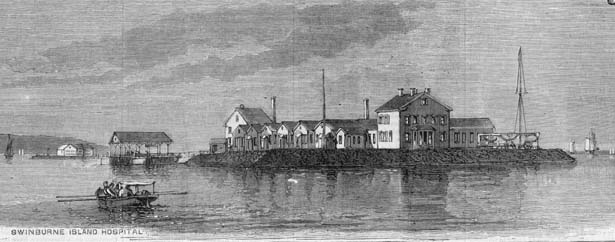 |
On Swinburne Island there are eight hospitals, each eighty-nine feet long, twenty-four feet vide, and twelve feet three inches from floor to ceiling, and all connected by a covered corridor. To supply the island with fresh water, there are twenty-two cisterns, capable of holding forty-four thousand gallons of water; the whole of the buildings, being lighted with gas manufactured on the island from gasolene.
The contract bid for the carrying-out of this experiment, never before tried in any harbor, was $310,618, and no more than that amount was paid.
In Chapter 733, "Laws of the State of New York, 1872," it was enacted, "And the lower of the West Bank Islands, built under the direction of Dr. Swinburne, shall hereafter be known and designated as Swinburne Hospital Island."
One of Dr. Swinburne's successors, persisting in calling the island Dix Island, and publishing diagrams of the island with that name in his reports, and also in the first volume of the "Report and Papers of the American Health Association," published in 1873, the Hon. Mr. Vedder, on Jan. 23, 1874, offered the following in the Assembly: --
Whereas It is provided and declared in and by Chapter 733, Laws of 1872, that the lower of the West Bank Islands, built under the direction of Dr. Swinburne, shall hereafter be known and designated as Swinburne Island Hospital; and
Whereas The health-officer, in his report to the commissioners, in their report to the Legislature for said year, in disregard and defiance of said legislative provision and declaration, did refer to and designate said hospital otherwise than by its true name, thus tending to produce confusion in the records of the State; and
Whereas The Legislature at its last session, by joint resolution of the Senate and Assembly, did direct that the said report of the commissioners and health-officer should be so amended by striking out the name given by them to said hospital in said report, inserting in place thereof its correct statutory name, and also directed that in all reports and papers said island should be designated as Swinburne Island Hospital; and
Whereas The said health-officer and commissioners, in further disregard and defiance of said legislative provision and declaration, have, in their annual report for the year 1873, just submitted to the Legislature, again ignored said statutory name of said hospital, and have therein designated the same by a name of their own selection, not sanctioned by law: therefore
Resolved (if the Senate concur) That the said last-mentioned reports be forthwith returned by the clerks of the Senate and of the Assembly to the commissioners of quarantine and said health-officer, and that they cause the same to be amended by striking out said unauthorized name of said hospital in said reports wherever the same occurs, and inserting in place thereof the name given to said hospital in and by the law aforesaid, and that they return the same to the Senate, thus amended, within ten days from this date.
On Jan. 9, Mr. Prince, from the Committee on the Judiciary, to whom was referred the resolution, reported in favor of the passage of the same, which report was agreed to; and on Feb. 3 the resolution was reported as engrossed.
On March 18 the resolution was adopted by a vote of sixty-seven in favor, to seven against.
The cost of this island, with the hospital thereon, was four hundred and ten thousand dollars. The enacting by law, at this time, that in the great port of New York there should be a "Swinburne Island," was an unusual honor to bestow on a man who had never aspired to political fame or preferment, and was intended as a mark of esteem that should be enduring, and become world-wide in reputation. It was voluntarily bestowed on the man who had conceived and executed such a perfect safeguard to the State, because of his faithfulness and honesty in the discharge of a duty affording such opportunities to plunder the people at large, and 'the mercantile interests of the State of New York in particular. During his term in the office, every report of the commissioners contained eulogies of the most complimentary nature of the health-officer; and these but expressed the views of the officials of the State in high positions, who were the guardians of the mercantile and commercial interests of the city of New York, and of the interests of the people at large.
To peruse the reports during the period when Dr. Swinburne was health-officer, and then for a number of years after he retired, is like being suddenly transformed from the genial warmth of a balmy, invigorating day in June, into the cold, dismal, and chilly breezes of a dark December night,---the first abounding in praises of Dr. Swinburne: and the other charging others prominent afterwards in the same responsible position with defiance of law; trickery in plundering the State of large amounts of money; swindling the shipping interests of the city, and the commerce arriving in New-York harbor; using the State steamers for the collection of ship news in the interest of the associated press, making no return of the moneys received to the State, and recommending the attorney-general to institute an action for the recovery of the same; illegally collecting fees from merchants for "medical attendance, and transporting the sick;" the "diverting" of money appropriated by the Legislature; and the withholding of money due the employees of quarantine and others.
If the quarantine established by Dr. Swinburne, and the commissioners working in unison with him, saved the people from plague, some of their successors determined that they would be worse than seven plagues in plundering the State treasury, and all with whom they had dealings. The virtues of one man are better understood when placed in contrast with the disreputable acts of another, as the fragrance of the rose is enjoyed after the senses have been attacked with the odor of Mephitis. In 1880, when the people began to realize how they had been plundered during the last decade, it was a consolation to review the transactions at quarantine for the previous decade, and feel the assurance that all men intrusted with great public interests were not recreant to their duties, nor faithless to the people.
In their report in 1877, the commissioners said, ---
"When the supply bill of 1870 was printed and made public, not a little surprise was caused by the discovery of a clause which transmitted the power of appointing, dismissing, selecting, and licensing to the health-officer. Thereupon followed the organized exactions down the bay, which became such a terror to our mercantile interests during the seasons of 1870 and 1871."
Under the general law of 1863, the commissioners had this power, and, as they were ignorant of the changes, the natural deductions are, that they were effected at the instance of the then health-officer, Dr. Carnochan, by means only those conversant with the manipulations of the lobby at Albany understand, whose "interests" in such affairs are always for those who have "designs," and are secured by "circumstances." By this change it is apparent "in what a hurry some persons were to become rich" as soon as an honest, fearless man was out of the way, Dr. Swinburne being then in Europe. The same report said, --
"When, in 1866, the law was passed providing for the building of the artificial islands, it associated the mayors of New York and Brooklyn with the commissioners of quarantine in their construction. In 1873 a five-line clause in the appropriation bill wiped out the commission, and transferred all its powers and funds to the then health-officer, Dr. Vanderpoel, making him the construction board."
To effect such an unprecedented and outrageous proceeding, there was unquestionably sinister motives to secure a collusion necessarily fraught with such dangers as this one was, and opening avenues to plunder. Such a power Dr. Swinburne never asked, and it is doubtful whether any honest man would covet it. By the statements of the commissioners themselves, who were in political sympathy with, Dr. Vanderpoel, and not with Dr. Swinburne, the State had reason, as did the merchants of New-York City, and the owners and masters of vessels arriving in New York, to mourn the change that had been made from good to bad, and from bad to horrible.
The intention and purpose was to have no portion of the quarantine on the mainland except the burying-ground; and, to this end, buildings for the residence of the health and other officers were erected on Hoffman Island.
Of these islands and quarantine, the commissioners said, -
"The year which closes with the date of this report has witnessed the completion of the new hospital on West Bank (Swinburne Island). It may be justly regarded as one of the most important and successful undertakings ever entered upon by the State. The magnitude of the structure, and the obstacles which have been encountered in its erection, have been very little understood by the public; and but few know the extent of the provision which has been thereby made for the care of the unfortunate victims of disease who are brought to our shores."
When these were completed, the Legislature, in 1873, when it centralized all power in the health-officer, appropriated a hundred and twenty thousand dollars for new grounds and residences for the health-officer and his assistants upon Staten Island; and Hoffman Island, with its three massive brick buildings, became solely a place of detention for well passengers; and thus property costing the State at least four hundred thousand dollars, and how much more is not known, became practically of no benefit. In 1876 and 1877 the commissioners suggested that the quarantine residence and connecting property on Staten Island, which had cost the State a hundred and seventy thousand dollars, be sold, and the headquarters of quarantine be transferred back to Hoffman Island, where the original intent was to establish them. Certain it was that to have every part of quarantine as far from populated districts as possible was a wise, humane, and judicious scheme; and no other motive than the supplying of jobs could have been the foundation for having a new residence erected on the mainland.
Dr. Swinburne's successor, Dr. J. M. Carnochan, in his report for 1870, said, --
"The completion of the new hospital at West Bank (Swinburne Island) has removed one of the greatest defects in the quarantine establishment at the port of New York. The old hospital ship, which had been in use since the destruction of the quarantine buildings on Staten Island, beside being ill suited to the care and treatment of the sick, had accommodations for a very limited number of patients, and, when overcrowded, was no doubt greatly detrimental to the lives and health of the patients, attendants, and nurses who were obliged to remain in the poisoned atmosphere of a crowded vessel. The value and importance of the new hospitals, and their adaptation to the necessities of quarantine, were fully apparent in the epidemic on Governor's Island, to which I have already referred. They afforded means for the prompt removal and isolation of the sick from the vicinity of the city to a place where they were surrounded with every comfort. While the new hospital at West Bank may be considered one of the most important additions that could have been made to the quarantine establishment, it is not less necessary that the other structures intended as a place of detention for those who have been exposed to contagious and infectious diseases should be completed without delay . . . . There is no doubt that in previous years many valuable lives have been sacrificed for the want of a place to which those who had been exposed to infection or contagion during the voyage could have been transformed immediately upon their arrival at quarantine."
And in his next report he adds, ---
"The present quarantine hospital at West Bank has answered admirably the purpose for which it was intended, and may be justly regarded as the most important addition which could have been made to the quarantine establishment. The pure air of the lower bay, the perfect ventilation of the hospitals, as well as the care and attention bestowed upon the sick, have all combined to promote their recovery and convalescence; and it is not too much to say that during the year many lives have been saved which formerly would, no doubt, have been sacrificed."
This gentleman's term, which for reasons it was thought would be of benefit to the State, was limited to two years, and the appointment of Dr. S. Oakley Vanderpoel followed. Of this official, the commissioners, after five years' intercourse with him, said,--
"So long as the remuneration of the health-officer is left to exactions upon commerce in the shape of fees, just so long will he seek to retain as large a portion of the fees as possible for himself, and pay out as little as possible for the State; and if the keeping of the quarantine establishment in repair is to be thus left to his generosity, or to his biassed sense of its necessities, it will not be long before the State property will go to ruin."
During the three years following the administration of Dr. Swinburne, when first Dr. Carnochan and then Dr. Vanderpoel were the incumbents, there was an annual expenditure, amounting in the three years to $110,000, for the health-officer's residence, grounds, furniture, etc.,---an amount exceeding the entire appropriation for quarantine for the two years of 1864 and 1865 under Dr. Swinburne.
In referring to the. property at Clifton, Staten Island, --- for the purchase of which, and the erection of buildings thereon, the Legislature in 1873 made the appropriation, ---the commissioners intimate, that, after the amount appropriated was expended, the then health-officer's (Dr. Vanderpoel) interest in keeping his residence in good condition vanished, and his ardor cooled. They report in 1878, "Since then (1875) the commissioners have expended little or nothing upon these grounds; and, inasmuch as the health-officer has devoted no portion of his revenues to keeping up the property, it is in a dilapidated condition." About two hundred feet of the seawall fronting the grounds had been undermined, and fell, owing to the removal by the health-officer of gravel between it and low-water mark, to cover the walks around his residence, at a loss to the State of over $2,000.
Twice during his term was Dr. Vanderpoel the subject of investigation by legislative committees,---in 1873 and 1876. And at these investigations it was developed, "that in 1873, while the duties of health-officer had greatly fallen off, the expenses of quarantine had nearly doubled, being over $70,000 a year; that the expense of furnishing the health-officer's house, and of paying the quarantine employees, had been laid on the State instead of on the health-officer; that the expenses had risen from $60 per patient in 1866, to $1,500 per patient in 1872; that the services rendered to vessels by the quarantine tugboats, the revenue from which should have been turned over to the State treasury instead of into the health-officer's pocket, was reduced by Dr. Vanderpoel one-half; that over $600,000 had been spent in partly finishing one of the islands in the lower bay, when $150,000 was ample to complete both islands; that the State was made to pay over $20,000 per year for steamboats used in examining vessels, which should have been paid out of the health-officer's own fees; and that the employees of the State were utilized in fumigating vessels (the fees of which amounted annually to a very handsome competency), making the State pay $20 per week for a fishing-yacht, 'Gertrude,' besides charging the commissioners of emigration $75 per month for allowing their agent to use a quarantine boat in going on board emigrant vessels as a boarding-officer." In the investigation of 1876 it was claimed that the health officer, Dr. Vanderpoel, had by some means secured appropriations amounting to $702,000, of which $690,000 had in some way been spent for his benefit; and that $139,000, placed at his disposal for the construction of quarantine islands and buildings, had not been accounted for; that he had used the State tug "Fenton" to collect ship news from incoming vessels, receiving therefor $4,000 a year, which was pocketed, and by this speculation, five men, who formerly did this work, were thrown out of employment, and their families thus deprived of support ; and that for the use of the yacht "Gertrude," worth but $2,500, the State was charged $5,000 per year; that the State wells, engines, and machinery in pumping water, which was sold at $20 per month, had been used without proper credit; that twenty-five tons of hay had been mowed in the burying-ground, and the money for which it was sold retained; and that also anchors, chains, etc., had been sold in the same way.
During the administration of Drs. Carnochan and Vanderpoel, it was reported that $750,000 had been expended to complete the buildings and facilities at quarantine; but all there was to show for the expenditure of this heavy amount, in further improvements than those completed by Dr. Swinburne, was a boarding-station on Staten Island, worth less than $20,000, and three brick buildings on Hoffman Island, which could have been constructed for less than $30,000, much of the $700,000 mysteriously disappearing under the administration of the "new construction board," or one-man management, ---a natural result where n scrupulous scientific officer of executive ability was removed to make room for one lacking in these requisites as a public officer.
There was nothing of this nature ever intimated against Dr. Swinburne, who persistently refused, while health-officer, to handle one dollar of the State moneys, insisting that the commissioners of quarantine, and the construction board, were the proper parties to handle the funds ; and therein lays the sequel why one health-officer possibly grew so rich in a short time, while the other, after many years of arduous duty in the same position, retired comparatively poor, he having expended over $90,000 of his own funds, at a time when gold was worth from two hundred to two hundred and eighty, in the work he accomplished,---a sum for which the State has never reimbursed him. The two artificial islands suggested by Dr. Swinburne were completed at the time he was superseded by Dr. Carnochan. On Swinburne, the lower island, all the buildings were erected, furnished, and completed with the exception of painting, and Hoffman Island made ready for the buildings, at an aggregate cost of $750,000. When this scheme was proposed, it met with strong opposition from the press, some of them styling the proposition as "Swinburne's folly," and for a time from the Legislature, on the ground that the outlay would amount to over $3,000,000 for the construction of this stupendous undertaking. These two islands were built in about twenty feet of water, at low-water mark, with three thousand miles of, ocean beating against them, and averaging over three acres of land each. Among the papers to oppose the undertaking was the "New-York Herald," which years afterwards, when the cholera was discovered among the troops on Governor's Island, assured the public that ample provision for the sick, and the safety of others, was provided in the "salubrious little Swinburne Island."
In their report dated Jan. 31, 1876, six years after Dr. Swinburne, the suggester and propagator of the scheme for the erection of artificial islands for quarantine, had been superseded, the commissioners said of Swinburne Island hospital --
"When this artificial structure, having a surface base of three acres, was undertaken below the Narrows, many were of the opinion that it would not withstand the action of the tides and currents, and vast bodies of ice which at certain seasons of the year are discharged through the Narrows. These fears have not been realized. With some repairs, the foundations of the island are as firm as when first laid."
To recapitulate briefly. During the six years that Dr. Swinburne held the position of health-officer of the port of New York, the appropriations aggregated $861,027.19, out of which was expended, on the islands and buildings, $750,000, and for which the State holds that amount of property, with the exception of certain furniture and other movable articles, valued at $25,000, supposed to have been spirited away by the rats since 1872. For the succeeding six years, under Carnochan and Vanderpoel, the appropriations aggregated $1,264,478.16, or $403,450.67 in excess of the previous six years; and for this outlay the State has not exceeding fifty thousand dollars' worth of property.
During his term as health-officer, Dr. Swinburne was but once summoned before a legislative committee. In 1868 complaint was made against him, and a committee appointed and instructed to investigate the office of the health-officer of the port of New York relative to his duties. The report, after a thorough investigation, was submitted March 18, 1868, and not only exonerated Dr. Swinburne, but complimented him on his open frankness, and willingness to have his department investigated. The seven members of the committee signing the report said, "Dr. Swinburne promptly responded to the notice, expressing an entire willingness that his official acts should be subject to the fullest scrutiny and investigation. Your committee proposed such general inquiries as seemed to be necessary to elicit such information as would enable them to determine whether there were any abuses, with the administration of his duties, which might be proper subjects of legislation. That the answers submitted by the health-officer to these inquiries satisfied your committee that there were many burthens imposed upon commerce in the administration of quarantine in the port of New York which very justly form the subject of complaint on the part of those engaged in it, but for which your committee is satisfied the health-officer is not responsible."
The report of the commissioners for last year (1884) asked, in view of the threatened appearance of cholera on our shores, for an appropriation of $24,500 for quarantine; and the New-York papers pertly remarked, "Give them the money, and call back the old officials," --- a very natural request where the health of the people is in great danger, and one which illustrates that even political journalists believe at times in the doctrine of "the survival of the fittest" when the health of the people is in imminent danger. And one of the leading journals of New York, in commenting on the request, said, "Give them the appropriation, and then call back some of the old quarantine officials,"---a very direct recommendation of Dr. Swinburne, and the commissioners with whom he acted when the country was before threatened with cholera. The health-officer, in his report last year, said,---
"There is a saying that 'like causes produce like effects.' If this adage is necessarily true, then cholera will certainly secure a lodgment at some place in our country in the near future. The same causes which have existed on other occasions of this dreaded disease's approach to our shores doubtless exist now. It is the same disease that has decimated our population in times past. We have held the same and greater commercial intercourse with the stricken people in. many localities. An immigration has existed for the year past, and still continues, far in excess of that which obtained during any previous invasion of cholera.
"But, if like causes operate now to produce like results, those causes are better understood than formerly. The sanitation of ships is more intelligently conducted, at least, than in the earlier visitations of the diseases. The agents believed to act as germicides or disinfectants are better understood. The cleansing of ships, and the disinfection of cargoes and baggage, are more thorough and efficient, because the agents employed can be more easily manipulated, more readily controlled, and therefore successfully applied. Hence there is reason to hope that the disease, if not controlled where it has already developed, will be arrested at our maritime quarantines."
The condition of the quarantine of New York prior to the appointment of Dr. Swinburne and the removal of Dr. Gunn may be inferred from an editorial in the "American Medical Times" of Aug. 9,1862:---
"It has been well said of the commissioners of health, that they 'perform the same relative service in regard to the public health as would a fifth wheel in the progression of a coach.' The principal duty assumed by the health commissioners is the supervision of the quarantine. There is here a wide field for useful labor, did they but apply themselves industriously and conscientiously to the interests committed to their charge. It is but too well known that gross abuses have always existed in the management of our quarantine. The confidence of the public in that board, never strong, has been greatly weakened by its recent action, which sent yellow-fever afloat in this community. If we accept the intimations of the 'Richmond-county Gazette,' this body is negligent of its duties, and allows the quarantine to be so managed as to render the occurrence of an epidemic of yellow-fever this summer not improbable. Vessels are allowed to come to the upper quarantine station with yellow-fever on board, and, immediately after the removal of the sick, the vessel has discharged its cargo at our wharves. The conviction is firm, and rooted in the popular mind, that all of these organizations are subservient, not to the public interest, but to the interests of individuals or of party. And this conviction is not based on any trivial circumstance, but has been the growth of years of observation of the grossest official malfeasance. They have seen a terrible epidemic approach the city with steady step; but no barrier was raised to stay its progress, because the proper authority did not care to call together the Board of Health, justly esteeming the latter more dangerous to the public health than the former. It will require something more than mere assertion to make it evident that the health commissioners do little else than give official sanction to the extortions of the health-officer."
In another article, the "Times," in an editorial on the prospect of health reform in New York, said, ---
"Quarantine, managed for the pecuniary benefit of the few, is become a formidable obstruction to commerce, but a ready method of introducing epidemic diseases directly to the city. Disease of every form and variety stalks abroad unchecked and unrestrained by the ignorant and corrupt officials who disgrace the health department."
The "Richmond-county Gazette," in 1862, in commenting on the defeat of the New-York health bill by the Legislature, said, --
"We don't blame Dr. Gunn so much as Mr. Opdyke, if at all, seeing that he had a motive which, leaving supreme selfishness out of the question, might be called a candid one. His pocket was in interest to defeat the bill for at least another year, should his good luck in drawing the prize of rich office continue under the next governor, as it has for four years under the present. Dr. Gunn would have received, under the bill, about $10,000 for the year. By its defeat he is secured in $30,000 gross, and at least $20,000 or $25,000 net revenue."
"To put the right man in the right place would be a novelty in the history of quarantine," said the "American Medical Times." That was exactly what Govs. Seymour and Fenton did in appointing Dr. John Swinburne, as the history of quarantine before and after his term as health-officer undeniably demonstrates. That the right man was in the right place during Dr. Swinburne's term, was attested not only by the reports of commissioners years after his removal, but by the Board of Health in 1873, when, in their report for that year, in giving the death and sick rates of the metropolitan and police districts of New York for the year, they said that in 1867, 1868, and 1869 it fell to a minimum rarely if ever reached in that city ; the mean ratio for these three years being equivalent to about 26 in 1,000 annually, in a total population of 935,100, while in 1873 it was 29, in a population of 1,000,000. During that period, Dr. Swinburne was, by virtue of his office as health-officer, a member of the Board of Health, and during 1867 had to meet small-pox, cholera, and yellow-fever arriving from a large number of infected ports. It was of 1869 that the commissioners said, "These statistics are without a parallel in the history of quarantine," and in 1870 said, "The scourge of cholera made 1866 and 1867 memorable in the history of quarantine."
A most remarkable instance in his term at quarantine, and illustrating how thoroughly he was qualified to be the "right man in the right place," was, that during the entire time there was not a death from any of the diseases he met at quarantine among the employees, and no cases of sickness that he had heard of coming from the diseases, notwithstanding it was their duty to care for the sick, bury the dead, and cleanse and fumigate the vessels on which sickness had existed.