 |
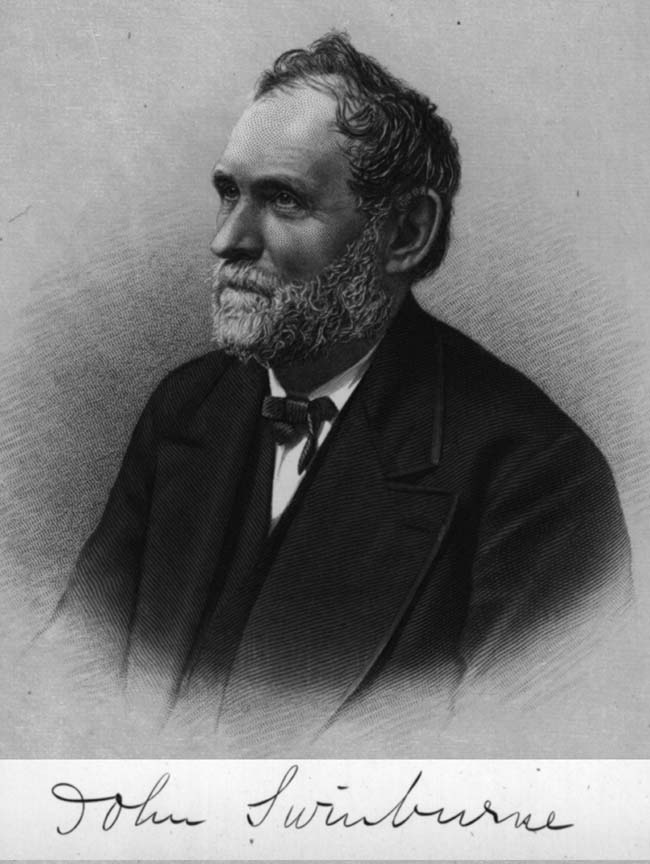
OR INCIDENTS IN THE LIFE OF DR. JOHN SWINBURNE OF ALBANY |
|
|
OR INCIDENTS IN THE LIFE OF DR. JOHN SWINBURNE OF ALBANY |
| Bold Words to the Rebels. --- Defects in the Medical Department, --- Controversy with the Sanitary Commission. --- Strange Anomaly. --- Observations on Surgery. --- A Brave Colonel killed by Malpractice. Red Tape in the Army. --- A Fearless Man |
THE treatment our sick and wounded were receiving was an all-absorbing thought with this unselfish physician, and incited him to make every effort for their relief. Under this feeling, he attacked the very highest in authority in the Confederacy, always using polite but plain Anglo-Saxon English, that could not be misunderstood, and appealed to all the better feelings of manhood. To the Confederate Gen. Winder he wrote from Savage Station, July 24, 1862, --
"Now, if you judge this the kind of food furnished your sick and wounded prisoners North, or as in accordance with the usages of war among civilized nations, you are mistaken. I have had to buy fresh meat for soups, and bread to supply the deficiency, since we have no means of cooking flour suitable to the sick. Now, I submit that flour and poor bacon are entirely unfit for the sick and wounded, since many have died from sheer exhaustion or starvation; and many more will die unless better fed. Many of those taken to Richmond, and detained so long in the depot without proper attention, have also died. Now, sir, all I ask is to have the sick and wounded who have become the recipients of my care receive the attention due them as prisoners of war, agreeably to the usages of civilized people; and that the surgeons to whose care they are intrusted be treated, not as felons, but in accordance with the precedents which have been established, and which you publish in all your papers, as the laws of the land. If we cannot be fed in accordance with the common usages of war,---in other words, if you have not the material with which to feed us, so as to keep us from starvation, --- I feel assured that your elevated sense of humanity will assist us to reach our own lines, where we can be attended to. I have seen and attended your sick and wounded at New York, Philadelphia, Fortress Monroe, and in this hospital, and have never seen any distinction made between them and our men. Now, with the insufficient nourishment supplied us, our funds failing, what are we to do? I leave the answer to your impulses of humanity, and ask you, in the name of the common obligations due from man to man, that you interpose your dictum, and change the status of our condition."
And to S. Guild, M.D., surgeon and medical director department of Northern Virginia, he wrote, --
"SIR, ---I regret exceedingly to again trouble you, but, under the circumstances, I must call your attention to a fact which I have before stated to you, that some of our surgeons are sick. One of them breathed his last yesterday afternoon. Some others are still sick, and all are more or less unwell. Lieut. Johnson, the commandant of this place, is now very sick, as is also several of his men. Lieut. Lacey Stewart has recovered, and has gone to Richmond to-day to procure rations for the patients. I feel as if I could not resist much longer the combined influences of this pus-generating place and the insufficiency of flour and bacon as food. It is not, however, for myself that I am so anxious. I have in my keeping many valuable lives, and I feel that every exertion on my part is due to them, to the end that they may be spared to their families.
"in view of these facts, I have purchased two sheep daily from my own funds, and have converted them into soup for the patients, hoping that it might contribute somewhat to their physical force during this trying ordeal. I trust, therefore, you will continue to exert your benign influence in behalf of suffering nature, so long as our necessities remain in the present status, or until we can all he removed to our own homes. I have to thank you for many kind attentions which I can never repay, or which, at least, I never expect to repay in the same way. So, also, Gen. Lee's attentions have surprised me, since he is burdened with a thousand cares incident to a life like his. I can only attribute it to his sympathy with those in distress, whether friend or foe. Now, sir, will it be possible for me, or some one of us, to go with these sick surgeons, who are delicate, and place them on board our transports, and to superintend the removal of sick and wounded? I hope you will excuse this constant interruption in affairs, since my whole heart is set on getting proper food for the sick and wounded. For myself, it matters little, but please don't allow us to remain in Richmond over night."
To all his communications to those in authority in the military or medical departments of the Confederacy in the field, he received the most courteous replies, in which, while those addressed regretted their inability to grant the relief he sought, they assured him of their sympathy, and the exercise of their influence in securing such relief from the government at Richmond as was possible.
While in active service in the army at the front, Dr. Swinburne saw many glaring defects in the management of the medical department which might be remedied, and thus tend greatly to the comfort of the sick and wounded. In the interest of the soldiers and humanity, he conceived many plans that would add to the comfort of the sick, and tend to the preservation of many valuable lives, ---a subject in which his thoughts seemed to be absolutely absorbed. On his arrival home from prison, he placed these views, with a statement of the facts as he found them, with his deductions from these observations and the results to which his experience enabled him to arrive, before the New-York State Medical Society. This body of scientific men, after fully discussing the matter, and hearing his recommendations, gave them their hearty indorsement, and appointed Drs. Swinburne and S. D. Willard a committee from that society, to confer with the governor, and to secure, if possible, an appropriation to carry out the design of obtaining more ample means for the relief of the sick and wounded New-York troops. Gov. Seymour, who then occupied the executive chair, feeling as he did a deep interest in the troops at the front, and knowing the eminent skill of the committee, gave them frequent and early hearings; and, as a result, a bill was draughted appropriating two hundred thousand dollars to carry out the views suggested by the volunteer surgeon.
As soon as it became known among a certain element, who professed to be especially working for the wounded soldier, that such a bill had been draughted, and the objects for which it was intended, there broke out a strong opposition in the ranks of a selfish volunteer organization, whose desire to gain notoriety exceeded their love for the soldier. This spirit of jealousy might have been expected, to a certain degree, from the regular medical department of the army, because of their training, and the assumption that in war every thing connected with the regular army was perfection, and, the greatest of all, that whatever they did was right, and that interference with their assumed superiority was to be regarded as an innovation not to be tolerated. But it was not from this source the opposition came, but rather from the executive committee of the United-States Sanitary Commission,---a volunteer organization supposed to enjoy only the same privileges accorded to other volunteer organizations, or societies of individuals, presumed to be working on the same humanitarian impulses.
In their opposition, this executive committee pathetically invoked the aid of the then surgeon-general of the State, Dr. Quackenbush, to defeat the measure, alleging that "the National Government is the national soldier's best friend," and "that whatever has hitherto been effectually done to benefit the cause of the sick and wounded soldier, has been done by increasing the force, improving the regulations, elevating the rank, or selecting more efficient presiding officers of the United-States Medical Department."
This executive committee of a society claiming to be composed of volunteers who desired to help the government, and benefit the wounded soldier, and who were still anxious to obtain broader fields and an exclusive monopoly, made the strange and irreconcilable assertion in opposition to the bill, "that already the great beneficent general system of the government in its medical department has been constantly embarrassed by the well-meant efforts of benevolent associations, either representing States or communities, who have insisted in pursuing their humane work." They further advanced the absurd proposition, "that the National Government is making provision at this very moment to do for the New-York troops, and every other soldier, precisely what the bill proposed, but could not do so if the bill were passed." The appeal to the surgeon-general, in closing, exposed the motives underlying the opposition, --- that of jealousy, lest the States, in assuming to do their duty to their sick troops, might find a more certain and efficient channel than through the sanitary commission. They stated that "it [the commission] collects money on the largest scale ever known to volunteer benevolence, and gathers supplies in an equal scale of vastness."
The reply of the committee, Drs. Swinburne and Willard, was prompt, cutting, and to the point. It said, among other things, ---
"The State clings to her citizen soldiers in the army. Her care for them is not lessened by their absence over the State line, and it is right it should not be. If committees from the city common councils and the village board of trustees visit them, and give them courage and hope, and help and good cheer; if the State sends committees to attend to their allotments; if the Legislature provides that they may vote ; and if the State looks well to their pay, and secures it or advances it early, ---if all these acts of kindness and care are manifested for the well soldier, how eminently proper and just, nay, how much more it is demanded by every consideration of humanity and good faith, that the thousands of feeble, maimed, and dying should be cared for, or at least inquired after, and their misfortunes alleviated in as kind and affectionate a manner as possible! And yet, when this latter course is suggested by the benevolent and philanthropic of the State, whose means of information as to the actual necessities are unquestioned; when a measure of relief is initiated, the executive committee of the sanitary commission, under whose administration these neglects occur, as was admitted by their own confessions in leaving every thing they had to be destroyed, or fall into the hands of the enemy at Gettysburg, proclaim that "voluntary associations, State societies, and local committees have constantly embarrassed the medical department of the government."
To this strange anomaly of the sanitary commission, the committee from the New-York Medical Society very pertly replied,---
"If this be true, well may the people of this State suspend efforts, and by so doing send comfort and joy to the soldiers, the sanitary commission, and the medical department of the Army."
To the cynical opposition of the commission, the committee make this- cutting satire: ---
"After the seven-days' battles before Richmond, not a single agent of the sanitary commission remained to care for the sick and wounded, and not one of them was taken prisoner. Their hospital supplies, deserted by their agents, were destroyed. The agents left at that time some five thousand sick and wounded to be cared for by the charities of the enemy, who had nothing to supply their wants."
This was a stinging rebuke, coming from a man like Dr. Swinburne, who had no honor to gain, and yet remained true to his mission, and was himself, while at his post of duty, taken a prisoner. There were no members of the sanitary commission taken prisoners at Savage Station, but there were several volunteers: among them, Felix R. Brunot of Pittsburgh, Penn., since an Indian peace commissioner under President Grant, with twenty-four nurses from that city; the Rev. Mr. Marks of Pennsylvania; the Rev. Mr. Reed of Washington, D.C.; and a Mr. Howell of Chicago, and several surgeons. Two of the latter, Drs. Milnor and Sutton, exhausted from their labors among the sick and wounded at that station, finally perished from starvation in the hands of the enemy.
The protest against the passage of the bill was made on March 11, 1864; and on the 30th, Gov. Seymour, in a communication to the Senate, recommended that an ample appropriation be made by the State for its sick and wounded troops. On April 24 the bill was unanimously passed by the Senate, and sent to the Assembly on the same day, and there passed without a dissenting voice, and before the sun went down was signed by the governor.
During the controversy over the passage of this bill, Surgeon-Gen. Hammond used his official position in an attempt to frustrate the measure, and wrote to J. V. P. Quackenbush, M.D., surgeon-general of New York, --
SURGEON-GENERAL'S OFFICE,
WASHINGTON, DC., March 2, 1863.SIR,--- I have the honor to acknowledge the receipt of your communication of the 25th ult., enclosing the copy of a bill proposed to be enacted by the Legislature of the State of New York, and asking my views upon the same.
I have read the bill very carefully, and, whilst admitting the correctness of the motive by which its framers have been actuated, I am satisfied, from much experience, that its chief effects will be to create trouble and confusion, to cause ill feeling between the representatives of the United States and the State, and to injure those whom it is intended to benefit. I am satisfied-that no military commander who has the good of the troops at heart would allow any agent of any State to interfere in the manner proposed in this bill. It would be found in practice wholly inoperative, and lead to the results indicated above, without any corresponding advantages being received. Doubtless there are deficiencies in the medical administration of the army, as there are in all other departments. Perfection is impossible of attainment ; but if I, with all my efforts, with the assistance of medical inspectors, medical directors, and over five thousand surgeons and assistant surgeons, together with the support of commanding officers, and all branches of the Federal Government, and the control of over ten millions (dollars, doubtless) per annum, cannot reach it, I am certain the agents of the State of New York will not be able to do better. I therefore hope you will use your efforts to defeat this bill.
I am not alone in my opinion in regard to it; as all to whom I have mentioned it, including several officers of rank, agree with me that its passage would be most unwise.
I hope you will excuse me for the freedom with which I have written.
I am, sir, very respectfully, your obedient servant,
WILLIAM A. HAMMOND,
Surgeon-General.J. V. P. QUACKENBUSH,
Surgeon-General of New York, Albany, N.Y.
The criticism, severe as it was, on the conduct of those who deserted the helpless brave in those trying days, had its effect, and was justifiable in Dr. Swinburne, as he, having remained and become a prisoner, had clearly won the right to condemn the cowardice of those who, acting on the motto that " self-preservation was the first law of nature," left the twelve hundred brave men at Savage Station.
In the Transactions of the New-York State Medical Society, submitted to the Legislature in 1863, is a full report from Dr. Swinburne during his imprisonment, with the communications that passed between himself and the Confederate authorities with reference to the exchange of prisoners, and his efforts for their comfort, as well as some severe strictures on the management of the medical department of the army. It also contains some able articles on resection of joints, and conservative surgery, on amputation when necessary, and the treatment of gunshot wounds.
His observations at the front confirmed the opinion, previously entertained, that there were by far too many amputations performed in the treatment of those wounded in battle; and that by the introduction of conservative surgery, if practised throughout the army, two great ends would be secured, ---the saving to the government of large amounts of money; and, what was of pre-eminently greater moment, the saving to the wounded of their limbs, and thus preserving them as their Maker would have them, and not having them crippled for life. He believed, if one limb was saved to a man who would live ten years, the government would be benefited to the amount of $2,050; and that if one surgeon would save, during a great battle, ten limbs from mutilation, he would save to the government, on the basis of ten years as the media of life after wounding, $20,500. While this was a pecuniary consideration, he felt more keenly, from humanitarian principles, a stronger desire to see the principles of conservation practised, feeling, that, if he could accomplish this, a great blessing would be achieved, and that he had been instrumental in doing some good to his fellow-beings. In this his ambition has been in a large degree gratified in seeing this system very largely adopted, both in military and private practice, although he was strongly opposed at the outset by many leading surgeons who have since acquiesced in the humane practice.
That he was eminently successful, has been demonstrated by the strongest arguments,---results. To show the wisdom of conservation, and the brutality or ignorance of the old system, a few cases are cited from this State. Lieut. Felix Angus of Duryea's Zouaves, while making a charge at Gaines's Mills, was wounded in the right shoulder by a minieball. Several surgeons insisted on an amputation; but he objected, saying he would rather die than lose his arm. Dr. Swinburne performed an operation of excision rather than amputation and "four weeks later, I was in New York, riding in Central Park, and enjoying life as well as ever," he afterwards wrote to Dr. Swinburne. He also wrote to the doctor, "I consider myself under a lasting debt of gratitude to you for the benefit you have done me; for you saved my arm, if not my life. As it was, you remember you took out my right-shoulder joint, and during the operation I felt no pain whatever." He afterwards raised and commanded Company I, One Hundred and Sixty-fifth New-York (Duryea's second) Regiment. Dr. Julius A. Skilton, who was present at the operation, and afterwards dressed the shoulder at White Oak Swamps, in writing to Dr. Swinburne, said," I am sure it would have done you good to see the satisfaction with which he expresses his gratitude for the preservation of his limb, and the manner in which he handles his sword with it now."
Lieut. Henry A. Wynkoop of Rochester was so severely wounded as to require the removal of the head and three inches of the shaft of the humerus; and still, at the end of four weeks, he had so far recovered the use of the arm as to be serviceable, and to give a tolerably warm shake of the hand. Less than a year afterwards he wrote to Dr. Swinburne from Rochester,---
"I must thank you again for saving my arm; and no money could make me feel as happy as this disabled arm does, thanks to your skill and kindness. The arm you operated upon was my right arm, and this letter is written with the same. After you left me at Fortress Monroe, my arm improved rapidly, and in four weeks not only was entirely healed up, but I was able to walk without in any way supporting myself. The wound never opened after it once healed up. I can use my hand as well as ever."
The young gentleman is still engaged in a banking-house near Rochester, and continues to write letters of gratitude to the surgeon who saved his arm.
In a volume of reminiscences of the war, a paper by Dr. Swinburne, dated July 23, 1863, in speaking of the losses of life occurring, as they did, not alone by the ravages of grim-visaged war in their usual phases, but in numerous instances from the want of care, disease, pestilence, and almost famine in camp and hospital, said --
"This awful destruction of life outside the usual course of war has been attributed by friends and supporters of the different parties in the country, and by the followers of different officers, to as many different causes as there have been parties or officers interested or implicated in the matter. Many of the alleged causes are truthful to a certain extent; but all of them are overdrawn, and very many more are entirely unfounded, disgraceful to those charging them, and only arise out of the evident desire of their supporters to heap unwarranted contumely upon the government, or the officers by them arraigned; and that, too, with a design thereby to further the still more evident and grossly treasonable intent to hinder the government in the speedy and successful prosecution of the war, and thus give aid and comfort to the enemy in such a covert manner as to shield the authors from the penalty of open treason.
"Foremost among these assigned causes has been the alleged inefficiency in the conduct of the medical department of the service during this campaign. It will be recollected that the celebrated Dr. Tripler, an old army surgeon, whose most valuable works on military surgery have justly attained a fame as world-wide as the subject itself, was medical director of the Army of the Potomac at that time. It has been charged, that, by reason of his neglect, the Army of the Peninsula was left without many things which were absolutely requisite for the proper administration of the medical department of that army; and that thus the soldiers, worn out by the fatigues of the march, weakened by exposure to severe storms and the dangerous miasmas of the swamps, and brought down to the hospitals by disease, were literally allowed to die from want of these necessaries, when they could have been promptly obtained at any time, it is said, upon proper call. This charge, it has occurred to me, is grossly unjust to one whose highest aim in life has been to serve his country faithfully, and make himself a useful and shining ornament to the glorious profession lie has adopted, and a lasting benefit to the human race. The office and duties of a faithful surgeon, even in civil life, is no sinecure; and when a surgeon of noblest mind and purest purpose, impelled by love of country, has chosen to abandon even the emoluments to be derived from the practice of his profession as a civilian, and is willing, for the paltry pittance allowed by government, to assume the responsibilities, and devote his utmost energies to the duties, of medical director of an army so large as that over which Dr. Tripler had charge, it seems to me that even the pardonable anxiety of the friends of those dying under his charge is not excusable for a violation towards him of the ordinary rules of charity which are, in the Book of books, laid down for our conduct towards all men.
"In my own experience in the peninsular campaign, I found it at times difficult to obtain a sufficient supply of many materials which were absolutely necessary for the proper care and cure of the sick and wounded, and, in fact, I was many times utterly unable to obtain articles most needed; and yet I have had the most convincing proof that the medical director cannot he justly held responsible for this. The fault, I am convinced, lay nearer the government at Washington. To my mind, the surgeon-general (superior officer to the medical director)---having the means at hand at Washington for ascertaining, if he did not know, the proportions of war the campaign was assuming; and knowing, as he must have known, the size of the army, the dangers by which that army was beset from the effects of the climate, the character of the country, and the probabilities of battle----was in duty bound to see that all necessary material was provided for the medical department of the service; and it would be but a sickly compliment (as it is an illy-consoling excuse) for that officer to say that perhaps he did not realize all the necessities of the case. And yet the fact is patent that there was, during the whole of the campaign, a lack of supplies for the medical and hospital departments, which, without doubt, was the cause of more deaths than occurred by the other and more direct casualties of war.
"After the removal of Dr. Tripler as medical director, the same lamentable state of affairs existed, and the same defects in the medical service, to a greater or less extent: as in the location of, and supplies for, the hospital at Windmill Point, where days are said to have elapsed before necessary food and medical supplies were obtained, and where a great number of our men actually died from lack of them; the medical history of the battle of Antietam, at which it is charged by Dr. Agnew that at least five hundred men died from the want of medical supplies; the battle of Chancellorsville, where thousands were, it seems to me, needlessly left in the hands of the enemy, when they might and should have been transferred to the other side of the river, and there received proper care and surgical attendance. It is said, that, after this battle, our brave wounded soldiers in many instances lay for days without proper food (and in some cases without any), and with no medical relief, many of them left to the tender mercies of the enemy, a large number of them dying from sheer neglect, and many others buried alive in fires occasioned by the contending armies in shelling the woods, and burning the Chancellor house."
As medical superintendent of the wounded New-York troops, he was not only ever anxious and vigilant in caring for them, but, wherever he saw bad management, was prompt and fearless to call attention to it.
In a letter to his Excellency Gov. Morgan, dated Falmouth, Va., Dec. 21, 1862, Dr. Swinburne again strikes some pretty hard blows at the head of the medical department of the army. He said, --
"It may seem presumptuous in me to offer any suggestions to men of such eminent ability as are to be found directing the medical department of our armies. I shall, however, offer to you, as the executive of the Empire State, such suggestions as shall seem to me appropriate and just in the present emergency, and particularly as you have seen fit to honor me as the accredited medical representative of the State of New York, to look to the interests of our troops now in the field. I should therefore prove recreant to my duty were I not to make all the suggestions which I deem pertinent to their welfare.
"In my judgment, there is something radically wrong in the manner in which surgeons are selected to fill certain positions. Merit or competency is in many instances entirely ignored, and seniority takes its place . . . . As it is now, many of the more useful, intelligent, conservative, and handy operative surgeons are acting in a purely executive capacity, as superintendents of hospitals, directors of brigades, corps, and divisions, instead of which they should be employed in selecting and deciding upon the operations to be performed, if any were requisite, and, if need be, to perform the operations in a manner most likely to give the patients the best chances of recovery. I know full well that there is a prevalent idea that the army is a good school for surgery. Now, while this is true in a certain sense, it is not so in another."
As an instance of the misplacing of surgeons in the field, the doctor wrote, --
"Take, for instance, our own Frank H. Hamilton, who consented to leave an elegant home, lucrative practice, and temporarily relinquished his position as teacher of surgery in Bellevue Hospital, to go out with a regiment of volunteers. What was the result? He was soon misplaced by being made a medical director of a corps; and that, too, where he was mainly useful as a executive officer, and where his peculiar talents could not be made available at the time of a great battle, when his genius would have relieved and saved many valuable lives. I mention this simply as one among the many instances in which talent is being constantly misplaced in this grand army, where there are thousands of the best men in the country, who command and obtain at home the best medical talent. Now, if these officers and men are willing to offer their bodies as a sacrifice to assist in saving our country from villanous treachery and rebellion, I think they have a right to demand of our government the services of the most experienced surgeons, at any cost. In this respect our government has displayed the most sordid penuriousness."
During the three days in June, 1862, while the wounded were being brought into Savage Station, the doctor performed twenty-two excisions of the shoulder and elbow. Of these, six resulted in good limbs; two which would have resulted well, were afterwards amputated by others without cause: the others, being removed to the pest-houses or "tobacco warehouses" in Richmond, were lost sight of.
In striking contrast to this humane system of conservative surgery, is a case given in the "Medical and Surgical Reporter" of 1863. On Sunday, May 3, Col. Newman, of the Thirty-first New-York, was wounded in the left foot by a grape-shot; the ball passing obliquely upward from the left side of the foot, crushing the anterior part of the tarsus, and lodging just under the skin, but not involving the ankle-joint. From twelve to fifteen hours after the injury was received, the ball was extracted, and the colonel sent, after the wound was dressed, to the National Hotel at Washington; the surgeons at the front deciding the foot could be saved. On invitation of a nephew of Senator Wilkinson, Minnesota, Dr. Swinburne called on the colonel, and, coinciding with the opinion of the surgeons at the front that the foot could be saved, washed out the wound, and dressed the foot. In the evening the doctor called again, and was told by the colonel that an army surgeon had been in and said that the foot must be amputated. As a friend, the doctor advised against amputation, and continued to wash and dress the wound twice a day. On the fourth day the inflammation had very considerably abated, and suppuration had commenced; the wound in the skin and soft tissue had begun to granulate; the whole appeared healthy; and the constitutional symptoms had subsided. His appetite was good. He slept well, and experienced little or no pain except when the limb was moved. Dr. Spencer of Watertown, Dr. Green of New York, and five army surgeons of good standing, who saw the colonel, agreed with Dr. Swinburne. On the 11th, however, he was told by Surgeon-Gen. Hammond, upon whom he called on business, that he (Hammond) objected to Swinburne visiting Col. Newman in any capacity, even as a friend; that the National Hotel, at which he was stopping, was located in a certain district in Washington, and that an army surgeon had charge of the district; that the patient belonged to such surgeon, and that he (Swinburne) had no business to call in any capacity. At the special request of Col. Newman, Dr. Swinburne called again, in company with Dr. Spencer, and advised the colonel to get permission to go to New York, Dr. Spencer offering to accompany him. But the army surgeons decided against this course, and said he must have the foot amputated, or they would not attend him; and that, if he did not submit to their decision in regard to him, he would be reported to the surgeon-general for contumely, and dismissed from the service, the colonel assuring the doctor a friend of his had been thus treated. The surgeon informed the colonel, he said, "that, if he did not submit, they would have to leave him, and that he should have neither pay nor medical attendance, but that they would strike him from the roll, and that they had the authority of the surgeon-general for saying this." The surgeon also added to the colonel's friend, "If I find a citizen surgeon in the room looking at any of my patients, I'll kick him down stairs." These remarks were made by Dr. Clymer. The amputation, after much dallying, was finally made by Dr. Clymer, assisted by Surgeons De White, Swasey, Farrel, and Allen, notwithstanding the patient was rapidly improving; and the colonel died. A friend of the colonel, writing to Dr. Swinburne after the butchery of this brave soldier, said, "This noble soldier often expressed his thanks for your kindness, and could not convince himself, that, in handling and dressing his wound, any hands were as soft and delicate in their touch as yours."
In reviewing the case in that fearless manner always characterizing the doctor's course when attacking malpractice on the soldier or private citizen, he raised these important points: --
First, The surgeons on the field decided upon the propriety of not amputating the foot of Col. Newman; that it could be saved without amputation.
Second, That the injury was inflicted on the 3d, and the surgeons on the field decided not to amputate. When he arrived in Washington on the 8th, while the whole limb was tumefied, and absolutely shining with inflammation, the surgeons in Washington wished to amputate. This was delayed from day to day, and still the foot improved, in spite of the depression of mind caused by the constant threats of amputation. On the 13th they demanded amputation, and it was delayed, the same condition of things existing, and I learn the surgeons decided upon waiting for a few days. On the 16th Col. Newman was troubled with little pain. Meanwhile his wounds freely suppurated; and, in fact, his condition had continued to improve, so that suppuration was free. On the 16th "the surgeons administered ether, and made a perfect examination"---of what? Why, a wound into which you could easily put your thumb and all your fingers. This examination resulted (as the surgeons stated) in finding a small bit of leather, and in wrenching by great force a piece of crushed bone, about one inch square, from its connection with the living tissues, besides doing other irreparable injury to the soft parts. All of these loose bones, leather, etc., would have dropped out of the wound whenever loosened by nature. Third, The 17th (next day) he was attacked with tetanus. How significant! Cause and effect are sure to follow. The story of the apples over again: you need not knock them from the tree, since, if let alone, they will fall when ripe. And so the bone will surely follow the organic laws of nature: ergo the ignorant interference with the bone caused the irritation which resulted in tetanus, the amputation and hemorrhage followed, and the sequel, death, was the result. Fourth, if amputation was to have been performed, why make the "examination" at all, in the manner it was made? since the eye could scan the entire wound, and the finger could easily pass through and into the wound, and ascertain its condition. Then why irritate the parts at all, before amputating? since fit is the desire of all good surgeons to avoid it, in order to save the shock, --- the pyaemia gangrene, or tetanus. That the latter followed so soon after this injudicious interference, there need be no wonder.
The review of this ease by Dr. Swinburne, and the deductions he drew, created quite a furore among the surgical profession in the army and with the public. It but proved the assertion made two months later by the "Medical and Surgical Reporter: "While on the whole there has been but little to complain of under the circumstances, regarding the employment of irregular practitioners by the government, instances have occurred, and still exist, where they have occupied prominent positions in the government service."
The "Reporter," in an article on "Tyranny in the Medical Department of the Army," referring to the case of Col. Newman, said,---
"On another page of this number we publish an article from a responsible source, detailing a case in which a cold, heartless, tyrannical exercise of power on the part of the highest medical officer under our government, and a subordinate who, if we mistake not, when the war broke out was engaged in mercantile pursuits, certainly not in the practice of medicine or surgery, seems to have cost a brave officer and worthy man his life. Let our readers peruse the article, and note the facts. Let them observe that at a public hotel a wounded man was denied the privilege of calling in the surgical aid of one of the first surgeons in the State from which he volunteered, who was then on official professional duty from the executive of his State, and was compelled to submit to an amputation against his own wishes, and against the judgment of a number of able surgeons; and that, too, when confessedly those who insisted on taking charge of the case had not time to give it the attention needed to save the limb. We had supposed, that, in the circumstances in which Col. Newman was placed, he had a right to choose his medical adviser, and that he also had a right to refuse to have his limb amputated. It seems, however, that he had no rights at all, that Brigadier-Gen. Hammond and his subordinates were bound to respect. The surgeon (Dr. Swinburne) of the patient's choice was one of high standing and acknowledged ability, and one who, in his capacity as surgeon, was officially connected with the government of the State to which the wounded man belonged."
In company with Senator Wilkinson and a governor of on of the Western States, Dr. Swinburne waited on Secretary of War Stanton, and indignantly denounced this piece of butchery, and other practices in the medical department of the army. The secretary, turning to the senator, asked, "Who is this man who so boldly makes these charges?" The senator replied, "He is a gentleman who knows of what he speaks, eminent as a surgeon, and successful beyond all others, terribly interested in the soldiers; and, if you don't know him now, you will soon know all about him."
The doctor wrote to the "Medical Times a severe criticism on the management of the medical department for the care of the sick and wounded after the battle of Fredericksburg. This communication was suppressed; and in its place laudatory articles appeared, praising the surgeon-general, who was reputed to be one of the proprietors of that journal, and who was busily engaged in preparing a medical and surgical history of the war.
Of this official and his enterprise, the "Medical and Surgical Reporter " said, ---
"The office of surgeon-general of the United States is one of great importance and dignity. Its occupant should have a better claim to it than any founded on mere personal or moneyed influence, or the advocacy of parties whose influence has tended to degrade the medical bureau. He should be a man of experience, a practical man. The head of the medical department is collecting material for a surgical history of the war; and army surgeons have been discouraged from publishing cases that have occurred under their observation, lest it should detract from the freshness and originality of the contemplated work."
On May 4, 1863, Dr. Swinburne was again commissioned, this time by Gov. Seymour, and left for Washington with a letter from the governor to Secretary of War Stanton, in which the governor wrote, ---
"Having had much experience in hospital practice, and also having seen much service with the army, I deem him eminently qualified for the duty to which I desire he may be assigned. Under letters from my predecessor, Gov. Morgan, Dr. Swinburne was placed in the position which I desire to have him occupy."
He also had with him a letter from Ex-Gov. Morgan to Secretary Stanton, in which the writer said, "I need not repeat to you that Dr. Swinburne is one of our most efficient surgeons, and has, by his skill and scientific treatment, saved many limbs and lives."
He had also a letter to the secretary from the late Thurlow Weed, in which he said, "You know how generously he has served the country, and the cause of humanity, and will, I doubt not, promptly pass him to the army."
On his arrival in Washington, he presented his credentials to Surgeon-Gen. Hammond, and was told "that it was the special request of Gen. Hooker and Medical Director Letterman, that no civilian surgeons be allowed to pass into the army lines at this time; that those who were there when the movement commenced were to remain, but additions were not desired."
The doctor then, with the assistance of the late Senator Sumner and others, persisted in an effort to get a pass to the front as a citizen in search of a friend, but in every effort failed; Surgeon-Gen. Hammond declaring he would submit the application, with his disapproval, to the war department, showing the animus and jealousy that actuated that official. In one conversation the secretary, in a very excited manner, declared the fact of giving the information Dr. Swinburne did to Gov. Seymour was wrong, and that of itself was evidence the doctor was a "bad and dangerous man." The doctor replied, "If doing my duty faithfully, and reporting the result to Gov. Seymour, who had sent me, and who was entitled to know the result, made me in his (the secretary's) estimation what he had been pleased to term me, then I acknowledge you are right."
Notwithstanding the efforts already made in vain, yet at the request of Senator Sumner to renew the application, and on the receipt of the following telegram from Adjutant-Gen. John S. Sprague, ---" Renew your application: it is the governor's desire that you go to the Army of the Potomac if possible,"---the doctor made one more effort.
On this effort proving a failure, he telegraphed to that effect to Gov. Seymour, and received the following from Adjutant-Gen. Sprague: -
"The governor is gratified with your zeal, but thinks he cannot ask the government to violate its rules. He hopes and believes you can be of great service to those who come from the army at Washington and vicinity."
Notwithstanding, both the secretary of war and surgeon-general, in refusing to allow Dr. Swinburne to go to the front, had suggested this very course; yet, when the governor's telegram to this effect was presented, a refusal was again met with. Surgeon-Gen. Hammond, who had said, "You can be of great service to the sick and wounded," now said, that, after what had occurred, he did not desire Dr. Swinburne, or any other medical representative or agent of the State of New York, to visit the hospitals about Washington, or offices in Washington.
In consequence of these several refusals of the war department and Surgeon-Gen. Hammond to recognize Dr. Swinburne as medical agent from the State of New York, or to allow him to visit the army as a citizen, the doctor felt that his remaining in Washington longer would certainly call down further opposition from the war department, influenced as it was by Hammond, and perhaps involve the doctor's personal safety; and realizing he was debarred from carrying out the mission for which he was sent, or the prompting of his own heart to benefit the sick and wounded, he left Washington for home. The dwarfish system of the head could not bear criticism, and knew he was safe from any censure by those who adhered strictly to military red tape, and wore the insignia of a regular of the army.
In 1864, Surgeon-Gen. William A. Hammond was, after a trial by court-martial lasting four months, dismissed from the service, and forever disqualified from holding any office of honor, profit, or trust under the Government of the United States. Soon after his removal, he inaugurated, according to the "Reporter," the "Medical Monthly," of which enterprise the "Medical and Surgical Reporter" said, ---
"It is reported in New York that the sanitary commission has subscribed to three thousand copies of this journal. We can scarcely believe that such a misappropriation of its funds has been made by that organization, certainly not to the extent reported, though it will be remembered that among the singular expenditures of the commission is a considerable amount for the publication of medical essays for the use of surgeons on the battle-field and in hospitals. It is possible that the commission has undertaken to distribute three thousand copies of the 'New-York Medical Journal' as a favor, to its reputed principal proprietor and editor."
As in all other conflicts where the doctor espoused the cause of the suffering soldier or the people, results brought about by time proved he was always right, and, when right, earnest.
| Health-Officer of New York, --- A Democratic Governor and Republican Senate indorse. ---No Man More Popular.-- -Forewarned, Fore-armed. ---Praised by the Governor and Press. ---Fighting Yellow-Fever. |
IN 1864 the State of New York, and the large portion of the nation to which the port of New York was the key, were threatened with another enemy more subtle than that of war, which was at the time creating such cruel havoc among the people in the southern portion of the country. This subtle foe, in the nature of the pestilential yellow-fever, was then infecting a larger number of ports with which our commerce was carried on than during any other season for sixty-six years, excepting, perhaps, the year 1856. The anxiety of the residents of that city, of the State, and of the State Government, was naturally aroused at the impending danger threatened; and prompt measures were deemed essential to meet this foe that must inevitably come to our shores, and, if possible, check it before its ravages had reached the land. This could only be done by an efficient and effective quarantine at the port of New York. To meet this emergency, the Legislature, in 1863, had enacted a law for the establishing of a system of quarantine in the lower bay. The very thought that there was even a possible danger of the plague spreading over the State, and adding its horrors to what the people were already enduring, was a strain almost too great to bear, and alarmed them to a degree that even the excitement attending the news from the fields of battle could not eclipse. Of what avail, it was readily recognized, would be laws to establish a quarantine, however well framed, or the appropriation of millions of dollars to effect the desired end for the purpose of saving the people, unless the right man was in charge as health-officer at the port of New York? For that position an eminently qualified man must be chosen; and Gov. Seymour, having the appointing power, by that intuitiveness for which he was characterized, realized the dangers that threatened, and the kind of a man the emergencies of the times required.
Dr. Swinburne had returned from the army, where he had been working out his plans for the relief of the sick and wounded, and where he had, after meeting with great opposition because of professional jealousy, accomplished much of his undertaking. Having no other desire than to succor and benefit the soldiers, and having come to fully comprehend the obstacles that were being placed in his way as a volunteer surgeon, he believed further effort would be the cause of intensifying opposition from the head of the medical department of the army, and necessarily in a large degree prove futile, he resigned, and returned to Albany. Gov. Seymour had watched with deep interest and pride the work accomplished by this volunteer surgeon, his boldness in denouncing mismanagement by those in high places, as well as his intrepid fearlessness as to personal danger, combined with his acknowledged skill in fathoming the causes of sickness, and applying the remedies to eradicate disease, saw in him the official he wanted for the responsible position of the times, and promptly sent his name to the Senate for confirmation as health-officer of the port of New York.
When the nomination of Dr. John Swinburne as health-officer was sent to the Senate, the two branches of the State Government --- the appointing and confirming powers --- were politically opposed to each other, and the number of applicants for the position was numerous. Yet, to the credit of all parties concerned in making the appointment, the same loyal spirit which had so often manifested itself during the previous years, when vital questions affecting the safety of the nation or the peace and health of the people were agitated, triumphed. There were no political lines of demarcation drawn: Republicans and Democrats arose to the demands of the hour, and were Americans. The fame the doctor had already achieved was known to every member of the Senate, as it was to the governor; and, as a sequence, one of the grandest indorsements of any man ever given in public life was there recorded of this gentleman by his appointment, made by a Democratic governor, being unanimously confirmed by a Senate, a large majority of whom were Republicans, in less than half an hour from the time it was placed before them.
That the appointment was heartily indorsed by the press, is evidenced by the comments of the journals of both political faiths, but by none more warmly than by the press of New York, politically opposed to him.
The "New-York Herald" of March 20, 1864, said, ---
"The public will be a little surprised to learn that the Senate confirmed the nomination of Dr. John Swinburne of Albany, for health-officer of the port of New York, in place of Dr. Gunn, who has held that position for several years past. This programme was agreed upon in the Republican caucus of senators the previous evening. There were facts presented to that caucus, in regard to the condition of affairs at quarantine, that justified, and, in fact, was considered by the Republican senators sufficient to demand, on their part, immediate action. The caucus decided to have the Senate go into executive session, and suspend the rules, and confirm the appointment of Dr. Swinburne, that he might immediately be commissioned. A messenger was sent to Dr. Swinburne, notifying him, that, if the governor would send his name into the Senate, it would be confirmed without delay. In accordance with this understanding, Gov. Seymour sent in his name. The Senate went into executive session, suspended the rules, -which require that the appointments by the governor shall be referred to a committee, and lay over for one week,---and unanimously confirmed the nomination."
On the following day the "Herald" said, ---
"Dr. Swinburne, whose appointment as health-officer of the port of New York by Gov. Seymour was confirmed by the Senate on Friday last, is a resident of Albany, and enjoys a high reputation as a physician and surgeon. During Gen. McClellan's campaign on the peninsula, he, with other New-York surgeons, volunteered his services, and at Savage Station and elsewhere rendered much aid to our sick and wounded soldiers. He was in charge of the hospital at Savage Station when that point was captured by the enemy, and accompanied our wounded soldiers, where he remained with them, devoting all his time and surgical talent to their care. Again, immediately after the battle of Fredericksburg, he, with other surgeons from this State, offered his services to attend upon, and look after, the welfare of our wounded soldiers, but learned, on reaching Washington, that an order had been promulgated excluding all volunteer surgeons from the front. Although a Republican in politics, it is understood that Dr. Swinburne's claims upon the Senate rested mainly upon his conceded professional qualifications, and the valuable services he has voluntarily rendered to our troops."
The "New-York World," in announcing the appointment of Dr. Swinburne, said, ---
"He is a bright, energetic, ambitious surgeon, who has in hospital and camp, in private practice and in a wide range of action, as in the army, and as in the prisons of the enemy, held bold and strong place, and made himself a name acceptable to Gov. Seymour, and accepted by the Senate. It is a remarkable step forward, as Dr. Swinburne is a lively man, and will make a good officer. It is a pleasant idea that in any thing there should be an entente cordiale between the governor and the Senate. It is an appointment that will be canvassed by the medical profession, who are somewhat distinguished for a sharp and severe criticism of each other; but the doctor is used to conflicts of this kind, and can smile at the storm. He finds himself suddenly, this sunshiny Saturday, health-officer of the great New-York harbor. It is waking up to find himself famous, and the surgeon will undergo the dissection of criticism. That the nomination met with unusual favor, is shown by the fact that the appointment, in its confirmation, was immediately sent to the governor. Of course, it is the event of the day."
The" New-York Times" said of the appointment, ---
"He is an accomplished physician, and one of the ablest surgeons in the State, and devoted to his profession, and is among the foremost in developing its skill, and extending its usefulness. Personally, no man can possess more popular qualities, and no man is more deservedly popular. It was Dr. Swinburne who, volunteering, and leaving a lucrative practice, was sent by the governor to the peninsula, where his skill and fidelity were of the greatest value. During the seven-days' battles, refusing to leave the sick and wounded under his charge, he was taken prisoner; and it was due to his firm and manly appeals to the rebel authorities that much of misery and death were saved, and comforts secured to our suffering soldiers. He will bring to the position of health-officer all the ability necessary to fill it, and the will to do so faithfully and valuably."
"That a prophet is not without praise save in his own country," did not apply to the honored physician. The press of Albany, his residence, where he was better known than anywhere else, was decided in their comments of the wisdom of Gov. Seymour in making this selection.
The "Albany Evening Times" said, "This is an excellent appointment, and one well deserved."
The "Evening Journal," "In nominating Dr. Swinburne, he selected a gentleman of high professional character."
The "Albany Express," "We think the fact that politicians of both parties dislike the appointment is the most satisfactory argument that could be offered that the governor nominated, and the Senate confirmed, just the right man."
The "Albany Argus," whose editor was well acquainted with the private and military career of the doctor, said editorially on March 21, "Dr. Swinburne was pressed by men of all parties, and by the medical profession of the State generally, not only on account of his scientific position, but on account of the service he had personally rendered our soldiers in the hospitals and on the battle-fields. These considerations induced Gov. Seymour to make the appointment, and the Senate, without a moment's hesitation, to confirm it." And on the 23d he again said editorially, "It was understood that a political appointment in place of Dr. Gunn would not meet the concurrence of the Senate. In nominating Dr. Swinburne, he selected a gentleman of high professional character, and one who devoted earnest and salutary labors to the soldiers of New York."
This position he held for six consecutive years, until the advent of the Tweed régime, and the inauguration of that era of public plunder which followed, marking the most corrupt epoch in the history of the State, ending at last in the ignominious death of the chieftain in a felon's cell, and the fleeing as outcasts, and fugitives from justice, of some of his most active princes and leaders. During that period, he established and built up one of the best, if not the best, quarantine systems in the world. The peculiar and fitting record of the esteem in which he was then held was greatly augmented in later years by his re-appointment as health-officer by Gov. Fenton (Republican) when he succeeded Seymour (Democrat), as did Seymour when he succeeded Morgan (Republican), in the re-appointment of Dr. Swinburne to a position in military service.
The appointment opened up a new field of professional activity and research to the inquiring mind, that had been restless for years in searching after greater truths in his profession, and the developing of more efficient means to suppress disease; as he had labored for years before, in introducing a more conservative system of surgery for the saving of limbs, as well as lessening the tortures that had heretofore almost caused the blood to chill at the mere mention of a surgeon, whose profession and practice were thought to be synonymous with cruelty and amputated members. All the diseases humanity so revolts from, such as cholera, small-pox, and yellow and ship fevers, he met at the watery gate of the city, and successfully conquered, often fighting these loathsome and dire diseases at quarantine, while the residents of the metropolis slept in safety, not even knowing danger was so near. The work accomplished at that station was even greater than that accomplished by him on the field. Here he had no ignorant superior, or professional jealousy, to contend with, and hence pushed forward his work with such marvellous success that he received the congratulations of the Executive in an annual message; and the Legislature, fully appreciating his work, by law enacted, after his retirement, that one of the artificial islands built by him in the bay should forever be known as Swinburne's Island Hospital.
No record of the living will ever reveal what was accomplished during the time Dr. John Swinburne held the position of health-officer; and it is utterly beyond all human power to conceive what evil results his knowledge and science, and the system of prevention he adopted, were the means of averting. That he established a great quarantine, to prove a continuous safeguard, is a matter of history ; that he run the quarantine department when the duties of the health-officer were much greater, at seventy thousand dollars per year less than one of his successors, Dr. Vanderpoel, is a matter of record on the books of the comptroller; that he never gave occasion for a suspicion of dishonesty during his management, is a pleasant reminiscence in official life; and that the results of his searching after the origin and nature of cholera and yellow-fever, as well as the most effective means to check and eradicate these diseases, have been accepted and dwelt upon as reliable authority ever since, must be gratifying to his professional pride, free as he is from vanity as a gentleman, and from professional jealousy---an outgrowth of the known and envied superiority of others---as a physician and surgeon.
A man filling such a position would be more than human, and nothing less than infallible, if he met with no opposition in the discharge of its duties. Dr. Swinburne was not exempt from complaints; but they came solely from persons who had pecuniary interests to serve, --- from owners of vessels, who were more anxious their crafts should prove profitable investments than they were in the preventing of the spread of disease; from stevedores, who were willing to jeopardize the lives of their men in the holds of infected vessels, and in the handling of disease-poisoned merchandise; and from boarding-house runners and scalawags, who would risk any thing to satiate their desires to plunder the "green-horn," and bleed the open-hearted sailor. All these the health-officer met with a firmness that knew no yielding. He was there to prevent the spread of disease; and effectually he accomplished that end by the enforcement, rigidly, of the rules his experience taught him were essential, even though some of them, at times, appeared harsh and even oppressive.
When he assumed the control and management of the quarantine, there were absolutely no provisions made for the effectual carrying-out of the purposes of quarantine. There was but one floating hospital, and this vessel was in a leaky and decidedly bad condition. There were no proper residences for the health-officers, and no wharves for the discharging of cargoes, and no warehouses for the cargoes, if discharged, during fumigation. To wait for another session of the Legislature, before active operations, was not in the nature of Dr. Swinburne. He held as a motto, "To be forewarned is to be fore-armed," and not only immediately commenced arranging for any emergency that might arise, but devoted himself to even a more searching diagnosis of the fever that threatened, as well as making the most minute and thorough analysis of its nature, growth, and the causes from which it emanated, so that, in the event of its arriving at quarantine, he would know on the moment what to do, and when and where to do it. His quarantine resources were less than limited and adequate, for in reality there were none. Yet when the season arrived, and the yellow-fever made its appearance at quarantine from the infected ports, with a larger number of vessels arriving from them than in any previous season, the health-officer was prepared to meet it so effectively that not a single case passed quarantine.
The commissioners, in their report to the governor that year, stated, that, on entering upon the discharge of their duties, they found that nothing had been done towards the establishing of the quarantine, contemplated by the act of 1863, and found the health-officer destitute of means. The floating hospital ship which had been provided, and in use for five years previous, for the reception of persons sick with yellow-fever, was found in a leaky condition, requiring extensive repairs. With their report, they submitted to the governor the report of the health-officer, asserting that it. contained so much valuable information that it should be presented in full. His Excellency, in submitting the report to the Legislature, accompanied it with a memorandum, stating "that it was replete with information regarding the various diseases which came under the health-officer's observation and inquiry, and abounded with valuable suggestions affecting the sanitary and commercial interests of the city and State."
In that first report, Dr. Swinburne, as health-officer, presented a number of suggestions and recommendations with reference to the erection of hospitals, warehouses, wet docks, and floating hospitals, as well as the necessity for a better system of police regulations, all of which were carried into effect during his administration. He treated the subject of yellow-fever in a manner that allayed much of the apprehension and fear entertained with reference to the disease, and afforded a feeling of safety such as had not been enjoyed before. Of the fever, he said, "The malignancy of this disease, which but a few years ago was regarded as an incurable plague, has at length been compelled to yield to the power of medical science. The origin, nature, habits, and peculiarities of this infection have at length become so thoroughly understood, that we are now enabled to guard against the extension of its poisonous effects with a certainty of results almost as definite and fixed as that attendant upon the care and cure of any other disease."
While during some of the previous years the infection had been carried on shore, and communicated to vessels in port, and in some instances had afterwards raged in a most fearful manner, not a single instance of this kind occurred during the season of 1864, the first that Dr. Swinburne was in charge of the quarantine as health-officer.
In 1865 there was no diminution in the danger of being infected with yellow-fever, still prevalent in many ports, with the means to check the disease at quarantine still in a crude condition, and far from what was deemed actually necessary in the discharge of the duty to which the health-officer was assigned. But again he was equal to the demands upon him, and exhibited that unconquerable spirit which he so often displayed in civil and military life; and knowing that to delay was dangerous, and that procrastination is the thief of time, he was able to meet the disease at the opening of the season, and again successfully blockade it at quarantine. During that season two hundred and thirty vessels arrived from ports infected with yellow-fever. On board fifty-three of these vessels, there were two hundred and forty-six cases. All these were quarantined, inspected, cleansed, and fumigated, and the disease, so far as that year was concerned, as completely conquered as was the Rebellion the same year by the Union army in the front; with even grander results, for not a case, as in the previous year, had passed quarantine.
So universal had become the fame of this health-officer at this critical period, that it won for him plaudits almost as great as those his valor on the field had called from the press and public. Pleased with the work the health-officer had accomplished, and the praise that was being bestowed on him, Gov. Fenton, under date of Nov. 4 of that year, expressed his pleasure to the commissioners in these words: "I am glad to know that the health-officer, Dr. Swinburne, has attracted honorable mention in the discharge of the responsible duties of his position, and that he is unwearied in his efforts in connection with your board, and other authorities of the city of New York, relating to the sanitary condition of the city."
From Washington came also words of praise. S. K. Barnes, surgeon-general of the United-States army, in writing to Gov. Fenton, said, "In this connection permit me to congratulate you upon the energy and efficiency displayed by your health-officer, Dr. John Swinburne, and to express the conviction, that, if sustained in the exercise of the necessary precautionary measures, he will be fully equal to any emergency that can now be anticipated."
Such words of approval, coining from the chief executive officer of the State, and from the head of the medical department of the United States, would have aroused no small degree of vanity in the majority of mortals. With this matter-of-fact but eminent physician, they elicited no further feeling than the satisfaction of knowing that his efforts to do his duty to the State and the people were appreciated by those qualified to know the magnitude of the work, and the results attained.
Again, the following year, the commissioners, in submitting their report, deviated from the established custom, among officials, of giving a mere synopsis of the health-officer's report, and transmitted it in full. They said, "The report of the health-officer contains much valuable information in regard to the principal quarantinable diseases which have visited our port, and shows a most gratifying result attending the administration of our quarantine system during the past season. It is replete with so many interesting statistics and practical suggestions, that, notwithstanding its extreme length, we have deemed it advisable to transmit it entire to the Legislature."
The health-officer, in his report, again presses the absolute necessity of a number of provisions for the hygienic treatment of the persons who arrive at quarantine sick with disease. This, like all other reports by him, is not confined to a formal statement of facts, of expenditures of the department, and the number of arrivals, sick, and deaths, but is accompanied with a minute statement of his observations of yellow-fever, and the conclusions scientifically arrived at after investigation, thus affording information of value in the present, and for time to come. In this connection Dr. Swinburne said, "While a climate may be generally unfavorable to the extension of disease, yet instances are not wanting where places, for years exempt from disease, have become infected: for instance, Newbern, N.C., for a long period of years considered one of the most healthful ports. During the year 1864 it became infected with yellow-fever, which prevailed in so malignant a form as to nearly depopulate the town. So with Key West, never infected until 1862; but the past season it has been the most malignant port, and no vessel could touch there without being poisoned." He cited the case of the ship "Tahama," which touched there on June 12, taking no cargo, only landing a gun; and yet in four weeks, while in a northern climate, yellow-fever was discovered, and within seven weeks twenty-six cases had occurred. "I may safely say," he adds, ,with the exception, perhaps, of 1856, no period has been fraught with more danger to the port and harbor of New York from infection than was the past season." He was inclined to doubt the possibility of purifying vessels infected with disease, --- whether by frost, fumigation, or otherwise, --- without the absolute discharge of cargoes therefrom. He recommended proper facilities for the purification of poisoned goods, especially clothing, etc., as no such existed; and all kinds of expedients were resorted to, to accomplish this work.
It was not till this year that the first appropriation was made for the carrying-out of the system of quarantine islands and hospitals, as recommended in two previous reports.