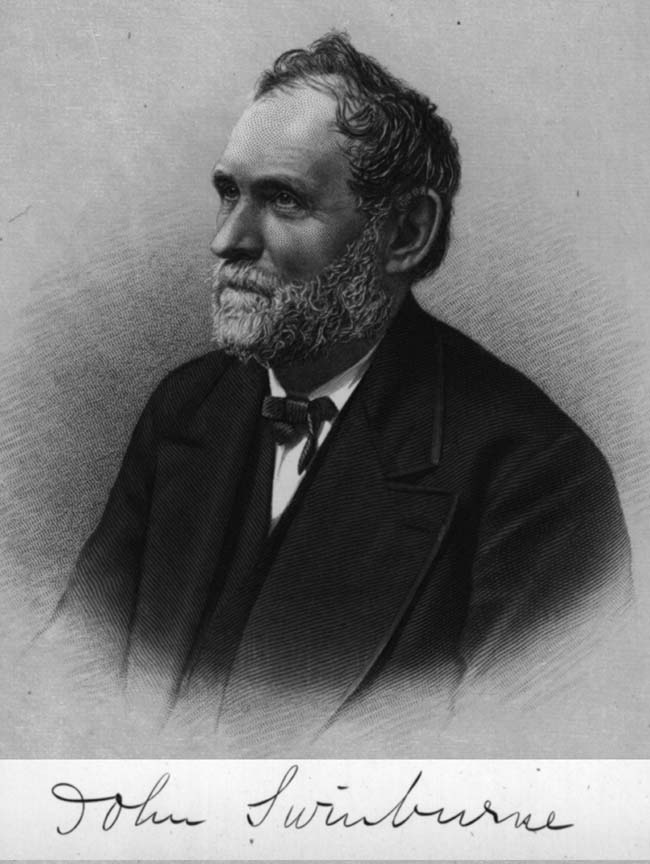
 |
OR INCIDENTS IN THE LIFE OF DR. JOHN SWINBURNE OF ALBANY |
|
|
OR INCIDENTS IN THE LIFE OF DR. JOHN SWINBURNE OF ALBANY |
| Envious Rivals.---Brave and Philanthropic.---Sacrificing Comfort for Patriotism.--- A Busy Life.---Thrilling Adventures. ---Self-made. |
"To be as busy as a Wallach woman, and do as little," was an old saying among the German settlers of Roumania; and the excuse given by the males for having wives was "to comb and keep them clean," as the men were a dirty, indolent, and cowardly set, except in the commission of such crimes as plundering, horse-stealing, and smuggling. For every neglect to live and act as human beings, they had an excuse. When the month of May arrived, the proper season for planting, they wasted an entire week in unmitigated idleness, under the supposition that their fruits would thereby be protected from the late frosts. These laggard husbands, however, were anxious that their wives should be always busy, and often frightened them into greater diligence by pretending that a fairy visits every house early on the morning of Holy Thursday, and inflicts on them some dreadful affliction if all be not found in order. Among more civilized people, and particularly with this nation, there are those who possess the same characteristics as the Wallachs, always ready with an excuse for not answering promptly the calls of duty as patriots, citizens, or humanitarians. Such men are the most anxious to disparage the works of others, and would, if they could, bury far from the sight of the world every record of heroism of their day, and blot from the pages of history those ennobling acts in the lives of fellow-beings that will live in memory long after their cowardly and selfish lives have been forgotten. Yet, to the credit of this comparatively young nation, this class of envious persons is small, compared to the great whole, and of a much smaller ratio than might be looked for among the heterogeneous mass from all nationalities, who make up the great American nation, and constitute a people whose bravery and humanity outstrips any records of ancient or modern times. It is the acts of individuals that make history for the future, as their deeds operate for good or evil in their day and generation; and truly the history of this nation is brilliant, as it is being written, with national acts of greatness, and individual deeds of daring and philanthropy, that obscure the most brilliant doings of the more ancient Spartan, or the chivalric deeds of the historian.
In the bustle and excitement of our progressive life in America, we are too prone to overlook the deeds of men while they are living, and await, because of ambitious jealousy for place and preferment, to render just tribute to the deserving, until the hand of death has laid cold the man the people should honor. When they have passed where earthly honors and mortal eulogies are as empty sounds to the departed, over their biers are pronounced the praises that should have been sounded in their ears while the senses were yet quickened to receive the grateful tributes. Not a month passes but history is repeating itself in giving to the world the sad tidings that some truly great man has passed away; and for a time the poisoned pen of partisanship is laid aside, and, the better nature prevailing in the presence of the dark spectre, a meed of praise is bestowed. But, alas! the just tribute to a worthy name is often too late, and only inspires the thought that merit has no rewards for the living to compensate for the sacrifices made.
When another century has passed away in the life of the American Republic, what an array of valiant men will be found to have lived and acted prominent parts in the great free government on this continent! Every page of history will sparkle with the names of men whose brilliant acts will shine out as startling constellations in the darkness of the struggles through which the country passed. Ever since the Indian war in 1675, that devastated New England, when Capt. Church of Massachusetts, and Capt. Dennison of Connecticut, became celebrated for their heroic ardor and fortitude, the list has constantly increased; and the acts of daring and self-denial have become grander as civilization has progressed, until in every emergency, in war and in peace, even the humblest citizens are performing acts that in other days would have caused them to be crowned with wreaths of glory.
The peculiar and striking bravery of the truly American is inspired only by that intelligence which assures him he is right, and to the commission of deeds which his conscience directs and approves, as the love of freedom animated to deeds of heroism the band of men under Gen. Putnam at Long Island, who fought with such bravery, with Gen. Clinton attacking them in the rear, and the Hessians in the front, when they believed neither valor nor skill could save them from defeat.
With us we have still living in active life, in the State of New York, one whose name will be in the future familiar among the votaries of science and the lovers of patriotism, and whose discoveries in the profession of his choice have already almost revolutionized the practice of surgery, and whose genius and skill will be honored by his profession for ages. His acts of intrepid bravery on the field of battle, his sympathy and care for the sick and wounded, his deeds of charity and benevolence among the poor, will be as familiar in the future as Ethan Allen's demand for the surrender of Ticonderoga is now, and his philanthropy will be as immortal as the poet has made Paul Revere's ride to Lexington from Boston.
Brave as a Wellington, yet tender as a woman; eminent as a surgeon and physician, yet plain as a man; polished and learned as a gentleman, yet humble as a peasant; a hater of fraud, chicanery, and dishonesty, yet jealous of no man; constantly moving about among the people, looking only to their interests, sacrificing time and money to make the condition of the masses better; supplying with a liberal hand the wants of the poor, caring for their sick and unfortunate; fighting error and corruption wherever he finds them, either in his profession or in government; and sacrificing all personal comfort for the good of others,---is the man to whom we would lead public thought, knowing that the American people love the brave and humane, and only require to be reminded, to awaken to the according of deserved honors.
The truly American, Dr. John Swinburne, has a life which has no parallel or precedent in the combining of so many distinguished qualities in any one man, and is a prototype for others to emulate. As a patriot, the relinquishing of a very lucrative practice, second to no other physician in Albany County, and going to the front during the Rebellion as a volunteer surgeon without pay, was a sublime act, and endeared him to the hearts of his countrymen; and his acts of bravery while there, have entered his name among the multitude of heroes of that period. His constant care of the sick and wounded on the fields of battle, and his never-ceasing efforts to have them comfortable, has made him an object of honor, and almost reverence, among the hundreds of his brave comrades who felt his tender touch, or heard his kind words of sympathy, while they lay in pain and agony. His eminent ability as a surgeon, and his constant endeavor to cure the injured and save the parts wounded; his aversion to the common practice of cutting and amputating; and his firm opposition to having the noble fellows, wounded for their country, made subjects for experiments in cutting and amputating, won for him the gratitude of thousands whose limbs were not sacrificed, but saved to them, as well as the respect and esteem of all humane and honest surgeons, and caused him to be hated and envied by the ignorant charlatans who practised human butchery and malpractice.
There is something phenomenally grand in the active, self-denying, and busy life of Dr. John Swinburne as a surgeon in the field of battle; as a health-officer, contending with the terrible diseases of cholera, small-pox, and yellow-fever, saving the people from their destructive ravages for years, and finding the means not only to check but to suppress these diseases; as a philanthropist, establishing sanitariums, hospitals, and dispensaries for the care and treatment of the poor; and the introduction of a conservative system of surgery that saved rather than destroyed, and the application and use of remedies that are comparatively costless, instead of the high-priced drugs and minerals usually prescribed in treating the sick. His quiet benevolence, and yet bold aggressiveness in fighting error and corruption in high places, both in professional and official stations, has given his life a charm unequalled in the past, and has won for him the unyielding love of the masses of the people. To these are added other events that render his career one of thrilling adventures and bold aggressiveness, that intensifies the charm, and holds the strongest admiration. As a medical expert on the stand, surprising the courts by his bold statements, arousing the opposition of almost the entire profession of the State, and finally satisfying the courts that he was right, proving his grounds as the only correct ones, and completely silencing his opponents, were remarkable victories, and have established him as the most reliable of medical experts, with whom others do not desire to cross professional swords. In a besieged city, where the shot and shell were falling fast, and riot was rampant on the streets, he was there cool, and, from the promptings of humanity, devoting his skill to the care of the wounded without money and without price, and winning in that foreign nation the highest position in his profession, a place accredited him by all the nations of Europe.
Like the other eminent names which grace our history, starting to work out their destinies from the tailor and shoemaker's shop, from the tanyard and wood-chopping, and ending with the presidency and vice-presidency, this man, from sleeping on the floor and living on seventy-five cents a week while a student, who has attained the highest pinnacle in his profession, is an eminently typical American.
In his address to the jury in the celebrated murder-trial in Albany in 1853, of John Hendrickson, jun., for causing the death of his wife by the administering of tincture of aconite, a vegetable poison, the Hon. L. S. Chatfield, attorney-general, said of Dr. Swinburne : --
"Who is John Swinburne? John Swinburne, with that frankness characteristic of the man, --- sunny frankness that knows no guile, --- he comes here and tells you he is a native of Lewis County. He was of humble parentage, and, like other poor boys, I suppose he had to work to acquire the means to further him in knowledge. He finally is found in the Lewis Academy, thence he went to Fairfield, and from thence he comes to this city. At the medical college here, he acts for two years as demonstrator; since when he has had a private dissecting-room, and has probably made more post-mortem examinations than any man in the State.
"John Swinburne was not put on that stand because he had a diploma in his pocket, nor because he had been born with a silver spoon in his mouth, and been reared in the lap of luxury. We placed him there because we knew him to be an intelligent, scientific, and honest man; because we knew that he would give us truth, which we were seeking for.
"I have yet to learn that colleges, or college honors, make the man. Wherever you find distinguished talent, in whatever profession you find mind leading in the race of popularity and distinction, in whatever walk of life you find prominence and true superiority leading to honor and respect, you will find that zeal, courage, virtue, industry, indomitable will, and untiring perseverance, underlie it all. These men, cast in Nature's noblest mould, are learned and intelligent in spite of colleges; and in our land nineteen out of every twenty of the men who have deservedly received honors from the hands of their fellow-citizens have fought their way to their exalted position from the humblest walks of life. They have conquered disadvantages which would have appalled the softer-natured collegiate, and, thirsting after true and useful knowledge, have attained it because it was attainable to the intelligent, the industrious, and the good.
"If I were to look for the intelligence of the land, I would look to what is termed the middling classes: for it is there we find sound, practical sense; it is there we find incorruptibility; ,and it is there we find those qualities of head and heart which endear man to his fellows. It is there, also, that we find that patriotism which protects the interests and institutions of our country. It is to that class John Swinburne belongs. He does not come here resting on a diploma, but he comes here with a pure heart, a clear head, and a richly stored mind.
"The community will cherish such men as he; and I here tell the gentleman that the name of John Swinburne will live long after his bones have mouldered in the dust. Confident in his integrity, his intelligence, I am willing to bring John Swinburne here, and I am willing to rest this case on his credibility; and I wish we had more men of as clear heads and pure hearts as he, instead of the scores of charlatans and quacks who can use muriatic acid for a tooth-wash."
| A Volunteer Surgeon. --- A Turkish Tradition. --- Among the Wounded in the Rebellion.--- A Carnival of Death.--- Medical Superintendent of Wounded New-York Troops in Full Command.---A Hard Road to Travel.---Official and Press Eulogies. |
DURING the trying days of 1861, when the arsenals and factories were busy moulding the weapons of death; when the steady tramp of armies of valiant men in blue were marching from every section of the North, East, and West to the sound of martial music, with a tread that shook the nation from centre to circumference; when loved ones were taking their farewells, perhaps forever, and the nation was in the throes of a terrible and wicked revolution that threatened the destruction of the grand republic of the free, so much patriotic blood had been spilt and hardships endured to establish and perpetuate,-Dr. Swinburne was living in Albany, enjoying the largest professional practice in the city. When the first struggles took place between the loyal and rebel forces, he entertained the hope thousands of others in the North indulged, --- that the conflict, though it might be a sanguinary one, would be of but short duration, and that the foolish leaders of the Rebellion would recover from their delusion, and, renouncing treason, return to loyalty and peace. As the months wore on, and the spirit of rebellion intensified, he realized that the end was not yet, and gradually arranged his business that he might go where he could do the most service to his God, humanity, and his country, and to this end tendered his services, without pecuniary compensation, to Gov. Morgan, as a volunteer surgeon. The governor, knowing the abilities of the surgeon and physician, and the pressing need there was at the front for one so skilled, promptly accepted the voluntary offering for his State and country; and, despite the earnest solicitations of the doctor's friends and patients, he was duly commissioned on April 7, 1862, a volunteer surgeon to care for the sick and wounded troops belonging to New-York State, and immediately left for the peninsula. Since that time, up to the present, the life of this remarkable man has been a continuous chapter of surprising personal achievements in military, scientific, and civil life, affording realities stranger than fiction in the active performances of a man impelled to exercise the gifts that God had endowed him with for the good of others.
From the breaking-out of the Rebellion, up to the date of his commission, he had not been a passive looker-on in the first stages of the terribly wicked and cruel drama, nor a drone in the hive of loyalty's busy defenders. At the very opening of the first tragic scene in the conflict, he was made chief medical officer on the staff by Gen. John F. Rathbone, and placed in charge of the sick in the Albany (N.Y.) depot for recruits, where, according to the report transmitted to Gov. Morgan by the then State surgeon-general, Dr. S. Oakley Vanderpoel, the result showed the wisdom of the appointment. The surgeon-general stated in that report, "Dr. Swinburne not only gave the sick soldiers his whole time and attention when needful, but, when it became necessary to put some seventy patients in another building, the same care and supervision were exercised." He further added, "The abstract accompanying this report is the best commentary of the fidelity and skill exercised by himself and his assistants," and then announced that up to that date, Dec. 13, 1861, "about three months, the whole number of cases treated by Dr. Swinburne during the period of his administration was fourteen hundred and twenty-seven, and the deaths only twelve."
It will seem scarcely reasonable that one who, because of his prominence in his profession, held such a position as surgeon-general of the State of New York, would, after indicting such an official commendation, and others equally laudatory, to which further reference will be made, because of professional jealousy, plot to undermine and destroy the reputation of the man he so praised. Yet it is true that in the hours of peace the mask of friendship was thrown off, and Dr. Vanderpoel became one of the chief actors in an ignoble and bitter but futile effort to destroy the fame of the eminent physician and surgeon, because he would not aid and abet error, nor cover up the professional and public shortcomings and lack of integrity, of this man and some of his associates.
The reader will pardon this digression, but will, by events that follow, see the connection in what occurred after Dr. Swinburne's military career, his success for years in fighting disease, and establishing as health-officer of the port of New York the best system of quarantine in the world, and winning a fame abroad such as was never bestowed on an American surgeon. These successes aroused the envy and hatred of some professional men who stood at the bottom of the ladder of fame, without any ability to mount it, much less to reach the eminence Dr. Swinburne had succeeded in reaching, and recalls the Turkish tradition of Moses and the Israelites. The story goes, "that while the Israelites were marching to the conquest of the Promised Land, Moses, desirous of contemplating the wondrous works of God, set out to travel. He voyaged for thirty years in the east and west, in the north and south. After many wanderings in distant countries, the patriarch returned to his tribe ; but, instead of being received as the wisest man and the first of legislators, he saw his fame as a prophet and a traveller eclipsed by the gold of a banker. During his absence, there had risen up a man among the Israelites, --- a man who had never ventured near the flames of Sinai, and had not the least admiration for the wonderful works of creation, but who had spent his days in ingenious speculation among the moneychangers of the wandering children of Israel. Despising in his wealth the poor man, who returned from his travels, he would not recognize him as the lawgiver of Israel. In order to make him contemptible in the opinion of those who still retained feelings of respect and gratitude for the ancient leader, he instituted a process of law against him, and suborned false witnesses. But these witnesses were stung in their consciences before the tribunal, and proclaimed the truth, and Moses triumphed. The people again received him for their leader, while the earth opened and swallowed up the banker with all his wealth." The tradition is in many points analogous with the treatment of Dr. Swinburne by the "tribe" (one of whom had acquired wealth by what was considered questionable means) who controlled the Albany Medical College and some of the hospitals at that time, in that most, if not all, of them are without honorable fame or preferment now, while he is the most popular man in the State, as proven in the overwhelming majority with which the county of Albany has made him its "lawgiver" in the National Congress, and in having twice elected him mayor of the capital city of the Empire State.
But to return to the story of his achievements in the fields of carnage and war. The commission given him by Gov. Morgan as a volunteer surgeon was applied for that he might have a broader field in which to exercise his universally conceded superior skill, and transferred him to a point where these qualities were eminently and urgently needed, and afforded opportunities to gratify his ambition to do much for his country, and won for him plaudits and honor few men acquired during his term of service. As an auxiliary volunteer surgeon, he reached the headquarters of Dr. Tripler, medical director of the Army of the Potomac, at the White House, on the Pamunkey River, Virginia, on the 18th of May, 1862, and was by that officer assigned to the establishment of a hospital at that point.
A letter in the "Albany Evening Times," dated White House, June 10, 1862, will give some idea of what the surgeons had to contend with at that place, and the inadequate provisions made to care for the sick and wounded, an emergency almost entirely neglected. Dr. Swinburne, with Drs. Willard and Lansing of New York, and Hall and Page of Boston, were assigned to the establishing of a hospital there, where they succeeded, after one week, in erecting wall-tents sufficient to hold from twelve hundred to fifteen hundred patients. When they commenced their work, there were only a few tents up, while patients were pouring in at the rate of from one hundred to one hundred and fifty a day. Indeed, there were nearly three hundred sick and wounded under the trees at the time, awaiting admission to a hospital, and a severe rain-storm approaching. Shelter was soon provided. The next consideration was something to keep them from the ground, in the form of beds. Straw arrived, but it was found to be wet from the insufficient housing, like all Virginia economy; but by means of India-rubber and boards they succeeded very well in keeping dry. The next day Dr. Baxter, brigade surgeon, sent in his private stock of hay (about four thousand pounds), and distributed it through the tents, in lieu of wet straw; and thereby the patients were made very comfortable. The next thing to be attended to was food for these hundreds of sick. Now came the rub. It was not intended to make this point a hospital of any size, and hence no provision had been made for such an influx of patients; but the unhealthiness of the peninsula about Yorktown, Williamsburg, West Point, and other places, added to the almost constant exposure which our men endured, rendered them victims to malarious disease. What was to be done? No fresh meat; no kettles to cook it in if they had it; and no water, except what was brought in pails from springs a half-mile off.
"I firmly believe [Dr. Swinburne wrote at that time] that more men will die who go home in this condition (remittent and typhoid fevers), from the insufficient knowledge of the physicians to whose care they are intrusted, of the character of this disease and the requisite for its removal, on the one hand, and, on the other, from the injury accruing from moving them in their feeble state, coupled with the closeness of the vessels in which they are transferred. Besides, during the stages of convalescence, the habit of lounging and drinking, to which they are inclined, adds very materially to the danger of collapse. On the contrary, if they are kept in open hospitals, like storehouses or wall-tents, and are supplied with proper nourishment, stimulants, medicines, etc., the mortality of those received before the stage of complete cerebral exhaustion would be very small,---not more than one or two per cent, ---while many of them who had arrived at this stage of exhaustion could be saved. Nearly all the latter die (if moved to hospital ships) from syncope. I think the removal in this enfeebled condition is all wrong; and, under any circumstances, it would be far better, both for the troops and the government, to build large storehouses, sufficiently wide for two rows of beds and a spacious walk in the centre of the room for the nurses and surgeons; the rooms to be at least twelve feet between joints, the roof built after the old Dutch peak style. This structure could be built a few feet from the ground, and grating made in the floor all along the line of the middle of the building and between the beds. The expense of this class of buildings would be very small where fine pine is so cheap. In this kind of hospital, with proper sanitary arrangements, medical attendance, etc., the mortality would be very small, while to the government millions of dollars would be saved. Out of three thousand sick I have seen, more than one-half are simply exhausted from sudden changes of heat and cold, long marches, wet, etc., and only require rest and appropriate food."
The hospitals established at White House were in readiness none too soon. Hardly had the last peg been driven, and the anxiety of the surgeons been set at rest as to shelter and food, when the terrible battle of Fair Oaks sent them plenty of employment to occupy their minds and hands. On Saturday night the brave boys began to come in in greater numbers, weary and wounded in every conceivable manner, shattered by shot and shell as only brave men could be, and bearing their terrible pains with a sublime heroism which cowards know not of. By those who were on the ground, it is reported that Dr. Swinburne worked from four o'clock in the morning until midnight, and was again at work the next morning at daylight.
Into this carnival of death and destruction he had voluntarily entered; and those who were so unfortunate as to be wounded, and yet so fortunate as to fall under his care, say his pleasant words of greeting and encouragement, with no dismal forebodings and no sign of discouragement on his countenance, encouraged many a brave fellow to struggle through who would otherwise have given up and died. He believed, and infused the feeling into others, "that he who laughed most was surest to recover." With a heart as sympathetic as a child, and with a nerve only an approving conscience could insure, he moved from one to another in his humane work, encouraging all, and deceiving none.
After the completion of his work at White House, he returned to Albany on the 12th of June, 1862, the city papers announcing his arrival; the "Albany Evening Journal" adding "that he was anxious to return to the hospitals, but urgent calls at home might prevent his return." How little even his journalistic friends had divined the nature of this noble man, was apparent when they thought that there was any business of so important a nature that he could consider it of more importance than the demands of his country and its brave defenders, as was shown in an announcement in the same journal only two days afterwards.
Again he was commissioned by Gov. Morgan, not as an auxiliary surgeon, as before, but as medical superintendent of the wounded New-York troops; and on the 14th of June, two days after announcing his arrival, the "Journal" said,---
"Dr. Swinburne left this city last evening for Yorktown, to assist in attending upon the sick and wounded soldiers. The doctor came home much displeased at the manner in which our disabled soldiers were treated, and, obtaining letters here to the heads of departments such as he desired, started off immediately, hoping to remedy the existing evils. That the doctor will succeed, is beyond a question ; and that lie will ultimately carry out his plans, there can be no doubt."
These letters referred to were the commission as medical superintendent of the wounded New-York troops, and a letter of recommendation and indorsement from Gov. Morgan to Secretary of War Stanton. Equipped with these, he started for Washington, where the secretary indorsed the letter to United-States Surgeon-Gen. Hammond. That official promptly entered into an agreement with Dr. Swinburne for "medical and surgical services to be rendered in connection with the Army of the Potomac."
In the letter to the secretary of war, Gov. Morgan said, --
"No surgeon in the State enjoys a more deserved reputation than he; and, from his urbanity and uniform courtesy, 1 am sure that no misunderstanding can occur between the United-States authorities and himself."
On his arrival at Fortress Monroe, he was requested by the medical director to take charge of the hospital at Newport News, ---a proposition he declined on the ground that lively times were soon to take place on the peninsula, as the army drew nearer to the rebel capital, and that his desire was to be as near the front and the heat of battle as possible, where he would be able to effect the most good for the greatest number of sick and wounded; that the demands and dangers were the incentives to make him the more anxious to be with the advance, as there was where his services would he in greatest demand.
Dr. Swinburne had scarcely entered upon his duties, when he received a signal mark of distinction from the commander-in-chief, Gen. McClellan, who ordered him to repair to Savage Station, which was to be an important point in the approaching conflicts, and to establish there a depot for the wounded, giving him full powers for the carrying-on of his department, and full command over all the forces in that section so far as pertained to a surgeon in charge of the sick and wounded. He also issued the following order:--
HEADQUARTERS ARMY OF THE POTOMAC,
CAMP LINCOLN, VA., June 20, 1862.SPECIAL ORDER NO. 186.
Thirteen men of the Second Army Corps, ten from the Fourth Army Corps, and fourteen from the provisional army corps, will be detailed by the corps commanders to report to Acting Assistant Surgeon John Swinburne for duty at the hospital at Savage Station.
On the requisition of Acting Assistant Surgeon John Swinburne, in charge of the hospital at Savage Station, the subsistence department will issue such rations, and the quartermaster's department will furnish such transportation, as may be required for that hospital.
By command
MAJOR-GEN. McCLELLAN.
S. WILLIAMS, Assistant Adjutant- General.
In connection with the establishing of the hospital at this point, one of the incidents illustrating his foresight was shown. In company with Gen. McClellan and Medical Director Tripler, he was at Savage Station, and said to the general, "You must have a depot here for the wounded." --"How do you know?" asked the general. "Well," said the doctor, you cannot go to Richmond without a battle here: if you are victorious you will want a hospital here, and if you are defeated you must leave your wounded behind." The general answered, "You are not supposed to know any thing about such matters." "Perhaps not," said the doctor, "in military parlance; but I know, nevertheless." Soon after this conversation, the general carried out the suggestion, and issued the order.
At the time this order was given, it was believed the year would be pregnant with the fate of the Republic, as the premonitions were that events were approaching a decisive termination. McClellan's preparations around Yorktown, and for the advance on Richmond, were about completed; and the imagination started back appalled, at the vision of slaughtered heaps, and garments rolled in blood, that rose in the future. The government, the officers in command on the field, the army, and the people, believed that in the few coming weeks the Army of the Potomac would pass through a terrible ordeal of war, and that the entire peninsula from Yorktown to Richmond would be a succession of desperate struggles, carnage and death. Both armies were in excellent condition, and anxious for the hoped-for final struggle, which the whole North and the army believed was to end in the fall of the rebel capital, the overthrow of treason, and the hasty and permanent suppression of the Rebellion, --- a consummation every royal heart prayed the God of battles would hasten, and which every traitor in the North feared, but hoped would not come about.
No man in the army or in civil life realized more keenly the terrible tide of fire through which all the actors in this field were to pass, than did Dr. Swinburne, unless it may have been the commanding general, George B. McClellan, himself. That in no arm of the service was true patriotism, bravery, and courage more requisite than in the medical and surgical department, was well understood by the general. If the army was victorious, the wounded must often be left with the surgeons in the rear, subject to be harassed and besieged by enemies and adventurers. If it met with defeat, they would, in all probability, fall into the hands of the enemy. As near to the front and the field of battle as possible, the surgeon was wanted. In selecting for the supervision of this important duty on that anticipated and inevitable field of slaughter, the general had reason to place in Dr. John Swinburne the utmost confidence as to his patriotism, bravery, and skill. The doctor knew the dangers and duties of the position; but he was there from his love of country and humanity, and like many of his comrades, while realizing the dangers, never, thought of shirking duty, but determined to offer his life as a sacrifice, if it were requisite. Events that followed proved his devotion and bravery, when to be brave was to ignore self for others, and demonstrated the wisdom of the general in his selection.
From the evacuation, by the rebels, of Yorktown on May 3, to the retreat of the Union forces from Savage Station on June 29, the army had passed through a baptism of blood, brilliant victories, and shattered hopes. During so brief a period the annals of history show no record of greater achievements and personal acts of heroism than were there performed by our brave fellows, and none greater in self-denial and fearlessness of danger than that exhibited by the noble surgeon whose profession, and part in the conflict, was not to destroy life or limb, and make widows, but to save the one, and prevent the other. The order was, "On to Richmond." and, as the Union chain was being drawn closer and closer around the Rebel capital, the times became more trying. Flushed with victory at Yorktown, and the rout of the enemy at Hanover Court-House, our gallant army swept onward. These were as a prelude to one of the most desperate battles so far fought on the peninsula, that of Fair Oaks, when the Rebel army, led by Hill and Longstreet, dashed down on our lines, determined, apparently, to annihilate our whole army. The mantle of darkness fell that Saturday night, as a funeral shroud, on a ghastly spectacle of the slain, who lay in heaps; and, as a requiem over these dead, the breezes were laden with the moans of wounded on their gory bed, presenting a scene of which those who were not there, or remained in the quietude where war did not rage, can never dream, much less realize. The following Sunday, June 1, presented a spectacle over which angels might weep, when over ten thousand men lay, by the cruel fates of war, among the dead and wounded, but over which the heart of the army bounded with joy, as these sad tokens were the proofs of a terrible conflict, and a glorious victory for our forces. There was no rest for the doctor that Sunday.
The New-York troops who were in the brigades of Heintzelman, Kearney, Sickles, Meagher, Meade, Hooker, Summer, Franklin, and French, through these days of fire on the Chickahominy up to the seven-days' fight and battle of Savage Station, --- where Dr. Swinburne, in the heroic discharge of his duty, became a voluntary prisoner of war rather than desert the wounded patriots in his charge, will never forget their comrades, or withhold from them the honor and praise they have earned.
They owe to posterity and to the memory of the brave dead, that they should not take council from the "Albany Argus," --- a journal which, at the very time they were sleeping in the swamps and miasma around Richmond, declared the "war a failure," --- and disband their Grand Army posts, but ever keep alive, and kindle anew, the memories of the heroism of the days of the '60's; and, in bearing their scars as a proud heritage to their offspring, many of them will remember the surgeon who volunteered first his services, and then his liberty, and at the time possibly his life, for the benefit of the sick, wounded, and dying boys in blue.
Testimonials of appreciation of his services in military life were showered on him not only by the press of the city of Albany, which took a natural local pride in his eminent services, but by the press of the country, the officials at the head of the National Government, and from those high in authority in the State Government.
Soon after his arrival at Savage Station, he received the following official letter from headquarters in the State of New York:
STATE OF NEW YORK. SURGEON-GENERAL'S OFFICE,
ALBANY, June 25, 1852.DEAR DOCTOR, --- Your letters from Washington and Savage Station were both duly received, and read to the governor. He is very much gratified with the success you have met, and feels assured great good will result from your mission. I really wish you God speed and success. I assure you, your great labors are appreciated by your friends, and we all feel you are in a field where the greatest good will be accomplished.
Truly yours,
S. OAKLEY VANDERPOEL,
Surgeon- General.JOHN SWINBURN.
This, coming from the head of the medical department in the State of New York, was a grateful tribute, well earned, and but faintly reflected the feelings of the hearts of the people who knew the recipient. It was, however, but a snowflake in the shower of compliments bestowed on him by press correspondents, historians, medical men, and others, who were eye-witnesses of his devotion and bravery before and after he was taken prisoner.
A correspondent of the "New-York Tribune," writing from Mechanicsville under date of June 23, said,---
"Dr. John Swinburne of Albany has recently been appointed acting assistant surgeon-general, and has been assigned to take charge of the hospital for wounded soldiers at Savage Station. Since yesterday he has caused to be put up tents to accommodate six hundred patients. Every thing necessary for the wounded has been provided. During the week, additional accommodations for over two thousand men will be provided; so that the wounded will not be compelled to be out under the scorching sun by day, and the cold and heavy dew by night, as was the case at the recent battle of Seven Pines or Fair Oaks."
The Rev. James J. Marks, a volunteer chaplain to a Pennsylvania regiment, who, true to his mission, remained with Dr. Swinburne at Savage Station, caring for the sick and wounded, and was taken prisoner, said in the preface to his work entitled "The Peninsular Campaign, or Incidents and Scenes on the Battle-Fields and in Richmond," --
"This work is given to the public with many misgivings; for it has been prepared by camp-fires, in the midst of hospital labors, and on marches on the Rappahannock, in the mountains of Virginia, and under the pressure of exhausting hospital duties. In the haste of such compilation, I may have made criticisms too sweeping and seemingly too severe, as is intimated by my excellent friend, Dr. Swinburne; but let it be remembered that no man's vices in the army are pushed into such an odious and unendurable prominence as those of a self-indulgent, intemperate, and heartless surgeon. No one endures more and perils more than the faithful surgeon."
In giving an account of the scenes of the seven-days' battles, or the second battle of Fair Oaks, which commenced on the 25th of June by the advance of Gen. Heintzelman's brigade, he says, --
"The picture of the friendly interchange of papers and. tobacco between the men of the two armies was changed to one of hatred, blood, and carnage. The opening of the slaughter was made by the advance of Gen. Hooker; the attacking column consisting of Grover's, Sickle's, and Robinson's brigades, with Gen. Kearney protecting the left, and' Col. Hicks, with the Nineteenth Massachusetts, on the right. Slowly and steadily the brigades advanced, the occasional shots of the advancing skirmishers changing to an incessant fusillade of infantry and the booming of cannon; and shortly after, the clouds hung heavy with smoke, and streams of fire, and the whole line was engaged in the struggle of war."
In speaking of a number of surgeons who at the battle of Fair Oaks had distinguished themselves by surgical operations, among whom were Drs. Page and Hall of Boston, Bliss of Michigan, and Swinburne of Albany, Dr. Marks said, --
"The latter gentleman had been sent to the army by Gov. Morgan of New York to minister relief to the wounded soldiers of that State, and to give them the benefit of his eminent surgical abilities. To a most unflinching hand he added the gentlest heart, always sparing when there was the least hope for a shattered limb, and by a thousand acts of kindness endearing himself to a multitude of sufferers."
All correspondents at the front agree in their testimony that this volunteer surgeon from New York, who was there without any pecuniary compensation, and who has never solicited or received one dollar for his eminent services, was not satisfied with the simple dressing of wounds, but, over the unfortunate sick and disabled, exercised a mother's watchfulness and care, always aiming to secure for them all the comforts of life it was possible to secure. Unlike too many of the paid and heartless surgeons, he did not wait for the arrival of the unfortunate to provide them shelter, but labored for these before they were in demand; and, as a result, the wounded were unusually fortunate who came to his department.
| Retreat of the Army from Savage Station.---A Shocking Scene.---In the Hands of the Rebels a Volunteer Prisoner.---Eating from the Operating-Table. --- The Surgeon and the Picket. --- Loyal to the Core. --- Return Home, and Cordial Reception. --- Honored by the Enemy. --- An Heroic and Daring Act. --- A Ludicrous Sight.---Notices of the Press. |
THE "American Medical Times," in an article during the war, said,---
"To be in the medical service of the army is now a patriot's privilege, and we predict that it will soon become a higher honor than ever before to be a member of the medical staff of the American army."
A war correspondent of the "New-York World," in writing from the front, in referring to the provisions of a bill to abolish the office of brigade surgeons, said,---
"It might seem a matter of regret that the surgical corps of the army should be reduced instead of being re-enforced; and yet, on the other hand, it must be confessed, that, if brigade surgeons generally are on a par with those in the majority, in the department of the South, the office may be abolished with little diminution in the professional acquirements and efficiency of the surgical corps. Some of them are unfit to hold any position demanding either soundness of judgment or rectitude of character."
The criticism of the "World's" correspondent would apply with equal force to many of the surgeons in the department of the peninsula where it was found necessary to discharge from the service more than one or a dozen surgeons for incompetency, and want of character, still leaving a large number who would have made better butchers than surgeons. Of the class to whom the "Medical Times" refers, Dr. Swinburne belonged, although it is a question whether the service was not more honored by his being in it than its honoring him. No intimation of incompetency or immorality was ever breathed against him ; and it is doubtful whether any other gentleman attached to the medical and surgical corps ever received such honorable mention as he did.
On Sunday, the 29th of June, the Army of the Potomac retreated from Savage Station. It was found impossible to take with it all the wounded, and consequently thousands of these were to he left to fall into the hands of the enemy, to be treated by them as only prisoners in Rebeldom understood. There were no military orders to compel Dr. Swinburne to remain; and it was purely a question whether he would at the last moment look to his own safety, and do as others did, ---leave these men to their fate---or acting on the impulses of humanity, and love for the brave fellows, remain, and share their unfortunate lot. The people of the loyal States, and the army, had learned too truly to realize that to be taken prisoner was equivalent to an almost certain slow, torturing death; yet the doctor promptly responded to the impulses of his noble nature, and decided to remain with those in the hospitals. The announcement that this noble volunteer had risked his all, and was a prisoner, was received with sorrow as a great public loss. The press universally recited his many acts of bravery, and printed eulogies on his humanity.
Of the place where he voluntarily elected to remain, the "Richmond Examiner" gave this description --
"The battle-field, surveyed through the cold rain of Wednesday morning, presented a scene too shocking to be dwelt on without anguish. The woods and the fields on the western side were covered with our dead in all the degrees of violent mutilation ; while, in the woods on the west of the field, lay in about equal numbers the blue uniforms of the enemy."
It was a busy time for the surgeons, such as remained, for some time; and one correspondent wrote that the brave Dr. Swinburne was untiring in his work, making in one day twenty-six exsections of the shoulder and elbow-joints, a number of amputations, and extracting a double handful of bullets. He had a barn and two sheds assigned him, and never left the operating-room while the wounded were being brought in. During the lulls, he ate his hard-bread and hominy, and drank his coffee, from off the operating-table.
In a letter to Gov. Morgan from the medical director of the army, officially announcing the capture of Dr. Swinburne, the director said, --
"Dr. Swinburne was left with the wounded at Savage Station. The courage and devotion exhibited by Dr. Swinburne will secure to him the deepest gratitude of those of the sick and wounded under his charge, and the unqualified esteem of the public at large."
The fortitude, heroism, and self-sacrificing spirit of Dr. Swinburne and some of his associates have been described by a writer, and incorporated in the "History of the Struggles at, and Retreat from, Savage Station." He says, --
"By order of Gen. McClellan, Dr. Swinburne had been placed in charge of this station. And, while the army was near that point, there was an abundance of help to be had from the surgeons of the army; but, after the defeat of our army at that point, most all the surgeons and nurses had been ordered to their regiments or to other points. As the army was preparing to leave, and the rebels were preparing to cross the Chickahominy, most of the wounded had been removed. There were still one hundred and fifty of the most severely wounded remaining at the hospitals. To every officer on the ground it was well known that to remain there would place them, in a few short hours, in the very centre of a field of carnage, cut off from all means of escape; and that becoming prisoners of war, with all the honors and privations such a fate was well sure to bring, was inevitable. Under these circumstances, a number availed themselves of the last opportunity, and left with the army.
"On Sunday morning, June 29, every thing was ready, and the march of the army in the direction of the James River was commenced. The enemy was then crossing the river. On the bluffs overlooking the river was Meagher's Irish brigade. The general saw the situation, and the fate that must so soon overtake those in charge of the hospital, and sent Col. Burke of the Sixty-third New-York to urge the removal of all the inmates as speedily as possible, as the probabilities were now almost certain that in a few moments the enemy would rush up and plant their batteries in the fields, and the house and barns would be seized in the coming conflict, alternately by both sides, as places of rallying and defence.
"He was told that they were without ambulances, that every one had been ordered away, that there was not a wagon or horses, and not more than six men well enough to help the others away, and that for these to remove one hundred and fifty sick was simply impossible, and the only alternative was to remain and trust to God, as they had done before.
"The general and colonel both realized the desperate condition, but could render no assistance. Every man in the brigade was needed at his post, and, if they could be spared, the place to which they might carry the sick might prove to be the spot of the severest carnage.
"At the earnest urging of Col. Burke, a volunteer chaplain from Pennsylvania rode to Gen. Heintzelman's headquarters to make known the state of affairs. The general listened to the story of the devoted chaplain, and replied that nothing could be done, that all the wounded at Savage Station would have to be left behind, and that it was a matter of stern necessity to leave the wounded in the hands of the enemy. The chaplain then asked what the general deemed was his (the chaplain's) duty under the circumstances, to which Gen. Heintzelman replied, --
"' I cannot advise you. If you remain, you will become a prisoner; no man can tell what you will have to endure; you will lose all. You have no commands holding you here, and, if you please to go with the army, no one ought to blame you.' ''
To leave the sick and wounded under such circumstances, as some did, would have been dishonorable; but Dr. Swinburne, the chaplain, and a few others, remained, and resolved to die, rather than cruelly desert the men who now, more than ever, demanded their care. That evening the conflict began, the shot and shell falling among the sick and wounded; and at night they were prisoners of war. These voluntary prisoners, prompted by love of country, and sympathy for the sick, elected capture and all its hardships by a cruel and heartless foe, rather than freedom and all its comforts. What they feared in the event of capture was fully realized. They were subjected to privations and hardships under which many succumbed and died; while others were so shaken and shattered physically, that soon after, "beneath the starry flag where they breathed the air of freedom in their own beloved land," they were numbered among the army in eternity. And it is safe to say that no man who fell into the enemy's hands as a prisoner of war ever recovered his former vigor and wonted health again. The nation owes a debt of gratitude to these men for their heroism and devotion, and the expenditure of their individual means to make the sick and wounded comfortable in captivity, which no pecuniary compensation can extirpate.
The surgeon too often, like the picket, has been passed over with a simple announcement, "He was shot on picket," or, "Our pickets were driven in," or, "The enemy's pickets were put to flight; " and occasionally the poet told us in song that "the picket is off duty forever." Of the surgeon we were told, "He was killed by a bursting shell," or, "he fell in the discharge of his duty." Yet these are positions eminently demanding, in their discharge of duty, courage, caution, patience, vigilance, and often a nerve of iron. If the pickets were timid, cowardly, negligent, or faithless, the thousands and tens of thousands depending on them were in danger. The success and safety of the army always depended on the pickets' faithfulness, and through them some of its most brilliant victories were won. Equal responsibility in the prompt care of time sick and wounded depended on the presence, honesty, and skill of the surgeon. Of the latter class was Dr. John Swinburne, whose never flinching from the discharge of duty in any of the walks of life, has won for him the gratitude of the soldiers, the people, and of the State; all of whom have repeatedly honored him, the latter through its officials of both parties in elevating him to positions of official trust, and time former in repeatedly electing him to some of the highest positions in government within their power to bestow. In every instance he has proven worthy the preferment bestowed; and he still grows warmer in the hearts of the people, whose appreciation will manifest itself still further while he is living, and will cause his name to be held in grateful and honored memory long after he has ceased to take an active part in the duties of life.
From among the hundreds of notices of his life in the army, published in the papers of this State, we collate a few from the journals of both parties who united in paying tribute to this eminent gentleman.
The Fortress-Monroe correspondent of the "New-York Times" gives this account of the characteristic fearlessness, and devotion to his noble calling, on the occasion of the advance of the rebels on Savage Station : --
"I am glad to say that all those who were at Savage Station on Friday, June 27, were safely removed, except one hundred and fifty. Three thousand were safely transferred on board five steamers at White House, and conveyed to Fortress Monroe. Drs. Rogers of New York, Swinburne of Albany, Charles R. Greenleaf and J. Allen of New York, were the parties who conveyed them to the White House, Dr. Allen proceeding with them to Fortress Monroe. Dr. Swinburne was taken prisoner at Savage Station, and all concur in testimony of his great bravery and loyal devotion. The published statements that the rebels fired upon the hospitals are quite true. Dr. Allen assured me that they continued shelling the building, full of the wounded and dying men, until Dr. Swinburne boldly sallied forth with a flag of truce, when they desisted."
The correspondent of the "New-York World," writing from Savage Station under date June 28, said, --
"Every available spot of tent-room, or shaded greensward, or outbuilding, is crowded thick with the wounded from yesterday's conflict. Besides, the train loaded this morning is still filled with the men, most of whom can walk, and who long to reach some spot where they can receive care."
On the 29th he wrote, --
"I find myself suddenly almost alone, ---no companions save the sick and wounded, and the faithful surgeons (under Dr. Swinburne) in attendance upon them. All the wounded who could walk have been started down the road towards the river. I learn that all the ambulances and wagons that can be used for the purpose have been filled with the severely wounded, and started toward the river. The balance, nearly eight hundred, have been provided with tents and hospital stores, and are to be kept here for the present, in care of the surgeons, who have volunteered to stay and minister to their wants, and trust to the clemency of the enemy."
In a correspondence published in the "World" on July 5, the writer said, ---
"This is not the time to pay tribute to the living heroes. Hereafter I shall name them, and do them full justice. Dr. Swinburne had the general supervision of the hospitals necessarily abandoned by Gen. Porter. As many of the wounded as could, retired with the army; but large numbers remained, and Dr. Swinburne with others remained with them. The country and the world will honor them for their heroic self-devotion."
The war correspondent of the "New-York Herald" on July 1 paid this compliment to Dr. Swinburne: --
"The best possible care is being taken of our gallant wounded. Commanding generals occupying the dwellings on the field in the earlier part of the day as headquarters, have all yielded them to be used as temporary hospitals. For hours, as fast as ambulances can convey them, they have been taken to Savage Station, where accommodations for their care exist on a scale of magnitude somewhat proportionate to the necessities of an army of our size. I am told that already over four hundred have been taken to the latter place. A large and efficient corps of surgeons has been detailed to give prompt and proper attention to them, the whole under charge of Dr. Swinburne."
Under date of July 7, the correspondent of the "Herald" said,---
"By Sunday, however, the general movement of the army towards the James River was so far advanced that it became necessary to abandon Savage Station. Heintzelman's whole corps fell slowly back from Savage Station towards the White-Oak Swamps. There being no means of transporting them, twenty-five hundred sick and wounded soldiers were left behind at Savage Station, in charge of Dr. Swinburne of Albany."
The correspondent also details the firing on the hospital, when Dr. Swinburne exposed himself to the fire by advancing with a flag of truce, and having the cruelty stopped.
The "Herald" editorially, on July 10, said,---
"The recent retreat of our army from the Chickahominy to the banks of the James River, conducted as it was with order and steadiness, was yet marked with one deplorable feature: we were compelled to leave behind, and at the mercy of an infuriated enemy, a large number of our wounded. This fact is attributed entirely to the known inefficiency of our ambulance system. In the French and Prussian armies an occurrence of this kind would be almost impossible, and, at all events, could not fail to bring down the severest censure on the department responsible for it."
While the war correspondents were a unit in commending the management, skill, and bravery of Dr. Swinburne, they were all led into the same error as to the reasons why so many wounded were left behind. They saw there were a great many, even thousands, but, in the excitement of the hour, did not learn the real cause. And this unintentional error on the part of the correspondents misled the editors at home. Dr. Swinburne had provided amply for the transportation of all who were in condition to be removed, and they were taken to a place of safety. There were numbers of ambulances sent away without any wounded from the hospitals at that point, simply laden with food; and all who were left were in such a condition, many of them in delirium, that to have attempted a removal, even for a short distance, would have proven fatal. When the doctor realized that the position was more than probable to fall into the hands of the enemy, he began sending forward such as could be removed, and, by his words of encouragement, induced hundreds to walk away themselves, many of them wounded in the upper extremities, some of them with wounds in the head and body.
On the 15th the "Herald" correspondent said, ---
"Since the battle, most of the wounded have had a hard time. Many have been obliged to lay on the ground. Nearly all the medicines were stolen by the rebels, and every bottle of liquor taken away. Every case of surgical instruments was taken. In addition to the depriving of these invaluable accessions in taking care of the wounded, the only food furnished was maggoty bacon and musty flour. I was told there were still about nine hundred wounded there, and that Dr. Swinburne, who was in charge when the enemy came in possession, had still the supervision, aided by a corps of surgeons."
Another correspondent of the "Herald," in describing the arrival of the sick and wounded at Harrison's Landing on July 28, most of them being brought from Savage Station, where Dr. Swinburne still had full charge, said,---
"Among those with whom I had the longest conversation was Dr. Churchill of the Fourteenth New-York, who stated, that, while remaining behind to aid in taking care of the wounded at Gaines's-Mills, he was taken prisoner. He was sent from there to Savage Station, where he was given, by Dr. Swinburne, charge of about five hundred wounded. He remained there three days, when he was sent to Richmond in care of about six hundred sick. He said the sufferings of our men at Savage Station from want of medicine, surgical instruments, and shelter, and the privations and hardships undergone by the surgeons, have been too frequently described to render a repetition necessary. They paid from fourteen to sixteen dollars apiece for lambs to make soup for the men, and some died of actual starvation, including two surgeons, notwithstanding all the care bestowed."
The "New-York Tribune," in describing the battles of the 26th and 27th of June, 1862, said, --
"During the afternoon and night the ambulance trains were engaged in bringing the wounded to Savage Station, where extensive arrangements had been made for their care by Dr. Swinburne. Tents and other arrangements had been made for the accommodation of about six hundred persons, and long before daylight (28th) it was necessary to lay the poor uncomplaining soldiers on hay in the open air. They received the kindest and most prompt care from Dr. Swinburne, who asked seventy-five hospital tents and received sixteen, but, with the 'flies,' made thirty-two of them."
These few out of the many notices of Dr. Swinburne's work at the front, from two representative journals of each of the two political parties, published at the metropolis, speak loudly of the faithfulness of the volunteer surgeon, and will command the esteem of all. The adage that "a prophet is not without praise save in his own country," did not apply to the eminent physician in the days when he was at the front, any more than it does now. The press of both parties in the capital city, the home of the doctor, were agreed in commending his ability and patriotism, and, on his release from prison, gladly made the announcement as one of great joy, and united in giving him a hearty and cheerful greeting on his return.
The " Albany Times" of July 28, 1862, has this excellent tribute to Dr. Swinburne : --
"The following extract from a private letter to one of the editors of this paper, and the accompanying statement of a released chaplain, will be read with interest by Dr. Swinburne's numerous friends, and by our citizens generally, who remember that he became a voluntary captive rather than abandon his sick and wounded, and who are therefore interested in his fate. It is the first authentic tidings received from him since his captivity.
PAYMASTER-GENERAL'S OFFICE,
WASHINGTON, JULY, 24.I returned this morning from Harrison's Landing on the James Hiver, having finished paying Gen. Gorman's brigade for March and April. On my passage down the James River yesterday morning, I met on hoard the boat Chaplain James Marks of the Sixty-third Pennsylvania Regiment, who was with Dr. Swinburne at Savage Station, and was taken prisoner, but since released. I obtained the following particulars in regard to Dr. Swinburne from him: --
"Chaplain James Marks of the Sixty-third Pennsylvania Regiment remained at Savage Station with Dr. Swinburne. There were fifteen hundred wounded and sick there from the battles of Thursday, Friday, and Saturday, June 26, 27, and 28. On Sunday night, the 29th, the enemy surrounded the place; but Sumner's division drove them back, and they retired towards James River. On Monday morning, about seven o'clock, the rebels came in and took prisoners all of the wounded and sick, and also all our surgeons and nurses, leaving Dr. Swinburne in full charge, as before. About twenty surgeons, of whom four or five were sick, remained to assist Dr. Swinburne in taking care of the wounded and sick. During this day, and on Tuesday, five hundred more wounded were brought in. Dr. Swinburne's labors at this time were constant, presiding over all departments, directing all amputations, and securing the confidence and esteem of all the surgeons and the officers. After the battle of Tuesday evening on Malvern Hill, information was brought to Dr. Swinburne that his presence was immediately demanded in various hospitals on the battlefield. The doctor immediately left, and, after going through various divisions of the rebel army, found his way to the hospitals on Nelson's Farm, the scene of the battle on Monday evening, and assisted in all of the amputations. Thence he found his way to the battle-field on Malvern Hill, and assisted and gave counsel to the surgeons. He then returned to Savage Station, and told his story to Chaplain Marks, who assisted him, obtaining such supplies as were needed, which were sent in rebel ambulances to the hospitals. Dr. Swinburne directed the return of the chaplain several times, passed through the lines and divisions of the rebel army without molestation, and visited the hospitals beyond the White-Oak Swamps, carrying food and medicines. He remained in full charge at Savage Station as late as the 13th inst. Chaplain Marks was sent by Dr. Swinburne, in charge of seven hundred wounded men, to Richmond, on Sunday, the 13th inst. Subsequent to this, he did not see the doctor, but heard of his continued health, activity, and benevolence He speaks in the highest terms of Dr. Swinburne's talents, and skill as a surgeon. His ear was ever open to the complaint of the poorest soldier, and he was untiring in his exertions to promote the welfare of the sick and wounded. Among the rebels, he was looked upon as one of the noblest and best of men."
R. H. KING, JUN.
On the 28th of July the "Times" said that the conduct of Dr. Swinburne was the theme of universal praise, and on the 30th said,
"Our citizens will be pleased to learn that by a telegram received last evening by Dr. Vanderpoel, Dr. John Swinburne, who was taken a prisoner at Savage Station while attending to our sick and wounded, has arrived at Fortress Monroe, en route for this city, with Capt. McRoberts, Capt. Vanderlip, and Lieut. Becker, all of the Ellsworth Brigade."
On the 2d of August the "Albany Evening Journal" announced his arrival in Albany in these words: :-
"Dr. John Swinburne of this city, who has for several weeks been discharging the responsible duties of medical superintendent of New-York troops with so much devotion, came home this morning. All will recollect that Dr. Swinburne was in charge of the hospital at Savage Station, nine miles from Richmond, when that station was taken by the Rebels, and that he voluntarily remained in charge. He, of course, became a prisoner of war; but, under an arrangement previously entered, physicians were permitted to leave without restraint. He could therefore have returned to the Union army; but he preferred to continue with our sick and wounded, who, more than ever, required his supervising care. It is proper to add that they are now all, or nearly all, away. We have spoken repeatedly of the humanity, skill, and bravery evinced by Dr. Swinburne in the performance of the service assigned him, so honorable to his profession and the man. His opportunities and experiences have been of the most varied character. He will be warmly welcomed back by our citizens."
A few days after his arrival home on sick leave, having been greatly reduced physically because of his incessant labors and the hardships endured while a prisoner of war, he received the following official letter: --
STATE OF NEW YORK, SURGEON-GENERAL'S OFFICE,|ALBANY, Aug. 5, 1862. SIR, --- I am requested by his Excellency Gov. Morgan to express his high appreciation of the services rendered by you while serving with the Army of the Potomac as medical superintendent of the forces from this State, and acting assistant surgeon of the United-States Army, and to return you thanks for the same.
An expression thus officially made is not intended as invidious to the noble corps of volunteer surgeons who so promptly and faithfully gave their time, their energies, their professional abilities, and in some instances their lives, to ameliorate the sufferings of the wounded; but that the position in which you were placed by the authorities of the State, the peculiar circumstances which resulted therefrom, and the manner in which you conducted yourself, both professionally and as the representative, for the time, of your government, call for, as it is most cheerfully bestowed, the commendations and approval not only of the constituted authorities, but of a whole community, who have watched with vivid interest the responsibilities, privations, and labors to which you were subjected.
As the head of the State Medical Bureau, I cannot forego the opportunity of thanking you for the bright example your labors have furnished of conservative surgery upon the field of battle.
Had you merely, in the performance of your labors, done all which humanity demands, you would have merited the compliment proffered, but to that you have added the exercise of high professional skill. When in a hospital of two thousand sick and wounded you amputated less than half a dozen limbs, but strove, rather, to save by exsection, you illustrated and carried out the views of the most intelligent of the profession.
Wishing you, in your safe return to your family and friends, the enjoyment of a well-merited confidence,
I am, with respect, your obedient servant,
S. OAKLEY VANDERPOEL,
Surgeon-General.JOHN SWINBURNE, M.D.
Within the rebel lines Dr. Swinburne maintained the same deportment as within our lines, and treated the rebel officials, in his intercourse with them, with the same politeness as he did his own, refusing on all occasions to enter into any discussion on political or other questions that might engender any feeling that would work to the injury of those under his care, and was at times austere in enforcing the same course in those under him. On one occasion, in passing through one of the hospitals, he overheard one of the nurses discussing the situation with a rebel captain, the nurse expressing sentiments such as a loyal soldier ought never to utter. The doctor stopped, and, turning to the nurse, said, "You are not here as a diplomat, to discuss questions you know nothing about; neither are you a general with any military knowledge; and, as for your ability to talk politics, you never had any. You are a nurse here, and to that business you are to attend strictly, or I will send you to your friends in Richmond, with whom you seem to sympathize."
Among the rebel authorities he won the utmost esteem, and paid the same attention to their wounded as he did to our own. He had many of the rebel sick to look after, among them Col. Lamar of Georgia. Standing in front of the hospital one day, Gens. Orr and Jameson, and a number of other rebel officers, came up, and, saluting him, entered into conversation, the discussion turning on the war and probable results. After they were through, the doctor answered, "Gentlemen, I am here to take care of the unfortunate, not to discuss these questions. I came here because the North is right, and you are wrong. I know your movement is wicked, although many of you may be misled. You will have to yield, and it is only a question of time. For your sake and ours, the North will never let you succeed, if it should take twenty years to conquer you. Now, I am a volunteer prisoner, holding the order of Gen. Jackson to command of you safe protection into our lines whenever I desire to go; and I have but one request to make of you, --- as gentlemen, that you will not introduce this subject again, and that you will use your interests to have our wounded sent into our lines as rapidly as they become fit to travel. My views cannot be changed, and I do not think yours can be until you are thoroughly flogged." From that time out, he had a warm friend in Gen. Orr, who had learned to honor the brave man in what he had only known before as a skilful surgeon.
This feeling of Gen. Orr was demonstrated afterwards, when want and necessity were killing the disabled much more rapidly than their wounds. In the hospital as a nurse was a Rev. Mr. R., who had formerly lived in Richmond. He insisted on going to that city, and placing the situation before the authorities, alleging he knew the people, and knew he could induce them to alleviate matters. The doctor endeavored to dissuade him, assuring him they would surely arrest and hang him as a spy. He, however, was obdurate, and persisted in going. After his departure, Gen. Orr rode up: the doctor detailed the circumstance to him, and asked the general to ride into Richmond and save the poor-----, saying he was only a harmless fanatic, and did not know enough to be a spy. The general did so, and, on returning, assured the doctor they had arrested the preacher, and were about to hang him when he (the general) arrived; that he told the authorities the doctor's story, and the fellow's life was saved.
Before the capture of Savage Station, and when the hospitals were being shelled, the doctor sallied out with a flag of truce. For this he was summoned before Gen. Sumner, who denounced the act as in violation of military discipline, and said that the surgeon had no right to presume to go out with the flag without first receiving orders to do so, adding, "I shall have you cashiered." --- " All right, general," said the doctor, "you can have me cashiered now, if you want to. I don't know any thing about military law, but I know enough to take care of my rights. You may kill me, just what the rebels were going to do, and that is all there is about it. I was looking out for my rights, as you will pretty soon for yours." He was not cashiered.
There was not a military officer around Savage Station who was not always ready to afford the doctor all the protection and assistance within his power; and when he applied to Gen. Stonewall Jackson for a pass to visit the various hospitals in the vicinity where our men were confined, the general, in granting him the pass to go wherever he pleased, in a very complimentary note referred to the doctor's skill and humanity, and informed him that he was not to be considered a prisoner of war, and that the pass would carry him safely through the lines, and into his own, whenever he desired to go.
The doctor himself, in reporting from Savage Station to our government, at a time when feeling was the most intense and bitter, with reference to the treatment of the sick and wounded under his care, said, --
"I feel assured that all the deficiencies and difficulties which we experienced were not the fault of Gen Lee, his officers, or his medical staff, since all the generals and medical officers with whom we were brought in contact were unusually attentive to the necessities of the wounded and sick. But that there was a fault somewhere, there is no question and that fault I attribute to the inhumanity of the authorities at Richmond, which has been fatal to many of our wounded soldiers."
His eminent skill and acknowledged ability made his services sought in every hospital in that section. On the morning of July 12, while passing Gen. McGruder's headquarters, he was handed a letter directed to the general from Assistant Surgeon C.S.A., C. B. White, and dated Malvern Hill, in which the writer said he had several cases which needed capital operations. He added, "If Dr. Swinburne can come (I hear he is in the vicinity), I would like it." The doctor responded, and going to Malvern Hill, with Drs. White, Chamberlain, and Jewett, performed all the operations.
During his term in Rebeldom, the volunteer surgeon's career was marked by many incidents of daring. On one occasion his services were in demand at Malvern Hill, whither he repaired. On his arrival there, he found the men were suffering for provisions. Without awaiting to send for these, he commenced a foraging expedition, and in the upper portion of a deserted house near by he found a large quantity of beans. Without waiting for any orders, or asking permission, he confiscated the "Yankee favorite berry;" and in four hours the six hundred men were all at work regaling themselves on bean-soup. On the completion of his work at this hospital, he started back for Savage Station on foot about sundown, walking a distance of twelve miles without a guide, passing through the rebel lines several times without molestation, and arriving safely, a feat to others seemingly impossible, and demonstrating that some unseen protector was always with the surgeon.
Perhaps the only laughable part of the doctor's military career was during one of his trips hack to Albany, when he boarded the steamer at New York, penniless and ragged, to beat his way to Albany. With an old slouched hat; boots out at the toes, and run over at the heels; pants of the latest cut (as they were all cut to pieces); and an old blanket thrown over his shoulders, ---this was the ludicrous condition he was in when recognized by a member of a Broadway firm as he lay stretched on the deck, and fast asleep. The regular surgeon of the army had pay and stores to draw from to prevent such a condition; but the faithful volunteer was without resources, and yet returned again to the front to undergo the same hardships.