
OUR BATTERY BOYS---A SECRET DRILL---THE DISCOVERY---OFF TO THE FRONT---GOD-SPEED AND FAREWELL TO MY SUNDAY-SCHOOL BOYS---EXTRACTS FROM THEIR DIARIES.
Our Church in Chicago---The Morale of its young Men---Memories of the Past---A loyal Congregation---What happened at Evening Service---Sudden Disappearance of our young Men---A peculiar Sound from the Sunday-School Room---Tramp! Tramp ! Tramp !---We stealthily open the Door and peep in---Our Discovery---"We have all decided to enlist"---An Unspoken Prayer---All but two of our young Men are mustered into the Chicago Mercantile Battery---The Grief of Parting---Solemn Consecration---An affecting Farewell---Extracts from their Diaries---A jolly set---Roughing it without Whining---The Art of Frying Cakes---" Sweet Times here"---The Siege of Vicksburg---Awaiting the Battle---Army Life at the Front---"Spoiling for a Fight"---Ordered into Action---We keep up Communication with our Boys---A Country devastated by War---An unexpected visitor.
 HERE was an unusually large number
of interesting young people in the ----- -----Society, of Chicago,
when the war of the rebellion began. The older members of the
parish felt that the church had in itself more than ordinary strength
and promise, because of the well-born, well-bred, well-educated,
and consecrated young men and women who confessed loving allegiance
to its faith and its interests. Especially were they proud of
its young men; and they felt that the future of the church was
very much in their keeping. Some were about to enter Harvard,
Tufts, or Yale, and all were connected with good families. In
addition to their other excellences, they possessed that nameless
ease and grace which are only acquired in the environments of
homes presided over by pure, refined, affectionate mothers and
sisters.
HERE was an unusually large number
of interesting young people in the ----- -----Society, of Chicago,
when the war of the rebellion began. The older members of the
parish felt that the church had in itself more than ordinary strength
and promise, because of the well-born, well-bred, well-educated,
and consecrated young men and women who confessed loving allegiance
to its faith and its interests. Especially were they proud of
its young men; and they felt that the future of the church was
very much in their keeping. Some were about to enter Harvard,
Tufts, or Yale, and all were connected with good families. In
addition to their other excellences, they possessed that nameless
ease and grace which are only acquired in the environments of
homes presided over by pure, refined, affectionate mothers and
sisters.
The Sunday-school was large, numbering more than five hundred teachers and scholars, who packed the vestries and parlors of the church every Sunday, regardless of weather or outside attractions. Into this school was harnessed our entire force of young men and maidens, who did duty as teachers, librarians, singers, or members of the Bible class. They did their work with wonderful heartiness and earnestness; and there was such genuine friendliness among them that one would have thought they were members of the same family.
What marvellous festivals and pleasure parties they extemporized in those days! Into what delightful rural fêtes and excursions were we older people enticed by these "young folks," who led us captive to their will! What continual surprises they planned for the bewilderment of the pastor, and the no less beloved pastor's wife! How they swarmed at the fortnightly church "sociables," and with their brightness and buoyancy, their contagious good-nature and overflowing hilarity, their wit and cleverness, their unselfishness and tact, made each of these small occasions more inviting than a grand banquet! I recall the memory of those days, removed into the past forever, not with pleasure alone, but with a sense of loss. Some of the grandest of our young men were brought from the battle-field, wrapped in the flag for which they had given their lives. Others are sleeping in sunny, but unknown graves in the far-away South, and all are scattered by land or by sea, never to be re-united until God "gathers in one, all the families of the earth."
There was not, from first to last, a disloyal person in the parish. It honored every draft upon its means with generous contributions of money, and almost every young man it numbered, old enough to bear arms, went into the service of the country, with the addition of several so young and some so old as to be legally exempted from military duty. First, one enlisted in the cavalry service; then two or three went into one of the Illinois regiments. Two or three others raised companies, and went to the front in command of them. Then the gunboat service took away a few more; until finally we found our large Bible class wholly depleted of its young men. But as they went singly, or in groups of two and three, with intervals of months between, we gradually became used to it, as to other sad events of the war. We had still a large number left, and, as their ranks were thinned, they closed up more solidly, increased their activity, became doubly useful to the parish, and doubly dear also.
One evening in the summer of 1862 there happened to be two meetings in the vestry --- one of Sunday-school teachers, in the library-room, and another of some sort in the small Sunday-school room. We missed our young men teachers, but went on with the business of the evening without them. Something unusual must have detained them, we said, for they were rarely absent from meetings of this kind.
"What is going on in the large Sunday-school room?" was asked. No one knew. But all the evening we heard a muffled, peculiar, regular sound proceeding thence --- tramp! tramp! tramp! --- tramp! tramp! tramp! --- which we could not explain. It continued with almost the regularity of the ticking of a clock. Tramp! tramp! tramp! tramp!---and, our meeting being ended, we stealthily opened the door, and peeped in. There were our missing young men, and they were drilling.
The settees were all moved to one side of the room, so as to make a clear space for their rudimental drill. The drillmaster was the Superintendent of the Sunday-school, who had organized it in the beginning, and had brought it to its present efficiency and size. He ceased the "left! left! left!" with which he directed their steps, as we swarmed, curious and fascinated, into the room, and the young men came to a halt. Before we could ask an explanation of this unusual proceeding, Mr. S----- had vouchsafed it:---
"We have all decided to enlist in the Chicago Mercantile Battery, now being formed, and shall hand in our names to-morrow."
We scanned their faces earnestly for a moment, and in silence. No! they were not jesting ---they
were in dead earnest. An audible sigh ran through the group of lookers-on, and some of us took in the whole meaning of what Mr. S----- had said. To our prophetic vision, the future loomed up clad with the sorrow, anxiety, and grief it afterwards bore. "Let this cup pass from us!" was the unspoken prayer of every heart.
Could we give up Mr. S------, the idol of. our four hundred Sunday-school children, the leader of the choir, whose cheerful words and presence always toned us to hopefulness and courage? Must George Throop go, whom the loss of a finger legally exempted, when his enlistment would bereave his parents anew? They had just laid under the sod one of the noblest sons God ever gives to parents. Could not the Brackett brothers excuse themselves from obeying the call of the country, by pleading the necessity of parents declining in years, the invalidism of a brother, and the helpless condition of the little daughter, whose young mother had but just passed on to heaven?
Young Willard was a mere boy, preparing for Harvard, unfitted by constitution and mental training for the life of a soldier. Turner was delicate, alarming us continually by his oft-recurring illnesses, and he would be on the sick-list immediately. The almost girlish slightness and fragility of young Munn were a perpetual reminder of the insidious pulmonary weakness which had carried his mother to a premature grave. Pitts had just taken to his heart and home a beautiful bride, a fair young girl, who shrank in an agony of apprehension from the prospect of his leaving her for the dangers of the tented field. While Hugh Wilson, the youngest of them all, was still in the High School --- a sixteen-year-old boy, the youngest of his own family --- a sort of church Mercury, who ran hither and thither as with wingèd feet, distributing library books, carrying messages, doing errands, ubiquitous, almost omniscient. Surely they would never muster that child into the artillery service!
All this, and much more, I thought, faster than it has been written, but I did not say it then. Mr. T-----, our minister, spoke first, with tremulous voice, and eyes glistening with tears. "It will be very hard to give you up, and we shall miss you inexpressibly; but if you feel it to be your duty, go, and God bless you!" Our lips acquiesced, but our hearts said, "Stay here!" Their resolution could not be shaken, although fathers, mothers, lovers, wives, sisters, and friends, pleaded for a reconsideration of their determination. They were all mustered into the Chicago Mercantile Battery, and ever after were known to us as "OUR BATTERY BOYS." This dismantled our society of the young strength and promise of which we had been so proud. All they young men of the parish, except two, were swallowed up in this battery, and they would have gone, if the surgeons who examined them had not refused to accept them. It was a heavy blow to the parish, and for a time it was enshrouded in sadness. Almost every home had its individual share in the grief of parting, as, indeed, almost every family in the community had part in a like sorrow. For
"The lines of every printed sheet
Through their dark arteries reeked with running gore.
Girls at the feast, and children in the street,
Prattled of horrors."
But we were too patriotic and considerate of the feelings of the brave young fellows, who had made heroic sacrifices for their country, to manifest the depression we felt. Towards them we bore ourselves like Roman matrons and maidens, going often to their camp to witness their military drills, talking proudly of their future, and pledging to them our devotion and service to the uttermost. Picnics were planned almost daily for their benefit, and there was not a day while they were in camp that they were unvisited by some members of the parish. We made them waterproof needle-books, filled with needles, thread, scissors, and buttons, whose use they were skilful in learning. We made them portable waterproof writing-cases, and supplied them with abundant postage stamps. We provided those who would accept them with small cases of such medicines as were supposed to be indispensable in army life. It became a part of our religion to serve and to minister to their happiness.
Before they broke up camp, and went to the front, public leave was taken of them in church. It was a lovely Sunday in August, and the house was crowded to suffocation. The boys occupied front seats, wearing their artillery uniform; and the entire services were arranged with reference to their departure and their consecration to the cause of liberty. Instead of a sermon, Rev. Mr. T delivered an address to the newly made soldiers, in which he besought them to guard well their health and morals, not only for their own sakes, but for the sake of those who remained at home. They were entreated to return to us, if they came at all, as good and pure as they were leaving us. They were instructed that the war was caused by slavery, and would only end with the death of slavery, and the transformation of the slave to a free man; and they were cautioned not to side with the persecutors of this long downtrodden people.
To each one Mr. T----- presented a pocket Testament, with the request that it should be read daily, when unavoidable hindrances did not prevent. He asked the boys, as far as practicable, to maintain weekly religious services when on the march and in the camp. He pledged to them the public prayers of the church on every Sabbath until their return, or their relief from the service by death. He promised that their friends and families should be the special charge of the church, which would rejoice in their joy, and sorrow in their sorrow, and, when circumstances demanded it, would match their need with requisite aid. Nobly were these promises redeemed! The soldiers were never forgotten, and their friends at home were ever remembered.
The young artillerymen were consecrated to God in prayer, its solemnity and earnestness moving every heart; its tearful tenderness indicating the preciousness of the gift being laid on the altar of freedom. I wrote verses in those days, and, by request of the boys, furnished the following hymn, which was sung by the great congregation to "Auld Lang Syne":--
So here we part! Our paths diverge---
Each leads a different way:
You go to freedom's holy war;
We tarry here to pray.
Our hands join brief in farewell now,
That ne'er so clasped before:
Oh, brothers, in this parting hour,
Death's bitterness is o'er.Yet proudly, though with hearts that ache,
We give to you "Godspeed!"
Haste! for our country gasps for life --
This is her hour of need.
Her anguished cry comes on the breeze,
And smites the listening ear;
The traitor's sword is at her heart---
And shall ye linger here?Nay, brothers! haste, with blessings crowned,
Engirded with our love;
Our hourly prayers, besieging heaven,
Shall plead for you above.
Your dear ones left in lonely homes,
Shall hence our lot divide;
We are but one blest household now,
Whatever may betide.We will not weep! Be done with tears!
Both paths lead home to heaven -
That marked for you through battle-fields,
And that which God has given
To us, who, weary, watch afar
The tide of battle swell ---
Then, hearts, be brave, and, souls be strong!
'Tis but a brief farewell!
The chorus of voices became less in volume as the song proceeded. One after another ceased to sing, because they could not forbear to weep. And by the time the last stanza was reached, our boys were singing alone, clear, strong, and unfaltering.
There were other excellent and very superior young I men in the battery besides our boys, but my sketch does not deal with them. Lockport, Ill., sent a contribution to the battery, from the flower of her youth ---young men who had grown up in refined, cultivated homes, with no thought of the destiny Providence had in store for them. There was a great variety of talent among them. One was a noble fellow, born in Burmah, the son of a missionary. Another had so good a knowledge of nursing, and so general a acquaintance with the milder forms of sickness, that he was nicknamed "Doctor," and was soon installed as the nurse of the battery. There was another whose forte was cooking, and who was forever building ovens of Southern clay, and out of the crudest materials concocting some delicacy to tickle the palates of his companions. I can testify that he was specially skilful in the art of frying cakes, and baking corn bread.
The young men affiliated readily, regardless of sect or difference of opinion, reading, singing, playing baseball, and often holding religious meetings together, as if they had always been associated.
I have in my possession some of the diaries kept by them, from the time of enlistment to the expiration of their time of service. In looking them over, I am impressed anew with the evident cheerfulness that characterized them, as it did the men of our army generally. When well, they were a jolly set, roughing it without much whining, and inclined to make the best of their frequent grave discomforts. I give a few of the entries taken at random from two of the diaries: ---
"Weather terribly cold. Rose at half-past eight o'clock. Sat on the ground in captain's tent, and wrote a long New Year's letter to mother. In the afternoon, put up tents, and got a warm meal. Had hardtack and raw pork for breakfast---oyster supper in the evening. A jolly time."
"Had funeral over Squad Six's horse. Doggie Doggett " --- a dog they took with them --- "principal mourner."
"Built a splendid 'shebang'; as convenient and handsome as a Yankee pigsty. Invited the squad, and had a pow-wow in the evening."
"Spent all the morning frying cakes; could not get ahead, boys ate them so fast. Don't like the business. Lewis died this morning. Body to be sent to Chicago. Had a jolly supper of oranges, soft bread, cold boiled beef, onion and cucumber pickles, and coffee. Wrote to father."
"Boys foraging freely. Plenty of turkeys and chickens. One of the Forty-Eighth Ohio, and one of the Twenty-First Iowa, captured by guerillas, while foraging, a mile from camp. They were tied together, and shot. One killed, the other wounded. They were brought into camp, and the wounded and dead were passed through on a horse, so that all saw them. There was great indignation. The Sixths Missouri Cavalry sent in pursuit. Boys found some hogsheads of molasses. Helped themselves. Got daubed from head to foot, and came into camp buzzing like beehives with flies. Had a bully game of base ball. Received letters from home."
"Boys all busy making molasses candy. Sweet times here."
"Face and lips parched with the wind, and covered with dust. Squad Two's men crossed the bayou, and caught sheep, but were ordered by the guard to leave them. After dark, Dick Powell swam over with a rope, and hitched the sheep to it; one of them was drawn over by the boys. Ordered to move at five o'clock in the morning."
"Thirtieth day of the siege of Vicksburg. Bullets flying over us day and night. Have had lively times. Shell from a twelve-pound howitzer struck a man belonging to Ninety-Sixth Ohio, while lying in bed, --- tearing his jaw, and dislocating his shoulder. Read 'Bitter Sweet.' Took a bath. Held theological discussion with Higby, Mendsen, and others. Wrote to mother."
"Put up tent, just in time to escape a terrible shower. Turned in, and slept in the water all night, but knew nothing of it till morning. Hot---hot---hot! We're getting cooked down here, and the rebs, knowing it, keep trying their hand at peppering us. Got nine letters from home to-day. Other boys got more. We talked, and sang low, a great deal about home. No sleep all night."
There is scarcely an entry in one of the diaries that does not record some event with a touch of humor in it, a frolic, or, at least, a gay social time that enlivened the gloominess of army life.
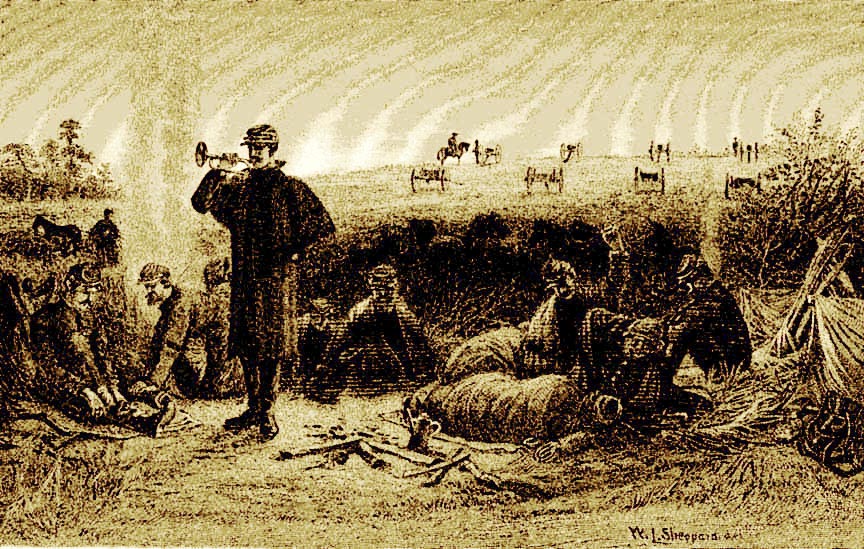
They reached the army just in time to be incorporated with the troops ---whose efforts were directed to the re-opening of the Mississippi, and first to the reduction of Vicksburg, as the direct means to that end. They accompanied General Sherman on the Tallahatchie march, which was "mere fun," as the roads were good, the country new to them, and very pleasant. Then they went in his command to Chickasaw Bluffs, where they stood ready to aid in an immediate attack, for three days and nights. The horses were ready harnessed, and standing, and the men sleepless and expectant; the rain pouring, the mud of the swamp-land where they were stationed deepening, the execrable bayous about them becoming hourly more dangerous and impassable Baffled, beaten back, and repulsed with great slaughter, Sherman returned up the river to Milliken's Bend, and our boys, incorporated into the Thirteenth Corps, in which they afterwards remained, were ordered thither also.
 |
Under command of General McClernand, they next went on an expedition against Arkansas Post, or Fort Hindman, up White River, fifty miles from the Mississippi, which fell into the hands of our troops, with five thousand prisoners. The following entries from two of the diaries briefly tell the story of their share in this engagement:---
"January 9, 1863. --- Started up White River on steamer Louisiana, which received our men, horses, and guns. Left our sick men on the Adriatic, in charge of Corporal Dyer (the excellent nurse we have before mentioned), as we are bound on an expedition of some sort against the enemy. Sent two short notes to father and friends, not knowing what may happen. Men in excellent spirits, spoiling for a fight."
"Jan. 10. Left the boat, and travelled three miles towards the Fort, against which we are proceeding. Received an accession of five men to our squad from the One Hundred Thirty-first Illinois Infantry Horses remained harnessed to the guns all night. Passed a line of rebel rifle-pits. The gunboat shelled the woods and Fort all the evening."
"Jan. 11. Our battery ordered into action Started about nine o'clock. Passed the second line of rifle-pits, and halted near a grave-yard. At noon the ball opened. We were drawn up within three hundred yards of the Fort. Early in the engagement a shell exploded over and around us, giving Hugh Wilson a big scare, who, boy-like, had climbed a tree, standing right in the range of the enemy's guns, hoping to see what was being done in the Fort. He was covered with broken branches, cut off by the explosion of the shell, and came down in a hurry, uttering a prayer or an oath, he says he does not know which. The artillery thundered around the Fort in all directions. We fired about forty rounds from 'Old Abe,"--- for so they had named one of their guns,---"when the rebs ran up the white flag. Amid tremendous cheering, that seethed to rend the heavens, we swarmed into the Fort, and took possession. We camped on the field that night."
Our boys were highly complimented by their officers for their gallant behavior on this occasion. The papers trumpeted their praises, and on the next Sunday, when Mr. T----- thanked God for their preservation, in the prayers of the morning service, every heart uttered a voiceless but fervent and devout "Amen!"
Next came the siege of Vicksburg, when they marched from Milliken's Bend down the west bank of the Mississippi nearly seventy miles, to a point opposite Grand Gulf. Here they crossed with other troops, and, under the lead of General Grant, marched to the rear of that seemingly invincible city. Until its surrender, they were active in the various measures that led to its capitulation on that glorious Fourth, when the nation surrendered itself to a delirium of joy over the success of our armies at Gettysburg and Vicksburg.
Hitherto we had been able to keep up constant communication with the boys. There was an uninterrupted procession of boxes going down to them, filled with everything for which they asked and with many things for which they never thought of asking.
Letters, papers, periodicals, clothing, writing materials, postage-stamps, photographs of persons, places, and scenes, everything which seemed likely to amuse, comfort, or assist, was sent on its way to their encampment. Very many of their friends obtained passes within the lines, and visited them, returning with such cheerful accounts of their daily life as greatly relieved their relatives of anxiety for them.
But from this time they passed beyond the reach of friends or packages from home, except at rare intervals. While they were in the rear of Vicksburg, there were weeks when we knew nothing of their condition or whereabouts. But through all the daily assaults and sallies of that memorable siege, although they were often in great danger, they were unharmed, except as the terribly hot weather, poor fare, and bad water caused sickness among them. Hardly had Vicksburg surrendered when they were sent with other troops to re-enforce Sherman on the Big Black, who had gone thither to oppose Johnston.
Over a region devastated by war, parched by the drought, both men and horses being maddened by thirst, suffocated by dust, and scorched by the July sun, they pressed on towards Jackson, Miss., only to learn that the city, was evacuated by the rebels. They had hurried across Pearl River, burning the bridges behind them to prevent pursuit. They were ordered back to Vicksburg; and after the fall of Port Hudson the battery was transferred to General Banks' command in the Department of the Gulf. The surrender of Port Hudson completely removed the rebel embargo on the commerce of the Mississippi, and permitted its waters to flow unvexed to the sea.
In one of the diaries are the following entries: --
"July 10, 1863.---Glory to God in the Highest. Port Hudson surrendered four days after Vicksburg. The Mississippi has got back again into the Union. The Confederacy is cut in twain! General Gardner gave up his sword to General Banks, they ran up the stars and stripes on the top of the highest bluff, and then a sutler opened his shop down by the landing. The Mississippi is open to trade its whole length!"
"July 20, 1863. ---Hartley suddenly dropped down in our camp to-day. Didn't know he had left Chicago, or thought of visiting us. A visit from the Sultan of Turkey wouldn't have surprised us more. He brought St. Louis papers of July 12, eight days after the fall of Vicksburg. Counted advertisements of nineteen steamboats, soliciting passengers and freight for the lower Mississippi, including Helena, Memphis, Vicksburg, and New Orleans. The old times are coming back to us! The Mississippi is once more open to commerce! Hurrah!"
THE STORY OF OUR BATTERY BOYS CONTINUED---A DISASTROUS EXPEDITION---A TRAP OF DEATH AND DESTRUCTION---SCENES OF HORROR---THRILLING ACTS OF BRAVERY AND DEVOTION.
Changes among our Boys---Breaking down under the Hardships of War--The Battery constantly shifts its Encampment---Working hard to kill Time---The Humorous Side of Life in Camp---History of "Doggie Doggett," the Canine Member of the Battery---His Exploits and Unknown Fate---Lost in the Service---Unfortunate Expedition---Up the Red River---Charging the Enemy with a Baggage-Train---Our Boys fall into a Trap of Death and Destruction---A terrific Charge by ten thousand Rebels---Overpowered by superior Numbers---Retreat or Surrender the only Alternative---The Guns of the Battery captured---Death of Lieutenant Throop---Sergeant Dyer shot while spiking his Gun---Many of our Boys are taken Prisoners---Hugh Wilson's Devotion---Only eight of our Boys return at the Close of the War.
 Y this time, a good many changes
had occurred among the boys. Five of them had broken down under
the unaccustomed hardships to which they were subjected, and,
after suffering for a long time in hospitals, were discharged
from the service. One had died, and his body had been sent home
for burial.
Y this time, a good many changes
had occurred among the boys. Five of them had broken down under
the unaccustomed hardships to which they were subjected, and,
after suffering for a long time in hospitals, were discharged
from the service. One had died, and his body had been sent home
for burial.
Lieutenant S-----, the original superintendent of the Sunday-school, was forced to resign because of circumstances that he could not control, and he had returned to Chicago. His resignation caused deeper despondency and discouragement than the sickness and death of all the others. The remarkable manliness, judgment, and good sense of the man, as well as the sterling integrity of his character, his cheerfulness, and affectionate nature, made him indispensable to our boys. We all felt that his association with them gave them a sort of immunity from many of the ills of a soldier's life. In a very large sense, the boys of the parish had been given to his keeping, as to that of a wise and good elder brother. But after a while we became accustomed to these changes, as to the other inevitable bereavements, disappointments, and griefs which the war had brought on us and on the dear country. We had counted the cost, and did not lose heart when it. proved heavier than we anticipated.
Until the spring of 1864, our boys were stationed in Louisiana and Texas, shifting their encampments occasionally as the movements of the enemy compelled them. Now, we heard from them at Carrollton, some half-dozen miles from New Orleans. Then, at Franklin, Algiers, Brashear City, Opelousas, New Iberia, Baton Rouge, and other points. They were continually flitting hither and thither, now to protect a point which the enemy threatened or, as an intimidation to guerillas; or, because a "reconnoissance in force" was proposed; or, as the boys themselves sometimes believed and openly declared, to render safe the cotton spoliations, in which not a few of our officers were at that time concerned. This sort of life was not to their liking, and they grumbled about it not a little.
Much of the time for the six or eight months succeeding the fall of Vicksburg, they were comparatively idle, save as they worked hard to kill time. The diaries kept during this period, show that this was dreary business. They gave concerts, extemporized theatrical performances, built shebangs, and painted over each some outré name, in the temporary absence of the occupants, which was intended as a joke on their peculiarities or history. If one was of a taciturn temperament, and had a shebang all to himself, he would find in the morning that his cabin had acquired during the night the painted cognomen of "Celibacy Hall." The shebang occupied by two dear friends rejoiced in the name of "Hotel de Siamese Twins." Three or four, more given to fault-finding than the rest, dwelt in "Grumblers' Den." A quartette of inveterate wags sported over their tent the staring announcement, "Pow-Wow Hall! Protracted meetings held here!" Two or three others, not very scrupulous, who had been detected in imposing on their best friends, the negroes, received their retribution in the unsolicited sign, painted in the night: "Legree House --- Negroes for Sale Here!" And so on.
Sometimes a waggish squad, assisted by a neighboring infantry company, would arouse the whole encampment at midnight with a moonlight parade. The men would be attired fantastically in what they called "night uniforms," with wash-dishes for caps, and caisson shovels for swords, and every other ridiculous contrivance in the way of dress. They would have "cow-born" music, by "Gideon's Band," a blast of which was strong enough to blow down the walls of any Jericho against which it was directed.
At Baton Rouge, where they were encamped some time, they found employment for themselves, and helped fill their empty pockets, by a public exhibition of negro minstrelsy. They persuaded the provost-marshal to give them the free use of the largest and most elegant hall in the city for several nights. There was a good deal of musical talent among the boys. They could play several instruments finely, and had often assisted us at home when we gave exhibitions of tableaux, or held festivals, with the music of an improvised band. Many of them were excellent singers; so they arranged a programme, blackened their faces, got up fantastic costumes, and for a week gave nightly entertainments to crowded houses, their audiences expressing their delight by the most boisterous applause. This was so profitable pecuniarily, that they would have repeated their negro performance elsewhere had they been able to command a hall.
Sometimes they went a-fishing, or, more frequently, a-foraging, and "Doggie Doggett" always accompanied them. I find frequent mention of this canine member of the battery. When our boys left Chicago they took two dogs with them; one a large, noble Newfoundland, which was lost on the Tallahatchie march, and the other a miserable little shepherd dog, that they christened "Doggie Doggett," and which proved invaluable to them. He was a great pet, and was instructed, and trained, and frolicked with, and caressed, until he became a highly accomplished animal. His exploits would occupy more space and time in recounting than would those of "old Mother Hubbard's dog," whose chronicles are to be found in the veritable nursery books of Mother Goose. He paid no heed to the stringent orders issued from time to time, commanding respect for the rights of property in the country through which he marched or where he encamped. If he saw a sheep or a pig at a distance, he immediately went for it, and held it until our boys could despatch it. Stimulated by the praise he received, he redoubled his efforts in the foraging line; and it was the boast of the battery that "Doggie Doggett could kill more sheep in one night than any other dog on record." He possessed so much of the savoir faire, that if he visited a flock, and was not discovered and called off, he left not one alive to tell of his dealings with them.
It was the intention of the boys to bring him North and make a hero of him; and this they promised the ugly little brute over and over, all through the war. His love of sheep would have cost him his life at an early day had they brought him home; and it is not therefore to be regretted that they lost him, just as the war ended, when they were on their way to the North. Amid the confusion of regiments hastening homeward, the dog became bewildered, and marched off with the wrong battery. That is the theory of the boys. So dear had he become to them, that they actually obtained a pass for a man to go to Brashear City to seek him, as he was supposed to have straggled off in that direction. But "Doggie Doggett" was not to be found, and to this day no one knows his fate; but his memory is honored in the records of the battery.
In the latter part of the winter of 1864, Genera Banks planned an ill-starred expedition, whose line of operations was Red River. Its object, was the capture of Shreveport, with the rout and dispersion of Kirby's army, culminating in the recovery of Texas and a boundless supply of cotton for our mills and for export. Admiral Porter was to take ten thousand of Sherman's old army, under General A. J. Smith, up Red River, with a strong fleet of ironclads. At Alexandria he was to meet General Banks with fifteen thousand more, who were to march overland from the Atchafalaya. At the same time General Steele, with fifteen thousand tried troops, was to move on Shreveport from Little Rock. Our boys went on this badly planned expedition, with two thin divisions of the Thirteenth Corps, of which they, were a part, under the immediate command of General Ransom, than whom the country had no nobler patriot and soldier.
The expedition proved a disastrous and mortifying failure. General Banks' force was ten days behind time in effecting a junction at Alexandria with Admiral Porter. There was not water enough to float the heavy ironclads as they proceeded up Red River, and the heaviest were left below Alexandria. To make matters yet worse, a portion of General Smith's troops were recalled to protect the Mississippi from incessant and troublesome raids. As General Steele could not render any assistance until the three divisions met at Shreveport, General Banks' force of forty thousand men was reduced, practically, to twenty thousand. There was little pretence of secrecy on the part of our army, and the enemy knew, just as well as did our own commanders, what was the object of the expedition, where it was going, by what route, how many troops were engaged in it, and what were the character, calibre, and experience of the men who officered it. Every rebel prisoner captured on the way was as well posted on these matters as our own men --- sometimes even more so.
They met with no very obstinate resistance until they reached Natchitoches, although the enemy kept up a steady skirmishing with the van of our army all the eighty miles of the way from Alexandria. From Natchitoches to Shreveport was one hundred miles, through pine woods, barren, sandy, and uninhabitable. On they pushed, into the trap set for them, right into the jaws of death and destruction. They left Natchitoches on the 6th of April and pressed on, meeting larger bodies of the enemy, the skirmishing growing hotter, the fight assuming larger, sharper, and more serious proportions. On the morning of the 8th, when they had come within two miles of Mansfield, they were unexpectedly confronted by the rebel "Army of the Trans-Mississippi," twenty thousand strong, commanded by Kirby, Smith, Dick Taylor, and other able officers. The principal portion of the rebel troops lay in thick pine woods, with a hill between them and our forces; and across this hill lay the only road which our men could follow, as it was the only one leading to Shreveport.
The van of our army was mainly composed of the Thirteenth Corps, and the Mercantile Battery, to which our boys belonged, was in the extreme front. Just as they marched from a dense pine forest into a small clearing, they were attacked by the rebels in great force, on both flanks and in front. A line of battle was immediately formed. The guns of the battery were put in position, and, for a time, it. seemed as though our men would make a successful defence. But suddenly there rose, as if out of the very ground, ten thousand rebel troops, who charged down on our panic-stricken men with terrific yells. They stood their ground bravely until they were overpowered by superior numbers. What availed two thousand cavalry, three thousand infantry, and twenty pieces of artillery, so placed as to be unable to act in concert, against a solid force of ten thousand men? An immense baggage and supply train of between three and four hundred huge army wagons was in the immediate rear of the advance, completely filling up the one narrow, winding forest road, and rendering it impossible for the main body of the army to give any support to the advance.
There was nothing left our men but to retreat or surrender. The officers of the battery, which was doing good service, cheered on the men; for it was not in their nature to give way, while there was a possibility of beating back the rebels. With uplifted sword, and words of cheer on his lips, George Throop, now a lieutenant of the battery, was struck in the pit of the stomach by the fragment of a shell. With the single exclamation, "My God, I am killed!" he fell back from his horse, was caught by his companions, and taken to the rear. But, heroically, he bade them return to the fight and leave him to die, since they could do him no good. A surgeon pronounced his wound mortal, and he was placed in an ambulance to be taken from the field.
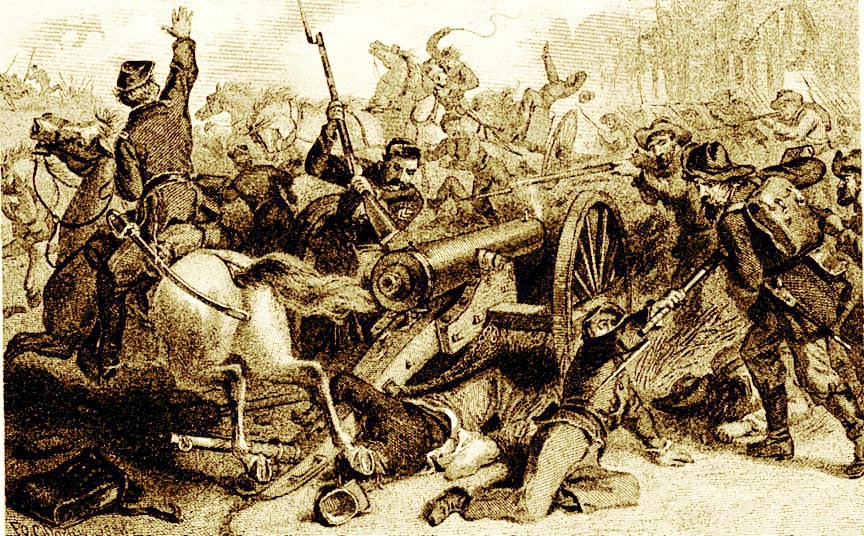 " Our boys tried to save their guns, but, finding that impossible, they endeavored to spike them. Sergeant Dyer, whom I have before mentioned as a rare nurse in sickness, was shot through the lungs, and mortally wounded, while in the act of spiking his gun. The captain and. two other commanding officers were taken prisoners, one of them was fatally wounded, and thirty-two of the men were killed or captured. Of one hundred and ten horses, they took off the field but forty-five." |
Before it could get under headway, a retreat was sounded, and then a horrible rout ensued, of which General Franklin has said that "Bull Run was not a circumstance in comparison." He was on both battlefields. Our boys tried to save their guns, but, finding that impossible, they endeavored to spike them. Sergeant Dyer, whom I have before mentioned as a rare nurse in sickness, was shot through the lungs, and mortally wounded, while in the act of spiking his gun. The captain and. two other commanding officers were taken prisoners, one of them was fatally wounded, and thirty-two of the men were killed or captured. Of one hundred and ten horses, they took off the field but forty-five. The rest were left wounded, dying, and dead. All their guns were captured, and fourteen others, belonging to other batteries.
"Sauve qui peut! "--- Let whoever can, save himself--- was the motto of the hour, and a wild and maddening flight ensued. The drivers of the army wagons, occupying the only road through the woods, turned to flee, upsetting the huge vehicles, when they cut the traces from the mules, and fled with them. Immediately the road was choked with overturned, crushed, entangled wagons, with struggling horses and mules, and half-crazed men. It was impossible to save the valuable wagon-train, and that, too, fell into the enemy's hands. There was no order, no heeding of commands, no thought of anything but safety, and only a headlong stampede.
Men on foot rushed precipitately to the rear. Bareheaded riders, with ashen faces, lashed their terrified beasts to more furious haste. Cavalry horses galloped riderless, at full speed, over the terrified infantry, the prostrate wounded and dying, and others on foot. Officers with drawn sabres, hoarse voices, and almost death-stricken faces, implored their unheeding men to stop, form again, and make a new stand. And in full pursuit of these routed fugitive the rebels followed pell-mell, yelling, shouting, and maintaining a continuous fire. The whistle of musket-balls filled the air in all directions. The crashing of trees, the breaking of fallen wood, the galloping of horses and mules, the eddying whirlpool of maddened men,---all this made up a scene of horror that beggars description.
For a full mile this terrible stampede continued; and then the fugitives came upon the magnificent Nineteenth Corps, formed in full line of battle, right across their road. Even this could not halt the panic-stricken men. So, opening their ranks, the Nineteenth Corps permitted the disorderly retreating forces to pass through. Then they closed up solidly again, and waited the oncoming shock of the enemy, flushed with victory, who anticipated no check. On they came, with headlong impetuosity, shouting and firing as they advanced, driving in the skirmishers that had been thrown out, and charging on the intrepid lines of blue and glistening steel as though they were the routed fugitives they had been driving. On they galloped, rushing almost up to the very muzzles of the guns, till they could look in the eyes of their foes, our men standing like animated granite, reserving their fire till the word of command was given. Then there came one blinding flash of flame, one reverberating burst of thunder, from our gallant hosts, one fierce rain of leaden hail on the ranks of the enemy, and the rebels surged back in a great wave, like the outgoing tide. Their pursuit was checked, their lines broken, and they could not rally again. It was now their turn to flee; and they fell back in haste, leaving their dead and dying on the field. The fight lasted but a few hours, but it brought discomfiture and deep humiliation to our forces. It cost the loss of three thousand men and twenty pieces of artillery, and compelled the entire army to turn sadly back to New Orleans.
But what of our boys? When George Throop fell, despite the battle raging around them, the boys all rushed to their fallen leader. But he commanded them to return to their duty, saying to each a tender "good-bye," as they turned away, and, dashing off the blinding tears, stood again manfully to their guns. "I am dying," were his words; "but I am not afraid to die. Tell my father and mother that I die willingly; my firm faith sustains me. I give my life for a glorious cause, and I do not regret it. So leave me, boys, for you can do nothing for me, but take care of yourselves." And so they left the brave young officer to die.
All but one; and he would not obey. He was Hugh Wilson. We had objected more seriously to his entering the service than to all the others. A mere schoolboy, a Sunday-school pet, the youngest child of his mother, he would be only the plague and the plaything of the battery. Why should he go? A larger license had always been permitted him than to any other of the battery boys, and so, instead of obeying the command of his officer to return to duty as the others did, he jumped into the ambulance, determined to save Lieutenant Throop if possible. The cry of retreat was sounded behind him, and the terrified driver immediately cut one mule from the traces, and, mounting it, sought his own safety. Hugh seized the reins, and with the remaining mule endeavored to pilot the ambulance through the labyrinthine maze of fleeing men, broken wagons, and galloping horses, to a place of safety. The road as rough, and the dying lieutenant was roused to consciousness. Again, with characteristic unselfishness, he remonstrated with the lad for running such risks to his own life and safety: "I am dying, Hugh, and you can do nothing for me. Save yourself; leave me, I entreat you!"
But the warm-hearted boy, loving his long-time friend more and more as he saw him drifting away forever, once more gathered up the reins, and urged the mule to greater speed. They came to a side road, and into this Hugh turned the ambulance. It looked as if it might lead to a less obstructed pathway. Alas! it led to a narrow stream of water, with steep banks and deep, swift current. It could not be forded. Again the lieutenant paused on the very threshold of heaven to beseech Hugh to seek his own safety. The iciness of death had already settled upon him. The unmistakable look of mortal pallor, that the human face never wears but once, was on his features. His speech was becoming inarticulate, and his pulse barely fluttered under the pressure of Hugh's finger. "Hugh, you must go! You will be taken prisoner. I am beyond the reach of the enemy; they cannot harm me. Put something under my head, and then go. Save yourself! Quick, Hugh!" At the same moment rebel troopers came dashing down the road, and, catching a glimpse of Hugh, called on him to "surrender!"
Quick as thought, Hugh stripped off his jacket, forgetting that it contained all his money (he had been paid off a few days before), the photographs of his father and mother, the little Testament his pastor had given him, and all the valuables he had in the world. Folding it under George Throop's head, he kissed his cold lips again and again, whispered a swift "good-bye," which the dying man had no voice to answer, leaped down the hank of the stream, and hid himself among the rank undergrowth, half in the water. They were parted now; one going back to the conflict, the other mounting heavenward.
The rebels rushed down to the bank, and, not seeing Hugh, fired into the clump of bushes where he was secreted, and then rode away. The balls whizzed around him, but did not harm him. Cautiously the poor lad felt his way out to the edge of the still retreating tide of Union soldiers, and, weeping silently, disheartened, and bereaved, commenced a search for his surviving comrades. He found them at last, such as were not left dead on the field, or prisoners in the hands of the enemy.
It was a gloomy hour. But one officer was left the battery, and of the missing they could not tell who was dead and who captured. Some time after, one of the battery boys who was left wounded on the field, and was taken to a rebel hospital, was paroled and came home. He brought with him a blouse which was known to be Lieutenant Throop's, as it bore his name marked by himself. He stated that he discovered one of the attendants at the hospital wearing it, and, on inquiry, learned that he took it from the dead body of a lieutenant of artillery, whom he had buried with other Union dead, after the battle of Mansfield. The grave of Lieutenant Throop is not known to this day, but his memory is green in the hearts of all who loved him, and they number all who knew him. It is no disparagement to the other members of the battery to say that his was the completest, most harmonious, and best developed character among them. To all the battery boys he was leader, and his influence was always for good. His superior officers respected him the more deeply in proportion as they were truly superior in the highest sense of the word. All trusted him.
His diary came into my hands, and its indications of filial and fraternal affection impressed me deeply. No one sought to comfort his father and mother, but all sat down and wept with them. "Oh," said one of his comrades, "how George Throop loved his mother! It would have been easy for him to die for her!" And by that token judge how the mother loved the son. She was the first to speak when the sad news was borne to the broken household. Lifting her white, tearless face, she said, "If it be true that all is over with George in this world, that he is dead, and not lingering in suffering, I rejoice for him! He will never have to suffer as his father and I are suffering now."
We gathered in the church on the following Sabbath, a sad and weeping congregation. We recalled the hour when from its altar we had dismissed the now glorified young leader to battle, to death, to Heaven. God had granted him a discharge from all earthly conflict, and for him there were no tears. We repressed our own lesser grief in the presence of the great bereavement of the parents. The choir sang of victory, and their voices swelled in a triumphant song of thanksgiving for the glorious hope of immortality that illumines our darkness. The prayers of the morning breathed resignation to the inscrutable order of Divine Providence, which had stricken us so severely, and implored the peace of Heaven to enter our souls. And the sermon lifted us out of the damps and fogs of our earthly atmosphere into the serene light of the happy hereafter. Time has softened the poignancy of grief felt during the months that followed, and memory and hope have done much to subdue the pain inflicted by that grievous wound.
--- " God keeps a niche
In heaven to hold our idols! and albeit
He brake them to our faces, and denied
That our close kisses should impair their white, ---
I know we shall behold them raised, complete --
The dust shook from their beauty --- glorified
New Memnons, singing in the great God-light!"
Those of our boys who were taken prisoners were carried to Camp Ford, in Tyler, Tex. Although they fared hard, and endured many privations, their lot was comfortable compared with that of the poor martyrs at Andersonville. They were placed in a camp of about ten acres, where seven thousand Union men were held as prisoners of war. It was inclosed by a stockade of oak timber, twelve feet high, and within its limits were five living springs of pure, clear water. These springs were ample for all the uses of the men, and, crowded as was the place, there was no excuse for personal uncleanness. No prisoner was allowed to come within ten feet of the stockade, and not unfrequently men who violated this rule, inadvertently or through ignorance, were shot down like dogs. When our boys first reached the rebel camp, there were but six axes for the entire seven thousand men, who were obliged to cut their own fuel and build their own cabins. But an exchange of prisoners was effected shortly after the arrival of the battery boys; and as some of the exchanged men were from Illinois, an appeal was sent to Governor Yates for axes and clothing. The appeal was munificently answered by an abundant supply of whatever was asked, sufficient for six or seven hundred men, which was faithfully distributed. With the arrival of the axes, the boys went to "shebang" building, in which they had had much experience. Permission was given them to cut timber in the woods, and very soon they had as good houses of their own as the Texans of the town, and commenced housekeeping under difficulties, and in a somewhat primitive way.
Many of the men were in a complete state of nudity, and their entire persons were browned to the color of Indians. Even their blankets were in rags; and on one occasion, when some were exchanged, they were sent to New Orleans, and marched through the streets in very nearly the simple costume of our first parents before they went into the manufacture of fig-leaf clothing. They also suffered from a lack of vegetables, and this induced scurvy. Some of the discharged men were so afflicted with scurvy that their teeth fell out, and they came home with them in their pockets instead of in their mouths. To obtain vegetables, our boys manifested no little ingenuity, assisted by others as energetic as themselves.
The prisoners had to slaughter their own cattle; and they were allowed the heads and hoofs as perquisites. From the hoofs the Yankee boys made glue. With this and the sinews of the cattle they manufactured violins of every size, and by and by organized a band, whose performances were greatly relished by their fellow-prisoners. They obtained files, and transformed the backs of their knives into saws, with which they sawed the horns of the cattle, lengthwise, and then cut them into combs. These combs were very salable, and brought a good price in Confederate money. Not infrequently, rebels of high social position would come into camp, and order combs, stipulating in advance. their size and the price to be paid. Some who bought of them had been without combs for a year. With the money thus earned, our boys bought sweet potatoes and other vegetables, which kept scurvy, the great foe of the camp and prison, at a distance. They bribed the guard to bring them chisels and files, and then manufactured from the horns that fell to their share complete sets of chessmen and checkers. For one set of chessmen they received from a rebel officer Confederate money equal in value to ten dollars of our currency.
There were frequent but always futile attempts to escape from the prison. The men dug tunnels, one of which was eight months in progress. But there were always rebel spies in camp, who were well informed of the plans for escape, and when, after eight months' patient, subterranean labor, the tunneling party came out through it, one hundred and fifty yards beyond the camp, there stood the rebel jailers waiting to receive them. If, by good luck, a man made his escape for a time, he was soon caught, and in two or three weeks brought back to his old comrades, who received him with shouts of laughter and mocking jeers and jibes. Some escaped temporarily by hiding in the carts of refuse and offal that were daily hauled outside the camp. When the officers learned this, a cartload was never dumped outside until, the guard had repeatedly plunged his bayonet through the mass, sometimes transfixing the secreted soldier, nearly suffocated under the refuse débris of the cabins. Fresh lots of prisoners were constantly added to the camp, and with them there was always smuggled in one or more of the rebels, disguised in Union uniform, who prowled about as spies.
The rebel regiments sent to guard the camp were repeatedly changed. The Union prisoners soon demoralized them; for the guards became completely fascinated with their conversation. This was understood in the camp, and, although conversation was prohibited between the guards and the prisoners, it was carried on constantly and without interruption. The former had sufficient intelligence to comprehend that their prisoners were better educated than themselves, better informed, and vastly their superiors in all matters of knowledge and skill. As they listened to their recital of the causes of the war, the overwhelming advantages of the North, and the inevitable and fast-hastening end of the conflict, the guards were won over to the side of loyalty, and fraternized with those whom they were to control.
At Marshall, Tex., where the boys were sent to the hospital for a time, they found an openly avowed sentiment of loyalty. The ladies of the town came to the wards and nursed them, fed them with food from their own tables, and attended personally to their wants, as if they were kindred instead of strangers. The mayor of the city and his son called on them, openly avowing Union sentiments, and denouncing the war and the Confederate government. Had they been in a Chicago hospital, among their own friends, they could not have received kinder or more generous treatment.
The boys were held as prisoners for fourteen months, and then the war ended. As soon as the news of the fall of Richmond reached the rebel guards, they left their posts without ceremony and went home. The prisoners saw their camp unguarded, and, understanding what it meant, made preparations to follow the example of their guards. With their usual good sense and foresight, they had been preparing to leave for some time, and, as they earned money, had bought supplies of crackers, and sewed them up in their clothing, against a day of need. It was well they did; for, though their jailers promised rations for the long march to Shreveport, and thence, hundreds of miles, to New Orleans, it was days before any were received, and then there was but a meagre supply. Nearly naked, not very well fed, they at last found their way within the Union lines, when each man was furnished transportation to his own command, where he could receive his pay, or be mustered out of service.
They found the wreck of the battery at New Orleans, where the men had been doing "fatigue duty," a part of the time at Camp Parapet. The powers that be had ordered them to take muskets and serve as infantry, and, I think, had sent the muskets for that purpose. But the boys indignantly refused them, or to perform any of the duties of infantry. They had enlisted in the artillery. Their decision brought them into bad odor with the resident military authorities. Some petty tyrannies and indignities were attempted towards them by officials, which waked up the Chicago Board of Trade, under whose auspices they were mustered into the service; and that organization took the matter in hand, and summarily redressed their wrongs.
At the close of the war the battery was mustered out of the service, and our boys came back to Chicago. There were but eight of them left. All the others had died, or been killed in battle, or had dropped out of the service from invalidism; but two or three of them survive to-day. One died in Minnesota, of illness contracted in the service. Another graduated from Harvard, and practises law in Michigan. Another is connected with the silver mines of Colorado. And of the young and manly strength, and power, and beauty, which were our boast when the war commenced, there is scarcely a trace remaining. Our boys are not; and others have succeeded to their places. We have lost them; but some time we shall find them.
THE FIRST GREAT SANITARY FAIR---RAISING MONEY FOR HOSPITAL RELIEF---A GREAT AND MEMORABLE DAY---MOTLEY PROCESSION THREE MILES LONG.
Continued Needs of the Hospitals lead to a great Sanitary Fair---A Woman's Enterprise from the Beginning---Large Preparations---Seventeen Bushels of Fair Circulars and Letters sent at one Mail---Mrs. Hoge obtains Help from Pittsburg and Philadelphia---Potter Palmer from New York---Boston and Connecticut contribute---The whole Northwest ransacked for Attractions---At last, Men catch the Fair Mania---Their varied Gifts---Opening Inaugural Procession---Captured rebel Flags borne along---School Children in Carriages and Omnibuses---Convalescent Soldiers from Hospitals---Procession of Farm Wagons, with Vegetables---Procession halts on the Court House Lawn---Firing of thirty-four Guns announces the Opening of the Fair.
HE continued need of money for
the purchase of comforts and necessaries for the sick and wounded
of our army, had suggested to the loyal women of the Northwest
many and various devices for the raising of funds. Every city,
town, and village had had its fair, festival, party, picnic, excursion,
concert, and regular subscription fund, which had netted more
or less for the cause of hospital relief, according to the population,
and the amount of energy and patriotism awakened. But the need
of money for this sacred purpose still continued. Our brave men
were still wrestling with the Southern rebellion, which, though
oft-times checked, was not conquered. The hospitals whose wards
were vacated by death, or recovery of their patients, were speedily
refilled by new faces which disease had rendered pallid, and new
forms shattered by cannon-shot or sabre-stroke. It was necessary
to continue to pour down sanitary supplies for the comfort and
care of the suffering soldiers, whose well-being, at that time,
lay so near the hearts of all loyal men and women. Since the most
valuable sanitary supplies could only be obtained with money,
the ingenuity of women was taxed to the utmost to raise funds.
The expenses of the Northwestern Sanitary Commission had been very heavy through the summer of 1863, and every means of raising money had seemed to be exhausted. At last, Mrs. Hoge and myself proposed a great Northwestern Fair. We had been to the front of the army ourselves, and had beheld the practical working of the Sanitary Commission, with which we were associated. We knew its activity, its methods, its ubiquity, its harmony with military rules and customs, and we knew that it could be relied on with certainty when other means of relief failed. We saw that an immense amount of supplies was necessary for the comfort and healing of the army of brave invalids, and wounded men, that filled our military hospitals, and our hearts sank as we realized the depleted condition of the treasury of the Commission.
We were sure that a grand fair, in which the whole Northwest would unite, would replenish the treasury of the Commission, which, from the beginning, had sent to battle-fields and hospitals thirty thousand boxes of sanitary stores, worth, in the aggregate, a million and a half of dollars. We knew, also, that it would develop a grateful demonstration of the loyalty of the Northwest to our beloved but struggling country. That it would encourage the worn veterans of many a hard-fought field, and strengthen them in their defence of our native land. That it would reveal the worth, and enforce the claims of the Sanitary Commission, upon those hitherto indifferent to them. That it would quicken the sacred workers into new life.
Accordingly, we consulted the gentlemen of the Commission, who languidly approved our plan, but laughed incredulously at our proposition to raise twenty-five thousand dollars for its treasury. By private correspondence, we were made certain of the support and co-operation of our affiliated Aid Societies, and our next step was to issue a printed circular, embodying a call for a woman's convention, to be held in Chicago on the 1st of September, 1863. Every Aid Society, every Union League, and ever Lodge of Good Templars in the Northwest, were invited to be present, by representatives. Some ten thousand of these circulars were scattered through the Northwest. A copy was sent to the editor of every Northwestern paper, with the request that it might appear in his columns ---a request generally granted--- and clergymen were very generally invited by letter to interest their parishioners in the project.
Pursuant to this call, a convention of women delegates from the Northwestern states was held in Chicago on the 1st and 2d of September, at Bryan Hall. The convention was harmonious and enthusiastic. The fair was formally resolved on. The time and place for holding it were fixed. The delegates came instructed to pledge their respective towns for donations of every variety, and help to the utmost. The women delegates were remarkably efficient and earnest; for each society had sent its most energetic and executive members. This convention placed the success of the fair beyond a doubt, and Mrs. Hoge and myself saw clearly that it would surpass in interest and pecuniary profit all other fairs ever held in the country.
On the evening of the first day, a grand social re-union was held in the parlors of the Tremont House. This gave the ladies who had gathered from all parts of the country an opportunity of forming each others' acquaintance, and of discussing socially, the various topics of interest suggested by the convention. On the afternoon of the second day, a mass meeting of women was held in Bryan Hall, when addresses were delivered by Thomas B. Bryan, Esq., Hon. O. H. Lovejoy of Illinois, Hon. Z. Chandler of Michigan, and some of the city clergymen.
Their utterances nerved those who were laboring in the arduous work of hospital relief, to renewed and deeper consecration. It was a fitting close to the two days' meeting, and kindled a flame in the hearts of the women who attended it. They returned to their homes glowing with enthusiastic interest in the forthcoming fair.
This first Sanitary fair, it must be remembered, was an experiment, and was pre-eminently an enterprise of women, receiving no assistance from men in its early beginnings. The city of Chicago regarded it with indifference, and the gentlemen members of the Commission barely tolerated it. The first did not understand it, and the latter were doubtful of its success. The great fairs that followed this were the work of men as well as of women, from their very incipiency --- but this fair was the work of women. Another circular was now issued, and this enumerated and classified the articles that were desired. It was a new experience to the Northwest, and advice and plans were necessary in every step taken.
Preparations now went on in good earnest. Up to this point the efforts had been to create a public sentiment in its favor, and to induce the prominent organizations in the Northwest to pledge it their active support. These ends being now attained, the work of gathering articles for the fair went on rapidly. Twenty thousand copies of the second circular, specifying what articles were needed, when, where, and how they should be sent, were distributed over the Northwest. The aid of the press was invoked, and it was granted in a most hearty and generous fashion. An extensive correspondence was carried on with governors, congressmen, members of state legislatures, military men, postmasters, clergymen, and teachers. The letters addressed to the women of the Northwest, explanatory, hortatory, laudatory, and earnest, were numbered by thousands.
Some idea may be formed of the amount of machinery requisite to the creation of this first Northwestern fair---the pioneer of the great Sanitary fairs which afterwards followed, "the first-born among many brethren" --- from the fact that on one occasion alone there were sent from the rooms of the Sanitary Commission, seventeen bushels of mail matter, all of it relating to the fair.
Nor was this all. Mrs. Hoge went to Pittsburg, Pa., for a few days, and formed a society for the express purpose of aiding the fair. She had formerly resided in that city, and had scores of friends and relatives there. So successful were her appeals to the citizens of Pittsburg, that it was necessary to fit up a booth for the reception of the articles contributed. Manufacturers, artisans, and merchants sent choice specimens of value, skill, and taste, from a huge sheet of iron, worthy of Vulcan, and a breechloading steel cannon of terrible beauty, to rich and rare fabrics of foreign looms, fit for the draping of a princess. Even the carbon oil, with which we have only unsightly and unsavory associations, was sent in hundreds of beautiful casks with painted staves and gilded hoops, bearing mottoes of undying loyalty.
From Pittsburg she proceeded to Philadelphia, the city of her birth and early girlhood. Although the remoteness of Philadelphia might have excused her from participating in the work of the fair, she caught the contagion of liberality, and sent substantial tokens of approval and interest.
Potter Palmer, the proprietor of the famous hotel that bears his name in Chicago, took the city of New York in hand, obtaining contributions from her importers, jobbers, and manufacturers, amounting to nearly six thousand dollars.
Boston was already astir with preparations for a grand soldiers' and sailors' fair, which proved a magnificent success. But she did not turn a deaf ear to my request for aid, but, with characteristic generosity, sent a large box filled with treasures abundant with her, but rare in the Northwest. The specimens of Chinese handiwork, of Fayal laces, of Sea Island algae as delicate as vapor and arranged in sets, curious fans, slippers, pictures, and tableware in the highest style of Japanese art --- these were rare at that time in the West, and when offered for sale at large prices vanished like dew before the sun. All sold quickly.
Connecticut sent a magnificent donation that realized thousands of dollars, and with it a deputation of Connecticut ladies, who superintended that department, and acted as saleswomen.
In every principal town of the Northwest "fair meetings" were held, which resulted in handsome pledges that were more than fulfilled. Towns and cities were canvassed for donations to the "Bazar" and "Dining Saloon." The whole Northwest was ransacked for articles, curious, unique, bizarre, or noteworthy, to add to the attractions of the "Curiosity Shop." Homes beautified with works of art, paintings, or statuary, were temporarily plundered of them for the "Art Gallery," and all who possessed artistic, dramatic, decorative or musical talent were pressed into the service of the "Evening Entertainments." Executive women were chosen in every state, who freighted the mails with rousing appeals from their pens, or with suggestions born of their experience, frequently visiting different sections to conduct meetings in the interest of the great and noble enterprise.
At last, even men became inoculated with the fair mania. They voluntarily came forward, pledging large donations in money or merchandise, or favoring the ladies with suggestions, and aiding in the work, which had now grown to huge proportions, and eclipsed all other interests. Mechanics offered their manufactures, one after another, --- mowing machines, reapers, threshing-machines, corn-planters, pumps, drills for sowing wheat, cultivators, fanning-mills,---until a new building, a great storehouse, was erected to receive them. They gave ploughs, stoves, furnaces, millstones, and nails by the hundred kegs. Wagons and carriage-springs, plate glass, and huge plates of wrought iron, --- one the largest ever rolled, at that time, in any rolling-mill in the world, --- block tin, enamelled leather, hides, boxes of stationery, cases of boots, cologne by the barrel, native wine in casks, refined coal by the thousand gallons, a mounted howitzer, a steel breech-loading cannon, a steam-engine with boiler, pianos, organs, silver ware, crockery, trunks, pictures, boatloads of rubble-stone, loads of hay and grain and vegetables, stall-fed beeves, horses, colts, oxen, the gross receipts of the labor or business of certain days, --- in short, whatever they had of goods or treasure.
During the last week of preparation, the men atoned for their early lack of interest, and their tardiness in giving, by a continued avalanche of gifts. The fate of Tarpeia seemed to threaten the women who were the committee of reception. Such a furor of benevolence had never before been known. Men, women, and children, corporations and business firms, religious societies, political organizations, ---all vied with one another enthusiastically as to who should contribute the most to the great fair, whose proceeds were to be devoted to the sick and wounded of the Southwestern hospitals. As the Hebrews, in olden time, brought their free-will offerings to the altar of the Lord, so did the people of the Northwest, grateful to their brave defenders, lay their generous contributions on the altar of the country. The rich gave of their abundance, and the poor withheld not from giving because of their poverty.
An inaugural procession on the opening day of the fair was proposed, and the proposal crystallized into a glorious fact. The whole city was now interested. The opening day of the fair arrived. The courts adjourned; the post-office was closed; the public schools received a vacation; the banks were unopened; the Board of Trade remitted its sessions. Business of all kinds, whether in offices, courts, stores, shops, or manufactories, was suspended. All the varied machinery of the great city stood still for one day, that it might fitly honor the wounded soldiers' fair. Could a more eloquent tribute be paid our brave men, pining in far-off hospitals, who had jeopardized life and limb in the nation's cause?
No better description of this splendid inaugural pageant can be given than the following, taken from the Chicago Tribune of Oct. 28, 1863. It gives a graphic picture of the procession as it gathered up its forces and moved on under the bright October sun, three miles in length. But there can be no description given of the spontaneous patriotism, the infinite tenderness, the electric generosity, the moral earnestness, and the contagious enthusiasm, that transfused and glorified the occasion. One could as easily depict the shifting hues and lights of the Aurora: ---
"Yesterday will never be forgotten, either in the city of Chicago or in the Northwest. It will remain forever memorable, as history and as patriotism. Such a sight was never before seen in the West upon any occasion, and we doubt whether a more impressive spectacle was ever presented in the streets of the Imperial City itself. The vast procession of yesterday, with its chariots and horsemen, its country wagons and vehicles, its civic orders and military companies, on horse and on foot, with their various designs, and mottoes, and brilliancy of color, converted Chicago, for the time being, into a vast spectacular drama.
"From the earliest dawn of day, the heart of the great city was awake. Long before eight o'clock the streets were thronged with people. Citizens in gala dress hurried excitedly to and fro. Country women, with their children, drove in early in the morning, with ribbons tied to their bridles, the national colors decorating their wagons, and miniature flags and banners at their horses' heads. From the housetops, from the churches, from the public buildings, was displayed the glorious flag of liberty. By nine o'clock, the city was in a roar. The vast hum of multitudinous voices filled the atmosphere. Drums beat everywhere, summoning the various processions, or accompanying them to the great central rendezvous. Bands of music playing patriotic airs, bands of young men and women singing patriotic songs, groups of children singing their cheerful and loyal school songs, enlivened the streets. Every pathway was jammed with human beings, so that it was with extreme difficulty any headway could be made.
"The procession was advertised to assemble at nine o'clock precisely, and was composed of nine divisions. As near ten as possible, it started --- banners flying, drums beating, all manner of brazen instruments thrilling the listening ear, and stirring the hearts of the vast multitudes of people with exciting music. It was a mighty pageant. The enthusiasm that accompanied the procession, from first to last, has rarely been witnessed on any occasion. It was a grand, sublime protest, on behalf of he people, against the poltroons and traitors who are enemies to the government, and opposed to the war. Bursts of patriotic feeling came from many a loyal bosom on this never-to-be-forgotten day. The people were overflowing with loyalty, and could not contain themselves.
"For a long time they had been silent, keeping alive their love for the old flag, nursing their wrath against those that hated it---and who had so long fired upon it in the rear --- finding nowhere any adequate utterance of their passionate feeling. Now the mighty eloquence of this majestic and sublime procession spoke for them. This was the thing which all along they had wanted to say, but could not. They were in themselves ciphers, mere units of the nation; but in all those thousands of men they saw themselves multiplied into an incalculable, irresistible host. They felt that their hour of triumphant speech had come at last. This was the answer which they thundered out in trumpet tones, to the miserable traitors who had so long torn the bleeding heart of their country."
"I always knew," said one old man at our elbow in the crowd, while we were watching the procession, "that the heart of the people was right; they did not know their danger for a long while; now they have found it out, and this is what they say about it."
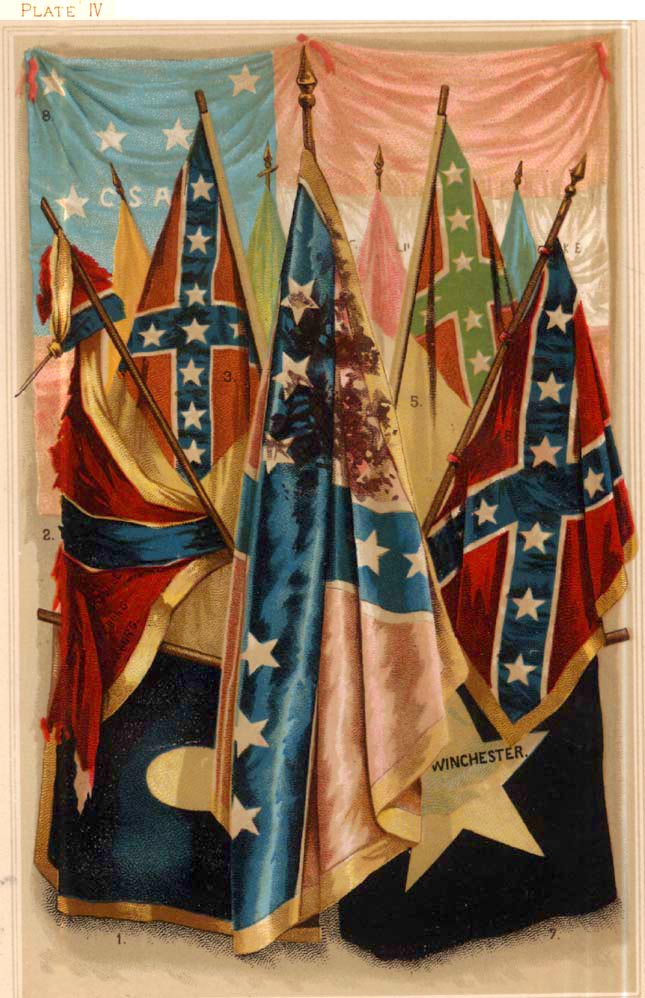
In this remarkable pageant, the carriage containing the captured flags attracted much attention, and excited great enthusiasm. These were the flaunting rags which the rebels had borne on many a battlefield, and which our brave soldiers had torn from the hands of their standard-bearers. No longer were they flaunting in haughty defiance at the head of rebel armies, but as bellorum exuviae ---spoils of war---they were carried in triumph at the head of a civic procession in the peaceful streets of Chicago. They must have conjured up many a tearful memory in the minds of spectators there present, whose sons fought in the battles where these flags were captured, and whose graves make the soil of the South billowy.
No less attractive was the sixth division of the procession, consisting of omnibuses and carriages crowded with children, who rent the air with their song of "John Brown's body lies a-mouldering in the grave!" and whose tiny flags fluttered incessantly in the air, like the wings of gigantic butterflies. After them came, in carriages, the convalescent soldiers from the hospitals in the immediate vicinity; wan, thin, bronzed, haggard, maimed, crippled. One incessant roar greeted them in their progress. They were pelted with flowers. Ladies surrendered their parasols to them, to screen them from the sun. People rushed from the sidewalks to offer their hands. Handkerchiefs were waved, and shout followed shout throughout the long three miles.
 |
|||
| 1. From Bragg's Army | 2. Forty second Miss. Reg't. | 3. Twelfth Miss. Cavalry | 4. Ninth Texas Reg't. |
| 5. Austin's Battery | 6. So. Carolina Flag | 7. Texas Black Flag | 8. Virginia Flag |
 Descriptions Descriptions |
|||
But perhaps the most interesting spectacle of all was the "Lake County delegation." This was a procession of the farmers of Lake County, who came into the city at an early hour, and wheeled into line with the procession. There were hundreds of farmwagons, loaded to overflowing with vegetables. The staid farm-horses were decorated with little flags, larger flags floating over the wagons, and held by stout farmer bands. The first wagon of the procession bore a large banner, with this inscription: "THE GIFT OF LAKE COUNTY TO OUR BRAVE BOYS IN THE HOSPITALS, THROUGH THE GREAT NORTHWESTERN FAIR." It was a free-will offering from hearts that beat true to freedom and the Union. No part of the procession attracted more attention, and no heartier cheers went up from the thousands who thronged the streets, than those given, and thrice repeated, for the splendid donation of the Lake County farmers. There were no small loads here. Every wagon was filled to overflowing with great heaps of potatoes and silver-skinned onions, mammoth squashes, huge beets and turnips, monster cabbages, barrels of cider, and rosy apples --- load after load, with many a gray-haired farmer driving.
Many of the farmers were sunburned men, with hard and rigid features, and a careless observer would have said that there was nothing in these farm-wagons and their drivers to awaken any sentiment. But there was something in this farmers' procession that brought tears to the eyes as the heavy loads toiled by. On the sidewalk, among the spectators, was a broad-shouldered Dutchman, with a stolid, inexpressive face. He gazed at this singular procession as it passed, --- the sunburned farmers, the long narrow wagons, and the endless variety of vegetables and farm produce, the men with their sober faces and homely gifts,---until, when the last wagon had passed, he broke down in a flood of tears. He could do nothing and say nothing; but he seized upon the little child whom he held by the hand, and hugged her to his heart, trying to hide his manly tears behind her flowing curls.
Among the wagons was one peculiar for its look of poverty. It was worn and mended, and was drawn by horses which had seen much of life, but little grain. The driver was a man past middle age, with the clothing and look of one who had toiled hard, but his face was thoughtful and kindly. By his side was his wife, a silent, worn woman,---for many of the farmers had their wives and daughters on the loads, --- and in the rear was a seeming girl of fifteen and her sister, both dressed in black, and with them a baby.
Some one said to the man, "My friend, I am curious to know what you are bringing to the soldiers. What have you?" "Well," said he, "here are potatoes, and here are three boxes of onions; and there are some rutabagas, and there are a few turnips; and that is a small bag of meal; and then, you see, the cabbages fill in; that box with slats has ducks in it, which one of our folks sent."
"Oh, then this is not all your load alone, is it?"
"Why, no; our region where we live is rather poor soil, and we haven't any of us much to spare, anyway; yet for this business we could have raked up as much again as this, if we had had time. But we didn't get the notice that the wagons were going in until last night at eight o'clock, and it was dark and raining then. So my wife and I and the girls could only go round to five or six of the neighbors within a mile or so; but we did the best we could. We worked pretty much all the night, and loaded so as to be ready to get out to the main road and start with the rest of 'em this morning. It's little, but then it's something for the soldiers."
"Have you a son in the army?"
"Well, no," he answered slowly, turning round and glancing stealthily at his wife. "No, we haven't now. We had one there once. He was buried down by Stone River. He was shot there. That's his wife there with the baby," pointing over his shoulder to the rear of the wagon without looking back; "but I should not bring these things any quicker if he were alive now and in the army. I don't know as I should think so much as I do now about the boys way off there. He was a good boy."
The goal, of the procession was the spacious yard of the Court House, where it halted for an address by Thomas B. Bryan, the loyal and gifted nephew of the rebel general Robert Lee.
The fair was opened at noon, and the firing of thirty-four guns gave to the public the indication that its managers were in readiness to receive guests, and to put on the market its varied wares. As the last gun boomed on the ears of the vast multitude, they surged like a tidal wave towards Bryan Hall,---the first of a series of six or seven, occupied by the fair, to be entered.
The Lake County delegation of farmers proceeded first to the rooms of the Sanitary Commission to unload their freight of vegetables. The hundreds of wagons drew up before the doors, and soon the sidewalks and streets were filled with boxes, barrels, and sacks. Scores and scores of bystanders eagerly put their shoulders to the work, proud to aid in unloading the farmers' produce. Madison Street, for a whole square, was blockaded an hour, and the progress of the street-cars arrested, but nobody grumbled. The passengers alighted and increased the crowd, cheering the farmers, shaking hands with them, offering help, uttering congratulations and benedictions. Many a rough fellow, who elbowed his way into the dense throng to lend a hand at the disburdening of the wagons, found his hitherto ever-ready words fail him, and turned to dash away, with the back of his hand, unwonted tears, of which he need not have been ashamed.
The back room of the Commission was speedily filled with wheat. Mr. McVicker, the well-known theatrical manager, tendered the use of his capacious cellar under the theatre for the vegetables, and that also was soon filled. While unloading, a messenger from the women managers approached the farmers with an invitation to Lower Bryan Hall, where a sumptuous dinner was awaiting them. The sturdy yeomen, accompanied by the marshals of the several divisions, marched to the hall, where the women warmly welcomed them.
A touching little episode occurred while the farmers were dining. In the neighborhood of their table were several soldiers, who had also ordered dinner. One of them chancing to give an order during a brief pause in the conversation, the tones caught the ear of one of the farmers, who turned quickly, and recognized in the bronzed and blue-coated soldier behind him his own son, whom he had not seen for two years and a half. He was now on his way home from Vicksburg on a short furlough. The discovery and recognition were mutual. Father and son started up at the same glad moment, and, in the touching language of Scripture, literally "fell on each other's necks and wept." This little occurrence gave new zest to the dinner, and added to the excitement of the hour.