
STORY OF THE GREAT FAIR CONTINUED---ITS SIX HALLS---PRESIDENT LINCOLN'S DONATION---UNEXAMPLED ENTHUSIASM---"GOD BLESS THE FARMERS."
Profusion of Wares and rapid Sales---Daily Excursion Trains---President Lincoln donates the Manuscript of the Proclamation of Emancipation---Large Quantities of Food sent from the Country to the Dining-Hall---How Dubuque furnished her Quota of Supplies---Picturesque Scene---Hall erected for Donations of Machinery---Our Bargain with the Builder---A Revelation and its Results---County Court Room transformed into a "Curiosity Shop"---Rebel Flags, and Battle Trophies---Slave Shackles and Collars---Large Loan Collection of Art Works---Anna Dickinson's Lectures---Dinner to Northwestern Governors, Congressmen, and other Dignitaries.---Gift of Live Stock---Auction Sales on the Sidewalk.
 HE inaugural ceremonies being over,
we will follow the multitude to Bryan Hall, transferred for the
nonce into a bazar, rivalling those of the Orient in bewildering
beauty. A semi-circle of double booths followed the curve of the
gallery, and another semi-circle was arranged against the wall,
a broad aisle being left between for a promenade. In the centre
of the hall, under the dome, a large octagonal pagoda was erected,
two stories high; the lower floor occupied by fair saleswomen
and brilliant wares, while in the gallery, overhead, the band
discoursed sweet music through the afternoon and. evening. The
leading architect of the city planned the interior arrangements
of the halls, while their decoration was happily entrusted to
a committee of German artists. This was eminently patriotic in
character, and full of significance in the history of the country
at that time.
HE inaugural ceremonies being over,
we will follow the multitude to Bryan Hall, transferred for the
nonce into a bazar, rivalling those of the Orient in bewildering
beauty. A semi-circle of double booths followed the curve of the
gallery, and another semi-circle was arranged against the wall,
a broad aisle being left between for a promenade. In the centre
of the hall, under the dome, a large octagonal pagoda was erected,
two stories high; the lower floor occupied by fair saleswomen
and brilliant wares, while in the gallery, overhead, the band
discoursed sweet music through the afternoon and. evening. The
leading architect of the city planned the interior arrangements
of the halls, while their decoration was happily entrusted to
a committee of German artists. This was eminently patriotic in
character, and full of significance in the history of the country
at that time.
The national flag was festooned, and clustered in all appropriate places. It floated overhead, it depended from arches, it entwined columns. It was looped, in silken folds over every door so that no one could enter any of its departments without passing under the flag. Soldiers from the battle-field, on brief furloughs home, would glance around on the beloved banner everywhere displayed. They had followed it to victory, and had endured, in its defence, hardship, sickness, and mutilation. Tears, which they could not repress, coursed down their brown faces, as they beheld the exaltation of the national ensign. Soldiers were welcomed to any department of the fair, on all occasions, and the blue uniform of the army or navy gave a free passport to all soldiers and sailors.
If the goods and wares exhibited for sale were as astonishing in profusion as in variety, there was no lack of purchasers. From eight o'clock in the morning until ten at night, and sometimes until a later hour, the six halls of the fair were densely packed with eager and interested crowds. To judge from the liberality of the purchasers, one would have supposed that each possessed the inexhaustible purse which the fairy gave to Fortunatus, for there was no haggling about prices, and no backwardness in buying. If the sales slackened, the fair traders had but to utter the talismanic words, "Buy for the sake of the soldiers!" and they proved the "open sesame" to all purses and pockets. The affable saleswomen, who, at the opening of the fair, were dismayed at les embarras des richesses, that piled their counters, remembering the vast quantities that lay snugly packed in boxes underneath, saw their goods disappear like snow in the warm spring sunshine, and the second week found them exercising their woman's ingenuity to replenish their rapidly disappearing stock.
Arrangements had been made with the railroads to run excursion trains, at low prices, each day, from different parts of the country. This brought daily new crowds of large-hearted, whole-souled country people, who brought with them a fresh gush of national feeling and glowing patriotism, and before whose unselfishness and devotion to. country, the disloyalty of the city shrank back abashed. The weather had no effect on the throngs---rain or shine, cold or warm, calm or blustering, the halls of the fair were so densely packed that at times it was impossible to cross them. Policemen were stationed a the doors of the halls, to enforce entrance by one door and exit by another. The sales of tickets were sometimes stopped for an hour or two at a time, to relieve the overcrowded halls. It was ascertained from the doorkeepers that the average daily attendance was six thousand.
It would not be possible to describe in detail the rare and beautiful articles that attracted throngs of people to this hall. The most noteworthy of all, and that in which the widest interest was felt, was the original manuscript of President Lincoln's "Proclamation of Emancipation," of the four million slaves of the South. This was the gift of the President to the fair, who accompanied it with the following characteristic letter:
EXECUTIVE MANSION, WASHINGTON, Oct. 26, 1863.
To the Ladies having in charge the Northwestern Fair for the Sanitary Commission, Chicago, Ill.:
According to the request made in your behalf, the original draft of the Emancipation Proclamation is herewith enclosed. The formal words at the top, and at the conclusion, except the signature, you perceive, are not in my handwriting. They were written at the State Department, by whom I know not. The printed part was cut from a copy of the preliminary Proclamation, and pasted on merely to save writing. I had some desire to retain the paper; but if it shall contribute to the relief or comfort of the soldiers, that is better. Your obedient servant,
A. LINCOLN.
This manuscript was purchased for three thousand dollars, by Thomas B. Bryan, for the Chicago Soldiers' Home, of which association he was president.
It was finely lithographed, and copies were sold by the Board of Managers for the benefit of a permanent Home for invalid Illinois soldiers, thousands of dollars accruing to the fund from their sale. The original manuscript was finally placed in the archives of the Chicago Historical Society for safe keeping, and was there burned at the time of the great conflagration.
While Upper Bryan Hall was occupied as a salesroom, Lower. Bryan Hall was used throughout the fair as a dining and refreshment hall. The lady managers had promised to dine fifteen hundred people daily, with home comfort and elegance; and they amply fulfilled their pledge. The rush to this hall was as great as to the others, and hundreds went away every day to restaurants and hotels who could not be accommodated. The perfect system with which the dinners were managed, merits a passing notice.
The city was thoroughly canvassed for donations to the fair, every district being taken by a lady, and faithfully visited by her, or her subordinates. The names and residences of all who would contribute to the dinner-tables were taken, with the articles they would furnish, and the days on which they might be expected. The canvassing over, a meeting of the canvassers was held, and the aggregate supply for each day ascertained. Previous experience in these fair dinners had taught the ladies what quantities of each article were necessary for one dinner so many turkeys, so many ducks, so many roasts, so many pies, so many puddings, so many gallons of milk, so many pounds of coffee, and so many cans of oysters, etc. If the amount pledged for each day was not sufficient, the dinner committee supplied deficiencies. These supplies thus pledged were sent to the dining-hall on the days they were promised, or to depots appointed in the various divisions of the city, whence express wagons ran daily, at specified and advertised hours.
In addition to this source of supply, large quantities of ready-cooked food were sent from various parts of the country. Notification of the time when it might be expected was previously mailed to the committee. Michigan sent immense quantities of the finest fruit, twenty times as much as was required by the exigencies of the refreshment tables. Hundreds of barrels of apples of late varieties were immediately despatched to the hospitals, whence in due time came grateful acknowledgment of the welcome donations. Grundy County, Ill., sent game exclusively, nicely cooked and carefully packed, and forwarded with such despatch that it hardly had time to cool before the express delivered it in the dining ball. Elgin, Ill., from her abundant dairies, supplied a large proportion of the milk used during the fair, her "milkmen" calling regularly at the dinner hour with overflowing cans.
Dubuque, Iowa, came to the help of the dining-hall in a most generous manner. The Dubuque ladies who visited the fair during the first week learned that there was not enough of poultry pledged for certain days of the week following. They hastened home to make up the deficiency. Some half-dozen of their best "shots" were instantly sent off "gunning." A general raid was made on hencoops. Turkeys were bought or begged by the dozen. Ducks and chickens were soon obtained by the hundred. On the days when their contributions for edibles were due, they sent to Chicago over one hundred turkeys, two or three hundred ducks, and as many chickens, exquisitely cooked, which were carried piping hot from the Dubuque kitchens to the express car. Several of the ladies sat up all the previous night, and gave personal help and supervision to the work of dressing, baking, and packing these fowls. By some mystery of the cuisine, on their arrival in Chicago, they were brought to the table as hot as though they had just made their début from the bakepan.
Fourteen tables were set in the dining-hall, with accommodations for three hundred at one time. Every table was reset four or five times daily. Six ladies were appointed to take charge of each table throughout the fair. Two presided daily---one to pour coffee, the other to maintain general supervision. These ladies were the wives of congressmen, professional men, clergymen, editors, merchants, bankers, commissioners,--none were above serving at the Soldiers' Fair dinners. Each presiding lady furnished the table linen and silver for her table, and added any other decorations and delicacies that her taste and means suggested, or that her friends and acquaintances contributed. The table waiters were the young ladies of the city, deft-handed, swift-footed, bright-eyed, pleasant-voiced maidens, who, accustomed to being served in their own homes, transferred themselves for the nonce into servants. Both the matrons who presided, and the pretty girls who served, were neatly attired in a simple uniform of white caps and aprons, made, trimmed, and worn, to suit the varied tastes and styles of the wearers. In common with every lady who assisted at the fair in every capacity, they wore the national colors.
A more picturesque scene than the dining-hall offered, when dinner was in progress, cannot be imagined. The decorations were like those of the other halls, with the national flag waving over every table, and crowning the table ornaments. There was a profusion of flowers everywhere, mostly hothouse exotics; and a small bouquet was laid beside every plate. The gas was lighted day and night, giving additional brilliancy to the scene. The numerous tables, crowded with ladies and gentlemen who had come to dine; the long line of carvers, one for each variety of meats, who had closed the ledger, and laid down the pen, to don the white apron, and take the knife of this department; the graceful girls in their pretty uniforms, gliding hither and thither in the discharge of their novel duties; the agreeable matrons, who received all who came to their tables as though they were honored guests in their own homes; the crowds who stood round, determined to dine in this hall, good-naturedly biding their turn, with many a bon mot which provoked constant peals of laughter; the continual incoming of fresh trays, baskets, and pails, laden with viands for the dinner, all this formed an animated and unusual picture, that pen cannot portray. There was no lack of sociality at these dinners. Mirth and laughter were as abundant as the food. Wit held high carnival. And a stranger, ignorant of the occasion, would have believed this a new Babel, where a second "confusion of tongues" had been wrought.
The kitchen adjoined the dining-hall, where the heavy work was done by servants; an into these penetralia only a favored few were admitted. The rule, was inexorable; and woe to the curious wight who ventured within its precincts without leave or business! Little ceremony was employed in enforcing his departure. Checks laid beside the plate indicated to each his indebtedness, which was more or less according to the bill of fare he had ordered. These bills were settled at the table of the cashier, who gave in return a receipt, in the form of another check, on the presentation of which at the door the party offering it was allowed to leave the hall. There was no exit otherwise. No department of the fair required more executive skill in management, and none was more popular or successful.
A temporary hall was erected, adjoining Bryan Hall on the east, for the reception of the heavy and bulky machinery contributed. A hall on the ground floor was necessary for this purpose, and such a hall Chicago did not possess. Obtaining a permit from the authorities for the erection, within the fire limits, of the temporary wooden structure that was needed, Mrs. Hoge and myself sought a builder. A gift of lumber had been made for this use; and we desired to contract with him for the erection of the hall. The plan was drawn, the bargain made, the contract written, and we both signed it.
"Who underwrites for you? "asked the builder.
"What?" we inquired in concert.
"Who endorses for you?" he explained.
"We wish no endorsers. We have the money in bank, and will pay you in advance, if you will draw the contract accordingly. We have more faith in you than you manifest in us," we replied.
"It isn't a matter of faith at all," was his answer, "but of law. You are married women; and, by the laws of Illinois, your names are good for nothing, unless your husbands write their names after yours on the contract."
"Let us pay you then in advance," we said. "We have money of our own earning, and are able to settle your bill on the spot. Instead of a contract, give us a promissory note, like this: 'In consideration of dollars, I promise to build for Mrs. Hoge and Mrs. Livermore a hall of wood,' etc. Can't you do that?"
"The money of your earning belongs to your husbands, by the law. The wife's earnings are the property of the husband in this state. Until your husbands give their written consent to your spending your earnings, I cannot give you the promise you ask. The law must be respected."
Here was a revelation. We two women were able to enlist the whole Northwest in a great philanthropic, money-making enterprise in the teeth of great opposition, and had the executive ability to carry it forward to a successful termination. We had money of our own in bank, twice as much as was necessary to pay the builder. But by the laws of the state in which we lived, our individual names were not worth the paper on which they were written. Our earnings were not ours, but belonged to our husbands. Later in the conversation, we learned that we had no legal ownership in our minor children, whom we had won, in anguish, in the valley of death. They too were the property of our husbands.
We learned much of the laws made by men for women, in that conversation with an illiterate builder. It opened a new world to us. We thought rapidly, and felt intensely. I registered a vow that when the war was over I would take up a new work---the work of making law and justice synonymous for women. I have kept my vow religiously.
The signing of the contract was delayed till our husbands could give legality to it, by signing with us. And then the building was pushed rapidly forward to completion. When it was no longer needed, was removed, and passed away forever. But the influence of the conversation with its builder still abides with me.
It was so constructed as to be entered from Bryan Hall by a side door. The contributions to this department were amazingly liberal, embracing almost every article of farm and household use, and were sufficient in number and importance for a good-sized State Fair. As the articles were mostly manufactured by contributors especially for the fair, they were made of the best material, and in the highest style of workmanship. In some remote districts, where a knowledge of the fair penetrated at a late day, manufacturers donated orders for machinery not then made. One order of this kind from Decatur, Ill., was for nine hundred dollars' worth of machinery, and was not available until the next July.
Of ploughs there were scores, embracing almost every patent. Nails were donated by hundreds of kegs. Stoves were contributed by dozens, no two being of the same pattern. Barrels of kerosene of every brand were piled on one another, no inconsiderable portion of the space being allotted them. There were a dozen sets of scales, four of them of the manufacture of the Messrs. Fairbanks, worth one hundred dollars each. Reapers and mowers were donated that had borne off the prizes at several State Fairs, and threshing machines which had received similar honors. There were corn-shellers and corn-planters, straw-cutters, and grain and grass seed drills, fanning-mills and non-freezing pumps, sugar-mills and marble mantels, nests of wash-tubs and. stacks of pails, every conceivable style of washing and wringing-machines, millstones, knife and scissors sharpeners, cases of boots and shoes, Saratoga trunks, common-sense chairs, carriage-springs, axles, hub and buggy spokes---in short, there were specimens of every branch of Northwestern manufacture.
That which attracted the most attention was a beautiful ten-horse power upright engine made and presented by the generous employés of the Chicago Eagle Works---every member of the establishment contributing to it. It was a most thoroughly built piece of machinery, and was very handsome. A boiler was also contributed by the boiler shops of the city, so that the engine was run during the fair, exciting great admiration by its easy and almost noiseless movements. The mechanics of the Northwest manifested a noble interest in the fair. In several instances, the employés of manufactories clubbed together and worked "after hours" to build machines for the fair. When this was not possible, they contributed their money, and sent a generous cash donation to its treasury, or they gave the entire proceeds of certain days' work. Not only did they contribute articles of their manufacture, but in the evening they came and assisted the ladies to sell them, disposing of the heaviest by raffling, and finding purchasers among their own customers for others. God bless them! Whether in the workshop or on the battle-field, the mechanics of the Northwest at that time proved themselves brave, true, noble-hearted men.
The supervisor's hall in the Court House, occupied mostly by the sessions of the County Court, Judge Bradwell presiding, was surrendered to the ladies, to be occupied by them as a "Curiosity Shop." Not only did the obliging Judge adjourn his court for two weeks, but gave up his room to the fair, and, with his wife, Mrs. Myra Bradwell, he gave his services to assist in arranging and superintending this department. More attractive than all else in this hall were the battle-torn flags of our own regiments, and the captured rebel flags. The fourteen rebel flags, which were trophies of victory, were loaned for exhibition by Secretary Stanton. In the history of each of them there was material for volumes of narrative and romance. One Union flag, blood-stained and rent, had been selected by General Grant to be first unfurled over the Court House at Vicksburg when that city surrendered. Another had been captured in the battle of Bull Run, and with it the color-bearer. Both were in Libby Prison for more than a year. A heartfelt and tearful interest clustered around the flags; and, though rent in shreds, discolored, soiled, and blood-stained, they lent a glory to the walls upon which they hung. Nor was it forgotten that those who had fought under them had laid down life in their defence, and were then sleeping the "sleep that knows no waking," no more to be saluted by friend or assaulted by foe.
A long table ran through the centre of the hall, covered with a motley collection of trophies captured from the enemy, including guns, cimeters, bowie-knives of all shapes, butcher-knives of most ferocious aspect, swords, balls, pistols, shells, camp-stools, etc.,---every one of which had a history.
Among these trophies was a shackle taken from the neck of a slave at Port Gibson by the "Walsh Guards," Eleventh Wisconsin. It was made of bar iron, three inches wide and half an inch thick, weighing between three and four pounds, and had been worn eleven months. One trophy, which challenged the attention and roused the indignation of all, was called the "Southern necklace," and had the following history: :--
While our army was at Grand Gulf, Miss., an intelligent contraband gave much valuable information as to the position of the enemy, and otherwise rendered himself useful to our forces. He finally fell into the hands of the rebels, who administered one hundred and fifty lashes, and placed an iron collar around his neck, riveting it on very strongly. Afterwards the negro was captured from the rebels at Baton Rouge, La., by Company F, Fourth Wisconsin, and was immediately released from the collar. This collar was a round rod of iron, two inches in circumference, riveted together before and behind with two iron prongs one inch wide, three fourths of an inch thick, and twelve inches long, rising from each side directly outside the ears.
There were little keepsakes made from the old historic frigate Constitution, better known as "Old Ironsides," and fragments of the wrecks of the rebel land Merrimac, and the frigate Cumberland, which the Merrimac had so murderously destroyed in Hampton Roads a short time before. A silver band and three silver bracelets, in perfect preservation, taken from the brow and arm of a gigantic Indian skeleton, were sent from Quincy, Ill., where it was exhumed a few days previous to the fair.. A young lady from the Island of St. Helena visiting Chicago, enriched the fair with a full collection of views of the island, and a large number of relics associated with Napoleon's life when held a prisoner there by Great Britain. Senator Chandler of Michigan sent an Alpine staff used by Napoleon when crossing the Alps to make war on Italy. The assistants in this department daily talked themselves hoarse and weary in reiterated explanations of their storied collection, to the never-ceasing crowds of curiosity-seekers. And probably this was the most interesting collection of articles and relics ever seen by Western people.
The best arranged and best lighted hall in the city was placed at the disposal of the fair for an Art Gallery. It was free of rent, and to be occupied as long as it might be needed for that purpose. Partitions were run up between the large windows, dividing the spacious hall into alcoves, both sides of which, as also the walls of the room, were covered with pictures. Lady canvassers waited upon the citizens of Chicago, and obtained the loan of their best works of art for exhibition. Very few declined, and the number collected was a surprise to all. Pictures were sent from New York, Wisconsin, Michigan, Iowa, and some from Pittsburg. The Chicago artists generously painted pictures which they donated, and which were sold at very liberal prices. Young as Chicago was at that time, over three hundred works of art were loaned from her homes.
Church was represented by two South American pictures, which reminded one of his "Heart of the Andes." There were pictures by Rossiter, Cranch, Angelica Kauffman, Durand, Cropsey, Gifford, and Kensett. Of works by the old masters; there were paintings by Rembrandt, Sassaferato, and Tintoretto. Many of Mr. Healy's best portraits were on the walls. He had just completed a portrait of Dr. Orestes A. Brownson, and another of the glorious head and face of Longfellow. They were classed among the masterpieces of this artist. Like all Healy's portraits, they were distinguished for their marvellous coloring, their careful finish, and conscientiousness of detail. The exhibition of statuary was small. A Mercury and Venus by Thorwaldsen, with several bronzes and medallions, made up all that was valuable in the collection. Above the gallery was another hall, devoted to photographs, water-colors, and steel engravings; and a very creditable collection was brought together.
The success of the Art Exposition may be inferred from the fact that twenty-five thousand people visited the gallery during the fair, and that it was necessary to continue it two weeks after the other departments closed, to satisfy the demands of the public. During the first five days, seven thousand catalogues were sold; and the profits from their sale alone were sufficient to defray all the expenses of the exhibition. On one day alone, eighteen hundred and fifty tickets were sold at the door, and eight hundred catalogues.
Metropolitan Hall was devoted exclusively to evening entertainments, and was not open during the day. Its decoration was given to a company of German artists, who transformed it into a scene of bewildering beauty. Every iron column was fluted with the white and the red. Festoons of red, white, and blue, glittering with gold stars, depended from the gallery. Everywhere were mottoes expressive of faith in God, devotion to the country, and undying interest in her brave defenders. The proscenium was arranged with fluted decorations and festoons of the national colors. Busts of Washington and Lincoln were on either side of the stage; while over the curtain hovered the national eagle, resting on a shield, grasping the stars and stripes in the talons of one foot, and the arrowy lightnings with the other.
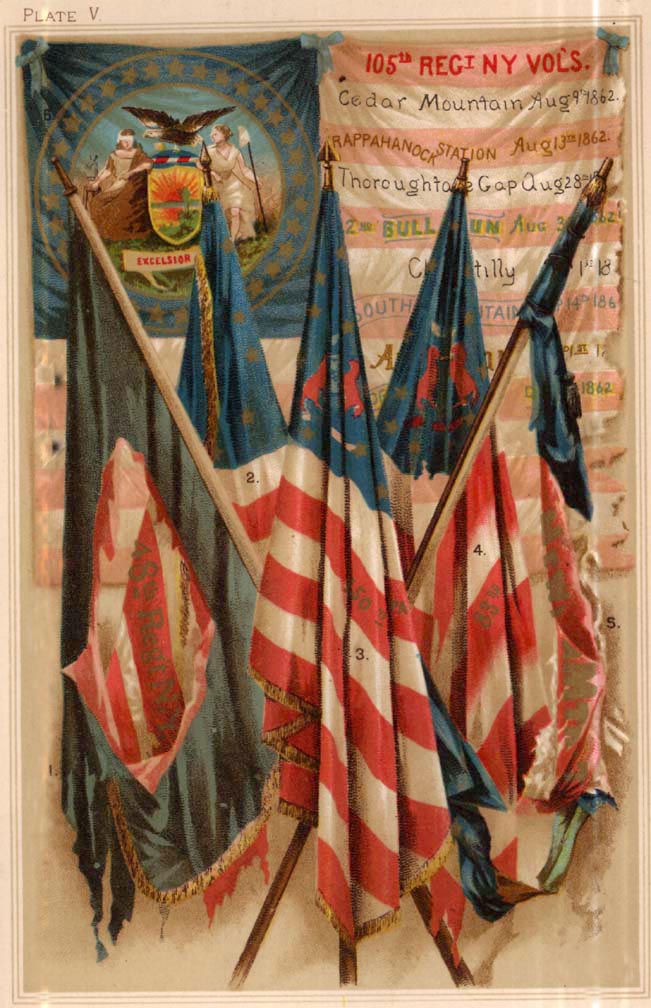 |
||
| 1. First N.J. Cavalry | 2. Forty eighth N.Y. Reg't. | |
|
|
||
| 4.Eighty third Penn. Reg't. | 5. Ninth N.J. Reg't. | 6. One hundred and fifth N.Y. Reg't. |
 Descriptions Descriptions |
||
In this hall the managers of the fair catered to the amusement of the crowd every evening of the fair. Every night the spacious hall was filled to its utmost capacity. Sometimes it was a children's concert. Then an exhibition of tableaux, allegorical, historical, patriotic, or classical, exhibited on a revolving platform. Chicago audiences never wearied of tableaux in those days. The ladies of Detroit gave an exhibition of tableaux, bearing all the expenses incident to preparation,---costumes, travelling expenses, hotel bills,---and giving to the fair the gross receipts of the entertainment. For magnificence of costume, artistic grouping, and startling effects, they could not be surpassed, even when arranged by professional artists. A monastic procession at midnight was a moving tableau. A company of nuns and priests, arrayed in the garb of their several orders, and bearing torches, filed slowly through the corridors and arches of the monastery, chanting clearly and sweetly the "Miserere" from "Il Trovatore."
Richard Storrs Willis, brother of N. P. Willis the poet, known then as one of the first composers and pianists of the country, with Mrs. Willis, accompanied the Detroit party to Chicago. In the closing tableau, Mrs. Willis personated the Goddess of Liberty, in a bodice formed of the Union, with a skirt of the stars and stripes, wearing the liberty cap, and holding the flag. At her left were army officers, and. a group of jolly tars in naval uniform. In a semicircle in the background were arranged the three graces, Faith, Hope, and Charity. Suddenly the goddess, Mrs. Willis, broke forth with the "Anthem of Liberty," both music and words of which were composed by Mr. Willis for the occasion: :--
"Anthem of Liberty, solemn and grand,---
Wake in thy loftiness, sweep through the land!
Light in each breast anew, patriotic fires!
Pledge the old flag again, flag of our sires!
Fling all thy folds abroad, banner of light!
Onward, still onward, flag of our might!
Onward, victorious, God for the right!
Amen, amen!"
The chorus was sung by all the group, and was most inspiring. The effect was electrical. The immense audience rose to its feet, and the curtain fell amid tumultuous cheers and applause. Again it rose; and again the Goddess of Liberty, as if inspired anew with patriotic fervor, sang the "Star-Spangled Banner," the entire audience rising and joining in the chorus, accompanied by the Light Guard Band.
Vocal and instrumental concerts filled up the evenings, with hops and pantomime and amateur theatricals. Then came the novelty of two lectures, delivered by
whose career as an eloquent and patriotic lecturer was then attracting universal attention. It was her first appearance in Chicago. The press had raised the expectations of the people very high by the narration of her oratorical triumphs in the East. The Republican party had acknowledged its indebtedness to her eloquence for victories in Connecticut and New Hampshire; and those who had been brought under the spell of her speech were extravagant in her praise. Every one was on the qui vive to see and to hear her; and her audiences were limited only by the capacity of the hall.
Her addresses were not so remarkable for originality, logic, or argument, as for the magnetic power with which they were delivered. With a fearful array of indisputable facts, she exposed the subterfuges of those who planned the rebellion at the South, and those who defended it at the North. With the majesty of a second Joan of Arc, she invoked the loyalty, patriotism, and religion of the North to aid in quelling it. It was a wonderful sight. She was a young girl, of twenty summers; but she held an immense audience spell-bound by her eloquence, now melting them to tears by the pathos of her voice and of her speech, and now rousing them to indignation as she denounced the enemies of the country, fighting against our armies at the South, or plotting treason at home.
Sandwiched between Miss Dickinson's lectures was a grand dinner, given by the lady managers to the dignitaries of the Northwest. Governors and ex-Governors, members of Congress, distinguished military men, at home on furlough, with such local magnates as could add éclat to the occasion, composed the guests. There were some two hundred in all. The most complete arrangements were made for their reception and entertainment. The ball was decorated for the occasion; and to add to the picturesque effect, the young lady waiters were attired in costume of their own devising, which harmonize admirably with the patriotic surroundings. A blue peasant-cap, skirt of the stripes of the flag, and jaunty little red cap, trimmed with gold braid and tassels, gave to some of the girls a stateliness of presence, and to others only added piquancy. "I do not find it easy to give orders for dinner to these, young goddesses of liberty," said one of the Governors; and others experienced a like embarrassment. A large audience listened to the after-dinner speeches of the eminent guests, which were all aglow with lofty patriotism. It was the aim of the managers of the fair not only to make money, but, to kindle anew the loyalty and devotion of the Northwest.
A second farmers' procession of wagons loaded with vegetables came in to the fair at noon on the day of the Governors' dinner. One would have supposed that the fair had just commenced, the procession created so much excitement. The streets were again thronged with people. The procession of wagons paraded through the principal thoroughfares, cheered wherever it passed, and then proceeded to the rooms of the Sanitary Commission, where the wagons were unloaded. This was a surprise to all, and helped to keep up the patriotic excitement to the utmost.
After unloading their stores, the farmers proceeded to the Soldiers' Home, where a dinner had been provided expressly for them. Two hundred soldiers on their way to the front dined with them. They made a jolly party. Addresses were delivered after the dinner was ended, the band played its most stirring airs, the best women of the city served them, and poured their tea and coffee, and then the gallant boys, hurrying back to the battle-field from hospitals and furloughs at home, gave cheer upon cheer for the farmers, when they learned of their generosity.
In the midst of the' festivities, a sick soldier in the hospital of the home, to whose dull ear the glad sounds penetrated, inquired the cause. When an explanation was given him, he said, "That is good! God bless the farmers!" and, turning his face to the wall, before the gayety was ended, he yielded his spirit to the God who gave it. With the benedictions of the living and dying resting on them, the farmers climbed to their empty wagons, and returned richer than they came.
Among other donations for which the ladies were unprepared was that of live-stock. Thoroughbred, colts, pet bears, Morgan horses, Durham cattle, and a stall-fed ox, which weighed when dressed eighteen hundred pounds, were included in these donations
As we were notified of these novel contributions, advertisements were inserted in the daily papers. All day and hour were appointed for their sale at auction on the sidewalk in front of Bryan Hall. A crowd always collected, and spirited bidding ensued, which resulted in the sale of all the live-stock given to the fair.
LAST DAYS OF THE GREAT FAIR---SOLDIERS' DAY---TOTAL RECEIPTS NEARLY ONE HUNDRED THOUSAND DOLLARS--INTERESTING ITEMS AND INCIDENTS.
Dinner given by the Ladies to eight hundred invalid Soldiers in Hospitals---Lady Managers dined by Gentlemen, who serve the Feast---Mighty Frolic---" Completely tuckered out! "---Items and Incidents---Afghan made with Money found in a dead Soldier's Pocket---Contraband's Gift---Donation of Octogenarians---Mite of the German Woman--The Luck of the Chickamauga Soldier---Major-General Herron of Iowa in the Fair---Letters of Gratitude from Soldiers in Hospitals---"Must see that Fair"---"All I have "---Safe place of Retreat---Pleasant Greetings---"A Soldier's Psalm of Woman "---Cheers for Lincoln---Cheers for the Soldiers---Cheers for the Ladies of the Sanitary Commission---Specimen of the Soldiers' Battle-cry---The Dead.
 T was decided to give a grand dinner
on the closing day of the fair to all the soldiers in Camp Douglas,
the convalescents in the Marine and City Hospitals, and the Soldiers'
Home. About eight hundred in all were present, but there were
many others, too feeble for the excitement, who remained behind.
Public announcement of the dinner having been made, donations
of refreshments were sent to the hall in great profusion. Such
a furor of preparation as that morning witnessed! Hot-houses were
rifled of their flowers,---plate-chests of their silver, and every
species of patriotic ornament was devised for the occasion. Rare
fruit, ices, jellies, flowers, and game poured in upon the ladies
in the greatest abundance. The best band in the city was engaged
for the Occasion. The hall was redecorated, and made more attractive
than ever. The pretty waiter-girls made their toilets anew, and,
taking their places behind the chairs, we saw that we had not
merely one Hebe, but scores of them.
T was decided to give a grand dinner
on the closing day of the fair to all the soldiers in Camp Douglas,
the convalescents in the Marine and City Hospitals, and the Soldiers'
Home. About eight hundred in all were present, but there were
many others, too feeble for the excitement, who remained behind.
Public announcement of the dinner having been made, donations
of refreshments were sent to the hall in great profusion. Such
a furor of preparation as that morning witnessed! Hot-houses were
rifled of their flowers,---plate-chests of their silver, and every
species of patriotic ornament was devised for the occasion. Rare
fruit, ices, jellies, flowers, and game poured in upon the ladies
in the greatest abundance. The best band in the city was engaged
for the Occasion. The hall was redecorated, and made more attractive
than ever. The pretty waiter-girls made their toilets anew, and,
taking their places behind the chairs, we saw that we had not
merely one Hebe, but scores of them.
Anna Dickinson had agreed to utter the words of cheer and praise and kindly remembrance with which every woman's heart dilated. The ladies felt it was not possible to sufficiently welcome and honor the brave fellows they had invited to dine with them. A more beautifully laid table was never seen. It far surpassed in elegance and sumptuousness that set for the dignitaries of the Northwest the day before, and the dining-hall glowed and glittered with the most brilliant of the combined decorations brought from the other halls of the fair.
At twelve o'clock precisely, all being in readiness, the doors were opened, and the guests of the day marched into the hall. It was a bronzed, scarred, emaciated, halt, blind, deaf, crippled, skeleton corps, some without arms, some without legs, some swinging painfully on crutches, some leaning feebly on those stronger than themselves, all bearing evidence in their persons that they had suffered for their country. "Brave Boys are They!" crashed the band. The ladies waved flags and handkerchiefs, and, according to the programme they had marked out for themselves, essayed a cheer. But it was drowned in audible sobs, as they gazed on the poor boys who were their guests.. They were slowly seated at table, and then with eyes humid with tears, and voice tremulous with emotion, Anna Dickinson, a fair young girl orator at that time, welcomed them in eloquent words, in behalf of the managers of the fair.
Grace was then said by the chaplain of Camp Douglas, and the waiters darted off for soup, fish, turkey, game, vegetables, pies, puddings, ices, tea, coffee,---anything that was called for. The poor fellows were served as brothers and sons would have been at home. Their food was carved for them, and their not over vigorous appetites were coaxed and catered to as though feasting were the supremest joy of life. Dinner was soon over, and then came the after-dinner talk. Speeches were made by chaplains and officers who happened to be present.
"Three cheers for Abraham Lincoln! a diamond in the rough!" proposed a manly voice; and so mighty a cheer thundered through the hall, that our guests seemed no longer invalids. Then "Three cheers for the ladies of the Northwestern Fair!" shook the hall again. The ladies, in their enthusiasm, responded by "Three cheers for the soldiers!" given with an accompaniment by the band and with the waving of flags and handkerchiefs.
One of the chaplains proposed that the soldiers should give the ladies a specimen of their battle cry, as they charged, double quick, on the enemy----and, unconsciously to themselves, the men took the attitude, and their faces assumed the determination of the charge as they uttered so prolonged, unearthly, and terrific a yell as beggars its description. We can imagine its power on the battle-field.
The excitement was now at a white heat, and there was no vent for it but in music. The band played "The Red, White and Blue "---the boys joining in rousingly with their bass and tenor; the ladies adding soprano and contralto, and for the next hour all sang together, until the entire répertoire of patriotic and soldier songs was exhausted. "Let us not forget our dead! " said Chaplain Day. "They who went out with us to the conflict, but whose slumbers on the battle-field shall not be broken until the réveillé of the resurrection morn shall awaken them. Let us remember that--
All stood in solemn silence, with uncovered heads, while the band wailed a dirge for those to whom God had granted a discharge from the conflict, and promoted to the ranks of the crowned immortals. A doxology was the only fitting close to the hour, and a thousand or more of voices joined in singing "Praise God, from whom all blessings flow!" Then with swelling hearts and quivering voices, with tremulous clasping of the hands, and broken words of thanksgiving, the boys slowly returned to the hospitals.
"We are not worth all this. We have not earned this kindness," they said. "But on our next battlefield, the memory of this day shall make us braver and stronger."
Is there but one step from the sublime to the ridiculous?. I hesitate to give the finale, but, as a faithful historian, I must tell the truth. "This is the soldiers' day!" said a practical woman at the, door, as the boys were making their exit. "Let us crowd into it all the good things we can. Hold on, boys! Run, John, run round the corner, bring some boxes of fine cigars!" A moment's delay, and the cigars came. And then to every soldier was given, as he went out, cigars and matches. We saw them depart with an aureole of smoke about their brows, if not of glory. To those whose feebleness detained them in the hospitals, boxes of tempting and delicate viands were sent,--such as the surgeons endorsed,---and committees of ladies accompanied them, and served them to the invalids, sometimes in bed. They even spent the larger part of the day in the hospitals, a veritable gala day. Now followed a scene. Two hundred young gentlemen from the business circles of the city, had proposed a dinner to the ladies of the dining-hall, and as the boys went out, these gentlemen came in. The girl waiters doffed their white aprons and caps, and the gentlemen begged them to retire to Upper Bryan Hall, while the tables were reset with the help of servants, and the dinner prepared. After an hour or two of waiting, the ladies were escorted to the dining-hall. The gentlemen had attired themselves grotesquely in the uniform of white aprons and caps, which they regarded as the serving-gear of the fair. The motley condition of the tables gave evidence of the handiwork of unskilled men, and not of servants. It was evident they were in for a frolic.
Who that partook of that dinner will ever forget it? Happy she who did not receive a baptism of oyster soup or coffee, as the gentlemen waiters ran hither and thither like demented men, colliding with each other, to the great damage of tureens and coffee urns, and the immense bespattering of the fair ones waited upon. We saw one city editor industriously peddling toothpicks before the soup was removed. Another, presiding at the coffee urn, was so intent upon a flirtation with his next neighbor, that he forgot to turn the faucet when the first cup was filled, and was not reminded of it until the urn was emptied on the floor, and a river of coffee was running underneath the table, among the feet of the ladies. For an hour fun and frolic held sway. Shout after shout of laughter pealed from the merry girls at the contretemps of their servitors. Now and then came a little shriek at a smash of crockery or the upsetting of a coffee cup. Faster and faster ran round the awkward waiters, until, at last, the masculine attendants, whose caps had fallen on their necks, and whose aprons had got twisted hind-side-before, gave up in utter despair. They declared themselves "completely tuckered out," and begged the ladies to help themselves to anything they liked, or could find.
In the evening, not satisfied with the fun of the afternoon, the young people, aided by carpenters, cleared away the booths, working like Titans, and wound up the fair with a vigorous dance, that closed, as the clock struck eleven. At the same time, the German ladies of the fair gave a grand ball at Metropolitan Hall, which was largely attended, and pecuniarily was a great success.
And so ended the Northwestern Fair, whose net receipts were nearly eighty thousand dollars, with unsold articles, of sterling value, slowly disposed of afterwards, to make the sum total nearly a hundred thousand. Other fairs followed in quick succession---in Cleveland, Boston, Pittsburg, St. Louis, and finally in New York and Philadelphia. But none of them were characterized by the enthusiasm, originality, earnestness, and contagious patriotism that glorified this, and made it forever memorable.
Several incidents which came to my knowledge during the fair are worthy of record. I will give a few.
In one of the Southwestern hospitals there died a young soldier whose home was in Chicago. He left an only sister to mourn the loss of the strong arm and brave heart necessary to her in the fierce battle of life. After his death there was found in his pockets a small sum of money, all the worldly wealth he had. His sister regarded the money as too sacred to be applied to daily uses. She purchased with it a quantity of worsted, out of which she wrought an afghan, memories of him who died dimming her eyes and saddening her heart as she crocheted. She brought it to the fair, and, modestly donating it, told its history. It was an article of exquisite beauty, and was sold at an early day, for one hundred dollars.
One of the contrabands from Montgomery, Ala. brought an offering to the fair, and, presenting it to the secretary, asked, "Please, missus, may dis yer sheet, what I got wi' my own money, and stitched wi' my own hands, be sold for Massa Linkum's sojers?" She held forth a large bleached cotton sheet, very neatly made. She was a comely woman, and gave her history briefly as follows: "I'se raised in Jones County, Ala. I'se fifty year old, missus. I'se left nine chillen in de land o' bondage. Ten o' my lambs de great Lord took, and dey's done gone home to glory." Out of twenty children she had but one with her. Her touching story, pathetically told, caused a speedy sale of her offering, which brought much more than its actual value.
One of the ladies of the fair was called to the door of Bryan Hall by the doorkeeper, with the statement that "an old man at the ticket office wanted to see, her, but dared not come in." She obeyed the summons, and found a white-haired old man, eighty years old and bowed with infirmity. He said: "My wife and I are very poor. We had two sons; both went into the army. One was killed on the 'Hatchie, and the other is still in the service. We want to do something for this fair, but it's so little that we are ashamed to speak of it." On being assured that the smallest gifts were acceptable, he continued: "We keep a few chickens; and, if they will do you any good, I will kill four; and bring them to-morrow all cooked. My wife is as old as I am; but she is a good cook, and will dress and roast them herself."
Tickets of admission for himself and wife were given him; and the grateful words of the lady made his withered face glow with pleasure. The next day, at dinner time, he came again, with the nicely roasted fowls, covered with a snowy napkin. " I wish I could do more, lady," he said; "but it's all I have."
An elderly German woman, with toil-hardened hands, came to the managers, and in broken English told her story. She was a widow with two sons, one in the army, and the other a mere lad, whom she supported by taking in washing. She offered fifty cents, and begged the ladies to "please accept that."
A brave fellow from Chickamauga, who had lain for weeks in the hospital, was sent to Illinois on furlough, with the hope that his wounded leg would heal, and his health improve. His wife came to Chicago to meet him, and to help him complete his journey. He was very eager to attend the fair. "Mary, I must see that fair," he said, "if it takes my last dollar!" He was brought in an invalid chair, and carried through Bryan Hall, his wife accompanying him. The brightness of the bazar dazzled him. It was an amazing contrast to the battle-field, hospitals, and barracks he had left behind. A silver cake-basket was being sold in shares at a dollar each. The style was pretty, and the silver was of the value of coin. "I'd like to take a share for you, Mary," said the wounded hero; and a half shadow fell over the face of the wife as she saw his last dollar go. The drawing commenced, and to the wounded brave from Chickamauga was delivered the cake-basket. His ticket had drawn it. There was great delight over his good luck.
"I enjoyed more seeing how glad the ladies were that I was the lucky one," said the happy fellow afterwards, "than I did in getting the cake-basket."
Half a dozen young ladies from Como, Ill., sent five barrels of potatoes to the fair, which they had planted, hoed, and dug, with their own hands. A similar contribution came from Pekin, Ill., from a young lady who "had dedicated a portion of her garden to the soldiers."
A poor contraband mother from Lake Superior sent socks knit by herself for her own son, also a runaway slave, but who went to an early grave while serving in the army of freedom. When the black woman fled from slavery, she went with her baby boy to the cold isolation of the upper lake, feeling safe with him in that remote locality. The war broke out, giving him a chance to strike for the freedom of his downtrodden race; and though he had not attained his majority, the boy enlisted. He was ordered, with his regiment, to the very place of his birth, and in the first engagement he fell a martyr to liberty.
Every day saw large numbers of military men in the fair, many of them officers of high rank, and not a few whose feats of bravery and brilliant daring have given them a place in history. They were always the lions of the hour, and were the recipients of unnumbered courtesies from the ladies. One morning, a tall, slender, fine-looking gentleman, modestly dressed in citizen's clothes, entered the hall, and made the tour of the booths, his numerous questions evincing more than ordinary interest. Soon a soldier who had lost a leg, and walked with a crutch, sprang from his seat, and hobbled towards the young man as fast as his enfeebled condition would allow. Forgetting the military salute in his eagerness, grasping him by the hand, with his face working with emotion, he said, "General, I was with you at Pea Ridge!"
Up came another, with emaciated face and figure, but with the same breathless gladness, "General, I fought under you at Prairie Grove!" Then others: "General, I was with you at Vicksburg!" "I marched with you through Arkansas!" "I have been with you ever since we left Dubuque! "---until, pretty soon, the almost stripling was surrounded with soldiers, all more or less hors de combat, and was shaking hands with them, congratulating them, and reciprocating their joy in the heartiest manner.
"Who is he?" was whispered around the hall.
"He is certainly a distinguished officer, who is here without shoulder-straps." Soon the Dubuque ladies caught a glimpse of him, and then there was another rush. The soldiers gave way for the ladies from Dubuque and Pittsburg---some of them dear friends of his early life---and for a few minutes he seemed in greater danger from encircling arms, and salutes not military, than when at Pea Ridge and Prairie Grove. It was Major-General Frank Herron, whose bravery in the battles of the Southwest made him worthy of honor and warm regard.
A very lively interest was felt in the fair by the soldiers in the Southwestern hospitals, who, since they could do no more, sent innumerable letters and messages to the ladies engaged in it. There were three thousand in the hospitals at Memphis, Tenn., who sent their greetings to the. ladies in the following letter, written at their request, and sent by them:
MEMPHIS, TENN., Oct. 28, 1863.
To the Managers of the Northwestern Fair:
LADIES,---The sick and wounded soldiers in the hospitals at Memphis send you greeting, and, through you, return thanks to the women of the Northwest for their efforts to alleviate our wants and sufferings. We are deeply grateful for the sympathy manifested towards us in words and deeds. We are cheered, comforted, and encouraged. Though absent, we are not forgotten by you, nor shall we be, when returned to duty in the. field, as we trust we soon may be. We shall be nerved once more to fight on until this unholy rebellion is crushed, and the old flag once more floats over a free, united, and happy people. In the light of your smiles, and in this great earnest of your sympathy, we have an additional incentive never to relax our efforts for our native land whose women are its brightest ornaments, as well as its truest, patriots. May your success be only measured by your love to home and country. In behalf of three thousand soldiers at Memphis,
[Signed] T. B. Bonn,
U.S. Sanitary Agent for Illinois.
A similar letter was sent from the hospitals at Chattanooga, Tenn. It bore the signatures of thousands of the wounded men, traced in every conceivable style of chirography. Many of the autographs indicated the extreme feebleness of the writers. Many of the men who signed it, and were eager to do so, were standing "just on the boundaries of the spirit land"; and some of them passed over the dark river of death before the letter was mailed for Chicago.
The following tribute to the women "whose efforts in behalf of the great fair at Chicago, for the benefit of the Sanitary Commission, accomplished such beneficent results for his sick and wounded comrades," was written by an Illinois soldier at Chattanooga. Has woman ever received a more exquisite tribute?
|
Down all the shining lapse of days, Her heart it is preserves the flower Oh, wives and mothers, sanctified In desolate paths, or dangerous posts, On cots of pain, on beds of woe, Oh, lips, that from our wounds have sucked Thank God! oh, love, whereby we know |
SHERMAN'S MARCH TO THE SEA---DEATH-BLOW TO THE REBELLION---SURRENDER OF LEE---ASSASSINATION OF PRESIDENT LINCOLN---THE MARCH OF EVENTS.
The End draws near---Sherman's March to the Sea---He finds the Southern Confederacy a Shell to be easily crushed---Much Anxiety felt at the North for the Result---He takes Savannah, with its immense Stores, and informs the President of his Gift---The South surprised---English Journals prophesy Failure---Reaches the Atlantic Coast---Co-operates with Grant and Lincoln---Richmond evacuated---Lee surrenders Delirious Joy of the Nation---Characteristic Procession improvised in Chicago---Lincoln assassinated---Joy swallowed up in passionate Sorrow---Disbanding of the Army---Motley Treasures brought Home by Soldiers---Eager to reach Home---Gladness of the Nation at the Return of Peace.
 S the day drew near when the death-blow
would be given to the rebellion, a hushed expectancy settled over
the country. The return of peace was longed for with an intensity
not to be expressed in words; and the movements of the great armies
as they drew more closely together for a last, final grapple,
were watched with indescribable eagerness. There was no abatement
of the iron resolve that the rebellion should be conquered. If
it had been necessary to prolong the war another period of four
years to accomplish this, the North would have girt itself anew
with will and persistence, and matched the emergency. But it was
evident that the end was drawing near---that the decisive blow
was soon to be struck; and the nervous strain on the people, who
waited and listened for this desired consummation, interfered
seriously with the ordinary pursuits of business and life.
S the day drew near when the death-blow
would be given to the rebellion, a hushed expectancy settled over
the country. The return of peace was longed for with an intensity
not to be expressed in words; and the movements of the great armies
as they drew more closely together for a last, final grapple,
were watched with indescribable eagerness. There was no abatement
of the iron resolve that the rebellion should be conquered. If
it had been necessary to prolong the war another period of four
years to accomplish this, the North would have girt itself anew
with will and persistence, and matched the emergency. But it was
evident that the end was drawing near---that the decisive blow
was soon to be struck; and the nervous strain on the people, who
waited and listened for this desired consummation, interfered
seriously with the ordinary pursuits of business and life.
General Sherman had prepared for his march to the sea. Rome and Atlanta were burned, with their foundries and tanneries, their merchandise and storehouses, their flour-mills and oil refineries, with thousands of bales of cotton, millions of dollars' worth of freight, bridges, turning-tables, freight-sheds, railroad depots,---all were soon in a fierce flame of fire. The few people who remained in Atlanta fled, frightened by the conflagration. In November, Sherman was detached from all his communications, and ready to move. When about to start, he wrote to Admiral Porter, on the Atlantic coast, to "look out for him about from Hilton Head to Savannah." To his wife he wrote: "This is my last letter from here. You will hear from me hereafter through rebel sources."
For twenty-four days Sherman's army disappeared from the view of the North, lost in the very heart of the rebellion. About sixty-five thousand men swept over the country, in a track fifty miles wide. General Kilpatrick's cavalry, five thousand strong, moved in front and on each flank; and the advance was from fifteen to twenty miles a day. The holidays found Sherman in Georgia, in possession of Savannah, which he presented to the President in the following terse despatch,---
"I beg to present you, as a Christmas gift, the city of Savannah, with one hundred and fifty guns, plenty of ammunition, and twenty-five thousand bales of cotton."
There proved to be thirty-eight thousand bales. Three steamers were captured, besides locomotives and cars; and eight hundred of the enemy were taken prisoners. The success of this march through the South was not believed in; and, from the middle of November until Sherman was heard of at Savannah, there was great anxiety at the North. The South derided this proposed march to the sea; and English journals, with scarce an exception, prophesied only disastrous results. General Kilpatrick, who made an extensive raid into the South, had declared "the Southern Confederacy to be but a hollow shell, which could be easily crushed "; but his statement was received as the utterance of extreme foolhardiness. Even General Grant, in reply to Sherman's request to be allowed to undertake this enterprise, had written him: "If you were to cut loose from your communications, I do not believe you would meet Hood's army; but you would be bushwhacked by all the old men, little boys, and such railroad guards as are still left at home."
"This march could not have been made through one of the Northern states," says a writer. "And slavery, which the South boasted was an element of strength in war, because it allowed all the whites to enter the army, and yet secured the cultivation of the soil, was found, in an invasion, to be an element of fatal weakness. The working population in a free state would have hung round the flanks of such an invading army like lightning around the edge of a thunder-cloud. But in the South that population was all on the side of the invaders; in short, it was an element of strength to us."
Having rested his army at Savannah, and completed his plans, General Sherman commenced his campaign through the Carolinas. His movements now attracted the attention of the whole country. "What will this wonderful man do next?" was the question in every one's mouth. Some believed that he would strike Augusta. Others were certain that Charleston was the place he wished to capture. But it was his determination to take his army through the heart of the two hostile Carolinas, five hundred miles north, to Goldsboro'. This he did. On the road he pursued such tactics that on the night of the 16th of February, Charleston, S. C., was evacuated, and the Union flag once more floated over Fort Sumter.
Then pushing forward his columns, as though his objective point was Raleigh instead of Goldsboro', he hastened onward, completely befooling the foe. Now he made a feint in one direction, and now in another, wading through boggy marshes and swollen rivers; over inundated lowlands and treacherous quicksands, his route illumined by the conflagrations of property, enkindled by the enemy, in the bitterness of hate and despair. At last he reached Goldsboro'. Then, turning his army over to General Schofield, he hastened to City Point, where he met General Grant and President Lincoln, who gave him a hearty welcome; and the trio consulted together respecting the next move to be made.
Great preparations had been made for the relief of General Sherman's army when it should appear on the Atlantic coast. Hospital supplies of every variety, and in immense quantities, were in readiness at Philadelphia and Washington, with surgeons and nurses to accompany them. Ships were loaded with these sanitary stores, and with food for the men also; for it was expected that the men who "marched from Atlanta to the sea" would be famished and exhausted---a skeleton army, requiring medical skill and careful nursing to save them from death.
But the sanitary supplies and medical skill were uncalled for. Sherman's men came out from their long march hale and hearty, having foraged on the enemy and lived on the fat of the land, but brown and barefoot, ragged and dirty. It was indeed a tatterdemalion army that invaded the Carolinas. In a fortnight afterwards, the quartermaster supplied twenty thousand of the men with shoes, and a hundred thousand with clothing, and everything necessary for entering on another campaign.
The march of events was now very rapid. General Grant wrote to Sheridan "I now feel like ending the matter, if it is possible to do so before going back. We will all act together as one army here, until it is seen what can be done with the enemy."
Sunday, the 2d of April arrived, and all saw the beginning of the end. A great battle had been raging near Petersburg for some days, which ended in the complete rout of the enemy, who fled in confusion, leaving all their guns and a large number of prisoners in the hands of the Union army. That night, both Petersburg and Richmond were evacuated.
But as long as General Lee's army had a collective existence, it could not be said that the war was ended. This fact was impressed on every mind, and on no one so strongly as on General Grant. Precaution had been taken to prevent the rebel army escaping South when it evacuated Richmond. And now, hemmed in by Sheridan and the Appomattox River on one side, by Meade on another, by Hancock on a third, and Thomas on the fourth, the destruction of that army was only a question of time. The celerity of General Grant's movements precipitated the surrender of Lee. And on the 9th of April, 1865, General Lee surrendered his sword and the Army of Northern Virginia to the eminent Lieutenant-General commanding the armies of the United States. The rebel army of Johnston, with Sherman in his front and Grant in his rear, must dissolve like the baseless fabric of a vision, or likewise surrender to the victorious armies of the Union. The great rebellion had ended, and the Union remained intact and undivided!
The day for which all loyal souls had prayed and waited for four long years had come at last. The nation was delirious with the intoxication of good news telegraphed from Washington,---"LEE HAS SURRENDERED TO GRANT!" Just as the Sunday evening church services were ended the bells of Chicago clanged out the glad tidings, and the event they rejoiced in was instinctively understood by heart. All were waiting for it; all knew it could not be long delayed. The iron-throated cannon took up the jubilant tidings, and thundered it from a hundred guns. Bonfires blazed it joyfully in all the streets, rockets flashed it everywhere on the night air, the huzzas and songs of the people rolled out from the heart of the city to the suburbs, and the ordinary quiet of the Sunday night was broken by universal rejoicing.
The next day, the rejoicing was renewed with more abandon than ever. Bells pealed afresh, cannon thundered anew, the air was rent with ten thousand hurrahs. Everybody saluted his neighbor with mingled laughter and tears. Flags floated from steeples and housetops and windows,---they streamed from wagons and carriages and car-roofs, of tiny proportions, men wore them in their button-holes, and women in their hats. At every street corner one caught the sound of martial music, mingled with the ringing bass and tenor of manly voices singing patriotic songs. Courts adjourned, banks closed, the post-office was summarily shut up, schools were dismissed, business was suspended. The people poured into the streets, frenzied with gladness, until there seemed to be no men and women in Chicago,---only crazy, grown-up boys and girls.
A procession was hastily improvised,---the people's procession,---measuring miles in length, and cheered by the tens of thousands lining the streets through which it passed. On they came, the blue-coated soldiers stepping proudly to glorious music, and shouts rent the air, and white hand kerchiefs floated from the windows, and gentle hands waved them welcome. Then followed the brazen-mouthed cannon, drawn by noble horses, that arched their necks and stepped loftily, as if conscious they had the "peace-makers" in their train. On they came,---men on horseback, men a-foot, six abreast, led by the Veteran Reserve Corps Band, thrilling the air with the triumphant strain, "Glory, Glory, Hallelujah!" The great multitude---tens of thousands of men, women, and children---caught up the refrain, and joined in the glorious chorus, singing, with heart and soul and might, "GLORY, GLORY, HALLELUJAH! "
Still they came. All the drays in the city; all the steam fire-engines, with the red-costumed firemen; all the express wagons; all the post-office wagons; all the omnibuses, loaded with men, and boys, and soldiers, ringing bells, beating drums, blowing trumpets, and fifes, and every manner of instrument that makes a joyful sound; blossoming with flags, vocal with hurrahs, bearing banners with eloquent mottoes, firing guns and pistols into the air, and in every conceivable manner testifying their unbounded gladness.
As the long procession moved on, fathers pointed out its peculiar features to their sons, and charged them to remember the day, and its history, to tell to their children. Mothers lifted their little daughters, to read the mottoes emblazoned on the banners, and to explain the emblems that thronged the line of march. Were there ever before two such carnival days crowded into one short week? Only a week before, the chords of the national heart were swept by the wildest ecstasy of joy, as tidings of the fall of Richmond flashed over the wires---and now the surrender of Lee made the nation fairly drunken with delight. Peace had returned,---
"Not like a mourner bowed
For honor lost, and dear ones wasted;
But proud, to meet a people proud,
With eyes that told of triumph tasted!
Who came, with hand upon the hilt,
And step, that proved her Victory's daughter
Longing for her, our spirits wilt,
Like shipwrecked men's, on rafts, for water.Peace, such as mothers prayed for, when
They kissed their sons, with lips that quivered;
Which brings fair wages for brave men
A nation saved! A race delivered!"
From the height of this exultation the nation was swiftly precipitated to the very depths of despair. On the fourteenth of April, President Lincoln was assassinated, and the great joy of the previous two weeks was drowned in passionate sorrow. Everything was forgotten in the presence of this overwhelming calamity. The air was solemn with the toll of bells. Flags, bordered with crape, floated at half-mast. Minute guns reverberated from vale, to hill, from mountain to mountain, and across the continent. Cities and towns and hamlets of the broad land were draped in black. Business was suspended. Men and women wept. At the call of the bells, the churches were thronged with weeping congregations. No attempt at comfort, nor any explanation of the bitter dispensation was given, but all seemed benumbed by the national bereavement. Never was a month so crowded with the conflicting emotions of exultation and despair, as was the month of April, 1865. Richmond fell on the third, General Lee surrendered on the ninth, President Lincoln assassinated on the, fourteenth.
Despite the bitterness of the times, the honesty, simplicity, and kindliness of President Lincoln had greatly endeared him to the national heart, and the people were thrilled with horror at the manner of his death. He had piloted the nation wisely through its stormiest years. Lacking superior mental qualities, and failing of careful educational preparation for his high office, singleness of purpose had guided him, and the wisdom of his presidential life placed him by the side of Washington, as his peer. Enemies, as well as friends, bewailed his death.
The funeral obsequies were celebrated in the Executive Mansion in Washington, and then the body of the dead ruler was borne to his former home in Springfield, Ill. The whole land was draped in mourning, and the tolling of bells, and the wail of funereal music accompanied the cortège, as it moved across the continent on its solemn mission, to the burial of the coffined corse.
And now began the disbanding of the army. Regiments returned to their homes on almost every train. The army of the Potomac, and the army led by Sherman, were henceforth only to be known in history. Comrades who had shared together the perils of the picket-line and the storm of the battle; exposure to the elements, and suffering from wounds; the fatigue of the march, and the grapple with swamp fever; the longing for home, and the inexpressible luxury of letters from dear ones left behind, now bade each other adieu. Scarred and maimed, these defenders of the Republic exchanged the discomforts and privations of the camp, for the solacing influence of their own firesides. Henceforth, instead of the everlasting drum corps, and the crack of musketry, they were to hear the voices of wives and children, parents and friends.
They did not return as they went forth---strong in numbers, with gleaming guns, stainless uniforms, and brilliant banners. But reduced in strength, dust-stained, battle-scarred, war-worn, with faded uniforms, tattered flags, sometimes with an empty coat-sleeve; sometimes swinging on crutches. Whenever it was possible, as regiments passed through Chicago on their way home, they were publicly received. Addresses were made to them, and dinner furnished at the Soldiers' Home, where the ladies were always in readiness to feed two hundred men. Although they bore the unmistakable marks of war in their appearance, they carried themselves proudly, and responded with a will to the cheers that were given them.
So motley a collection of treasures, picked up in the South, as the returning soldiers bore home, one does not often see. One had a yellow puppy, a little barking nuisance, which nestled in his bosom, although he was so sick with chills and fever, as to be almost incapable of taking care of himself. Another had a shrill-voiced, but gay parrot, in a cumbersome cage---another a silken-haired spaniel---another a pet rabbit---another a kitten from Fort Sumter--another a mocking-bird, and the thoughtful fellow had cut off the skirts of his blouse, to wrap around the songster's cage, to keep him warm. They had relics, shells from the Gulf of Mexico, curious insects in boxes, and slips of rare shrubbery, set in potatoes, which they were going to plant at home.
With some, there was a great parade of washing, brushing, and furbishing up, so as to look respectable in their proposed walks about the city, while waiting their departing train. These toilet performances met with every species of comical interference, from their mischievous comrades. Apple, orange, nut, and cake peddlers drove a thriving business among them, every man within reach of the apple woman investing largely in her wares. Hilarious, and full of rough fun, they waited impatiently for the hour when they would leave Chicago. Their conversation was mainly of the campaigns through which they had passed, and the homes to which they were going. Sometimes, as they recounted the changes that had taken place in their absence, a choking sob silenced them, or they dashed into a frolic to conceal their emotions.
"I left four children when I went away," said a middle-aged man; "and now, there is but one left. I shall miss my three little girls."
"My mother has died since I went into the service," said another in a low tone.
"They are going to put me off at Denton," said a mum third, with an anxious face; "my wife is very low with consumption, and if I should be detained long, I might never see her."
For some, poor fellows! other changes were near at hand. For the labored breath, the incessant cough, the attenuated figure, and the hectic flush predicted a not far distant promotion to the higher ranks, where wars are unknown.
There were enlisted into the service, during the war, 2,850,000 men. By the first of November, 1865, there had been mustered out 1,023,021 men, and the army was reduced to eleven thousand soldiers. There were killed in battle during the war, fifty-six thousand. There died of wounds and disease in the military hospitals, two hundred and nineteen thousand. There died, after discharge, from disease contracted during the service, eighty thousand-making a total loss of about three hundred thousand men. About two hundred thousand were crippled or permanently disabled. One hundred and thirty-four thousand sleep in nameless graves. Of colored troops, one hundred and eighty thousand enlisted, and thirty thousand died. The national debt June 30, 1865, amounted to $2,680,000,000.00. During the war, the Sanitary Commission disbursed in money and supplies, not less than $25,000,000. The Christian Commission disbursed $4,500,000.
These figures give a better idea of the war of the rebellion, which was gigantic in character, and of the immense sacrifices made by the people, than any elaborate statement in words. The courage of the nation proved equal to the great emergency. Its patriotism never faltered, its faith in the permanency of the undivided Republic grew mightier as the contest was protracted. But never was a nation more profoundly thankful for the cessation of war than were the American people. They turned with infinite gladness to the duties of peace---they sought to forget the dark days of conflict through which they had toiled. Quietly, and without any friction, the vast army was resolved into its original elements, and soldiers became again civilians, members of homes, and components of families. A grateful nation still honors the memories of those who fell in the conflict, cares tenderly for those who were disabled, and cherishes their stricken families.