
I AM INSTALLED HEAD COOK IN A FIELD HOSPITAL---CHEERING UP THE "BOYS"----CAPRICIOUS APPETITES---MY RIDE WITH BLACK SOCRATES---VICKSBURG.
Large Field Hospital at Young's Point---Am put in Charge---Cater to the capricious Appetites----"Tea and Toast" for a forty-five-year-old "Boy"---" Tea! tea! tea! from the homespun Teapot"---Lemonade under Difficulties---Men transferred to Hospital Steamer City of Memphis---Visit to the Thirteenth Illinois---"Socrates" and his Six-Mule Team---" Mules is dat mean dey has ter be licked!"---Accomplishments of the Thirteenth Illinois---"The stealing Regiment"---Accompany the Engineer Corps down the Levee---Peep into Vicksburg with a powerful Glass---No sign of Home-Life---Rams Lancaster and Switzerland run the Blockade---One destroyed, the other disabled.
 OST of the hospitals at Young's
Point were regimental. There was one large field hospital, made
by pitching tents lengthwise, one beside the other, and one opening
into the other, but it was a comfortless place. In this field
hospital were one hundred and fifty or two hundred men, all sick
with diseases that had assumed a chronic form, the surgeon said.
A hospital steamer, the City of Memphis, was daily expected at
the Point, when this hospital was to be broken up, and the patients
removed to St. Louis. I received permission to do anything I pleased
for them within certain specified limits; and the head surgeon
seemed much gratified that I manifested an interest in his men.
He evidently lacked force and vital sympathy with his patients.
He was a man of routine, a man of prescriptions; but he was kind-hearted.
He indicated what patients might have toast, tea, and soft-boiled
eggs; who could be treated to "egg flog," who to lemonade;
who might have soup, and who only gruel; and he plainly marked
on the diet-book, for my assistance, the food for each. There
was nothing for any of the patients in the hospital but army rations.
OST of the hospitals at Young's
Point were regimental. There was one large field hospital, made
by pitching tents lengthwise, one beside the other, and one opening
into the other, but it was a comfortless place. In this field
hospital were one hundred and fifty or two hundred men, all sick
with diseases that had assumed a chronic form, the surgeon said.
A hospital steamer, the City of Memphis, was daily expected at
the Point, when this hospital was to be broken up, and the patients
removed to St. Louis. I received permission to do anything I pleased
for them within certain specified limits; and the head surgeon
seemed much gratified that I manifested an interest in his men.
He evidently lacked force and vital sympathy with his patients.
He was a man of routine, a man of prescriptions; but he was kind-hearted.
He indicated what patients might have toast, tea, and soft-boiled
eggs; who could be treated to "egg flog," who to lemonade;
who might have soup, and who only gruel; and he plainly marked
on the diet-book, for my assistance, the food for each. There
was nothing for any of the patients in the hospital but army rations.
"Moreover," said the surgeon, "if you really wish to arrange special diet for these men yourself, I will put at your service the most efficient colored help we have, and our conveniences for cooking." Conveniences! The good man must certainly have meant inconveniences; for there was no kitchen, no stove, no cooking apparatus,---nothing except two or three immense portable soup-kettles, or boilers, with a little furnace and pipe attached. The cooking was performed in the open air, where rain, smoke, and ashes saturated both the cook and the food. The colored men speedily made a huge fire of cottonwood logs sufficient to roast an ox; and, having seen water put into the boilers to heat, I went into the hospital to investigate the appetites of the men.
It was a miserable place, although, at that time, and in that locality, the best probably that could be done. The cots were. placed inside the tents, on the unplanked ground. The soil was so dropsical that wherever one trod, it sank under one's weight, and one immediately stood in a little pool of water. The legs of the cots stood on small square pieces of board, which alone kept them from sinking into the moist earth. The weather was warm as July in our climate, although it was April, and the atmosphere was dense with gnats, small flies, and every other variety of winged insect. The hospital swarmed with large green flies, and their buzzing was like that of a beehive. The men were hushed to the stillness of death. They had been sick a long while, and had utterly lost heart and hope. Many of them did not even lift their hands to brush away the flies that swarmed into eyes, ears, noses, and mouths.
I walked through the oozy, muddy aisle to the end of the connected tents; but not even the rare sight of a woman among them induced a man to speak, few even to turn their heads. I wanted to break this apathy, to see a little life kindled in these disheartened fellows. I saw that I must create a little sensation among them. So, taking a stand in the centre of the tents, I called to them in a cheerful, hearty tone, "Boys! do you know you are to be got ready to go North in a day or two?" This brought up a few heads, and caused a little additional buzzing from the flies, which were brushed away that the men might hear better. "This hospital is to be broken up by day after to-morrow," I continued, "and you are to go to St. Louis, and perhaps to the Chicago hospitals. The City of Memphis is on its way down here for you. By next Saturday at this time you will be almost home. Isn't this tiptop news?"
I had roused them now. There was a general waking up at the sound of the words "almost home." They had lost mental stamina in their protracted illness, and needed the tonic of a great hope, or the influence of a stronger mind exerted upon them. After the first shock of surprise was over, the men gathered their wits, and precipitated questions upon me, in a slow, sick, drawling, semi-articulate fashion, a dozen speaking at a time: "Where'd---you---come---from?" "Who---told-you----so?" "What-you-down-here-for?" I had aroused their curiosity, and I hastened to answer their questions as they had asked them---all at once. I had gained an advantage, and hastened to follow it.
"Now, boys, I expect to stay here till this hospital is broken up; and if you would like to have me, I am going to stay here with you. I have lots of good things for you. The folks at home have sent me down here, and have given me everything that you need; eggs, tea, crackers, white sugar, condensed milk, lemons, ale, everything---and your surgeon wants you to have them. He has told me what each one of you can have. Now, my boy," turning to the man nearest me, "if you could have just what you wanted, what would you ask for?" He was a married man, as old as myself, but at that time, in his miserable weakness and discouragement, a mere puling, weeping baby.
It was an effort for him to think or decide; but finally he settled on a slice of toast, a poached egg, and tea. I brought out my spirit lamp, bottle of alcohol, and teapot, and made the tea before his eyes, sweetening it with loaf sugar, and adding condensed milk. One of the negro assistants toasted the bread by the roaring, crackling fire outside, burning up half a dozen slices by way of preliminaries, and looking, when she brought the crispy cinders to me, with her characteristic "It's done done, missis!" as if she had strewn ashes on her head for her ill-luck.
I dropped an egg into boiling water, cooking it slightly, and laid it on the toast, buttering the whole economically for the sake of the sick man's stomach, and then took it to his cot.
A hundred pairs of eyes had been watching these preparations, and as I set the tin cup of tea and tin plate of toast on the campstool, I received a score of orders from neighboring beds for "some tea and toast, just like that 'ere." Crowding his knapsack and pillow behind him, I propped up the forty-five-year-old "boy" to whose uncertain appetite I was catering, and invited him to taste his "special diet." As he tasted, a sickly smile distorted his thin ghastly face, which was succeeded by a fit of weeping, his tears literally mingling with his drink. "Is it good?" I asked. "Oh,---proper---good! jest---like---what---my---wife---makes!" with the drawl of long sickness and great weakness.
I had got into business. "Tea! tea! tea! with white sugar and milk in it! "---was the cry that came up from every bed. I undertook to make the tea by the wholesale, in the inevitable camp-kettle, in which soldiers make tea, coffee, soup, and cook everything. But no! they would have it from my "homespun teapot," as one of them called it. "Don't-let-that-'ere---old---teapot---o' yourn---git---played---out---before---you---git---to--me!" entreated a Missourian at the farther end of the hospital. I explained to him that there was no "play ont" to the teapot; that I had alcohol and tea enough to keep it in active operation for weeks, and he then waited patiently for his turn.
For nearly three days I made tea for all who wanted it in that three-pint teapot, over an alcohol lamp. It came out from this service as good as new. And when a party of nine of us went from Chicago across the Plains, four years after, all the tea necessary to our inspiriting was brewed in that same army teapot. It still lives, and does duty at midnight, when now and then a hard night's work' cannot be avoided.
I had with me the condensed extract of beef, and desiccated vegetables, so that the soup-making was an easy matter. Before dark, limited as were the arrangements of my cuisine, every man was made more comfortable, happier, and more hopeful, than had seemed possible in these forlorn quarters. Except, alas! some seven who lay dying, their wide-open eyes seeing only the invisible---slowly drifting, drifting, drifting, out on the great ocean of eternity. Three of them died before morning, and were buried in the side of the levee before I got round to the hospital the following day.
The next day and the day after were spent in about the same way, varied with letter-writing for the men, and in hearing the multiform versions of their various troubles, which were mainly the troubles of wives and children, and friends at home. As badly off as they were themselves, covered with the mud and filth of months of sickness, neglected, unnursed, unwashed, uncared for as they needed to be, they had little to say of themselves. It was of their dear ones at home, some of whom, not thinking of the harm they were doing, poured out their magnified little sorrows into the letters they wrote their soldier relatives. These were read and re-read, and brooded over, and then placed under the pillow to be read again, until the sick man's fevered imagination peopled his waking, as his sleeping hours, with phantoms of horror.
If our men were brave on the field, they were still braver in the hospital. I can conceive that it may be easy to face death on the battle-field, when the pulses are maddened by the superhuman desire for victory, when the roar of artillery, the cheers of the officers, the call of the bugles, the shout and charge and rush impel to action, and deaden reflection. But to lie suffering in a hospital bed for months, cared for as a matter of routine and form, one's name dropped, and one only known as "Number Ten," "Number Twenty," or "Number Fifty"; with no companionship, no affection, none of the tender assiduities of home nursing, hearing from home irregularly and at rare intervals, utterly alone in the midst of hundreds; sick, in pain, sore-hearted and depressed,---I declare this requires more courage to endure, than to face the most tragic death.
Oh, the Christ-like patience I have seen in the hospitals! Oh, the uncomplaining endurance of soldiers who had been reared as tenderly as girls, and who were just from under their mothers' wing! In every hospital there were these silent heroes, whose gentle patience and uncomplaining fortitude glorified the rough wards. Every woman nurse, every matron, every "Sister of Mercy" who did duty beside the beds of our sick and wounded during the war, carries in her heart tender memories of them, which sanctify the otherwise horrible associations of army life.
On the third day the City of Memphis steamed to the landing, and as rapidly as possible the patients of this comfortless field-hospital were taken on board, put in a warm bath, their hair cut, fresh, clean garments given them in exchange for the filthy ones; they wore, and then in sweet, clean beds they started up the river for St. Louis. They had been transferred from one hospital to another, each as destitute of proper accommodations as the one they had left; so that most of them were rooted in the belief that the transfer to this hospital steamer would prove only another illustration of a change of place, and a retention of discomfort. But a smile stole to their faces as they were lifted into fresh beds, and from scores of pallid lips came the outspoken satisfaction: "Oh, this is good! this is like home!"
I went on board to bid them "good-bye," and found them vastly improved by their change of condition. To some I had been more drawn than to others, and in a few I had become specially interested. One of these had never recovered from an attack of pneumonia, and was fearfully attenuated and spectral. But his physical decay had not told on his mental condition, and he was enduring mutely and heroically, asking no sympathy, making no complaints, never parading his sufferings, never whining or impatient, and always accepting the attentions paid him with grateful courtesy. I went over to his bed, and, offering my hand, said in a lower tone, and less familiarly than to the others: "Good-bye, my friend! I am glad you are going North. The change of climate will set you up directly; I think you will get well right away now."
He shook his head. "I am not concerned about it. I gave myself to God when I entered the service, and I have tried to do my duty. Whether I live or die is His business."
"That is so; but for the sake of those who love you, I hope you will recover."
Without lifting his eyes again to my face, and withdrawing his hand from mine, he said in a lower voice, "There is nobody to care whether I live or die. I am obliged to you, though, for the interest you express." I never heard of him afterwards.
I had been requested before leaving home to visit the camp of the Thirteenth Illinois, if I should happen in their neighborhood; and I had been entrusted with various packages for individuals belonging to it. These I had sent forward, and had received acknowledgment of their receipt. They were encamped seven miles down the levee, and almost daily I had received a note from some man of the regiment charging me "not to forget to come to them," with other similar messages.
One pleasant day I started for their encampment. The only chance of riding was in an army wagon, drawn by six mules, and loaded with molasses, hardtack, salt pork, and coffee. A very black negro drove the team, who rejoiced in the name of "Socrates." He pronounced his name as if it were "Succotash." In this lumbering ark I took passage through the mud and water. We had gone but a little way when we stuck fast in the mud. Thereupon black Socrates fell into a passion worthy of Xantippe, and cudgelled the mules unmercifully. They kicked, and pulled, and floundered, and at last extricated themselves. We started again, rode slowly on a little farther, again got stuck in the mud, and again Socrates plied his cudgel, and beat and swore, and swore and beat, until I could endure it no longer.
"What are you beating the mules for?" I remonstrated. "Don't you see they are doing the best they can?"
"Lors, missis, dey orter be licked. Mules is dat mean dey allers won't pull a bit when dey knows yer's gwine som'whar in a hurry."
"Well, I won't have them heat any more. Now stop it. I cannot stand it. It hurts me."
Socrates threw back his head, showed all his gleaming teeth, and laughed immoderately. "Yer'd git hurt a heap, missis, if yet-stayed hyar allers; for I 'clar to goodness, mules is dat mighty mean dat yer jes' has ter lick 'em! " and he flew to cudgelling again. It was too much. I could not endure it; and, crawling out from the molasses and pork, I picked my way to the top of the levee, thickly dotted with soldiers and tents.
For miles the inside of the levee was sown with graves, at the head and foot of which were rude wooden tablets, bearing the name and rank of the deceased, and sometimes other particulars. The soldiers spoke of their buried comrades in a nonchalant way, as "planted." In most cases the poor fellows had been wrapped in their blankets, and buried without coffins, or "overcoats," as the men called them. In places the levee was broken, or washed out by the waters, and the decaying dead were partially disinterred. This sickening sight did not move me then as it would now, for hospital and army life, after the first few weeks, mercifully bred a temporary stoicism, that enabled one to see and hear any form or tale of horror without deep emotion.
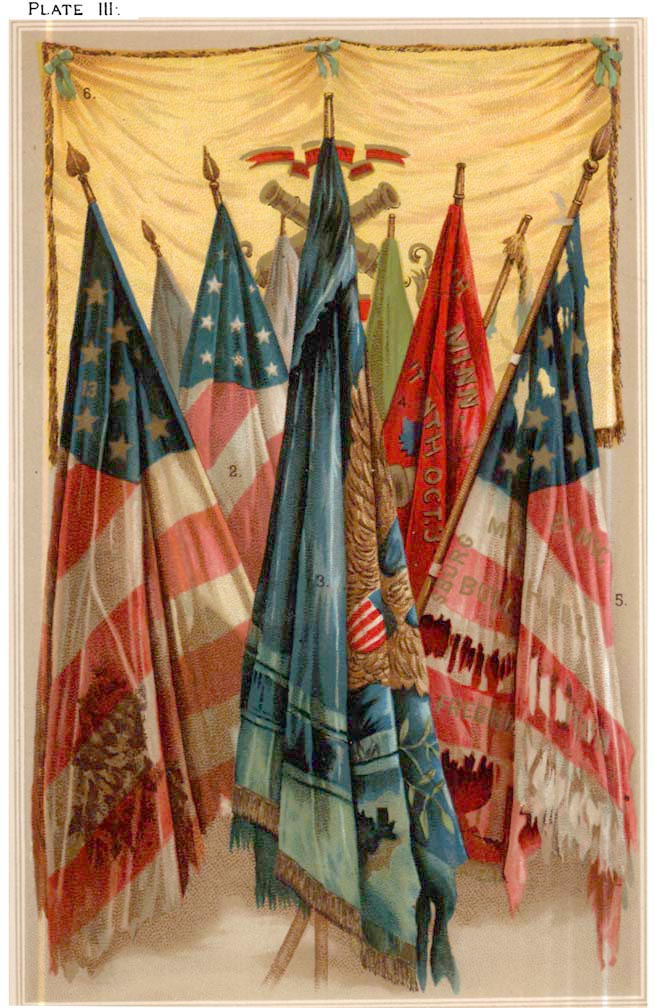 |
||
| 1. Thirteenth Ills. Reg't | 2. Twenty fourth Mich. Reg't. | 3. Eighth Mo. Reg't. |
| 4. First Minn. Art. | 5. Second Mich Reg't. | 6. Seventh N.Y. Heavy Art. |
 Descriptions Descriptions |
||
A young lieutenant became my guide and escort to the camp of the Thirteenth Illinois. We came upon it unexpectedly. I halted reverently, and laid my hand upon the lieutenant's arm, for some sort of service was in progress in the camp. The men were standing or sitting in a body, and a chaplain was delivering an address, or preaching a sermon. As I listened, he seemed to be setting the sins of his audience before them in a manner that savored more of frankness than tact, and he was exhorting the men to repentance. The boys, however, seemed to enjoy the recital of their shortcomings and sins of commission, and frequently assisted the preacher's memory to facts which he had forgotten, or did not know, suggesting peculiar punishments for them, all of which was immediately adopted into the discourse. I thought the interruptions of the soldier audience needless and profane. Little as I sympathized with the queer exhortation of the chaplain, I tried to infuse into my manner an expression of reverence, that would rebuke the wild fellows. The service was brought to an abrupt close by one of the men shouting out, "I say, Harry, you'd better wind up your gospel yarn, and see who's behind you!"
There was a shout. The speaker turned toward me, when lo, it was no chaplain, but the young brother of one of my friends, an irrepressible wag and mimic. His mimicry in this case, if reprehensible, was perfect. I found that this regiment had made itself quite a reputation by its versatility. There was nothing its men could not do. All the arts, trades, professions, and mechanical employments were represented in it. In addition to their other accomplishments they were such experts in quizzical thefts, that they had earned the somewhat equivocal sobriquet of "The Stealing Regiment."
The brigade surgeon walked back with me part of the way, and gave me an amusing account of their exploits in this line, some of which were very comical. He told me afterwards, that while he was thus engaged, the boys went to his tent, and while some of them diverted the attention of his servant, others stole his stove with all the pipe attached to it, the fire in it burning all the while, all his kettles and pans on it, and his supper cooking in them. They gave operatic concerts, theatrical performances, mock trials, sham fights, exhibitions of gymnastics and feats of legerdemain, were proficients in negro minstrelsy, gave medical lectures, and conducted religious services-in short, there was no performance to which they were not equal.
As soon as we had recovered from the laughter raised at the expense of the counterfeit chaplain, I asked to be shown to the regimental hospital.
"Haven't got any!" Was the answer in chorus,
"Why, what do you do with your sick men?" I inquired.
"Don't have any!" was the reply, again in chorus.
And indeed they rarely had sickness in their camp. They were fortunate in the men to begin with, who were strong, not too young, and mostly married. Then almost all had resources in themselves, thanks to their mental ability and early training. They had an inducement in their families to take care of themselves, and good influences were exerted over them by the letters of wives and mothers. Their officers were men of intelligence, who knew how to take care of their men, had become attached to their commands, were humane and not drunken. They had lost heavily at the battle of Chickasaw Bluffs, their colonel being left among the dead. But when it came to sickness, they hooted at the idea.' The regiments in their neighborhood were a little afraid of them, I found; they were so hearty and roistering, and so full of mad pranks. After dining with the adjutant I left them, not quite satisfied with my visit, because, as that worthy explained, "I had unfortunately found them all well instead of sick."
On the way back I passed black Socrates, still ploughing through the mud, but evidently reconciled to the "mighty meanness" of his mules, as he was sitting aloft on the driver's seat, shouting in a singsong recitative,--
"An' I hope to gain de prommis' lan', Glory, hallelujah!
Lor', I hope to gain de prommis' lan', Dat I do!
Glory, glory, how I lub my Savior, Dat I do!"
When I reached the sanitary boat Omaha, I found that a portion of our delegation, and some of the supplies, had been transferred to the Fanny Ogden, destined for a point up the river a few miles, where there were sick men in great destitution. I went on board the boat with them. But after dark we steamed down the river, below the point where a canal was being cut by Colonel Bissell's Engineer Corps, which, it was hoped, would divert the main current of the Mississippi, and leave Vicksburg on a bayou two or three miles inland. Backwards and forwards, up the river and down the river, the little boat darted most of the night, carrying orders and despatches for General Grant. Most of the time we were within range of the enemy's guns, which kept up an incessant firing of shot and shell at the dredging boats in the canal, whose locomotive headlights-furnished an admirable mark.
We sat on deck through the night, watching the shells as they flew shrieking over our heads, which we could distinguish by the lighted fuse, and endeavoring to judge the size of the shot by the singing, howling, whizzing, or shrieking they made in their swift transit through the air. The Fanny Ogden did not go up the river at all, but returned to the landing by morning, out of the reach of the enemy's guns, where she lay until night. We were again informed she was bound up stream, again embarked on her, only to pass the second night like the first, steaming up and down the river, carrying General Grant's despatches.
During the day, a detachment of the Engineer Corps was sent down inside the levee, to plant a battery at the extreme point of land directly opposite Vicksburg, where the Mississippi is very narrow and deep. The levee at this place was nearly fifteen feet high, and the battery was to be built into the levee. from the inside. Its object was to destroy the foundries and railroad and machine shops of Vicksburg, lying near the river, and which were in great activity day and night. The prospecting for the position of the battery, and the planning and marking out of the work, had been done in the night, not to attract the attention of the enemy. Now they were to work wholly inside the levee, and so were busy in the daytime.
Colonel Bissell himself was in command, and I accepted his invitation to accompany the squad, and take a nearer view of Vicksburg than it was possible to gain elsewhere. We steamed down near the mouth of the canal, took a rowboat through one of the creeks to the point of land opposite the city, and then walked behind the levee. While the men were working like Titans, the Colonel loaned me a powerful field-glass, and found for me a position where I could look over into the beleaguered city, without being seen by their pickets. Here the river was so very narrow that the pickets of the two armies could carry on conversation, when all was still a they sometimes did.
At the right was the hospital, swarming with gray-uniformed Confederates. They were sitting in the windows, at the doors, on the piazzas, lying on the grass in the yard, coming and going, some on crutches, some led by assistants. A newsboy was selling papers among them, and I could distinguish between the large type of the headings and the smaller print of the columns. In the belfry of the court house, more than half-way up the hill, an officer was signaling with flags, of which he seemed to have an immense variety. Beside him stood two ladies, one wrapped in a cloak, and the other in a shawl. I could even see that the bonnet of one was blue in color. Two negresses, carrying baskets on their heads, which looked as if filled with clean clothes, set down their baskets, bowed and courtesied to one another, and then, with, arms akimbo, stood and gossiped, laughing convulsively, if one could judge from the motions and gesticulations. Gray guards were pacing back and forth before the foundries. Officers were galloping to and fro; trains of freight cars were being loaded; new batteries were being placed in position; and other scenes of warlike activity were apparent. But nothing was visible that betokened pleasure or social life, or such proceedings as occupy the people of a city in time of peace. No children were on the streets, no women walking or shopping, no gay equipages, no sign of inhabited homes.
During the day I learned that the gunboats Lancaster and Switzerland were to run the Vicksburg batteries during the night, to co-operate with Admiral Farragut. He had steamed up the river from New Orleans, had fought his way past Fort Hudson, and was now moored nearly opposite the canal before spoken of, but on the other side of the bend, below Vicksburg. The Mississippi River was now open its entire length, save here at Vicksburg. The gunboats did not get started as soon as they were ordered, and it was day-dawn before they came under the rebel fire. They were both rams; one, the Lancaster, being of wood, and every way frailer than its consort, the Switzerland.
As they rounded the peninsula, from which the trees had been cut, a signal rocket was sent up by the enemy, and then the heavy guns opened their iron throats and belched thunder and fire. All along the river bank, below, and above, flames seemed to leap out of the ground, as if the very, bottomless pit had been uncapped, and then the earth and the water shook with the roar of the batteries. Louder and faster bellowed the cannon, and the whole opposite hillside seemed on fire. But on went the rams, not a living thing being visible about them, seeming to bear charmed lives, that could not be wrecked by shoot or shell. " They will get by in safety! " we said, as we watched them through the portholes of the gunboat Lafayette, which hugged the west shore of the river: "Another quarter of an hour, and they are safe!"
Vain prediction! There came a plunging shot-a rush of steam---an explosion---the air was full of cinders and splinters, and then men could be seen leaping into the water, swimming and struggling for life. A shot from one of the upper batteries had exploded the boiler of the Lancaster, and then a shell, bursting in another part of the boat, completely wrecked her. The Confederate batteries continued to pour in upon her a tremendous fire. She was struck thirty times. Her entire bow was shot away, causing her to take water so rapidly that she sank almost instantly, turning a complete somersault as she went down.
The Switzerland was more fortunate, but was finally disabled by a sixty-pound ball penetrating her steam drum. She floated below Vicksburg, the batteries still keeping up their terrible fire upon her, and striking her repeatedly. At last, the Albatross, from Admiral Farragut's fleet, which had come up from New Orleans, steamed to her relief, fastened to her, and towed her to the lower mouth of the canal, where she lay helpless.
Those who were watching the contest, when the Lancaster was wrecked, and who knew the current of the river, climbed over the embankment of the Vicksburg and Shreveport Railroad, and threw out planks and limbs of trees, and aught else that the swimmers could seize, around whom, as they struggled in the water, the shot and shell were flying like hail. One after another they were drawn to land,. some of them scalded, and all exhausted. As the engineer of the Lancaster clutched the hand of a man who drew him from the water, the skin of the scalded hand came off in that of his helper, almost as if it were a glove. It retained the creases of the knuckles, and the nails of the fingers. The poor fellow was scalded horribly, but as he stepped on shore he drew his revolver, and, turning upon his comrades, exclaimed: "Where's that coward that talked of surrendering? I'll shoot him before I die!" and discovering the man, who had said just before the explosion of the boiler, "It's of no use, we shall have to surrender!" he rushed upon him, and would have harmed him but for the bystanders.
The poor fellow, with one other as badly scalded, and several in less distress, was taken to the hospital, where he died that afternoon. I went over to see him, but he was free from pain and needed nothing, sinking rapidly away. He had no fear of death, and expressed regret only for one thing, that his boat, the Lancaster, had not run the batteries as well as the Switzerland, which got past the guns, and joined Farragut, although badly cut up. "But," he added; "I did my duty and never talked of surrendering. And I thank God I have no mother, wife, nor child to mourn for me." And so did I. "You may say a prayer for me," he said faintly; "a short one, for it's almost over." And the brave man's spirit went up, on the breath of the short, but heartfelt petition that was made for him.
COMING UP THE RIVER---A FREIGHT OF LIVING MISERYGOING OUT FROM THE LAND OF BONDAGE---AMONG SICK SOLDIERS, CONTRABANDS AND REFUGEES.
A forward Movement---Gunboats run the Vicksburg Batteries---They convoy Transports down the River---Troops cross, and beleaguer Vicksburg---We take Passage in the Maria Denning for Cairo---The Boat packed with human and animal Misery---Sick Soldiers comforted by our Presence---Johnny, the Virginia Refugee, given to my Care---His History---The tempestuous "Praise-meetings" of the Contrabands tabooed---Refugees en camped on the River Bank---Signal the Boat to stop---The Captain dares not---Fears Treachery---Meet Ford Douglas at Lake Providence---Agree to take a slave Boy to Chicago, despite Illinois "Black Laws."
 T was the last week of April, 1863,
when, having finished the work we were sent to do, we turned our
faces homeward. There was no longer any need of our remaining
"down the river." The troops at Lake Providence, and
those sent to "flank the Mississippi" by the way of
Yazoo Pass and Steele's Bayou, under Generals Sherman and McPherson,
were brought down to Milliken's Bend. By the complete breaking
up of all the hospitals, and the removing of all the sick to the
North, as well as from the general note of preparation in the
camp and among the fleet of gunboats, we understood that a "forward
movement" of some kind was resolved on. We were not left
to conjecture what it might be.
T was the last week of April, 1863,
when, having finished the work we were sent to do, we turned our
faces homeward. There was no longer any need of our remaining
"down the river." The troops at Lake Providence, and
those sent to "flank the Mississippi" by the way of
Yazoo Pass and Steele's Bayou, under Generals Sherman and McPherson,
were brought down to Milliken's Bend. By the complete breaking
up of all the hospitals, and the removing of all the sick to the
North, as well as from the general note of preparation in the
camp and among the fleet of gunboats, we understood that a "forward
movement" of some kind was resolved on. We were not left
to conjecture what it might be.
We were told frankly, by one of the officers, of the new line of operations marked out by General Grant. Vicksburg was to be assailed from the east; and the ironclads and gunboats, with the transports, were to run the batteries, and convey the army across the river at a point farther down. The Thirteenth Corps had already left Milliken's Bend, and marched down the west bank of the Mississippi. They were to be ready to cross in the transports when they should have run the gauntlet of the terrible batteries, and got safely below the defiant stronghold. So we now took passage in the Maria Penning, and prepared for our slow trip up the river.
While our boat was taking its heterogeneous freight on board, the last gunboat of the expedition returned, which had been seeking a way to the rear of the defences of Vicksburg via Yazoo Pass, on the east side of the Mississippi. Busy as everybody was, on land and on river, and blasé as the soldiers had become with continued excitement and adventure, the return of this gunboat created a decided sensation. It had been navigating narrow, tortuous streams, which, at that stage of high water, had a headlong current, bearing them through gigantic forests, which overarched and interlaced, sweeping away smokestacks, and scraping the deck clean of pilot-house and every other standing fixture.
Abrupt turns at almost every boat's length of the way down the Coldwater and Tallahatchie Rivers had broken her bow and damaged her sides, while snags and fallen trees, and now, and then getting aground, had injured the rudder and wheels. They had been halted at Greenwood, on the Tallahatchie, where the rebels had erected defences, and, with the aid of rifled Whitworth guns, had compelled the expedition to return to the Mississippi by the same way it had come. Some of the men had been killed; several were badly wounded, and were brought on board our boat to be taken to the Memphis hospitals. All were exhausted by the protracted and excessive work, performed on half and quarter rations. And yet all wanted to go forward with the new movement of the forces to the east of Vicksburg. The wounded brought on board the Maria Denning loudly lamented their hard fate in being sent to the hospitals "just when something was going to be done."
The Maria Denning was an uncouth and lumbering three-decker, if so definite and dignified a name may be applied to a nondescript river-boat. It was three stories high, each of the upper two stories being more contracted in dimensions than the one immediately beneath it. The lowest deck, or story, was open, not enclosed, and was devoted to the transportation of condemned government mules and horses, sent to St. Louis for sale. The second story was occupied by contrabands who had come from the plantations within the lines of our army, and who, like the mules and horses, were bound for St. Louis. Here, also, were sick and wounded soldiers, going home on furlough or discharge. The third story was for the accommodation of the officers of the boat and passengers.
The dumb animals were driven from their corral, some three or four hundred of them, with a vast deal of whooping, shouting, and wild driving. They ran in every direction but the one in which they ought, and at every turn were met by fresh outbursts of shouts and yells and frantic gesticulations. For soldiers seemed to spring out of the ground, who joined in the unfeeling sport, until the poor, jaded, worn-out beasts were mad with fright. It was half a day before any of them were got on board. And several of them, in their terror, ran into an immense slough, sank slowly in the mire with but feeble struggle, and died before our eyes.
"When this war is over," said Mrs. Governor Harvey, of Wisconsin, who passed three years of the war in the hospitals, and at the front, in devoted labor for the soldiers, "I never want to see again a negro or a mule. Both of them are so abused in the army, and both are so dumbly patient, and uncomplaining, and receive so little sympathy, that I suffer a perpetual heartache on their account." To express pity for, or interest in, a suffering mule, or to interpose entreaties on its behalf, was to run the gauntlet of the most stinging ridicule. Everybody beat and neglected the unhandsome brutes; and when they fell into the hands of the ill-treated negroes, they fared worse than ever. From their own persecution and abuse, they seemed to have learned only lessons of brutality and tyranny, when they became mule-drivers.
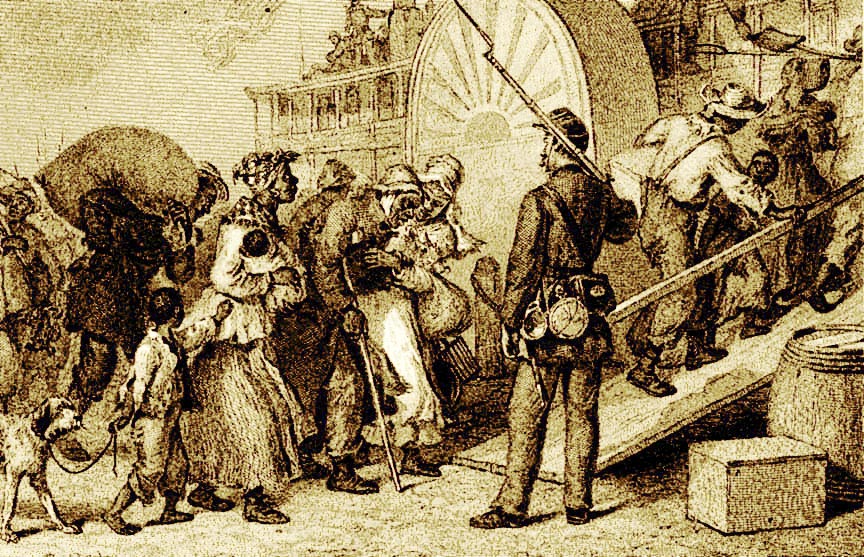 "Mothers carried their babies on one arm, and led little woolly headed toddlers by the other. Old men and women, gray, nearly blind, some of them bent almost double, bore on their heads and backs the small plunder they had "toted" from their homes. They were all going forth, like the Israelites, 'from the land of bondage to a land they knew not.'" |
As the half-imbruted contrabands came on board, under military surveillance, clad in the tattered gray and black "nigger cloth," and shod with the clouted brogans of the plantation, my heart went out to them. Subdued, impassive, solemn, hope and courage now and then lighting up their sable faces, they were a most interesting study. Mothers carried their piquant-faced babies on one arm, and led little wolly-headed toddlers by the other. Old men and women, gray, nearly blind, some of them bent almost double, bore on their heads and backs the small "plunder" they had "toted" from their homes, on the plantation, or the "bread and meat" furnished them by some friendly authorities. They were all going forth, like the Israelites, "from the land of bondage to a land they knew not."
Like the Hebrews, they trusted implicitly in God to guide them, and their common speech, as we spoke with them, had an Old Testament flavor. Never before had I witnessed so impressive a spectacle. There were between three and four hundred of them. Half of the middle deck of the huge boat was assigned them, into which they filed, and began to arrange themselves in families and neighborhood groups.
The other half of this deck was used by sick and wounded soldiers, who were brought on board in great numbers. They were either furloughed or discharged. Some of them were brought on stretchers, and a comrade was detailed to accompany them, and assist them in their long journey. Others swung themselves painfully on crutches, or were led between their comrades, frequently falling from weakness; or they crept feebly and haltingly on board, without assistance.
We stationed ourselves---the women of the company---in this compartment of the boat, which we saw was going to be packed with misery and suffering. As the soldiers were brought in, we fell into maternal relations with them, as women instinctively do when brought into juxtaposition with weakness, and were soon addressing them individually as "son," "my boy," or "my child." They were all greatly comforted to learn that we were going up the river with them. Those who had had fears of dying before they reached their homes, grew courageous and hopeful, as we assured them that we were going to take care of them. Before the boat started we were at work,---making tea for one, filling a canteen with fresh water for a second, bathing the soiled face and hands of a third, sewing up rents in the garments of a fourth, preparing hot applications for the cure of earache for a fifth, and beseeching our one physician on board to prepare immediately a cough mixture for the whole company, who were coughing in deafening chorus, but in the most inconceivable dissonance. The contrabands were also coughing with might and main, and there were times when this violent and irritating lung exercise was so general, that conversation was as impossible as in the midst of a brisk artillery fire.
Among the soldiers was one delicate boy of fifteen---tall, slender, and frail. A chaplain accompanied him and gave me his history. He was the only child of a wealthy Virginian, living near Petersburg, who remained loyal to the old flag, and voted against secession. When Virginia went out of the Union, he was so fierce in his denunciation of its treason, so active in his hostility to the new-fangled Confederacy, that he was arrested and sent to Libby Prison. " Johnny," the son, sympathized with his father, and after his arrest was more passionate and terrible in is outspoken scorn and hate of the treachery of his native state, than his father had dared to be.
Only the fact of his being a mere boy saved him from his father's fate, or perhaps from assassination. As it was, the overseer of one of his father's plantations, who loved the boy, secreted him for a few days; for he had awakened such enmity towards himself, that on one or two occasions he had been attacked in the streets of Petersburg by a mob of boys of his own age, and beaten half to death. The overseer got him safely beyond the rebel lines, and gave him a horse and two hundred dollars in gold, with the name and residence of one of his father's brothers, living somewhere in Missouri. He had also furnished him with a letter of instruction as to the route he was to take to reach his uncle.
Johnny got on very well as far as Louisville, Ky. There he fell sick, and, when he recovered, found himself in the "Refugees' Camp," his money gone, his horse missing; even his letter of instruction had been stolen. Strolling around, he came upon the encampment of one of our regiments, into which he was absorbed, notwithstanding his boyishness and feebleness, and where he remained nearly a year He became the pet of the regiment, any of his comrades being always ready to relieve Johnny of any severe duty or rough work which fell to his lot, or to share with him any delicacy or pleasure. He was of the genuine metal, however, and asked no favors, until the regiment came to live an amphibious life at Young's Point. Then he succumbed to swamp fever, and, after lying at the point of death for days, had recovered partially. Thinking it suicidal for the boy to remain in the army, young and delicate as he was, one of the chaplains had procured his discharge, and brought him on board the boat, with transportation to St. Louis.
My heart went out to the poor child immediately. He had never known his mother, as she had died at is birth; but of his father he spoke with eloquent and tearful affection He was wholly unfitted to search for his uncle; and knowing, as he did not, what a complete overturning the war had made in Missouri, I proposed to him to go home with me, and stay until he became strong, when I would help him seek his relative, of whom he knew nothing save his name and address. The lad put his thin, tremulous hand in mine, lifted his large brown eyes to my face, and tried to say "Yes." But his lips moved only, without emitting any sound, and then he broke down in tearless sobs.
I hunted up the captain, and made friends with him, although he was a coarse, whiskey-drinking man, for I had a favor to ask of him. After some fifteen minutes of good-natured palaver, in which I played the rôle of the amiable woman to the utmost, I obtained permission to take Johnny into the upper saloon among the passengers, and also two or three others of the soldiers, who were very ill. They could be made more comfortable there than in the middle compartment of the boat, to which they were assigned, and I could more easily nurse them.
At last, after two or three days' delay, we started. It was a tedious journey home. We were impatient; for we had finished our work, and had be a long time from our families, who were eagerly looking for our return. The passengers with whom we were closely shut up most of the time---for the weather had turned cold and stormy were coarse, ruffianly, brutal fellows with one or two exceptions They smoked, chewed tobacco incessantly and expectorated in so reckless a way as to make it dangerous to sit in their vicinity. Gambling, smoking, swearing, and berating the Union and its friends were their unvaried pastimes.
The Maria Denning was a slow sailer, and puffed and snorted up the river against the rapid, headlong current at a snail's pace, compared with the speed at which we had descended the Mississippi. A terrific gale drove us against the east bank of the river, which was skirted with cottonwood trees, heavily shrouded from their roots to the topmost branches with the funereal moss which is a parasite, upon them. Here we remained immovable nearly twenty-four hours; not without anxiety, for we were in the enemy's country, and boats in similar stress had been burned by the rebels only a few days before, and their crews and passengers murdered or taken prisoners.
Now and then, as we kept the middle of the stream, still at a very high stage of water, we would be signalled by people on the banks, where was no sign of habitable life. With-waving of white flags, and passionate gestures of entreaty, they begged us to take them on board. An inspection of them through the field-glass aroused our captain's suspicion, and,, fearing a ruse to decoy us ashore to our own destruction, we went on our way, and left them behind.
One afternoon, as the sunset was deepening into-twilight, we made a bend in the river, when we received a momentary fright from a huge fire blazing red, straight before us, close at the water's edge. A great crowd was hovering about it, waving flags, gesticulating, and signalling us. As we came nearer, we found they were negroes, of all sizes, and had their little bundles in their hands or on their heads and backs.
The captain dared not, or would not, stop. As the poor creatures saw us steaming directly by, they redoubled their exertions to attract our attention. Catching up blazing firebrands they ran up the shore with them, waved them, threw them in air, and with the most frantic pantomime sought to convey to us a sense of their eagerness to be taken aboard. It seemed pitiful not to stop for them. They had made their way to the river, not doubting, probably, but any of "Massa Linkum's" boats would take them on board. Doubtless they had signalled other boats ahead of us; and still they were left on the river banks, amid the gray moss-draped cottonwoods, as far from the land of freedom as ever.
At Milliken's Bend another detachment of broken-down mules was received on the lower deck, but without the brutality attending the reception of the first lot. Our contrabands were increased by the addition of fifty or a hundred more; and a score or two of soldiers were taken aboard, all a little under the weather, going home on brief leave of absence, or permanently discharged from the service. One who undertook to come on the boat slipped, in his weakness, as he came up the plank, and his crutch flew out from his grasp into the river. He tried to catch it, lost his balance, and tumbled head foremost into the turbid, whirling stream. Once he came to the surface on the other side of the boat, whither he was carried by the current. Ropes, chains, and planks were thrown him, but he sank, and we saw him no more. Who he was, what was his name, where was his home, what was his regiment, no one could tell us. Perhaps father and mother looked and longed vainly for his coming, until hope died out in despair. To all their inquiries they could only learn the one fact, that he started for home, and could be traced no farther. "Missing" was his only record.
At Lake Providence we stopped to take on cotton. Very little of the cotton on the deserted Providence plantations had been gathered; and the government let the job to contractors, who picked it on halves, delivering it in bales to the government. The contractors paid the negroes a penny a pound for picking, and the government furnished them rations. A large quantity being ready for transportation North, the Maria Denning agreed to carry it.
As I was standing on the upper deck, watching the negroes roll the bales up the plank, I espied in the crowd below Ford Douglas, a well-known colored man of Chicago, who had no inconsiderable local reputation as an anti-slavery lecturer. Like his great namesake, he was born in slavery, had run away from his master, and concealed his own name, assuming one which he liked better. Although prejudice against the black race was then at its highest pitch at the North, and especially in Illinois, and the offers of colored men to enlist in the service of the country were refused with scorn, Ford Douglas was enlisted in the Ninety-fifth Illinois, where his virtues, talents, and, above all, his fiery eloquence, gave him welcome. He was fraternized with as if he were a white man. Everybody respected him.
He uttered a little cry of joy as he saw me, accompanying his salute with a gesture of delight. We had known each other for some years, and he rushed on board to meet me. Grasping my hand warmly, he said: "The Lord has sent you this time, sure! I have been praying that He would send along somebody that I could trust; but I little thought He would answer by sending you. You will not refuse to do me a great favor?"
"Certainly not, Ford; you know that without asking."
"I have in my tent a little colored boy, six or eight years old, a slave child whom I have stolen. His mother was a slave living near New Orleans, but before the war she escaped to Chicago. Will you take the boy to his mother?"
"It will not be safe, Mrs. Livermore," immediately interposed one of our company, a member of the Illinois Legislature. "You will run great risk in undertaking to carry a negro boy through Illinois."
The infamous "Black Laws" of Illinois were then in force, and any one who took a negro into the state was liable, under these statutes, to heavy fine and imprisonment. Under the stimulus of a most senseless and rabid negrophobia, then at fever heat, the provost-marshal at Cairo searched every Northernbound train for negroes, as well as deserters. Whenever they were found, they were arrested; the former were sent to the contraband camp, an abandoned, comfortless, God-forsaken place, and the latter to the guard-house.
"You cannot escape detection if you try to run this boy through Cairo," said the surgeon of our the child alone."
I knew both of these objectors thoroughly. They felt it to be their duty to warn me of the risk I was inclined to run, and were unwilling that I should get into trouble. But they were the most reliable anti-slavery men, and, when their feelings were touched, would run any gauntlet of danger to serve a distressed human creature. So I turned to Mr. Douglas, and pressing his arm significantly, to secure his silence, I replied, ,Well, never mind about your slave boy, Ford, let me know what you are doing down here. Come to the after part of the boat, out of the way of this noise, where I can talk with you." And we went aside by ourselves, where I learned the little black boy's history.
Not long before the war, the boy's mother, then a slave on a Louisiana plantation, accompanied her master and mistress to Newport, R. I., leaving her only child behind her, a guaranty,, in the opinion of her owners, that she would return. But the slave mother, following the example of several of her relatives, found her way to Chicago on the "underground railroad." After she had obtained her well-earned freedom, she made persistent efforts to get possession of her child, but without success. Once her uncle, himself a runaway slave, and from the same neighborhood, went down to the vicinity of the plantation to hunt for the lad. But after lurking around for weeks, and almost securing him, he returned without him.
When Mr. Douglas' regiment was ordered South, to Lake Providence, the mother begged him to search for her boy, and, if be was found, to forward him to her. Ford obtained leave of absence from his regiment, went directly to the plantation, found the child, and brought him away with him. For six weeks the boy had been concealed in his tent, and he had been watching an opportunity to send him to Chicago. The opportunity had now arrived. Clad in plantation clothes, the lad was stealthily brought on board the Maria Denning, and placed among the other contrabands, whom he resembled in appearance, in the patois he spoke, the rough clothing he wore, and in manners. The colored stewardess, a woman of elephantine proportions, whose heart must have been as big as her body, judging from her devotion to the forlorn people of her own color, took my protégé under her special care. She fed him bountifully whenever he was willing to eat, which was about every hour of the twenty-four.
More sick soldiers were brought on board, and given to our care. One, on a stretcher, was so very low, that I ordered him carried immediately to the upper saloon, and deposited beside my stateroom, where I could attend him night and day. Then we started again, after twenty-four hours delay at Lake Providence.
What a freight of living misery our boat bore up the river! I ventured once to the lower deck, given up to the horses and mules. Some had slipped their halters, and, in consequence of weakness, had fallen under the feet of others, where they were stamped to death. It was a horrible sight, which I wished I had not seen. In the middle compartment of the boat were the contrabands, always in great activity, in consequence of the large number of children among them. I could only think of a vast nest of angle- worms, wriggling and twisting, when I went among them. When they were awake, they were either cooking, or eating, or holding "praise-meetings." It would be difficult to say which they most enjoyed. The "praise-meeting" was the usual occupation of the evening. Then they sang and prayed. until their enthusiasm became tempestuous. They beat time with their feet, they whirled in dizzy gyrations, or vented their effervescence of spirit in quick convulsive leaps from the floor, accompanied by ear-splitting shouts.
The sick soldiers, who shared one half of the middle compartment, dreaded these "praise-meetings" inexpressibly. The poor fellows were so feeble that they had neither strength nor nerve to endure the intolerable din, and it became necessary at last to interfere with the negroes, and to prohibit the meetings altogether, since, once begun, they could not be kept within bounds.
One of our sick men died before we reached Memphis. Like most men in his circumstances, he was possessed with but one desire---to see his home once more---but it was apparent from the first that he would be buried on the way. In his delirium he babbled incessantly of home and. its occupations. "Harness the horses to the reaper, and we will star out for that twenty-acre piece of wheat!" "We are all going to the picnic to-morrow, so get your basket ready, Sis!"
Sometimes in his lucid moments he would please himself by instituting comparisons between his mother and myself. "You have just her eyes, and her hair, and her way of talking and doing; and if I didn't look, I should think she was here!" I rarely rendered any service to these poor fellows that they did not assure me that I was like their mother, or wife, or sister.
THE STORY OF THREE LITTLE ORPHANS---SMUGGLING A PLANTATION WAIF THROUGH "EGYPT"---THE UNDERGROUND RAILROAD---SAFE AT LAST---AFFECTING MEETING.
We find three Orphan Refugees in Camp Convalescent, Fort Pickering---Their pitiful History---We take them to the Chicago Home of the Friendless---Adopted by an Iowa Family---Cairo makes Addition to our Cares---Lizzie the Orphan Refugee from Missouri---Go aboard the Chicago Sleeper, with Johnny and the black Lad---The stuttering. Porter hides the black Boy---"D-d-d-dat Woman's slep' mighty little fo' mos' s-s-s-six Weeks---She's d-d-d-done got monst'ous sick"---We defy "Egypt" and the "Black Laws "---Reach Chicago at Midnight---Sunday Morning, hunt up the black Lad's Mother---Affecting Meeting---Sarah Morris tells her Story---Johnny and Lizzie cared for.
 T Fort Pickering, two miles below
Memphis, there was a convalescent camp, and, while the boat stopped
for coal, we went ashore to pay it a brief visit. In one of the
tents we found three dark-haired; dark-eyed little girls, whose
ages ranged from two to nine years. They seemed perfectly at home,
climbing upon the knees of the four convalescent soldiers assigned
to the tent, ransacking their pockets for jack-knives, pencils,
and other like treasures which the soldiers stowed in them for
the use of the children. And with juvenile restlessness they rushed
from one employment to another, asking the aid of their military
companions, with a confidence that showed they were not often
repulsed. Whose children were these tangle-haired, bare-footed,
unkempt, ragged little urchins? The soldiers told us.
T Fort Pickering, two miles below
Memphis, there was a convalescent camp, and, while the boat stopped
for coal, we went ashore to pay it a brief visit. In one of the
tents we found three dark-haired; dark-eyed little girls, whose
ages ranged from two to nine years. They seemed perfectly at home,
climbing upon the knees of the four convalescent soldiers assigned
to the tent, ransacking their pockets for jack-knives, pencils,
and other like treasures which the soldiers stowed in them for
the use of the children. And with juvenile restlessness they rushed
from one employment to another, asking the aid of their military
companions, with a confidence that showed they were not often
repulsed. Whose children were these tangle-haired, bare-footed,
unkempt, ragged little urchins? The soldiers told us.
Their father was a Union man of Memphis, and lost his life before our troops took possession of the city. Their mother, with these three children, the youngest then an infant in arms, came within our lines for protection, and made herself useful in the officers' quarters by washing, cooking, etc. Three months before, she had died from exposure, hard work, and heartsickness. There was no one to take the children, and so the soldiers had gathered them into their tents, and taken as good care of them as they knew how.
"But what's to become of them when you are ordered away?" we asked.
The soldiers shook their heads. "Don't know; they ought to be taken care of, for they are good, right little things!" was their reply.
We could think of but one thing to do for them, and that was to take them to Chicago. But we were already burdened with as many dependants as we could take along at one time. While we were debating what to do-for to leave the children with so uncertain a future, and no one responsible for them was not to be thought of, the chaplain of the post came along, and we learned that his wife was with him on a brief visit, and was to return North in a week. It was arranged that she should bring the children, and deliver them to my care in Chicago. This she did, and I took them to the "Chicago Home of the Friendless," of which institution I was a manager, and. advertised in the daily papers for a home for them, giving a brief account of their history and appearance. After they were washed and dressed in decent apparel, they were very pretty and promising.
An Iowa tradesman, from one of the growing inland cities of his state, came to the Home with his wife, in quest of a baby for adoption. They had buried five infant children in eight years, and had decided to adopt an orphan child to fill the void in their bereaved and childless home. They selected the youngest of the three little refugees as the object of their parental affection. But when they prepared to take her away, a touching scene ensued. Jenny, the eldest sister, clasped the little one in her arms, and wildly and with tears protested.
"Oh, no, no, no!" she cried; "you mustn't have my baby. I won't let you have her. You sha'n't tote her away! You sha'n't have my baby! No, no, no!" and they clung wildly to each other, hugging each other with all their little might.
The Iowa couple sought to compromise the matter by offering to take the middle sister. But to that Jenny also opposed tears and resistance. "No, no, no!" refused the child. "You sha'n't tote either of them away; they shall stay with me!"
The more we sought to persuade the eldest sister, the more fiercely she clung to the little ones, who shrieked in terror, at they knew not what, until half the children in the house were screaming in sympathy. So I pacified. the motherly little Jenny, telling her that nobody should take her "babies" away,--for so she called her sisters,---unless she said so, and dismissed the Iowa people. .
The next morning the gentleman and his wife came back, offering to take all three of. the sisters, and adopt them as their own. They had lain awake all night, talking it over, and, as the lady expressed it, they had concluded that God had emptied their hearts and home of their own children, to make room for these three orphans. We called Jenny and told her of the proposal. Half laughing and half crying, she put her hand on her adopted mother's shoulder, and sobbed out the question, "Then won't you tote us all right away to-day, before anybody comes to take sister and baby?"
Trembling with eagerness, delight, and fear lest something would yet intervene between them and their future home, she followed the two little ones into the carriage with the adopted parents, unwilling to go herself until the last, lest somebody should be left. In the last year of the war, the dear Jenny, who had grown close to the hearts of the adopted father and mother, died of scarlet fever. She was much the most promising of the three, and, had she lived, would have developed into a womanhood of unusual excellence.
At Cairo, where we left the boat and took the Illinois Central Railroad for Chicago, there was another accession to our cares. Dr. Taggart, the humane surgeon of the large General Hospital in Cairo, had picked up on the levee, some three months before, a girl of fourteen, whom he had first thought in a dying condition. She, too, was the daughter of Southern refugees. Her father was a Union man of southern Missouri, who was driven from his far with his wife and two daughters. Escaping, with others, to St. Louis, he joined our troops, leaving his family behind him in the city, and was killed at Island Number Ten.
Shortly after he left them, his wife and younger daughter died of typhoid fever, induced by improper food and water, neglect, hunger, cold and exposure. Then Lizzie, the elder daughter, not knowing that her father was dead, sought to find him. Aided by the kindness of officials, and chance friends who started up in her path, she reached his regiment on the island, only to learn that she was an orphan. Not knowing where to go, she struggled back to Cairo. In the incessant rush and whirl of the then busy city, she was unnoticed, and left to live or die as might happen. For sixteen bitterly cold nights, she slept in outhouses, barns, underneath overturned boats, in sheds, or in any other place that offered shelter. Such food as she obtained, was given her at back doors, by servants, or by soldiers, who were continually crowding the levees. At last she succumbed to the hardships of her fate. Seeking an out-of-the-way corner, racked with pain, burning with fever, weak, sick, footsore, discouraged, she lay down to die, praying God for speedy release from suffering.
Here, Dr. Taggart stumbled upon her, and, immediately ordering an ambulance, he took her to his hospital, and devoted himself to her cure. Poor Lizzie always insisted that her mother came to her in her abandonment, and remained with her, only going back to heaven when her daughter was partially restored to health. Who can say that this was a mere sick-bed fancy? Not I, and I never gainsaid the poor child's assertion. To whom should the angels of heaven minister, if not to the homeless and friendless little ones of earth? I had agreed to receive her when she was able to go to Chicago, and it was thought best that she should be taken along now, when I could attend to her in person.
We bade adieu to the contrabands who were going to St. Louis, and to those of the, sick men whose transportation papers took them by the same route. Then, taking the refugee boy, Johnny, by one hand, and Ford Douglas' charge, Ben Morris, the little slave boy, by the other, I walked directly to the train standing on the track. It was nearly midnight; the train was to start for Chicago at three in the morning, and the sleeping-car was then half full of sleeping passengers. Almost all our party had similar responsibilities on their hands as myself; and those who had not, agreed to assist our sick and wounded soldiers to re-embark on the Chicago-bound train. Entering the sleeping-car, to my great joy, I found the same colored porter who had been in I charge whenever I had journeyed to and from Cairo.
He dropped the boots from which he was scraping deposits of Cairo mud, and gave me a glad welcome.
"I g-g-g-got jes' one lower b-b-b-berth lef'!" he said. He was an inveterate stammerer.
"But, Henry, does the provost-marshal come in now to search the train for negroes and deserters?" I asked.
"Y-y-y-yes, jes' afore the t-t-t-train st-tarts;" and he glanced at the white boy on one side of me, and then at the colored boy on the other. So I gave him the boy's history, and asked him to help me hide the little fellow until we had safely passed through "Egypt," as the southern part of Illinois was called,: and which at that time was aflame with intense hatred and persecution of negroes. He proposed at first that I should put the boy in the back of ray berth, and cover him well with the blankets; but, as the child was swarming with vermin, I entreated him to think of some other plan. Looking under the berth, where was a large unoccupied space sufficient for a good-sized valise, for it was a sleeping-car of an old style, Henry said,---
"A p-p-p-plantation nig like dis yere ch-ch-ch-ch ile can sleep anywhar" and forthwith he stowed him away under my berth, where no provost marshal would ever think of searching for him. In a few moments I heard him snoring as nonchalantly as though there were no provost-marshals or negro-0haters in existence.
Henry was very uneasy when the provost-marshal came in to inspect the train; for, by the "Black Laws" of Illinois, whoever assisted in bringing a negro into the State, was liable to a year's imprisonment and a fine of one thousand dollars. So he walked up the aisle of the sleeper with the officer, past my berth, talking rapidly, asking needless questions, and stuttering, at a fearful rate. Meanwhile, the little fellow underneath the berth was snoring as loudly as though he was under a contract to furnish nasal music for the entire train. But his hiding place was not suspected, and we reached Centralia at nine the next morning, no one having discovered this waif of the plantation, who was enjoying a free ride through the great State of Illinois, in utter defiance of its "Black Laws."
It was arranged that I should not leave my berth until we reached Centralia, where we were to breakfast, and to change conductors, and where Henry left the train. The cars were crowded to overflowing, a large number of persons being obliged to stand. As I occupied in my section the room that would accommodate four when seated, there was naturally a very urgent desire among the standing passengers that I should be compelled to get up.
"Why don't you wake that woman up?" I heard one savagely inquire of Henry. "Is she going to lie abed all day?"
"D-d-d-dat woman's bin down to t-t-t-take keer ob de s-s-s-sick sojers!" stuttered Henry. "S-s-s-she's slep' mighty little f-f-f-fo' mos' six weeks, an' she's d-d-d-done got monst'ous sick! L-l-l-let her sleep!"
Henry was right. I was "monst'ous sick," and for the next ten days I could hardly lift my head from the pillow. Every other member of the party had been sick down the river. I was the only one who had not had a touch of swamp fever, and I had boasted of my exemption. But my time had come. It would not do to give up until we reached Chicago, and I compelled my will to triumph over my aching, fevered body until I was again at home.
At Centralia, I learned, from the wife of a Chicago physician, that the conductor who now took charge of our train had served a long apprenticeship on the "underground railroad," and so my black boy' perils were over. We reached Chicago at midnight on Saturday. Johnny and Lizzie went home with me, but the black lad was altogether too filthy to be taken into any decent house. One of the gentlemen left him in care of his barber until morning, and the little fellow dropped sound asleep on the floor, beside the stove,, almost immediately.
The next morning, about church time, we instituted a search for the boy's mother. We only knew her name, and that she was a regular attendant at the African Baptist Church. To that church we wended our way, and in the vestibule met the sexton, to whom we told our errand. He proceeded to the pulpit and repeated the story to the minister. In his turn he rehearsed it to the congregation, and inquired if Sarah Morris, the boy's mother, was present. One of the assembly informed the minister that the mother was a Methodist, and not a Baptist; and so we turned our steps to the Methodist church, where the same programme was followed, eliciting the information that Sarah Morris was not at church, but lived at No.---Avenue.
We followed up our clew, accompanied by quite a procession that had joined us from both the Baptist and Methodist churches, and at last discovered the house where the mother lived as cook. She was not at home, however, but was sitting with a sick friend that day, and very confused directions to the house of the friend were given us, which we proceeded, to follow. At last Sarah Morris was found. As the door was opened to us, we saw some eight or ten colored men and women sitting within, and, as my eye ran over the group, I recognized the mother, from her resemblance to her son. Before one word was spoken, she threw herself upon her boy with a joyful shriek of recognition, the child rushing towards her half-way, as if by filial instinct, and they wept in each other's arms, uncontrollably. In kisses and claspings, and endearing epithets, the defrauded love of the mother vented itself upon her child, whom she had mourned almost as one dead. All in the room dropped on their knees, and the air was vocal with-thanksgivings and hallelujahs.
In a week or two the mother called on me with her boy, to show me how cleanliness and decent dress had improved him, and to reiterate her gratitude for his recovery.
"But how could you run away from your baby, even to obtain your freedom?" I inquired.
"Well, missis," said the woman, "when I left Lou's'anny I didn't tink not to go back agin. I tole my ole man, and all de folks on de ole place dey'd see me back, sure, to my pickaninny. Ebery gal missis had done took Norf for tree year had done gone and run off; and dat's why she took me, an' lef' my chile in de place. When we'd got Norf, to a place dey call Newport, I didn't tink den to run away. But one Sabba' day massa and missis dey gone to ride on de beach, an' I set down on de doorstep an' tink o' my little chile; an' den I hear de Lor' speak to me out o' de stillness. He say, 'Sarah, go up stars, an' pack up your tings, an' go to Ch'cago!' But I say: 'Oh, no, Lor'! I want to go back to dat chile. What dat little chile do on dat big place widout his mammy? No, Lor', I don't want to go to Ch'cago.'
"An de Lor' He speak agin in de stillness, an' dis time wid a great voice, and say: 'Sarah, do as I tell yer! I'll take keer o' dat chile; you go to Ch'cago. So I go up stars, an' pick up my duds, a-cryin' an' a-cryin' all de time. I tell de Lor' on my two knees two, tree time: 'If yer please, O Lor' King, lemme go back to my chile! I don't want to be free. What for shall I be free, an' my chile be lef' down on massa's ole place?' Ebery time de Lor' King He say loud, so it fill all de room, 'Go to Ch'cago!' So I go down to de cars, an' sot down on de seat, a-cryin' all de time in my heart, 'cos I was 'shamed to cry wid my eyes 'fore all de people. An' when de conductor gib de word, 'All aboard!' I was gwine to jump off, for I said: 'O Lor' King, I don't want noffin widout my chile! I don't want heben widout my pickaninny! I can't go to Ch'cago!' An' de Lor' Kin he ketched me back; an' he said, so loud and strong I 'spected all de folks would hear, 'DAT CHILE'S MY CHILE; I'LL TAKE KEER O' HIM!' So I gin up to de Lor' den, honey; and all de big storm in my heart stop, an' I was dat happy I could ha' sung an' shouted, like I was in a praise-meetin'.
"An' de Lor' He take all de trouble out o' my way, an He fix eberyting for me, 'fore I know it's got to be fixed; an' He send frien's at ebery place, to tell me whar to go, an' to gib me money, an' clo'es, an' grub, till I git to Ch'cago. An he hab a place all ready for me hyar, an' I nebber hab a day idle 'cos thar was : noffin to do, or 'cos I was sick. Sometimes, when I hab a great misery in my heart for my chile, den I go to de Lor', an' tell Him all about it. An' de Lor' He would take all de misery 'way; for He would 'clar dat chile was Hisn, an' dat He would tote him to me bime-by. An' de Lor' King is jes' as good as His word; an, He's sent de pickaninny, grown so peart an' so big dat nobody but his mammy would cher ha' known him. So now I prommis' de Lor' King I'll neber mistrust Him no more, an dat dis chile shall be His chile, for shure, sence He done took keer o' de little chap. when he didn't hab no mammy, an' was too little to take keer o' hisself."
The earnestness, pathos, and solemnity of this narration cannot be described. To the mother, the voice of the Lord and His direct guidance were verities.
But what of Johnny and Lizzie? As soon as possible, I published their histories in brief in the city papers, and applied to a loyal and generous people to compensate them for the suffering entailed on them by the loyalty of their parents. Most generous were the responses. Chaplain McCabe, known throughout the country, saw the published account of the refugee children, and came to my house to see them, suspecting that he knew something of Johnny's father. In conversation with the lad, his impressions deepened into certainty. Chaplain McCabe was I taken prisoner at the first Bull Run battle, and was thrown into Libby Prison. Here he found a number of Virginians incarcerated for their hostility to secession.
One of them was in failing health, and solicited the chaplain's prayers and ministrations. Gradually the man told him his story. He proved to be Johnny's father. He had been informed of his son's departure for Missouri, and often, begged the chaplain to seek the lad and the uncle in Missouri, whenever he regained his liberty. The chaplain had the address of the uncle, which was the same as that given to Johnny. "If I needed other proof of your being the son of my fellow-prisoner," said the chaplain, "I have it in your complete resemblance to him. You are his perfect facsimile."
"Yes," said' Johnny, "they always used to say I was exactly like my father. Did you leave him in Libby Prison when you were released?"
A shadow fell over the chaplain's fine face. Alas! alas! Johnny was an orphan. Chaplain McCabe had seen his father pass through the valley of death and had commended his departing spirit to the dear God, who rules, even in the midst of the inharmonies and strifes of our human existence. The boy could not be comforted. He went to his room, and, locking himself in, wept aloud. It was hours before I could obtain access to him. His father had been to him both father and mother, and until the war they had been inseparable. Now all was gone---he was alone.
After a time he was received into a family, that became deeply interested in him; and as there were only daughters in the home, they hoped to keep him always with them. For a year he attended school, and grew rapidly to the height of manhood, but was thin and frail. The iron had entered his soul deeply, and it was not possible for him to settle down into quiet life in the North. Despite the remonstrances of his adopted parents and sisters, who had become much attached to him, and in utter disregard of my entreaties and promises to aid in re-instating him in his home and property at the close of the war, he went again into the service, about six months before the conflict ended. He was in camp at Springfield, Ill., for some time, where he was attacked with pneumonia, and died in hospital, never reaching the field.
Lizzie was adopted by a Southern family driven from Mississippi for loyalty. Not brilliant, nor very quick of perception, she proved a good girl, and matured in the home of her adoption, under most favorable influences. There were no other children in the family, and she became the companion of the lady who stood to her in place of mother. I often saw her, and rejoiced that the habitually sad look on her face was gradually displaced by as heavenly a smile as ever irradiated a human countenance. She had a very happy temperament.