
THE BEGINNING OF THE WAR---THE SPIRIT OF 1861---FIRST CALL FOR VOLUNTEERS---UPRISING OF THE NORTH---EXCITING SCENES AND INCIDENTS.
In Boston with my dying Father---His early History---Surrender of Fort Sumter---Uprising of the North---President Lincoln's Call for Seventy-five Thousand Troops---Their Rendezvous in Faneuil Hall---Departure of the Massachusetts Sixth for Washington---Scenes at the Boston and Albany Station---Interview with Mr. Garrison and Wendell Phillips---The Massachusetts Sixth attacked in Baltimore---War Scenes in Auburn, N. Y.---My Return to Chicago---Impressive Scenes in the Republican Wigwam---Cairo, Ill., a strategic Point---North and South hasten to seize it---Chicago Troops arrive first and take Possession---Increased Preparations for War---Washington carefully guarded---Defeat at Bull Run---The North nerved to Power and Purpose---The South exultant in Self-Confidence---Lines now sharply drawn between loyal and disloyal States.
 HE opening of the War of the Rebellion
found me in Boston, my native city. My own home had been in Chicago
for years, but my aged father was thought to be dying, and the
stern speech of the telegram had summoned me to his bedside. It
was a time of extreme and unconcealed anxiety. The daily papers
teemed with the dreary records of secession. The Southern press
blazed with hatred of the North, and with fierce contempt for
her patience and her avowed desire for peace. Northern men and
women were driven from Southern homes, leaving behind all their
possessions, and thankful to escape with life. Every one was asking
his neighbor, "What will be the end?" but there was
no answer, for over the whole North the paralysis of death seemed
to have settled.
HE opening of the War of the Rebellion
found me in Boston, my native city. My own home had been in Chicago
for years, but my aged father was thought to be dying, and the
stern speech of the telegram had summoned me to his bedside. It
was a time of extreme and unconcealed anxiety. The daily papers
teemed with the dreary records of secession. The Southern press
blazed with hatred of the North, and with fierce contempt for
her patience and her avowed desire for peace. Northern men and
women were driven from Southern homes, leaving behind all their
possessions, and thankful to escape with life. Every one was asking
his neighbor, "What will be the end?" but there was
no answer, for over the whole North the paralysis of death seemed
to have settled.
The day after my arrival, came the news that Fort Sumter was attacked, which increased the feverish anxiety. The threats of its bombardment had been discredited, for the North believed the South to be as deeply rooted in attachment to the Union as it knew itself to be. All its high-sounding talk of war was obstinately regarded as empty gasconade, and its military preparations, as the idle bluster of angry disappointment. When, therefore, the telegraph, which had registered for the astounded nation the hourly progress of the bombardment, announced the lowering of the stars and stripes, and the surrender of the beleaguered garrison, the news fell on the land like a thunderbolt.
During those never-to-be-forgotten days of Sumter's bombardment, I vibrated between my father's sick-room and the bulletin-board. With his anxious eyes asking speechless questions, he challenged every one who entered his apartment. When the speedy end came, and he was told that "Sumter had fallen!" he turned his face to the wall with an exceedingly bitter cry: "My God! now let me die, for I cannot survive the ruin of my country!" His illness was occasioned by mental suffering, and not by bodily ailment. The pending calamities of the nations and the threatened disruption of the Union, had smitten him with sore anguish of heart. And mistaking the patience of the North, which hoped to avoid a collision with the excited South, as acquiescence in its rebellion, he believed the Republic rent in twain. For him, every fibre of whose being was intertwined with an almost ecstatic love of country, all joy in life was over.
Born just at the close of the War of the Revolution, in which his father and his kindred had served, my father was reared in a home where the memories of that war were sacredly cherished. Its great underlying moral cause---the defence of "inalienable human rights,"---its hardships, heroism, and undying glory,---these were burned into him in his boyhood by constant recital, and he grew to manhood an enthusiast in his love for the young Republic. When, in 1812, war was declared by the United States against Great Britain, my father was more, than a willing volunteer, and he entered the naval service.
The persistent claim of Great Britain that she had a right to search American vessels for deserters from her navy,---a right which she exercised in the most offensive manner, until she had "impressed" thousands of American-born seamen into her unwilling service,---was the cause of the war. My father had been a victim of the British "press-gang," and, although born in Massachusetts, among the Berkshire hills, he was arrested on board an American trading-vessel, as an English deserter, and was forced to do duty on a British man-of-war.
I have listened, spell-bound, in childhood, to his graphic narration of the indignities and cruelties to which he was there subjected. Suspected of a purpose to escape, he was degraded to menial service; and when he refused to fight against his own countrymen in time of an engagement, he was put in irons and threatened with death. When unexpectedly restored to menial service, he watched his opportunity, and, running fearful risks, succeeded in escaping from the detested British war-vessel while it was lying at Copenhagen. After weary weeks of hiding and watching and waiting, with experiences of danger that afterwards were woven into many a terrible dream of the night, a chance of return to his own country was given him; and was gladly accepted.
Hostilities had already commenced between the two belligerent nations, and, fired with a desire to avenge his wrongs, he enlisted on the frigate "Constitution" and served under Commodores Hull and Bainbridge until the end of the war. Now, fighting sunder the flag of his country, he coveted hardship and rejoiced in peril, for his early patriotism had become a devouring flame, only equalled in its intensity by his burning hatred of Great Britain. Ever after, love of country and pride of American citizenship were a vital part of his nature, dominating his speech and his life. The dreary winter of secession, when the nation seemed slowly disintegrating, had brought low his pride, and consumed both life and hope, and it seemed doubtful if he would survive the shock of Fort Sumter's reduction.
The next day, April 14, was Sunday. The pulpits thundered with denunciations of the rebellion. Congregations applauded sermons such as were never before heard in Boston, not even from radical preachers. Many of the clergy saw with clear vision, at the very outset, that the real contest was between slavery and freedom; and, with the prophetic instinct of the seer, they predicted the death of slavery as the outcome of the war. Some of the ministers counselled war rather than longer submission to the imperious South. Better that the land should be drenched with fraternal blood than that any further concessions should be made to the slaveocracy. For they were willing to disrupt the Union rather than yield their hated purpose to extend slavery throughout the Republic. The same vigorous speech was heard on the streets, through which surged hosts of excited men. There was an end of patience, and in its stead was aroused a determination to avenge the insult offered the nation. Conservative and peaceful counsel was shrivelled in a blaze of belligerent excitement.
Monday dawned, April 15. Who that saw that day will ever forget it! For now, drowning the exultations of the triumphant South, louder than their boom of cannon, heard above their clang of bells and blare of trumpets, there rang out the voice of Abraham Lincoln calling for seventy-five thousand volunteers for three months. They were for the protection of Washington and the property of the government. All who were in arms against the country were commanded to return home in twenty days, and Congress was summoned to meet on the 4th of July.
This proclamation was like the first peal of a surcharged thunder-cloud, clearing the murky air. The South received it as a declaration of war, the North as a confession that civil war had begun; and the whole North arose as one man. The Union was not to be destroyed without a struggle that would deluge the land with blood. The calls of the governors of the loyal states were met with a response so generous, that ten times seventy-five thousand volunteers could have been furnished had, they been asked. All the large cities and towns raised money for the volunteers and their families, and it was believed that abundant means were placed at the disposal of the general government for a speedy quelling of the rebellion.
Everywhere the drum and fife thrilled the air with their stirring call. Recruiting offices were opened in every city, town, and village. No stimulus was needed. The plough was left in the furrow; the carpenter turned from the bench; the student closed his books; the clerk abandoned the counting-room; the lawyer forsook his clients; and even the clergyman exchanged his pulpit for the camp and the tented field, preaching no longer the gospel of peace, but the duty of war. Hastily formed companies marched to camps of rendezvous, the sunlight flashing from gun-barrel and bayonet, and the streets echoing the measured tread of soldiers. Flags floated from the roofs of houses, were flung to the breeze from chambers of commerce and boards of trade, spanned the surging streets, decorated the private parlor, glorified the school-room, festooned the church walls and pulpit, and blossomed everywhere. All normal habits of life were suspended, and business and pleasure alike were forgotten.
To my father this uprising of the country was the very elixir of life. The blood came again to his cheek, and vigor to his system. And when, on the morning of Tuesday, volunteers began to arrive in Boston, and Faneuil Hall, the old "Cradle of Liberty," was opened for their accommodation, he insisted on being lifted into a carriage, and on going to witness their arrival and reception. As they marched from the railroad stations, they were escorted by crowds cheering vociferously. Merchants and clerks rushed out from stores, bareheaded, saluting them as they passed. Windows were flung up; and women leaned out into the rain, waving flags and handkerchiefs. Horse-cars and omnibuses halted for the passage of the soldiers, and cheer upon cheer leaped forth from the thronged doors and windows. The multitudes that followed after, and surged along on either side, and ran before in dense and palpitating masses, rent the air with prolonged acclamations.
As the men filed into Faneuil Hall, in solid columns, the enthusiasm knew no bounds. Men, women, and children seethed in a fervid excitement.
"God bless it! " uttered my father in tender and devout tone, as he sat beside me in the carriage, leaning heavily forward on his staff with clasped hands. And following the direction of his streaming eyes, and those of the thousands surrounding us, I saw the dear banner of my country, rising higher and higher to the top of the flagstaff, fling out fold after fold to the damp air, and float proudly over the hallowed edifice. Oh, the roar that rang out from ten thousand throats! Old men, with white hair and tearful faces, lifted their hats to the national ensign, and reverently saluted it. Young men greeted it with fierce and wild hurrahs, talking the while in terse Saxon of the traitors of the Confederate States, who had dragged in the dirt this flag of their country, never before dishonored.
I had never seen anything like this before. I had never dreamed that New England, slow to wrath, could be fired, with so warlike' a spirit. Never before had the national flag signified anything to me. But as I saw it now, kissing the skies, all that it symbolized as representative of government and emblematic of national majesty became clear to my mental vision. It was honored on all seas---it afforded sanctuary in all lands---it represented the authority and protection of a united people. It signified an advance in human government, for it had been adopted by millions of men, who stepped out before the on-looking world, and wrote out a declaration of human rights as the basis of national life, pledging to its maintenance "life, fortune, and sacred honor "---a pledge they kept so nobly that the world learned a new meaning to the word, consecration. It was this holy flag that had been insulted---it was this mother country, the grandest on earth, with all its faults, that the South were determined to slay---it was this nationality of which they would bereave us. And all in the interest of human slavery! I knew the full meaning of slavery, for I had lived two years on a plantation in Southern Virginia, twenty years before, and had seen its woe and shame. "If it be a question of the supremacy of freedom or slavery underlying this war," was my mental ejaculation, "then I pray God it may be settled now, by us, and not be left to our children. And oh that I may be a hand, a foot, an eye, a voice, an influence, on the side of freedom and my country!" I was weak with the new tides of feeling coursing through my being.
That day cartridges were made for the regiments by the hundred thousand. Army rifles were ordered from the Springfield Armory. Fifteen hundred workmen were engaged for the Charlestown Navy Yard. Enlistments of hardy-looking men went on vigorously, and hundreds of wealthy citizens pledged pecuniary aid to the families of the soldiers. Military and professional men tendered their services to the government in its present emergency. The Boston banks offered to loan the state three million six hundred thousand dollars without security, while banks outside the city, throughout the state, were equally generous in their offers. By six o'clock on the afternoon of Tuesday, April 16, three regiments were ready to start for Washington, and new companies were being raised in all parts of the state.
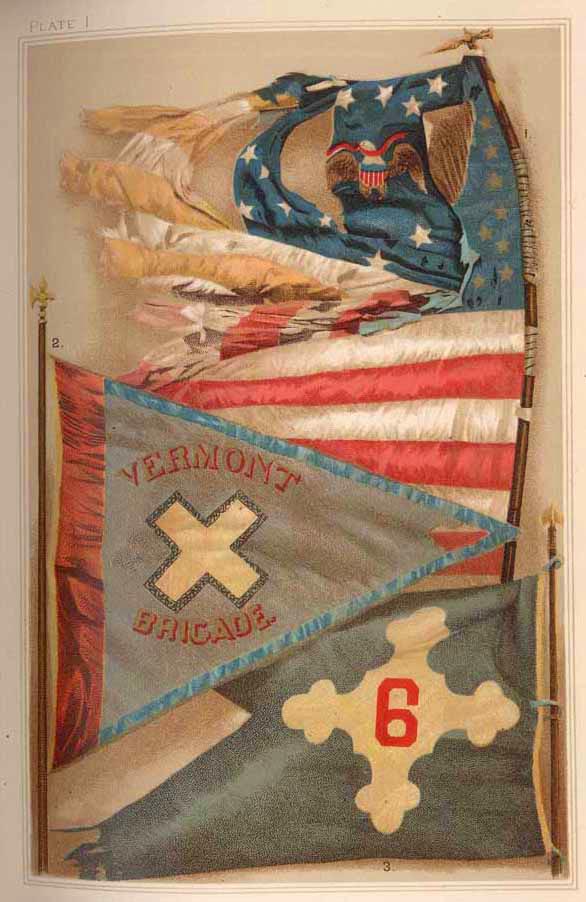
|
1. Eleventh Regt. Conn. Volunteers  Descriptions Descriptions |
On the afternoon of the next day, the Sixth Massachusetts, a full regiment one thousand strong, started from Boston by rail, leaving the Fourth Massachusetts to follow. An immense concourse of people gathered in the neighborhood of the Boston and Albany railroad station to witness their departure. The great crowd was evidently under the influence of deep feeling, but it was repressed, and the demonstrations were not noisy. In all hands were evening editions of the daily papers; and as the record of the disloyal behavior of Maryland and Virginia was read aloud, the comments were emphatic in disapproval. With the arrival of the uniformed troops, the excitement burst out into a frenzy of shouts, cheers, and ringing acclamation. Tears ran down not only the cheeks of women but those of men; but there was no falter. A clergyman mounted an extemporized platform, to offer prayer, where he could be seen and heard by all, and a solemn hush fell on the excited multitude, as if we were inside a church. His voice rang out to the remotest auditor. The long train backed down where the soldiers were scattered among mothers, wives sweethearts, and friends uttering last words of farewell
"Fall into line!" was the unfamiliar order that rang out, clear and distinct, with a tone of authority. The blue-coated soldiers released themselves tenderly from the clinging arms of affection, kissed again, and again, and again, the faces upturned to theirs, white with the agony of parting, formed in long lines, company by company, and were marched into the cars. The two locomotives, drawing the long train slowly out of the station, whistled a shrill "goodbye "---every engine in the neighborhood shrieked back an answering farewell---from the crowded streets, the densely packed station, the roofs of houses, the thronged windows, and the solid mass of human beings lining both sides of the track, further than the eye could see, there rang out a roar of good wishes, and parting words, accompanied with tears and sobs, and the waving of hats and handkerchief---and the Sixth Massachusetts was on its way to Washington. Ah, how little they, or we, foresaw the reception awaiting them in the streets of Baltimore!
As I turned to leave the station, my attention was attracted by little groups, in the centre of which were sad men and weeping women. A woman had fainted, and I waited till restoratives and kind offices had brought her back to life. She apologized for her "weakness," saying she was not very well, and her son's departure was sudden. One of the company added that "Mrs. didn't know that Andrew had enlisted till to-day noon, and she hadn't got over the bad news received a week ago; for Clement, her only other child---and a good boy he was, too---was drowned last week in the Bay of San Francisco." My heart went out to the poor woman, and I tried to say something comforting to her.
"He has only gone for three months, you know," I said "and probably. will not be called to do more than police duty. I hardly think there will be any fighting---certainly nothing more than skirmishing." My speech took counsel of my wishes, for I did not believe what I said. But there was a general feeling that the rebellion would be suppressed speedily, and that the determined attitude of the North would end very shortly the hostile bluster of the South.
The pallid middle-aged mother was weak in body only. "If the country needs my boy for three months, or three years, I am not the woman to hinder him," was her answer. "He's all I've got, now that Clement is drowned; but when he told me he'd enlisted, I gave him my blessing, and told him to go---for if we lose our country what is there to live for?"
My father's condition was so improved that there was no longer any need of my remaining in Boston. He lived, active and vigorous, and with perfect mental clearness, until within a few weeks of the surrender of Lee, in April, 1865---always admonishing me, whenever we met, that "the severest years of a war are the twenty-five that succeed it, when the demoralization which it has engendered is found in every department of business, society, and government." He had had experience in war and its demoralizing influence.
My husband's letters from Chicago were full of the war excitement of the West. The more than doubtful position of Missouri, and the fact that the lower tiers of counties of Illinois and Indiana were allied to the South by kinship, trade, and political sympathy, caused great anxiety. The banks of Illinois were based on Southern state bonds, and secession had caused suspension, failure, and financial distress. My husband was editor and proprietor of a prosperous weekly paper, whose subscribers were scattered throughout the Northwest, and I was associated with him. I knew that a large proportion of them sympathized with the secessionists, and would immediately discontinue the paper, and become its active, open enemies, if its editors came out decidedly loyal to the Union, as he had written me we must do in the very next issue. I must hasten home to Chicago. But, before leaving, I coveted an interview with Mr. Garrison or Wendell Phillips. For many years they had been to me prophet and king, and I now sought them, as, of old, the oracles were consulted.
I found Mr. Garrison in his office on Washington Street, with composing-stick in hand, setting up matter for the next week's Liberator. He was as calm and serene as a summer morning. No one could have divined, from his passionless face and manner, that a hurricane of feeling was raging in the moral and political world.
"Mr. Garrison," I inquired, "what is your opinion of this Southern rebellion? Will it be a 'sixty days' flurry,' as Secretary Seward prophesies, or are we to have war?"
"We are to have war---a bloody, merciless war---a civil war, always more to be dreaded than one with a foreign nation."
"Do you think it will be a long war?"
No one can tell. It may last as long as the War of the Revolution. The North underrates the power, purpose, and ability of the South, over which it expects an easy triumph. Instead of this, it will be plunged into a desperate struggle, of which it does not dream."
"What will be the result? How will the war end---in dissolution of the Union?"
"No one can answer that question. Of one thing only am I certain---the war will result in the death of slavery!"
"Do you believe that, Mr. Garrison? Theodore Parker has predicted that slavery would go down in blood, but it has never seemed possible that his prophecy would he verified."
At that moment Mr. Phillips entered, with the morning paper in hand, glowing with the account it gave of the magnificent ovation accorded the Sixth Massachusetts in its passage through New York. How impassioned he was, and yet how self-poised! if Mr. Garrison appeared the incarnation of serenity, Mr. Phillips seemed aglow with sacred fire. In the first pause of the conversation between the two men, I interrogated Mr. Phillips as I had Mr. Garrison.
"Mr. Garrison tells me that he is confident the: war will result in the destruction of slavery. Do you share this confidence with him, Mr. Phillips?"
"Yes; slavery has taken the sword, and it will; perish by the sword. Five years hence not a slave will be found on American soil!"
The next morning I left for Chicago. All along the route were excited groups of people, eager for news from Washington, and everywhere was displayed the national flag. At Albany, where we halted for dinner, we learned the reception given the Massachusetts Sixth in their passage through Baltimore the day before. A vast and angry crowd had opposed their progress, showers of stones and other missiles were hurled at them from the streets and house-tops, the soldiers had defended themselves and fired into the mob, and the dead, dying, and wounded lay in the streets. So read the telegram. It was startling news, and blanched the cheeks of those who listened while the exaggerated accounts of the papers were being read. The war had indeed begun. The dead silence was broken by a tall, stern, sinewy, and grizzled Yankee, who had listened standing with both hands deeply plunged in his pockets.
"Waal, now, them Southern fire-eaters have gone and done it---that's a fact!"
The quaintness of the speech, with the peculiar tone and manner, spoke volumes. The breach between the North and South was fast becoming irreparable. War had begun in Baltimore, and its streets were reddened with fratricidal blood. The bodies of the Massachusetts fallen were "tenderly sent forward" to Governor Andrew, in obedience to his telegram. The whole city joined in the obsequies of these first martyrs of the new revolution, and, linking their memories with those of the early patriots who fell at Concord and Lexington, the drums that had done service at the battles of Lexington and Bunker Hill, were beaten at the head of the funeral escort.
I was detained en route over Sunday in Auburn, N.Y. The war spirit was rampant there, as everywhere. A newly recruited company of volunteers were to leave on Monday morning for New York, and they were honored with a public leave-taking in one of the churches that evening. The spacious church was crowded to suffocation,---as large an audience waiting outside as was packed within. The pulpit was decked with the national colors. Bunting festooned the walls and the sides of the gallery. The great audience rose, clapping and applauding, as the soldiers filed into the pews reserved for them. The very air was electric with patriotic feeling. The sermon stirred the pulses like the blast of a bugle. It was a radical discourse, and recognized slavery as the underlying cause of the outbreak, which, it predicted, would result in the freedom of the Southern serfs.
The choir sang patriotic odes, the audience joining with one voice in the exultant refrain, "It is sweet, it is sweet, for one's country to die!" The great congregation without caught it, thrilling the evening air with the spirit of the hour, "It is sweet, it is sweet, for one's country to die!" So intense was the feeling: that when an appeal was made from the pulpit--transformed by the excitement into a recruiting office---for volunteers to defend the country, some half dozen rose, who were afterwards mustered into the service.
In Chicago there was more stir and excitement than I had seen elsewhere. The war spirit, war news, and war preparations engrossed everybody. The day presented scenes of din and bustle, and the night was scarcely less tranquil. The streets were thronged with eager men and women rushing here and there as incidents called them.
On the evening of the very day that Fort Sumter capitulated, an immense meeting of citizens was held in the great "Republican Wigwam," erected especially for the accommodation of the convention which nominated Abraham Lincoln to the presidency, less than a year before. It was now re-baptized, and called "National Hall," and was consecrated afresh, not to "party," but to "patriotism." Every inch of standing room was utilized on the ground floor, and the gallery was packed to the ceiling. Men of all religious creeds and party affiliations came together---a unit now---to deliberate on the crisis of the hour.
The gentleman chosen to preside had voted against President Lincoln. "But," he said, "the Administration, which I did not help elect, shall have my support now to the last, for this is a just and holy war on which we are entering."
Hon. George Mannière, eminent and popular, administered to the assemblage the oath of fealty to the government. Never was there a more impressive scene. The vast multitude rose, numbering nearly ten thousand, and, reverently baring the head, and raising the right hand,---old men and youths, matrons and maidens, and even young children,---they repeated solemnly after Judge Mannière the words of the following oath
"I do solemnly swear, in the presence of Almighty God, that I will faithfully support the Constitution of the United States, and of the State of Illinois. So help me God."
All the speeches of the evening were short and to the point. The time for harangue was over---the time for action had begun.
"I did not vote for Abraham Lincoln," said Hon. John Van Armen, "but I will sustain him to the last drop of my blood."
As long as this war lasts," said E. W. McComas, of the Chicago Times, a Democratic journal, " I will stand by the flag of my country. Intimations have been thrown out that I shall not be true to my country, because I am of Southern birth. I came here of my own free will. Your allegiance is my allegiance. I am no longer a Virginian, but a citizen of Illinois and of the United States."
On Sunday night, eight days after the fall of Sumter, troops were despatched from Chicago to Cairo, the southern terminus of the state, and a point of great strategic importance. At that time a muddy little town, it is situated at the confluence of the Ohio and Mississippi rivers, and is the key to the navigation of both. It is also the southern terminus of the Illinois Central railroad, whose northern termini are Dubuque and Chicago. Its importance as a military post at that time could not be over-estimated. Had the South seized it, it could have controlled the railway combinations of the Northwest, and closed the navigation of the Ohio and Mississippi. Southern leaders were well aware of its value as a railway and river centre, and were hurrying preparations to take possession of it.
They were forestalled in their action by Chicago. In less than forty-eight hours a force of infantry and a company of artillery were ready to march from that city. It was a citizen-corps, made up mainly of young men, most of them belonging to the best families of the state. Not only were these youths surrendered to the service of the country, but, aided by requisitions of the stores of Chicago, they were equipped with such munitions of war as they carried. They left in haste, little time being accorded to leave-taking or indulgence in grief. The long train of twenty-six cars stood waiting them at the station, with two powerful engines attached, which panted and puffed and shrieked as if eager to be off. As the precious train moved slowly out along the pier, the tens of thousands who lined the lake-shore bade them farewell with deafening cheers. Round after round rang out over the Prairie City, and were seconded by the prolonged shrill shrieks of all the locomotives waiting at the numerous railway stations.
They were none too soon in their occupation of Cairo. Many of the inhabitants were credited with a leaning towards secession, and would have been glad to welcome Southern instead of Northern troops. But they found the arguments of four brass six-pounders, accompanied by men with power and authority to use them, quite irresistible, and the town stiffened into undoubted loyalty immediately. "Them brass missionaries converted a heap o' folks that was on the anxious seat, now I tell ye!" said a plain, loyal man of the town, with a knowing wink of the eye, when narrating these events.
If the North had been skeptical as to the probability of war with the South, it was swiftly undeceived. For the President of the Southern Confederacy had also called for volunteers, and for persons to take out letters of marque as privateers, to destroy the commerce of the North, and his proclamation was received with an enthusiastic response. To meet this, President Lincoln declared all Southern ports blockaded, and. denounced as pirates the commissioned privateers. Nothing daunted by the dreary prospect before them, the Southern leaders sent messengers to Europe, to obtain a recognition of their government as an equal nation contending with the North, and to get the blockade broken by promising England free trade and an ample supply of cotton. The South was in earnest, and the North began to believe it.
On the 3d of May, President Lincoln issued another proclamation calling for forty-two thousand and thirty-four volunteers, at the same time increasing the regular army. In six weeks from the fall of Sumter, over half a million of men had volunteered to support the Union, nearly two hundred thousand of whom had been accepted, or were on the march, or were drilling preparatory to active service. More than one hundred thousand were organized by the different states, who were not accepted.
The two hostile armies were rapidly nearing each other on the Potomac, for the South was intent on capturing and holding Washington, and boastingly proclaimed its determination to do this. This would give the Confederacy prestige in the eyes of the world; and when once in occupation of the capital city of the nation, it could demand the recognition of foreign powers with a probability of success. Now its position was anomalous. Its seat of government was at Montgomery, Alabama, "a capital without a capitol. It had a Secretary of Treasury without any treasury; a Secretary of Navy without any navy; a Secretary of the Interior without any interior; a Secretary of Foreign Affairs without any foreign affairs; a Postmaster-General without any Post Office; a Judiciary without any judgment,---in short, an Administration with nothing to administer." To protect Washington was the one agony of the Northern people. Regiments were hurried forward without proper preparations for their care, which caused them great privation and suffering. They were quartered in the Capitol; they camped in the public squares; they were even accommodated in the house of the President. Arms were stacked in the rotunda of the Capitol, the stately edifice became a fortification. Zouaves lounged in the cushioned seats of members of Congress; and a military hospital was made of the Washington Infirmary, located on the site of the present Judiciary Square Hospital. Washington looked like a besieged city; and the nation breathed freely, for its seat of government was safe. There were constant collisions between small bodies of troops, and an incessant skirmishing between pickets, in which the Union soldiers were generally victorious. This kept the war excitement at fever heat, and confirmed the North in its confidence of crushing the rebellion at an early day.
The defeat at Bull Run extricated the nation from this condition of perilous self-confidence, and led it to measure more accurately the mighty work on which it had entered. Our soldiers, enlisted only for three months, most of them unskilled, and commanded by officers who had never "smelt gunpowder," marched into Virginia to attack the rebels with a gay sang froid, as if bound on a military picnic. They plundered as they marched, riotous with fun and frolic, accompanied by Congressmen, reporters, civilians---all who could muster passes from the government---and who followed on in carriages, omnibuses, and on horseback. They were going to witness an easy victory.
From a combination of causes the battle of Bull Run was lost to the Union army, composed mostly of raw troops fresh from the counting-room, farm, and workshop, who had been marching and fighting for thirteen hours without any respite. Wearied and famished, and agonizing with thirst, ten thousand fresh troops of the enemy were thrown suddenly upon them, and a panic ensued. Back they fled to Washington, a headlong, disorderly mob; men in regiments and men in groups, army wagons and sutlers' teams, riderless horses, and the thunderous artillery, crushing all that came in their way---a routed host, confused, terror-striken, and choked with dust, that no authority could halt, and no military skill re-organize. The rain came down in torrents, deepening the gloom, as the drenched fugitive poured over Long Bridge into the capital, cumbering the roads behind them with abandoned cannon, arms, and equipments, leaving their dead and dying uncared for. They filled the public ear with exaggerated accounts of surprise, slaughter, and pursuit, which could not be corrected, when later they were followed by orderly regiments and solid battalions, that unbroken and with military discipline marched back to their old encampments.
As the story of this disaster was carried by the telegraph into the homes of the people, the North was stunned and temporarily paralyzed. Its dream of invincibility was over. It was a gigantic war into which it was precipitated, and a gigantic army must be collected, equipped, and organized to meet it. Lifting itself out of the despair which for the moment prostrated it, the nation girt itself anew with power and purpose. Its army of seventy-five thousand three months' men melted away as soon as its brief term of service was ended. In its place the government now proceeded to raise, equip, drill, and prepare for the field an army of half a million ; and the North rose in majesty to aid the administration in its herculean task.
But if the North was sobered by this disaster, and nerved to a firmer grapple with her foes, the South was intoxicated with her easy success. Her forces were strengthened and consolidated by this victory. She had little doubt but the independence of the Southern confederacy was now achieved. Whoever throughout the South had hesitated to swear allegiance to the cause of secession delayed no longer. Tennessee now voted to leave the Union. A great army of rebels suddenly made their appearance in Missouri, which was now rent with the ravages of civil war. And Fort Fillmore, in New Mexico, with seven hundred men, surrendered to a body of Texans without firing a gun. And now at last matters had sharply defined themselves ; the lines were drawn between the States that were loyal and disloyal, and the millions of the United States were ranged on one side or the other of a long and desperate struggle.
Meantime, what did the women of the North?
LOYAL WOMEN OF THE NORTH---THEIR PATRIOTISM AND DEVOTION---HEROINES OF THE BATTLE-FIELD---HOME WORK AND RELIEF SOCIETIES---SCRAPING LINT AND ROLLING BANDAGES.
The Patriotism of Men paralleled by that of Women---Notable Examples---Testimony of President Lincoln---Blunders of Inexperience---The Havelock Mania---A Woman Soldier in the Nineteenth Illinois---Sent out of Camp, she attempts Suicide---Is rescued and joins her Husband---Madame Turchin, Wife of the Colonel---Her Bravery and military Skill---Her Ability as a Nurse---She defeats a Court-Martial---Other military Heroines---Annie Etheridge of the Third Michigan---Bridget Devens of the First Michigan Cavalry---Kady Brownell of the Fifth Rhode Island---Georgianna Peterman, the Wisconsin Drummer-Girl---Army Stories of military Women---Bandage and Lint Craze---Local Relief Societies--Queer Assortment of Supplies---Cars flooded with fermenting Goodies---Great Waste and Loss---Liberality of the People continues---Wiser Methods are devised.
HE great uprising among men, who
ignored party and politics, and forgot sect and trade, in the
fervor of their quickened love of country, was paralleled by a
similar uprising among women. The patriotic speech and song, which
fired the blood of men, and led them to enter the lists as soldiers,
flourished the self-sacrifice of women, and stimulated them to
the collection of hospital supplies, and to brave the horrors
and hardships of hospital life.
If men responded to the call of the country when it demanded soldiers by the hundred thousand, women planned money-making enterprises, whose vastness of conception, and good business management, yielded millions of dollars to be expended in the interest of sick and wounded soldiers. If men faltered not, and went gayly to death, that slavery might be exterminated, and that the United States might remain intact and undivided, women strengthened them by accepting the policy of the government uncomplainingly. When the telegraph recorded for the country, "defeat" instead of "victory," and for their beloved, "death" instead of "life," women continued to give the government their faith, and patiently worked and waited.
It is easy to understand how men catch the contagion of war, especially when they feel their quarrel to be just. One can comprehend how, fired with enthusiasm, and inspired by martial music, they march to the cannon's mouth, where the iron hail rains heaviest, and the ranks are mowed down like grain in harvest. But for women to send forth their husbands, sons, brothers and lovers to the fearful chances of the battle-field, knowing well the risks they run,---this involves exquisite suffering, and calls for another kind of heroism. This women did throughout the country, forcing their white lips to utter a cheerful "good-bye," when their hearts were nigh breaking with the fierce struggle.
The transition of the country from peace to the tumult and waste of war, was appalling and swift---but the regeneration of its women kept pace with it. They lopped off superfluities, retrenched in expenditures, became deaf to the calls of pleasure, and heeded not the mandates of fashion. The incoming patriotism of the hour swept them to the loftiest height of devotion, and they were eager to do, to bear, or to suffer, for the beloved country. The fetters of caste and conventionalism dropped at their feet, and they sat together, patrician and plebeian, Protestant and Catholic, and scraped lint, and rolled bandages, or made garments for the poorly clad soldiery.
An order was sent to Boston for five thousand shirts for the Massachusetts troops at the South. Every church in the city sent a delegation of needlewomen to "Union Hall," heretofore used as a ballroom. The Catholic priests detailed five hundred sewing-girls to the pious work. Suburban towns rang the bells of the town hall to muster the seamstresses. The plebeian Irish Catholic of South Boston ran the sewing-machine, while the patrician Protestant of Beacon Street basted,---and the shirts were made at the rate of a thousand a day. On Thursday, Dorothea Dix sent an order for five hundred shirts for her hospital in Washington. On Friday, they were cut, made, and packed---and were sent on their way that. night. Similar events were of constant occurrence in every other city. The zeal and devotion of women no more flagged through the war than did that of the army in the field. They rose to the height of every emergency, and through all discouragements and reverses maintained a sympathetic unity between the soldiers and themselves, that gave to the former a marvellous heroism.
At a meeting in Washington during the war, called in the interest of the Sanitary Commission, President Lincoln said: "I am not accustomed to use the language of eulogy. I have never studied the art of paying compliments to women. But I must say that if all that has been said by orators and poets since the creation of the world in praise of women, was applied to the women of America, it would not do them justice for their conduct during this war. I will close by saying, God bless the women of America!"
Entirely unacquainted with the requirements of war and the needs of soldiers, it was inevitable that the first movements of women for army relief should be misdirected. They could not manifest more ignorance, however, nor blunder more absurdly, than did the government in its early attempts to build up an effective and disciplined army. Both learned by blundering.
It was summer; and the army was to move southward, to be exposed to the torrid heats of the season and climate. A newspaper reminiscence of the good service rendered British troops in India by General Havelock set the ball in motion. He had devised a white linen head-dress to be worn over the caps of his men, which defended them from sunstroke, and in his honor it was named the "Havelock." Our men must, of course, be equipped with this protection, and forthwith inexperienced women, and equally inexperienced men in the army, gave orders for the manufacture of Havelocks. What a furor there was over them! Women who could not attend the "sewing-meeting" where the "Havelocks" were being manufactured, ordered the work sent to their homes, and ran the sewing-machines day and night; till the nondescript headgear was completed. "Havelocks" were turned out by thousands, of all patterns and sizes, and of every conceivable material.
In the early inexperience of that time, whenever regiments were in camp awaiting marching orders, it was the custom of many women to pay them visits, laden with indigestible dainties. These they furnished in such profusion, that the "boys" were rarely without the means of obtaining a "permit" to the hospital until they broke up camp. While the Havelock fever was at its height, the Nineteenth Illinois, commanded by Colonel Turchin, was mustered in, and was ordered to rendezvous at Camp Douglas. A detachment of the "cake and pie brigade," as the rollicking fellows called them, paid the regiment an early and were received by the men who were not under drill, en Havelock. As the sturdy fellows emerged from. their tents, all wearing "the white nightcaps," as they had irreverently christened the ugly head-dress, their appearance was so ludicrous that a shout went up from officers, soldiers, and lady visitors. They were worn in every imaginable' fashion, as nightcaps, turbans, sunbonnets, bandages, sunshades,---and the fate of the "Havelock" was sealed. No move time nor money was wasted in their useless manufacture.
En passant, I remember another occurrence of that afternoon when we visited the camp of the Nineteenth Illinois. I was watching companies that were drilling, a good deal amused at their awkwardness and their slow comprehension of the orders given them. One of the captains came to me, with an apology for intrusion, and begged to know if I noticed anything peculiar in the appearance of one of the men, whom he indicated. It was evident at a once that the "man" was a young woman in male attire, and I said so. "That is the rumor, and that is my suspicion," was his reply. The seeming soldier was called from the ranks and informed of the suspicions afloat, and asked the truth of them. There was a scene in an instant. Clutching the officer by the arm, and speaking in tones of passionate entreaty, she begged him not to expose her, but to allow her to retain her disguise. Her husband had enlisted in his company, she said, and it would kill her if he marched without her. "Let me go with you!" I heard her plead. "Oh, sir, let me go with you!" She was quietly conducted outside the camp, when I took her in charge. I wished to take her to my home; but she leaped suddenly from the carriage before we were half way from the camp, and in a moment was lost amid the crowds hastening home from their day's work.
That night she leaped into the Chicago river, but was rescued by a policeman, who took her to the Home of the Friendless. Here I found her, a few days later, when I made an official visit to the institution. She was extremely dejected, and could not be comforted. It was impossible to turn her from her purpose to follow her husband. "I have only my husband in all the world," she said, "and when he enlisted he promised that I should go with him; and that was why I put on his clothes and enlisted in the same regiment. And go with him I will, in spite of everybody." The regiment was ordered to Cairo, and the poor woman disappeared from the Home the same night. None of us doubted but she left to carry out her purpose.
Madame Turchin, the wife of the Colonel of the Nineteenth Illinois, was the daughter of a Russian officer, and was born and reared in foreign camps, a favorite with the men of her father's command.
She followed the fortunes of her husband in the War of the Rebellion, and accompanied him to the field. I met her at Springfield, Ill., where her husband's regiment was waiting marching orders. Fine-looking, but unmistakably for foreign in appearance and manner, she was intensely loyal to the Union, and thoroughly American in her sympathies and interests. She was as popular with the men of her husband's regiment as she had been with the Russian soldiers commanded by her father. They went to her with their illnesses and troubles, and she received them with kindness, a good deal of playful badinage, and very careful nursing when it was needed.
In the spring of 1862, when the Nineteenth Illinois was actively engaged in Tennessee, Colonel Turchin was taken seriously ill, and was carried for days in an ambulance. Madame Turchin not only nursed her husband most tenderly, but took his place at the head of the regiment---the men in the ranks, and the subordinate officers, according her implicit and cheerful obedience. She was not one whit behind her husband in courage or military skill. Utterly devoid of fear, and manifesting perfect indifference to shot or shell, or minie-balls, even when they fell thickly around her, she led the troops into action, lacing the hottest fire, and fought bravely at their head. When her husband was able to resume his command, she gave herself again to the care of the sick and wounded, in the field hospital.
An attempt was made to drive Colonel Turchin from the army, and on some pretext, ill or well founded, he was court-martialed. His plucky wife hastened to Washington, and not only obtained an order to set aside the court-martial, but her husband's promotion to the rank of Brigadier-General. Dashing back to Tennessee, she entered the court-room triumphantly, just as her husband was being declared "guilty," with the order to abandon his trial in one hand, and his commission in the other. If the young woman who was mustered into her husband's regiment, disguised as a man, appealed to Madame Turchin for permission to accompany her young soldier husband, I know she was not denied. No captain would be allowed to conduct her out of camp a second time. Madame Turchin's permission for her to serve as a soldier would be as effective as one from the Secretary of War.
The number of women who actually bore arms and served in the ranks during the war was greater than is supposed. Sometimes they. followed the army as nurses, and divided their services between the battle-field and hospital. I remember Annie Etheridge, of Michigan, who was with the Third Michigan in every battle in which it was engaged. When their three years' service was ended, the reenlisted veterans joined the Fifth Michigan, and Annie went with them. Through the whole four years of the war she was found in the field, often in the thickest of the fight, always inspiring the men to deeds of valor, always respected for her correctness of life. Soldiers and officers vied with one another in their devotion to her.
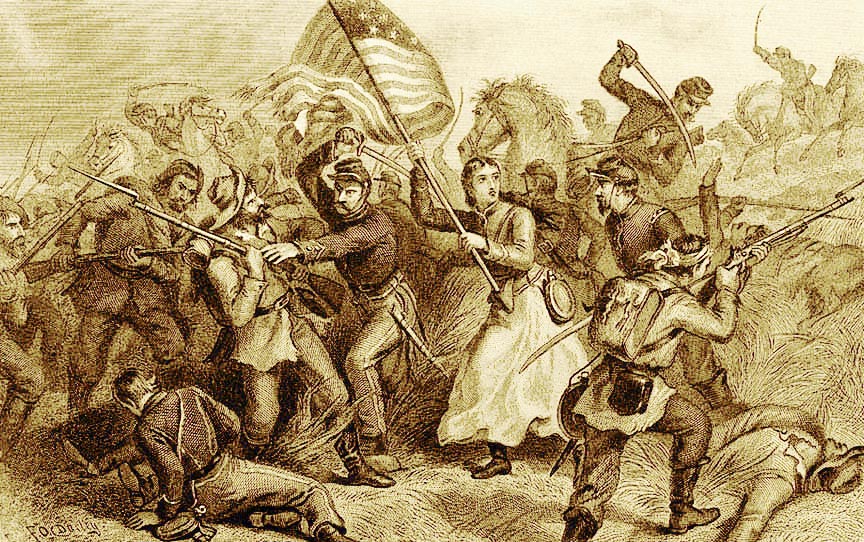
Bridget Devens, known as "Michigan Bridget," went to the field with the First Michigan Cavalry, in which her husband was a private, and served through the war. Sometimes when a soldier fell she took his place, fighting in his stead with unquailing courage Sometimes she rallied retreating troops,---sometimes she brought off the wounded from the field---always fearless and daring, always doing good service as a soldier. Her love of army life continued after the war ended, and with her husband she joined a regiment of the regular army, stationed on the Plains.
|
"Sometimes when a soldier fell she took his place fighting in his stead with unquailing courage---always fearless and daring always doing good service as a soldier." |
Mrs. Kady Brownell was, like Madame Turchin, born in camp, her father being attached to the British army. She accompanied the Fifth Rhode Island Infantry to the war, of which regiment her husband was a non-commissioned officer. She was the color-bearer of the regiment, and was a skilful sharpshooter and expert swordsman. She marched with the men, and asked no favors as a woman, but bore the brunt of the battle, on occasion, a fearlessly as her comrades. She was in General Burnside's expedition to Roanoke Island and Newbern, where her husband was severely wounded. When he was pronounced unfit for further service, and discharged, she also sought a discharge, and retired with him to private life and domestic duty.
The Plattville, Wis., Witness, of March, 1864, records, as if it were nothing unusual, "the return from the army of Miss Georgianna Peterman." Says the local paragrapher, "Miss Peterman has been for two years a drummer in the Seventh Wisconsin She lives in Ellenboro', Wis., is about twenty years old, wears soldier clothes, and is quiet and reserved." Similar paragraphs appeared occasionally in other Western papers all through. the war. These half-soldier heroines generally adopted a semi-military dress, and became expert in the use of the rifle; and skilful shots.
Some one has stated the number of women soldiers is known to the service as little less than four hundred. I cannot vouch for the correctness of this estimate, but I am convinced that a larger number of women disguised themselves and enlisted in the service, for one cause or other, than was dreamed of. Entrenched in secrecy, and regarded as men, they were sometimes revealed as women, by accident or casualty. Some startling histories of these military women were current in the gossip of army life; and extravagant and unreal as were many of the narrations, one always felt that they had a foundation in fact.
Such service was not the noblest that women rendered the country during its four years' struggle for life, and no one can regret that these soldier women were exceptional and rare. It is better to heal a wound than to make one. And it is to the honor of American women, not that they led hosts to the deadly charge, and battled amid contending armies, but that they confronted the horrid aspects of war with mighty love and earnestness. They kept up their own courage and that of their households. They became ministering angels to their countrymen who perilled health and life for the nation. They sent the love and impulses of home into the extended ranks of the army, through the unceasing correspondence they maintained with "the boys in blue." They planned largely, and toiled untiringly, and' with steady persistence to the end, that the horrors of the battle-field might be mitigated, and the hospitals abound in needed comforts. The men at the front were sure of sympathy from the homes, and knew that the women remembered them with sleepless interest. "This put heroic fibre into their souls," said Dr. Bellows, "and restored us our soldiers with their citizen hearts beating normally under their uniforms, as they dropped them off at the last drum-tap."
The decline of the Havelock fever was followed by a "lint and bandage" mania, which set in with great fury. For a time it was the all-absorbing topic. Knowing now how insignificant in value these items of relief proved in the actual experience of the war, one cannot forbear a smile when reading the sapient discussions of the time. "What is the best material for lint?" "How is it best scraped and prepared?" "By what means can it be best gathered, in the largest quantities?" These were the questions of the hour, discussed gravely by professional men. And the "New York Medical Association for furnishing Hospital Supplies," actually held meetings to discuss "the lint question," and finally opened a "lint and bandage depot." Thus stimulated, every household gave its leisure time to scraping lint and rolling bandages, till the mighty accumulations compelled the ordering of a halt. A little later, the making of lint by machine relieved women of any further effort in this direction.
So determined were the people that their citizen soldiers should be well cared for, that "Relief Societies" were frequently organized in the interest of regiments, as soon as they were mustered into the service. They proposed to follow the volunteers of their neighborhoods with their benefactions---"to provide them with home comforts when well, and with supplies and nurses when wounded or sick." It would have been an admirable plan if it could have been carried out. But numerous difficulties and failures soon brought these methods into disrepute. The accumulation of perishable freight for the soldiers became fearful. It demanded instant transportation, and the managers of freight trains and expresses were in despair.
Women rifled their store-rooms and preserve-closets of canned fruits and pots of jam and marmalade, which they packed with clothing and blankets, books and stationery, photographs and "comfort-bags." Baggage cars were soon flooded with fermenting sweetmeats, and broken pots of jelly, that ought never to have been sent. Decaying fruit and vegetables, pastry and cake in a demoralized condition, badly canned meats and soups, whose fragrance was not that of "Araby the blest," were necessarily thrown away en route. And with them went the clothing and stationery saturated with the effervescing and putrefying compounds which they enfolded.
Added to this discouragement was the frequent loss of the packages. For the constant movements of troops rendered it impossible for express agents to forward boxes to special regiments. For a time there was great waste of the lavish outpouring of the people. It did not, however, check their liberality, but compelled wiser methods. For out of this chaos of individual benevolence and abounding patriotism the Sanitary Commission finally emerged, with its carefully elaborated plans, and its marvellous system.
AT THE FRONT---WRETCHED HOSPITAL ARRANGEMENTS---THE SANITARY COMMISSION---ITS OBJECT, METHODS, AND WORK---BATTLE-FIELD RELIEF.
Early Ignorance and Inefficiency of Officers---The Cause of Sickness and Death in Camp---Letters from the Front in Proof---Fearful Mortality of British Soldiers in the Crimea, in 1855---Occasioned by similar Causes---Local Relief Societies organized---New York Women show practical Wisdom The Sanitary Commission evolved from their Methods---Plan of Organization drawn up by Dr. Bellows---Sanctioned by the President and Secretary of War---The Commission soon conquers all Prejudice---Its Work very extensive---Inspectors sent to Camps and Hospitals---Monographs prepared on the Hygiene of the Army---Portable "Soup-Kettles"----" hospital cars''---Forty Soldiers' Homes---Claim, Pension, and Back Pay Agency---"Hospital Directory"---"Battle-field Relief Service"---Ten "Branch Commissions" "---Relief rendered at Shiloh and Antietam---The Supplies, or Money for their Purchase, Made or Collected by Women.
HE work of sanitary relief was
very soon outlined by the necessities and sufferings of the men
at the front. In the early period of the war, the troops reached
their destination generally in a very unsatisfactory condition.
They were crowded into cattle cars as if they were beasts, frequently
with empty haversack, and with no provision for their comfort
on the raid. Prompted by generous impulse, men and women boarded
the trains as they halted at the stations in cities, and served
to the men hot coffee and such food as could most readily be provided.
But it was only by accident, or through tireless and patient watching, that they were enabled to render this small service to their country's defenders; for no telegram announced the coming of the hungry men, nor for long and weary months was a system devised for the comfort and solace of the soldiers, as they passed to and from the battle-field. Many became ill or exhausted from exposure, but no relief was furnished.
Rarely were preparations made for their reception. "Men stood for hours in a broiling sun, or drenching rain, waiting for rations and shelter, while their ignorant and inexperienced Commissaries and Quartermasters were slowly and painfully learning the duties of their positions. At last, utterly worn out and disgusted, they reached their camps, where they received rations as unwholesome as distasteful, and endeavored to recruit their wasted energies while lying upon rotten straw, wrapped in a shoddy blanket." Such fearful misery contrasted sadly with the cheerful scenes they had left, and if it did not cool their enthusiasm for the national cause, it developed an alarming prevalence of camp diseases, which might have been prevented, if efficient, military discipline had prevailed.
The hospital arrangements, in the early part of the war, were as pitiful and inadequate as were the facilities for transportation. Any building was considered fit for a. hospital; and the suffering endured by army patients, in the unsuitable buildings into which they were crowded during the first year of the war can never be estimated. Before the war there was no such establishment as a General Hospital in the army. All military hospitals were post hospitals, and the largest contained but forty beds. There was no trained, efficient medical staff. There were no well-instructed nurses, no sick-diet kitchens, no prompt supply of proper medicines, and no means of humanely transporting the sick and wounded. Our entire military and medical systems, which seemed well nigh perfect at last, were created in the very midst of the war.
All this was the more keenly felt by our volunteer soldiers, because they were, in the beginning, men of remarkable character and spirit. They were not reared in dissolute camps, nor raked from the slums of the cities. They were the flower of our youth, young men who not unfrequently had been tenderly reared by mothers, to whom young wives had surrendered the keeping of their happiness, and who had faithfully discharged their duties in time of peace. They sprang, at the call of their country, from the workshop, the counting-room, the farm, the college, the profession, the church, the Sunday-school and Bible-class, ready to lay down their lives for their country, if it were necessary. All the more sensitive were such men to the neglect of government and the incapacity of officers.
I maintained a somewhat extensive correspondence with many of these young citizen soldiers throughout the war. Their letters lie before me. One of the volunteers of the Chicago Light Artillery, writing from "Camp Smith, near Cairo, Ill.," June 2, 1861, says:--
My departure from Chicago was very unceremonious. I had not time to say "good-bye " to my father and mother, to say nothing of my friends; but I resolved, when the first gun was fired in Sumter, if the government should call for men to sustain the honor of the country, not to be the last to offer. A young man cannot sacrifice too much in this cause; and every man in my company is of this mind. Not a man among us but has left a lucrative situation, and is undergoing many privations for the country's service. Not a man here knows as yet, or is anxious to know, what pay he is to receive for his services. To know that we have done our duty will be sufficient pay for most of us.
The government has done very little for us yet. My friends at home gave me a capital outfit, and I am prepared for all kinds of weather. Many of our men are not so fortunate. Many are sick from exposure and lack of proper protection. For these we need very badly, beds, blankets, pillows, socks, and something in the way of food besides "hardtack and salt junk." But nobody, complains; for we know the administration is heavily burdened and has everything to do, and that all has been done for us that could be done, during the time that we have been in camp. We are eaten up by mosquitoes, and maintain a constant warfare with every kind of insect and "creeping thing."
Another, belonging to the Fifth Wisconsin, writing from "Camp Griffen, near Washington, D. C.," Nov. 12, 1861, tells a similar story:--
I suppose you would like to hear what we are doing in Virginia in the way of bringing the rebels to subjection. As yet we have done little fighting, but have lost a large number of men. They are dying daily in the camps and hospitals, from pneumonia, dysentery, and camp diseases, caused by severe colds, exposure, and lack of proper food when ill. We have taken very heavy colds lying on our arms in line of battle, long frosty nights. For two days and nights there was a very severe storm, to which we were exposed all the time, wearing shoddy uniforms and protected only by shoddy blankets, and the result was a frightful amount of sickness. We have about thirty in our regimental hospital who will never again be good for anything, if they live.
Our hospitals are so bad that the men fight against being sent to them. They will not go until they are compelled, and many brave it out and die in camp. I really believe they are more comfortable and better cared for in camp, with their comrades, than in hospital. The food is the same in both places, and the medical treatment the same when there is any. In the hospital the sick men lie on rotten straw; in the camp we provide clean hemlock or pine boughs, with the stems cut out, or husks, when we can "jerk" them from a "secesh" cornfield.
In the hospital the nurses are "convalescent soldiers," so nearly sick themselves that they ought to be in the wards, and from their very feebleness they are selfish and sometimes inhuman in their treatment of the patients. In the camp we stout hearty fellows take care of the sick,---rough in our management, I doubt not, but we do not fail for lack of strength or interest. If we could be sure of being half-way well cared for when we get sick or wounded, it would take immensely from the horrors of army life.
We need beds and bedding, hospital clothing and sick-diet, proper medicines, surgical instruments, and good nurses,---and then a decent building or a good hospital tent for the accommodation of our sick. I suppose we shall have them when the government can get round to it, and in the meantime we try to be patient.
One of the writers of these letters was a teacher, and the other was in his sophomore year in college, when the war began. Similar letters, from equally intelligent sources were written to parties throughout the country, and they quickly found their way into print.
The same lack of sanitary care and proper food complained of in these letters had wrought fearful havoc in the British army, in the war of the Crimea, in 1855, only six years before, and the American people remembered it. Out of twenty-four thousand troops sent to the Crimea, eighteen thousand had died in less than nine months,---a mortality, it has been said, "never equalled since the hosts of Sennacherib fell in a single night." They died from lack of care, proper sanitary regulations, and the diet necessary to the sick. With their slowly dimming eyes they could see the vessels anchored in the harbor, freighted with the food and medicine, clothing and tenting, sanitary supplies and preventives, for want of which they were perishing.
All were tied up with the red tape of official formalism until Florence Nightingale, with her corps of trained nurses, and full power to do and command as well as advise, landed at Scutari, and ordered the storehouses opened. Then want gave place to abundance, and, through her executive skill and knowledge of nursing and hospital management, the frightful mortality was arrested.
There was a resolute determination in the hearts of the people, that neither inexperience nor dogged adherence to routine should cause such wholesale slaughter of their beloved citizen soldiers. Whether sick or well, they should receive such care as the soldiers of no nation had ever known before. No failure of their plans of relief abated their ardor, and no discouragement stayed the stream of their beneficence. Especially did women refuse to release their hold on the men of their households, even when the government had organized them into an army. They followed them with letters of inquiry, with tender anxiety and intelligent prevision, which eventually put them en. rapport with the government, and developed a wonderful system of sanitary prevention and relief. For the outcome of their patriotism and zeal, their loyalty and love, was the Sanitary Commission.
"The Woman's Central Association of Relief" was the name of a large and remarkable organization, formed in the city of New York, very early in the war. In connection with other similar organizations, they decided to send a committee to Washington, to learn, from the highest authorities, "in what way the voluntary offerings of the people could best be made available for the relief 6f the army."
Dr. Bellows was chairman of this committee, and before he returned from Washington, a plan of organization for the U. S. Sanitary Commission, drawn up by himself, received the sanction of the President and the Secretary of War. Not heartily, however, for the very highest officials of the government regarded the whole plan as quixotic, and consented to it only because "it could do no harm." President Lincoln himself failed at first to comprehend the. large humanity of the organization, and described it as "a fifth wheel to the coach." But for the zeal, intelligence and earnestness of his numerous women constituents, it is more than probable that Dr. Bellows would have retreated before the rebuffs and hindrances opposed to his humane efforts.
The object of the Sanitary Commission was to do what the government could not. The government undertook, of course, to provide all that was necessary for the soldier, whether sick or in health; whether in the army or hospital. But, from the very nature of things, this was not possible, and it failed in its purpose, at times, as all governments do, from occasional and accidental causes. The methods of the Commission were so elastic, and so arranged to meet any emergency, that it was able to make provision for any need, seeking always to supplement, and never to supplant, the government. It never forgot that "it must be subordinate to army rules and regulations, and in no way break down the essential military discipline, on the observance of which everything depended."
In a few months, the baseless prejudice against the Commission melted away. The army surgeons, at first opposed, became enthusiastic in its praise. And the people, who were, in the outset, bent on dispensing their charities only to the companies and regiments organized in their neighborhoods, came finally to accept the larger methods of the Commission, which disbursed the sanitary supplies it received to any hospitals or soldiers that needed them, without. regard to sectional limits. The government accorded to the Commission increased facilities for performing its work. The railroads transported all its freight free of charge---the express companies carried its packages at half price---and the telegraph companies remitted the usual charges on its messages.
The Commission did a more extensive work than was at first contemplated, or is to-day generally known. It sent inspectors, who were always medical men, to the army, to report on the "quality of rations and water---the method of camp cooking---ventilation of tents and quarters---the drainage of the camp itself---the healthfulness of its site---the administration of the hospital---the police of the camp---the quality of the tents, and the material used for flooring them---the quality of the clothing, and the personal cleanliness of the men "---and other points of importance to the health and efficiency of the army.
It also caused to be prepared, by the best medical talent in the country, eighteen concise treatises on the best means of preserving health in camp, and on the treatment of the sick and wounded in hospital and on the battle-field. These were acknowledged by the surgeons to be of great value.
It put nurses into the hospitals who had been trained for the work, and who, in addition to having aptitudes for the care of the sick, were attracted to it by large humanity and patriotic zeal.
It established a series of kettles on wheels, with small portable furnaces attached, in which soup was quickly made in the rear of battle-fields, for the faint and wounded, even while the battle was in progress.
It invented hospital cars, for the humane transportation of the wounded, in which the ordinary hospital bed was suspended by stout tugs of india rubber, preventing jolting.
It maintained forty "Soldiers' Homes," or "Lodges," scattered all along the route of the army, and over the whole field of war, which were free hotels for destitute soldiers, separated from their regiments, or passing back and forth, with neither money, rations, nor, transportation. Over eight hundred thousand soldiers were entertained in them, and four and a half million meals, and a million nights' lodgings were gratuitously furnished.
It established a "Claim Agency," to secure the bounty of the soldiers, when, by some neglect or informality, it had been kept back. It opened a "Pension Agency," whose name explains its office. It arranged a "Back Pay Agency," which took the defective papers of the soldiers, on which they could not draw their pay, regulated them, and in a few hours drew the money due them, sometimes securing twenty thousand dollars back pay in one day.
It maintained a "Hospital Directory," through which information could be officially obtained concerning the invalids in the two hundred and thirty-three general hospitals of the army, and concerning others, reported as "missing," and "fate unknown." In the four offices of the Directory, at Washington, Philadelphia, New York, and Louisville, there were recorded the names of more than six hundred thousand men, with the latest information procurable in regard to them.
The Commission also methodized a system of "Battle-Field Relief," which did much o mitigate the horrors inevitable to battles. Its agents were always on the field during an engagement, with surgeons, ambulances, and store wagons, with anæsthetics, surgical instruments, and every species of relief. They rendered invaluable aid, and were sometimes in advance of the government in their ministrations on the field of conflict. There were over six hundred pitched battles between the two hostile forces during the War of the Rebellion. History will record only a very few of them as "great battles." The suffering and horror incident to those were so immeasurable, that they could be only partially relieved ; and had the ability of the government and of all the volunteer agencies of the country, been tenfold greater than they were, they would have been inadequate to the awful necessities of those titanic conflicts.
After the battle of Antietam, where ten thousand of our own wounded were left on the field, besides a large number of the enemy, the Commission distributed "28,763 pieces of dry goods, shirts, towels, bed-ticks, pillows, etc.; 30 barrels of old linen, bandages, and lint; 3,188 pounds of farina; 2,620 pounds of condensed milk; 5,000 pounds of beefstock and canned meats; 3,000 bottles of wine and cordials; 4,000 sets of hospital clothing; several tons of lemons and other fruit; crackers, tea, sugar, rubber cloth, tin cups, chloroform, opiates, surgical instruments, and other hospital conveniences."
After the battle of Shiloh, in the West, where nearly as many wounded men were left on the field as at Antietam, the Commission distributed "11,448 shirts; 3,686 pairs of drawers; 3,592 pairs of socks; 2,777 bed-sacks; 543 pillows; 1,045 bottles of brandy, whiskey, and wine; 799 bottles of porter; 941 lemons; 20,316 pounds of dried fruit; 7,577 cans of fruit; and 15,323 pounds of farinaceous food."
Whence came these hospital supplies, or the money for their purchase? They were gathered by the loyal women of the North, who organized over ten thousand "aid societies" during the war, and who never flagged in their constancy to the cause of the sick and wounded soldier. As rapidly as possible, "branches" of the United States Sanitary Commission were established in Boston, New York, Philadelphia, Cincinnati, Chicago, and other cities---ten in all. Here sub-depots of sanitary stores were maintained, and into these the soldiers' aid societies poured their never-ceasing contributions. The supplies sent to these ten sub-depots were assorted, repacked, stamped with the mark of the Commission, only one kind of supplies being packed in a box, and then a list of the contents was marked on the outside. The boxes were then stored, subject to the requisitions of the great central distributing depots, established at Washington and Louisville. Through these two cities, all supplies of every kind passed to the troops at the front, who were contending with the enemy.
A most rigid system was observed in the reception, care, and disbursement of these hospital supplies; for the methods of the Sanitary Commission, through its entire system of agencies, were those of the best business houses. It was easy to trace the packages sent to hospitals back to their original contributors, vouchers being taken of those who received them, at every stage of their progress to their ultimate destination. Only a very insignificant fraction of them was lost or misused.
Through all the branches of the Commission there was the same wisdom in planning, ability in executing, and joyfulness in sacrifice. Into them all, were borne the suffering and patience of the soldier in the hospital, and the sorrow and anxiety of his family at home. Men en route to the front, full of manly strength and courage, and men en route from the camp or battle-field going home to die, invaded the busy" headquarters." People of all conditions and circumstances, wise and unwise, rich and poor, women and men, went thither for inspiration and direction. Scenes were there enacted and deeds performed which transfigured human nature, and made it divine. It was there that one felt the pulse of the country, and measured its heart-beats.
My own experience was with the Chicago Branch of the Sanitary Commission. And the brief résumé of the varied phases of life that flowed and ebbed through its unpretentious rooms, which follows in; the next chapter, will give the reader some idea of the patriotic zeal, the noble self-denial, and organized work of the women of the war, in which they were grandly assisted by men.