
MY FIRST CONNECTION WITH THE SANITARY COMMISSION---HOME SUPPLIES FOR THE SOLDIERS---A PEEP INTO THE BOXES---LETTERS FOUND INSIDE---ODD CONTRIBUTIONS.
Local Societies merged in the Commission---Become identified with the Chicago Branch---The Secrets of the Boxes of Supplies---Notes packed in with the Clothing---They are tender, pathetic, heroic, and comic---A letter-writing Army"--Consecrated Chicken, be jabers! "---"Butter an' Chase, bedad! "---" Comfort-bags"---"Benedictions" in the Murfreesboro' and Vicksburg Boxes---"One Box a Month"---Ingenious Wisconsin Farmers' Wives---Women in the Harvest-field---A Talk with them---Generosity of a "Tailoress"---The "five-dollar gold Piece"---Matches! Matches!"---Afraid of a Kiss---Children's sanitary Fairs---Gift of a five-year old Boy.
 RGANIZATIONS of women for the relief
of sick and wounded soldiers, and for the care of soldiers' families,
were formed with great spontaneity at the very beginning of the
war. There were a dozen or more of them in Chicago, in less than
a month after Cairo was occupied by Northern troops. They raised
money, prepared and forwarded supplies of whatever was demanded,
every shipment being accompanied by some one who was held responsible
for the proper disbursement of the stores. Sometimes these local
societies affiliated with, or became parts of, more comprehensive
organizations. Most of them worked independently during the first
year of the war, the Sanitary Commission of Chicago being only
one of the relief agencies. But the Commission gradually grew
in public confidence, and gained in scope and power; and all the
local societies were eventually merged in it, or became auxiliary
to it. As in Chicago, so throughout the country. The Sanitary
Commission became the great channel, through which the patriotic
beneficence of the nation flowed to the army.
RGANIZATIONS of women for the relief
of sick and wounded soldiers, and for the care of soldiers' families,
were formed with great spontaneity at the very beginning of the
war. There were a dozen or more of them in Chicago, in less than
a month after Cairo was occupied by Northern troops. They raised
money, prepared and forwarded supplies of whatever was demanded,
every shipment being accompanied by some one who was held responsible
for the proper disbursement of the stores. Sometimes these local
societies affiliated with, or became parts of, more comprehensive
organizations. Most of them worked independently during the first
year of the war, the Sanitary Commission of Chicago being only
one of the relief agencies. But the Commission gradually grew
in public confidence, and gained in scope and power; and all the
local societies were eventually merged in it, or became auxiliary
to it. As in Chicago, so throughout the country. The Sanitary
Commission became the great channel, through which the patriotic
beneficence of the nation flowed to the army.
When the local aid society of which I was president, merged its existence in that of the Sanitary Commission, I also became identified with it. Thenceforth, until the bells rang in the joyful news of peace, my time and energy were given to its varied work. In its busy rooms I was occupied most of the time when not in the hospitals, or engaged with some of the Northwestern soldiers' aid societies.
Here, day after day, the drayman left boxes of supplies sent from aid societies in Iowa, Minnesota, Wisconsin, Michigan, Illinois, and Indiana. Every box contained an assortment of articles, a list of which was tacked on the inside of the lid. These were taken out, stamped in indelible ink with the name of the "CHICAGO SANITARY COMMISSION," the stamp as broad as your hand, and the letters so large as to be easily read across a room. For the convenience of the hospitals they were repacked,--shirts by themselves, drawers by themselves, and so on. Then they awaited orders from the hospitals.
One day I went into the packing-room to learn the secrets of these boxes,---every one an argosy of love,---and took notes during the unpacking. A capacious box, filled with beautifully made shirts, drawers, towels, socks, and handkerchiefs, with "comfort-bags" containing combs, pins, needles, court-plaster, and black sewing-cotton, and with a quantity of carefully dried berries and peaches, contained the following unsealed note, lying on top:--
DEAR SOLDIERS,---The little girls of-----send this box to you. They hear that thirteen thousand of you are sick, and have been wounded in battle. They are very sorry, and want to do something for you. They cannot do much, for they are all small; but they have bought with their own money, and made what is in here. They hope it will do some good, and that you will all get well and come home. We all pray to God for you night and morning.
The box was carefully unpacked, each article stamped with the mark of the Commission, as a preventive to theft, and then carefully repacked just as it was received. That sacred offering of childhood was sent intact to the hospital.
Another mammoth packing-case was opened, and here were folded in blessings and messages of love with almost every garment. On a pillow was pinned the following note, unsealed, for sealed notes were never broken:---
MY DEAR FRIEND,---You are not my husband nor son; but you are the husband or son of some woman who undoubtedly loves you as I love mine. I have made these garments for you with a heart that aches for your sufferings, and with a longing to come to you to assist in taking care of you. It is a great comfort to me that God loves and pities you, pining and lonely in a far-off hospital; and if you believe in God, it will also be a comfort to you. Are you near death, and soon to cross the dark river? Oh, then, may God soothe your last hours, and lead you up "the shining shore," where there is no war, no sickness, no death. Call on Him, for He is an ever-present helper.
Large packages of socks, carefully folded in pairs in the same box, contained each a note, beautifully written, and signed with the name and address of the writer. They were as various as the authors. Here is one:
DEAR SOLDIER,---If these socks had language they would tell you that many a kind wish for you has been knit into them, and many a tear of pity for you has bedewed them. We all think of you, and want to do everything we can for you; for we feel that we owe you unlimited love and gratitude, and that you deserve the very best at our hands.
Here is another, of a different character:---
My DEAR Boy,---I have knit these socks expressly for you. How do you like them? How do you look, and where do you live when you are at home? I am nineteen years old, of medium height, of slight build, with blue eyes, fair complexion, light hair, and a good deal of it. Write and tell me all about yourself, and how you get on in the hospitals. Direct to-----.
P. S. If the recipient of these socks has a wife, will he please exchange socks with some poor fellow not so fortunate?
And here is yet another:--
MY BRAVE FRIEND,---I have learned to knit on purpose to knit socks for the soldiers. This is my fourth pair. My name is-----, and I live in-----. Write to me, and tell me how you like the foot-gear and what we can do for you. Keep up good courage, and by and by you will come home to us. Won't that be a grand time, though? And won't we all turn out to meet you, with flowers and music, and cheers and embraces? "There's a good time coming, boys!"
Very many of these notes were answered by the soldiers who received them, and a correspondence ensued, which sometimes ended in lifelong friendship, and, in some instances which came to my knowledge, in marriage.
A nicely made dressing-gown, taken from one of the boxes, of dimensions sufficiently capacious for Daniel Lambert, had one huge pocket filled with hickory nuts, and the other with ginger-snaps. The pockets were sewed across to prevent the contents from dropping out, and the following note was pinned on the outside :--
MY DEAR FELLOW,---Just take your ease in this dressing gown. Don't mope and have the blues, if you are sick. Moping never cured anybody yet. Eat your nuts and cakes, if you are well enough, and snap your fingers at dull care. I wish I could do more for you, and if I were a man I would come and fight with you. Woman though I am, I'd like to help hang Jeff Davis higher than Haman---yes, and all who aid and abet him, too, whether North or South!
There was exhumed from one box a bushel of cookies, tied in a pillow-case, with this benevolent wish tacked on the outside :--
These cookies are expressly for the sick soldiers, and if any body else eats them, I hope they will choke him!
A very neatly arranged package of second-hand clothing, but little worn, was laid by itself. Every article was superior in quality and in manufacture. Attached to it was a card with the following explanation, in most exquisite chirography:--
The accompanying articles were worn for the last time by one very dear to the writer, who lost his life at Shiloh. They are sent to our wounded soldiers as the most fitting disposition that can be made of them, by one who has laid the husband of her youth---her all---on the altar of her country.
Rarely was a box opened that did not contain notes to soldiers, accompanying the goods. In the pocket of one dressing-gown, a baby's tin rattle was found---in another, a small china doll, tastefully dressed---in another, a baby's photograph---in yet another, a comic almanac. In every box was a good supply of stoutly made "comfort-bags." A "comfort-bag" usually contained a small needle-book, with a dozen stout needles in it, a well-filled pin-ball, black and white thread, buttons, etc. These "little usefuls," as the boys called them, were invaluable to the handy fellows, who very often became skilful extempore tailors.
As whittling and wood-carving were among the prime amusements of the hospital, a jack-knife was added, and generally a pair of scissors. Sometimes a square piece of tobacco was included among the miscellanies, nor was the "comfort-bag" considered less valuable in consequence. Often a small Testament increased the value of the little bag, with the name and residence of the donor on the fly-leaf.
And if the comfort-bag contained no letter, with a stamped envelope, and blank sheet of paper added, its recipient was a little crestfallen. The stationery was rarely forgotten. Folded in the sleeves of shirts, tucked in pockets, wrapped in handkerchiefs, and rolled in socks, were envelopes with stamps affixed, containing blank sheets of note paper, and usually a pencil was added. The soldiers expressed their need of stationery in almost every letter they wrote. Most of the letters sent to the army contained stamped envelopes, and paper, for the men were without money so much of the time, that when the sutlers had stationery for sale at exorbitant prices, the soldiers were unable to buy it.
There never was an army so intent on corresponding with the kindred and friends left behind. If you went into any camp at any time, you would see dozens, and sometimes hundreds, of soldiers writing letters. Some would be stretched at full length on the ground, with a book or a knapsack for a table---some sitting upright against the trunks of trees, with the paper resting on their drawn-up knees---others would stand and write. The average number of letters sent to the army on the Atlantic coast was forty-five thousand daily. An equally large number was sent through the mails by the soldiers, making an aggregate of ninety thousand daily letters that passed through the post-office at Washington. About the same number were carried by the mails to and from Louisville, these two cities being the gateways to the army during the war. One hundred and eighty thousand daily letters received and answered, created a demand for stationery, which in the army it was not always easy to supply. On one day of the week preceding the battle of Pittsburg Landing, or Shiloh, there were sold to the soldiers, from the Pittsburg post-office, seven hundred dollars worth of postage-stamps. Who wonders that our army fought like heroes?
Over and over again, with unnecessary emphasis and cruel frequency, officers, surgeons, and nurses were adjured through notes in the boxes, to bestow on the sick and wounded the comforts and delicacies contained in the cases. There was more honesty in the hospitals, and much less stealing by the officials, than was popularly believed.
"For the love of God, give these articles to the sick and wounded, to whom they are sent!"
"He that would steal from a sick or wounded man would rob hen-roosts, or filch pennies from the eyes of a corpse!"
"Surgeons and nurses, hands off! These things are not for you, but for your patients,-our sick and wounded boys!"
"Don't gobble up these delicacies, nurses! They are for the boys in hospital!
Similar injunctions were found tacked on the inside lid of many boxes, or stared us in the face in startling colored capitals, when the cover was hammered off.
Occasionally the opening of a box revealed an unwise selection of donations, or a careless preparation of them. A packing-case was opened one morning, smooth and polished without and neatly jointed, when an overpowering odor smote the olfactories, that drove every one from the room. It was as if a charnel-house had been opened. Windows and doors were flung wide to let in the fresh air, and a second attempt was made to examine the odoriferous box. The intolerable stench proceeded from "concentrated chicken," which had been badly prepared. The box had been some time on the journey, and the nicely cooked chicken had become a mass of corruption. "Be jabers!" said Irish Jimmy, the drayman, as he wheeled the box back into the "receiving-room," "I hope the leddies God bless 'em!---won't send enny more of their consecrated chicken this way, for it smells too loud intirely."
Another box came from the depot completely besmeared with honey, leaking from within. Irish Jimmy pronounced it "grease," and, always ready with an opinion, declared that "the leddies were gittin' no sinse at all, to be afther sindin' grease in a box, loose like that, and the weather jist hot enough to cook ye!" When told that the Sanitary Commission called for no "grease," he ventured the sagacious opinion that it was "butter and chase inside, bedad! and by the howly Moses! they'd a jist melted in the great heat and run together. And shure! that was grease, and nobody could deny it." Two large boxes of honey in the comb had been packed with hospital clothing. In transportation the honey had drained from the comb, leaving it empty and broken, and had saturated the contents of the box.
Many of the boxes for the wounded at Murfreesboro' and Vicksburg, and packed for them especially, contained indications of the deepest feeling. "We send these supplies to the noble boys that beat back Bragg's army! We are proud of them!" "Three cheers for Rosecrans' army!" "Dear wounded soldiers! we shall never forget your gallant conduct at Murfreesboro' and Stone River!" May God place his everlasting arms of love underneath you, my dear wounded brothers!" These and like benedictions were affixed to almost every article.
In looking over the contents of the boxes as they were unpacked, one realized the passionate interest in the war felt by the women of the North. They toiled, economized, and retrenched to furnish the necessary supplies to the hospitals, and then hallowed them with a patriotic and religious spirit. They flung heart and soul into the labor of their willing hands, until the articles of their manufacture were redolent of blessings and affection. Then, pouring out their souls in written ejaculations of love and in tender benedictions, they forwarded these to the soldiers with the material comforts.
The aid societies were asked to contribute one box of hospital supplies a month, and this was the standard of efficiency upheld throughout the war. Some did much more than this, and some less; but the standard was never lowered. As there were nearly four thousand aid societies in existence in the Northwest, auxiliary to the Chicago Branch of the Sanitary Commission, and as over seventy thousand boxes were received, or were packed and forwarded from our rooms to Southern hospitals, it is evident that the women in the newly settled and sparsely populated states did not shirk the duties which the war imposed on them. They rifled their houses of whatever bed-linen could be spared; denied their families canned and dried fruit; retrenched in the use of butter and eggs, that they might have more to take to market, and so more money to bestow on the soldiers; held festivals and dime parties; gave concerts; got up fairs,---in short, their ingenuity was as limitless as their patriotism.
Some farmers' wives in the north of Wisconsin, eighteen miles from a railroad, had donated to the hospitals of their bed and table linen, of their husbands' shirts, drawers, and socks, until they had exhausted their ability in this direction. While the need lasted, they could not be satisfied to remain inactive, and so cast about to see what could be done by new and untried methods. They were the wives of small farmers, lately moved to the West, and living in log cabins,--where one room sufficed for kitchen, parlor, laundry, nursery, and bedroom,---doing their own housework, sewing, baby-tending, and dairy-work. What could women do so burdened, hampered, and straitened? "Where there's a will, there's a way."
They resolved to beg wheat of the neighboring farmers, and turn it into money. Sometimes on foot, sometimes with a team, amid the snows and mud of early spring, they canvassed the country for twenty and thirty miles around, everywhere eloquently pleading the needs of the blue-coated boys in the hospitals,---their earnest speech proving an open sesame to the granaries. Now they obtained a little from a rich man, then a large quantity from a poor man---deeds of benevolence are half the time in an inverse ratio to the ability of the benefactors---till they had accumulated nearly five hundred bushels of wheat This they sent to market, when they could obtain the highest market price, and forwarded the money to me, to be given the Sanitary Commission. Knowing the history of their contribution, their bank-check had a sacredness in my eyes.
During the war I was called into the country on frequent errands. Sometimes it was to organize aid societies---sometimes to attend mass conventions, called for inspiration and instruction in the work to be done. The attendance was increased by a natural desire for social enjoyment, which the necessities of the times greatly abridged. Sometimes a meeting would be called in a large town for the double purpose of stimulating hospital supplies and enlistments---sometimes I went in charge of soldiers, too ill or enfeebled from wounds to be sent alone. On these trips I noticed a great increase of women engaged in outdoor work, and especially during the times of planting, cultivating, and harvesting.
In the early summer of 1863, frequent calls of business took me through the extensive farming districts of Wisconsin, and Eastern Iowa, when the farmers were the busiest, gathering the wheat harvest. As we dashed along the railway, let our course lead in whatever direction it might, it took us through what seemed a continuous wheat-field. The yellow grain was waving everywhere; and two-horse reapers were cutting it down in a wholesale fashion that would have astonished Eastern farmers. Hundreds of reapers could be counted in a ride of half a dozen hours. The crops were generally good, and in some instances heavy, and every man and boy was pressed into service to secure the abundant harvest while the weather was fine.
Women were in the field everywhere, driving the reapers, binding and shocking, and loading grain, until then an unusual sight. At first., it displeased me, and I turned away in aversion. By and by, I observed how skilfully they drove the horses round and round the wheat-field, diminishing more and more its periphery at every circuit, the glittering blades of the reaper cutting wide swaths with a rapid, clicking sound, that was pleasant to hear. Then I saw that when they followed the reapers, binding and shocking, although they did not keep up with the men, their work was done with more precision and nicety, and their sheaves had an artistic finish that those lacked made by the men. So I said to myself; "They are worthy women, and deserve praise: their husbands are probably too poor to hire help, and, like the 'help-meets' God designed them to be, they have girt themselves to this work and they are doing it superbly. Good wives! good women!"
One day my route took me off the railway, some twenty miles across the country. But we drove through the same golden fields of grain, and between great stretches of green waving corn. Now a river shimmered like silver through the gold of the wheat and oats, and now a growth of young timber made a dark green background for the harvest fields. Here, as everywhere, women were busy at the harvesting., "I've got to hold up a spell, and rig up this 'ere harness," said my driver "something's got out o' kilter." And the carriage halted opposite a field where half a dozen women and two men were harvesting. Not a little curious to know what these women reapers were like, I walked over and accosted them.
"And so you are helping gather the harvest?" I said to a woman of forty-five or fifty, who sat on the reaper to drive, as she stopped her horses for a brief breathing spell. Her face was pleasant and comely, although sunburned, with honest, straightforward eyes, a broad brow, and a mouth that indicated firmness and tenderness. Her dress, a strong calico, was worn without hoops, then thought essential on all occasions, and she was shod with stout boots, and wore a shaker bonnet.
"Yes, ma'am," she said; "the men have all gone to the war, so that my man can't hire help at any price, and I told my girls we must turn to and give him a lift with the harvestin'." "You are not German? You are surely one of my own countrywomen---American ?" "Yes, ma'am; we moved here from Cattaraugus county, New York state, and we've done very well since we came."
Have you sons in the army?"
"Yes," and a shadow fell over the motherly face, and the honest eyes looked out mournfully into vacancy. "All three of 'em 'listed, and Neddy, the youngest, was killed at the battle of Stone River, the last day of last year. My man, he went down to get' his body, but he came back without it. There were nine thousand of our men left dead on the field there, and our Neddy's body couldn't be found among so many. It came very hard on us to let the boys go, but we felt we'd no right to hinder 'em. The country needed 'em more'n we. We've money enough to hire help if it could be had; and my man don't like to have me and the girls a-workin' outdoors; but there don't seem no help for it now."
I stepped over where the girls were binding the fallen grain. They were fine, well-built lasses, with the honest eyes and firm mouth of the mother, brown like her, and clad in the same sensible costume.
"Well, you are like your mother, not afraid to lend a hand at the harvesting, it seems!" was my opening remark.
"No, we're willing to help outdoors in these times. Harvesting isn't any harder, if it's as hard as cooking, washing, and ironing, over a red-hot stove in July and August only we have to do both now. My three brothers went into the army, all my cousins, most of the young men about here, and the men we used to hire. So there's no help to be got but women, and the crops must be got in all the same, you know."
"One of our German women," said another of the girls, "tells us we don't know anything about war yet. For during the last war in Germany men were so scarce that she had to work three years in a blacksmith's shop. You wouldn't think it, though, if you should see her. That would be rather tough, but I tell Annie we can do anything to help along while the country's in such trouble."
"I tell mother," said the Annie referred to, standing very erect, with flashing eyes, "that as long as the country can't get along without grain, nor the army fight without food, we're serving the country just as much here in the harvest-field as our boys are on the battle-field---and that sort o' takes, the edge off from this business of doing men's work, you know." And a hearty laugh followed this statement.
Another one of the women was the wife of on of the soldier sons, with a three-year-old boy toddling beside her, tumbling among the sheaves, and getting into mischief every five minutes. His mother declared that he was "more plague than profit." From her came the same hearty assent to the work which the distress of the country had imposed on her. And she added, with a kind of homely pride, that she was considered "as good a binder as a man, and could keep up with the best of 'em."
Further conversation disclosed the fact that amid their double labor in the house and field, these women found time for the manufacture of hospital supplies, and had helped to fill box after box with shirts and drawers, dried apples and pickles, currant wine and blackberry jam, to be forwarded to the poor fellows languishing in far-off Southern hospitals My eyes were unsealed. The women in the harvest field were invested with a new and heroic. interest, and each hard-handed, brown, toiling woman was a heroine. When the driver called to me that he had mended the broken harness, I bade the noble harvesters " good-bye," assuring them that they were the "peers of the women of the Revolution."
A poor girl, who called herself a "tailoress," came one day to the rooms of the Commission.
"I do not feel right," she said, "that I am doing nothing for our soldiers in the hospitals. I must do something immediately. Which do you prefer---that I should give money, or buy material and manufacture it into hospital clothing?"
"You must be governed by your circumstances," was the answer made her. "We need both money and supplies, and you must do that which is: most convenient for you."
"I prefer to give money, if it will do as much good."
"Very well, then, give money. We need it badly, and without it cannot do what is most necessary for our brave men."
"I will give the Commission my net earnings for the next two weeks. I would give more, but my mother is an invalid, and I help support her. Usually I make but one vest a day, as I do 'custom work,' and am well paid for it. But these next two weeks, which belong to the soldiers, I shall work earlier and later."
In two weeks she came again, the poor sewing girl, with a radiant face. Opening: her porte-monnaie, she counted out nineteen dollars and thirty-seven cents. She had stitched into the hours of midnight on every one of the working days of those two weeks.
A little girl, not nine years old, with sweet and timid grace, entered one afternoon, and laid a five-dollar gold piece on my desk. Half-frightened, she told its story. "My uncle gave me that before the war, and I was going to keep it always. But he's got killed in the army, and now mother says I may give it to the soldiers if I want to---and I'd like to. Will it buy much for them?"
I led the child to the store-room, and pointed out to her what it would buy so many cans of condensed milk, or so many bottles of ale, or so many pounds of tea or codfish, etc. Her face brightened with pleasure. But when I explained that her five-dollar gold piece was equal then to seven and a half dollars in greenbacks, and told her how much comfort could be carried into a hospital with the amount of stores it would purchase, she fairly danced for joy. "Why, my five dollars will do lots of good, won't it?"
Folding her hands before her in a charmingly earnest way, she begged me to tell her something that I had seen in the hospitals. A narration of a few touching events, such as would not too severely shock the child, but which showed the necessity of continued benevolence to the hospitals, brought tears to her eyes, and the resolution to her lips, to "get all the girls to save their money to buy things for the wounded soldiers." And away she ran, happy in the luxury of doing good.
A little urchin who often thrust his unkempt pate into the room, with the shrill cry of "Matches! Matches!" had stood a little apart, watching the girl, and listening to the conversation. As she disappeared, he fumbled in his pockets, and drew out a small handful of crumpled fractional currency, such as was then in use. "Here," said he, "I'll give yet' suthin' for them are sick fellers!" And he put fifty-five cents in my hand, all in five-cent currency. I was surprised, and hesitated.
"No, my boy, don't give it. I am afraid you cannot afford it. You're a noble little fellow, but that is more than you ought to give. You keep it, and I'll give fifty-five cents for you---or somebody else will."
"Git eout!" was his disgusted commentary on my proposal. "Yer take it, now. P'raps I ain't so poor as yer think. My father, he saws wood, and my mother, she takes in washin', and I sells matches, and Tom, he sells papers, and p'raps we've got more money than yer think. Our Bob, he'd a gone to the war hisself, but he got his leg cut off on the railroad, in a smash-up. He was a brakeman, yer see. You take this, now!"
I took the crumpled currency. I forgot the boy's dirty face and tattered cap; I forgot that I had called the little tatterdemalion a "nuisance" every day for months, when he had caused me to jump from my seat with his shrill, unexpected cry of "Matches!" and I actually stooped to kiss him.
He divined my intention and darted out on the sidewalk as if he had been shot.
"No, yer don't!" he said, shaking his tangled head at me, and looking as if he had escaped a great danger. "I ain't one o' that kissin' sort!"
Ever after, when he met me, he gave me a wide berth, and walked off the sidewalk into the gutter, eyeing me with a suspicious, sidelong glance, as though he suspected I still thought of kissing him. If I spoke to him, he looked at me shyly and made no reply. But if I passed him without speaking, he challenged me with a hearty "Hullo, yer!" that brought me to an instant halt.
During the July and August vacation of 1863, the little folks of Chicago were seized with a veritable sanitary-fair mania,---a blessed form of craze, which had had an extensive run among their elders during the winter and spring. These juvenile fairs were held on the lawns of private houses, or, if it rained, in the large parlors, and they became immensely popular among the little people. They were planned and carried on exclusively by children from nine to sixteen years of age, who manifested no little shrewdness in their calculations, and ingenuity in their devices. In one fortnight these fairs netted the Commission about three hundred dollars in money---a handsome sum for children to make during the torrid holidays.
I accepted a pressing invitation to one of these mimic bazars. A boy of eleven stood at the gate as custodian, gravely exacting and receiving the five cents admission fee. Another little chap, of ten, perambulated the sidewalks for a block or two, carrying a banner inscribed, "SANITARY FAIR FOR THE SOLDIERS!" and drumming up customers for his sisters under the trees. "Here's your Sanitary Fair for sick and wounded soldiers!" he shouted, imitating the candy vender who was licensed to sell his wares from a stand just around the corner. "All kinds of fancy goods, in the newest style, and cheap as dirt, and all for the soldiers! Walk up and buy, ladies and gentlemen, walk up!"
The fair tables were spread under the trees, with an assortment of toilet-mats, cushions, needle-books, pen-wipers, patriotic book-marks, dolls, and confectionery. The national colors floated over the little saleswomen, some of the very smallest sitting in high dinner-chairs, and all conducting their business with a dignity that provoked laughter. Big brothers and sisters stood behind them, ostensibly to assist in making change, but in reality because they enjoyed the affair. The mimic traders stoutly resented their interference, declaring "they could make change themselves." One of the little gypsies shook back her yellow curls, and, lifting her sunny face to the assembled buyers, announced that "they'd dot twenty-free dollars already, and the fair hadn't but just begun."
The fair mania extended into the country, and children's letters were daily received containing various sums of money netted by their little enterprises. A carriage stopped at the door of the Commission one day, and landed a black-eyed and rosy-checked boy at the office. He ran into the room with a two-dollar greenback in his extended hand. "I'm five years old to-day, and my dranpa div me this to buy some nuts and tandy. But tandy makes me sick, and I don't want none, and mamma says dir it to the soldiers what gets shot." And back he ran, clambering into the carriage without waiting to give his name or to be kissed.
It was from these and similar sources, multiplied thousands of times, that the stream of supplies for the sick and weary of the army maintained its vast and constant proportions to the very close of the war. The supplies varied according to the needs of the men at the front. But whatever was the need as to quality, quantity, or cost, it was soon apparent that in the zeal and intense nationality of the women of, the North there was a certainty of its being supplied systematically and bountifully. No rebuffs could chill their zeal; no reverses repress their ardor; no discouragements weaken their devotion. The women had enlisted for the war.
AT THE ROOMS OF THE SANITARY COMMISSION---ITS WORKERS AND ITS VISITORS---HEART-RENDING SCENES AND INCIDENTS---THE RECORD OF A DAY.
Rooms of the Chicago Commission---The Din of Draymen and Packers---Sewing-Rooms for Soldiers' Families---" The Perfume of the Sanitary"---The dingy little Office---Immense Work performed in it---Judge Skinner, the President---Mr. Blatchford, Treasurer---The "Quartette" of the Office---John Freeman, the "Man of all Work"---William Goodsmith, our "Sheet-Anchor"---Mrs. Hoge, my Friend and Co-Worker---Volunteer and transient Help---Women, Girls, and Soldiers---Drayloads of Boxes---Ladies seeking Information---Express Messengers---The Morning Mail---The aged Father and his dead Son---" What ails the little Fellow?"---A Bevy of Nurses---A sorrow-stricken Mother---Soldiers from the City Hospitals---More loaded Drays---More Men and Women come and go---The Day declines--Return to my Home---"A Suburb of Heaven."
 HE headquarters of the Chicago,
or "Northwestern Sanitary Commission," as it was correctly
re-christened----for all the, Northwestern states became its auxiliaries---were
the least attractive rooms in the city. Except during a brief
period of its early existence, it occupied the large rooms under
McVicker's Theatre, then, as now, on Madison Street. They seemed
smaller than they were, because they were generally crowded with
boxes and packages, huddled together to suit the convenience of
those who opened, unpacked, assorted, stamped, and repacked their
contents. Drays were continually unloading and re-loading with
a furious racket; and the dray men were not possessors of "soft,
low voices." The din was further increased by incessant hammering
and pounding within, caused by opening and nailing up boxes. Horse-cars
passed to and fro every minute, and heavily laden teams, omnibuses,
carriages, carts and wagons of all descriptions, rolled by with
intermitting thunder.
HE headquarters of the Chicago,
or "Northwestern Sanitary Commission," as it was correctly
re-christened----for all the, Northwestern states became its auxiliaries---were
the least attractive rooms in the city. Except during a brief
period of its early existence, it occupied the large rooms under
McVicker's Theatre, then, as now, on Madison Street. They seemed
smaller than they were, because they were generally crowded with
boxes and packages, huddled together to suit the convenience of
those who opened, unpacked, assorted, stamped, and repacked their
contents. Drays were continually unloading and re-loading with
a furious racket; and the dray men were not possessors of "soft,
low voices." The din was further increased by incessant hammering
and pounding within, caused by opening and nailing up boxes. Horse-cars
passed to and fro every minute, and heavily laden teams, omnibuses,
carriages, carts and wagons of all descriptions, rolled by with
intermitting thunder.
The sewing-rooms of the Commission were located on the floor above us, where between thirty and forty sewing-machines ran all day. Upstairs, and downstairs, and over our heads, the women of the soldiers' families maintained a ceaseless tramp from morning till night, coming to sew, to receive or return work, or to get their greatly needed pay. Add to this a steady stream of callers, on every imaginable errand, in every known mental mood---grieved, angry, stupid, astonished, incredulous, delighted, agonized---all talking in the tones of voice in which these various moods betray themselves---was there an element of distraction omitted?
The odors of the place were villanous and a perpetual torment. Codfish and sauerkraut, pickles and ale, onions and potatoes, smoked salmon and halibut, ginger and whiskey, salt mackerel and tobacco, kerosene for the lamps, benzine for cleansing purposes, black paint to mark the boxes, flannel and unbleached cotton for clothing,---these all concentrated their exhalations in one pungent aroma, that smote the olfactories when one entered, and clung tenaciously to the folds of one's garments when one departed. We called it "the perfume of the sanitary," and at last got used to it, as we did to the noise.
From one corner of this room an office was partitioned, so economical in dimensions that ten people crowded it. One large window lighted it, the lower half of ground glass. The upper half of the partition was also of glass, for the double purpose of light, and of keeping easily in communication with our coworkers in the outer room. The floor was carpeted with ingrain, and desks of the simplest pattern and chairs of the hardest wood completed the furnishing.
In these uninviting quarters the work of the Northwestern Sanitary Commission was outlined or performed. Here were packed and shipped to the hospitals or battle-field 77,660 packages of sanitary supplies, whose cash value was $1,056,192.16. Here were written and mailed letters by the ten thousand, circulars by the hundred thousand, monthly bulletins and reports. Here were planned visits to the aid societies, trips to the army, methods of raising money and supplies, systems of relief for .soldiers' families and white refugees, Homes and Rests for destitute and enfeebled soldiers, and the details of mammoth sanitary fairs.
Hon. Mark Skinner of Chicago was president of the Commission through the darkest and most arduous days of its existence. Just as its work had become so organized and systematized that anxiety concerning it was at an end, and the machinery ran with very little friction, Judge Skinner was compelled to resign because of ill-health, and Mr. E. B. McCagg of Chicago succeeded to the office. It was indeed a bereavement to lose Judge Skinner from the board. The weight of his name and character, and his worth as an adviser, greatly strengthened the organization with the outside community; while the charm of his manner, and the subtle humor that brightened his speech, rendered his almost daily visits to the rooms a pleasure that was keenly anticipated.
Mr. E. W. Blatchford of Chicago was treasurer till the Commission disbanded. His office was no sinecure, for he not only received the money, but expended it. No language can describe the promptness, accuracy, and conscientiousness, which he carried into this work. Nor is it possible to measure in words the courtesy, patience, kindness, and fineness of spirit, which all felt who were brought into relations with him. I shall always congratulate myself that the work of the Sanitary Commission brought me into association with Mr. Blatchford. For I learned of him an exactness and promptness, and a careful attention to detail in matters of business, that, as a woman, I should have learned nowhere else. Both Judge Skinner and Mr. Blatchford had large business and professional engagements of their own, demanding all their time and attention, which rendered their devotion to the cause of hospital relief more noteworthy.
The constant habitués of the little office were four. Mr. John Freeman was nominally the shipping clerk; but if there was any kind of work connected with the rooms at which he did not lend a hand, I have yet to learn what it was. He attended to the boxes, to the packing, to the shipping; helped soldiers to obtain transportation back to their regiments, or assisted them, when feeble and wounded, to reach their homes; went on the most surprising and unheard-of missions, and accomplished them,---in short, did anything and everything, whether in the line of his duty or not, and always did it well. He was a man of remarkable good-nature, which no contretemps could disturb, and this made him a universal favorite. He possessed that "tact which is almost talent," and a discretion which bore him safely through many peculiar experiences where another would have blundered. Not the least valuable of his accomplishments was his keen sense of the ludicrous. Rarely did he return from one of his many expeditions---sorrowful though they sometimes were---without a comic story to narrate, or a funny incident to describe. Seasoning both with a spice of native waggery, he would cause the rooms to resound with laughter, and render us all oblivious for a moment to both work and care. We regarded him at such times as a benefactor.
Mr. William Goodsmith was a man of different temperament. Care did not sit lightly on his shoulders. Under Mr. Blatchford's directions he made purchases of supplies, which were always selected with care, paid bills, transacted business with banks, and all difficult and delicate matters were entrusted to his management. All relied implicitly, on his judgment, good sense, and honor. So careful was he in all transactions, so absolutely faithful and painstaking in everything, that limitless confidence was reposed in him. I have never known a more trustworthy person. His ideal of excellence was very lofty, and his spirit so unselfish that at times he was unjust to himself. With all his recognized abilities, there was a hint of reserved power in his speech and manner, that made one sure he would be equal to the duties of a much higher position than he held. The Commission was very fortunate to command his services. We sometimes called him our "sheet-anchor."
Mrs. Jane C. Hoge and myself completed the quartette of the office. Rarely were we both absent at the same time. We were personal friends, and had long been associated in the charitable work of the city. She was a practical woman, and, her executive ability was very marked. Her power of patient, persistent work was seemingly limitless. Her force of character was irresistible, and bore down all opposition. Her energy was simply tremendous. She excelled in conducting a public meeting, and was a very forceful and attractive public speaker. The inspiration of the war developed in her capabilities of whose possession she was not aware, and she surprised herself, as she did others, by the exercise of hitherto unsuspected gifts. Of how many women workers of the war could the same be said!
A devoted Presbyterian from childhood, Mrs. Hoge was very catholic in spirit. Her largeness of heart included the race, and, united to her keen sense of justice, led her into the charitable and reform work of the time. She was concerned for the public welfare, and gravitated instinctively towards public work. It was impossible for her to do otherwise than identify herself with the interests of the country. And when two of her sons entered the service, she gave herself unreservedly to the work of relieving our sick and wounded soldiers.
My friend still lives in Chicago, where the calm evening of her days is brightened by the society of her husband, with whom she has spent more than half a century of happy wedded life, and by the encompassing tenderness of her children, seven of whom are settled around her. By her grand, good life she has earned a long sojourn in the "Land of Beulah," while awaiting the summons to the "Celestial City."
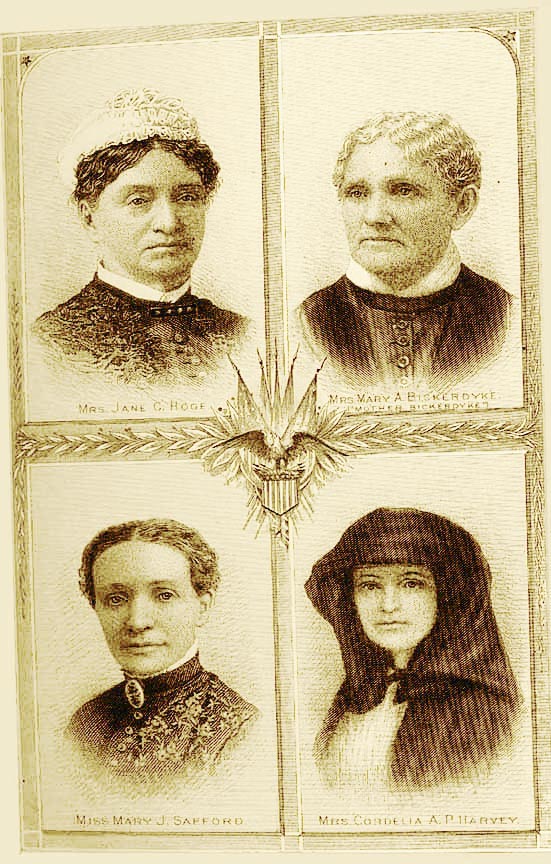
There was always more or less volunteer and transient help in the rooms. Sometimes companies of ladies, who gave their services on certain days; sometimes young girls, who caught the patriotic spirit of the time, and craved a share in the work; sometimes detailed soldiers from Camp Douglas, doing guard duty over rebel prisoners; sometimes convalescent soldiers from the hospitals, who sought to dispose of the lagging hours while awaiting transportation to their regiments. There was never any lack of employment. The rush of business lasted all day and ran over into the midnight. We frequently took letters to our homes requiring immediate answer, and in the stillness of the night overtook the work that outran our most diligent efforts during the day. Not even could we control the hours of Sunday during those busy, years. The work of hospital relief ran over into them, and busy scenes were sometimes enacted at the "rooms," of which the closed doors gave no hint to the thronging church-goers. It is lawful to do good on the Sabbath day."
A description of "A DAY AT THE ROOMS OF THE SANITARY COMMISSION," which I wrote at the. time for the columns of my husband's paper, gives a vivid idea of the routine of daily life in the busy office, and so I transcribe it here:---
"It is early morning,---not nine o'clock, for the children are flocking in merry droves to school. The air is resonant with their joyous treble and musical laughter, as with clustering heads and interlacing arms they recount their varied experiences since they parted the night before, and rapturously expatiate on the delights of a coming excursion or promised picnic. With a good-bye kiss, I launch my own little ones, bonneted, sacqued, and ballasted with books, like the rest, into the stream of childhood that is setting in a strong, full current towards the schoolroom. I then catch the first street-car and hasten to the rooms of the 'Northwestern Sanitary Commission.'
"Early as is my arrival, a dray is already ahead of me, unloading its big boxes and little boxes, its barrels and firkins, its baskets and bundles. The sidewalk is barricaded with the nondescript and multiform packages, which John, the faithful porter, with his inseparable truck, is endeavoring to stow away in the crowded 'receiving-room.' Here, hammers and hatchets, wedges and chisels are in requisition, compelling the crammed boxes to disgorge their heterogeneous contents, which are rapidly assorted, stamped, repacked, and reshipped, their stay in the room rarely exceeding a few hours.
"I enter the office. Ladies are in waiting, desirous of information. The aid society in another state, of which they are officers, has raised at a Fourth of July festival some six hundred dollars, and they wish to know how to dispose of it, so as to afford the greatest amount of relief to the sick and wounded of our army. They were also instructed to investigate the means and methods of the Commission, so as to carry conviction to a few obstinate skeptics, who persist in doubting if the Sanitary Commission, after all, be the best means of communication with the hospitals. Patiently and courteously the history, methods, means, views, and successes of the Commission are lucidly explained for the hundredth time in a month, and all needed advice and instruction imparted; and the enlightened women leave.
"An express messenger enters. He presents a package, obtains his fee, gets a receipt for the package, and without a word departs.
"Next comes a budget of letters---the morning's mail. One announces the shipment of a box of hospital stores which will arrive to-day. Another scolds roundly because an important letter sent a week ago has not been answered, while a copy of the answer in the copying-book is indisputable proof that it has received attention, but has in some way miscarried. A third narrates a bugaboo story of surgeons and nurses in a distant hospital, with gluttonous habits, who are mainly occupied in 'seeking what they can devour' of the hospital delicacies, so that little is saved for their patients. A fourth pleads passionately that the writer may be sent as a nurse to the sad, cheerless, most poorly furnished and far-away hospitals. A fifth is the agonized letter of a mother and widow, blistered with tears, begging piteously that the Commission will search out and send to her tidings of her only son,---
and has not been heard from since the battle of Grand Gulf. A sixth asks assistance in organizing the women of a distant town, who have just awaked to their duty to their brothers in the field. A seventh is a letter from two nine-year-old girls, who have between them earned five dollars, and wish to spend it for 'the poor sick soldiers.' God bless the dear children! An eighth begs that one of the ladies of the Commission will visit the aid society of the town in which the writer lives, and rekindle the flag flagging zeal of the tired workers. They propose to cease work during the hot weather, forgetting that our brave men halt not on their marches, and postpone not their battles, because of the heat or of weariness. A ninth announces the death of one of our heroic nurses, who was sent by the Commission a few months ago to Tennessee---a serious, comely girl, with heart as true as steel, and soul on fire with patriotic desire to do something for her country, and who has now given her life. And so on through a package of twenty, thirty, forty, sometimes fifty letters; and this is but one mail of the day---usually the heaviest, however.
"Now begins the task of replying to these multitudinous epistles---a work which is interrupted every five minutes by some new comer. A venerable man enters, walking slowly, and my heart warms towards him. I remember my aged father, a thousand miles away, who is, like him, white-haired and feeble. He has been here before, and I immediately recognize him.
"Have you heard anything yet from my son in Van Buren Hospital, at Milliken's Bend?'
"'Not yet, sir; you know it is only nine days since I wrote to inquire for him. I will telegraph if you think best.'
"No matter;' and the old man's lip quivers, his figure trembles violently, a sob chokes him, his eyes fill with tears, as with a deprecating wave of the hand he says, 'No matter now!'
"I understand it all. It is all over with his boy, and the cruel tidings have reached him. I rise and offer my hand. He encloses it convulsively in his, leans his head against the iron column near my desk, and his tears drip, drip steadily.
"'Your son has only gone a little before you,' I venture to say; 'only a hand's breadth of time between you now.'
"'Yes,' adds the poor old father; 'and he gave his life for a good cause---a cause worthy of it if he had been a thousand times dearer to me than he was.'
"'And your boy's mother---how does she bear this grief?' The tears rain down his cheeks now.
"' It will kill her; she is very feeble.'
"What shall assuage the sorrow of these aged parents, bereft of the son of their old age by the cruel war that slavery has invoked? Sympathy and comfort are proffered the poor father, and after a little the sorrowing man turns again to his desolate home.
"A childish figure drags itself into the room, shuffles heavily along, drops into a chair, and offers a letter. What ails the little fellow, whose face is bright and beautiful, and yet is shaded by sadness? I open the letter and read. He is a messenger-boy from Admiral Porter's gunboats, who is sent North with the request that the child be properly cared for. Not thirteen years old, and yet he has been in many battles, and has run the gauntlet of the Vicksburg batteries, which for ten miles belched forth red-hot and steel-pointed shot and shell, in fruitless efforts to sink the invulnerable ironclads. Fever, too much medicine, neglect, and exposure, have done their worst for the little fellow, who has come North, homeless and friendless, with the right side paralyzed. He is taken to the exquisite tenderness of the Soldiers' Home,' and for the present is consigned to the motherly care of the good ladies who preside there.
"Who next ? A bevy of nurses enter with carpetbags, shawls, and bundles. A telegram from the Commission has summoned them, for the hospitals at Memphis need them, and straightway they' have girded themselves to the work. One is a widow, whose husband fell at Shiloh ; another is the wife of a lieutenant at Vicksburg ; a third lost her brother at Chancellorsville ; a fourth has no family ties, and there is no one to miss her while absent, or to mourn her if she never returns. They receive their instructions, commissions, and transportation, and hurry onward. God guide you, brave, noble women
"Ah! that white, anxious face, whiter than ever, is again framed in the doorway. Is there no possible escape from it ? One, two, three, four days she has haunted these rooms, waiting the answer to the telegram despatched to Gettysburg, where her son was wounded ten days ago. The answer to the telegram is this moment in my pocket---how shall I repeat its stern message to the white-faced, sorrow-stricken mother? I involuntarily leave my desk, and bustle about, as if in search of something, trying to think how to break the news. I am spared the effort, for the morning papers have announced her bereavement, and she has only come to secure the help of the Commission in obtaining possession of her dead. There are no tears, no words of grief; only a still agony, a repressed anguish, which it is painful to witness. Mr. Freeman accompanies her to the railroad officials, where his pleading story wins the charity of a free pass for the poor woman to the 'military line.' There she must win her way, aided by the letters of endorsement and recommendation we give her. Bowing under her great sorrow, she goes forth on her sacred pilgrimage. Alas how many thousand mothers have been bereft at Vicksburg and Gettysburg, refusing to be comforted, because their children are not!
"Soldiers from the city hospitals visit us, to beg a shirt, a pair of slippers, a comb, or a well-filled pincushion, 'something interesting to read,' or 'paper, envelopes, and stamps,' to answer letters from wives, mothers, and sweethearts. They tarry to talk 'over their trials, sufferings, and privations, and their anxiety to get well and join their regiments, 'which is better than being cooped up in a hospital, even when it is a good one.' They are praised heartily, petted in motherly fashion as if they were children, which most sick men become, urged to come again, and sent back altogether lighter-hearted than when they came.
"And so the day wears away. More loaded drays drive to the door with barrels of crackers, ale, pickles, sauer-kraut, and potatoes, with boxes of shirts, drawers, condensed milk and beef, with bales of cotton and flannel for the sewing-room, all of which are speedily disposed of, to make room for the arrivals of the morrow. Men and women come and go---to visit, to make inquiries, to ask favors, to offer services, to criticise and find fault, to bring news from the hospitals at Vicksburg, Memphis, Murfreesboro' and Nashville, to make inquiries for missing men through the 'Hospital Directory' of the Commission, to make donations of money, always needed, to retail their sorrows, and. sometimes to idle away an hour in the midst of the hurrying, writing, copying, mailing, packing and shipping of this busy place.
"The sun declines westward, its fervent heat is abating, and the hands of the clock point to the hour of six, and sometimes to seven. Wearied in body, exhausted mentally, and saturated with the passing streams of others' sorrows, I select the letters which must be answered by to-morrow morning's mail, replies to which have been delayed by the interruptions of the day, and again hail the street-car, which takes me to my home. Its pleasant order and quiet, its welcome rest, its cheerful companionship, its gayety, which comes from the prattle and merriment of children, who have a thousand adventures to narrate,---all seem strange and unnatural after the experiences of the day. It is as if I had left the world for a time, to refresh myself in a suburb of heaven. And only by a mental effort do I shut out the scenes I have left, and drop back for a time into my normal life---the life of a wife, mother, and housekeeper. I try to forget the narratives of gunshot wounds, sabre strokes, battle and death, that have rained on me all day. This hour with my husband and children shall not be saddened by sketches of the suffering men and women who have defiled before my vision during the hours of daylight. There is a bright side even to these dark pictures; and there comes to me like a tonic the grand solace of the poet:---
"'Above, or underneath,
What matters, brothers, if we keep our post
At truth's and duty's side!
As sword to sheath,
Dust turns to grave---but souls find place in Heaven! '"
A CAMPAIGN PLANNED BY A WOMAN---DESPERATE BATTLES---TERRIBLE SCENES ON THE BATTLE-FIELD---TERRIFIC FIGHTING AND APPALLING SUFFERING---THE AGONIES OF WAR.
General McClellan supersedes General Scott---Missouri becomes the Field of Battle---General Grant wins a Victory at Belmont---Fleet of "Ironclads" for Service on Southern Rivers---The "Tennessee Campaign" planned by Anna Ella Carroll, of Maryland---Plan adopted by President Lincoln and Secretary Stanton---Carried out by General Grant---The "Court of Claims," in 1885, decides in her Favor---Fort Henry on the Tennessee captured by Gunboats---They fail to take Fort Donelson on the Cumberland---General Grant attacks by Land---The Fort surrenders, after three Days' Fighting---"Unconditional Surrender Grant!---"Joy of the Northwest---Frightful Suffering of the Wounded---Many frozen to Death on both Sides---The People move to succor the Wounded--Immense Quantities of Supplies forwarded---Seven thousand Prisoners sent to Camp Douglas---Five hundred die.
 FTER the battle of Bull Run had
been fought and lost, there was a lull in the storm of war on
the Atlantic Coast. "All is quiet on the Potomac!" was
daily bulletined from the army for months, until the people became
depressed and exasperated. They could not understand the strange
inactivity of the land forces, nor the timidity and weakness of
the government.
FTER the battle of Bull Run had
been fought and lost, there was a lull in the storm of war on
the Atlantic Coast. "All is quiet on the Potomac!" was
daily bulletined from the army for months, until the people became
depressed and exasperated. They could not understand the strange
inactivity of the land forces, nor the timidity and weakness of
the government.
In November, 1861, Major-General Scott, weighted with age and infirmities, resigned his position, and young General McClellan was installed in his place as commander-in-chief of the army. The heart of the nation went out to him in trust and affection, and it bent its ear southward, to catch the first sound of the forward movement of the mighty host under his leadership. The government had now in its service for the suppression of the rebellion six hundred and eighty-two thousand soldiers and sailors, and a larger force was at its disposal whenever it was demanded. But the mild weeks of the autumn dragged away, now and then a fierce storm presaged the coming winter; and yet the dreary bulletin was daily repeated, "All is quiet on the Potomac!"
In the meantime all eyes were turned to the West, for Missouri had become the great field of battle. General Fremont had returned from Europe in June with arms for the government, and had been assigned to the Department of the West. He reached St. Louis in July, and took command. Before he had had time to acquaint himself with the condition of affairs, to organize an army, or decide on a plan of action, the battle of Wilson's Creek occurred, in which General Lyon was killed, and a large portion of Missouri was left in the hands of the rebels. Then came the battle of Lexington, in which the enemy was again victorious, and Missouri was now the scene of widespread devastation and blood. Small bodies of troops kept the field, and there were incessant skirmishes and combats. Remote towns were occupied alternately by the Unionists and the enemy. Railroads and bridges were destroyed, houses and barns fired, families scattered, neighborhoods desolated, and murders were of constant occurrence.
Later, in November, an expedition was sent from Cairo, under General Grant, to break up a camp of the enemy in Belmont. It was not only done, but more was accomplished than was proposed, which toned up the troops engaged in the fight to great confidence and fortitude. Almost simultaneously with the battle of Belmont, Major-General Halleck superseded Fremont.
During the first two years of the war, the naval forces took a very prominent part in all Western operations. The blockade of the Mississippi and the breaking out of hostilities had thrown large numbers of the river steamers out of occupation. When these were sheathed with iron, they could defy the heaviest artillery of the enemy; and, as they were of light draught, they could steam up shallow streams into the interior of the country, and make their way in rivers at the lowest stage of water. When these "ironclads" carried heavy guns, as most of them did, they were especially dreaded by the enemy.
Early in the year 1862 a fleet of these dreaded ironclads moved down the Southern rivers, and began the long-talked-of advance into the Confederate States. No decisive blow had yet been struck at the rebellion, but there seemed now to be a purpose to wrest the valley of the Mississippi from the control of the enemy. It was seen that the strategic key of the war of the Southwest was not the Mississippi, but the Tennessee. It was determined to break the line of defences along the Tennessee and Cumberland rivers by taking Forts Henry and Donelson, both of them strong fortifications. Fort Henry was on the Tennessee and Fort Donelson on the Cumberland, only twelve miles apart, in Tennessee, near the state line.
This change of plan---which transferred the national armies from Cairo and Northern Kentucky to a new base, in Northern Mississippi and Alabama, and which made the fall of the Confederacy inevitable---has a remarkable history. It was planned by a woman, Anna Ella Carroll, of Maryland, a descendant of Charles Carroll, of Carrollton, of Revolutionary times, and whose father was governor of the state in 1829. Belonging to one of the first families of the country, of brilliant intellect, and intensely loyal to the Union, she comprehended state and military questions with wonderful clearness. She wrote and published papers and pamphlets on some of the debated important topics of the time, that attracted the attention of leading members of Congress, and made her one of the advisers of President Lincoln. She was admitted to his presence at all times, and "he reserved a special file for her communications."
By advice of the War Department she went to St. Louis in the fall of 1861, and there studied and planned the Tennessee campaign, which was adopted by the administration, and carried out by General Grant. By this campaign the Confederacy was cut in twain, the Mississippi was opened to Young's Point, opposite Vicksburg, European intervention with the United States was averted, the national credit was revived, the heart of the country strengthened, and its drooping courage toned up to firm resolution.
Not only did President Lincoln acknowledge Miss Carroll to be the author of the plan of the Tennessee campaign, but Secretary Stanton gave her the same credit. So also did Hon. Henry Wilson, Chairman of the Senate Military Committee of the Forty-Second Congress, in a report on the memorial of Miss Carroll, asking for compensation for her services, as she had become an invalid and was in want.
Hon. B. F. Wade, Chairman of the Committee on the Conduct of the War, was most emphatic in testifying to Miss Carroll's authorship of the plan of the campaign, as was Hon. L. D. Evans, of the Supreme Court of Texas. Their letters and statements have been published again and again, and have now passed into history.
At last the Court of Claims, which decides all cases on their merits, has, after careful consideration, decided in her favor. It has "substantiated the claim to recompense she long ago made before Congress for services performed during the civil war." That she has been obliged to wait until the present time for recognition is pitiful. But the delay has arisen from two formidable obstacles, as was stated before the Court of Claims: first, the unfavorable attitude of the military mind towards what emanates from outside circles; and, secondly, the fact that the claimant is a woman---a fact for which she is not responsible---has operated against her through all these years in a powerful manner.
In pursuance of this plan of the Tennessee campaign, Fort Henry was first attacked. Commodore Foote, with seven gunboats, engaged the batteries on the river front; and before General Grant had arrived with his troops from Cairo, the main force of the enemy retreated to Fort Donelson, and the remainder surrendered.
Fort Donelson was next attacked, lying nearly opposite Fort Henry, a stronger and more important position, garrisoned by twenty-one thousand troops. General Grant moved his forces across the country, and invested the place, while waiting for Commodore Foote with his gunboats, which were to engage the river batteries, as at Fort Henry. The three days of the fight, the thirteenth, fourteenth, and fifteenth of February, were days of intense anxiety in the West, specially in Chicago. It was known that the attack y water, which had been so easily successful at Fort Henry, had failed at Donelson through the disabling of Commodore Foote's gunboats; and the heart of the Northwest was sick with forebodings of failure.
When, therefore, on Sunday, the sixteenth, the telegraph flashed to the nation the news of Grant's victory,---that nearly fifteen thousand troops, sixty-five guns, some of them of the largest calibre, and seventeen thousand six hundred small arms, had fallen into the hands of the victor,---the delight of the West was boundless. "The whole of Kentucky and Tennessee fell at once into the hands of the national forces. The Tennessee and Cumberland rivers were opened to national vessels for hundreds of miles. Nashville, the capital of Tennessee, and a place of immense strategic importance, fell. And the Mississippi was left free of the rebel flag from St. Louis to Arkansas." All this was the legitimate result of the capture of Fort Donelson. It was a great victory, and the first of any importance since the beginning of the war. Great as were its military results, its happy effect on the spirits of the soldiers and the people was even greater.
No one of the later or larger victories of the war, not even the fall of Richmond, awoke the enthusiastic delight of the Northwest like the fall of Fort Donelson. Bells rang; cannon thundered the general joy; bands perambulated the streets of the cities, playing the national airs, deafening cheers often drowning their music; flags were flung out from almost every house, and where there was any reluctance to give this manifestation of loyal delight, from sympathy with secession, the overjoyed people took possession and compelled the display of the national colors. Many a disloyal wretch who had assisted to plot the rebellion, and had contributed money and arms to the enemy, was compelled to enter his house under the flag of the stars and stripes, which he had been forced to purchase. Men rushed from their stores, offices, counting-rooms, shops, and work-benches, to congratulate one another. They met on the streets and threw their hats in air, embraced one another, wept, and shouted.
The public schools of Chicago had each purchased a flag by joint subscription, and a flagstaff had been planted on the roof of every one of the handsome brick schoolhouses for just such occasions as this. So the boys ran up their flags amid immense cheering, and, under the direction of the teachers, the day was given up to patriotic dissipation. National songs were sung, patriotic scraps of speeches found in the reading-books were recited, and the location and importance of Fort Donelson were explained to the young people. When the hour of dismissal came, they added to the joyful confusion of the streets by shooting out of the schoolhouses like bombs from mortars, with shrill and prolonged hurrahs leaping from their lips as they rushed through every part of the city. Night came, and the people crowded the churches to return thanks to God. Meetings were held to raise funds for the relief of the wounded. The streets blazed with bonfires, and the glare of the flames was like that of a great conflagration. Nor did the rejoicings cease until physical exhaustion compelled an end of them.
With the news of the victory the telegraph flashed the terrible needs of the wounded men. During the first day of the fight a cold, heavy rain fell ceaselessly, converting the roads into rivers of mud, through which the troops painfully toiled. During the night the rain changed to sleet and snow, and the wind blew in fierce, wintry gusts, the weather became intensely cold, and the thermometer dropped to zero. Our brave fellows were mostly young, and not yet inured to the hardships of war. With the improvidence of inexperience, they had thrown away their blankets on the march, and had only the insufficient rations they had brought in their haversacks, of which they had been very careless. They had no tents; were obliged to bivouac in line of battle, lying on their arms; and as the rebel pickets were out in strong force, no fires could be kindled, as their position would be revealed.
The enemy were in much worse plight, as, in addition to their foodless, fireless and tentless condition, they were poorly clad. All through the long winter night both armies were pelted by the driving, pitiless snow and hail. Many of the soldiers on both sides were frozen to death before morning. "An incessant firing was kept up by the pickets; and the groans of the wounded, who lay shivering between the two armies, calling for help and water, were heard all through the night." Meantime the muffled sounds that came from the front during the pauses of the storm told them that the enemy were receiving heavy re-enforcements. The next two days were equally bleak and cold; and the men bivouacked each night on their arms, in the snow, and on the frozen ground. In the morning they were roused from their icy couches, and stumbled stiff and shivering into their places in the ranks.
The very topography of the battle-field added to the miseries of the fight. It was made up of hills and valleys, stretched across ravines and broken ground, and extended through dense forests. Every commanding height bristled with cannon, constantly sending shot and shell among our men massed below. Every position of the enemy on the precipitous heights was carried by storm. Our brave men, in regiments, swept up the steep sides of the hills, in the face of sheets of fire, and amid tempests of balls. The gaps in their ascending ranks were instantly closed, and, stepping over the dead and wounded, they pressed resistlessly on, silent as death, reserving their fire till they reached the crest of the heights. Then, with exultant shouts, they poured in their volleys of shot, and flung themselves like an avalanche on the enemy, driving them at the point of the bayonet. All through the three days of the struggle, the roar of the contending hosts was like that of a tornado, as they surged back and forth through the forest, strewing it with dead and wounded.
But few of the wounded could be removed from the field while the fight lasted. There they lay, some two and three nights and days, uncared for, many freezing to death. Hundreds who fell in the beginning of the battle, when the ground was soft and muddy, were frozen into the earth; and it was necessary to cut them out of the ground, when attention could be given them, and in this deplorable plight they were taken to the extemporized and unready hospitals. Their removal was horrible torture; for there were few ambulances, and the wagons and carts impressed into the service were of the rudest construction, and generally lacked springs. In these the pool. fellows were jolted and pitched down the precipitous heights, where they had lain for two or three days and nights, encased in bloody and frozen uniforms. Any convenient shed, barn, house, or church received them. They were laid on the bare floor, their wounds undressed, their frozen clothing unchanged, faint from loss of blood' and extreme bodily anguish, and hundreds died miserably before relief came to them.
The surgeons of the government were few in number, and its medical supplies utterly inadequate to the occasion. But the people moved to the succor of the wounded, with a royal generosity. The Chicago Board of Trade immediately raised three thousand dollars, needed supplies were purchased, and a committee of citizens started for the scene of suffering. Seventeen physicians were sent down on the first train that left Chicago after the fall of Donelson was known. The Chicago Sanitary Commission had been sending supplies to its depot in Cairo for weeks, at the rate of a thousand dollars' worth daily, and it continued to do this for weeks afterward. These were drawn upon ad libitum for the occasion.
Floating hospitals, or "Hospital Steamers," as they were called, which after this were always in the near neighborhood of the gunboats as they advanced down the Southern rivers, were rapidly fitted up and loaded with supplies by the Chicago and St. Louis Commissions and sent on their errands of mercy. Merchants, lawyers, clergymen, women, ten times as many as were needed, volunteered as nurses. Spontaneous contributions of sheets, pillows, shirts, lint, bandages, jellies, canned fruits, and other stores of the housewife, were poured into the recently opened rooms of the Commission in magnificent abundance. There was but one heart in the community, an eager and determined purpose to alleviate the sufferings of the heroes of Donelson. Every day's fuller report of their bravery and indescribable endurance only intensified the compassion and gratitude of the great Northwest, not then as rich and powerful as now,---and there was no withholding anywhere.
The elation of the country was boundless. After so many delays and defeats, this victory cheered the nation and inspired, the army. General Grant had won national fame. His memorable answer to General Buckner, the rebel commander, who proposed "the appointment of commissioners to settle terms of capitulation," gave him the hearts of his countrymen.
"No terms except immediate and unconditional surrender can be accepted. I propose to move immediately on your works." The speech and the deed, of the not yet recognized leader, were indications of character. The enthusiasm of the Western army was enkindled. They dubbed their commander "Unconditional Surrender Grant," declaring this to be the name indicated by the initials "U. S."
There was a great lack of hospital clothing, and one of the largest halls of Chicago was loaned to the women for its manufacture. To this hall they flocked in such numbers, that it was necessary to apportion the days of the week to the various districts of the city, so as to accommodate all the willing workers
Every sewing-machine office in the city put its rooms, machines and operators to the same service, to the entire suspension of its own business. Never was clothing manufactured more rapidly; for the machines were run into the small hours of the morning, and there was no slacking of effort while the urgent demand lasted. It was the same all over the West. The facts of the desperate battle, the severe exposure of the wounded, the incomplete preparations for their removal and care, the great destitution of surgeons, instruments, supplies, of everything that was needed,---as these became known to the people, their patriotic generosity was stimulated to fever heat.
Seven thousand of the enemy taken at Fort Donelson were sent to Chicago as prisoners of war, and were given accommodations at Camp Douglas. They were quartered in the same barracks, and were furnished with the same rations, both a to quality and quantity, as were accorded our own troops that had occupied the camp a few months before. It was amusing, as well as pathetic, to listen to their openly expressed satisfaction. "You-uns got better grub than we-uns down South; better barracks, too." A more motley looking crowd was never seen in Chicago. They were mostly un-uniformed, and shivering with cold, wrapped in tattered bedquilts, pieces of old carpets, hearth rugs, horse blankets, ragged shawls,---anything that would serve to keep out the cold and hide their tatterdemalion condition.
They had evidently suffered severely in the terrible three days' fight at Donelson, not only from the arctic weather, but from insufficient food and clothing. If their own pitiful stories were true, they had failed to receive good care from the time they entered the Confederate service. They seemed a poorly nourished and uncared-for company of men, and their hopeless and indescribable ignorance intensified their general forlornness. Despite good medical attendance in camp and hospital, and notwithstanding the sick lacked for nothing in the matter of nursing and sick-diet---so well managed was the hospital, and so constant the ministrations of the women of Chicago---more than five hundred of them died at Camp Douglas before they were exchanged. It was pitiful to see how easily they gave up all struggle for life, and how readily they adjusted themselves to the inevitable. Not less uncomplainingly than the camel, which silently succumbs to the heavy load, did these ignorant, unfed and unclad fellows turn their faces to the wall, and breathe out their lives, without a regret, or a murmur.