
| The departure from my house---How we passed through the Porte Maillot---A little history---The Empress talks freely---The French people---Saint-Germain-en-Laye---On the road to Poissy---We stop at the wine-shop of Madame Fontaine---A la bonne franquette---We stop again near Mantes---O fortunatos agricolas---I procure another carriage and fresh horses---The formation of the new Government is reported to her Majesty---Her astonishment on hearing that General Trochu was the President of this Government---Her comments---Could she no longer rely on any one?---The consequences of the Revolution in Paris not fully apprehended at the time---The Empress discusses the situation---Her courage---Her patriotism |
 T was about five o'clock on the
morning of September 5th when I rapped upon the door of her Majesty's
room, and informed her that the hour fixed for our departure was
at hand. Soon after we had taken a light breakfast---a cup of
coffee and a roll---a servant announced that my landau, a four-seated
covered carriage, was at the door, and we were ready to go.
T was about five o'clock on the
morning of September 5th when I rapped upon the door of her Majesty's
room, and informed her that the hour fixed for our departure was
at hand. Soon after we had taken a light breakfast---a cup of
coffee and a roll---a servant announced that my landau, a four-seated
covered carriage, was at the door, and we were ready to go.
We left the house dressed as we were the evening before. Not a bag, not a package even of toilet articles, did one of us carry. The Empress had on a black cashmere dress, which, she told me afterward, she had not taken off for nearly a week, subject as she had been to calls at every hour of the day and night. Over this she wore a dark-colored, thin waterproof cloak or mackintosh. A narrow, white collar about the neck, dark gloves, and a round, black Derby hat, to which was attached a plain black veil, completed her costume. Not the slightest attempt had been made to disguise her person, beyond such concealment as might be afforded by a dress too simple and common to attract attention. In the hurry of leaving the palace she had taken with her absolutely nothing more than the clothes she wore, except a small reticule, in which were a couple of handkerchiefs. She had no visible jewels with her, or money, or valuables of any sort. Madame Lebreton, her companion, was also very simply dressed, and without wraps, or articles de voyage of any kind whatsoever.
Madame Lebreton entered the carriage first, taking the back seat on the right hand; the Empress took the seat on the left. Dr. Crane sat opposite Madame Lebreton, and I took the place opposite the Empress. This disposition of seats had been prearranged; it would, in a measure, keep the Empress out of sight of the guards stationed on the left-hand side of the gate through which we were to pass. The carriage was closed, a window only being open on the side taken by Madame Lebreton and Dr. Crane. My faithful coachman, Célestin, was on the box. I told him to drive to Saint Germain.
It was a few minutes before sunrise when we started on our journey. The sky was cloudless; the atmosphere seemed slightly hazy in the soft gray light; the air was cool and fresh, but there was no wind. It was, in short, a lovely September morning, and everything gave promise of the fine day it proved to be. As we crossed the section of the city between my house and the foot of the Avenue de la Grande Armée, we saw the street-sweepers at their work, shutters being taken down by shopkeepers, market-wagons, and milk-carts, and other familiar indications of the hour-evidence, in a word, that the events of the preceding day had not interfered perceptibly with the functions most intimately connected with the organic life of the city. When we arrived at the gate we were ordered to halt. As the officer of the guard approached, I let down the window at my right; and on his coming close to the door of the carriage and asking me where we were going, I leaned forward, and, partly filling the opening with my head and shoulders, told him that I was going with my carriage, horses, and coachman into the country to spend the day with the friends who were with me; that I was an American; that I lived in Paris, and was well known to everybody in the neighborhood. He did not ask my name. Had he done so I probably should have given it. My reply to his question seemed to be perfectly satisfactory to him; for, stepping back, he looked up at the coachman, and said, "Allez " (go on).
I may add, to complete the account of this interview with the guard at the Porte Maillot, that, fearing a person on coming close to the carriage might see and have too good an opportunity to inspect the occupants of the back seat, I had provided myself, before starting off, with a newspaper to be used as a screen, should the case require it. While speaking with the officer on guard, I held the paper loosely opened in my left hand, which rested on the side of the window nearest the Empress. This newspaper completely concealed her face from the view of any one standing on that side of the carriage.
As I leaned back in my seat I heard the rumble of our wheels as we went over a sort of drawbridge thrown across the moat in front of the fortifications, which had been extended and cut through the roadway, and I caught a glimpse of some palisades and earthworks that had just been erected to defend this entrance to the city in the event of a siege. In a moment we were past the outposts and the sentries, and I was greatly delighted to know that we had escaped the first, and perhaps greatest, danger we were to meet on our journey. Indeed, it was an immense relief to every one of us to feel that, after the long hours of anxious waiting through the night for the day to come, we were now safely out of Paris and on our way to the coast.
But I could not help looking back once more upon the city where I had resided so many years, and which I had left, in all probability, for a long time, perhaps forever; for the future nobody could foresee, and all the indications seemed to justify the most gloomy apprehensions. Behind us loomed up the majestic form of the Arc de Triomphe, reminding me of the first Napoleon, of his prodigious achievements and his wonderful career, but also of the fate of his Empire, and of the man whose sole aim was the glorification of France. And was history about to repeat itself? The successor and continuator of the grand ideas of the great Captain was to-day a prisoner of war; and she to whom only a few weeks before the world was only too eager to pay homage, dethroned and abandoned, was fleeing from her capital under cover of the dawn.
Continuing on our way down that celebrated avenue along which "the Grand Army" of Napoleon had so often marched in triumph, and coming in sight of Courbevoie, the sunlight fell upon Mont Valérien, and illuminated the hills on the left bank of the Seine, at the feet of which, close by the river, framed in foliage just beginning to be touched by the tints of autumn, lay the villages of Puteaux, and Suresnes, and Saint Cloud; while higher up, in the park of Montretout or on the wooded slopes and green terraces in front of us, glimpses of the red roofs, or white, shining walls of villas or kiosks were to be seen. The landscape that was spread out before us was most charming, full of natural beauty and repose, but at this early hour so wonderfully still, so suggestive of peace and happiness, and so contrasting with the noisy scenes of passion and violence which we had just witnessed, as to make us feel that we were now in quite another and altogether blessed and heavenly world. The very sight of the open country relieved the tension of our jaded nerves, and we began to breathe more freely under the spell of its soothing and benign influence. Our hearts were full of the joy of a deliverance from a great danger; and the fresh morning air that entered our carriage windows, now opened, was most grateful to us, especially to her Majesty, who had been subjected so long to the terrible weight of official responsibility and personal anxieties.
Yet there was something inexpressibly sad in the thoughts suggested at every turn of our route. On the right once stood the Château of Neuilly, the favorite residence of Louis Philippe. It was only a little over twenty years before, in February, 1848, that I had seen this splendid building plundered by the mob, and almost burned to the ground. And soon we were passing by the bronze statue of the ''Little Corporal," standing like a sentry on guard at the end of the broad Avenue in the Rond-Point of Courbevoie---but since removed by the "Patriots" and pitched into the Seine. Two or three miles farther on we came in sight of the Church of Rueil, where rest the ashes of the Empress Josephine, and of Queen Hortense, the mother of Napoleon III. And this mother was herself a fugitive from the Tuileries, when, in March, 1814, the victorious army of the allies reached Paris; and as she escaped from the city she heard the guns that fired the last shots in its defense from the Buttes Chaumont. Strange as it may seem, these guns were under the command of Colonel Porto Carrero, Count de Téba, the father of the Empress Eugénie. A few minutes later we passed the gate of the Park of Malmaison, the famous Château in which the Empress Josephine so long resided, and where she died; and where, after Waterloo, Napoleon sought a refuge for a day with his mother; and whence, with a "Good-by, mother," "Good-by, son," mother and son separated, she to be thenceforth, to use her own words, "la mère de toutes les douleurs," and he, the son, never to see France again; and where Napoleon III. also saw for the last time his uncle, who, as he turned to leave the house, seeing the little Prince, caught him up in his arms, and with tears in his eyes kissed him again and again. Is it strange that the great image of Napoleon should have been graven upon the heart of this child, there to remain forever?
What memories this word "Malmaison" brought. to mind! Everything about us was suggestive. The very road we were traveling had been a via dolorosa in the history of the Bonaparte family. And of the moving scenes of romance and tragedy of which this place had been the witness, was this hurried flight to be the last?(51)
The spirits of the Empress rose as we went on our way along the route Impériale, the great highway that follows the left bank of the Seine through Bougival, Marly, and Le Pecq, these lovely suburbs of the French capital, where the parks and gardens were still fresh, and clean, and full of color; and she talked freely, and often with great animation, about her present difficult situation, and the events and incidents that had led up to it.
"They asked me to abdicate," she said, "but how could I? How could I, who have acted only as a delegate, abdicate a sovereignty that is not my own? I had, on personal grounds, no objection to doing this; I was quite willing to surrender into the hands of the representatives of the people all my power as Regent, but it seemed to me necessary, in the interests of France, that the Regency should be maintained in name in order to meet with efficiency the exigencies of the moment. And I told them that the one thing, the only thing, that should concern us now is the military situation, the enemy, and our armies; and that in the defense of the country I was ready to assist any persons, no matter who they might be, provided they possessed the confidence of the nation."
Everything indicated that Paris would be besieged within a few weeks; and when her Majesty recalled how much she herself had done to prepare the city for such an emergency, she felt deeply grieved that she should not be permitted to have the just satisfaction of guiding, by her authority and judgment, the defense toward which she had contributed so much. How willingly would she have run all risks, and have made every sacrifice for her subjects! How gladly would she have shared their sorrows and misfortunes! How bravely would she have endured all suffering!
"I could have been," she said, "of service in many ways. I could have been an example of devotion to my country. I could have visited the hospitals; I could have gone to the outposts; I could have encouraged and stimulated the defense at every point of danger by my presence." Finally, wrought up, as it were, to a state of exaltation by her own words, she cried out: "Oh, why could they not have let me die before the walls of Paris!"
She referred with indignation to the attempts that had been made to throw upon her personally the responsibility for the war---a war justifiable solely because German diplomacy had put in jeopardy the prestige of the French nation; and which had been precipitated by the clamor of the very persons who were now trying to disclaim any responsibility for its consequences, and at the same time were rejoicing at the opportunity thus given them to rise to power on the ruins of the State. "The French people," she went on to say, " have great and shining qualities, but they have few convictions, and lack steadfastness. They are versatile, but volatile. They love glory and the sunshine, but have no heart for reverses of fortune. With them the standard of right is success. In France we are honored to-day and banished to-morrow. It has sometimes seemed to me that the French set up their heroes, as it were, on pedestals of salt, so that when the first storm strikes them they tumble down, to lie forever in the mud. In no country in the world is the step between the sublime and the ridiculous so short as in this. And how French history repeats itself! Every Government in France, for a hundred years, with a single exception, has ended in a Revolution and a flight. Only a few days ago I declared to some of those who were near me and were fearful lest the announcement of another defeat might lead to the fall of the Imperial Government, that I never would leave the Tuileries in a cab, as Charles X. and Louis Philippe did. And that is exactly what I have done!" As she said this, she could not resist the impulse to laugh at the comicality of the coincidence.
But the subjects referred to sometimes brought the tears to her eyes; as, for instance, when she told us of the despatch she received from the Emperor on Saturday evening, announcing that the army had surrendered at Sedan, and that he was a prisoner, after having in vain sought to die on the field. "It is terrible!" she exclaimed. "I cannot think of it, and I myself am here a fugitive! It all seems like a horrid nightmare." Then, quickly changing the conversation to some political subject, she discussed it with vivacity as well as with remarkable perspicacity; or some personal incident coming to mind, she narrated it with striking, and often amusing, originality and esprit.
And now the first houses of Saint-Germain-en-Laye came in sight, and the anxieties of the moment arrested the conversation.
We had again come to a place where caution was necessary, because, before entering the city, we had to pass the toll-gate, where the Octroi officers were stationed, and an inspection of our carriage, for the purpose of seeing whether we had with us any articles subject to the Octroi (the city toll), was sure to take place. We could not, of course, avoid this investigation, and I had to think of some device by which I might be able to quiet the suspicions of these toll-takers in case they should be too inquisitive. Remembering that near Saint Germain there lived an English lady, one of my acquaintances, who was very well known, and was loved by all the inhabitants of the neighborhood on account of her charity and kindness to the poor, I had decided to state, should I be asked where we were going, or if any trouble should arise, that we were the friends of this lady, and I was nearly certain that any of her friends would be respected; while at the same time I was persuaded that a few words to Lady Trotter---this was the name of the lady---would be sufficient to make her enter into my plans for the safety of her Majesty.
Fortunately, things turned out better than we had expected, and we were not obliged to appeal to Lady Trotter. The officers, when we reached the gate, permitted our carriage to pass almost without stopping. They had no suspicion of the character or quality of the travelers who with so much anxiety awaited the result of this inspection; it was quite enough for them to know that we did not look like persons who wished to smuggle chickens, or cheese, wine, vegetables, or other similar articles, into the worthy city of Saint Germain.
I will confess I was greatly relieved when we had passed the toll-gate; for I was afraid that my house had been watched, or that our movements after leaving it had attracted attention, and that a telegram might have been sent ahead of us to Saint Germain to stop us on our arrival there.
Although we were tempted to make inquiries here as to whether any special news had been received from Paris, we did not think it wise to ask questions, and so drove on without stopping, leaving the city, a few minutes later, by the gate which opens on the road to Poissy. After a short drive through the beautiful forest of Saint Germain, we reached this town, which is well known as the birthplace of Louis IX.; a fact which suggested to one of our party an additional piece of history, as a pertinent reminder, perhaps, of the transitory glory of this world, namely, that Philip the Fair had a church erected at this place, where once rose the royal residence of his ancestors, and that the altar had been put exactly on the spot where formerly stood the bed in which Blanche de Castille gave birth to the most pious of the French monarchs. King Philip, we were told, did not think that this edifice erected in honor of the Lord would ever succumb to the cruel hand of political revolution. He was mistaken, however. Nothing is eternal but change. And so when the Revolution of '93 came to startle sleeping France, like the sudden eruption of a volcano, the church of Philip and the renowned abbey connected with it were sold to the highest bidder. At present there remains nothing which reminds the visitor to Poissy of the former existence of these splendid memorial buildings, except the font in which Louis IX was baptised, and a leaden urn containing the heart of the pious king.
From Poissy to Mantes, the road follows along the right bank of the Seine, and passes through Triel, Vaux, and Meulan, picturesque towns with interesting histories, which, however, we did not stop to inquire about or care to think about. The history of our own time---of yesterday and to-morrow---was just then what principally concerned us.
As we proceeded on our way, the road, shut in by the hills on the north, and exposed to the sun on the river side, grew dusty, and the glare and the heat became disagreeable and oppressive; but we did not for a moment interrupt our journey until we were about twelve miles from Mantes, when it became evident that our horses needed rest. We stopped, therefore, at a small cabaret by the wayside, where we might obtain some water for our horses, and perhaps some refreshment for ourselves; for Dr. Crane and I, at least, were beginning to feel the need of food, and were of the opinion that it would be prudent not to neglect any opportunity of getting it.
As I was on the point of stepping from the carriage, I heard a certain commotion within the little wine-shop, and almost at the same moment saw at the door a stout, red-faced old woman clinging to the handle of a broom, which seemed to be following in the air just behind a big black cat that was leaping for a clump of lilac bushes near by. "Gros Matou!" cried the woman, as the cat escaped the impending consequences of doubtless some indiscreet breach of the etiquette of the place. This exclamation, breaking sharply the stillness of the brilliant September morning, amusingly accentuated the comic features of a rustic picture worthy of the brush of the elder Teniers. I think it caused a smile to pass over the face even of Madame Lebreton, who was more inclined than her Majesty to consider our situation a sad as well as a serious one, and who had looked sorrowful and weary all the way.
Getting out, I bade the woman good morning, and told her we wished to water our horses and rest them a little; I asked her if she could furnish us also with something to drink or to eat.
Oh, yes," she said; "I can give you some good wine, such as we make here (vin du pays). Come in and try it!"
The doorway in which she stood opened directly into a room that served at the same time as kitchen, wine-shop, and living-room. Entering, I sat down at a rough table, and in a few minutes the woman had placed upon it a bottle of wine and some glasses, a roll of bread a couple of yards long, two or three kinds of cheese, a big bologna sausage, and a knife. The wine and bread and sausage proved to be really good, and Dr. Crane and I obtained here a very satisfactory lunch; but the Empress and Madame Lebreton were not disposed to leave the carriage, nor would it have been prudent for them to have done so.
Madame Fontaine---that was the name of the woman seemed to be greatly pleased by our appreciation of the things she had set before us, and told us that she and her husband, who was a stone-mason, owned the shop. She gave us also to understand that they had prospered because they had always acted on the principle that "good wine needs no bush."
Two years later, when Dr. Crane and I again stopped at this little wayside inn, Madame Fontaine remembered us very well; but to my question as to whether she remembered the appearance of the persons who had remained in the carriage, she replied that she could not, for she had not looked into the carriage because, to use her own words, she thought: "Que c'était un affront de regarder trop ces voyageurs."
Before settling our score with this good woman, we got her to put up in a paper some bread and a piece of the bologna sausage, in case they should be desired or required on our journey. It was rough fare, indeed, but it was the best we could get; and not long after we had set out again on our way, the Empress asked to have the package opened. She then broke off a piece of the bread, and, having eaten it, pronounced it excellent, and borrowed Dr. Crane's pocket-knife to cut off a slice of the sausage. Poor Madame Lebreton, however, seemed to have no appetite for the lunch we had bought at the wineshop. She had not recovered from the shock produced by the events of the preceding twenty-four hours; and she lacked also that rarest of gifts with which the Empress was so richly endowed, the faculty of adapting herself, with the most perfect ease, simplicity, and naturalness, to the conditions of her immediate environment, whatever they might be. Sympathizing as the Empress always did with the common people, with admirable sincerity she could neither see nor feel that there was anything ignoble or unworthy in engaging, whenever it was necessary, in the rough work of the world, and bearing the burden of its physical discomforts and hardships. A State dinner or a picnic à la bonne franquette, whether appearing as the matchless mistress of some tournament of beauty and courtesy at Compiègne, or riding on a camel in the Libyan desert, it mattered little to her, although I think she would at any time have preferred "roughing it "à la guerre comme à la guerre to any function of ceremonial display, not merely as a diversion, but from a romantic sense of the pleasure of winning victories by effort and sacrifice.
Soon after leaving Madame Fontaine's establishment our road led through beautiful scenery, with wheat-fields and orchards and vineyards on either side, and the loveliness and brightness of nature about us, and the all-prevailing quiet contrasted strangely with the complexion of our inmost and constantly recurring thoughts. Everywhere there seemed to dwell peace and happiness. The war, the terrible disasters that had just befallen the nation, the great revolution which had taken place in the Government, hardly affected, seemingly, the light-hearted, simple life within and around the pretty farmhouses and cottages by the wayside.
It was about eleven o'clock when we approached Mantes, and as our horses could not go much farther except after a long rest, I decided to stop at Limay, a suburb on the right and opposite bank of the Seine, and to go myself on foot into the city in order to procure another carriage and fresh horses. The place where we halted was near the Rue Farvielle, just by the junction of the roads leading to Meulan and to Magny. A sign-post stood in the angle of the roads; it bore on one side the inscription, "Route Impériale," and on the other the number 13 and the inscription, "à Meulan 13.5 kilomètres." Over a large ornamental iron gate, at our left, were inscribed Virgil's well-known words:
words that might well have expressed the thought of the unfortunate sovereign herself during the last stage of our journey, and also during the anxious hour of waiting that followed, near this gate, when, looking out from the carriage in which she alone kept her seat, half concealed in the corner, she saw spread out before her in this lovely valley of the Seine the broad and highly cultivated fields that extended southward and westward to the forests, and the blue undulating hills in the far distance, and which lay, as it were, asleep in the soft sunshine---"procul discordibus armis."
A few minutes after having left my companions, crossing the bridge I entered Mantes la Jolie, as it was formerly called. The morning papers from Paris had just arrived, and I went to a small stationery shop in the Rue Royale (now called Rue Nationale), No. 25, belonging to Messrs. Beaumont Frères, and bought copies of the Journal Officiel and the Figaro, which I scanned carefully in order to see if they contained any paragraphs referring to the Empress; but I could not discover any. It seemed that up to the morning of the 5th the disappearance of her Majesty had not been publicly noticed. This gave me some ease of mind; still, it was not clear to me what steps I should take in order for us to continue our journey. While I was thinking over this matter and walking through the streets, without knowing just what to do or where to go, I saw a harmless-looking individual standing before a shop, reading a newspaper; and from an exclamation he gave utterance to, I observed that he seemed to be greatly astonished. The reason of his astonishment was, of course, the news of the Revolution in Paris and the proclamation of the Republic. But pretending not to have any idea of what he had found so startling in his paper, I approached him, and asked him if he would kindly let me know what important event had taken place.
"The Republic has been proclaimed in Paris," he said, "and there is great excitement there on account of the fall of the Empire."
"The fall of the Empire!" I exclaimed, as if surprised. "Are you certain that the report is correct?"
He handed me the paper, and, reading it, I pretended to discover news which was entirely unknown to me and which greatly disconcerted me.
"I must at once go back to the place from which I came," I said, returning to him the newspaper; "I must report to my friends this extraordinary announcement. But where shall I find a carriage? Besides, the Marquis de R----" (I remembered that this gentleman had an estate near Mantes, but I had no idea where it was situated) must know, through me, at once, what has happened, and I shall be greatly obliged to you if you will tell me where I can find a carriage to take me to his château."
Thereupon the good man conducted me to the place where the omnibus office was situated, and told me that here, if anywhere, I would be able to get what I desired.
At the office, which was in the Rue Bourgeoise, No. 36, I inquired if I could obtain there a four-seated carriage with a driver, and was told that I must wait for information until the return of the omnibus, which had been sent off to the railway station with passengers.
I waited for about half an hour. But that half hour seemed a century to me; and I did not dare to walk again through the streets of the town, where I was sure to attract notice; for in French provincial towns every stranger is easily recognized.
At length becoming impatient at this detention, I asked to be shown into the carriage-house, wishing to see for myself if there was really on the premises a conveyance of any sort which we could make use of. To my great dismay, when I entered I saw at first nothing but a two-wheeled vehicle, which, of course, would not have suited us. On looking around, however, I discovered in a corner, partly hidden under a covering, a carriage in which four persons could easily travel; in fact, it would apparently answer our purpose perfectly, as it could be opened or closed as occasion might require.
When the omnibus returned from the station I at once opened a conversation with the man in charge of the stable, by asking him if he could let me have a carriage. His answer quite naturally was: "What kind of a carriage do you want, and where do you wish to go?
I then said to him---thinking it best to tell a plain story, one as near the truth as was prudent---that I had started that morning from Paris in my own carriage with my invalid sister, her doctor, and a lady companion, on the way to Trouville; that we had taken this means of traveling as my sister preferred it to going by the railway; that we had proposed to make the journey by easy stages, but that, unfortunately, we had met with an accident just before reaching Mantes which would make it necessary for us to send our carriage back to Paris and continue our journey in some other way; and that, as this occurrence had interfered with our original plans and most of the day was still before us, we had decided, if we could obtain another carriage in Mantes, to go on to Evreux. I then said to him:
"Can you furnish me with a conveyance suitable to take our party of four persons to Evreux, or to some place on the road where we can obtain a relay to carry us to that town?"
He replied that he could not send us as far as Évreux, the distance, going and returning the same day, being too great for the horses; but that for thirty francs he would give me a landau, with horses and a driver, which would take us to Pacy, where we would have no difficulty in finding a conveyance in which to go on to Evreux, if we wished to do so.
My mind was very greatly relieved when I found that I could get what I so much desired---the means of continuing our journey in the way we had begun it. I therefore accepted at once the terms of this offer, although I should have been still better satisfied had I known that our way was clear to Évreux without a break.
The man then went with me to the carriage-house; the vehicle that I had seen was pulled out, a pair of fairly good horses attached to it, and the driver was told to go with me to the place on the Paris road where we had stopped, and to take our party on as far as Pacy.
A few minutes later I found myself, to my extreme delight, en route; and I was pleased, also, to observe that the "turn-out " I had secured was, taking it altogether, a very comfortable and decent-looking affair, even better suited for the business before us than-the voiture de maitre in which we had made the journey to Mantes, because it would be less likely to attract the attention of those whom we might meet on the way.
After a short drive, we arrived where Célestin, with my carriage, was waiting. When a few rods from the place I told the man to stop; and going to my friends I explained how I had arranged matters, giving to her Majesty and my companions instructions how to act in order to prevent the new coachman seeing her Majesty's face.
This done, I returned, and directed the driver to bring his landau up as close as possible to my own, so that the doors of the carriages should be exactly opposite each other. By this device the Empress, as well as Madame Lebreton, was able to take her seat by simply stepping from one carriage into the other; and as the drivers were facing in opposite directions, neither of them was able to see the travelers without turning and looking back-and this they did not do.
I then gave my coachman, Célestin, orders to return to Paris; and having instructed the driver of our new conveyance to turn about and proceed on his way, passing through the outskirts of Mantes to the route Impériale leading to Évreux, Dr. Crane and I again took our seats in front of the ladies.
When, after leaving the town behind us, we had reached the open country, I reported to her Majesty the news I had obtained at Mantes: that the Republic had been proclaimed at the Hôtel de Ville; that a Ministry had been chosen which included among its members Favre, Gambetta, Cremieux, Picard, and Jules Simon; that the new Government was called " Le Gouvernement de la Défense Nationale"; that apparently it was in full possession of all of the administrative offices, with the army behind it; " for," I added, Trochu, the Military Governor of Paris, is at the head of the revolutionary movement." Her Majesty listened to me with interest while I was speaking of the revolutionary Government as an accomplished fact, but appeared to be anxious only to know who had been made Minister of the Interior, and who Minister of Foreign Affairs. That, the Imperial authority having been momentarily paralyzed by the action of the mob, an attempt should have been made by the enemies of the Empire to profit by the opportunity to seize the sovereign power, seemed to be something that she was quite prepared to hear. When, however, I announced that the Military Governor of Paris (Trochu) had joined hands with the agents of the revolt and had consented to act as their chief, she manifested great astonishment, and at first refused to believe it.
"No, no,'' she said, " this cannot be so! " Then, after a brief pause, she added with much feeling: "How could he go over to the Revolutionists, after the solemn declarations of loyalty and personal devotion that he made to me? I cannot believe it!"
"But, madame," I replied, "here is the Journal Officiel, published this morning, in which there is an account of the proceedings at the Hôtel de Ville that immediately followed the invasion of the Chamber of Deputies.
"You will see," I said, as I handed the paper to her, "the names of the persons calling themselves the Government of the National Defense, and that General Trochu is the President of this Government."
The Empress took the paper, and glancing over the list of names in the new Ministry, her eyes fell on the following words:
"General Trochu, invested with full military powers for the national defense, has been appointed President of the Government.
For the Government of the National Defense,
"LEON GAMBETTA,
"Minister of the Interior."
As soon as she had read this, the paper dropped from her hands, and she exclaimed:
"How was it possible for him to so betray me!" Then, after a few moments, she continued: "Only yesterday morning, spontaneously, of his own volition, he pledged to me, on his honor as a soldier, on his faith as a Catholic and a Breton, that he would never desert me; that whoever might wish to harm me, would have to pass first over his dead body; and those words were spoken with such apparent emotion that I could not suspect his sincerity. His loyalty he proudly proclaimed from the day he was made Governor of Paris. Shortly afterward, at a Council of the Ministers, when the measures to be taken to prevent an insurrection in Paris were brought up for discussion, General Trochu being present, I said: 'In case of a revolt I do not wish you to think of me; but it is most important that the Corps Législatif should be protected.' 'Madame,' said General Trochu, addressing me in a voice indicative of decision and firmness, 'I pledge you my honor that I will protect you, and the Chamber of Deputies also.' Whom could I have trusted, if not him?" ---a soldier selected by the Emperor himself as one especially trustworthy, whose accepted duty it was to defend me, who to the last hour swore fealty!"
Her Majesty seemed to be quite overcome as she spoke. Her voice trembled, the tears came into her eyes, and she remained silent for some time. Then, taking up the paper again, she read over the names of the members of the new Government, two or three of which evoked a smile or a vivacious comment, as she repeated aloud, "Ministre des Affaires Etrangères, Jules Favre; Ministre de l'Intérieur, Gambetta." But she reverted almost immediately to Trochu, whose name, in her mind, seemed to stand for the whole Government, and to suggest the basest kind of personal disloyalty. Nor was it so much the setting up of the Republic that distressed her Majesty; in fact, this appeared to give her very little concern. It was her discovery of the treachery of the soldier, the avowed friend and protector, in whom she had trusted, that weighed most heavily on her mind. It was not the loss of power that she felt, but a keen sense of abandonment, which for the first time had thus been brought home to her. And then there were others who also had stood very near to her; had they, too, deserted her? With the triumph of the mob in Paris, had she lost everything---not only a throne, but friends, and faith in the honor of men? By nature generous, frank, and trustful, and having known in the intimacy of the Court circle only those who had given her every assurance of the sincerity of their friendship and loyalty; never having learned by sad experience to call in question the fidelity of her professed friends; never herself forgetting a favor; never suspecting duplicity and ingratitude in others, one can imagine how cruelly she must have suffered, as this horrible thought forced itself upon her: that many, perhaps most, of those professions of loyalty and love, which she had accepted with confidence and returned even with affection, were mere lip-service, the masks for personal ambitions seeking their own ends, without regard either to honor or conscience. And could she no longer rely on any one to help her and advise her in this hour of great need and difficulty? Was she absolutely alone? What was she to do? What could she do? Such were the questions, such the thoughts, that wrought upon her mind and caused the tears to fall.
But it was not long that these shadows rested upon her face. After a few moments she looked up suddenly, and, smiling through her tears, said: "I shall soon be in England, and then I shall know what is to be done." And the thought of soon seeing again the Prince Imperial, and perhaps the Emperor, quickly dispelled all traces of sorrow, and she talked with hope and confidence of the future. Although occasionally, during this day and the following days, she alluded to the treachery of Trochu, it was with no further manifestation of feeling, except one of contempt.
Indeed, the Empress did not at this time fully apprehend the political consequences of the Revolution. It was not possible then for any one to do so, much less for her, with an imperfect knowledge of the situation as it existed in Paris, of the sentiment of the French nation, and of the policy of the King of Prussia. She knew that the Empire, the French army, and France had met with a series of terrible disasters, and believed that the war with Germany had practically come to an end at Sedan; but she did not seem to think that the Republic proclaimed in Paris was a necessary, or even a probable, final, and substantial consequence of these events. She doubted very much if the King of Prussia would be willing to treat with a Government which was the product of a street riot, and the existence and acts of which were without the sanction of the French people. Furthermore, it remained to be seen how the announcement of this new Government would be received by the army that was under the command of Bazaine.
Certainly it was not likely that a self-constituted Government of Radical Republicans, acting without legitimate authority and absolutely irresponsible, even if recognized by the King and his Councilors, could obtain a treaty of peace except on terms humiliating to the last degree to the amour propre of the French nation. She presumed that the King of Prussia would be willing to conclude a peace with the Imperial Government on conditions that might be accepted with honor. She thought that an effort should be made at once to obtain peace on such conditions. France was not prepared for this war; a great mistake had been made; it should be frankly recognized by all, and the damage repaired to the fullest extent possible. And the Imperial Government, in her opinion, would be far better able than any other to secure peace upon favorable terms, and to mitigate the consequences of the existing military situation. But if such was her opinion, she made it clearly understood that she was speaking not for herself, nor for the dynasty, but in the interest of the French people. "I had," she said, "a thousand times rather abandon every attribute of the sovereign and every dynastic claim, than feel that such claims were an obstacle to an honorable peace and the permanent prosperity of France. Oh," she continued, "why could not the people of Paris allow me to remain with them? The German army is reported to be marching on to Paris. How happy I should be, could I have the privilege of defending---could I but save the city that for me possesses so many delightful souvenirs, for the sake of the people in it, whom I have so dearly loved!
And here I should say, since I have spoken of the sense of abandonment and desertion which for a moment seemed to crush and overwhelm her, that it was only the broken heart of the woman that found relief in silence and in tears---broken by feeling the cruel injustice with which she had been treated by those to whom she had dedicated her life and in whom she had implicitly confided. But never once did she exhibit the slightest indication of fear, or any sense of danger to herself personally. Whatever had happened or might come to pass, her soul remained unconquered and unconquerable. When, as the hours passed during this day, the possibility of certain eventualities came to her mind, it did not disquiet her, except it were the thought of a civil war. This she shrank from; this she never would listen to.
But as Regent still-de jure---she was as fearless and heroic as she was prudent. Peace should be sought, and any honorable terms promptly accepted. But were the Germans to consent to make peace only on such terms as a great and brave and independent people could not with honor accept, then let the war go on. Never would she give her consent to an ignoble peace. Were insolent and humiliating conditions exacted, then the nation should make a supreme effort to drive the invader from its territory. Forms of government and dynasties should be forgotten, and parties disappear, melted in the glow of an ardent patriotism.
It was not in her thought to stand in the way of the national defense. No personal sacrifice could be too complete in order to effect this object. "I am willing to forget everything, and to forgive all my enemies, if they will only find a way to save the honor of the nation. Oh," said she, "should the occasion ever come, how I should like to show to the world the joy with which I can suffer and endure!"
Her words were noble and magnanimous---those of a self-forgetting heroine, ready to immolate herself at the call of duty---while with passionate eloquence she proclaimed her undying devotion to France. No Orleans Maid was ever inspired by a loftier or more fervent love of her country, or showed a braver spirit, or expressed a more unfaltering purpose to sacrifice herself, if need be, to save her people. If Fortune, less kind to her than to others, did not give her the opportunity to realize all her dreams of glorious doing, it was through no fault of hers. God had bestowed on her every quality, both of head and heart, for such a part. To save France from the humiliation of conquest, and the army from the dishonor of defeat, this was the principal theme of her discourse, and the subject that was uppermost in the Empress' thought until she reached England.
| Pacy-sur-Eure--A change of conveyances---The "outfit"---A professional opinion---Evreux---"Vive la Republique"---A tragic story---La Commandérie---Horses but no carriage---An accident---La Rivière de Thibouville---A serious question---"Le Soleil d'Or"---Diplomacy---"Too funny for anything!"---French peasants---A night alarm---Madame Desrats and her "cabriolet"---"My carriage is at your disposal "---A railway trip---A miserable morning---I go for a carriage---A polite clerk ---A striking contrast---The last stage of our journey---Pont l'Evêque---Another coincidence |
T was about two o'clock when we
came to the little hamlet of Pacy-sur-Eure, and drove into the
yard of a house, the owner of which, a certain Madame Everard,
our driver had informed us, could furnish us with a carriage and
a pair of horses. "And if you cannot get a carriage there,"
he added, "I don't think you can find one in the place."
There was an uncertainty about this information that was rather
disquieting; and our disquietude was increased on learning that
there was no inn to which we could go, excepting one near the
railway station; in fact, that Pacy was a rustic, shabby place,
impossible to remain in, yet one it might not be easy to get out
of.
We had scarcely stopped, when an elderly countrywoman came forward and stood in the doorway of the house. Without leaving my seat, I called out to her, asking if we could get here a carriage and horses to take us on to Évreux, or beyond. She replied that she had a carriage, but only one horse. After some further inquiry, she said there was a horse then working in a neighboring field which might perhaps go with the one she had; but that it was a much smaller horse, and the two had never been harnessed together. We told her to make up the team, and we would see if it would answer our purpose.
A boy was then sent off to fetch the horse from the field. We all alighted now, and the ladies went into the house; although they would have very much preferred to remain in the carriage, could they have done so.
The principal room---the general reception-room, it might be called---on the ground floor of this house, was roughly furnished, anything but clean, and infested with flies. In an adjoining room groceries were kept for sale. The flies were the only customers while we were there.
After waiting a long time, the boy returned with the horse---and such a horse! We were not surprised that the old woman had hesitated to mention it to us. However, it was Hobson's choice. We could take it or leave it. And we took it---hoping that the horse in the stable, which we had already seen, and which was a fairly good one, would be able to pull us through.
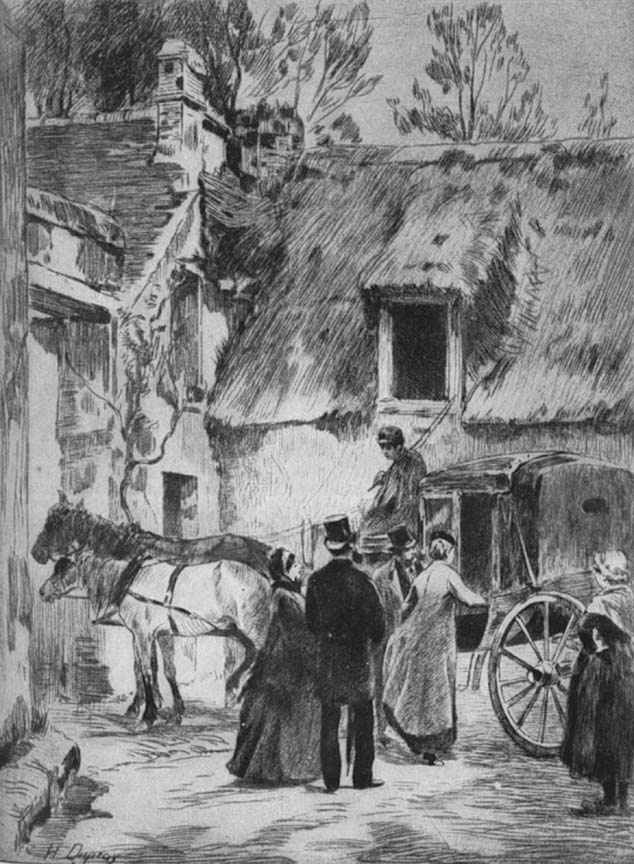
But the carriage---when it was dragged out from under the shed, where it had probably reposed most of the time since the introduction of railways in France---was a wonder indeed. I really do not know bow to describe it. It was a four-wheeled, four-seated, two-horse, closed vehicle, but with large, very large, glass windows at the sides and in front. The leather covering was rusty, and cracked, and creased; and the blue lining on the inside faded, ragged, and dirty. It had a green body and yellow wheels. The body was shallow, and the front seat low. The wheels were ramshackle and of questionable solidity. It was once, perhaps, what may have been called a "calash"; but it had been worn, and torn, and broken, and painted, and patched, and mended, and nailed together, and tied up, until one might have called it anything he liked. A very appropriate name would have been the "Immortal"---one given by Sydney Smith to his ancient chariot at which, whenever they saw it, all the village boys cheered and all the village dogs barked.
When our two horses, the big one and the little one, the gray mare and the chestnut horse, were matched and harnessed to this carriage, and all the necessary strings and ropes had been attached to the harness, the "outfit" closely resembled one of those perambulating conveyances occasionally met with in the byways of France, the property of some family of prosperous gipsies. It was in this vehicle, with M. Ernest Everard for driver, that we continued our journey, after a stop at Pacy lasting quite an hour.
During this time not a person came near us, and the Everards had certainly not the least suspicion that we were other than what they had at first taken us to be, "des Américains," or "des milords Anglais," traveling for our pleasure.
It was with some difficulty that we succeeded in helping her Majesty and Madame Lebreton into this carriage; and Dr. Crane having got in I---seeing it was too small to carry four persons inside comfortably---took a seat by the side of the driver, thinking also that I might have a little talk with him and see and hear something of the country; but while we jogged along over a road as smooth as a floor, like all the great highways of France, our carriage so rattled and creaked that it was often quite difficult to hear what was said, and painful even to speak. The air, however, was delicious, and the wide stretches of cultivated country through which we were traveling furnished an ever-changing and pleasing prospect.
Nevertheless, there were moments during my enforced silence when not a soul was to be seen on the long straight white road, and the absence of all life and movement in the landscape, sharply defined in the bright sunlight, produced in me a strange sense of the unreality of this enchanting and very peaceful visible world. I could not understand how such great events in human affairs as had happened, only the day before, could have occurred without leaving a trace of disturbance upon the face of things, so near and so closely related to them. There was a mystery, something uncanny even about it all. It seemed to me that what I saw with my eyes had no history---was an appearance without substance; that this peace of things was an illusion and a mockery; and that my own thoughts and emotions and the rattling of the green body and the yellow wheels of the calash were the only realities I was certain about and which immediately concerned me; for I felt it was these that bound me as with bands of steel to an invisible but real world of Revolution, violence, and peril, from which I was striving, perhaps vainly, to make my escape.
Occasionally, on coming to some long ascent among the chalk hills that form the solid framework of Normandy, and give to this land its picturesque outlines, Dr. Crane and I got down and walked on ahead of the carriage, which followed slowly after. And sometimes, too, our conversation drifted far away from the subjects of our immediate interest. It certainly did in one instance that I well remember. As our road wound its way up by the side of a deep, white cutting, the geological history of the so-called Rouen chalk-formation having been referred to by the doctor, he went on to speak of the immense extent and power of life in the sea; and finally remarked that Nature seemed to be so determined to accomplish what she proposed to do when she set to work about it, that she was apparently very apt to largely overdo it. To which I replied that I did not know whether his generalization was really justified by the facts or not, but that I was quite willing to admit---speaking professionally---that the stock of tooth-powder she had so carefully prepared and stored up in these hills did seem to me to be prodigiously in excess of any possible necessity or any probable demand. I do not recollect the doctor's reply; perhaps the carriage just then overtook us, and we were both suddenly reminded of the serious business we were at the time engaged in, and of our responsibilities. I shall never forget, however, his look of surprise at what he doubtless thought was a highly indiscreet and unprofessional admission.

We were now approaching Évreux, a large town with a population of nearly twenty thousand souls; and we feared there might be some popular manifestation in progress in the place, which we could not well avoid, and that the rather outlandish appearance of our equipage might make us the objects of a disagreeable, if not dangerous, curiosity. We accordingly directed our driver to pass through the town without stopping, and to rest his horses, if necessary, in the suburbs. This he did; although, on entering it, we found the place perfectly quiet---as dead, I may say, as a French provincial town usually is, the inhabitants of which rarely show signs of life except at a fair or a fire. We learned afterward that the Mayor had read a proclamation, and that a review of the Gardes Mobiles had been held in the market-place not long before we arrived.
It was about five o'clock when we came to a place called Cambolle, situated hardly more than half a mile beyond Évreux, on the road to Lisieux. There, in the Avenue de Cambolle, which was lined with beautiful elm-trees, we saw, in the shadow of the foliage, a small wine-shop called the "Café Cantilope"; and our driver now insisted upon making a halt, in order to feed and water the horses. We therefore stopped here, our carriage standing almost in the middle of the road. Availing myself of the opportunity, I got down from my seat, and after walking about for a few minutes, went into the café. While Madame Cantilope and her husband, the proprietor of the shop, were serving me, I heard a vague, confused sound outside, which gradually became more and more distinct, and the cause of which appeared to be approaching. I listened anxiously, for the noise was like that produced by a great number of human voices; and under the circumstances the presence of a crowd, whoever they might be, was very undesirable.
Nearer and nearer came the sounds; and soon, to my horror, I heard very plainly the cries, "Vive la France!" "Vive la République!" repeated by a hundred voices, while at the same time I recognized the notes of the "Marseillaise." My companions, whom I at once rejoined, thought, perhaps, that our departure from Paris had became known and that we were pursued. None of us spoke a word, but from the expression on the faces of the ladies it was plainly perceptible that they were very uncomfortable.
Only for a few minutes, fortunately, did this state of trepidation last. Great was our relief when we found that our fear was groundless. The noisy persons who had given us so much uneasiness were only companies of Gardes Mobiles, who, returning from the review in Evreux, were going to some neighboring village. Several wagons full of them passed us while we were stopping here, and full themselves of wine and new-born patriotism, they lifted their hats and saluted us, with exclamations of "Vive la République!
But was our fear groundless? More than once during the day we had been reminded that history was repeating itself, by a member of our party who was well acquainted with the history of France, and who knew by heart the tragic story of Marie Antoinette.
She could not have forgotten that this unhappy Queen also fled from the Tuileries; and that, disguised, and in the darkness of the night eluding the sentries, she, with the King, and their children, and Madame Elizabeth, having squeezed themselves into an old coach that was waiting for them in the Place du Carrousel, were then driven through the Clichy gate to Bondy; and that, after changing carriages, they continued on their way, embracing each other with tears of joy, happy to feel and to think, in the light of the splendid June morning, that they had escaped from their ignoble persecutors; and how all went well with the royal family until they had gone some eighty miles---just about as far from Paris to the east as we then were to the west---when the son of a postmaster, recognizing the King, determined to have him arrested; and that overhearing the order given to the postillons to drive on to Varennes, he sprang upon a horse, and riding furiously in advance, informed the Procureur of the Commune of the King's flight; and how, on the arrival of the royal party late at night at Varennes, they were arrested. Nor could she have forgotten how, a day or two afterward, they were all packed into the same coach again, and, escorted by a detachment of the National Guard, were taken back to Paris, arriving at the barrière de l' 'Etoile after twelve hours of continuous travel, and forced to keep their seats in a closed carriage, on one of the hottest days of the year; nor that, when near the end of this terrible journey, exhausted by fatigue and overcome by the heat, the poor mother, wiping the perspiration from the forehead of the little dauphin, said to one of her guards:
"See the condition my children are in---they are suffocating," she received the brutal answer, "We will suffocate you in another way"; nor how, between a double row of National Guards, the carriage proceeded down the Champs Elysées, the immense crowd gathered together on either side of the way jeering and hooting, and insulting the Queen---the "Autrichienne "---in every possible way, until, turning into the Garden of the Tuileries, it stopped before the Pavillon de l'Horloge, and Louis XVI. and Marie Antoinette entered the palace as prisoners of State. And afterward---that scene on the Place de la Concorde, where the Obelisk now stands! Was my fear groundless? Had not the Empress reason to be alarmed?
From Cambolle our road went through a beautiful stretch of country, the hills on the right side of the way being covered with rich vegetation, while on the left fertile meadows extended far into the distance.
The sun was now sinking, and the approach of evening was indicated by the lengthening shadows of the elm-trees. The poor horses, which had kept up so far notwithstanding the long drive and the hard labor that had been exacted from one of them before it was put in front of our calash, began to show signs of exhaustion; and M. Ernest Everard told me that he could not drive us beyond La Commanderie, a small village on the road, where we might have a chance to get a fresh pair of horses, for his would not be able to go any farther.
We reached La Commanderie just before sunset, and drove into the yard of the old post-house, on the left-hand side of the route Impériale. The owner was a rich, well-to-do farmer, who took more pride, however, in his fine cattle and large and well-filled barns than in the appearance of the house he lived in and that of the yard behind it. As several years before he had given up the business of furnishing relays of horses to travelers, we had some difficulty in getting him to consent to take us on to the next station, La Rivière de Thibouville. It is quite likely that he may have suspected we were fugitives of some sort---we were so anxious to proceed. He had a pair of fine horses, he said, and would be glad to accommodate us, but he had no carriage. We succeeded, however, in disposing of this difficulty, by persuading, by means of a substantial gratuity, the man who had brought us from Pacy to lend us his carriage. As the farmer had no longer a plausible excuse, and had been stimulated into taking an interest in executing our wishes by the prospect of an ample reward for his services, he at last consented to drive us to the next station.
Having settled this matter, Dr. Crane and I went to a wine-shop across the way, and a piece of bread and cheese with a bottle of sour wine we obtained there seemed to us a royal lunch indeed. Madame Lebreton, in the meantime, succeeded in getting some coffee made in the kitchen of the post-house for the Empress and herself. The Empress, however, did not leave the carriage, but kept her seat, while we were doing our talking or trying to get something to eat, and the horses were being changed.
We remained here more than an hour, and it had become quite dark before we started on our way again. We had not gone very far, however, before an accident occurred. The rickety old calash was not strong enough to resist the pull of our fresh, vigorous Norman horses; and so it came to pass that, as we were rolling along at a rattling rate, crack! went a whiffletree, and we were brought suddenly to a standstill, with the traces dangling about the heels of one of the horses. Our driver now wanted to go back. He said he could not go on; that he could not repair the break where we were, for he could not see to do it, and had nothing to do it with, and did not know how to do it, and so forth. In all of which discourse the only thing made quite certain was that he did not wish to proceed any farther. He seemed, in fact, rather too anxious to have us return to the old post-house and spend the night with him.
Beginning to suspect the man had in mind some dark design---that perhaps this accident entered into his scheme ---Dr. Crane and I got down to investigate the case and find out for ourselves what had really happened, and what could or could not be done in the way of repairs. We soon discovered that if we only had a piece of rope, or some twine, we could so fasten the traces as to be able to continue on our way. But where were we to get either? We were half a mile from any house. What was to be done? The driver, the prosperous owner of the horses, insisted on returning. But this we were determined not to do if we could prevent it. Noticing that there was a box under the front seat, we opened it, and, as luck would have it, found there just what we wanted---a piece of cord, an old halter I think it was, eight or ten feet long. With this we lashed the whiffletree firmly to the cross-bar. Then, taking my seat by the side of the driver, off we started again. This accident delayed us about half an hour. While riding with the driver, I had with him sufficient conversation to convince me that my suspicions with regard to his motive when advising us to return to the post-house were not well-founded. I am now quite sure that he gave us what, from his point of view, was very sensible advice, and what, perhaps, ought to have been considered at the time as sensible advice from any point of view.
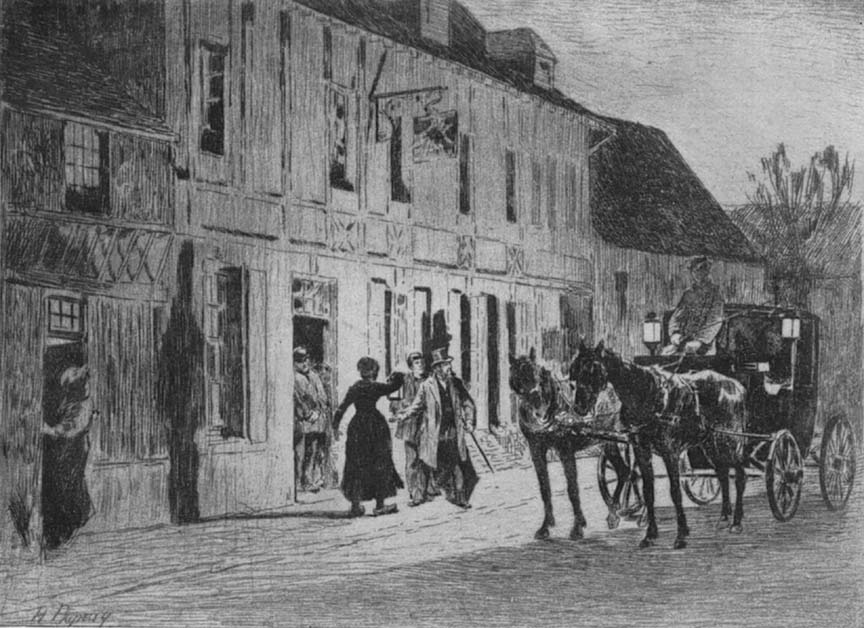
It was nearly ten o'clock when we arrived at La Rivière de Thibouville, a town in the valley of the Risle, about a hundred miles from Paris. We stopped on the outskirts of the hamlet, in front of an auberge, or small tavern, on our left, and at the foot of a pine-clad slope, down which the road descends into the valley. Alighting from the carriage, I approached the house, and the door standing wide open, I saw, within, a large room where a bright fire was blazing in a big fireplace at the right. Over the fire some pots and kettles were hanging on long hooks, and attending to them were one or two women. On entering this room I saw in an adjoining one several men, apparently of the peasant class, seated at a rough table, eating and drinking. But I had little time to notice, and still less to appreciate, the rusticity of the place, for almost immediately the proprietress of the establishment---Madame Desrats, a rather corpulent, light-complexioned woman of about forty---came forward to learn what was wanted by us, the newcomers.
I told her that we wished to get a conveyance to take us, a party of four, on to Lisieux that night. Her reply was that no carriage of the kind we required could be obtained in the place for such a journey; nor could such a carriage be got without sending to Bernay for it, a town ten miles distant. This information I was wholly unprepared for, and I was much disturbed by it, as it greatly interfered with our plans. Evidently we had come to the end of our day's journey, and it would be necessary for us to pass the night where we were. How we were going to do this soon became a very serious question, since Madame Desrats, on further inquiry, informed me that she could not furnish us with lodgings, for every room in the house was occupied. She was very sorry, she said, and the more so because she was sure there was no other place in the village where we could find accommodation for the night. As the man who had brought us must return to La Commanderie after resting his horses, it seemed for a time as if, at the end of a fatiguing carriage journey of nearly a hundred miles, we were to be left, late in the night, under the stars, in the middle of the road. But I have observed that pretty nearly everywhere in the world it is possible to obtain the cooperation of others when it may be required; in fact, what is wanted, if one only sets about it in the right way and employs the right means, and especially sufficient means.
This rude hostelry in the suburbs of La Rivière, as I afterward discovered, was a small, long, low, stuccoed house, behind which was a dirty yard, shut in by a number of ill-conditioned outbuildings. Over the front doorway hung and swung a rather large sign-board, on which had been painted the now faded image of the sun, the original appearance of which was presumed to be represented by the words inscribed on the sign, "Le Soleil d'Or." As I have already stated, the front door opened directly from the street into the principal apartment, which served the double purpose of parlor and kitchen. Beyond this, to the right, there was a public room or kind of bar, where wine and beer, and other drinks, were dispensed, principally to passing teamsters and laborers in the neighboring fields. On the left, a door opened into a small room used as a private dining-room; near this door was another, at the foot of a flight of stairs leading to the floor above. On this upper floor there were three or four chambers; one was over the dining-room just mentioned; and there was another, to the right, beyond the kitchen, and over a passageway that led into the court-yard in the rear. These two chambers were the only ones let to lodgers, and they had both just been taken, as we learned, by an English coachman and his family, who, on their way to Trouville, had stopped here for the night.
Finding Madame Desrats 's accommodations for additional guests were so limited that she was really unable to do anything more than to extemporize for us some beds on the floor, either above or below---which she offered to do---I asked to see the coachman, who had already gone to his room.
He came down soon, and I laid our case before him. I told him I was taking my sister, who was an invalid, to the seaside; that she was attended by her physician and a nurse; that we were disappointed on reaching this place at not being able to continue our journey to Lisieux, where we had intended to pass the night; that we should be compelled to stay here; that my sister's present and most distressing situation was causing me intense anxiety; that we were informed he had engaged the only sleeping-rooms in the house; and, finally, that we were willing to pay a round sum for the use, for this one night, of the rooms in question. The man "executed himself," as the French say, promptly and very graciously; for he assured me, while accepting his compensation, that he was induced to give up the rooms by a feeling of the deepest sympathy for "the poor lady in the carriage. However this may have been, we got what we wanted, and it was not long before the chamber over the passageway was made ready for the Empress and Madame Lebreton. Dr. Crane and I then proceeded to assist the invalid to descend from the calash, which having been effected with no little difficulty, she took Dr. Crane's arm and walked to the door, slightly limping, I going before and Madame Lebreton following. In this order we entered the public room, in which there were at the time several persons, some drinking and some at work. Screening the Empress from observation as much as possible, I opened the door of the staircase, which Dr. Crane and his patient ascended slowly and with some difficulty---not simulated this time, for it was dark and the steps were very narrow and very steep. On reaching the chamber selected for her, the Empress dropped into a chair, and, surveying the room and its rough, scanty contents with a rapid glance, burst out laughing. She made no attempt to suppress this éclat. I do not think she could help it. She did not even try to excuse it; unless the remark made by her, which an American girl might translate, "This is really too funny for anything! " be considered as an excuse.
"Oh, mon Dieu! mon Dieu, madame!" exclaimed Madame Lebreton as she stepped into the room, "how can you laugh in this sad situation? Mon Dieu! mon Dieu! And everybody is watching us, and there are people in the next room who may overhear you!"---and doubtless did, for that matter, as the partition, and the door separating the rooms, were of the flimsiest construction. "I beg you, madame, not to laugh---not to speak, even, lest we betray ourselves. And after you have had some supper, which has been ordered, you must rest, for you are very nervous after this awful journey!" The Empress recognized that she had, perhaps, been a little imprudent in yielding to an emotional impulse, and in an amiable spirit of contrition, I have no doubt, would now have been perfectly willing, could it have helped matters in the least, to try to look as solemn, and take as serious a view of the situation, as did Madame Lebreton herself.
Dr. Crane and I now returned to the kitchen, and ordered a dinner to be served to us in the private dining-room.
While this dinner was being prepared, we looked about the place, studied the people, overheard their talk, and even entered into conversation with them. They seemed to be strangely indifferent to the great military and political events of the preceding week. The crops, the weather, their own private affairs, were what chiefly concerned them. They appeared to care very little even to know what was going on in Paris, except as it might favor or prejudice their personal interests. They were representative French country people, thrifty but earthy. Among them was the man who drove us over from La Commanderie, and who had told me, while on the way, that he was worth two hundred thousand francs. This property he had acquired by forty years' hard labor, with pinching economy---an economy that would amaze a New England farmer. He had but one object in life, and that was to make money. Yes, he had another and a more worthy one: it was to provide a dot---a marriage-portion---for his daughter. It was not the money itself that he wanted; it was the use to which it was to be put that made it desirable to him, and for which he was willing to toil, and live poorly, and to hoard. And it is this strong desire which most Frenchmen have to look after the future of the family, and to provide more particularly for its dependent members, that ennobles the parsimony of these peasants, and elevates the thrift of the common people of France to the dignity of a national virtue.
Our dinner was excellent, and so was the sauce---the appetite---that went with it, for we had had really nothing to eat but bits of bread for more than twenty-four hours. We sat for a while over our coffee and cigars, talking of the incidents of the day and the contingencies of the morrow. It was one o'clock before we went up to our room. An hour or two later, when we both were sound asleep, we were aroused by a great racket outside---the clatter of horses' hoofs, followed by loud talking, and, finally, by pounding on the door almost directly under our window. Our first thought was that the escape of the Empress from Paris had been discovered, that an order had been issued to arrest her, and that a squad of gendarmes had ridden up here to execute the order. We opened our window very carefully, and cautiously peeped out. But the night was dark, and we could not see the mounted men with sufficient distinctness to tell who or what they were. Indeed, it was some time before we learned from the words passing between them, which we overheard, that they were not searching for us. As this was all we cared to know about them at the moment, we went back to bed and slept soundly till morning. We then were told that the party that had disturbed us in the night were some gamekeepers who had been scouring the neighborhood looking for poachers.
Dr. Crane and I got up early, as we wished to send to Bernay for a carriage. When we spoke to our hostess about this, she stared at us, and seemed to think it was a very singular thing to do---to send some one ten miles away to find a carriage, when it would be so much easier for us to go to Trouville by the railway, and the station was only a mile off. I think she would have thought we were all mad, had she not believed we were English---"et les Anglais sont tellement drôles." We tried to explain to her that the lady with us was ill, that she disliked very much to travel by railways, and that it would be as impossible for her to walk one mile as ten. To this she replied that she did not see why the lady might not be taken to the station in the cabriolet; the rest of us could certainly walk.
The cabriolet referred to by Madame Desrats was a two-wheeled, high-seated, gig-like contrivance in the back yard, an inspection of which at once suggested to me the probable appearance of the deacon's "wonderful one-hoss shay," at the critical period of its existence---its grand climacteric, so to speak---when it was in a state of equivalent decay in each of its several parts and articulations; and its complete collapse into disjecta membra and dust might reasonably be expected at any moment. Taking it altogether as it stood, this cabriolet was a curiosity quite worthy of a place in a museum of vehicular antiquities.
While we were considering what we should do, rain began to fall, and with every appearance of continuing for some time.
We were reluctant to make use of the railway; but it would take some hours to bring a carriage from Bernay, and we were anxious to proceed on our way without delay.
La Rivière is on a branch railway connecting the Paris-Havre with the Paris-Cherbourg line at Serquigny, a station less than three miles distant. Lisieux, the chief town in the department of Calvados, is on the Paris-Cherbourg railway, fifteen miles west of this junction. There we could get a carriage to take us to our destination---Deauville, about eighteen miles beyond. We found that, by taking a train due at La Rivière at five minutes past eight o'clock, we could meet the Paris-Cherbourg express at Serquigny a few minutes later, and reach Lisieux at twenty minutes past nine o'clock. An hour by railway would help us forward greatly, and we concluded that we would accept the additional risk of discovery it might involve, rather than be kept waiting at La Rivière. But how was the Empress to get to the railway station? We had rejected the vehicle proposed by our hostess, for, if not absolutely dangerous, its oddity would attract too much attention. The Empress had certainly better walk; and she could do this perfectly well, but for the invalidism upon which we had been laying such stress. We had about made up our minds to discover that our patient, to our surprise and great delight, had so wonderfully improved during the night as to feel confident she could walk to the station, going slowly and with a little help, when a carriage drove up before the door of the auberge. A gentleman got out, and, coming into the house, sat down near the fire while his horses were resting. He had left Bernay that morning. I noticed he was alone, and that his carriage, a closed one, was large enough to carry our party easily. I thought it might be worth my while to make the acquaintance of this man. And so, in a very unsophisticated sort of way, I fell into conversation with him. I found him an amiable, very intelligent, and extremely interesting man. We spoke of many things, but agreed in everything. I myself, quite naturally, was in a most agreeable mood. After a while I mustered up sufficient courage to repeat to him the story of the invalid sister, which had proved to be an "open sesame" all along the road, and to remark, quite incidentally, that as we could get no carriage to take us to the railway station I greatly feared the walk might overtax "my sister's " strength.
"Oh," said he, " my carriage is quite at your disposal. I shall be most happy to be of service to the lady. It is really too far to the railway station for a lady who is ill or an invalid to think of walking, and especially when it is raining, as it now does."
I thanked my new acquaintance effusively for his generous offer, which of course I could not decline. Greatly relieved in mind, I immediately reported to the Empress and Madame Lebreton that we had found it necessary to go to Lisieux by the railway; and also that a carriage was at the door to take them to the La Rivière station, as soon as they could get ready to go. In a very few minutes the Empress descended the stairs, assisted by Madame Lebreton, but walking with much less difficulty than on the evening before.
I observed that the persons in the public room through which the Empress passed had the courtesy to show no curiosity to see her, or to watch our movements while we aided her to get into the carriage. The gentleman himself who had offered us the use of his carriage, with admirable discretion, perhaps out of sympathy for the invalid, also kept at a respectful distance. Having thanked him again, and especially expressed my gratitude on behalf of "my sister," I mounted upon the seat by the side of his coachman, and we drove off so suddenly that I fear the kind-hearted and obliging stranger must have taken her Majesty for a very impatient patient.
We reached the station some time before the train was due, and were the only persons there, except the stationmaster and a ticket-agent. When the train arrived we took our seats in a compartment which we saw was vacant, and congratulated ourselves upon our good fortune. But as the "chef de Gare," passing along, opened the door of the carriage, and, after looking in, shut it with a bang, the Empress observed on his hard face a malicious smile and a leer which alarmed her. She felt certain she had been recognized. I did not notice the incident, nor did the Empress allude to it when it occurred, although it certainly produced a deep impression upon her mind at the time; for when, more than twenty years afterward, she related to me the incident, she said, ''I shall always remember the look that man gave me."
We arrived at Serquigny just as the Paris express reached the junction. I hurried across the platform, and asked the guard to give my party seats where we could be by ourselves, intimating that the arrangement, if it could be made, might prove as pleasing to him as to us. He walked down the platform a short distance, threw open a door in one of the carriages, and said to me, " You can have these." As I slipped some money into his hand, he informed me that we would not be disturbed, since Lisieux was the next stopping-place.
On arriving at Lisieux, we found quite a number of people in and about the railway station, and omnibuses and carriages were standing there, ready to convey passengers to the hotels or other places in the town. We could make no use of these conveyances, as we wished to avoid coming in contact with people whenever it was possible to do so. We therefore, on getting off the train, left the station at once on foot.
It was raining, and we had no umbrellas. The morning proved to be gloomy, miserable, and stormy. After walking some distance, I said: " It is unnecessary for us all to go into the town. Let me go on alone. I will find a livery-stable and get a carriage, and come back and pick you up."
Thereupon I left the party, and hurried forward in search of a conveyance to take us to Deauville. I had to walk very far before I came into any streets that looked as if I might obtain in them what I wanted. I called at half a dozen places in vain, and had nearly given up all hope, when at length I found a person who, after some persuasion, principally in the form of a promised payment considerably above the usual rate, agreed to drive us to Deauville. The time during which he was preparing his horses seemed to me endless, when I thought of those who were waiting for me; but notwithstanding my efforts to have him make haste, the man did not change his phlegmatic manner in the least, and I had to wait until he announced that he was ready to go.
In the meantime, the Empress, Madame Lebreton, and Dr. Crane had followed me slowly, until it began to rain very heavily when they stepped in under the porte cochère, or entrance, of an establishment where carpets were made, on the left-hand side of the street. Here they remained a long time; the Empress standing in the doorway, scarcely out of reach of the dripping from the building, and Madame Lebreton partly sitting on and partly leaning against a bale of wool in the passage beyond. After they had been there a few minutes, a young man, an employee, came out of the establishment with a chair, which he offered to the Empress, saying, "Perhaps the lady would like to sit down." The Empress declined to take the chair, with thanks; as also did Madame Lebreton on the chair being offered to her. Madame Lebreton, however, not only expressed her appreciation of the courtesy, but added,
"We are waiting for a carriage we expect here every moment, and feel under obligations to you already for the liberty we have taken in entering within your doors."
"Oh," said the young man, "that is a liberty which belongs to everybody in France on a rainy day; but should your carriage not come, and should you get tired of standing, if you will come into the office we shall be pleased to give you all seats."
Madame Lebreton again thanked the man for his civility.
But as the time passed and I did not return, the Empress thought perhaps something had happened to me, or that there might have been some misunderstanding as to where. we were to meet. She remembered also the sinister glance of the eye of the station-master at La Rivière, and it began to trouble her; and, growing more and more apprehensive that something really serious had prevented my return, she requested Dr. Crane to go and try to find me.
The doctor accordingly set out to hunt me up; but after tramping about in the rain for nearly half an hour without success, he gave up the quest and went back to the carpet factory, where he found the Empress still standing in the doorway, her plain, dark dress glistening with rain, her skirts and shoes soiled; herself unnoticed, uncared for by those who passed by hurriedly on their way homeward, pushing their dripping umbrellas almost into the face of her who was now without a home and shelterless, but who only a few days before was their sovereign. Both the ladies were now beginning to feel very anxious indeed. Dr. Crane tried to reassure them, and also to persuade the Empress to step in under the cover of the passage, but to no purpose; so that, when my carriage turned into the street leading. to the railway station, I saw her Majesty standing in the rain at the entrance of the factory, apparently alone, and presenting such a picture of complete abandonment and utter helplessness as to produce upon me a powerful and ineffaceable impression.
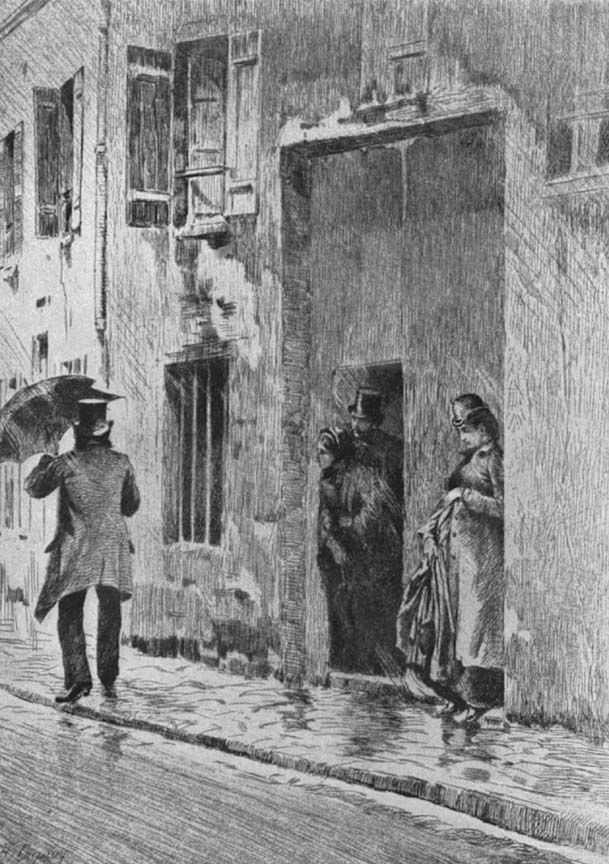
It seemed impossible that this thing could be. What I saw was so utterly inconsistent with what I had seen, and the memory of which flashed into my mind instantly, that I could scarcely believe my own eyes. "Am I dreaming," I said to myself, "or is this indeed reality?"
Less than a year had passed since, at Constantinople, I had watched from the villa of Sefer Pacha the Aigle as she rounded the Seraglio Point and entered the waters of the Golden Horn, bringing the Empress as the guest of the Sultan, and had witnessed the unparalleled magnificence and splendor of the ceremony with which she was received.
No vision of fairy-land could be more exquisitely beautiful than was seen under the soft, opalescent sky, and in the balmy atmosphere of that superb October day when, just before sundown, the barge of the Sultan, manned by forty oarsmen, and especially constructed to convey the Imperial visitor to the residence that had been chosen for her--the palace at Beylerbey, on the Asiatic shore---shot out upon the bright blue waters of the Bosporus, from under the walls of the palace at Dolma Bagchtie, and appeared in the midst of the fleet of war-ships, steamers, yachts, and innumerable caiques, decorated with the flags of France and Turkey; half a million people, on the water and on the land, watching the wonderful spectacle; the Turkish women, dressed in costumes of the most brilliant colors, massed together by thousands in the open places on the bank, between Tophaneh and Dolma Bagchtie, that encircles the water-front like an amphitheater, and which framed in a noble and singularly picturesque setting the panoramic scene immediately before me. In the barge---a graceful construction of polished cedar, and ornamented with gold, and massive silver and velvet, and richest fabrics---a dais or canopy of crimson silk had been erected, beneath the folds of which I saw the Empress, as the barge drew near me, sitting alone in evening dress, a light mantilla over her head, wearing a diadem and many rich jewels, radiant and beautiful, and supremely happy and proud to accept this magnificent tribute paid to the glory of France, and to witness the extraordinary scene which she herself had unconsciously created.
"It is impossible," I said to myself, as I recalled to mind the incidents of this more than royal progress, "that she, who was the recipient in a foreign land of all those honors; on whom, as the most interesting and distinguished feature and the most brilliant and attractive ornament of a marvelous pageant, thousands of eyes were then turned in wonder and admiration, was the same person who to-day is a fugitive, without a shelter even from the inclemency of the weather, forgotten, unnoticed by her own people as they pass by her on the street, and so completely lost, in this very France where she was once so honored, that her existence even is known to but two men-and those two Americans!
Such a shifting of situations and scenes might well have been the work of some malignant Jinn, so suddenly, so unexpectedly, with such seeming mockery, had the transformation been made. So closely were these situations related to each other, so sharp were the contrasts they offered, that they seemed incredible. Yet all these events had actually taken place, and under my own eyes, and to the least circumstance were matters of fact and of history. And so it happens in human affairs, that the prodigies of Fortune in reality lie beyond the range of the imagination, and that truth is indeed sometimes stranger than fiction.
I found the Empress wet through and through by the drenching rain, and it grieved me bitterly when I saw her in this pitiable condition. The vulgar, dismal, and dirty surroundings, the gloomy sky, and especially the wearied faces of the two ladies, that bespoke the consequences of many anxious, sleepless nights, made me feel more sad at that moment than I had felt at any time since our departure from Paris. But it was not long before we were on our way again; and soon after leaving Lisieux the clouds lifted, and we caught glimpses of the sun.
We were now passing through one of the richest agricultural departments in France, famous for its horses and its dairies; where the broad yellow fields from which the wheat had just been harvested; and acres of green sugarbeets, and belts of clover and lucerne in which the tethered cattle were feeding, extended to the right and to the left of us as far as the eye could reach. Here and there were farmhouses and thatched cottages, those nearest to us half concealed in the midst of orchards or by clumps of protecting trees; those in the distance half revealed by the smoke slowly rising from great heaps of smoldering colza stalks. The splendid road was lined with trees on either side. Some of the villas we passed were very handsome, and looked charmingly in their setting of green lawn, and plots of flowers, and autumn foliage. And many of the quaint cottages and outbuildings with whitewashed walls, held together by a framework of black wooden beams arranged in lozenges, were extremely picturesque. The scenery was lovely, the air was mild and soft, and the country looked clean, and fresh, and beautiful after the rain. It was not only la belle France which was here the object of our admiration, but la France faisant la belle after a frowning and unhappy morning.
We were on the last stage of our journey, and, as things began to look brighter about us, we began to feel more cheerful and more hopeful; we amused ourselves, even, by recounting some of our experiences at the "Soleil d'Or." And the Empress told us how, before she left her room that morning, she had washed and ironed---that is, pressed out in some ingenious way, I have forgotten just how it was done---a couple of handkerchiefs, the only ones she had; and she exhibited them to us, asking if we did not think the work was well done, considering the circumstances; adding archly, "When there is no necessity that moves us, we little suspect our own cleverness or capacity to do things."
At Pont l'Évêque we stopped at the "Lion d'Or " just long enough to feed our horses and get a lunch ourselves, and then went on to Deauville, through the beautiful valley of the Auge, which soon unites with the valley of the Touques, past the little hamlets of Coudray, Canapville and Bonneville, and through Touques, with its quaint old wooden market and its long, deserted street, until we reached the bridge that crosses the river Touques at Trouville and connects this town with Deauville, which is exactly opposite, on the left bank of the river. Here we arrived about three o'clock in the afternoon; the last stage of our journey having been accomplished without interruption, and very comfortably, the carriage being the best one we had been able to obtain on the way.
The route we had followed, from Évreux to the coast, was almost exactly the same as that which Louis Philippe had taken at the time of his flight from Paris, twenty-two years before.
Just eight days previous to our escape from Paris I was walking with Mrs. Evans upon the beach at Deauville, as we were accustomed to do in the morning, when we met Count G. B-----, whom I had known for many years, although our acquaintance had always remained a casual one. By accident, a conversation ensued in the course of which the Count invited me to go, the next day, to see a villa which he had recently built or bought. I told him that I should have to return to Paris early the next day-Monday---on account of my professional engagements; but he pressed me so much, and in so kind a manner, that I could not refuse, especially after he mentioned that he would like to show me an American "buggy," or trotting wagon, that had been sent to him, and that he would take me out in this to see the country lying around Trouville and Deauville, which, notwithstanding my frequent visits to both towns, was not very well known to me. The next morning, at an early hour, the Count called on me with his new "trap," and we had a delightful drive over excellent roads, which offered to my view at every turn a great many things of interest. The time passed so quickly and pleasantly that it seemed to me we had but just started, when we arrived before the door of a church in Honfleur. Here the Count halted, and invited me to go with him into the building. On entering it, he said to me, "I hope you will excuse me for leaving you for a few moments, but I never come here without saying a prayer."
Thereupon he went to the basin containing the holy water, crossed himself, and knelt down upon a priedieu opposite the altar, where he remained for some minutes in silent adoration. When we had left the church and we* together again, he said: "You were perhaps surprised that I made you wait in the church; but it was at Honfleur that my King, Louis Philippe, spent his last night in France. The place where he slept a few hours during that night is not far off, and, if it interests you, we will go and see it." I, of course, gladly assented, and we soon reached the very unpretentious-looking building where this unfortunate King of France passed his last hours in the country he had once governed. From my companion I learned that the house at that time (1848) belonged to a fashionable court milliner of the Place Vendôme, who on this occasion offered to the dethroned monarch her hospitality. The vivid manner in which the Count related some of the incidents of the King's flight impressed upon me the sad story of the fall of that monarch from his high position. And now, one week later, strangely enough, I myself was accompanying another sovereign of France, who had experienced a still greater reverse of fortune, in her flight from her capital over almost exactly the same road, her Majesty reaching the coast at Deauville, and Louis Philippe at Trouville; for it was at Trouville that he remained several days, hidden in a small house in one of the narrowest streets in the town---No. 5 Rue des Rosiers---before venturing to go on to Honfleur.