
| Deauville---Precautions---Looking for a boat in which to cross the Channel---Interview with Sir John Burgoyne-Lady Burgoyne---Dinner at the Hôtel du Casino---A small gold locket---I meet Sir John Burgoyne on the quay---Her Majesty leaves the Hôtel du Casino---A wild night---The strangeness of the situation---Contrasts---On board the Gazelle---Dr. Crane returns to Paris |
WHEN the first houses of Deauville became visible, the driver asked me where I wished him to take us. To find an answer to this question had greatly perplexed me during the last hour; for, although our destination was the Hôtel du Casino, where 1 had apartments for my wife and myself, I did not think it wise to drive there openly, fearing that word might have been sent ahead to arrest us in case we should be found there.
We had little doubt that a description of us had been forwarded to all the seaports of France, and the fact that Mrs. Evans was passing the season there was a special reason for suspecting that a careful watch would be kept about this hotel and its immediate neighborhood. Moreover, my wife was quite unaware of my presence in Deauville, and of the special circumstances which had brought me here. I therefore told our driver to stop at the entrance of the race-course, as a friend of mine lived near by whom I wished to see before going farther.
When we halted at the side of the road, I got out, and leaving my companions in the carriage, walked into the town. On arriving at the Hôtel du Casino, passing behind the main building, I went through the garden, entered a door of the house at the end fronting on the sea, and rapidly mounted the staircase leading to the rooms occupied by Mrs. Evans. Fortunately I found my wife at home, and I announced to her in as few words as possible what had happened and told her what I wished to do. I learned from her that no news about us had been received at Deauville, and that no one knew where the Empress was. So there seemed to be no danger to be apprehended for the moment. Whereupon, having provided myself with an umbrella---for it had now begun to rain---I went back to the place where I had left the carriage and rejoined my companions.
After reporting to them that all was well and everything in readiness, I gave the driver instructions where to go, telling him to stop in front of the little gate that opened into the garden at the west end of the hotel. I thus took the Empress to the hotel by the same side-way by which I myself had approached it on arriving. Dr. Crane and Madame Lebreton then turned about and drove up to the front entrance, where they got out and made their inquiries like other travelers. When the Empress and I came to the garden-gate, I found my umbrella very useful, for a young American happened to be standing there who, upon seeing me, advanced to greet me. As a few drops of rain were falling I opened and held the umbrella in front of me, at the same time walking quickly forward. I was told, not long after, that he took my companion for Mrs. Evans, and thought I had not seen him. We thus fortunately reached Mrs. Evans's rooms unobserved, where, after greeting my wife, the Empress fell back exhausted into an armchair, exclaiming:
A few minutes later I heard the chambermaid directing Dr. Crane and Madame Lebreton to rooms that were exactly opposite ours, which made communication easy between them and us in case of need. In accordance with a previous understanding, they had asked for rooms on the first floor, on which were the apartments occupied by my wife, but had acted as if they were strangers to the place and had nothing to do with us.
So far everything had succeeded very well. The next thing to be considered was how we were to get to England. Accordingly, soon after our arrival at the hotel, accompanied by Dr. Crane I crossed over the ferry to Trouville to obtain information on this subject; and, more particularly, to see if there was any chance of obtaining a boat for the execution of this part of our plan, and which, perhaps, I might hire under the pretext of desiring to use it for a fishing-excursion or for a pleasure-cruise.
There were two possible ways for us to cross the Channel: one was by the regular passenger-boat that left Havre for Southampton on the following evening at nine o'clock; the other was by a boat hired for the trip, or whose owner might be disposed to share with us voluntarily the honor and the risk of aiding her Majesty to escape from France. The Havre-Southampton boat we did not wish to take, if we could possibly avoid it. There was sure to be a great number of passengers on board, some of them probably refugees like ourselves. Detectives would very probably be on the look-out for them; and, if so, were we among them we certainly should be discovered. No, we will not go that way, we said, so long as there is the least chance of our being able to find a suitable boat for our exclusive use, even if we have to go over to Havre to get one.
While we were considering these matters and making inquiries about the boats that could be hired in this place for excursions, our way had taken us along the quays to the bridge over the Touques, connecting Trouville and Deauville, and close by the Deauville docks. I now remembered that a number of pleasure-yachts were frequently lying in these locked docks; for instance, I had often seen there one owned by the Duke of Hamilton, as well as those of other Englishmen; and I knew that if I could obtain one of these we could cross the Channel much more comfortably than in a fishing-vessel. We therefore directed our steps toward these docks in search of a yacht, and soon discovered, in the upper one, a boat with two masts, which we thought would serve our purpose uncommonly well.
On making inquiries about it, we were informed that the owner was absent, but that we would find in the cabin an American gentleman, one of his friends. Hearing this, I decided not to go on board, as I feared I might meet an acquaintance. Proceeding a little farther along the quay (de la Marine), I saw another but smaller boat, half concealed behind a huge pile of boards. At the same time a sailor approached us, wearing a blue jersey packet, and having on his cap the word Gazelle.
Upon our inquiring to what boat he belonged, he informed us that he was one of the crew of a yacht owned by Sir John Burgoyne, which happened to be the very vessel I was looking at. After I had spoken of the neat, trim appearance of his yacht, and expressed a wish to obtain certain information about it, he said that if I would go on board he thought there would be no difficulty in my getting it from Sir John himself, as he believed he was in the cabin. And so, under the guidance of the sailor, we went on board the Gazelle. The man then left us, and after a few minutes returned to announce that his master would show us over the vessel. When Sir John Burgoyne joined us, we introduced ourselves, I handing him my card having on it the words:
We told him that we had admired the appearance of his boat, and had come on board at the suggestion of one of his men. We thanked him for his courtesy in receiving us, and, without immediately disclosing to him the real purpose for which we had come, after having asked a question or two, told him we should certainly be very glad to visit the yacht. Whereupon the owner of the Gazelle led us round, showing and explaining to us many of the details of his pretty craft, telling us something of its history; giving its measurement, forty-two tons; its length, sixty feet; the number of the crew, six all told, and so forth; and finally, after we had obtained all the information we desired with respect to the boat, he announced to us that he hoped to leave the next morning, about seven o'clock, for England, as at that hour the tide would enable him to get out of the harbor, adding that bad weather had already kept him in Deauville a few days longer than he had anticipated.
After Sir John Burgoyne had finished showing us his yacht, and had stated his intention to leave Deauville the next morning, I drew him aside and told him I had a confidential communication to make, saying that I believed him to be a man in whose honor I could trust, and on whose silence I could rely should he be unable to give me the special assistance I was seeking. Sir John, in answer to my statement, opened his card-case, and giving me a card, remarked, "I am an English gentleman, and have been in her Majesty's service and in the army for some years." These words quite assured me, and I then told him frankly and without reserve how I happened to be in Deauville. I related some of the incidents connected with the Revolution in Paris, and with our flight from the city. I told him where the Empress was at the time; of the unhappy situation she was in; that it was her Majesty's most earnest desire to escape to England; that we were afraid to make use of any public conveyance; and finally asked him whether, in view of the urgency of the case, he would be willing to receive the unfortunate sovereign, Madame Lebreton, and myself on board his yacht and take us to England. I, of course, did not doubt for a moment that his answer would be in the affirmative. The reader may therefore imagine my astonishment when Sir John replied:
Although Dr. Crane and I had noticed the change in Sir John's manner immediately he was made aware of the real object of our visit, we were not prepared for his refusal of our request. But what appeared to us still more extraordinary were the reasons he gave for declining to assist us. Inasmuch as he had with some emphasis drawn my attention to the fact that he was an English gentleman, I said to him: "Sir John, I am an American, and in our country every man will run any risk for a woman, and especially for a lady whose life is in danger. I, therefore, when her Majesty applied to me for help, left my home in Paris, and all that it contains, without taking the least thought of the dangers that might come in my way, or calculating the losses I might suffer." And with the greatest earnestness, and remaining as calm as possible, I informed him that I should endeavor to find a boat whose owner would be willing to give us the assistance we required, adding that I had already examined another yacht in the basin which would quite answer our purpose.
My last words seemed to have caused Sir John to reflect, for, after hesitating a moment, he said to me: "That little schooner, in such weather as we shall probably have, would be very likely to go to the bottom, in case the owner should consent to make the trip."
Although, after what he had said at first, I had no intention of discussing the subject further with Sir John, this remark of his set me to thinking of my own responsibility for the safety of the illustrious lady who had entrusted her life to me. And in justice to Sir John I should say that, among the reasons he assigned for not being disposed to receive the Empress on board his boat, there were two or three which I am now willing to admit were entitled to much more consideration than at the time I was inclined to give them. He was by no means certain, he said, that he should be able to leave Deauville the next day, on account of the heavy sea outside, and the northwest wind that was still blowing stiffly. For her Majesty to remain long on the yacht in port might become embarrassing, and to put to sea dangerous.
Dr. Crane, in the meantime, not willing to accept a refusal, continued the conversation with Sir John, and urged him strongly to reconsider the matter. He reminded him that his decision was one that concerned not only the Empress, but himself as well; that a man rarely had the chance to accede to such a request as we were making; that, were he to take the Empress over to England, he might some day be very glad he had once had the good fortune to be of service to her; when, abruptly, as if to end the. whole matter, Sir John said: " Well, gentleman, you may submit the case to Lady Burgoyne. If she is willing to have the Empress come on board, she can come."
We then, on Sir John's invitation, went down into the cabin, and were presented to Lady Burgoyne. When the facts had been laid before Lady Burgoyne, and her husband asked her if she was willing to have the Empress come on board, she instantly replied: "Well, why not? I certainly shall be greatly pleased if we can be of any assistance to her, and I can readily understand how anxious she must be at the present moment to find a refuge. Let her come to us to-night, or as soon as she can safely do so."
Our request had met with a favorable answer. We had found a boat on which her Majesty could cross the Channel to England.
As dinner-time was approaching, we now took leave of Sir John and Lady Burgoyne; and the former not having yet given me any definite answer to certain questions relating to our embarking, I made an appointment to meet him in the evening on the quay, in the lumber-yard. Thereupon Dr. Crane and I returned to the Hôtel du Casino, and I announced to her Majesty what we had done.
At about half past six o'clock, the usual dining-hour, I ordered dinner for two persons to be served in our drawing-room, because the presence of the Empress, as before stated, was not known in the hotel, and three dinners could not have been called for without risking discovery or exciting a dangerous curiosity. After the table had been set, Mrs. Evans's maid took the dishes from the hands of the waiter who brought them up-stairs, and no waiter or servant was permitted to enter the room while the Empress was there. The fact that we had to divide our table service and food, which were meant for two persons only, in such a manner that three persons could dine, created much amusement, and we were put into rather a merry mood, the Empress herself two or three times giving way to hearty laughter at the shifts that were resorted to during this improvised dinner.
Since her Majesty had left the Tuileries she had not once sat down to a regular meal, for during our whole journey she had found no opportunity to do so. This dinner in our bright, quiet room, which fronted the sea and the setting sun, was therefore greatly appreciated, and especially as the news I had brought that she was to embark that evening had relieved her of a heavy weight of anxiety. For the moment she seemed to feel that she had come to the end of her journey, and talked with animation about the events of the past few days and the incidents of which she herself was a witness, dwelling, however, rather on those of a personal than of a political character. She appeared to forget the perils she had escaped, and to look upon the novelties and limitations of her present estate as if they were parts of a comedy at which she could laugh and be amused. She had at length found rest; she was to embark that night, and was happy. And what did it amount to, this Revolution in Paris? It could not change the past, and the future was in the keeping of God. And then a sweet expression, as if of gratitude and trust, spread over the features of our illustrious guest, and for some time she sat in silent reflection. Perhaps her thoughts wandered to her loved ones who were separated from her, and of whose fate she was ignorant.
After a while she drew from her pocket a small gold locket, that contained a likeness of the Prince Imperial, and fixed her eyes tenderly upon the beloved features of her son, whom she had not seen since they parted at Saint Cloud. But the thoughts which were awakened in her mind by this picture were too vivid and painful for her at this trying moment; and although she had hitherto succeeded perfectly in suppressing her feelings of anxiety concerning him while she still needed strength for action, she now burst into a flood of tears. After a few moments she regained her self-possession. She then told us she had not dared to look upon the miniature of the Prince for many days, knowing well how the sight of the face of her child would act upon her. She was now glad, however, that she had done so, because it had greatly relieved her. When she had conversed for an hour or more with us, her Majesty began to show-signs of weariness, and, on the advice of Mrs. Evans, she withdrew to my wife's bedroom, and, lying down upon her bed, soon fell into a sound sleep.
I then went over to Dr. Crane's room, where I remained until about half past ten o'clock, when I left the hotel to keep the appointment which I had made with Sir John Burgoyne to meet him in the lumber-yard near the railway station.
On arriving at the place mentioned, I found Sir John waiting for me behind a pile of planks. I inquired if he had decided when we could go on board; for, at the end of our interview in the afternoon, the time when he would be ready to receive us had not been fixed, and I was naturally quite anxious about it, since I was afraid something might occur at the last moment to interfere with the realization of our hopes and wishes. Sir John replied that he thought it would be best for us not to come on board until morning---say five or six o 'clock---a little before he east off and began to warp the yacht out of the dock. The delay which was then suggested, although only of a few hours, made me feel very uncomfortable. I told Sir John that, if we were really to leave the harbor at an early hour in the morning, in my opinion the Empress ought to go on board at once; that five o'clock was a most inconvenient hour for every one; that it would be imprudent for us to wait until morning, because the Empress was in Mrs. Evans's rooms, without any one knowing the fact, and it would be very difficult for her to leave at so early an hour of the day without attracting attention; that, on the other hand, it would be comparatively easy for us to leave the hotel toward midnight, because there was a train from Paris due about twelve o'clock, and passengers arriving by it often remained for an hour or more in the dining-room, as the hotel was not usually closed until after 1 A.M. We could therefore slip out in the dark into the garden at a time when most of the regular guests were in bed, and escape also the notice of servants or watchmen. For these reasons I was convinced that it would be best for us to go on board as soon as we could get ready-it was then after eleven o'clock-and I told him that, unless we could do this, I greatly feared his help would be of little use to us.
"It is a great responsibility that you are asking me to assume," said Sir John.
"Perhaps," I replied; "but the greater the responsibility, the greater the honor."
Sir John made no answer to this; but after an interval of time, during which neither of us spoke, he said: "The barometer has been rising for some hours, and the wind and the sea have gone down considerably. I think we can get out to-morrow. Well, she may come. We shall be ready to receive you by twelve o'clock. Come down by where we are now standing; one of my men shall be here with a lantern, and I will meet you on the quay by the gang-plank, on which there will be a light."
In my conversation with Sir John Burgoyne I had been very careful to say nothing more than was necessary, because, until I met him, none but the persons directly concerned in her escape from Paris knew where the Empress was; and during the whole of the eventful journey of the two previous days, no one, so far as I knew, had recognized her. It was in Deauville that I was obliged for the first time to entrust the secret to a stranger; and I was, of course, anxious to know for a certainty that it would be unnecessary for me to communicate it to others. I felt, therefore, greatly relieved when Sir John consented to permit us to go on board the Gazelle that night.
On returning to our hotel, I found the Empress still sleeping quietly; but I informed Madame Lebreton that I had seen Sir John Burgoyne, that all the arrangements had been made to receive us, and that we must get ready at once to go on board of the yacht.
During my absence Mrs. Evans had prepared for her guests a parcel containing linen and the articles most necessary for a voyage; so that neither the Empress nor Madame Lebreton---who had, as before mentioned, been unable to provide themselves with the commonest articles of the toilet when leaving the Tuileries---should be in want of them until they were settled in England. Some wraps and shawls for the ladies completed the outfit.
Her Majesty soon joined us, and, putting on her hat and waterproof, said she was ready to go. Then, after taking leave of Mrs. Evans, embracing her most tenderly and with many thanks, accompanied by me---leaving Dr. Crane and Madame Lebreton to follow a little later---she passed out of the hotel through the door by which we had entered.
It did not rain, but the weather was threatening. A strong wind was blowing in sharp gusts from the west and driving the dark clouds swiftly across the face of the moon, that for an instant shone out brightly, and then disappeared so suddenly as to plunge everything into obscurity. It was a wild night, and as the sound of the distant surge of the sea came to my ears, it seemed to be the forerunner of some impending calamity. And it was! At that very moment the Captain, the most powerful fighting ship in the British navy, was struggling with the storm at the mouth of the Channel, where she sank an hour later, taking down with her all on board, a crew of officers and men five hundred in number; and---a remarkable coincidence---her commander was Sir Hugh Burgoyne, a cousin of the Sir John Burgoyne, on whose small cutter we were so rejoiced to know we were to embark this night that we had never once thought of danger. The appalling news of the loss of the Captain, which came to us very soon after we arrived in England, impressed us very forcibly with a sense of the risks and hazards of attempting to cross the English Channel in such weather, in such a boat as the Gazelle, and of thankfulness that we ourselves had not been swallowed up by the besieging and insatiable sea.
We had gone but a few steps, when the puddles of water in the road and the uncertain light caused us to separate and pick our way as best we could. Indeed, the Empress, who was in advance of me and hurrying forward eager to reach the quay, I am sure must several times have quite lost sight of me.
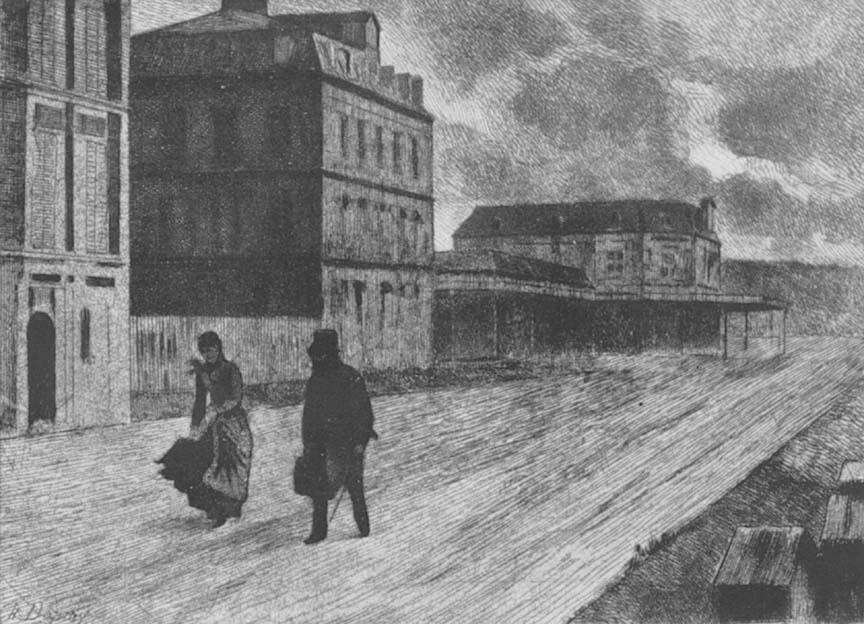
At first we followed the road that skirts the seashore, going towards the lighthouse; and then, turning to the right, we entered a path that crossed some open fields and came out at the Rue du Casino, not far from the place where stood the statue of the Duke de Morny---the Emperor's faithful and intelligent friend, his alter ego---to whom Deauville owes its existence as a fashionable seaside resort.
As the Rue du Casino led almost directly to the head of the dock in which the Gazelle was lying, we crossed the Place de Morny, and passing hurriedly by a café brilliantly lighted and from which issued the sound of drunken voices, we walked on in the middle of the street until, approaching the appointed rendezvous, we saw the man with the lantern, whom Sir John had put there to guide us to the yacht. Turning to the right and the left to avoid stacks of timber, and piles of boards, and pools of water on the ground, we very soon reached the place where the Gazelle was moored, and found Sir John waiting for us at the gang-plank. After being' introduced to the Empress, he escorted us down into the cabin, where we were received by Lady Burgoyne.
The condition in which we arrived was deplorable. Our shoes were water-soaked, our clothing bedraggled, and we were spattered with mud from had to foot.
It had rained heavily during the day, and we had walked quite three-quarters of a mile, a large part of the way over ground covered with sand-drifts, where it was impossible at times, in the shifting and uncertain light, to avoid stumbling against invisible hillocks, or stepping into holes full of water and mud. We had come quickly, considering the roughness of the way, but had proceeded separately and silently, scarcely uttering a word.
What may have been the thoughts of her Majesty as we were hurrying through the byways and deserted streets of Deauville at midnight, anxious not to be seen, under the protection even of the darkness and the storm, I cannot say. With me the thought uppermost was the strangeness of the situation. It seemed impossible that I was really alone with the Empress of the French, who was leaving in this remarkable manner the land where she had reigned so many years in splendor, and the people to whom she had been so devoted and by whom she had been so greatly admired.
How different was this departure of the Empress for a foreign country from those of former days! Then, she went forth accompanied by her ladies-in-waiting, and chamberlains, and officers of the household, escorted by squadrons of cavalry riding rapidly through the streets lined with enthusiastic spectators, crying, "Vive l 'Impératrice!" and who assembled in crowds about the approaches of the quays to catch a glimpse of her person, and to greet her with offerings of flowers and multitudinous manifestations of patriotism and loyalty. How different were her journeys in France commenced in the days of her sovereignty! Then, every step from one place to another resembled a triumph, and the journals all over the country vied with each other in reporting the most trivial incidents in the tournée of her Imperial Majesty, the beautiful and distinguished consort of the ruler of France.
On that gloomy night of September 6th and 7th there were no flags waving, no cries of "Vive l'Impératrice!" or "Vive Eugénie!" nor any admiring crowd to witness the departure, perhaps forever, of this great lady from the home she had so long made radiant by her presence; only the clouds in black masses, spread over the heavens like mourning drapery; there were no offerings of fresh flowers, only the scattered leaves of autumn driven before the wind; there were no attending courtiers at her side, only one follower and friend accompanying the deserted Empress to the place where she was to embark; and the only voices to be heard were those of men singing the "Marseillaise" in the wine-shops, and of the howling storm, and of the rolling waves breaking against the shore. The world which had always heretofore been so accurately informed as to every movement of her Majesty, did not know that she was about to leave her country; and her subjects were so busy in the work of smashing in pieces the whole fabric of the Imperial Government, or in seeking their own personal safety, that nobody in the capital from which she had fled seemed to have even thought of her.
This indifference, however sad and regrettable, was at least fortunate for her Majesty in one respect; for, though it was quite certain that there would be no courtiers to follow her, it was very questionable whether some spy might not be lurking by the way to prevent the unfortunate sovereign escaping from the jurisdiction of the Revolutionary Government. But no spy even was sent to follow her. The thought, however, that a mouchard might be watching us made me feel uneasy at each step; and every sound and every sudden ray of light falling across our path startled me, and gave rise to some apprehension that, although apparently so near the realization of our purpose, the success of the previous days might end in failure,
A sadder night I have never experienced, and I hope never to witness its like again.
Soon afterward Madame Lebreton arrived, accompanied by Dr. Crane, bringing along with him the parcel above-mentioned. They had come to the yacht over a different route from that taken by us; but they had been obliged to wade through the water, which in several places was quite deep, and had met with the same difficulties on the road that her Majesty and I had encountered.
Lady Burgoyne was most gracious and sympathetic. She immediately placed everything she had at the disposal of the two ladies, and did everything in her power to make them comfortable. Changes of clothing were made, a room was provided for them, and then hot punch was prepared and served, which was greatly appreciated by the whole company. The only news we heard on board the yacht, apart from what we had read in the Paris morning papers, consisted of vague rumors that during the day, acts of violence had been committed in Paris; that a number of persons had been arrested, and among others the Princess Mathilde. The Empress was particularly anxious to know if the London papers contained any news of the Prince Imperial, or any information about the Emperor, and was greatly disappointed to learn that the latest English papers received, dated September 5th, contained very little that interested her, and no indication of the place in which the Prince then was. She, however, quickly suppressed her emotion, thanked Lady Burgoyne for what she had done and was doing for her, and recounted some of her own recent personal experiences.
After we had talked together awhile, the Empress and Madame Lebreton retired to their small stateroom at the end of the cabin, and Lady Burgoyne also went to her berth, which was at the side of the saloon.
After the ladies had left us, Sir John, Dr. Crane, and myself went on to the deck, where we walked slowly up and down in subdued conversation. Sir John told us some of his yachting experiences, and again reminded me of the fact that he had been brought up as a soldier. He said that, after quitting the army, he had spent a great deal of his time in yachting, and that his friends considered him a famous sailor. He also again referred to the unpleasant consequences which our presence on board his yacht might have for him. I assured him there were no reasons for such apprehensions, as our secret was safe for the time being, and that, when it became known that he had taken us over to England, no one could blame him, but on the contrary, every one would praise him. Sir John then remarked that he was greatly afraid the Empress had been followed by spies; that he had been to the Casino during the evening, where his suspicions had been aroused. He was evidently very uneasy, and on the watch for some movement having for its object the arrest of her Majesty. But everything remained perfectly quiet in the neighborhood, and not a soul came near the yacht, or was seen, but the douanier (the custom-house officer) on guard.
It was perhaps 3 A.M. when we left the deck and returned to the cabin; and while Dr. Crane and I sat or reclined upon a settee near the table in the center of the small saloon, Sir John lay down in a berth on the side of the cabin opposite to that where Lady Burgoyne was resting. Neither my friend nor I thought of sleep, and we talked over various important matters which had to be attended to during my absence from France, and especially considered what further provision was necessary to complete and put in working order the Ambulance in Paris, which I had left so unexpectedly and so suddenly.
Soon after it began to grow light, Sir John went on deck, and, on returning, reported wet weather, and a fresh west-southwest wind; but that he had given orders to have everything ready to cast off before seven o'clock. The Empress was now informed that we were soon to leave the dock, and that Dr. Crane was not to remain with us, and would take back to Paris any messages she might wish to send. Her Majesty rose immediately, and, coming into the saloon, sat down on a settee and gave the doctor a list of the persons she wished him to see, together with instructions respecting the channels through which letters or other communications could be quickly and safely sent to her. Her Majesty's messages were, however, almost entirely of a personal character, and were intended to relieve her friends of any anxiety they might have felt on account of her sudden and mysterious disappearance.
About half past six o'clock Dr. Crane bade us good-by and went back to the Hôtel du Casino, from which place, after having presented our adieus to Mrs. Evans, he returned to Paris.
| We leave the harbor---Rough weather---In a gale---We reach Ryde Roads---The landing---At the York Hotel---News of the Prince Imperial---The Empress and the Bible---We go to Brighton---The Empress hears that the Prince Imperial is at Hastings---She insists on going there---A vain device---We arrive at Hastings---I go to the Marine Hotel and find the Prince---My plan for a meeting between mother and son---The Empress cannot wait---The way barred---The Prince in the presence of his mother---Tears of joy and of sorrow---The Empress and the Prince Imperial remain in Hastings---House-hunting---Mrs. Evans comes to England---Miss Shaw---Camden Place---Negotiations---Camden Place is rented---"A spirited horse, perfectly safe"---Her Majesty leaves Hastings---She takes possession of her new home---The first night at Chislehurst---The first act of the Empress next day---A tragic story---Conversations with the Empress . |
 T was a little after seven o'clock
, when we left the harbor of Deauville-Trouville and laid our
course for Southampton. The weather was thick, a little rain was
falling, and the sea rough; but the yacht, with her mainsails
set, together with the spinnaker and second jib, and the wind
in her favor, began to make good headway. This gave us hope that
we should reach the English shore during the course of the afternoon.
Our hopes, however, soon left us, for the weather grew worse,
and before long became very threatening. At about one o'clock
a violent squall came up, the wind veering round almost dead ahead,
and blowing from the northwest, the direction in which we had
up to this time been steering. We lost our spinnaker boom by this
sudden shift of the wind, and were forced at once to reef the
mainsail, run down the jib, and set the storm-jib. All hands were
called up, and orders were given to have everything made fast
and to be prepared for a blow. From moment to moment the wind
increased in intensity, and the yacht began to roll and pitch
more and more heavily, taking on board large quantities of water.
The force of the wind was so great, and the sea running so high,
that soon it was no longer possible to keep our course.
T was a little after seven o'clock
, when we left the harbor of Deauville-Trouville and laid our
course for Southampton. The weather was thick, a little rain was
falling, and the sea rough; but the yacht, with her mainsails
set, together with the spinnaker and second jib, and the wind
in her favor, began to make good headway. This gave us hope that
we should reach the English shore during the course of the afternoon.
Our hopes, however, soon left us, for the weather grew worse,
and before long became very threatening. At about one o'clock
a violent squall came up, the wind veering round almost dead ahead,
and blowing from the northwest, the direction in which we had
up to this time been steering. We lost our spinnaker boom by this
sudden shift of the wind, and were forced at once to reef the
mainsail, run down the jib, and set the storm-jib. All hands were
called up, and orders were given to have everything made fast
and to be prepared for a blow. From moment to moment the wind
increased in intensity, and the yacht began to roll and pitch
more and more heavily, taking on board large quantities of water.
The force of the wind was so great, and the sea running so high,
that soon it was no longer possible to keep our course.
Under these circumstances it became a serious question whether we should be able to continue our voyage, for the Gazelle was not calculated to encounter such rough weather, and Sir John suggested to me that he might be forced to seek a shelter in some harbor on the French coast. I was much disturbed to learn that it was possible we might be compelled to put back, and insisted that we ought to trust in Providence, which had hitherto protected us. But I was greatly reassured when the Empress herself told us she was not afraid. She considered that she had escaped from a much more dangerous storm when she left her capital. Indeed, the courage and the unwavering fortitude which her Majesty showed during the whole voyage made a great impression upon everybody on board. Sir John, observing her Majesty's fearlessness, and believing it to be her wish that we should continue on our course, made no further reference to turning back.
But the gale continued, the violence of the gusts increased, and the yacht rolled badly in the heavy groundswell. In order to expose the small craft as little as possible to the severity of the tempest, her sails were closely reefed, except a small storm-sail, and her head brought up into the wind, where she lay plunging and rolling and making no headway, except by drifting with the tide or on short tacks. It was six o'clock when the Isle of Wight was first sighted, in the eye of the wind; and the worst of the storm was yet to come. The night settled down thick and dark; the gusts of wind became still more frequent, and the rain fell in torrents, accompanied by vivid flashes of lightning and sharp thunder. As the yacht reeled and staggered in the wild sea that swept over her deck and slapped her sides with tremendous force, it seemed as if she was about to be engulfed, and that the end indeed was near. At one moment the pounding on the deck was such that her Majesty sent to inquire what had happened ---if any one had been hurt. But the Gazelle, although small, proved to be a stanch boat, and careen as she might under the force of the storm, she righted herself quickly and rose on the next big wave, buoyant as a cork. The Empress told me afterward that during this night she several times thought we were sinking, and that the noise and the creaking were such as to cause her to believe the yacht would certainly go to pieces before many minutes. "I was sure we were lost," she said; "but, singular as it may seem, I did not feel alarmed in the least. I have always loved the sea, and it had for me no terrors then. Were I to disappear, I thought to myself, death, perhaps, could not come more opportunely, nor provide me with a more desirable grave."
Towards midnight the force of the gale began to abate, so we let out a reef in our mainsail; and the wind coming round more to the west, we began to scud along quite briskly toward the Nut Light, which could be seen dead ahead. The weather continuing to improve, we reached Ryde Roads, and dropped anchor there about four o'clock on the morning of September 8th. As soon as she heard that we were safely across the Channel, her Majesty requested me to thank the crew, as an expression of our appreciation of their services, and at the same time I handed them some gold coins, which, it was suggested, they might keep as souvenirs of the voyage.
The sun was just rising when we left Sir John's yacht to go ashore. We landed at the pier, and having passed the toll-gate, where we were stopped for a moment, we first directed our steps to the Pier Hotel, very near the jetty. But here, probably because of the early hour, or our shabby appearance---on foot and without luggage---we were refused admittance; the reason, however, very politely given, was that there were no rooms unoccupied. We then walked up George Street until we came to the York Hotel. Here I asked for rooms for our party, but the woman to whom I spoke, apparently hardly deeming us worthy of an answer, left us and kept us waiting for a long while before she at last returned, saying that we could be accommodated. She then showed us up to the top of the house, where we were led into some very small rooms, which we told her would do for the present; for we were glad to find even such a resting-place as this, after the discomforts and emotions we had experienced during our perilous passage across the English Channel. On her asking for our names, I wrote upon a bit of paper, "Mr. Thomas and sister, with a lady friend.''
As I was about to leave the ladies, in order that they might give some of their clothes to the chambermaid to be cleaned and dried, and have a chance to dress, it was discovered that the gown worn by her Majesty could not at once be entrusted to the domestics of the house, for it was attached to a belt upon which was fastened a large silver "E" surmounted by a crown. This ornament had first to be removed, since it would undoubtedly have attracted immediate notice. Her Majesty therefore handed this garment out to me through the half-opened door; and after making the necessary change in it, I took it down-stairs to have it cleaned and dried as well and as quickly as possible by the kitchen fire. When the ladies had dressed, and rested for a time, we sat down to breakfast, which was very welcome to us, for on board the yacht we had eaten little, and became keenly aware of our famished condition soon after our feet had touched terra firma. We would surely have liked to repose for a day or two, now that we were safe in England; for none of us had been able to get much, if any, sleep during the preceding four days, and, besides, we were each one of us thoroughly worn out under the incessant stress of our anxieties and responsibilities. But we did not yield to this temptation, for we were too eager to know what had happened during the days that we had been cut off from every source of information, and, furthermore, felt that we must be ready, at a moment's notice, to leave for a destination to be determined by the circumstances.
I therefore, soon after breakfast, went into the town to see what news there might be of interest to us; for I knew that the plans and movements of the Empress were necessarily dependent upon the political situation created by the events immediately succeeding the fall of the Imperial Government, and more particularly, and directly, on news concerning the Prince Imperial, whom she was most anxious to hear from and to see.
In a morning paper that I bought, it was reported that the Prince had arrived at Hastings. I felt that, if this news should prove to be correct, it would be, of course, my duty to bring the mother and son together as quickly as possible. Since, however, I did not place much confidence in what I had read, the papers accepting at the time so many rumors for facts, and fearing the report might excite her Majesty unnecessarily, I concluded to simply state to her that it would, in my opinion, be well to go on at once to Brighton. There I hoped to learn the truth; and Brighton was on the direct road to, and not far from, Hastings.
Upon my return to the hotel I found the Empress sitting with an open Bible in her hand. Her Majesty, not being aware of the English custom of keeping in the rooms of hotels copies of the Old and New Testaments, told me that she was quite surprised to find this book upon the table, and that, regarding its presence as providential, she had opened the volumes to see upon what passage her eyes would first fall. She had found some very hopeful and encouraging words; they were: The Lord is my Shepherd; I shall not want. He maketh me to lie down in green pastures: He leadeth me beside the still waters."
In consequence of this oracular message, or from some other cause more natural, she had become quite cheerful and composed. And when she heard my proposal to take her to Brighton, where, I told her, I hoped to hear news regarding the Prince Imperial, she seemed to be delighted, and eager to go.
We were very soon ready to start, and leaving the hotel, went down to the pier to embark on the steamer going to Southsea. The Princess Alice, which we found at the landing-stage, took us to the place mentioned, and thence by tramway we went on to Portsmouth. Here we bought tickets for Brighton; and, when we had come to this well-known watering-place, hearing there was a Queen's Hotel in the town-as this name seems always of good omen to me in England---I called a cab and directed the driver to take us to this hotel. My expectation was correct; here we found excellent accommodations.
Every arrangement having been made that the ladies should be comfortably provided for, I went out to look about and see if I could ascertain whether the news concerning the Prince, which I had seen in the paper at Ryde, was correct. The London evening papers, which had just arrived, confirmed the report that the Prince was in England; and soon after I met several friends on the Promenade, who, to my inquiries, replied that the Prince was actually at Hastings, and stopping at the Marine Hotel.
My doubts being thus removed, I returned to the Queen's hotel, and during dinner repeated what I had heard. This news had an electrical effect upon her Majesty. She rose up quickly, left the table, and insisted upon going immediately to meet her son. Seeing that all remonstrance would be in vain, I asked the porter of the hotel at what hour trains for St. Leonard's would be leaving, and learned that, if we wished to take the next train, we should have but a few minutes to spare. We therefore hastily got ready to leave the hotel, procured a closed cab, and arrived at the railway station just before the train left.
The name St. Leonard's I had not chosen at random, for I really wished to go only as far as this place, which is the last station before arriving at Hastings. I thought it would not be wise for her Majesty to go to her son, it being rather his duty to come to her, after I had announced to him her arrival in England and where he could meet her. Although, from the point of view of sentiment and affection, it might be a matter of indifference as to where the meeting should take place, or whether the son should come to his mother or the mother should go to her son, I was certain that, in case her Majesty's arrival in England should become publicly known, her every step would be reported and commented upon in the newspapers, and I thought it was not to her interest at this time to become the subject of much publicity.
Another reason why I desired her Majesty should not go to Hastings was the fact that the words "Marine Hotel," the name of the house where the Prince had taken rooms, suggested to my mind a kind of sailors' boarding-house, or hotel of the second-class. For this thought I beg the pardon of the most excellent people who kept the hotel, which proved to be all that could be wished, and who treated the Prince, as well as the Empress and myself, with the greatest kindness from the moment of our arrival until our departure.
Then again, before we left Brighton I knew nothing of Hastings, never having been there; but I had heard that in St. Leonard's there was a large and well-known hotel, which I thought would be a place where her Majesty could meet her son very properly and conveniently. Being nevertheless afraid that I should meet with objections from her Majesty were I to advise her not to go on to Hastings, I kept my own counsel, and, without her knowledge, took tickets only as far as St. Leonard's. This device proved, however, to be in vain, for her Majesty, on getting out of the train, inquired at once, "Is my son here? "
No---n-not exactly here," I stammered out, "b-but quite near---at---at the next station. As soon as we have secured rooms at the hotel I will go there and bring him over."
Of this the Empress would not hear. And although I stated to her my apprehensions with respect to the comments of the press, and my doubts as to the respectability of the Marine Hotel, and finally drew her attention to the fact that it would be better to wait until next morning for a meeting, as the evening was advanced and she was much fatigued, her Majesty was so anxious to see the Prince that she would not listen to my remonstrances, and insisted upon going by the very next train to Hastings. Upon inquiry, we found that this train would leave within twenty-five minutes, and not knowing Hastings was so near St. Leonard's that we could easily have driven there in a cab, we walked up and down the platform to pass away the time. The twenty-five minutes which we had to wait seemed a century, so to speak, to the Empress, she was in such haste, so nervously impatient, to see her son. And Madame Lebreton and I were greatly relieved, for her Majesty's sake, when the train that was to take us on entered the station.
It was about ten o'clock when we arrived at Hastings. Leaving the ladies in the Havelock Hotel, near the railway station, I went myself to the Marine Hotel, where the Prince Imperial was staying. When I asked the person in the office to announce me to his Imperial Highness, I was told that I would probably not be able to see the Prince that night, since it was already late, and his Highness had wished to retire early, on account of an indisposition from which he had suffered during the last few days. "If, however,'' said the clerk, "you choose to mount the stairs, you will find in the drawing-room some of the friends of the Prince, who no doubt can give you information about him." Hearing this, I went up to this room, and when the door was opened, I saw his Highness, surrounded by several gentlemen who had come with him from the Continent. As soon as the Prince saw me, he stepped quickly towards me, and exclaimed: "Have you any news of my mother? Where is she? Nobody can tell me whether she is still in Paris, or whether she has left France. It is now four days that no one has known what has become of her. And I am so anxious! Do tell me if you have heard anything about her!"
The rapidity with which the Prince spoke, scarcely waiting for an answer, indicated very clearly his deep concern for his mother's safety, the warmth of his affection for her, and that now she was the principal subject of his thought.
"Oh," I replied, as soon as I had a chance to speak, " I am sure your mother is safe. She is not in France; and I have just heard she is in England, having reached here some time to-day."
"But where did she land? Where is she now?"
"With friends, I understand, under whose protection she left Paris. If your Highness will wait a little while, I will make further inquiries, and perhaps, on my return, I shall be able to inform you positively where your mother now is."
The Prince, as soon as I held out to him the hope of receiving news of his mother, was greatly delighted, and said he should most certainly not retire for the night until he had heard what I had to report. Promising that I would not keep him waiting long, I left the Prince, and returned to the Empress to announce to her that I had seen her son, and to arrange with her a time and place for their meeting.
The reader may perhaps be surprised that I did not at once tell the Prince Imperial the whole truth. It was because I saw from the manner of the Prince, immediately he spoke to me, that to do so would not be expedient. He was, as all who knew him personally are aware, of a highly sensitive and emotional nature. He was then only fourteen years old, and, after his father had become a prisoner, had been hurried through Belgium to England, and from one excitement to another, without rest either of body or mind, until his nerves were in a state of extreme tension. I therefore thought it prudent to let him at first, only know that there was good reason to believe his mother was safe, and to prepare his mind for the reunion with her by suggesting to him that such a meeting might be expected very soon.
On my way back I was still thinking how I could induce the Empress to receive her son at her own hotel, for I believed this to be the better plan, for reasons which I have stated above; but as soon as I found myself once more in the presence of her Majesty, I saw that no reason I could give for a postponement of the meeting would find favor with her. All her thought seemed entirely engrossed by the hopes and anticipations of this meeting. On entering the room, I found her sitting in a chair in exactly the same position in which I had left her, with a little satchel in her hand, and waiting, apparently ready to start off at a moment's notice. The instant she saw me she sprang up, and rushing towards me, said:
These and similar questions followed each other in quick succession. As soon as I had informed her Majesty that I had seen the Prince; that, with the exception of a slight cold, he seemed to be in good health; and had told her how anxious he had been to receive news of his mother, nothing could keep her any longer in the room; and half drawing me with her to the door, she hurried me out of the house and into the street, exclaiming: "Where is he? Let me go to him at once!"
Running rather than walking through the streets, we directed our steps towards the Marine Hotel; and in a few moments we---the Empress, Madame Lebreton, and myself---stood in the office of the building which I had left scarcely half an hour before. When I announced to the hotel proprietor that we desired to see the Prince Imperial, he looked closely at the Empress, and taking her, as he afterward told me, on account of her having put the cape of her waterproof over her head, for a Sister of Charity, replied that it was too late; that he thought the Prince had retired to his room and did not wish to see any one. We told him we did not think so; that, in any event, we would go up-stairs and see. But having reached the top of the staircase, an English valet-de-chambre, who had evidently heard our conversation or guessed our intention, barred our way with the words: "The Prince has gone to bed. If you wish to see him you will have to come another day."
During my brief interview with the Prince I had observed that folding-doors separated the drawing-room from another room, which was probably, as I thought, in the private suite of his Highness. While the valet was still talking, I saw there was an entrance from the corridor where we stood into this room. Pushing by him, without speaking another word, I opened the door, and seeing at a glance that the room was occupied by the Prince, hurried her Majesty and Madame Lebreton into it, and leaving them, walked into the drawing-room where the Prince was standing.
Upon encountering his inquiring look, I simply pointed to the door through which I had entered. He understood me, and in another moment he was in the presence of his mother.
What a moment in the history of these two persons! This noble woman, who had kept up so bravely during the most trying hours of her flight, could restrain her emotion no longer. The tears of joy flowed abundantly, and her lips murmured words of thanks to Heaven, which had preserved to her that son who had been her pride and delight, and the sight of whom now caused her to forget all she had lost and all she had suffered.
But was the past quite forgotten at this meeting? Had really all remembrance of those days of splendor and triumph vanished from her memory?
No, indeed, the past could not have been forgotten by her; for although joy and gratitude filled her heart, as she pressed her child to her breast, this joy was mingled with sorrow. What pictures must have flashed across her mind, what thoughts have disturbed her soul?---the memory of her happy childhood; her brilliant womanhood; the realization of her most daring wishes; her son, the heir to the glory and the throne of Napoleon; and, at last, the downfall that came like a thunderbolt from a serene sky, annihilating all the splendor which for so many years had surrounded her, and leaving her a homeless, helpless woman, with her son, both fugitives in a foreign land.
However inarticulate her thoughts, she must have been vividly impressed by her immediate surroundings, and felt their deep significance, as she stood before me, embracing her son with tears of joy and sorrow in her eyes. The Prince, unable to control his emotion, sobbed as he rested in his mother's arms, and in broken sentences told how he had grieved for her, and how rejoiced he was to be with her once more.
The spontaneous and impulsive manifestations of maternal and filial affection, of which I was a witness on this occasion, were, under the special circumstances, extremely touching, and I stepped out of the room, overcome by a feeling of sympathy and profound pity, leaving mother and son to themselves, alone.
And what a meeting! She, who only a few days before was the most exalted, the most envied sovereign in Europe, now deserted by all who had been proud to obtain a glance from her eye or a word from her lips, is unable to offer to her child, whose Imperial heritage has vanished, anything but Love---the imperishable love of a mother. What a drama! And yet what a triumph! For the glory of the world passeth away, and love endureth forever.
After a while the Prince Imperial came to me and expressed in the warmest terms his thanks for my having restored his mother to him, for he had now learned from her that it was to me that she had gone for protection when she found herself in the streets of Paris alone and helpless, and that I had brought her in safety to England. It was plainly to be seen, from his bright and happy face, that the loss of an Empire had troubled him much less than his anxiety for her whom he loved so dearly, and of whose fate he had so long been kept in ignorance. And those must have been bitter hours for the heir to the French Empire---his father a prisoner in the enemy's country, his mother probably at the mercy of a mob, perhaps already a victim, while he himself was fleeing for safety to a foreign shore, and vainly trying to ascertain what had taken place since he had left the head-quarters of the French army!
But here, at Hastings, mother and son were reunited, and the first ray of sunlight pierced the darkness which for many days had covered the destiny of the Imperial family.
Before the Empress had met her son, it was agreed between us that she should return to Brighton after their meeting; but this plan, very naturally, was not executed. Mother and son had no wish to separate after they had found each other. On this account former plans were changed, and the Empress and the Prince Imperial remained together in Hastings.
It was at a rather late hour that I left the Marine Hotel and returned to the Havelock Hotel, where we had temporarily stopped on arriving at Hastings. On the following morning, when I went to the Marine Hotel to learn the Empress' wishes, to my great regret I found her confined to her bed from exhaustion, and suffering also from a severe cold. Her Majesty had already a slight cold when, she came to my house on September 4th, and it was no wonder that her exposure on our journey through France, and during the rough night on the Channel, had aggravated it. Besides, the continued excitement and loss of sleep, and the anxiety to which she had been subjected for many days, and weeks even, were too much for human strength to support; and although she had kept up bravely under the most severe trials, and had not given way while she was sustained by the hope of seeing her son, now that this most fervent wish of her heart had been realized, a reaction followed, which kept her in her room for several days.
Her Majesty's arrival in England was now publicly announced, and friends began to gather about her---the Duke and Duchess de Mouchy, M. de Lavalette, the Princess Murat, and others. But the situation in France, which grew more serious from day to day, made it probable that her Majesty's sojourn in England would last for weeks, perhaps for months; and possibly the thought may have already occurred to her that England might become her permanent home. However this may have been, Hastings was not at this time a desirable place of residence for the Empress. There were too many people coming and going, and it was also the rendezvous of too much fashion and too much curiosity. The Empress very soon began to be annoyed, and she expressed to me a wish that I would obtain for her, as quickly as possible, a suitable residence, where she might feel that she had some personal freedom, and where she could conveniently receive her friends.
On Sunday, the 11th, I received a telegram from Mrs. Evans, to whom I had reported our arrival at Ryde soon after we landed there. In this telegram she informed me that she, in company with Doctor and Miss Sharpless, old friends from Philadelphia, who had been with us at the Hôtel du Casino in Deauville, would, coming by way of Dieppe, arrive at Newhaven on Wednesday morning, September 14th. And there I went to meet her. The boat came in several hours behind time, after a terribly rough passage. It was crowded with refugees, men, women, and children all huddled together, everybody sick, large numbers on deck, drenched and looking utterly miserable. My poor wife had been "dreadfully ill," but quickly recovered on coming ashore. She accompanied me to Hastings, where we took rooms at the Albion Hotel.
As soon as we were settled there we made excursions into the country almost every day, visiting the villas which were to let, and trying to obtain a suitable residence for the Empress. I had, when this matter was first mentioned to me, entered into correspondence with a number of house-agents; and a residence in Torquay, which I visited, I found very attractive. Indeed, I was so convinced it left nothing to be desired as a temporary home for the Empress that I engaged to take it, conditionally. I was, however, obliged to cancel the arrangement which I had made, her Majesty having expressed to me a desire to live not far from London, as a matter of convenience to the friends who might wish to visit her; because, she said, "I wish to save them a long journey, and to many of them, also, the expense of going to a place so far from France might be embarrassing."
This generous consideration on the part of the Empress is in very striking contrast with the behavior of many of those in whose friendship at that time she still believed. The years have come and gone, but they have never thought it their duty or found it convenient to visit their exiled sovereign, who always felt so kindly towards them.
One humble, simple friend, however, did not hesitate to go to Hastings as soon as she heard that her former mistress and the Prince Imperial had arrived there. This person was Miss Shaw, the faithful nurse of the young Prince---"Nana," as he, when a child, used to call her. She had remained in the Tuileries as long as she had been permitted to do so, and then she left for England; for, although she had no idea of what had become of the Empress or the Prince, she nevertheless felt sure she should find his Imperial Highness in that country. To her great joy, on arriving at Dover she heard that the Prince, with Count Clary, had passed through Dover, coming from Belgium. On inquiring, she was informed he had gone to Hastings. Immediately she hastened to this place, and thus, as early as the 10th, she was able to see again "her boy," as she always called the Prince, her affection for whom absorbed her whole soul.
This faithful woman had been sent to Paris by Sir Charles Locock, after the Empress' confinement, at the special request of her Majesty, the Queen of Great Britain; and her tender love for the Imperial child, and her unalterable devotion to the Imperial family, had fully justified the recommendations which had been given her. From the moment she entered the Palace of the Tuileries until the death of the Prince Imperial, all her energy, her whole life, was devoted to the welfare of the boy who had been confided to her care. She had in a short time gained the entire confidence of the Emperor and Empress, who wished her to remain as a guardian of the Prince in the palace when her duties as nurse were no longer required.
She not only had a care for the bodily welfare of her trust, but she tried to instil into the heart of the boy all the noble principles which are needed by one who is to become the ruler of a great nation; and she had also made it her duty to watch over the health of his soul. She had strictly kept him to the observance of his religious duties, which was the more remarkable, as she, being a Protestant, had charge of a child brought up in the Catholic faith. And while it was easy for her to develop in the open and impressionable mind of the young Prince a clear and abiding sense of right and of wrong, she did not fail to cultivate in him that reverence and respect for truth, and for law, which she herself felt as the result of her own English education.
When this excellent woman, who had always had an important voice in the councils of the Imperial family, if anything regarding the future of the Prince was to be decided, heard the sad news of the premature death of the young soldier in Zululand, she said to me: "He was too good for this world. God has saved him from severer trials, and I shall soon go to him."
Her apprehension proved to have been correct. The faithful nurse only outlived her foster-child by three years. She died in 1882.
Besides Miss Shaw and the persons whose names I have mentioned, there came to Hastings very few visitors. Those courtiers who had formerly been daily guests at the Palace of the Tuileries, did not come over to England until much later, after her Majesty had taken up her residence at Chislehurst.
Camden Place, Chislehurst, which afterward became so well known as the home of the Imperial family, I discovered by a fortunate accident, after searching many days in vain for a residence for the Empress in the neighborhood of London. Although I had seen a considerable number of fine houses, scarcely one of them seemed to me to be perfectly suitable or desirable, either on account of the locality or the accommodations, or on account of the conditions which the landlord wanted to impose upon the tenant, and occasionally these were even embarrassing, as, for example, when letters were addressed to me by gentlemen placing at her Majesty's disposal their houses and villas, free of every charge. It is scarcely necessary to say that these offers were most decidedly but courteously refused by the Empress.
In a conversation which I once had with the Emperor, he told me that some of the most agreeable days during his long sojourn in England had been passed at Tunbridge Wells. He praised the beautiful scenery, and spoke of the magnificent trees which he had seen there, and manifested a strong predilection for the place. The remembrance of this conversation induced me to see if it was possible to find a residence for the Imperial family at Tunbridge Wells; for we all hoped that the Emperor would soon be permitted by the Prussian Government to leave Wilhelmshöhe and rejoin his wife and son in England.
I consequently went to Tunbridge Wells, and succeeded in finding a place there which I thought would probably meet all the immediate requirements of the Imperial household; but just before speaking to the owner upon the subject, a gentleman mentioned to me Camden Place, at Chislehurst. He described it as a large and beautiful country-seat, close to London and yet secluded, saying it was just what I wanted, but that, unfortunately, it was not to let. Believing from the description he gave me that the place was really a very desirable one, and not allowing his last remark to deter me---after having heard that Chislehurst was so near London that it could be reached in twenty minutes from Charing Cross station---Mrs. Evans and I took tickets for this place.
On arriving at Chislehurst station, I hailed the first conveyance I saw, and a few minutes later we halted at the gate in front of Camden Place. At the entrance, Mrs. Taylor, the lodge-keeper, received us, and I asked her a few questions about the house. She replied that Camden Place could not be rented, and expressed doubt as to whether it could be visited. Hearing me, however, speak a few words in French to Mrs. Evans, she seemed to reconsider the matter, and exclaimed:
"Oh, if you speak French you may perhaps be admitted into the house. There is a gentleman living here ---Mr. Foder---who also speaks French, and if you would like to see him I will go and call him."
With these words, after inviting us to come into the lodge, the lodge-keeper hastened to the house, and before long returned in company with a man who informed us that he had charge of the property, which belonged to a Mr. Strode. After we had conversed for a few moments, he very kindly offered to show us over the place-an offer we gladly accepted.
The house was a large, well-constructed building, built of brick and stone, with projecting wings in front, surmounted by balustraded parapets. The façade was well exposed and very handsome. The house was approached by a fine sweep of roadway, and contained, as I ascertained on inquiry, several large living-rooms, twenty or more bedrooms, and the offices for a full establishment. The stable accommodation also was ample. I saw at once that the grounds were quite extensive, and handsomely laid out. The main avenue from the gate to the house was lined with elms and beeches, and the broad stretches of well-kept lawn were broken here and there by foliage plants and beds of flowers, and were decorated with statuary; while, not far from the house, a massive group of cedars branched out conspicuously and threw into relief the body of the building. The impression produced upon us, as we passed through the park, was extremely pleasing; the color was so soft and yet so varied, the calm, the restfulness, so complete, that the place seemed to be indeed an ideal retreat for one seeking a surcease from the turmoil and trouble of the world. Upon entering the house, we were surprised to find in it so many articles of French manufacture. The long hall lighted by a skylight, the large drawing-room, the fine staircase leading to the floor above, and the arrangement of the very handsome rooms, with the furniture and other fittings, gave me at once the impression of being in a veritable French château. I was consequently not surprised when I was told that some of the furniture came from the Château of Bercy; but it was certainly remarkable, as was discovered some time afterward, that several of the pieces of carved mahogany in the dining-room were exactly similar to a number that, on the demolition of this château, had been purchased by the Empress at the same auction sale of the woodwork and other fixtures, and had been placed in the residence she had built in Paris for her sister, the Duchess of Albe. Moreover, the building was beautifully situated; in a word, it seemed to me more attractive than any I had visited during the previous days, and pleased me greatly. I therefore, observing the excellent French taste with which Camden House was furnished, remarked to Mr. Foder that it afforded me much pleasure to see myself again, so to say, in a French intérieur. Then, leading the conversation to France itself, and speaking of the misfortunes which had so recently befallen that nation, and of the sad consequences which they must have, not only for that beautiful land but also for many of its inhabitants, and especially for the Imperial family, I at last said it was for this family, some of whose members were then in England, that I was seeking a residence. The conversation which followed led in a few moments to the plain statement that our object in coming here was to inquire if Camden Place could possibly be obtained for her Majesty, the Empress of the French. When Mr. Foder heard this, he told me that although Camden Place was not to be leased, he believed that Mr. Strode, whose French sympathies were very strong, and who had often spoken with admiration of the Imperial family, would gladly place his property at the disposal of the Empress and her son, without asking any remuneration for it.
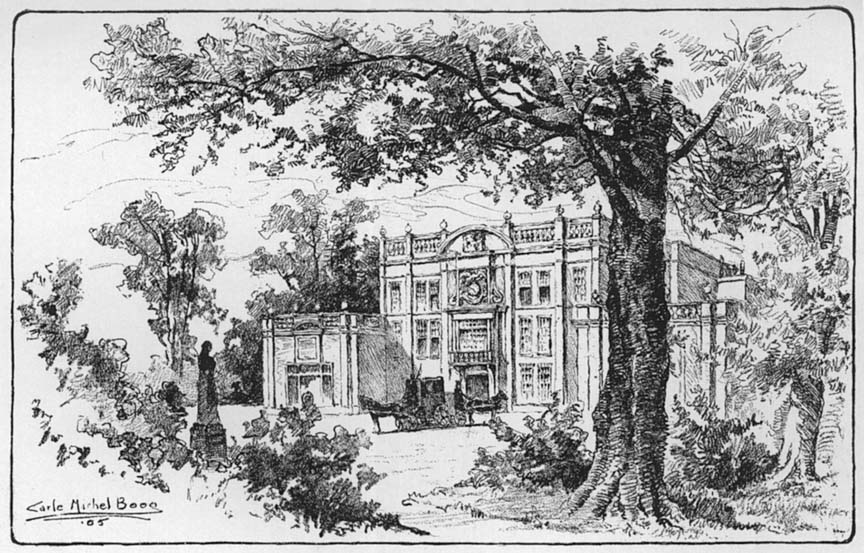
To this remark I replied that many such offers had already been made and refused; but that if the house could be rented, I would like to engage it, as I considered it the most suitable of all I had seen, and was sure her Majesty would be pleased with my choice, not only because the house was conveniently near London, but also on account of the extent and disposition of the grounds about it, and the arrangement of the interior, which even to its furnishing was French; besides, Camden Place was near a Catholic church, and this, I knew, would be very agreeable to the Empress, who always faithfully attended the services of her church, wherever and whenever it was possible for her to do so.
Thereupon Mr. Foder kindly proposed to go to London by the next train, to state the case to Mr. Strode, whom he said he was sure to find at the Garrick Club that night. This proposal I accepted with thanks, and after leaving my address, Mrs. Evans and I returned to Hastings.
The next day, September 22d, I again took Mrs. Evans to Chislehurst to see the house in question. We examined it very thoroughly. My wife thought it really"palatial," and the situation " exquisite," so calm and restful were the surroundings. We afterward went on together to London, where we lunched with Mr. Strode.
At a late hour the same evening I received a despatch from Mr. Foder, making an appointment with me to meet him at Chislehurst the following morning; and upon arriving at Camden Place the next day at the appointed hour, we heard that Mr. Strode, who had been obliged to remain in London, had consented to let his property to her Majesty.
This was welcome news, not only to me but to Madame Lebreton and Mademoiselle d'Albe, the Empress' niece, who, having come up that morning from Hastings to visit the place, had both been greatly pleased with the house and the situation. We therefore---Mr. Foder and I---at once drew up a lease by which Camden Place was to be rented for a given time, at a given rate, and on terms entirely satisfactory to all parties.
A few weeks later, on my last visit to Camden Place before leaving for the Continent, Mr. Foder took me to the railway station in a light carriage, which was drawn by a very fine but rather unruly horse. We proceeded at a rapid pace, evidently to the delight of the owner of the horse, and one could not deny that the animal possessed remarkable qualities and was very spirited; but its gait was unsteady, it was apparently imperfectly broken, and it had an eye that indicated a fiery and capricious temperament. Seeing that Mr. Foder was greatly pleased with the spirit and action of the animal, and thinking he might desire to have the horse display its points before other visitors, and possibly the new occupants of Camden Place, I said to him, when bidding him good-by: "Mr. Foder, I am greatly obliged to you for bringing me to the station, and am especially thankful that I have got here safe and sound; but you will do me a favor by promising me not to offer your horse either to her Majesty or to the Prince Imperial, for I fear some accident might happen."
"The horse is high-spirited, but perfectly safe," he replied; "nevertheless, I will make the promise you desire, to remove your apprehensions, which I assure you are quite groundless."
Not long after, the intelligence reached me that, while being driven one day to the station, this horse became uncontrollable, and, dashing down the road, ran against a tree and upset the carriage, throwing Mr. Foder to the ground and killing him on the spot.
"Oh! " I then said to myself, "it was perhaps well that I obtained that promise. How easily her Majesty or the young Prince might have met with a similar fate!"
Alas, no word of caution could break the spell of fate that rested upon Camden Place!
Going on to Hastings, I went to the Empress, who had given me full power to settle matters with Mr. Strode, and had consented to indorse all my arrangements without personally inspecting the property, and I informed her that I had come to an agreement with the landlord of Camden Place, and that a new home was ready for her.
Her Majesty received this announcement with the greatest satisfaction, and told me that she would like to leave for her new residence as early as possible. Having spoken to the station-master of her Majesty's intentions, the next morning a message from the railway office arrived at the Marine Hotel, announcing that orders had been received from London to place a special train at the disposal of the Empress, and those who should accompany her to Chislehurst.
Her Majesty, as soon as she saw me, told me of this communication, and said she could not accept the offer, and asked me to be kind enough to tell the officials that she preferred to make use of the ordinary passenger-train in the afternoon. I stated the Empress' choice to the station-master, only requesting him, as a small favor, that, after all the passengers had taken their seats, and after the doors of the carriages had been closed, the train should remain for a few minutes in the station and await the arrival of the Empress and the persons accompanying her.
This favor was kindly granted, and enabled her Majesty at the moment of her departure to take her seat without being annoyed by the curiosity of the passengers.
When our party, which consisted of the Empress, the Prince Imperial, Mademoiselle d'Albe, Madame Lebreton, two gentlemen who had come with the Prince Imperial from the Continent, and myself, arrived at Chislehurst, we found at the station, in consequence of an order which I had given the day previous, two "four-wheelers," as the large hackney-coaches are called in England, in readiness for us; and, by the tact and kindness of the station-master of the place, these vehicles were placed at the side opposite the one from which the passengers usually alight; so that we were able to enter our carriages without having to pass through the waiting-room. A few moments later we drove up to Camden Place, the residence which the Empress took possession of on Saturday, September 24th, 1870, and where so many memorable events in the history of the Imperial family afterward happened.
Soon after our arrival, an excellent dinner was served in the large and very elegant dining-room, but no one seemed to take much interest in it. Nor was the conversation very lively or engaging, as might well be expected under the circumstances, and we all retired to our respective rooms at an early hour.
The Empress, on the first night, occupied the large front room on the second floor, directly over the drawing-room, while the Prince Imperial slept in the room which later became the Emperor's cabinet; and I had the honor of occupying the chamber which afterward was used as a study by the Prince.
I shall always retain a vivid remembrance of that first night in the new residence of her Majesty.
I could sleep but very little. The chamber was musty and chilly, for it had not been occupied for a long time, and the walls were full of moisture. Although the room was comfortably furnished and its appearance cheerful, I felt depressed and gloomy, and realized more fully than I ever had before the significance of the change which had come over the fortunes of her Majesty. This was quite natural. The narrow quarters, the discomforts, whatever had previously happened to us, had been to me only the incidents of a journey; while with our arrival at Chislehurst a new life began for the Empress, and everything suggested a long sojourn here---in fact, that the home of her Majesty was to be no more in the Palace of the Tuileries, but at Camden Place.
The thought of this was sufficient to prevent sleep from coming to the eyes of a friend who sympathized deeply with the sovereign on whom he had seen Fortune lavish her most splendid gifts, the victim now of unparalleled disaster, but with a soul rising superior to every blow of Fate, brave and great-hearted still.
I was indeed glad when the morning came and the first rays of the sun were entering through the windows. The splendid light of the rising sun fills the heart with cheerful thoughts, and a new day is like the opening of a new chapter in our fortunes. So when I looked out, and saw the glittering shrubbery, and the sheen of the grassy lawn on which the dew had fallen heavily during the night, I seemed to feel that this quiet, beautiful Sunday morning was a harbinger of brighter and happier days for the mother who had at last found a refuge and a home for herself and her son on English soil.
The Empress awoke refreshed by repose, lightsome of heart, with a smiling face, and full of gratitude to God for having shielded her from danger, and full of hope in the future of her son.
Her first act on this day was to visit the church across the Common, to render thanks for infinite mercies and to invoke the Divine blessing. We all accompanied her and the Prince Imperial to the place where, at eleven o'clock, High Mass was to be celebrated. The small community who came regularly to this service had already taken their seats, and there was no place reserved for us, for no notice of the arrival of the Empress had reached Monsignor Goddard, the clergyman, or the inhabitants of Chislehurst. We went into the church by the back entrance, and finding no seat unoccupied, but seeing a few vacant benches without backs, took our places on these. And so the Empress, the first time she attended religious service at Chislehurst, sat with the poor of the parish. None of the worshipers had any suspicion of the presence among them of so illustrious a personage.
Times change. Visitors at the little chapel at Chislehurst---"St. Mary's Church," as it is called---have since often seen her Majesty in the place of honor. Many persons of high birth visited it in after-years. And it finally gained a gloomy renown as the temporary sepulchre of the unfortunate Emperor and his beloved son.
Camden Place took its name from Camden, the antiquary, who lived there and died there. It was for a time the property of Lord Camden, but was afterward purchased by Mr. Thomas Bonar, a wealthy city merchant, and was subsequently sold to Mr. and Mrs. Rowles, of Stratton Street, London. After passing through the hands of two or three other persons, it became the property of Mr. N. W. J. Strode, of London, the present owner.
Camden Place has had a remarkable history.
I was rather surprised as well as pleased to learn, soon after taking a lease of the property, that while the Rowles family were living here Prince Louis Bonaparte was a frequent visitor to the house, and that the place was well known to him, and agreeably associated in his mind with the memory of several charming people with whom he was intimate during those years of exile in England, when, to use his own words, he "was so happy and so free." It has even been said the Prince so fell in love with Miss Emily Rowles that they were for a time actually engaged to be married. This much is certain: the lady having afterward married the Marquis Campana, who became involved in serious difficulties with the Papal Government, the Prince, who had now become Emperor, gave to her husband his powerful protection. And there is no doubt that Camden Place was remembered by his Majesty then, and to the end of his life, as the scene of a romantic attachment that adds interest to the sad story of his own residence at Chislehurst.
But a shadow passed over the house not long after its occupancy by the Rowles family. Mrs. Rowles was an Italian, a woman of wit, great beauty, and distinction, who had many admirers, and many misfortunes also. While living in Stratton Street, early in her married life, a brilliant young lawyer, rising rapidly in his profession, became so infatuated with this lady that he thought he could not live without her, and so destroyed himself; and while living at Camden Place, Mr. Rowles for some reason grew so despondent, that he, it would seem, came to the conclusion that he could not live even with her, and thereupon he killed himself.
A little later, as part of the earlier history of the house, a story was told me that shocked me greatly at the time, and left a sinister impression upon my mind.
On the morning of May 31st, 1813, the owner of Camden Place, Mr. Bonar, was found dead upon the floor of his bedroom, and his wife dying in her bed near by. Each had apparently been beaten to death with some heavy instrument. Their skulls were crushed, their bodies horribly bruised and mangled, and they lay weltering in their blood. It was evident, from the appearance of the room, the furniture, and the clothing of Mr. Bonar, who was a very strong man, that the murderer had accomplished his purpose only after a terrible struggle. Not a servant in the house had heard a sound; not an article of value had been removed; the Bonars were not known to have an enemy in the world. Who could have committed the murder, and the motive that prompted it, were alike mysteries. One or two arrests were made, but alibis were successfully proved. Finally suspicion fell on a footman employed by the family, who bore an excellent reputation. When brought before the Lord Mayor, the man---Nicholson by name---at first denied, but afterward confessed his guilt. When asked why he had killed his employers, his answer was that he bore them no ill-will; that the idea of robbing them never entered his mind; but that on waking up about three o'clock in the morning, he was seized with an irresistible impulse to kill his master and mistress; and that, winding a sheet about him as a disguise, and taking a heavy iron poker which was lying by the grate, he went upstairs to the large sleeping-room occupied by the Bonars, entered it, and having first struck Mrs. Bonar a powerful blow on the head, aimed another at Mr. Bonar, who immediately sprang up and grappled with him. After a desperate struggle that lasted ten or fifteen minutes, Mr. Bonar fell exhausted; and "having beaten him over the head with the poker, I left him," he said, "groaning on the floor."
Nicholson was tried at the Maidstone Assizes for petty treason, the indictment curiously averring that he, being a servant, had traitorously murdered his master and mistress. His condemnation and execution followed as a matter of course.
When the rope was round his neck, as he stood on the scaffold, he was asked if he had anything to say. Clasping his shackled hands together as closely as he could, his last words were, "As God is in heaven, it was a momentary thought, as I have declared before---" and before he could speak another word, the drop fell.
A curious detail remains to be told. A son of Mr. Bonar, upon whom at first suspicion fell, becoming almost insane in consequence of this shocking murder, and of the fact that any one could for a moment suppose him to be a parricide, passed most of his time in the cemetery at the grave of his parents. Here he caused a costly tomb to be erected; and directing in his will that his own body should be laid by the side of his parents, had cut in the stone the words, "It is I ; be not afraid."
As often happens, the facts are forgotten and the fiction survives in legend. So, in this case, the imaginary crime, the fancied guilt of the unhappy son hovers about this enigmatical, if scriptural, inscription.
The Prince Imperial, whose curiosity was moved by it when he first saw it, seemed to doubt whether it was to be considered as the confession of a parricide, who had used the phrase the better to effect his purpose; or as the utterance of a compassionate son, who feared lest the reopening of the tomb to receive his body might alarm his beloved in their last repose. And he often put this question to his companions as a conundrum.
But on the floor of the principal bedroom---the one occupied by the Empress---and on the handsome stairway of Camden Place, dark stains and the prints of bloody feet long remained, the ghastly witnesses of a crime, to haunt the mind with ghostly figures in the silent watches of the night; and a presage, as it were, of events to come sixty or more years later, when two other dead bodies were to lie in the same house---those of a father and his son, each also the victim of a tragedy.
For two or three weeks, affairs relating principally to the establishment of her Majesty in her new home kept me at Chislehurst, or in its immediate neighborhood. I saw the Empress daily, and was surprised to observe how rapidly she recovered her health and spirits, and adjusted herself to her new surroundings; and this in spite of the fact that she was far from being free from much personal anxiety and very grave political responsibilities. But one of her most characteristic traits has always been her power to put aside the subjects she no longer cares to think about, and to give herself up freely and fully to the impressions and suggestions of the present moment. The conversations I had with her generally related to non-political affairs. But however commonplace the subject-matter might chance to be, I observed with great pleasure that it was now almost sure to be made the occasion of some original comment, or of some bright sally that brought a smile to the lips of those who heard it, and to which the laughter in her own eyes was the sympathetic and charming response---in a word, that her Majesty was herself again. And yet there was a seemingly ineradicable sadness at the bottom of her heart that gave a color to her thoughts, and that from time to time revealed itself when least expected.
One afternoon, when we were walking in the Park, she stopped suddenly, and looking across the lawn for a moment, exclaimed: " How beautiful is the sward, so green, so smooth! When in the country at this season of the year, one loves to walk with one's eyes on the ground; for the sky is rarely clear, but the grass is always fair and delightful to look at, and so restful to the eyes. Indeed, the country would seem to be the place to which we should take our sorrows. Overwhelmed as I am with anxiety, with a strange and terrible sense of loneliness, I feel like looking down; and after I have done so for a while, it gives me such relief! How different it was with me when a girl in Spain! I walked then with head erect, and looked at the cloudless sky. The earth beneath was less attractive to me in those days when all before me and above me was so bright. But I was young then, and that, no doubt, is why I felt as I did." Then turning quickly, as if coming to herself, she said: "How wrong it is for me to complain! I, who have had so much, what right have I to complain now I should think of those who have never had any of the privileges and gifts that I have enjoyed. And those who have lost much should not forget that they have had much, and that Fortune has been more generous to them than to those who have had nothing."
As we continued our walk about the grounds, the conversation drifted from one subject to another, until mention was made of some of the ladies who were conspicuous at the Court between 1855-60. "I can never forget," she said, "the impression made upon me by Madame S----- when I first saw her; she was a most amiable and lively woman, and extremely beautiful." "Yes," I remarked, "and still is; but she cannot bear to think that she is growing old; she makes herself quite unhappy about it." The Empress' reply was: "When those who have been called handsome begin to lose their good looks from the natural effects of time, they do wrong to make themselves unhappy about it. The women who lose their remarkable beauty as they grow old, are better off than their less-favored sisters, for these have failed to find in life what the others have had---admiration. When old age comes on, handsome women should accept it and be thankful for the past."
But how few are willing to do this! I have known many of the most beautiful women in Europe, and of all the celebrities I have known or seen, at one time or another, during my long acquaintance in court circles, very few indeed have ever learned how to grow old becomingly. The contrary has generally been the case. They have been distressed at the inevitable changes time was producing, and, forgetting that a graceful old age is still charming, too often have only succeeded in making themselves ridiculous by their vain attempts to repair the irreparable ravages that are wrought by the advance of the remorseless years.
I do not remember if during this conversation any reference was made to health as among the things for which we ought to be thankful. Yet I have often thought, and it recurs to me as I am writing these lines, that one of the Empress' greatest and most valuable personal possessions is the splendid health she has always enjoyed. It is this which enabled her during her Regency, and when she fell from power, and has enabled her since, in the hours of her greatest misfortune, to support physical exertions, and excitements, and suffering, and sorrow, that would have crushed to the earth a woman of less vitality and organic vigor and resiliency. From her girlhood until recent years the Empress has led a life of great activity--seemingly quite insensible to fatigue; and, even now (1897), although in her eighth decade, she finds her principal pleasure in journeys, or on her yacht; or, when at home, in daily drives and walks. It is only a few months ago, on my last visit to Farnborough, that her Majesty invited me to walk with her. The time passed pleasantly and quickly as always on these occasions, when everything about us was agreeable to the eye and suggestive of that light comment and talk for which her Majesty still possesses so rare a talent. But if, on returning, I found the distance we had gone without a rest something more than a surprise to me---if, in a word, I discovered that her Majesty was the better walker of the two, I could only the more admire the firmness of her step as she entered the vestibule of her residence after this, in my opinion, rather too long a walk. And when she passed before the fine picture of Winterhalter, that hangs upon one of the walls of the vestibule, and in which she is represented seated among the ladies of her Court, the contrast between the painted portrait and the living subject, dressed in the deepest black, as she has always dressed since her widowhood, struck me very forcibly---the freshness and brilliancy of the coloring in the picture serving to bring into full relief the striking figure of this great lady as she looks to-day, and to which the advancing years have added the dignity and distinction of age.