
| The Imperial Court---"Paris the heaven of Americans"---The banquet to Gen. John A. Dix---The American colony---How things have changed---Parisian society in those days---Causes of its decadence---Its "exoticism "---Sunt lacrimœ rerum--The War of the Rebellion---The Emperor not unfriendly to our Government---Mr. William M. Dayton---How I kept the Emperor informed with respect to the progress of the war---The Roebuck incident---The Emperor is urged to recognize the Southern Confederacy---How he came to suggest friendly mediation---He sends for me to come to Compiègne---The interview and what came of it---My visit to America---Interviews with Mr. Lincoln and Mr. Seward---Visit to City Point---Conversations with General Grant---His opinion of "political generals"---The Emperor's first words on my return---Why the Imperial Government did not recognize the Southern Confederacy---The Mexican Expedition---The assassination of Mr. Lincoln---The United States Sanitary Commission---The Empress's letter to me |
 HAD the honor of being among the
first of the Americans that the Emperor knew intimately, although
before I made his acquaintance in Paris he had visited the United
States. Having arrived there in March, 1837, with the intention
of remaining at least a year for the purpose of studying the institutions
of the country, in less than three months he was called back to
Europe suddenly by the illness of his mother. Of the few acquaintances
he made in this brief visit he retained to the end of his life
very pleasant memories; for the most enduring trait in his character,
and the one perhaps most strongly marked, was his lively remembrance
of kindnesses shown him, particularly when he was an exile. He
never forgot a person, however lowly, who had been kind to him
in England, Germany, Italy, or wherever else he had lived; and
he afterward, when Emperor, gave to some of these persons positions
of which they were scarcely worthy. He would even go to much trouble
to find out what had become of men who made no effort to recall
themselves to his memory. It was most natural, therefore, that
he should remember his visit to America, under the unhappy circumstances
which caused him to leave Europe, and never forgot the attentions
he received while in New York and in other cities of the United
States, for they were bestowed when he was in the greatest need
of sympathy and most susceptible of kindness.
HAD the honor of being among the
first of the Americans that the Emperor knew intimately, although
before I made his acquaintance in Paris he had visited the United
States. Having arrived there in March, 1837, with the intention
of remaining at least a year for the purpose of studying the institutions
of the country, in less than three months he was called back to
Europe suddenly by the illness of his mother. Of the few acquaintances
he made in this brief visit he retained to the end of his life
very pleasant memories; for the most enduring trait in his character,
and the one perhaps most strongly marked, was his lively remembrance
of kindnesses shown him, particularly when he was an exile. He
never forgot a person, however lowly, who had been kind to him
in England, Germany, Italy, or wherever else he had lived; and
he afterward, when Emperor, gave to some of these persons positions
of which they were scarcely worthy. He would even go to much trouble
to find out what had become of men who made no effort to recall
themselves to his memory. It was most natural, therefore, that
he should remember his visit to America, under the unhappy circumstances
which caused him to leave Europe, and never forgot the attentions
he received while in New York and in other cities of the United
States, for they were bestowed when he was in the greatest need
of sympathy and most susceptible of kindness.
At no court in Europe were Americans more en évidence than at that of the Tuileries during the entire reign of Napoleon III. and the Empress Eugénie. They both spoke the English language perfectly, and the Emperor had that broad way of looking at things, those liberal ideas, that love of progress, which enabled him to appreciate the greatness of our rapidly growing country, the energy of our men, the beauty and elegance of our women, their sparkling wit and self-dependence. In fact Americans were always well received at the Imperial Court, especially if they were men or women of distinction, intelligence, and refinement; and the number of these, particularly of women remarkable for their social accomplishments, who were to be found in Paris during the Empire, either as residents or as occasional visitors, was very large.
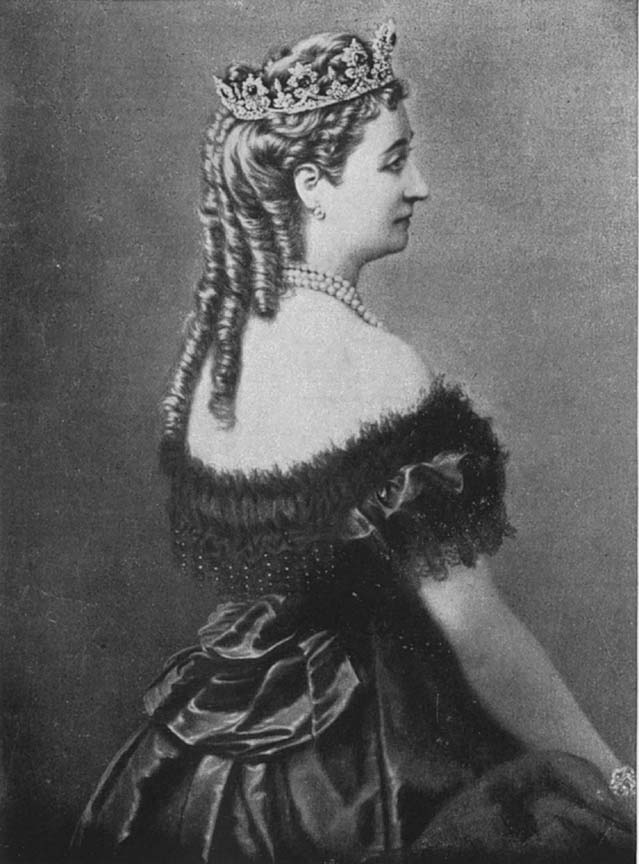
Less rigid in its etiquette than most European courts, and at the same time more splendid in its ceremonial forms; the center of political power on the Continent, and the mirror of fashion for the whole world; a stage on which were assembled the celebrities of the day, statesmen, diplomatists, generals, persons eminent in letters and in art, men distinguished in every field of human interest, and women as famous for their wit as for the elegance of their toilets and their personal charms, preeminent among whom was the lovely Empress herself, a vision of beauty and grace, always with a pleasant word, or a sweet smile, or a bow of recognition for every one---is it wonderful that Paris, in those days, seemed most attractive to Americans?
It used often to be said, "Paris is the heaven of Americans;" and we were even encouraged by the late Mr. Tom Appleton, of Boston, to be virtuous and pious, by the assurance "that all good Americans when they die go to Paris." And should this assurance be regarded by a few incorrigible skeptics as the language of transcendent metaphor, certainly no foreign visitors to the splendid capital of Prance were better able than we Americans to understand how a Frenchman, how Sainte Beuve could say: "O Paris! c'est chez toi qu'il est doux de vivre, c'est chez toi que je veux mourir."
Never at any time were the Governments of Europe so splendidly represented at the French Court. The ambassadors, the ministers, and the attachés of the Embassies and Legations were not only diplomatists of great ability, but were men of the world; and their wives were generally equally remarkable for their intelligence and brilliant social accomplishments. Men and women like Lord and Lady Cowley, Count Hübner, the Prince and Princess de Metternich, M. de Goltz, Baron Byens, Count Andrassy, MM. de Stückelburg and Kisseleff, the Count and Countess Hatzfeld, Signor Nigra, and scores of others of equal rank and distinction, could not fail by their presence to add luster to a court already remarkable for its elegance and urbanity.
It was my good fortune to have professional relations with the families of nearly all the diplomats who at different times, from 1852 to 1870, were accredited to the Imperial Government; and I am pleased now to remember a considerable number of those whose acquaintance I first made in this way, not so much because they were men and women conspicuous in the social life and the political history of the time, as because I have always felt that I could count them among the number of my warmest and truest friends. I think I may say this without indiscretion. At least I hope it may be accepted as evidence that I am not speaking without knowledge of the time of which I am writing.
It is well known that my countrymen, during the last few years of the Second Empire, were in the enjoyment of such privileges at Court as to be regarded with no little envy by the members of all the foreign colonies in Paris. At the splendid receptions given in the winter, in the great salons of Apollo and the First Consul, where the whole world was brilliantly represented, few of the foreign ministers or ambassadors ventured to bring with them more than three or four of their compatriots. But our Minister was generally attended by a full squadron of his fair countrywomen, the delighted witnesses of pageants of which they themselves were one of the chief ornaments. Could it be expected that one should not sometimes hear it said: "Ah, those American Democrats! How they do love kings and princes, the pomps and ceremonies of courts!" And they did love to see them then, and still do, in these days of the triumphant Democracy---not at home, but abroad, where they leave it to their Minister or Ambassador, dressed like an undertaker, to represent the Jeffersonian simplicity of the great American Republic.
Nor can some of us ever forget the gala days and Venetian nights at Saint Cloud, at Fontainebleau, and Compiègne; nor those brilliant scenes on the ice, in the Bois de Boulogne, where all Paris assembled to enjoy the skating, gay and happy in the keen air resonant with laughter, our countrywomen winning the admiration of every one for grace of movement, and elegance of dress, and sureness of foot, leaving it to others to provide the gaucheries and the falls; nor how the Emperor and the Empress joined with the rest in the exhilarating sport, and enjoyed the fun of it all with the zest and enthusiasm of youth.
Large as was the number of Americans almost always present at the concerts and balls given at the Tuileries, who received through the United States Legation their invitations for these as well as for other great official functions, reviews, and festivals, the Emperor---thinking that it might be particularly agreeable to Americans to witness these displays, coming as they did from a country where such spectacles were seldom if ever seen---often asked me to furnish the names and addresses of any of my country people who, being in Paris, I thought might like to receive invitations. And many of them would never have seen some of the most brilliant assemblies and interesting ceremonies that took place during a very remarkable period in French history---a period of unparalleled magnificence--- had they not been favored in this way.
Perhaps the most notable of these pageants---those which appealed most strongly to the popular imagination---were the entries into Paris made by the army on its return from the Crimea in 1855, and by the "Army of Italy " in 1859. They were triumphs "such as were formerly accorded by the Roman Senate to its victorious legions"; and when the Imperial eagles "which had conquered for France the rank that was her due," and the captured standards and cannon, and the tattered colors, and the bronzed and war-worn heroes passed in review on the Place Vendôme, before the Emperor, on horseback, surrounded by a brilliant staff drawn up at the foot of the column made of the guns captured at Austerlitz, the scene was most impressive.
I remember, as if it were yesterday, the 14th of August, 1859; the extraordinary display, on this occasion, of flags and banners, and decorative devices and inscriptions, in the Rue de la Paix and the principal boulevards; the triumphal arches; the immense ornamental columns surmounted by 9 colossal Victories holding in their outstretched hands golden wreaths or crowns of laurel; the rich draperies spread from balcony to balcony across the façades of the buildings that front upon the Place Vendôme; the great tribunes to the right and the left, rising tier upon tier, and filled with thousands of people; and the gallery built over the entrance of the Ministry of Justice, where, under a magnificent canopy of crimson velvet, studded with golden bees and fringed with gold, the Empress sat, surrounded by the ladies of her Court, while all the neighboring windows and balconies were occupied by the great dignitaries of the Empire in their showy uniforms or robes of office, and by ladies in elegant costumes---the very roofs of the houses being covered with spectators. As regiment after regiment passed along the line of march flowers were thrown from every window and cries of "Vive l' 'Empereur!" arose on every side. Suddenly, as a great body of cavalry debouched from the Rue de la Paix on to the Place, a baby---the little Prince Imperial, now three years old--dressed in the blue-and-red uniform of the Grenadiers de la Garde, was lifted up on to the pommel of the saddle in front of the Emperor. The scene that immediately followed is indescribable. The waving of handkerchiefs, the dipping of colors, the flashing of sabers, the storm of vivas that rang out from the officers, the soldiers, the tribunes, the whole vast assembly, to acclaim the little Prince on his first appearance in public, appeared to be without end. This union of the future of the nation with the triumph of the army of Solférino and Magenta, at the foot of the monument that commemorated the victories of the founder of the dynasty, seemed most auspicious and touched the hearts of the people. They had been brought in contact with the forces that govern the world, and the contagion of the human feeling set in motion was so strong, so irresistible, that even the most irreconcilable enemies of the Government were carried away by it, and, joining in the demonstration, threw flowers at the feet of the Emperor and his son, and cried out with all their might: "Vive l'Armée! Vive la France!
Few of those who were present on either of these occasions will ever forget the immense enthusiasm with which the spectacle revived again the "glories of the Grand Army" and the memory of Napoleon.
Say what some Frenchmen may now, there were never prouder days in the history of France than these.
In June, 1869, a banquet was given by the American colony to General John A. Dix, who was about to leave Paris, having just retired from his post as our Minister to the Imperial Court, after he had served his country faithfully, and had won the esteem, the admiration, and the love, I may say, of all who were fortunate enough to have made his acquaintance. Nearly four hundred Americans were assembled together on this occasion, which was the most brilliant of its kind in the history of our colony. A soldier by training, General Dix was widely acquainted with the world, deliberate in his judgments, not inclined to exaggeration, and, withal, possessed a delicate and highly cultivated sense of the true and the beautiful. His reply to the toast offered in his honor was remarkable in many respects; but among the words then spoken by him, none perhaps are better worth remembering and repeating than these:
"The advantages enjoyed in Paris by the American Colony, which has become so populous as almost to constitute a distinctive feature in the physiognomy of the city, can be by none better appreciated than by ourselves. We are living without personal taxation or exactions of any sort in this most magnificent of modern capitals, full of objects of interest, abounding in all that can gratify the taste, as well as in sources of solid information; and these treasures of art and of knowledge are freely opened to our inspection and use. Nor is this all. We are invited to participate most liberally---far more liberally than at any other Court in Europe---in the hospitalities of the palace. I have myself, during the two years and a half of my service here, presented to their Imperial Majesties more than three hundred of our fellow-citizens of both sexes; and a much larger number presented in former years have during the same period shared the same courtesies.
"In liberal views, and in that comprehensive forecast which shapes the policy of the present to meet the exigencies of the future, the Emperor seems to me to be decidedly in advance of his ministers, and even of the popular body chosen by universal suffrage to aid him in his legislative labors. Of her who is the sharer of his honors and the companion of his toils, who in the hospital, at the altar, or on the throne, is alike exemplary in the discharge of her varied duties, whether incident to her position or voluntarily taken upon herself, it is difficult for me to speak without rising above the common language of eulogium. As in the history of the ruder sex great luminaries have from time to time risen high above the horizon, to break and at the same time to illustrate the monotony of the general movement, so, in the annals of hers, brilliant lights have at intervals shone forth and shed their luster upon the stately march of regal pomp and power. Such was one of her royal predecessors; of whom Edmund Burke said, 'There never lighted on this orb, which she scarcely seemed to touch, a more delightful vision.' Such was that radiant Queen of Bohemia whose memory history has embalmed, and to whom Sir Henry Wotton, in a moment of poetic exaltation, compared the beauties of the skies. And such is she of whom I am speaking. When I have seen her taking part in that most imposing, as I think, of all Imperial pageants---the opening of the Legislative Chamber, standing amid the assembled magistracy of Paris and of France, surrounded by the representatives of the talent, the genius, the learning, the literature, and the piety of this great Empire; or amid the resplendent scenes of the palace, moving about with a gracefulness all her own, and with a simplicity of manner which has a double charm when allied to exalted rank and station, I confess I have more than once whispered to myself, and I believe not always inaudibly, that beautiful verse of the graceful and courtly Claudian, the last of the Roman poets:
Divino semita gressu claruit or, rendered into our plain English and stripped of its poetic hyperbole, 'the very path she treads is radiant with her unrivaled step.' "
The special favors accorded to the members of our colony by the Imperial Court were duly appreciated. They gave pleasure to us, but, in turn, by benefiting the furnishers of all the beautiful things loved and admired by Americans, they gave pleasure to the French also.
The proportion of resident members in the American colony was much greater than at present, and our colony then formed a far more considerable and influential section of Parisian society than it does to-day. And it was all the while, up to the fall of the Empire, constantly growing by the increase of its permanent elements.
During this period, the cost of living in Paris was relatively small. Rents were low, the domestic service nearly perfect, and luxuries of every sort cheap. The educational facilities were ample, not expensive, and of a high order. Paris was not only a delightful place for the rich to live in, but large numbers of Americans with moderate incomes found that they could reside here free from a multitude of cares, in comparative elegance, members of a cultivated and refined society, and at the same time could secure for their children the advantages and accomplishments of a superior education.
New York, Philadelphia, and Boston were always well represented in our colony. But the Southern contingent was perhaps the strongest. It represented a large constituency and a class of Americans accustomed to spend money freely. If the war of 1861-65 reduced the incomes of these Southern colonists, it greatly increased their number. Moreover, up to 1861 the American Minister to France was generally a Southern man---the series ending with William C. Rives, John Y. Mason, and Charles J. Falkner, all of Virginia.
Owing to the great increase in the population and wealth of the United States, the number of Americans who visit Paris every year is larger now than it was twenty-five or thirty years ago. But few of these visitors remain here long, and those who do have generally preferred to pitch their tents among the nomads of the Quartier Latin, rather than live in the more conventional and fashionable Quartier de l'Etoile.
How things have changed with us here in Paris since 1870! Who are the Americans that are invited to the official receptions to-day? The members of our Embassy and a few persons on special missions. The relations between Americans and the representatives of the French Government are now wholly official and perfunctory. Left, since the disappearance of the Imperial Court, without a recognized head and arbiter of forms and ceremonies, and procedures and precedents, Parisian society has become broken up into circles and cliques, and small bodies which move about subject to no law, and whose being and coherence would seem to be determined solely by mutual repulsion.
The tone of Parisian society in those days was quite unlike that which has since obtained. It was cosmopolitan and not provincial, and was a reflex of the political prestige of the Empire both at home and abroad. It was a society full of movement and originality, of unconventionality, and gaiety, and charm. The admirable taste, the artistic sentiment and distinction shown by those who best represented it, especially in everything relating to manners, and dress, and the outward appearance of the person, found expression in a word which was then frequently used to symbolize the sum of all these mundane elegancies. The women of those days were not more beautiful than are the women of the Republic; but the women of the Empire had chic. Every one then who was somebody in society---man or woman-was chic, if not by nature or by grace, by example and habit. As this word is now obsolescent, at least, it would seem as if the qualities it was intended to express were gradually dying out. Nor is it surprising that it should be so---that with the change in the Government there should have been a social revulsion as well, and that Parisian society under the Republic should imitate the stiff and meager conventionalities and formalisms of the bourgeois monarchy; should sneer at "the meretricious splendor of the Imperial Court"; should scoff at the cocodettes and femmes exotiques of the Second Empire, and cultivate a narrow, repellent, and exclusive Nationalism; or, moved by the Democratic spirit that is now, at the end of the century, sweeping over the world, should be rather proud than otherwise of the cotton umbrellas of Louis Philippe, and the frugalities of M. Grévy.
The generous hospitality extended to foreign visitors by the Imperial Court was often---sub rosâ---the subject of envious or cynical comment on the part of those who witnessed it. But the journalists and chroniclers of the day were polite to strangers. Since the fall of the Empire, however, its "exoticism," as it is called, has become a sort of Turk's head with a certain class of writers.
The distinguished but slightly bourgeois element that constituted society under Louis Philippe"---to use the language of one of these writers---was shocked by the introduction into France of outdoor sports such as tennis, and archery, and hunting; and was made inconsolable on learning that "l'argot britannique des jockeys" had forced its way into Salons once famous as the officines of the degermanised Hegelianism of M. Cousin. These political moralists and incorruptible patriots pretend to have discovered in a fondness for foreigners and foreign ideas the origin of the frivolity, the unbridled license and corruption which, they allege, prevailed during nearly the whole of the Imperial régime; and that one of the contributory causes of the present general decadence of French society---which they acknowledge---was the favor accorded by the Tout Paris of that time to princes and nabobs from Asia and Africa, and to successful American speculators, and traders in pork and sewing-machines. I have no doubt that there are persons who sincerely believe these things, but they are certainly not those who have most vehemently and persistently asserted them---something much easier to do than to make evident to the world the preeminent excellence and unsullied purity of political and social life in the French capital, during the Monarchy and under the third Republic. Indeed, much of this silly criticism is only a rehash of the gossip of "salons" that under the Empire were démodés and had become merely the convenient rendez-vous of literary Bohemians, emancipated women and politicians out of business---in short of the uncompromising Opposition. The simple truth is that if foreigners were treated with especial hospitality and courtesy at the Imperial Court, it was only a proper and polite recognition of the homage the whole world was then pleased to pay to France, and to the sovereigns who represented with such distinction a nation which under their rule had gained the ascendency it lost at the Restoration and had become once more, and beyond dispute, the dominant power on the European Continent.
There was a time when all roads led to Rome. But when Rome ceased to be the Capital of the world and became the capital of Italy and the See of a Bishop, roads were built to meet the requirements of the multitude of foreigners who preferred to travel in other directions.
If there is no longer an American society here, if London has captured it---in part, at least---it is because Paris is now socially dead.
The lights that once shone here have been extinguished, the guests---the entertained as well as the entertainers--- have gone. The very palace even, where they were wont to assemble, has been destroyed by the torch of the incendiary. The chef d'oeuvre of Philibert Delorme and Jean Bullant, with its majestic pavilions, its noble galleries and salons, with all their rich embellishments, the work of three hundred years of the genius and esthetic sentiment of France; the sculptures and paintings, the furniture and the tapestries, the polished bronze and marble, the splendid staircase ---on the steps of which at either side the cent gardes stood like statues on State occasions; and the magnificent Salle des Maréchaux---where the great ceremonies were held---resplendent with mural decorations and velvet draperies, and traceries of gold, and superb chandeliers hanging from the ceiling like vast masses of jewels, and adorned with the portraits and busts of dead heroes; and the brilliant uniforms and elegant toilettes, and the music, and the flowers, and the spectacular effects of the moving and constantly changing scene, which opened to the admiring eyes of the throng a new world of beauty and of grace---all these glories and these pageants have vanished, and the world now knows them, and will know them, no more forever---except as history or legend. Sunt lacrimoe rerum.
It has been the habit of Americans to say of Napoleon III that he was not friendly to our Government during the War of the Rebellion.
At the beginning of this war, it is quite certain that nearly everybody in Europe felt a sympathy for the South, for it seemed to be the weaker party. Sharing this general feeling, the Emperor may have had, moreover, a passing and chivalric sentiment of admiration for the stubborn, plucky, and gallant resistance which the seceding States offered to the Federal Government. It should be remembered also that a very considerable part of the territory of the Confederacy once belonged to France, and that the largest and richest city of the South---New Orleans---to great numbers of Frenchmen has always seemed to be a city of their own people.
Then, again, commercial interests were deeply concerned, and became more and more so as the war went on. National industries were paralyzed and markets lost. Thousands of working men were idle.(10) And after great battles had been fought that decided nothing, and apparently tended to no definite conclusion, the people, more particularly in England and France, began to grow tired of hearing of the continued slaughter in what, to them, seemed to be an interminable war.
The French, however, were less interested than the English in the final issue of the war; and the French Press was much more moderate in its tone than the English Press, from which, however, it obtained most of its information and misinformation with respect to American affairs. Few Americans living, in the present era of good feeling, have any adequate idea of the intense hostility exhibited towards the Government of President Lincoln in English official circles and in the British Parliament, not by the Tory opposition alone, but by the leading representatives of the Liberal Government of the day---Gladstone, Roebuck, Lord Brougham---Blanche, Tray, and Sweetheart---it was the same cry: "Jefferson Davis has created a new nation and the Yankee war must be stopped."(11)
The Southern Confederacy was ably represented in Europe; its agents were numerous, intelligent, and active. But public sympathy was of little practical service to their cause; what they wanted to secure was the effective aid of the European governments---recognition, at least. In France, especially, their work was principally within official circles---although unofficial. Mr. Slidell, the Commissioner of the Confederate Government, unrecognized at the Ministry for Foreign Affairs, sought to confer with other members of the Imperial Government and directly with the Emperor himself. In this and in all his doings he had the active cooperation of large numbers of Southern men and women who resided in Paris during the war; and the Southern ladies, who formed a brilliant and influential society, vied with each other in their endeavors to enlist in support of their cause every one connected with the Imperial Court. It was most natural, since they were pleading for their homes and their families. Many of them had fathers, brothers, husbands, and sons fighting for what they regarded as birthrights. Their zeal, their strenuous efforts, and continued labor were not in vain, for the Court was almost entirely gained over to their side. The consequence was that the Emperor was constantly surrounded by those who sympathized with the South.
I regret to say that there was another reason for this sympathy, there were men at Court holding high official positions who acted entirely from motives of self-interest. There were, to my knowledge, offers of large quantities of cotton made to some of these persons, if by their influence they could induce the Emperor to recognize the Southern Confederacy. The Emperor was, at times, absolutely beset by these people. According to them, the South was sure of success, and the inability of the Federal Government to carry on the war much longer was a constant theme with them. The Emperor listened to these statements in his usual quiet way, occasionally smiling, but whether because he was pleased or incredulous was never known; for he was never betrayed into consenting to an act or giving an opinion inconsistent with an attitude of complete neutrality, although he often expressed his desire, in the interest of humanity, to see the war brought to a close, in order that the suffering and loss of life necessarily caused by this cruel conflict might cease.
But when the real causes that led to the secession of the Southern States from the Federal Union began to be apparent, and it became clear that the leaders in this movement had but one end in view, namely, the creation of a powerful Republic for the perpetuation of human slavery, it grew more and more difficult for the Emperor, as for many others who could not fail to watch this great struggle with intense interest, to reconcile their very natural sympathies for the weak with a desire for the triumph of right and justice, and the advancement of civilization and happiness among men. However brilliantly the commercial benefits to Europe of a great cotton-growing, freetrade American Republic might be set forth, the condition on which alone they could be obtained---a sanction for the servitude of the black race---was intolerable to the European conscience. No man understood this better than Napoleon III. But the opinion of others was unnecessary in this case, for the thought of servitude was always repugnant to him.
While a prisoner at Ham he wrote: "To-day the object of enlightened governments should be to devote their efforts to hasten the period when men may say, 'The triumph of democratic ideas has caused the extinction of pauperism; the triumph of the French Revolution has put an end to serfdom; the triumph of Christianity has destroyed slavery.'" And when finally he became Emperor, he did not forget his words; for the single object of his own life, constantly in mind to its very end, was to see these ideas realized in history.
I had personally the greatest respect for the American Minister at the French Court, Mr. William M. Dayton. He was an able lawyer, a most honorable and upright man, beloved by all who knew him, and universally esteemed. But Mr. Dayton was an exceedingly modest man, with a fine sense of the dignity of his office, and certainly would not have considered it proper that he should attempt to represent the United States before the French Government in any other than a strictly diplomatic way.
As a simple American citizen, I was free from all official responsibility. I knew that I could be of great service to my country, and whenever I felt that I ought to act or speak, I was restrained by no fear of being too intrusive or too strenuous. At the beginning of the war the Federal Government was unable to arm the soldiers who were called out by the President, and efforts were made to obtain military supplies in Europe. And I am happy to say, that in my capacity of private citizen I was able to obtain from a French company a large quantity of firearms which were sent with other military stores to the United States; and---what is of more importance in this connection---that the transaction was effected with the knowledge and permission of Napoleon III.
With the facilities I had of communicating directly with the Emperor and coming in contact, as I did every day, with the principal personages about the Court, and the most distinguished men in the Legislature, the Army, the Church, and in every walk of life, and with the members of their families, I had very frequent and unusual opportunities of defending the cause of our National Government. Moreover, my relations with my compatriots, my presumed acquaintance with American affairs, the deep interest I took in the preservation of our Union, and the confidence with which I predicted it, caused me and my opinions to be much sought after; and particularly as I, excepting perhaps Prince Napoleon, was the only person with pronounced Northern views having frequent access to the Emperor. I firmly believed in the eventual success of the Federal Government, and, being almost alone in that belief, I was compelled to keep myself well informed with respect to everything that might strengthen it and furnish me with facts and arguments to support and add weight to my assertions. I was constantly on the lookout for the latest news, and took special pains to meet and converse with those persons coming from America who could give me information, so that I might communicate it to the Emperor, who was never unwilling to hear "the other side." It was, therefore, necessary to be always at work to meet the statements, and thwart the designs, and destroy the hopes of the agents, accredited or unaccredited, of the Confederate Government, for "those who hear only one bell hear only one sound." I accordingly, as long as this terrible war lasted, continued to do what in ordinary circumstances is either not done, or is effected through diplomatic channels.
I always let Mr. Dayton know that I was keeping the Emperor informed of what was passing; and he rendered me all the assistance he could, never feeling that I was in any way interfering with his duties or prerogatives. A more patriotic, generous, and unselfish man could not be found.
I particularly endeavored to convey to the mind of the Emperor some idea of the fervent patriotism, the indomitable courage, the inexhaustible patience, and the undying devotion to their cause, of the men of the North. And I never lost an occasion to show him the progress we had made, or to call his attention to what our troops were doing. I supplied him continually with documents and newspapers containing important information relating to the war, and with maps that would aid him in following the movements of the different armies in the field. These were placed in a room at the Tuileries near his private cabinet. Here he frequently went to consult the maps, and to mark, with pins to which little flags were attached, the positions of the opposing armies. At times he was greatly interested in watching the movements of these armies, and made them even the subjects of critical technical study.
Thus he was able to estimate the value of the assertions of those who surrounded him, and sought to bring him to the point of acknowledging the Southern Confederacy; and so it happened that when they felt most sure of accomplishing their purpose they found him to be immovable. His reticence puzzled them. And yet, sometimes, he surprised them by statements showing that he knew more about the war, and its probable duration, and the final result than they had imagined possible. On one occasion, that came within my knowledge, to a person who had reported to him a great Confederate victory, he replied quietly, but with a most crushing effect:
"The facts are quite contrary to what you have been telling me."
One afternoon, in the summer of 1862, while driving in the Bois de Boulogne, I met Mr. N. M. Beckwith, who informed me that on the following evening Mr. Roebuck was to make a statement in the House of Commons relating a conversation he had had with the Emperor at Fontainebleau a few days before; his purpose being to show that in this interview the Emperor had given him assurances that he would not be indisposed to intervene in behalf of the Southern Confederacy under certain conditions agreed upon with the English Government.
I thought over the matter during the night, and came to the conclusion that if the Emperor had had a conversation with Mr. Roebuck it had not been of such a nature as to authorize him to announce, or even to attempt to foreshadow, in Parliament the Imperial policy with respect to this subject. I knew Mr. Roebuck was interested in giving the conversation such a color that it would seem, to those who heard him, that the Emperor had decided to join with England in this much-desired alliance in behalf of the Confederacy. I had, however, personal knowledge of the views entertained by the Emperor, and was confident that he had no such intention, but was determined not to recognize the Confederacy, to observe the strictest neutrality, and to intervene only in case of our manifest inability to bring the war to an end ourselves. To such a strait he did not believe we would come. And it was for this reason that he had refused all the entreaties, not only of English statesmen, but of those about him, of some of his own ministers, and more especially of M. de Persigny, who never lost an occasion to present the case of the Confederates as favorably as possible, and to insist on the utter inability of our Government to put down the rebellion. Nevertheless Mr. Beckwith's statement was so precise that I resolved to see the Emperor and ascertain what possible foundation there might be for it.
With this purpose in view I started early the next morning for Fontainebleau. I saw the Emperor as soon as he had left his bed, and communicated to him what I had learned about Mr. Roebuck's intention. I asked him if anything in the conversation he had had with that very active member of Parliament could be construed into a promise to recognize the Southern Confederacy on certain conditions; and if Mr. Roebuck had his permission to make an announcement to that effect in the House of Commons. His Majesty most unhesitatingly denied having given him any assurances or promises whatsoever. The conversation he said had been general and he should be greatly astonished if Roebuck were so to report the conversation that it could be considered as containing a promise or pledge on his part to act in relation to the matter conjointly with the British Government. So anxious was he to avoid any such interpretation of the conversation, that he decided, at my suggestion, to have a telegram sent to a member of Parliament, directing him, in case Mr. Roebuck should make such a statement, to deny immediately that there had been any pledge or promise, or that he was in any way bound by the remarks of that gentleman.
This was done, and when Mr. Roebuck, in the course of a speech, referred to his having seen the Emperor of the French at Fontainebleau a few days before, and began to report the conversation which had taken place on that occasion, he was immediately informed that a telegram had been received from the Emperor stating that the conversation had been entirely private.
Besides the influences the Emperor was continually under, coming from his entourage and from interested private individuals, much pressure was brought to bear on him from several foreign governments---especially the English---to induce him to recognize the Southern Confederacy. I am in possession of positive information upon this subject. I have seen and read, and have had in my hands, papers sent to the Emperor, and coming from the English Foreign Office, in which it was proposed that France should join with England in recognizing the Confederacy. This is at variance with the usually received impression. It is generally believed that France and her Government, and the Emperor personally, were anxious to recognize the Confederacy; and to that end solicited the cooperation of England. I insist that this was not the case, and that the contrary was true. The Emperor never came at any time to the point of believing, as Palmerston did, that it was best to recognize the Southern Confederacy. After some of the failures and defeats of our army, it is not to be wondered at if, in common with nearly every one in Europe, he had some doubts of the final result.
Those were dark days that followed the failure of the Peninsular campaign and the battles of the second Bull Run. Then it was that Gladstone made his notorious speech at Newcastle, and that even the friends of the Union in Europe began to grow faint-hearted. It was of this time that Lowell spoke when he said of Charles Francis Adams, "None of our generals in the field, not Grant himself, did us better or more trying service than he in his forlorn outpost in London." Then it was, also, that the Emperor expressed the opinion that perhaps the Federal Government might be induced to accept the friendly mediation of England, Russia, and France, and consent to an armistice; and if so, that the offer of such mediatory services was desirable. But this opinion was suggested by humane rather than by political considerations.(12) At the outbreak of the War of the Rebellion, the relations of the French Government with the Federal Government were very friendly. Our War Department obtained military supplies of various kinds in France without difficulty; and the views expressed by the Emperor in July, 1861, with respect to the blockade of the Southern coast, were entirely satisfactory to Mr. Lincoln. It was even supposed, so marked was the absence in France of the hostile feeling which prevailed in England, that, under certain circumstances, the Imperial Government might give direct assistance to the cause of the Union. Or was the suggestion of such assistance actually made to Mr. Lincoln and Mr. Seward by Prince Napoleon when he visited Washington in the summer of 1861? Whatever answer may be given to this question, it is quite certain that Mr. Seward entertained the idea of the friendly neutrality of France at the time of the Trent affair; and, if it was among the reasons that led him at first to decline to surrender the Confederate Commissioners, it was also because of the very amicable relations between the French Legation and the State Department that Mr. Seward was disposed to listen to the representations on this subject made to him by M. Mercier at the request of M. Thouvenel, acting at the suggestion of the Emperor. Indeed, it was because the friendly advice given on this occasion had proved so successful---had apparently prevented a disastrous war between the United States and Great Britain---that the Emperor was finally induced to sound the English and Russian governments with respect to the expediency of offering to the belligerents, conjointly with the Imperial Government, their friendly services as mediators.
But while the relations between France and the United States were constantly maintained upon an amicable footing until near the end of the secession war, the relations between the English and the French governments during the same period, if not strained---in the diplomatic sense of that word---were certainly very far from being cordial.
Not only was the hostility then shown by Lords Palmerston and Russell to the policy of the Empire, with respect to nearly every question concerning European politics, a cause of almost constant irritation, but the abusive language employed by the Press and by individuals, who were presumed to represent the English Government, when speaking of Napoleon III---language which often exceeded in bitterness that with which Mr. Lincoln was bespattered by the same Press and the same persons---was keenly felt by the Emperor, and was frequently the subject of his indignant remonstrance. The Emperor, when his cooperation was desired by the English Government contemplating an intervention in American affairs, was in no humor to listen to the solicitations of the men who were responsible for that Government, and were, at the same time, his personal enemies and the friends of his political enemies. The Emperor never wholly gave up the thought that ultimately the North would succeed. In his opinion it would be a misfortune for the country to be divided. In fact, a division of the United States into separate and independent Governments would have been in conflict with the principle of "great agglomerations," of "nationalities and natural boundaries," which was the foundation of his theory of international relations. It would not only have been contrary to his general political policy, but it would have been unnatural for him to wish to see our Union dismembered. No. That was never his wish.
I could furnish, were it necessary to do so, innumerable proofs to sustain these affirmations. I will here state what took place one day in the summer of 1864, as also its consequence---an episode that brings to my mind delightful reminiscences of men now and forevermore famous in our national history.
I was sent for by the Emperor to come to Compiègne. This was just after the great battles of the Wilderness and the failure of Grant's first movement against Richmond; when Early's army was in sight of the Capitol, and news of the capture of Washington was expected at any moment. His Majesty informed me that he had received a communication from London, in which he was seriously advised, urged, and even begged to recognize the Southern Confederacy.
The substance of the note was to this effect: "The Washington Government have no chance of getting through with this cruel war. It is now time it should cease, and a stop should be put to it." And the Emperor was told that if he would take the initiative in the work of ending this war, public opinion in England would force the Government to cooperate with him.
"You see how hard I am pressed," the Emperor said, yet I have not yielded, because of the assurances I have received---and from you among others---that it is only a question of time when the war must end in the complete success of the Federal Government."
I told him the war was certainly approaching an end; that the resources of the South were almost exhausted; that, with nearly a million seasoned soldiers in the field, the military power of the North was irresistible. So I pleaded for hands off; and pleading with the Emperor not to yield to the pressure of private interest, nor to be influenced by communications of the kind he had just received, but to await events, I became warm and was quite carried away by my subject. I told him that the recognition of the Confederacy would only cause much more blood to flow; that foreign intervention would be useless; that the people of the North would never permit any intervention from abroad in their affairs---no matter what sacrifices it might be necessary to make, either of money or of men.
Just at this moment a door, which was hidden with upholstery so as to be invisible, opened as if by magic, and the Prince Imperial, then a beautiful boy of eight years, appeared before us in a most charming and surprised manner ---as he did not know that any one was in the private room of his father. He had thought him alone, and began to apologize for his intrusion.
But it furnished the occasion and gave me the courage to say: "Sire, you cannot think of recognizing the Government of Jefferson Davis; for the dismemberment of our great Union founded by Washington would be a crime. No! Were it done by your aid, the States of the North would never forget you nor cease to curse your name. For this boy's sake you cannot act. He is to succeed you, and the people of my country would visit it upon his head, if you had helped to destroy our great and happy Union.
"You cannot think of the miseries it would entail. You cannot think of doing this. Keep our friendship---our ancient friendship that was sealed with the blood of France---for your son." Continuing, I said, "I will go to the United States. I will leave by the very first steamer, and learn for myself what the situation is---what is the feeling of the people, and what is the power of the Government. I will go directly to Washington and see Mr. Lincoln and Mr. Seward, and I will report to you the exact truth, whether they believe and have reason to believe that the end of the war is not far off." And I entreated his Majesty to suspend all action until I could report to him what I might learn about the war by personal observation and inquiry.
The Emperor, who had listened to me without saying a word, when I had finished speaking said, "Well, Evans, go! I shall be pleased to hear from you and to get your impressions and opinions, and "---smiling as he spoke---" I don't think I shall recognize the Southern Confederacy until you have had an opportunity of communicating to me the results of your visit."
Accordingly I left Paris, with Mrs. Evans, on the 11th of August, for Liverpool, where the following Saturday we embarked on the China for New York, which port we reached ten days later---August 23d.
After a brief visit to my family I proceeded to the Capital, where I was received by Mr. Seward, Secretary of State. I told him the object of my visit was to learn the true state of affairs with respect to the rebellion, and whether there was any prospect of a speedy termination of the war. I was astonished to find Mr. Seward rather gloomy and dispirited. He said things looked bad. I was introduced to other members of the Cabinet, and found that they also were feeling very uneasy. I was the more surprised at this feeling, as the fall of Atlanta had just been announced.
It was not, however, so much the military situation as the political outlook that was troubling them. A Presidential election was to take place in November. The Democratic party had pronounced the war to be a failure; and, with this as the issue before the people, had nominated General McClellan as their candidate for the Presidency. Mr. Lincoln was again the candidate of the Republican party for that office; but his reelection was by no means certain, and his defeat would have been disastrous to the cause of the Union.
I was received afterward by President Lincoln, whom I had met at his home some years before---having been introduced to him at Springfield, in the year 1860, before he was elected President, but after his nomination. Remembering my former visit to him, he greeted me with much affability and spoke of that meeting, and of persons both of us knew. When I told him what I had come to America for, he seemed much pleased, and said I would be given every opportunity to see for myself, and would be supplied with all possible information concerning the situation.
I informed the President of my efforts to convince the Emperor that the North would succeed in suppressing the Rebellion; and related to him how his Majesty was pressed on every side to acknowledge the Southern Confederacy, how I had told him that such recognition could only lead to complications which might prove disastrous, and that I had entreated him to suspend any action in this direction until I could lay before him the facts as they appeared to Americans who were on the ground, and were most familiar with the conditions of the contest, and most competent to forecast its result.
I had a long conversation with Mr. Lincoln on this occasion; but before the interview ended Mr. Seward joined us, and I was furnished by these eminent men with information that gave me a very clear insight into the situation from the official or governmental point of view. Mr. Lincoln was in much the better spirits and the more sanguine---summing up his forecast of coming events in his homely way as follows: " Well, I guess we shall be able to pull through; it may take some time. But we shall succeed, I think," with an emphasis on the last words that was significant.
It was then proposed that I should go to City Point and see General Grant. It was thought that a visit to the head-quarters of the Army of the Potomac, then engaged in siege operations in front of Petersburg and Richmond, might supply me with some of the special facts I was in search of, and prove an object-lesson of great value to me in the accomplishment of my mission.
Arrangements were accordingly made for me to go to City Point on a "transport," the only means of conveyance that could be had. And so, after having been provided with letters of introduction and the necessary passes, on the morning of the 4th of September, accompanied by Mrs. Evans, my niece, and her husband, I sailed for Hampton Roads. The great heat compelled us to remain on deck; the boat was crowded with troops going to the front; and the mosquitoes, the noise and the confusion, and the want of beds made the night one of the most disagreeable I ever experienced.
Arriving at Norfolk the next morning, I saw for the first time the ruin and desolation wrought by the war. The town was full of soldiers and "contrabands," and nothing was going on but what related in some way to the war. Finding that I should be obliged to leave Mrs. Evans and my niece in this place, I obtained for them, after much searching, lodgings with a private family. The food was coarse and badly cooked, and my wife and niece occupied a room in the garret that during the day was intolerably hot, and where, at night, they were nearly suffocated. This I learned afterward; for before noon I left Norfolk and, taking a boat at Fortress Monroe, arrived at General Grant's head-quarters in the evening of the same day.
The General received me in a simple, off-hand way; invited me to dine with him; and made me as comfortable as could be expected in time of war and in camp. I explained the object of my mission, and he seemed pleased that I had come to see him and learn for myself how things were going on. I found the General delightful in conversation. As he was much occupied during the day, our talks were principally in the evening---after his colored boy had made up a large fire in front of his tent; for although the days were hot, the evenings were cool and damp, and the fire kept off the mosquitoes. Then it was that the General took his seat in a camp-chair before the burning logs, with his staff about him, and also his visitors, of whom there were almost always a number at head-quarters. Throwing his leg over the arm of his chair, after having lighted a cigar, the General was ready for a talk.
We discussed not only questions relating to the war, but all sorts of subjects, political, social, and personal. I was astonished to find the commander of so large an army, who had already shown extraordinary talent and had gained great victories, was one of the most simple-minded of men. Of what was passing in Europe and in other parts of the world he was almost utterly ignorant. Concerning the French Empire, its government, and its economical and social life, he had not the slightest idea. But he never seemed tired of hearing about the Emperor and the Court. The Empress, her beauty, and her never-failing kindness to Americans interested him greatly; and it delighted him to have me dwell upon the attractions and pleasures of Paris. On one occasion he remarked: "When I have got through with this war that we have on hand, I hope to go abroad and see for myself all these beautiful things. I shall want rest; my only fear is that I cannot afford it, for I am not rich, and I am afraid I shall be obliged to wait a long time before I can go over to see you, and enjoy all these things we have spoken about."
I replied: "Why, General, when you have finished the war, as you seem to be sure you will, to the satisfaction of your country and the Government that placed you in command, the people will put you up for President; and, if so, I have no doubt you will be elected."
Seeming to hesitate for a moment, he said: "This I doubt, and shall never consent to. I may be successful as a military man, but I know nothing of politics. I never voted but once in my life, and then I made a mistake. I never interested myself in politics. Once when I was going home, after taking a load of wood into town, my friends met me and insisted that I should vote, as it was election day. I was persuaded to do so, and threw my vote for Mr. Buchanan; and that, as you see, was a mistake."
But, General, other men have risen to the Presidency, having had no more experience in political matters than yourself. Each of our wars has produced a President---Washington, Jackson, Taylor-"
"No," he replied, " I had rather go abroad and see something of the Old World."
He was very positive about the final result of the war. He was frank and unreserved in giving his opinions, and freely expressed to me his hopes. He impressed me with his sincerity, his simplicity, and at the same time his entire confidence in himself. On my asking him when he thought the war would be brought to a close, he said: Not until we get rid of some of these political generals. It is these men who have kept us so long from putting an end to the war."
During my visit he had long interviews with General Butler. He criticized the works at Bermuda Hundred as designed and carried on by General Butler; and made no secret of his dissatisfaction with much that was done by political generals, as he called them.
One day, when General Butler was dining with us, General Grant inquired of him what he was doing over at Bermuda Hundred; he asked him about the canal he was cutting, and many other questions concerning what was passing at his head-quarters. General Butler invited him to come over and see for himself. Accordingly, the next day, General Grant, with his staff, set out to visit the camps around Richmond, and he invited me to accompany him. The General rode a big bay horse, and he offered me for this excursion the black mare that, as he told me, he had taken from the farm of Jefferson Davis in Mississippi, after the surrender of Vicksburg. A very excellent riding horse she was, and the General set much store by her. I was afterward told that it was a great favor for him to lend this mare to any one.
We visited Generals Meade, Hancock, Butler, and others, riding along almost in sight of the city. We were so near that we could see the Confederate pickets, some of whom were reading newspapers; and occasionally a shot came hurtling over our heads. The General never seemed to think his life was in danger. While visiting the works that had been constructed by order of General Butler, he looked from behind the earthen defenses, and at times exposed himself so much, that his officers called his attention to the risk he was running. Yet he was not a foolhardy man.
We dined at the camp or head-quarters of General Hancock, and I was much impressed with the military bearing of the General.
While I was at City Point, General Grant had a visit from some old friends of his. Among them was Mr. Washburne, afterward Minister to Paris. The General told us that he was having a correspondence with General Sherman concerning a movement he was about to make; and I believe I was one of the first persons who knew something of the plan of campaign agreed upon.(13) This march to the sea, the getting behind the army of Northern Virginia, seemed to Grant the one thing that was needed to bring about the end; and he was right in believing it to be so. For, as every one knows, Lee's army was finally crushed between the columns of Sherman and Grant.
During my visit to City Point I had an excellent opportunity of becoming acquainted with many things connected with the maintenance of a great army engaged in actual warfare, such as the commissariat, the transport service, and the provisions made for the care of the sick and wounded. This last subject was one that interested me particularly.
After remaining at General Grant's head-quarters five days, I rejoined Mrs. Evans at Norfolk, and we returned to Washington. It was not long before I discovered the existence of a more hopeful feeling, not only among those who directly represented the Government, but generally among the people. The capture of Atlanta, by Sherman, the final destruction of Early's army by Sheridan in the valley of the Shenandoah, the evident collapse of the political plot to put McClellan in the place of Lincoln, these things encouraged the Government greatly, and filled the minds of the loyal men of the North with hope and confidence---a confidence that was contagious.
Very soon feeling, myself, entirely convinced that the end of the war was not far distant, I so informed the Emperor.
Upon my return to Paris in November, one of the first remarks he made to me was: "When the plan of campaign arranged between Grant and Sherman was reported to me, I saw by my maps that it was the beginning of the end (ce fut le commencement de la fin)." These were the Emperor 's very words.
How often I have heard him express himself as more than satisfied that he had waited and not acted precipitately during our great internecine war; for to him the friendship of the whole United States was important. Yet he has suffered severely in American opinion through those who believed and gave currency to the false statement that he wished to divide us, and to that end had solicited the cooperation of the English Government.
Americans would do well to remember that if the English Government, represented by Lord Palmerston and Lord John Russell, did not intervene during the War of the Rebellion, the principal cause was the personal reluctance of the Queen and the Prince Consort to give countenance to such a policy. I do not know that there exists any official' proof of this. But that the neutrality of the English Government at this time should be attributed to the friendly feeling of the Queen towards the cause for which the Northern States were contending, has always been firmly believed by the American people.
Now there can be no question that M. Thouvenel and M. Drouyn de Lhuys and other official representatives of the Imperial Government were as ready to intervene in behalf of the Southern Confederacy as were Lord John Russell and his associates. But the Imperial Government did not take one single step in that direction. It did not recognize the de facto government established at Richmond. And to the question, Why not? the answer is to be found in the fact---for the truth of which I can vouch---that, personally, Napoleon III. shrank, as did Queen Victoria, from the thought of actively contributing to the building of a great State whose corner-stone was human slavery. Any one who knows anything of the Emperor or of his opinions knows that he was seldom in accord with his ministers on questions relating to international affairs. This, it may be said, was one of the causes of the apparently uncertain and indecisive character of the Imperial policy; for there were times when, after his Minister for Foreign Affairs had said one thing, the Emperor did not hesitate to say exactly the contrary. Therefore, no one need be surprised that, whatever may have been the wishes of his ministers with respect to the Southern Confederacy, Napoleon III. should never have ceased to be at heart a friend of the North.
Those persons who, careless of the facts, are in the habit of meting out responsibility in accordance with their prejudices and political feelings, and who are guilty of the gross injustice of holding Napoleon III directly responsible for public opinion in France during these years, should at least be sufficiently open-minded to observe that this opinion was never exhibited in any act of hostility to the Federal Government, either on the land or on the sea. If the neutrality of the English Government is generously attributed to the personal influence of the Queen, it is but fair to give some credit to the Emperor for the neutrality of his Government during our Civil War---a neutrality so strictly observed that no Alabamas were allowed to escape from French ports to destroy our commerce.
And yet in these later years I have often wondered that the Emperor did not recognize the Southern Confederacy. It would have been entirely in accordance with our own international policy, which has been, and is, to recognize every de facto Government without regard to its origin, and without waiting to become assured of its stability. Within forty-eight hours after the Paris mob had set up a Government at the Hôtel de Ville, this Government was officially recognized by Mr. Washburne, the American Minister accredited to the Court of the Tuileries.
If there be any Americans who are still inclined to resent the attitude they believe Napoleon III to have assumed toward our country during the War of the Secession, it is well that they should be reminded of our own public policy in similar cases; and more than this, if they would be just, that they should consider how much---and to his everlasting credit---the Emperor resisted when declining to recognize the Southern Confederacy. No real friend of the Federal Government could have been expected to do more.(14)
I have not here to speak of the attempt to establish an empire in Mexico, nor yet to be its apologist. This unfortunate affair into which the Emperor allowed himself to be drawn, partly by unwise friends and partly by interested counselors, went far to give Americans the right to believe that he bore us no good-will. It may be well, however, before pronouncing a harsh judgment, to remember the condition of Mexico, suffering from chronic revolution, repudiating its debts and international obligations, and, at the time, in a state of absolute anarchy. Many European Powers hoped to see a responsible, stable Government established under Maximilian. The Emperor's motives were good and his action well meant; only he did not sufficiently take into account the very great difficulties that would have to be met and overcome at home, as well as abroad, in order to succeed in an attempt to create a new empire on the American continent.
The Emperor was deeply moved by the news of the assassination of President Lincoln and Mr. Seward---for it was at first reported that Mr. Seward had been killed also. He was, however, not inclined to attribute to this act any political significance. "The war ended," he said, " with the capitulation of General Lee, and the act, consequently, having no rational purpose, must be regarded as that of a political fanatic. Such men are to be found in all countries and as ready to strike at those who represent the sovereignty of the people as at those who claim to rule by Divine right." The Empress, also, was greatly shocked when she was informed of this dreadful affair, and wrote to Mrs. Lincoln a private letter in which she expressed the sincere sympathy she felt for her in her bereavement under such tragic circumstances.
And here I may say that her Majesty took a most lively interest in the progress of the War of the Secession from its very beginning. Not that she cared to hear about the battles and sieges, and the exploits of armies and commanders, but she was deeply concerned to know what was being done to alleviate the immense amount of suffering inevitable from diseases and wounds in a war carried on over such a vast and thinly inhabited country and on such a scale. As early as 1862---about the time General McClellan opened the campaign that came to its close at Harrison 's Landing on the James River---she asked me if I could furnish her with any information respecting the provisions that had been made by our Government for the care of the sick and wounded; and more particularly to what extent, if any, voluntary aid was supplementing the official service. Having inquired into this matter I explained to her Majesty how the medical service of the United States Army was organized; and informed her that a Sanitary Commission had been created, unofficial in character but recognized by the Government, the object of which was to inspect the camps and hospitals, bring to the notice of the proper authorities any neglect or want therein, and direct the distribution of voluntary assistance, whether in the form of material gifts or personal service. I told her that the people of the North had responded most generously to the calls for contributions issued by the Commission; that its agents were working harmoniously with the regular medical staff; and that never before in any army had such large provision been made for the sanitation of the troops while in camp and the care of the sick and wounded. The Empress asked me to write out what I had told her about this Commission, which I did. A few days afterward I received from her the following letter:
[TRANSLATION] PARIS, May 13th, 1862.
"DR. THOMAS W. EVANS,
"SIR: In reply to your letter, I thank you for the information which you have given me with respect to the organization and the work of the United States Sanitary Commission.
"This institution interests me very greatly, and I love to think that it will not be long before many associations, animated as this one is by the spirit of charity and humanity, will be organized everywhere to give succor to the wounded and the sick---to friends and enemies alike.
"Believe me,
"Yours very sincerely,
"EUGÊNIE."
It was through the encouragement I received from her Majesty, perhaps more than from any other person, that I was induced to prepare a work on the United States Sanitary Commission, which was published in French, in 1865, under the title of "La Commission Sanitaire des États-Unis; son origine, son organisation, et ses résultats."