
| Louis Napoleon is advised to marry---The Princess Caroline---The Duchess of Hamilton---Ancient and modern Knights---The Duke of Hamilton---A great surprise---Eugénie de Montijo; her character, her person---The Emperor announces his engagement---How the announcement was received---The marriage ceremony---My first visit to the Empress at the Tuileries---A little incident---The Empress does not forget her old friends---Pepa----The character of Eugénie de Montijo unchanged by her elevation to a throne---Criticism---The fortune of the Imperial family---The demands upon the privy purse---The generosity of the Empress---Her first act after her engagement---Her visits to the cholera hospitals---"Pious, but not bigoted "---Her public liberalities---The house parties at Compiègne---The Empress a lover of the things of the mind---The Suez Canal---The character of the Empress described by the Emperor---The Empress not exempt from the defects of her qualities |
 ERY soon after the coup d'État
the friends of the Prince, as well as the Government officials,
began to urge for reasons of State the importance and even the
necessity of his marriage. M. Thayer, the husband of the daughter
of General Bertrand, the companion of Napoleon at St. Helena,
said to me one day, "I have just seen the Prince and told
him he must now get married, have a family, and found a dynasty
in order to continue and perpetuate the name of Napoleon. I told
him that he should do this as soon as possible." Then he
went on to say that the Prince, pulling at his mustache, as was
his habit, replied: " I will marry; but as for founding a
dynasty, that I cannot promise."
ERY soon after the coup d'État
the friends of the Prince, as well as the Government officials,
began to urge for reasons of State the importance and even the
necessity of his marriage. M. Thayer, the husband of the daughter
of General Bertrand, the companion of Napoleon at St. Helena,
said to me one day, "I have just seen the Prince and told
him he must now get married, have a family, and found a dynasty
in order to continue and perpetuate the name of Napoleon. I told
him that he should do this as soon as possible." Then he
went on to say that the Prince, pulling at his mustache, as was
his habit, replied: " I will marry; but as for founding a
dynasty, that I cannot promise."
It was not without a struggle that the Prince consented to break away from old attachments that had been sealed by personal sacrifices and magnanimous acts in his behalf; nor was it easy for him to come to a determination which involved a complete change in his habits of living. He yielded, however, to the counsel of his friends.
The question now was, whom should he marry? And it was one that interested a great many persons, each of whom had some Royal or Imperial princess to propose. What intrigues there were to find a wife for the Prince, planned by people who wished to closely connect themselves with the Court of the future!
But of all these proposed matches there was only one that for, a time seemed probable. The Duchess of Hamilton---who was the daughter of Stéphanie (Beauharnais), the Grand Duchess of Baden, and a cousin of Louis Napoleon, and consequently in a position to speak to him very frankly---advised him to marry a Royal princess, and commended to him her niece, Caroline, the daughter of Prince Vasa, son of Gustavus IV., King of Sweden. Prince Vasa was then in exile---a Field-Marshal in the service of the Emperor of Austria. He was without fortune; but his daughter had been brought up at Carlsruhe and Baden-Baden, and it had long been the wish of the old Duchess Stéphanie to make a great marriage for this favorite granddaughter. With this idea she had canvased the chances of making her the wife of most of the hereditary princes of Europe.
The attention of Prince Louis was therefore turned to the eligibility of this Princess, and the great advantage it would be to him to be allied to so many powerful Royal families, both German and Swedish, Catholic and Protestant. It was considered that such an alliance would greatly strengthen his position. The Princess herself was all that could be desired, suitable in age, charming in personal appearance, intelligent, and educated in a superior manner.
Such was the match proposed to him by his family, or by one relative to whom he was greatly attached, since he and the Princess Mary had spent much time together in their early days, both in Germany and elsewhere.
The intimate relations of these two cousins, and the natural gallantry and romantic temperament of the Prince are shown in a very striking and interesting manner in the following incident:
One day Prince Louis Napoleon, while on a visit to the Grand Duchess, was walking on the banks of the Rhine with this cousin and her sisters Louise and Josephine, when the conversation turned upon the gallantry of men in former times. The Princess Mary extolled in the strongest terms the chivalry of those days when the knight took for his motto, "God, my King, and my Lady," and insisted that men had sadly degenerated in modern times. The Prince denied this, and asserted that in all times knightly devotion was never wanting towards a lady who was worthy of inspiring it, and that the French, at least, had not degenerated, but were as brave and chivalric as their ancestors.
Just then a gust of wind blew from the hat of his cousin, Princess Louise, a flower, which fell into the river.
"There!" said the Princess Mary, as the flower drifted off into the stream, "what a chance for a knight of the olden time to show his courage and devotion!
"Ah!" said the Prince, "is that a challenge? Well, I accept it"---and, before a word could be spoken, he plunged into the water, dressed as he was. One can easily imagine the consternation and alarm of the young ladies. But if the Prince yielded to an audacious caprice, he knew the measure of his strength; and he swam out boldly into the stream until he reached the flower, when, having seized it, he turned towards the shore and breasted the current that beat against him, and threatened for a moment to sweep him into the rapids below. With a few strong strokes he extricated himself from the suction of the rapidly moving water and gained a foothold. Clambering up the bank, dripping and somewhat out of breath, he walked up to his cousin Mary, and with a polite bow addressing her, said:
"I have proved to you the sincerity of my belief. Here is the flower, my fair cousin, but," with a shiver, for it was in the winter that this happened," for Heaven's sake I beg of you henceforth to forget your ancient knights."
Two years after this adventure the Princess Louise married Gustavus Vasa, and the Princess Caroline was her daughter; and Josephine who married Antoine, Prince of Hohenzollern, was the mother of Prince Leopold, who by a strange fatality, as the instrument of Bismarck, finally brought about the downfall of Napoleon III, his mother's cousin, and the destruction of the Second Empire.(5)
I can, without indiscretion or a breach of confidence, say that a marriage would have been the consequence of the deep attachment existing between these two young people had not the ambitious mother of the Princess positively prohibited the match. I have been assured of her saying that she doubted if Louis would ever be in a position worthy of her daughter Mary. The old duchess had always been kind to the Prince; she was sincerely fond of him, and often invited him to see her; but it was not her wish that he should marry her daughter---his uncertain future being an insuperable obstacle. She was eager for money, as the family had not much themselves; hence Mary's subsequent marriage with the Duke of Hamilton, who was not royal, but rich and powerful in his own country.
By way of parenthesis, I may mention here the singular fact that, when the Duke of Hamilton, years afterward, had the misfortune to fall down the entire flight of stairs at the Maison Dorée in Paris, striking his bead on each step as he fell, and was carried to the Hotel Bristol in a terrible state, it was the Empress Eugénie who visited him, sitting by his side, doing all she could for him, and nursing him like a sister. Indeed, she took care of him until his death, for the duchess only arrived at Paris some days after the accident. Happily, she came soon enough to see the duke in a lucid moment, in which he entreated her forgiveness for his many shortcomings; and it was well that he did so, since there was a great deal for her to forgive, which she willingly did.
In these painful circumstances the Empress was admirable. She left everything at the Tuileries to attend to the duke.
So then it was the Princess Mary, Duchess of Hamilton, his cousin, who proposed the Princess of Vasa as the future Empress.
Prince Louis knew that I had seen much of this Princess; for I was often at the Court at Carlsruhe, being rather a favorite of the Regent, Frederick William, whom I knew, as well as the Princess Louise, before their marriage-the latter especially as a girl at the Anlagen-Schloss near Coblentz, where the then Prince of Prussia and his wife, the Princess Augusta, spent a considerable part of each year with their daughter, Louise, and their son, Frederick---afterward the Grand Duchess Louise, and the Emperor, Frederick the Noble.
It is therefore, perhaps, not remarkable that he should have questioned me about the Princess, and asked my opinion of her suitability as a wife for him. He had heard much; but he was not a man to be deceived by profuse recommendations and praises, and he wanted my opinion on some points---an opinion which he knew he would get from me honestly and specifically. Even then the Prince showed the honorable qualities of his finer nature. He did not wish to be deceived upon a most important question---what were the real feelings of the Princess herself on the subject of marrying him? He knew he was much older than she, and had been educated differently, and that perhaps her feeling was only one of passive acquiescence in her aunt's and mother's scheme. So to me he entrusted the task of finding out the real sentiments of the lady towards him; as also something more of her education, temperament, health, and so forth.
I accordingly went to Carlsruhe, and there had a long conversation with the Princess, and more especially with Madame E. Steinberg, her principal lady-in-waiting and "gouvernante." I was convinced from what was said to me that the Princess was delighted at the thought of this marriage, and I found that she had thoroughly acquainted herself with the life and character of the man she had decided to marry---for decided she was.
I was, therefore, scarcely surprised when, upon bidding me good-by, she said with a smile, "Au revoir. À Paris."
She evidently considered the question settled. And, as I knew of no personal disqualifications, I naturally thought so also. On my return to Paris, I reported to the Prince all that had occurred.
He now proposed to pay a visit to Baden-Baden to see the Princess and, in person, ask her hand in marriage. The time for the visit was fixed; and a few days later the Prince left Paris, stopping at Strasbourg. From there he went to Baden-Baden and met the Grand Duchess Stéphanie and her daughters, and also the Princess Caroline. The marriage was considered by the Prince himself to be no longer in doubt, although, at this time, no formal offer had been made on either side. This was to follow upon the return of the Prince to Paris, after certain questions in regard to settlements and other necessary matters had been arranged.
All was progressing favorably, when a great surprise took place. Word came from the Grand Duchess Stéphanie that she had reconsidered the matter of the marriage of her granddaughter, and that the hand of Princess Caroline had been promised to Prince Albert, who was the heir to the throne of Saxony.
What was the cause of this sudden volte-face? The excuse given was a previous engagement more or less definite. The motive was political, no doubt. It was certainly an afterthought, dictated in response to German wishes. It is generally believed that the opposition to the marriage came from Austria. The father of the Princess was not opposed to it; but, having sought the consent of the Austrian Court to which he was attached, it is reported that Francis Joseph gave him to understand that, remembering the fate of two Austrian archduchesses, Marie Antoinette and Marie Louise, he was not disposed to approve of a marriage with a French prince.
The rupture of these matrimonial negotiations was a cause of humiliation both to the Prince and the Princess, since matters had advanced so far. But the Prince accepted the situation without a word of complaint, and seemed to feel that he, after all, had been fortunate, and had escaped "embarrassing alliances," as he called them. Believing implicitly in his destiny, he did not permit what some would term an insult to disturb him.
"If," said he, " the royal families of Europe do not want me among them, it is better for me. It certainly is hardly consistent for us Napoleons who are of plebeian origin, to seek alliances with families whose distinctions come to them by Divine right."
So ended the dream of the excellent Princess Mary, Duchess of Hamilton, and others, among whom was my friend, Madame Thayer. But I do not think that the Prince was seriously disappointed. Princess Caroline had been, to a certain extent, imposed upon him. He had promised to marry some one, and, having himself no one in view, she was the most eligible princess proposed to him. Time also pressed, for he was getting on in years---he was then forty-four years old.
Once, however, started upon this marriage project, the one of convenance having failed, it proved to be a case of the premier pas qui coûte, for he was determined now to marry, and this time to choose his consort himself, without any regard to her being a princess born---as his uncle had done when he chose to marry the beautiful Vicomtesse de Beauharnais---the Prince's own grandmother, the Empress Josephine---the real Empress, not the Austrian.
In the autumn of 1851, I made the acquaintance of a Spanish family consisting of three persons, a lady and two daughters.
One of the daughters was remarkable, not only because of her great beauty but also on account of her vivacity and intelligence; and those who knew her intimately still more admired the kindness of her heart, and her sympathy with all who were suffering or needy.
The first proof which I had of this trait of her character, was an act of charity towards some poor Spanish exiles who were living in the United States. She asked me to send to them, from time to time, small amounts of money, and presents of more or less value, which, as I have since ascertained, were taken from her economies. The manner in which she transmitted her gifts was so ingenuous and considerate, and her whole behavior was so free from ostentation, that I soon recognized Eugénie de Montijo, Countess of Téba---this was the name of the young lady(6) to be one of the few persons who give simply on account of the inclination of their heart, and who do not allow their left hand to know what their right hand does.
She was living at the time at No. 12 Place Vendôme, not far from my office, and came to see me generally accompanied by a friend, Madame Zifrey Casas, a lady of American parentage who had married in Spain, or by her faithful attendant, Pepa.
The many visits which I received from the young Countess, partly on account of her interest in her countrymen across the Atlantic, and partly because she wished to obtain my professional advice and assistance, gave me a good opportunity to form an opinion of her character.
Emotional, sympathetic, generous, quick to be moved by the impulse of the moment, thinking little of herself, she always seemed, during these early days of my acquaintance with her, to be most happy when she could render a service to others.
One day, it happened that while the young lady was with other professional visitors in my waiting-room, there was also present a friend of the Prince-President of the French Republic. This gentleman being much pressed for time, the Countess of Téba, waiving her right of precedence, permitted to enter, first into my private office, although she had been waiting much longer than he had; and the graceful manner in which this permission was given evidently made an impression upon him; for on entering my room he immediately inquired who the beautiful young lady was that had granted him the precedence.
Not long after this the Countess of Téba and her mother, the Countess of Montijo, were among those who regularly received invitations to the Elysée Palace, where the Prince-President then resided; and there the young Countess was greatly admired and attracted the attention of everybody.
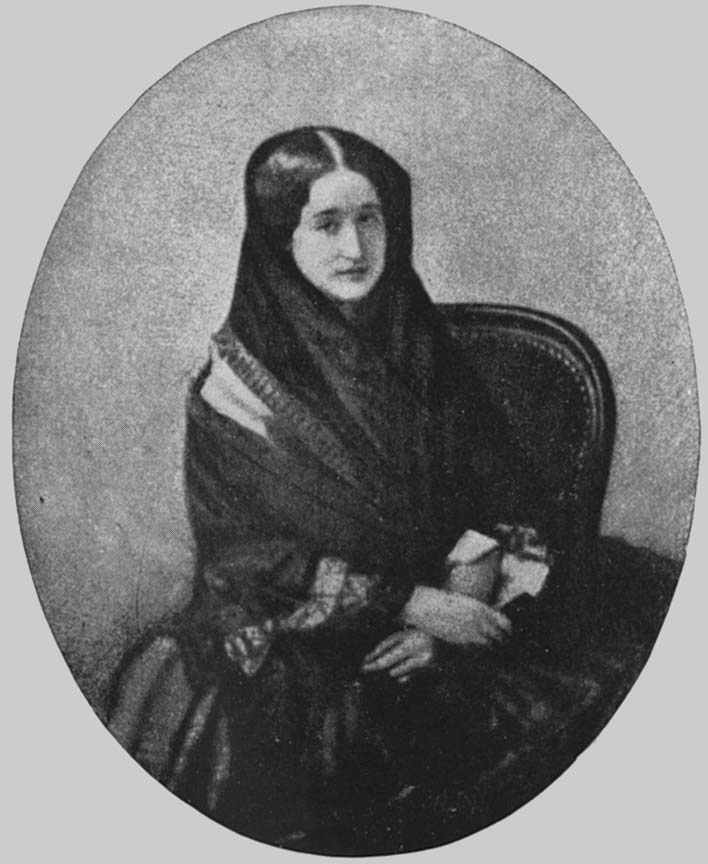
She possessed a singularly striking face, oval in contour, and remarkable for the purity of its lines; a brilliant, light, clear complexion; blue eyes, peculiarly soft and liquid, shielded by long lashes and, when in repose, cast slightly downward; hair of a most beautiful golden chestnut color, a rather thin nose exquisitely molded, and a small delicate mouth that disclosed when she smiled teeth that were like pearls. Her figure was above the average height and almost perfect in its proportions---the waist round, and the neck and shoulders admirably formed---and, withal, she possessed great vivacity of expression and elegance in her movements, together with an indescribable charm of manner. Indeed, she was a woman of a very rare type physically as well as morally; one whose distinguishing qualities always seemed to me to reveal the existence of Irish rather than Scotch blood, notwithstanding the name of her mother's family---Kirkpatrick. But she was richly endowed, by inheritance or otherwise, with the best qualities of more than one race; and, if it was true that her beauty was blond and delicate from her Scotch ancestry, it was no less true that "her grace was all Spanish, and her wit all French."
The Prince himself soon recognized the extraordinary personal and mental endowments, and the various excellent and characteristic traits of the Countess. It, therefore, is not to be wondered at that, when he came to the conclusion that marrying princesses was not his affair, he should have remembered the lady whom he had so often admired, or that he renewed the acquaintance purposely and more intimately in the autumn of 1852; and that it led, with the rapidity of romance, to an engagement of marriage which he, having in the meanwhile become Emperor, formally announced, January 22, 1853, in the throne room of the Tuileries, to the Senate, the Legislative Assembly, and the highest officials of his Government.
The words which the Emperor used on this occasion, present in their true light the motives that led him to this union, and are a beautiful appreciation of the worthiness of his betrothed, who afterward proved so faithful to him as a wife, not only in the days of splendor when Fortune smiled upon the Imperial throne, but also in the hours of misfortune and exile that followed.
"She whom I have chosen by preference," said the Emperor, "is of high birth. French at heart by her education, and by the remembrance of the blood which her father shed for the cause of the Empire, she has, as a Spaniard, the advantage of having no relatives in France to whom she would be obliged to grant honors and dignities. Endowed with every good quality of the mind, she will be an ornament to the throne, and in the hour of danger she will become one of its most courageous supporters. Catholic and pious, she will send to Heaven the same prayers as I for the welfare of France; gracious and good, she will, as I firmly hope, revive the virtues of the Empress Josephine, whose place she is about to take.
"I come here, then, gentlemen, to say to France: 'I have preferred to have for a wife a woman whom I love and respect, rather than a woman unknown to me and with whom the advantages of an alliance would have been mingled with sacrifices. Without showing disdain towards any one, I yield to my own inclinations, but after having consulted my reason and my convictions. In short, having placed independence, the qualities of the heart, and domestic happiness above dynastic prejudices and the designs of ambition, I shall not be less strong, since I shall be more free.' "
As might have been expected, the announcement of this marriage came as a surprise to the French people. Nor was it at first received with entire satisfaction by those who, having rallied to the support of the new Government, had hoped to see it strengthened by an alliance with the reigning families of Europe. This feeling of disappointment found expression in various ways that sometimes were not wanting in piquancy.
One of the persons who had most urgently opposed the Emperor's marriage with Mademoiselle de Montijo was M. Drouyn de Lhuys, the Minister for Foreign Affairs. On finding that his counsel had been entirely disregarded, he concluded to send in his resignation to the Emperor, but, before doing so, he called upon Mademoiselle de Montijo to pay her his respects officially. He had scarcely spoken when she said:
"You will permit me to thank you, and very sincerely, for the advice you have given to the Emperor with respect to his marriage. Your advice to him was exactly the same as mine."
"The Emperor has betrayed me---I see," said the Minister.
"No: the honorable recognition of your sincerity---the making me acquainted with the opinion of a devoted servant who has given utterance to my own sentiments---this is no betrayal. I told the Emperor, as you did, that the interests of his throne should be taken into consideration; but it is not for me to be his judge, whether he is right or wrong in believing that his interests can be reconciled with his sentiments."
It is hardly necessary to add that M. Drouyn de Lhuys promptly reversed his opinion concerning Mademoiselle de Montijo, and retained his portfolio.
A story also is told of a distinguished Senator, who, having been asked what he thought of the Emperor's declaration of his matrimonial intentions addressed to the representatives of the Government and the people, replied:
"A fine speech---excellent; but I prefer the sauce to the fish."
It seems this remark was reported at the palace, greatly to the amusement of the parties principally concerned. Now it so happened that, at a dinner given at the Tuileries a few weeks later, this Senator was seated next to the Empress, who, observing that after having been helped to the turbot, he declined the sauce, said to him, smiling roguishly:
"Monsieur, I thought it was the sauce you liked and not the fish."
With rare presence of mind the gentleman replied after a moment of hesitancy: "A mistake, madame, for which I am now trying to make amends."
And so nearly all those persons who at first were inclined to manifest their disappointment or surprise, discovered they had made a mistake, the moment they enjoyed the privilege of meeting her Majesty, and were themselves fascinated by her beauty and wit, or felt the influence of the subtle charm that seemed to come from the very soul of the woman, and, like an ever-present atmosphere, invest her sweet and sympathetic personality. They were now ready to confess that the Emperor was right when he said to the great dignitaries of the Empire: "You, gentlemen, when you come to know her, will be convinced that I have been inspired by Providence."
The marriage of the Emperor had the sanction of public opinion and there was a touch of romance about it that made it pleasing to the people. While Lamartine, the shifty Republican, could hardly look with favor on the Imperial pair, Lamartine, the poet, gracefully acknowledged that the Emperor had by this marriage made real the most beautiful dream a man can have---that he had raised up the woman he loved and had set her above all other women.
On the 30th of January, 1853, I saw the marriage between Napoleon III and Mademoiselle Eugénie de Montijo celebrated in the old cathedral of Notre Dame with all the splendor and magnificence to which the monarch of a great nation and the consort of his choice were entitled. The ceremonial observed on this occasion was quite like that employed at the marriage of Napoleon and Josephine, but was even more elaborate and spectacular in its details. The gilded State carriage surmounted by the Imperial eagle and drawn by eight horses, in which the Emperor, in the uniform of a general of division, was seated by the side of his bride, was the one used by Napoleon and Josephine on the day of their coronation. The approaches to the Tuileries, the courts of the Louvre, and the streets leading to the cathedral were filled with an immense crowd of people whose enthusiasm was unbounded. It would be impossible to describe the profound impression produced when, after the passing of the main body of the cortège, the Imperial carriage was seen advancing, surrounded by the great officers of the army, and preceded and followed by squadrons of cavalry, and we heard the hum of voices---the half-suppressed exclamations of admiration---then a silence, followed by long-continued vivas---" vive l'Empereur "---" vive Eugénie "---" vive la France." Those who were fortunate enough, as I was, to catch, through the windows of the coach of glass and gold, a glimpse of the divinely beautiful bride who sat beside the Emperor like a captive fairy queen, her hair trimmed with orange blossoms, a diadem on her head, her corsage brilliant with gems, wearing a necklace of pearls, and enveloped in a cloud of lace---can never forget this radiant and yet shrinking figure. Radiant, she seemed to feel that Fortune had conferred upon her its supremest gift, and that she was about to realize the prediction once whispered in her ear by a Spanish gypsy woman, "the day will come when you shall be a Queen"; and yet shrinking, as if she feared that behind all this show of enthusiasm and splendor there was another world---a world of violence and of sorrow; that the things which were seen were an illusion and vanity, and that the things which were not seen were the eternal reality. Perhaps she was thinking of the young Austrian Princess whose marriage was also celebrated with the greatest pomp; and of the day that followed---the 16th of October, 1793---when the shouting of the people was heard by her for the last time; for Eugénie de Montijo even then had learned by heart this touching story of royal happiness and despair.
In the cathedral, where the marriage ceremony took place, the columns and lofty vaults had been decorated with rich draperies, and banners, and banderoles; and palms, and garlands of white blossoms, and banks of flowers had been scattered everywhere---innumerable candles lighting up the whole of the vast interior, filled to its utmost capacity by the great bodies of the State, the diplomatic corps and the representatives of the Army, the Church and the cities of France, and by the elegance and beauty of the world of fashion. The scene was one of unparalleled magnificence. Nothing was wanting to invest the occasion with splendor and solemnity. On entering this ancient church and going forward to the altar, while a wedding march was played by an orchestra of five hundred musicians, the bride was quite overcome by her emotions. But when the archbishop said to her: " Madame---you declare, recognize, and swear before God, and before the Holy Church, that you take now for your husband and legal spouse the Emperor Napoleon III, here present," she responded, in a clear, sweet voice, "Oui, Monsieur."
If the elegance of her person evoked admiration on every side, the modest dignity with which she performed her part in this great and imposing ceremony secured to her the sympathy and good-will of all who witnessed it.
After the ceremony was over the procession returned to the Tuileries in the same order in which it had left the palace, and the Emperor and the Empress, ascending the steps of the "Salle des Maréchaux," came forward on the balcony, and saluted the assembled multitude, who returned with loud and repeated vivas this gracious recognition on the part of their sovereigns.
Napoleon, on the morning of his marriage, going into the dressing-room of Marie Louise, said as he placed with his own hands a crown upon her head: "The Empress will wear this crown. It is not beautiful, but it is unique, and I wish to attach it to my dynasty." On the 30th of January, 1853, Eugénie de Montijo entered the Tuileries---the Palace of Catherine de Medicis, of Marguerite de Navarre, of Marie Antoinette, of Josephine, of Marie Louise---in triumph, wearing upon her head the same Imperial crown. And she was worthy of this honor; for from that day the Empress Eugénie ranked without question among the most admired and beloved sovereigns of the nineteenth century; and, as if she were destined to have over her predecessors a certain melancholy preeminence, her name is the last of the names of women, the wonderful story of whose lives has made the Palace of the Tuileries forever memorable in French history.
A few days after Eugénie de Montijo---or, as I had always been accustomed to call her, the Countess of Téba--had been installed as Empress at the Tuileries, she sent word to me by Mademoiselle Pepa, her confidential maid---who afterward, by marriage with a subaltern officer, became Madame Pollet---that, having need of my professional services, she wished me to come and see her at the Tuileries.
Pepa informed me that her Majesty desired to see me personally. The Empress, as the Countess of Téba, had always been accustomed to come to my office and to take her turn with the others, and it was an innovation to ask me to go to her; so she was careful, in making this request, to have it appear that she considered she was asking a favor, or at least was paying me a special compliment.
On entering her room, she received me most cordially and unaffectedly. We conversed about the great change in her position, and how it had come to pass; and she told me many things that had taken place during the interval since I had seen her.
I remember, when Pepa came into the room to speak with the Empress, how they both laughed as the poor, simple woman who had known the lady from childhood and had naturally been most familiar with her as a young girl, tried to say, "your Majesty." She could not get it out. She spoke French with a strong Spanish accent, and kept laughing as she tried to call her by her new title. It was most amusing, and the Empress saw it in a humorous light and enjoyed it greatly. But with time, Pepa and all of us fell into the way of giving to the Empress her title "your Majesty.''
As my illustrious and most interesting patient, although at the moment quite comfortable, had been suffering greatly and feared a repetition of the same trouble, and as she had important duties to attend to, and a reception in the evening, I remained at the Tuileries several hours in order to be sure that she should, if possible, be able to appear at the function, for which elaborate preparations had been made. We had, therefore, much time for conversation.
While speaking of the Tuileries, the part which we were in being one that I had never before visited, the Empress called my attention to certain articles of furniture and precious objects, some of which had belonged to Marie Antoinette. She spoke of the Queen's sad fate, and of the souvenirs connected with the room we were sitting in, and about the historical associations of the old palace. Much of this conversation was to me particularly interesting. There was in it a vein of sadness or melancholy mingled with scarcely concealed surprise at her own position as sovereign mistress where so many great ladies had lived ---to-day the favorites of fortune, to-morrow the unhappy victims of popular fury, some sent into exile and some to the scaffold. There was, however, no indication whatsoever in her deportment of any feeling of vanity, or of pride at being elevated to the throne, and becoming the first lady in the land. In all this there was a charm, a simplicity of soul which I saw again in troublous times, in the terrible days of 1870, when hastening with her from that France where, for upwards of seventeen years, her goodness, and her beauty, and distinction had held the world at her feet.
A little incident took place on this day which revealed to me the strong and romantic attachment of the Emperor to his lovely wife. It was the first day since her marriage on which she had suffered acute pain, and the Emperor expressed the greatest sympathy for her, and was most attentive---coming upstairs from his cabinet several times to inquire how she was feeling. Just before I left the palace, very happy to know that my charming patient was no longer suffering, the Emperor entered the room again, with a box in his hand, and, approaching the Empress, took from it a magnificent string of pearls, which he placed around her neck.
Some time before, M. Charles Thélin had told me that the Emperor possessed a remarkable collection of pearls, which he had selected one by one, intending to make with them a necklace for the Empress. Touched by a feeling of love and compassion, his Majesty had been unable to keep his secret from her any longer.
Eugénie de Montijo was not so dazzled by the splendor of her new position as to forget the companions of her earlier and more simple life. She invited them to come to see her. Some of them became her "dames du Palais." She wished all of them to speak to her familiarly, as they used to do. Her friendly advances towards them were not to relieve ennui, or to fill up a void created in her life by the formalities of the palace. She now had the power to help them and to honor them---and this she loved to do. I may remark here that this kind consideration---this fondness for her friends---was a sentiment that had its origin in an affection which once having been felt was sincere and constant, and endured through good report and evil report to the end.
I have never known a woman that had such reason to distrust the sincerity of some of the persons in her immediate entourage, who was so full of faith in the good intentions, and so abounding in charity towards the shortcomings, of all who claimed to be her friends. If she could not say something in praise of them she preferred to remain silent, unless their conduct was made a subject of criticism by others, when she was pretty sure to come to their defense, and sometimes with a warmth of feeling that was surprising.
Perhaps the explanation of this trait of character is to be found in her inability to forget a kindness.
When reproached one day for keeping up her intercourse with certain ladies---the Delessarts---who were well known for their Orleanist sympathies, her reply was:
"They were very kind to me before my marriage, and I never forget my old friends." Indeed, I do not believe there is a single person now living that has ever rendered her Majesty a notable service who has not heard her say ---and more than once---"I never can forget what you have done for me."
The attachment of the Empress to her old friends and the associates of her earlier days, is strikingly illustrated by her relations with, and the consideration which she always had for, her principal lady's maid, Madame Pollet. "Pepa," as she was familiarly called, was the daughter of a Carlist general; but when very young she entered into the personal service of the Countess of Téba. Her devotion to her mistress was unbounded, and she soon obtained, as she deserved, her esteem and confidence in equal measure. With her Majesty, Pepa went to the Tuileries, where she was entrusted with the general direction over a multitude of things connected with the domesticity of the palace, and became, in a way, a personage---at least to a certain circle. She was a little woman, not in good health, fretful, irritable, and timid. Her person, her manner, her accent, her devotion to her mistress, the fact that she was the direct intermediary between her Majesty and the tradesmen, and the very confidence reposed in her, in all her doings and dealings, exposed her constantly to ridicule and reproach. It is, therefore, not surprising that great injustice should have been done this faithful attendant and confidant of her Majesty by the personnel of the palace and the chroniclers of the doings of the Imperial Court. But the Empress knew her sterling qualities, her sincerity, and her integrity, and appreciated her accordingly. In fact, she never failed to defend with warmth her "poor Pepa" against every attack, from whatever quarter it might come.
Yes," said the Empress to me one day, "Pepa is timid; she starts at the rustling of a curtain, and turns pale at the moaning of the wind, and screams at the sight of a mouse, and is in a constant state of terror lest we should all be assassinated; but let her see or think that I am in any real danger---ah! then she is no longer afraid, but has the courage of a little lioness." Pepa is long since dead; but she never in life was more devoted to her mistress than the Empress is still devoted to the memory of her very humble, but most sincere, friend and servant.
Notwithstanding the great change in her rank, the Empress remained unchanged in her character; and unchanged also was the unaffected courtesy with which she received all who came into her presence. Nor did her kindness and love for everything that was true and noble grow less. I have seen her frequently during many years; I have seen her surrounded by luxury and the pageantries of the most brilliant Court in Europe; I have witnessed her greatest triumphs, but I cannot recall one moment in which her demeanor towards others, no matter how humble their station in life, was different from that by which she attracted the sympathy of all those who knew her as a young lady. She always had the excellent good sense never to impose herself as Empress upon the persons whom she had known before her elevation to the throne; and yet she never forgot that she was no longer of that world to which she had once belonged. In a word, she possessed an instinctive appreciation of the requirements of her position, and so happily harmonized and combined her natural impulse to be herself with a sense of the reserve and dignity becoming her exalted rank, that she won the praises of all. Queen Christine pronounced her deportment admirable, and declared that she carried herself "neither too high nor too low." And the Queen of England was of the same opinion. At the time of the visit of their Imperial Majesties to London, in 1855, the Queen writes in her diary of the Empress as follows: "She is full of courage and spirit, and yet so gentle, with such innocence and enjouement, that the ensemble is most charming. With all her great liveliness, she has the prettiest and most modest manner." And a day or two later, the Queen writes, "Her manner is the most perfect thing I have ever seen---so gentle, and graceful, and kind; and the courtesy so charming, and so modest and retiring withal.(7)
And yet while she was so condescending and so courteous to all, and so easy of approach, who that ever saw the Empress on great ceremonial occasions will forget the dignity as well as grace with which she responded to the salutations she received, or the grand manner of her carriage? The appearance of her Majesty on some of these occasions has doubtless suggested to the mind of more than one person the words used by Saint Simon when speaking of the Duchess of Burgundy:" Sa démarche était celle d'une déesse sur les nuées."
But it was the amiable and gentle manner of the Empress, the absence of every sign of superciliousness or of undue pride after her elevation to the throne, even more than her extraordinary beauty and esprit, that disarmed opposition, and won for her the admiration even of those who, jealous of her rare fortune, were at first most disposed to criticize her. And such criticism as she was subjected to! How insignificant in reality it always was! Never a word that cast a reflection on her goodness, her loyalty, or fidelity as a wife and mother! The foundation on which her character as Empress and woman rested was unassailable. But the anti-Imperialist gossips never grew weary of tattling about her love of personal display, of inventorying her dresses, and bonnets, and jewels, and furs, and of hypocritically bemoaning the "luxe effréné "---the unbridled luxury---of the Court. Just as if it was not one of the principal functions of a sovereign in a country like France-the arbitre de la mode for the world---to set the fashions of the day, and to regulate the etiquette and ceremonials of the Court!
And most eminently was she qualified to prescribe and govern the "form" at a Court brilliant and fond of display and originality to the verge of eccentricity. It was with the most exquisite tact and taste that she fixed the line where fashion stopped, and to pass beyond which would have been ridiculous. The beau monde everywhere accepted her decisions in these matters as ne plus ultra. From the day she entered the Tuileries, the Empress was the ruler of the world of fashion, and the supreme authority with her sex, in the four quarters of the globe, in all matters pertaining to the graces and elegancies of social life; and through her patronage the names of the couturières, and modistes, and florists of Paris became famous in every land.
And yet most ladies who are at all prominent in our fin de siècle society, would probably be greatly surprised were I to tell them that the Empress, when one day at Farnborough reference was made to these particular critics and the alleged extravagance of her wardrobe, said in my presence: "How very ridiculous all this is. Well! I suppose they think they must say something. Why! with the exception of a few gowns made for special ceremonial occasions, (those which she used very happily to call 'mes robes politiques ') during the whole time I was at the Tuileries I never wore a dress that cost more than fifteen hundred francs, and most of my dresses were much less expensive."
A writer who is no friend of the Empress has the grace to say, when speaking of her: "We live at a time when queens are exposed to public observation more than ever before, when they cannot put on a dress without having it described by fifty newspapers, when twenty articles are published every day about their fêtes, their amusements, their jewels, and their head-dresses. This publicity tends to lower queens in the estimation of the people, who no longer see anything but the frivolous side of their lives.
To support without concern, as also without haughtiness, the gaze of so many people who are constantly examining you; to take, without having the appearance of it, one's part of the responsibility of governing, and the most dangerous, perhaps; to appear at the same time serious and frivolous, a woman of the world and of the home, and religious without being a devotee; to dress without affectation; to discuss literature without pedantry, and politics without embarrassment; to read what a well-instructed woman should read; to say what a clever woman is expected to say; to know how to speak to women and to men, to the young and to the old; to be in a word always on the stage---this is the rôle of a queen."
And certainly very few persons will be disposed to deny the truth and justice of this writer's conclusion that "Queen or Empress is a difficult trade in a country like France, and in a time like that in which we live!"(8)
Soon after the fall of the Empire, stories were put in circulation to the effect that the Imperial family had accumulated a large fortune, which they had been very careful to remove from France. It was alleged that always uncertain as to the stability of a Government of adventure, they had with great discretion been "making hay while the sun shone," and had invested considerable sums in English consols, and, wonderful to relate, in New York real estate. The honor even was attributed to me of having advised the American investments, and also of having acted as the agent in these transactions. Not only were all these stories untrue, but, for those making me a party to the financial affairs of the Imperial family, there was never the slightest foundation.(9)
The Emperor's generosity, his prodigality even, was notorious. The direct appeals to him for pecuniary assistance were constant, and he gave away immense sums to charities of every kind. The Empress was the Lady Bountiful of the reign; but the Emperor delighted to aid her in her benevolent work and to make her the agent and dispenser of his own liberalities. The demands upon the privy purse were endless. Often it was drawn upon to supplement the lack of public funds. The account of the Imperial civil list, which has been published, shows that during his reign the Emperor distributed personally over ninety millions of francs in public and private benefactions. The last large sum of money he had in his possession, 1,000,000 francs, he ordered to be distributed among the troops that capitulated at Sedan---reserving absolutely nothing for his personal use. During his reign, he made no monetary provision for the future. When he left France, in September, 1870, his personal fortune was no greater than it was when he came to France twenty-two years before. He owned the château at Arenenberg which brought him no income, and a little property in Italy, from which he derived a small revenue---all of which he had inherited. Had it not been for the private fortune of the Empress, the family would have then been at once reduced to very straitened circumstances.
The Empress was the owner of some property in Spain, the Villa Eugenia at Biarritz, besides other real estate in France; some of which she subsequently generously gave to the French people. But a large part of the Empress' fortune consisted of jewels, most of which had been presented to her at the time of her marriage, and some of which were of very great value---among them a magnificent collection of pearls, and several large diamonds of extraordinary purity and brilliancy that originally belonged to Marie Antoinette and formed a part of the famous "diamond necklace," the tragic story of which has been so powerfully told by Carlyle. These jewels were sold after their Majesties were settled in England, as was also the property at Biarritz, and the proceeds were invested in income-yielding securities. But, altogether, the fortune of the Imperial family was not large, particularly in view of the claims of needy dependents and obligations of various kinds, which could neither be repudiated nor ignored.
I may remark that very few of the persons prominently connected with the Second Empire appear to have accumulated wealth; and that having lost their official positions after the fall of the Imperial Government, great numbers of those who were advanced in life, were reduced to extreme indigence. When the attention of a French Republican is called to this fact---that money-making was not the business of the servants of the Empire---he shrugs his shoulders and cynically says: "I suppose they thought it was going to last forever."
It is not difficult to understand how impossible it was to satisfy all those servitors who felt that they had a right to appeal to their late sovereigns for pecuniary assistance; or to prevent in some cases the disagreeable consequences of a failure to respond to such appeals.
But there was another class of solicitors far more difficult to deal with, men and women who were anxious to espouse the Imperialist cause---for money. It was impossible to listen to these people, and their assistance was politely declined. But they went away carrying with them a bitter feeling of disappointment that subsequently found expression in petulant and vicious attacks, directed more particularly against the Empress, whose good sense in refusing to be exploited was attributed to parsimony and niggardliness. There were times when these personal attacks were absolutely heartless; when even the mourning of a mother was made the pretext for the most cruel insinuations. These savage thrusts were keenly felt, but the wisdom and real greatness of character which the Empress possesses were never more conspicuously shown than in her ability to listen to these slanders in silence---and if in sorrow, in pity also.
Although misfortune finally dethroned the Empress Eugénie it was certainly not because she had proved unworthy of her high position. She, as well as her magnanimous husband, had to suffer on account of being too trustful and generous to others. They lost their Empire because they loved their people, believed them, and confided in them. History may judge the monarch and his companion in the Imperial dignity by the political events of their reign. It is the privilege, it is the duty, of the friend to judge the man and the woman, to judge their hearts. But if historical writings were free from errors of fact and were a philosophical record of the actions of men, stating correctly their motives and their material and moral limitations, and giving credit to whom credit was due, many of those persons who are condemned by public opinion would be admired and honored.
Indeed, few women who have sat upon a throne have a larger claim to the love and esteem of their people, or have shown to the world a higher and more charming personal character than the noble consort of Napoleon III. The conduct of her whole life bears witness to this.
The first act of the Countess of Téba after her engagement to the Emperor, like so many of her acts, was one of charity. The Municipal Council of Paris, desirous to show its devotion to the Emperor's bride, had voted a sum of 600,000 francs for the purpose of purchasing for her a set of diamonds.
When the Countess heard of this she addressed to the Prefect of the Seine the following letter:
"MONSIEUR LE PRÉFET:
I have been moved greatly by hearing of the generous decision which the Municipal Council of Paris has taken, and by which it manifests its sympathetic approval of the union which the Emperor is about to contract. Nevertheless, it would pain me to think that the first public document to which my name is attached at the moment of my marriage, should record a considerable expense for the city of Paris.
You will, therefore, please permit me to decline your gift, however flattering it is to me. You will make me happier by using for charitable purposes the sum that you have appropriated for the purchasing of the diamond set which the Municipal Council intended to present to me.
"I do not wish that my marriage should impose any new burden on the country to which I belong from this moment; and the only ambition I have is to share with the Emperor the love and esteem of the French people.
I beg you, M. le Préfet, to express to your Council my very sincere thanks, and to accept the assurance of my great esteem.
"EUGÉNIE, COMTESSE DE TÉBA.
"PALAIS DE L'ÉLYSÉE, January 26th, 1853."
In conformity with this wish of the bride of the Emperor the sum voted by the City Council was used for the erection of an establishment in the Faubourg Saint Antoine, where young girls receive a professional education. This establishment was opened in the year 1857, and placed under the protection of her Majesty; in it were accommodations for 300 pupils.
But not satisfied with declining the gift of the Paris Municipal Council and suggesting its use for charitable purposes, the Countess of Téba set the example she wished others to follow, by taking the 250,000 francs the Emperor had placed among her wedding presents, and sending them to be distributed among the poor.
In order to be always informed of cases where help and assistance to the sick were especially needed, the Empress, during the whole period of her reign, was surrounded by a staff of persons whose business it was to inquire into the condition of the poor and suffering, and to report the result of their investigations to her personally.
Her Majesty not only generously disposed of her fortune in charitable work and gave assistance in special cases on the representation of others, but she went herself to visit the needy, even in the most remote quarters of her capital.
Frequently, and especially in winter when the indigent suffer the most, the Empress left her palace incognito, accompanied by one faithful attendant only, to visit the dwellings where she had been informed there was destitution and distress. On many occasions she ascended to the attics where the poor persons lived, not minding the fatigue, and sat down by the beds, without fearing contagion, to encourage the sick by her presence and with kind words.
The courage and self-sacrifice she at times exhibited, when engaged in benevolent and charitable work, were conspicuously shown during her memorable visits to the cholera hospitals in Paris and at Amiens.
On October 23d, 1865, cholera was epidemic in the city of Paris, and the deaths had within a few days increased so rapidly, that a state of panic reigned among the inhabitants. Most of those who were able to do so had left, or were preparing to leave, the city, but the Empress Eugénie took this opportunity to give to her subjects an example of courage. It is well known that fear is a very effective agent in the propagation of disease. The Empress, wishing to show that there was no good reason for fear, visited successively the cholera patients at the Beaujon, Lariboisière, and Saint Antoine hospitals.
I may mention a little incident that occurred at this time. When visiting the Hospital of Saint Antoine, the Empress addressed a question to a patient; the man, whose sight had become weak, on account of his being in a state of collapse and at the point of death, answered, " Yes, my sister.''
"My friend," said the Lady Superior of the hospital, it is not I who speak to you, but the Empress."
"Do not correct him, my good Mother," said her Majesty; "it is the most beautiful name he could have given to me."
And when, on returning to the palace, one of her ladies-in-waiting, having learned where she had been, said: " I am sorry you did not ask me to go with you---if I am permitted to participate in your pleasures, I think it is only right that I should share your dangers," the Empress replied: "No, my dear; it was my duty as Empress to take this risk; but I should do very wrongly were I to request you, who are a mother and have other duties, to imperil your life unnecessarily."
In the following year the cholera raged fearfully among the unfortunate inhabitants of Amiens, where the alarm was greater, if possible, than it had been in Paris. On the 4th of July, upon the receipt of the news of the enormous number of deaths that had occurred there, the Empress left her capital, accompanied by the Countess de Lourmet and the Marquis de Piennes, and hastened to Amiens, where, immediately upon arriving, she drove to the Hôtel Dieu. She visited all the wards of this hospital without exception, stopping at the bed of every patient. Taking their hands, she spoke to them kindly, and perhaps saved the lives of many by thus reviving their hopes. As she was about to depart, two little children who had been made orphans by the epidemic were pointed out to her by M. Cornuau. When the Empress beheld them, she instantly said:
"I adopt them. They shall be provided for." Many of the bystanders, at these words of her Majesty, were moved to tears.
From the Hôtel Dieu, the Empress drove to the City Hall, where she remained for a short time, and afterward visited the hospitals in the Rue de Noyon, kept by the Petites-Sœurs-des-Pauvres, the charitable institutions in the Quartier Saint-Leu, and in the Rue Gresset, and many other hospitals besides. And then she went to the great Cathedral---the noble and solemn magnificence of which so impressed Napoleon, that he exclaimed:" An atheist would not feel at home here!"---to pray to God to deliver the good city of Amiens from the power of the scourge.
In order to perpetuate the remembrance of this visit to Amiens, a painting representing the Empress at the bed of a cholera patient was placed in one of the halls of the museum of that city. The Municipal Council of Amiens has, however, lately ordered this painting to be taken away. But the visit of her Majesty, who came as an angel of pity in the hour of suffering, will long be remembered by the inhabitants of the ancient capital of Picardy.
Always faithful to her Church, and sedulously observant of her religious obligations and duties, the Empress is absolutely free from any suspicion of sacerdotalism.
As the Emperor himself said of her: "She is pious but not bigoted." How could she ever have been bigoted, with Henri Beyle as the mentor of her youth, and Mérimée the friend of her later years; both accomplished littérateurs and men of the world, but materialists both, and. each capable---if men ever were---of eating a priest for breakfast? Indeed, the society in which she passed her whole life from her earliest childhood, if not precisely latitudinarian, was one of great intellectual breadth, in which questions of every sort were discussed on every side and with the utmost freedom.
When M. Duruy proposed to open the University for "the higher education" of girls he brought down upon himself the wrath of the ultra-Catholic party, led by Dupanloup, the fiery Bishop of Orleans, and encouraged by Pius IX. himself, who praised the Bishop for having "denounced those men who, charged with the administration of public affairs, were favoring the designs of impiety by new and unheard-of attempts, and imprudently putting the last hand to the ruin of social order." That such opinions were not her opinions, the Empress did not hesitate to openly declare, and she emphasized her position with respect to these "designs of impiety" by sending her nieces to attend the lectures at the Sorbonne.
Whatever in her own mind she might hold to be the ultimate truth, she had learned and believed that religion was largely a personal matter and an inheritance, and, consequently, has always regarded with tolerance, and with sympathy even, the members of every confession and the worshipers at altars other than her own. And this tolerance is genuine and true. It is no product of policy or indifference. It is the result of knowledge. For the Empress has discovered, as many of us have, that respect for the temples of others in no way weakens, but rather strengthens, the veneration in which we hold our own holy places.
I shall never forget her unconcealed indignation on a certain occasion---since she has been living in England---when some one remarked: " It was the man's religion, I suppose, that condemned him." "No!" said she, starting up suddenly; "a religion should condemn no one. I don't believe it. It would be a disgrace to our Christian civilization---to any civilization." And turning towards me she continued: "You are a Protestant, I am a Catholic, another is a Jew. Is the difference in our religious opinions, in our forms of worship of one and the same great God, a reason why we should be not equal before the law? Is it on the pretext of these differences that we are to be refused justice in our courts? The idea is monstrous! There is but one justice before God; and it belongs to all men alike, rich or poor, black or white, Catholic or Protestant, Jew or Gentile." And these opinions---this large and tolerant spirit---owed nothing to her altered situation in life and a new environment.
Some time in the early sixties, the Grand Rabbi of France received a note asking him to come to the Tuileries on the following morning. His astonishment was great. What had he done that should have provoked this sudden summons? With fear and trepidation he went to the palace, and was ushered into the apartment of a chamberlain. Here he was told that the Empress wished to see him. On being introduced into her cabinet the Empress to his surprise received him very graciously; but he was, if possible, still more astonished when he learned her Majesty's object in requesting him to come to the palace: She wished to obtain his advice and cooperation in a charity in which she was greatly interested--one intended for the special benefit of the Jews.
Nor did the Empress restrict her liberalities and activities to work that was merely eleemosynary and philanthropic. She was keenly interested in everything that might extend the moral power, the civilizing influence, the language, and the fame of the French nation. She was ever ready to encourage literature, art, and science by appreciative words and helpful gifts.
Those famous "house parties" at Compiègne were not assemblies, as so often represented, of men and women preoccupied with fashion and the frivolities of life, but of persons distinguished in the liberal professions and arts, or for their special accomplishments or personal achievements. An invitation to pass a week in her society was among the gracious ways the Empress took to encourage those who were striving to widen and enrich the field of knowledge and cultivate a love of the true and the beautiful in the service of man, and to express her recognition of the merits of a Leverrier or a Pasteur, of an Ernest Legouvé, a Gérôme, or a Gounod. And was it not Flandrin who wrote to his friend Laurens to tell him how the Empress never ceased in her attentions to him while he was a guest at Compiègne? That this generous hospitality was appreciated, at the time, by those who were privileged to enjoy it, we may feel quite sure when a man of the eminence and sobriety of speech of M. Victor Cousin---who always stood aloof from the Empire---could write to her and say: "The esteem of such a person as you ought to satisfy the most ambitious."
But for the things of the mind themselves she had a genuine love. Nothing delighted her more than to be able to steal away with some book that had captured her fancy, and, all alone by herself, devour its contents. She was also fond of drawing, and of painting in water-colors; and she made many original designs and sketches, intended to show landscape effects, for the use of the engineers who were engaged in laying out the Bois de Boulogne. She was even a competitor for the prize offered for the best design for the new Opera House; and if she failed to obtain it, she at least had the satisfaction of hearing that her work was judged to be of sufficient excellence to entitle it to an "honorable mention."
Much of the decorative painting in the Empress' apartments at the Tuileries was designed and executed under her immediate direction. Taking Cabanel one day into her cabinet de travail---"There," said she, " is a panel---you see there is nothing on it but a cord. Make me a picture for it. If you don't," she continued, looking at the artist with the utmost gravity, "the cord can be used to hang-you." And so it was that to escape being hung himself, Cabanel painted his famous picture of "Ruth"---and then his fine portrait of Napoleon III, that was placed in the same room.
The Empress was a sincere lover of Art, of healthy Art, of architecture, of pictures of nature as seen out-of-doors under the sky, of the mysterious and ever-changing sea, and of the land in its infinite variety of shape, of texture, and of color---of mountains, and valleys, and streams, and fields, and trees, and cattle. Indeed, for homely, rural pictures she has always had a strong predilection. One, therefore, will not be surprised to hear that he was an early admirer of the works of Rosa Bonheur, or that she publicly recognized the merits of that highly gifted woman by attaching with her own hands the Cross of the Legion of Honor to the lapel of Rosa's jacket. But gifted as she was with fine artistic sense, she appreciated genius wherever she saw it. How much M. Violet le Duc, the famous archæological architect, owed to her may never be known. Not always, however, was her generous patronage forgotten. The deposed sovereign still possesses many souvenirs of grateful remembrance from artists whom she encouraged and aided---when she had the power to do so. But the one cherished above all others, and never out of her Majesty's sight when she is at Farnborough, is Carpeaux' statue of the Prince Imperial standing by the side of his dog Nero---a work of beauty---a figure full of grace, the lines in the face of which are as pure and charming as those in the bust of the young Augustus.
With the extraordinary curiosity to know that characterized the Empress, it is not surprising that she was passionately fond of traveling; that she wished to see the great world beyond the borders of France, and loved to visit strange lands, and to listen to reports and stories about distant or unexplored countries. Indeed, such was her interest in these matters that in .July, 1869, she set aside from her own private purse the sum of 200,000 francs as a perpetual fund, the interest of which---estimated at 10,000 francs---was to be awarded annually to the Frenchman who during the preceding year should have made the most important contribution to geographical knowledge.
And every one knows the deep interest she took in the construction of the Suez Canal; how warmly she espoused the cause of M. de Lesseps in 1865; how she encouraged him in the tours of his greatest difficulty; how he acknowledged her to be the "guardian angel of the canal," to have been to him "what Isabella, the Catholic, was to Christopher Columbus"; and how she went to Egypt to enjoy with him his triumph, and to rejoice during those glorious and splendid days when the waters of the Red Sea and those of the Mediterranean were formally joined together, and a new pathway was opened to the commerce of the world by French genius, energy, and perseverance. I can never forget her radiant figure as she stood on the bridge of the Aigle, while the Imperial yacht slowly passed by the immense throng that had assembled on the banks of the canal to greet her Majesty on her arrival at Ismalia. What a welcome she received from those children of the desert! "Vive l'Impératrice!" "Vive Eugénie!"--with cannon firing, and a thousand flags and banners waving. But not to herself did she take these honors. It was to France that she gave them---as, finally overcome with patriotic feeling, she covered her eyes with her handkerchief to suppress her tears. And the pity of it all! Only a few years later this great work with its vast consequences slipped forever out of the feeble hands that held it.
While recording here some of my personal impressions and souvenirs relating particularly to those moral attributes with which in my judgment her Majesty was so richly endowed, it may be interesting to note that, after the fall of the Empire, there was found at the Tuileries a manuscript in the handwriting of the Emperor, containing his own appreciation of the character of his consort. It was written in 1868, fifteen years after his marriage.
In it, among other things, he says: "The character of the Empress still remains that of a lady of the simplest and most natural tastes . . . . The lot of all classes of the unfortunate constantly awakens her special solicitude.. . . How many generous reforms she still pursues with marvelous perseverance! A little of the young Phalansterian is still to be found in her. The condition of women, singularly preoccupies her. Her efforts are given to the elevation of her sex. . . . At Compiègne nothing is more attractive than a tea-party of the Empress (un thé de l'Impératrice).
"Surrounded by a select circle, she talks with equal facility upon the most abstract questions, or on the most familiar topics of the day. The freshness of her powers of perception, and the strength, the boldness even, of her opinions at once impress and captivate. Her mode of expressing herself, occasionally incorrect, is full of color and of life. With astonishing power of exact expression in conversation on common affairs, she rises, in remarks on matters of state or morality, to a pitch of real eloquence.
"Pious without being bigoted, well informed without being pedantic, she talks on all subjects without constraint. She perhaps is too fond of discussion. Very sprightly in her nature, she often lets herself be carried away by her feelings, which have more than once excited enmities; but her exaggerations have invariably, for their foundation, the love of that which is good."
The love and admiration of the Emperor for her whom he had chosen to be his life companion only increased as the years passed. He was proud of her beauty; so much so that he was heard to say, more than once, as she appeared, dressed for some public occasion, "Comme elle est belle! " But he was in reality, as one may see from the language he uses in describing his consort, still prouder of her intellectual and moral qualities. He was forever charmed by the brilliancy of her conversation, and still more so by the sincerity of her character and the purity of her ideals in all matters of conduct. The Emperor and the Empress thoroughly understood and thoroughly appreciated each other; and their mutual affection was indissolubly united in their love of an only son, a love which knew no bounds and was complete and perfect. This was the light of the life of each.
Were I to express in a few words what to me has always seemed to be the distinguishing quality of her Majesty's character, I should say it is her perfect naturalness. She was always at home, in every sense of that word. In whatever situation she might be placed, she was as free from self-consciousness as a child. It was the spontaneity of the spoken word, the freedom of movement, its instinctive grace, and, above all, the spiritual sincerity apparent in every word and act, that gave to her personality its irresistible charm. And yet this characterization would fail to express the whole truth, did I not say that her Majesty is not exempt from the defects of her qualities. Had she permitted herself to be less under the empire of her natural impulses, and less frequently given to the vivacious expression of her feelings and her thoughts, and been more observant of the conventionalities that were inseparable from her official station and were often imperative, she might have avoided much of the criticism to which she has been subjected and to which, I have no doubt, she for the most part unconsciously and innocently exposed herself. She has suffered, and sometimes severely, in the judgment of the world, as have other women---as does all emotional imaginative humanity that is in the habit of speaking with little premeditation and without much reserve. To words expressing merely the passing sentiment of the moment a meaning was often imputed which they were never intended to convey. Sometimes, they were supposed to represent her political convictions and sometimes her personal antipathies. They generally represented neither.
To one of his friends who thought he had occasion to complain of a rather sharp remark addressed to him by her Majesty, the Emperor replied: "You know the Empress is very hasty---but in reality she is very fond of you!"
As for her Majesty's political convictions and sympathies, I will only say, in this connection, that they have been grossly misrepresented---for partizan purposes. The 4th of September must be justified; it is always injustice that requires instant and persistent justification. It is the old---the everlasting story: "And then they began to accuse him, saying we found this fellow perverting the nation."
When the protagonists of the Third Republic have passed away, and the history of the Second Empire can be judged without prejudice, the true character of the Empress Eugénie---her public virtues, her goodness and her kindness, especially to the poor, will be recognized and gratefully remembered by the French people. It is the business, it is the duty, of posterity to rectify the mistakes of contemporary opinion; but happily, as Alexandre Dumas, the younger, has wittily said of this opinion, when it relates to French affairs: '' La postérité commence aux frontières de la France."