 |
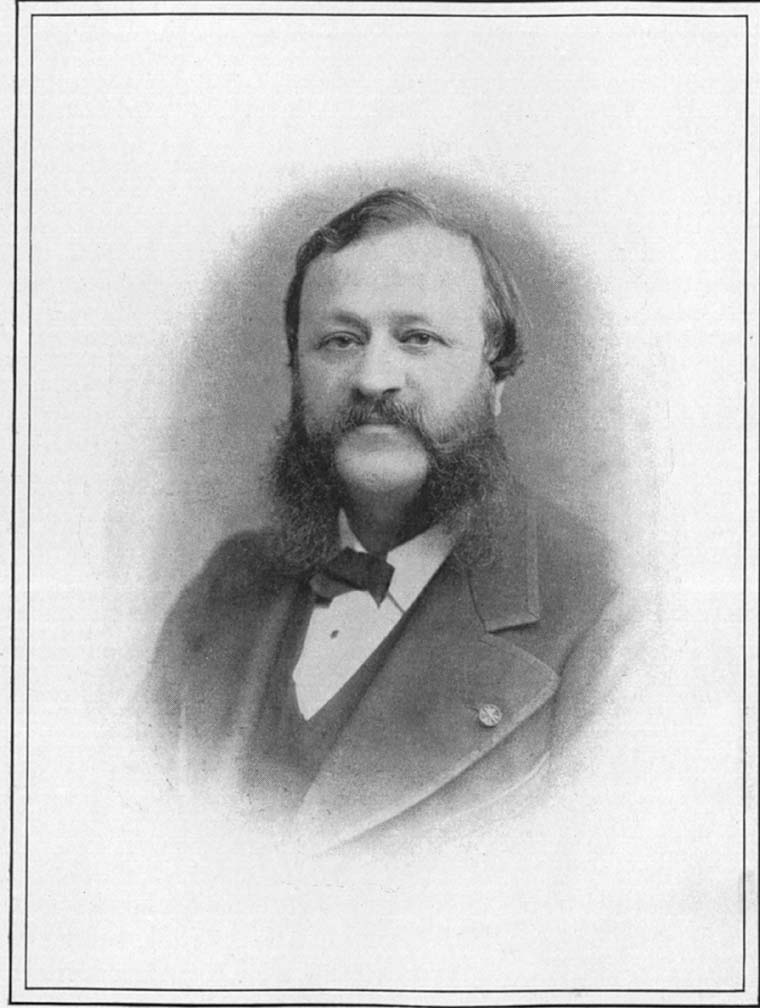 From a photograph by Oh. Reutlinger taken about 1875. |
|
|
From a photograph by Oh. Reutlinger taken about 1875. |
| How my acquaintance with Prince Louis Napoleon began---His life at the Élysée---The day before the coup d'État---Dr. Conneau and Charles Thélin---The Emperor's way of bestowing favors---A cross of the Legion of Honor---A diamond pin---My professional relations with the Emperor---Dentistry in France in 1847---The wife of a dentist---My position at Court---"Have you nothing to ask?"---The courage of the Emperor---The bombs of Orsini---The Emperor's generous nature---A debt of Honor---A Dreyfus case---François Arago---The Emperor's philanthropy---"L'Empereur des Ouvriers"---The Emperor's amiability---Abd-el-Kader |
 N November, 1847, I came to Paris
with my wife, having accepted an invitation from Cyrus S. Brewster,
an American dentist of repute then living in Paris, to associate
myself with him professionally.
N November, 1847, I came to Paris
with my wife, having accepted an invitation from Cyrus S. Brewster,
an American dentist of repute then living in Paris, to associate
myself with him professionally.
In France everything was then quiet. M. Guizot, the Prime Minister, ruled the country with an authority that was absolute. The politicians, of course, were, some of them, clamoring for "Reform," and all of them playing the eternal game of seesaw on every question of public concern that might serve their personal or party interests. But the people were apparently uninterested or asleep. It seems that they were just on the point of waking up. Three months later, in February, 1848, the Tuileries were invaded by the Paris mob, and Louis Philippe, having cut off his whiskers, under the cover of an old hat and a shabby coat, made his escape from the palace. The Republic was now proclaimed and the march of events was rapid-the opening of National workshops, the election to the Constituent Assembly in April; and then the barricades and the bloody days of June, with the shootings and transportations of the apostles of Communism---in rehearsal for the final scene in the great drama of 1871.
On the 23d of September, 1848, Prince Louis Napoleon, having been elected a member of the National Assembly, left London, and the following day arrived in Paris. Less than three months afterward he was elected President of the French Republic, and established his residence at the Palace of the Élysée in the Faubourg St. Honoré, where he remained until the 24th of February, 1852, when he removed to the Tuileries, and occupied the apartments from which Louis Philippe had fled, exactly four years before---on the 24th of February, 1848.
My acquaintance with the Prince began very soon after he came to Paris. He had not been long at the Élysée when he sent a message to Dr. Brewster, stating that he would like to have him come to the palace, if convenient, as he had need of his services. It so happened, when the message came, that Dr. Brewster was ill and unable to respond to this call himself. It fell to me, therefore, by good fortune, to take his place professionally, and to visit the Prince. And there it was, at the Élysée, that I first saw him.
He received me very kindly, without the least intimation that he had expected to see someone else, so that I soon felt entirely at my ease. I found that a slight operation was necessary, which, when made, gave him great relief. On my leaving, the Prince thanked me most cordially, commended me for the "gentleness" of my manner of operating, and expressed a wish to see me the next day. I then saw him again, professionally; and, from that time, up to the day of his death, I visited him often---sometimes as often as twice a week; for the relations between us were not entirely of a professional nature, having very soon become friendly, and confidential even.
During his residence at the Élysée, I was, on several occasions, invited to come in the evening and take tea with him, and some of his intimate associates, at a house in the Rue du Cirque, where he was a frequent visitor. This house, in which Madame H----- lived, was to him easy of access ---a gate in the wall, enclosing the garden of the palace, opening on the street close to the house. There, free from the restraint of official surroundings, the Prince-President loved to take a cup of tea, or to sit during the whole evening sipping a cup of coffee, or smoking a cigarette, his black dog, a great favorite with him, sometimes at his feet and sometimes on his knee.
An excellent listener to the conversation of others---it was with the greatest interest that we all listened to him, when he chose to speak. However light the subject, his remarks were never commonplace, but were often weighty and always bore the impress of originality. There were times when he exhibited rare powers of description and a delicate but lively appreciation of the humorous side of things; and other times---the subject moving him---when his earnest and kindly words and the sympathetic tones of his voice were irresistibly seductive, and we---hardly knowing why, whether we were captivated by the personality of the speaker or surprised at the height to which he carried his argument----in wondering admiration sat in silence under the spell of the Charmer. He talked with the Utmost freedom of his past life in Germany, in Switzerland, in Italy, in England; of Napoleon and of government in general; but spoke rarely and with more reserve about the French politics of the day. And he liked to hear others talk of their own lives, of the subjects that personally interested them, of their occupations and amusements during the day, and to have the conversation go on as if in a family circle, without the restraints of etiquette. He also liked, on these occasions, to listen to simple music---at the same time admitting that music in general he did not like. He seemed to seek the satisfactions of a home, and the pleasure of being surrounded by a few but intimate friends. Madame Henriette, as she was called familiarly, had living with her no family or relative except a sister---a most beautiful creature, artless but full of grace, whose head was one of the finest I ever saw on a woman's shoulders. As Madame de Sévigné said of Mademoiselle de Grignan, she was une créature choisie et distinguée. Here I met MM. Fleury, Persigny, Mocquard, Edgar Ney, and some others. But only a very few of the persons in the entourage of the Prince were ever invited into this little society.
The relations of the Prince to the beautiful and devoted Madame H----- have been a subject of censure and even of scandal. The irregularity of the situation he himself recognized; but he was too kind-hearted to break away from it without some strong and special motive. And then, to use his own words:
"Since, up to the present time, my position has prevented me from getting married; since in the midst of all the cares of the Government I have, unfortunately, in my country from which I have been so long absent, neither intimate friends nor the attachments of childhood, nor relatives to give me the comforts of a home, I think I can be pardoned an affection that harms no one, and which I have never sought to make public."(1)
I was, at first, asked by the Prince to go to this house for the purpose of seeing Madame H----- professionally, he remarking to me that he would consider it a favor if I would do so, since were she to go to my office, her presence there might give rise to comment. Thus it happened that subsequently I became one of Madame H----- 's occasional evening visitors as well as her professional adviser.
The Prince was very fond of walking in the morning in the grounds of the Élysée palace, sometimes alone, but more frequently with Fleury or Persigny or some other member of his official household. Several times, when he had something special to say to me, or inquiries to make, he invited me to take a turn with him in the garden, usually speaking in English, for he liked to talk in English whenever he could; and it often served him well when he wished to converse and did not care to have some one, who might be near him, understand what was said. It was during this quiet life at the Élysée that our relations became intimate and that a lasting friendship was formed.
At this time---while President of the Republic---the Prince had few intimate friends, and but very few acquaintances. A stranger to the French people when he came to Paris, he did not seek at once to make new acquaintances; moreover his power as President being limited, and generally supposed to be temporary, did not attract to the Élysée a crowd of interested friends---supplicants for favors. If he was sometimes oppressed with a sense of political isolation and loneliness, and more than once was heard to say sadly, "I do not know my friends, and my friends do not know me," it was not without its compensations, among which the greatest was the liberty it gave him to form his own friendships, or, perhaps rather, the opportunity it afforded him to watch dispassionately the drift of public opinion in France, and discover the means of realizing les idées Napoléoniennes---the supreme object of his ambition. For it was in the seclusion of his Cabinet de travail---his study---that he always seemed to take his greatest pleasure.
These were happy days for the Prince. He had attained, at least in part, to what he had always believed would come that he would be called upon to rule in one way or another, as his uncle did, the French people. To him I am positive this was a certainty, the realization of which he considered to be only a question of time. It never seemed in any way to surprise him that events had so shaped his career as to bring him where he was at the moment; and it was his calm belief, at this time, that his increasing popularity and power were only a part of that of which he was also sure to see the accomplishment. If he referred to the significant or exciting political events of the day, it was with quiet ease, never himself excited, never complaining, avoiding exaggeration, and never showing the slightest anxiety or personal concern.
This countenance of extreme placidity which the Prince always wore, seems to me now, if it did not at the time, all the more remarkable when I remember the unsettled and very stormy political situation in France during the years of his Presidency---the extraordinary violence of the Socialists and Red Republicans---the revolutionary manifestations in the streets of Paris, Marseilles, and Lyons; and, finally, the reaction and the plots against his Government laid by the powerful Royalist combination in the Legislative Assembly.
On the morning preceding the night of the coup d État, I was sent for to see the Prince at the Élysée. I noticed that his manner and conversation were more than ordinarily affectionate. There were moments when he appeared to be thoughtful, as if there was something on his mind that he wished to speak about, and yet did not. When I was leaving, he went with me to the door of his study, where I had been conversing with him, and then, placing his arm within my own, walked with me through the adjoining room. He knew that great events were about to happen, but this knowledge did not ruffle his serenity or change in the least the suavity of his voice or the complaisance of his address. That evening there was a reception at the palace, and a crowd of people, his cousin, the Duchess of Hamilton, being present among the rest. No one had the slightest suspicion of the blow that was soon to fall; but just as the duchess, with whom the Prince was talking, was about to leave, he said to her in the very quietest way, as he gave her his hand, with a kindly smile, Mary, think of me to-night." Something in the tone of his voice, rather than the words, impressed her strongly. What could he mean? The next morning, when the duchess awoke, she learned what was in the mind of the Prince when he bade her good night, and was amazed at his extraordinary self-control, his seeming impassiveness, and the gentleness of his manner at such a critical, decisive moment in his career.
And this manner never changed. Whether Prince-President, or Emperor, in victory or defeat, he was always the same; and he was also the same in all his relations and intercourse with men, both in official and private life. In return, every one who knew him personally, was drawn towards him by a strong sentiment of sympathy and affection. The devotion of his followers after the affairs of Strasbourg and Boulogne bears witness to this. In those early days, all who knew him intimately wished to follow him.
The two persons who stood nearest to him and who were attached to him the longest, were Dr. Conneau and Charles Thélin. Conneau was a protégé of his mother, Queen Hortense, who, on her death-bed, made him promise never to forsake her son---a promise he observed with the most pious fidelity. Thélin was in the domestic service of the Queen; he was at first Prince Louis' valet, afterward a head servant, and, finally, the treasurer of the Imperial privy purse. Not only were these two men devoted to the interests of the Prince, but they continued to be faithful and unselfish in ways that are rare. When the Prince became Emperor---and their positions were necessarily changed, having everything at their command if they had wished it---they showed no ambition to be anything more than the true friends of their early companion and master.
Dr. Conneau desired nothing better than to be, as he had been of old, the confidant of his inmost thoughts. He opened and read his letters. He also read the despatches, as well as articles from the newspapers, which were sent to his Majesty from the Ministry of Foreign Affairs; for at that Ministry there were secretaries whose business it was to read the different English, Spanish, and Italian newspapers---in fact, to examine all the principal papers from foreign countries, and prepare a résumé of their contents for the Emperor's use. Dr. Conneau was often the one to see these summaries first and read them to his Majesty, using his own discretion and passing over unimportant matters. He was also entrusted with the distribution of the Emperor's private charities; and for this purpose from fifty to one hundred thousand francs were placed in his hands every month. Dr. Conneau held the official position of principal physician attached to the Emperor's person; but the Emperor regarded him as his fidus Achates.
"Charles," as he was always called, enjoyed the Emperor's confidence in an equal degree. Dr. Conneau and Charles Thélin had been with the Emperor almost constantly for so many years, in the same countries, that they had learned to speak the same languages that he did, and had acquired many of his habits. I was often struck with the similarity even in the voices of these persons, especially in the softness of their tones, and with the quiet simplicity of each in speaking, at all times. Indeed, they grew to be very much alike in many things. The Emperor never had any thought of his own private interests or of increasing his personal fortune; and the same indifference was shown by Dr. Conneau and Charles Thélin; for, with all kinds of opportunities to grow rich, by taking advantage of their knowledge of impending war or peace, the laying out of new streets---in a word, of a thousand things that would make the Stock Exchange, or values, go up or down---at the end of the Empire they were left penniless, having lived on their modest salaries from the very first day they entered into the service of Prince Louis, devoted to their special duties, and without a thought of accumulating wealth.
Not long after the Emperor's death Dr. Conneau came to see me. He told me the only thing he possessed in the world was a collection of Bibles---in several hundred languages or dialects, including some rare copies---which then lay in a heap on the floor of a stable, as he no longer had a place of his own in which to keep them. He said it grieved him greatly to part with this collection, the making of which had given him so much pleasure; but that it distressed him still more to see it treated as it had been and in danger of being destroyed; and that I would render him a great service if I would take it off his hands and save it. This I at once agreed to do. And when the tears came into the eyes of the kindly old man I felt in my own heart that it was a blessed thing indeed to be able to help a friend in time of need.
The Emperor had an exquisite way of bestowing favors. When he made a present, he often gave it the appearance of paying a debt.
On one occasion which I remember, he engaged a young man to make some researches for a literary work he was interested in. The young man was to have a certain sum paid to him, monthly, in advance. The next day the Emperor handed him double the sum that had been fixed upon. Thinking a mistake had been made, he said, "Sire, you have given me too much." " Oh, no... replied the Emperor; " you forget that you began your services yesterday---a month ago." This was his way of disguising a gift.
After living in Paris a number of years, wishing to go to the United States, I informed his Majesty that it was my intention to return home soon to see my family and country. I had a strong attachment to the relatives and friends I had left in America, and, more especially, I wished to see my mother, as she was advancing in years, and I told him that I felt it a duty to go to her. He said he perfectly understood my wish to return home and my strong desire to see my mother, and that he was glad I felt as I did. He then asked me when I proposed going. On my telling him the date of sailing I had fixed upon, he said, "Come and see me again before you go "---naming a day. As he was at the Palace of Saint Cloud, I was to go there. Upon my arrival at the time appointed, he received me in the room which he occupied as a study, on the floor below the apartments of the Empress. After some conversation, he led me up the private staircase and opened the door into the first room, which was a boudoir, or antechamber, giving access to her Majesty's apartments. Immediately upon my entering this room with him, for the purpose of saying, as he said, good-by to the Empress, he took from the table a case containing the cross of a Knight of the Legion of Honor, and, as I stood before him, he fixed the cross to the lapel of my coat, saying, "We want you to go home a Knight." He then opened the door leading into the room where the Empress was, and said, as she came forward: "The Empress wishes to be the first to congratulate the Chevalier "; and he added: " I hope your friends in America will understand how much you are appreciated by us. You will promise us to come back again, won't you " This was said in that tone of voice and with an expression in his eyes, full of kindness and goodness, which it is quite impossible to describe. His manner under such circumstances was really irresistible; I had many occasions to feel its charm.
I have sometimes thought that the Emperor owed his singular power of winning the esteem and affection of those with whom he had spoken, although but once, to the softness of his voice and to a peculiar hesitancy of manner---especially when opening a conversation---which might be taken for diffidence, the most delicate form of flattery that one man can offer to another.
When misfortunes befell his friends, or bereavements came to those who were near to him, the Emperor never failed to console them with kind words or to remember them by acts of gracious consideration.
On the occasion of the loss of the steamer Arctic, in the autumn of 1854---when my wife and I were informed that a dear sister and her husband and child, who were returning to New York from a visit they had paid us, had all three perished---the Emperor, and the Empress also, expressed for us their deepest sympathy.
One morning the Emperor said to me, after referring to this painful event, that he wished to give me, as a token of his regard, a keepsake that I might perhaps doubly esteem. He then handed to me a case within which he said there was a diamond that had been taken from the hilt of a sword which had belonged to his uncle, Napoleon, and had been worn by him, and which he had caused to be reset in a scarf-pin.
This pin I rarely wore, for the diamond was not only a remarkably fine one, but I prized it highly as a souvenir and was afraid of losing it. When, in April, 1855, the Emperor and Empress went to England to visit the Queen, Mrs. Evans and I also went to London, where we occupied rooms at Fenton's Hotel, St. James's Street. The day after our arrival, having occasion to be present at a royal function, I decided to wear the beautiful pin I had brought with me. And this I did. But, either before I left the hotel or after my return, I met an American gentleman who was stopping in the house, with whom I probably had some conversation concerning the diamond pin, although at the time the Conversation seemed so insignificant that I could never recall it. I have always believed, however, that he related the history of the jewel-perhaps in the coffee-room. On going to my room to change my dress, I placed the pin in its écran, or case, and, rolling this up very carefully, together with some French paper money, in several pocket-handkerchiefs, stowed the package at the bottom of my satchel. A few days later I returned to the Continent by the way of Belgium and Holland. On arriving at The Hague I took the package from the satchel, opened the case, and found within it---nothing. The money had not been taken, neither had some jewels that my wife had put in the satchel, but the diamond pin had vanished. The mystery of its disappearance has never been solved. That it was stolen I have no doubt. I am also convinced that its historical character was not foreign to the theft.
Being extremely anxious to recover the pin, I reported my loss to the police, and caused an active search to be made for it, and for the thief; but the search was of no avail. Nothing was ever heard of the pin, or how it disappeared. I felt so badly about it that I never spoke to the Emperor of my loss. Years passed, and the loss of the diamond pin had ceased to trouble me.
One morning in the month of May, 1859, a day or two before the Emperor was to leave Paris for the seat of war in Northern Italy, he sent for me to come and see him. On being introduced into his presence, I found him sitting before his toilet-table. Without changing his position, he began to speak at once of the campaign he was about to engage in, and of other matters, when, suddenly turning partly round and looking me directly in the face, he said: And so you lost the diamond pin I gave you?
"Yes, Sire," I replied; and, greatly confused, I was about to make some wretched apology for never having spoken of it to him, when he said:
"I knew it had been stolen from you, but it has been found"---taking at the same time from a drawer, in the table before him, a case similar to the one he had given nine years before, with the same Imperial crown in silver on the blue velvet.
"Here," he said, ''is the lost pin; " and, as I opened the case to look at the jewel, he added quietly: " At least, it may in a measure replace the other. I am going away. Keep this as a souvenir of me."
Surely no man ever had a more delicate and delightful way of bestowing favors and recognizing the services of his friends.
It was one of my rules to ask of his Majesty no personal favors. I never asked him even for a photograph or an autograph. These things and many others were given to me unasked and of his own free-will, he alone judging when, and under what circumstances, or for what services a recompense should be given.
Once at a large luncheon at the Palace of the Tuileries, when there were many guests present, although the occasion was unofficial, the Emperor---who, I presume, during the morning had suffered from the customary importunity of some of them---feeling in the humor, remarked in a clear voice to a lady sitting at the end of the table: "I have been much occupied this morning with demands for everything. By the by, Countess, I believe you are the only one of the Court that has not asked me for something. Have you nothing to ask?
"No, Sire, nothing." But after a moment she added, "Yes, I have. My concierge has been asking me to recommend him for the military medal, because he fought in the Crimea and has not received it. If your Majesty would kindly obtain the medal for him I should be very glad."
The Emperor replied: "It is done. I had observed that you never asked anything of me. I believe you are the only one here---No," he said, turning to me, " Evans has never asked of me anything for himself."
My answer was, "I hope your Majesty may always be able to say so; "for I felt then as I do now that, by his frequent remembrances and by his appreciation of the services I had occasion to render him, I was always most generously recompensed without my seeking.
My professional relations with the Emperor began, as I have already said, soon after he became President of the Republic. He had extremely delicate teeth---an inheritance from his mother, he told me; and, being more than usually sensitive to pain---this condition of hyperæsthesia, as Corvisart and Nélaton termed it, was generalized and especially pronounced towards the close of his life---he suffered greatly from the least inflammation, and, in consequence, frequently required my professional assistance. Moreover, he was constitutionally inclined to hemorrhages, and, when a child, nearly lost his life from the bleeding which followed the extraction of a tooth. In this instance he was saved by the watchful care of his mother, who, in the night, having discovered the flow of blood, put her finger on the gum and held it there firmly until the bleeding stopped.
As I was commonly summoned to the Palace immediately there was anything amiss about his mouth, I generally succeeded in obtaining for him the relief he sought. He hated to be hurt, and I was always very careful not to hurt him when it was necessary to use an instrument for any purpose. It was therefore only natural, perhaps, that the Emperor should have gratefully recognized the immense relief from absolute torture which, on several occasions, I was fortunately and most happily able to secure for him almost immediately I saw him. But his appreciation of such services was something more than personal. It was not limited to me; it reached out and included the whole dental profession. He found the dental art to be of great use to him, and, accordingly, had an excellent opinion of dentists in general, and saw no reason why they should not be as proud of their specialty as the practitioners of any branch of medicine or surgery.
If it was my privilege to render considerable professional services to the Emperor, I was richly repaid in many ways; but more especially by the direct support and encouragement he gave me in the practice of my art, and the social consideration he accorded to me, and, through me, to my profession. Indeed, the immense importance of this can hardly be understood by one not acquainted with the character of the men who practiced dentistry when I came to Paris, and the contempt with which they were spoken of and regarded. Those persons who made it their business to treat diseases of the teeth were ranked with barbers, cuppers, and bleeders, just as, a hundred years before, surgeons were, everywhere in Europe. Physicians and surgeons considered the care of the teeth as unworthy of their attention and science; the rectification of those irregularities of dentition that give rise to defects in speech, or disfigure the mouth, they knew nothing about; and extractions were left to be performed by mountebanks at street corners, or fakirs at fairs, where the howls of the victims were drowned by the beating of drums, the clash of cymbals and the laughter and applause of the delighted and admiring crowd. This alfresco practise of dentistry was to me one of the most curious and foreign features of street life in the old Paris of 1847.
If the dentist was sent for to attend a patient he was expected to enter the house by the back-stairs, with the tailor and the butcher boy and the other purveyors to the establishment. The front-stairs were for those only whose social standing gave them the right to use them. Although it was never within my own experience to be invited to go up the escalier de service, it is not surprising that the low social standing of dentists in general, at this period, should have been made known to me in ways that sometimes left a sting. But, after a while, these things ceased to trouble me. In fact, after I had been in Paris a few years, I seldom heard, or overheard, a word in disparagement of my profession. An exception, however, to this experience may be worth mentioning.
At a ball given at the Palace of the Tuileries, in 1857, to which Mrs. Evans and myself had been invited, we overheard a conversation which took place so near to us that very little of it was lost.
"Who is that woman? " said one lady to another"---she is so delicate and lady-like---she looks like an American." "Yes, she is," was the reply; "and only think ---she is the wife of a dentist! How dreadful!"
A few minutes later, the Emperor approached us and shook hands with us both.
"And who is the gentleman to whom the Emperor is now speaking so cordially? " again inquired the lady first mentioned. " Oh, that is Evans, the dentist, the husband of the woman; he was pointed out to me last week at the Cowleys'; they say he is very clever and that the Emperor thinks very highly of him; his manners appear to be good. Those American dentists, it seems, are something wonderful."
Not long after, I received a visit from both of these ladies, who wished to consult me professionally; and one of them, the Countess de L------, who is still living, became one of my warmest personal friends.
I was young and ambitious when I came to Paris, and, as an American citizen, I had never thought it would be necessary for me to feel ashamed of myself socially, or that I was about to be deprived of the privileges and civilities usually conceded to the practitioners of the liberal arts and professions. The Emperor quickly saw how I felt about the position I was to hold in his immediate entourage, in view of my professional relations to him. And since he was not disposed to recognize distinctions of any kind among men, except such as were determined by intelligence, or personal accomplishments, or special abilities, I was very soon admitted to the Élysée officially, on a footing of equality with doctors of medicine, surgeons, university professors and men of science in general. When the Court was established, I received my appointment of "Surgeon Dentist," and in the same form and on the same terms as the other doctors and surgeons in the "Service de Santé " attached to the "Maison de l'Empereur." My court dress was the gold-embroidered special uniform worn by every member of the medical staff. We all received the same compensation.
I was the only dentist at the Court of the Tuileries; and the Emperor was most kind and considerate to me on all occasions, in public as well as in private. Once having a standing at the Imperial Court I was enabled to be received at other courts; and there are few, if any, in Europe where I have not been at some time a guest.
I am sure that the consideration which has been shown to me by nearly all the royal families of Europe, whether visiting them professionally or otherwise, has been of very great service to me personally; and I am equally sure, but still more pleased to believe, that my profession has been benefited and honored also by the numerous Imperial and Royal attentions and honors I have received, during the nearly fifty years that I have practiced the art of dentistry in Europe.
Sensitive as the Emperor was to physical pain, no man faced danger more bravely or more calmly. The courage that he displayed at Strasbourg, at Boulogne, and at Sedan is a matter of history; so also is the extraordinary self-possession, at a most critical moment, that enabled him to effect his escape from the fortress at Ham.
I saw him soon after the cowardly attempt to kill him and the Empress, made by Orsini, in front of the Opera House, on the evening of January 14th, 1858. The bombs had killed several persons outright and wounded one hundred and fifty-six others. The carriage in which he was riding was wrecked, and one of the horses killed. The Emperor's hat had been pierced with a projectile, and the Empress' dress spattered with blood; but by a miracle, as it were, their Majesties escaped untouched. Descending from their carriage, calm and self-possessed, in the darkness---for the explosion had extinguished the gaslight---and in the midst of the cries and the rush of the panic-stricken crowd, they pushed their way on to the Opera House, where, when they appeared in the Imperial loge, they were greeted by the audience with tumultuous applause. The performance---"Marie Stuart," with a ballet representing the assassination of Gustavus III, King of Sweden---was not stopped; and their Majesties remained in the house until its close.
At midnight they returned to the Tuileries.
When the report of this attempt to assassinate the Emperor reached me, I was about to go to the English Embassy, where I had been invited by Lady Cowley. As is usually the case in times of great public excitement, the facts were exaggerated. I was told that the Emperor and Empress had both been killed. Stunned by the news, it was some time before I could realize the situation. It then occurred to me that the Tuileries might be attacked and that the young Prince Imperial might perhaps be in danger. My carriage was at the door, and I drove at once to the palace, where I learned that their Majesties had not been killed. I saw Miss Shaw, however, and told her that I had come to take her and the "baby," as she called the little Prince, if there should be any fear for his safety, over to the British Embassy, where I was sure "dear Lady Cowley" would be only too pleased to protect him. But it was very soon evident that the occupants of the palace were in no danger. Not long after I arrived Lord Cowley, together with other representatives of the Diplomatic Corps and a number of high officials, came to the Tuileries to congratulate the Emperor and the Empress on their fortunate escape.
When their Majesties entered the salon, where we had all assembled, I was surprised to see that the terrible tragedy they had witnessed, and of which they alone were the intended victims, had in no way visibly affected the absolute self-command and habitual serenity of the Emperor; and that the Empress thanked, with her accustomed dignity and grace and the sweetest of smiles, those who had come to tell her how happy they were to know that she had met with no harm.
But the Empress soon hurried to the room of the young Prince to see her "darling "; and it was only then, when she had clasped him in her arms, that she gave way to emotion.
The Emperor related to us some of the particulars of the affair, without showing the least excitement. He deplored the loss of life, and the sorrow and suffering it had occasioned, and observed that every one had reason to be thankful that the number of the killed was not greater. Pointing to the hole torn in his hat, he turned towards me and said very calmly:
"This was done by an English slug---that bomb was made in England."
I saw him again the next morning. He then spoke of the event as if it were really something that concerned others rather than himself-as if it suggested to him no personal danger---as if he felt perfectly sure that his time had not yet come. And the same day he drove out with the Empress, going the whole length of the boulevards, with only a single attendant.
Again, his self-control was put to a severe test at the time of the great review held at Longchamps, in 1867, in honor of the Czar, when Berezowski, the Pole, made his desperate attempt to assassinate Alexander II Berezowski fired point-blank at the Czar, the two sovereigns being seated side by side in their carriage. The ball, striking the nose of the horse of an equerry, M. Firmin Rambeaux, dashed the blood in their faces and passed between them. The Emperor immediately arose and waved his hat to show the people that nobody was hurt; and then, resuming his seat, turned to the Czar and said jokingly: " We have now been under fire together."
Paris was greatly excited by this affair; but it apparently affected in no way either the Czar or the Emperor. They moved about among the people as usual, and freely, both by day and by night. I saw the Emperor soon after this wretched attempt to murder a foreign sovereign who had come to visit the Exposition, and thus pay homage to the nation. In speaking of this incident, he exhibited his habitual composure, and appeared not to have been in the slightest degree impressed with a sense of the danger he had escaped. His only feeling seemed to be one of regret that such an experience should have happened in Paris to a guest of France. "I am sorry," said he, " that our hospitality should have been, so outraged."
Unostentatious and full of charm, how little the outside world knew the generous and affectionate nature underlying the personality which it considered cold and calculating!
The sympathy of the Emperor for any one in distress was so great that often it was almost impossible for him to resist the generous impulse of the moment. More than one person has owed everything in life---position, fortune, honor even---to being able to make a direct appeal to his Majesty. As for instance the young officer of the Imperial Guard who had ruined himself one night at cards. Having left the table without a sou, and twenty thousand francs in debt, this young man, with dishonor staring him in the face, went straight to the Emperor, and told him the whole story, saying that he saw but one sure way out of his trouble, and that was to kill himself. The Emperor listened calmly until he had finished; and then, without uttering a word, opened a drawer in his bureau, and taking out twenty one-thousand-franc notes, he handed them to the young man, saying as he did so, "The life of one of my soldiers is worth more than the money I have given you, but I am not sufficiently rich to be able to redeem them all at that price." Then, with a pleasant smile, he added: "You can go now---but don't do it again."
And if credence can be given to another story, whispered about at the time, but afterward told openly, the goodness of heart of Napoleon III sometimes led him to be as inconsiderate of the letter of the military code as was our great President Abraham Lincoln.
The case was one of espionage---a Dreyfus case, in point of fact. A young artillery officer of distinction, and, moreover, a sort of " protégé " of the Emperor, was charged---so it is said---with furnishing the Austrian Government with a description of a rifled cannon which had been constructed under the Emperor's personal supervision. This was just before France and Italy declared war against Austria. The case having been fully investigated, the incriminating facts and circumstances were reported to the Emperor, who listened to what was said in silence. He requested, however, that the lieutenant should be brought before him the next day. As soon as the accused officer was ushered into his Majesty's presence, he was seized with a nervous paroxysm that made him speechless and was pitiful to witness. Napoleon III, standing before him and looking calmly in his face, said in the quietest manner possible, "It is true, then---you are a traitor! " As the young man made no reply, but began to sob, the Emperor continued, "Stop your crying, sir---listen to me!
"Out of respect for the honor of the army, and inasmuch as the criminal act you were about to commit has, very fortunately, not been carried out, I pardon you. Having once loved you, this is my sad duty. Furthermore, I do not wish that any one should be able to say that a French officer has betrayed his country. There will be no scandal; and for you there will be, at the same time, no punishment. But, from this hour, you are no longer a soldier. Hand to me your resignation immediately and I will send it to the Minister of War."
The lieutenant wrote his resignation on the spot and gave it to the Emperor, who, taking it without a word, walked to his desk to resume the work upon which he was then engaged.
As the story goes, when the young man left the Emperor's cabinet, the officer who had him in charge said to him, "Well, his Majesty has been very indulgent to you. You will neither be shot nor degraded. You are satisfied, are you not? " The young man making no reply, he continued: " But you understand, sir, what the pardon of the Emperor must mean---for you? " Then, looking up into the face of the officer and speaking for the first time, the young man said, '' Yes, sir."
And that evening he blew his brains out.
So the honor of the army was saved. But I am quite sure it was never the intention of the Emperor to have it saved in that way. It would have been incompatible with one of the reasons assigned by him for pardoning the offense committed, and contrary also to his well-known abhorrence of all scandal. And the story itself---is it true? For, kind as the Emperor always was, no man could be firmer or more inexorable than he, when dealing with subjects relating to principles and public order.
But the story of the payment of the "debt of honor " is authentic. And it may please the reader to know that the twenty thousand francs were returned to the Emperor, and that the young man not only followed the advice given to him, but became, afterward, one of the most brilliant and distinguished officers in the French army.
The kindness and generosity of the Emperor were not however the products of a passing emotion or a commonplace feeling of good-fellowship, limited to those who were brought into immediate relationship with him, but arose from an elevated sentiment of benevolence, of longanimity even, towards all men. When the death of François Arago was announced, although the great astronomer and physicist had been one of his most uncompromising political enemies, the Emperor directed that the Government should be represented at the funeral by Marshal Vaillant, the Grand Marshal of the palace, and he himself, personally, by an officier d'ordonnance, Baron Tascher de la Pagerie. He was willing, at once, to efface from his mind the depreciatory words that Arago had uttered, words that the world itself would not long remember, and to pay an immediate tribute to the genius of the man whose name the nation was about to place upon the walls of the Pantheon. And how ready he was to honor the memory of Carnot! how ready to come to the relief of Lamartine, in his old age and poverty! And yet how small, even at the time, was the recognition he received for these generous acts. Strange as it may seem, there was scarcely a newspaper that did not reproach him for extending a helping hand to the author of "Jocelyn." But the Emperor was willing to recognize the merits of men who had stood aloof from him, and from whom he had nothing to expect in return for his generous appreciation of the services they had rendered to their country. He took of events and of men a view too broad and too impersonal ever to forget that he was Emperor of all the French, or to refuse Imperial homage to those persons who had conspicuously contributed to the prosperity and glory of France---even were they his bitterest enemies.
He wished to see France great and prosperous. But the dream he cherished was that Europe and the world might be at peace; and his hope, his ambition was that it might be his destiny to lay the foundations of a future reign of justice among men. In 1854 he said: "France has no idea of aggrandisement; I love to proclaim it loudly the time of conquests has passed never to return, for it is not by extending the limits of its territory that a nation is to be henceforth honored and to become powerful; it is by making itself the leader of generous ideas and by causing the sentiment of right and justice to prevail everywhere." And he continued to say these things to the end of his life ---striving all the while to make real what he was profoundly convinced ought to be governing principles in a well-ordered State.
The policy for which he has been most severely criticized, that of natural frontiers---the rectification of boundaries which he believed to be necessary for the permanent peace of Europe---was only one of the ways in which his philanthropic feeling found expression. Indeed, there is something really pathetic in his attitude at Saint Cloud, when, reluctantly yielding to the advice of his Councilors and finally consenting to the mobilization of the troops, he said: " If we should succeed in this war, its most beneficent result will be our ability to secure a general disarmament in Europe."
His philanthropy manifested itself in innumerable ways, and in his dealings with every one, no matter how humble his station in life. His grandeur never weighed heavily with him. A democrat at heart, he loved to talk with the common people---the soldier, the peasant, the working man; he was always willing to listen to their complaints and ready to relieve them when he could.
One day, when he was inspecting some buildings that were being erected by his direction, an aide-de-camp informed him that the workmen seemed to be discontented. "What is the matter? "said the Emperor. "Well," replied the officer, after hesitating a moment, "they say that you and everybody about you are drinking champagne, while beer is thought to be good enough for them."
The Emperor made no reply, but slowly and alone walked forward, and, approaching a number of the men who were standing together in a group, said, "Good morning, my friends." Then, after a few pleasant words, he continued, "Ah, they have given you beer, I see. Come, let us have a glass of champagne! " And when the champagne, which he then ordered, had been brought and the glasses of all had been filled, calling out to the foreman, and touching glasses with him, he said, "My best wishes," and, turning to the others, "Your good health, my friends!"
All of this was done and said with such perfect ease and naturalness, such entire sincerity, that it went straight to the hearts of these men, who felt that the Emperor was not like other emperors and kings, but was as they expressed it "one of us." And yet, although approachable at all times and absolutely free from haughtiness, when he was most familiar there was in his manner a dignity which caused those with whom he was speaking to understand that he was still the Emperor.
Never was a ruler judged more falsely than Napoleon III. He loved mankind and was always thinking of ways in which he could benefit the people or make some one happy. On one occasion, after he had spoken of the condition of the laboring classes in France, and the measures that ought to be taken to raise the standard of living among the people generally, I ventured to say to him, "Why! your Majesty is almost a Socialist, your sympathies are always with the poor; their welfare would seem to concern you more than anything else."
"It ought to," he replied. Was he not worthy of the title given to him by the people-" "L'Empereur des Ouvriers ''
But it must not be supposed that the Emperor, deeply interested as he was in ameliorating the condition of the poor, sought to find in fanciful speculations and theories remedies for the want and suffering which he deplored.
No amelioration of the lot of the laboring classes is possible," he said, "except under a firmly established government, and where there is a sense of absolute social security. The false idea is the doctrine that pretends to reach this end by upsetting everything which exists, and by the successful working of chimeras that have no roots in the past, and whose future is hopeless."
Ideas, principles---things that were impersonal and enduring---were the concerns that preoccupied his mind. It was the triumph of these that he strove for; and to which he easily subordinated every other sentiment and impulse. He was always ready to forget the harsh sayings of his political enemies; and if they were men of ability and distinction he frequently took great pains to conciliate them and to secure their services in the interests of the State, and, if possible, their friendship as well. "On gouverne," said he, "avec un parti; on administre avec des capacités."
His idea was to establish a government of order and justice in which the rights of every man should be respected; and one also in which the administrative functions should be discharged by the most competent, without regard to rank, or fortune, or privilege, or social circumstances of any sort. And to this end---to this supreme purpose---liberating himself from every transient passion or previous prejudice, he solicited the support of all the people, and strove to keep the way to the highest offices and positions in the Government open to all the talents.
It was by means of this conciliatory disposition, by tact, by the charms of his personality, his conversation, his demeanor, that he subdued his political enemies when he chanced to meet them, and brought many of them finally to rally round him.
The Emperor has been bitterly denounced by his political adversaries, who have applied to him nearly every name in the vocabulary of ineptitude and of crime. These names, however, are not to be taken seriously; they never were by those who uttered them. They are not characterizations. They merely indicate the state of mind of those who made use of them; for, as Paul Louis Courier has told us, "imbecile," "rascal," ''thief," "assassin," are in France the conventional epithets which writers and speakers apply to a person when they simply wish to say they do not agree with him. But very few of the Emperor's calumniators have failed to recognize the amiable character of the man; and it is a fact, sufficiently curious to be remarked, that, so far as I know, not one of those writers or "chroniqueurs" who have seen fit to be especially spiteful when speaking of the Empress, has failed to accentuate the malice by extolling the generous and noble qualities of the Emperor, and by discharging him even of a large share of his official responsibilities.
Indeed, whatever may be the judgment of contemporary France with respect to the merits or shortcomings of the Imperial régime, or of the Emperor himself, nothing is more certain than that it would be extremely difficult at the present time to find a personal enemy of Napoleon III in the country over which he once ruled.
I have had on many occasions the privilege of listening to some of the most distinguished men in Europe, when they have been speaking freely and informally about the Emperor and his Court. While the opinions of these persons were often at variance in regard to matters relating to the policy of the Imperial Government, they had only one opinion as to the Emperor's amiable character and the goodness of his heart. His magnanimity, his forgetfulness of injuries, his great kindness to the unfortunate, even his political enemies, foreign as well as domestic, were willing to admit; although some of those who were the beneficiaries of his generosity and were indebted to him for everything they possessed, afterward proved singularly inappreciative of the indulgence and favors that had been most liberally granted to them.
Not one of these was Abd-el-Kader, the famous Emir of Algiers---that noble representative of the Arab race who, after years of heroic resistance, having surrendered to the French, on condition that he should not be deprived of his liberty, in flagrant violation of the terms of the capitulation was shut up in prison at Amboise by the Government of Louis Philippe. Nor did the Republic of 1848 have the grace to release him, and thus make amends for a breach of faith that dishonored the army and was a disgrace to the nation. But the very first act of Louis Napoleon on obtaining Imperial power, in December, 1852, was to set Abd-el-Kader at liberty. Not only did the Prince feel that it was shameful for a great Government to fail to keep its promises to the weak, but that to spare the vanquished was a principle dictated alike by considerations of public policy and humanity. And so the Emir, having been set free, was no longer treated like an enemy, but rather as a brother; for when he knelt before his benefactor to thank him, the Emperor, taking him by the hand, raised him up and embraced him; and then gave him a residence at Broussa, in Syria, and provided him with attendants, and horses, and money, and everything necessary to his comfort and his maintenance, in keeping with his high rank and his splendid military record.
When the Emir came to Paris not long after, he was treated by the Emperor with the greatest consideration. He and his Arab retinue had a place of honor at every fête or military review, and were the lions of the day.
Abd-el-Kader was deeply sensible of the kind attentions and the honors he received during this visit to the French capital. "I never can forget," he said, " what the Lord of Kings has done for me, Abd-el-Kader, the son of Mahhiel-Din. He is dearer to me than are any of those whom I love---I was far away and he has brought me near to him. Others may have rendered him greater service; no one can have for him an affection greater than mine."
In 1855, Abd-el-Kader paid a second visit to Paris, where he and his retinue of attendants were again received officially, with the honors and the courtesy due to princes. Wherever they went, the manly bearing and the picturesque costumes of these swarthy guests of the Emperor made them the observed of all observers at the first of the great Paris Expositions.
While in the Capital, the Emir came to consult me professionally. I saw him frequently---he visited me even at my own house---and the distinction of the man, and the story of his brave life and his fall from power, interested me greatly. But his gratitude for the favors shown him by the Emperor and the Empress was something he always seemed to carry very close to his heart.
"Where I live," he said," there are unhappily frequent conflicts between the Mohammedans and the Christians, and, if ever I should have the chance, I shall be more Christian than the Christians, for I have suffered and promised, and Abd-el-Kader never lies."
And his was no vain promise, for when the conflict between the Druses and the Maronites broke out afresh in Syria, in 1860, Abd-el-Kader used his powerful influence among his coreligionists to prevent the massacre of the Christians and to preserve peace. Indeed, the Maronites would have been exterminated but for his magnanimous protection.
That the famous son of Mahhi-el-Din never failed to remember his own generous protector and benefactor---nor indeed any one who had rendered him a service---I have in my possession an interesting proof.
He said to me one day, "I cannot recompense you for what you have done for me; but I will give you my portrait---and I will write beneath it my name." A pen having been brought to him, he then wrote a number of lines in Arabic, of which the following is a translation:
"Praise be to God! This is my portrait which I have given to the Seigneur Evans, Doctor. I hope that he will keep it.
"When he has cured Kings, they have given him Crosses as a recompense---but I---a poor man, I give him my portrait; and, judging from what I know of his kindness of heart and his character, I am sure he will be as pleased to receive this portrait, as he has been to receive the decorations that have been conferred upon him by Kings.
"I myself was once a Sultan---now I am but an orphan, kindly picked up by the Emperor Napoleon III., may God glorify him.
"Written by me, Abd-el-Kader, son of Mahhi-el-Din, about the middle of the month of Moharram, 1272 (beginning of October, 1855)."
| The mother of Louis Napoleon---The personal appearance of the Emperor---His love of the country---"He was a wonderful landscape gardener"---He cared nothing for art for art's sake ---His utilitarianism---His domestic habits---He was an able writer---He despised flattery---M. Duruy---The Emperor disliked circumlocution---He was tenacious of his opinions, but slow to form them---The sources of his information---The Burlingame Mission---The Emperor's extreme caution---An illustration---The Emperor's wit and humor---He was a peacemaker---His imperturbability no mask---He was a forcible speaker---His religion---His pride---His qualities the opposite of our faults |
 OUIS NAPOLEON was in more than
one sense the son of his mother. He was the younger of Queen Hortense's
two (surviving) children; and while the elder brother went at
an early age to live with his father Louis Bonaparte, Louis remained
constantly with his mother until he entered the University of
Augsburg. The devotion of this mother to her son---who a few years
later was to become her only son---was unbounded. It began early
and ended only with her death.(2) In him her whole life was centered.
To his education she dedicated herself. She admired him and was
proud of him. " What a generous nature! "she used to
exclaim." What a good and worthy young man! "
OUIS NAPOLEON was in more than
one sense the son of his mother. He was the younger of Queen Hortense's
two (surviving) children; and while the elder brother went at
an early age to live with his father Louis Bonaparte, Louis remained
constantly with his mother until he entered the University of
Augsburg. The devotion of this mother to her son---who a few years
later was to become her only son---was unbounded. It began early
and ended only with her death.(2) In him her whole life was centered.
To his education she dedicated herself. She admired him and was
proud of him. " What a generous nature! "she used to
exclaim." What a good and worthy young man! "
He was born to do great things." And his letters to "Ma chère Maman," how full they are of filial affection and respect!
The Emperor often spoke of his mother, of how much he was indebted to her for her tender care when a child, and for the wise counsel she gave him during the years they lived together in exile. I doubt if he ever regretted anything more than that his mother did not live to see the realization of hopes they had cherished in common, and her son on the throne of his uncle. Some of his very last days at Chislehurst were spent in reading over the letters his mother had written to him, and in reviving the memories of those happy years of his life when, at her side, he learned by heart the true story of Napoleon. And it is undoubtedly to her that must be ascribed in a very large measure the powerful impression the career of Napoleon---with its astonishing accomplishments and noble but unfulfilled purposes-made upon the mind of the young Prince. "No one," he used to say, "ever succeeded in describing Napoleon so well as my mother." And no one, perhaps, was so admirably qualified to do this;, for the mother of Napoleon III. was not only "adorned with all the talents," and accomplished in nearly every art within the domain of the imagination and of taste, but was a woman of unusual intellectual power and spiritual insight. Nor had any one examined more closely or understood better the character of Napoleon. It is not surprising, therefore, that the lessons given by this mother to this son in his earliest childhood and in his youth, and especially those concerning his duties to his family and his country, like those given by Roman matrons to their children, formed the law and the religion of Louis Napoleon. And this Queen Hortense knew full well when she wrote in her last will and testament the words: " I have no political counsel to give my son. I know that he recognizes his position and all the duties his name imposes upon him."
Queen Hortense and the Empress Josephine---the mother and the grandmother of Louis Napoleon---were each of them famous beauties; but the Emperor Napoleon III was not a handsome man in the sense commonly given to these words. His head was large, usually slightly inclined to one side, and his features were strongly pronounced. The forehead was broad, the nose prominent, the eyes small, grayish-blue in color, and generally expressionless, owing to a somnolent drooping of the lids; but they brightened wonderfully when he was amused, and, when he was aroused they were full of power; nor were those likely to forget it who had once seen, through these windows of the soul, the flash of the fire that burned within. His complexion was blond but rather sallow; the lower part of the face was lengthened by a short "goatee"--called in honor of his Majesty an "imperial"---and broadened by a very heavy, silky mustache, the ends of which were stiffly waxed. His hair was of a light brown color, and, when I first knew him, was abundant and worn rather long; at a later period it was trimmed short and was habitually brushed in the style made familiar by the effigy on the coinage of the Empire. In complexion, in the color of his hair, and also in the shape of his head, Napoleon III was a Beauharnais, not a Bonaparte, and a Frank, not a Corsican. He was a little below the average height; but his person was marked with dignity and distinction, and his deportment with ease and courtliness. No one seeing him could fail to observe that he was not an ordinary man. Late in life, he inclined to stoutness; at the time I first met him, his figure was not large but his body was compact and muscular.
He was always carefully dressed, and in public, when in plain clothes usually wore a black frock coat tightly buttoned. But whatever the fashion of the day might be in hats, rarely could he be induced to wear any other than a "Count d'Orsay," or a very subdued type of the style in vogue, in which respect he exhibited his good taste-to those of us who remember the tall, flat-brimmed, graceless "stovepipes" with which the Parisian hommes du monde covered their heads under the Empire.
When a young man, the Emperor was fond of athletic sports, hunting, fencing, and military exercises of all kinds. He was a strong swimmer---an accomplishment to which he may have owed his life, on the failure of the expedition to Boulogne---and a fine rider. In fact, he never appeared to better advantage than when in the saddle; and during the years of his Presidency he was often seen on horseback in the parks and suburbs of Paris, accompanied by only one or two attendants. A little later, and after his marriage, he liked to go out in a carriage and to drive the horses himself. When staying at Saint Cloud, he was to be seen almost daily in the park or its neighborhood, riding with the Empress in a phaeton, behind a span of fast trotters, handling the reins himself, and entirely unattended.
During the latter part of his life, owing to increasing infirmities, he became more and more disinclined to physical exertion. Horseback exercise was now almost impossible, and his out-of-door excursions were limited, with rare exceptions, to carriage drives and walks. He could be seen in these last years almost any day, when in Paris, on the terrace of the Tuileries overlooking the Seine, always moving slowly, and frequently leaning on the arm of an attendant, or stopping occasionally, as he was fond of doing, to look down upon the merry groups of children at play in the garden, whose clamorous happiness, careless and unrestrained, like a breath of fresh air from another world, was an inspiration and a delight to him.
He hated to be shut up, and was never so happy as when he could get away from Paris, and be in the open air. He loved the country and country life. I have heard him say that he would have liked nothing better than to be a farmer. He was pleased to see the broad fields, and orchards, and the gardens; he would have been still more pleased could he have cultivated them, or laid them out.
When the improvements were being made in the Bois de Boulogne, he took so much interest in the work that he frequently came from Saint Cloud very early in the morning, not simply to see what the engineers had accomplished, but to superintend and direct, or as an American might say, "to boss the job." I have been with him there myself, with M. Alphand, the chief engineer, when, having proposed some change, the Emperor has taken a hammer from a workman, and planted a number of pickets with his own hands, to mark the line that in his opinion should be followed. He seemed to take great pleasure in indulging his taste for this kind of work.
A good story that illustrates his real capacity in this direction was told me by the Duke of Hamilton, when I was visiting him at Brodick Castle in Scotland. Being seated one day on a bench by the side of his Grace, not far from the castle, I remarked: "How wonderfully the vista opens before us; the trees have been so cut away as to make this landscape most picturesque."
Yes,'' he replied, "it has been greatly admired; it is quite perfect. But, do you know, this was all done by Louis Napoleon. When he was in exile in England, he used to come here occasionally, and was very fond of the place. But he was always suggesting changes, which, he said, would greatly improve it---the removal of trees from certain places and the planting of others elsewhere---with flowers here and shrubbery there. I, and my father before me, allowed the Prince to carry out his suggestions, and you now see with what excellent and very beautiful results. He was a wonderful landscape gardener; and," he added laughingly, " if he should ever lose his place, I should like to take him as my head gardener."
I afterward told the Emperor what the duke had said---that he had a place for him always open, in case he ever needed one. He laughed and replied: "He was always most kind. I shall never forget my free and independent life at Arran with the good duke. Those were among the happiest days of my life, and the privilege I enjoyed of exercising without restraint some of my personal tastes contributed very much to my happiness."
Louis Napoleon had, however, little liking for Art for its own sake---nor speaking generally had he a very high appreciation of the excellency of the products of æsthetic feeling and the poetic imagination. He loved facts, not fancies. He was a philosopher and not a poet. He was called a dreamer; and so he was in the sense in which the word can be applied to a political idealist---to a man incessantly thinking---whose mind is engrossed and preoccupied by social and economic problems. But he was very far from being a dreamer who cherished illusions, or wasted his time in idle speculations. He kept very close to his facts in all his thinking---never reasoning far ahead of them after the manner of visionaries and so-called philosophers.
The Emperor's mind was preeminently a practical one. From early youth he was only fond of those studies that had utilitarian ends in view; questions relating to government, to the army, to political economy, to sociology ---whatever might contribute to the well-being of the people. There was never a detail so small concerning any of these subjects which, if new to him, failed to interest him. He was also unusually anxious to know all that was to be learned about ingeniously constructed machinery and useful inventions of every kind. He had a great admiration for these things. This, he acknowledged to me, was one of his principal reasons for having a very high opinion of Americans. On my showing him, one day, a mechanical device which a New York gentleman had requested me to submit to him, he said, after examining it carefully, and expressing his appreciation of the skill of the inventor, "You Americans are sensible enough not to permit yourselves to be bound hand and foot by the usages and customs of centuries. Your aim is to accomplish what you do with the least expenditure of force---to economize labor and time; and it is by such economies that industrial and social progress is made possible."
The utilitarianism of the Emperor was not, by any means, a mere sentiment confined to words, and to commending and recompensing others for the excellence of their inventions. Possessing himself an ingenious, constructive mind, he had a decided taste for mechanical work, and liked to suggest improvements and to experiment with things. He so loved to make use of tools that, at one time, he had a lathe set up in a room in the Tuileries, and would often spend an hour there in turning the legs and arms of chairs, and similar objects. And the walls of his study bore the marks of the bullets with which he and Major Minie experimented, when they were working out the problems that led to the invention of the once famous projectile. He often did with his own hands impromptu what he thought he could do better than any one else. I have seen him more than once, when an article of furniture was being moved or a picture hung, and some difficulty was met with, step forward and remove the obstacle himself. And he seemed to take delight not so much in telling how the thing ought to be done, as in showing how easily it could be done, by having some regard for very simple mechanical principles.
But more illustrative still of his love of invention---of his passion one might say for making improvements---was the work upon which he was engaged at the time of his death. When, with the approach of winter, in the autumn of 1872, the weather became colder, and the price of fuel increased, it occurred to the Emperor---thinking always of the poor---that something might be done to decrease the great waste of heat carried up the chimneys of dwelling-houses with the ascending smoke.
As the result of his studies he proposed to bring this about by means of a cast-iron cylinder, with certain attachments, to be set in the fireplace.
"I think this apparatus," said the Emperor, "will considerably increase the heat in the apartment, and reduce the coal bills by more than one-half." His drawings, all prepared with his own hand, were given to a practical stove maker and the apparatus, when constructed, was found to work well and as was intended. But the Emperor thought he could still improve it; and he was experimenting on it when he died. It was the very last work upon which he was engaged. And, if it serves to illustrate the Emperor's mechanical turn of mind, when we remember how much he did during his reign to improve the material and social condition of his subjects, how deeply he was interested in the uplifting of the masses, it is interesting to know that even when dethroned and in exile he still cherished the same humanitarian ideals, and that the last subject which occupied his mind was how he could make lighter the burdens and diminish the sufferings of the poor.
The Emperor's domestic habits were simple. The Emperor and Empress generally breakfasted alone with the Prince Imperial, while residing at the Tuileries---although when at Saint Cloud, or Fontainebleau, or Compiègne, the midday breakfast or lunch was taken with the company in the palace.
The hour fixed for dinner, at the Tuileries, was seven o'clock, and it was then only that their Majesties were in the habit of meeting at table the guests of the palace, generally from twelve to eighteen in number, who included the officers and ladies of the palace who were on duty for the day, and one or more guests. The table dinner service was very elegant, and the cooking as nearly perfect as possible, with fresh fruit of every sort in all seasons.
But there was little ceremony and the formalities were few. The dinner was served with the greatest order and promptness. Rarely more than three-quarters of an hour was spent at dinner. And the time always seemed even less than this, if the Emperor was in good spirits, for he generally led the conversation, which was sure to be most interesting and entertaining; the news of the day, reminiscences, stories-these were his favorite subjects. He liked to address his conversation to some one in particular, and to say something amiable to each of the guests; but avoided saying anything of persons---in fact all talk about persons was strictly tabooed at the Imperial table.
After dinner the company passed into the Salon d'Apollo---a splendid room with a lofty ceiling, and magnificently furnished after the style of Louis XIV---where coffee was served. The Emperor always took his coffee standing, smoking at the same time a cigarette---the gentlemen standing around and the ladies being seated. After a general conversation for perhaps a quarter of an hour the Emperor was usually in the habit of quietly withdrawing to his private rooms, on the floor below, where he could look over his papers and smoke his cigarettes at his ease.
Often, however, he reappeared at ten o'clock, when tea was served, and remained chatting with the company for a while, or sometimes sat listening but taking no part in the conversation until he finally retired for the night. The Empress generally left the salon about half past eleven.
The rooms in his palace which the Emperor selected for dwelling-rooms were chosen and furnished with regard to comfort, rather than for luxurious display. He occupied a few chambers having low ceilings on the ground floor of the Tuileries between the Pavillon de l'Horloge and the Pavillon de Flore. Queen Victoria of England, in her diary, speaking of the Emperor's rooms, says:
"In his bedroom are busts of his father and uncle, and an old glass case, which he had with him in England, containing relics of all sorts that are peculiarly valuable to him. In some of the other rooms are portraits of Napoleon, Josephine, his own mother with his elder brother, and one of her with his brother and himself as little children."
The walls of the room where he spent most of his time, were covered with miniatures of the Imperial family, and the room itself contained a beautiful collection of arms, and many historical relics and documents of the greatest value.
He loved this room above all. It was his "snuggery." Here he could feel that he was free indeed; here he could put on the loosest trousers, and the coat that he liked, and drop where he pleased the ashes of his cigarettes, of which his pockets always contained a seemingly inexhaustible supply. And here, amid heaps of papers, books, and models, he spent the hours, indulging in pleasant reminiscences of the past or devoting himself to serious studies of the great questions that directly concerned the administration of the Government, or the international policy of France. And he gave here, also, audiences to scholars, inventors, and men of science, talking with them about history and archæology, the latest invention, or the most recent discovery.
How often have I been with the Emperor in this room! And how often had I here an opportunity of admiring the clear, and intelligent, and wise remarks he made in regard to the most varied subjects! There was nothing of importance going on in his Empire, or in other countries, in which he was not interested; and, notwithstanding the cares of Government, and his numerous preoccupations, he always found time to inform himself concerning the scientific and industrial accomplishments of the nineteenth century. He especially liked to talk about the marvelous inventions and the practical improvements which were brought to Europe from the United States; it was here in this room on the ground floor of the palace, looking out upon the garden of the Tuileries, that we had our long conversations with regard to the trans-Atlantic cable, the new tramways, army hospitals, sanitary institutions, and other American applications of art and science by which the whole world has been benefited.
Napoleon III. was a most industrious man. He retired late and rose early. My professional appointments were very often fixed for some early hour in the morning. When I arrived, I generally found him in his cabinet and learned that he had been there several hours, hard at work, with books and documents and memoranda at hand, studying some special subject, or writing out abstracts, or preparing a paper for some particular occasion.
He was very fond of writing, and took great pleasure in sending to the Press communications to be published anonymously. Early in life, he began to exhibit his rare talent as a writer and also as a journalist. And what he wrote was always well written. He needed no help in his literary work. Once his materials were in hand, he preferred to frame his own paragraphs and to polish his own periods. It was the subject that interested him. He had no fancy for superfluous words, or metaphors, or elaborate ornament, but expressed his thought with directness, in language that was definite and transparent, sane and sonorous, and which at times was almost lapidary in its terseness. His published speeches, proclamations, and letters are, many of them, remarkable examples of clear and forcible literary expression. There can be no question about their authorship. It used to be said that Mocquard gave to them their clarity and finish. The death, however, of this accomplished chef du cabinet did not affect in the least the quality of the literary work of Napoleon III. For many reasons he was careful to submit what he wrote to the criticism of experts. But his own judgment was the final authority for his literary style. It is a case in which one may plainly see that the style is the man. His acknowledged writings from first to last, without exception, bear the same stamp, and are the products of the same mind. Had Louis Napoleon not been an Emperor he would have been counted one of the ablest publicists and esteemed as one of the most brilliant writers of his time.
I may relate here a little incident which will go to show that the Emperor's literary ability-and, perhaps, in the case I am about to mention, his political tact also -when recognized was not always admired.
It may be remembered that M. Thiers was very friendly to Prince Louis on the latter's return to France in 1848. When the Prince began to think of becoming a candidate for the Presidency of the Republic, he consulted M. Thiers about it, and asked him what he thought of his publishing a declaration of political principles, telling him that if he would consider the subject he (the Prince) would think it over also.
A few days later the Prince called his friends together, and laid before them two drafts of an address to his fellow-citizens. On the first one being read, it was pronounced "fine" ; it was long, well-developed, carefully written, and sonorous, but intentionally vague. The second one was then called for. It was short, concise, simple, clear---something that "he who ran might read." Every one who heard it was delighted. The preference given to it was unanimous. The Prince then said to his friends, "You embarrass me greatly; the first draft that I read was written by M. Thiers, the second one by myself."
"But yours is the best! " they all exclaimed.
And in consequence the draft of the Prince was adopted and published without the alteration of a word.
On hearing what had taken place at this meeting, M. Thiers was greatly exasperated. Not only had his literary self-esteem been wounded, but he foresaw that the Prince, should he be elected to the Presidency of the Republic, would be quite able to dispense with his services in connection with more important matters. He pronounced the manifesto of the Prince "imprudent," and declared that not he, but his friend, M. de Remusat, had written the rejected address, and, of course, finally went over to the Opposition.(3)
The Emperor was generally slow to form friendships, but, when once made, they were lasting. They were not broken by calumnious stories---these he never eared to listen to. "You have no need to defend yourself," he said one day to one of his friends, "the more they calumniate you, the more I love you."
The Emperor despised flattery and even the semblance of it. Unlike most princes, he knew men only too well. If he asked of any one his opinion on a subject it was in the hope that the person consulted would not hesitate to make known his real opinion, however opposed it might be to the one he himself had formed; and he never took offense, even when the contrary opinion was the blunt expression of a political difference, provided it was sincerely held. In fact, it was by just such an expression that M. Duruy, the famous Minister of Public Instruction under the Empire, first won the esteem and confidence of his sovereign.
Having been invited to look over some chapters of the "Life of Cæsar," which the Emperor was then writing, M. Duruy did not hesitate to criticize with great frankness the work of the Imperial author. On coming to a passage in which Cæsar was commended for having usurped the sovereign power, and it was asserted that when public order was in danger the usurpation of authority might become necessary, turning to his Majesty M. Duruy said: "I cannot allow this justification of a violation of law to pass without notice. There have been coups d 'Etat---but we should try to forget them."
So far was the Emperor from showing any displeasure at this remark, made with great seriousness, that he smiled and said most amiably: "I quite agree with you---we will strike it out."
In the important duties that M. Duruy was not long afterward called upon to assume, and in the discharge of which he was often violently opposed by the clerical and reactionary sections of French society, and by certain members of the Government also, he never failed to obtain the most cordial cooperation and support of the Emperor, who seemed to take great delight in silencing the enemies of his high-minded and liberal Minister by a single phrase ---"Duruy est un honnête homme."
And the Emperor himself was un honnête homme also, when he said, "I quite agree with you." It is well known to those who were intimate with Napoleon III. that the coup d'Etat of the 2d of December was an act for which he had no admiration, and to which he never referred except to excuse it. "My friends," he said, while living at Camden Place, "were often urging me to have some monument erected commemorative of this event; but notwithstanding that the coup d'État was afterward legalized by the votes of eight millions of Frenchmen, I refused to celebrate an action which, although in my opinion necessary, was nevertheless a violation of the law."
The Emperor disliked to have any one beat about the bush in the endeavor to persuade or convince him. A straightforward, concise statement of the case without phrases was what he wanted. One day when I was with him, Dr. R.----, who was attending his uncle, Jérôme, the ex-King of Westphalia, in some illness or other, came to report to him the condition of the patient. The Emperor, not wishing to have him come into the room, did not request him to do so, but asked him how his uncle was getting on. Standing by the open door, the Doctor described in learned language and ponderous technical terms, and at great length, the symptoms of the case and the condition of the patient. When he went away, the Emperor turned to me and said: "I suppose all that-means that my uncle has a bad cold. Why didn't he say so simply, without that long-drawn-out scientific dissertation? He wished, I suppose, to impress me with a sense of his importance."
The Emperor was very tenacious of his opinions; but was an excellent listener to opinions not his own; he could even tolerate the talk of a dunce. Indeed, as has been very justly remarked, one of his most enviable characteristics was his patience with fools.
In a letter written to his cousin, Prince Napoleon, in 1849, he says: "I shall always strive to govern in the interest of the masses and not in those of a party. I honor the men who by their capacity and experience can give me good advice; I receive daily the most contradictory counsel; but I follow only the impulses of my reason and my heart."
He disliked discussion; but if he seemed to have very little desire to convince others, he rarely abandoned an idea or a purpose were it once entertained. To his mother he was, when a child, the "gentle headstrong one" (le doux entêté)---so rarely was he insistent, so firmly he held to his purpose. If obstacles stood in his path he could wait for the opportune moment, but never forgot to act when the time came. It was very easy for him to give way; it was extremely hard for him to give up.
His persistency of belief in his destiny, in spite of repeated and disastrous failure---his fixity of purpose, even to the details of administration---in a word, the unflinching tenacity with which he held to whatever was a matter of conviction with him, and which was perhaps the most distinctive feature in the character of this very remarkable man, is strikingly illustrated by the following anecdote told by Sir Archibald Alison:
"The Duke of N----- said to me in 1854: 'Several years ago, before the Revolution of 1848, I met Louis Napoleon often at Brodick Castle in Arran. We frequently went out to shoot together. Neither cared much for the sport; and we soon sat down on a heathery brow of Goatfell and began to speak seriously. He always opened these conferences by discoursing on what he would do when Emperor of France. Among other things, he said he would obtain a grant from the Chamber to drain the marshes of the Bries, which, you know, once fully cultivated, became flooded when the inhabitants, who were chiefly Protestants, left the country on the revocation of the Edict of Nantes. And what is very curious, I see in the newspapers of the day that he has got a grant of two millions of francs from the Chamber, to begin the draining of these very marshes.'"
The Emperor, while holding fast to what his judgment had approved was slow to form opinions. He wished to examine every side of the question under consideration; and he commonly took the time to do so. He was very fond of asking questions about subjects in which he took an interest, of any one who he supposed might be able to throw light upon them---even if it were only a side-light. This habit was doubtless, in part, a matter of temperament, but it was a habit that was strengthened by having a practical end in view---he wished to form his own opinions; and, consequently, to see for himself what was to be seen, and in doing this he liked particularly to look into the dark corners of things. Indeed, in all matters of public concern he sought for information, when he could, at first hand, with a view of obtaining such a direct and personal knowledge of things as would enable him, should there be occasion, to check off, as it were, the more formal information that came to him through official sources, and thus more clearly understand its real value and significance. Credited by the world with being an absolute and responsible sovereign, he had no wish to be the slave of his own bureaucracy.
I shall have occasion elsewhere to speak at length of my relations to the Emperor as a source of information concerning matters with which I was personally acquainted and about which I was supposed to be well qualified to speak. But the habit above mentioned may be illustrated by the following incident:
In the winter of 1868-69, the Hon. Anson Burlingame came to Paris at the head of a special and very important Chinese Mission. Mr. Burlingame was a warm personal friend of mine, and, from the moment of his arrival in the French capital, I saw him almost every day. Just before, or soon after, the Mission reached Europe, I spoke to his Majesty about it, saying that Mr. Burlingame was an old acquaintance and friend. "Oh," said he, "I wish you would tell me who he is, and just what the object of this Mission is." "Sire," I replied, "I can tell you at once who Mr. Burlingame is---but I fear that I cannot tell you now, just what he hopes to accomplish here." "Very well," said his Majesty---"I wish then you would find out why this Mission has been created---what powers it has, what it has done, and what is wanted of us, and let me know. Put any facts you have to give me in writing---not at great length, but summarily."
It will be easily understood that I had no difficulty in obtaining the information desired. And very soon after our conversation, I had the pleasure of communicating it to his Majesty in the form he had requested.
When, subsequently, this Mission entered into official relations with the French Government, and its proposals became the subject of deliberations in the Imperial Council, his Majesty was thoroughly familiar with every aspect of the case.
The accurate knowledge the Emperor occasionally exhibited about things he was presumed to be quite ignorant of, was very remarkable and, sometimes, the cause of great astonishment to his Councilors. How he obtained his information was no secret to those who were acquainted with his habit of extracting information from those that possessed it and were cognizant of the care and the persistence with which he studied, quite by himself and for himself, every subject that concerned the welfare of the people or the prestige of the Empire. In matters of action, especially, he desired to have nothing left to chance, but to have what was done, done with consideration---the contingencies, so far as possible, foreseen and properly provided for.
His prudence, his extreme caution even, was one of the most remarkable traits of his character---the one, perhaps, with which the general public is least familiar; for if it was a trait that few could fail to observe, it was commonly and wrongly supposed to indicate hesitancy and indecision, rather than a clear sense of the unwisdom of acting without knowledge and without reflection. Moreover his confidence in his destiny would seem to preclude the need of knowledge or of caution in the execution of the work he aimed to accomplish. But Louis Napoleon's trust in "destiny," like Cromwell's "trust in God," in no way lessened the strength of his conviction that it was very important at the same time to "keep the powder dry"; or the firmness of his belief in the assurance of a greater authority that---"faith without works is dead."
It may be safely said that he engaged in no serious undertaking without looking at it in all its aspects, and, if it was attended with risks and perils, without having weighed them carefully in his own mind. In consequence he was never taken unawares nor surprised by any event, and was thus morally able to accept and to bear all that fortune gave to him, whether of good or bad.
I presume that many---perhaps most---of the persons who have read the historical account of Louis Napoleon's attempt to capture the garrison at Strasbourg, in 1836, or, the story of his expedition to Boulogne, made four years later, were astonished at the audacity of the Prince, and at the apparent absence of any just appreciation on his part of the very probable consequences of these attempts. To some persons they have doubtless seemed to be the acts of a man who was mad. And they might be properly so characterized had they been determined by the facts and conditions then existing, as understood by the world at large. But no man was more sane or perspicacious than he, when he made these attempts to overthrow the Government of Louis Philippe, single-handed---but in the name of his uncle. He then clearly perceived how profoundly the memory of Napoleon was cherished by the French people, and correctly estimated the feebleness of the monarchy, and the incomparable power of that sovereignty of which he was the living representative. A few years later the whole world saw that he had committed no error of judgment, but was right when he believed himself to be strong enough to revive in France the system of Napoleon---an Imperial democracy---if he could but obtain a foothold in his country. He knew perfectly well that any endeavor to do this forcibly would be attended with great risks; and they were carefully counted, but calmly regarded.
If he failed to accomplish his purpose at Strasbourg, and again at Boulogne, it was not because the scheme itself was not feasible, but because its success was made impossible, in each case, by the misunderstandings and blunders of those who were more directly responsible for its execution.
These revolutionary attempts were certainly audacious. What makes them still more remarkable is the clairvoyant judgment of the political situation in France that prompted them, and the cool deliberation with which they were planned or plotted.
This same trait of character---his extreme cautiousness---could not be better illustrated than by an incident that occurred at the time of the Paris Exposition of 1867, and which was reported to me by my friend, Dr. C-----. "I had come," said he, "one morning quite early to the pavilion containing the United States Sanitary Commission's exhibit. As there was no one in the building, and very few people were in the grounds at that hour, I took a cigar from my pocket, lighted it, and sat down to look over a morning paper. I had been seated but a moment, when I heard an unusual trampling of feet on the gravel walk near by, and on looking up to discover the cause of this commotion, I saw a gentleman approaching the open door of the pavilion, quite alone---but followed at a short distance by two others, behind whom, a little farther away, a crowd of people had gathered. Recognizing instantly who my visitor was I hastily laid on a table that stood conveniently near me my freshly lighted cigar, and stepped forward to meet the Emperor. He greeted me with a pleasant smile, and addressing me in English, said:
" 'Is this the collection of Dr. Evans?' I told him that it was; and then he immediately began to ask me questions about the objects near him. Passing on from one to another, we moved slowly around the room---he evidently quite interested in what he saw and heard, and I greatly delighted to have an opportunity to explain these things to so distinguished a visitor. Finally we came to the beautiful model of one of the United States Army post hospitals that stood upon a broad, wooden table covered with green cloth. I was quite proud of this model, and particularly invited the attention of his Majesty to it, and began to talk very enthusiastically about it and the great hospital it so admirably represented. But suddenly I stopped speaking, for I observed that his Majesty was not listening to me, nor even looking at the model. His eyes were fastened upon another object; and then, to my astonishment, I saw him reach out his hand and with thumb and finger pick up the cigar I had just laid down, and place it, with the half-inch of white ashes still sticking to the end, on the hard, solid base of the model.
"My confusion can be imagined when, after having thus disposed of the cause of offense, the Emperor turned to me, and with a quizzical expression on his face, and in the gentlest possible tone of voice, said: ' I think it would be safer there---don't you? You see the cloth on which it lay is inflammable, and so is the table under it. And if by chance they should take fire---as the pavilion is constructed wholly of light wood and cloth, and the buildings that are grouped around it are equally frail and combustible---it would be impossible to tell what a disaster might follow---n'est ce pas?
"Of course, I entirely agreed with his Majesty that it would be a calamity to have this splendid Exposition brought to an end in such a way. And he smiled again most complaisantly, evidently greatly amused at my ill-concealed embarrassment.
"He had, however, given me a lesson, which I am sure I accepted at the time with due humility, and which I have never since forgotten---namely, be always mindful that a little spark may kindle a great flame, and act accordingly.
"And when the Emperor had gone---'No,' I said to myself, 'M. Thiers may launch his sarcasms and M. Emile de Girardin may rave, but there will be no war between France and Prussia about this Luxembourg question. The man who is so far-seeing, so cautious, so apprehensive even of the consequences that might follow from what would seem to most men a trifle, is not likely to risk his throne over this miserable affair---if he can help it. And, as he has the power in his own hands, the peace of Europe will be preserved.'
"And it was preserved."
His cautiousness, his slowness, his hesitancy to come to a decision were in striking contrast with the boldness and swiftness with which he acted when he had finally decided upon the course to be taken, and felt that the opportune moment had come. Having resolved to accomplish a purpose, to reach an object, he was prompt to move. Were the undertaking difficult or dangerous to execute, his activity was prodigious, his self-control extraordinary, and the reserve of energy upon which he drew apparently inexhaustible. Then it was that his nature seemed to be entirely transformed, and the man who was as tender-hearted as a woman in the presence of suffering, and who shrank from pain like a child, could act without feebleness and endure without a murmur.
Absolutely fearless when the time for action came, but deliberate, cautious, and careful at every step that led to it---such was Napoleon III.
He was always the complete master of his own thoughts and emotions. Generally grave and serious, he could not only be amused and join in the merriment of the hour, but could, on occasion, laugh as heartily as any one. He was quick to see the comic features of an incident or situation, and often greatly enjoyed a witticism, or an epigram. He was, however, himself too polite and too kind to be clever at the expense of the feelings of others. His unwillingness to give pain to others occasionally led him to show what was thought to be feebleness. But, as he was capable of acts requiring him to ignore the promptings of sentiment, so, too, when he felt called upon to say what he thought, no one could exceed him in the keenness of his sarcasm or the sharpness of his retort. For instance, Prince Napoleon having petulantly remarked to him that he had nothing of his uncle (the first Emperor) about him, he replied, You are quite mistaken. I have his family."
Or when, on a certain occasion, having been told that the Count de Chambord had said that in case he should come to the throne he intended to secure the services of all the clever people that Napoleon III. had gathered about him, he quickly retorted, "Ah, indeed! If he should secure the services of all the clever people who have gathered about me his reign would be a very short one."
But his repartees were generally of the most amiable kind. What would disturb the equanimity of most men was to him only the occasion for a pleasantry. For example, a little rascal having driven his hoop against him while he was walking in the Bois de Boulogne, on being stopped by an aide-de-camp and told that it was the Emperor he had hit, answered back," I don't care if it is, my father says he is a great scamp." One can imagine the amazement of those who heard the speech of this enfant terrible. "Who is your father? " he was at once asked.
"No," said the Emperor," I do not wish to know; and besides," laughing aloud, "it is forbidden in the Code to inquire who the father is."
The instant reply on this occasion, "I do not wish to know," reveals like a flash of light the true character of the man behind the impertransible countenance the Emperor habitually wore. He never wished to know who his personal enemies were or what they said about him. He frequently surprised and vexed his intimate friends by the kind things he said of men who had grossly abused him; and astonished and annoyed them, perhaps, still more by the favors he was ready to accord to these men and the official positions he offered to them and actually placed them in.
He possessed in an unusual degree the gift of making graceful little speeches on the spur of the moment, to meet a dilemma, to pay a compliment, or to protect a friend. At a ball given at the Tuileries a general, slipping upon the polished floor, was so unlucky as to fall at the Emperor's feet, pulling down with him his partner. The awkwardness of the situation and the embarrassment and mortification of the officer can easily be imagined. "Madame," said the Emperor, as he assisted the lady to rise, "this is the second time General --- has fallen in my presence; the first time was at Solférino."
The dignity and habitual reticence which caused him to be often spoken of as a "sphinx" by those who did not know him intimately, gave a special saliency to these impromptu expressions of intelligent interest and kindly feeling. It is true they frequently were not comprehended by those who heard them for the very reason that they were so unexpected.
He was always a refined gentleman in his dealings with men, whoever they might be. It is well known that in the Boulogne affair the Prince had the promised support of a number of persons of high rank. But when my friend, the late Henry Wikoff, on the death of one of them wrote to the Emperor, asking permission to mention his relations to this person at the time referred to, the Emperor in a letter written in answer to this request said: "But it is my desire also that even the dead should not be named; for that might be disagreeable to those who are still living." He preferred to have nothing said rather than to permit, perchance, the feelings of any one to be unnecessarily wounded.
It having been reported to him that Jules Favre had made a number of false declarations for the purpose of concealing certain facts relating to his domestic life, and that, if the matter were brought before the courts, his most bitter and persistent opponent might be silenced forever.
"Stop your enquiries," said he; "to attempt to destroy the reputation of this man in such a way would be a detestable thing."
When in the bitterness of his defeat---a prisoner---M. Guizot, in letters addressed to the London Times in the autumn of 1870, grossly misrepresented his opinions, conduct, and responsibilities with regard to the war, the Empress, justly indignant, sent a despatch to him at Wilhelmshöhe, in which she suggested that the answer should be the publication of certain correspondence between the Guizots and himself. The Emperor telegraphed back immediately: "I forbid you to mention a word of it. M. Guizot is an illustrious Frenchman. I have helped him. I do not confer favors in order that they may become arms against my enemies. Not a word."
These were the sayings of a genuine man---of one of Plutarch 's men---the greatness of whose character is to be measured not in the line of historical achievement but by the qualities of his soul.
His good-nature was never ruffled by trifles; a casual mistake of no real moment---a delay, some failure of accomplishment, the maladresse of an attendant or of a servant---was rarely noticed. He had too keen a sense of the relative importance of things. On one occasion, while at dinner, an awkward waiter discharged a portion of the contents of a seltzer bottle in his face. The poor man was paralyzed with terror; but his Majesty merely remarked that the levers of syphons were often treacherous. I cannot remember, at this moment, any trifling inadvertence that really seemed to annoy him except the neglect of a person leaving his room, to close the door he had opened. But a failure of duty, an obvious carelessness or lack of order, even in the smallest matter, seldom if ever escaped his notice; and he often directed the attention of the person at fault to the expediency of more painstaking.
Kings, and Presidents even, are apt to be troubled by the contentions and rivalries among those who surround them, and who are made jealous by every preferment or favor granted. The Imperial Court being a new establishment, was very often disturbed, as was to have been expected, by the grumbling of unsatisfied ambitions, and the more or less malicious gossip, and the petty manifestations of spite that are seldom absent where the vanities of the world are on exhibition. But the grumblers and the gossips received no encouragement from Napoleon III. Scandals he would not tolerate. Contentions over personal matters annoyed him. He wished to have all those about him living together in harmony and fraternity. He was the peacemaker of the palace. I could give many instances within my knowledge in. which he so acted. But none is so striking, so eminently characteristic of the man, as the one in which he appeared as a peacemaker at Sedan.
After the raising of the white flag, the Emperor sent for Generals Ducrot and de Wimpfen, requesting them to meet him at the Sub-Prefecture. There these two Commanders-in-chief, immediately they met, regardless of the awful situation---the dead and the dying lying around them on every side--and of the urgency of coming to a conclusion quickly and sanely, began to indulge in violent recriminations; and each, disclaiming his own responsibility for the disaster, proceeded to place the blame upon the other. Both men were greatly excited and seemed ready to seize each other by the throat. The scene was pitiful in the extreme. Then it was that the Emperor, a sad witness of this wretched conflict---himself without a command, but upon whom all the responsibility had fallen---came forward to intervene, and soothe with conciliatory words the wounded pride or vanity of his generals..
"We have all done our best, as best we understood it, and as we best could. Don't let us forget the duties we still owe to ourselves, to the army, to France, and to humanity."
It is infinitely pathetic, this attitude of the defeated sovereign, his calmness, his forgetfulness of self, his concern for the peace of mind---for the amour propre even---of others; and above all the large way in which he sought to look at things when grief and sorrow were eating his heart away.
The Emperor often seemed to be lost in abstraction, thinking about, or looking at, something afar off; and, apparently, paying no attention to the conversation or discussion that was going on around him, when, to the great surprise of every one, a sudden, forcible remark, or a sharp criticism revealed the fact that he had been a most attentive listener.
It has often been said that the imperturbability of the Emperor was a mask"put on"; that in fact he was exceedingly emotional and impulsive, but had schooled himself to conceal his feelings and dominate the strongest momentary inclination; that even his slowness and hesitancy of speech, the habit of partly closing his eyes, and his appearance of detachment were mannerisms acquired, and not original and genuine characteristics. These statements, while perhaps not absolutely untrue, are fallacious and misleading.
It is my belief that the phlegm of the Emperor was entirely natural---in brief that he was to the manner born. The subjection in which he was able to hold his emotions and feelings, if remarkable in degree, was certainly not unusual in kind. The dominance of the passions over the reflective faculties, so characteristic of youth and inexperience, is commonly presumed to end when the natural processes of mental development have been completed and the age of discretion has been reached. It is quite true that the Emperor possessed a mind always sensitive and emotional in a high degree---but it was a mind that in its maturity was governed by a powerful will directed by intelligence, experience, and reason; and it was to this same will also that he was indebted for his apparently inexhaustible powers of physical endurance. His habits of thinking---his abstraction---his reticence---his peculiarities of manner, all his distinctive personal traits of character were the products or visible forms of his temperament---a temperament that was stamped upon every lineament of his face, and which it was as impossible for him to put off as it would have been to put on.
That his imperturbability, and wonderful power of self-control, made it extremely difficult to divine his inmost thoughts is unquestionably true. But a ruler of men is under no obligation to confess himself to those around him, or to tell the world what he thinks about everything, however curious everybody may be to discover it; and a man who is able to keep his opinion to himself is much more likely to owe this ability to the possession of a sound and well-disciplined mind, than to the use of a mask---a word that connotes intentional deception and, consequently, weakness rather than a prudent and legitimate reserve.
His mental and moral equipoise was perfect. When returning from Bordeaux, in 1852, he made his entry into Paris and was hailed as "Augustus" by the enthusiastic people and as the "savior" of his country by the Municipal Council, and the reestablishment of the Empire having been demanded, he knew that he was about to realize the supreme object of his ambition, not the slightest change in his deportment was visible to those who were nearest to him. And at Metz, when the news of the defeats of MacMahon and Frossard fell at head-quarters like a thunderbolt, to fill it with consternation and to destroy the self-possession of all about him, we are told that his was the only cool head."
The masterful composure of Napoleon III, in every situation and circumstance, was no concealing mask to be put on and put off, but a quality of the mind that reveals very clearly the intellectual elevation, the moral force, and the commanding character of the man.
In this connection, I may say that the usual expression on his face, when Prince-President, was one of absolute serenity. When Emperor, his features, although always perfectly composed, became more and more grave, giving to him the air of a man who was constantly thinking of great and serious things. After his days of grandeur and power, when an exile in his modest home at Chislehurst, his countenance wore the expression of a man at peace with himself, and his manner was that of the profound thinker who, notwithstanding a shade of sadness often noticeable in his features or his voice, still esteemed himself superior to the accidents of fortune.
Although he seemed phlegmatic and hesitating, and uncertain in his ordinary conversation, and to possess a rather weak voice, when once aroused he no longer hesitated and his utterance was forcible. He expressed his thought with directness, and on occasion with eloquence. His addresses before official assemblies or on ceremonial occasions were pronounced or read by him with great effect. As a public speaker he had a remarkably good voice---smooth, flexible, sonorous, and full in volume---which he used with skill, and his enunciation was so distinct that no word was lost. He seldom made use of gestures but stood firmly on his feet, and in complete possession of himself. His speaking or reading left upon those who heard him an impression of power. Its vocal effect was very much like that produced by the reading of his great and implacable enemy---Victor Hugo.
In religion, the Emperor was a Catholic, and was careful to comply with the formal observances of his Church. But he was a liberal Catholic---a Gallican and not an Ultramontane---and looked with sympathy and favor on every historical religious confession. He advocated religious liberty everywhere, and gave directions that intolerance, in matters of religious opinion and worship, should not be permitted either in France or in the dependencies of the Empire.
"Everywhere, indeed, where I can," he once said, "I exert myself to enforce and propagate religious ideas---but not to please a party."
In "Les Idées Napoléoniennes," Prince Louis referring to his uncle says: "He reestablished religion, but without making the clergy a means of government." And one of the questions he imagines that Napoleon might ask, were he to return to France, was: "Have you kept the clergy strictly within the limits of their religious duties, and away from political powers?"
It was because of these liberal views with respect to religious confessions and the relations of the Church to the State, that the Emperor never ceased to be suspected of a lack of fidelity to the Papal authority, whether temporal or spiritual, and was often assailed with extreme violence by the militant representatives of the Roman Catholic Church. Every one knows how abhorrent to M. Louis Veuillot and his friends was the effective work of the Emperor in behalf of the kingdom of Italy; but perhaps few now remember that his equally successful effort at home to keep the educational institutions of France free from the mildew of clericalism was equally productive of angry protest on the part of the ultra-Catholic party.
But while he continued scrupulously to observe the terms of the convention that established the relations between the civil and ecclesiastical authorities in France, he must frequently have been reminded of the admission of his uncle, who, in enumerating the mistakes be had made, said: "Mais le Concordat est la plus grande faute de ma vie."
In fact, the hostility of the reactionary wing of the French Catholic Church to the policy of Napoleon III., contributed directly and powerfully to the overthrow of the Second Empire. And this was finally accomplished when the French Democracy, under the political leadership of Delescluze and Leon Gambetta, effected a junction with French clericalism, under the military leadership of General Trochu.(4)
I think, however, that the Emperor was more inclined to look upon the Church as an important---a necessary social institution, than to regard it as the keeper of the keys of heaven. And yet he was a firm believer in the Kingdom of God. His fatalism was not a blind determinism, but a religious faith. It had its origin in a deep and abiding conviction that every man is an instrument in the hands of God for a purpose; and he was fully persuaded that he himself-like Cæsar, Charlemagne, Napoleon-had been providentially chosen to fulfil a mission, and that every act and every event of his life, every failure and every success, was a necessary and inevitable part of it.
The strong and almost mystical belief that he had a mission and that it would be accomplished to the end, in spite of any human agency, was never more strikingly manifested than when, after the failure of the attempt to assassinate him made by Pianori---who on the 28th of April, 1855, discharged a revolver twice, almost in his face---the Senate came to the Tuileries in a body to congratulate him on his providential escape. "I thank you," said the Emperor, "but I do not fear in the least the attempts of assassins. There are beings who are the instruments of the decrees of Providence. So long as I shall not have accomplished my mission, I incur no danger." And he spoke then as he always spoke when expressing this belief, quietly and with no show of that tremendous sense of his own importance in the economy of the universe which characterizes most men who fancy they have a mission in the world.
I never had any reason to suppose that the Emperor could with justice be charged with vanity. At least he was free from that kind which, he himself often admitted, was the characteristic French foible; for his vanities were impersonal, and had a purpose. But he was proud, very proud. He knew that he was a Bonaparte. His reverence for his famous uncle had in it something more than respect for the prodigious genius of the man; he felt that he was the heir, and the legitimate and sole heir, to all he possessed; that in him had been incarnated the spirit of Napoleon; and that it was not only his business and his duty, but that he had been born under Providence, to be the propagator of the ideas of his uncle, and the reconstructor and continuator of his work.
His foster-sister, Madam Cornu, used to relate a little incident that shows how early he became imbued with the Napoleonic legend.
Having remarked that Louis when a child was of a most amiable and generous disposition, she went on to say that one day, when they were playing together---he being about ten or twelve years old---he spoke of the great Emperor, and told her what he was going to do when he grew up to be a man; and that when she laughed at something he had said, he did not seem to take offense, and soon after invited her very pleasantly to walk with him towards the foot of the garden, but that on turning into a side-path, where they were out of sight, he suddenly seized her arm with both hands and, with an expression of intense anger on his face, cried out, "Hortense, if you don't take that back I'll break your arm."
If he never forgot a kindness; he never forgot an injury, and was as sensitive as a woman to a personal offense. When, on the reestablishment of the Imperial dynasty, the Emperor Nicholas declined, in acknowledging the announcement of this event, to address him as "Mon frère," according to diplomatic usage, but used instead the words "Mon ami," the Emperor was cut to the quick. It is true he is said to have taken the affront very calmly, and to have been moved only to remark that "Heaven gives us our brothers, but we can choose our friends." However this may be, I am quite sure that at the time he regarded the form of address chosen by the Russian Emperor as an intended indignity to be dealt with only and properly by a prompt suspension of diplomatic relations. He finally accepted the Russian letter; but I am inclined to think that he never forgot the form of address nor forgave it---although too proud to acknowledge that he thought it worthy of notice. It has been said that had the Czar, on this occasion, addressed the Emperor as "Mon frère," there would have been no Crimean war; and it is equally probable that the remembrance of the reluctant and conditional recognition of the Imperial title---"Napoleon III." on the part of Austria and Prussia, may have strongly predisposed the Emperor to the wars he subsequently waged with these two Powers.
In 1859, not long before war was declared against Austria, the Emperor wrote to Walewski, his Minister for Foreign Affairs: "Strong as is my love for everything that is great and noble, I would tread under my feet reason itself, were reason to wear the garb of pusillanimity. Although I may say the contrary, I have deeply graven upon my heart the tortures of St. Helena and the disaster of Waterloo. It is now thirty years that these memories have been gnawing at my heart. They have caused me to face without regret death and captivity. They would cause me to confront something greater yet---the future of my country." What a self-characterization! How suggestive of what was to come!
But it was his pride that enabled him to support with such sovereign dignity all the humiliations that befell him after the destruction of his armies and the loss of his throne. Whatever weakness he may have shown as Emperor, as a dethroned monarch his conduct was irreproachable. His real greatness and magnanimity, his elevation of mind and moral courage, were made evident by what he did and said at Sedan, and when a prisoner; but still more not only then, but afterward when in exile, by what he did not do and did not say. He accepted his responsibilities fully. He made no attempt to lay the blame on others for the disasters that followed each other with such frightful rapidity, from the opening of the war to the capitulation at Sedan. He never excused himself, although ready to excuse his generals and his political advisers.
If the ambition of Napoleon III. was equal to that of the first Napoleon, it was less personal and more scrupulous he sought nothing for himself alone, and to him the most glorious victories were the victories of peace; but his pride was greater and more noble. If ambition led to the downfall of the first Napoleon, pride may have been the cause of his own downfall; but it also finally preserved him from railing against both men and fate, after the manner of his uncle; and, by enabling him to live with honor and to die with dignity, it has secured to him the sympathy of the world. Unmoved by calumny, silent under criticism, the serenity---the superb stoicism---with which Napoleon III. accepted his destiny makes him one of the most remarkable characters in history.
The story of his life moves along from the beginning to its very end with the perfect unity of action of a Greek tragedy.
"Nature prepared him for the part he was to take," says M. Granier de Cassagnac," by endowing him with qualities that are the opposites of our faults: we seldom listen, he listened attentively; we rarely reflect, he was meditating incessantly; we get angry with men and with things; he was gentle in his dealings with persons and events. Such a character was beneath neither the grandeur nor the perils of the situation, for he joined to the power that at a glance takes the measure of obstacles, the courage that encounters them and the patience that wears them down."
If the career of Napoleon III. was extraordinary, no less extraordinary were the qualities of head and heart with which Nature had endowed him.