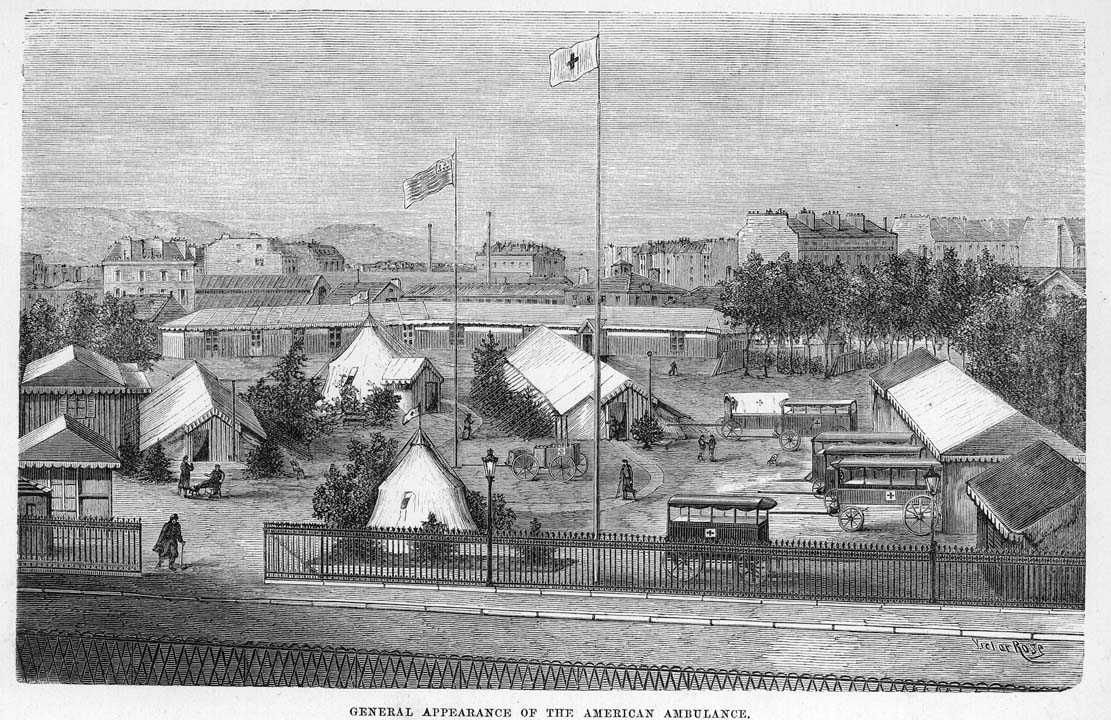
146. The word ambulance, from ambulare, to move on, to march, is in several respects an unfortunate one. Introduced into our language, by the celebrity obtained by Larrey's ambulance volante---a service organized to afford immediate relief on the battle field, in which a light waggon was an original and characteristic instrument---in England and the United States, the word has been applied to a waggon used for the transportation of the sick,
In France, it was first used as a noun substantive in place of hôpital ambulant, that is to say, the hospital moving with the army. In this sense the word is still used,
As, however, since the time of Larrey, the essential elements of an ambulant hospital have been surgeons, stretcher bearers, stretchers, waggons, medicines, &e. the word ambulance has been applied to the service or organization obtained by the union of these material and personal elements, and in this sense the word was, in fact, generally employed by French medical writers before the late war.
But the enormous number of temporary hospitals, created during the late war, has resulted in an extension of the meaning of the word, which is now popularly and generally applied to every military hospital, called into existence during a campaign.
147. "Turpin de Crissé." Op. cit.; tome ii. p. 84, et passim.
148. "L'Hôtel Dieu de Paris ne refuse personne; mais l'engorgement qui en résulte dans cette maison fait qu'on ne se determine à y avoir recours, qu'à la dernière extrémité."---Idées sur les Secours à donner aux Pauvres Malades dans une Grande Ville, Philadelphie, et se trouve à Paris, chez Moutard, 1786, p. 18. An anonymous paper written against the project of M. Poyet---the establishment of a new "Hôtel Dieu" on the Isle de Cygnes---and remarkable in many respects.
149. So late as 1781, we read in a French ordonnance, that if the affluence of the sick makes it necessary to put two sick into the same bed, this shall be done successively, commencing with those who can bear the doubling with the least inconvenience. "Ordonnance du Roi concernant les Hôpitaux Militaires." Du 2 Mai, 1781 ; titre vi. art. 6.
150. One of the most remarkable facts, connected with public hygiene, during the eighteen century, was the prevalence of the itch. The disease seemed to be endemic pretty nearly everywhere, and to break out as an epidemic wherever men were long assembled together. According to M. Bailly, in one of the Reports of the Committee of the French Academy appointed in 1786, to investigate the subject of hospitalization :--- "The itch is almost universal at the Hôtel Dieu---it is an inexhaustible source from which the disease is spread through Paris." But it was a scourge of armies as well as hospitals. Says Munro (1764):---"In military hospitals, there is no malady so common as the itch;" and it appears to have been, at least in the French army, the occasion for adopting more rigorous measures for securing the isolation of patients than any other malady, whether contagious or infectious.
151. "Description abrégée des Maladies qui regnent le plus communément dans les Armées." Paris, 1760; p. xxii.
152. Pringle, "Observations on the Diseases of the Army." London, 1772; p. 104.
153. "Programmes des Cours Révolutionnaires sur l'Art Militaire, faits aux Élèves de l'École de Mars." A Paris, de l'Imprimerie du Comité de Salut Public, an 3 de La République Française. "Des Maladies Contagieuses," p. 6.
154. The committee, in its report of March 12, 1788, upon the conditions essential to a model hospital, proposed an assemblage of separate pavilions; in short, the general plan of construction, therein set forth, was identical with that which was adopted fifty-eight years later in the construction of L'Hôpital Lariboisière.
155. See Husson, op. cit. p. 51.
157. There is a very curious account of Sutton's system in Mead's works---"Recueil des OEuvres Physiques et Médicinales Publiées en Anglois et en Latin," par M. Richard Mead." Traduction Françoise, par M. Coste. Bouillon, 1774.
158. Michel Lévy, ' Traité d'Hygiène," tome ii. p, 480.
160. "Etudes sur la Ventilation," par Arthur Morin. Paris, 1863; tome i. pp. 109, 110.
162. "Inspection Medicale," 1862.
163. According to Miss Nightingale, during the first seven months of the Crimean campaign, the mortality among the English troops from disease alone amounted to a yearly death rate of sixty per cent, of the present strength of the army, while during the last five months of the campaign the mortality from disease did not exceed a yearly average of one and one-tenth per cent. "Report of the Commissioners appointed to inquire into the Regulations affecting the Sanitary Condition of the Army." 1858, pp. 361, 362.
164. MM. Demoget and Brossard ("Étude sur les Construction des Ambulances temporaires," Paris, 1871), state that the idea of barrack hospitals, which has recently been put in practice, has not only been recommended by physicians of our own time, but also by physicians of the middle ages, and they support the statement by passages from the "Opuscule ou Traictés divers et curieux en Médicine," par François Ranchin, Lyon, 1640. Ranchin simply recommended the building of huts for pest patients, from the impossibility of their being received in hospitals and private houses, and as a sort of quarantine for the disinfection of a city. He says, that during the plague at Montpellier, he and his companions constructed a hundred huts outside of the city: "C'était comme une petite ville de bois. Et au plus haut des huttes nous fismes construire une belle chapelle," &c. But it is very evident, from his own statements, that what he commended and did, was done less by reason of the hygienic advantages to be thus secured to the sick, than for the purpose of protecting the well against infection "L'institution des léproseries . . . . semble avoir été moins une oeuvre de charité qu'une mesure de police sanitaire."---Vie Militaire et Religieuse au Moyen Age, par Paul Lacroix. Paris, 1873, p, 381. A work highly esteemed by --the Society of Jesus.
165. "Œconomical and Medical Observations," by Richard Brocklesby. London, 1764; pp. 66, 67. 2 Quoted by Parkes, "Hygiene," p. 329.
166. "Traité d'Hygiène;" tome ii. p. 543.
167. "Circular No. 6," p. 152.
168. This circular-order, issued as late as July 20th, 1864, is to be considered simply as an official statement and recognition of the principles of hospital construction, previously accepted by the War Department. At the date mentioned, the military hospitals of the United States had received their largest development, and, as a matter of fact, scarcely a hospital was built after the issue of the order.
169. Scarcely a French writer on hospital hygiene, who has alluded to the barrack hospitals employed in the United States during the war of the Rebellion, has failed to repeat the ridiculous statement, that after these wooden barracks had served a number of years, more or less, until they were presumed to have become infected, the common custom was to set fire to them and burn them up. I can easily understand, how such a story once told, might become a subject of popular tradition in France, but that for a period of years it should be seriously repeated in nearly every new essay or chapter on hospitalization, is more wonderful, than that an account of Mark Twain's stone man should have once appeared in the columns of the Lancet.
If a barrack has become infected by long use, it certainly ought not to serve any longer as a hospital, and when this conclusion has been reached, its history for the sanitarian is finished. Whether it is burned up, or otherwise disposed of, can very rarely be a matter of consequence to him; but to those who have paid for and own the building, the value of the material entering into its construction, will generally be considered as of more importance than an absurd coup de théâtre.
No wooden barrack hospitals were burned up in the United States, except by accident, but at the close of the war, the necessity having entirely ceased which called them into existence, they were all sold to the highest bidder.
170. "Statistique Médicale des Hôpitaux de Paris," tomes i. ii. iii. Paris, 1867-63
171. "Report of the proceedings of the Sanitary Commission despatched to the seat of war in the East, 1855-56," pp. 134, 135, 142, et passim.
172. A similar barrack was also about the same time erected by Dr. Esse, as an annex to the military hospital at Berlin.
173. "Die Freiwillige Hülfsthätigkeit im Grossherzogthum Baden im Kriege 1870-71." Karlsruhe, 1872; pp. 109, 110, 111.
174. Süvern's mixture, which is used in Germany, principally for the disinfection of latrines, night utensils, &c., is prepared as follows
Quick lime 100 lbs. Coal-tar 15 lbs Chloride of magnesium 15 lbs
The lime is slacked with hot water, and the tar at the same time poured into the mass, which it is necessary to stir continually while pouring on the water. The chloride of magnesium is added afterwards, having been previously dissolved in a closed vessel. The quantity of water used is about five times the weight of the materials; and would be for the quantities given about eighty gallons, giving to the mass "just sufficient liquidity to drop slowly from a stick inserted in it and then pulled out."
175. It is to be regretted that so many of the German barracks, erected during the late war, were not designed to be used as winter hospitals. This was the case even with the Tempelhofer Barracks at Berlin. Everybody at first supposed the war could not last later than October, and the buildings were constructed accordingly. But when cold weather came, the means found so excellent for securing a summer ventilation---the open roof, windows, &c., had to be closed up, and even then, it was often found difficult to keep the wards sufficiently warm. The patients consequently suffered from both cold and bad air, and I am not surprised to learn that a number of cases of gangrene, &c. were reported during the winter in these Berlin barracks. It is questionable if any advantage was derived from lifting the buildings so high---many of them standing on piles quite eight feet above the ground. The sharp winter wind blowing all around them, they were cold without necessarily being well ventilated.
176. See "Circular, No. 4," War Department, Surgeon-General's Office, Washington, 1870; p. xiii.
177. "Mémoires de Chirurgie Militaire," de D. J. Larrey. Paris, 1812; tome iii. pp. 38, 39, 42, 43.
180. Arrêté du 24 thermidor, an viii. titre 1er, 6me sec. See "Legislation Militaire," par H. Berriat. Alexandrie, 1812; tome iv. pp. 2, 3, et seq. -
181. Chenu, "Rapport au Conseil de Santé des Armées." Paris, 1865; p. 14.
182. Bazancourt, "L'Expédition de Crimée." Paris, 1857; tome i. p. 98.
183. Shrimpton, "La Guerre d'Orient." Paris, 1864; pp. 5-20.
185. Baudens, "Souvenir d'une Mission Médicale on Crime." Paris, 1857; pp. 36, 37.
186. Chenu, "Rapport au Conseil de Santé des Armées." Paris, 1865; p. 708,
187. "Un Souvenir de Solferino." Genève, 1863; pp. 44, 66, 68, 69, 74, 75, 78.
188. "Sanitary Institutions." Thomas W. Evans. Paris, 1868; pp. 55, 56.
189. "Malades et Blessés de l'Armée de la Loire. Rapport au Ministre par T. Gallard." Paris, 1871; pp. 14,15.
190. See the "Report of the Operations of the British National Society for Aid to the Sick and Wounded in War," London, 1871; p. 68.
It is not surprising that there should have been some difficulty in keeping good ventilation under the circumstances mentioned, but it is certainly surprising that any one should have had recourse, as late as 1870-71, to the system of warming the wards of hospitals alluded to---the system of overcrowding simple, if not pure---inasmuch as animals (cattle), when present in an apartment, vitiate the atmosphere and render it unfit for respiration, even more rapidly than would the same number of men.
"Les animaux qu'on a la funeste habitude de laisser dans les chambres coucher, même dans les chambres des malades pendant la nuit aussi bien que pendant le jour, ne contribuent pas moins que l'homme à vicier l'atmosphère. Le chien, par exemple, comme M. Béclard en fait la remarque, d'après les expériences de MM. Regnault et Reiset, exhale, en égard à son poids, une quantité d'acide carbonique plus considérable que l'homme; par conséquent il absorbe une plus grande quantité d'oxygène; il en est de même pour le chat."---Introduction of M. Daremberg to the French translation of Miss Nightingale's "Notes on Nursing; what it is and what it is not."
191. The annual mortality from disease in the British army in the Crimea was 23.2 per cent, of its whole strength, while the annual mortality in the French army during the same campaign was over 30 per cent, of its strength.
192. Vegetius "De Re Militari;" lib. iii. c. 3.
193. "Instruction sur la Santé des Troupes de la Grande Armée." Quoted in "Dictionnaire Encyclopédique des Sciences Médicales ;" art. Camp.
194. "Comptes-rendus ;" tome lxii. p. 749.
195. "Report of the Operations of the British National Society for Aid to the Sick and Wounded in War;" p. 172, et passim.
196. "Comptes-rendus de l'Académie des Sciences;" tome lxii, p. 750.
197. "Report of the Operations of the British National Society," &c.; pp. 176, 177.
198. "Medical Recollections of the Army of the Potomac," by Jonathan Letterman. New York, 1866; p. 15.
199. The italics are reproduced from Dr. Lidell's paper.
200. "Surgical Memoirs of the War of the Rebellion," collected and published by the United States' Sanitary Commission. New York, 1870; vol. i. pp. 341,343.
1. I perhaps ought to except "Tents and Tent Life," by Major Godfrey Rhodes. London, 1859---the only book ever published in English upon this special subject. The subject holds even a smaller place in French literature; represented as it is by a single brief "Dissertation sur les Tentes ou Pavillons de Guerre," par M. Beneton de Perrin. Paris, 1735. But, aside from a few short articles in encyclopædias and dictionaries, the two works cited complete the bibliography of tents, so far as I am acquainted with it.
2. According to the Biblical account, the use of permanent houses preceded that of tents (see Gen. iv. 17) ; but it is more than probable, that when the Judaical Genesis begins to speak of men and their social habits, the human race had already exhibited itself in a variety of phases, and had shown its power as well to build and dwell in cities, as to subsist in ways more primitive.
3. "And Laban went into Jacob's tent, and into Leah's tent, and into the two maidservants' tents, but he found them not. Then went he out of Leah's tent into Rachel's tent."---Genesis xxxi. 33, &c.
4. I do not wish to convey the impression, that the Bedouins make use of no other kind of temporary shelter than that which I have described; they often shelter themselves under constructions covered with coarse hair-cloth or skins. Says old Sir John Maundeville :---" In that Syrian desert dwell many of the Arabians who are called Bedouins and Ascopardes, who are people full of all evil conditions, having no houses but tents, which they make of the skins of camels and other beasts which they eat, and under these they sleep and dwell in places where they can find water." Strabo called these Arabs "tent dwellers," σκηνῖται (Strabo, book xvi.); and Pliny gives the same name to them---"scenitæ"---because they were in the habit of living in tents (N. H., book vi.). Still, these names are not incompatible with their having dwelt, two thousand years ago, in constructions such as I have described, "booths," which are now much used by the Bedouins, as they also are, and there is every reason to believe have been, used by other Syrian tribes, both ancient and modern.
5. "Oriental and Western Siberia," by Thomas Witlam Atkinson. Philadelphia, 1865; p. 157.
6. "De Bello Africano," c. xlvii. Cæsar also here says, that his soldiers made for themselves little tents out of their clothing.---"ex vestimentis tentoriolis factis;" and more than all, that these makeshifts were quite useless,---that the rain beat through them, that the fires were put out and the provisions spoiled, and the soldiers at length forced to protect themselves, as best they could, under their shields.
9. "Practical Observations on the Means of Preserving the Health of Soldiers." Edward Thornhill Luscombe, M.D. Edinburgh, 1820; p. 106.
10. From the Bible description of the Tabernacle, as also from the description given by Josephus (book iii. e. 5, "History of the Jews"), it is quite evident that this construction was a tent-barrack, covered almost entirely with, tissues of "fine twined linen," and with "hangings of blue, and purple, and scarlet," and only provided with double roofs of coarse goats' hair cloth and skins, to secure its more complete protection from the destructive action of the weather---from rain and sunlight.
12. "Et Jacob venit in Socoth; ubi ædificatâ domo et fixis tentoriis, appellavit nomen loci illius Socoth, id est tabernacula."---Gen. xxxiii. 17, "Biblia Sacra Vulgatæ editionis Sexti V. et Clem. VIII." In the English version, " booths" is used as the equivalent of Succoth, as well as for the word rendered in the Vulgate by tentoriis.
13. "Solomon's Song," i. 5. Volney, vol. i. p. 279. The tents of Kedar are said to have been made of goats' hair mixed with camels' hair. The Arabs still call their tents beet el shaar---"houses of hair," and the colour of the covering was determined by the natural colour of the hair used in weaving it. It has been said, (D'Arvieux, "Voyage dans la Palestine") that hair-cloth was chosen for the purpose of excluding the rain and dew; if hair-cloth was used instead of other cloths, it was for the simple reason that among the nomads of Arabia, goats' hair and camels' hair were the principal textile materials known.
14. "And Abraham sat in the tent door in the heat of the day."---Genesis xviii. 1.
15. "Bell. Jugurth." c. xviii.
17. Leviticas xxiii. 42. It may be observed, however, that the "feast of tabernacles" was not peculiar to the Jews. The Egyptians, Greeks, and Romans had also their skenopegia. These feasts were held in the spring or early summer: by the Egyptians, in honour of the god Thammus (Osiris); by the Greeks, in honour of Bacchus; and by the Romans, as a thank-offering to Nature, under the name of Anna Perenna.
18. "Nineveh and its Remains." By Austen Henry Layard, D.C.L. Paris, 1850; p. 206.
20. "Illustrations of Scripture Manners and Customs," vol. i. p. 78.
21. "The Land and the Book," by W. M. Thomson, p. 290. Layard in op. cit.
22. As tents have long been so indispensable to those living in the East, it is quite natural that we should occasionally meet with Oriental allusions to their use by houseless spirits after death. One of the most curious of these allusions occurs in connection with this story. After the establishment of Mahometanism, on a certain occasion, a theological dispute arose between some doctors of that religion and some Jewish rabbis. These last, it is said, positively denying that the others would ever find a place in Paradise, the Mahometans replied,---" Since you pretend that we shall never enter there, and as it seems to be your wish that we remain outside of the gate, it will be necessary for you to provide us with the means of obtaining tents" (papiliones). And on this pretext the Jews were immediately charged with a tax, which the Turks have continued to levy, in the language of the narrator, "even to this day."
23. Strabo, book iv. c. 2, 7. Herodotus also mentions these tents on wheels; and Horace has given them notoriety, by referring to the Scythians :---
"Quorum plaustra vagas rite trahunt domos."---Od. iii. 24, 10.
24. "Cum carpentis, in quibus habitant."---Ammianus Marcellinus, lib. xxxi. c. 2.
25. "Oriental and Western Siberia," by Thomas Witlam Atkinson. Philadelphia, 1865; p. 225.
26. "Iliad," book i. ll. 189, 325, 346, 391, 485; book ix. ll. 71, 107, 178, 185, 226, 263, 622, 652, 663, 669, and in many other places.
27. Αὐτὰρ Ἀχιλλεὺς εὔδε μυχῷ κλισίη ἐϋπήκτου. ---Iliad, ix. 663.
But Achilles slept in the mucho of his hut solidly built; that is, the part, or room, furthest removed from the entrance.
28. σκηνὰς κατεσκευασμένας χρυσῷ καὶ ἀργύρῳ. The Greek word σκηνὴ, which is generally considered as synonymous with tentorium, tent, tente, &c., is derived from the verb σκέω, to cover---from which σκιὰ, a shade---and signifies a temporary domicile, "made," says Stephanus, "of the branches of trees, straw, boards, skins, linen or woollen cloth, or similar material, commonly erected in camps and gardens to make a shade, or as a protection against the rain." The word σκηνὴ cannot, therefore, be regarded as the equivalent of the English word tent; as for example, in the passage, σκηναὶ λευκοῦ κιττοῦ καὶ ἀμπέλων, tents of white ivy and vines---arbours---which has caused Stephanus to observe: "Nec enim hic reddere queas tabernaculum, quod ex tabulis potins construitur; nec tentorium quod ex pannis lineis laneisve aut pellibus tensis, sed umbracula." (Stephanus, "Thesaurus Grecæ Linguæ ;" see also Casaubon, "Animadversio in Athenæum," l. iv. e. 21.) So the word σκηνάω---tentorium pono, I pitch a tent---the several inflected forms of which are frequently found in Greek authors, indicates the establishment of a camp under no specific kind of shelter, and oftentimes simply relates to the halting of the army for the night. Still the words σκηνὴ, σκῆνος, and their derivatives, were used by Greek writers to indicate those specific constructions called in English, tents.
29. Herodotus, book ix. e. 80.
30. Plutarch, "Life of Aristidea." In the "Life of Aristides," Plutarch makes three other allusions to tents:--- τὴν σκηνὴν τοῦ Θεμιστοκλέους ---τὴν σκηνὴν τοῦ Παυσανἰou--- καὶ κατασκηνούτων ἀτακτως Two, inform us that Themistocles and Pausanias, Greek generals, had tents; from the third, we may infer that the Greek troops also had their tents.
31. "Anabasis," book iv. e. 4.
32. Διφθέρας ἆς εἴκον στεγάσματα, ἐπίμπλασσαν χόρτου κούφου. Literally, The skins which they had as coverings they filled with light grass. "Anabasis," book i. c. 5.
33. Arrian, "Life of Alexander;" book iii. c. 10. Indeed, Arrian's words are quite unmistakable in their meaning: τὰς διφθέρας ὐφ᾽αῖς ἐσκήνουν οἰ στρατῶται. The skins under which camped the soldiers. Arrian also speaks, in the same work, of the passage of the Danube, of the Hydaspes, and the Acesines, and in each instance, the construction of the rafts used, is described in almost exactly the same terms (see book i. c. 1; book v. c. 3; book v. c. 5).
34. ἔπειτα καὶ τὰς σκηνὰς συγκατακαῦσαι.---Anabasis b. iii. c. 2.
35. καὶ ἀπελθόντες κατέκαιον τὰς ἀμάξας καὶ τὰς σκηνάς. ---Ibid. b. iii. c. 3.
36. Plutarch, "Life of Alcibiades," c. xii.
37. Quintus Curtius, lib. iii. c. 3.
38. Ibid. lib. ii. c. 2; also Diodorus Siculus, Σκηνὴν δέ κατασκευασάμενος ἐκατοντάκλινον, book xvii. c. 16; and Athenæus, Deipnosophistæ." Lugduni, apud viduam Antonii de Harsy, 1612; p. 539 (lib. xii. c. 54, 538 c).
41. Dionysius of Halicarnassus, book ii. c. 2; book viii. c. 6; book ix. c. 4, &c.
43. Dionysius of Halicarnassus, book xi. chap. 4--- σκηνὰς καὶ ὐποζύγια καὶ χρήματα, κ.τ.λ.
49. I may here remark that the word tabernaculum, although sometimes used by Latin writers as a synonym of tentorium, generally signifies a hut or booth, and not a tent. Thus Cæsar, in speaking of the luxury in Pompey's camp, says, there were tables and sideboards loaded with silver plate, "and booths covered with fresh turf, and some even, as that of L. Lentulus, overhung with ivy"---recentibus cespitibus tabernacula constrata, L. etiam Lentuli et nonnullorum tabernacula protecta ederâ. ("De Bello Civili," lib. iii. c. 96.) Although the word tabernacula in this connection has frequently been translated by the words tents, tentes, such translations are inexact. The improbability of laying courses of sods, or training vines upon awnings of skin or canvas, is quite evident. Lucan, in speaking of the same booths, says:
"Capit impia plebes
Cespite patricio somnos."LUCAN, Pharsalia, lib. vii.
50. "Extra vallum sine tentoriis destitutas invenit.".---Livy, book x. e. 3.
51. "Decreverunt, ut ex iis, qui equo meruerant, peditum numero militarent, qui pedites fuerant in funditorum auxilia transcriberentur; nove quis eorum intra castra tenderet, neve locum extra assignatum vallo aut fossa cingeret, neve tentorium ex pellibus haberet."---VALERIUS MAXIMUS De Disciplinâ Militari, lib. ii, c. 7.
52. "Tum tendentium ordine, tum itinerum intervallis, et negasse barbarorum ea castra ulli videri posse."---Livy, lib. xxxi. e. 34.
53. "Miles ad sua quisque tentoria discurrit."---Ibid. lib. xlii. c. 58.
55. "De Bello Gallico," lib. i. c. 39.
57. Ibid. lib.viii. c. 5. May we not infer, from a passage in Cæsar, that tents were sometimes similarly used to protect the soldiers on transport ships? The troops on a certain expedition, are said to have been so short of water, as to have been compelled to gather the dew which fell during the night upon the skins which covered the ships---ex pellibus, quibus erant tectœ naves. ("De Bello Civili," lib. iii, . c. 15.)
59. Lucan, "Pharsalia," lib. i.
61. "Quæ more Gallico stramentis erant tectæ."---Bello Gallico, lib. v. c. 43.
63. Cæsar, "Bello Gallico," lib. iv. c. 1. Tacitus says, everybody knows the Germans do not live in cities; that the art of building seemed to be unknown among them; that they constructed their huts of the rudest materials; and that they very commonly passed the winter in holes dug in the ground---Solent et subterraneos pecus aperire,---suffugium hiemi et receptaculum frugibus ("Germania," c. 16); and this practice seems to have long prevailed, among the rude races who inhabited northern Europe. So late as the tenth century, a large portion of the Scandinavian peasantry passed the winter in trenches in the ground; while their chiefs lived in huts built of timber, but so covered over with earth and turf as to resemble natural hillocks, especially when crowned with the rank vegetation, which sprung up upon them, during the spring and summer months. ("Les Scandenaves." Paris, 1601; tome i. Notes de M. de Montbron.)
64. Caesar, "Bello Gallico," lib. vii. c. 22.
65. Ibid. lib. i. cc. 5, 26; and Tacitus: "Unde feminarum ululatus audire unde vagitus infantium; hi cuique sanctissimi testes, hi maximi laudatores."---Germania, c. 7.
66. καὶ σκηνὰς Γαλατικὰς ὐπο τῶν ᾽Ρωμαίων εἰς τὸ στατόπεδον κομιζομένας.---PLUTARCH, Life of Cæsar, c. 27.
68. "Nam nec explicare quidquam, nec statuere poterant: nec, quod statutum esset, manebat . . . . ut, omnibus omissis, procumberent homines, tegminibus suis magis obruti, quam tecti."---Livy, book xxi. c. 58.
71. "Hibernacula Carthaginiensium, congesta temere ex agris materia exædificata, lignea ferme tota erant. Numidæ præcipue arundine textis, storeaque pars maxima tectis, passim nullo ordine," &c.---Livy, book xxx. c. 3.
73. "Pauci tabernacula haberent, multitudo alia casas ex arundine textas fronde, quæ umbram modo præberet, texissent," &c.---Livy, book xxxv. c. 27.
74. Tacitus, "Annales," lib. xv. c.
76. Livy, lib. xxvii. c. 40; lib.xxxii. c. 89; lib. xxxiv. c. 48; lib. xli. cc. 10-14; lib. xliii. cc. 7-10, &c.
77. "Retentusque omnis exercitus sub pellibus, quamvis hieme sævâ adeo ut, obductâ glacie, nisi effossa, humus tentoriis locum non præberet.---"TACITUS, Ann. lib. xiii. c. 35.
78. "P. Valerio consuli senatus præcepit exercitum ad Sirim victum ducere Serinum, ibique castra munire, et hyemem sub tentoriis exigere."---SECT. JUL. FRONTINI Strategemata, lib. iii. c. 1.
80. Isidorus, quoted by Justus Lipsius "De Militia Romanâ." Antverpiæ, 1596; book . p. 57.
81. "Papilio tegit hommes octo."---HYGINUS GROMATICUS De Castrametatione. "Ut decem militibus sub uno papilione degentibus."---Vegetius, lib. ii. c. 13.
82. The word prætorium is often translated tente, tent, &c.; but it has a much broader meaning than such a translation would indicate, and would be much better rendered, as Mazeroy has suggested, by quartier-général-- head-quarters, or even by the words general's quarters, as Gibbon translates it (see "Decline and Fall of the Roman Empire," book i. c. i.). So, also, it would be improper to render Cæsar's words, depositis in contubernio armis---leaving their arms in their tents. The contubernium was the soldiers' quarters, or rather, perhaps, the squad occupying those quarters. The soldier's hut was rarely, if ever, called a taberna; this word belonged essentially to civil life:
"Pallida mors æquo pulsat pede pauperum tabernas
Regumque turres."---Horace, lib. i. ode 4.
"Tabernæ dicuntur ædificia qualiacunque popularis usus."---BARTHOLOMÆUS, Romanæ Antiquitates.
83. "Papiliones tentoria dicuntur a similitudine parvi animalis volantis, hæ sunt aviculæ."---ISIDORUS, in Calepinus.
84. "Quia expansa vela habet ad similitudinem alarum papilionis" (see Papilio, "Lexicon" Jacobi Facciolati; Rich, "Roman Antiquities;" Bardin, art, tente). "Papiliones, pavillons, sont aussi dicts tentes, a la semblance d'un oysillon qui vol." (Robert Valturin, translatez de langue Latine en Francoyse, par Loys Meigret, Lyonnois. Paris, 1555; p. 120.) Schelius gives a reason for the lifting up of the walls of the papilio. He infers that, as the arms, &c., must have been placed behind the tents, it would have been very convenient to have had a ready access to them. "Hence," he thinks, "tentoria took in camps the name of papiliones, because covered with skins, opened both in front and behind, to furnish a passage-way, the four flaps or wings of these, when raised up a little, might have had a certain resemblance to flying butterflies." "Ac inde, opinor, castrense hoc nomen tentoria traxerunt, quod binis à fronte et à tergo pellibus in medio ad exitum apertis et divisis, in modum quatuor alarum tegerentur, quibus hinc paulum allevatis inde papilionum volantium similitudinem quandam exhiberent." ("Hygini Gromatici de castris Romanis quæ exstant," &c. Amstelodami, 1660. Notæ Schelii, p.2.) Wedgewood suggests that this name was given to tents because their sides, when flapping, were like the moving wings of butterflies. Ferrari, however, explains the origin of the word in another way. He says tents are called papiliones, not because the butterfly spreads out its wings like a tent, but because papiliones was the generic word for winged insects, as a protection against the annoyance of which, canopies were attached to beds; and that from their resemblance to these canopies, military tents obtained their new name. "Tentoria dicta sunt papiliones; non quod id animal, dum flores delibat, alas instar tentorii extendit; sed quod genericâ voce culices papiliones dicti sunt: adversus quorum tædium conopæa lectis abtenta, a quorum similitudine tentoria militaria, pariter padiglioni, sunt appellata." Ménage ("Dictionnaire Étymologique de la Langue Française ") considers this explanation as satisfactory as any which can be given.
85. In "Tyrann. Herod." c. 15.
86. Pliny, lib. iii. c. 5. It is only proper that I should say that there is a variation in the reading of this passage, and that in certain texts pabulis is used instead of papilionibus.
87. Tertullianus "Adversus Marcionem," lib. iii.
88. "Vidi, qui vellet tabernacula principum, gregarii militia papiliones esse . . . . Sed Romani tam his quam illis tentoria ex pellibus attribuebant quæ castrensi vocabulo papiliones vocabantur" (Rathbodi Hermanni Schelii, "Thesau. Antiq. Rom." Notæ in Hyginum); and this opinion was repeated by Schwebelius, one of the commentators of Vegetius. Of the papiliones, he says they were "tentoria ex pellibus confecta, quibus non gregarii solum milites, sed principes quoque usi fuerunt." Lipsius speaks vaguely of the distinction to be made between the words in question; but incidentally quotes, from Procopius, perhaps the strongest passage which could be offered to show that there was really, at least in the time of that writer, no difference in the signification of the words: Ipse subito tugurio ex crassis asseribus compacto, quod papilionem vocant---A hut solidly built of large joists, which they call a papilio. (" De Militiâ Romanâ," lib. v. p. 58.)
89. The only explanation of the distinction to be made between the papilio and the tentorium, which I have met with, may be found in Calepinus and Facciolatus. Says the first authority :---"Inter tentorium et papilionem hoc est discriminis, quod tentorium proprie dicitur, quod ad brevem moram figitur, papilio vero est ad diu morandum aptum tabernaculum." Between a tentorium and a papilio there is this difference, that the tentorium, properly speaking, was a shelter established as a temporary expedient, while the papilio was a sort of tabernaculum, fit for a much longer and more permanent service. Says Facciolatus :---"Si discrimen est inter papiliones et tentoria, fortasse est, quod illi minoris molis et apparatus sint." If any distinction is to be made between the two words, it is, perhaps, because the papiliones may have been smaller, and fitted up with less gearing. It will be noticed that these attempts to establish a difference in the signification of the words are founded upon quite different, if not absolutely contradictory, ideas as regards the essential character of the papilio.
90. "Tabernacula, quemadmodum consueverat temporibus stivis, carbaseis intenta velis, collocari jussit in littore."---CICERO, Second Oration against Verres, c. XXXi.
92. Georgics, lib. iii. 312-13.
93. De Perrin, "Dissertation sur les Tentes," pp. 23-27.
94. Several writers, among others M. Michel Lévy, have included the conopeum among Roman tents. This is a mistake. The conopeum was a bed canopy, or a mosquito netting, rather than a tent. It had an Eastern or Egyptian origin, and its use at Rome was always considered a foreign practice, and thus a subject for satire:
"Interque signa turpe militaria
Sol aspicit conopeum."---HOR. Epod. ix.
"Foedaque Tarpeio conopea tendere saxo."
---PROPER. lib. iii. El. 9.
The distinction to be made between a tabernaculum--tent, and a conopeum---bed canopy, is clearly recognized in the Vulgate Bible. "Duxeruntque illam ad tabernaculam Holofernis . . . videns itaque Judith Holofernem sedentem in conopœo, quod erat ex purpura, et auro, et smaragdo, et lapidibus pretiosis intextum" . . . And after Judith had cut off the head of Holofernes she exhibited it to her people, together with a piece of this canopy, saying: ---"Ecce caput Holofernis, principis militiæ Assyriorum, et ecce conopæum illius, in quo recumbebat in ebrietate sua."--Judith c. x.-xiii.
95. For an account of the extensive use of splendid tissues made by the Ephesians, see Athenieus, op. cit. p. 525. Says M. Renan :---"Ionia, in the first century, was densely populated, and covered with cities and villages. Powerful associations of workmen, similar to those of Italy and Flanders in the middle ages, elected their chiefs, raised public monuments, erected statues, created works of public utility, founded institutions of charity, and exhibited all the signs of prosperity, welfare, and moral activity. Around the manufacturing cities, such as Thyatira, Philadelphia, and Hierapolis, devoted to the great industries of Asia, the fabrication of tapestries, of woollens, and of leather, and the dyeing of stuffs, a rich agriculture was developed," &c. ("Saint Paul," Paris, 1869; pp. 354, 355) ; and on p. 341 of the same work this writer says: "Ephesus was justly celebrated for its tents." Certain facts relating to Roman commerce with Asia, early in the Christian era, may be found in Gibbon's "Decline and Fall of the Roman Empire," book i. c. 2; but for a full and complete exposition, consult Heeren, " De la Politique et du Commerce des Peuples de l'Antiquité ;" trad. de l'all, par W. Suckau. Paris, Didot, 1830-34.
96. I do not wish to convey the idea that the words tabernaculum, tentorium and sub pellibus were at any time obsolete; they may be found not unfrequently in writers who wrote long after Hyginus. Some of these, even, do not employ the word papilio. Thus Ammianus Marcellinus, who wrote at the close of the fourth century, speaks often of tentoria, and even of encampments sub pellibus, but never once of the papilio; and yet he was a contemporary of Vegetius, who, in his treatise "De Re Militari," scarcely uses any other word than papilio, when he has occasion to indicate a tent. Indeed, there is reason to believe that sub pellibus may have been in use, as an archaic or poetic form of expression, long after it had ceased to be descriptive of the material of which tents were commonly made. One can easily understand why Pacatus, in praise of Theodosius, should have alluded to the "hyemes actas sub pellibus;" and why Claudian, in his adulatory verses, written as late as the fifth century, should have credited the Vandal Stilieon with having inured his legions to a discipline even more rigorous than was practised in the days of Brutus and Valerius :---
"Quoties sub pellibus egit
Edonas hyemes, et tardi flabra Bootæ
Sub die Rhipæa tulit," &ec.
Still the word papilio grew into such general use, as to find its way into the Greek language, and to be able to hold its place, in the vocabularies of the monkish chroniclers. Du Cange closes a long list of references to the use of this word by such writers by, "et alii sine numero." The word also occurs in the Vulgate:---"Datham et Abiron egressi stabant in introitu papilionum suorum,"
97. "La Militia Romana di Polibio, di Tito Livio, e di Dionigi Alicarnaseo," da Francesco Patricii. Ferrara, 1583. See also the engravings in the magnificent edition of Clarke's "Cæsar," published in London, in 1712, by Tonson. These round, highly-ornamented tents are very frequently to be seen in the sketches of Greek and Roman encampments, which may be found in military works of the sixteenth and seventeenth centuries; they have, however, no historical value except as representations of the tents in use at the period when the sketches were made.
It is a remarkable fact that historical accuracy in composition rarely seems to have been observed by the most eminent designers of the sixteenth and even seventeenth centuries; it was then, those splendidly illustrated Dutch Bibles were appearing, in which the antediluvians are represented as living in Flemish houses, and Moses as having been taken out of the Nile, at a point where the narrow tortuous stream winds among wild, rocky hills, whose flanks are covered with pines and birches, and whose summits are picturesquely crowned with Rhenish castles and watch-towers. Rhodes has been careless enough to suppose, that the representations of encampments and tents in Clarke's "Cæsar " were historically accurate. Accordingly, he tells us that "the army of Ariovistus, a king of the Germans, used huts and tents similar to those represented in Froissart," &c. ; as also, that among "various other tents used in Cæsar's wars, are shown three tents of the exact form now used in England---the old pattern round tents, without the improved short wall." This surprising similarity in the forms of ancient and comparatively modern tents, is explained by the almost universal custom among the artists, at the time referred to, of representing the subjects of ancient history, by modern and familiar symbols. Thus, the most common form of the Roman soldier's tent, shown in Clarke's engravings, is a long wedge-tent capable of sheltering a whole company; such a tent is neither described by any Roman writer, nor exhibited on any Roman monument, but was well known in Italy and Germany during the seventeenth and eighteenth centuries.
98. Josephus, "Wars of the Jews against the Romans," book iii. c. 6.
99. The work of Hyginus Gromaticus "De Castrametatione" commences, rather abruptly, with these words: "Nunc papilionum tensionem cohortium superscriptarum ostendimus. Papilio unus occupat pedes decem, accepit incrementum tensuræ pedes duos, tegit homines octo; plena centuria habet milites octoginta, erunt papiliones decem."
It is remarkable that Schelius, in his plan of a section of a Roman camp, should have given to the papilio the form shown in fig. 8, p. 275. Hyginus says there were but two feet between the tents as they stood together side by side in line---accepit incrementum tensurœ pedes duos; they could not, therefore, have been supported by side stay ropes; but we are told that they covered an area of ten square feet---scrupulum ita que terrœ occupat. (Schelius, not. in Hyg.) Now no tents covering a square area can be made secure without stay ropes at the sides, except those having a wedge or pyramidal form, unless sustained on the inside by a strong framework; and such tents, as we have elsewhere stated, were called tabernacula. The papiliones mentioned by Hyginus must, therefore, have been either wedge-shaped or pyramidal tents, or a sort of tent-barracks. That Roman camps in the time of Hyginus were generally laid out in view of the employment of a comparatively non-portable shelter, is scarcely probable. If papilio was at any time a common camp-name for a tent, there is reason for believing, from the indications of Hyginus, that he refers simply to a tentorium, the form of which may be seen in fig. 9.
100. Masquelez, "Etude sur la Castramétation des Romains." Paris, 1864; p. 53.
101. "In expeditionibus tesselata et sectilia pavimenta circumtulisse." (Suetonius, "Life of Caesar," c. xlvi.) Admitting this statement to be true, there can be very little reason for supposing the pavimenta were to be employed in tents. It is altogether more probable, that they were intended to be used in the construction of those public buildings, which the Romans were in the habit of erecting, in conquered provinces, alike as records of their military successes and symbols of imperial power.
| 102. |
"Hic picta Saces, fucataque Medus, Stilico, lib. i. |
| 103. |
"Neu defensura calorem Panegyr. Honorii Augusti |
105. "Et lego Scipionem Æmilianum ipsum primum in stramento dormuisse."--Lipsius, lib. v. p. 60.
106. "Non culina, non cubicula et lecti? Rideo . . . . De cubiculis aut lectis apage."---Ibid. lib. v. p. 59.
107. "Et non saxum erat, ut antehac armato cubile, sed pluma et flexiles lectuli."---Ammianus Marcellinus, lib. xxii. c. 4. .
108. Leon, "Institutions Militaires," traduites en François par M. De Maizeroy. Paris, 1778; tome i. p. 163,
109. Ἠ τέντα τῆς κατουνας σεβαστοκράτος τέσσαρας στύλους εἶχεν. The tent of the quarters of the sebastocrator was supported by four columns."---Chronicle of the Morea, lib. ii.
110. Ammianus Marcellinus, lib. xxxi. c. 1.
111. Jornandes, "De Rebus Gestis Gothorum."
112. Ammianus Marcellinus, lib. xxvii. c. 2.
113. Greg. Turon., "Hist. Franc." lib. v.; apud "Script. Rer. Gal.," lib. iii. p. 244.
| 114. |
Li en voia .j. pavellon Chronique rimée de Philippe Mouskés, tome i. p. 150. |
115. "Histoire de Charlemagne," par M. P. Granié, Paris, 1819; p. 377.
116. "Les officiers provinciaux étaient chargés de distribuer les équipements, les vivres, la solde, sur divers points de la route que ces troupes devaient suivre, et l'habitant n'avait pas à fournir autre chose que le logement; servitude militaire à laquelle nul ne pouvait se soustraire."---Vie Militaire et Religieuse au Moyen Age. Op. cit. p. 43.
117. "Horda Angelcynnan," by Joseph Strutt. London, 1775; vol. i. p. 31.
118. "Vous veissiez appareiller chevaux, palefroys et destriers, tentes et pavillons faire, armures chargier," &c.---Chronique de Bernard, le Trésorier.
119. William of Malmesbury, 11 Chron." book iv. c. 2.
121. "Itinerary of Richard I." book iv. c. 34.
123. William of Malmesbury, "Chronicle," book iii. But Rapin, according to Grose, says that William quartered almost all his troops upon the monasteries, besides obliging the monks to find them in necessaries.
124. Cited from Grose. Op. cit. vol. ii. p. 11.
125. "Chroniques de J. Froissart," liv. i. c. xxxiii.
127. "Chroniques d'Enguerrand de Monstrelet," livre premier.
128. Froissart, livre 1. partie 1. c. ccxcvii.
129. "Histoire des Ducs de Bourgogne," par M. de Barrante. Paris, 1824; tome i. liv. ii. p. 3.
130. "Chronicle of the Conquest of Granada." Washington Irving. Paris, Baudry, 1842; p. 265.
131. "Histoire des Ducs de Bourgogne," par M. de Barrante; tome iii. liv. i. p. 73.
132. "Chroniques d'Enguerrand de Monstrelet," liv. i. c. 84.
133. In the rolls of Parliament (1423) are two items concerning tents, inserted into a schedule and valuation of furniture belonging to Henry V.:
"Item---2 tentes de bloy carde linez de toile linge queux furent au Sr Herry d Escrop, vi. li. xiii. s. iv. d."
"Item---1 tente qui fuist a l'Emperour pris, xxvi. s. viii. d."
134. De Barrante, tome x. p. 345.
135. Katona, "Hist. Critic." t. vii. p. 906. Thuroczi, p. ii. e. lxxix.
136. See note in "Chroniques de Froissart," ed. Panth.; tome i. p. 274.
137. It always seems to have been a common custom in the East to have had large numbers of tent-makers in the train of armies. Fifty tent-makers are mentioned as required to accompany the "camp equipage for journies" of the kings of Persia, by Gladwin, in his "Ayeen Akbery."
139. "Histoires des Ducs de Bourgogne," par M. de Barrante; tome xi. livre vii, p. 28.
140. "Histoires des Ducs de Bourgogne;" tome i. livre ii. p. 204. See also Froissart: "Et là étoient de toutes les deux parties tendues tentes, trefs, pavillons, pour eux tenir . . . . et là se tinrent en une très belle tente, qui par accord de toutes les parties étoit tendue;" and quaintly he adds that what he says is true: "Car, pour ce temps et pour savoir la vérité de leurs traites, ce que savoir on pouvait, Je Jean Froissart, auteur et proposeur de ce livre, fus en la bonne ville d'Abbeville."
141. τὴν τέντα δὲ τοῦ Κονραδῆ ὀποῦ εἶχε δέκα στύλους. ---Chronicle of the Morea, lib. .
142. "Histoire de François Premier," par Monsieur Varillas. Paris, 1685; tome i. pp. 171-72; and "Monuments de la Monarchie Françoise," tome iv.
143. For original and curious documents concerning the "Field of Cloth of Gold," consult the "Rutland Papers" and "The Chronicle of Calais," published by the Camden Society.
144. "Ayeen Akbery; or the Institutes of the Emperor Akber." Translated from the Original Persian by Francis Gladwin. London, 1800; vol. i. p. 61.
145. Knolles' "History of the Turks," cited by Rhodes.
146. See "Les Arts Somptuaires," par M. O. Louandre. Paris, 1857; also "Costumes in England," by T. W. Fairholt. London, 1860.
147. "Recherches sur les Étoffes de Soie d'Or et d'Argent, pendant le Moyen Age," par Francisque Michel. Paris, 1852; tome ii. p. 129; also, "Les Arts Somptuaires," op. cit. texte, p. 100.
148. "All then assembled around the crimson sail of the admiral's (William the Conqueror's) ship."---William of Malmesbury, book iii.
"Les voiles drecies au vent
Fetes de porpre et de cendals
Et de pailles imperials."Le Roman de la Guerre de Troyes, cited by Du Cange.
"D'autres bateaux . . . et y en avoit deux couverts de satin cramoisy."---Mémoires de P. de Commines, liv. vii. c. 15; ed. Panth. Paris, 1854.
149. From an illumination representing the camp of du Guesclin at Chisech in Poitou, p. 406. The tent which I have had copied, is surrounded in the illumination, by quite a number of magnificent, tall, steeple-shaped pavilions, of different colours.
"King Richard took the pavillouns
Of sendal and of cyclatoun.
They were in shape of castels
Of gold and silver the pencels.
Many were the fair gest
Thereon were written."Romance of Richard Coeur de Lion.
150. In the collections of MM. Jubinal and Du Sommerard are a great variety of sketches of mediaeval tents taken from tapestries. Such tents are also not unfrequently to be found represented on old pieces of faïence.
151. "Recherches sur les Étoffes de Soie," &c., op. cit. tome i. p. 295.
152. "Livre premier des Antiquités perdues." G. Pancirole. Traduction de Pierre de la Noue. Lyons, 1617; liv. ii. p. 357.
153. "Histoire de la République de Venise." Par P. Daru. Paris, 1821; tome ii. pp. 304-7. M. Michel mentions by name, thirty-three different kinds of velvet known in the middle ages, and eighteen kinds of cloth of gold in use in the sixteenth century---"sans parler de la toile d'or," &c.---and the cloths of silver, of which there were an equal number of varieties; and, finally, states that his lists are quite incomplete. ("Recherches sur les Étoffes de Soie, d'Or et d'Argent pendant le Moyen Age," tome ii. pp. 187, 193, 207, 208.)
155. Littré says, that as the word pavilion was not only applied to tents, but to cloths used for awnings (tentures), the word began to be used to signify a standard. I see, however, no very natural connection between awnings and flags. A much better suggestion has been made---that pavilion, a flag, is not derived from the same root as pavilion, a tent. The custom of carrying a flag at a point is said to have been a Moorish one; and the name pavilion, given to a flag, is said to have originated from this custom, and to have been derived from the Spanish word pabellon, an augment of paves, whence the French words 'pavois, pavoiser, &c. If, however, they both take their origin from the root papilio, a flag was called a pavilion, most probably by a simple metonymy, the occasion for which I have stated.
156. De Perrin, op. cit. p. 59.
157. Œuvres d'Ambroise Paré, tome iii. p. 708.
158. "Le Maistre du Camp General. Mise en lumière en langue italienne par le très illustre Seigneur George Basta, Conte du S. Empire, &e. &e. &c. Traduit en langue française, et déclaré par figures, par Jean Theodore de Bry, Bourgeois d'Oppenheim." Imprimé à Francfort sur le Mein de l'impression de Paul Jacob, aux frais du dict de Bry, l'an 1617. La troisième partie; du Loger.
159. "Mémoires de F. de la Noue," c. 16.
160. These huts were built in the following manner:---Two poles, twelve feet long, and forked at the top, were set up, eight feet apart, and sunk in the ground one foot. A ridge-pole was placed in their forks. Four forked sticks, five feet high, served as corner posts, each pair sustaining a pole which answered as a plate; a rafter also connected each corner post with the ridge-pole. These eleven poles, which were tied together, formed the principal part of the skeleton, of the hut. The skeleton was, however, completed and strengthened by a lattice-work of sticks---four vertical and nine transverse, at each end, two vertical and three transverse on the sides, while five vertical and four transverse sticks completed the roof---the whole being tied together by cords or withes. The frame-work was now thatched with straw, which for the most part was woven into mats and put on in sections.
161. "La Charge du Mareschal des Logis, tant general que particulier, soit de toute une Armee de Cavallerie et Infanterie en general, que d'une Brigade et regiment de Pied et i Cheval. OEuvre tres necessaire et instructive pour tous Amateurs de la noble Art Militaire et singulierement pour ceulx qui desirent honnorablement parvenir a la charge, par David de Solemne, Mareschal de Logis General de la troisieme partie de l'armee de Messeigneurs les Etats Generaulx des Provinces Unies des Pais-bas," &c. &e. Imprimé a la Haye par Henry Hondius Sculpteur, 1632. This work, in folio, one of the completest treatises on castrametation ever written, is perhaps not less remarkable as a splendid sample of the printing and engraving of the time.
162. "La Doctrine Militaire," par le Sieur De la Fontaine. Paris, 1671. Sixiesme Partie, "De la Castramétation." "Le Nouvel Art de la Guerre," par De Gaya. Paris, 1692; p. 58.
163. "Le Nouvel Art de la Guerre," par De Gaya. Paris, 1692; p. 16.
164. "Essai sur la Castramétation," par M. Le Blond. Paris, 1748; p. xix.
165. "L' État Militaire de l'Empire Ottoman" 1732; seconde partie, c. xvi.
166. " Encyclopédie," art. "Tente."
167. Bardin, after having quoted the statement of the "Encyclopédie," immediately observes:---"Ces pavillons ont pu être, on le voit, le modèle de nos marquises." Now the tent described in the "Encyclopédie" resembled a marquee in no respect more than does a modern French tente conique. The similitude of the mansard roof misled. Another cause of misconception may also possibly have existed in the word pavillon, which has recently been chiefly applied to house-shaped constructions; formerly the pavilion was usually a round or conical tent.
168. Thus, an expeditionary force, sent to the aid of Candia in 1669, numbering about 6000 men, is said to have taken with it "more than fourteen hundred tents." ("Histoire de Louvois," par Camille Rousset, tome i. p. 258.) But the common method of establishing an encampment at this time, is better shown in the following statement, which appears in a communication of Camus Destouches to Louvois, cited in the work referred to:---"The soldiers are lodged at Charleroi in the most pitiable manner. Sixteen soldiers are placed with four beds in a little hut made of straw, which it is impossible to keep warm, without great danger of setting it on fire, and as the floor is always covered with mud, and there can be but little fire, the soldier is constantly suffering from humidity."
169. "Mémoires sur la Guerre, tirés des Originaux de M. de T-----." Paris, 1738; p. 34. "Mémoires de Montécucuili." Paris, 1746; liv. i. C. 4.
170. "Mémoires sur le Service Journalier de l'Infanterie," par M. de Bombelles. Paris, 1719; tome i. c. ii. art. 50.
171. Grose says the troops "were indiscriminately quartered upon all householders, as was practised in England so late as the rebellion in the year 1745." ("Military Antiquities," vol i p. 339.) Towards the close of the eighteenth century, Hamilton states that "the billets in England, and I may add in Scotland, are always in public houses." ("The Duties of a Regimental Surgeon," vol. i. p.12.)
172. Strutt has a plate, in which there are representations of a considerable number of common tents of the time of Henry VIII. Among these may be seen several tent-barracks---quadrilateral constructions with flat sloping roofs of boards, or of boards covered with canvas, and with canvas side curtains.
A paper has been preserved, showing the composition of the household of King Henry VIII., and how it was lodged at the time he engaged in a war with France in 1545. It is entitled "Hales (i.e. tents), round houses with creasents and their appareil with wagens furnyshed for the carriage of theym delivered at the Kings Mats Commandement by thandes of Anthony Aucher Lievetenante appoynted frome the xviiith daie of July Anno rr, H. viii. dei gra.," &c.
And according to it, the three officers of the stables, "for the use of the stables had 14 hales, 5 round houses, 5 creasents and 2 wagens. Twenty hatchments of the Kings Arms.
"Twelve partitions of canvas of three breades, and one hundred manger stakes . . . .
"The King's Phisitien.
1 hall,
3 round houses,
3 crescents and
1 hatchment."The Surgeons and Potticarie.
l hall,
3 round houses,
2 crescents and
1 hatchment."
and we are told that the tent-makers received as wages sixpence per day.
When the King (Henry VIII.) went to Hampton Court two years later, it is recorded that his Master of the Revels "had to convey to attend the king n large house made of forse, with timber and boards, tents, halls, pavilions, and timber houses." The windows of these houses were made of horn, "and 2168 pounds of wax at 6d. was spent in searing 1647 yards of new vytrye canvas for the covering of the timber houses and the banketing houses." (See "Archæologia," published by the Society of Antiquaries of London, vol. xviii. p. 313.)
I may further note, as evidence that tents and pavilions were used at this period in England, rather by kings and their attendants than by the common soldiery, that in Rymer's "Fœdera," under the date of 1415, is a Royal Commission, De operariis capiendis pro pavilionibus et tentoriis Regis, and which begins as follows :---"Rex dilecto sibi Johanni Covyn Pavilionario nostro salutem." In the Rolls of Parliament (1485---Henry VII.) Richard Walshe is mentioned as the "Sergeaunt of the Kings tents." At a later time the Pavilionarius seems to have been better known as the "Master of the Revels."
173. No. 6008, entitled, "A brief Treatise of War, containing ye most essential and circumstantial parts thereof, digested into seven sections, by W. T., in the year of our Redemption, 1649."
174. Orrery says, the soldiers' huts were eight feet broad and seven feet long, and that each hut accommodated three soldiers; but towards the close of the seventeenth century, the size of the huts would appear to have been reduced. According to Sir James Turner (who, however, calls it "the old way ") there should be fifty huts in each row, "8 foot for the breadth" and but 3-1/2 feet in length. Each of these huts was to be occupied by one soldier. And he adds:---"In the Low Country wars, the Prince of Orange allowed four foot for the length of every foot-soldier's hut; but the Germans, for most part, allow but 3-1/2, whom, in this point, I have followed in this castrametation." ("Pallas Armata," by Sir James Turner, Knight. London, 1683; pp. 291-293.)
175. A Treatise of the Art of War, dedicated to the Kings Most Excellent Majesty and written by the Right Honourable Roger Earl of Orrery." 1677; p. 86.
177. "La Tactique et la Discipline selon les Règlements nouveaux Prussiens," par M. de G. (de Gisor). Francfort, 1767 ; tome i. p. 180.
178. The dispositions, which I have just described, may be seen in a series of engravings, marked "Med. Fol. No. 31. George Balthasar Probst excud. A V." The engravings are without date; but Probst worked in the first half of the eighteenth century. No. 115 is entitled, "Representatio castrorum a fronte." No. 116, "Prospectus castrorum ex parte al dextræ." No. 117, "Prospectus castrorum ex parte alæ sinistræ." No. 118, "Representatio castrorum a tergo." These engravings belong to the sanitary collection of Dr. Thomas W. Evans. I may here also remark, that the double roof or hood, as applied to the wedge-tent, may be seen in many French engravings of the same period. One of these I have now before me. (Planche 108 in "L'Expérience de l'Architecture Militaire," par le Sr. * * * Paris, 1687.)
179. Op. cit. pp. 376, 377, 378.
180. Bardin, op. cit. art. "Pavillons." This statement is not correct. The marquees of the Turks, and the tent first known as a marquee in the Austrian army in the seventeenth century, only possessed a sur-tente, an over-roof, or fly. The Austrians added to the fly, as Di Marsigli informs us, curtains or walls, thus giving to the marquee its present form.
181. "Encyclopédie Méthodique," art. "Militaire;" tome iii. 1787.
182. 1 The origin of the word marquee---marquise---is not certain. Bardin denies that it comes from marquis, a title, and states that a distinction was made between tents marquees de raies---striped, and those of a single colour; that the word in its primitive form, is seen in the English marquee, and that the French soldiers have corrupted marquée into marquise. Without pretending to state positively either how or when this word first came into use, I believe Bardin's statement is wholly improbable. The word marquise has since two hundred years been applied to a tent, not of a peculiar colour, but of a peculiar and definite construction. This tent was a square or oblong tent, which always had, or was intended to have, a second roof; and this second roof was not a lining, but a second roof stretched above and over the roof of a tent. If the upper roof was made à murailles, with walls completely enclosing the tent, the enclosed tent was originally still called a marquise. It is generally conceded that the marquee is of Eastern origin. Now Di Marsigli gives a number of sketches of Turkish marquees, and no tent appears to have been known in his time as a marquee which did not have a second roof; or at least was not constructed with reference to the application of such a roof. This upper roof was not provided with walls---it was a simple "fly;" and he says that a tent provided with such an upper roof was called in the imperial army a marchesa---marquise. He says that such tents were used, principally by Turkish pashas and officers of rank, and it would appear probable from his statement, that they were introduced into Christian Europe in the seventeenth century, during the wars between the Turks and Austrians. Their use among the Austrians seems also to have been limited to officers, who, according to Di Marsigli, added the walls to the upper roof. The uncertainty which has obscured the reasons why a certain tent should be called a marquise, has very naturally given rise to conflicting opinions with regard to the part of such a tent which was, strictly speaking, the marquise. The "Dictionary of the French Academy," and Furetière, define a marquise---"grande toile qu'on tend par-dessus une tente d'armée." French lexicographers have, quite unanimously, agreed to consider the sur-tente, or outer tent, as the true marquise, excepting the definition of the Academy, or perhaps the authority of Furetière, whose technical definitions are not always trustworthy. Bardin takes the same view, and evidently bases his statement partly upon a passage in Lachesnaie, who---probably---forgot to say that he took it verbatim from De Perrin. Now none of these authorities are anterior to Di Marsigli, who distinctly states, as will have been observed, that it is the under covering which is called in the imperial armies the marchesa; while, as if to make this point still more certain, he calls the sur-tente, (the over covering,) the dome. In short, a tent was originally called a marquee or marquise, if not because, at least only when, it had been constructed with reference to the application of an outer covering; and it was to the tent, and not to this covering, that the name was given. Still, general usage perhaps sanctions calling a sur-tente---the marquise, as this word is not only at the present time applied to over coverings of tents, but is used also to indicate various awnings, whether of canvas or other materials, projecting over steps leading into houses, &e., and is even applied to the padded or outer door of a double door, which, en passant, I may observe, certain etymologists would have us believe received its name from the German marc, Low Latin marca, French marque, in the sense of a boundary or limit, to wind, rain, &c.
183. "Institutions Militaires," op. cit. tome i. p. 155.
185. "L'Etat Militaire de l'Empire Ottoman," seconde partie, p. 56.
186. "And he made a covering for the tent of rams' skins dyed red, and a covering ,of badgers' skins above that."---Exodus xxxvi. 19.
187. According to Bardin, when the Prussian Government first began to issue tents to the troops, it took twenty-eight horses and sixteen teamsters to transport the one hundred and twenty-eight tents of a single battalion.
188. "Campagne de l'Armée du Roi en 1747." A la Haye, chez Henry Scheurleer 1747.
189. "Préceptes sur la Santé des Gens de Guerre." Paris, 1775.
190. "Journal des Marches, Campements, &c., des Armées du Roi en Flandres," 1690-94, par Vaultier. "Mémoires de Monsieur de la Colonie, Maréchal de Camp des Armées de l'Electeur de Bavière." Bruxelles, 1737. "Histoire de Louis de Bourbon, Prince de Condé," par M. Coste. A la Haye, 1748. "Histoire de Louvois," par Camille Bousset. Paris, 1864. "Mémoires de Montécuculi," liv. i. chap. iv. art. 5. "Mémoires de Turenne," chap. i. art. 2. "Les Rêveries de Maurice, Comte de Saxe." La Haye, 1756, &c., &c.
To go into winter quarters, hiverner, on the approach of cold weather, was as customary during this whole period, as it ever was in the Roman military service.
191. "Considérations sur l'Art de la Guerre." Paris, 1820; p. 264.
192. "Journal de Médecine Militaire," tome ii. p. 5.
193. "Victoires et Conquêtes," tome xv. p. 80.
194. "Parmi les effets de campement, ne sont plus comprises les tentes, parce que l'usage s'en est perdu."---Cours d'Études sur l'Administration Militaire, par P. A. Odier. Paris, 1824; tome troisième, p. 17.
195. "When straw is issued for the use of troops, it should be made into mats, and not left loose in the bottom of the tent. Mats may be best made as follows: The straw is twisted into ropes; two rows of tent pegs are driven into the ground parallel to one another and two feet apart, and the ropes passed around the pegs to form the web. Other straw ropes are interlaced so as to form the woof, and an excellent mat is made in a short time. Each man should have two mats, one for his head and shoulders, the other for his legs."---Regulations and Instructions for Encampments, War Office, 2 June, 1872.
196. La Santé de Mars," par Jourdan Le Cointe. Paris, 1790; liv. ii. c. 5.
197. Says Frederick the Great:---"When the campaign is over, one begins to think of winter quarters . . . . Winter campaigns destroy troops, as well on account of the diseases which they occasion, as from the difficulty of obtaining sufficient supplies. . . It is certain that the best army in the world could not long endure such campaigns; hence war in the winter should be avoided as of all military expeditions the most objectionable." And yet, he observes, it is sometimes necessary, and, "I think I have made more winter campaigns than any other general of this century." And in conducting such wars, he recommends that the troops should be kept in cantonnements, as much as possible, and when the decisive moment arrives to march against the enemy, that they should camp à la belle étoile, each company passing the night around a large fire." But as such fatigues are too violent to be long resisted, you will use in such enterprises the greatest possible despatch." ("Instruction Militaire du Roi de Prusse," traduite en français par M. Fæsch. Amsterdam, 1760; arts. xxvii.-xxviii.)
198 La Santé de Mars." Paris, 1790; liv. ii. c. 5.