199. Castra sunt victori receptaculum, victo perfugium . . . patria altera est militaris hæc sedes, vallumque pro moenibus, et tentorium suum cuique militi domus ac penates surit."---Livy, lib. xliv. c. 39. See also, Livy, lib. xli. e. 4, and Dionysius of Halicarnassus, lib. viii. e. 10, and lib. xi. e. 4; indeed, a vast number of instances might be cited in which the camp is spoken of by writers of Roman I history, as a refuge for the sick and wounded.
200. "Q Curtii Rufi dc Rebus Gestis Alexandri Magni." Argentorati, anno ix. (1801), p. 64.
201. Ibid. lib. vii. p. 54, "vol in tabernaculo ægri et vulnera curantis."
202. Thucydides, lib. y. c. 75.
203.. "Ipse circum saucios milites inserens in tentoria caput, singulos, ut sese haberent, rogitans," &e.---Livy, lib. viii. e. 36.
204. Tacitus, "list.," book ii. o. 45.
205. Æl. Lampridius, "Alexander Severus," o. 47; and Gratian is said to have had the same habit..ª Vidi te circumire tentoria; Satin' salve ? quærere, tractare vulnera sauclorium" (Ausonius "Do Gratiano.")
206. Hygini Gromatici " De Castrametatione" liber.
207. " Masquelez, "Etude sur la Castramétation des Romaine." Paris, 1864; p. 367. See also Hyginus Gromaticus, edition of Lange; Göttingen, 1848.
208. Colombier, "Préceptes sur la Santé des Gens de Guerre." Paris, 1775; p. xviii.
209. I have elsewhere stated that contubernium was a name often given to the squad of soldiers occupying the same quarters or tent. These soldiers were called contubernales. Now, Vegetius, when speaking of sick soldiers, has used the words œgri contubernales. (" De Re Militari," lib. ii. e. 10; lib. iii. e. 2.) This expression most unequivocally conveys the idea that although œgri---sick----soldiers nevertheless continued to be contubernales---occupants of the same quarters. Indeed, the existence of military hospitals of any sort, among the Romans, yet remains to be proved. The arguments adduced in proof are generally quite supposititious, since they are based to a considerable extent upon the fanciful interpretations of scholiasts.
210. According to Ambroise Paré, the Germans, on raising the siege of Metz, in 1552, "left behind in their tents, pavilions, and lodges, many sick." It is evident, however, from his quaint description of the quarters of the German army, which I have quoted on a preceding page, that very few were in tents. (Paré, op. cit., tome iii. p. 707.)
So, in Sammonte's "Storia di Napoli," we are told that Braccio da Mantova, a celebrated condottiere, engaged in the service of Don Alphonso, of Spain, in 1423, having been attacked by Francesco Sforza, was seriously wounded, and that Braccio was carried on a shield to the tent of his conqueror, who sent to his assistance the surgeons of his troop. Braccio died. But Sammonte adds, in the same connection, that many other wounded were treated in camp, in their tents. And so after Wallenstein had repulsed, on the 4th of September, 1632, the assault which Gustavus Adolphus then made upon his camp, he is said to have gone around addressing words of consolation to the wounded soldiers, who had been carried to their tents. (Schiller, "Geschichte des Dreissigjahrigen Krieges.")
Aubrey, in his "History of Cardinal Richelieu," says that after every engagement, the Cardinal sent his confidants to inquire after the wounded, and to assist them by presents of money, &c. "in their tents and huts." And Audouin, in a passage cited on page 143 of this Report, says that during the sixteenth and seventeenth centuries, all nations continued to treat the wounded and sick "in tents and quarters."
It is evident, however, from the context in each case, that these statements are to be accepted literally, only in so far as they show that the wounded, in the times referred to, were not provided with special shelter, but were occasionally permitted to occupy their quarters, at least temporarily.
211. Op. cit. chap. xxvii. p. 88.
212. That too much importance may not be attributed to the passage cited in its bearing upon questions relating to the first use in the field of regular camp and more especially tent hospitals; and, inasmuch as Ballinglal ("Outlines of Military Surgery") appears to have been particularly familiar with the writings of the "worthy Fray Antonio Agapida," I may here note: that in fact there never was a Fray Antonio Agapida. The name of this imaginary personage was used by Irving as a collective expression for the various sources from which he took his narrative, including among these his own imagination. It is much more probable, however, that the passage quoted contains facts derived from some one of the numerous chronicles consulted by Irving, in the preparation of his "Chronicle," than that the statement is a fiction of his own. Still, as an authority upon any historical subject, Irving has but little weight; and his Mr. Diedrich Knickerbocker is about as good evidence on the history of New York, as his Fray Agapida on that of Granada.
213. Bombelles, "Mémoires," tome i. p. 152.
214. "Ordre du Service des Hôpitaux Militaires," par M. G. Daignan. Paris, 1785.
215. Médecine d'Armée." Traduction par M. le Bégue de Presle. Paris, 1769; tome i. Introduction, seconde partie, p. lvii.
216. Op. cit. Int. seconde partie, p. 82.
217. "Programmes des Cours Révolutionnaires sur l'Art Militaire," op. cit. c. viii.; and also, chap. sup. " Sur la Santé des Troupes."
218. Arrêté du 24 thermidor, an viii, (August 11, 1800.) See " Législation Militaire," tome iv. p. 4.
219. Larrey, "Mémoires," Paris, 1812; tome i. pp. 244, 281.
220. John Hennen, " Principles of Military Surgery," London, 1829.
221. I may note a fact with which old campaigners are familiar. The sides of all conical tents can be made to incline more or less sharply, or in other words, the height of the tent can be diminished, and the base diameter increased, by sinking the mast in the earth, while by planting the mast above the level of the ground, the dimensions of the tent are inversely changed.
Barth recommends for African travelling, "a strong, spacious, and low tent," and again he says:---"All tents intended for travellers in hot climates should be well lined, and not too high. Those which we received (from the English Government) were quite unfit for the country whither we were going, and while they could hardly withstand a strong blast of wind, they scarcely excluded the sun, particularly after a little wear and tear." ("Travels and Discoveries in North and Central Africa," by Henry Barth. Philadelphia, 1865; p. 29.)
222. Encyclopédie art. "Toile."
224. Puységur, "Art de la Guerre." Paris, 1749; tome i. p. 216.
225. Encyclopédie, art. "Toile Cirée."
226. Dictionnaire Encyclopédique des Sciences Médicales." Paris Victor Masson 1871 ; art. "Camp."
227. These figures are taken from Dr. Thomas W. Evans's Report on "Voitures et Tentes d'Ambulance," made to the French Commission at the time of the Exposition of 1867, and are the measures of a "hospital marquee" then exhibited by the British Government. But there is a singular disagreement among the measures which I have seen in books. Thus, in the "Rapport de la Haute Com- mission Militaire," the lengths of the long and short axes of the inner tent are stated to be respectively 9 m. 20 and 4 m. 50. Parkes, without stating whether his measurements refer to the inner or outer tent, says:-" Length, 33 ft.; breadth, 12 ft.; height, 12 ft.; total cubic space, 3,366 ft." He states in a note, however, that the measurements apply to "the older pattern -the new pattern is a little less."
228. Report of the Sanitary Commission, presented to both Houses of Parliament, 1857; pp. 138-139
229. See "Medical and Surgical History of the British Army," p. 503.
230. The "Art of Travel," by Francis Galton. London, 1867, p. 154.
231. "Rapport sur l'état sanitaire du Camp de Châlons," par M. Le Baron Larrey. Paris, 1857.
232. "Journal of the Royal United Service Institution," vol. iv. No, xii, May, 1860, p. 86.
233. "Shifts and Expedients of Camp Life," by W. B. Lord and T. Baines. London, 1868, p. 64.
234. Parkes' "Practical Hygiene," p. 322.
235. "Camp Life and its Requirements." A. H. Baily and Co., London, 1872; p. 47.
236. Since this page was written I have been informed that the Italian Government has recently suppressed the supporting-sticks or bâtons of the tente-abri, for the purpose of lightening the weight to be carried by the soldier, and has directed that the tent be sustained by muskets. The fact is sufficiently important to be stated. I am not induced by it, however, to change any opinion which I have advanced concerning this method of propping up tents.
237. Quoted by Scott, in " The British Army; its Origin, Progress and Equipment," vol. ii. pp. 472, 473.
238. "Des Inventions et des Perfectionnements dans le Matériel de l'Armée et a propos d’un Nouveau Système de Tente-Abri." Paris, 1865. H. Alexis Bel. "Notice sur la Tente-Abri a Lacets," par Alfred Vernier. Bordeaux, 1863. "Projet d'Amélioration de l' Abri des Troupes en Campagne," par Paul Barbe. Strasbourg, 1860.
240. "Réglement sur le Service des Armées en Campagne," par M. Durat La Salle, 1846, " Notice Historique," p. xx.
241. In the article on camps in the "Dictionnaire Encyclopédique des Sciences Médicales," published by M. Victor Masson, it is said the marabout weighs 5750 kilogrammes ; probably this weight does not include that of the pole, pegs, &c. Seventy-two kilogrammes is the official weight.
242. This is the price given in the "Rapport de la Haute Commission Militaire." The estimated price at the Intendance is as follows: ---Canvas, 67 m. 60 at 1 f. 70 per metre = 114.92 francs; cost of making up with the accessories= 57.65 francs; total cost, 172.57 francs.
243. The French verb "tamiser" is the equivalent of the English verb to sift, but whenever a Frenchman says of his tent, "elle tamise," he means to say, "It leaks like a sieve."
244. Larrey, "Camp de Châlons."
245. "Instruction pour le Campement de l'Infanterie." Le Ministre de la Guerre. Alex. Bertier, Paris, an xii.
246. "Le Spectateur Militaire." Paris, 1836; tome xxii. p. 227.
247. Larrey, "Camp de Châlons," p. 36.
248. The manteau d'armes, which is included by the French among the effets de campement, is not unfrequently spoken of as a tent. It has never, however, been used, as may be inferred from its name, for any purpose except to cover arms and to protect them from wet. The company muskets being arranged around an upright post en faisceau, were covered by a small conical tent, for which the upright post (chevalet d'armes) served as the pole. This tent was 6 ft. high and 18 ft. in circumference at the base. By the Ordinances of 1753 and 1788, two manteaux d'armes were issued to each company. The manteau du chevalet de piquet---covering arms resting against a horizontal bar---instead of being conical was house-shaped, or en mansarde. The model in use in the French army in 1867 weighed, with the gun rack, 253 kilogrammes, and cost 55.64 francs. The manteau d'armes would appear to have been rarely used except in the French service---it having been the custom in most armies for the soldier to stack his arms at night, or in rainy weather, in his quarters or in his tent.
249. "Tents and Tent Life," p. 92.
250. "Étude sur quelques points d'Hygiène Hospitalière," par G. Chantreuil. Paris 1868; p. 13.
251. "Voitures et Tentes d'Ambulance," par Dr. Thomas W. Evans. Rapport du Jury International, Paris, 1867.
252. The idea of employing an iron framework appears to have been first put in practice in Prussia At least, I find it stated as a novelty in a number of the "Mechanic's Magazine" for the year 1840, that "the King of Prussia has recently caused a large tent, supported by an iron framework, to he erected at the camp in Silesia"
253. Cf. Rhodes, "Tents and Tent Life," pp. 164-167.
254. "The Prairie Traveller," by Randolph B. Marcy. New York, Harper and Brother, 1859, p. 134.
255. "The Art of Travel," by Francis Galton. John Murray, London, 1867, pp. 135-137.
256. "A slight amount of shelter will protect a man from wind, and a very small piece of canvas or waterproof judiciously placed will 'protect him from rain."---Regulations and Instructions for Encampments, War Office, 2nd June, 1872. Plate xxi. of this book contains representations of straw and canvas "lean-to shelter."
257. Fronsperger, op. cit. See cut opposite page xii. and the large eau-forte opposite page lvi.
258. "United States Army Revised Regulations." Washington, 1863; p. 318.
259. Comptes Rendus," Op. cit. part i. p. 137.
260. Practically, the storm-ropes of this tent are seldom used.
261. This is an error. The wooden keys attached to the stay-ropes and described on p. 391 were designed to correct, so far as there was any necessity for doing so, the effects of the atmosphere referred to. Indeed, M. Le Fort himself seems to have partly recognized the object of the keys, as more recently he has said (" La Chirurgie Militaire," p. 173):---" The American tent requires an extravagance---(un véritable 'luxe)-of stay-ropes, and these ropes must be constantly manipulated in tightening and loosening the canvas according to the constantly varying hygrometric state of the atmosphere."
As experience is always worth more than a theoretical opinion, I may remark that -during the six months our tents were pitched at the American ambulance I never had occasion myself, nor did I ever see anyone attempt, to tighten or loosen the cords. I do not say this was never done, I only wish to say that tightening and loosening were seldom required, and that loosening was rarely if ever required, on account of the immediate shrinking of the canvas from wet, even when coming in the form of rain. The shrinkage of cotton stuffs from wet is slight.
The English marquee requires eighty-two stay-ropes. If the twenty-eight or thirty ropes of the American tent are for M. Le Fort positively, un véritable luxe, I am a little curious to know what may be his comparatives and superlatives.
262. This name is given by the house Husson to canvas which has been prepared by having been passed through a solution of sulphate of copper, &c. The process is covered by a patent.
263. "Des Hôpitaux sous Tente," par Léon Le Fort. Victor Masson, Paris, 1869.
264. Tent coverings have also occasionally been made of wool, or of cotton and wool mixed. I am not aware, however, if such tissues have ever been employed by Governments to an extent worthy of note. Whatever the special excellence of such coverings, their high cost must always be an obstacle to any very extended use.
265. "Traité Complet de la Filature du Coton," par M. Alcan. Paris, 1865; p. 72.
266. M. Michel Lévy, "Traité d'Hygiène," tome ii. p. 101.
268. Alcan, op. cit. pp. 298-333.
270. It may be remarked that the prices of cotton canvas in Europe are still controlled by the exaggerated prices commanded by cotton a few years since. Thus, English 7-oz. tent duck now sells in London, nominally, at one shilling a yard (27 in. wide). But this price represents the former cost of cotton, a limited market, &c. rather than the actual cost of producing the tissue to-day, when Georgia "ordinary" and "middlings" are quoted in the Liverpool market at 10-1/4 d. to 10-3/8 d. per pound.
Special duties and a depreciated currency may also, in certain countries, give an inflation to prices. Probably causes of this kind partly explain the very high cost of Italian duck, as also of Austrian (linen) tent canvas, which, while lighter than the French, or even the English regulation canvas, yet costs the Austrian Government, per metre of 78 centimetres width, 69 kreutzers, a sum equal to 1.79 francs.
271. In dry weather and moonlight nights the dew is abundant even under tents (French); the clothing, the boots which are to be worn the next day, everything which may be injured by dampness, should be covered up, or shut up in a valise. Études sur l'Établissement des Tentes dans les Camps. Paris, 1869, p. 26.
272. It may be noticed that equal measures of French canvas and American 14-oz. duck in this instance had equal weights. Theoretically, the duck should have been slightly the heaviest. Now small equal linear measures of even the same piece of tissue rarely have equal weights. Moreover, it is practically very difficult to measure surfaces of tissue with exactness. The condition in the experiment of most consequence was that equal weights of tissue be used. As a matter of fact, a reason why cotton tissues can hold more water, in a state of interposition, than linen tissues, is their relatively greater bulkiness.
273. An order was issued by the French Government in 1843 that after every rainfall the tents should be thrown open until they were dry. "Yes," it has been remarked, "when they have the time to dry; but if it is towards evening it had better not be done, for if the tents have not entirely dried they cannot be closed." And the same writer in another place observe :---"In damp weather the canvas shrinks and the tent is closed with difficulty, all the fissures gape," &c.---Étude sur l'Établissement des Tentes dans les Camps, op. cit.
274. Larrey, "Camp de Châlons," p. 30.
275. It has been said to have been a rule among the Romans to encamp their troops under trees in all hot countries. The rule referred to is probably that of Vegetius, who says :---"Soldiers should not be encamped upon arid mountains or fields destitute of the shade of trees." "Ne aridis et sine opacitate arborum campis, aut collibus . . . milites commorentur." (Lib. iii. c. 2.) While it would be very difficult to construe this passage into an advice to encamp men under trees, in practice such encampments were certainly not common in Roman armies. To have a few trees in the camp, or to have many upon its borders or in its immediate neighbourhood is often to be desired.
276. It has been said that "half an hour's work on a wet day, when the natural run of the water can be seen, will do more to keep the camp healthy than a day's labour in dry weather." (" Regulations and Instructions for Encampments," War Office, 2nd June, 1872.) However true this statement may be, it should never induce one to omit, where rain may be expected, to establish trenches around the tents immediately after they are pitched; to wait until "the natural run of the water can be seen," would be in many cases to wait until, by being "drowned out," the occupants of the tent had been taught how important trenches are.
277. Barracks certainly possess over tents many great advantages of convenience. But considerations of special convenience should not be allowed to unduly influence the dispositions and character of the constructions which are to form a hospital. It 's to be presumed that hospitals are built rather for the welfare of the sick than the convenience of the well. Houses and barracks furnish to surgeons, nurses, and attendants more comfortable quarters than it is usual to find in tents, and I am inclined to believe that a knowledge of this fact has greatly delayed and interfered with the general adoption in armies of what is called the open-air treatment of the sick. But the general use of tents for the sick and wounded would rarely necessarily preclude the employment of those kinds of shelter best suited for other and Special purposes.
278. "Lehrbuch der allgemeinen Kriegs-Chirurgie." Berlin, 1868. (Figs. 36 and 37 were taken from this work.)
279. In the autumn of 1871 this ambulance was "given to the army" by the "Société de Secours aux Blessés "---à la seule condition que sa destination ne serait pas changée (!). Its proximity to the camp of Villeneuve l'Étang seemed to render it a desirable acquisition; but it was found impossible to heat the barracks or to make them in any way comfortable, and the Ambulance was shortly after abandoned The sick of the neighbouring camp have since been sent to the military hospital at Versailles,
280. The writer desires to express his obligations to M. Le Fort, who has been so kind as to furnish him with the electroplates for Figs. 33, 34, 35, and 39.
1. Péclet, "Nouveaux documents relatifs an Chauffage et à la Ventilation." Paris, 1854, p. 88.
2. This statement, which I make on the authority of MM. Lévy, Chantreuil, Le Fort, and others, is perhaps not strictly correct. Scrive says that in accordance with a letter addressed by him to the Intendance of the army on the 19th of July, advising the establishment of tent-hospitals, on the following day "the principle of hospitalization under canvas was consecrated by the installation in the open country of a great hospital under tents upon the elevated plateau of Franka, about seven miles from the city. A convalescent dépôt of similar organization was at the same time established upon the plateau of Schiferlick. This new kind of hospital, attended with complete success, suggested the idea of establishing similar camp-hospitals at Varna for the cholera patients themselves. "---SCRIVE, Relation Médico-Chirurgicale de la Campagne d' Orient, pp. 70, 71.
3. Michel Lévy, "Bulletin de l'Académie de Médecine," 1862, p. 595 et seq.
4. "Dictionnaire Encyclopédique des Sciences Médicales," p. 574.
5. Scrive, "Relation Médico-Chirurgicale de la Campagne d'Orient." Paris, 1857, p. 433.
6. Art. "Ambulance," "Nouveau Dictionnaire de Médecine." Baillière, Paris, 1866 It is only just to Dr. Sarrazin, the writer of this article, to say, that, attached as surgeon-in-chief to the corps of General Ducrot, he was, during the siege of Paris, one of our warmest friends, and that the interest he took in our experiment, and the satisfaction he has often expressed in view of our results, are among the pleasant remembrances which we all, of the American ambulance, shall not soon forget.
7. "Rapport de la Haute Commission Militaire." Paris, 1869 ; p. 443.
8. Husson, Note sur les Tentes---" Bull, de l'Académie de Médecine," tome xxxiv, 1869.
10. Le Fort, "Hôpitaux sous Tente." Paris, 1869 ; pp. 10, 11.
11. "Conférences Internationales à Paris." Paris, 1867.
12. "Medical and Surgical History of the British Army." London, 1858; vol. i.
15. Op. cit. vol. i pp. 498-503,
16. "Practical Hygiene." Dr. Parke, John Churchill, London, 1804; pp. 632, 633, 635,
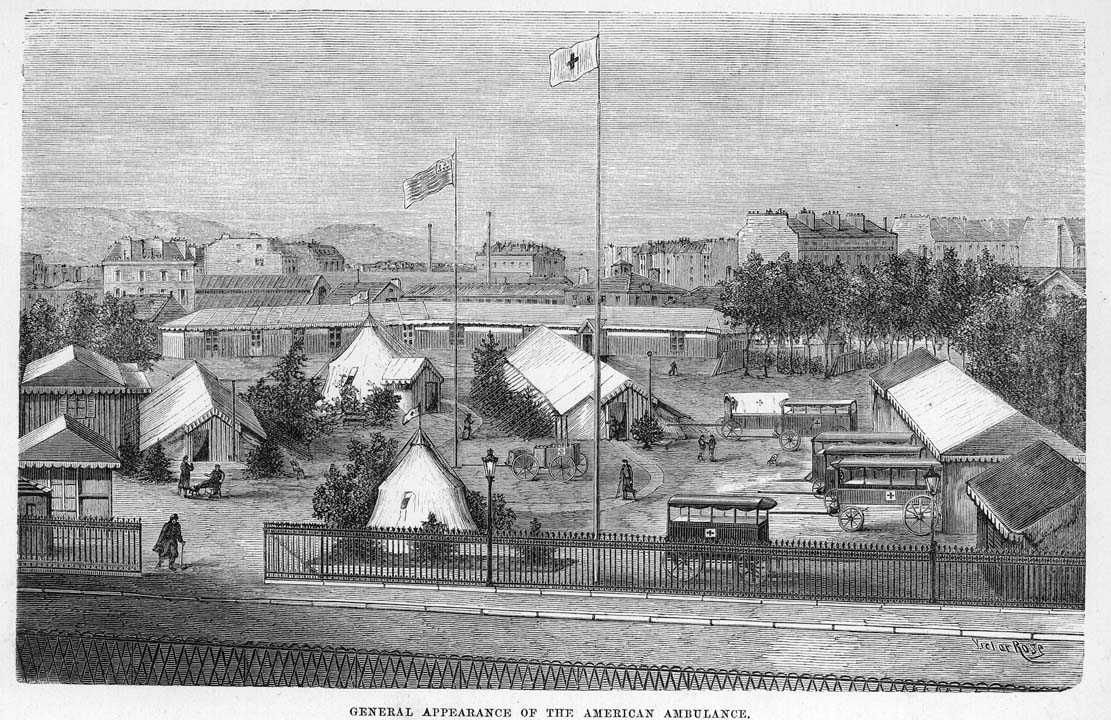
17. I except, in making this statement, the ambulance established in the Garden of the Luxembourg, after the close of the siege of Paris, under the direction of Dr. Depaul, and which, in the disposition of the pavilions, system of heating adopted, &c., was an exact copy of the American Ambulance. M. Le Fort says ("La Chirurgie Militaire," p. 182):---" During the winter of 1870-71 the tent hospital attached to the Hospital Cochin was utilized for the wounded of the siege," &c. It was only, however, after the capitulation of Paris, and after M. Le Fort had returned to the city, that it was opened. In October, 1870, as soon as the weather became frosty, the patients were removed and the tents closed.
18. According to M. Leplat's report, the number of tents pitched upon the Esplanade was two hundred and fifty.
19. "Étude sur la Construction des Ambulances Temporaires," par A. Demoget et L. Brossard. Paris, Alfred Cerf, 1871; p. 180.
20. "Histoire Médicale du Blocus de Metz," par E. Grellois, ex-Médecin-en-chef des hôpitaux de cette place. Paris, J.-B. Baillière et fils 1872; pp. 71, 72, 159, 160, 161.
21. "I have often heard the poor sick soldier complain while lying upon the straw. It is perhaps, nevertheless, the most desirable as well as the most hygienic kind of bedding, where overcrowding may give rise to fears of infection." (Note, p. 203, op. cit.)
25. Fischer, quoted by Demoget and Brossard in "Étude sur la Construction des Ambulances Temporaires." Paris, Alfred Cerf, 1871 ; p. 127.
26. "Report of the British National Society for Aid to the Sick and Wounded in War." London, 1871; p. 58. Here is a case in which a hospital was avowedly, and in spite of the preferences of the surgeon, fitted up for the nurses. The misfortune is that, nine times out of ten, the interests of the sick are thus sacrificed in compliance with the wishes of these people.
29. A division, in the Federal army, consisted of two or three brigades, and a brigade of "two or more" regiments. The average full strength of a division may be estimated at about 8,000.---men and officers included.
30. Since this passage was written, Dr. Swinburne has informed me that the hospital was established upon an old camping ground---a bad location---but that he had no ease of hospital disease, while gangrene and pyæmia were at this time the causes of a large mortality in the hospitals in the rear, established in buildings.
31. "History of the United States Sanitary Commission." Philadelphia, 1866; p. 371.
32. If there were over two hundred permanent hospitals established, mostly in wooden pavilions, constructed expressly to be occupied by the sick and wounded, the fact at first would seem to militate against the accuracy of my statement as regards American opinion concerning the use of tents even in the summer months. But I may here observe that, while sanitary considerations are always of the greatest importance in the construction of a hospital, motives of general convenience may oftentimes determine the character of the establishment.
Another reason which encouraged the creation of barrack-hospitals in the United States, was the fact that, in a country abounding in lumber of every kind, it was frequently found to be much cheaper to build a barrack than to buy a tent.
While having no reason to change my statement concerning American opinion regarding the use of tent-hospitals it is only justice to Dr. Wm. A. Hammond, to whom, more than to any other man, the American army was indebted for its hospital system to state that since these pages were written I have found in his work, "On Hygiene," the general affirmation that "nothing is better for the sick and wounded, winter and summer, than a tent or a ridge-ventilated hut."
33. "Bulletin de l'Académie de Médecine," 1862, p. 617.
34. Chantreuil, op. cit. pp. 26-27.
35. Hammond, "Treatise on Hygiene." Philadelphia, 1863; p. 355. Parkes, in speaking of air rendered impure by exhalations from the sick, observes that:---"It is now well known that by the freest ventilation, i.e. by treating men in tents or in the open air, hospital gangrene can be entirely avoided. The occurrence of hospital gangrene in a tent is a matter of the rarest occurrence."---Practical Hygiene., p. 106.
36. "Étude sur les Hôpitaux sous Tentes." Schatz, Paris, 1870; p. 57.
37. Chantreuil, op, cit. p. 35.
38. The increase in the death-rate as the siege continued is strikingly evident in the returns of nearly every ambulance. Thus in the ambulance established by the Administration of the ambulances of the Press, in the École des ponts et chaussées: In September, 26 wounded were admitted with no deaths; in October, 35 were admitted with four deaths ; in November, 93 were admitted with eight deaths; in December, 45 were admitted with thirty-two deaths; in January, 77 were admitted with seventeen deaths; and in February, 2 were admitted with two deaths. "In the ambulance de la marine, in Paris, the rate of mortality among the wounded increased in each of the periods into which the siege was divided. Thus in the first, there were admitted 23 cases of wounds, of whom four died; in the second, 88, of whom eight died; and in the third, 41, of whom thirteen died; showing clearly that here, as elsewhere, the rate of mortality underwent progressive increase as the siege went on."
39. "Medical and Surgical History of the British Army during the War against Russia." London, 1858;vol. ii. pp. 259, 388, 389.
40. Salleron, "Des Amputations Primitives et Consécutives, Recueil de Mémoires de Médecine," &c. Deuxième série, vingt-deuxième vol. Paris, 1858.
41. Dr. Job, "Ambulance de l'Hôpita1 Rothschild pendant le Siége de Paris, 1870-1871." Delahaye, Paris.
42. "Les Ambulances de la Presse." Paris, Baillière, 1873; p. 60, et passim.
43. "Lessons on Hygiene and Surgery from the Franco-Prussian war." By Charles Alexander Gordon. London, Baillière, 1873;p. 149.
44. Liegois, "Première Ambulance Voluntaire." Victor Masson, Paris, 1871; p. 18.
45. "Notice sur l'Hôpital civil de Strasbourg pendant le Siége et le Bombardement," par le docteur F. Gross. Paris, 1872.
46. "Thèse pour le Doctorat en Médecine." Paris, 1872.
48. Surgeon-Major Wyatt, the colleague of Dr. Gordon in a special mission to the French army, under orders from the English Secretary of State for War, and who remained with Dr. Gordon in Paris during the siege, says, in a letter addressed to Col. Loyd Lindsay, and dated November 7th, 1870, (see Report of British National Society for Aid," p. 57) --- "There has been as yet no proper military ambulance constructed. The best model is that which the ingenious Americans display here, but that is by no means perfect." Perfect---we never supposed it to be; the best model ---that is all we have ever claimed it to be.
49. For facts and statements concerning the sanitary and physiological influence of light, I would refer the reader to a very interesting little work by Dr. Forbes Winslow, entitled, "Light; its Influence on Life and Health."
50. When it became evident that Paris was an objective point in the German strategic plan, the Government of the Empire set itself vigorously to work to organize a defence; and during the last week of August under the direction of M. Clément Duvernois, then minister of agriculture and commerce, certain quantities of flour, wheat, &c., were introduced into the city, and contracts were made for the delivery---at a short delay---of siege supplies on a large scale. The Revolution of the 4th of September put an end, not only to the Imperial Government, but to all systematic effort to provision the city. If Paris was able to feed its population for five months or more, official provision is entitled to very little credit for the fact; it is to be attributed principally to the existence of those vast stocks of provisions which the commerce of modern times has the habit of storing in or near great cities,
51. For this table I am indebted to the "Etude sur la Mortalité à Paris pendant le Siége," par M. Henri Sueur. Paris, 1872.
52. As illustrating the condition to which the troops were brought by the continued action of insufficient food, fatigue, exposure, and cold, Dr. Gordon mentions an interesting incident:---"From the month of September, when the siege began, till the date of the last great battle, it may be said that the great body of the troops lived in the bivouac, exposed to all weathers, with little or no comfort, and without continuous rest. The battle of Montretout and Bougival produced a large number of wounded, of whom sixty-four were sent to the American ambulance. In the course of the evening I visited the portion of that establishment where they were accommodated. On either side of a long tent some were arranged, comfortably put to bed, and there they lay, covered with blood, it is true, but all sound asleep; not a groan was heard, although the wounds of all were dangerous, and of several mortal. Some had limbs shattered by shot or shell; many had severe flesh wounds; one young man had been struck by a Bavarian bullet in the forehead, one half of the missile still projecting ; but so great had been the physical wear and tear of all for months before, that their wounds, severe as they were, were yet insufficient to banish sleep when the comforts of a bed and restoratives gave place to the miseries of the previous four months." ("Lessons on Hygiene and Surgery," p. 227.)
53. Only a small number of the volunteer ambulances have as yet made reports possessing any statistical value. The report of the War Department, should it ever appear, will inevitably be incomplete and most unsatisfactory, while the mortuary returns of the city of Paris throw little if any light on the subject. These returns in principle include all the deaths, from whatever cause, occurring within the limits of the city. As nearly all the ambulances, together with the civil hospitals and the great military hospitals---Le Val de Grâce and Le Gros Caillou---were within the limits of the city, were these returns complete we should be in possession of much of the data bearing upon the mortality of the army during the siege. But on examining the municipal monthly bulletins, I find that in the month of September 37 deaths were attributed to wounds received in battle (blessures militaires) ; in October 333 deaths are attributed to the same cause; in November no deaths were reported from this cause; while in December the number had risen to 1,058. In short, the military mortuary statistics of the siege are in about as hopeless a condition as possible, and beyond certain gross aggregates which may approximate the truth, our knowledge is never likely to be much extended.
54. I am sorry that I am unable to here present a number of facts which should enter into a mortality table---such as the cause of death, and the sex of the decedents. But the city monthly record of vital statistics has---at the time of my writing---only been published down to the 1st of January, 1871, and therefore no official tables covering the whole period of the siege have as yet appeared. While indebted to the gentlemen in charge of the Bureau of Statistics at the Prefecture of the Seine for much valuable information, the only table I can present is unofficial and incomplete, although the facts it contains were derived from official sources, and are entirely trustworthy.
55. It has been remarked that candles are not as good as lamps for lighting a ward, "because they often emit unpleasant odours, especially when the wicks are long or they are snuffed." Lamps are certainly much better than candles for permanent lights, but good candles are by no means as likely to smoke and emit unpleasant odours as equally good lamps. All lamps require constant regulating. For field service, candles are greatly to be preferred to lamps---because it is more easy to transport them, and less difficult to take care of them.
56. An objection made by the Germans to the establishment of a hospital at Sedan under tents, captured from the French, was that the bedsteads in use were too large for the tents.
| 57. |
"The troops exulting sat in order round, Pope, "Iliad," book viii. v. 553-4 |
58. "In none of which (huts), on any pretence, fire is to be allow'd" (Orrery, op. cit. p. 84) ; and among the instructions given by Sir James Turner is this:--"That no fires be made among the tents and huts, but only in those places which re allotted for them." ("Pallas Armata," p. 287.)
59. Colombier, op. cit. pp. 274-276.
62. Dr. J. J. Woodward, of the United States army, informs me that Surgeon D. McRuer, formerly attached to the army of the Potomac, addressed on the 17th of November, 1861, a letter to Dr. Tripler, then medical director of that army, in which he recommended the warming of tents by means of a "California stove," and asked for a commission of inquiry to examine the four hospital tents to which the system had been applied in his own brigade ; as also, that Dr. McRuer afterwards received a sort of general commission authorizing him to visit the different camps and instruct surgeons how to construct the stove. But Dr. McRuer was not the inventor of the system he commended.
I am told by Dr. Eugene Sanger (now of Bangor, Me.), who was well acquainted with Dr. McRuer, that the "California stove" had been introduced into his own and other regimental tent hospitals at Lewinsville (army of the Potomac) some time before the date of McRuer's letter. Indeed, the name given to the device---a California stove---is strongly suggestive, not only that it was not, in 1861, a new invention, but that it was one of those many ingenious conceptions which have been suggested by the necessities of mining, trapping, or a rude life of exposure,
63. I have here described the position of the cellar in pavilion No. 1 ; in pavilion No. 2 the steps leading to the furnace were in front of the end of the tent, and not at the side, and the cellar was under the vestibule, and not under the tent itself. (See Plates Il. III. and V.)
64. A reference to the Plates accompanying this Report will make this description perfectly intelligible. The cellar is indicated by the letter A, the trench by B, the stove by a, the elbow by b, the horizontal section of pipe by the letters c c c c, the vertical section by the letter d.
65 "Notice sur l'Ambulance Américaine," submitted to General Morin, with the Plates I. II. III. IV. V. and VI. accompanying this Report.
66. "Ambulance Américaine," par M. Ch. Jolly.
67. See "La Réforme des Hôpitaux par la Ventilation Renversée," par M. Félix Achard. Paris, Eugène Lacroix, 1865.
This also is the system most successfully adopted by General Morin for the ventilation of the amphitheatre of the Conservatoire des Arts et Métiers.
68. "Études sur la Ventilation," tome i. p. 423,
69. It possesses a very striking theoretical advantage, to which, however, perhaps too much importance has been attached; the shaft is worked by a force---heat---which would be often otherwise wasted. In a résumé of the principles of artificial ventilation, M. Jolly says:---"On devra utiliser pour l'appel la fumée, c'est-à-dire la force perdue du foyer servant à chauffer l'air nouveau." ("Traité Pratique du Chauffage, de la Ventilation &c.," par V. Ch. Jolly. Paris, 1869.) The principle is an excellent one, but its value in any given case must depend equally upon the relative cheapness of its application and effectiveness.
70. A square inch of French regulation tent-canvas contains on the average about 30 threads, crossed by 44 or 46 threads, and may be said to represent a pavement composed of 1,300 or 1,400 little, not quite regular, squares. Now between many, if not most, of these there are visible apertures or meshes. The number of these apertures, plainly visible on holding a piece of this canvas between the eye and the light, may be safely estimated at 800 per square inch. Their average diameter cannot be less than 1/400 of an inch---that is to say, the meshes occupy at least of the surface, and thus represent in the aggregate for each square yard of canvas an opening containing 6.4 square inches. But French regulation tent-canvas is of a fairly good quality. I have frequently seen linen canvas, used for making tents, in which the holes between the threads represented nearly a quarter of the surface. While these apertures are so very visible, and play no inconsiderable rôle in the ventilation of tents made of linen, the meshes are scarcely visible in fairly good cotton canvas. In a piece of American regulation tent-canvas which I have now in my hands I cannot detect, even with a lens, a single opening through the canvas. The meshes, therefore, in well-made cotton canvas, or, in other words, in an American tent, cannot be considered as contributing very much to its ventilation. The canvas is permeable to air and gases, principally because, although unprovided with many visible apertures, it is still highly porous.
71. "Projet d'Hôpital Militaire," par F. P. J. Pirori. Paris, 1865, p. 41.
72. Cotton wool is one of the best known non-conductors of heat. According to Péclet, if the conductibility of copper is represented by 64.00, that of sand may be represented by 0.27; of carded wool, by 0.044; of cotton wool, by 0.040; of eider down, by 0.039; and that of unsizcd brown paper, by 0.034. (Péclet, op. cit. pp. 105, 106, 107.)
73. As I have not noticed in this connection the existence, in the roof of each tent, of a window (14 inches by 12), I may here observe that the windows were rarely opened in cold weather. Then every crevice in the canvas was shut as tightly as possible, and it was then also that the air within our tents was always the purest. The windows and doors were only opened when the general temperature was relatively warm, or when the heat from the furnace was in excess, to facilitate its escape.
74. Pinel, "Nosographie Philosophique," vol. ii.
75. "Dissertation sur la Nature des Eaux de la Seine," par M. Parmentier. Paris, 1787 p. 8, et passim.
76. Michel Lévy, "hygiène," tome i. p. 811.
77. "Le Blocus de Metz." Publication du Conseil Municipal. Metz, 1871.
78. Nearly every one, however, of the public bathing-houses of Paris was closed before the end of November, from the impossibility of obtaining the necessary fuel.
79. "Des soins donner aux Malades; ce qu'il faut faire; ce qu'il faut éviter." Par Miss Nightingale. Paris, Didier et Cc, 1869; p. 186.
80. De Presle, in an essay preliminary to his translation of Munro's "Account of the Diseases which were most frequent in the Military Hospitals of Germany," says:---
"The fosse should be dug deep and narrow, its length depending upon the number of troops in the camp; it should be 15 or 20 ft. deep, and 8 or 12 ft. wide; and one or two pieces of wood should be put up at the edges to prevent accidents. Every morning, a layer of earth, about a foot deep, should be thrown into this fosse, which, when thus filled to within 3 ft. of the surface, should be filled up entirely, and another fosse opened near by."
81. The ordinance referred to would scarcely seem to have been original with Moses. Injunctions quite identical are to be found in the Hindoo Shastras, from which some curious extracts relating to the subject may be found in Gordon's "Army Hygiene," pp. 486, 487.
82. The capacity of a given quantity of earth to take up gases is very much increased by drying it. So the natural capacities of earths vary considerably. Soils which contain humus, clay, and marl, commonly known as barns, are in the highest degree absorbent, while sand and gravel are feeble absorbents of gases.
83. Since this portion of my Report was written I have seen a statement (in "L'Étude sur la Construction des Ambulances Temporaires ") that:---"In the Prussian barracks the latrines have seats with transversal bars above them to force those using them to sit down." I never saw such seats in use in any barrack or hospital establishment previous to their having been adopted at the American ambulance. The paragraph quoted contains also the first written allusion to the use of the transverse bar which I have ever seen.
84. Contract currency prices at New York, July, 1870, reduced to gold and to francs. These prices are in excess of present prices; and there is little reason to doubt that such tents could be now made in France at a cost 30 or 40 per cent. less than that which appears in the statement. The cost of manufacturing tent coverings has been quite fully discussed in Part II., to which I would refer the reader.
85. 1 L'Hôpital Lariboisière cost the administration of the city of Paris-
For the grounds 3,189,930.54 fr.
" buildings and furniture 7,255,215.52 "
Total 10,445,146.06 "
It contains 606 beds; the average cost of each was therefore 17,236.21 "
See Husson, "Etudes sur les Hôpitaux." Paris, 1862; p. 344.
86. A commission of the Society of Physicians and Surgeons of the Hospitals of Paris, appointed to visit and report upon this hospital, after a careful inquiry and a long discussion, voted unanimously, on the 6th of January, 1872, the following resolution:---"The new Hôtel-Dieu, such as it has been built, is arranged in a manner absolutely contrary to the first principles of hospital hygiene." This monumental hospital is still unfinished, and it has been recently proposed to turn it over to the Government, to be converted into a General Post Office.
1. This diagram is essentially the same as shown in Fig. 54.
2. The second stage here spoken of is the true congestive, or one intermediate to the first and second stages of authors.
3. See "Circular" No. 6, S. G. O., 1865, p. 30.
4. See Cases 3 and 134, pp. 592, 596.
5. Including certain unofficial cases, and a few which appear in the table of medical cases.
6. These patients have now (August 1st, 1871) each so far recovered as to be able to walk with only a cane. (J. S.)
8. Of the 247 surgical cases treated in the ambulance, 114 soldiers had compound fractures; a few soldiers had sustained two or even more, so as to represent 126 distinct compound fractures.
9. July 26th: albuminous condition has disappeared; health good, limb strong, patient walks with a cane; anterior wound still open, and discharging moderately. Small fragments of dead bone still undischarged.---(J. S.)
10. "Circular No. 6," S. G. O., 1865.
13. July 1st.---Patient is well, with good arm, and has nearly full use of the elbow-joint. (J. S.)
14. July 1st.---Patient well, and has full use of his limb. (J. S.)
15. July 28th.---The patient is in good health.---.J. S.
16. "The Science and Art of Surgery," by John Erichsen, vol. i. p. 123; London, 1869.