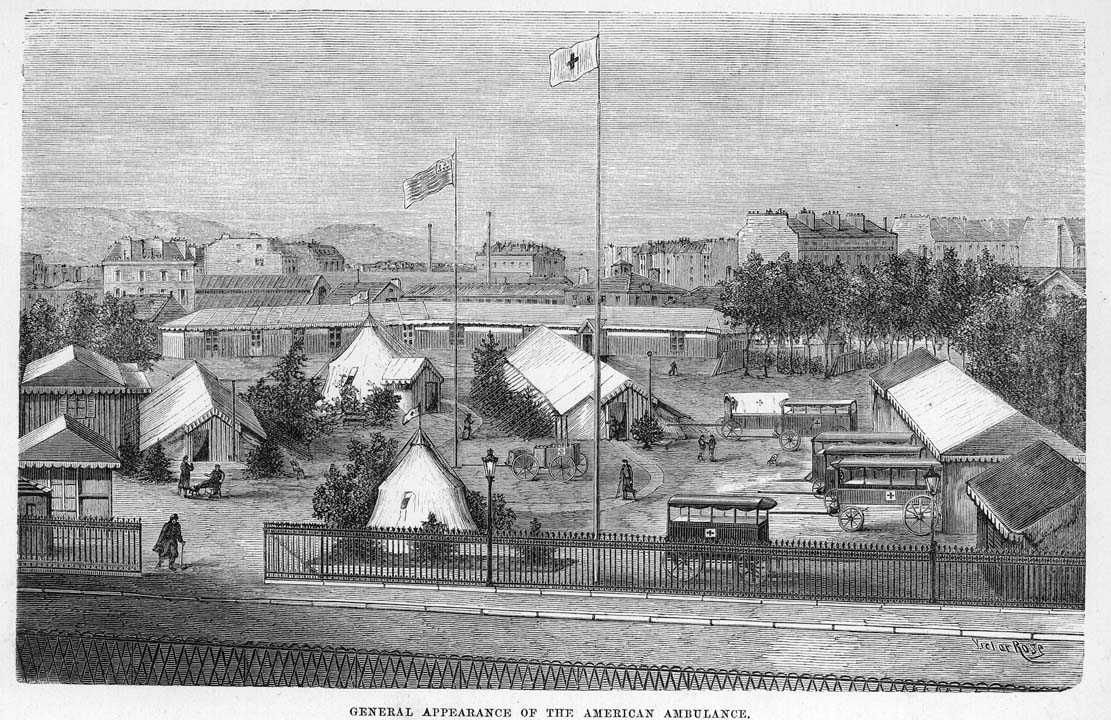
1. Says a French medical authority, in speaking of the American ambulance:-- "Nous accordons à cet établissement une importance tout-à-fait capitale, moins pour les services qu'il a rendus, et qui sont du reste considérables, que pour les vérités importantes qu'il nous a fait toucher du doigt. Désormais la mobilisation des hôpitaux temporaires est un problème résolu." ("Nouveau Dictionnaire de Médecine et de Chirurgie Pratiques." J.-B. Baillière, Paris, 1873; art, Hôpital, tome xvii. p. 726.)
1. L'Electeur Libre," Oct. 3, 1870.
3. "L'Univers," November 1, 1870.
4 "Paris Journal," October 31, 1870.
5. "Le Petit Moniteur," November 6, 1870.
6. Archbishop Darboy, who fell a victim to the fury of the Commune the following May.
7. "La Semaine Religieuse de Paris," Nov. 26, 1870.
8. "Constitutionnel," November 2, 1870.
9 "Journal Officiel de Ia République Française," November 27, 1870. The whole article was republished in the "Gazette des Hopitaux," January 26, 1871, under the title of " Documents pour servir à l'Histoire du Mouvement Scientifique pendant le Siège de Paris."
10. "Le National," December 11, 1870; and republished in the "Gazette des Hôpitaux," March 21, 1871.
11. "La Liberté," December, 1870.
12. "Le Figaro,"26 Janvier, 1871.
13. "La Défense Nationale," Dec. 14, 1870.
14. "La Patrie," Jan. 19, 1871.
15. Francisque Sarcey, in " Le Temps," December 21, 18 1870. A large part of this article appears in M. Sarcey's "Le Siège de Paris," a book which had the rare fortune to run through twenty-four editions in the course of about six months.
16. "Le Rappel" du 16 Novembre, 1870.
17. "Gazette Médicale," Dec. 1870, tome xxv. p. 610, and reproduced in the "Gazette des Hôpitaux," March 9, 1871.
18. "Union Médicale," Feb. 4, 1871.
19. These statistics were true when given to M. Monsnereau.
20."Gazette Hebdomadaire de Médecine et de Chirurgie," tome viii. pp. 113-117; 17 Mars, 1871.
21. "Comptes Rendus de l'Académie des Sciences," tome lxii. p. 750.
22. "Traité pratique du Chauffage, de la Ventilation," &c., par M. Ch. Joly. Paris, 1869.
23. "Circular No. 6." War Department, Surgeon-General's Office, Washington 1866, p 81.
24. La Vérité," Mars 17, 1871.
1. "Histoire de la Médecine," par Daniel Le Clerc. A La Haye, 1729; première partie, liv. i. chaps. ix.-xx. liv. ii. chap. iii. "Histoire de la Chirurgie," par M. Dujardin. Paris, 1774; tome premier, liv. .i. Haeser, Il Lehrbuch der Geschichte der Medicin." Jena, 1853. "Review of the History of Medicine among the Asiatics." Thomas A. Wise, London, 1867; vol. i. p. 53. "Histoire des Sciences Médicales," par Ch. Darembourg. Paris, 1870; tome i. pp. 25-73. See also "Diodorus Siculus," book i. chaps. xxv. lxxxii. lxxxiii.
2. 'Q Curtii Rufi de Rebus Gestis Alexandri Magni, Argentorati," 1801; lib. ix. p. 175; lib. iii. p. 109.
3. "Cyropædia," book i. chap. vi. et passim. When Xenophon ventured to attribute these humane sentiments to Cyrus, he was probably considering rather what moral effects such an example might have upon the Greeks themselves, than the historical accuracy of his account. That the Persians were particularly kind to their wounded is certainly not a fact of general history. Herodotus represents them as in the habit of abandoning their sick in camp in a shameful manner; (Herod. lib. c. 135); and Darius, just before the battle of Issus, is even said to have "put to death all the sick who were then in the city of Issus." (Rollin, "Ancient Hist." New York, 1837, vol. iii. p. 101.)
4. The statement of Herodotus appears in a rather curious connection. Artabazus was besieging Potidæa, and Timoxenus, the chief magistrate, had made an arrangement to deliver over to him the city. A correspondence was carried on between the two by means of letters attached to arrows shot at points agreed upon. One day the arrow of Artabazus went so far astray as to bury itself in the shoulder of a besieged Potidæan. The conspiracy was of course revealed. But in describing this incident, Herodotus, probably quite undesignedly, makes us acquainted with a custom among the Greeks. "Immediately," says he, "a crowd gathered around the wounded man, as is generally the case in battle."--- τ we rtgPr τD iρorwρDμi xμotÊς ÊHD jotrio aί iσPDo i Êtiμ'.---HERODOTUS, lib. viii. e. 128, p. 419, ed. Firmin Didot, Paris, 1858.
5. See "Anabasis," book iii. Coming to a certain village "they appointed eight surgeons, for there were many wounded."
6. Xenophon, "Rep, de Sparte," c. xiii.
7. "Patentibus omnes domibus saucios excipiebant, vulnera curabant, lassos reficiebant." "Justini Hist." lib. xxviii. c. 4. See also Herodotus, book viii. c. 115, where we are told how Xerxes imposed upon the inhabitants of Thessaly and Macedonia the care of his sick.
8. From the statement made by Diodorus Siculus, that in Egypt, "in military expeditions the sick are taken care of gratuitously, inasmuch as the physicians are supported at the public expense" (lib. i. c. 82); and from the fact that the Greeks for a long time derived from the Egyptians their knowledge of practical medicine and surgery, it may be inferred that the Greeks were at least not entirely ignorant of what might be called an established army health service. Still, it is altogether probable that such a service was never at any time considered by the ancient Greeks as an essential part of the military organization.
9. "Histoire de La Chirurgie," par M. Peyrilhe, tome second, pp. 396, 397. M. Peyrilhe is in error when he says that Greek and Roman historians have described with the greatest care encampments, as I shall have occasion to show in another part of this report; nor is the fault to which he alludes peculiar to ancient historians. Writers of history have almost uniformly occupied themselves with political incidents, and have rarely referred to customs, habits of living, and the material expressions of human civilization, more frequently than was absolutely necessary for the mise en scene of their dramatis personæ. For example, I have now before me the "Rise of the Dutch Republic, a History," by J. L. Motley, a new edition, London, 1871. It is a recent, well-known, and brilliant narrative of certain events which occurred within a period of less than thirty years (1555-84), a period of almost constant warfare and slaughter; and yet I find not an allusion in this bulky volume of a thousand pages either to an army surgeon or to an army hospital. Nor is there a single word in the book which informs us how the troops engaged were encamped or lodged, or even how they were maintained. In the index, the "people" are referred to in eleven lines, and the "army" in one line, while "Orange, William of Nassau, Prince of, his personal appearance," &C., fill eight solidly printed columns.
Whatever the merits of this book---and they are certainly very great---like most so-called histories, it is much less "a history" than a biographical dictionary, in which the incidents of each life have been skilfully grouped, with reference to the general dramatic effect,
10." De Bello Civili," lib, iii. c. 74.
11. "De Bello Civili," lib. iii. c. 78.
14. f τÊe στρDτÊrwÊ PDτρό . "Achillis Tatii Alexandrini De Clitoph. et Leucip. Amoribus;" lib. iv. c. x, Paris, Firmin Didot, 1856.
15. See "Gruterus et Muratorii Thesaur. Inscriptionum." Also, a book received by me while this report was in press, "Du Service de Santé Militaire chez les Romains," par le Dr. René Briau, Victor Masson, 1866. In this work twenty-five mortuary inscriptions are reproduced, which contain the words, medicus cohortis, medicus castrensis, etc. Whether Dr. Briau's conclusions are to be accepted or not, he is certainly entitled to the credit of having presented to his readers most of the inferences which can be drawn from these titles. And I may here add a few words upon this subject. After the Christian era, Roman armies were generally followed by a certain number of Medici, who seem to have been for the most part either Greeks or of Greek extraction. It is doubtful if these medici ever held an official position in the military hierarchy; in any event, it is certain that in the time of Aurelian they depended for their emoluments upon those whom they treated. (See " Vopiscus in Divo Aureliano.") It appears, however, that they were recognized, at least as camp followers, and even allowed certain privileges. Thus, the Emperor Antonine is said to have addressed a legionary physician in these terms:---" Since you announce yourself to be the physician of the second legion adjutrix, you will not be compelled to support municipal charges as long as you are absent in the service of the state, should you wish to be relieved from them at the expiration of your exemption, for the reasons given, such immunity will only be accorded in ease you are enrolled among those physicians whom these conceded privileges concern." (Cum te medicum legionis seeundæ adjutricis esse dicas, munera civilia, quamdiu reipublicæ causâ abfueris suscipere non cogeris. Cùm autem abesse desieris, post finitam eo jure vacationem si in eorum numero es, qui ad beneficia medicis concessa pertinent eâ immunitate uteris.) See "Code of Justinian," lib. x. tit. 52. This is a most important statement, as it tends to confirm opinions rendered highly probable by other acts, viz., that the legionary surgeon was a sort of volunteer, who offered his services to the legion for a longer or shorter time, and was not necessarily entitled, by reason of having been engaged in such a service, to the civil immunities accorded to the better class of physicians.
16. "Mémoires Militaires," par Charles Guischardt, à la Haye, 1758; tome ii. p. 114, note.
17. Suetonius, "Caius Caligula," c. 8.
18. "Sed rei militaris periti, plus quotidiana armorum exercitia, ad sanitatem militum putaverunt prodesse, quam medicos. ---VEGETIUS, "De Re Militari," lib. iii. c. 2. Mead, while repudiating the idea that medicine was ever regarded by the Romans as a servile art, admits that surgery was so considered, and was only practised among them by slaves and people of low condition. (Address delivered in the Amphitheatre of the Royal College of Physicians, October 18th, 1723.)
19. " Dionysius of Halicarnassus," lib. v. e. 5.
20. "Neque immemor ejus, quod initio consulatus imbiberat, reconciliandi animos plebis, saucios milites curandos dividit patribus. Fabiis plurimi dati: nec alibi majore cura habiti. Inde populares jam esse Fabii."---LIVY, lib. ii. c. 47.
21. Tacitus, "An." lib. iv. c. 53.
22 "Sed foemina, ingens animi, munia ducis per eos dies induit, militibusque, ut quis inops aut saucius, vestem et fomenta dilargita est."---TACITUS, "Ann." lib. i. c. 69.
23. C. Plinii "Panegyricus Trajano Dietus," c. 13.
24. "Mémoire couronné par la Société des Sciences, Belles-lettres, et Arts de Macon." Paris, 1813.
25. "Pharsalia," lib. iii. If I have not referred to a passage often quoted to show that the sick in Roman armies were carefully provided for, it is because the statement therein contained by no means warrants the inference which has been occasionally drawn from it. Velleius Paterculus has said:---"During the whole of the Pannonian war, no one of us, whatever his rank, was ill, whose health was not sustained by Cæsar's care; although he was so much occupied with the load of weighty affairs, he seemed to be occupied with this work alone. A harnessed waggon was ready for those who might need it---his own litter was public property, and I profited by it as well as others. Doctors, cooking utensils, a bathing apparatus, carried for this single use---everything was for the sick. We were far from our own homes and domestics, but of these nothing was wanting which we could either prefer or desire." But who is this of whom Velleius speaks? Tiberius! Suetonius and Tacitus have made us well acquainted with the character of this man. Stript of its verbiage, the passage informs us that Tiberius took care of the sick of his army by sending to them his doctor, his sedan chair, and his bathing tub---which was certainly very gracious on his part---but considered as a provision for the whole army, the simplicity of the material and the service is remarkable.
Of all the courtiers who have written history, Velleius Paterculus was notoriously one of the most servile flatterers. His own vanity also seems to have been immeasurable. He is particular to tell us how he stood behind Tiberius' triumph car---how he was the last tribune nominated by Augustus, and the first nominated by Tiberius, &c., and the passage in question was doubtless written, quite as much for the purpose of stating that he himself had been carried in the litter of Cæsar, as to pay adulatory compliments to his chief---but these he has certainly not forgotten. "O rem dictu non eminentem, sed solida veraque virtute atque utilitate maximam, experientia suavissimam, humanitate singularem! Per omne belli Germanici Pannonicique tempus, nemo e nobis, gradumve nostrum aut præcedentibus aut sequentibus, imbecillus fuit, cujus salus ac valetudo non ita sustentaretur Cæsaris cura, tanquam, distractissimus ille tantorum onerum mole, huic uni negotio vacaret animus. Erat desiderantibus paratum junctum vehiculum: lectica ejus publicata, cujus usum quum alii, tum ego sensi. Jam medici, jam apparatus cibi, jam in hoc solum importatum instrumentum balnei, nullius non succurit valetudini. Domus tantum ac domestici deerant; cæterum nihil, quod ab illis aut præstari, aut desiderari possit."---(VELLEIUS PATERCULUS, lib. ii. c. cxiv.)
I should hardly have cited this passage, had not Percy ("Dictionnaire des Sciences Médicales") used it as authority for the sweeping statement:---"Que pendant la guerre de Pannonie, tout avait été si bien prévu pour les infirmeries que les blessés n'y manquaient de rien, et que les voitures pour leur transport y étaient aussi nombreuses, que les vivres et les médicaments pour les traiter y étaient abondans."
This sort of historical criticism is altogether too common, and occasionally leads to conclusions remarkable, not to say absurd. Homer tells us towards the close of the eleventh book of the "Iliad" that Eurypylus, having been wounded, asked Patroclus to lead him to the "black ships," and to there take out a dart and bind up his wounds. In a historical sketch, "Sur le Service de Santé," which appeared in the "Gazette des Hôpitaux" during the year 1871---I forget the exact date---the Homeric incident above mentioned is referred to, and the writer most ingeniously suggests that of these black ships some may have been hospital ships, like, for example, the floating hospitals employed in American waters, during the war of the Rebellion, and that Patroclus was an active member of a Hellenic "Société de Secours aux Blessés." It would be interesting to know, if this connection with the ships entitled him to wear a blue-cloth naval cap; it might serve to explain the origin of that casquette d'ambulance, which has puzzled so many of us.
26. "L'Administration Militaire dans l'Antiquité," par Adolphe Gauldrée Boilleau, Paris, Dumaine, 1871, p. 402.
27. Mortification was the only condition which was supposed by the ancients to indicate the expediency of removing a portion of a limb. Paul of Ægina, who probably lived towards the close of the sixth century, and of whose "Surgery," it has been said, that "No other work of antiquity presents the art in so advanced a state, and treats every subject in so complete a manner" ("Chirurgie de Paul D'Egine, texte Grec, avec traduction Française etc. par René Briau." Paris, 1855, p. 20) writes only a few lines "About cutting off extremities "---Ë T eTefT fs---in which he says mortification may sometimes render it necessary to cut off the hand or foot; but he speaks of the danger of hemorrhage, and advises the most cautious procedures. Paul, in his article "About the extraction of darts "---Ë T e e e T f sf --- quotes Homer ("Iliad" xi. 515) to show that this kind of work must principally occupy the army surgeon; but he nowhere speaks of fractures produced either by darts, arrows, or javelins; he only alludes to the possible wounding of the bone ( στrÊ τρωPr τÊς) and remarks in that connection that when arrows stick in the bones, we know this has happened because they resist our efforts to move them.
28. " Institutions Militaires de l'Empereur Léon. Traduites en Français, par M. de Maizeroy," Paris, 1778; part i. inst. 4, p. 36.
29. It is said that Asoka, the great Buddhist Emperor of Hindostan, who reigned B. C. 220, caused certain edicts to be cut upon the rocks in his empire, and that among these was one relating to the care of the sick and to hospitals. It directed, among other things, that caravansaries be erected in the public highways for the use of travellers, and that the sick and wounded be carefully attended to by the erection of medical houses or hospitals and depôts of medicine. These hospitals were to be provided with all sorts of instruments and medicines, "and skilful physicians are to be appointed to administer them at the expense of the state" ("Review of the History of Medicine among the Asiatics," op. cit. vol. ii. pp. 390-91). Wise considers this as perhaps the oldest reference to the establishment of a hospital, although it will be observed that the date of the edict is comparatively modern.
Of pre-Homeric Greek medicine we really know nothing. But M. Darembourg, in his "Histoire des Sciences Médicales," a work as remarkable for the critical and philosophical spirit which pervades it, as for its profound erudition, while admitting that the history of Greek medicine begins with Homer, "whose poems constitute our oldest archives," advances the opinion that among the ancient Hellenic tribes the art of medicine was not less esteemed and cultivated than among the Hindoos. "Heureusement le passé d'un peuple ne meurt jamais complètement, si nous ignorons ce que pensaient au moment où quittant leur berceau les divers tribus qui furent plus tard confondues sous le nom d'Hellènes, commencèrent à couvrir l'Asie Mineure, les îles et le continent de la Grèce, c'est à dire bien longtemps avant Homère, nous pouvons à l'aide du Rig Véda, essayer de déterminer ce que pensaient et ce que savaient leurs proches parents, les Aryas de l'Orient, il y a près de trente-cinq siècles. . . Ainsi nous sommes autorisés à chercher dans les vieux hymnes des Védas une esquisse de l'état probable de la médicine chez les Hellènes durant une partie au moins de la période qui a précédé Homère." (Darembourg, op. cit. p. 72.) The ancient Hindoo writings are, however, by no means rich in illustrations of medical history, and the art of healing was cultivated in India in those far distant ages, as in Greece during the mythological period, principally by the sacerdotal castes and as a means of obtaining and retaining power.
30. From jr Êς a stranger, and wrÊÊμDo to receive.
33. "Histoire des Chevaliers Hospitaliers," par l'Abbé De Vertot. Amsterdam, 1732; tome i. p. 14.
34. "Génie du Christianisme," par Chateaubriand. Hachette, Paris, 1863, p. 605.
35. Beekmann's " History of inventions," art. Infirmaries, Hospitals for Invalids Field Lazarettos,
36. "Histoire de la Médecine." Traduite de l'Anglois de I. Freind; Paris, 1728 p. 115.
37. As a proof of the care taken of the sick poor in the middle ages, the astonishing assertion has been made, and often repeated, that twenty-eight thousand hospitals an lazarettos were at one time maintained and supported at the expense of the Templar and Hospitaliers alone. The authority quoted is Matthew Paris. What that writer really said is as follows:-" Moreover, the Templars in Christendom have nine thousand manors and the Hospitallers nineteen, besides the emoluments and various revenues arising from their brotherhoods and from procurations, all of which are increased by their privileges; and every manor can furnish, without grievance, one soldier well armed and fully equipped," &c. The statement was only intended to show the wealth and material resources of the orders mentioned---resources which, so far from having been devoted to works of charity, were consecrated to the development of the ambitious political and military schemes of these semi-ecclesiastical organizations. (See Matthew Paris' "Chronicle." Bohn; London, 1852; vol. i. p. 484.)
38. "Histoire des Chevaliers Hospit." Op. cit. Tome iv. (Anciens et Nouveaux Statuts de l'Ordre), titre iv.
39. Guiot de Provins. See "Histoire des Hôtelleries, Cabarets," &c., par Francisque Michel et Edouard Fournier. Paris, 1851; tome i. p. 315.
40. The monastic hospitals were suppressed in England just at the close of the reign of Henry VIII. and almost immediately after the confiscation to the state of the abbeys and convents. Says Burnet:---"There passed another act of this parliament (1542) that made way for the dissolution of colleges, hospitals, and other foundations of that nature." (Burnet "History of the Reformation of the Church of England." London, 1857; vol. i., p. 229.) "The visitations which preceded the suppression of the monasteries (in England) discovered, if credit be due to the inspectors, crimes the most degrading to human nature . . . These crimes were apparently notorious,---nor is their existence doubtful, or the licentious lives of the regulars disputable, when their debaucheries had already attracted the Papal indignation, and their crimes incurred the censures and menaces of Morton the Primate." ("An Historical Account of the Origin of the Commission appointed to inquire concerning Charities in England and Wales." By Nicholas Carlisle. London, 1828; p. 7.)
41. In England the same practice long obtained, and was termed "having garisona in a monastery." (Archæologia, Society of Antiquaries, London, vol. xxxi. p. 343.)
42. See Beckmann's "History of Inventions," art. "infirmaries, Hospitals for Invalids, Field Lazarettos."
43. Chateaubriand himself ingenuously declares that "Il n'y a pas un beau souvenir, pas une belle institution dans les siècles modernes que le Christianisme ne réclame;" ("Génie du Christianisme." Op. cit. p. 559); and for him Christianisme was a synonym for Romish Catholicism par excellence.
44. Physicians are mentioned in the codes of the Visigoths, promulgated in A. D. 504 and 608; but as to what may have been their relations to the armies of that people, the codes would appear to be silent. (See Malgaigne, "Œuvres d'Ambroise Paré," Introduction, pp. xvi. xviii.), and also "Histoire de la Chirurgie" par M. Peyrilhe, Paris, 1780. Tome second, pp. 727-728.
45. In Joinville's "Memoirs of St. Louis" (1226-1271) the allusions to physicians and surgeons are quite frequent, but their quality is indicated in the following passage:---"The whole army was infected by a shocking disorder (1249) which dried up the flesh on our legs to the bone, and our skins became tanned as black as the ground or an old boot that has long lain behind a coffer. . . The barbers were forced to cut away very large pieces of flesh from the gums to enable their patients to eat. It was pitiful to hear the cries and groans of those on whom this operation was performing." But we are also told, and this is perhaps more important, that "the good King St. Louis" not only stipulated with the Sultan that his sick should be taken care of at Damietta, but that he also "issued his commands to the masters of the galleys to have them ready to receive on board the sick, and convey them to Damietta," and that "the king's seamen made great fires on board their galleys to cherish the unfortunate sick." But as to the existence of hospitals for the disabled, whether at Damietta or elsewhere, the memoir is silent.
46. The Councils of Lateran (1139), Montpellier (1162), Tours (1163), Montpellier (1195). Malgaigne, op. cit. Introduction, p. xxviii.
47. "Anatomy seems to have been in no respect improved among them; while surgery rested upon the same footing, and they carried it no further than the latter Greeks, until the time of Albucasis." (Freind, op, cit. p. 211). Albucasis was one of the last of the Arab medical writers, living at the close of the eleventh or the beginning of the twelfth century. He wrote quite extensively on surgical subjects, and even gives some of his own experiences in connection with military surgery; but he observes that in his time surgery was so far forgotten that there scarcely remained a trace of the art. (Freind , p. 178).
48. "Il faut même avouer que c'est à eux que la Faculté de Montpellier doit une grande partie de la réputation qu'elle a eu dans son origine, parce qu'ils étaient aux 10e, 11e, et 12e siècles, presque les seuls dépositaires de cette science en Europe, et que c'est par eux qu'elle a été communiquée des Arabes aux Chrétiens.---ASTRUC. Histoire de la Faculté de Montpellier, p. 168.
49. "Dictionnaire de l'Armée de Terre," par le General Bardin; art. Hôpital Militaire.
50. "Li baron et li home le roy doivent le roy servir soixante jours et soixante nuicts." ---Établissement de St. Louis, chap. 59 (A.D. 1250), "By the feudal law (in England) every tenant in capite, that is, every person holding immediately from the king the quantity of land amounting to a knight's fee, was bound to hold himself in readiness with horse and arms to serve the king in his wars, either at home or abroad, at his own expense for a stated time, generally forty days in a year, to be reckoned from the time of joining the army. Persons holding more or less were bound to do duty in proportion to their tenures; thus, one possessed of but half a fee, was to perform service for twenty days only."---Military Antiquities, by Francis Grose, Esq. London, 1801, vol. i. pp. 4, 5. See also Blackstone's "Commentaries," book i. chap. 13, "On the Military and Maritime States." I find, however, in the Rolls of Parliament (Edward II. anno. ix.) that the English militia enrolled for the Scotch war were called out for sixty days---as also, that they were paid 4d. per day.
51. "Military Antiquities," op. cit.; vol. i. p. 242.
52. The only instance, with which I am acquainted, which might be cited in controversion of my statement is one mentioned by M. Malgaigne:---"Charles the Bold," says that writer, "first took measures to meet this necessity of every regular army, and he established a military surgical service. Thus he attached a surgeon to each company of one hundred lances. As each lance represented eight combatants, there was a surgeon for every 800 men; and as he had 2,200 men of arms, the military surgery of Burgundy counted a staff of twenty-two surgeons for a total of about 20,000 combatants, not including the surgeons of the barons and those of the Duke himself." ("Œuvres d'Ambroise Paré," par J. F. Malgaigne. Paris, 1840; Introduction, tome i. p. clxvii.)
The statement will lose, perhaps, none of its historical interest to the reader on his learning that all these surgeons, without exception, were simply barbers.
53. "Voilà quelles sont les belles galleries et les beaux promenoirs de gens de guerre, et puis leur lit d'honneur est un fossé où une harquebusade les aura renversés." ---Mémoires de F. De la Noue, ed. Panthéon, p. 335.
54. "Von Kayserlichen Kriegsrechten Malefitz und Schuldhändlen Ordnung und Regiment." Frankfurt, 1560; p. 81.
55. "Etudes sur le Service de Santé Militaire en France," par L. J. Bégin. Paris, 1849; p.2.
56. Colnet and Morstede were indentured on the same day (April 29, 1415), the former as " Phisition" and the latter as " Surgien."
57. Grose, "Military Antiquities," vol. i. p. 236.
58. And how they were returned we learn from "Certain Discourses," by Sir John Smythe, knight, 1590:---" Besides that great numbers of such their sieke and starved soldiers, by order of the Earle of Leicester, were in those parts (Flanders) embarked and transported into Essex and Kent, and other partes of England, to recover health; of which foresaid great numbers of miserable and pitiful ghosts, or rather shaddowes of men, the Essex and Kentish carts and carters (that carried them) can testifie; of which scarce the fortieth man escaped with life."
59. Doubtless one of the causes which tended to retard the efficient organization of the health service in European armies is to be found in the intense jealousy with which, during the sixteenth, seventeenth, and eighteenth centuries, those who claimed to practise surgery were regarded by all who had regularly obtained the title of "Doctor." After the priests had exhibited all the hostility towards surgery of which they were capable, then came the turn of the Faculties of Medicine, and the efforts made by these bodies during this time to degrade the surgeon and his profession were often almost incredible. "In France the Faculty called in the barbers to entrust to them the administrative work of surgery; afterwards it instructed them how to perform the principal operations; and at length it succeeded in having the barbers made members of the surgical corps. Surgery, thus degraded by its association with workmen, was exposed to all the contempt which naturally resulted from so unworthy an alliance. In 1660, by a formal decree, it was stripped of all literary honours, and if learning fled not utterly from surgery, it could only remain connected with it in shame and humiliation." ("Encyclopédie," art. Chirurgien.)
The 24th art, of the "Statuta Facultatis Medicinæ Parisiensis," published in 1696, is as follows---" Si quis inter Baccalaureos sederit, qui Chirurgiam aut aliam Artem manuariam exercuerit, ad Licentias non admittatur, nisi priùs fidem suam astringat publicis Notariorum instrumentis, se nunquam post hac Chirurgiam, aut aliam Artem manuariam exerciturum; idque in Collegii Medici Commentarios referatur. Ordinis enim Medici dignitatem, puram integramque conservari par est."
In England, during this period, surgery was in equal disrepute. The London Company of Barber Surgeons had grown to be an ancient and powerful corporation, but the practice of surgery had become so abased, that even in the reign of George II. the question was brought before the Chief Justice of England:---"Whether a surgeon was an inferior tradesman, within the meaning of a certain statute of William and Mary?"
After long and frequent contests, in which the surgeons and the doctors scrupled little as to the measures employed to maintain their respective pretensions, the strife in France was turned in favour of the surgeons by a decree of July, 1750, which established a complete course of studies in all the branches of the art and science of surgery, which should extend through three consecutive years; it was also decreed that the "masters" in surgery should enjoy, the prerogatives, honours, and rights recognized as belonging to the other liberal arts, as also the rights and privileges enjoyed by the well-to-do burghers of Paris. It was scarcely, however, before the beginning of the present century that French military surgeons succeeded in obtaining for themselves the rank and consideration to which they were rightfully entitled, as well in the hierarchy of letters as of arms.
60. This siege has been commonly said to have been called the siège de velours, on account of the hospital then established. The reason assigned is probably erroneous in any event, the term was at that period frequently used to indicate a siege in which the labour was slight and the hardships few. Thus La Fère was besieged in 1580, and we are told that although the siege was long, "the season was fine, the provisions abundant, and the soldiers called it le siège de velours." (" Histoire de l'Ancienne Infanterie Française," par Louis Susanne. Paris, 1850; tome ii. p. 24),
61. "Ordonnance de Janvier, 1629." Art. ccliii.
62. " Recherches sur l'Origine de Ladreries, Maladreries et Léproseries," par L. A. -Labourt. Paris, 1854; p. 15.
63. It was only after the French Revolution had broken up the whole structure of traditional government in France that an attempt was made to sweep away the last vestiges of the public hospitality of the middle ages. On the 10th of Thermidor, in the year III., an order was issued closing the hospitals to vagrants, and suppressing practices which, in the existing state of society, were a detriment to the sick, and an encouragement to the idle and vagabond. (See Husson, op. cit. p. 483.)
64 An attempt was made by Henry IV. to establish a "maison roïale de la charité chrétienne aux pauvres gentilshommes, capitaines et soldats estropiez, vieux et caducs," by an edict issued in June, 1606; but it was found difficult to obtain revenues sufficient to support the establishment, and the house was soon suppressed, and the "gentilshommes vieils, caducs, et soldats estropiez n'ayant moyens d'ailleurs de vivre," were redistributed as "religieux laïs" among the abbeys and priories. (See Doc. cited by Gama, op. cit. p. 50 et seq.)
65. "Le dit hôtel n'étant destiné que pour le logement, subsistance et entretenement des dits officiers et soldats estropiés et invalides," &c. Versailles; Edit du Roi, Avril, 1674. (See "Code Militaire, ou Compilation des Ordonnances des Rois de France concernant les Gens de Guerre, par M. de Briquet." Paris, 1761; tome 5me, titre cxxii. p. 196.)
66. "Histoire de la Milice Française," par Le R. P. Daniel. Paris 1721; tome ii. pp. 567-74.
67. "Fragments Historiques et Médicaux sur l'Hôtel Nationale des Invalides," par M. F. Hutin. Paris, 1851; p. 37.
68. Audouin affirms that, so late as 1727, not even a sedentary military hospital had been created, and that the civil hospitals, such as they were, were the only establishments open to sick soldiers.
69. Gama "Esquisse du Service de Santé Militaire," p, 107.
70. Commentaires sur les Institutions Militaires de Végèce, par M. le Comte Turpin de Crissé. Paris, 1783 ; tome ii. p. 85, et seq.
71. "There are in the kingdom eighty-five military hospitals of the king, under the orders of the Minister of War, and erected in favour of sick soldiers. In each hospital there is a controller, a physician, a surgeon-major, and a contractor, to provide and take care of the troops of his Majesty. Besides these hospitals which are fixed, &c." (" Dictionnaire Militaire," par M. D. L. C. D. B. Paris, 1758; art. Hôpital.)
72. Tenon, "Memoire 2me," p. 45.
74. During the eighteenth century the Hôtel Dieu at Paris, containing but six or seven hundred beds, occasionally received within its walls three or four thousand patients. In a ward reserved for small-pox patients there were sometimes as many as six adults or eight children in one bed, four feet and four inches wide. They lay dovetailed together, the feet of one set resting against the shoulders of the other. (See Arago, "Annuaire du Bureau des Longitudes," 1853, p. 458.) "A l'Hôtel Dieu il y a des jours où l'on purge; il y a des jours où on ne purge pas." (" Du degré de Certitude de la Médecine," par P. J. G. Cabanis. Paris, An. ix. 1803; p. 178.) "It is the largest, the most frequented, the richest, and the most frightful of all our hospitals" ("Encyclopédie," 1765; art. Hôtel Dieu). One may easily infer, from the frightful state of things said to exist at "the largest and richest of our hospitals" in 1765, that the administration of those less liberally endowed left much to be desired; so much, that the soldier who for a hundred years after the nominal creation of military hospitals, had almost uniformly been imposed upon these establishments, might, perhaps, have fared better had he been left by the wayside to the charity of chance and of Heaven.
76. John Evelyn, "Diary and Correspondence." Alexander Murray and Son, London, 1870 ; pp. 638, 640. Pepys also refers to the wretched treatment of the sick at this period. Under the date of Oct. 5th, 1665, he makes this entry in his" Diary":-- "Item: to Mr. Evelyns to discourse of our confounded business of prisoners and sick and wounded seamen, wherein he and we are so much put out of order."
77. John Evelyn, "Diary and Correspondence," op. cit. p. 312.
78. "Du Service des Hôpitaux Militaires," par M. Coste. Paris, 1790 ; pp. 27, 28.
79. According to the " Encyclopédie Méthodique," most of these hospitals were established in private houses. (Art. Hôpitaux, art. vii.-viii.)
80. "La Santé de Mars," par Jourdan Le Cointe. Paris, 1790; p. 438.
81. "Etude sur les Hôpitaux," par Armand Husson. Paris 1862; p. 481.
82. "Dictionnaire Raisonné de l'Architecture Française du XIe. au XVIe. Siècle," tome vi. p. 117.
83. The infirmary itself was almost a second monastery. Hither came the procession of the convent to see the sick brethren, and were greeted by a blazing fire in the hall, and long rows of candles in the chapel. Here, although not only here, were conducted the constant bleedings of the monks. Here, in the chapel, the young monks were privately whipped. Here the invalids were soothed by music. Here also lived the seven 'play.fellows,' the name given to the elder members, who after they had passed fifty years in the monastic profession, were exempted from all the ordinary regulations, were never told anything unpleasant, and themselves took the liberty of examining and censuring everything."---Historical Memorials of Westminster Abbey. Dean Stanley, London, 1869, p. 448.
85. By a law of the 23rd Messidor of the year II. (13th of July, 1793), the property of the hospitals was attached to the domain of the state, and the expenses connected with the establishment and maintenance of hospitals, were assumed as a part of the annual budget.
86. The responsibility, however, of the intendance for the proper administration of military hospitals is merely nominal, as it is only responsible to itself. Thus, the officier comptable is an agent appointed to execute its orders in the hospitals. If the administration of the hospital becomes a subject of complaint, the intendance sends a controleur to investigate matters. In short, the intendance holds in its own hands both the authority of administration and the supervising power.
87. M. Fournier Pescay, "Dictionnaire des Sciences Médicales," art, Chirurgiens Militaires.
88. As a matter of fact, it is very doubtful whether Ballingall makes the statement quoted. I find it in "Outlines of Military Surgery, by Sir George Ballingall, M.D., F.R.S., and F.R.C.S.E., Surgeon to the Queen and to H.R.H. the Duchess of Kent; Regius Professor of Military Surgery in the University, &c., &c., &c., Edinburgh, 1838," a book in which the nominal writer has not scrupled to attempt to palm off as the fruits of his own research, and as the work of his own pen, whole pages taken verbatim from Beckmann's "History of Inventions," "The Conquest of Granada," and, apparently, from pretty nearly every book upon which he could lay his piratical hands.
89. According to Duane (in "A Military Dictionary," Philadelphia, 1810), and who in fact only repeats a statement made by Smith (in "A Military Dictionary," London, 1779), it was not before 1660 that a regimental organization was adopted in the English army. The statement is certainly rather surprising, as the word regiment was in common use long before. Bardin, however, observes that this word was employed in camp, as a synonym for troup, band, and legion long before it received an official recognition, and that the doubts and disputes which have arisen as regards the time when regiments were first created, are to be attributed principally to this circumstance.
91. The following passage from Clowes expresses very clearly what he thought of those who brought "the worthy artist into very great diseredite:"--- "It is most truly said, there is no coine so current but hath in it some counterfaits, which make it suspitious; so is there no profession so good, but hath also some counterfaits, which breede in it disgrace, and none so much (I suppose) as there are some in these daies, that take upon them the honest titles and names of travelling surgeons, nay these are idle and ignorant menslaiers, or wandering runnagate surgeons, that I speak of, which very boldly, with most glorious facings, challenge unto themselves to be the only masters of Chirurgery in the world, because they have a little travelled: nevertheless, a number of these od, arrogant, & frivolous fellowes are known to be men altogether ignorant in the art, both in reason, judgement, and experience, howbeit, some one of them will use more comparisons, prating and babling words, than fewer wise men would willingly answer; and you shall also farther know them by this note: They are most commonly unfurnished of all good medicines, either medicinal or instrumentall, unlesse it be some such palterie stuffe, which a man would scarce lay to a gauld horse back, with other furniture answerable to the same. And so they are no more able to performe any good cure they take in hand, than they be able with one puffe of their winde to turn about a mill stone, for their cures at their comming home are plaine demonstrations of their beastly ignorance, and thus they bring themselves into ignominie and shame, and the worthy artist into very great discredite. Therefore friendly reader, let this be a warning unto thee to take heede of these unclean birds who do daily abuse many worthy persons, captains, gentlemen, masters of ships, &e . . . . and have been and daily are entertained to be principall surgeons for great ships of war, &c . . . . But, good reader, what hath issued hereof? Truly many a brave soldier and mariner hath perished, and sometimes the general and captains themselves, and so by this meanes, partly the whole voyage bath been overthrowne, by reason they had no helpe or succour, either of Physicke or Surgerie to releeve or comfort any of them."---A Profitable and Necessarie Booke of Observations, for all those that are burned with the flame of Gun powder, By William Clowes, one of hir Maiesties Chirurgions. London, 1596; ch. 27.
92. During the sixteenth and seventeenth centuries it was also not uncommon on the continent---particularly in Germany and Italy---to allow a surgeon to each company or troop. The number of surgeons, in an army of 10,000 men, was thus often several times greater than is at present provided; still, the general ignorance and low social position of the so-called "surgeons," and the wretched measures adopted by the administration for the care of the sick, were radical defects which were not to be in any way compensated, by the presence of a crowd of vagrant nostrum vendors and barbers.
93. Richelieu's words are these :---"Si l'on continue les missions militaires pratiquées en 1639, pour les (les soldats) empêcher de tomber malades; si lors qu'ils le sont, on a des Hôpitaux qui suivent l'armée en tous lieux, ainsi qu'on a fait en la même année, et qu'en asseurant la vie à ceux qui auront esté estropiez en servant le Roy, dans la Commanderie de Saint Louis destinée à cette fin; j'ose répondre que l'Infanterie de ce Royaume sera bien disciplinée à l'avenir."---Testament Politique. Amsterdam, 1689; p.334.
94. Chennevières, "Détails Militaires." Paris, 1750; tome ii. p. 137.
95. Brevet, cited by Gama, in op. cit. p. SEl.
96. Établissement fait en faveur des gens de guerre qui ne veulent point aller aux hospitaux. Année 1638. Doc. cited by Gama, in op. cit. p. 94.
97. "Le Nouvel Art de la Guerre," par Do Gaya. Paris, 1692; p. 44. The inference from this citation is that but a single hospital was established in the immediate neighbourhood of an army; and Le Père Daniel, writing in 1721, says it is the duty of the Maréchal des Logis de l'Armée to mark out the quarter of the king, the position of the artillery, the market place, and the place for the hospital. See "Histoire de la Milice Française," tome i. p. 359.
98. Audouin, "Histoire de l'Administration de la Guerre." Paris, 1811; tome ii. p. 65 et passim.
99. Détails Militaires," par M. De Chennevières, tome ii. pp. 152, 154, 155.
100. Order cited by Chennevières, op. cit. tome v. p. 173.
101. Décret du 16 ventôse, an. II. Arrêté du 24 thermidor, an. VIII.
102. Since 1792 the Service de Santé in the French army, has been the occasion of various decrees, which have changed its relations to the administration, as well as the organization of its personnel. Nevertheless, its organization has always had reference to three distinct branches of the health service. Surgeons and physicians have, accordingly, been assigned to the hospitals, the ambulances, and the regiments.
To the hospitals medical officers are assigned, both in number and in rank, "according to the importance of the establishment."
To the troops they are attached according to the following schedule:---
To a regiment of infantry, (strength about 3,000)---
One surgeon-major of the 1st class.
One surgeon-major of the 2nd class.
One aid-major.
The ambulances are divided into those attached to the head-quarters of the army, the head-quarters of the several corps, and the head-quarters of the divisions forming those corps; and the personnel varies both in number and rank in a descending scale, or in accordance with the importance of the service. The ambulances attached to the head-quarters of the army, and to a division of infantry, are usually compose about as follows:---
|
|
|
|
| Médecin Principal |
|
|
| Médecins Major |
|
|
| Médecins Aides-Major |
|
|
| Pharmacien Major |
|
|
| Pharmaciens Aides-Major |
|
|
| Officier d'Administration Comptables |
|
|
| Adjudants d'Administration |
|
|
| Infirmiers de Visite |
|
|
| Infirmiers |
|
|
Unfortunately, however, the numerical strength of the regular medical corps of the French army is by no means as considerable as these statements would seem to indicate. Thus, during the recent war, it was frequently the case that but a single medical officer was connected with the regiment, and he often held only the rank of an aid-major. In the organization of the regiments of the garde mobile but one medical officer was allowed.
103. I here give the personal composition of one of these ambulance corps, but they seem never to have been constructed upon any well-defined basis. Thus, the "Fifth Ambulance" contained 41 surgeons and assistants, 5 comptables or book-keepers, and 121 infermiers, waggon drivers, corporals, &c.
104. "Bulletin de la Société Française de Secours aux Blessés Militaires," publié à Bruxelles. Oct.-Mars, 1870-71; seconde édition, p. 20 et seq.
105. Hamilton, "Duties of a Regimental Surgeon." London, 1794; vol. ii. p. 187.
106. I believe the medical profession has always been rather over sensitive, in all matters relating to military rank, and that a greater effort has been made, by military medical officers, to prove that in certain cases they have been treated with disrespect, than to prove that they have in general been held in modern armies in quite as much consideration as other non-combatant officers. Thus, the following advertisement, which appeared in the London Gazette in 1689, has been quoted a good many times. (See "Remarks on Army Surgeons and their Work," by Charles Alexander Gordon, M.D.) "Run away out of Captain Soames company in his Grace the Duke of Norfolk's Regiment of Infantry, Roger Curtis, a barber-surgeon ; a little man with short black hair, a little curled; round visage, fresh-coloured; in a light coloured cloth coat, with gold and silver buttons, and the loops stitched up with gold and silver; red plush breeches and white hat. Whoever will give notice to Francis Baker, the agent of the same regiment in Hatton Gardens, so that he may be secured, shall have two guineas reward!" But it will be noticed, that this "run away" was qualified as a "company and barber-surgeon." Many army surgeons at this time were doubtless barber-surgeons;" nevertheless, the English regimental surgeon is generally spoken of with respect during the whole of the seventeenth century, and seems to have ranked with the "preacher" and "quartermaster." Thus I find in manuscript No. 6008, of the "Harleian Collection," and dated 1649, that "ye preacher, quartermaster, chirurgian, and ye waggon master of ye regiment" are spoken of in the same connection---" whos huttes are to be placed even with ye captains huttes." The pay of "preachers" and chirurgiens" seems to have been nearly the same, during the whole of the seventeenth century. Thus, in a pay-list for the year 1639, four regimental preachers are entered at 3s. each per diem, and four chirurgeons at 4s. each per diem. In a list for 1697 the (regimental) chaplain is entered at 3s. 4d. per diem. In the middle of the seventeenth century, the chaplain appears to have had the advantage of the surgeon in the matter of pay, as he is inscribed in a "marching regiment of foot" at 6s. 8d. per diem, and the surgeon at 4s. But during the seventeenth and eighteenth centuries, the pay of both the surgeon and the chaplain was considerably above that of the quartermaster, as also of every officer below the rank of a captain. (See papers cited by Grose, vol. i. pp. 291-322.) The surgeon, it is true, was expected to provide medicines, &c., but his allowances and special perquisites, of one sort or another, were presumed to cover the expenditure necessary for that purpose. Company surgeons and surgeon's mates were for a long time noncommissioned officers, and were subject to the same discipline as the private soldier, however ignominious might be the consequences. (See Hamilton, op. cit. Vol. ii. p. 163, and Gordon, op. cit., p. 56.)
107. See "Report of the Commissioners appointed to inquire into the Regulations affecting the Sanitary Condition of the Army." Appendix xiii. London, 1858. In 1793 the surgeon's pay was raised to ten shillings per day, with an allowance of two horses "for self and medicine-chest," and an annual money allowance for the horses of £37 16s. (Grose, op. cit. vol. i. pp. 320-322.)
108. "Autobiography," p. 191. Quoted by Gordon in op. cit. p. 97.
109. The great difficulty found by most regiments in procuring an hospital for their sick, renders a clause in the Mutiny Act for that purpose much wanted; it would be a very considerable benefit to the service, if the magistrates of every district wherein troops should be quartered were obliged to provide a convenient barn, stable, or other building, at a reasonable rent. For want of some such regulation, the most exorbitant demands are usually made for the most wretched hovels, though the slender allowance to a regimental surgeon enables him to afford very little, particularly where the regiment is in scattered quarters, as in that case he must have two or more hospitals; the consequence is, that many a life is lost, which, with proper accommodation, might have been saved; in villages, parish officers might be obliged to take sick soldiers into their parish poor houses, assigning them one or more rooms, according to their numbers."---Grose, op. cit. vol. ii. pp. 76, 77.
110. Hamilton, op. cit. Vol. i. p. 7.
111. "Report of the Commissioners appointed to inquire into the Regulations affecting the Sanitary Condition of the Army." 1858; p. 421.
114. According to Sir James Macgrigor, in the Peninsula, between the 21st of December, 1811, and the 20th of June, 1814, 163,803 soldiers were admitted into the general hospitals, and 176,067 into the regimental hospitals---"Sir James Macgrigor on Diseases of the Army"---Medico-Chirurgical Transactions, vol. vi. p. 478.
115. Pringle, "Observations," p. 107 et passim.
116. Medico-Chi. Trans." vol. vi. pp. 475-476.
117. Macgrigor states that of the 176,067 soldiers treated in the regimental hospitals in the Peninsula 3,841 died, while of the 163,803 treated in the general hospitals 14,672 died. Ibid. p. 478.
119. See Ranby, "Method of Treating Gunshot Wounds." London, 144; and Hennen, "Observations." Edinburgh, 1818, pp. 28-29.
120. "The Army Medical Officers' Manual," by J. G. V. Millingen. London, 1819; p. 213 ci passim.
121. "A Treatise on the Transport of Sick and Wounded Troops," by Deputy Inspector-General T. Longmore, p. 33.
122. The French dépôt de convalescens is by no means the equivalent of the English or the American convalescent hospital.
123. The first question asked in France, whenever an administrative reform is proposed, is, Et le prix? and if the first cost of the system proposed involves a centime of additional expenditure, the custom has been to condemn it as impossible---and that quite without reference to any gain of power, or even to any saving which ultimately might be secured by the use of more perfect machinery. The additional cost has, almost uniformly, been considered as a reality which was more than an offset, to gains which were only theoretical.
124. " Règlement Général du 1er Avril, 1831." Titre xi.-.cii. sec. ii. arts. 1063, 1064.
126. "Ordonnance du 3 Mai, 1832," arts. 12 and 209.
128. "Les médicaments portés au Formulaire Pharmaceutique sont les seuls qui puissent être employés dans les hôpitaux militaires. "---Règlement du 1er- Avril, 1831; titre vi. chap. ii. sec. i. art. 30.
129. "Il est expressement interdit aux pharmaciens comptables d'édulcorer des tisanes qui ne sont pas designées comme devant être sucrées on miellées."- Circulaire Ministérielle du 11 Sep. 1839.
130. "La Chirurgie Militaire," par Leon Le Fort. Paris, 1872; p. 13.
131. By a Ministerial Decree, after the 1st of October, a franc a day was allowed by the Government to the "Société de Secours aux Blessés "for each soldier taken care of in its ambulances.
132. M. Leon Le Fort, 'Revue des deux Mondes." Tome xcvi. p. 122.
133. "Traité d'Hygiène." Paris, 1869; tome ii. p. 542.
134. "8me Ambulance de Campagne de la Société de Secours aux Blessés." Rapport par M. Amédée Tardieu. Paris, 1872; p. 5.
136. "La Chirurgie Militaire." Appendice, p. 33, et seq.
137. Rapport Général du Dr. Piotrowaki." Paris, 1871.
138. "Malades et Blessés de l'Armée de la Loire." Rapport au Ministère par T. Gallard, 1871.
139. In accordance with the 5th Article of the Treaty of Geneva:---
"The inhabitants of the country, as well as the members of the volunteer ambulance corps, who shall give aid to the wounded, shall be respected and protected.
"Any wounded soldier received and taken care of in a house shall be for it a safeguard."
140. "8me Ambulance," op. cit. pp. 18, 19.
142. While during the late war the regular medical service, in the German armies, retained in the field a large portion of its just independence in matters of administration, it seems to have exercised very little, if any, control over most of the general hospitals, opened in Germany, for the sick and wounded returned from the front. Large numbers of these hospitals were essentially civil foundations, created, as were the French ambulances, by "Sociétés de Secours," or private individuals; they were very generally directed by committees of ladies, and the doctors and surgeons appear to have been, almost without exception, the most insignificant appendages of the establishments.
143. "Revue des Deux Mondes." Tome xcvi. (Nov. 1871); p. 132.
145. "History of the United States' Sanitary Commission," by Charles J. Stillé. Philadelphia, 1866; pp. 36-37.