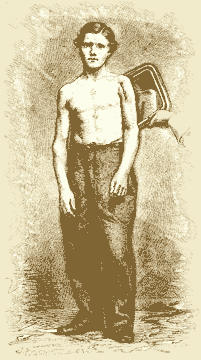
 FIG. 59.---Appearance (front and back view) of the shoulder of Private Clement Daumont at the time of his discharge. |
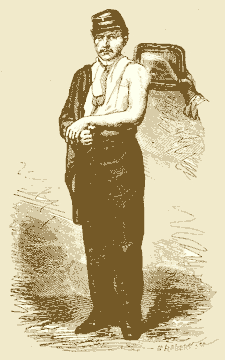 FIG. 60.---Appearance (front and back view) of the shoulder of Lieut. Fénelon Barbier at the time of his discharge. |
There have been eight injuries to the shoulder-joint; of these six occurred on November 30th, 1870. Primary excision was performed in five cases, three of which recovered. Their histories are subjoined.
CASE 32.---Private Clement Daumont, 5th Company, 2nd Battalion, 35th Regiment of the Line (136th Marching Regiment), was received from Malmaison, October 21st, 1870. A ball had entered the left shoulder at the posterior border of the deltoid, and had made its exit at the anterior border. The patient was exhausted from loss of blood, and was, moreover, suffering from gonorrhoea and pleurisy. The chest was filled with a pleuritic effusion. The following day, October 22nd, excision was performed by a longitudinal incision of about five inches through the deltoid. The head and three inches of the shaft of the humerus were excised. The wound was filled with lint, and the parts covered with warm water applications and oil-silk. This treatment was continued until the fifth day, when suppuration commenced. The patient was supported by stimulants. Improvement was regular. The arm was supported from the neck and shoulders by diachylon and bandages until the 25th of November, when he was transferred to the convalescent hospital. Two small abscesses afterwards formed, but in no way interfered with the success of the operation. In the middle of January he was able to use his hand in the manufacture of baskets. Early in March he was quite well, and had good use of his hand and arm, working daily at his trade. At this time his photographs were taken, sketches from which are here appended. (See Fig. 57, No. 1, and Fig. 59.)
CASE 56.---Lieutenant Fénelon Barbier, 3rd Company, 1st Battalion, 114th Regiment of the Line, was received November 30th, 1870. A ball had entered at the anterior face of the left humerus, and had passed directly backward through the head of the bone, making its exit posteriorly. December 2nd, excision was performed by extending the opening longitudinally and vertically, and removing the head of the bone by sawing through the surgical neck. The long tendon of the biceps was preserved. The wound was filled with lint, and the parts were covered with warm water applications and oil-silk. December 4th, healthy suppuration was established. On the tenth day, after excision, a drainage tube was inserted into the wound, and the edges brought together by strips of diachylon. The arm was supported by means of bands. December 21st, nineteen days after the operation, the wound was nearly closed. January 25th, the wound was still closing and the shoulder resuming its normal condition. February 25th, the patient was entirely well. March 5th, a photograph was taken, which is reproduced in Fig. 60.
|
FIG. 59.---Appearance (front and back view) of the shoulder of Private Clement Daumont at the time of his discharge. |
FIG. 60.---Appearance (front and back view) of the shoulder of Lieut. Fénelon Barbier at the time of his discharge. |
CASE 166.---Private Alphonse Tessier, 5th Company, 2nd Battalion, 112th Regiment of the Line, was received from the outposts at Bourget, December 24th, 1870. A ball had entered anteriorly to the shoulder-joint, and had passed through the head of the humerus, making its exit posteriorly. The head was crushed to atoms, many of which were carried out posteriorly, and remained in the deltoid. He was intoxicated on arrival. The skin around the entrance was burnt, the wound having been received from a point-blank shot. He arrived late in the evening. Excision was performed immediately by lamplight. The posterior wound was extended in the long axis of the limb, and the head and about one inch of the shaft of the humerus removed. During the first twenty-four hours the parts were much swollen. Warm linseed poultices were used. For the first three days the wound was filled with lint, covered with compresses dipped in warm water, and enveloped in oil-silk cloth. After the fifth day, when pus began to form, the wound was dressed with nitric acid lotion. The inflammation at this time had begun to diminish. Up to the twenty-first day the patient did well; then fuel giving out, he suffered from the severe cold, and had a slight chill. The granulations disappeared, and his appetite became poor. On the twenty-third day he was somewhat better, and healthy pus was again secreted in abundance, but exhaustive suppuration continued up to the twenty-fifth day, when the edges of the wound were brought together with adhesive plaster. On the twenty-seventh day he suffered from vomiting and diarrhoea, which were controlled in part by laudanum and brandy. The same day delirium supervened. Beef-horse beef- tea and brandy were given every hour. The quantity of pus decreased, and the granulations diminished. On the forty-first day the wound again opened, and discharged freely. The following day his diarrhoea was entirely controlled, and he began to improve. The day after he sat up, though vomiting again occurred in the course of the day. From this time he continued steadily to improve until February 21st, when the wound was nearly closed, and his health so far re-established that he could sit up all day without fatigue. March 3rd, he walked about and was considered as perfectly well. March 12th, photograph taken. (See Fig. 61.)
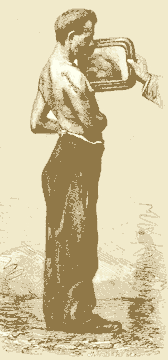
| FIG. 61.---Appearance (front and back view) of the shoulder of Private Alphonse Tessier, at the time of his discharge. |
The two remaining cases did well up to the nineteenth day, and were considered out of danger, but they died from the effects of cold, caused by a deficiency of fuel. (Cases 96 and 109, "History of Fatal Cases.")
Besides these, there were three other cases reserved for conservative treatment. They all did badly for days after admission, and it was found that unless amputation or excision were performed they would die. The most favourable case was selected and excision performed; but, as was feared, it only hastened the fatal result. The patient died soon after the operation. (History of Fatal Cases, Case 83.) The two remaining cases were complicated. (History of Fatal Cases, Cases 59 and 120.)
There were no amputations at the shoulder-joint, and but one of the arm; the history of this case, No. 106, is given at length in another connection.
In the report of the Surgeon-General of the United States(10) the subject of shoulder-joint operations is carefully discussed, with the records of 1,033 cases which had been treated up to a certain date during the Rebellion.
The Report states:(11)---
"It is creditable to the surgery of the war that the number of cases of amputation at the shoulder-joint reported is less than the number of cases of excision of the head of the humerus, and that the latter operation appears to have been adopted in nearly all the cases in which it was admissible. The reported cases of amputation at the shoulder-joint for the entire period numbered 458; of excisions of the head of the humerus there were 575. Of the 237 terminated cases of amputation, 93 died, a ratio of mortality of 392, which is 67 per cent. greater than the mortality in excisions."
And again :(12)---
"Excisions of the Shoulder-joint.---Nearly all the cases that have been reported during the war have been recorded. The results are given in the following table:--
|
|
|
|
| Died |
|
|
| Recovered |
|
|
| Results undetermined |
|
|
|
|
|
|
|
|
|
|
"The percentage of mortality is 23.8 in primary cases, 38.59 in secondary cases, or a mean ratio of 32.48. The ratio in amputations at the shoulder-joint is 39.24, a percentage of 6.76 in favour of excision. Of 36 cases of gunshot fracture of the head of the humerus, selected as favourable cases for the expectant plan, and treated without excision or amputation, 16 died, or 44.4 per cent., a ratio in favour of excision of 11.96 per cent. But it is superfluous to offer further proofs in behalf of this admirable operation."
It is scarcely necessary to say, in view of these results, that excision is the proper treatment for gunshot fractures of the shoulder-joint, and that amputation is only admissible when the soft parts are so injured as to destroy vitality or render the arm useless.
Of this class of injuries I append two cases, to show the results of the treatment.
CASE 36.---Corporal Anatole Menez, 5th Company, 3rd Battalion, 3rd Regiment of Zouaves, was received from Malmaison, October 21st, 1870. A ball had fractured the shaft of the right fibula, in the upper third. Warm water applications covered with oil-silk cloth were used until the sixth day, when warm linseed-meal poultices were substituted to accelerate suppuration and combat the pain produced by the formation of abscesses. The pain continued intense until several small scales of bone were discharged. A drainage tube was inserted after the tenth day, and opium cigarettes of four grains each were freely given to calm the pain. From this time the case proceeded favourably until, the date of discharge, December 8th; the patient then returned to service perfectly well..
CASE 244.---Corporal Hippolyte Charpenet, 9th Regiment of Chasseurs, was received January 24th, 1871. He was thrown from his horse, which fell upon him and produced a transverse fracture of the middle third of the tibia and fibula of the right leg. When the patient was received, the limb was much swollen from inflammation and infiltration in the tissues. The limb was placed in a wire gutter, well padded with oakum, so as to keep the bones in place. It was then covered with hot water applications and oil-silk, which were changed as often as the comfort of the patient would indicate. The limb continued to improve up to the 1st of March, when it was found to be firmly united, with no distortion. On the 6th of March the patient was discharged entirely well.
There were eight gun-shot fractures of the forearm. Of these seven recovered; one died. The history of this case (No. 106) will be found under another heading.
CASE 130.---Private Pierre Lhéandre, 3rd Company, 3rd Battalion, 114th Regiment of the Line, was received with two wounds, from Champigny, November 30th, 1870. A conoidal musket-ball had entered at the anterior face of the ulna, fracturing the bone, and had passed out through it posteriorly, making a wound of three and a-half inches in length by two and a-half in breadth at entrance, and a large one at exit. A fragment of shell had struck the inner part of the left thigh, producing a flesh-wound extending from the inner condyle of the femur, 5 in. upwards and inwards. No apparatus was applied. The treatment was limited to warm water applications, covered with oil-silk cloth. The progress was very favourable. No untoward symptoms arose to retard recovery. January 6th, both wounds were healed, and the fracture firmly consolidated.
CASE 225.---Private Joseph Paya, 1st Company, 2nd Battalion, : 109th Regiment of the Line, was received from Montretout, January 19th, 1871. A ball had entered, the forearm a little above the carpal end of the ulna, breaking it at this point, and had passed obliquely upwards and outwards, making its exit posteriorly. There was paralysis of the little and ring fingers, caused by the destruction of the ulnar nerve. The parts were covered with compresses dipped in warm water and enveloped in oil-silk cloth, and the hand was supported by a splint. This treatment was continued for six days, when pus began to form freely; nitric acid lotion was used in addition as a stimulant. Several abscesses formed in the tendons of the anterior and internal muscles, which afterwards discharged through the wounds. On the thirty-first day after admission an abscess formed and was opened in the middle of the anterior part of the forearm. March 3rd, the wound was healed; there was a little stiffening, but no anchylosis in the wrist-joint; the patient was discharged well.
CASE 31.---Private Jean Louis Pelletier, 6th Company, 1st Battalion, 38th Regiment of Mobiles of the Seine and Marne, was wounded at Malmaison, October 21st, 1870. A ball had entered the right forearm posteriorly, and passed obliquely downwards, fracturing the shaft of the ulna at the lower third. Warm water applications wrapped in oil-silk were used. On the sixth day, when suppuration commenced, warm flaxseed poultices were substituted. An artificial support was given to the arm by light wooden splints, retained by strips of adhesive plaster. Progress was continuous, and he was discharged on the 19th of December, perfectly well.
CASE 18.---Private Flouriselle Lecomte, 1st Company, 1st Battalion, 38th Regiment of Mobiles of the Seine and Marne, was received from Malmaison, October 21st, 1870. A ball had entered the right forearm, anterior to and a little above the carpal end of the radius, and had passed downwards between the carpus and the carpal end of the ulna, fracturing both. The arm and hand were supported by a splint extending from the elbow to the ends of the fingers, and fixed immovably by bands of adhesive plaster. The parts were kept moist by wet compresses covered with oil-silk. Fomentations were added when abscesses were forming or scales of bone were seeking an outlet. The healing of the wound was continuous, and the patient was discharged, December 19th, with a useful hand---having regained also the partial use of the wrist.
CASE 115.---Private Léon Filip, 1st Company, 3rd Battalion, 42nd Regiment of the Line, was received November 30th, 1870. A bullet had entered the inner side of the forearm, about 4 in. below the elbow, and had passed out just below the olecranon, breaking the same and opening the joint. The elbow was not swollen, and it was therefore determined to treat the case without operation. The wounds were dressed with compresses dipped in warm water, and covered with oil-silk. Suppuration began on the seventh day, up to which time he had suffered no pain. On the 8th of December he had a chill, due probably to the forming of an abscess. On the same and following day there was great pain and slight swelling of the joint. Cold dressings, with laudanum, were now applied, and gave much relief. On the twelfth day he had slight constriction in the throat, which was relieved by cigarettes containing each four grains of opium. On the fourteenth day two or three little spiculæ of bone were discharged from the superior wound. The forearm and hand now began to swell considerably; there was a very free discharge of pus, and pain had entirely ceased. On the thirty-fifth day abscesses began to form in the upper third of the forearm. On the 12th of January, forty-three days after admission, a piece of the olecranon, about one-fourth of a cubic inch, was discharged. At the above date he had eight or ten abscesses in the upper third of the forearm. February 21st, the forearm was much less swollen, and the abscesses had begun to heal. The great number of small abscesses was probably due to the fact that he would not permit the first large abscess to be opened, and not to the presence of necrosed bone, as might have been supposed. There was much thickening about the elbow-joint, impeding the motion of the arm, but no bony anchylosis. March 11th, some pain and inflammation. March 12th, there was found to be some necrosis of the superior end of the ulna, which might require time to dispose of. The patient was discharged March 18th, quite out of danger, and with every prospect of having a useful limb.(13)
CASE 14.---Private Dieudonné Boussinesy, 6th Company, 2nd Battalion, 45th Regiment of Mobiles of Hérault, was received October 17th, 1870. His injury was a fracture of the middle of the ulna---caused by a ball from a revolver---with an anterior and posterior wound. The parts were covered with hot water applications and oil-silk. The arm was supported by splints and bandages. After twenty days, perfect union had taken place, and the splints were removed. At this time there was great bony thickening, giving to the arm the appearance of distortion. By November 25th all the débris of bone had been discharged, the anterior wound, however, not being quite healed. There was steady improvement up to December 10th, when the patient was discharged well.
I introduce the two following cases to show the mode of treatment and the general results in this class of wounds.
CASE 41.---Private Louis Godon, 5th Company, 3rd Battalion, 3rd Regiment of Zouaves, was received from Malmaison, October 21st, 1870. A ball had entered the sole of the foot, passing through the os calcis and astragalus, and making its exit anterior to the ankle-joint. For the first week the whole foot and limb were enveloped in compresses dipped in warm water and covered with oil-silk cloth. On the sixth day pus formed in such quantities that a drainage tube was passed through the wounds in the foot. From time to time débris of bone were removed. Several abscesses formed and were opened. Towards the end of February he appeared to be quite well. There remained however a little stiffness about the joint, but no bony anchylosis. He was not yet able to bear the weight of his body on his foot. March 25th the patient was discharged much improved.(14)
CASE 45.---Private Michel Gaudry, 4th Company, 28th Regiment of the Line (36th Marching Regiment), was received October 22nd, 1870. He had several wounds. A ball had entered the right foot anteriorly to the external malleolus, and passed obliquely upwards, backwards, and inwards between this and the astragalus, cutting in its course the tendon Achillis. A second ball had passed through the left axilla, making in its course five flesh wounds. A third ball had passed through the second joint of the phalanx of the index finger of the right hand, crushing the joint. The patient was found in a small house in the outskirts of Rueil, where he had dragged himself the night after the battle. He was much exhausted from loss of blood, want of food, and exposure. His nervous system was much affected, and for several days it was necessary to force him to take sufficient nourishment. He had several violent chills. Stimulants were freely given. Suppuration having commenced on the fifth day, the foot was rendered immovable by wooden splints and adhesive plaster, and dressed with compresses dipped in warm water and covered with oil-silk. Linseed-meal was used when abscesses were forming. Several of these formed on the inside and outside, and were opened drainage tube was passed through the joint. December 15th, the wooden splints were replaced by a pillow, which, when wrapped around the leg and secured by bandages, served the same purpose---viz., gave support. He continued to improve, and with the exception of an occasional abscess, his convalescence was steady.
At the end of February, there was a slight stiffness about the joint, but no anchylosis. The wound in the finger was dressed with warm water applications, and the finger made firm by bands of adhesive plaster. It is now healed, but shortened and anchylosed.
The following are two interesting cases of this class of injuries
CASE 43.-Captain Martin Ducos, 6th Company, 3rd Battalion, 3rd Regiment of Zouaves, was received October 21st, 1870. A ball had entered posteriorly to the middle portion of the clavicle, and passed obliquely downwards through the spine of the scapula. The wound was covered with warm water applications, poultices, and oil-silk. Scales of bone continued to be discharged from time to time up to the 20th December, when both wounds were healed. The patient was only confined to his bed for fifteen days. February 15th he was discharged well, with the exception of a little stiffness in the muscles surrounding the joint. Opium was given in small doses to combat the pain. He was well sustained by a generous stimulating diet.
CASE 6.---Barnole Gill, 2nd Company, 3rd Battalion, 35th Regiment of the Line, was admitted September 30th, suffering from a fracture of the scapula. A ball had entered just behind the middle of the clavicle, and, passed downwards and backwards through the middle of the scapula, fracturing the same, and making its exit at the apex.
The parts were covered with warm water compresses and oil.silk cloths. On the 6th day after admission there was a free discharge of pus. On the 9th, fragments of cloth and débris of bone accompanied the ordinary discharge. The above treatment was continued to the 25th of October, at which date the anterior wound had closed. Morsels of bone still frequently issued from this injury until November 25th. December 15th, the posterior wound had closed. December 10th, patient was discharged well.
Of this class of injuries all recovered. I give the details of two cases, to show the mode of treatment adopted and the good results obtained therefrom. In case 215, the entire carpus was carried away, the wrist shortened about an inch, and still a good and useful limb resulted.
CASE 191.---Private George Goudelin, 6th Company, 3rd Battalion, 109th Regiment of the Line, was received from Buzenval, January 19th, 1871. A ball had entered the right hand at the centre of the carpus, on the ulnar side, making an opening of half an inch, and had passed obliquely downwards, carrying with it the greater part of the carpus, and having its exit just above the junction of the metacarpal bones of the thumb and forefinger, cutting the radial artery and palmar arch, and making an exit wound of three inches in diameter. He arrived at the ambulance much exhausted from loss of blood. His wound had a mushroom appearance. The hæmorrhage was with difficulty controlled during the first four days. It recurred repeatedly, and was as often checked by cold astringents, compresses, and bandages. On the 26th suppuration commenced, and several small pieces of bone were removed. A support of thin board, cushioned with oakum, was attached to the hand and forearm. The dressings consisted of compresses dipped in warm water and enveloped in oil-silk. This treatment was continued until February 5th, when linseed poultices were used to alleviate the pain caused by the forming of an abscess. Suppuration continued abundant. February 13th, a second large abscess began to form between the two wounds. To relieve the excessive pain and nervousness, laudanum was freely added to the poultices. From this time to February 20th, the suppuration was profuse, but the swelling of the parts had subsided, and the patient's general condition improved.
March 8th, the patient was discharged with a useful limb.
CASE 29.---Private Charles Joseph Engel, 5th Company, 2nd Battalion, 36th Regiment of March, was received from Malmaison, October 21st, 1870. A ball had entered the left hand at the lower face of the carpus, anterior to the carpal end of the ulna, fracturing the carpus, and making its exit posterior to the carpal end of the phalanx of the index finger. On arrival the patient was anæmic. There was considerable hæmorrhage from the wounds, and also from the nose. He was at this time suffering from rheumatism. The hand and forearm were covered with warm water applications and oil-silk. Suppuration began on the fifth day, when poultices of linseed-meal were substituted. Several slight hæmorrhages were treated with burnt alum. Stimulating drinks were freely given. The arm and hand were placed on a large, soft pillow. During the interval between this time and November 15th several abscesses formed at different points over the carpus, and discharged freely both pus and bony débris. The hand and forearm were supported by splints padded with oakum and sustained by bands of diachylon. The progress was continuous, and November 25th the patient was transferred to the convalescent ward. February 25th, the wound was entirely healed, and the patient had recovered, in a great measure, the use of his wrist.
March 4th, the patient was discharged well, with a useful hand and arm.
There have been five gunshot wounds of the jaws. All recovered, and as they contain much of interest I give their histories.
CASE 62.---Captain Pierre Jardin, 1st Company, 3rd Battalion, 42nd Regiment of the Line, was received November 30th, 1870.
A ball had entered the left side of the face, one inch anterior to the angle of the left jaw, and had passed out immediately under the right ramus, destroying in its course the lower maxillary on the left side and the muscles of the tongue, and cutting into the fauces. He was weak from loss of blood, but otherwise in good condition. Being unable to take food, owing to the opening in the fauces, he was fed by the stomach-pump. On the 5th of December hæmorrhage occurred, which was arrested by liquid perchloride of iron. In the night it re-occurred. December 6th, six days after the injury, there was again hæmorrhage. It was arrested by laying open all the tissues between the wounds of exit and of entrance, removing all the débris of bone and tissue, and ligaturing the sub-lingual artery, which had been wounded. The facial artery was compressed by passing a silver wire through the tissue under the artery, and twisting the two free ends over a block of wood with a compress under it. The wound was then left exposed to the air until all hæmorrhage had ceased and the wound was dry. It was then treated by hot compresses and oil-silk. December 10th, four days after, the wire compression was removed, and suppuration fully established. In addition to the warm compresses, dilute nitric acid, 120 drops to the quart of water, was applied to the wound. This treatment was continued up to the 25th of January, when the wound was nearly closed. The patient was discharged February 15th, entirely well.(15)
CASE 65.---Captain Louis Noëll, 1st Company, 3rd Battalion, 114th Regiment of the Line, was received from Champigny, November 30th, 1870. A ball had entered the face on the right side, about one inch outwards and downwards below the outer angle of the mouth, and had passed obliquely downwards and outwards, breaking the ramus of the inferior maxillary between the condyle and the inferior angle; re-entering just above the inner angle of the scapula, it passed out again through the lower angle, fracturing the same. The treatment consisted in the application of compresses dipped in warm water. The upper and lower jaws were fastened together with metallic wire by means of the teeth, the upper jaw acting as a splint to the lower. On the tenth day after admission a very small piece of bone was discharged from the lower wound of the scapula. Pieces of bone were also discharged from the jaw. An abscess formed in the neck and was opened. He was discharged on the 19th of February, well, except that a slight amount of suppuration continued from the scapula, evidently from some small fragments of bone not yet exfoliated. At this time the jaw had nearly resumed its normal position.
CASE 73.---Corporal Pierre Soulan, 3rd Company, 3rd Battalion, 114th Regiment of the Line, was received from Champigny, November 30th, 1870. A ball had entered below the malar bone on the right side, and had passed internally to the ramus of the jaw, and out through the middle of the neck; re-entering just above the scapula, it passed downwards through the spine of that bone. It was extracted at the ambulance on the same day. The parts were covered with warm water dressings enveloped in oil-silk. On the 5th of December, suppuration having commenced, warm fomentations were applied. The discharge of pus was at all times abundant and healthy. Small abscesses formed at different times from the 10th of December to the 3rd of January, anterior and posterior to the scapula along the line of the wound. Suppuration continued until the 10th of January. From this time until January 20th he convalesced rapidly, and was thought ready to be discharged. He was retained, however, until February 19th, awaiting an opportunity to return home.
CASE 129.---Private René Le Viément, 3rd Company, 3rd Battalion, 42nd Regiment of the Line, was wounded at Champigny, November 30th, 1870. A musket-ball had entered midway between the ramus of the jaw and the symphysis on the left side, and had passed obliquely forwards, frightfully crushing the jaw and dividing it into four portions, one at each angle, and one on each side of the symphysis. The whole front of the lower jaw and lip was torn into fragments. A cheiloplastic operation was performed. The lower lip was cut through and the splinters removed; the partially detached fragments were put back into position. The loosened teeth were left in---those alone which were forced from their alveoli being removed---and tied to the sound teeth with silver wire. A simple apparatus, ordinary bandages, maintained the parts in place, fixed the chin and line of the teeth, and steadied the fragments. From the great comminution and splintering of the bone, followed a copious and fetid muco-purulent discharge. The fetid secretion was a source of great discomfort to the patient, by finding its way to the stomach. Scrupulous attention was paid to cleanliness by repeated injections of a solution of carbolic acid. The constitutional irritation was overcome by the administration of the hydrate of chloral and opiates. Moderate antiphiogistic regimen was employed, and the patient disturbed as little as possible. During a period of four weeks he was not allowed to masticate, but was sustained by fluid nourishment. Talking was likewise prohibited. Union took place slowly, and the fragments continued mobile for several weeks. January 6th, 1871, the wires were removed, and an apparatus of gutta-percha, having been soaked in warm water, was moulded to the part while soft; as soon as it had assumed the proper shape it was dipped in cold water and allowed to dry; its interior was lined with lint, and thus properly padded it was fixed in place by bandages. This apparatus, however, did not hold the parts in as close and accurate apposition as the more simple means employed at first. By the fourth week after admission the fracture had assumed a certain degree of firmness, enough to keep the fragments in apposition; it still, however, yielded at the points of injury. February 19th, 1871, the patient left the ambulance for his home. The teeth had contracted adhesions, and fixed themselves firmly. The jaw was solid, but the articulation somewhat impaired, although the face presented no appearance of deformity.
CASE 145.---Private Joseph Sebastian Chabrier, 4th Company, 2nd Battalion, 35th Regiment of the Line, was received from Champigny, December 2nd, 1870. A ball entered above the right malar bone, one and a-half inches from the angle of the eye, passed downwards and backwards in a line with the lower lobe of the ear, and had its exit 3 in. posterior to the ear, cutting in its course the facial nerve and producing paralysis of the left side of the face; re-entering one and a-half inches below in the neck, it passed down the muscles of the back, posterior to the spine, as far as the middle of the dorsal region. It was extracted at the ambulance. The treatment consisted in the application of compresses dipped in warm water and covered with oil-silk cloth: On the fourth day, when suppuration commenced, hot poultices were substituted. Abscesses formed from time to time, and discharged by the wounds and by the ear. This treatment was continued up to February 21st, when suppuration was still going on in the ear. The wounds of the neck and back closed soon after the injury. February 27th, he sat up and walked about. March 7th, he was discharged in good health, although paralysis still continued, and the ear discharged slightly.
CASE 179.---François Roux, Sapper, 1st Company, 2nd Regiment of Engineers, was received from Buzenval, January 19th, 1871. A ball had entered the inferior maxillary to the left of the epiphysis, fracturing the lower part of the alveolus, carrying away several teeth on the left side, and lodging in the base of the tongue. The wounds were filled with lint and enveloped in warm water applications covered with oil-silk. When suppuration began warm poultices were used. Roux was discharged well, February 7th, 1871.
CASE 200.---Private Louis Hippolyte Cintrat, 3rd Company, 116th Battalion, 16th Regiment of National Guards, was received from Buzenval, January 19th, 1871. A ball had entered the face midway between the symphysis and the angle of the right lower jaw, fracturing the inferior maxillary, and had passed obliquely backwards, not displacing the teeth. Warm water applications were used, and when suppuration began, warm poultices covered with oil-silk were substituted. Progress was rapid and continuous, and on the 16th of February the patient was discharged, the wounds being healed, and the displacement of the jaw very slight.
There have been several wounds of the abdominal and pelvic cavity. One of these recovered. An abstract of the case is subjoined. The histories of the fatal cases will be found under another heading. In the case, the report of which is here appended, the direction taken by the ball would indicate a wound of the liver.
CASE 239.---Private Alphonse Barbier, 5th Company, 10th Battalion, Mobiles of the Seine, was wounded January 19th, 1871, by a rifle ball, which entered the right hypochondriac region at the junction of the anterior and inferior extremity of the ninth rib, passed obliquely across, and made its exit posteriorly, just above the crest of the ilium at the juncture of the eleventh and twelfth ribs near the spine. He was received in a very feeble state; great abdominal pain, tenderness on pressure, and symptoms of traumatic peritonitis, but no extra-abdominal extravasation. The entire body, from the armpits to the hips, was enveloped in warm water applications, covered with oil-silk. Opium was administered in full doses. January 31st, the pain on pressure was circumscribed. February 2nd, there was no abdominal pain or tenderness. February 27th, the patient's wounds were healed, and he was discharged perfectly well.
These have not been very numerous, but on account of the interest attached to them I append the histories of the four which terminated in recovery. Careful histories of the three which terminated fatally will be found in another section of this report. In two of these cases the wounded survived their injuries but a few hours.
CASE 13.---Private Jean Mondine, 5th Company, 4th Battalion, 100th Regiment of the Line (14th Marching Regiment), was received October 13th, 1870. A ball had entered just below the external end of the clavicle, crushed the third rib, passed down through the right lung below the inferior border of the apex of the scapula, crushing the seventh rib in its exit, and had lodged under the skin, from whence it was extracted on the same day. The patient was very weak from loss of blood, and had great difficulty of breathing. The wound was covered with silk plaster so as to constitute an elastic valve, permitting the egress of air and fluid, but not the ingress of either. The chest was supported firmly by bandages. The pain was combated by opium and chloral, and the system sustained by a liberal use of stimulants, generous food, and quinine wine. The pleural cavity was filled with blood. The posterior wound closed at the expiration of ten days. The anterior wound continued to discharge pus and blood for about twenty days, when auscultation and percussion showed the cavity of the chest to be emptied of all fluid matter. November 10th the patient was able to rise. From that time he continued to improve, and was discharged December 19th entirely well.
CASE 55.---Captain Eugène Roché, 3rd Company, 2nd Battalion, 42nd Regiment of the Line, was received November 30th, 1870. A ball had entered and fractured the eighth and ninth ribs on the left side, on a line vertically under the axilla, opening the pleura, and producing intense suffering and great difficulty of breathing, followed by constitutional disturbance. He was naturally of a delicate constitution, and was greatly weakened by loss of blood. The ball, with several fragments of bone, was extracted at the ambulance on the evening of arrival. Some hæmorrhage followed the operation. The wound was covered with silk plaster to prevent the ingress of air and to allow the exit of fluid. Great local inflammation followed, which was treated with warm water compresses and oil-silk. Pain was combated by opiates. At the expiration of eight days full and healthy suppuration was established. Fifteen days after the injury an abscess formed, and was opened. For several days hot applications were applied. December 18th, eighteen days after the injury, nitric acid lotions and bandages were used in addition. The case then proceeded favourably, and the patient was discharged January 20th, entirely well.
CASE 64.---Lieutenant Louis Choley, 3rd Company, 3rd Battalion, 42nd Regiment of the Line, was received from Champigny, November 30th, 1870. A bullet had entered anteriorly between the sixth and seventh ribs, and had passed directly backwards through the right lung and out through the rib, fracturing the same. There had been but little hæmorrhage from the wounds. He discharged blood with his sputa, and had considerable difficulty in breathing. His chest was covered with compresses dipped in warm water, enveloped in oil-silk cloth, and tightly bandaged. Suppuration was fully established about the sixth day. From that period the wounds were stimulated with nitric acid lotion. January 13th, 1871, they were healed. Two days afterwards he was discharged cured.
CASE 68.---Captain Jean-Baptiste Alliey, 5th Company, 3rd Battalion, 114th Regiment of the Line, was received November 30th, 1870. A ball had entered between the third and fourth ribs on a line below the middle of the clavicle, and had passed downwards and backwards through the right lung, and out of the chest through the apex of the scapula. He had, when admitted, a severe cough, was suffering from great difficulty of breathing, and expectorated large quantities of blood. There was a troublesome bleeding from the anterior wound. These conditions lasted up to the 13th of December, twelve days after the injury, when pus mixed with blood was discharged from the anterior wound. The conditions remained the same until January 1st, when he began to improve. On the 19th the anterior wound was entirely healed, the posterior wound being still open and discharging healthy pus. Upon percussion it was ascertained that there was considerable thickening of the lung tissue, and that effusion had taken place within the cavity of the pleura, producing much pain and dulness. The chest was painted with the tincture of iodine from December 13th to January 25th, forty-three days, when it resumed its normal condition. The remaining wound healed soon after, and on the 19th of February he was discharged in perfect health. Besides the application of iodine, the chest was bandaged so as to prevent pain and the disposition to hæmorrhage from the movement of the respiratory muscles. To prevent the introduction of air into the chest through the openings, the wounds were covered with isinglass plaster. This acted as a valve, allowing the egress of air and fluid matter, but not the ingress of either. Pain and extreme nervousness were combated by the use of morphia, chloral, and the valerianate of zinc. The patient was sustained by liberal nourishment, iron and quinine.
I give the two following cases as illustrative of the general condition following this class of injuries. In one case there can be no doubt that the sciatic nerve was wounded.
CASE 108.---Private Pierre Bretenaud, 6th Company, 2nd Battalion, 124th Regiment of the Line, was received from Champigny, November 30th, 1870. A ball had penetrated the left thigh, passing posteriorly to the femur, about four inches above the knee-joint, in the line of the sciatic nerve. On arrival there was entire loss of motion and sensation below the knee-joint, except in the anterior part of the leg and around the heel. There was great pain in the foot and ankle-joint. This was combated with warm compresses saturated with laudanum. The wounds healed rapidly. On the thirty-first day raised blisters filled with blood were perceived on the upper surfaces of the four small toes of the left foot. The cuticle was removed and the toes dressed with nitric acid lotion. Subsequently the great toe became affected in the same manner, and was similarly treated. On the thirty-eighth day after admission it was found that sensibility had returned to the skin of the foot. Pain in the foot returned at intervals of a few days, but was much diminished in degree.
February 3rd, the sixty-sixth day, all but the fourth toe were entirely healed, and that was nearly so. The paralyzed condition of the muscles of the leg remained. The patient was discharged February 19th, cured of his wounds, and directed to use the limb as much as possible.
CASE 128.---Sergeant Laurent Arraquin, 2nd Company, 3rd Battalion, 35th Regiment of the Line, was admitted November 30th, 1870. He was wounded in the right thigh. The ball had entered on the inner side of the rectus muscle, about the middle of the thigh, and had passed downwards and backwards, and out, just above the popliteal space, at a point near the sciatic nerve. For some time his condition improved. Warm water applications, covered by oil-silk, constituted the dressing. December 18th, a slight inflammation supervened near the wound. December 20th, it had increased, the excessive tenderness of the parts was greater, and the secretions had become unhealthy. The inflamed parts were bathed in a liniment of chloroform, sweet oil and laudanum, and the wounds covered with linseed poultices. Laudanum and chloral were given internally. December 21st, he was attacked with general spasms, which returned at intervals until the 23rd, when the inflammation began to diminish, the spasms to subside, and the secretion of healthy pus was restored. January 21st, his wounds were healed. He walked with crutches until February 28th, when he was discharged well.

 ASE 7.---Private Ernest Grevin,
of the 35th Regiment of the Line, was wounded the 30th of September,
1870. He was suffering, when brought to the ambulance, from a
gunshot fracture of the condyles of the right femur, the missile
having destroyed the knee-joint in its course through the limb.
October 1st, amputation was performed at the junction of the lower
and middle thirds. Circular flaps were made. To the 9th of the
month the progress of the patient was good. On that day he was
attacked with tetanus. Opium in large doses was administered frequently
during the day. This failing to relieve; him, chloral (hydrate)
was added---5 grammes dissolved in 250 grammes of syrup ; the
solution was given in tablespoon doses every hour ; this produced
considerable prostration, but little relaxation or decrease of
rigidity or spasm. The dose of chloral was then increased to 15
or 20 grammes in twenty-four hours, but even this failed to afford
any apparent relief. About the 11th of October the patient was
taken with severe spasms, which continued to increase until the
following day, the 12th of October, when he died..
ASE 7.---Private Ernest Grevin,
of the 35th Regiment of the Line, was wounded the 30th of September,
1870. He was suffering, when brought to the ambulance, from a
gunshot fracture of the condyles of the right femur, the missile
having destroyed the knee-joint in its course through the limb.
October 1st, amputation was performed at the junction of the lower
and middle thirds. Circular flaps were made. To the 9th of the
month the progress of the patient was good. On that day he was
attacked with tetanus. Opium in large doses was administered frequently
during the day. This failing to relieve; him, chloral (hydrate)
was added---5 grammes dissolved in 250 grammes of syrup ; the
solution was given in tablespoon doses every hour ; this produced
considerable prostration, but little relaxation or decrease of
rigidity or spasm. The dose of chloral was then increased to 15
or 20 grammes in twenty-four hours, but even this failed to afford
any apparent relief. About the 11th of October the patient was
taken with severe spasms, which continued to increase until the
following day, the 12th of October, when he died..
CASE 8.---Private Joseph Edet, 5th Company, 2nd Battalion, 35th Regiment of the Line, was wounded September 30th, 1870. A ball had passed through the epiphysis and femoral end of the tibia, destroying nearly two inches of the bone below the joint, but not opening the joint. The wound was covered with hot water applications, enveloped in covered oil-silk cloths, and the limb placed in a wire gutter. After twenty days a great quantity of bony débris was removed. At the end of thirty days more was removed, at which time several abscesses formed and were opened, on each side below the injury. At the end of fifty-five days the joint was in good condition, the wound suppurating freely ; a large amount of bony matter was being deposited, and the bone becoming firmly united. Until the seventy-second day the limb improved and the general condition of the patient was good. Edet was now directed to get up. He continued to improve for seven days, when, whilst sitting with his leg extended on a second chair, a nurse fell heavily upon the unsupported portion of the limb. Great swelling and inflammation followed, immediately after the accident, extending from the knee to the hip. Enormous abscesses formed under the quadriceps muscle and around the femur, extending from the middle of the femur to the knee, and appearing to involve the joint. On Tuesday, the 27th of December, a puncture was made, with Dieulafoy's apparatus, on the inner face of the tendon of the quadriceps muscle, about an inch above the patella. One and one-half fluid ounces of pus were removed; two days afterward two fluid ounces were removed; two days after this three and a-half fluid ounces; on the 3rd of January fourteen fluid ounces. On the 6th twelve fluid ounces were removed from a corresponding point exterior to the quadriceps. Finding that such large quantities of pus were constantly forming, and that a small opening existed at the seat of the first puncture, through which pus was constantly flowing, it was thought advisable to insert an india-rubber drainage tube, through which large quantities of pus (not less than sixteen fluid ounces) continued to flow daily. The limb was then placed in a wire gutter, at such an angle as would be most useful for locomotion in case of a stiff limb. During all this time the leg remained in its former healthy condition, except the swelling incidental to interrupted circulation of blood, and dependent upon inflammation and swelling of the thigh. A collection of pus, seemingly independent of the other, now formed externally to the tendon of the quadriceps muscle. An opening was made about an inch above the patella (externally), and a drainage tube introduced, through which several ounces of pus were immediately discharged, and through which large quantities of pus continued to flow daily. The inner abscess continued to extend upwards on the inner face of the thigh, and subsequently broke six inches above the first opening. From this time large quantities of fluid and blood were discharged daily from these openings. At this time, January 25th, one hundred and seventeen days from the first injury, and thirty-nine days from the second, the thigh had diminished in size, so as to be smaller than the healthy one. On the 28th of January a consultation was held, and it was decided to amputate, as the last chance for recovery. From the receipt of the first injury up to the time of amputation, the pus was always healthy. When the amputation was performed, over a quart of pus and clotted blood was discharged, coming from around the femur and the soft parts of the thigh as high up as the upper third. The condition of the soft parts and the denuded state of the bone rendered it therefore necessary to amputate through the upper third of the femur. The destruction of muscular and soft tissue on the anterior part of the thigh rendered it impossible to obtain a flap from that source. It was deemed best to make a long flap from the posterior part of the limb. The amputation was therefore performed after the method of Teale, except that the long flap was taken posteriorly instead of anteriorly. In order to avoid the mischief which might arise from involving the nerve in the cicatrice, the main trunk of the sciatic nerve was removed from the posterior flap. Not more than two or three ounces of blood were lost in the operation. The limb was dressed with sutures, bandages and supports. Full reaction soon took place. The patient was seemingly doing well. There was complete union by first intention through the whole extent of the limb, except at the points left for drainage and at a small slough, of the size of a five-franc piece, over the seat of the old abscesses, to which was applied dilute nitric acid as a stimulant. The slough was entirely discharged at the end of six days, leaving a healthy granulating surface, with secretion of healthy pus. Notwithstanding this the patient died on the 5th of February, evidently exhausted by the repeated drain from the system incident to the long-continued processes of suppuration. Examination of the amputated limb showed that the knee-joint, as well as the entire leg and foot, were in a healthy state; that the portion of the tibia involved in the comminuted fracture had discharged all the débris of bone ; that the cavity was so nearly filled up with a new deposit of bony tissue, as to render it as strong as the other limb ; and that the abscesses, instead of involving the joint, had destroyed many muscles and their connections with the femur, and had extended from near the knee-joint to a distance of eight inches above, producing the condition of the bone previously described. It is thus evident that, so far as the results of the treatment of the fracture were concerned, it was all that could have been desired; and that the cause of the fatal result was due entirely to the second injury, and its effects upon the involved parts which, prior to the accident, were entirely healthy.
CASE 10.---Private Henri Tribouillard, of the 35th Regiment of the Line, was wounded on the 30th of September, 1870. A ball entering the left thigh, externally, opposite the junction of the lower and middle third of the femur, had passed obliquely upward and inward posterior to the femur, making its exit posteriorly twelve inches above the knee (not involving the artery, nerve, or bone), and had again entered the heel of the right-foot just below the internal malleolus. These wounds continued to do well up to the 6th of October, when the thigh wound had healed. The heel injury still remained open. Toward night, on the 6th, without any warning symptoms or apparent cause, the patient was attacked with tetanus. Large doses of laudanum were hourly administered, but with little effect. On the succeeding day, the patient not improving, a large dose of chloral was given every two hours, while during the intervals the potion of opium was increased. He was seized with spasms soon after, which continued to exhaust him gradually until the 10th of October, when he died.
CASE 53.---Lieutenant-Colonel Adrien Prevault, of the 42nd Regiment of the Line, was wounded at Champigny, November 30th, 1870. The ball entered two inches externally to the ensiform cartilage, passed obliquely backward through the abdominal cavity, and made its exit posteriorly, wounding the spine. When admitted he was much exhausted from shock, hæmorrhage, and intense pain. Palliative treatment was adopted. The patient vomited profusely, had frequent chills, with a feeble circulation, and died ten hours after admission.
CASE 54.---Commander Rhodolphe Mowat, of the 114th Regiment of the Line, was wounded at Champigny, November 30th, 1870. A ball had entered and passed through the lower part of the right lung. On admission he was much exhausted from loss of blood, and greatly depressed in spirits. He sank into a state of great irritability; his mind wandered continually, and on the 2nd of December, thirty hours after admission, he expired. In consequence of there being no post-mortem examination, it was doubtful whether or not the projectile had entered the abdomen.
CASE 58.---Captain Alexander Bourson, 2nd Company, 3rd Battalion, 42nd Regiment of the Line, was wounded November 30th, 1870. A ball had passed through the fleshy part of the arm, just above the elbow joint anterior to the humerus. Another ball had entered the left gluteal region, making its exit posteriorly through the middle part of the thigh. The patient was prostrated by habitual intemperance, by bad food, and from great exposure to cold. The wounds were covered with warm water applications and oil-silk. The case proceeded favourably for ten days, when profuse secondary hæmorrhage occurred. This was arrested by compression and astringents for six hours, when it again occurred, but was arrested by increased compression and astringents. Eighteen hours afterward, there was again hæmorrhage. The wound in the arm was then extended in the line of the artery upwards and downwards, and the artery tied on both sides of the opening. The wound did well for five days, when hæmorrhage again occurred from the cardiac side of the humeral artery. The artery was again exposed some two inches above in the healthy tissue, and again ligatured. From this time there was no more hæmorrhage. The great loss of blood, added to the bad condition on arrival, produced an extremely feeble circulation. Prior to the last operation the patient's health had declined, his appetite had become very poor, and his general circulation feeble; so much so, that it was deemed advisable not to amputate. Three days afterwards abscesses formed in the arm. These were opened, and discharged healthy pus freely. As these abscesses extended lower down, other openings were made. Circulation became more and more feeble; and the patient, not having retained any nourishment for several days, sank and died December 25th.
CASE 59.-Lieutenant Joseph Chéon, 5th Company, 3rd Battalion, 42nd Regiment of the Line, was wounded November 30th, 1870. A ball had entered the right shoulder anterior to the glenoid cavity, passed thence through the shoulder, and made its exit posteriorly, injuring the head of the humerus so slightly, that it was considered advisable to preserve the joint. The patient was of a scrofulous temperament, and had suffered much from cold, as also from insufficient and bad food. The wound was covered with warm water applications and oil-silk cloth. Moderate inflammation ensued. On the ninth day the suppuration was free, with discharge of fragments of bone. The patient remained for the following eight days without any improvement, gaining no strength from the little food and stimulants he was able to take. A passive secondary hæmorrhage occurred about this time, evidently from the capillary vessels. He grew weaker daily until the 10th of January, when he died. All this time the pus remained healthy, except when mixed with blood, when it became offensive. Post-mortem revealed the fact that the head of the humerus was carious, and entirely deprived of its covering.
CASE 63.---Senior Captain Hippolyte Proal, 2nd Battalion, 35th Regiment of the Line, was wounded at Champigny, November 30th, 1870. A ball had fractured the condyles of the femur and destroyed the knee-joint. On arrival it was found that he was suffering from gastric irritation, had vomited on eating for a week prior to his being wounded, was emaciated, and had lost large quantity of blood on the battle-field. Blood was also effused within the fascia lata, distending the skin to its fullest capacity. Circulation had entirely ceased below the knee, and his vomiting continued. Amputation was performed the morning after admission by a long anterior flap. The loss of blood from the operation did not exceed three ounces. He rallied soon afterwards, and for some hours improved, evidently from the removal of the source of irritation. During the second and third day he continued very nervous, with feeble circulation and no appetite, the vomiting continuing. Diarrhoea now intervened, and on the third day retention of urine was superadded; this was relieved by the catheter. He died, however, the same evening from the exhaustion induced by the causes above enumerated.
CASE 72.---Private Jacques Viallard, of the 42nd Regiment, was wounded at Champigny, November 30th, 1870. One ball had entered the left pectoral one inch external to the nipple, passed across the chest, fractured the rib and crushed the sternum, making its exit by the right pectoral, one and a-half inches beyond the nipple, and opening the pleural cavity. A second ball had entered the right arm near the elbow, fractured the ulna, opened the elbow-joint, and lodged near the coronoid process, from which it was extracted at the ambulance. Still a third ball had entered the body near the posterior portion of the crest of the ilium, crushing the crest and the transverse processes of the lumbar vertebræ, and then lodged deep in the muscles. On admission he was much exhausted from hæmorrhage and from the oft-mentioned causes incident to the siege. The injured parts were covered with warm water applications and oil-silk cloths. Subsequently linseed-meal poultices were substituted; the arm was properly supported, and stimulants were freely administered. December 10th, the wounds discharged a large amount of offensive matter. This rapidly weakening him, he sank, and died on the 11th.
CASE 82.---Private François Moinet, of the 14th Regiment of Artillery, was wounded at Champigny, November 30th, 1870. The left hip was struck by a fragment of shell, which crushed the ilium, destroyed the gluteal muscles and periosteum over a space of four square inches, and exposed the peritoneum. Owing to the shock, improper food, and loss of blood, he was very faint and much exhausted on arrival. The wounds were at first dressed with warm water applications, and subsequently stimulated with dilute nitric acid; extensive sloughing of the soft parts followed, but no healthy suppuration or granulation; a large portion of the ilium became necrosed soon after the injury; the patient grew delirious, and gradually sank until the 13th of December, when death ensued.
CASE 83.---Private Martin Knittel, of 119th Regiment, was wounded at Champigny, November 30th, 1870. A ball had entered the deltoid at the junction of the middle and upper thirds of the left humerus, and had passed diagonally upward and inward, fracturing the head of the humerus in its course. The arm and shoulder were so much swollen as to prevent the immediate discovery of the ball. The case was diagnosed as a compound fracture of the shaft of the humerus very close to the head of the bone, and was regarded as one suitable for conservative treatment. Little motion was perceived at the point of fracture upon any movement of the arm. The wound never granulated, but discharged unhealthy matter ; the parts became more swollen; and the patient's condition growing worse, a more careful exploration of the parts disclosed the fact that the joint was involved, when it was deemed advisable to resect it, in order to afford the only means of recovery. Prior to the operation, while the subject was under the influence of chloroform, it was found that the missile had passed into and along through the medullary cavity, splitting the bone into fragments above the insertion of the deltoid, and had lodged in the glenoid cavity of the scapula. The operation was followed by moderate re-action; still great exhaustion remained. Stimulants failed to produce the desired effect. From the first, the stomach was unable to receive and digest food, but after the operation the appetite improved, and the patient responded more readily to stimulants. The wound was cleansed and stimulated with a solution of carbolic acid, and dressed with lint dipped in nitric acid lotion. On the 15th the patient's condition was worse; he seemed more exhausted and more disposed to sink; same treatment continued. In the evening the wound was re-dressed, and he appeared better. December 16th, Knittel had passed a quiet night, and seemed to be rallying under the influence of stimulants until near evening, when he suddenly began to sink, and died during the night.
CASE 85.---Private François Theoli, of the 6th Regiment of Artillery, was wounded at Champigny, November 30th, 1870. The ball had entered the left leg at the inner side of the middle third, passed diagonally downward and forward, fractured the tibia, and lodged close to it without entering the bone. The result was a fracture without comminution. The ball was extracted on the evening of the day of admittance. The patient was exhausted from loss of blood, from cold, sickness, and want of food. His circulation was feeble. He stated that he had been under treatment in a hospital for syphilis, and that he had more recently been discharged from a hospital for diarrhoea. On the day of arrival he complained of pains in the head, back, and in the loins; while at times there was mental aberration. December 2nd, rheumatic inflammation having ensued, the body, from the leg to the arm, was covered with warm water compresses and oil-silk cloths, and the adjoining painful parts painted with the tincture of iodine. The injured limb was placed in a wire gutter well padded with oakum, and linseed-meal poultices were substituted for warm water dressings. December 8th, an abscess formed three inches above the wound, and was opened and allowed to discharge freely. December 12th, a second abscess formed, and was opened below the fracture. The patient at this period being unable to sleep, from fifty to seventy-five drops of laudanum were administered every night. December 20th, there was severe diarrhoea accompanied by colic. Opium and bismuth pills were given for this, but without much effect. December 21st, a casual visitor accidentally fell against and displaced the gutter, violently shaking the wounded limb, and producing a hæmorrhage which, though temporarily checked by burnt alum, perchioride of iron, &c., frequently re-occurred during the three following days. December 23rd, diarrhoea again became very troublesome. We had recourse now to the mistura cretœ and large doses of laudanum (given alternately every two hours, both day and night). December 24th, circulation feeble; diarrhoea continues. Stimulants used, and tannic acid added to the doses of yesterday. Passages now consisted of a dark green bilious matter. December 26th, injections of starch and laudanum temporarily arrested the diarrhoea. December 28th, syphilitic nodes appeared, accompanied by great pain, swelling, and tension behind the ears. Attacks of diarrhoea re-occurred, followed shortly by delirium. December 29th, constant evacuations both of fæces and urine. Chloral given hourly. Patient died about 3:30 A.M. the following day. The suppuration from the wounds and incisions was at all times abundant and healthy. Diarrhoea was undoubtedly the immediate cause of death, accelerated by his previous condition and the character of his injury.