Right Bank to Left
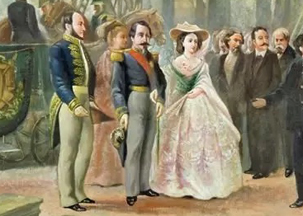
The city of Paris, as it appears to the visitor to-day, was created by Napoleon III.; for whatever public improvements have been made, since 1870, have been executed only to complete the original plan of the Emperor and his famous Prefect of the Seine. (Thomas W. Evans, The Second French Empire, 1905.)
We begin the next leg of our visit on the boulevard named for this famous prefect, Georges-Eugène Haussmann, and at a place which speaks not only of the material successes of the Second Empire, but of those of the American Colony.
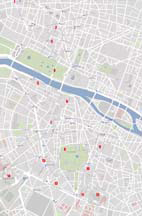
Métro #3: Havre-Caumartin
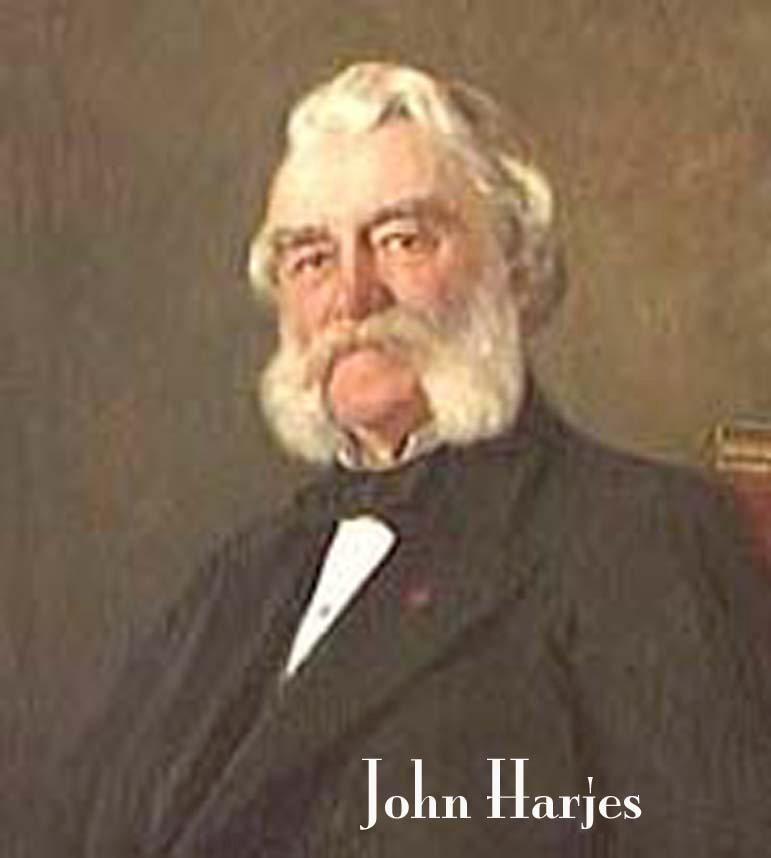
1: Morgan-Harjes Bank,
31 boulevard HaussmannA "post office" for visiting Americans, as the American Express was later to become, the Morgan-Harjes was far more, playing a key role in international banking. Both its founder John Harjes, and his son and successor, Herman Henry, were prime movers in the American Colony. Both were among the creators of the American Hospital. From the outbreak of the war, Herman Henry Harjes was at the heart of many American relief efforts in Paris: head of the American Red Cross, chairman of the American Relief Clearing House, founder of the Morgan-Harjes Ambulance Corps.
The Morgan, a veritable institution in the world of international banking, had first come to Paris in 1868, setting up shop at 3 Rue Scribe under the name Drexel Harjes and Co, and working in close collaboration with the Drexel Morgan and Co. of New York. In the United States, it was the great period of the conquest of the West and the construction of the railroads about which Westerns have left us with images of wild horse rides and extraordinary adventures. The Morgan collected French capital and invested it in American rail. At that time, American railroads enriched their investors. Private fortune in France was quite considerable at that time---it still is---and the bank prospered along with its clients when the defeat of 1870 at Sedan brought all into question and Morgan removed half of its personnel to Switzerland in order to maintain contact with London and New York. (Harjes Archives, n.d.)
* * * * * * *
Later in the day I pulled myself together and went down Boulevard Haussmann to the offices of Morgan-Harjes. About that place I remembered having written to my partner in the banking business, that while their furniture is not as handsome as ours, they seemed to have more customers. At Morgan-Harjes there was no news for me. I went back to Henry's and retired for the afternoon. I arose for supper which I had in the café---and signed for it---a short walk as far as the Café de la Paix, back to Henry's and to bed, back to sleep, back to Verdun---back to the shrieking shells, the whirr of the aeroplanes, the rats, and the crowded, bloodstained roads. (Philip Sidney Rice. An Ambulance Driver in France, 1918.)
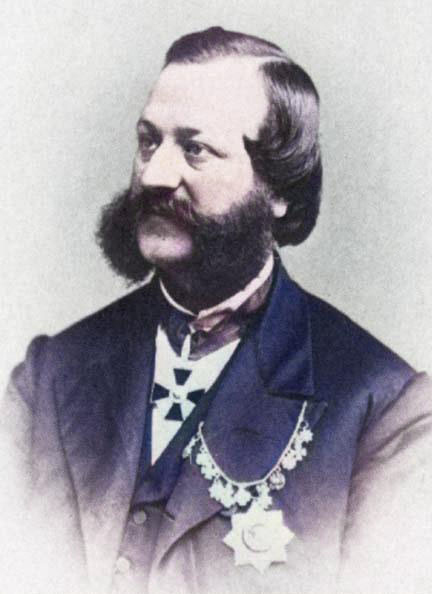
Thomas Wiltberger Evans
2: Dr. Evans' dental office,
15 rue de la Paix
So, on November 10, 1847, the Evanses sailed for Europe on the steamer Bavaria with a nest egg of five hundred dollars. Evans knew nothing of France or of Paris, had no understanding of the French language. But he had boundless confidence in his professional competence. Fourteen days later the Evanses landed at Le Havre, took the boat train for Paris, and drove to the Hôtel de Normandy, Rue de la Paix, the gas-lit street of the luxury trades, of fashionable dressmakers, jewelers, and dentists. Dr. Brewster's office was nearly opposite the hotel, at Number 11. Meeting the next day with Evans, Dr. Brewster asked to see the case of contour fillings that had won the award at the Franklin Institute, watched him work on a patient, and came to an agreement with him. Dr. Evans moved to modest quarters at 39 Rue de l'Arcade, back of the Madeleine, "for his means," the nephew Theodore wrote later, "were none of the greatest." However, the young dentist toiled at his French, labored diligently at the dental chair, and by June 1848 had recouped his savings. The partnership, called Brewster and Evans, lasted only until 1850. After many personal and professional differences with Brewster, Dr. Evans moved his residence and office to an apartment at 15 Rue de la Paix on the first floor (the second floor in American usage) and so escaped from the rather draconian contract Dr. Brewster had imposed on him. (Gerald Carson. The Dentist and the Empress, 1983.)
* * * * * * *
My acquaintance with the Prince began very soon after he came to Paris. He had not been long at the Élysée when he sent a message to Dr. Brewster, stating that he would like to have him come to the palace, if convenient, as he had need of his services. It so happened, when the message came, that Dr. Brewster was ill and unable to respond to this call himself. It fell to me, therefore, by good fortune, to take his place professionally, and to visit the Prince. And there it was, at the Élysée, that I first saw him.
He received me very kindly, without the least intimation that he had expected to see someone else, so that I soon felt entirely at my ease. I found that a slight operation was necessary, which, when made, gave him great relief. On my leaving, the Prince thanked me most cordially, commended me for the "gentleness" of my manner of operating, and expressed a wish to see me the next day. I then saw him again, professionally; and, from that time, up to the day of his death, I visited him often---sometimes as often as twice a week; for the relations between us were not entirely of a professional nature, having very soon become friendly, and confidential even. (Thomas W. Evans. The Second French Empire, 1905.)
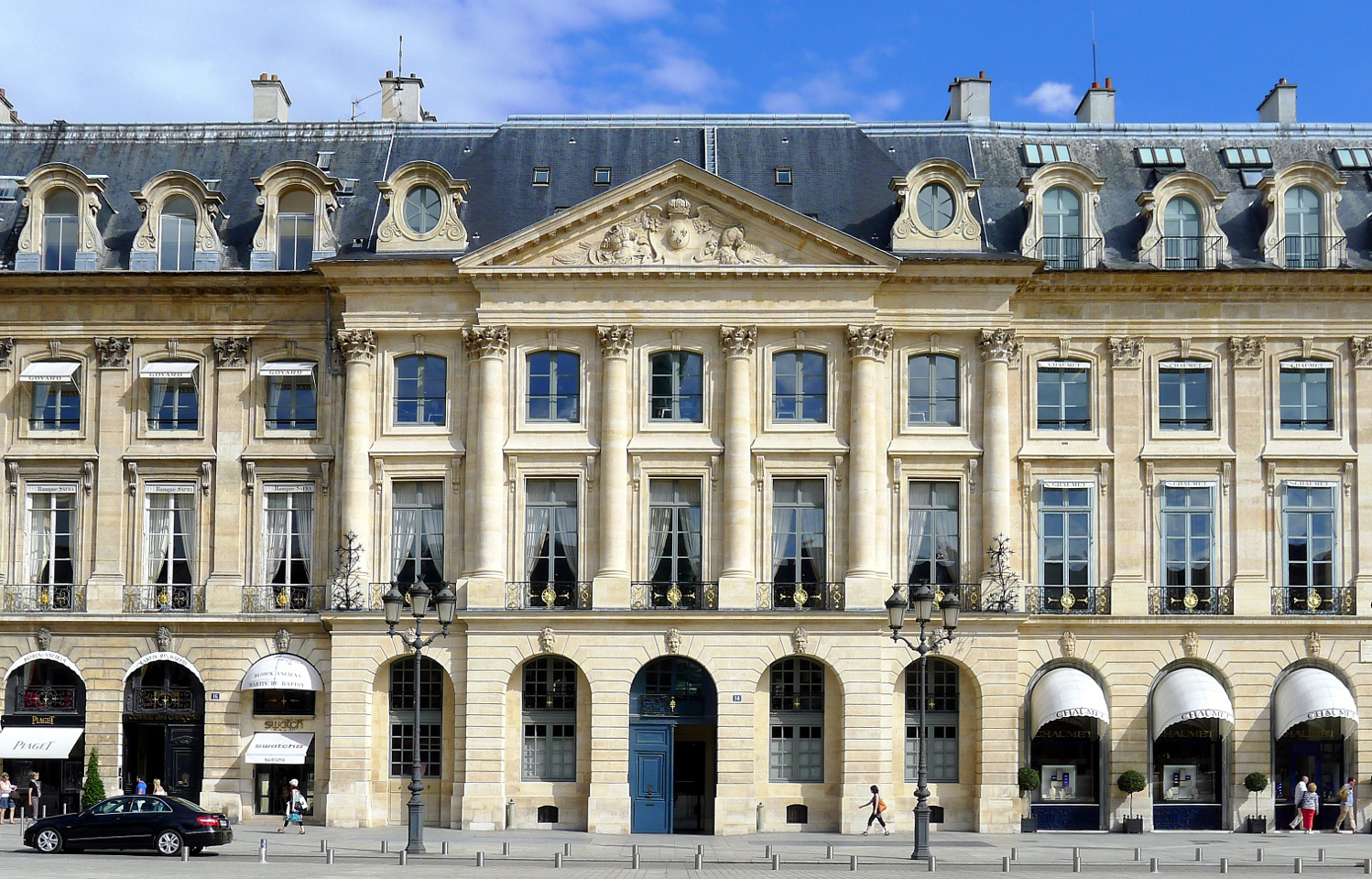
3: Morgan-Harjes Bank,
14 place Vendôme
This firm has been established since 1868 in Paris, where it was first at 3 Rue Scribe under the business name of Drexel, Harjes and Co. In 1873 its offices were transferred to 31 Boulevard Haussmann, and its business name became Morgan, Harjes and Co., in 1895. Since the 31st March 1919 the bank has been settled in this splendid hôtel of the Place Vendôme, built during the early years of the XVIIIth Century by Jean Masneuf, whose name covered the association of six financiers, contractors of the Place. (François Boucher, American Footprints in Paris, 1921.)
* * * * * * *
The firm moved from Boulevard Haussmann to 14 Place Vendôme in 1919. The new quarters provided additional space for personnel so that the firm could increase its commercial banking activities by organizing a Credit and Statistical Department, an Exchange Department and a department for dealing with commercial letters of credit. The firm continued, however, to engage in the underwriting and distribution of French franc securities since the French Treasury would not authorize the issuance of securities of foreign corporations. (Harjes Archives, n.d.)
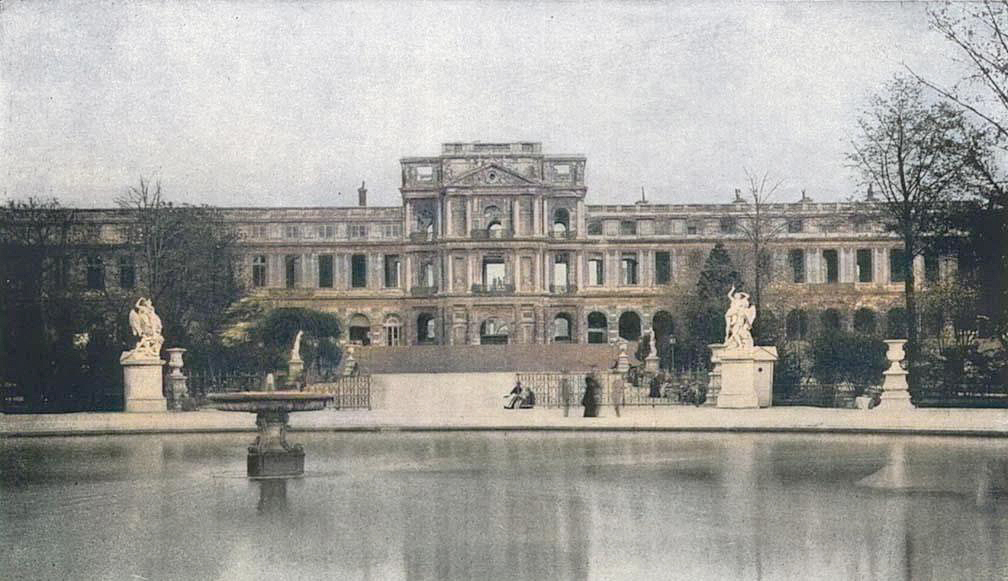
4: The Tuileries-Louvre
headquarters of the Imperial Court
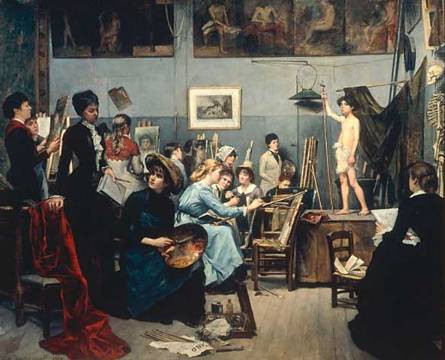
Starting with the Second Empire and trickling down after the Second World War, there was a real flow of eager young men and women coming to France, and more especially to Paris, in order to study art. Strangely enough, such a rush is unknown in any other field than art. Various reasons should be invoked to explain such an attraction to France: the increasing prosperity of the United States, along with its desire to gain access to the international cultural arena; the promotion of arts in France under Napoleon III and the Third Republic; the urge to go transmitted by those back home who had had the experience. (Véronique Wiesinger, "Some General Ideas”, 1990.)
* * * * * * *
The last official dinner given at the Tuileries June 7th, 1870, was in honour of E. B. Washburne, United States Minister, and Napoleon III recalled on that occasion that his grandfather, the Vicomte de Beauharnais, had fought for American Independence. (François Boucher, American Footprints in Paris, 1921.)
* * * * * * *
On the morning of the 4th of September (…) the Empress Eugénie rose at an early hour in order to perform the urgent duties which now devolved upon her as Regent of the Empire (…) the Emperor a prisoner in Germany, the flower of the army ignominiously plucked, the Prussians advancing rapidly upon Paris, thousands deserting the city, the troops at hand mostly raw and undisciplined, Montmartre and La Villette in an uproar, surrounded by weak and vacillating councillors, the situation of the Regent was perilous in the highest degree (…)
The question finally arose, since it was deemed necessary that the Regent should depart for very life’s sake, whether anyone had procured a carriage or provided any other way of escape. No : nobody had thought of that, and it was now too late. It was at this moment, however, that the Empress evinced her fortitude and promptitude in action : calling to her the various officiers of the household, she gave them her last orders, and then turned to General Mellinet :
"General," she said, "can you defend the château without use of arms?"
"Madame," replied the old defender of the Tuileries, "I think not."
"Then," exclaimed the Empress," all is lost. We must not add civil war to our disasters."(Louis Judson Swinburne. Paris Sketches, 1875.)
The Empress took refuge at Bella Rosa, whence Dr. Evans spirited her away to England. Almost a fairy tale, and one which Dr. Evans himself never tired of recounting.
And now we cross the great River Seine, moving from Right Bank to Left, from the prosperous underpinnings of Paris and its American Colony to the heady world of youth, of art, of studies, of "Bohemia"…
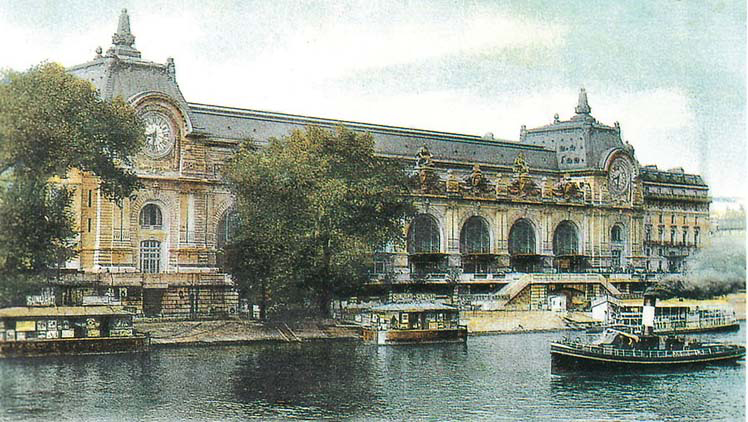
5: Gare d’Orsay,
62 rue de Lille
The station:
This is where the trains from Bordeaux deposited the incoming volunteers, who then were picked up by ambulances or who took taxis over to AFS headquarters.
We came up through Angouleme, Tours, Orleans, and finally arrived at about nine-thirty A. M. at the quai D'Orsay in Paris. Paris, cité de joie!!! Strange as it may seem I wasn't in the least thrilled at getting there. It seemed as if I had just left there, and the drive out to the Rue Raynouard had the familiarity of something seen the day before. ("Somewhere in France." Personal Letters of Reginald Nöel Sullivan, 1917.)
* * * * * * *
Everybody was working harder that Spring than he had ever worked before but Galatti did as much as any four of the rest of us. He never took a holiday. Seven days a week he got to the office at least at 8 A. M. Sometimes he went away at seven in the evening, sometimes later. And such days as he put in: He wired the agent at Bordeaux, selected just the right man to fill a vacancy, sent off reassuring cablegrams to parents anxious about their sons, located missing livrets, dictated letters, ordered brass donor-plates and saw that they got put on the right ambulances, listened to kicks, organized new sections, and if as often happened a wire came in at five announcing that 50 men would be up from Bordeaux at 7.30 --- oh very well --- it was all in the days work. He hustled just a little harder than usual and at 7.30 he had enough cars at the Quai d'Orsay to carry them and their baggage, supper and beds were waiting for them. (J.R. Fisher, in AFS Bulletin of April 1919.)
The museum:
The Musée d'Orsay was inaugurated on December 9, 1986 to display artwork from 1848 to 1914. Its collections were drawn from three sources: the Louvre, the Jeu de Paume and the National Museum of Modern Art.
A perfect introduction to Left Bank Paris, the museum puts visitors in touch with the world of art which drew so many young American students to Paris.
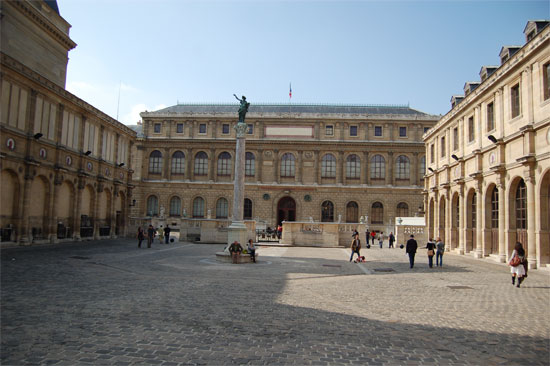
6: Ecole des Beaux-Arts,
14 rue BonaparteThe Salons existed well before Napoleon III. However, under his reign, the image of France changed dramatically to one of a modern country enjoying renewed luxury, a new home for the arts, and a land of plenty as far as art commissions were concerned. The prestige of the Ecole des Beaux-Arts, especially after the reform of 1863, started to outshine that of the Academies in London, Munich or Düsseldorf. Moreover, the bustling building atmosphere in the air pervading Paris from Haussmann on, all the new monumental sculpture then rising from the earth, the respect the art professions enjoyed in France, the attention given to art exhibitions by the media and the public, the stimulation and fraternity existing between art students in schools, all these feelings and events unknown in America were instrumental in making studies in Paris a unique experience, bringing to maturation many young artists from the United States. (Véronique Wiesinger, Paris Bound, Americans in Art Schools 1868-1918, 1990.)
7: Académie Julian,
31 rue du DragonA favored destination for American students of painting and sculpture, founded in 1868 by the French painter Rodolphe Julian (1839-1907).
The artists were once again an interesting group living and studying abroad. "My God," exclaimed William M. Chase, when first given such an opportunity, "I'd rather go to Europe than go to Heaven." Some among them still joined the older colonies in Rome and Florence, and a few went to London, Munich (where Chase himself studied) or The Hague. These years in the late nineteenth century, however, were the period when Paris first came into its own as the city of cities for painters. Here they now congregated as they never had before to work under the French masters and enjoy the romantic, carefree atmosphere of the Left Bank. They studied at such popular art schools as the Académie Julian, so crowded that the young novices hardly had elbow room; lived in cold, little attics which served as studio, bedroom, and kitchen; affected the flowing ties and broad-rimmed hats that were the accepted artists' costume; and gathered nightly at the Latin Quarter's restaurants, brasseries, and sidewalk cafés. This was the Paris of bohemian legend. (Foster Rhea Dulles. American Abroad. Two Centuries of European Travel, 1964.)
* * * * * * *
By March 25, 1891, his twenty-fourth birthday, Gutzon had completed six months' study at Julian Academy and had been accepted as a student at the Beaux Arts school. While Gutzon studied the basic techniques of sculpturing at the Academy, it was in Rodin's studio that he learned the fundamental lessons of honesty in art. "In making a bust," advised Rodin, "you must create what you see, not what your model wishes you to see." He reaffirmed what Gutzon had always believed, that to be a great artist one should have respect for the beauty of nature.
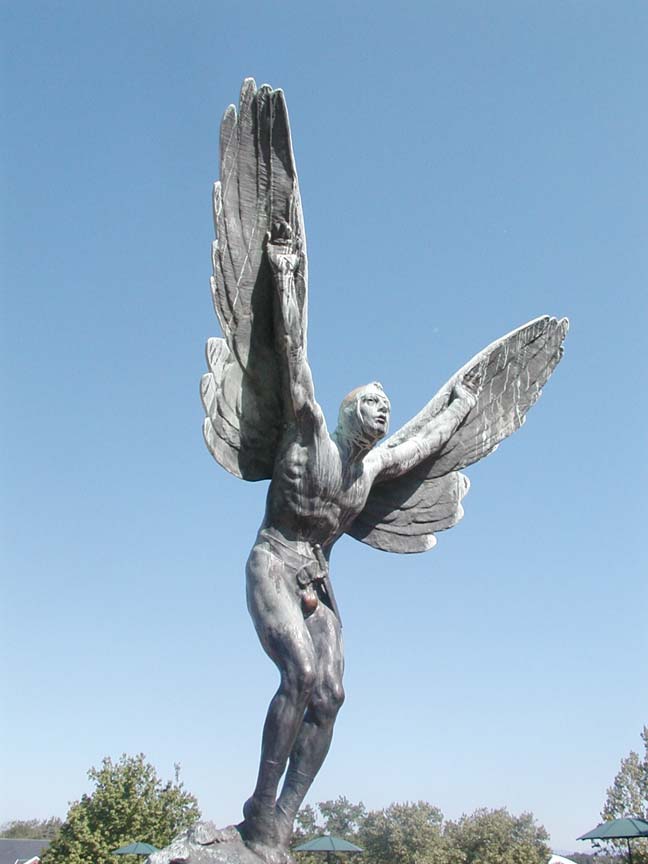
Gutzon's first statue to be unveiled following the Armistice was one he had taken particular pleasure in doing. It was a memorial to a flyer, James Rogers McConnell, a young University of Virginia student, who was killed early in the war flying for France. Some years before, Gutzon had worked on a figure of a human with wings as a memorial to the Wright Brothers. This was never completed so he incorporated some of his ideas into the McConnell statue. The finished memorial shows a figure of a young man with vast wings attached to his arms. He is standing tiptoe on a globe as if he were just ready to take flight. Young McConnell's father, who attended the unveiling at the University of Virginia, wrote Borglum of the statue, "It is magnificently beautiful, comprehensively expressive, and highly inspiring." (Willadene Price. Gutzon Borglum, Artist and Patriot, 1961.)
Aviatrix
8: Musée du Luxembourg,
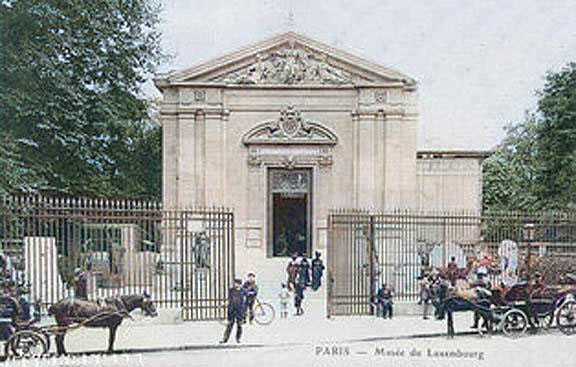
rue GuynemerEstablished in 1818 under Louis XVIII, for the exhibition of the works of living artists, the Luxembourg nonetheless refused avant-garde painting until the end of the century. The same reticence was shown towards foreign painters, although a good number of their works were purchased by the State--- subsequently housed in the storerooms of the Louvre, where they were to inspire its curator of paintings, Pierre Rosenberg, to develop the Museum of Blérancourt into a place where the works of American painters in France, and French painters in America, could be displayed.
9: Sorbonne University,
Place de la Sorbonne
The Latin Quarter is full of prestigious institutes of higher learning, most not as well known to Americans as the famous Sorbonne.
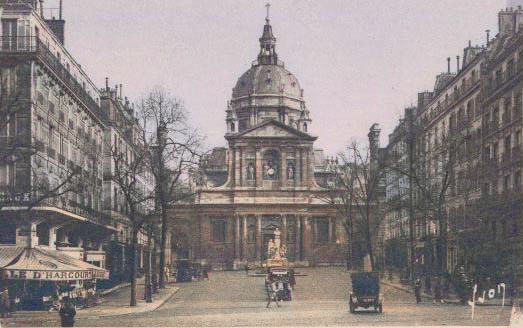
In conclusion let me say a word concerning that part of the University of Paris called the Sorbonne. The Sorbonne is the home of our Facultés des Lettres et des Sciences. Here, together with the Library, they occupy one of the original sites of the University of Paris. This institution --- with the Universities of Bologna and Oxford, the most ancient in Europe --dates back to the twelfth century, and following the general type, for which, moreover, it served as model, it was at first composed of a certain number of separate colleges. The name Sorbonne was applied to one of these colleges founded in the thirteenth century under St. Louis by Robert de Sorbon, to shelter poor theological students. This college afterwards became the Faculté de Théologie. In the seventeenth century the Sorbonne was rebuilt by Cardinal Richelieu, the great minister of Louis XIII. It has been recently reconstructed and enlarged (1885-1900), but the Richelieu chapel where one may still see the tomb of the great statesman, and the general appearance of the courtyard have been preserved. The location of the Sorbonne thus evokes ancient and illustrious memories. (Maurice Calléry, "French Universities and American Students", 1917.)
By the end of the 19th century, Americans were attracted to Paris to study other subjects than art and architecture, but they faced obstacles.
A Franco-American Committee had been organized in Paris under the direction of the Ministry of Public Instruction, with the aim of creating university degrees for American students in Paris. In a meeting at the home of Dr. T. W. Evans, July 8, 1895, it was decided to form a local committee of Americans to promote this movement. This committee was named “the Paris-American University Committee”, at a meeting held at Dr. Evans’ Wednesday, July 19, 1895. Evans was named president of this committee, founded to cooperate with the Franco-American Committee, in order to help to extend French university privileges to American students and to promote their interests in their relations with universities in France. (Correspondance de Stéphane Mallarmé, 1959.)
And herein are the roots of AFS’s student exchanges:
It may not be inappropriate to here recall the origin of the Society for American Fellowships in French Universities. Late in 1915, Dr. John H. Wigmore, Dean of Law in the Northeastern University of Chicago, a widely known educator, laid the foundation of the Society, which from now on will bear the name of American Field Service Fellowships for French Universities. In correspondence with Professor C. H. Grandgent, then exchange Professor at the Sorbonne, he learned that the project would be cordially welcomed by the French authorities. The French Ambassador at Washington, M. Jusserand, also expressed to Dr. Wigmore his deep interest in the movement. (AFS Association Bulletin #2, July 1920.)
* * * * * * *
This new wave of "friendly adventurers" from America (to use Joseph Cochran's phrase)--- art students, university students--- often faced difficult conditions far away from the family and friends of their homeland. Their well-established compatriots of the American Colony noticed, and eventually stepped into the breach, concerned as they were about the moral and physical well-being of these young people.
The Latin Quarter has been the Mecca of American art students since the coming of the painter Vanderlyn, who was the first American to exhibit in the French Salon in 1808, receiving the Napoleonic medal of honour. Since then many celebrities have received their inspiration under the dim gray shadows of the Luxembourg---Healy, Trumbull, Rembrandt Peale in the earlier years, then William Morris Hunt, John W. Alexander, John Sargent, Whistler, George de Forest Brush and a score of other famous painters. Among sculptors, Augustus Saint-Gaudens and Lorado Taft matured their powers in the studios of Paris.
Whistler used to say, "There is something in Paris which incites one to do beautiful things." The rarest voices of the concert and the opera, the greatest masters of musical instruments, have acquired technique and developed soul in this city of beautiful things. The Director General of the Paris Exposition of 1900 said that the ambition of American artists is to interpret the world of today and that they come to Paris to get their expression.
It is for this reason that thousands of aspiring young Americans crowd into the Latin Quarter every year. Most of them come with slender resources and are compelled to seek quarters that are cramped and unwholesome. They live amid surroundings not entirely conducive to physical and moral well-being.
It was not until the last decade of the 19th century that any particular attention was paid to these conditions by those who had the means to assist toward higher standards of living. (Joseph Cochran. Friendly Adventurers, 1931.)
* * * * * * *
So many Americans, young men and women, go over to Paris to study art and are not really serious about their work. It is for this reason you never hear of them again. Paris is the hardest place in the world to win. Competition is keen, the temptations numerous and difficult to resist. It takes strong character to keep from going down in the maelstrom. Yet, if you ‘arrive’ in Paris, you are absolutely sure of making a success elsewhere.
Many young people go there expecting to win success right away and without effort. The American girl is wonder-struck by the life in the quarter. The idea of sitting about in cafés and smoking and drinking liqueurs seems to appeal to her. The woman is apt to become very "bohemian," and then it is good-bye to any more serious work for her. (Sara Morris Greene, "Hunting Bohemia Spoils Art Work," New York Times, 29 November 1912.)
* * * * * * *
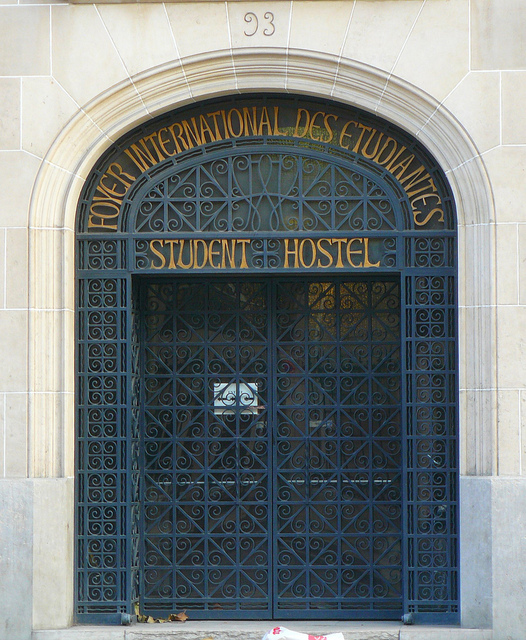
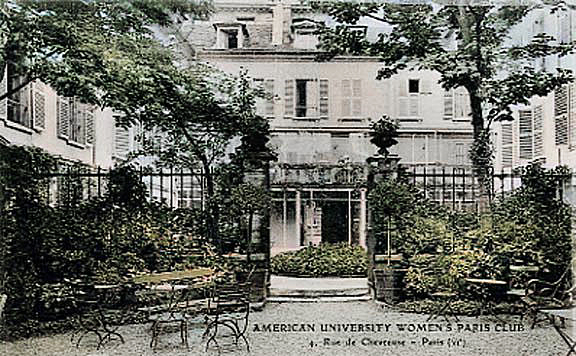
American Students' Clubs.---There are in Paris a number of clubs, which have been organized primarily by generous Americans, and provide admirably for the interests of American women students. Among these are the Students' Hostel, 93, boulevard Saint-Michel, which has a club-house admirably equipped in every respect, including an infirmary; the American Girls' Club, rue de Chevreuse, very comfortably situated in a retired street and provided with a beautiful garden; and Trinity Lodge, rue du Val-de Grace, under the auspices of the Anglican Church, very pleasantly installed. All these clubs offer homes to a limited number of American and English girls, as well as provide a complete social center with all the necessary equipment for a much larger number. (Science and Learning in France, 1917.)
10: Foyer International,
93 boulevard Saint MichelGrace Whitney Hoff established the British American Young Women’s Christian Association center on the rue de Turin. In 1906, the hostel moved to 93 boulevard Saint Michel and, after World War I, took in women students of all nationalities, henceforth calling itself the "Foyer International". It was demolished then reconstructed in 1928 as a much larger building, and given to the University of Paris in 1936.
Mrs. George Munroe and Anne Vanderbilt
11: Holy Trinity Lodge and American Hospital,
4 rue Pierre Nicole
Saint Luke's Chapel, under the care of the Episcopal Church of the Holy Trinity, has for years divided the responsibility for the religious and moral care of American young people, its Students' and Artists' Club at 107 Boulevard Raspail being an active center. With four thousand American students each year in the art and music schools of Paris and at the Sorbonne, there is ample need for both types of work as conducted by the two American Churches. (Joseph Cochran. Friendly Adventurers, 1931.)
* * * * * * *
The church has extended itself in Holy Trinity Lodge, in the Rue Pierre Nicole on the other side of the Seine, where there is a chapel for services ; an industrial school of which Mrs. George Munroe is the directress ; an hospital ; reading-rooms and a circulating library ; classes for a course in French following the lectures delivered at the Sorbonne; classes in French literature and in history ; lectures and a musicale once each week.
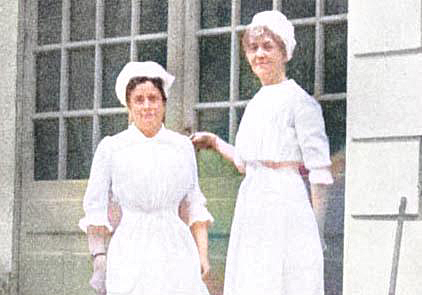
Holy Trinity Lodge and American Hospital, at 4 Rue Pierre Nicolle [...] is the only American Hospital in the city of Paris. It was founded in October, 1905, and is in connection with our Church.[...] During the four years and a half of its existence it has received and ministered to 225 patients treated in the hospital, and 320 in the clinic, making a total of 545 [...] It has nine beds, and its operating department, etc., is equal to any necessities of the present day. (The Parish Kalendar, January 6, 1910. [A few unchurchly digs at the newly-opened American Hospital of Paris, located outside Paris, in the western suburb of Neuilly-sur-Seine, and which, at the time of the writing of this article, had been inundated by the great flood of January 1910]).
A parenthesis here, for practical reasons, jumping ahead in our story for a little side trip to Paris' military hospital…
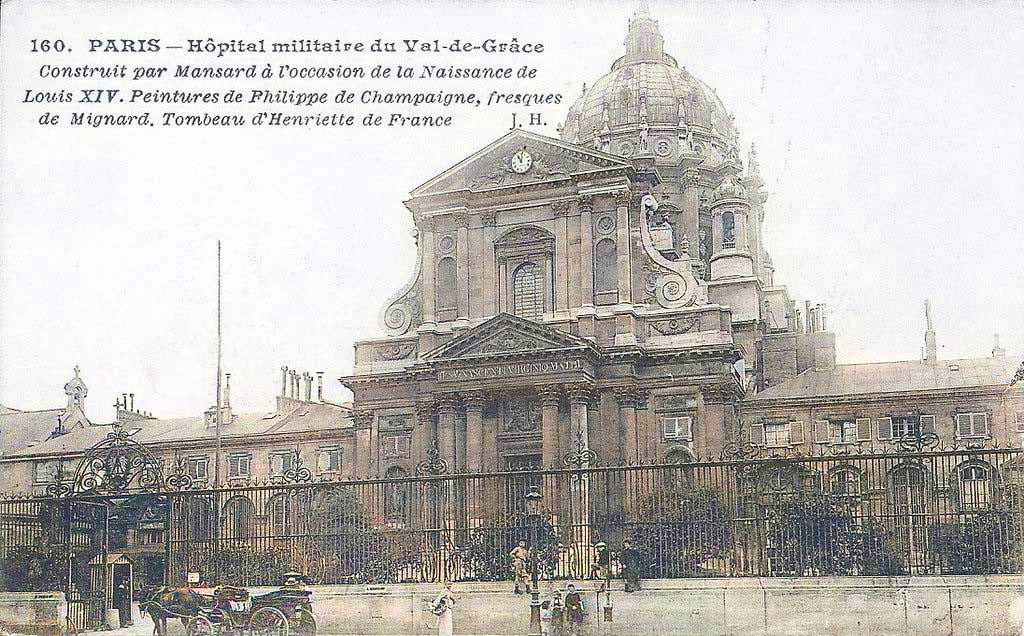
12: Val de Grâce Hospital,
boulevard Port-RoyalThe head orderly, on being questioned as to the admission of these German wounded to our Hospital instead of sending them on to Val de Grâce, said that he had had no choice in the matter; that the men were brought in during the night by Mr. Robert Bacon, former Ambassador to France, [...]
In 1919 Mr. Herrick took luncheon with me at a cottage which I had rented in Montecito, on what are now the Biltmore grounds and which were then known as Montecito Park. After luncheon he said to me, "Doctor, I never treated you badly but once, did I? but I did so once, I know, and now that the story can be told I want you to know all about it. The Secretary of State, Mr. Bryan, was much exercised about that Ambulance Hospital of ours at Neuilly; he held that our maintaining and supporting it was an non-neutral act; that inasmuch as it was called a Military Branch of the American Hospital of Paris which latter was chartered by Congress, it was virtually an interference in the War by a recognised creation of the Congress of the United States; that it was therefore within the power of Congress to revoke the Charter of the American Hospital, and that then the Hospital would have to close. Whether this was merely a threat, or whether it had some reality behind it I did not know, but I made up my mind to take no chances on what the demonstrations of an ultra-neutral Administration might result in, so I said to my Military Attaché, 'I would like to have a couple of wounded German soldiers in our Ambulance at Neuilly; can it be managed?' 'Most easily,' he said, 'they are lying all along the road but a few miles away.' 'Good,' I said, 'when it is dark, take my car and go out and get two of them and take them to the Ambulance.' Robert Bacon was in the office at the time, and he said, 'I'll go with him.' They got their prisoners and brought them to the Ambulance and safely installed them there as you know; and when their report came to me that the deed of darkness had been done, I cabled the State Department, "Hospital neutral; have German wounded." That was real diplomacy. (Samuel N. Watson. Those Paris Years, 1936.)
To resume our visit of high points of the American student experience on the Left Bank:
13: Reid Hall,
4 rue de la ChevreuseDuring the Fall of 1889, a couple associated with the American Church began to organize student gatherings in their apartments in the Latin Quarter. This initiative was approved by the Episcopalians and led to the establishment of "reading rooms" and the founding of St Luke’s Chapel, first in an apartment and then, in 1892, in a prefabricated metal building erected in a garden next to the Keller Institute on the Rue de Chevreuse. The following year, Mrs Whitelaw Reid, the wife of the ambassador, working in collaboration with the pastor of the Holy Trinity Church, Dr Morgan, took a step beyond the reading rooms by transforming the building of the Keller Institute into a home for American women students.
During the Ministry of the Hon Whitelaw Reid, [...] Mrs. Reid converted an old Louis Xlll property unto a students' hostel for women. Dr. Morgan erected on the grounds an ivy-covered chapel named St. Luke's in the Garden, but known affectionately throughout the Quarter as "The Little Tin Church". It was first opened for services in November, 1892. Frederick W. Beekman, "A Centennial Day Address", July 6, 1947.
* * * * * * *
Ernest Shurtleff was one of those rare souls whose spiritual quality appeared in all his acts and speech without the slightest taint of pietism. Naturally shy and retiring, he never forced himself upon the attention of others, but the pull of his deep and quiet nature had the force of a rising tide. He was preeminently fitted for work among artists for he lived in the world of beauty. Nature was to him the clothing of the Holy Spirit. His splendid gifts as musician and poet had been dedicated to the cause of religion. Had he specialized in either music or literature he would have made a name for himself. But he had chosen the ministry of Christ and subordinated his art to his supreme calling.
Often at the student meetings he would render a program of piano numbers and give an address. During the week he would be found in the studios, sometimes painting with the students. His Reunions at the large atelier of the École Spéciale d'Architecture, 254 Boulevard Raspail, were famous for their musical programs and friendly atmosphere. The hall had a seating capacity of four hundred but often the adjoining hallways were filled with those unable to secure admission. Once or twice a month "at homes" were given in the Shurtleff apartment where as many as one hundred and fifty students gathered.
But the public meetings were only functions of the work, the heart and core being personal contacts with individual students. "I can never forget how Mr. Shurtleff saved me in Paris," said one. His sympathy and understanding evoked confidences, and many a heart-sick, broken student left his presence with new-found courage and hope. Not a few were saved from despair and even suicide. (Joseph Cochran. Friendly Adventurers, 1931.)
For a taste of the studios where the young artists worked, a visit to the Bourdelle Museum is in order...
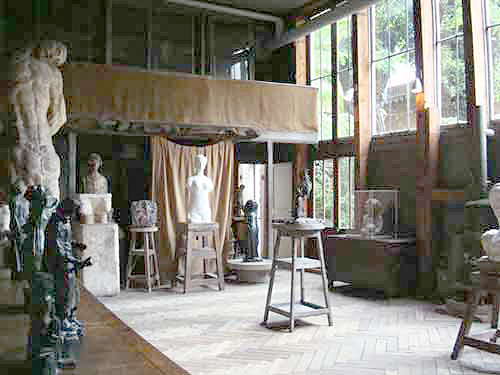
14: Musée Bourdelle,
18 rue Antoine-BourdelleFrom 1885 to 1929, this was the studio of Emile-Antoine Bourdelle, one of a number of notable sculptors who gravitated around Auguste Rodin. For a while, he was Rodin's assistant, giving classes both at the studio on Rue de l'Université and here. Also in this circle of artists was Sara Morris Greene, an American who studied with Rodin from 1905 to 1912. Her son, Jack Morris Wright, was a schoolmate and close friend of Emile-Antoine Bourdelle's son, Pierre.
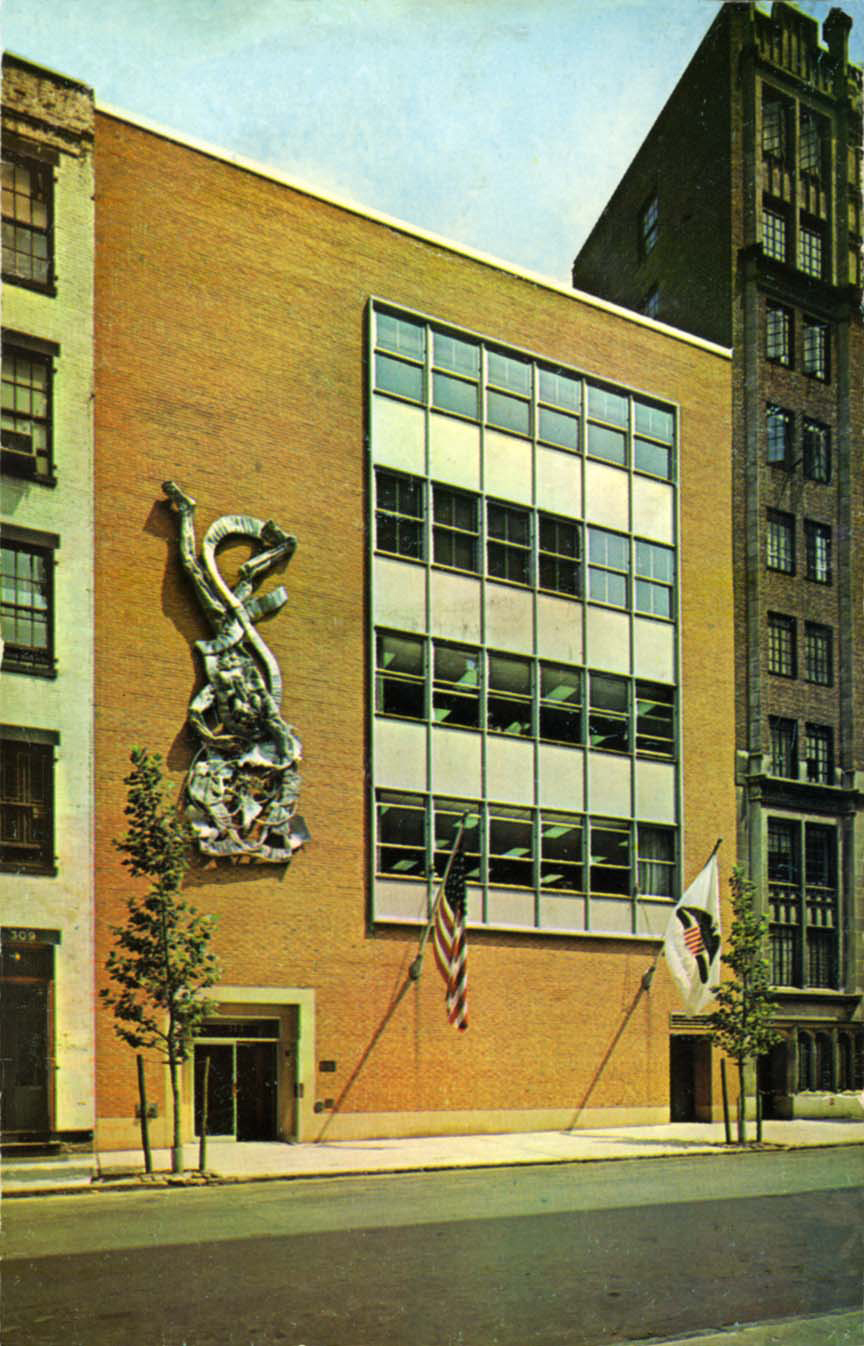
313 E 43rd Street, New York
During the war, Pierre followed the example of his older friend. Jack Wright was a member of AFS's Andover Unit, driving for the Réserve Mallet before signing up for aviation. Jack's death in a plane accident did not deter Pierre Bourdelle from himself becoming an aviator and then, after the fall of France in 1940, an AFS driver in North Africa and Italy. By then, he had emigrated to America where he was to pursue an art career of his own. Pierre Bourdelle was present in his AFS uniform, on February 8, 1961, for the unveiling of his 26-foot aluminum sculpture, The Spirit of International Understanding, which would adorn the new Galatti building on East 43d Street, New York until its sale in 1993.
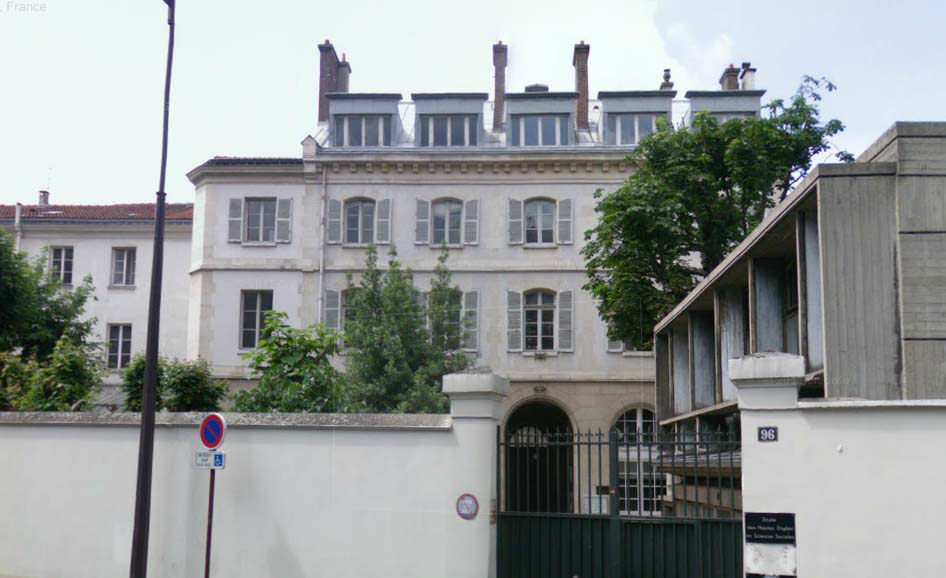
15: Office national des universités et écoles françaises (ONUEF),
96 boulevard RaspailOur visit to the Left Bank ends before the site of a non-profit institution which would play an important rôle in both the AFS French Fellowships and subsequent high school exchanges. The ONUEF's mission was to make known abroad the resources of French universities and schools, while developing teacher and student exchanges between France and other countries. Founded in 1910, it was most active between the wars, but gradually declined in importance after WW2 until its dissolution in 1980. The first AFS international scholarships in France were under its administration.
The Office National des Universités et Ecoles has incontestably become the center of intellectual and scientific relations with the United States.[...] Student exchanges have been entirely confided to its responsibility. In 1918 and 1919, one of its principal occupations was the sending of French scholarship holders, both men and women, to America. In a movement of admirable generosity, the Association of American Colleges [...] granted a large number of scholarships to French female students in university and secondary school, as well as primary-school teachers.[...] That was not all. During the winter of 1918-1919, scholarships were also granted to students who had been wounded during the war. The Office of Universities sent 34. When school resumed in the fall of 1919, 29 scholarships were granted to French university students. Some were sponsored by universities, colleges or technical institutions, others were founded by the Association of American Students who had been welcomed in French universities during the period of demobilization.[...]
To thus mix our young compatriots with American youth, of such different education and social customs, was a rather delicate operation. Precautions were taken, the necessary advice given, and as a whole, everything worked out quite well. A fine thing has been done and will be continued. It will [...] contribute towards bringing together the youths of the two countries, towards dissipating a great deal of prejudice, will open minds and unite hearts. (C. Petit-Dutaillis, Relations universitaires de la France avec les Etats-Unis, 1919.)
Chapter Three
Table of Contents