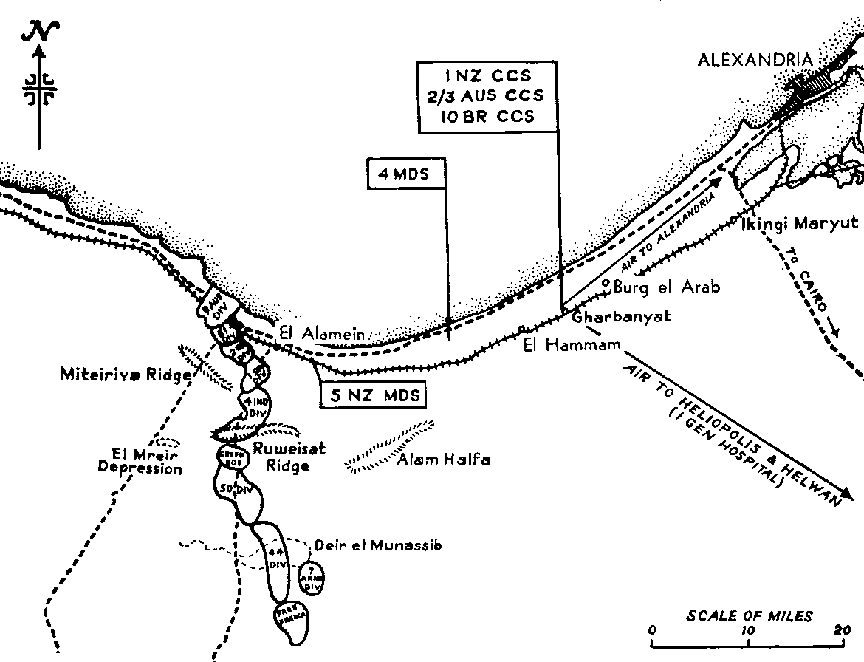
THROUGHOUT September and October Eighth Army continued its preparations for the offensive, but the medical personnel heard little of these plans. Patients were the main source of information although they knew only their own particular sectors. Daily, convoys of guns rolled along the dusty roads past the camp areas, while at night there was an almost ceaseless clatter of tanks and transporters moving into position. The medical officers attended conferences and made arrangements for the part their particular units were to play in the medical chain. Increased activity in the air indicated that the day was near.
It arrived on 23 October 1942. During the day all members of the units were assembled, General Montgomery's order of the day read, and plans for the battle due to begin that night outlined. The day was comparatively quiet. All the sick had been cleared from the forward medical units and the lines of evacuation were ready. Most of the men did some last-minute washing and letter-writing, while the units generally made final preparations for the heavy casualties expected. Extra tentage was erected at the CCS as soon as it was dusk. The job had been left until this time because in enemy reconnaissance photographs such an obvious increase in the layout of a medical unit would, indicate the nearness of large-scale operations at the front. Evening came, and an air of expectant hush seemed to settle over the whole desert as the moon rose. For once there was no sound of transport. Everything was silent and waiting. The Eighth Army's guns, nearly a thousand of them, were ready, and the infantry and armour were awaiting zero hour.
The New Zealand Division, as part of 30 Corps, was to capture and hold the Miteiriya Ridge west of the Qattara Track. It was then to revert to the command of 10 Corps, an armoured formation which, passing through gaps in the minefields westwards, would try to cut off the enemy.
After functioning as an ADS in Swordfish area (between Amiriya and Burg el Arab and about 16 miles inland) A Company, 5 Field Ambulance, under Capt J. M. Tyler, moved on 21 October. It drove along the coast road in complete darkness, then turned inland to an allotted area. Here slit trenches were dug, but no tents or bivouacs were erected and the Red Cross signs were again not displayed. Five extra American Field Service ambulance cars, with seven drivers, were attached to the ADS. No movement of troops was permitted during the next few days, and because of this some difficulty was experienced in dealing with the intake of patients. At 7 p.m. on 23 October the company again moved forward and about 9.20 p.m. sited an ADS behind a low escarpment. Here the brown and white 40ft by 40ft tarpaulins with large Red Crosses were erected, and a small German tent was set up to serve as an MI Room.
Ten minutes before zero hour, A Company, 6 Field Ambulance, under Maj R. A. Elliott, moved up in the dark to set up its ADS in a forward position well in front of the artillery and in close support of 6 Brigade infantry battalions.
The artillery opened fire at 9.40 p.m. on 23 October. Gun flashes floodlit the desert and the air reverberated with the continuous concussion of the gunfire. By the time A Company, 6 Field Ambulance, reached its position the barrage was thundering overhead and the men set to work immediately to erect and sandbag the tents. The tense atmosphere of battle, the incredible noise, the throbbing air, and the unnatural light spurred them on, and the dressing station was very soon established and ready for operation. Nearby were some dugouts left by South Africans, and the men were able to use these for themselves. The enemy must have been stunned by the terrific weight of the barrage, for he threw little back.
At ten o'clock the infantry went forward under the barrage. Men wounded in the advance from the infantry start line to the first minefields reached 6 ADS by midnight, but it was not until the early hours of the 24th that the ambulances were able to get through to the battalion RAPs and clear the wounded, who were by then accumulating. The task of the ambulance car drivers was most difficult; the desert tracks between the ADS and the several RAPs, though lit in parts, were ill-defined and difficult to follow, and were congested with armour, particularly in the narrow gaps leading through the minefields. Tanks moving up prevented the ambulances from making their way through, and by the time they were able to reach the RAPs and set out on the return journey, the enemy, reviving somewhat after the initial stunning shock, was beginning to hit back. Returning amid bursting shells and whining shrapnel, the ambulances relayed their wounded back to the ADS, and the little dressing station became a bustle of activity.
With a clearer passage for the ambulances, the wounded began to pour into 6 ADS, which for a time was taxed to cope with the flood of casualties. Medical officers and orderlies were dressing wounds in a frantic rush, bandaging, splinting, and administering drugs, giving blood transfusions to those whose condition was low, and even performing some minor surgery where it was deemed urgently necessary. But still the number of men awaiting attention accumulated---they lay on stretchers on every available square foot of space. In the holding wards, too, men who had received attention lay everywhere awaiting evacuation to the MDS, for it was impossible to get them away before first light; armour in a densely packed mass was moving up past the ADS during the early hours of the morning, and ambulances could not find a passage through the congestion.
By 6 a.m. it was possible to send the first of the wounded down the desert track to 5 MDS, under Lt-Col McQuilkin, and all vehicles that could be used, ambulances and three-tonners, were despatched fully loaded with wounded. To clear the congested treatment tent for those awaiting attention, the wounded were loaded on the ambulances direct from the reception centre at first, and soon some semblance of order was restored in the dressing centre. By midday six extra ambulance cars were secured to assist the evacuation and the dressing station had returned to smooth-running routine.
All day the ADS worked steadily. That night the barrage opened again and there was a further heavy flood of casualties, but a continuous relay of ambulance cars plying from RAP to ADS, from ADS to MDS, created a smooth-running chain of evacuation, and the capacity of the ADS was not again overtaxed. With tank engagements on the 25th, 6 ADS was receiving casualties mostly from the British armoured units; a light dressing station from 166 British Field Ambulance joined the ADS to assist in treating these casualties.
Fortunately for 5 ADS the enemy did not reply to the opening artillery barrage. Had he done so, the ADS, just forward of our own guns, would probably have been in an untenable position. A steadily increasing number of casualties poured in, and the medical officers and men of the company worked without a break during the night and all the next day. It was fortunate that additional ambulance cars were available to take the casualties back quickly to 5 MPS, then some eight miles way. In a period of 26 hours the ADS admitted and evacuated approximately 460 casualties.
One medical officer, assisted by orderlies, dealt with walking wounded only at the small German tent. A second medical officer, with the most skilled nursing orderlies, treated the serious cases and applied Thomas splints whenever lower limb fractures were involved. A third medical officer, with less skilled assistants, dealt with the miscellaneous wounded. As far as possible the orderlies and stretcher-bearers worked in rotational shifts. This ensured some rest for all from their very arduous and trying duties. Next day, 25 October, fewer casualties were received, the total admissions numbering 94. One ambulance car, en route from the ADS to the rear, ran over a mine and was damaged. During attempts to salvage the vehicle, it struck another mine and was so damaged that it had to be abandoned.
At 5 MDS very full preparations had been made. At 11 p.m. on 23 October the first casualties began to arrive. During the early hours of the 24th, Major McKenzie's(1) General Hospital surgical team began performing urgent major surgery; it continued to work without a halt for 16 hours. All through the early morning a steady stream of stretcher casualties poured in, and at mid-morning twelve three-ton trucks filled with walking wounded returned from the ADSs. The MDS was exceptionally busy, and a request was sent to the ADMS for an additional surgical team. To clear the MDS of patients, extra transport was pressed into service, as the ten MDS ambulance cars could not cope with the numbers waiting to be evacuated. After midday, casualties began to arrive at a terrific rate, many of these being from 51 Highland Division. From 1 South African Division's forward medical units, considerable numbers of chest, head, and abdomen cases were also received. The accommodation of the MDS was completely overtaxed, and at 3 p.m. 250 lying cases surrounded the area without any form of protection from sun and dust. The staff of the unit worked continuously. and the ASC drivers, when not driving their ambulances, assisted in general duties. At this time the supply of stretchers was exhausted and it was impossible to procure more. The supply of blood and plasma was adequate, and during the day nearly ninety transfusions were given.
About 6 p.m., through the efforts of ADMS 2 NZ Division (Col Ardagh), 30 vehicles arrived, and within an hour a great number of casualties was evacuated, leaving with the MDS only those who had recently come from the operating theatre. Considerable relief was afforded the overworked medical officers when Maj S. L. Wilson, with his additional surgical team from 1 NZ CCS, began operating during the afternoon. Both surgical teams operated without a halt for many hours. The evacuation arrangements worked more smoothly as the day progressed, and an adequate number of three-tonners was available to clear the MDS. On an average it took three hours for a vehicle to do the round trip from MDS to CCS.
Over a period of 24 hours (23-24 October) the MDS handled a record number of 838 patients, of whom more than 500 were New Zealanders. The surgical teams, as well as the field ambulance surgeons, were fully engaged with either major or minor surgery. The resuscitation department was always abreast of blood transfusion requirements. The day's intake on 25 October was much lighter (about 300), and every feature of the work in the MDS, including evacuation, went most smoothly. The special surgical teams attached to the MDS worked under a rotational scheme of duty, and this gave the surgeons an opportunity for rest.
Amongst the casualties received at the MDS were also many enemy prisoners, but their own captured medical personnel were able to look after them. Considerable air activity in that sector and heavy bombing in nearby areas interrupted rest and sleep. During the day there were several air battles overhead. On the night of 25-26 October things became relatively quiet, and as many of the staff as possible took the opportunity to rest.
The Battle of Alamein provided 1 NZ CCS at Gharbanyat with the busiest period of its life, but the unit rose to the occasion. Surgeons, doctors, sisters, medical orderlies, stretcher-bearers, and cooks all gave of their best.
The CCS and the adjacent 2/3 Australian CCS and 10 British CCS received patients in rotation. The unit started receiving at 5 p.m. on 24 October, and within three hours over 300 cases had been admitted, most being seriously wounded. At half past eight a special evacuation by road to Alexandria cleared some of the wards and the unit was able to admit a further 70 casualties. No member of the staff will ever forget that first night. Every department was working at top pressure, all wards and annexes were congested, stretcher cases were everywhere. Special attention could be given only to the very seriously wounded, while for the others there was time only to see that they were as comfortable as possible and well covered with blankets. More than anything else, the wounded appreciated hot drinks, and the Padre ensured that all of them received Red Cross cigarettes and chocolate. Morphia gave relief to those in pain but shock and exhaustion brought instant sleep to most.
The next day, Sunday, a blockage on the railway line upset the evacuation of wounded, and. patients had to be taken by road to the train at Ikingi Maryut. This caused a shortage of ambulances for a while and casualties accumulated. A further 300 cases came in during the day, so that by night the hospital was again full to capacity. Overnight a heavy rainstorm brought further problems when some of the tents leaked. No one had time to stop and make repairs. Next morning a strong wind quickly dried the ground, but then there was dust to contend with.
And so the busy period continued day after day. Admissions for the ensuing week averaged over 200 daily. Extra tentage had now been erected, bringing the number of wards to ten. All the staff worked long hours. Some of the sisters and orderlies were often on duty over eighteen hours a day. The sisters were proud to he attending to battle casualties in the forward area. After such long hours on duty it was a great relief to get out of one's department and enjoy the fresh air while walking across for a quick meal at the cookhouse.
Volunteers freely offered their services for extra tasks such as stretcher-bearing. The ASC drivers and general duties teams, though not at all accustomed to nursing, were willing assistants in the wards, and by attending to routine jobs enabled the orderlies to employ their skill where it was most needed. A number of men had roving commissions and lent a hand where necessary. Considerable assistance was given by a team of Mauritians who arrived at the hospital each morning. Two or three were attached to each department and proved first-class workers. Although they spoke French only, they were quick to see what was required and were keen to learn.
Much could be written about the work of the operating theatre and of the trials and difficulties that the number of serious cases brought its staff. Naturally the most important, it was by far the busiest section of the whole unit, working non-stop for ten days and nights. The CCS had only one theatre at this time. It was an EPIP tent, and in it two operating tables were set up. Working in this very confined space, two surgical teams, under Maj T. W. Harrison and Capt A. W. Douglas,(2) operated almost continuously for 72 hours in eight-hour shifts. All the operations were major ones. Then, when the work was at its peak, Capt Douglas had to go off duty with a septic finger. Col T. D. M. Stout and Maj W. M. Brown(3) were attached at this time and it was possible to form three operating teams. After an eight-hour shift in the theatre, the orderlies of each team had to spend a further eight hours sterilising and cleaning up. With endless major operations, the cramped space and the heat, and with but a few hours' sleep daily, these surgical teams required extreme patience and endurance. They did a grand job and saved many lives.
When it was seen that the main theatre could not possibly cope with all the cases requiring surgical treatment, the MI tent was equipped with surgical and anæsthetic equipment and used as a small operating theatre. Maj Brown, and later Lt-Col Hunter, performed the surgery here, with the assistance of a theatre team. Long hours were worked in this small department, too, and many patients were handled. Most of the wounds treated were slight, requiring only surgical cleaning, dusting with sulphanilamide powder, and dressing with vaseline gauze.
With the ambulance convoys arriving unheralded at all hours of the day and night, and famished drivers and wounded all in need of a meal, the hospital cookhouse was almost as important as the theatre. The cooks kept up a 24-hour service and ensured that the large numbers passing through the unit were able to have a meal. Food was kept in special hot-boxes and cocoa or coffee was always available. Walking patients ate at the cookhouse, but the wards' staffs had to collect meals for stretcher cases.
The New Zealand CCS was not, of course, in the field to deal with New Zealand sick and wounded alone. Medical services were pooled and the unit was under Corps control, admitting troops from all the Allied formations that constituted Eighth Army---cheery Australians, often too long for their stretchers; South Africans, who could always be told by their solid weight; staunch Scots from the Highland Division; and English Tommies, always to be admired for their patience and philosophical acceptance of suffering. Someone could always be found to interpret for the Fighting French, but Greeks, Indians, and Italian and German wounded prisoners of war presented difficulties, particularly when their medical documents were written in their own language.
Patients did not remain long at the CCS during this busy period. All who were fit to travel went on as soon as possible, some remaining for only an hour or so. Most of the wounded were sent by train from Gharbanyat station to hospitals in the Delta area, but some went by road to Alexandria. Air evacuation had been instituted just before the battle began, and cases urgently needing specialised treatment went by hospital plane to Cairo. The landing ground was about three-quarters of an hour by road from the CCS and the air journey from there took just over an hour.
In the first three days of the offensive, Eighth Army drove a big salient into the enemy's defences. The fighting was bitter and the objectives were gained at great cost. But to the enemy the cost was much greater, and in men, armour, and materials he had been heavily depleted. Since daybreak on 24 October the Germans had been making a series of counter-attacks. These, together with a heavy armoured counter-attack on the 27th, were all repulsed. The ADSs treated and cleared to the MDS a large number of wounded from the fighting.
October the 26th was the quietest day experienced at 5 ADS since the action began, and only 70 casualties were brought in. Seventeen of these had resulted from enemy bombing of front-line positions near the ADS and the artillery positions sited just behind it. The ADS was fortunate to escape being hit as considerable numbers of enemy aircraft were in action over the sector. These same gun positions were again bombed on 27 October and further casualties suffered. The enemy also began to shell the area, and the resulting casualties were brought back to the ADS by ambulances of the American Field Service.
On the night of 26-27 October 6 Brigade made an attack which gained more depth in front of Miteiriya Ridge, and during next morning 6 ADS was busy clearing the casualties. Eighth Army was then regrouped, and the next night the whole of 2 NZ Division, except the artillery, was relieved by 1 South African Division and moved back to a rear area to reorganise.
'While the Division was resting, 9 Australian Division, fighting magnificently, succeeded in penetrating far into the enemy's defences. This threat to cut off his coastal forces drew the enemy's main concentration to the north, while farther south Eighth Army resumed its attack. For this attack 2 NZ Division, with two British infantry brigades(4) under command, was brought back into action on 1 November to conduct a further assault and enable the mobile 10 Corps to break through.
A Company, 6 Field Ambulance, dug in its ADS that night in the salient driven into the German lines. Its position was almost on the railway line, some distance beyond the El Alamein station. Nearby were s ome uncleared minefields, and a little to the north was the main road, north of which the Australians had been fighting. With the help of bulldozers borrowed from the Engineers, areas for the tents had been dug out during the afternoon, and the men set up and sandbagged their tentage, completing the erection of at least a partially protected dressing station. 6 ADS was opened at last light.
It was five o'clock next morning (2 November) before casualties reached the dressing station from the attack, most of them from 152 Brigade and armoured units. Wounded flowed in steadily, and the ADS continued working through the day, on through the night, and during the following day. As the wounded were sent back, 5 MDS, the CCS, and the hospitals were busy in turn.
This attack, relentlessly pressed by 9 British Armoured Brigade, burst through the enemy's anti-tank gun screen which had so far successfully barred the way-to the armour. In the morning of 4 November it was found that this screen of guns had withdrawn to the north-west. The way was clear. Rommel was retreating and the chase was on.
PROVIDING ADSs for 5 and 6 Brigades, A Company, 5 Field Ambulance, and A Company, 6 Field Ambulance, passed through the gap on the evening and night of 4 November. During the morning HQ and B Companies of 6 Field Ambulance had moved up from their reserve position into the gap, ready to move forward in their role of mobile MDS for the Division. Around them was an amazing concentration of guns and transport, tanks and armoured cars. Guns were barking close by. After dark the unit moved out into the open desert in a night lit with flares and tracer.
Throughout the night the column moved westward from Alamein, churning slowly through the soft sand. Along the skyline to the rear the flickering and rumbling of the battle continued, and to the north and west there was intermittent bombing and artillery fire. At daylight A Company, 6 Field Ambulance, moved on in desert formation behind 6 Brigade and travelled north-west until noon. Twenty patients, mostly casualties from encounters en route, were treated and evacuated to the MDS. The 5 Brigade ADS also admitted some wounded.(1)
Because of the heavy going, the original object of reaching Fuka in time to cut off the retreat of a section of the enemy was defeated. In thirteen laborious hours only 35 miles had been covered. Time and again vehicles had stuck, and the men had piled out and heaved and manhandled them through the soft sand, often axle-deep. While there was no bombing in the vicinity of the field ambulance, men were occasionally sent scurrying by German fighter-bombers that came roaring down over the column, while Bren guns and Bofors jabbered and coughed in deafening chorus.
Many prisoners were passed during the day. Some were walking, and others, more fortunate, were crowded into trucks. Late in the afternoon the cook's truck and water cart, which had been missing, rejoined the company much to everyone's relief, and conversation, which had been gloomily dwelling on the prospect of a diet of dry rations, switched to speculation on the fate of the Division moving on ahead, miles inside enemy territory.
HQ and B Companies, 6 Field Ambulance, drew up close behind A Company when the column halted for the night. The men were exhausted and bedded down without digging in. Huddled in their blankets, they lay around the trucks, and the only sounds to he heard were the calls of desert night birds and the tread of the sentries.
In the early hours of the 6th the weather was fine; the troops were stirred into life by reveille, played on a spandau. Congratulating themselves on having passed the night without incident, the men were startled by a burst of machine-gun fire and a stream of tracer from a group of vehicles moving off to the left. This fire was followed by anti-tank shells which ricochetted from rocks and went screaming overhead. The New Zealanders retaliated, and the situation showed every indication of developing into a really hot skirmish. However, the fire died away as suddenly as it had started. Direct hits had been scored on the German vehicles, killing and wounding some of the occupants. In this skirmish 100 Germans and 500 Italians were captured. Ambulance cars of A Company went out to investigate and returned with the wounded, who were treated and evacuated. One young, slightly wounded German, standing amid the mangled remains of his comrades, seemed grimly amused at the affair. He explained that they had slept alongside the New Zealanders all night, assuming them to be a German force.
HQ Company, in the meantime, was partially set up and began to receive patients at nine o'clock. During the morning 126 cases, some requiring blood transfusions, were treated and evacuated in ambulance cars.
Late in the morning rain began to fall, developing into a torrential downpour that continued until the desert, composed of a clayey type of sand, became a swamp. When, at 2 p.m., the two companies moved off, several trucks were immediately stuck. Men and vehicles struggled on until, in darkness, they were finally bogged. There was further heavy rain during the night. In the morning, with the assistance of artillery tractors and tanks, the trucks were extricated and moved a short distance to a point eight miles south of Sidi Haneish.
At 10 a.m. A Company, with 6 Brigade, passed through a gap in the minefields ahead, fanned out into desert formation, and moved forward until halted in deep mud and heavy rain. HQ and B Companies advanced on the following day (7 November) to a point one mile west of A Company. It rained intermittently all day and no further advance was possible. Farther west, the armour had been so badly bogged that it was unable to reach Mersa Matruh in time to cut off the retreating enemy. In the south, however, four Italian divisions, which had been abandoned without transport by the Germans, were cut off and rounded up by 13 Corps.
This day and night of enforced waiting was a period of acute discomfort for the troops, who huddled in the vehicles for shelter and slept in wet clothing, packed like sardines. Any man who stirred overmuch in his efforts to relieve cramped limbs was likely to receive a blistering round of abuse from his suffering comrades.
With fine weather on the 8th, the ground showed signs of drying out, and the advance continued. Many vehicles were stuck fast. A Company moved at 10 a.m. Most of the trucks had to be manhandled, the men struggling, over their boots in mud, to get them on to sufficiently hard going. Conditions improved as the day passed; a point 15 miles south of Mersa Matruh was reached, where a halt was made for the night. HQ and B Companies, moving an hour or so after A Company, proceeded west along a telephone line, encountering similar difficulties.
On the 8th, and with 4 Light Armoured Brigade as a screen, the Division moved through the minefields south of Matruh. On the way to Sidi Barrani, strongpoints left by the enemy to delay the advance were quickly and decisively dealt with. The path of the advance was littered with burning vehicles and destroyed enemy equipment.
On the following day B Company relieved A Company and accompanied 6 Brigade to Mersa Matruh, where the ADS opened on the 10th and operated until the 20th. 5 Field Ambulance was also under command of 6 Brigade, which remained at Mersa Matruh while 5 Brigade continued the pursuit to the frontier.
A Company, 6 Field Ambulance, rejoined HQ, and on the morning of the 9th the two companies moved behind 5 Brigade and made a slow trip through the minefield, later turning north to reach the main road in darkness and camp for the night.
At first light, in weather that was fine but which also had the chilly touch of approaching winter, the advance continued. The transport rolled on in an endless convoy stretching from skyline to skyline and far beyond. Just west of Sidi Barrani, during a long halt, the adjoining unit to the rear was strafed by a lone enemy fighter and one truck was left in flames.
About mid-afternoon there were signs of movement ahead. The troops, utterly weary of standing about, eagerly clambered aboard the trucks, and the convoy was in motion again. The Buqbuq turn-off was passed. Just beyond was the destination for the day, a flat area already crammed with transport, lying between the road and sea. As evening approached, everyone was startled by the sudden appearance of swarms of particularly voracious mosquitoes. It was impossible to sleep completely covered by blankets, and next day many faces were covered with bites.
That morning (11 November) A Company was ordered to move on ahead. It was rumoured that the forward troops had encountered stiff resistance and that an extra ADS was required. The company left the road and moved rapidly toward Sollum, in extended desert formation, across grey-green, herb-covered plains that sloped gently from the flat-topped escarpments to the white sand dunes of the beaches.
The escarpments and the beach gradually converged until the company moved on to the road and travelled in column to the foot of Halfaya Pass. Later HQ arrived, and the unit pulled off the road towards the beach, where, amidst a mass of closely congested traffic of all descriptions, the vehicles waited all day.
In a surprise attack just before dawn on 11 November, 110 men of 21 Battalion had captured Halfaya Pass, killing 70 of the enemy and taking 612 prisoners, at the cost of one man killed and one wounded.
With the Pass cleared, a continuous stream of tanks, guns, and trucks slowly threaded its way up the winding road. During the morning a few enemy aircraft appeared and bombed and strafed the traffic on the top of the pass. Throughout the day, parties of the ertswhile defenders of the pass marched through the waiting lines of transport, on the first stage of the road back to captivity. The unit was treated to the diverting, probably unique, sight of a column of prisoners guarded by two New Zealand infantrymen, who, disdaining to carry their own rifles, had compelled two of the prisoners to carry them.
The field ambulance pulled on to the road late in the afternoon, moved at 7 p.m., and slowly ascended the steep pass in darkness, spending the night at Musaid, six miles beyond the summit. On the following day (12 November), after travelling via Capuzzo to an area south of Bardia, the unit set up and opened the MDS.
In the course of the next few days the Division assembled in this area. Throughout the remainder of the month the Division as a whole was occupied with general re-equipping, reorganisation. and recreational training.
Fifth Field Ambulance did not move forward until 8 November, while 4 Field Ambulance continued to run a divisional rest station on the coast a few miles from El Alamein until 18 November, when it moved up the coast to Bardia, accompanied by 4 Field Hygiene Section, and again set up a rest station.
When the CCS left Gharbanyat on the morning of 8 November there were already signs that this part of the desert was returning to normal. Smoke rose from the chimney of the gypsum factory, occasional trains passed up the long-disused railway line, while wandering Arabs and their camels once more appeared. The war was over for this region. A cold wind blowing in from the sea filtered sand over the theatre and ward sites where 1 NZ CCS had played its part in the historic Battle of Alamein.
On the fully loaded trucks there was little room for comfortable travel. Some of the men contrived to lie down on mattresses, while others sat up behind the cab or clung on precariously to gaze at the relics of battle. Strewn along both sides of the road were burnt-out trucks, charabancs, staff cars, German and Italian planes, gutted tanks, and useless anti-aircraft guns. Shells, tins, and jerricans in scattered heaps told of hasty retreat. During long delays in the dense traffic, many explored wrecked cars and trucks. There was always the possibility of discovering a prize.
The convoy stayed overnight at Fuka and next day took nine hours to travel the 40 miles to Gerawla. Here, where wrecked vehicles were still smouldering, the unit opened on a site near to that occupied a year before by 2 General Hospital. It erected nine wards and in the following week admitted 700 patients, mostly sick. From an Italian hospital at Smugglers' Cove, cast of Mersa Matruh, several German field hospital tents with canvas floors were salvaged. Light and simple to erect, these tents added greatly to the mobility of the CCS. At Gerawla water had to be rationed and the men would queue up once a day for half a bottle each.
As they stood in the queues the men speculated about the future.
British and American forces had landed in Morocco and Algeria and had advanced into Tunisia. What would be the fate of the enemy, what army would reach Tripoli first, and how far the CCS would travel were questions of the hour. The unit was to go farther than most men conjectured. The next step was a move up to Tobruk.
A strong wind was blowing when the convoy left Gerawla on 19 November, and in half an hour a thick dust-storm had developed. Visibility was reduced to a few yards, and travel at little more than a crawl was most uncomfortable. Sitting on top of the loaded vehicles, the men had no protection against the swirling sand and the keen, biting wind.
Skirting Mersa Matruh the trucks swung inland, following the main bitumen road past the airfield and through the deep perimeter defences. Soon the well-known desert corner, Charing Cross. was reached. Turning west here the road ran in a straight line for 80 miles. With absolutely no relieving features, the stony desert stretched flat as a table top to distant horizons.
After Sidi Barrani was passed next morning, the road became little more than a rough desert track twisting between barren hillocks. Water cans, buckets, and loose equipment rattled and clattered as the trucks jolted over the rough surface. Feeling anything but happy as these conditions continued for mile after mile, the men looked like ghosts in the clouds of white dust enveloping each vehicle. Then the heavily laden trucks slowly climbed Halfaya Pass. The going was better now. Soon the Wire was behind them and the CCS was in Libya. The rubble heap that had been Fort Capuzzo was passed, and an hour and a half later the buildings of Bardia showed up white against the blue sea. Near here was the New Zealand Division. The familiar fernleaf roadside signs of the various divisional units were left well behind before the day's trip was over.
Gambut was passed early next day and by mid-morning Tobruk was reached. The advanced party had already marked out the sites for the various departments. Much to everyone's delight a large quantity of mail, the first for several weeks, was waiting.
The new site was on high ground five miles inland from the sea and eight miles by road from Tobruk. Burnt-out trucks, barbed wire, and other rusting debris were evidence of the early battles that had been fought on the outskirts of this important port. Rocky ground made it almost impossible to drive in tent pegs. However, no time was lost once the trucks were off-loaded---four hours after arrival most of the departments were set up. Seventy patients. the overflow from 15 British CCS nearby, were admitted by the middle of the afternoon. This unit, with its 6 a.m. bell-ringing, whistle-blasts, and calls of 'Wakey! Wakey!' which signalled reveille, will be well remembered.
The CCS was at Tobruk for nearly three weeks. Patients came by plane from El Adem and by road back from Barce and Derna. Medical units in the rear sent them forward. Contrary to the usual policy by which patients were sent on as soon as possible, they were now held pending evacuation by the hospital ship Llandovery Castle, which sailed once a week for Alexandria. Under this system the bed-state at the end of each week far exceeded the normal 200-bed establishment. When the New Zealand Division moved from Bardia, patients received from the field ambulances brought the number held up to 470. Accommodation was heavily taxed and extra tents had to be erected.
Fortunately by this time the Light Section, under Maj S. L. Wilson, had returned and its staff was distributed among the various wards. The loss of a truck by fire had been one of the highlights of its experiences since being separated from the Heavy Section two months previously to perform surgery with the field ambulances.
In the last days of November the weather grew much cooler. Extra blankets, battle dress, and winter clothing were issued, and wards were supplied with kerosene heaters. Tarpaulins were overhauled and repaired against rain. And it did rain at Tobruk. Strong winds blew in low cloud from the sea and there were heavy downpours. Large pools of water formed throughout the unit lines and many areas were muddy, but this did not deter the footballers.
There was little air activity at Tobruk, although on several nights enemy bombers appeared. The importance of the harbour could be judged by the concentrated ack-ack barrage sent up. The unit had a front-seat view of this spectacular display, and splinters often fell in its area. About a mile away across minefields lay the railhead of the single track from Alexandria. Against the possibility of raids on this target, some of the tents were sandbagged. It was disconcerting to imagine what might have happened when, a few days after the unit had moved farther forward, it was learned that a stick of bombs apparently intended for the railway had landed in the unit's lines.
Meals were good during this period in spite of the speed with which the Army had moved away from Base depots. 'Bully', however, appeared only too frequently. One day there was an issue of bread---a welcome change after weeks of hard biscuits. Water was again a problem as all the wells at Tobruk had been salted. For making drinks, washing, or for sterilising instruments, salt water was not ideal.
The front was now some hundreds of miles away. Benghazi was again in British hands, and practically all Cyrenaica was clear of the enemy. Forward elements of Eighth Army were probing at the El Agheila line. Back at Tobruk the CCS felt quite out of the picture. The Light Section staff, ambulance drivers, and patients brought back accounts of the green acres that were to be seen farther forward. Everyone was anxious to move away from the monotony of the area.
The Division, too, was eager to be on the move again. The region of flat desert at Bardia, without even an escarpment to break the monotonous horizon, had begun to pall; and the frequent heavy rain, combined with bitterly cold winds, had often made living conditions extremely unpleasant. Hence when the field ambulances, on instructions from the ADMS, began evacuating patients to 1 NZ CCS at Tobruk, all ranks had one thought in mind-Tripoli; and they had their Army Commander's assurance that there would be no more of these annual trips to Benghazi.
The enemy position at Agheila was strong, flanked on the north by the sea and in the south by a desert of soft sand, and covered frontally by salt marshes. Out into the desert the Division was to make an outflanking movement, a 'left hook', coinciding with a frontal assault by British forces on the Agheila line. When it received its role it was still at Bardia, 350 miles from the front, but early on the morning of 4 December the force moved west and in three days crossed 356 miles of desert to an assembly area at El Haseiat, east of the Agheila position. All three field ambulances accompanied the Division, while 4 Field Hygiene Section and 1 Mobile Dental Unit remained near 1 CCS and moved with that unit to Agedabia on 8 December. When the CCS reached its new site near Agedabia three days later, the presence of the sisters so far forward was a surprise to wounded soldiers, some of whom had not seen white women for many months.
At El Haseiat the Division made final preparations for its 300-mile sweep into the desert as a self-contained force without roads or supply lines. Petrol for 400 miles and food and water for eight days were loaded up, and the medical units made plans so that facilities for treatment were in no way impaired by the unusual nature of the operation. In a move of 300 miles or more, with no established lines of communication, the evacuation of patients was not practicable. Dressing stations and their surgical teams were to operate wherever necessary and to hold patients or carry them with the Division as conditions demanded. It was arranged that 5 and 6 Field Ambulances and 14 Light Field Ambulance (the medical unit of 4 Light Armoured. Brigade, again under command) would move with the Division, as well as two complete surgical teams equipped with hospital beds and additional equipment for brain, chest, and abdominal surgery, and 2 NZ Field Transfusion Unit carrying full stocks of plasma and serum and 104 pints of fresh blood preserved in special refrigerators. All the medical units were equipped with wireless, ready to be summoned or moved quickly as the need arose. Large quantities of extra dressings, blankets and stretchers, and Red Cross supplies were also carried.
Twenty-five extra AFS cars were attached to the Division, and ten extra to 14 Light Field Ambulance, to build the total number to 75 so that mobility could be maintained even in spite of heavy casualties. In the event of complete isolation, the medical organisation, by using empty ASC trucks to carry the less serious cases, would have enabled many hundreds of patients to be treated and held or carried with the Division until the situation improved.
The whole Division moved forward at 7 a.m. on 13 December. The going was excellent for the greater part of the distance, the column sweeping rapidly over vast areas of smooth, firm sand. The surrounding country was grotesque. To a lone traveller it would have been overwhelming, and even soldiers, travelling by the thousand, were not insensible to its influence. To the north of the route lay a series of isolated hills of bare, smooth rock, and far away to the south could be seen a considerable range of jagged mountains that glowed red, like mounds of embers, in the sunset. As night fell conditions deteriorated, the flat surface giving way to the difficult going of Chrystal's Rift, which was negotiated in darkness.
A heavy fog blanketed the landscape in the early hours of the 14th. The men were informed that news had been received that the Germans were retiring from the El Agheila positions. The Division was to press on with all possible speed.
The desert was rough and progress was slow. The long column moved, with frequent halts, all through the day, carrying on until 11.30 p.m., when a halt was made for the night, the unit camping on the Marada Track. The going was good on the 15th. One halt was made among pools of clear water left in depressions in the hard ground by recent rains---long enough for many of the men to bathe and wash clothing.
During 15 December the Division got behind the enemy. Its task was to destroy any trapped enemy forces, and while 6 Brigade, with an ADS, moved north to cut the main road, 5 Brigade formed a line farther south, facing east, to prevent a withdrawal by the considerable force of Germans still east of the brigade position. There was, however, a wide gap between the two brigades which could not be filled.
Sixth Field Ambulance halted for the night behind 5 Brigade's positions on a low ridge. Next morning no one seemed to have any idea of what was happening, and most of the ambulance men waited around their trucks in mingled uncertainty and boredom. Others resorted to the New Zealander's one unfailing pastime: the thud of boots against leather began to be heard and footballs sailed from group to group. The 25-pounders nearby opened fire. Machine guns opened up also and sounds of firing came from the east, appearing to grow closer. Then enemy gunners began to reply to the 25-pounders. Shells landed at the foot of the ridge, working back until they were raising fountains of earth amongst the transport on the crest. The position was becoming uncomfortable. Moving off the ridge, 6 Field Ambulance withdrew to a flat sandy area about a mile back and halted. Here the tarpaulin shelters were set up to receive casualties.
To the north 6 Brigade was in action. The troops made their first contact with the enemy during the evening of the 15th, when a carrier patrol, some 1000 yards ahead of the column, encountered a German position south of the road. The patrol was thrown into some confusion by mortar and anti-tank fire. The strength of the enemy was not discovered, but it was decided to attack the position.
B Company., 6 Field Ambulance, under Maj Duncan, retired some distance under mortar fire and set up the ADS in a small valley. It was an unpleasant situation. At intervals throughout the night, bombs fell close to the ADS. The sound of enemy transport retreating along the road could be plainly heard.
A few casualties were admitted and treated during the night and more were brought in after dawn. Evacuation was risky, as between 6 Brigade and the 5 Brigade position where 6 MDS was located there was a ten-mile gap, through which many of the enemy could not be prevented from making their escape. During the morning Lt-Col Furkert attempted to reach 6 ADS but was confronted with retiring German forces. A retreating enemy column captured an ambulance car driven by AFS driver Charlie Perkins, with his orderly and three patients. Driver Perkins could have escaped by making a dash for it, as it was unlikely that the Germans would fire on a Red Cross vehicle. However, the unavoidable jolting would have endangered the lives of his patients and he was obliged to submit to capture. Early in the afternoon Lt-Col Furkert reached the ADS and an unavailing search was made for the missing ambulance.
The 16th was a hard day for 6 MDS. On the 15th, 5 Field Ambulance was in reserve with Divisional Administration Group, some ten miles to the east. Because of the risk of enemy columns breaking through to the south at this point, the group was moved a further ten miles east during the night, with the result that throughout the action all cases were evacuated to, treated, and held by 6 Field Ambulance.
Battle casualties and sick began to arrive in the morning, and by afternoon the tarpaulin shelters were full to capacity. Orderlies of HQ and A Companies worked throughout the day and night; the unit operating team, with two operating tables continuously in use, and the attached surgical team both worked until midnight. Minefields and impassable country prevented ambulance cars reaching the road. Hence it was decided to detach A Company, with six ambulance cars and four ASC trucks, to carry the patients back by the desert route, south and east, and then north along the Marada Track to El Agheila. The MDS was closed at first light on the 17th, patients were. loaded and sent away and equipment packed, and at 11 a.m. HQ moved to join the Division, which by this time was proceeding west towards Nofilia.
By dawn on the 16th 6 Brigade had patrols on the main road. Very few of the enemy now remained to the east, and at 3.10 p.m. instructions were received to rejoin the Division. B Company, 6 Field Ambulance, moved westward behind the brigade, opening an ADS in an area south-west of Nofilia. On the 19th the brigade moved to an extensive area near the Via Balbia, and the ADS was established on the south side of the road, Kilo 7, west of Nofilia. (Opened in 1937, this road ran from Tripoli right through the Italian colonies in North Africa to the Egyptian border.)
Meanwhile, on the 17th, HQ Company moved with the Division toward Nofilia, where the Scots Greys were in contact with the enemy. There was a hold-up for a time after midday when the armour went into action. The field ambulance halted and the men watched shells bursting in front of them, while occasional anti-tank shells, overs from the tank battle ahead, whistled past and thudded into the ground.
At nightfall casualties began to come back. The MDS was set up, and theatre staff and nursing orderlies worked almost without pause until 3 a.m. During the morning of the 18th, however, work slackened off somewhat. There had been 39 admissions, including three cases with brain lesions which were operated on satisfactorily despite unfavourable conditions. Most of the others were men from the Scots Greys with severe burns---their regiment was operating Sherman tanks with 4 Light Armoured Brigade.
The stream of casualties continued intermittently throughout the day, another 55 being admitted. 6 MDS was by this time holding 88 patients, seven having been discharged. Because of the long lines of communication, the roughness of the country, and the serious condition of many of the casualties, evacuation was extremely difficult. On the 19th a further 22 were admitted, 20 of them being held, bringing the total number up to 108 and seriously taxing the resources of the MDS. To the difficulty of evacuation was added the corresponding difficulty of bringing up supplies, and rations, both of food and water, were becoming short. However, on the 19th engineers began to bulldoze an ambulance track, along a route reconnoitred by Lt-Col Furkert, through to Nofilia to the north-east, the enemy having evacuated the town the day before.
A Company, 6 Field Ambulance, rejoined the MDS on the 20th. It was the first convoy to move over the Via Balbia in that region, the advance along the coastal strip not having gone beyond Marble Arch. After cautiously negotiating the narrow cleared lanes through the mine-strewn areas surrounding the demolished bridges and culverts, the company turned south at a point west of the Nofilia turn-off and drove inland, over wild, switchback desert, to the MDS.
By 21 December the track to Nofilia was completed and the main road and airfield cleared of mines and booby traps. All the patients, with the exception of 14 serious cases who, with a medical officer, were flown direct from Nofilia, were sent by road to 4 Field Ambulance, which was acting as Corps MDS near Marble Arch. One company of the unit worked at Marble Arch airfield as an air evacuation centre. From the aerodrome all patients were flown back to El Adem by transport planes returning there after bringing up supplies. This was a more or less impromptu arrangement by 4 Field Ambulance and, with the ready co-operation. of the pilots, it worked most satisfactorily, resulting in the evacuation of 253 patients in six days. Six bombs were dropped in the MDS area one night, but although vehicles and tents were damaged, no one was injured.
The Division then concentrated near Nofilia. 6 Field Ambulance went into reserve in a pleasant area on the seaward side of the Via Balbia, and 5 Field Ambulance set up an MDS near the beach, where it was joined by 4 Field Hygiene Section. The prospect of working again as an MDS pleased all ranks of 5 Field Ambulance, as, except for a few days at Tobruk, the unit had been living in and out of its trucks during the advance.
Thus the first of the Division's left hooks had been slammed home, and although, unfortunately, it had not been a knock-exit blow, it had helped to force the enemy out of the Agheila line without prolonged resistance. During the whole operation the medical units had provided service of an extremely high order.
For the rest of December the Division was occupied in recreation and training near Nofilia. The weather was fine, and the medical units that were closed indulged in a period of pleasant relaxation. There were, as always, varying interpretations of the word relaxation. Some took it literally; others relaxed on the football field. The tenniquoits enthusiasts made courts and organised tournaments. Though the water was rather cold for swimming, many of the hardier spirits bathed among the piled slabs of rock of which the beach was composed.
Others occupied themselves in other ways. In 6 Field Ambulance a sergeant was seen squatting outside his bivvy, oblivious to everything but a block of white sandstone from which he was carving a head with his jack-knife. The idea took on, and within a short time heads, feet, clenched fists, and various other parts of the human anatomy, all carved from the same material, were to be seen lying about the area. No doubt they have since been picked up and examined by more than one puzzled bedouin.
Water was practically the only source of complaint at this time. Drawn from local wells, it was brackish and almost undrinkable, and as it curdled milk, decent tea was out of the question.
The arrangements for Christmas Day astonished everyone. It had been thought that it would be impossible to have Christmas fare and parcels up to the units in time. However, everything arrived in abundance. The Division was a thousand miles from its base after a rapid advance; nevertheless, a huge consignment of Christmas mail and parcels was distributed on 24 December.
The 25th was a fine, bright day. The medical units held the midday meal in the tarpaulin shelters, and officers and sergeants, in the traditionally happy fashion, moved among the tables serving soup, poultry, and plum pudding. A bottle of beer and fifty cigarettes were issued to each man, and the cooks received an ovation that they more than deserved. There was not much movement during the afternoon. Everyone was enjoying that pleasant torpor that comes of a really well-filled stomach. The evening meal was equally satisfying, consisting of roast pork and apple sauce, fruit salad and cream, and iced Christmas cake. He was a most unimaginative man who did not wonder how it had been done.
On New Year's Day the CCS at Agedabia packed equipment and loaded trucks again, and early next morning its convoy began a move of 250 miles along the Via Balbia. Culverts and lengths of causeway dynamited by the enemy forced many dusty detours.
Next morning a particularly unpleasant dust-storm was encountered near the divisional area at Nofilia. The CCS's new area, a few miles east of Sirte, was reached by mid-afternoon. Each vehicle drove to a pre-selected site and was unloaded by its passengers. In these moves the unit's own trucks carried ward equipment, and when once off-loaded each truck remained at the site. Where the ward consisted of a tarpaulin-type tent, this was attached to the vehicle's canopy so that the truck actually became part of the ward. At this location a new style of unit layout was adopted since Army had ordered that even greater dispersal be observed. Wards and departments were set out in a circle over a mile in circumference. A road was formed round this for the use of ambulances. The hospital kitchen and theatres were in the centre, and food kept in hot-boxes was delivered by truck to each ward at meal-times.
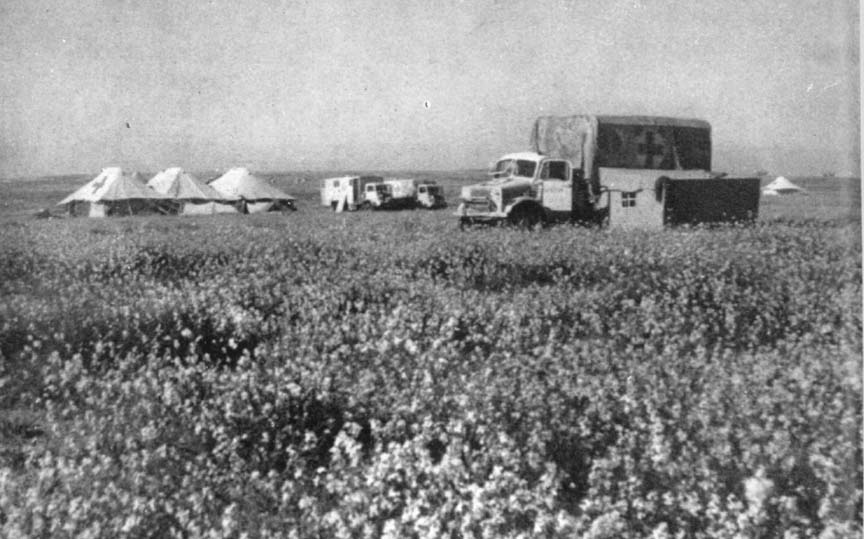
This new area was like some large garden lavishly strewn with wild flowers. Night-scented stock, mignonette, marigolds, linarias, and many others grew in profusion. This pale-coloured mass of bloom stretched in long undulations as far as the eye could see. The night winds sweeping across the lonely expanses were richly laden with the scent of stock. The CCS had this locality all to itself and there was little sign of other military life.
The unit was only nine days at Sirte before it moved 40 miles ahead to a site near Tamet airfield, which was being used as the air evacuation centre instead of the landing ground at Sirte. By 14 January the CCS was functioning fully at Tamet.
Enemy aircraft were active for a few nights, and for the first time some of the CCS staff decided it was wise to dig slit trenches. On the ground and on the tents Red Crosses were prominently displayed, but some of the staff were not too sure of the protection these might give. In bright moonlight the tents stood out very clearly and must have presented a sizeable target from the air. Several times aircraft dived low over the area to drop bombs on targets a short distance off. Attacks on Tamet airfield were frequent, and often during the night a sharp rat-tat-tat heralded the approach of a strafing enemy plane. Because of these raids the airfield did not become a terminus for air supplies, and air evacuation of patients was therefore limited.
From El Agheila the enemy had gone back 200 miles to a defence line near Buerat. Early in January 1943 preparations by 2 NZ Division for another left hook were completed on the same pattern as for the Agheila operation, vehicles being loaded with water, petrol, ammunition, and food for eleven days. On 3 January the Division concentrated in the desert south of Nofilia and grouped for the next advance, while 5 Brigade moved up near to Wadi Tamet to prepare a new landing ground for the Desert Air Force. Here on 5 January an enemy air raid resulted in ten being killed and 30 wounded. The casualties were treated by B Company, 6 Field Ambulance, ADS to the brigade, surgery being performed by 2 Field Surgical Unit attached to 151 Light Field Ambulance, two miles away. When the Desert Air Force moved up to the landing ground a few days later, enemy dive-bombers and fighters, which had been dominating the forward area, were soon driven back by Spitfire squadrons.
Then, on 12 January, 2 NZ Division moved forward to Wadi Tamet to lie up in broken country, with all vehicles camouflaged.
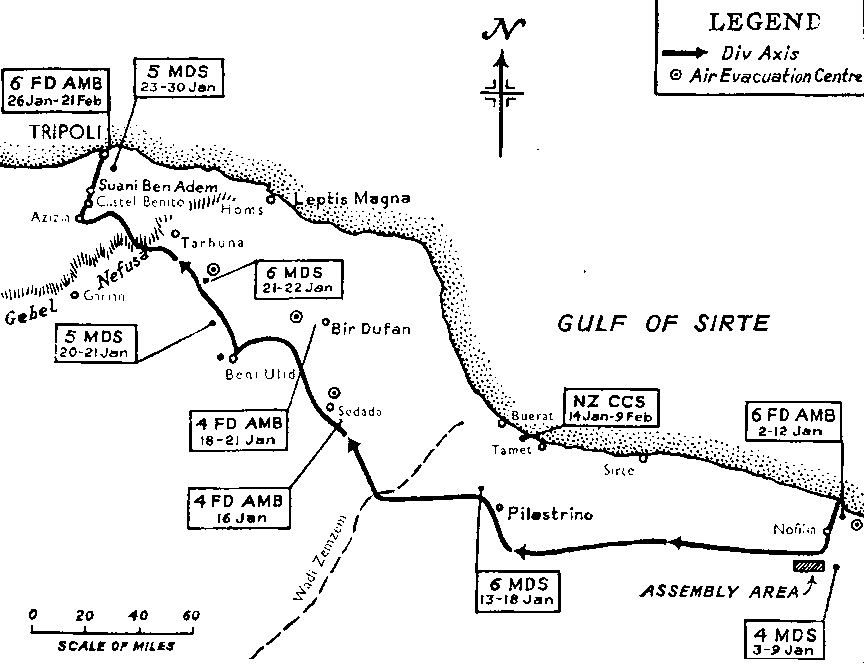
Medical arrangements for the final advance to Tripoli were similar to those for the Agheila operation. This time 4 and 5 Field Ambulances accompanied the Division, and 6 Field Ambulance served as a Corps MDS. The advance began on the afternoon of the 14th. At first light on the 15th the Division was in contact with the enemy, as also were 7 Armoured Division and 51 (Highland) Division to the north. Following an armoured screen, 6 Brigade, which was the leading formation, probed the approaches to Wadi Zemzem. With the brigade was A Company, 6 Field Ambulance, under Maj R. A. Elliott, but casualties were few; for the ADS the most eventful part of the day was when enemy guns landed shells among the ADS vehicles while trying to hit a nearby battery.
In the evening the company moved forward and down a defile into the wide bed of Wadi Zemzem, where it halted for the night. There was continuous firing ahead, and salvos of heavy shells were landing close by, sending up clouds of dust and debris. Occasionally shells, evidently armour-piercing, whistled past and landed without exploding.
Progress was slow on the 16th and confined to short moves between long halts, with the sound of tank fighting ahead where the Divisional Cavalry and the Scots Greys were meeting stubborn resistance on the escarpment south of Sedada. About 5 p.m. enemy aircraft bombed the column in front, leaving a number of vehicles ablaze, and working back strafed the stationary transport to the left of A Company. From this raid the company received about a dozen casualties, who were treated and evacuated. The advance was delayed on the 17th. The escarpment was cleared, but the. road down to Sedada was blown up and made impassable. All morning, while an alternative route down a defile was reconnoitred and engineers cleared the mines, A Company waited behind 6 Brigade, finally moving forward in single file until ten miles past Sedada. Again the leading elements of the column were bombed and a number of severe casualties brought back.
Movement continued slowly and with difficulty on the 18th and 19th, the ground becoming rough and stony. The transport bumped and jolted over protruding edges of eroded rock strata, with engineers working ahead clearing anti-tank mines, S-mines, and booby traps. Forward elements encountered a formidable escarpment north of Beni Ulid, and there was a delay for the whole afternoon of the 19th while a negotiable route was reconnoitred.
At nine o'clock 6 Brigade was given the task of proceeding through Beni, Ulid up the main road to Tarhuna. The road was thickly planted with mines, and the ADS, moving slowly toward the Arab town, received word that the engineers had mine casualties ahead. As the road was packed with transport, Capt J. L. Wright(2) went on with ambulance cars and blood. He treated the casualties and held them on the roadside until the company passed in convoy at ten o'clock. The casualties were carried forward in the ambulance cars until, two hours later, a halt was made 20 miles past Beni Ulid. The edges of the road had not been cleared of mines. and as it was impossible to evacuate the wounded back against the stream of traffic, the shelters were erected and medical officers and orderlies worked until 3 a.m. applying splints and plaster bandages.
Evacuation still presented some difficulty in the morning. as it was discovered that the 5 Field Ambulance MDS, to which the ADS had been evacuating, had passed through with 5 Brigade during the night, that brigade having taken the lead. Finally, the casualties were sent to 4 Field Ambulance, which was handling air evacuation at Sedada airfield.
There followed two days of slow going, with long delays as the forward troops picked their way through the rough country. Movement at night required particular care, as even in bright moonlight it was difficult to distinguish the edges of the many steep-sided wadis. Drivers would suddenly become aware of other vehicles immediately below on some wadi floor. The Division passed to the south and west of Tarhuna, following on the heels of the enemy toward the Garian-Tripoli road. The heights of the Gehel Nefusa loomed ahead, smudged with clouds of dust where the RAF bombed the columns retreating through the passes.
The bombing was continued throughout the night. On the following morning, the 22nd, the company moved on to the Tarhuna. Garian road that led westward through the hills, past Tazzoli, a small colonial settlement, where the troops had their first glimpse of Italian civilians. The road wound around hillsides and through valleys, and the column, now in single file, moved slowly west and then north-west, onto the coastal plain and the Azizia road. The Division poured onto the plains to the south of Tripoli on 22 January, by which date two other Eighth Army spearheads were almost the same distance from the city. In face of these combined threats the enemy withdrew from Azizia on the night of 22-23 January, and the next day an endless stream of vehicles began to roll into Tripoli.
In a series of leap-frogging movements, the medical units maintained a chain of evacuation during the left hook, and air evacuation units worked from Bir Dufan, Tarhuna and Sedada landing grounds. Wounded were evacuated by air within a few hours of the advanced units reaching the landing grounds, and the dangers of ambulance car evacuation over rough country on this 200-mile journey were avoided. Between 17 and 24 January 337 patients were flown out. Where patients were not fit for air evacuation immediately, detachments of medical units remained to nurse them while the main bodies moved ahead to form further staging posts. An abundance of ambulance cars, with short runs between staging posts, and the proximity of airfields made evacuation very easy indeed. Wireless played an invaluable part in the smoothness of these operations, although casualties were light as the enemy did not stay to fight.
On 25 January it was decided that 6 Field Ambulance. MDS, under Lt-Col Furkert, and 8 South African CCS should operate a general hospital in Tripoli, pending the arrival of a British general hospital unit. On the 26th the MDS occupied the northern wing of the modern, well-appointed building of Caneva Hospital, standing about one mile from the Benito Gate, the western entrance to Tripoli. Because of chaotic conditions in the town, electricity was available for only four hours daily, and the operating theatre and corridors were wired from the unit's lighting plant; the water supply, also inadequate, was augmented by a relay of buckets from the water cart. By 3 p.m. 50 patients had been admitted to the 6 Field Ambulance wing, and on the 27th the number rose to 120. The unit was working extremely well and giving full general hospital treatment. In addition, one of the tarpaulin shelters was erected outside the gates, with equipment and a detachment of orderlies, to deal with the sick parades of adjacent units. More beds were procured from Tripoli on the 29th, bringing the available accommodation of the wing up to 208 beds, 170 of which were occupied within two days.
 |
 |
 |
 |
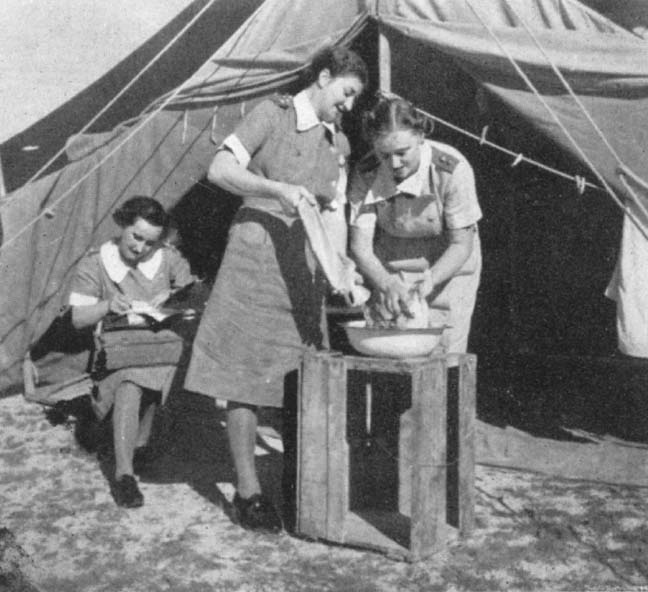
Several English nursing sisters were attached during this period. Accustomed to working with orderlies of hospital units who, generally speaking, have little opportunity to carry out treatment, they were frankly astonished at the manner in which the orderlies of the New Zealand field ambulance took over the work of the hospital, carrying out the instructions of the medical officers without difficulty. Members of the original staff, Italian sisters of a religious order, were also in occupation, and all members of the unit warmly appreciated their willing service in operating the laundry and performing general tasks about the buildings.
Perhaps the outstanding feature of life at Caneva was the almost nightly anti-aircraft barrage. Tripoli and the surrounding countryside bristled with guns, which filled the night with frenzy and pandemonium and plastered the sky with shellbursts. The blast from a battery immediately behind the hospital shattered one window after another.
The hospital was kept busy. At one stage 233 beds were occupied in the 6 Field Ambulance wing. On 20 February most of the patients were evacuated by hospital ship, but there was a general feeling of relief when 48 British General Hospital took over next day.
In the divisional area on the outskirts of Tripoli 5 Field Ambulance, under Lt-Col McQuilkin, opened an MDS on 23 January and was relieved by 4 MDS, under Lt-Col King, on the 30th. It was a beautiful, peaceful region of vineyards and olive and almond groves, sheltered by windbreaks of tall gums. Alas, the peace was soon to be shattered. Across the road from the field ambulance area was a vintnery, with a vat as big as a standard army hut, full of potent red wine. From the moment of its discovery the North African nights lost their elusive air of romance and were rent by catcalls and wild Bacchanalian choruses.
Mr. Churchill visited Tripoli on 4 February, and members of 6 Field Ambulance at Caneva Hospital helped to line the road along which he drove to HQ 30 Corps. In the afternoon, medical units in 2 NZ Division's area took part in a divisional parade reviewed by the Prime Minister. The parade was an impressive spectacle. The Division passed the saluting base in columns of twelve, marching to the pipes of 51 (Highland) Division, followed by the armour and guns.
While at Caneva Hospital it had been a simple matter for the men of 6 Field Ambulance to stroll in to Tripoli through the Benito Gate whenever they were off duty. But beyond an attractive waterfront, with a number of fine buildings and a variety of palm trees, Tripoli had little to offer. Practically the only things for sale were shoddy, worthless souvenirs at exorbitant prices, and oranges; and, as one soldier was heard to observe, after eating a Tripoli orange it was advisable to suck a green lime to sweeten the mouth.
In Tripoli the Field Hygiene Section had a great deal of work to do. Restaurants, barbers' shops, and billets all had to be inspected. Water and sewerage services had been damaged by bombing, and this added to the difficulties as water had to he brought into the town from outlying wells and tested before use. The language barrier was troublesome at first, the Italian municipal authorities being unco-operative, and blocked drains had to be traced without their assistance. But soon sanitation was under control. The unit continued to run its Italian mobile shower acquired at Tobruk, and hundreds of troops each day enjoyed the luxury of a hot shower.
The CCS moved from Tamet on 9 February to an area west of Tripoli. Chest and abdominal cases were left in the care of a nursing team until their evacuation by air could be arranged. The journey was the most interesting the staff had had since leaving Syria and was in direct contrast to previous trips through Egypt and Libya. The road was bad until after Buerat, but northwards from there a modern bitumen highway made travelling comfortable. Again signs of civilisation appeared, and soon the convoy had entered a richly cultivated belt. Palm trees grew in profusion, rising tall above green, fertile acres. Wells were amazingly plentiful. Cactus fences and fig trees reminded one of Palestine.
Leptis Magna was the camping spot for the night. No sooner had the trucks stopped than dozens of local egg-vendors appeared as if by magic. Tea and sugar only were accepted in exchange. Even heavy rain in the evening did not discourage those hopeful of trade. The famous ruins of Leptis Magna were only a few minutes' walk from the camping area, and many took the opportunity to visit them.
Homs, a walled coastal town, was passed next morning, and from here the way lay through hilly country. Miles of anti-tank ditches could be seen but all had apparently been a waste of time. By now the belt of palms had been left behind and neat fruit farms appeared. Cypress trees bordered the road, while twin rows of these graceful evergreens in many places marked an avenue leading to a neat white farmhouse. Peach, apricot, plum and almond trees were in blossom, providing a pretty and welcome spring scene after the months spent in barren surroundings. Soon the road led along cliffs bordering the sea. In the distance silver barrage balloons glittered in the sky above the port of Tripoli.
A stop was made for roadside lunch in an avenue of tall eucalyptus trees five kilometres from Tripoli. The town was bypassed, however, as the convoy travelled west along the coast road, through Zavia and Sorman to Sabratha. The original arrangement had been that the unit would set up here in the hospital section of a former Italian barracks. Now plans were changed. The main section of the CCS was to continue on a further 25 miles to Zuara. The CCS surgical team was withdrawn from the New Zealand Division and, joined by the advanced party from Tamet, was to act as a Light Section at Sabratha. Minor casualties were to be handled there.
As the main party continued on along the coast, the country again changed. Fertile acres gave place to swampy land studded with palms. These in turn thinned out until the scene was a semidesert one, with clusters of trees around oases. Zuara was reached by mid-afternoon, the distance travelled from Tamet having been 340 miles. The unit's function here was to receive casualties from Eighth Army during the advance on Ben Gardane. The sisters did the journey by staff car, staging three nights with 8 South African CCS in Tripoli.
At Zuara, for the first time since Zahle, in the Lebanons, the unit had the use of a building. Situated on the fringe of this small coastal town, the building had originally been an Italian hospital and more recently had been used as enemy barracks. Much cleaning was required before it could be used to hold sick and wounded. The spacious rooms were ideal for the CCS wards, but it was found more convenient to set up the theatre and pre-operative ward in tents in a walled compound at the rear.
All around were places likely to receive attention from hostile aircraft. The area bordered a corner of the main highway. along which there was a great volume of military traffic day and night. Half a mile to the north was a small harbour which, although full of sunken fishing vessels, was being cleared by engineers. The railroad passed close by to the south. Two kilometres away was the railhead and ammunition dump, and a short distance south-west was a forward fighter airfield. It was no wonder that minds were not always tranquil when aircraft droned overhead at night.
Admissions here were not heavy, but they brought the number handled by the unit since leaving Cairo up to 10,000, including those treated by the Light Section. Evacuations were made daily by road to Tripoli; later, a few were sent by air. When returning from the forward areas with accommodation available, the ambulance plane would circle over the unit area. If there were patients ready for evacuation a Very-light signal was fired by Reception. The aircraft would then drop a message giving details of the room available and would land at the nearby airfield. Patients were despatched immediately by duty ambulance car.
In off-duty hours the staff again found relaxation in sport. On hard mud-flats opposite the hospital, a tennis court was marked out and camouflage netting was used as a net. Soccer, too, was played on these extensive mud-flats. Some of the men preferred walking, while others were able to go boating on the small harbour. All ranks had an opportunity of visiting Tripoli. Only a few hours could be spent there, however, as it was a 70-mile trip each way. The days were becoming longer, although for the most part cold weather prevailed. Frequent winds blowing in strongly from the Mediterranean tried the tempers of the tent dwellers.