 "Soldier Calvary";
Enfidaville, Battle for Tunisia, April 1943 "Battlefield Cross"; (Sonnet) "To Mother"; (Sonnet) "No Place for Kids"; To Denny Hunt, Italian Campaign,
Ortona, January 1944 "Preb"; In memory
of Vernon Preble, mine casualty, Sangro River, Italy, November 28, 1943 "Cassino"; Italian Campaign, February
1944 "Sterling --- Beyond the
Sky"; In memory of Sterling Grumman, October 1978 "Monte Cassino Revisited, 1984"; Return to Cassino,
July 1984 "Soldier Calvary";
Enfidaville, Battle for Tunisia, April 1943 "Battlefield Cross"; (Sonnet) "To Mother"; (Sonnet) "No Place for Kids"; To Denny Hunt, Italian Campaign,
Ortona, January 1944 "Preb"; In memory
of Vernon Preble, mine casualty, Sangro River, Italy, November 28, 1943 "Cassino"; Italian Campaign, February
1944 "Sterling --- Beyond the
Sky"; In memory of Sterling Grumman, October 1978 "Monte Cassino Revisited, 1984"; Return to Cassino,
July 1984 |
War is the most destructive of human enterprise; and yet war summons sacrifice, and demands creative endeavor. In the crucible of total war, our scientists unleashed a force capable of destroying life on the planet, but also harnessed atomic energy for peaceful purposes. Out of the agony of war, statesmen promise a "new world order." And as we search for just peace, we ponder the absence in time of peace of the moral equivalent to the sacrifices that war commands.
Swept as I was with my generation in the maelstrom of World War II, I was authorized under Selective Service for combat medical duty with the American (Ambulance) Field Service (AFS), assigned to British army units in the Mideast, North Africa, Italy (1942-1945). The eight poems which follow are based upon these World War II experiences.
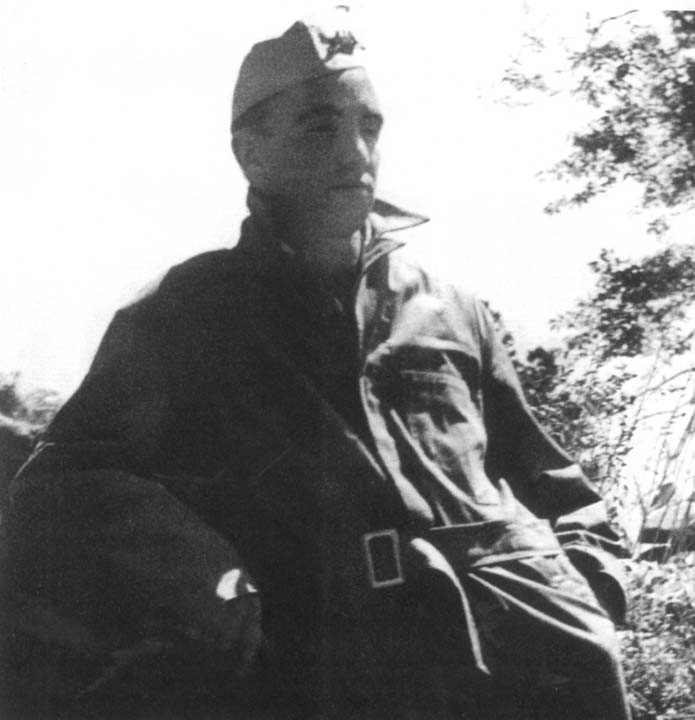
I wrote the first poem "Soldier Calvary" after a brutal German barrage at Enfidaville, Tunisia May 1943 where I served for three weeks at a front-line Regimental Aid Post (RAP) with a light field artillery regiment, British 8th Army; and where the final remnant of Rommel's Afrika Korps surrendered through our lines.
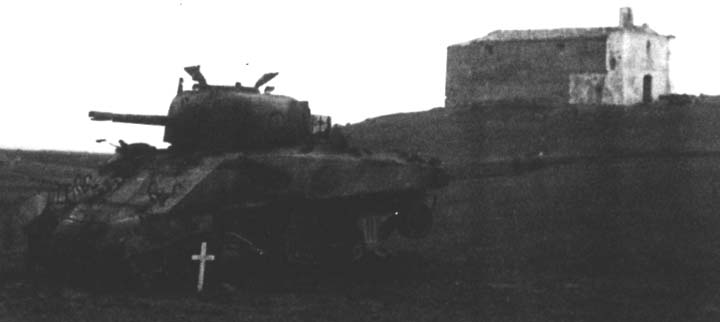
Then "Battlefield Cross," a sonnet, describes a crude cross placed beside a blown-out tank to mark a temporary battlefield grave in Italy, November 1943. In the next poem. "'To Mother," also a sonnet, I imagine my own battlefield grave. "Preb" and "No Place for Kids" honor the memory of two "comrades-in-arms." The first was killed in action on November 28, 1943 during our advance against the German armies in Italy, his was the first ambulance to cross the Sangro River. The second was wounded near Ortona Italy January 1944. Ortona, "little Stalingrad," was totally demolished in the war as shown by its bombed-out cathedral (photograph p. 6 ).
In February 1944 I witnessed at first hand the destruction of the celebrated Abbey at Monte Cassino following the annihilation of the city of Cassino itself, and I wrote the poem "Cassino." This poem, and those that precede it, honor the bravery of the soldier, and the supreme sacrifice made by many, but they also document the horror and the brutality of modern war. Man is "destroyer," even when waging a "just war" for the cause of freedom against an aggressor. "Sterling" the seventh poem, honors the memory of one of our best loved fellows of the AFS Platoon to which I was assigned, who survived the war but not a climbing accident in the Himalayas.
In 1984 I returned to Cassino, and I was dumbfounded to find the Abbey arisen phoenix-like upon its mountain, and the city no less marvelously restored (although moved to a different location). Thus inspired, I wrote the poem "Monte Cassino Revisited." It represents my hopes for the triumph of Man "the Creator," and for the ultimate victory of peace over war.
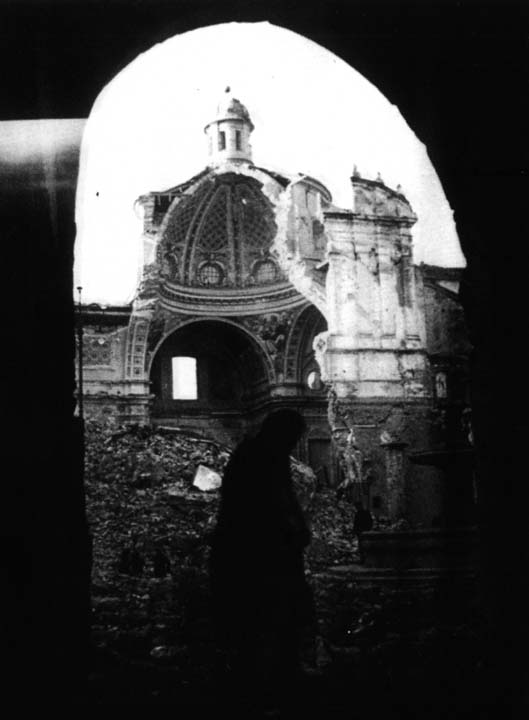
| By these four walls Filled with wonder I die An invisible arch It has flown: I am infinite, My life becomes more kin to death, I have become You forced us into war |
| Where armies sweep across the ravaged plains, Beside the shattered tank the wood cross stands |
| If it must be that I am meant to die --- The western wind will envy my soul's flight |
| "Please, dear God, do this job yourself ---Cowboy Prayer |
| His horse The front wheel There was not much left of his ambulance. "Here's your fountain pen," Something that a soldier means by "chance" It must have been God |
| They wrapped him in an American flag The fire It was a brave fight They found him An ambulance in war They picked him up We loved him |
| A sign The bare flank of "hangman's hill" Cassino was thrust Cassino |
| No peak His ready wit |
He was one with us in bonded brotherhood of C Platoon, AFS, 567 Company during war and for all the years after the guns of war had ceased. We loved the warm, sparkling, ever-ready, friend and companion side of him whose presence among us brought a special electricity and joy
But there was so much more. Man of ideas and ideals but also of the world, preeminent in his profession, he never let his command of the world of things separate him from the world of the spirit --- of the peace between and within nations he worked for, of brotherly love, of justice. To these things he devoted his sacred honor and his fortune.
From his youth he was a man of the mountains, finding in their grandeur the inner peace that seemed so often to elude him. Rock of New England, solid and steadfast in character --- so much so that much of him was kept inside. But he was at home and as one with us, and our many gatherings and reunions were among his greatest joys --- ours too.
"In their lives they were lovely and pleasant, and in their deaths they were not divided." We are not divided from him --- no, never --- each of one of us with special memories to preserve and to cherish among the all too transient passages of our lives.
| The mild, sweet Saint, Where the mountain rose Toppled by man's militant hand, Today transformed |
| 1. C Platoon, 567 Ambulance
Car Company, AFS World War II Commanding Officers (1943-45) --- Roster Friends
and Brothers (1962) 2. The AFS Dodge Ambulance.
Specifications, Configuration, Markings --- and 567 Company Logo: an American
Eagle ("Chicken") 3. Vehicle Maintenance, 31 Point Check List 4. Songs of the British Eighth Army, Titles,
Excerpt 5. Laugh with or at the Two
Types by Jon, Some Samples 6. The Vernon William Preble Memorial at AFS Headquarters, from
1950 7. Testimonial to Stephen Galatti,
November 1961 (draft by C. Edwards) 8. Reunions of C Platoon 1945-90, and All Drivers 50th
Anniversary, 1995 |
During the Battle for Tunisia in late April 1943 four of the desert Platoons, including our C Platoon and the "Lucky 13" Sections of it, had been merged into what became for the rest of the war 567 Ambulance Car Company (ACC) led initially by Major Arthur Howe.
Lieutenant John ("Jack") Hobbs, Mideast Unit 4, was C Platoon Commanding Officer from late April through summer 1943 at Tripoli Libya, then for the Trigno-Sangro offensive in Italy during autumn and winter 1943 and on north of the Sangro until he was wounded January 29, 1944 at Ortona, Italy. Robert ("Bob") Blair, Mideast Unit 27, who had been the Platoon NCO (Sergeant) replaced Jack as Commanding Officer through December 1944. Chandler ("Chan") Keller, Mideast Unit 26, who had served as NCO under Bob Blair, took over from Bob as Commanding Officer in late December 1944 to the end of the war in Europe (May 1945) and repatriation. Arthur ("Art") Ecclestone, also Mideast Unit 26, was NCO for the Platoon under Chan Keller.
Both Chan and Art and others of us of "Lucky 13" Unit 26 had formed the nucleus of the newly organized C Platoon of 567 Company in April 1943 and most of us continued with the Platoon through the end of the war.
As reported in Part I above we of "Lucky 13" were the final 13 of the 50 untested AFS Drivers-to-be of Mideast Unit 26 to board HMS Aquitania September 21, 1942 at New York harbor. We had been assigned to spartan quarters down in E deck, which contributed to the growth of our friendship. Consequently our C Platoon can claim roots back to September 21, 1942.
The bonding we of "Lucky 13" experienced during forty days and nights at sea continued as we trained together in Lebanon and Syria, traveled in one long convoy to Marble Arch Libya on the Western Desert. At Marble Arch Libya we had been posted initially with C Platoon of 485 Company; Lieutenant Thomas ("Tom") White, Mideast Unit 4, was the Commanding Officer.
After Marble Arch we advanced with 8th Army, serving in the forward areas of the Battle for Tunisia. We came together as C Platoon 567 Company after the German surrender in Tunisia May 13, 1943 and on through the long summer of '43 at Tripoli. Our feelings of brotherhood were established for all time by the engagement of our Platoon in the bloody and arduous campaigns of the war in Italy from the autumn of 1943 through the spring of 1945.
The most challenging campaign of all and in which all of us shared, was our Platoon's engagement in the Trigno-Sangro offensive by 8th Army (October to mid-December 1943) against successive German winter lines as the Germans held Rome. This may well have been our Platoon's "finest hour." This was followed by our six-weeks rest and recovery at Pollutri south of the Sangro (December 15, 1943 to January 24, 1944); then action at San Vito-Ortona north of the Sangro, over to Cassino, and back to the Adriatic front and Lanciano holding along the German Gustav line through June 1944. Our in-gathering at Pollutri, and our relative "isolation" as the one AFS Platoon along the Adriatic front (February-June) reinforced the bonds of our brotherhood all the more.
Rome was occupied June 4, 1944 just two days before the Normandy landings. Italy was no longer the only front of the Anglo-American allies in Europe; however difficult campaigns continued in Italy north from Rome until the German army surrender in North Italy May 2, and in Germany itself May 5, 1945; V-E Day was proclaimed May 8. Most of us "veterans" of C Platoon had continued together in this final year of the war. We had done our duty, suffered casualties, served with distinction. None of us could ever know bonds of brotherhood as unique and as strong as those forged by the experiences of war.
Truly it was for us, as in the words of Shakespeare spoken by the young Henry V on the eve of the battle of Agincourt: "We few, we happy few, we band of. brothers; for he, today that sheds his blood with me, Shall be my brother..."
These bonds, forged in war, continued uniquely for us of C Platoon 567 Company for all the years since the war down to the present as attested by our Platoon communications and the five reunions we held from 1945 down through 1990. We also participated as a Platoon at the AFS-USA reunion in NYC 1961, and at the Drivers' 50th Anniversary celebration at Williamsburg, Virginia October 24-26, 1995. These reunions are listed and described in Section 8 of this "Annex" below.
The roster of C Platoon as of 1962 (44 names) which follows is a copy of one I duplicated and distributed to each of our members. It was used as the invitation list for our reunion of August 9-11, 1962 at Hyannis Port. The names underlined were members of Mideast Unit 26; hence most of these were of "Lucky 13." The 26 names that are starred (*) of which 24 were Platoon members was the invitation list for our C Platoon reunion of July 11-12,1990 hosted by Tom and Anne Hale at Vineyard Haven. This has been our final gathering as a Platoon, and the reduction in 1990 of 20 names from our 1962 roster is mute evidence to the adage that "old soldiers never die, they just fade away" --- for us now in increasing number. There had been 52 names on our roster in 1943.
As the poet wrote "Where oh where are the snows of yesteryear?"
| Aument, Carroll (Henrietta) --- New York, NY. Barbour, Thomas --- New York, NY Barrel, Robert L. --- Kailua, HA.* Bell, Whitfield Jenks --- Philadelphia, PA.* Blair, Robert F. (Jean) --- Hudson, Ohio Bourdelle, Pierre --- Oyster Bay, NY. Brennan, Ken --- Sarasota, FL. Brewster, James H. --Chicago, III Brooke, Howard (Ann) --- Rosemont, PA. Chaffee. John B. (Marion) --- Farmington, CT. Chaney, Bev (Louise) --- Croton-on-Hudson, NY. Cady, Edwin --- Hillsborough, NC.* Craven, Robin (Babette-Carolyn) --- New York-, NY. Collins. George (Christiane) --- New York, NY. Cobb, John C. (Holly) --- Corrales, NM.* Ecclestone, Arthur (Carlotta) --- Westwood, MA Edwards, Charles P. (Licia) --- New Wilmington, PA.* Everett, Francis (Eleanor) --- New York, NY.* Fiedler, Harry Jr. (Susan) --- Scarsdale, NY. Field, Manning --- Brooklyn, NY.* --- special guest of the Platoon Galatti, Stephen --- New York, NY. --- special guest of the Platoon Graney, Pat --- Fayetteville, West Virginia Grumman, G. Sterling --- Weston, MA. Hale, Tom (Anne) --- Vineyard Haven, MA. Hanna, Carl (Mary) --- Milford, Michigan Hoeing, Frederick --- New York-, NY. --- special guest of the Platoon Hobbs, John N. (Sarah) --- Andover, MA. Howe, Arthur (Peggy) --- Lyme, CT.* --- special guest of the Platoon Hunt, Dennis --- Tucson, Arizona Keller, Chandler Y. (Shirley) --- Binghamton, NY.* Kinsolving, Lucien (Mary) --- Bethesda, MD.* Leinbach, John D. (Mary) --- Byram, CT Maynard, Edwin --- Brooklyn, NY. McKinley, Rowland --- Duxbury, MA Meeker, John --- Marlboro, NJ. Metcalf, Houghton --- Providence, RI Morris, Joseph P. (Rebecca) --- Ambler, PA.* Murphy, Duncan --- Sherman, NY.* Nierenberg, Jay (Inge) --- Morristown, NJ.* Orton, Robert --- Cincinnati, OH. Pierce, Charles --- New York, NY. Riege, John H. --- Hartford, CT. Reynolds, Clarence J. --- Kew Gardens, NY.* Rock, George --- New York, NY. Taylor, H. William --- Tucson, Arizona Wackernagel, Fred (Ingrid) --- Montpelier, VT. * Wolhandler, Joseph (Jean) --- New York-, NY.* Wright, Mortimer (Eva) --- Noank, CT.* |
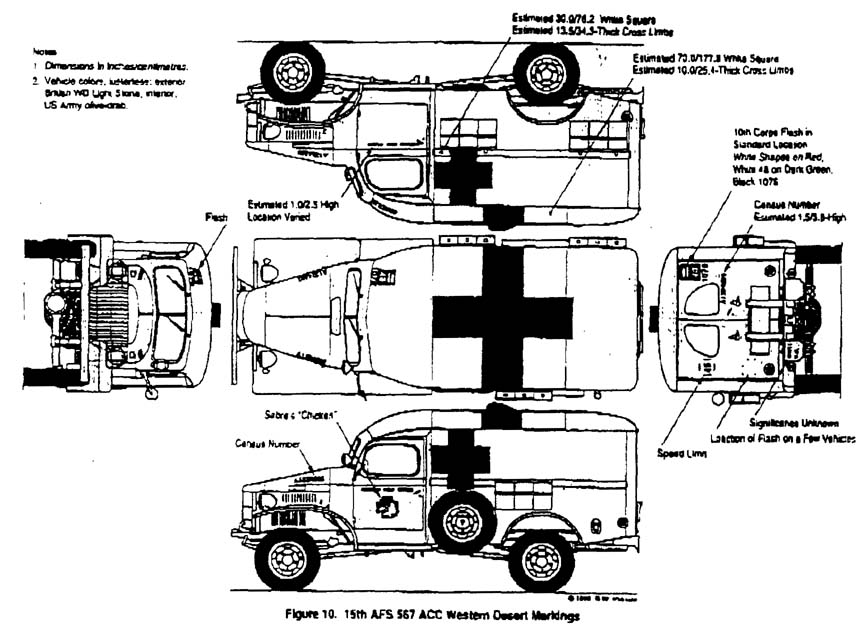
It was our Dodge Ambulances that contributed as much as any supply factor to the achievement by AFS as an Ambulance Car Company in World War II. Based on, I believe, the then Dodge T-211 light truck chassis, they were nimble with four-wheel drive capable of navigating in rough and hilly terrain in conditions of desert or freezing mud. They made possible the rapid staged evacuations from the Aid Posts and Car Posts at the front back to the less exposed territory for the Advanced Dressing Stations, Main Dressing Stations, and Casualty Clearing Stations where surgery could be performed. Immediate evacuation was often the margin for life over death. There was no comparable medical transport for the British Commonwealth units with which we were posted. We could carry at a time four stretcher patients or up to ten sitting. When our. rosters were at full strength there were two Drivers to an ambulance one of whom was assigned responsibility for it.
Our ambulances were exposed to and came through unbelievable punishment. Falling off a narrow track under blackout conditions and rolling over a time or two happened to a number of us, including to me. One ambulance survived being run over by a tank; all of them sported the scars of battle. They were extremely sturdy.
Our ambulances were also our homes away from home. We could stow our gear in odd places or lashed onto the fenders; sleep on a stretcher under a blanket. We loved them; we gave them names. For those assigned to me I bestowed upon each of them my AFS nickname of "Fox." In all there were four up to "Fox IV." All performed yeoman service; all became rather badly beaten up but kept on going. Needless to say, we gave our cars tender loving care as attested by our responsibility to carry out the 31-point check-list for "Vehicle Maintenance" which is printed below Section 3. The skilled "fitters" of our mobile British Army workshops performed miracles of major repair keeping our vehicles going for thousands of miles of the most horrendous of driving conditions.
We were proud of our vehicles, proud to be associated with them representing AFS. The basic coloring and markings were uniform, mandated and distinctive as shown by the drawing on the next page. For the desert the exteriors were a light color "British WD Light Stone" and the interiors "US Army olive-drab." After the desert campaigns the exteriors were darkened. Attention was given to painting the red crosses on each side and on the roof; there could be distinctive markings on the doors.
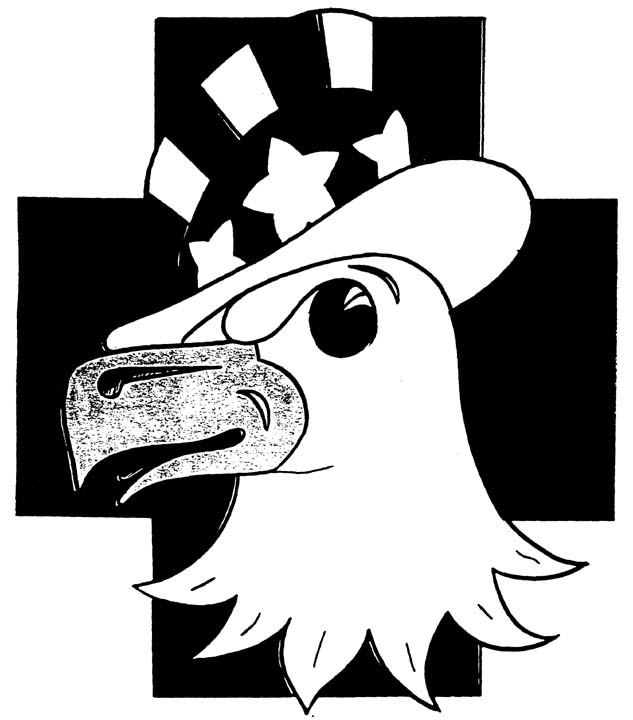
After the first AFS units had reached the Middle East by September 1942 on the eve of the El Alamein battle, a full company of four platoons was formed, each platoon with four sections of five cars each, in all over 80 ambulances. According to George Rock's The History of. the American Field Service 1920-1955, pp. 126-127 the new Company held a competition for the design of an insignia to go on the front doors.
The design by Driver-artist Clifford Saber (Mideast Unit 16), who had created "The Desert Rat Sketchbook" was chosen and was painted on the doors of what was initially 15th and would become 567 Ambulance Car Company. George Rock provides us with a light-hearted account of the painting of the insignia:
On 17 September, in the teeth of rumored disapproval by Cairo HQ, the new Company's cars were painted with an insignia designed by C.O. Saber ... an eagle with a top hat against a red cross. From the first they were known as "chickens," which they did not wholly disresemble. When on 20 September the Company was inspected by Brigadier Walker, DDMS, the chickens had been painted on all the cars, but there was considerable apprehension as to whether they would be allowed to remain. On first sight the Brigadier asked Captain Geer what the. design was. "'Our emblem, Sir, an American eagle.'"
"At that he laughed outright... 'My only suggestion is this ... Have it on both doors, and make the red-cross background larger. That way it can serve a useful as well as a decorative purpose. I like to see units adopt emblems --- it shows they have pride in their outfits.'"
 |  |
The lives of our patients, even our own, depended at times upon the capacity of our ambulances to keep going for weeks on end and to navigate under the worst possible conditions. The importance of maintenance was drilled into us during our training. The "Vehicle Maintenance" check list which follows was issued to each one of us and explained at workshops together with distribution of the essential tools and supplies. Racks for fitted on one side to carry "Jerry cans" for petrol supply.
One ignored maintenance at his peril and there were few violations although during conditions of extreme stress in battle the daily routine had to be postponed. We were assigned an entry "412 book" to record work done, and we were subject to periodic inspections. We all became proficient in this, some more than others. My fellow Driver at times, Jock Cobb, became indeed a master mechanic and volunteered for service at workshops while we were pulled back at Tripoli.
Major repairs, and there were many, were handled with amazing skill and versatility by the mobile workshops units assigned to our Companies. Mechanics were also assigned to Platoon HQ's. Their commanding officers, sergeants, and mechanics called "fitters" were devoted to us as we to them in bonds of service and friendship.
| DAILY | |
| 1. | Check level of engine oil. Keep oil level between the 3/4 mark and full mark --SAE 30 oil. |
| 2. | Check water level in radiator. |
| 3. | Check tire pressure. |
| 4. | Fill up with petrol after each run. |
| 5. | Keep interior of vehicle neat and clean. |
| 6. | Make entries in 412 book. |
| 250 MILES | |
| 1. | Grease U-joints (6) and splines (3) --- heavy grease. |
| 2. | Oil spring shackles (12) --- SAE 90 oil. |
| 3. | Grease steering knuckles (4) --- Heavy Grease. |
| 4. | Grease water pump (1 or 2) and brake and clutch bearings (1 or 2) heavy grease. |
| 5. | Inspect battery water level. Use distilled water when available and fill to 1/8" above plates only. |
| 6. | Inspect wheel lugs. If loose, tighten with foot pressure. |
| 7. | Inspect bolt nuts and tighten with foot pressure. |
| 8. | Clean around moving parts with petrol. |
| 500 MILES | |
| 1 . | Check oil level in gearbox & transfer case. Fill to filler plug level --- SAE 90 oil. |
| 2. | Check hypoid level in front and rear differentials. Fill to filler plug level ---HYP-90 or 90 oil. |
| 3. | Check steering box oil level. Fill to 1/2" from top --- SAE 90 oil. |
| 4. | Fill master break cylinder with brake fluid to 1/2" from top. |
| 5. | Tighten engine mounting bolts (6) and radiator mounting bolts (2). |
| 6. | Tighten miscellaneous nuts and bolts. |
| 1000 MILES, OR PREVIOUS TO 406 INSPECTION | |
| 1. | Clean engine, all moving parts with petrol. |
| 2. | Clean interior of vehicle with soap & water. |
| 3. | Remove petrol filter and clean. Be sure to replace gasket and tighten firmly. |
| 4. | Remove oil filter and clean. Refill with SAE 30 oil to proper level. |
| OIL CHANGES All oil changes are made when oil is warm to insure maximum drainage. |
|
| 1 . | Engine oil changed every 3000 miles --- SAE 30 oil. |
| 2. | Gearbox & transfer case oils changed every 5000 miles --- SAE 90 oil. |
| 3. | Differentials drained every 5000 miles --- Hyp-90 oil. |
It is suggested that the driver spend at least ten minutes a day working on his vehicle. In doing this minor defects can be discovered and rectified, thus saving road stoppages. Keep close check on the panel instruments when driving. When irregularities in instrument readings occur stop --- Platoon fitters or workshop fitters should be called on to determine the trouble.
Note: my friend and brother in AFS George Collins, charter member of our "Lucky 13," trained the new arrivals coming to Italy in the final six months or so of the war. He added the following facetious footnote to his list which he copied to me: "As you may recall there is nothing more beneficial and invigorating than greasing the shackles regularly before breakfast."
A frequent greeting between us during chance meetings was: "Have you greased your splines lately?"
From the above, it is clear that we were truly devoted to. our maintenance responsibility, but a quip now and again helped to shoulder this responsibility.
It is said that an army marches on its stomach. This is not entirely true, and in the case of our AFS experience with 8th Army, a good pair of lungs was almost as essential as a reasonably replenished stomach. A few of us of "Lucky 13" could carry a tune; notable were the voices of Jay "Bird" Nierenberg, Chan Keller, George Collins. What most of us lacked in quality we more than made up for in volume.
In Part III above, "Go West," I recounted the boisterous songfests we of C Platoon and "Lucky 13" staged dispersed out in the desert at night when evacuations were done. Two ambulances back-to-back with blankets over the windows formed our "Fox-Hall" able to accommodate a merry crew of revelers when we ran down together our repertory of these time-honored songs. At the outset for us neophytes, we were joined by an AFS veteran or British support staff to teach us the words.
In Italy a few of us in a sturdy stone billet would break into a chorus. Or when all of us were pulled back for "rest" as at Pollutri, "Lofty" --- one of our British catering staff stalwarts --- led the outburst of song with his accordion. Tom Hale, in the concluding pages of his The Cauldron --- 1943-1945 titled "Songs of the 8th Army," explains the reason why we sang the songs: " ... when sung by the light of a single kerosene lantern in a ruined farmhouse with the mutter of guns nearby, they had a magical way of relieving tension and raising morale."
The songs of the British Army are generations old, and redolent with references to bygone years when "Britannia ruled the waves." They were also redolent with some of the most salacious, vulgar, scandalous phrases and four-letter words know to the English language and indeed to mankind. I leave these to your tender imaginations. Needless to say, we sang the uncensored versions with relish.
When AFS Archives and Museum prepared so well the program and background materials for the 50th Anniversary Reunion of the Drivers at Williamsburg, October 24-26 1995, they put together a bound collection titled "World War II --- Songs We Remember." These include the lovely haunting ballads that touched all our hearts then and now such as "White Cliffs of Dover," "Don't Sit Under the Apple Tree," I'll Never Smile Again," I'll be Seeing You," "As Time Goes By," "God Bless America," "It's Been a Long Long Time." We sang these, with our hearts in our throats.
AFS Archives also included the following best known of the British Army songs in this collection (the songs were not of course limited just to 8th Army); these are the titles: "Bless 'Em All," "Queen Farieda," "I Belong to Glasgow," "I've Got Sixpence," "The D-Day Dodgers." You can be sure that the texts as printed by Archives were of the sanitized versions, and in particular one of the most frequently used four-letter words, the notorious "f-word," is nowhere to be seen in this collection.
A word of explanation is in order for "The D-Day Dodgers," and I quote from Tom Hale: "At some point Lady Astor in a speech in London had made a slighting remark about the Allied soldiers in Italy, called us 'D-Day Dodgers.' Needless to say, her remarks were resented by all of us who had been fighting for many months before D-Day." I quote below from the first and last stanzas of this song, and the refrain; we sang all of the song (five stanzas) with particular gusto:
| (Sung to the tune of Lili Marlene) We landed at Salerno, a holiday with pay Oh, we're the D-Day Dodgers out in Italy Dearest Lady Astor, now listen here to this |
There was another form of song and verse which became a significant part of our repertory, This is the limerick, and we chose the most ribald versions of this classical type. Each one of us had a favorite or two, and in a song test we went 'round and around, each one of us in turn rendering his selection trying to surpass the others in an excess of vulgarity about amazing feats of sexual prowess. The variety was almost, endless, as was the versatility of the often extemporaneous composition. After each solo rendition of the limerick cinquain, the assembled gathering joined in a rousing rendition of the refrain with the words: "That was a jolly good song, sing us another one just like the other one, sing us another one, do."
Yet another variety of song was the traditional folk ballad, and in these George Collins and Chan Keller excelled. With these two taking the lead, we could go on for hours with "Oh They Built the Ship Titanic," "MacNamara's Band," "My Home Town is a One-Horse Town," "Yankee Doodle Dandy," "The Whiffenpoof Song," "East Side West Side." "Give Me a Home Where the Buffalo Roam," "I Want a Girl Just Like the Girl," "School Days," "Take Me Down to the Ball Park." The list is endless. Nostalgia reigned, and for magic moments we were kids again and back home.
The reference above concerning "The D-Day Dodgers" as "Sung to the tune of Lili Marlene" invokes another song which was universal, intercultural and appropriately included in its English text in the AFS Archives' collection. It is of course "Lili Marlene." Of German origin, I heard it for the first time in German on radio from Berlin; I believe it was a broadcast by "Axis Sally." Our Company and Platoon radios played it. Translated into English, Italian, French and I assume other languages, its haunting words and melody were loved by all the troops friend or foe. It was too close to the human spirit, heart and soul to be sullied by any of those four-letter words.
Indeed, there was no song in World War II that could match in melody and verse the depth of the pathos of "Lili Marlene." It captured as nothing else could the universal longing between young men and young women in love but caught up in the trauma of World War II, and the absolute horror of the separations that tore them apart all too often never to embrace each other again.
We human beings so often, and indeed so tragically in times of war, bring ourselves to the brink of self-destruction, hopefully always to "muddle through." As in the words of the poet (Alexander Pope) ours is a confused creation, a paradoxical heritage: "in doubt to deem himself a God, or Beast; In doubt his Mind or Body to prefer; Born but to die, and reas'ning but to err; ... Created halt to rise, and half to fall; Great lord of all things, yet a prey to all; Sole judge of truth, in endless error hurl'd: The glory, jet, and riddle of the world."
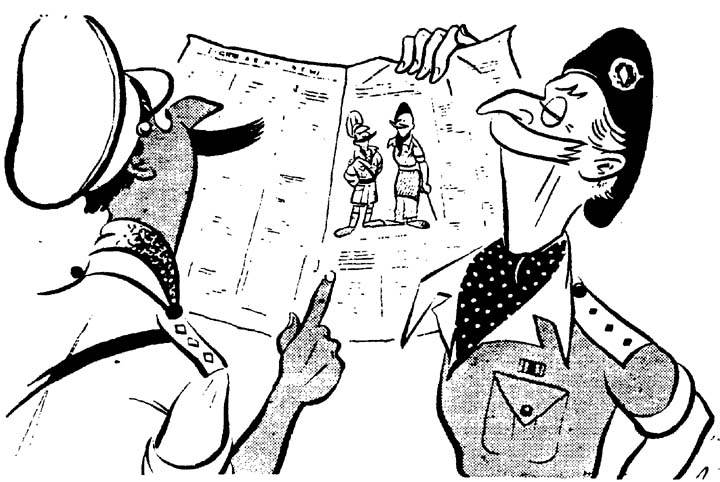
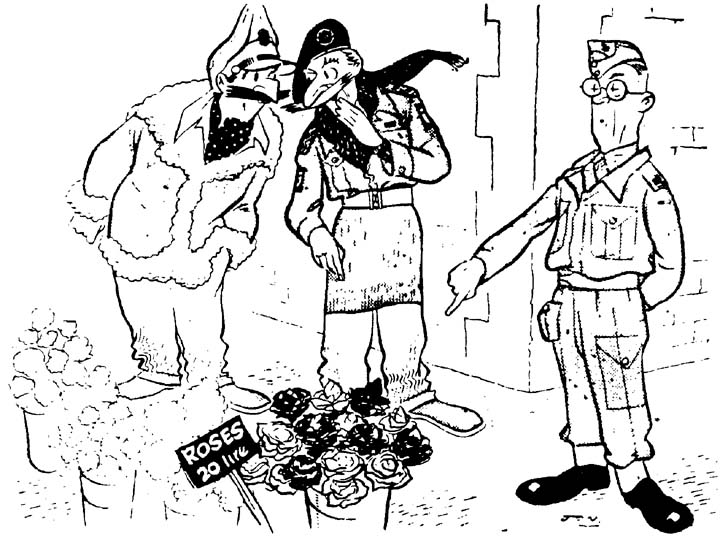
At the conclusion to Section 2 "The Soldier's Way in World War II" of Part X above, I comment on the importance of humor to the morale of the soldier, with examples of Jon's The Two Types for British humor, and Mauldin's Willie and Joe for American humor. The copies which follow about The Two Types are taken from a collection assembled for the first time in paper-book form under the following citation and reference:
PRODUCED by the British Army Newspaper Unit, C.M.F. for the fighting men of all ranks and services in this theatre. DISTRIBUTED by the Directorate of Army Welfare Services, A.F.H.Q. PRICE twenty lira a copy.
There was no date (or even copyright) given in the citation . The references to Central Mediterranean Forces ( "C.M.F".) and "twenty lira a copy," indicate that it was published in Italy during the Italian campaign. The cartoons themselves represent the desert campaign of 1940-43 from which the outlandish eccentric dress and deportment of these delightful two fellows originated. The Italian campaign (1943-45) is also represented, where they sport the same desert-inspired garb.
I quote below from the Foreword of the collection:
Since Bruce Bairnsfather's Old Bill of the last war, no cartoon has caused so much interest to the men in uniform as The Two Types by Jon. From Alamein to Tunis, Tunis to Sicily, and on to the North of Italy, we have all been familiar with the sartorial eccentricities, the resilience, and the affable nature of The Two Types during the past few years, but it needed Jon to capture their activities for us in black and white.
His cartoon --- now known in Britain as well as in this theatre of war --- first appeared in "Eighth Army News" on August 16, 1944; it spread to "Crusader" on Oct. 15; and then to all the editions of "Union Jack on Nov. 7, 1944.
--- EDITOR-IN-CHIEF
"Eighth Army News", "Union Jack", "Crusader" British Army Newspaper Unit, C.M.F.
There follow some samples with captions, first of the desert campaigns of 1940-1943, then of the Italian campaigns of 1943-45. Both are sporting "pukka" handlebar mustaches and their outlandish dress, one of them the "Dark Type" and the other the "Fair Type." Both of them were jolly good friends.
 |  |
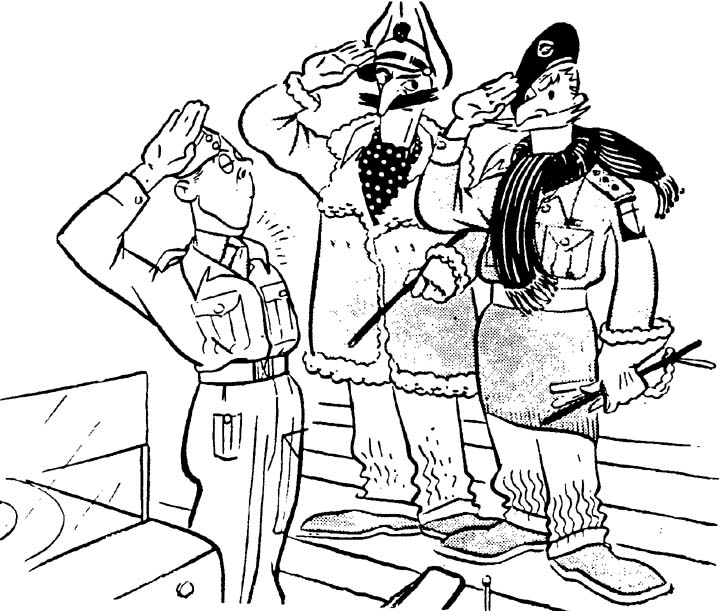 | 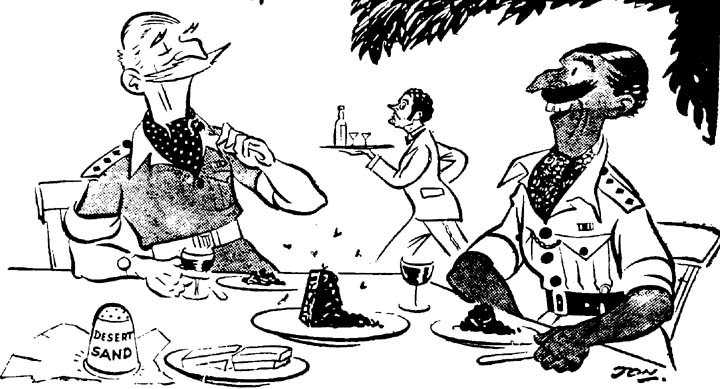 |
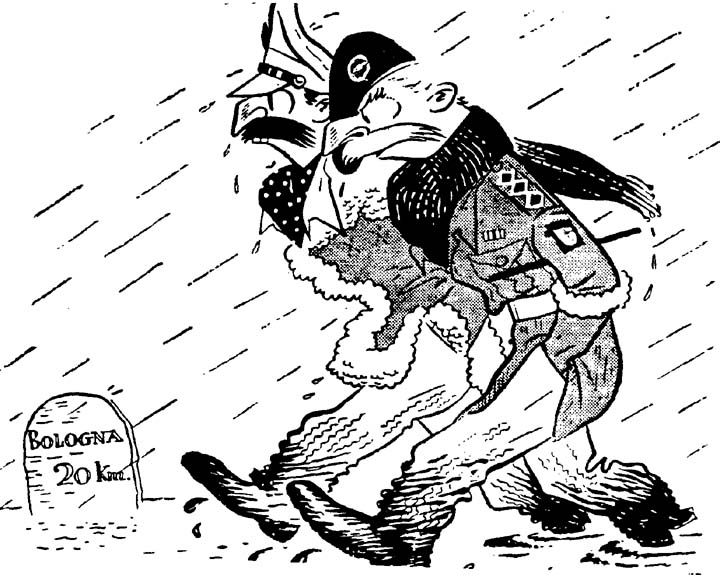 | 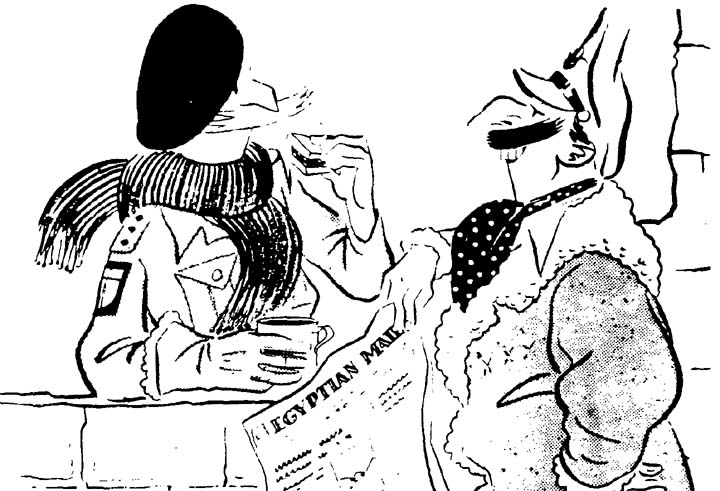 |
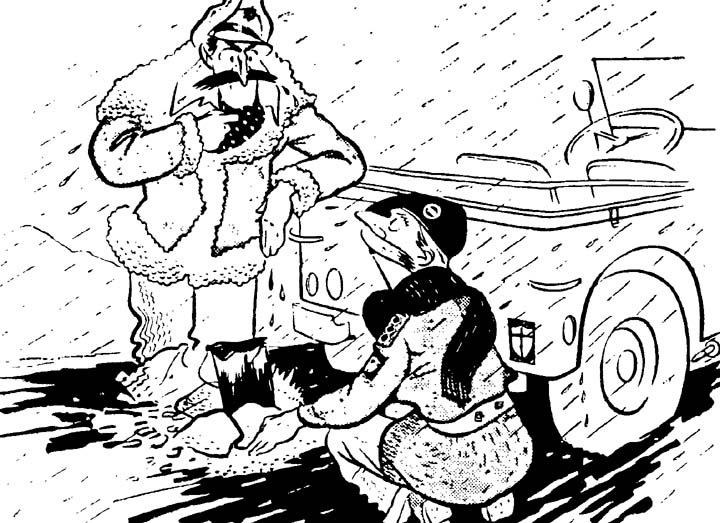 | 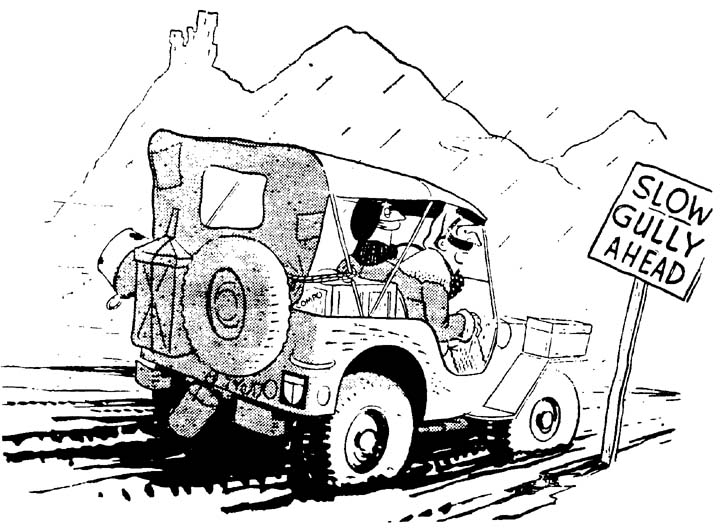 |
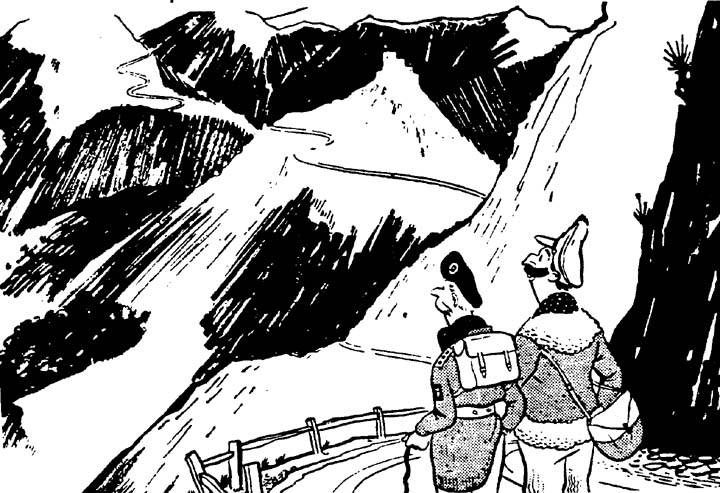 | 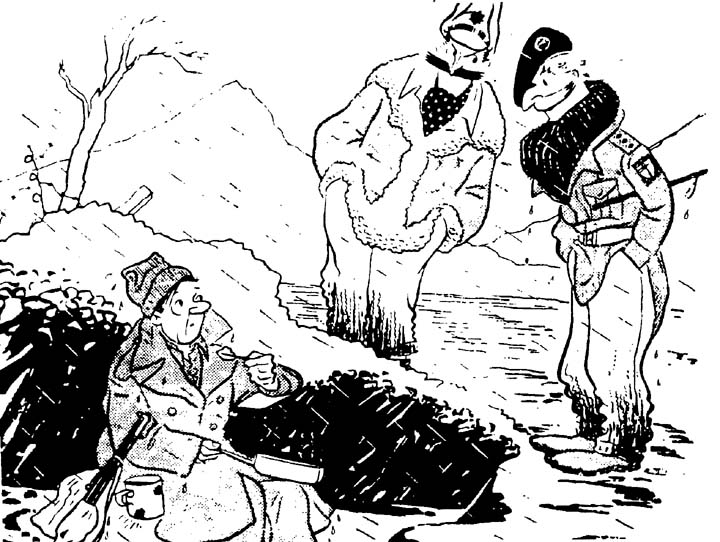 |
A principal focus of my story, An AFS Driver Remembers, concerns my fellows of "Lucky 13," AFS Unit ME 26. Above in Section 3 of Part I of this story, "In the Beginning," I wrote that we were the final 13 of our Unit to board HMS Aquitania, and that we were relegated down "below" to E-deck. Six of us served together for the "duration" to the end of the war. We promptly co-opted three other kindred spirits of Unit 26 into our "Lucky 13" fellowship also for the duration. Vernon William Preble of Lowell Massachusetts was one of these; he was then only twenty-one years old.
We lost Vern on November 28, 1943 in the cold and mud of the Trigno-Sangro campaign in Italy. He had been the first of us to cross the Sangro, as he had been first to cross the Trigno. Backing his ambulance against the shelter of a scarred stone farmhouse, he ran over a powerful anti-tank mine in a wooden-box which could not have been detected. Blasted and scorched by fire, he died shortly after; there was not much left of his ambulance. My poem "Preb" (Part XI above) tells this story. There are photographs of Vern above in Section 5 of Part VI "Italy, Sangro and Beyond," and also of his ambulance after it was demolished.
On December 13, 1944 I wrote a letter to our Director General Stephen Galatti to tell him about Vern. Our Director General took a personal interest in each one of us, and would also write to our parents. The loss of any one of "his" Volunteers or Drivers always touched him deeply. These are some of the lines from my letter:
Dear Mr. Galatti,
I am writing to you about Vernon Preble, and I hope you will find my words good enough... especially do I hope they will be of comfort to Vern's Mother.
I think I knew Vern as well as anyone did. We left New York City as members of the same unit, spent the first months overseas in Syria, went out to the Western Desert before the Eighth Army commenced its battle for Tunisia ... Vern's sense of humor was one of the most spontaneous and refreshing among the fellows of our Platoon and Company. He had many friends, and there was no one who was not at one time cheered by his companionship.
We spent the first weeks of the Tunisian Campaign posted together with the 12th Light Field Ambulance (LFA). Vern was eager for posting to an R.A.P. in the front line... he felt that he was needed most where the going was the toughest, and he did not want anyone else doing his job. After the first weeks in Tunisia his wish was granted, and he spent the rest of that campaign and all of his service in Italy in the thick of the fighting. The record of his work under fire is the best of any that I know of in the Field Service.
My letter to Mr. Galatti about Vern Preble continues:
He stuck it out for a month at Enfidaville ... His ambulance was the first to cross the Trigno River during the nasty battle for San Salvo in Italy. It is not simply what a man does that makes another man, and other men, love and respect him. Vernon's courage was the sort that infected and pervaded those of us who knew him and worked with him. He never let himself appear disturbed by the presence of danger, and accordingly whenever anyone of us was near to him, that person became strengthened. In this connection I remember the last time I saw him. It was at night, and our ambulances met at the bottom of a diversion around a blown bridge. He stopped to let me pass, and I stopped to shout thanks. When I found that I was talking with Vern, I stayed for a few minutes with my motor idling while we chatted together. An approaching vehicle forced me to continue up the narrow track, but I drove on with a newly gained confidence.
During the weary months of waiting in the African summer at Tripoli ... Vernon refused to get depressed by the inaction ... We discussed a thousand topics together ... Vern never said much about the good work he had done in Tunisia, nor the reason why he wanted to drive an ambulance during the war. In his boyish way, he was as modest as any person I have known ... his beliefs were sound. He believed in peace; and in war he wished to save lives rather than take them. In so doing, he assumed the hardest tasks himself.
Following a temporary battle-field burial, Vernon's remains were transferred to the American Military Cemetery Sicily-Rome (at Nettuno near Rome). Each grave is marked by a headstone of white Italian marble, with Latin Cross or Star of David, all lovingly tended. Vern was so young, as a younger brother for all of us of his Platoon and his death was a terrible shock for us. To be sure all of us faced death in war, but we hoped that it would not happen to one of us.
Vern and I had something else in common; each of us had a twin sister. After the war, I made contact with Vern's Mother, Mrs. Bessie Preble, and also his twin Thais. My wife and I visited with them from time to time at their home in Lowell, and we corresponded. We could not, and would not forget Vern, especially during a Platoon reunion, or a social gathering of a few of us. At one such occasion at John and Mary Leinbach's place (Greenwich, Connecticut) in the spring of 1950 we talked about doing a memorial for Vern. Sterling Grumman and I ("Fox") took the initiative on behalf of Vern's Platoon, Unit, friends and family. Sterling and I carried on a voluminous correspondence over the next two years (1950-52) to undertake this memorial project, and we kept all participants informed.
Sterling (CM Unit 41) had joined C Platoon at Tripoli during our "Summer of '43" and became at once one of our most devoted, dearest and loyal fellows. For us of the Platoon he was "Stalino," his Italian nickname acquired at Pollutri; he wrote to me as "Volpe" (the Italian for Fox).
Our plans for the memorial developed on two fronts. One element was to refurbish and decorate a room in memory of Vern at the American Field Service building, then at 113 East 30th St., New York City. The building served as AFS Headquarters and as a club house for the exchange students. The second element of our memorial was to design and create an appropriate memorial plaque to be hung in the Preble room.
Sterling was already member of a Memorials Committee Mr. Galatti had formed to improve the furnishings, decor and appearance of Headquarters as a "living museum" representing AFS.
For us to take over one of the principal rooms at Headquarters as a memorial to Vern conformed perfectly to this initiative. Sterling, who commuted to New York from his home in Darien, was ideally situated to take the lead on this element of our memorial project. After some inspection and exchange of views, a large room on the second floor known as the map-room was selected, so named because framed maps had been hung on the walls. This room had access to the kitchen, adding to its utility as a dining and meeting place. Mr. Galatti confirmed this selection in a letter to Mrs. Preble, and she was pleased. Kenneth Austin, Mr. Galatti's staff officer at Headquarters with responsibility for the redecorating, was informed And supportive.
Sterling inspected the room, made arrangements for painting and lighting, for some new furnishings and souvenirs, and for pictures, paintings, photographs to be framed and hung. These included photographs of Vern, as well as of AFS in action in war and peace; also something of, Vern's service records. George Collins and John Leinbach residents at or near New York City helped out, and everyone involved in the project was kept informed. Sterling did a great job, assisted by George and John.
A second element of the memorial was to design and construct an appropriate plaque to be hung in a central location in the room. I prepared an outline and text which was approved. The drawings as developed by Tom Hale called for a 1/16" bronze plate which measured 7"x 12" fixed onto a 3/4" mahogany base which measured 8"x 13" with a 1/8" bevel. The following designs and text were engraved on the plate* (a) at the top half center of the plate a simple latin cross 4 1/2" tall by 3" wide; (b) the name VERNON W. PREBLE (in capital letters of about 1/4" each) under the cross, then under his name the dates 1921-1943 followed by a third line with the words IN MEMORIAM (in capital letters of about 1/8" each). Then (c) at the bottom halt center of the plate there were eight lines of text in capital letters of about 1/8" each printed as follows (next page).
| AS WE DEDICATE OURSELVES TO CHERISH HIS MEMORY AND TO KEEP ALIVE FOREVER OUR DEVOTION TO THE HIGH CAUSE TO WHICH HE GAVE HIS LIFE: THAT FREEDOM AND MERCY SHALL NOT PERISH FROM THE EARTH. |
Finally, at the bottom center of the plate the following text in three lines (capital letters of about 1/8" each) was engraved:
At the bottom on the left and right sides of the plate framing the above three lines, were two insignia inside 1 and 1/4" squares; on the left side the Eighth Army shoulder patch which was the Cross of St. George on a shield, and on the right side the American Field Service Eagle with stars and stripes on a shield at its center. At the bottom center of the plate a laurel leaf completed the engravings.
Tom Hale (Unit CM 47), one of our most dedicated C Platoon fellows, a naval architect by profession, was a skilled draftsman and master cabinet-maker; he volunteered to complete the drawings according to specifications, and prepare the mahogany base and take over and supervise the engraving and fixing of the plate to the base. And it was Tom who suggested adding the word "Forever" to the fourth line of the text of the memorial plaque. Tom brought the completed plaque down to New York to be hung in the Preble room.
It was appropriate that Tom volunteered his time and skill to this important work. As a Driver, Tom's first assignment in action was to Vern Preble's ambulance at the start of the Trigno-Sangro campaign. There could have been no braver or better guide for Tom under combat conditions. As this campaign took its toll from illness (a veritable jaundice epidemic), exhaustion and some casualties, our ranks thinned. Tom was assigned his own ambulance, but had to be pulled out of the line for a time because of malaria. Vern was alone and had evacuated his patients when he was killed.
We wanted to reach as many of Vern's fellow Drivers and friends as possible. I prepared a mailing list of about 85 names with addresses taken from our C Platoon roster of 1943 and the ME Unit 26 roster of 1942; also including some fellows of 485 Company as well as of our AFS "Seniors" --- Stephen Galatti, Bill Wallace, Fred Hoeing, John Nettleton, Ward Chamberlin.
I prepared a letter which was approved to explain our plans for the memorial and to invite donations. This was dated October 9, 1950, and I followed up with another letter in late 1952 to report completion of the project. To assist me in mailing these two letters, I duplicated copies for distribution and divided the mailing list into seven parts of ten to twelve names each. I called upon seven of us to join me, each to take one of these shorter lists for mailing. These fellows were: Jock Cobb, George Collins, Art Ecclestone, Sterling Grumman, Chan Keller, John Leinbach, and Jay Nierenberg --- the heart and soul of our "Lucky 13" circle.
We obtained 440 dollars in donations in addition to gifts of some furnishings, photographs and pictures, and Tom Hale's contribution for the plaque. I remember a flood of emotion as I stood before the beautifully mounted and engraved plaque hung in the Preble room to honor and remember Vern. I quote below from both these letters. First, some lines from my circular letter dated October 9, 1950:
Dear Friend of Vern Preble,
For some time a number of us, who felt particularly close to Vernon Preble, have wanted to establish a fit memorial to his memory and honor. We do not want to act without the approval and support of all those of the American Field Service who knew Vern, and we have accordingly addressed this letter to all members of Vern's Platoon and Unit ... for such a memorial that would be enduring, personal, useful, and within the scope of a modest financial outlay. We felt that these requirements would best fulfilled by furnishing and dedicating to Vern one of the upstairs rooms in the Field Service Club in New York City.
A fit memorial of this sort requires in addition to furniture pieces, items such as photographs, letters, poems, carvings, Vern's awards and his service records ... some placed along the walls, others contained in a bound. volume. An inscribed plaque should be included. Steve Galatti has kindly set aside one of the front rooms for us, and details of the final disposition can be arranged by a committee of those of us who are in the vicinity of New York.
There are in all over 80 of us who were with Vern in C Platoon or in Unit 26 ... Any donation no matter what its size will be most gratefully welcomed. In addition, please send me your proposals for and offers of items of a personal nature (letters, pictures, remembrances etc.) to be included in the memorial .... I have talked with Vernon's mother and sister about this. They are grateful and pleased, and are planning to join with us in making this memorial possible...
Second, and in conclusion, there follow some lines from my open letter circulated to our mailing list in late 1952 to describe the memorial and to express thanks to those contributing to its success:
Dear Friend of Vern Preble,
The Memorial in honor of Vern Preble nears completion, and those of us who have been directly associated with the project take this opportunity to inform all of Vern's friends as well as the Field Service Membership of our progress ... friends donated over $400. With this as a financial base, and with the support of Mr. Galatti and the Field Service Executive Committee, it was decided to establish the Memorial at the Field Service Headquarters building in New York City ... and a committee led by Sterling Grumman saw that our funds (and gifts) were used to best advantage. The "Map-Room" and adjoining kitchen have been in part redecorated, refurnished ... to the end that a ... center for Field Service activities could be prepared. Photographs and other remembrances have also been prepared for hanging along the walls, and an appropriate bronze plaque is being fashioned...
It has been a rewarding experience, and all of those who have contributed to it have welcomed the chance to honor Vernon's memory in this way. All of us who have been working on the project during the past two years wish to thank from the bottom of our hearts, all of you who have made it possible to create the fine and useful Vernon Preble Memorial at Field Service Headquarters, New York City.
With sincere thanks (signed),
Charles Edwards, Sterling Grumman
Symptomatic of the progress of the Scholarship Program, which is now called AFS Intercultural Programs, have been changes in Headquarters accommodation. This has in turn affected AFS Memorials. By 1956 when the scholarship program had topped 1 000 exchanges annually, the small building at 113 East 30th Street could no longer serve the office needs and the flood of exchange students. The AFS Directors approved plans to construct a new building at 313 East 43rd Street; a beautiful and functional structure of five stories plus full basement. The main floor contained a spacious assembly area and comfortable lounge with alcoves at one side to accommodate memorials. The Preble memorial plaque and other Preble movables were transferred to this new "Memorial Room." This magnificent building was a dream of Mr. Galatti's come true.
In 1993 there was another change in AFS office locations to accommodate by lease in New York what had become AFS- International world-wide on the one hand and AFS-USA on the other in its status as one of the "Partners." These two shared offices at first, then in 1996 obtained separate office space with AFS Archives situated at AFS- International at the following address: AFS Intercultural Programs, Inc. 71 West 23rd Street, 17th Floor, New York, NY 10010-4102 USA. A listing of AFS Memorials is recorded at AFS Archives. AFS-USA is currently located at 198 Madison Ave., New York. NY. 10016.
November 1961 marked the 20th anniversary of the sailing of AFS Mideast Unit number 1 one hundred strong led by Col. Ralph Richmond . They sailed from Halifax on November 10, 1941 --- destination Egypt by way of Capetown. This was just over one month before the attack on Pearl Harbor,
Unit 1 would distinguish itself in the Western Desert and at El Alamein. It included a number of the remarkable men of AFS who rose to positions of senior command at Headquarters, Company, and Platoon levels and who obtained our respect and love; to name a few: Doug Atwood, Manning Field, Fred Hoeing, Art Howe, Chan Ives, Houghton Metcalf, John Nettleton, and of course Ralph Richmond.
The formation of Unit and its sailing to join the British Eighth Army in Africa, resulted from remarkable accomplishments in recruitment, accommodation, organization and negotiation by Stephen Galatti. These negotiations involved the top echelon of American and British Governments and British Army Command.
Stephen Galatti, our beloved "Steve," in the words of George Rock "heads the AFS. he runs the AFS, he is the AFS." Born in 1888, a graduate of St. Mark's school and Harvard, he quarterbacked the Harvard football team. His life-long career, at first in banking (New York and Paris) continued on after World War I with the New York stockbroking firm of Paine Webber. When with the American Embassy London in 1915 he joined AFS. and he served as second in command to the founder and first Director of AFS A. Piatt Andrew. Henceforth AFS was his love and his life.
A man of incredible vision and imagination, he knew AFS had an important role to play in World War II and was determined to make it happen. He summoned some of his able AFS fellows of World War I to his side. He re-established AFS in 1939 as the Nazi juggernaut demolished Poland then turned on France, England, and Russia. To organize. recruit, equip and ship Unit 1 and in the teeth of United States isolationism, is in itself testament to this truly extraordinary man, and he had only just begun. Throughout the war he was our Director-General with rank of Colonel.
His vision and leadership for all of us enabled him to take the initiative for the founding of the Scholarship Program (AFSIS) in 1946, and then to lead the Program as its first President until his death in 1964. This is yet another testament to him of so very many. Throughout all his years with AFS down to 1954 he served as a Volunteer, coming to his office after the market closed in mid-afternoon, and working far into the night. From 1954 to his death at age 76 in 1964, he accepted a modest professional stipend in his continuing capacity as AFS President.
If there could be one single word to describe Mr. Galatti it would be "rumpled." But it takes a score of words to capture all the things he was --- warm, caring, compassionate, dedicated, selfless, concerned. He possessed enormous energy vision and imagination. He had the capacity to meet, motivate, bring about consensus, and achieve rapport and agreement at any level of human discourse and interaction.
During the war, Mr. Galatti took personal interest in each of us Drivers, and he wrote personal notes to our parents. My folks received several. After my wedding, he sent me a personal note dated September 25, 1944: " ... this is to wish you the best of luck and my best to Mrs. Edwards." After the war, he tried to meet as many of the exchange students coming through New York as he could.
For him, AFS Headquarters New York City should be as a living museum to highlight AFS action and achievement in war and in peace, and to facilitate periodic meetings and reunions bringing together us Drivers at Headquarters as well as leaders and participants in the scholarship program. The 20th anniversary of the sailing of ME Unit 1, November 10, 1961 was for Steve a significant milestone to celebrate by means of a reunion of as many of the Drivers as possible to be held at Headquarters, November 10-11, 1961.
In 1961 I was a member of the faculty of Westminster College, New Wilmington, Pennsylvania where I was President of the Wilmington Area AFS Scholarship Committee. having established it in 1956; I had also taken initiative for our C Platoon gatherings and in our Vern Preble Memorial project. Both of these activities had involved correspondence with AFS Headquarters including some exchanges with Mr. Galatti. and Mr. Galatti looked to me to help out on the proposed November reunion. Although too distant from New York to attend meetings, I was appointed to the "AFS World War II Reunion Committee" formed August 17, 1961.
I received a letter dated July 10, 1961 jointly signed by Stephen Galatti and Frederick W. Hoeing stating that "the twentieth anniversary of the sailing of the First Unit ... would be a fine occasion for a reunion of World War II members..." they invited me to write letters to friends of my unit "urging them to attend," and they also invited my suggestions for the reunion which was planned for November 10-11, 1961.
I responded (July 20, 1961) in a two-page letter to Fred Hoeing with a total of seven suggestions and a few specifics for each. One suggestion was for a Memorial Service Sunday morning November 11 (which was also Armistice Day) in memory of all 48 AFS Volunteers killed in both World Wars. This took place, and was conducted by AFS Driver Rev. Norm Eddy at the new AFS building at 10:45 A.M. November 11.
My letter of July 20 was to Fred only because one of my suggestions to Fred was that this would be an appropriate occasion for a gift to honor Steve himself.
I included some ideas in my letter to Fred about assembling and giving to Steve an appropriately bound record of his life-time work and achievement. I also recommended that a special committee or "gift commission" should be formed for this. There followed several letters between us each way, "Fred" to "Fox, and "Fox, to "Fred," through August 18, 1961. One of Fred's was a three-page letter to me (August 4). I responded with a second two-page letter (August 12) in which I explained in detail my ideas about the packaging and content of "a Galatti Archive" as a gift from "the ambulance drivers." I confessed, however, that there probably wasn't time to carry this out before the November dates of 10-11 for the reunion.
In his letter to "Dear Fox" August 18, 1961 Fred wrote to me that he had presented my suggestions to the Reunion Committee, and that "Your Galatti Archive sounds brilliant --- but we think too much for the short time and also that it might be more rounded and fitting for 1964 [the year of the 50th AFS anniversary celebration], but we would like to do something along that line." He passed on my letters and suggestions to Gerry Griffin (member of our Unit 26) who was chairman of the World War II Reunion Committee, and to Ward Chamberlin who was appointed Chairman of a Gift Committee (possibly my "Gift Commission" idea). Gerry wrote (August 15) that some of my ideas "will somehow get incorporated into the proceedings." I had also helped out to mail invitations to the reunion to members of Unit 26 and C Platoon.
Ward invited me (September 20, 1961) to join his Gift Committee, indicating his interest in trying to put together a leather-bound loose-leaf collection with a first page dedication to Steve (reference my "Galatti Archive" idea). I responded immediately to Ward (September 25) elaborating further on my ideas. On October 3 Ward wrote to ask me to prepare a draft for a first page dedication for this collection. I completed and forwarded my draft to Ward as soon as possible in early October, with more than the allotted 300 words double-spaced to assist in the process of editing and cutting.
In retrospect, there hadn't been time to complete an acceptable "Galatti Archive cum leather-bound loose-leaf collection for November 10-11, 1961 and my dedication was not used. The reunion itself was a success, with just under 200 acceptances by mid-August. After the reunion, Fred Hoeing wrote me (November 28, 1961) to thank me for serving on the committees. With regard to the Galatti gift idea he wrote: "I still think the Galatti Archive an excellent idea for 1964. Why doesn't your Committee on the Reunion Gift remain in existence to guide it?"
Actually, Ward Chamberlin was Chairman of the gift committee. In 1962 I had left Westminster College for the U.S. Foreign Service and by 1964 had been posted to Tunis, Tunisia. Sadly we lost Steve in 1964. Apparently, my suggestion of an appropriate gift "Archive" to honor Mr. Galatti was not or could not be completed and presented for the 1964 reunion. Nevertheless, I believe my dedication to Stephen Galatti intended for it to be a worthy tribute to our "Steve" and so I have included my draft below, next page.
Seldom in the history of significant institutions cutting across boundaries and generations has one man so completely come to personify many men; "Stephen Galatti" and "American Field Service have become almost one.
Steve Galatti has given his life to AFS, and in his giving he has nurtured it, shaped it, directed it, given it vitality and meaning. He has ministered to its slightest needs; he has counseled in its greatest challenges. He has summed up its highest ideals, and in the summing up has summoned it to heroic service in war and in peace.
These things he has done, not aloof, distant, haughty --- but as one with each ambulance driver, each exchange student, each staff member, each community representative. AFS is today, on this twentieth year since AFS Mideast Unit 1 sailed for Egypt , a monument to the mind and heart of Stephen Galatti.
The unshapely crude but starkly symbolic "Hunk O' Tin" ambulance at Blerancourt, France, preserves the memory of that first American Field Service of World War I and its creator Colonel Piatt ("Doc") Andrew. Steve Galatti was one of those first Americans to volunteer for France and Humanity with AFS in 1914-15; was second in command to Piatt Andrew as Assistant Director-General, then Director-General of AFS in 1936. In those fitful inter-war years, the AFS name was kept alive by American Field Service Fellowships for French Universities, by an occasional reunion and Bulletin, and the AFS memorial established at Blerancourt. In those years Steve Galatti also pursued his career, accumulating the wisdom and fortune he bestowed so freely to AFS in all the years, and doubtless irked at inaction and the thought that AFS might indeed remain merely memorialized.
The trumpet calls to action by free men against the Nazi terror summoned the real life work of Steve Galatti: all before for him was preparation, and henceforth his commitment to AFS could be total. There were others close to him, revered names all, and in his modesty he would give them credit; but the record shows that his was the vision and the driving spirit. AFS became alive, first for France and then for Britain and the Commonwealth, fanning out its units, companies, platoons, sections across the Western Desert, up the Italian boot, on into India-Burma. This is history as if it just happened on its own. But there were a thousand-and-one difficult decisions in his orchestration. of the grand design: manifold problems of support, supply, finance, organization, recruitment, international politics, diplomatic agreement involving headquarters and field before the grand design could unfold.
Continuation of my draft dedication to Stephen Galatti:
In all this, and more, the Director-General was the essential instrument of leadership, doing the undramatic things at home, coursing the moving fronts abroad, sustaining his troops, impressing his beliefs upon the dignitaries with whom perforce he dealt. Honors he did not seek, or perhaps greatly cherish; honors he did receive.
War's end, perhaps the end of AFS? Or so it might have been had Steve Galatti allowed the past to dictate the future. But he had learned that war does not make peace, that the end of fighting is the real beginning of the search for peace through human understanding, that this was to become the authentic mission of AFS for peace.
The Exchange Program, AFSIS, is all Galatti, although again in his modesty he would bestow credit upon others and assume little for himself. AFS to him meant a common humanity mingling in honor and in understanding with all humanity even in war, and he would apply this same logic to the art of perfecting peace. On September 28, 1946, it was decided [a meeting of us Drivers led by Steve] that AFS would be perpetuated, it would be housed, it would initiate a student exchange program and Steve Galatti would lead it: a vote of confidence for his ideas, ideals, and his continued leadership along uncharted ways.
So AFS lived on, and the Exchange Program began, at first fitfully, painfully, urged on by a loyal staff and sustained by a dedicated man devoting his talent, his sinew, his fortune, his very life to the work at hand. And so at first a trickle, a stream, and then a torrent, a flood, until in one decade the largest volunteer international teen-age exchange program in history had been firmly launched. And again there was the constant traveling, speaking, pleading, deciding, inspiring, bargaining, dealing, transcending; dealing with committees, officials, dignitaries, heads of state; transcending the networks of arbitrary political boundaries that crisscross our human stuff in a titanically shrunken world.
And there were plaudits, decorations, honorary degrees: these he did not seek, or perhaps greatly revere except as through him, AFS and AFSIS would live on, except as through them the unabashed love and affection of all whose lives he touched would shine through.
Seldom has one man embodied the dreams, and hopes, and ideals for a more decent world of so many men and women in many lands. Seldom has one man's stewardship been so complete.
All hail our chief!
Section 1 above of this Part XII lists the names of the 44 members of our C Platoon, AFS 567 Ambulance Car Company as of 1962. This was 17 years after the ending of World War II and our Platoon "brotherhood" was as enduring as it had become during the war. This list in 1962 included the names of four very special guests who were always invited to and welcome at our reunions; their names which follow need no introduction: Stephen Galatti, Fred Hoeing, Art Howe, Manning Field.
This 1962 listing of our members with their addresses was distributed to each one of us and served as a mailing list for our reunion of August 11-12, 1962 and for our successive reunion. All in all, counting our first reunion on Labor Day weekend 1945, we held five reunions down to 1990 plus attending three reunions organized by Headquarters for all the Drivers. This included the AFS celebration of the 50th Anniversary of the ending of World War II held at Williamsburg October 24-26, 1995 and for which C Platoon's Tom Hale was chairman.
After the war, I served as a sort of ex officio Platoon secretary assisted by Sterling Grumman when I was overseas with the U.S. Foreign Service. I prepared the rosters for our reunions and took care of many of the communications. In addition to our Labor Day weekend al Hyannis Port in 1945, I hosted with my wife Licia two more reunions at Hyannis Port.
It was Tom and Anne Hale who organized and hosted our final C Platoon reunion, a marvelous event July 11-12, 1990 at Martha's Vineyard island, with their lovely Vineyard Haven residence as "home base." Between reunions we exchanged letters at Christmas, stopped by for occasional visits at each others' homes; this was especially true of our "Lucky 13" fellows.
All of us Drivers regardless of our affiliations whether Headquarters, Company, Platoon or Section considered ourselves to be true friends and kindred spirits. However, I do not know of any other AFS unit where the bonds of friendship and brotherhood were as close as those of C Platoon, 567 Ambulance Car Company of the American Field Service, World War II and also after the war.
There follows a chronological outline of our C Platoon reunions, and the All Driver reunions in which C Platoon members participated.
| |
|
|
| Labor Day weekend, 1945 | Edwards residence, Hyannis Port | Twelve |
| Sept. 27-28, 1946 | AFS Headquarters NYC | For all Drivers, birth of AFS, Intercultural, Post War |
| Nov. 10-11, 1961 | AFS Headquarters NYC (separate Platoon dinner) | For all Drivers /17 C Platoon, plus our wives and guests |
| Aug. 11-12, 1962 | Edwards residence, Hyannis Port | 20 adults (8 wives), Six children |
| Dec. 2, 1966 | Yale Club NYC, S. Grumman host | Eleven |
| June 5-6. 1981 | Edwards residence, Hyannis Port | Seven with wives |
| June 2, 1984 | AFS Headquarters, NYC | For all Drivers /10 C Platoon |
| July 11-12, 1990 | Tom and Anne Hale, Vineyard Haven | Fifteen wives, 4 guests |
| Oct. 24-26. 1995 | The Woodlands, Williamsburg, Virginia | For all Drivers /16 C Platoon participated |
To capture some of the flavor of our C Platoon gatherings, and the good fellowship we knew, there follow in chronological order commentary on highlights of our reunions as well as copies of a few of the inspiring, intriguing even outrageous communications that accompanied each of our gatherings and sometimes in between.
On November 11-12, 1961 Headquarters conducted a reunion at New York City to celebrate the 20th anniversary of the sailing of ME Unit 1 to Egypt. Seventeen of us of C Platoon including some of our wives, took part in this reunion and organized a separate Platoon dinner the evening of November 11 .Sterling Grumman, Fran Everett, and John Leinbach each resident at or near NYC took the initiative to rally the troops, with Fran as chairman for reunion preparations. I, then living in western Pennsylvania, was appointed master of ceremonies for our dinner. We sent out a letter to the Platoon prepared by Sterling and dated September 26, 1961. The result was an enthusiastic response.
I quote below from portions of Sterling's letter of September 26, 1961 which surely qualify among the "outrageous" category of our C Platoon communications:
Those of you who attended the last Platoon festivity will not be surprised to hear that the shy and retiring Fox Pastene Edwards, B.A., M.A., PhD., B.S. has again been prevailed upon to act as master of ceremonies. Those of you who did not attend the last celebration will be amazed to hear that the Fox has overcome his forgetfulness of punch lines. Though no longer the holder of the title of "the world's fastest human," he still struts around on his hands, a feat that we will undoubtedly witness again...
Our next reunion, August 11-12, 1962, would be one of our biggest and took place at "Fox Hall" Hyannis Port hosted by Licia and me. I quote below from a "C Platoon Newsletter" dated December 11, 1961 which I wrote as a follow-up to the November 11, 1961 Platoon dinner at Headquarters. In this letter I announced my proposal to host with Licia a reunion at Hyannis Port August 1962. This letter may also qualify in part for the "outrageous" category of our Platoon communications.
Dear Fellows, I have decided to celebrate by means of this newsletter my smashing victory over one G.S. Grumman in the obviously rigged election race for Platoon Secretary ... In point of fact I have been prodded by letters from several particularly Paul Morris to compile and circulate the addresses [i.e. our 1962 roster of 44 members] ... Thanks again to Fran Everett Chairman and his doughty assistants, particularly Leinbach and Grumman, in planning the Platoon affair, and Fred Hoeing helped greatly on the hotel accommodations.
By the same token, the affair also created the opportunity for meeting with and among the wives, and other friends and guests of the Platoon --- notably Steve Galatti (now inducted as a full-fledged member of the Platoon) .... Twenty with wives attended the evening dinner, and on the basis of the 24 questionnaires filled out at the dinner, there are presently 48 Platoon "small fry." "Col." Brooke with five appears to lead all the rest (with an assist from his Ann); however, we were informed that one T. Hale was prevented from attending the reunion at the last minute by the arrival of his 6th (with an assist from his Anne).
Oral response to the suggestion of a Hyannis Port reunion this summer registered high on the "clamormeter"... I propose the weekend of August 10-12, 1962 ... I have room for all the men ... for those wishing to bring wives (one per person) ... I can arrange for a near-by facility (at your expense) where wives could be housed together, while husbands lodge at Fox Hall. Keller writes "the wives would not dare stay in the same quarters with me anyway .. .... Cheers ... stiff upper lip ... jolly good show, carry on .... until we meet again.
---"Fox"
Indeed, as proposed per my newsletter quoted above, Licia and I entertained the Platoon at our home ("Fox Hall" ) Hyannis Port the weekend of August 10-12, 1962. Announcements were mailed to all 44 on our 1962 roster. The good cheer and the good weather more than made up for the rather modest turnout of 26 in all --- eleven Drivers, nine wives, six children. More had hoped to come; there were ten letters of regret including one from Stephen Galatti, who had to meet a boat bringing in 800 AFS kids, and another letter from Luke Kinsolving all the way from Damascus.
At all three of the Fox Hall reunions at Hyannis Port, one of the most popular events was an authentic traditional Cape Cod clam bake I put on with all the fixin's plus the indispensable keg of beer. I had learned this art from a neighbor friend, and our beach club was an ideal location for it.
This was the "main event"; it was "laid on" for Saturday at 18:00 hours per the "Orders of the Day" printed and posted for the occasion. While the bake was steaming to its delicious perfection, the following beach-side seminars were offered: greasing splines, see Collins; buying high and selling low in the market, see Grumman; sleeping, see Leinbach; drinking, see Orton; eating, see Keller; "new frontier" sports, see Wright; instruction in the arts, see Barbour and Aument.
Other activities, both days, included exploring Hyannis Port, sun-bathing and swims at the beach, volley-ball and badminton (at Fox Hall lawn), golf and tennis (Hyannisport Club), watching the yacht races (Yacht Club pier). I supplied passes and ID's for any who may have encountered one of the police check points looking after security for the President of the United States at the "Summer White House" that weekend. I also arranged for lunch at our beach club, plus recommendations on some of the better Pubs and NAFFY's around town.
That Saturday night a few never made it to their bed-rolls or slit-trenches while they continued to entertain the rest of us with loud renditions of 8th Army songs (censored with the ladies in mind) until most of us "packed in." Orders of the Day for Sunday called for quarters inspection at first-light, followed by tea and fried bread at 900 hours. in addition to the activity options of the previous day, Church Services were available at 1000 hours: for "officers-only" (Keller) at St. Andrews Episcopal; and for "other-ranks" at our modest Union Chapel.
I followed up with a newsletter to all Platoon members about the reunion dated Christmas '62. This summed up the main event (lobster bake) and the events of the "Orders of the Day." I also included news items received since the reunion. I wrote that "your Secretary hangs on in consequence of a definitely 'hung' election at the August gathering .... somehow the Hyannis Port reunion group just couldn't manage a serious business-meeting: it must have been the lobster, clams, corn, beer (plenty of that !) and those wonderful wives. But we did have a meeting, and I did promise a letter, too."
I reported in this letter about "a dramatic reading by Tom Barbour before a fire in the open hearth..." This had followed the Saturday evening lobster bake when the "weather was a bit moist --- outside, and in." I also wrote that "the real spirit of the reunion is best captured by ... the inspired muse of one Shirley Keller --- henceforth named by common acclaim the Platoon laureate." I quoted this "delightful ballad" in my December '62 newsletter, as I quote it below as follows:
| by Shirley Keller with an Assist by Chan We went to the Cape for the weekend The Fox had called a reunion A northeaster blew in from the ocean We relived the war of the forties The next time we come to reunion |
In late 1962 I had moved to Washington D.C. pending an overseas assignment in 1963 with the U.S. Foreign Service. I identified myself in my December '62 letter as "your ex-Secretary" and that "your Platoon Secretary has been turned into a Secretariat with Fred Wackernagel getting out the addresses and Chan Keller doing the mailing."
While I was in Tunisia, Sterling Grumman hosted a reunion dinner at the Yale Club, NYC, December 2, 1966 with twelve of the fellows (including Sterling of course) present and accounted for. I received in the mail (via State Department pouch) as a sort of surprise Christmas gift, a packet of notes from each one of them.
These were addressed "Dear Fox" or "Dear Fox and Licia" and each surpassed the other in good-natured ribbing in the spirit of C Platoon. Sterling wrote that "Keller was in favor of sending this to you via cable collect" but that I had opposed this idea. Keller responded that "the trends of postwar thinking has escalated immensely since USAID took over Tunisia" and that "Col. Richmond sends his regards.' Mort Wright missed my "public speaking and timely anecdotes" and Tom Barbour added "no jokes, we miss you." Rob Craven observed that "U.S. representation abroad stays on its usual unusual level." Whit Bell addressed "Volpe, wife and cubs... Auguri! Hail!" Jay N. kidded me on my "irrepressible master-of-ceremonies approach" and Leinbach added "No jokes. No towel dance ... When are we going to see you?" What a bunch!
I did make it back to the States "on rotation" in the early 1970's, and got together with Sterling Grumman to obtain a good deal for a Caribbean cruise for February 22-March 1, 1975 on board the Leonardo. Although there was interest, only five couples signed on, insufficient to consummate the "deal" with the Italian Lines. We did circulate our Platoon roster (44) in a letter written by Sterling August 20, 1974. It is a delightfully "outrageous" letter in the style of which Sterling was master, and at the least brought us all together again in the spirit of good-natured ribbing and C Platoon camaraderie. And we all participated vicariously in an exotic cruise to faraway places.
I quote below from some of the more "outrageous" lines of Sterling's letter:
Cari Amici: The world's fastest human of yesteryears, poet laureate of the AFS and chief base waller, C. Pastene Edwards has commissioned me secretary of C Platoon and charged me with the responsibility of drafting all volunteers for a reunion of unparalleled dimensions. Fox has chartered the Leonardo De Vinci for one week of dolce vita ... Wives are invited, and because of Fox's controlling interest in the Italian Line and Licia's brother Tony Sargiacomo's high management position, the cost of. a cabin on boat deck will be no more than $460 per person ... Professor Collins will be asked to conduct a course on Italian art as well as one on automobile maintenance; the Fox has already agreed to walk on his hands and to lecture on "the latest trends of postwar thinking" --- take heart, he has promised to keep his bad jokes to himself ... In addition Barbour is being requested to exhibit his wound, and Giovanni Leinbach once again will give us his rendition of "The Birth of the Blues."
Elsie and Jay Nierenberg, Mary and John Leinbach, and Joe Wolhandler as well as the Fox and Licia and yours truly have already signed up, while the characters listed on the accompanying page are being drafted... Don't be misled by President Ford's clemency; the Fox and I are going to be tough on draft dodgers. The consequences could be bully beef and tea ! let us hear from you affirmatively.
Auguri, Grumm
I encountered mandatory retirement from the Foreign Service in 1980. Licia and I managed a small reunion for a few of us June 5-6, 1981 when we had gotten back to the Hyannis Port house. We had acceptances from Kellers, Leinbachs, Hales, Ecclestones, Cobbs, and Joe Wolhandler. Sterling's daughter Carol Grumman came and brought slides of Nepal; her father, our Sterling, had been killed in a fall in the Himalayas in 1977. (it should be noted that we had "adopted" Joe Wolhandler from B Platoon).
The "main event" was a sail on board my good ship Diona, a sturdy Vineyard Vixen designed and built by Tom Hale. (Being a "Vixen" he must have done it for the "Fox.") Unfortunately the "flung spray, the blown spume, and the seagulls crying" proved too much for John Leinbach, who spent most of the sail leaning over the side to feed the fishes. Diona loved a good blow. Licia and I loved getting together again with at least a few of our "Lucky 13" and C Platoon brothers after many years in Africa.
The years sped by, taking their toll. We had been 52 strong in our roster of 1943 as new fellows came on board to replace some lost; then there were 44 of us on our 1962 roster The years took their toll on our ranks but not on our spirits. We still cherished our friendships and our memories, maintained our contacts and our communications.
AFS Headquarters arranged for a reunion of the World War I and World War II Drivers for Saturday, June 2, 1984 in New York City. There was a reception and cocktails at Headquarters followed by a dinner at the Terrace Pub. Ten of us of C Platoon (six "Lucky 13") arranged to attend and meet together at this reunion; four of us with our wives. There were then about 30 of us in all for whom we had names and addresses for a Platoon roster.
Clearly by the beginning of 1990 another of our C Platoon reunions was long overdue, and this one could very well be our last opportunity for a good turnout and to rekindle once more what C Platoon had been for us over all the years. Tom Hale, now graying along with the rest of us, had been our youngest; he had been in his teens and a recent graduate of Milton Academy when he joined C Platoon at Tripoli during our summer of 1943. He proved to be one of our most loyal and enthusiastic members. Tom and Anne moved to Vineyard Haven on Martha's Vineyard Island early on in their marriage. Tom, a gifted designer and builder of the ships he loved, was founder and President of the Martha's Vineyard Shipyard at Vineyard Haven until he turned it over to his elder son Philip when he retired.
It was Tom Hale who seized the torch to host the most incredible C Platoon reunion of all at Martha's Vineyard island on the weekend of July 11-12, 1990. He gave to this reunion with Anne at his side the fullest measure of his memory of what C Platoon had been for us over the years; of his wisdom and wit, his organizational ability, his enthusiasm and indeed his love for AFS and our Platoon.
In all of this he more than rekindled within each one of us the best of the experiences we had known individually and together. Happily one's memory can play tricks bringing to life good times, setting aside the trials, tribulations, horrors each one of us had known and witnessed. And for a few shining moments we shed all the intervening years and we were as we had been almost a half century before --- young, filled with hope and ideals, our unique fellowship of bonding in war reborn.
In Tom's opening words spoken at the reunion dinner on Saturday evening he told us: "we are here tonight to refresh friendships ... tempered in the furnace of war and in the presence of pain and suffering of friend and toe alike. But all was not death and cold and misery, and today let us remember the good times we have shared ... among us and among our British and 8th Army mates."
One of Tom's favorite passages were the stirring words, as only Shakespeare could write them, spoken by Henry V on the eve of the battle of Agincourt: "We few, we happy few, we band of brothers, For he today that sheds his blood with me shall be my brother..." Tom felt that these words applied equally to us, and he quoted the entire passage during his opening remarks.
The most moving moment of the entire reunion then followed, when he asked us to stand and pay silent tribute to "those of us who could not be with us tonight" as he reverently read off their names. There were fourteen names of our C Platoon fellows and three others who had been our guests and were revered by all AFS: Stephen Galatti, Fred Hoeing, John Nettleton. Vern Preble's name led all the rest. We had lost Dick Stockton in Africa.
Tom's preparations were as thorough and almost as much fun as the reunion itself. He got started more than eight months before the July 10-12 weekend chosen for the event. On November 1, 1989 he wrote to me from Vineyard Haven that "Anne and I are considering having a small C Platoon reunion here..." In retrospect this reference to "small reunion" belongs in the category of "famous last words" such as when Major Shaffer told us "it never rains on the desert." In that letter of November 1, he listed a "core" group of 13 names plus his own, and asked for help on addresses as well as suggestions for other names. I was able to pass on addresses for these, as well as for another 14 names with addresses --- a total of 28, 16 less that our 1962 C Platoon roster. Tom invited all of these, as well as Art Howe, Manning Field, and Bob Applewhite.
By January 2, 1990 there were already fifteen acceptances, and Tom was elated --warning however that "No one admitted without an updated 412 book" and demanding of each of us "have you greased your shackles today?" By February 24 Tom had received 36 C Platoon acceptances of which 16 were wives, as well as acceptances from four guests including Art Howe and Manning Field. These numbers are eloquent evidence of our Platoon spirit, even in our "golden" years
With so many accepting early on, Tom and Anne concentrated on preparations. Starting November 1, 1989 and in addition to an exchange of letters with me concerning names and addresses and suggestions, he distributed eight helpful sets of instructions for all of us from February 1990 on down to the opening day of the reunion. Most of these were written in the mode of British Army "bumph." under the OHMS (On Her Majesty's Service) letterhead coming from T. Hale T.V.A.N.C.O. (Temporary Voluntary Acting NCO).
Tom's instructions were addressed variously to "intrepid volunteers, bints, friends, hangers-on, camp followers" and covered such essential subjects as "Kits (Mess) all troops, for the use of," "Vehicle Maintenance," 'Transport," "Dress." One two-page memo reported the sad news that "the lorry driver bringing up the bully for C Platoon from Bari had flogged the last lot at Termoli ... and that the powdered eggs got left out in the rain." Tom added that he had providentially received by "carrier pigeon ... from the heirs of Maestro Mauro and Mama the recipe for pigeon spaghetti ... so things are really shaping up." Tom had also "requisitioned (liberated) a villa belonging to a prominent Fascisti who fled with the Tedeschi. It has been swept for mines, it is only a short walk from the Piazza Publica where excellent vino may be obtained for one bar of soap" adding that "dinner is all laid on. I'm hoping we can find Lofty and Taffy to dish up some deep fried bully beef."
And so it was, and it was all in great fun and transported us "into the mood" and ready to go even before the reunion got under way. Somehow, between the lines, these epistles by Tom explained that reservations had been made for all of us at the attractive Kelley house in Edgartown; also how to get there as well as to the Island by road, plane, and/or ferry; with appropriate schedules, maps, and locations; and he kept us posted on those planning to attend. All of us being together at Kelley House added to our reunion fellowship.
The Hales opened their spacious Cape Cod mansion, on its hilltop overlooking the harbor below, for cocktails each day and a Sunday cook-out which they hosted. (Tom managed to keep caterer and bus service costs for the other reunion events to $74 per person). For Sunday morning Tom and Anne had planned a bus tour of the entire island and they both served as entertaining and well informed guides; the bus was also needed for runs between Edgartown and Vineyard Haven.
The Main Event of the reunion was a catered banquet Saturday evening July 11, 1990 in one of the spacious sheds of Tom's Martha's Vineyard Shipyard following cocktails at the Hale's. One long table sufficed for us all, with Tom serving as Master-of-Ceremonies at its center. At each place setting the "Order of Service". sported a drawing on its cover of the jaunty top-hatted AFS eagle on a red cross, the logo of our 567 Company. At each setting also was a horseshoe painted white. In Italy we turned horseshoes such as these on their sides forming a "C" which we affixed to the hoods of our ambulances proudly affirming that we were C Platoon, something very special.
Calling us to order with the rousing salutation "Saida Wogs and Bints!" Tom in his opening remarks as noted above quoted those Shakespearean words spoken by Henry V at Agincourt, Tom also toasted "our friends in all the forces with which we served, Americans, British, Canadians, New Zealanders, French, Indians, Ghurkas, South Africans, the Jewish Brigade, Italians." He then led us in that silent tribute to those "who could not be with us" as he reverently spoke their names.
Vociferous toasting led by Tom was offered to the Queen of England and to the President of the United States. Tom also toasted "the lovely lady on my right" his wife Anne; they had celebrated their 40th wedding anniversary just four days before.
Instead of reading a prepared text Tom recited a four-page list of place and other names he had assembled each one of which "rang a bell" of memory. It was clever and effective. Tom also presented several appropriate and light-hearted gifts: a compass for "tenente" Chan Keller who had almost run into Germans troops at Utrecht; a miniature motorcycle for "sergente" Art Ecclestone our rock-solid NCO; a choice can of bully for Whit Bell; a purple grease-gun for Tom Barbour in lieu of a Purple Heart.
His final gracious toast commenced on the sad note that "it was a shame and a missed opportunity that there were no girl (I'm sorry female) drivers in A.F.S .... The French had "lady" ambulance drivers but, well, you know the French..." But then he acknowledged that "we do have a lovely lady here tonight who surely is a member of C Platoon, and she is pretty, vivacious, and fun to be with as when I first met her in the spring of 1944. There is only one, of course, and I know you feel as I do about the Belle of Lanciano and the Sweetheart of C Platoon --- Licia Edwards! Licia, we hope this little silver pin with a bunch of Vineyard Grapes will remind you of this happy reunion as well as of the vineyards of your home in beautiful Lanciano !"
Needless to say, Licia and I were deeply touched. Considering what Licia and her family had done for the Platoon in the final year and more of the war, especially brother Vittorio making of his villa our "C Platoon Rest Home Rome, Unofficial" it was a splendid tribute.
One feature of the reunion was a bound folder Tom had prepared containing in alphabetical order biographical data completed by 22 of us in accord with a questionnaire prepared by Tom and Joe Wolhandler. This collection was duplicated and distributed to each one of us; it included our C Platoon roster then of 28 names, and as an added "treat" Tom had also included a collection of Songs of the 8th Army.
In his Foreword, Tom noted "a remarkable diversity of interests and occupations" but that "one constant theme keeps reappearing: a dedication to humanity and the realization that our shared experiences in the Field Service were such as to forever affect the lives of all of us --- for the better, I feel sure."
One of us, Bob Barrel who had joined us in Italy, sent a sonnet instead of a biographic essay. in its fourteen disciplined and poetic lines, it captures the essence of the youth and the idealism we once knew, of the travail we together encountered, of the hopes we hoped and the dreams we dreamed --- in short, the essence of our enduring fellowship in C Platoon. This is the poem, thanks to Bob --- and to Tom for giving Bob the opportunity to write it and to provide us with copies:
| The past is past --- the future waits, ahead --- |
I wrote to Tom on July 13 the next day after the reunion not only to express Licia and my thanks for the tribute to Licia but also for the entire affair. In lines which follow from this letter, I tried to capture the impact and the meaning of the reunion:
Dear Tom, and Anne and Family,
I just still can't believe all the things you did for your C Platoon Reunion! ... Licia and I were deeply touched by your presentation to her of the lovely silver pin --- and on her importance to and for the Platoon...
Your reunion required a great deal of time, energy, organization, planning on your part --- but above all, it was an act of love and an act of re-creation: to bring to life so many individual and group memories, to revive our youthful idealism, to catch once again that very special bond of fellowship and even brotherhood that an experience such as ours in war paradoxically creates. It was a war for liberty and freedom. We can also take great pride in the successful scholarship-exchange program which today is known around-the-world simply as "AFS."
I was delighted to have had the chance to visit with Anne ... Philip, Marion, Annie... we appreciate all that they did. When you and Anne are cruising in these parts, drop anchor and rest your sea-legs on our veranda!
Always, "Fox"
In 1986 Tom had passed on his acclaimed shipyard to son Philip to enjoy a richly earned retirement with Anne. Anne completed an excellent book on the natural history of the Vineyard, Moraine to Marsh. Tom applied his skills as designer and in wood-working to his hobby of constructing scale models of the classical wooden sailing ships he loved; he also published some marvelous sea stories illuminated by his line drawings. He and Anne loved to cruise on their sturdy motor-sailer. He lost Anne in 1992 to an unexpected stroke one day as they were about to set sail. Having had the reunion in which she played a leading part had been providential.
As I had predicted, our C Platoon Reunion at the Vineyard July 11 -12, 1990 was the "grand finale" of our many reunions. I was fortunate to have taken part in it with Licia, and to be able to include this first-hand account of it in my Memoir. Although it was the last of our Platoon Reunions, there have been three AFS events since then involving some of us of C Platoon.
First of all in the next year following our Vineyard gathering, three of us with our wives made a return pilgrimage to Lanciano, September 25-October 5, 1991. Licia and I had visited Lanciano frequently; two of our dearest friends of the Platoon and "Lucky 13" had not and we had always dreamed to return to Lanciano with Chan and Shirley Keller and John and Mary Leinbach. This was one dream that came true.
Chan and John could not believe the beauty and the vigor of the rebuilding and recovery of Lanciano and its surroundings where one of the most brutal battles of the entire war had raged for two months pulverizing virtually everything in its path. The Sangro valley where two armies were locked in combat now boasts a thriving industrial park as well as productive farms. Attractive residential and commercial construction rings Lanciano, and the old city at its center is fully restored while its roots and traditions have been respected. All of this reflects the pride of these gallant people who had single-handedly rebelled against the Nazi occupation before our troops could reach and save them.
Our visit was made more poignant by the affection of Licia's family for "Giuseppe" (Chan) and "Giovanni" (John) and their wives. An especially nostalgic moment was when we visited the palazzo of the Barone Cocco which had housed C Platoon HQ for better than four months. There to greet us was Signora Pina Cocco, a charming and vivacious lady in her 80's remembering and hugging us Italian-style as we did her. We felt we had represented the entire Platoon.
The war came back to us vividly and with tears as we visited the British Commonwealth Military Cemetery on its hillside overlooking the Sangro valley, and the Canadian Military Cemetery just south of Ortona. Thousands of lovingly tended marble crosses or other monuments give mute testimony to the brave men resting there who gave their lives for freedom. Some of those who could not be saved we carried in our own ambulances.
Once again, and In 1995 there was an AFS reunion in which C Platoon was engaged. This was to celebrate the 50th anniversary of the victory of our allied forces ending World War II, and it was intended for all of our fellow Drivers then living. Our C Platoon "delegation" of 16 at the reunion was the largest of all Platoons of both 485 and 567 Companies as well as the India/Burma group.
This special event was the 50th Anniversary Drivers Reunion held at the Woodlands, Williamsburg Virginia, October 24-26, 1995. C Platoon's Tom Hale served as Reunion Chairman. He was assisted on his Committee by fellow Drivers Art Howe, Ward Chamberlin, Liv Biddle, Wally Brethauer all AFS legends in their own right --- Art Howe Major, former AFS President; Ward Chamberlin also Major, AFS Life Trustee. Assisting also were Dan Hastings of AFS Travel and Bill Orrick with Eleanora Golobic of AFS Archives. It was in the words of the Chairman in his final report on it "a simply spectacular affair."
"Spectacular" hardly does it justice. We took over Woodlands, and there could not have been a more attractive facility for the 280 participants at the Reunion of which 157 former Drivers plus their wives, a few children, AFS leadership and special guests. All Drivers at the reunion were awarded a medallion designed by Archives.
Both Richard Spencer, then President of AFS International, and Jennifer Froisstad, AFS USA President joined with us and participated in a panel presentation on "AFS Today" together with Georg Broch National Director of AFS Norway, and Marianne Meyer of the Board of Trustees, AFS International. Dick Spencer of Australia, had been an exchange student; Jennifer Froisstad had been a Peace Corps Volunteer and former Peace Corps Administrator.
Following registration and free time October 24, an exciting agenda featuring video presentations, films, panel presentations and discussions filled morning and afternoon sessions October 25 and 26. There was also an Archives exhibit. The main event was the American Field Service 50th Anniversary Dinner at the elegant Cascades Meeting Center following cocktails. The agenda promised us a "special surprise during the cocktail hour" and we were not disappointed. To the unforgettable sounds of a bagpiper in full Scots-Guards array leading the way, a perfectly restored AFS 1942 Dodge Ambulance drove up and stopped right at the Center entrance as we gathered around in delighted amazement. This was the work of Colin Gemmell (CM 92) and his sons, who had found the hulk in Oregon and rebuilt it to perfection.
The Anniversary Dinner presentations included remarks and toasts by Tom Hale, and a talk on "AFS at War and Peace" by Art Howe. Introduced were Brigadier Baly representing the United Kingdom, Air Commander Manttan representing New Zealand, and Richard Spencer President AFS International. Archives had prepared a beautifully bound dinner program with photographs of each of the Drivers attending as well as group photographs and news clips of V-E Day and V-J Day.
Shortly before serving as Chairman of the AFS Driver's 50th Anniversary Reunion, Tom had met and happily married a true kindred spirit in AFS, a lovely lady Kelsey Beech by name. Kelsey had been one of Stephen Galatti's able volunteers at his New York Headquarters during the war. She had known C Platoon's Bob Blair, and had also married a former AFS Driver.
I have only one more AFS gathering to report before I complete this final page of my story An AFS Driver Remembers ... 1942-1945. Appropriately this gathering was all about AFS Intercultural Programs; it was the "simply spectacular" celebration of "50 Years of Intercultural Exchange" held at New York City August 1 and 2, 1997. This impressive celebration was attended by hundreds of representatives of the national Partner organizations world-wide; by AFS returnees and their American families, the AFS leadership past and present, distinguished guests USA and guests of other AFS Partner countries.
To plan and conduct such an affair represented a truly amazing effort and achievement by AFS-USA.
The Celebration was touched off August 1 by the arrival of the QE2 bringing participants from Europe for a festive brass-band greeting at Pier 90. This cruise had been arranged and chartered by AFS Norway for 1,000 friends of AFS from 30 countries on board. That afternoon a "Benefit Reception" at the Pegasus Suites, Rainbow Room of Rockefeller Center was held in support of the AFS-USA Scholarships; it featured remarks by Returnees and a performance by the Lionel Hampton Orchestra. There followed a huge "Jubilee Dinner" at Rockefeller Plaza that evening.
The outstanding "International Festival" program took place all day August 2 at the spacious Grand Ballroom of the Manhattan Center and its adjoining rooms. The closing ceremony at the Oscar Hammerstein Ballroom included tributes to AFS past and present and recognition of the AFS Drivers.
We Drivers had not been forgotten, and indeed the Directors of AFS-USA had invited us to a "Breakfast Reception" on Saturday morning, August 2. We were each presented a red sash with gold letters "AFS Driver" and given a tour of the new AFSUSA offices at 198 Madison Avenue. I attended the breakfast with two others of C Platoon, Tom Hale and Luke Kinsolving, together with fellows and friends of the other AFS Platoons.
This "Festival" was rousing evidence that AFS is "alive and well" having completed its first 50 years with flying colors. I know Stephen Galatti would have been pleased, his name and his vision were lovingly recognized during the events of this 50th "birthday" of AFS Intercultural Programs.
My odyssey An AFS Driver Remembers ... 1942-1945 began innocently enough in 1993 with an exchange of letters with Bill Orrick, then Director AFS Museum and Archives. Bill had mistakenly given me credit for my collection of photographs taken by my fellow Driver John C. ("Jock") Cobb, AFS photographer World War II. Bill wanted the collection for Archives. I agreed to send it provided I would write something about each photograph. That was six years and 686 pages ago! I didn't know what I was getting in to; Bill did; he charged me to "persevere!"
As I complete my story, I look back at an odyssey across three continents during three years at war which I somehow survived more than a half century ago. My prints of the Cobb photographs, 142 of them together with my narrative, have been deposited with AFS Archives under the able direction of Bill's successor Eleanora Golobic. Instead of looking back at it all, I now can glance ahead with the hope that I have created a valuable archive for AFS which may also have possibilities for a larger distribution.