|
|
This memoir, An AFS Driver Remembers, gives expression to my own experiences as a young Driver or Volunteer with the American Field Service (AFS) during the final three years of World War II, 1942-1945. The settings for these experiences are illuminated by a remarkable set of photographs taken by my fellow Driver with AFS, and life-long friend, John C. ("Jock") Cobb.
I acknowledge that my memoir is but a "blip" in the titanic passages of the annals of World War II, the most devastating of wars unleashed upon our planet.
It does, however, portray a creditable sample of AFS in action in the Middle East, North Africa, and Italy during World War II, and within the context of a number of major battles. As such, I hope it can become a significant archive in the history of AFS. To write it, I have consulted George Rock's masterful The History of the American Field Service 1920-1955, and other sources as listed.
AFS, with less than a thousand personnel at any one time in the theaters of war, played a role of significance beyond such small numbers during the war, and has continued to play an even larger role for world peace by means of the world-wide AFS Intercultural Programs which developed out of our war time experience.
Our 20th century gave birth to unprecedented scientific and technological advances. compressing distances into the time it takes to touch a computer key, in the exploration of space, and with the promise of universal benefits for mankind.
Nevertheless, it was a century of war: two World Wars visiting upon the first half of the century a reign of fury, death, devastation, and the unspeakable Nazi holocaust; one "cold war" occupying most of the second half of the century in the dance macabre of containment of communist imperialism by the threat of atomic obliteration. But the eventual collapse of the Soviet "evil empire" (1989) left in its wake a score of genocidal blood baths frustrating hopes for a "new world order" as well as the continued risk of atomic obliteration.
Our 20th Century, now in its final few years, began with a European-centered optimism based upon an unwritten acceptance of white racist supremacy, expressed in terms of unabashed imperialism and colonialism. Indeed, the autocratic monarchies of Europe had carved up into colonies and spheres of influence the entire African and Asian continents. Less autocratic but more expansionist than the others, Great Britain boasted that the "sun never set" upon its territorial domain.
The Western Hemisphere was left to the sphere-of-influence of the United States of America. Having survived our civil war and settled our continent, America also dabbled in imperialism --- the lands taken following its war with Spain.
When Germany invaded France in 1914, all the European powers were sucked into the maelstrom of World War I, leading to the atrocity of trench warfare that destroyed the young manhood of Europe, 1914-1918. In the wake of such a war that was not supposed to happen, all the autocratic empires toppled --- the Russian, German, Ottoman, Austro-Hungarian. Great Britain, although victorious, had received a wound from which its Empire would not recover.
AFS., initially the American Ambulance Field Service, was created out of the idealism of Americans in Paris and their devotion to the cause of freedom as exemplified by France. These included medical personnel of the American Hospital, and other Americans.
As the rampant armies of the Kaiser reached the Marne River in September 1914, the only remaining barrier to Paris, these Americans marshaled what vehicles and supplies they could, and offered themselves in succor for the hard-pressed French soldiers. However, It was not until A. Piatt Andrew reached Paris in early 1915, and negotiated with the French Government for its own organization and front line service, that the American Ambulance Field Service was established with Mr. Andrew (later Colonel) its founder. Subsequently the word "Ambulance" was dropped from the name; hence "AFS".
From this small beginning, a total of 2,500 AFS Driver/Volunteers, and almost 1,000 of their nimble "hunk o' Tin" Ford ambulances, backstopped by support in the United States with a Boston Office, provided almost all of the front-line ambulance cadre for the French armies, 1914-1918, serving as many as 30 divisions. When the United States Forces under General Pershing reached France in 1917, AFS personnel and vehicles were co-opted into the U.S. Army Ambulance Corps, and "reloaned" back to the French.
During the inter-war period (1918-1939), and briefly after the war, AFS maintained an organization and promoted Franco-American exchanges by sponsoring university-level scholarships for American students in France, and for French Fellows in the United States, a total of 223 in all. This was precedent for, and followed by, the far more comprehensive AFS world-wide International/Intercultural program initiated in 1947 after World War II, now named AFS Intercultural Programs.
Symptomatic of the idealism which had motivated the American Ambulance Field Service to the aid of soldiers of France in 1914, the United States of America had entered the war in 1917 to tip the balance on behalf of the Allies, and to "make the world safe for democracy."
President Woodrow Wilson, therefore, was in position to introduce American principles for "self determination of nations" into the Peace Settlement, and to include within that settlement a "League of Nations" for a "collective security" system.
The League might well have stopped Hitler, had America joined ---had Henry Cabot Lodge and the United States Senate not prevented ratification of it, breaking Woodrow Wilson's heart in the process. Even worse, America turned inward into an orgy of profiteering and devastating protectionism which unleashed the world's first world-wide, economic depression in the 1930's. This was fuel for the fires of fanatic Nazism and Communism, and also weakened the resolve and capacity of France and England to resist.
The inter-war AFS friendship for France and the AFS educational exchanges between our two countries, significant as it was, was powerless against the isolationism that held our great nation in thrall until the terrible lesson of Pearl Harbor. But the response of America thereafter, and our determination to mold and lead any future peace settlement, was proof positive of the vitality of American idealism and commitment to world peace.
The lesson of non-ratification of the Covenant of the League of Nations by the U.S. Senate, was not lost upon President Roosevelt. He determined that a League reborn out of World War II, with American leadership, should be negotiated and signed before the end of the war. He gave the new organization its name, United Nations, first articulated in the "Declaration by United Nations," by 20 nations in Washington D.C. January 1, 1942. The U.N. Charter which followed was completed during the war and signed on April 25, 1945 at San Francisco by leaders of 50 nations. Sadly, President Roosevelt did not live to witness the fulfillment of this dream.
When Hitler unleashed his Blitzkrieg, first on Poland (October 1939) then France, AFS mobilized for action in France, calling upon its cultural and spiritual ties with France, its organization, and its veterans of World War I ---notably Stephen Galatti who had taken over AFS leadership in 1936 from A. Piatt Andrew ("Doc") the founding organizer and genius of AFS in 1915. AFS units and ambulances actually reached France and performed heroically before France capitulated in June 1940. This was 18 months before the Japanese attack on Pearl Harbor destroyed the myth of isolationism and inadvertently mobilized the American "Arsenal of Democracy" under President Franklin Roosevelt.
As the Germans advanced into France in 1940, AFS had accumulated funds from generous foundations and individual donors, and obtained and shipped ambulances. Volunteers requesting assignments were flooding the New York and other offices. With the capitulation of France in June 1940, service for France had to be canceled.
AFS did not capitulate in 1940 with the fall of France, thanks in part its network of associations, and the loyalties AFS had inspired in the United States ever since 1914; thanks also to Stephen Galatti. Formerly Major Galatti, second in command to Col. Andrew in World War I, Mr. Galatti was Director-General of AFS from 1938 until his death in 1964. He was the organizing and inspiring genius of AFS and the very embodiment of the spirit of AFS of voluntary service in the cause of freedom and peace. He was also a human dynamo. Establishing the AFS office in New York City, he brought to his side dedicated and experienced persons who had served AFS in World War I.
Even after the occupation of France in the summer of 1940, AFS was able to locate the beginnings of the Free French Forces (FFL), but at this time the FFL had no significant base of operations where AFS could serve. Later on during the war, it became possible for assignment of AFS units to the FFL for the duration of the war.
After the fall of France, Mr. Galatti and his "lieutenants" tried alternatives to France, such as transfers of AFS resources to the American Ambulance and American Eagle organizations in Britain, to the Hadfield-Spears Mobile Hospital in Palestine, for service in Greece and Kenya. None of these were satisfactory, although AFS volunteers actually participated in the hotly contested action by the British 9th Army to eliminate Vichy and German penetration in Syria, Lebanon, Iraq (May-June 1941).
Mr. Galatti increased his search for an "active Allied army" which AFS could serve. British Commonwealth forces under General Wavell had engaged the Italian forces in Libya, and would soon face Rommel's formidable Afrika Korps in March 1941. Britain was also standing alone against the Germans after the fall of France.
Consequently the principal focus for AFS service in World War II shifted to Great Britain and the British Commonwealth forces, then holding the field in Africa and the Middle East. This in time provided AFS personnel opportunities for service with a multitude of diverse nationalities from around the world during the war, serving in the Middle East, Africa, Europe and also India/Burma. Indeed, at times we Drivers felt as if we were a de facto United Nations force. It also provided a fund of experiences promoting the world-wide AFS intercultural program initiated after the war.
The arrangements for an AFS cadre with the British forces took time, commencing with an AFS mission to British Army Headquarters, Middle East, Cairo in March 1941, directed by Mr. Galatti from New York.
Negotiations were prolonged and complicated, involving not only AFS and GHQ/MEF Cairo, but also the British War Office, the U.S. Department of State, the British Embassy and their Military Attaché Col. Rex Benson, who would become a staunch friend of AFS during the war.
So it was not until Nov. 10, 1941 that the AFS ME Unit 1, 100 strong --- including Col. Ralph Richmond who would command AFS forces overseas for the duration ---shipped out from Halifax for Egypt on a circuitous sea voyage around Africa.
The complicated and unique arrangements for civilian "Volunteers" to serve in the critical front line areas of a formidable armed force taking on the best the Germans could offer and steeped in the centuries old encrusted traditions of His or Her Majesty's Service, were eventually hammered out to the satisfaction of all the parties. With some adjustments, interpretations, and flexibilities, they served well.
The AFS commitment was to staff and provide ambulances for two of the British Army Establishment's ACC's --- Ambulance Car Companies. Although these were essentially rear echelon units of the British Medical services, they provided autonomy for AFS personnel under its own officers, and front line service was assured as soon as warranted by training. The composition of an ACC called for four Platoons of up to six ambulance sections each plus additional ambulances in reserve at ACC HQ. The AFS commitment called for 400 ambulances and 800 men at a given time.
The British commitment was for supplies (gas, oil, tires); food, lodging, hospitalization overseas and transport from the United States; "battle dress" overseas; cooks and some clerical help. An unexpected benefit were British rations of cigarettes and liquor, AFS kicked in a small allowance, initially $20 a month, raised to $50 a month after one year of service. These were banked, or dispersed by AFS finance.
Subsequently, workshops from Royal Transport Corps were assigned to each ACC and performed wonders to keep our ambulances going. AFS was authorized to determine its own "ranks and grades" --- Officers, NCO's, Section Chiefs. The "rank and file," the Driver/Volunteers, were accorded "Warrant Officer" status. Although not actually commissioned, these were none the less recognized. This was significant for the class and rank oriented British forces, especially when we AFSers had to fit in to a "proper" mess in the rear areas. As a raw arrival for training in Syria, I was amazed to find myself accepted into the haughty Sergeant-Major's mess at Damascus.
In time, there were accounts of casual Americans, sporting British uniforms and failing to properly salute spit-and-polish martinets in the rear areas, including the alleged response of "kiss my----" in one such incident after a proper salute had been ordered.
When it came to discipline, a regulation had to be made because of a few unfortunate cases, whereby AFS personnel, although civilians, became subject to the British Army Act including trial by Court Martial.
AFS personnel were not required to carry arms, and were recognized under the terms of the Geneva Red Cross Convention concerning army medical personnel in war. In time, other increments in the basic agreements were negotiated as needed.
Other adjustments in the United States were made authorizing approvals in some cases by American Draft Boards for AFS service or for AFS Volunteers on home leave. "Service points" were recognized for AFS veterans to quality for demobilization after the war. A tremendous boon was granted when AFS joined the Army Post Office (APO) mailing system. The steady flow of correspondence and packages to and from home was by all odds the major morale-builder for us; we also shared our packages with our patients, and at times with civilian refugees. I confess, now, to have handed out my cigarettes in those days to many patients.
Pearl Harbor (December 7, 1941) just a month after ME Unit 1 sailed for Egypt, and the mobilization of all American resources human and material of the American "Arsenal of Democracy" made it more difficult for AFS to meet the numbers of cars and men called for in its commitment, and it took more than a year to achieve.
All in all, these unique arrangements, pieced together by all the parties in three continents, worked amazingly well. Such arrangements involved mechanics; even more significant was the human dimension. At the highest levels good will was generated between the United States and its fraternal ally and forebear, England. At the level of all ranks in the field, an incredible bonding developed between us and the gallant soldiers of the many nations of the British Commonwealth with whom we served in the front lines of battle, as well as with civilians in places we occupied who looked to us as liberators.
When Mideast Unit 1 finally reached Capetown (early December 1941) Colonel Richmond with Major Benson flew to Cairo to prepare for the arrival of the Unit at the British Army Mobilization (Mob) Center at El Tahag, Egypt. The torrid wastes of El Tahag become well known to the many Units that followed and provided a perfect introduction to desert conditions.
Colonel Richmond, who had served with AFS in France in World War I, was the perfect choice to lead AFS men overseas, and especially for relations with the British Army authorities. Harvard graduate, successful leader in business, scion of a respected and influential Bostonian family. His residence (and mine) was in Milton, a suburb of Boston. Reserved, unassuming, tall, of distinguished bearing: he was a perfect gentleman with a backbone of steel and a heart of gold who commanded immediate respect and affection.
Colonel Richmond ably represented Director Galatti and the Field Service in manifold negotiations and arrangements as the AFS Mission grew and extended into the Middle East, throughout North Africa, into Italy, and also in India/Burma. Major Benson and then Major King were outstanding as his second in command.
Colonel Richmond established a small AFS headquarters in December 1941 near British GHQ MEF in Cairo. As the Service expanded, larger quarters and the required staff were obtained, and departments organized for operations, public relations, finance, personnel, transport, mail as well as the ongoing tasks of liaison. Colonel Richmond reluctantly increased staff, but kept it well under British establishment provisions for HQ's. Eventually, a transit billet was added.
As the tide of Allied advance went west, then north to Italy, liaison offices were set up at Tripoli Libya, in Algiers, Taranto Italy. Finally, November 1943, Colonel Richmond initiated transfer of AFS/HQ to Naples Italy not far from Allied Forces HQ Caserta. A skeleton office was left in Cairo, and eventually closed.
In addition to his responsibility to direct the entire AFS operation, requiring constant communication and consultation with London, Washington, and the field, Director-General Galatti and his staff undertook the recruitment, the fund-raising, the provision of ambulances, and the shipping arrangements without which there could have been no AFS. That it was done successfully, and in consideration of the overriding priorities of the massive American mobilization, was tribute to our Director-General's virtuosity. As AFS proved its effectiveness in the field, and congratulatory messages came in during the war from the highest British and American civilian and military authority including President Roosevelt and General Montgomery, the task became less difficult. President Roosevelt wrote to "Mr. Galatti" on September 14, 1943 with reference to AFS Volunteers: "in serving our Allies, they serve America."
One of the factors for the AFS success was the small, nimble four-wheel drive Dodge ambulance contracted for by AFS before America entered the war, and employed by the American Army as well as AFS. The bulky rear-wheel drive Austin and Humber ambulances of the British medical establishment could not perform so well, and would be relegated to the rear echelon as soon as the Dodges could be put into service and our men trained to operate them. Fortunately 260 ambulances and parts had been shipped before Pearl Harbor, but it took almost a. year to deliver the balance of the AFS commitment of 400 ambulances in the field, as well as replacements for those broken down in war.
That it all "worked" so well is a tribute to the perseverance, imagination, dynamism, and overriding spirit of Stephen Galatti and his able "lieutenants" in AFS who served his staff; to the choice of Ralph Richmond as second-in-command to Galatti as well as Commanding Officer overseas; and to the generous, willing spirit of the AFS Volunteers of all ranks.
AFS Headquarters in New York and overseas functioned with less overhead and rear-echelon cadre than the host British Army Medical Service and the even more expansive American Army medical services. And our AFS officer cadre was selected for the most part from those who had served as Drivers or in France. To paraphrase Churchill's well-worn words: rarely in the annals of war have so few done so much for so many. The record, as outlined below, speaks for itself.
Who were these AFS Driver/Volunteers? The composition of the large ME Unit 1 of 100 men, is representative. They ranged from ages 18 to 64; were residents of 22 States, graduates or students of 44 American or European universities and colleges, and occupied 36 different professions. Other Units were as diverse, with a large proportion of college students or graduates. Later on, as the Selective Service system took hold, the Volunteers were perforce too young or too old for classification. Others were not able to meet the rigorous physical requirements for the armed services, or chose to register as conscientious objectors.
Ten States provided 60 and more Volunteers, led by New York with 434 and Massachusetts with 223. Every State of the Union was represented except for three. In all there were embarkations for 175 Units, with the largest numbers of men to Central Mediterranean (827 in 1943-45), the Middle East (807 in 1941-43), and India-Burma (615 in 1943-45). Three AFS Units were torpedoed outbound, and four home-bound.
Thirty-six AFS Volunteers gave their lives in World War II, 68 were wounded, 13 were prisoners of war. In the "Appendices" of George Rock's History are six pages of Awards. Decorations and Campaign Ribbons presented by Britain, France, Poland, Italy. the United States.
Total strength overseas on VE Day was 891; total 18-month enlistments for 1939-45 were 2,196. For its war effort, AFS raised $2,460,040 of which $683,600 received from the National War Fund.
One statistic stands out in this catalog of achievement, sacrifice and honor attributed to these few AFS Driver/Volunteers and the organization that nurtured them; it is that AFS carried 1,000,000 wounded and sick during the period 1940-1945. This was about double the total carried in World War I.
One of the most unusual tributes to AFS Ambulance Drivers appears in an article in The Blue Devil, Volume 44, Number 3, August 1993. This is a quarterly publication of the U.S. Army 88th Infantry Division. This Division saw action at Cassino and beyond, 5th Army front, Italy, 1944; and whose liaison officers and men witnessed at first hand AFS ambulances working with battalions of the 8th, as well as with British, Indian, Free French, Polish, New Zealand, and Gurkas forces.
It is significant to note that this article is titled *Ambulance Drivers Need Help," as an expression of support by the 8th for certain VA benefits for AFS survivors under Section 401 of Public Law 95-202. AFS Drivers Joseph P. ("Jody") Brinton and William A. ("Bill") Cantrall had helped to prepare and lead the AFS effort for such benefits long denied. Both had served with units of the 8th. The hardship case of Clifford Bissler, who had lost a leg with AFS in Burma and still needed medical treatment, was cited in the Article.
While supportive of the AFS cause, the article noted with wry humor that, as most AFS veterans were 70 or older, they "would be expecting nothing more than burial benefits."
This article describes AFS organization in the field, noting the delegation of authority down the line and flexibility achieved by AFS for quick response as needs arose; it also details percentages and numbers in the AFS record of service. The sources of the data, possibly from contacts of the 88th with AFS veterans, are not given. The numbers seem to conform to comparable AFS Archives data, although the global total by AFS Archives for all wounded and sick carried (one million) is higher than the 714,000 given in the article.
There follow quotations from pertinent paragraphs of the article.
In both World Wars, the American Field Service was a volunteer group deployed in combat zones before war was declared. There were almost 2,500 AFS men in World War I. The World War II AFS roster lists 2,196. About 80 of these were prewar and 110 were en route to Egypt when war was declared. The AFS GHQ's overseas in World War II were in Paris, Cairo, Naples, Calcutta, and Brussels. Civilian support was based in New York.
AFS men serving in Italy were seldom formally assigned to U.S. divisions but, because of the continued shifting of troops at the front, were borrowed when needed from British and other Allied units. The AFS was at the front at Anzio, Mt. Battaglia and Mt. Grande, among other positions. While AFS groups were fully military units, the table of organizations was extremely flexible. Procedures were improvised overseas according to combat necessity. Officer ranks up to and including colonel were not commissioned, yet were recognized by all armies as real ranks with full authority. Nearly all officers had served first as drivers in World War I or II. NCO's did not wear stripes but could adopt whatever rank was appropriate. Drivers were any rank they needed and were authorized to assume command in emergencies.
The article continues:
The first World War II AFS combat action was at Beauvais, France in May 1940. A small AFS unit joined the Free French in October 1941, aiding French brigades from Syria to Tunisia. The main group of AFS drivers entered battle at El Gazala, Libya in May 1942. Separate units reached the Burma front in December 1943.
For most of Italy, the AFS had 264 ambulances (about 15% of all forward ambulances) and about 550 personnel (including HQ personnel). With turnover and replacements the number approached 1,100.
In Italy, it is reliably estimated, 35% (72,500) of the 294,000 American and Allied wounded were transported at some point by AFS drivers. Of the 134,000 5th Army wounded, 20% (26,500) were aided by the AFS drivers, including both the wounded and the sick. It is figured that 338,000 individual carries of U.S. and Allied soldiers were made in Italy. Evacuations world-wide are estimated at 714,000.
Those transported in Italy number 107,000 with 5th Army and 231,000 with 8th Army. In Tunisia, 18th Army Group (Eisenhower's AFSHQ), 20,000; in Holland and Germany, 21st Army Group Eisenhower's SHAEF), 14,000; France and Germany, U.S. 6th Army Group, 21,000; India and Burma, 14th Army, 150,000; Egypt and Libya, 8th Army, 95,600; Syria (includes Lebanon USAAF base), 9th Army, 50,000; Free French in Africa (from December 1941), 12,000; prewar France and Syria (1940-41), 14,000.
It seems that impressive work done by AFS with 8th Army in the major Battle for Tunisia, is included in the Eisenhower 18th Army Group total in the article above, but understated. This article of the 8th Infantry well represents the respect for AFS by combat troops in contact with us.
Our AFS enlistment contracts were initially for one year, then extended to 18 months and ultimately two years. For those terminating, reenlistments were permitted by AFS and Draft Boards in some cases. I never took advantage of such "home leave" possibility.
VE Day (May 2, 1945) found me posted to Colonel Richmond AFSHQ, Naples --awaiting possible transfer to India/Burma. I received travel orders for travel by train to London and Liverpool, sailing from there by troop ship in early August.
I was at sea August 15, 1945 when Japanese surrender was broadcast: my destination was Montreal. I reached Boston's South Station (and then home) by train from Montreal in late August, almost three years from the day I had departed by train for AFSHQ, 60 Beaver Street, New York City --- and an unknown future in far away places.
I was grateful to have survived, but surely older, wiser, and sadder than when I had "shipped out." But I was also one of thousands of "GI's" (although AFS was denied the "G.I. Bill" ) who flooded our colleges and universities, determined that America would now lead the world within the framework of a United Nations Charter capable of arresting aggression, promoting economic and social development, and safeguarding human rights. Such hopes were dimmed as an aggressive and tyrannical Soviet communism plunged the world into a "cold war" until the Soviet collapse of 1989. Such hopes were also tarnished when America itself plunged into a mistaken and unjust war in Vietnam (1965-1973).
But America still leads, as the 20th Century winds down. And the principles written into the United Nations Charter by American leadership still stand, as the U.N. Organization has gained virtually universal membership of the nations of our world.
We of our "G.I. Generation" (so named by historians Strauss and Howe) are no longer the youth who rallied to the defense of freedom with stars in our eyes. We can also claim to have been the instruments for an "American Century" in which democratic forms of government and free market systems at the close of this 20th Century have become almost as universal as membership in the world organization born out of World War II. One of our own, John F. Kennedy, was the first of us to succeed the previous generation as President of the United States. Universally loved, his supreme legacy was hope - at home and abroad.
In 1945, as in 1914, and again in 1939, AFS believed it had a mission and a role to play --- this time in peace-making and peace-keeping. On the face of it this sounds pretentious, given our small numbers, our tiny presence upon the world stage. But, in the words of a famed Chinese proverb, "a thousand mile journey starts with a single step." This might well be co-opted by AFS as one of its guiding principles.
In late September, 1946, Mr. Galatti with help from his faithful staff organized a reunion and meetings of AFS Drivers in New York City to determine if there was a future for AFS, and it so what it might be. In all, 600 participated at the reunion banquet; British and French officials also attended.
George Rock's History... (pp. 589-590) quotes Mr. Galatti's eloquent remarks at the reunion banquet, speaking to the British and French officials present; here are a few of his words about the AFS Drivers:
In the two wars they carried one million and a halt of your soldiers: They did this as volunteers ... some were killed, some were wounded ... in doing it they experienced the opportunity to mingle with you to realize that the men of your nations are their friends ... all the same kind of people, brothers under the skin ... We look forward ... and will find every means to further the understanding that we know exists between free men of all nations ... we will remain at your side during peace because we know that it can endure only if all of us can understand each other as we understand you.
Some 250 Drivers stayed on for the meetings, led by Mr. Galatti; and it was determined that AFS should continue as a permanent organization with its own office and program. The Drivers had no intention to establish a veteran's interest group, but felt that AFS was uniquely qualified to play a role for international understanding in the cause of peace. The AFS French Fellowships were a precedent, but Mr. Galatti had something different in mind, as explained below, which would impact on a world-wide basis; the meetings enthusiastically endorsed his ideas. This was the birth of AFS International Scholarships (AFSIS).
In 1947-48 the first AFSIS students, 50 from ten countries, initiated the program in the United States; and in 1950 the program for American AFS students overseas began. What was unique was the selection of qualified teen-age high school students who would spend an entire school year accepted as sons or daughters of a sponsoring family. This was the first small step of the "thousand mile journey." Today the numbers of AFS student exchanges each year is quite literally in the many thousands, managed by a correspondingly manifold and almost entirely volunteer infrastructure world-wide.
New York City is the location of the international office of AFS Intercultural Programs, and also of AFS Intercultural Programs USA. As the 50th Anniversary is celebrated in New York City, August 1-3 1997, there are more than 60 member countries in AFS representing many cultures world-wide each with its national Intercultural Programs Center; they all in turn represent and manage grass-roots networks of families, communities, schools numbering hundreds of thousands of volunteers needed to assure the success of the long term student exchanges that take place between all of the participating countries and the United States, and among the countries themselves. The "thousand mile" journey continues unabated.
These results exceed the wildest dreams of those of us meeting in New York that September of 1946, under the leadership of our Director-General Stephen Galatti --- our beloved "Steve." This program would not have begun had it not been for the vision of Mr. Galatti. This program would not have developed into the unique system it has become transcending national barriers had it not been for his skill in shaping it, his ability to attract and rally to its management outstanding men and women including former Drivers, and his energies to nurture its growth as first President until his death in 1964. And his spirit and example have gained support from all levels of government, business, school, and community around the world. He gave his life to AFS in War and in Peace. His spirit is the embodiment of the selfless volunteer serving the common good in meaningful ways without personal gain.
Another significant result that Mr. Galatti actually visualized in his lifetime has been realized. There is now an expanding network of AFS "alumni" spanning the globe. Many have risen to responsible positions in government, industry, the professions. All cherish and maintain contact with their AFS "families" in other countries, and their fellows in AFS.
For the thousand or so of us Drivers remaining at this time, we realize that hardly any of these alumni know the root meanings which the letters "A.F.S,." represent. Indeed, so successful is the Intercultural Program, and so strong the loyalties it invokes, that the letters "AFS" have become fused as one de facto word in the languages of the students, families, schools, communities, local and national organizations around the world where AFS is involved.
What better proof for us Drivers that the roots sustaining AFS Intercultural Programs are deep, strong, enduring.
 1. Conscientious Objector to War 2. Origins of my Objector Status 3. With the American Friends Service Committee, Mexico 1. Conscientious Objector to War 2. Origins of my Objector Status 3. With the American Friends Service Committee, Mexico |
I became an AFS Volunteer/Driver because of my registration under Selective Service as a conscientious objector to war, as explained below. This Memoir not only chronicles a slice of the history of AFS at war in which I participated, it also explains the origins of my objection to war based upon Christian conviction and the testing and evolution of this belief as a result of actual experiences in combat operations.
Swept up as I was with my generation in the maelstrom of World War II, I experienced a crisis of conscience which challenged my belief in Christian non-violent resistance on the one hand and my devotion to duty and to country on the other. In June 1942 1 registered as an objector to war under Selective Service and was .authorized for combat medical service as a "Volunteer" with the American Field Service. My Draft Board, Milton Massachusetts, was familiar with AFS and approved of my desire to serve with it.
In a letter in August 1942 to the American Legation, Cairo, to explain that I was not available to accept an offer to teach at the American University of Beirut, I had written:
I have joined the American Field Service because it offered me the best compromise between two sides of my nature which conflicted because of the war. I was classified as a conscientious objector to war by my draft-board, and as such have been given the right to noncombatant service. At the same time I felt, and do feel, that this service should be similar in privations and in element of danger to that which combatant soldiers are asked to accept.
I had also written at that time (summer 1942), that "I could never kill another man..." I had written also that I identified with "my Country and its fight for Freedom and Justice...as with Humanity which had been once again sold down the river by the God of Wars..." And I added in these notes: "I could not feel hatred for the German people I wanted to carry wounded Germans in my ambulance I wondered if I would grow to hate when I saw war at first hand. At least I was going to find out."
In Part VI. below, Our Summer of '43.... midway through the war, and again in my concluding Part X, Reflections.... I examine further the testing and the maturing of my objector beliefs.
I was born in 1919, when the Treaty of Versailles marked the end of World War I, but also the beginning of the end of Woodrow Wilson's heroic attempt to "make the world. safe for democracy." In 1920 the United States Senate, led by Senator Henry Cabot Lodge of my State of Massachusetts, rejected ratification of the Covenant of the League of Nations --America would remain isolated behind its oceans.
A resurgent and isolationist Republican Party, under ineffectual Presidents, reflected the American mood of the "roaring twenties" --- free-wheeling profiteering behind the highest protective tariffs ever. The inevitable result was the 1929 American "crash" and the world-wide depression which followed. This was tinder for the flames of fanatic Communist and Nazi dictatorships, and these flames would soon engulf our world in a second world-wide war.
As a student growing up during the two decades between the wars, I had not questioned the prevailing wisdom that America, secure behind our oceans, should keep out of "foreign wars." Photographs of the slaughter at Verdun and other decimated battle grounds of trench warfare, as well as encounters with the horribly wounded or gassed veterans of those trenches, only reinforced my isolationist roots, and my determination never to engage in the apparent futility and total horror of modern war.
Another important facet in my early education was the devotion to community, to country, and to duty instilled in me by my parents, my school and my church.
This background, and these feelings could not qualify as a legitimate basis for conscientious objection under Selective Service. Indeed, such feelings were widely held by my own generation in America, as well as overseas. And I would learn that my fellows, who would form the great Allied armies, hated war as much as I.
To be registered as a Conscientious Objector to war demanded demonstrated pacifist religious beliefs, such as those of practicing members of religious denominations like the Society of Friends.
As a Unitarian, I could claim no such membership per se, although I could claim a commitment to the principles of Christ's teachings as the "Prince of Peace" --- thanks to family, private school, and church. Our Minister of the First Parish Milton, the Reverend Vivian Pomeroy and his marvelous wife who taught my Sunday School class, were surely sent to us as angels from heaven.
At Bowdoin College (1937-41) I was a Christian activist, elected President of the Bowdoin Christian Association my senior year. I was strongly influenced in my studies by the life and writings of Henry David Thoreau, whose principles of non-violent resistance were co-opted by Mohandas Gandhi, a towering world figure and one of my own "heroes."
Most significant in terms of my understanding of and commitment to Christian Pacifism, was my Professor of- Religion at Bowdoin College, Henry Russell, himself a member of the Society of Friends.
Thanks in part to my friendship with Professor Russell, and after I graduated from College in 1941 when Europe was already engulfed in war as the Nazi stormtroopers swept through France and then into Russia, I joined two work projects of the American Friends Service Committee, one in Wisconsin, the second in Mexico In Mexico the project was to drain a malarial swamp in the tropical lowlands east of Mexico City. "Jock" Cobb, my classmate at Milton and AFS Driver to be, had joined the project ahead of me.
As late as 1941 the Congress of the United States had terminated the initial year of Selective Service. Charles Lindbergh, probably America's most loved "hero" of that era, endorsed the "America First" movement --- Hitler might win, but America was safe behind its ocean moats. Our Ambassador to the Court of St. James had also taken an isolationist line. President Roosevelt, who had somehow kept Britain and Russia afloat with Lend-Lease, had almost run out of hope and "tricks." December 7, 1941 changed all of this in a horribly tragic but great awakening. The bankruptcy of isolationism was exposed, the American "arsenal of democracy" unleashed.
By December 7, 1941 I had "signed on" for the Mexico project with the Friends Service Committee, and was waiting for transportation from Philadelphia. With other project members, we drove in a battered station-wagon all the way to the little town of Paso de Ovejas in the tropical coastal region west of Vera Cruz city.
This was my first experience overseas of work and social relations with peoples of a different culture. Living "off the land" in one of the stone and thatch houses, we pitched in with pick and shovel working side by side in the heat with the farmer worker-owners of a large sugar-cane ejido (cooperative). Speaking their language, participating in the fiestas of the seasons, working together, we earned respect and gratitude for the ditch more than five miles long dug to drain a malarial swamp.
We completed the project in May 1942. Strong friendships had been formed, and my commitment to Christian pacifism reinforced by my participation in a community service project of the Friends Service Committee. Many of the participants in the project were members of the Society of Friends, and most of these intended to register as objectors to war for alternative service in the United States.
One or two were so adamant in opposition to war that they faced jail rather than register under the draft. I was deeply touched by their courage and faith, and their friendship. One of these, Arlo Tatum by name, a dear and sweet friend, was gifted with a golden voice. When he sang "The Lord's Prayer" as a particular flavor for me, it brought "all heaven before my eyes." He was quietly preparing himself for jail, so deep was his commitment to his pacifist belief and faith.
All of us would soon face Selective Service when we returned to our homes.
In Mexico in early May, Jock returned to Milton; however, I had to be evacuated to the then clean and fresh air of the high plateau at Mexico City because of a violent attack of dysentery. Our project director, Heberto Sein, invited me to the hospitality of his home and family: his delightful Swiss wife Suzanne and their three small children. Located in the Lomas de Chapultepec suburbs, one could clearly see the twin snowcapped peaks close by this beautiful capital city, now shrouded in smog. Heberto, whose reddish hair bespoke his Aztec ancestry, headed the Quaker Society in Mexico, and was also University Professor in modern languages.
In such loving hospitality and flower-girt surroundings, my recovery was rapid. I explored the famed monuments of this fabled city: its majestic avenues, museums, markets, the Chapultapec Palace of the fated Maximilian, Cathedral, baroque marble Opera House which had sunk into the drained lake-bed beneath, Presidential Palace and central square, the Zocolo. Heberto guided my study of the highlights of Mexico's history and its national heroes. My Spanish was good enough in those days for me to lecture informally to some of Heberto's students.
With the Seins, and at the project, everyone called me "Carlos."
During those six months in Mexico, and as America was plunged into the war, I agonized with my conscience, with my fellows, and with Heberto as to my own course of action. But the evils of the Nazi dictatorship, allied with a militant Japan, were so palpable, and the threat to civilization by these massed armies so abhorrent, that I began to question my commitment to Christian pacifism and non-violent resistance. And I wondered if I could participate as a Christian in a just war, a bellum justum, waged by my country in self defense and against such evil.
When I left Mexico in early June 1942, I knew only that I would register with Selective Service as required by law. I hoped that I might find a way to serve with honor as a non-combatant but subject to the same conditions and dangers as the millions of my generation who had rallied to the armed services for the defense of our country and freedom. I faced an uncertain future.
So it was that I did not return to Milton and my Draft Board until a month or so after my fellow Milton classmate Jock Cobb. I knew little or nothing about the American Field Service at that time, then recruiting Drivers for combat medical duty with the British 8th Army in Africa.
Jock was informed about AFS, had registered as an objector with approval for AFS service as a Volunteer/Driver with the British 8th Army. He confronted me with overwhelming logic, profound in its simplicity; he reasoned: "if everyone drove an ambulance, there would be no war."
This helped to put an end to my doubts. Service with AFS as a non-combatant in the front lines was what I had been looking for.
I registered with my Draft Board as Conscientious Objector, authorized for active duty with the American Field Service, subject of course to their recruitment requirements. In this, I was kindred spirit with Jock Cobb; also others of close friends and fellow Drivers in AFS who were conscientious objectors to war.
|
|
The incentive to put "pen to paper" to write this memoir, stems from a number of factors as explained below all of which got me started in the summer of 1993 and kept me going --- seemingly unto the "last syllable of recorded time"!
It wouldn't have happened had it not been for my collection of some 138 enlargements of photographs taken by my fellow AFS Driver John C. ("Jock") Cobb during the years 1942-44. These had been gathering dust in a box in my attic since 1945.
Equally significant for "starters" on the project was an exchange of letters with William P. ("Bill") Orrick, Director of the American Field Service Archives and Museum, New York City. This correspondence dates from March 26, 1993, and unleashed the "tiger" I have been trying to ride ever since. Needless to say, our correspondence has become rather voluminous, as the outline for the project has expanded and the pages of narrative multiplied.
I would not have let myself into this tiger's den, had it not been for Bill's letters and Jock's photographs, as explained later on in these 'Acknowledgments." But none of this could have happened had it not been for a unique organization, the American Field Service (AFS).
I enlisted with AFS in June 1942 as a Driver for the duration, 1942-1945. AFS has played a significant role in war and in peace upon the world stage since 1914. Presently the world-wide AFS Intercultural Programs, founded in 1946 by the Drivers, is the world's largest private long-term exchange program for senior high school youth. My "Foreword" above is both portrait of and panegyric to AFS.
In June 1942 1 was accepted by the American Field Service as a Driver/Volunteer for combat medical duty with Allied Armies in World War II, with the approval of my Draft Board (Milton, Massachusetts). This in retrospect was the most significant decision of my life. It resolved for me a crisis of conscience; bonded me with some of the dearest friends I would ever know; and made possible my marriage in Italy on August 3, 1944, attended by eight of these friends.
During that summer of 1942 I completed the recruitment formalities, and awaited orders for transport to Egypt and assignment to Britain's 8th Army, then engaged in battle with Erwin Rommel's famed Afrika Korps. My orders came through finally in September to join AFS Unit ME 26. Our troop ship was HMS Aquitania and we pulled out from New York at night, September 21, 1942 --- destination Egypt.
The first 37 men of our AFS unit to board were assigned to converted staterooms on A deck. We of the final thirteen, the last to board, were relegated to the converted swimming pool deep down on E deck. Here (the water having been drained of course) rows of narrow metal hammocks four deep had been slung from metal posts ceiling to floor. We shared this cramped space with soldiers of the first large American Army contingent heading for the Middle East.
Others of our Unit called us "unlucky." But this "unlucky" circumstance became for some of us our first bond of a "lucky" friendship, bonds that would be strengthened a thousand-fold in the next three years, and retained for the rest of our lives. I acknowledge therefore a special band of "brothers" in AFS whose names and presence occupy many of the pages of this memoir. I define this "band of brothers" as a "fraternity" of the "Lucky 13."
The following fellows formed the core of this fraternity during the war and for the years of our lives since that chance first encounter on E deck; they were George Collins, "Art" Ecclestone, "Chan" Keller, John Leinbach, Jay Nierenberg. Three others of Unit 26, although not assigned to E deck, promptly joined our Lucky 13 fraternity: Howard ("Col.") Brooke, "Jock" Cobb, Vernon Preble. Subsequently there would be others, such as Sterling Grumman, Luke Kinsolving, Tom Hale "preempted" by us and as closely bonded with us.
I shared ambulances at times with Chan, Jock, Howard, Jay. We were posted together for training in Syria; together formed Sections 2 and 3 of C Platoon, 485 Ambulance Car Company (ACC) Marble Arch, Libya in February 1943; staffed these same C Platoon Sections through the Battle for Tunisia, and also during the war in Italy (1943-45) when our Platoon was transferred to the reorganized 567 Ambulance Car Company.
In time, these few --- our Lucky 13 fraternity --- became the "veterans" and the core of our assigned Platoon --- C Platoon, 567 AFS Ambulance Car Company. When the Platoon became engaged in the Battle of the Trigno-Sangro, Italy, October-December 1943, and then pulled back for rest and refitting at the Italian village of Pollutri (December 15, 1943-January 23, 1944), C Platoon, 567 ACC became united as one fraternity for the balance of the war, and continued so ever since. Other names come to mind: Tom Barbour, Bob Blair, Ken Brennan, Dennis Hunt, Jack Hobbs, Clarence Reynolds, and indeed the entire Platoon.
I have dedicated this memoir, as noted, to the memory of Chandler ("Chan") Young Keller (1917-1993). Most loved of our Lucky 13 fraternity and our Platoon, his dauntless spirit sustained each one of us as he served as Section Chief, then NCO and Commanding Officer of C Platoon, 567 ACC in the final 14 months of the war.
We were truly as brothers throughout the war, and continued so together with our families and mutual friends for all our years since then. When a student at Yale Law School. Chan was the first of the Platoon to welcome my war bride to the United States, December 1945. He had attended our wedding in Italy, August 3, 1944.
I also acknowledge a special friend in AFS, Bob Blair. Bob was NCO of C Platoon under Jack Hobbs as we began our advance in Italy in October 1943, and he became Commanding Officer of the Platoon after Jack was wounded in late January 1944. Gentle, unassuming, unflappable, Bob was a natural leader who lead by expecting the best of every one, and who commanded loyalty and devotion to duty by love and example.
As our Commanding Officer in March 1944 Bob negotiated my temporary transfer (April-June 1944) as Public Health and Welfare Officer of the Allied Military Government Command at the town and region where C Platoon HO was located. I could not have had a more challenging and rewarding assignment. One totally unforeseen consequence of this was my engagement to Licia Sargiacomo. Bob became witness for Licia and me at our wedding in August 1944, as called for by the Italian marriage formalities.
John Candler ("Jock") Cobb, charter member of our Lucky 13 brotherhood, was and is one of those rare people who with complete poise and calm no matter how hectic the situation can do almost anything to perfection, and make it seem as if there was nothing to it. Such was the case with one of his many hobbies, photography.
This hobby, in turn, won his appointment as "Official C Platoon Photographer" --- in addition to his paramount duties as Ambulance Driver. In a letter of his from Libya March 12, 1943 he wrote that before leaving Syria (January 1943) he had obtained special permission" to develop his own photographs, and "had made quite a hit with them at Cairo, so I think I am now established as a photographer." This was confirmed by his letter dated March 31, 1943 stating, "I am one of the official photographers now, so I have the required pass and am able to take all kinds of pictures."
As his fellow Driver, I became subject-matter at times for his photographs, and was able to obtain a comprehensive sample of them from him after the war. This happened at the first of what would be many reunions of our C Platoon. Twelve of us, returned from the wars, managed to get together on Labor Day weekend 1945 at my parent's summer residence, Hyannis Port. Six of us were of our Lucky 13 fraternity, including Jock.
Jock, then in Medical School, had made one set of enlargements of his best photographs with captions, and passed them around for those wanting copies. He was, however, "too much involved at Medical School" to make the copies. Fortunately my sister Betty, using her dark room, pitched in to print the requested enlargements, recovering only her costs --- and with a complete set (138) as a gift for me.
Jock and I share a special friendship that predates the bonding we experienced as fellow Drivers during the war, and has continued with our AFS and C Platoon fellows since the war.
Jock and I grew up in Milton, Mass., went to the same school (Milton Academy). After College (he Harvard, I Bowdoin), we joined the same work project of the American Friends Service Committee to drain a malarial swamp near Vera Cruz Mexico. Returning to Milton in May and June 1942, we registered as Conscientious Objectors, and signed up with AFS, I with his encouragement. We shipped out with AFS Unit ME 26, reaching Port Tewfik Egypt October 31, 1942. We were posted at times together in Syria (November 1942-January 1943), and to the same Section and Platoon from Libya through the Battle for Tunisia (February-May 1943). At Mareth (in March 1943) he was fellow Driver with in my assigned ambulance.
We continued with our Section and Platoon (C Platoon, reorganized within 567 Ambulance Car Company) at Tripoli (summer 1943); then in Italy from October 1943 to April 1944 when Jock returned to the States to enter Harvard Medical School.
After the war --- he with an M.D. (Harvard), I with a Ph.D. (Fletcher School of Law and Diplomacy) --- we followed career paths that converged and diverged in the United States and in various developing countries overseas. We kid each other as to which one of us followed the other. Together with our families, our friendship has deepened over the years, as have our associations with our fellows of Lucky 13 and C Platoon.
"Out of sight, out of mind" --- this was the fate of my collection of 138 enlargements of Jock's photographs following our first post-war reunion, that Labor Day weekend of 1945. I tucked them away in a box in a file cabinet in my attic, together with other memorabilia of my three-year saga with AFS at war --- for possible future reference. My energies were more than consumed by family and career.
In correspondence commencing in June 1993 with Bill Orrick, Director of AFS Archives and Museum, I referred to this boxed collection of mine gathering dust in my attic for half a century, and I sent him a few samples. I also gave him the following breakdown about them. 20 for Egypt, Syria and Lebanon (1942-early 1943); 38 for Africa (1943); and 80 for Italy (1943-44). These were all beautifully done in black and white, 5"x7" by my sister Betty in her dark room at Hyannis Port..
Bill, who had reactivated AFS Archives in 1982, was delighted and wrote back (June 17, 1993):
It would be great to have copies of your photograph collection. If we had them, we would of course keep them together as the "Charles P. Edwards Collection"--- indeed, a valuable addition to our holdings.
Bill apparently did not relate these photographs to Jock's taken as AFS and C Platoon Photographer, or perhaps he had not been aware of them. As regards the distribution of his pictures to AFS during the war, Jock wrote to me (June 10, 1996): "I was able to send a hundred or more pictures back to AFS HQ in Cairo for official AFS use in publicity, etc. I have no idea how many of these eventually got into the AFS archives, or were used at the time."
Consequently, in reply to Bill, I explained that these were enlargements of photographs taken by Jock Cobb the "Official C Platoon Photographer" for AFS during the war. I stated that instead of sending them off in a box to Archives willy-nilly, I proposed to write a story about C Platoon during the war to be illustrated and illuminated by the enlargements and also to include narrative framework for them. My story when completed would be intended for deposit at AFS Archives.
Bill and Jock both agreed. I initially suggested as title A Saga of C Platoon. In late 1993 I prepared an outline for the project, and began to write.
It soon became apparent to me that there was no way I could hope to write a story or "Saga" of the entire Platoon, but at best only a "slice" of it. I revised the contents under the more modest title An AFS Driver Remembers, as a personal memoir. Its principal focus (as noted) involves those of us who shipped out together in 1942, trained in Syria, then formed the nucleus of the C Platoon of this story --- first with 485 AFS ACC in Africa (1943), then transferred to 567 ACC in Italy (1943-1945).
Another facet in my correspondence with Bill Orrick in 1993 were references to my marriage to Licia Sargiacomo in Italy in August, 1944 as "possibly one of the first AFS marriages --- to get the eventual Intercultural Program off to a good start!" This wedding was witnessed by eight of my fellow Drivers, including at that time the C Platoon Commanding Officer Bob Blair and his NCO Chan Keller --- truly it was an "AFS wedding." In responding to this, Bill noted "the impetus you and Licia gave to the intercultural program."
With encouragement from Bill and now Eleanora Golobic, Bill's replacement (1997) as AFS Archivist, I have continued to write, hoping to complete my memoir by 1999, and to incorporate into it references to the intercultural experiences gained by our contacts as AFS Drivers with soldiers and civilians of diverse cultures and places all caught up in a. world at war, as well as an account of my own wartime AFS intercultural wedding (Part IX below).
It is said that a picture is worth thousand words. How then calculate the worth of the 124 photographs taken by Jock Cobb incorporated within this memoir of mine. which so wonderfully illuminate my words. Indeed Jock's photographs with his captions can stand on their own. They are tribute to his mastery of taking a picture as well as the technology of developing it, even when smack in the middle of war!
These photographs are also tribute to the amazing ingenuity of John C. Cobb. Few if any of us possess the patience, the imagination, the resourcefulness, the technical capacity, and the artistic talent for this accomplishment. With his vintage Voigtlander and Argus flash 35 mm cameras, and such supplies of film as he could scrounge here and there, he was at the right places at the right times.
He captured upon a thousand negatives the manifold human and physical faces of episodes in battle, and of lulls between battle assignments, as experienced by himself, his AFS fellows, troops with whom he served, civilians along the way, patients sustained, medical operations in process. His pictures show the wreckage of war. buildings destroyed, towns in rubble, materiel shattered. All of this in a journey across thousands of miles from Syria, Egypt, Libya, Tunisia and on up into Italy in winter snows, summer heat.
He developed and enlarged his negatives in the back of his ambulance when off duty to minimize censorship control, and he made two separate sets to assure that at least one set would safely reach the United States.
He had a little developing tank, a compact Kodak portable enlarger that worked on the ambulance battery, and a few trays and chemicals, all tucked into a typewriter carrying case. His darkroom was the back of his ambulance at night, with blankets over the windows. His table was a stretcher slung on one side in the ambulance.
Somehow, the hundred or so prints he had done overseas, and all of the negatives, were saved by ingenious Jock from the vagaries of the censor and of postal services traversing thousands of miles in time of war. He explained in a letter to me dated July 10, 1996 how he had done it'.
I also used to make smaller prints on thin paper and enclose them with my letters home. I found that by sending duplicates by two different routes, one through Army P.O., the other by regular air mail, the censors for one route would generally censor out different photos from the censor of the other route. Thus many of my pictures got home. Then, of course, I carried the negatives home in a fruit-cake can. They were confiscated by the official on my arrival at Norfolk, VA., but eventually returned to me, so I was able to make 8" x 10" enlargements in Milton in the summer of 1944.
Meticulous Jock had somehow found the time to classify, code and systematically store these negatives in a fruit can while overseas. He wrote to me (May 16, 1996): "There are over 1000 negatives in all, generally identified by date and place, sometimes by subject. Most have never been printed! These are now carefully cataloged and stored in his home, Corrales New Mexico.
This remarkable achievement constitutes of itself an authentic "saga" about our Section and Platoon captured on film by the exploits of the "Official Photographer of C Platoon," John C. Cobb.
The rediscovery of the "Charles P. Edwards Collection" of enlargements, and my correspondence with Bill Orrick and Jock Cobb as a result, prompted the beginnings of this memoir. But there was more in my attic gathering dust having to do with my three years as an AFS Driver/Volunteer than the box of 138 enlargements of Jock Cobb's pictures.
Most important to bring to life incidents long forgotten were more than 150 letters I found in that attic of mine, letters that I had written to my Mother, Father, Sisters. They were on sheets of thin paper 7"x10" --- each letter running to several pages some with lines cut out, and all checked and signed by the censor (usually one of our own officers). Kept dry, they were well preserved, neatly folded in paper bags as Mother had stored them. I had never reviewed them since writing them. To read them after almost 50 years, was to be reborn into that difficult time, and live it once more. I have quoted from these letters in the pages of this memoir.
Jock also shared with me copies of his own letters, and I have quoted from these --- a priceless additional first-hand source.
During our summer of 1943, while our Platoon was pulled back to Tripoli, Libya, I had written commentaries of my experiences in the Battle for Tunisia. Mother, with assistance of a former Milton Academy teacher of mine," had consolidated these into a single narrative, "Letters from Charles P. Edwards;, it came to 31 pages of single-spaced typewritten manuscript, safely stored. I had also written notes during the war, and poems. Too busy to do anything these drafts, except for the poems, they gathered dust in my attic --- along with the letters, and the enlargements.
And there was more. In my second year overseas I was able to secure a small portable typewriter by APO, and it helped my writing. I discovered in my attic the typewritten outline with short summaries for twelve chapters for a book I had hoped to write with the title: Journey Through War. A Journal of the "Middle" Campaigns: Tunisia and Italy.
I found the drafts for the opening chapters of this book; these covered my recruitment as an AFS Driver as well as the forty-day voyage of my Unit, AFS ME 26, from New York around Africa to Egypt. In a letter dated Dec. 3, 1943 about this proposed book I wrote: "My idea is to include a sprinkling of Jock Cobb's excellent pictures throughout the book"--- prophetic words indeed! This outline and drafts of the two chapters were as far as I had gotten.
I have used these drafts as the basis for Part II, In The Beginning .... which follows.
All of this has given me invaluable source material for my memoir. Thus armed, I have turned the clock back a half century and more, to relive almost every day of those years 1942-1945; to rekindle the many episodes, the bonds of friendships, the hopes and fears,--- and to try to bring them to life once more in this memoir.
Hopefully, thus, to provide a worthy glimpse into my own personal pilgrimage as an objector to war but also as a "foot soldier" for peace in the front lines with the Allied armies during the world's most devastating and all-encompassing of wars. In this, I was one of a band of brothers serving with honor and courage under the proud standard of the American Field Service in war --- and in peace.
As I have written, Jock has reviewed my drafts with helpful corrections and suggestions.
We were known in World War II as "Drivers," a term used in purely British Ambulance Companies. It was, however, an amorphous term and could apply to anyone who sat behind the wheel to operate any kind of vehicle in any circumstance however near or remote from the tides of battle. In short, it did not in my view aptly fit the risks we took and some of the responsibilities we assumed as AFS Drivers.
Another term used for us was "Volunteer." A number of us did in fact volunteer although not drafted, and all of us were not paid except for a modest monthly allowance. However, this amorphous term also fell short of valid definition.
I took up this matter in correspondence with Arthur Howe. "Art" Howe was one of the shining lights of our AFS constellation of true "heroes" (although he would be the first to deny this accolade). One of our very first to enlist (ME Unit 2), at the front at El Alamein 8th Army's finest hour (23 October 4 November 1942), decorated with one of Britain's top military honors (Honorary Officer, Order of the British Empire), he rose through the ranks to Major. He was Commanding Officer of 567 Company during the Battle for Tunisia, continuing his service to AFS through his two-year enlistment. Appropriately, it was he who followed our revered "Steve" Galatti as the second President of AFS International after the war.
In my letter to Art, I had suggested that the term "Medic" used for American Army medical troops in the lines, was more appropriate than "Driver." We were indeed trained in basic first aid and used it, although not to the level (as I understand it) of a GI Medic.
Art agreed that I was "certainly correct to stress that we did more than drive!" In his letter to me (January 27, 1999) he enumerated six actions that all of us when in the lines were called upon to do and that "needed to be done at times of emergency, heavy casualties or isolated circumstances." This was of course in addition to the driving which in itself required great skill, endurance and courage in the conditions all of us at one time or other faced. This is Art's list, which I believe helps to define "AFS Driver" as part of a comprehensive and more correct "job description" in addition to the very significant and vital tasks of driving especially in conditions at the front:
(1) stretcher bearing, (2)... assistance in medical treatment and surgery, (3) personnel services for men in desperate circumstances (often about to die) such as letters to family and collection of personnel items, (4) transportation of messages and medical personnel between aid posts and field positions, (5) assistance at burials, and (6) ... providing travel for purposes of "morale building."
Our first C Platoon Reunion took place during Labor Day Weekend 1945, shortly after the ending of World War II and the high hopes at that time for an enduring peace among the nations and peoples of our world.
Initially, we AFS "Drivers" or "Volunteers" were formed into "units" by AFS Headquarters, New York City, for transport overseas by troop ships. My own unit was Mideast 26. We embarked from New York City on September 21, 1942. There were fifty of us in all, lost in a sea of 7,000 troops on a converted British liner, our troop ship.
Thirteen of us had been consigned to cramped quarters down in "E" deck in what had been the ship's swimming pool. In retrospect, despite such inauspicious beginnings, we became a "Lucky 13" fraternity, serving together and helping to form the nucleus of C Platoon 485 Ambulance Car Company (ACC) of the American Field Service (AFS) when assigned to action (February 1943) with the British 8th Army in the "Western Desert" following our initial training in Lebanon and Syria. Subsequently, midway through the Battle for Tunisia, our Platoon was transferred to 567 AFS Ambulance Car Company for the duration.
Most of us of our C Platoon were privileged to return to the United States at the end of World War II (August 1945), to be "discharged" under the Selective Service point system then in effect. We were classified 1-G ( "discharge from an Allied Army"). Our Platoon Roster (November 1943) had 52 names. But we were not the same as when many of us had "shipped out" three years before. Each of us by the grace of God and good fortune had survived front-line action. We had become bonded into the brotherhood of "C Platoon," and the bonding would "stick" for the rest of our lives.
Most of us made it back; and one of the first thing some of us did as soon as we established contact was to get together. My parents, Robert and Teresa Edwards, agreed to host this first of many C Platoon gatherings or reunions over the years.
There were twelve of us at this first reunion, including six of our "Lucky 13" fraternity (Cobb, Ecclestone, Edwards, Keller, Leinbach, Nierenberg). The names of all those present are listed with the accompanying photograph taken at the front steps of the family Hyannis Port residence where we gathered, that Labor Day weekend 1945.
This was the house where I had spent my boyhood summers, and which had become the butt of good-natured kidding by my wartime comrades-in-arms. "Hey, "Fox", tell us about that 35-room mansion of yours, and will we be invited for a visit?" helped lighten many a difficult moment. (My Platoon nickname was "Fox" --- how I earned" such a name is explained below, Part I).
There were not quite 35 rooms. But it was sufficiently ample to accommodate all twelve of us, as well as my parents and sisters, and in a mode superior to a slit trench in the sand of Africa or the mud of Italy.
It was the best of times for us after our three year odyssey. We cherished a hard won peace in the defense of freedom, and we were filled with hope to build the better world our allied armies had secured under the clarion calls of the "Atlantic Charter" and the "Declaration by United Nations."
We had been part of this. AFS units had served with units of most of the allied armies, and in all principal theaters of war. I counted some 20 different nationalities in my own experience: troops from North America, Europe, Africa, Australia, New Zealand, India, the Middle East. All of us had witnessed atrocities by Nazi forces; a few of us had been among the first of allied units to enter and to witness the unspeakable horror of the Bergen-Belsen concentration camp in Germany. Combined with our sense of the sacredness of life, and the idealism of youth, each of us had become committed to work in our lives in various ways for a world in which such horrors. should not exist.
Indeed, we AFS veterans were to meet in the following year, under the leadership of our Director-General Stephen Galatti, to launch what has become one of the largest privately managed high-school-age student exchange and intercultural programs on earth, AFS Intercultural Programs. Known today simply as "AFS," the international headquarters, and the headquarters of AFS/USA are both located in New York City, in a world-wide partnership with some 60 "Partner" national AFS intercultural organizations in every continent except Antarctica.
Our gathering that first Labor Day weekend of World Peace after the most devastating of World Wars, was simply to cherish the miracle of being alive, of having been reunited with our families; and to renew friendships of cherished comrades. We celebrated with a traditional lobster-bake on the beach, as well as impromptu bouts of long neglected tennis, golf, volley-ball.
Other gatherings would follow over the years, and there would be a living network of friends who were also brothers in C Platoon, 567 ACC, AFS.
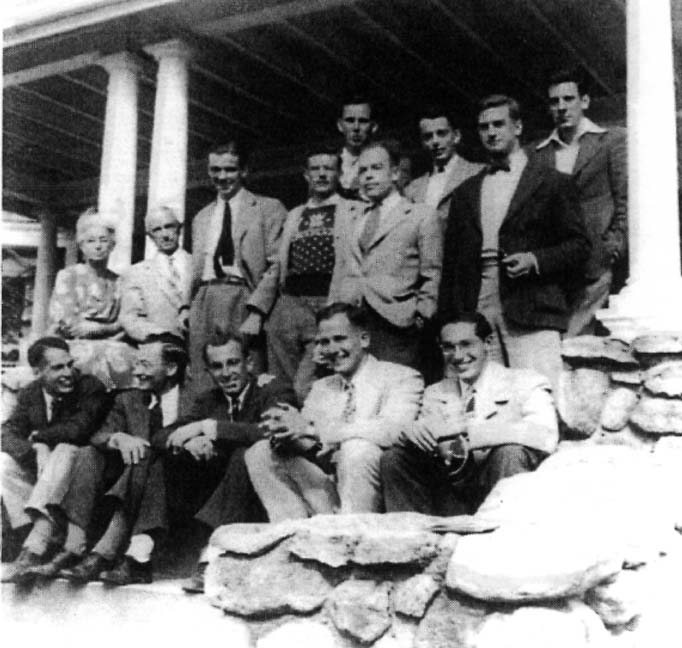
| Names, left to right. shown with hosts Mr. and Mrs. Robert Edwards: Top Row: Sterling Grumman, Bob Blair, Clarence Reynolds, Steve Rowan, Tom Hale, Art Ecclestone, Tom Barbour Bottom Row: John ("Jock") Cobb, John Leinbach, Charles Edwards, Chan Keller, Jay Nierenberg |