
FROM Jorhat to the Irrawaddy was a long and arduous journey, day after day of driving in convoy for hours on end. The roads were unspeakable over the second part of the route beyond the Chindwin. And if the distance was less than that covered by the Division on its way to Kirkuk at the end of 1941, or from Cairo to Baghdad a year later, neither journey had been so exhausting or so difficult.
The two brigades, which left Jorhat at intervals from March 5 onwards, drove through Kohima, past the greened-over scars of 'Liver,' the plain of Imphal surrounded by its ring of all too familiar green hills, and the breath-taking, precipitous stretches of road between Palel and Tamu. East of Kalemyo the country was fresh to the troops, but otherwise dry, scorched and devoid of freshness. Indeed, that drive through the teak forests, with the roadside shells of abandoned cars a grim reminder of the retreat from Burma when the country was first occupied by the Japanese in 1942, was as dusty and jolting as any track in Arakan, as any in the Desert. Each vehicle moved in the backlash of dust from its predecessor in the column. Every driver and passenger grew coated with yellow dust, mouths became dry, and thirsts compelling. This land seemed unnatural in its loneliness, for villages were rare, and no well or river was passed that had any water.
All day long the sun beat down upon this torrid waste. With infrequent halts the vehicles of 161 and 123 Brigades bumped their way forward towards the halting-place for the night. The teak trees gave but little shade, and the oppressive heat was an ordeal. But at last the landscape changed to softer lines, to green paddy fields and villages built among bamboo clumps. And by the roadside stood Burmese villagers, shyly watching, and offering eggs and vegetables for sale. White pagodas were passed in their hundreds, and outside the temples stood guard the strange, symbolic Chinthes, beasts carved in stone and not unlike a lion having a dragon as a forebear.
Through the ruins of Ye-Yu drove the brigades, farther and farther into, Central Burma. Near Monywa---Headquarters of General Shin's Fourteenth Army---the Chindwin was crossed a second time, on ferry boats that chugged to and fro between the river banks. On and on moved the convoys, across the parched plains, past pagodas that gleamed white in the strong sunlight, through undamaged villages, past lurching bullock carts and static water tanks. The villagers, dressed in white shirts and gaily coloured longyi skirts, hopped off the road when the jeeps and lorries roared by, just as nimbly as did the yellow-robed monks.
No more signs of war were met until Pakokku came in sight, but here the telegraph wires hung in festoons, wooden crosses beside the road marked the graves of British and Indian soldiers who had fallen during the fight by the Seventh Indian Division to secure a bridgehead across the Irrawaddy. 161 Brigade crossed the river in ferry boats, on March 16, at the same time as the main part of Nine Brigade was landing on Meiktila airstrip. A little to the south, on the far bank, our troops could see the gilded temples and pagodas of ancient Pagan shimmering through the morning mist. The waters of Irrawaddy flowed with relentless speed---one more river to cross. From the past rang out the names of other rivers that the Division had crossed: Atbara and Gash, Nile, Euphrates and Tigris, Ganges and Brahmaputra. Veterans added one more to the list of rivers in which they had bathed.
The road from Nyaungu on the east bank seemed more uneven and dust-clogged than ever before. The sun's heat was no less fierce. And the glare stabbed into men's eyes and made them crease up their faces. Burma at this time of year seemed to be a land without green. Only an occasional group of palm trees provided scant shade beneath which the leading vehicle of a convoy might halt. Then the jeeps and trailers behind would close up and stop also. The canvas chaguls of water hanging on the side of every jeep were tipped up; the dust was washed from the lips, and dry throats were eased by the cool water. But there was no ease for smarting eyes.
Ninety miles beyond the Irrawaddy the Division, led by 161 Brigade, established itself in Kamye, facing the green massif of Taungtha, held by the Japanese. The Division's task was to clear the dominating Taungtha hills, that rise to a height of 1,700 feet, and the road between Myingan and Taungtha. The country round Kamye is flat and arid. Thick hedges of thorn and cactus, and trees by the roadside and among the village buildings, are the only landmarks, save for the countless white pagodas that are met with on every hand and round each bend in the dusty road. Taungtha is an important road junction, linking Myingan to the north, Mandalay to the east, and Pagan to the west.
In order that our L. of C. to Meiktila should be secured, and the road. through to the besieged forces there be opened, the Japanese holding these hills had to be destroyed or driven away. So long as the enemy remained to threaten the area, the Division could not move down into Meiktila. While 33 Brigade of Evans' Seventh Indian Division advanced south from Myingan---it was temporarily under General Mansergh's command for this operation---Grimshaw's 161 Brigade would encircle the southern ridge by Taungtha and assault the main hill, Point 1788.
The battle started on March 25, and was a success. 33 Brigade soon reached a line five miles north of Taungtha. Little enemy opposition was encountered, and our artillery silenced the Japanese guns. The enemy was found to be holding two hill features with strong forces. When the 1/1st Punjab tried to capture Point 1788, they failed. Though our troops penetrated among the foothills, they had to withdraw in the face of frontal resistance and heavy mortar fire. It was not until the night of March 29/30 that the Taungtha hills were finally occupied by 161 Brigade. The Japanese restricted their activities to sniping and the laying of booby traps. Their retreat was hastened when the Divisional Reconnaissance Battalion, the 3/9th Jats (Lieutenant- Colonel R. A. M. Binnie), went round behind Point 1788, cut the Mandalay road, and linked up with the leading battalion and tanks of 33 Brigade.
As speed was essential, planning for the move to Meiktila---seventy miles distant to the south-east---continued throughout these operations near Taungtha. On the last day of March the Division moved to Meiktila along the good metalled road. With it travelled a great column of soft vehicles belonging to units in the Meiktila garrison, in particular to Nine Brigade.
On the same day Appleby's 2/1st Punjab, reinforced with a squadron of armoured cars, a battery of field guns, a detachment of 74 Field Company (Major D. Brunt), and some anti-tank mortars, were left to establish a firm base at Mahlaing, a small town half-way between Taungtha and Meiktila. Appleby's force was to keep open the road. Within two hours of arriving in the town, it received news that a party of Japanese were in a village three miles away. Major Jamshed's company and the armoured cars went out and killed sixty-one enemy soldiers without casualty to themselves. The Japanese, caught unawares, lost more than half their number.
At the end of March the troops of the Division entered Meiktila, passed the blue-grey lakes, drove through streets of ruined red brick and plaster houses. On every side were buildings without roofs, windows, doors, heaped about with blackened timber and broken brickwork. Bridges had been destroyed. But in the sunshine the scarred town had beauty, for trees still lined the streets, palm groves cast their shadows into the lakes, and the white façades of those houses that still stood unscathed gleamed among the deep red of walls and roofs.
The Divisional troops and 123 and 161 Brigades settled in quickly in the southern part of Meiktila. The enemy had withdrawn from the town, south to Pyawbwe, east by Thazi.
Preparations for the pursuit of the Japanese to Rangoon were pressed forward. As soon as the 19th Indian Division arrived at Meiktila from Mandalay, it would be possible for the Fifth Indian Division to take part and help Cowan's 17th Indian, Division, which was fighting for Pyawbwe, some twenty miles south of Meiktila. Planning had to be intensive and careful, for under General Mansergh's command were 34,000 troops with over 4,500 vehicles and tanks. And it was proposed to operate two divisions down the one main road between Mandalay and Rangoon.
The first phase of the operation was the capture of Pyawbwe by General Cowan's troops. When the Fifth Indian Division had secured Pyinmana and Toungoo, and the vital airfields there, the 17th Indian Division would pass through and continue the southward advance.
The distance between Meiktila and Rangoon is 384 miles.
The monsoon was expected to break at the end of April. Speed of advance, therefore, was the first essential.
With the capture on April 8 of Pyawbwe, Cowan's Division completed its first task. The Fifth Indian Division started to pass through the forward troops on the 11th. In the lead was Denholm-Young's 123 Brigade with, under command, tanks of the 7th Cavalry, (Lieutenant- Colonel Barlow) and 116 (Gordons) R.A.C. (Lieutenant-Colonel Blackater), and the 18th Field Regiment. The Brigade was divided into nine separate columns and numbered over 1,200 lorries and tanks, trucks and jeeps, armoured cars and bridging vehicles.
At half past four that afternoon the two leading columns, composed of tanks, puns, and two companies of Dogras, reached Yamethin and passed through the town without trouble. But as the next group, two batteries of guns and a company of Jats, was entering the place it was engaged by Japanese east of the main road. A unit of over 300 enemy soldiers had slipped into the town and dug itself in among the houses. The remaining companies of the 3/9th Jats commanded by Major Campbell were soon on the spot, but nothing could be done that evening. The night was spent with the armour on its own south of Yamethin, the rest of Denholm-Young's force to the north. And all round our hastily prepared defences the enemy was most active.
Early next morning our rear column was attacked by four Japanese aircraft. These, roaring low over the road, bombed and strafed the vehicles, which could not escape. Twelve ammunition lorries still in harbour were destroyed, and Major Meraj-ud-Din, second-in-command of the 2/1st Punjab, and former Brigade Major to Nine Brigade, was killed---a severe loss to the Division and to the Indian Army.
Two companies of the 7th York and Lancaster probed forward into Yamethin, but were held up by fire and compelled to withdraw. That afternoon, as soon as our artillery had shelled Yamethin, the British battalion with two squadrons of 16 R.A.C. in support advanced again. Meanwhile, Campbell's Jats were clearing the town west of the road and making good progress, but later, when a company of the York and Lancaster ran into trouble and suffered heavy casualties, all troops were withdrawn.
After a night during which the Jats were twice attacked, the York and Lancaster again probed forward, only to meet strong opposition among a group of pagodas. The Jats secured the road and rail crossing in the centre of Yamethin, and at half past eleven Brigadier Denholm-Young sent out the 2/1st Punjab with a squadron of tanks to advance down either side of the road. Though the two leading companies had cleared the southern outskirts of Yamethin within two hours, considerable firing was still coming from the Japanese soldiers who had dug themselves in on the eastern edge of the town. Accordingly, two companies were diverted towards this quarter, but came under intense fire. The leading platoon ran on to a minefield and suffered a dozen casualties within a minute. Then our companies were ordered back, to allow a Divisional artillery concentration to be brought down on the area. Part of its object was to destroy this unexpected minefield.
When the British infantry went forward with three companies, they were again held up, and forced to retire under cover of a screen of mortar fire and snipers. While the Jats held the north-west part of Yamethin, the 2/1st Punjab consolidated along the line of the main road. All through the night our Gunners harassed the enemy in the eastern streets and buildings, and the morning brought an attack by four Mitchell. bombers and a second Divisional concentration. Then the 2/1st, with a company of Dogras protecting either flank, moved eastwards from the road, and by half past one Yamethin was in our hands. Contact was made with the two columns that had become isolated south of the town. Our advance had been held up for two days, the enemy had been difficult to dislodge, and the fighting to secure Yamethin had been severe and costly.
Now the 4/7th Rajputs of 161 Brigade took over Yamethin, the 7th York and Lancaster assumed responsibility for protecting the Divisional administration box just south of Pyawbwe, and 12 3 Brigade resumed their southward drive on April 16. Tatkon, twenty-two miles from Yamethin, was reached lied before nightfall.
Between Yamethin and Pyinmana the main road runs alongside hilly country and thick jungle, and at the Schwemyo Bluff, eight miles south of Tatkon, it was known that the Japanese would attempt to make a strong stand. While the Division had been hurrying south to capture this most formidable of all obstacles along this stretch of road, the enemy had been rushing reinforcements up from the south to meet the threat. Our leading troops were held strongly on the line of the Sinthe Chaung and on Schwemyo Bluff itself. But 161 Brigade succeeded in securing a bridgehead across this chaung, while Denholm-Young's men made a wide left hook on to the Bluff from the east. The 2/1st Punjab and 1/17th Dogras took the hills. And so a strong position, which the enemy would in earlier days have held with great tenacity, was wrested from his grasp. Pyinmana, another twenty miles nearer to Rangoon, became our next objective.
Nine Brigade was brought forward from Meiktila to Tatkon, where a Dakota strip was rapidly constructed. 161 Brigade pushed ahead down the road with the tanks, which had difficulty in recrossing the Sinthe Chaung, owing to enemy sniping and to the presence of mines and serious demolitions. Nine Brigade was directed to advance against Pyinmana via the railway line, which runs west of both the chaung and the road. Most of the equipment had to be conveyed on local bullock carts, for the Brigade was not a motorized but an airborne formation, and had to adapt itself with rapidity and skill.
By April 19 123 Brigade had been relieved on Schwemyo Bluff, and was moving down the foothills east of the Sinthe Chaung. 161 Brigade and the armour, making all speed along the main road, reached Pyinmana early next day, and, thanks to the dash of the Gordon Highlanders and 7th Cavalry, the bridge over the chaung was secured intact, although it had been prepared for blowing. The Japanese soldier responsible, being asleep, was killed before he was aware of our sudden arrival. The tanks rumbled amongst the Headquarters of the Japanese 33rd Army, killed hundreds of enemy troops and, as it later transpired, missed capturing the Army Commander by a matter of minutes. While Nine Brigade was left to mop up enemy resistance in Pyinmana, 161 Brigade and the tanks by-passed the town by a diversion, and continued south. The first rains fell that evening, a warning that speed must be quickened if Rangoon were to be reached in time. Part of the town was still strongly held, but as the 17th Indian Division was following close behind, our leading troops could pursue their advance without anxiety about the road behind them. 161 Brigade captured the airfield at Lewe---more vital to our advance than any single town---and 123 Brigade, using the same diversion that bulldozers had made to the east of Pyinmana, reached Thawatti that evening, April 20. Great difficulty in crossing a wide chaung just south of Lewe meant that the tail of Denholm-Young's column did not arrive in until three o'clock the next morning, in darkness.
By the evening of the 21st our tanks had brushed aside light opposition along the road, and had reached Yedashe. This town lies some sixty miles beyond Pyinmana, and only 184 miles from Rangoon. The rapid advance continued, the enemy being bewildered by its speed and unable to hold up our tanks except by destroying bridges. Small pockets of Japanese resistance had to be left for the following troops to destroy. Groups of enemy and Jif soldiers surrendered. Many nights the Japanese attacked our positions, which were never anything but temporary halts, so constant was the progress towards Rangoon. The enemy laid ambushes, posted snipers, and sent out 'jitter parties' to harass our men by night. In daylight both sides used their aircraft to strafe and shoot up convoys, points of opposition, and road-blocks. The last had to be cleared by the Sappers.
On April 22, after covering fifty miles, the tanks and 123 Brigade captured the Toungoo airstrips. No opposition was met there, and the 7th York and Lancaster, who had now rejoined the Brigade, hurried into Toungoo behind the armoured column. Two companies of this battalion went on to Oktwin, while the 2/1st Punjab and 1/17th Dogras guarded the airfields, and the rest of the British troops held the town itself. The first tanks of the 7th Cavalry that entered Toungoo overran the Japanese traffic police at the northern outskirts of the town.
No sooner had fifty Japanese been killed than the remainder took fright and fled. More than 3,000 members of a Jif division surrendered, just in time to start work on repairing the airstrips which made Toungoo of such importance. Rangoon now lay 166 miles away, and our fighter aircraft would be able to cover that distance if based on Toungoo.
This was the last place until Pegu was reached where the Japanese could make an effectual stand. The enemy's position was now critical.
After a day for maintenance, during which the Royal Air Force, by some fortunate error, dropped thousands of eggs on to the troops, so that men could go about ordering omelettes made from ten eggs. 161 Brigade headed south again on the 24th, and the Royal West Kents and tanks reached the next town down the road and railway---Pyu. The remainder of the Division was delayed till the following day by the rains, which flooded the river south of Toungoo, made the fords unusable, and necessitated the building by the Sappers of a floating pontoon. No sooner was the pontoon completed than the Division, making use of a full moon, moved south during the night, and caught up the leading troops at Pyu that evening. Only Nine Brigade, still under command of the 17th Indian Division, remained behind at Pyinmana.
The river bridge at Pyu had been destroyed by the retreating enemy, but fortunately the tanks and Dogras managed to cross by a ford, and by April 26 had secured Penwegon, seventy miles south of Toungoo.
In fourteen days the Division had advanced 211 miles, killed more than two thousand Japanese, and captured much equipment, many guns and prisoners. Cowan's 17th Indian Division now passed through and took the lead in the drive on Rangoon, little more than one hundred miles distant.
The advance had become a race, for it was now known that on May 1 Fifteen Corps would assault Rangoon from the sea.
The armoured column that led the 17th Indian Division did not catch up with the fast retreating enemy until within two miles of Nyaunglebin. These Japanese, mostly horsed cavalry, were scattered or destroyed, and our leading troops reached Daik-U, only eighty-five miles from Rangoon. More determined opposition was met at Payagale, where the enemy had placed many mines and where he launched expensive attacks against our tanks. But an airstrike and a brigade attack demolished all resistance, and by the evening of April 29 the tanks with the 17th Indian Division were just east of Pegu, and the rest of the troops just to the north.
Stiff opposition was met in the town. The Japanese commander had hurriedly gathered every available man to defend Pegu. But to do this he had almost denuded the garrison of Rangoon itself. The monsoon broke in earnest; the tanks were blocked by a canal; the river was in spate and could no longer be forded; the two northern bridges were down. Although the railway bridge and the southern road bridge had remained intact, the latter was unfortunately destroyed by the enemy during the last night of April. Airstrips became waterlogged and unusable. Neither tanks nor vehicles could operate away from the road. The rain poured down. But though soaked to the skin, on half rations, and weary, the troops fought with the greatest enthusiasm, established a bridgehead across the river, and had cleared Pegu of all but a few Japanese snipers by the evening of May 1. Until the bridges were repaired, no vehicles could move south of the town, but the infantry of Cowan's Division hurried on.
On May 1, as planned, a Gurkha paratroop battalion had landed at Elephant Point, at the mouth of Rangoon river. Next day the 26th Indian Division landed from the sea unopposed. Rangoon was entered on May 3. Abandoned by the enemy, the city bustled with welcoming Burmese crowds, and elated, thankful Allied prisoners of war who were delivered from their prolonged and arduous captivity. The meeting between the 17th and 26th Indian Divisions took place on May 6 at Hlegu, twenty-eight miles north of Rangoon. The infantry coming from the north had been seriously delayed by mines, by destroyed bridges, by swollen waterways. And they had been obliged to swim several chaungs in order to make any progress at all.
Now Burma was ours. All that remained was to mop up the retreating enemy forces, disordered, leaderless, out of touch, dejected, liable to be trapped, and faced with a country flooded by the violent monsoon rains, with rushing streams and rivers, paddy fields deep in mud, and British and Indian troops ready to destroy or capture the straggling Japanese as opportunity offered.
THE situation on May 5 was as follows: Messervy's Four Corps, comprising the Fifth, 17th and 19th Indian Divisions, held the corridor of the main road and railway between Mandalay and Rangoon. To the west Stopford's Thirty-Three Corps, formed of the Seventh and 20th Indian Divisions, was advancing astride the Irrawaddy towards the Burmese capital by way of Prome.
The Japanese Army was now doing its best to escape from Burma in two main parties. The first---some 10,000 men---was still in the Irrawaddy Valley and could only get away over the Pegu Yomas and across the Sittang River. Most of the second and larger party was making its way slowly southwards through the Shan Hills, hoping to reach the Bilin road via the Salween River.
To withdraw eastwards across the Sittang River was difficult, for the enemy troops had to cross the axis of first one corps and then the other before reaching the river. They had to traverse country that is thick jungle, sparsely populated, without roads and with few good tracks. Then they were faced, between the Mandalay-Rangoon road and the Sittang, with flat, open paddy fields, devoid of cover save in the elongated villages with their clumps of trees. Here, too, the roads were few and bad.
The Division was ordered to pursue the enemy in the direction of Waw, a station on the railway between Pegu and Moulmein, and also to the east bank of the Sittang, towards Bilin, a place farther down the line to Moulmein. Moulmein seemed an obvious rallying point for the disorganized bands of Japanese making their way through the gaps between our two corps. Our object was to intercept as many of these Japanese as could be, and to prevent their reaching Moulmein or crossing the Sittang River.
Nine Brigade (Brigadier H. G. L. Brain) was flown south from Lewe to Pegu and at once started operations towards Waw and the Sittang. At the same time, 123 and 161 Brigades began to engage the enemy forces who were seeking to escape across the main road south of Pegu. Every report of Japanese troops had to be investigated. Many small parties were encountered, casualties inflicted, prisoners taken, and all at very light cost to ourselves. Nine Brigade met heavy opposition east of Waw, and in several battles caused severe loss to the Japanese. It was planned for the Brigade to cross the Sittang to Mokpalin, but when patrols of the 3/9th Jats reconnoitred on the east bank, they reported communications to be so bad that the plan had for the time being to be abandoned.
Once the monsoon had broken in earnest, the whole district east of the main road became flooded to a depth of two feet or so, and patrolling was well-nigh impossible except along the paddy bunds between the villages. The Divisional Engineers organized a jeep railway which pulled some of the old metre-gauge coaches, and this was the sole means of supplying our battalions forward of Waw.
On May 10 the 2nd West Yorkshires (Lieutenant-Colonel P. W. P. Green), supported by tanks, attacked the enemy at Nyaungkashe, killed some two hundred Japanese soldiers, and captured the village, which had for some days been a collecting point for parties of Japanese moving towards the river. It was when the enemy, driven from strongly defended positions, broke cover that they were mortared, shelled and machine-gunned by the infantry and 7th Cavalry, who had two troops of tanks in support of the battalion. Our total casualties for this successful operation were twenty-four. On the previous day the stores had been brought up on seventy bullock-carts, collected locally, and on an assortment of railway trucks, including seven captured Japanese bogies, that were pushed by fifty villagers. This strange party was met by a solitary Japanese sniper on the railway line. He was soon disposed of.
If the West Yorkshires met with success on this occasion, they ran into trouble five days later, in a village named Letpanthonbin, where a local villager had reported the presence of a store of Japanese. Two platoons under Captain H. Evans approached across the flooded paddy fields, and when fifty yards from the edge of this village were received with heavy fire. Evans was killed early in the engagement, and a serious number of other casualties were incurred. There was no cover and the range was short. Another platoon sent out to reinforce the forward troops was unable to approach nearer than six hundred yards, because of accurate fire that pinned them to the ground. Six hours passed. Then 'B' Company managed to join this second platoon, with a F.O.O. from the 4th Field Regiment. All day the rain poured down, all day the men wounded in the first brush near the village lay in the water or across the muddy bunds, waiting for darkness and the cover of night. Artillery fire was brought down on Letpanthonbin, in order to assist these wounded men. It was early next day that survivors trickled back to battalion headquarters in ones and twos. Corporal Venables, who had been wounded, reported that all bodies lying round him had been bayoneted by the Japanese during the night. He himself had feigned death, but was taken prisoner. A Japanese officer addressed him in English, and told him to wait until he had finished his meal. But a fierce downpour of rain provided Venables with a chance of escape. He took it and reached safety.
This fight cost us twenty-six men killed and six wounded. It was but characteristic of similar engagements fought out among the villages and across the swamped fields by the other battalions of Brain's brigade---the 3/2nd Punjab, 3/9th Jats and 1st Burma Regiment. Operations were extremely difficult, the weather grew worse, the floods expanded and deepened, and Japanese bands kept on coming from the west. They seemed to occupy villages at intervals and for short periods, trying thereby to protect their scattered remnants. Jitter parties, long and short range brushes, intermittent firing, patrolling as a result of some local report, men squelching their way yard by yard,. the rain soaking their already damp uniforms, feet that were wet all day long, mud and slime, and chill discomfort---these were but some of the features of this mopping-up end to a campaign. Only in Waw, with its few wooden buildings raised on stilts, was there any good cover.
During May Appleby's 2/1st Punjab spent a fortnight in the neighbourhood of Mokshitwa in the Pegu Yomas. Here the battalion fought against the remnants of the Japanese Army retreating in disorganization from Prome. It was an area of small hillocks covered with thick clumps of bamboo, and some five thousand enemy troops were said to be trying to escape across the road. Each day patrols of a company strength hounded the Japanese. Airstrikes and artillery concentrations were called down upon places where the Japanese were known to be. Ambushes were laid on likely escape routes. Most nights the battalion perimeter was jittered by enemy parties, and on one occasion a heavy attack was made by 150 Japanese. This was repulsed with severe loss to the assailants. Indeed, the enemy suffered heavily during this period of hunting and skirmishing in the jungle.
The enemy soldiers were running extremely short of ammunition and food, though in many of the villages they were able to find stocks of rice, their staple diet. It was, of course, impossible to deny the enemy access to every village. Not only were they too numerous to guard, but also the problems of maintaining soldiers in inaccessible places would have been insurmountable in monsoon conditions, when all vehicles were bound to the road. Our troops would secure a firm base, and then send out very strong fighting patrols with a Gunner observation officer. They would tour all the villages in a certain area, seeking out the Japanese, who were seldom to be found in villages during daylight. They came in by night, and in the daytime might occupy a small hillock in the jungle, covering the approaches to a village. If the enemy was present in strength, he would be shelled by our Gunners, who harassed at night on targets that they registered whenever possible in daylight. Sometimes the enemy would make a stand, but this only brought him heavier casualties.
During the night of May 29/30 the 17th Dogras, now commanded once again by Lieutenant-Colonel F. I. Wallace, who had just returned from leave in Britain, started a full-scale operation up the road to Paunggyi, away to the west of the Pegu-Rangoon road. In support was a troop of the 7th Cavalry. A village named Uwinwa was occupied, and when an armoured car patrol reported that Paunggyi was deserted two companies entered the place next day. Local inhabitants said that the Japanese had left just before the arrival of our armoured cars. They had first set fire to the village.
The Dogras found here forty derelict enemy vehicles, and many tons of burning grain.
At the end of May and early in June it became increasingly obvious that the Japanese were planning a mass break-out from the jungle west of the main road, with the object of crossing the Sittang. To prevent this, our patrolling grew more vigorous still, and the activities of the Japanese were closely watched. Then, in the middle of June the Japanese east of the Sittang, by applying strong pressure against Nine Brigade on the Waw front and occupying several villages on the west bank of the river, proved that they were working to a plan, in order to help their comrades still in the jungle west of the road. It was, however, considered unlikely that this enemy break-out would come within the Divisional area. The pressure against Nine Brigade was thought to be a cover plan aimed at relieving pressure on the Japanese elsewhere. This supposition proved to be correct.
It was at Pegu that the 56th A.A./A.Tk. Regiment said farewell to the Division. An officer has recorded an impression of that occasion.
"The General, who must have been as dearly loved by every individual man as any Divisional Commander could ever be, told us that he wished to see as many men as possible. We all stood there in the rain, the water ankle-deep in the field where we had been living for three days. He was at his most charming, and if, instead of telling us that our time was now due for home, he had asked us to follow him for another year, I am pretty certain that we would have gone. I know that I would."
Owing to releases, repatriation, and the shortage of British troops in Burma, the Division lost all but one of its British units: the 4th and 28th Field Regiments, whose guns had supported the infantry during every campaign in which the Division had fought; the 4th Royal West Kents, who had defended Kohima; the 7th York and Lancaster; and 56th Anti-tank Regiment. Their places were taken by the 4th and 5th Indian Field Regiments, the 5th Anti-Tank Regiment, the 3/4th and 3/9th Gurkha Regiments. Of the British battalions, only the veteran 2nd West Yorkshires remained.
The Division was eventually released from active operations against the Japanese at the end of June, and its positions near Pegu and Waw were taken over by the Seventh Indian Division, still commanded by Major-General Geoffrey Evans. Some fifteen miles north of Rangoon among the rubber plantations of Mingaladon was the new area in which the various units pitched their tents and settled down, not to rest from their battles, but to train for them in a new type of warfare: combined operations. The Division was to form part of the force preparing to invade Malaya (Operation 'Zipper').
The programme of training to be got through was extremely heavy. Every officer and man in the Division was put through a normal six weeks' dryshod course in half that length of time by a most efficient combined operations training team. The local cinema was kept working for six weeks day after day from seven o'clock in the morning till eleven at night showing instructional films. In three days the Sappers bulldozed a magnificent cutting lined with bit-hess, floored with pierced steel planking, and filled with water by pumps from a leak in the Rangoon water pipe-line which ran near by. Drivers of proofed vehicles were given practice in underwater driving through this trough.
The troops practised swimming in full equipment, and the Royal Lake in Rangoon was used for pontoon bridging and outboard motor-boat training. Units and brigade groups rehearsed beach landings, while the staff made final adjustments to convoy-loading and assault-landing tables. Scrambling nets and sliding ropes were used, scaling towers built by the Sappers and put to good purposes, and the troops rehearsed with landing craft.
The A/Q, Lieutenant- Colonel Tom Roe, who was very soon to say good-bye to the Division after serving on its headquarters for three years, made some interesting comments on the preparations for Operation 'Zipper.'
"I always feel to give people in Europe an idea of the difficulty of mounting the Malayan invasion it is necessary to give them this parallel. A number of troops for the invasion of France were two months before D-Day in action in Italy. Their commanders and staff were summoned to Moscow (fitting in on such air services as existed with no special aircraft available) for planning their part in the invasion. The troops to receive new equipment from America and reinforcements from Egypt. The invasion to be embarked at ports ranging from Marseilles and Gibraltar to Glasgow. The whole force to rendezvous off a spot on the Malayan coast some days later. "
On August 8 news was received of a possibility of Japan surrendering. If this occurred, the Division would sail at once for Singapore. Then on the 15th Japan did surrender, and the troops displayed their joy and relief with firing, dancing, Very lights, concert parties, free drinks, and a round of celebrations of all kinds.
But meanwhile the staff officers were working in shifts throughout the twenty-four hours to keep abreast with the latest whim and alteration of the authorities in the allocation of shipping for 'Zipper.' Changes were frequent; some ships already loading had to be unloaded; but in good time all the many problems were resolved in one way or another, and the Division was ready to embark for Malaya and Singapore. Until the last moment the Staff had to plan both for the invasion of Malaya and for the reoccupation of Singapore. Which plan would be implemented depended upon the Japanese.
THE Division embarked at Rangoon Harbour in the middle of August, but the convoy did not sail for another eight days. The reasons for this delay were that the Japanese surrender party was awaited in Rangoon, and that Lord Louis Mountbatten had to be sure that the Emperor's orders to all Japanese forces had been sent out and received. Eventually the envoys arrived in their two white planes with green crosses, "escorted by Spitfires, and the surrender of the remainder of Japanese territory was co-ordinated.
The troops knew that they were bound for Singapore, but no one could tell whether or not our landings would be opposed. Even though the Japanese High Command had decreed surrender, it was not certain that the enemy troops on Singapore Island, many of them fresh and untried in war, would accept such a decision. They might resist it. In an appreciation written on August 29, General Mansergh stated that the possibility of opposition could not be disregarded. There might be isolated resistance by local commanders, or deliberate acts of treachery. And uppermost in the General's mind at this time was the security of his force. For whereas the Japanese numbered about ninety-six thousand on Singapore Island, he would have available on the first three days after landing only ten thousand men.
The convoy of sixteen large and crowded troopships and an equal number of cargo vessels eventually set out from Rangoon on the morning of August 27. The sea was calm, the voyage uneventful. For a week the ships steamed on, until soon after dawn on September 3 our troops saw in the distance the hills of Penang. This was the sixth anniversary of the outbreak of a long war. Veterans of the Division recalled other anniversaries: the Sudan; Ruweisat Ridge and the battle of Alam el Halfa; the moist heat of Bihar Province; and the mud of the road to Tiddim. This day of eager anticipation was to be the final anniversary, but not the final sea voyage. Some looked back to the weeks when the Division first left India, bound for Port Sudan, or to the humidity of Massawa and the Red sea. Many remembered the crossing to Cyprus, and the return to India from Basra. Some, even, had gone to Arakan, not by rail and by river ferry across the Brahmaputra, but in ships from Vizagapatam over the Bay of Bengal. And now the Division was approaching Singapore.
In case it should be needed, Brain's Nine Brigade on board the Corfu was detached from the main convoy and sent into Penang. In the event it was not required, and thus reached Singapore thirty-six hours after the rest of the Division. It was here, off Penang, that General Mansergh and his A.D.C. were taken in a small boat to H.M.S. Sussex, which had come from Ceylon.
Then, next morning, September 4, a surrender meeting was held in the Sussex, by now a score of miles from Singapore. The morning was still, and the atmosphere close and muggy. At hand waited Japanese tugs, flying black and white surrender flags. After breakfast one of these tugs was summoned across to H.M.S. Sussex. The Japanese representatives were piped aboard, met by naval officers, escorted to a small cabin, and disarmed of their swords.
The conference was held in the Admiral's dining room. On either side of a long table, covered with green cloth, stood a row of chairs; those for the Japanese were some distance from the table, to prevent the vanquished envoys from leaning on the table or using it for writing or keeping their papers. Meanwhile the British senior officers had assembled on their side of the conference table: present at the talks, besides Major-General Mansergh, were Rear-Admiral Cedric Holland and Lieutenant-General Sir Philip Christison---Mountbatten's Navy and Army representatives-, Major-General Ralph Hone, the Civil Administration Officer, a Group Captain of the Royal Air Force, the several chiefs of staff, interpreters and recording secretaries.
Then the Japanese officers were summoned. They marched in, saluted, bowed to each service representative, and, when told to, sat down. It was a tense moment. Representing Field-Marshal Count Terauchi, supreme Japanese Commander of the Southern Region, were General Itagaki, Commander of the Seventh Area Army---this included Malaya, lava and Sumatra---and Vice-Admiral Fukodome, who commanded the Tenth Area Fleet. Itagaki looked particularly upset.
In the doorway stood a marine sentry. For a moment dead silence filled the Admiral's dining room. Then General Christison opened the proceedings, speaking through his interpreter.
CHRISTISON: What is your name, rank and appointment ?
ITAGAKI: General Itagaki, Commander-in-Chief of the Seventh Area Army.
CHRISTISON: Are you entitled to speak for the Field-Marshal Count Terauchi, Supreme Japanese Commander, Southern Region, on Army matters ?
ITAGAKI: Not entirely for the whole area, but only for the landings in the Singapore area.
CHRISTISON: Do you know the Terms of Agreement signed in Rangoon ?
ITAGAKI: I know of the Agreement signed in Rangoon and, furthermore, 1 have complied with what 1 ought to have done in Singapore with regard to this Agreement.
CHRISTISON: Do you abide by the Imperial decision to cease hostilities and are you prepared to carry out the orders of the Supreme Allied Commander, South East Asia ?
ITAGAKI: Yes, I am quite prepared....
CHRISTISON: Is there any sabotage, looting or local civil disturbance taking place in the Singapore area ?
ITAGAKI: With regard to the maintenance of law and order there are no riots of a serious nature, but there is every sign of possible looting and some sort of violence of a small nature which is under the guard of our Forces. now. And we have also suspicions certain Societies are being formed, but we are taking every possible step to suppress them. We are also collecting information about them.
CHRISTISON: I rely on General Itagaki to keep law and order until my Forces take over.
ITAGAKI: Yes, I will.
CHRISTISON: My Forces will act strictly in accordance with the Laws and Usages of War and International Law.
ITAGAKI: Yes.
The Japanese forces were to be reduced immediately and marched to the mainland. Itagaki objected that no quarters existed there, north of Johore Baru. This objection was brushed aside. Huts must be built in the jungle. Movement would start that night, immediately after the return of the surrender party. This was, in fact, carried out to such good effect that by dawn on September 5 over 35,000 Japanese troops were already across the causeway and building their concentration areas as ordered. The only enemy troops allowed to stay in Singapore were those needed for guard and labour purposes.
Among the terms of surrender were the following instructions and stipulations :
The Japanese forces on Singapore Island and in Malaya were to be treated as 'surrendered personnel' rather than as prisoners-of-war. They would be disarmed, but would continue to wear uniform and badges of rank. Japanese commanders would remain responsible for the maintenance and discipline of their own troops, for public order, the protection of banks, and the feeding of civilians in territories that had hitherto been under their control. Essential services such as light and water were to be maintained and guarded until Allied forces had assumed control; aircraft would be grounded and remain so. No demolitions would be permitted; and damage to bridges, waterways, railroads, telegraphs and telephones, stores of food, and cattle belonging to civilians must be prevented. To implement these instructions, the Japanese would be allowed guards of one hundred men for military stores, dumps and vehicle parks, for dock installations, for bulk holdings of cash, and for Japanese hospital patients who could not be moved.
The location was to be given of fortifications, of camps of Allied prisoners-of-war or internees, of aircraft and airfields, of weapons, tanks, and ammunition. The whereabouts of broadcasting stations, radar and signal equipment, rolling stock, workshops, harbour facilities, war materials and food stocks were to be given. Charts of mine-fields and booby traps were required from the Japanese; all documents, records, ciphers and codes would be handed over together with nominal rolls, orders of battle, lists of medical supplies, shops used by the Japanese forces, and stocks of petrol and oil; all requisitioned or stolen goods and property must be restored. A record. was required of all the graves of Allied troops and civilian internees. All Japanese flags, emblems and memorials other than graves were to be removed before we landed.
To the Japanese Commander of Singapore Island orders were issued that every member of the Japanese forces and puppet forces remaining on the Island was to wear a white armband. Japanese wives, families and members of the Japanese comfort corps were to accompany their respective formations on the withdrawal from the Island. Hospital staffs were to remain on duty. A guard or caretaker would be left in every building that was vacated by the Japanese Army, so as to ensure its safe-keeping and to prevent looting.
On the second day of occupation one hundred large staff cars in high-class condition would be made available for the use of the occupying forces. A further five hundred lorries, with drivers, were to assemble in the dock area, and another hundred at Kallang airfield on the day of occupation.
A curfew from sunset to sunrise was imposed until further notice. All stocks of spirits and liquor shops were sealed and guarded, a report was required of all epidemics or infectious diseases, the location of hospitals and laboratories, together with that of all Allied sick and wounded men. Singapore Military Hospital would. be emptied of all Japanese patients except those who- were too ill to be moved. It would then be cleaned and made ready for use by the Allied medical services. In addition, interpreters and guides were to be available to help our landing forces.
A Japanese general was selected to report twice daily to General Mansergh for orders. Mansergh had dealings with no other representatives; the other enemy generals---twenty-eight of them--were housed in Raffles College.
The two Japanese representatives took four hours to consider the terms. They raised many points and dragged red herrings. But at length the document of surrender was signed and sealed. Itagaki wept, but Fukodome continued his efforts to ingratiate himself with the British commanders, grinning and winking as he had done at intervals during the proceedings.
Early in September Mountbatten laid down for his Allied commanders rules of conduct for relations, with surrendered Japanese forces. We may quote the following:
"There will be no fraternizing whatever between Japanese and Allied forces. In dealing with Japanese your behaviour will be guarded and coldly polite. You will, in the case of senior Japanese officers, use their correct titles. You will not shake hands with them. In no case will British and Japanese officers feed in the same room, nor will tea be offered at any meeting. Any Japanese who come to receive orders or report should be kept at arm's length, e.,g., with a table between you and them, and they should not be allowed to sit at the same table. Under no circumstances will either Japanese prisoners of war or surrendered personnel be abused or maltreated, nor will violence be used against them except when necessitated by their own behaviour."
That same morning of September 4 the Divisional convoy entered a swept channel in the Malacca Straits, and during the rest of the day our ships steamed along, some ten miles out from the coast of Malaya. In the afternoon could be seen the actual beaches on which our forces were to have landed, had Operation 'Zipper' been carried through. The men saw gleaming sand with palm trees close to the water's edge, an occasional white house with its red roof and, further back, a mass of green jungle. They saw, too, mangrove swamps, with signs of heavy Japanese defences and mines on the beaches. As the surrender talks on board H. M. S. Sussex were completed before nightfall, the blackout was lifted, and the convoy sailed on with its lights blazing. During the night the Division prepared for the landing next morning.
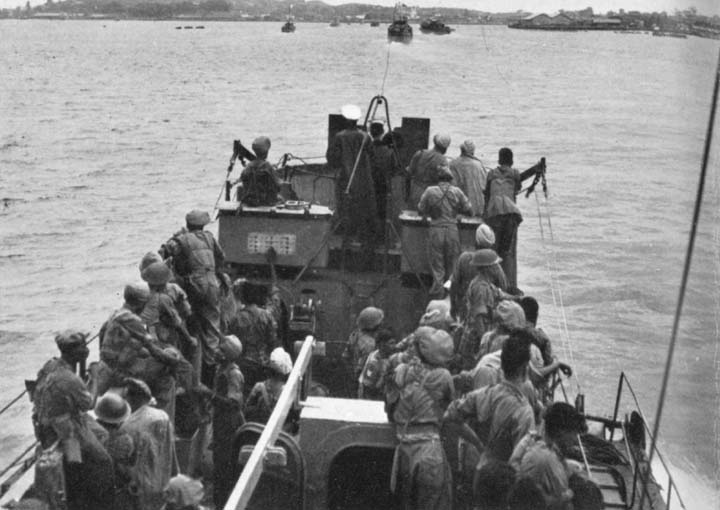
Full war precautions were taken. At seven o'clock on the 5th, the landing craft. many of which had taken part in combined operations in North Africa and Europe, came alongside, and boatload by boatload the troops scrambled down the nets into them. By half past eight the craft were ready in battle formation. On board, everyone felt a thrill of expectancy. How would the Japanese take the surrender ? Would there be treachery ?
The first flight which steamed in from a distance of some twenty-five miles was composed of, on the left, the 3/9th Gurkha Rifles, and on the right the 2/1st Punjab. 123 Brigade Headquarters travelled with the latter. And the 1/17th Dogras moved off to secure possession of certain islands---Pulau Brani, Blakang Mati, and Pulau Hantu, two miles south of Singapore harbour. These were occupied without incident at 10.30 a.m. The rest of the convoy passed a series of these small islands, striking by their greenness, many of them only two hundred yards or so in length, with sandy beaches and palm trees, and a few white houses.
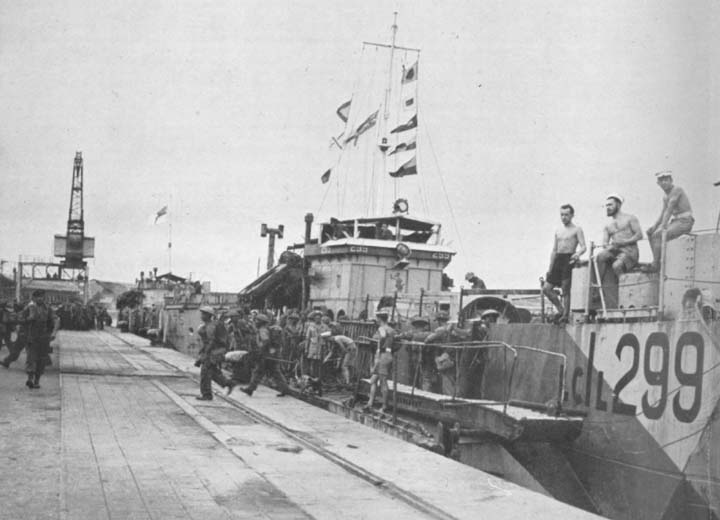
Then Singapore itself appeared, no longer hidden from view by these islands that cover the approaches. Suddenly the scene opened up, and the water line became visible in its wide semicircle, a mass of buildings along the front showing clearly against a dull and thundery sky. Soon after eleven a.m. the landing craft, in single file and with pennants gaily fluttering, passed H.M.S. Sussex, lying with her guns trained upon the city, and entered the harbour to berth, alongside the main wharfs.
In the dock area there were only a few civilians. But a small number of dockers and coolies gave a cheer and a wave of greeting, and several Chinese shouted from the roof of the customs sheds.
The first troops of the Division ashore were, 'D' Company of the 2/1st Punjab, under Major Niaz Mohammed Arbad. The battalion was met by two senior Japanese officers, who wore ceremonial swords and highly polished jackboots. All were standing rigidly to attention, at the salute. Behind them again was parked a line of glittering civilian cars, each with a booted chauffeur. On the main wharf Brigadier Denholm-Young was met by the Japanese General who was staff officer to General Itagaki. And soon after midday Denholm-Young held a conference with a number of senior Japanese officers, who showed themselves most helpful. All went as had been planned during the voyage, and no opposition was met with.
The battalions moved out fanwise from the docks, and according to prearranged instructions occupied such key positions as arsenals, installations, airfields, the railway station, and camps. The Japanese officers, assisted by interpreters and by maps, showed our officers the dispositions of all enemy guards in Singapore itself.
Meanwhile, 161 Brigade had landed at the West Wharf, near the Power Station, and were greeted by a lone Chinese boy, full of smiles. Led by the 4/7th Rajputs, they moved straight through northwards across Singapore Island to the naval base and causeway at Johore Bahru.
The main shopping areas were Chinese, and in the shops excited crowds of waving, cheering Chinese, particularly children, watched our troops arrive. Union jacks were flying from buildings or being waved. The streets were empty of buses, trams and tongas, and the sole means of transport seemed to be a few rickshaws. So few were the Malays and Indians by comparison with the Chinese inhabitants that you might have thought yourself in China.
During the first week very few shops were opened. Nobody knew what would happen. People were scared of looting. But if the shops remained closed, trade continued notwithstanding, and the centre of business was on the quayside. All the Chinese with anything to sell gathered here, sidling up with bulging pockets to transact business with those who had time to drive down to the waterfront. And before the re-establishment of British currency, watches, fountain pens, rings, cameras, and many other articles were offered in exchange for cigarettes, ten the first day, twice that number on. the next day, and so on by rapid leaps.
But the troops of the Division had very little free time. They were hard pressed by guard duties during the first weeks of our occupation. They guarded dumps of stores, some that had belonged to the Japanese, others our own that dated from before the war and had remained untouched. In the city itself many buildings had been stocked up with supplies and equipment. An example was the base stationery office. Here our men came upon shelves loaded with bottles of ink, pencils by the thousand, rubbers and paper stacked up on every side. Crates of paper were taken away, to the various headquarters. Bags were stuffed with pencils and rubbers that we badly needed.
But the greater part of the dumps that were guarded had been widely dispersed through the rubber plantations by the Japanese. The dispersion, though a tribute to the activities of the Royal Air Force, meant that our troops had to look after wide areas. Most of these supplies were stored in large bamboo bashas, roughly made. These were scattered under the rubber trees over a plantation of maybe a hundred acres.
The Japanese stayed in their concentration areas, ruled and guarded themselves, sent out ration parties, and fed themselves. Our troops were warned not to enter the Japanese camps. The Japanese discipline was remarkably good. All were smart despite their bandy legs and ill-fitting uniform, that resembled bloomers. They provided a marked contrast to the troops encountered in Burma, where in the fighting line they had been at their scruffiest and most desolate. These enemy troops looked fit and tough. Most of them had been in Singapore ever since they first broke victoriously on to the Island, and they had missed the fighting. They had led a comfortable existence, and at times hardly seemed to realize that they were a beaten army. They had seen nothing of Burma and of their defeated regiments foot-slogging dejectedly south, quickened by fanatical spasms, starving, disease-ridden, often desperate, and truly vanquished in battle.
 |  |
 |  |
Efficient they were, if sometimes truculent. Their staff work was excellent, and they did what they were ordered to do. Their bowing politeness was absurdly exaggerated, and their saluting punctilious and rigid. Sometimes they carried this to comic lengths. As one of our officers in a jeep met a lorry carrying a Japanese ration party, he heard an order shouted. All the Japanese soldiers stood up to attention inside the lorry as this bounced along the road, and saluted smartly.
In the diary of the Machine-gun Battalion of the '7th Dogra Regiment (Lieutenant-Colonel R. C. B. Bristow) appears the following outspoken description of the Japanese:
"The Jap is a complete locust. His method of life in an occupied country consists of occupying the best house not required by his seniors; living upstairs with his girl friends or captives; downstairs accumulating and dumping loot of three kinds---food, war material, and private loot which he sells to supplement his poor rate of pay; paying no attention to maintenance or sanitation. Eventually, the country is bare and the dirt indescribable. It does us good now to see him cleaning the drains. His recreations are bayonet fighting, flogging civilians, and prisoners, and brothels. Most of them look the part and have criminal faces with beady little slit eyes."
Every day Japanese prisoners were ordered down in working parties for each battalion and headquarters. They worked in long shifts, and were kept very hard at it. Some squads swept the roads, filled in trenches round the Cathedral, unloaded ships and coal. Others, armed with buckets and brushes, whitewashed buildings, walls and gates. Parties cut grass and tended the gardens. Some Japanese, pulling dilapidated carts through the streets, helped to collect our rations under the orders of a sepoy, or cleaned the drains, just as our own men when prisoners had been made to do.
As Singapore had been a large base area, the surrendered Japanese garrison numbered many tailors, shoemakers and other craftsmen in their midst. So Nine Brigade, for example, could order thirty carpenters and a score of tailors to be included in the next day's working party. The tailoring squad was led off and sat down in shade of the trees. From outlying dumps a pile of green material was collected, and our trucks brought loads of leather and rubber soles, and wood. Officers and men arrived to be fitted for suits. And all day beneath the trees the squads of tailors kept on stitching away. Thus, shirts and trousers and shoes were made for all, from the Brigadier downwards. Japanese carpenters were kept busy making wooden boxes in which baggage could be kept, while others transformed Japanese tool boxes into smaller cases.
As soon as possible the Japanese remaining on Singapore Island were cleared to the mainland. On September 8 General Mansergh had issued a ode of the kit and equipment which Japanese surrendered personnel would be permitted to retain in their concentration areas. During the initial exodus they had taken an excessive collection of baggage; this was now to be retrieved. They were not allowed luxury articles such as radios, gramophones, mattresses and curtains. Chairs, tables and mess furniture were forbidden; so, too, were expensive clothes, crockery, thermos flasks, refrigerators and cameras. No article that might have been stolen from Singapore could be taken with them. Rugs, cushions, upholstery, electric fans, comfortable office furniture were also banned.
At the end of his memorandum Mansergh stated:
"The Commanders are reminded that on the Japanese occupation of Singapore our troops---men, women and children---were only permitted such articles as they could carry on their bodies or in the minimum pack. Every luxury, all spare clothing, and all the normal necessities for the reasonable comfort or decency of our men, women and children were removed. There are instances in which elderly civilian ladies were deprived of every form of clothing except two or three garments. During the three years of occupation these women received one issue of army pants. It is my intention that no Japanese officer or man will be permitted to retain any article, other than those strictly necessary for his adequate covering in his correct uniform and underclothes."
The total number of Allied prisoners-of-war in Singapore at the beginning of September was over 32,000. Of these the Indians numbered sixteen thousand, the British over six thousand, Australians five thousand, Dutch four thousand. In addition, there were some four thousand five hundred civilian internees.
Lieutenant-Colonel J. F. Carroll, G.S.O.1 of the Division, wrote at the time:
"The bearing and morale of our prisoners-of-war was a sight I shall never forget; it has made one proud of one's fellow men. They were magnificent, despite the appalling times they had been through and endured."
The troops of the Division saw them first in the docks. Groups of British prisoners-of-war had wandered about the quayside looking pitifully thin. Some were dressed in ill-fitting uniforms with shorts too long and jackets too big; some of them, dressed only in an old pair of gym shorts, walked either barefooted or in sandals of their own making. One man wore nothing but a. Japanese loin cloth and he carried half a loaf of bread between his thin arm and his chest. Many were in a bad way and had been working on the notorious railway inland. The worst ones were evacuated within the first few days of our landing in Singapore.
Most of them, to judge by the impressions gained from our officers, and men, were almost child-like. They seemed quite astonished that here, once again, were their own kind and that they were free to come and go. Many of them were entertained to meals in the various messes of the units and headquarters, and they seemed overwhelmed. Naturally, they could not eat too much., but they were so vividly grateful for all that was done for them. And as they passed by in lorries and ambulances that were taking them to the hospital ships for evacuation, they waved and shouted wildly like schoolboys.
At meals they did little talking and were content to listen to the others. Their silence was most noticeable. All had similar stories to tell: of the weight they had lost, of Japanese brutality, of the magnificent Chinese help, of secret home-made wireless sets, of disease, of improvised clothing and footwear, and of the terrible railway.
But though sometimes pathetic, their spirit was extraordinary.
They had shown the highest endurance, and were in good heart. General Mansergh recalls how our Indian prisoners-of-war mounted small guards armed with sticks on their camps, and how they would smartly present arms with these sticks. One day he walked with General Slim into a camp where many of the Indians were dying of tuberculosis. Slim and Mansergh went from hut to hut, and were deeply moved by the wonderful gratitude and loyalty of these Indians, who were happy now that they had seen their General.
All the civilian internees were housed in the Symes Road camp in the most distressing conditions, though in the same wonderful state of morale as the soldier prisoners. The R.A.P.W.I. (Repatriation of Allied Prisoners-of-war and Internees) control was quickly established in the Goodwood Hotel, under Lieutenant- Colonel Crook, who, with the smallest of staffs, did wonders. And by the end of September most of the prisoners and internees had been evacuated from Singapore in hospital ships.
The supply sections of the Division were the only R.I.A.S.C. units on Singapore Island for a month, and under the command of Lieutenant- Colonel E. A. S. Collison they worked night and day to unload stores in the docks and to issue the supplies, not only to the brigades and Divisional troops, but also to the Army, the Air Force, and the prisoners-of-war and internees in Singapore. To exemplify the enormous strain placed upon the Divisional supply organization, 60 Indian Composite Platoon, which in its normal function would be expected to feed some 4,500 troops from a score of units, fed during September an average of over fifty thousand people a day, from more than 110 different units.
The Sappers and Miners, too, under Lieutenant-Colonel R. Orgill, had many problems to face. The water supply was improved, public utilities repaired, and reconnaissance made of store dumps. In South Malaya communications were restored and airfields repaired. Drains were cleared, anti-tank ditches and potholes filled in, bridges strengthened or replaced, and road-blocks removed. Classification signs were erected on bridges. Stock lists of Engineer dumps were prepared, and sawmills and quarries in southern Johore reconnoitred. All the bridges for the first hundred and fifty miles up from Singapore to Malacca had to be replaced.
At night, while the military police closed the road, a platoon or two of Sappers were hastily stripping an old timber bridge and putting up a Bailey bridge by the glare of headlights.
For those who watched or took part, September 12 was perhaps the most memorable day of all in Singapore. It was on this day that the official surrender of all the Japanese in South-East Asia was signed by Admiral Mountbatten and General Itagaki. This ceremony in the council chamber of the municipal buildings was attended by nearly every senior commander in South-East Asia. In the harbour lay the battleships Nelson and Richelieu, accompanied by-cruisers, escort carriers and destroyers.
At 10.15 a.m. General Slim, Admiral Power and Air Marshal Park arrived. Ten minutes later Admiral Lord Louis Mountbatten drove up with his American deputy, General Wheeler, and was welcomed by the three commanders-in-chief. A combined guard of honour from all three services presented arms and was inspected. The Army guard of honour was provided by the 1/17th Dogras. Then, amid catcalls and jeers from the local population, arrived the Japanese representatives. The enemy generals and admirals were escorted by senior Allied officers, of whom two were Lieutenant-Colonel P. W. P. Green, commanding the 2nd West Yorkshires, and Lieutenant-Colonel Sarbjit Singh Kalha of the 2/1st Punjab.
The enemy delegates with their ceremonial escort marched up the steps and into the council chamber, where soon after eleven o'clock the surrender terms were signed and sealed. Half an hour later the Japanese reappeared and were marched away amidst devastating jeers from the watching crowds.
Mountbatten read the text of his Order-of-the-Day from the steps of the municipal buildings. The Union Jack was formally hoisted and the Royal Marine Band played the National Anthems of all the Allies participating. On behalf of the Division, a seventeen-gun salute was fired for the Supreme Allied Commander by the 11th Battery of the 5th Indian Field. Regiment.
In his Order-of-the-Day Admiral Mountbatten said:
"The defeat of Japan in the last month is the first in history. For hundreds of years the Japanese had been ruled by a small set of Emperors, and they had been told to look upon themselves as a superior race of divine origin. They had been taught to be arrogant to foreigners and to believe that the treachery they practised on Pearl Harbour is a virtue so long as it ends in Japanese victory. They are finding it very hard to accept defeat, and try to wriggle out of the terms of surrender. . . I wish to warn, too, of the situation you find when you proceed to liberate other territories in this command. In the new territories you will be occupying, the Japanese have not been beaten in battle. You may well find, therefore, that these Japanese who have not been beaten may still fanatically believe in the supreme superiority of their race. They may try to behave arrogantly. You will have my support in taking the firmest measures against any Japanese obstinacy, impudence, or non-cooperation."
Meanwhile, social life was revived and the troops had plenty to occupy their spare evenings. Local liquor that had been doped with the design of killing our troops caused a poisoning epidemic, and twenty-one men died in one week from the effects. Other victims were claimed by numerous road accidents. But the men were entertained by Chinese families who served them with frangipani tea and various sweetmeats; they sang long out-dated songs around the piano and learned to play mahjong. And from these Chinese people the troops heard something about the humiliations of life under Japanese occupation.
A crowd of mixed nationality thronged both sides of the main streets in the evening, stepping off narrow pavements and back again as bicycles and tongas slid past on the fringe of the hectic motor traffic.
Singapore at night became the brightest and noisiest place most of the troops, accustomed as they were to the Burmese jungle, had seen for years. "The Great World," and later "The New World" and "Happy World". amusement parks were reopened. Although at "The New World" there were such items familiar on a British fair ground as 'dodgems' and a ghost train, the place of roundabouts and swings was taken by cinemas, theatres and open-air cafés, each with its own orchestra. If on the one hand Chinese patrons of these cafés insisted on paying for the iced drinks that our troops enjoyed, the Chinese proprietors of such establishments insisted on extortionate prices. In the stuffy, overcrowded dance hall the perspiring, troops paid a dollar for four dances with the, local dance hostesses or "taxi girls," as they were more usually called. In the ring servicemen boxed or wrestled with local champions. And others reckoned with the intricacies of Malayan dancing. You paid fifteen cents to walk in at the gaudy entrance, with its electric lights hanging on chains. You could sit on a bench in the Chinese theatre and watch the acting and listen to the wailing songs; you could pay to see the fat woman, or throw darts.
To be billeted in a modern and civilized town was particularly thrilling to the Indian troops. The British, though they had been deprived of comfort and luxury during long periods of the war, were accustomed to such things; but never in their lives had the Indians lived in such houses. For them it was memorable to stay in a house as palatial as that into which Nine Brigade Headquarters later moved. The hall and large drawing room had marble floors and pillars. And the garden overlooking the sea front had balconies and balustrades.
Grimshaw's 161 Brigade had in the meantime occupied the area of the naval dockyard and the causeway at Johore Bahru. Torpedo, fuel oil and armament depots were taken over by the 1/1st Punjab and 3/4th Gurkhas. It was noticeable that, although the houses had been left by the Japanese in extremely good condition---it appeared that great care had been taken to give a good impression by leaving the buildings clean and tidy---during the period between the evacuation of the Japanese and the arrival of our troops the local population had indulged heavily in looting, mainly directed at obtaining cloth. To this end they had even ripped covers from chairs and baize from tabletops. The exploring battalions found many tunnels that had been dug into the hills inland, and in these tunnels machinery that had been evacuated from the naval base by the Japanese had been hidden to avoid damage from Allied air attack.
Each day Brigadier Grimshaw issued orders, through a Japanese lieutenant-colonel to the enemy senior commander. On September 12, in view of the fact that only a fraction of the one hundred lorries and twenty staff cars which the enemy had been ordered to produce arrived at Brigade Headquarters, a conference was held at which the Japanese Chief-of-Staff was informed that unless the Brigadier's orders were obeyed implicitly in future, he would be arrested.
Chinese resistance forces staged processions and meetings in the Johore area. These meetings, though orderly, appeared to be in protest against the cancellation of Japanese currency. As the civilian population had as yet no British currency, they were unable to buy anything. Consequently, the looting of food dumps tended to increase despite our guards. Further, unrest was caused inland by reports spread by the Japanese to the Malays that when the British arrived, the people would be punished and at least part of Malaya handed over to the Chinese. This led certain sections of the Malays to attack the Chinese resistance forces. And platoons of the 1/1st Punjab had to be sent down to the troubled villages to show the flag. They had to go out again when a Japanese ration lorry carrying food to Japanese forces was attacked by Chinese.
The guarding of dumps stretched the brigade group to the extent of leaving no reserves. In the 161 Brigade area there were no less than sixty stores dumps, ranging from small and valuable collections of food and machinery to large ordnance dumps that contained, in some cases, more than five thousand tons and covered as much as eight square miles.
Early in October 161 Brigade was made responsible for building and organizing a camp beside Kluang airfield from which all the Japanese forces in South Malaya were to be evacuated to the islands of the Riouw Archipelago, south of Singapore. The work was carried out by 2 Field Company, assisted by the 3/4th Gurkhas and a Japanese labour party.
Reception and assembly camps were built, a search point and interrogation centre set up, and white, grey, and black camps constructed to house the Japanese according to their past character and record. The camp was to be ready to deal with up to two thousand Japanese a day. Timber for the camp was obtained by our starting a local steam-driven sawmill. As all the owners and the managers lived in fear of the terrorists, a Sapper officer ran the mill directly through an English-speaking Chinese clerk. The twenty-five sawyers cut six tons of planking a day, and the logs were hauled by lorries from the nearby forest. In this, parties of Japanese under British or Indian N.C.O.s. were made to help.
Then bricks were needed for the camp, and the adjoining brick kilns and clay pits were reopened. Local labour was extremely difficult. The inflationary price of rice and the general fear of working for less money than the high wages dictated by terrorists-caused strikes. One afternoon the whole village population of Kluang marched in procession with banners flying. No Chinese owner dared to show his face. and several were abducted and killed.
On October 8 the first Japanese party arrived in the camp. The Japanese officers, who had been allowed a certain amount of kit over that permitted to other ranks, had grossly exceeded their allowance. This extra baggage, which largely comprised silks and clothing, was removed and placed under guard. And the Japanese liaison colonel was told that, as a result, officers' kit would in future be the same as that of other ranks.
By the end of the month nearly 100,000 Japanese troops had passed through the Kluang reception and evacuation camps.