
IMPHAL had been saved. The enemy had been driven from the plain in the north and east. A first plan was ordered for the next stage of the campaign. The Fifth Indian Division would pass through the 17th Indian Division south of Imphal, near Buri Bazaar, and establish a strong base by Milestone 36. At this point the high ground would be held on either side of the muddy road that wound away to Tiddim. The Japanese were now retreating rapidly south from Bishenpur and the Silchar track. But it was at first not our intention to pursue them, for the monsoon was in full flood. And for troops to fight and be supplied during the season of pouring rains was considered impossible. So rapidly had the health of the troops deteriorated after nine months of continuous operations that the average monthly evacuation of sick from the Division had now risen to 2,000. The mule companies were tired, and 23 Animal Transport Company was isolated with surra.
But in the third week of July new orders were received: Nine Brigade would advance south as far as Milestone 64---less than halfway to Tiddim-and then withdraw to the edge of the Imphal Plain. The road would be destroyed in the Brigade's wake, and the enemy prevented from ever again using this route.
Finally, when the Division came under the command of Stopford's Thirty-Three Corps, orders were issued that the Japanese be relentlessly pursued despite the monsoon. The Division would drive the enemy back across the frontier into Burma, and force its way through the hills to Tiddim. Then General Evans' troops were to assault the mighty Kennedy Peak, capture Fort White, and march down into the valley by Kalemyo. Here the 11th East African Division, which was at the same time fighting down the Kabaw Valley, would also arrive. This was to be a two-pronged drive against the Japanese. How long would this operation last ?
This could not be prophesied. It depended upon the enemy's resistance, the state of the road, the force of the rains, the incidence of disease, our ability to supply two divisions, the skill, endurance, and resolution of the British, Indian, and East African soldiers.
Salomons' Nine Brigade would lead the way as far as Milestone 82. And the name of the operation was, ironically enough, 'Gallop.' Progress was inevitably slow, for until the third and final plan had been adopted, the Brigade travelled down the first twenty miles with mules and without vehicles. Field and medium guns gave support from the Division's firm base until the leading battalions went out of range. Tanks were unable to accompany the Brigade, for at first the bridges, every one of which had been destroyed by the enemy, were not repaired behind the advance. With Nine Brigade marched 12 Battery (Major Anson B. Howard) of the 24th Mountain Regiment, part of the 10th Field Ambulance, Hatch's 20th Field Company, Bombay Sappers and Miners, the 47th Animal Transport Company, loaned from the 17th Indian Division, and 200 Dhotiyal porters.
While the 2nd West Yorkshires fought down the road along a ridge of low hills to the left, Baker's 3/14th Punjab thrust down the right flank through tall elephant grass and sodden country. They rejoined the road near Milestone 33, where two bushy islands, unsuitably named Duke and Duchess, divided the mud track. Colonel Cree's three companies had by now overcome strong opposition on Julius-Caesar, the first hill that rises from the southern edge of the Imphal plain, but not before the Royal Air Force had bombed and strafed the Japanese bunkers.
Now Salomons' three battalions, West Yorkshires, Jats, Punjabis, leapfrogged down the road, the lead taken by each in turn. To describe in detail the day-to-day engagements would be tedious. Progress was reckoned by milestones. The enemy fought a delaying action all the way, mile by mile. His rearguard waited in concealed defence positions that commanded the winding road, opened fire on our leading infantry section, and killed or wounded several men. If the rifle company failed to oust the enemy, then Howard's mountain guns battered the position with whatever ammunition the limited airdrops had provided.
At first the Japanese were content to arrest our advance for a day or a night. But so prolonged was their resistance near the fiftieth milestone, where the road wound up the side of a hill named "Drake," that Salomons sent for Hurribombers to evict them. For three days the Japanese clung tenaciously to this hill. By firing its steep slopes they denied all cover to the 3/14th Punjab, who were now leading the Brigade. Twice the infantry climbed to attack. Twice they came within four hundred yards of the summit. But each time grenades and machine-guns forced them back. When one fierce assault brought Baker's platoons almost to the top, they could not stay there. The sepoys held positions on the hillside through the next night. In the tense hour before sunrise they endured a fusillade of rare intensity. An attack was expected from above. No attack came. Instead, the Japanese soldiers hurled grenades down into our trenches. Abruptly silence fell. When, at dawn on August 7, the Punjabis crept up the bare and blackened slope, they found Drake's crest deserted. The fierce outburst had been a final defiant gesture. Already the enemy was preparing to delay us a little farther down the road.
And this road---for the soldiers a long, long trail to Tiddim---bore the tracks of a retreating foe. Mud-clogged rifles and splintered packing-cases kept company with dirty webbing equipment, hand grenades and blood-stained, muddy, rain-soaked corpses. From beneath mounds of loose earth appeared legs and arms, even a solitary hand. Over all, and on almost every stretch of the road, hung the sickly smell that betrayed the presence of some dead enemy in a patch of jungle, beneath a dripping tangle of bamboo. At one road fork lay the scorched and buckled shell of a jeep that had blown up. In the bed of one stream was found a small Japanese tank, painted a pale shade of green and adorned in scarlet with the sun of Japan.
Near Drake our patrols found the site of a large Japanese hospital, and close on a hundred graves in the surrounding jungle. Among the trees within a few yards of the road lay two very long brown Japanese lorries. These contained the smashed equipment of a sterilizing unit and X-ray plant, surrounded by wickerwork hampers, chemicals and clothing, and a weighty generator. Inside, too, buzzed a host of savage hornets; one naked corpse lay there, and, pervading all, the smell of death. Back near Milestone 40 were discovered many traces of the one-time headquarters of the 33rd Japanese Division. Here stood brown staff-cars under the scrub oaks, shelters built of branches and roofed with bits of tarpaulin, cookhouses, mouldy uniforms, blackened pots, and the rain-sodden ashes of a score of fires. Men who searched in Japanese lorries found maps and papers, private kits and coloured postcards, notebooks and personal seals. They found tools and flags, damp newspapers, office equipment muddled up with wireless valves. And from trenches they unearthed heavier, more valuable items of military equipment. At this stage of the campaign it was comparatively rare to find so much belonging to the enemy, and some men, among the West Yorkshires at least, must have cast their minds back to booty captured from the Italians in Eritrea and Abyssinia more than three years before.
No sooner was it decided to go all the way to Tiddim and Kalemyo than Nine Brigade was joined by a squadron of the 3rd Carabiniers, commanded by Major Dimsdale, and the 28th Field Regiment (Lieutenant-Colonel R. A. Collins). The Divisional Sappers repaired the road behind the Brigade. Jeeps and four-wheel-drive trucks were allowed forward, and motor-cycles, though these last were ill-fitted to cope with a road that, already damaged by mules and men, now became churned into deep ruts by tanks, guns and heavy ammunition quads.
Where the Japanese had blocked the road with fallen tree trunks, these had to be cleared, usually under fire; Cree's West Yorkshires had to deal with no less than six blocks of this sort within three days of the second week of August. And on several occasions, where a wider bridge than usual had been blown up, the tanks had to put down a "Scissors" bridge, so that the squadron should not be held up too long.
Day by day Nine Brigade moved a little nearer to Tiddim. And the rain poured down. Yet between hard showers the sun's warmth dried out shirts and trousers as the men marched beside the road or went about their work. Seldom did it rain while our columns were actually on the move. But soon after their arrival in a new bivouac, dark clouds would blow across the green hills, which here rose to no great height, and soon the rain would come teeming down for hours on end. The earth grew slippery, yellow rivulets streamed down the slopes, and even when the rain stopped for a while you could still hear the pattering of raindrops off the trees overhead. Dust on the road turned to thick mud. Bivouac tents and large-heavy tarpaulins were barely enough to keep off the rain, and the troops went about wearing waterproof capes and wide-brimmed felt hats. Sometimes men woke to a sunlit sky, and their spirits rose in the same proportion as they, fell when the sky was weighted with rain and the jungle gloomy and dripping wet.
The passage of mules up and down the road turned its soft surface into mire and holes. Hard-worked mule-drivers toiled with their animals to the forward battalions, linemen unreeled their slender cables, wireless operators set up their little No. 48 sets, and erected rod or wire aerials. Bearded Sikhs passed by with pieces of their mountain guns strapped on their sturdy artillery mules. And always the infantry dug trenches, or patrolled through the jungle, their eyes and ears alert for the enemy's presence, their nerves tense with the expectancy of a burst of bullets from some hidden Japanese in front. Dakotas roared over the Brigade and down floated the white parachutes, bringing precious bales and tins, boxes of rations and ammunition. These supplies had to be collected without delay, and issued by Captain Towning and his men of the R.I . A.S.C., once the reserve battalion had carried in the loads and piled the voluminous parachutes neatly by the roadside.
Communications in the very dense jungle were not always reliable. Patrols seeking a route off the road were often forced to make detours, to slither down hillsides, to wade streams, to clamber and force their way up bamboo slopes; and all this while laden with weapons and equipment, ammunition and packs---and as silently as possible.
Enemy flanking attacks against the road constantly threatened our leading troops. Sometimes Japanese snipers were left behind to shoot at drivers who moved down the road alone and without due precaution. Impatience might lead to disaster, unwariness to serious casualties. Our mountain and field guns harassed the enemy by day and by night. And when the Japanese artillery did retaliate, the often erratic shelling splintered trees hundreds of yards from the road, and sent up puffs of smoke from some ridge or jungle thicket. But on occasions this enemy fire was more accurate, and its consequences unpleasant for the nerves if not harmful to the flesh.
As the days slipped by, so our casualties mounted. More serious than those wounded by shell or shot were the many who lay dangerously ill with scrub typhus. This dreaded and deadly illness brought a high percentage of the battalions, in particular the 3/14th Punjab, to bed with a high fever, intense headache, pains in the chest and back, vomiting and a cough. Colonel Hugh Baker himself was stricken with the fell disease, and yet stayed on his feet until Drake had been captured. Several of his officers were also taken ill. It has been recorded by one doctor that in many cases the British troops were more frightened of typhus than of the Japanese. "Cases used to come in prepared to die of a mild attack of malaria. The Indian was not affected in this way; he was too unimaginative and fatalistic, and one wonders whether this was not a major cause of the much smaller Indian mortality. In the minds of many the word Typhus was synonymous with Death."
And all the time malaria and dysentery robbed the units of their men, until one man was doing the work of two, one officer bearing the responsibilities of another who had been evacuated to hospital. No man knew but that the evening would find him shivering. No commander who did not count his numbers with anxiety to see which men had been taken away. And this toll of sickness mounted in spite of every precaution carried out with strict discipline: mosquito cream was smeared on hands and face, on wrists and neck. When nightfall drew near, shirtsleeves were rolled down and buttoned, mosquito nets lowered and tucked under the blankets, and trousers dabbed or sprayed with an oily liquid named "Skat." Every evening yellow mepacrine tablets were swallowed. But although these precautions did serve to diminish the number of those who went to hospital, they could do little against mite-borne typhus. Evacuation by air was impossible, and the appalling journey back up the road, thirty or forty miles in jeeps specially fitted with stretchers, caused a number of men with typhus to die of heart failure. By the end of August Cree's 2nd West Yorkshires had suffered forty-two casualties from typhus, of whom fifteen died, while the 3/14th Punjab had ninety-seven cases, eight of them fatal.
Just beyond Milestone 62 the West Yorkshires met serious opposition. At a point where the road ran steeply down to a demolished bridge, then swung back and zigzagged up a long hill on the other side, the leading company, commanded by Major A. C. Dunlop, was fired on. Dimsdale's Carabineers were unable to help. Their advance was barred by a wide crater on a bend in the road, and every time the "scissors" bridge showed its nose round. the corner it was greeted with fire from grenade dischargers and machine-guns. The driver of the bridge transporter was twice wounded.
Then Colonel Cree sent up 'A' Company (,Major S. V. Bishop) in a night attack. The river was crossed by rope. The men clambered up the hill. They dug positions on top, close to the main Japanese defences. At the same time a platoon of Dunlop's company laid an ambush in the enemy's rear. This plan succeeded. The Japanese withdrew. The "scissors" bridge was laid without hindrance and our tanks rumbled slowly ahead.
Prisoners taken were few indeed, and these were usually men who were too weak from disease to retreat with their comrades. One was found bathing in a stream; he was naked and without weapons.
Another who had lost his unit in the jungle was emaciated and dismal, his expression woebegone and his features hollow beneath the crumpled peak of his cap. To see a village, or local inhabitants, or cattle near the Tiddim Road was rare. For the road, built by Engineers the previous year, seldom followed the tracks linking the few villages that did exist.
At Milestone 70 the road crossed a river some forty feet in width. Here, as always, the enemy had destroyed bridge; and the Sappers of 20 Field Company erected a Bailey bridge. But this work took two days. Without waiting, the leading infantry waded through the fast-flowing water. They carried their rifles and Bren guns above their heads, and tugged the mules behind them in a flurry of mud and spray, as the animals heaved out of the stream and plunged recklessly up the far bank.
It was here that contact was made with the Lushai Brigade (Brigadier P. C. Marindin) that had been operating against the Tiddim Road from the Lushai Hills to the west. Its task was to dislocate Japanese traffic, and render the road useless to the enemy as an L. of C. The Brigade, with. its four battalions, had blocked the road at several points, prevented the enemy from bringing up reinforcements, and harassed his retreat unmercifully. Marindin's men had marched more than eighty miles across difficult hill country to reach the road behind the Japanese, and had been supplied entirely by air. Their contribution towards the successful advance of the Fifth Indian Division was outstanding. The Lushai Brigade was placed under General Evans' command on August 15.
Three hundred yards beyond the 75th milestone the frontier between India and Burma was crossed, and the last enemy troops driven from Indian territory. The ground now opened out and became less hilly. Resistance weakened. The Japanese rearguards were hastening to the sheer mountainside that rose between Milestones 86 and 100, where this extraordinary road spiralled upwards in dangerous bends. Here was a formidable natural obstacle to our advance. Here the enemy was expected to offer stout opposition.
By reaching Milestone 83 on August 22, the 3/9th Jats completed the task given to Nine Brigade. And Colonel Bernard Gerty, who had commanded the Jats throughout the previous twelve months, was promoted to command a brigade of another division, and received a D.S.O. Nine Brigade had advanced at a speed of just over two miles a day. Thirteen Japanese soldiers had been captured, and eighty-three killed, at a cost of nine killed and eighty-five wounded. But although our men found no less than three hundred enemy corpses beside the road, to say nothing of a still larger number of graves, Salomons' Brigade Group lost over five hundred men through sickness during that period of a month.
Now 161 Brigade passed through and took the lead in driving back the Japanese. For this operation Brigadier Warren had under command 20 Battery (Major J. Nettlefield) of the 24th Mountain Regiment, Dimsdale's 'C' Squadron of the 3rd Carabiniers again; the 2nd Field Company, 82nd Animal Transport Company, and 75th Field Ambulance.
The obstacle that faced Brigadier Warren and his men would have been formidable even in dry weather. But now, with the monsoon rains teeming down, it was doubly so. Only four-wheel-drive trucks were allowed forward, and even these had often to winch themselves out of ruts or up the steepest stretches. Well might the troops call this treacherous route the "Ladder." The road suddenly left the valley, and in one bend after another mounted some two thousand feet in twelve miles. Those parts of the mountain face that were bare of trees soon became broken up by the rains, and down upon the road fell cascades of shale and earth, of trees and rock. After each hairpin bend lorries found themselves a hundred feet or more above the spot where they had been a minute earlier. And the intervening wall of oozing mud had to be held from collapse by immense tarpaulins stretched out and linked together. It was hoped that these would at least shield the bare mud from the rain. But to shield the surface of the road itself from these torrents was quite impossible. Soon the mud was calf-deep, and so wide apart were the ruts made by trucks and lorries that jeeps had always to advance at a sharp tilt, one pair of wheels down in the ruts, the other pair slithering on the surface.
The edge of the precipice was very close, and so perilous did the road appear to passengers, if not to drivers, that many hung ready to leap off if the vehicle showed signs of skidding.
At one point lorries weighed down with bridging equipment for the Sappers were stuck for four days, patiently waiting for a day of hot sunshine to dry out the mud sufficiently for them to proceed. One dispatch-rider took sixteen hours to complete a return journey of eighteen miles between Milestones 100 and 109.
Though a spell of fine weather during the second week of September enabled stocks of rations to be built up for British and Indian troops and for mules, very heavy rain over the next two days so damaged the road once more that no supply convoys could move. And the road was closed by the Provost unit to prevent its complete ruin.
This state of affairs was to continue all through September and the first part of October, as long as the road was in use. Men had to jump out into the squelching mud and dig the mud from round the sunken wheels. Bamboos, branches, and sacks were laid on the mud, and pieces of rock were pressed in to support the flailing rear wheels. In parts one-way traffic had to be enforced by the military police. Lorries that had become embedded in the mire had to be hauled to one side before other vehicles could be steered past. Mule-drivers tugged sweated, shouted and swore in several languages at their muddy animals, which struggled gamely up and down the hills with their balanced loads creaking from the saddle. Those men who tried to keep their green trousers clean soon gave lip the effort, for boots and clothes were rapidly soaked and stained with brown.
Convoys took rations for several days when they set off up the road, for the troops often had to spend two days and more in the open making slow and exhausting progress from one camp, traffic control post, or supply point to the next. On bad corners the Sappers laid rows of logs that helped a little; but these became embedded, uneven, splintered, or they vanished altogether; and lorries found temporary pits in which to sink for hours at a time. Guns had to be winched and man-handled up the slopes.
Throughout this campaign outstanding work was performed by the units of the I.E.M.E., which had in 1943 been renamed from the I.A.O.C. under the direction of the Division's first C.I.E.M.E., Lieutenant-Colonel K. Fryer; 112 and 113 Workshop Companies and 5 Recovery Company (Major J. H. Dale) maintained the vehicles on the road and the technical equipment in action. With each Brigade moved a Light Aid Detachment which performed 'first-line' repairs that could be completed in a few hours. The L.A.D. had, in mobile warfare particularly, to keep pace with its Brigade, and could not be burdened on a move by disabled lorries and other 'crocks.' These were towed back by the Recovery Company to the workshops, where Indian fitters, blacksmiths, welders, carpenters, sheet metal workers and other craftsmen changed engines and effected other major assembly changes. Vehicles, guns, wireless sets and other equipment that needed still more fundamental or lengthy 'third-line' repairs were evacuated behind the Division.
Down the Tiddim Road the Recovery Company was split into sections and attached to each Brigade. Placed at intervals along the road these sections were combined with military police posts. All unit transport officers knew this, and drivers soon learned where to find the nearest breakdown lorry.
On long moves, whatever the campaign, the L.A.D. was always the last in at night, having travelled at the rear of the convoy to repair vehicles stopped by the roadside. The fitters and mechanics worked all night until the column set out again next morning. Any vehicle that was still not going was handed to the Recovery Section to tow.
The tanks had their own workshops, but sometimes needed help from the Division's resources.
Most of the. day the rain poured down, until the road's outer edge was swept away; and moving streams of shale and mud, trees and boulders, flowed across the road like lava from some volcano. Certain drivers found their way barred by a landslide that was still in motion. To clear such landslides took Sappers of the 2nd Field Company many hours. Trees were cut with explosives, and rocks broken down to a size that could be dealt with by the bulldozers.
But when the rain did cease, when the clouds were blown away from the hilltops, the view was awe-inspiring. As one Gunner officer, Major C. Morshead, M.C., wrote in a letter at the time: "When you get on the top the ridge is open with pine trees and grass; on the lower slopes it is mostly thick scrub oak reaching to more tropical jungle below. And from the tops the view is of the kind you pay many pounds to travel to see. Rank upon rank for maybe fifty miles run long and featureless ridges of forest, steep-sided in all shades of green, shadow and sunlight. Here and there are long views down deep glens that seem to lead nowhere at all." And he contrasted these hills with the majesty of the bare rock mountains of Persia which he had seen when the Division had driven to Kirkuk, three years before.
His description was a true one. On every side the bluish-green hills stretched their flanks and backs towards a distant horizon. And from point to point the red-brown streak of this infernal road appeared against the lush green of the hillside.
It was during September that the 1/1st Punjab captured an elephant. A patrol discovered it standing sadly on top of a hill near Milestone 116, swathed in cloud and with a little bell fastened round its neck. The elephant was escorted back to Brigade Headquarters, and Brigadier Warren's orderly, who had had experience as a mahout, was charged with its care. The elephant's appetite was huge: a banana tree for breakfast, and a daily consumption of atta of one hundredweight, fed in the form of chapathis. A large figure 68 was painted on its back for recognition purposes, just as every vehicle had the unit number painted on bumper and tailboard. Being docile, the elephant was used for taking 161 Brigade's laundry down to the river. The dhobi used the, elephant's hide as a scrubbing-board and even beat out shirts and trousers on its back. When the guns opened fire, this sagacious elephant would move briskly round to its slit trench---a bomb shelter that had previously been dug out of a bank for a 3-ton lorry. For all its docility and wisdom, the elephant possessed a terrible voice, that was likened to the sound of someone tearing up strips of corrugated iron. When the 1/1st Punjab advanced again, the elephant was sent back to Imphal, with three Indian soldiers riding on its back. On the way it met a score of mules and drivers of the West Yorkshires, and caused a stampede among the frightened mules. These could only be persuaded to advance when the elephant had retired up a nullah.
The elephant was last heard of in the stables of the Maharajah of Cooch Behar.
By the end of August it appeared likely that the rearguard of the Japanese 33rd Division opposing 161 Brigade would withdraw rapidly across the Manipur River at Milestone 126. Then another enemy force, composed of two very depleted battalions hard by Tonzang village in the hills some five miles south of the river, would oppose our crossing. At an average rate of progress of two miles a day, it was reckoned that 161 Brigade would reach the banks Of the Manipur River by September 15.
123 Brigade, now commanded by Brigadier E. J. Denholm-Young, was to help this crossing by advancing down the eastern flank, across very severe country, over rivers, up and down hillsides, through dense jungle thickets. The object of this march was to establish a firm base on the high ground south-east of Tonzang, from where the Brigade would seek to destroy the Japanese force east of the Manipur River. Having achieved this, Brigadier Denholm-Young was to exploit as far south as Tiddim, along the main road.
Communication would be by wireless only. Support would be given from west of the Manipur River by Collins' 28th Field Regiment: a battery commander and F.O.s. accompanied the column. So, too, did 74 Field Company, Bengal Sappers and Miners, 45 Field Ambulance, a mobile surgical team, 250 Dhotiyal porters, four troops from three different mule companies, an air support control tentacle, one company of the 2/1st Punjab, and 11 Battery of 24 Mountain Regiment.
By advancing east of the river, the Brigade would avoid having to make the crossing. All villages would be out of bounds except for operational purposes; villages would be ringed before our troops entered, to prevent any southward movement of the local inhabitants. All ranks were to be told the destination of the force, divided into four columns. With each marched detachments of Brigade Signals, 'V' Force, porters, the Field Ambulance, and the Supply Section that was responsible for picking up and issuing all supplies dropped each day by parachute.
Brigadier "Tim" Denholm-Young came to the Division from commanding with distinction a battalion of his regiment, the 13th Frontier Force Rifles. During operations he never spared himself, for nothing mattered except the task in hand. Spurred, on by enthusiasm, he would throw himself whole-heartedly into whatever work came to his hand. But when the Division was out of the line, then his parties and hospitality were famous. Sufficient unto himself, momentarily intolerant, and, sometimes having a deceptively fierce exterior, he would go to endless trouble to help those who needed help, and his understanding and sense of humour smoothed many a difficult passage.
Widely read and always mentally alert, his conversation in the mess ranged far and wide. He had rowed with success for the Army Signal School in India and the Royal Connaught Boat Club, Bombay, and he had both stroked and coached the eights.
His lean figure, his long staff, and his small brown eyes smiling from beneath the brim of his bush hat soon became familiar to 123 Brigade and to the Division.
123 Brigade started its approach march south from Shuganu on the fifth anniversary of the outbreak of war. The four columns moved at one day's interval. The track proved good throughout, except for several small bridges that the Sappers had to repair. The weather was fine, although it was the period of the monsoon. But for the unusual dryness, the steep ascents and descents would have been slippery, the many unbridged streams unfordable, and progress slow and even more a arduous than in fact it was. Ahead of the leading column moved a patrol screen of 'V' Force and Chin Scouts, but the first twelve days passed without Japanese opposition. One of the few incidents of this period was the galling sight of the Royal Air Force carrying out an excellent airdrop on a place that the Brigade had left the previous day. No mules could be spared to go back and bring these supplies forward, so the local villagers doubtless fed well for many months to come, and clothed themselves in parachutes.
Then, on September 13, a tiny village named Anlung was reached. Already more than sixty miles had been covered down the track shown as a dotted black and red line on the maps. By sunset two days later a vital hill, Point 5801 just north of Lungtak, was securely in our hands. The Brigade was now level with Milestone 126 and the river crossing on the main Tiddim Road.
One company of the 1/17th Dogras entered Phaitu, three miles south of Lungtak, without trouble. The rest of Middleton's battalion went into harbour along the track between the two villages.
The following day Gleeson's 3/2nd Punjab placed a strong road-block near Tuitum. In vain the Japanese attacked our blocking force all night. They had no course but to withdraw. No longer could they dominate the vital Manipur River crossing. While the 2/1st Punjab in reserve controlled the track south of Phaitu, and the Dogras secured a dominant hill more than 6,500 feet high and established a road-block at Milestone 139, just south of Tonzang. Gleeson's companies set off down the main road from Tuitum.
We must now turn back and see how Warren's 161 Brigade had kept to the estimated rate of progress along the winding, precipitous road. Notwithstanding a delay at the beginning of September a short way beyond Milestone 97, they had driven the enemy fourteen miles that first week. They came in behind from the flank. To do this the troops climbed down and up rain-sodden slopes, crossed swollen streams, and struggled to carry supplies to forward companies, or to evacuate wounded men on stretchers. And all the time the rain poured down, with little respite. Landslides prevented more than one field gun from being brought forward to snipe at the Manipur River.
161 Brigade Headquarters had difficulty in keeping up with the battalions. But Brigadier Warren was there, delighted at playing truant from his H.Q., chuckling, encouraging his troops, and all the time formulating plans for the next move.
"Where," demanded his harassed and incensed Brigade Major, "is the Brigade Commander?" Warren at the time was eating a hastily prepared supper with Nettlefield's 2 Battery of 24 Mountain Regiment. He had given orders that he was not to be disturbed.
"He's up forward," the Brigade Major was told. "But we can relay any message."
"Tell him, for God's sake, to get back to his H.Q. Division have been yelling for him for hours," was the reply.
Warren heard this. "Too bad ! Too bad" was his only, comment, as he filled his pipe.
The 4/7th Rajputs had a sharp engagement at Milestone 114, but were then able to press on six miles until a second block arrested their advance. This time it was the turn of the Royal West Kents to lead the Brigade. By hooking behind, as was now the practice, the battalion cleared another four miles of the road. And on September 14 British patrols reached the Manipur River. The enemy was not in sight.
To cross without the assistance of the Sappers was out of the question, so rapid and swollen was the torrent that swirled along between the banks. Waves and small whirlpools broke up the surface, and even to those standing on the bank the river presented a frightening spectacle. Its roar was likened to that of a football crowd.
The river was 110 yards wide at the crossing, and had a fall of fifteen feet per mile as it approached this point. The speed of the current varied with the level of the water, but it averaged twelve feet a second. During one spate the level rose three feet in two hours, and the speed of the current increased to twenty feet a second.
At first it seemed that no boat could cross without being smashed on the boulders round which the yellow-grey waters swirled angrily. But the initial crossing, a terrifying experience, was made on September 16.by Lieutenant D. I. Cordon and eleven men in a folding boat. The Japanese offered no resistance. Then a single cable was thrown across the river by means of an attachment to a 3-inch mortar shell, and this line was caught by the men who had crossed by boat. A double cable was fastened to the end of the single one and hauled across. In the same way lengths of cordage and a 3-inch wire hawser were pulled over the whirling torrent.
The hawser, tightened by a two-ton winch, was secured to the ten-ton-capacity log anchorages that had been built by our troops in April of the previous year, and which, fortunately, had been left both by them and the Japanese. The folding boat was used as a ferry, until a raft was built. On its last trip this boat capsized in the fierce stream and five men were drowned. Two folding-boat ferries were constructed and used after September 19, until the speed of the current proved so great that the bollards, to which the leads of the 'traveller' were secured, pulled out under the strain, and left gaping holes in the boats. It took fifteen men to operate this ferry, and in one hour a dozen return crossings could be made .
A second hawser was stretched across the river thirty yards downstream, and on September 21 a two-pier raft made to bear nine tons, but with deck space limited to twenty feet by ten, was ready for use. When more equipment arrived a week later, two such rafts were coupled together, the deck space was doubled, and mules, ammunition quads, guns, and vehicles with trailers could be taken from one bank to the other. For the mules screens had to be erected on both landing stages and rafts, but later, when the screens were removed, it was found that the mules were willing to go quietly on board. This double raft needed twenty men to operate it, could make six return trips each hour, and carry twelve loaded artillery mules.
Later still, six pontoon piers were, lashed together, and the resultant raft bore four tanks across in an hour. These rafts were operated day and night, even in heavy rain. To light up the landing stages and the surface of the river, headlamps were used with effect. The Sappers---Jat Sikhs, Pathans, Punjabi Mussulmen, Rajputs, Garhwalis---who operated the rafts had, as a safety precaution, to be lightly clad, in bare feet or gym shoes, notwithstanding the added risk of malaria. In all, ten men were drowned in the efforts to bridge this turbulent watercourse. Without the rapid work, ingenuity and untiring energies of the Field Companies engaged, the Division could not have crossed. Had 161 Brigade not crossed to time, Denholm-Young's men on the other side might have been placed in a grave position.
It was on September 17 that two companies of the Royal West Kents crossed the Manipur and gained touch with men of the 3/2nd Punjab. Next day the remainder of the British battalion crossed, as did Grimshaw's 1/1st Punjab., They turned their backs to the river and their faces to the enemy . Their arrival on the southern bank freed the battalions of 123 Brigade for a further advance beyond Tongzang.
On the 17th, accordingly, 123 Brigade Headquarters set out from Lungtak to the main road at Milestone 133, seven miles, beyond the river and hundreds of feet above it. Things went wrong. No patrols had been along this route before. Brigade Headquarters---staff officers, clerks, mess waiters and cooks, orderlies, sweepers, together with the Signals section and Advanced Dressing Station---walked along the track between Phaitu. and Tongzang. At four o'clock that afternoon they were ambushed by snipers. The night was spent beside the track, and next morning a patrol was sent out under the Brigade Orderly Officer, Lieutenant Dutt, M.C. He was to find a route round the Japanese ambush. As the patrol took longer than was expected, Headquarters set off again without waiting for a report. The column plunged down a very steep jungle slope. The going was terrible, and progress slowed up by the carriage of stretcher cases by the A.D.S.
By nightfall the column was lost. Brigadier Denholm-Young had walked on ahead, and was out of touch. Brigade Headquarters bivouacked for the night, and, pocketing their pride, asked one of the battalions to send out a patrol to find them. This they did next day. When the main road was at last reached, it was found that the Brigadier had stumbled in a nullah and strained a ligament in his leg.
Having failed, on the night of September 19/20, to break through the Dogras' road-block at Milestone 139, the Japanese commander decided to jettison his few remaining guns, and to extricate the rest of his troops along tracks to the east and south. Enemy resistance in the Tongzang neighbourhood ceased. 123 Brigade prepared to advance towards Tiddim itself, and, while waiting for the field artillery, jeeps, and replacement mules, the arrival of which had been delayed by bad weather and a rise in the Manipur River, spent the last week of September in searching the land between Tuitum and Tongzang for abandoned enemy equipment, guns, and vehicles, and for graves, of which there were many.
September was a month of changes within the Division. General Evans was stricken with typhus and taken to hospital. When he did recover, the Seventh Indian Division was entrusted to his charge---General Messervy had been meanwhile promoted to command Four Corps. Brigadier Mansergh was also ill. He left to fill the post of second-in-command to a brigade. And so, on September 23 , command of the Fifth Indian Division devolved upon Brigadier D. F. W. Warren, who had long since proved his worth with 161 Brigade. Warren's place was taken by Brigadier R. G. C. Poole.
The next change affected Nine Brigade, resting near Milestone 83. The West Yorkshires had become reduced to two weak rifle companies, and it was necessary to form one strong company from this veteran battalion, place it under the command of Majors J. F. Newman and J. B. Miller, and attach it to the Royal West Kents of 161 Brigade. They, too, were decimated by disease, casualties, and the departure of men on repatriation to Britain. It was essential that at least one British infantry battalion should continue in action, notwithstanding the shortage of reinforcements.
A second change occurred within Salomons' Brigade, when the 3/14th Punjab returned to the North-West Frontier of India, after a long period of service, first with the Fourth Indian Division in Eritrea, and then with the Fifth in the Desert, Arakan, and Imphal. It had been the ravages of typhus that had finally brought this sturdy battalion to a state of weakness. And as the class composition of the 14th Punjab Regiment was being reorganized in India, the battalion was required back at its depot. A replacement was needed to continue the struggle, and this was provided by the 4th Jammu and Kashmir Infantry, commanded by Lieutenant-Colonel Narayan Singh. This battalion of State Forces, untried in battle, led entirely by Indian officers, joined, Nine Brigade high up near Tongzang, on October 10.
As the advance to the Manipur River, 126 miles south of Imphal, continued, the L. of C. became more and more stretched, the road ever deeper in mud. It had become increasingly clear that before long the Division would have to be pared down to a bare minimum of men and vehicles. While a large rear party was left at Imphal, the forward troops would have to rely entirely on airdrop supply. And the tortuous road, which required very large numbers of men to maintain it, would be kept open only in the immediate operational area of the Division.
Accordingly, Brigadier Wilson-Haffenden, in charge of Administration at Thirty-three Corps, was asked to come down and discuss the matter. Without hesitation he said, "Of course, the only answer is to abandon the road and put the Division on air supply can arrange for seventy tons a day for you."
The advance went on with Division reduced to ten thousand men, stripped of heavy vehicles, but supported by six tanks. Two hospital units were provided to enable up to six hundred casualties to be held forward until Tiddim was captured. Then an airstrip would be built for the evacuation of wounded and sick. Once the road was closed, no reinforcements would be received. Bridging equipment for the Sappers was brought forward. The following units were sent back to Imphal and did not accompany the Division: the 4th Field Regiment, 56 Anti-tank Regiment, 44 Field Park Company (less detachments), 60 I.C.I.S. (less detachments), 113 Mobile Workshop Company, two of the Brigade Light Aid Detachments, the Divisional Recovery Company, the Brigade 'B' Echelons, 238 G.P.T. Company, and most of Rear Division Headquarters.
Formidable, indeed, was the task of supplying the troops down this long and appalling road, with its rutted and muddy surface, its swirling rivers, its landslides, its precipitous hillsides, its dangerous bends. Apart from 160 General Purposes Transport Company (Major R. Runciman), whose Mahsud drivers performed wonders of driving as their trucks brought men and stores to and fro, there was a jeep company, a malaria unit, a mobile laundry and bath unit, a mobile veterinary section, a pioneer company of Dhotiyal porters, and four animal transport companies, all under command to help the Division on its way.
The air supply worked splendidly. Whereas in Europe the Royal Air Force asked for dropping zones six hundred yards in length, in the Tiddim Hills they had twenty-five yards if they were lucky, on the side of a hill. It would take one aircraft half an hour to drop its load. Seventy tons was a small daily tonnage for a division ---in Europe an airborne division received two hundred tons---and it could not be exceeded. This meant that every time extra gun ammunition was needed for a battle, the troops had to go on half rations. Strict economy had to be exercised, and stocks for a pitched battle could not be built up other than slowly. And if rations were not received on any one day owing to bad weather, all troops and animals had to go on half rations immediately, until the next successful supply drop was received.
The work entailed for Lieutenant- Colonel T. C. W. Roe and his 'Q' staff was continuous for nearly three months, and fraught with problems that had somehow to be solved. Every day they had to keep within the allotted tonnage, and the priorities were conflicting. Requirements had to be sent by wireless to Corps Headquarters two days in advance. The items were packed on the rear airfields the day before and arranged in plane-loads. On the day itself they were dropped, weather permitting. There were days when flying into the hills was impossible or when the pilots could not see the dropping zones for cloud. To listen for aircraft and to wait for reports of drops imposed a constant strain. And the strain was greater when the drop on an isolated battalion failed, and the men came down to their final reserves.
In addition to normal supplies, two complete sets of tank tracks were dropped, also jeep engines, charging engines for the Signals' wireless batteries, champagne for typhus patients in the hospital, frozen Australian mutton, and many other items: unleaded petrol, kerosene oil, aviation spirit, diesel oil, grease, boxes of grenades, thousands of multi-vitamin tablets, rum three times a week, tubes of toothpaste and packets of razor blades, bars of toilet and washing soap, tobacco, ten thousand cigarettes a day, the newspaper SEAC, and many pounds of salt, which had to be taken to counter the loss of body salts through perspiration.
Reserves of ammunition and food had to be built up, parachutes collected and sent back when transport was ready or else dumped in piles by the roadside---a source of joy to the local hill people, who made clothes from the white parachutes. The few coloured ones---red, green, orange---on which were dropped special items of equipment, were eagerly sought after by members of the Division for pyjamas and underclothes.
Within a few weeks American planes joined in the dropping. At first the pilots were very inexperienced. But so keen were they to learn that Major Moriarty, commanding the 3rd Combat Cargo Squadron, drove down to stay with the Division in order to see for himself, from the ground, just what his pilots were doing wrong, and how it could be put right. He quickly sized up the situation, and rapidly the standard of dropping improved. Privately, a special wireless link was arranged whereby at six o'clock every evening Colonel Roe gave Moriarty the results of each day's airdrops and put the American major in the tactical picture.
It is certain that these daily conversations, this close personal liaison, helped considerably to make the pilots feel that they were taking part in the battle and not just dropping supplies impersonally "into the blue." Ground-to-air communication by wireless was also established at the dropping zones, so that direct instructions or advice could be given to the pilots. One day an American was dropping very well indeed, and after every drop a blasé officer on the ground remarked, "Your last drop was perfect. " The American pilot got bored with this, and exclaimed, "Say, is there no improvement on perfection?"
During the last days of September the 1/17th Dogras progressed slowly along the difficult gorge where the road runs close beside the Manipur River, between Milestones 140 and 150. So. Delay was caused by Japanese parties who resisted stubbornly until encircled. Heavy rain and several demolitions also hindered our advance'. At the end of this gorge, where the river flows away a little towards the west, the road was crossed by, the swift Beltang Lui, a tributary of the main stream. At first fordable, it later rose in spate, and the passage of men and supplies was, until the Sappers built a bridge, only possible by means of a temporary rope and sling.
Leading companies of Gleeson's 3/2nd Punjab crossed on September 28, and secured the high ground near Haupi, a village 1,400 feet below Tiddim, and some five miles distant as the crow flies. The Japanese were holding a position here. But on the first day of October an airstrike and continuous harassing fire by our artillery caused them to abandon their defences and go.
Meanwhile, Appleby's 2/1st Punjab had been marching down the eastern flank, through torrential rain, up and down steep and slippery hillsides, and across flooded streams. The men had ploughed their way along tracks that were deep in mud. Several mules lost their footing in the mire and slid over the khud side with all their loads.
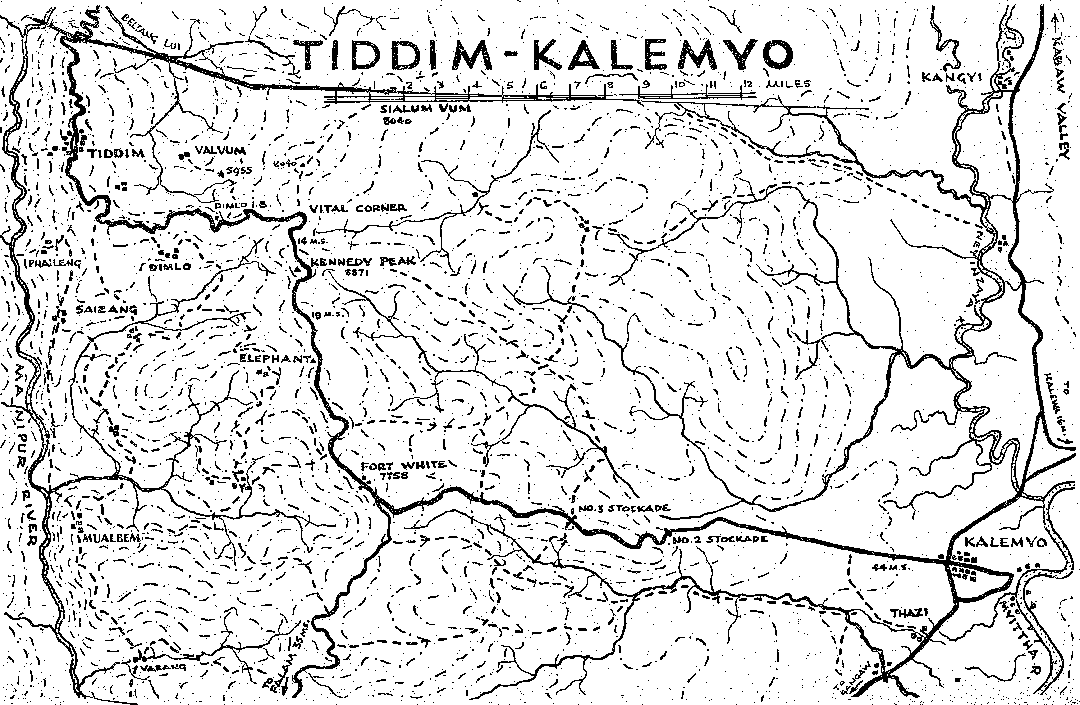
The object of this march was to capture Kennedy Peak, which rises to a height of 8,871 feet, and thereby to cut off the remainder of the enemy division fighting near Tiddim. But the Japanese realized only too vividly the absolute need of defending the long ridge that led up to the Peak from the north. Either they must prevent our advance from this quarter, or see their communications and way of retreat cut.
The sharp bend in the road between Tiddim and Kennedy Peak, where the road turns south towards Fort White and Falam, was christened "Vital Corner," and vital it was. When the leading company of the 2/1st Punjab clambered through dense mist up the slopes of Sialum Vum---the hill that barred the way to the Corner and the Peak---the enemy was found to be entrenched with mortars and medium machine-guns four hundred yards beyond the crest. 'A' Company (Major A. Slater, M.C.) attacked, killed twelve Japanese soldiers, but failed to penetrate the defences. To left and right of the track the ridge drops precipitously from a height of over eight thousand feet to half that altitude in the valleys below. Thus, unless this position was cleared, it would be impossible for Appleby's battalion to move farther south.
Thick mist swirled about the hilltops, and visibility was barely twenty yards even in daylight. One month was to pass before the Japanese soldiers were driven from this magnificent bastion of defence. And the final success was not without cost in human lives.
The battalion dug in on Sialum Vum, and felt itself too close for comfort. Rain, mist and cloud were grave handicaps. Moss-covered creepers growing from the trees dripped ceaselessly. Movement on the abrupt slopes was generally impossible, and reconnaissance patrols were seriously hampered by the wet, slippery ground. For the first five days of October the men lived on half rations, so bad was the weather at the dropping zone. For two days, even, they had no rations. Colonel Appleby tells how a sepoy came to him on the second day and said,---Sahib, I have got a biscuit left and I want you to have it." Eventually the Colonel and the sepoy shared the biscuit. The men slept with one soaking wet blanket between three of them. Having only light tropical uniform of jungle green, they were never dry or warm. Only later, when flying conditions improved. were warm battle-dresses and extra blankets dropped for the battalion. The mules became in bad condition for lack of grain. Six died of exposure and cold. Visibility was normally some twenty yards, but whenever the mist lifted, watchers with field glasses could see plainly Vital Corner ahead, and often enemy troops and lorries on the road were visible.
On October 5 two companies attempted to get round the enemy position on the ridge, but though this move was partially successful at the beginning, the Japanese counter-attacked before our men had time to dig themselves in, and forced our withdrawal.
Then Captain Mohd Jamshed, with the guerilla platoon and three picked men from each company, was ordered to seek a way to the road near Kennedy Peak by going round the enemy defence positions. When evening came the party had reached a hill no more than five hundred yards as the crow flies from their starting-point. The Indians had been obliged to cut a track through the dense jungle undergrowth, and had climbed down some two thousand feet before toiling up the other side to the same level. As Jamshed could go no further, he was ordered to stay on his hilltop.
On several days the battalion positions were shelled by a Japanese 105 mm. gun, and a score of sepoys were killed or wounded. Those who were not hit found the constant threat of shells falling through the mist nerve-racking and unpleasant ; it was obviously impossible for everyone to remain all day long in his bunker or trench. And one of the tragedies of Sialum Vum was that any serious casualty had to be evacuated all the way back to the Mobile Surgical Team at Kahgen. A mere six miles on the map, the journey along a bad and mud-clogged track that wound down four thousand feet was terrible. Small chance, then, for any severely wounded sepoy to survive the jolting, prolonged agony on a stretcher. Many good men died of their wounds along that grim track to Kahgen.
The Medical Services of the Division, under the A.D.M.S., Colonel D. Panton, had great problems to face and overcome. Along the Tiddim Road the Field Ambulances took up a new function. Because the road had been closed behind, and no casualties could be evacuated, the Main Dressing Stations became Field Hospitals with a hundred or more beds. Feeding utensils were held only for the authorized twenty-four patients. Though expanded in this way, the hospitals had still to remain mobile and follow the Division at each stage of its advance. And this could only be achieved by opening as far forward as possible, closing as the rearguard overtook them, and then leap-frogging one another. Jeep ambulances, some of them driven with great skill and daring by volunteers of the American Field Service, proved a success, for they could go in places barred to the ordinary ambulance. Yet, for all their mobility, these jeeps gave an exceedingly rough ride across the ground where they. alone could be used, and such journeys exhausted the sick and were hell to the wounded. The. sole alternative---hand carriage on stretchers---was too slow and wasteful of man power.
The presence of a surgical team with the Division saved many lives by the emergency operations that were performed. More than any other single factor in saving life were. intravenous blood and plasma transfusions. Colonel Steen, who commanded the 10th Field Ambulance, recalls one soldier whom he picked up on the roadside, in a state of complete collapse. He had a tiny hole in his skull behind the ear, and had bled extensively from this single wound. He was lifted into the jeep and driven back to the Main Dressing Station. Within half an hour, after two bottles of plasma had been given intravenously, the man was sitting up and smoking.
For a time we must leave Colonel Appleby's companies struggling eight thousand feet up in the mist and rain. and go back both in time and along the road to watch the progress of the other two battalions of Denholm-Young's 123 Brigade.
It had originally been planned to postpone an attack against the very difficult features of the stretch of road leading up the mountain face from the Beltang Lui to the summit just short of Tiddim itself. Up these seven miles the muddy road spiralled in a series of some forty hairpin bends. From the colour of the road surface and the appearance of these bends twisting against the green of the hillside, this formidable obstacle was known as "The Chocolate Staircase.
A further obstacle as the Division approached Tiddim was mines---British mines that had been recovered from Tiddim by the enemy after the departure of the 17th Indian Division in March.
The road surface, being too scarred for the Sappers to detect the presence of mines by eye, had to be swept at every point. The fact that, of the six tanks that had crossed the Manipur Road, one had burnt out during an engagement, and a second had been lost when the road beneath it collapsed, made this careful sweeping still more imperative.
No longer was it advisable to wait until the thrusts by the 2/1st Punjab and 3/2nd Punjab against the enemy's L. of C. to Tiddim began to exert an effect on the battle. Bad weather, administrative problems, and opposition were holding up their advance. 123 Brigade must increase pressure along the main road and so prevent the Japanese from concentrating their strength on any one front.
Fortunately the enemy failed to make full use of the natural obstacle that the Beltang Lui was in monsoon flood. On October 3 two companies of Dogras under Major Delme-Murray, who won the D.S.O., made an arduous approach climb on the left flank and blocked the road effectively at Milestone 158, near the top of the Chocolate Staircase. Here they ambushed twenty-five fully equipped Japanese. Seven were killed. The remainder fled, harassed by our guns.
This road-block dislodged the enemy from his positions on the mountainside, and the rest of Colonel Middleton's Dogras were able to push forward to the top of the Staircase. Here they were faced by some two hundred Japanese troops, who occupied old defences near Milestone 160. But a short hook by one Dogra company from the east, supported by two air strikes, drove the enemy from this position on October 16. On the two previous days, which were fine, the Royal Air Force had made eighty-two sorties with four squadrons of Hurribombers against the enemy bunkers in this place. And so enthusiastic was the co-operation of the pilots that in the end they were selecting targets and asking permission to bomb them. Tiddim was found deserted by Dogra patrols on the 17th.
At long last, after three months, after a gruelling advance along 150 miles of mud-surfaced road that had been the constant nightmare of every driver and passenger; past a host of milestones where the enemy had held up our leading platoons for a day and a night, and sometimes for longer; beneath dark skies from which the rain had poured with hampering flood and dismal discomfort---after all these weeks of steady plodding and endurance, of struggle against an enemy rearguard and the ravages of malaria, dysentery, and the dangerous scrub typhus, Tiddim was ours.
It was a small place, that stretched itself below the main road at a point where the saddle of the hill range forms a brief plateau edged with pine woods. Some fifty houses stood on the green slopes, square-roofed buildings of wood and of corrugated-iron sheets that had been painted red. Some were more solid structures of brick, and the windows on the ground floor were covered with metal grilles. Before the Japanese came and forced the 17th Indian Division to withdraw to the plain of Imphal in the spring, officials of the Chin Hills Administration had lived and worked here. Now the place was empty. No men and women and children came from their homes to welcome the incoming soldiers with garlands, though flowers still bloomed in the front gardens---honeysuckle, roses, and a type of bright marigold. Though certain houses had been damaged by the bombing, though pariah dogs prowled and sniffed their four-footed way among the ruins, Tiddim lay out stretched on its eminence, five thousand feet up in the beautiful hills. These were beautiful, when the troops had time to look out across the rolling wooded slopes towards the far horizon. An And now, dominated as the little town was by the range of Sialum Vum, Vital Corner and Kennedy Peak a dozen miles forward, there was a special beauty of arrival and achievement to those who set eyes on the place bathed in sunlight. White clouds billowed towards the mountain ridge ahead.
But the Division knew that Tiddim, to which this long road had led for so many weeks, was not the end. Kennedy Peak reared its crest as a challenge for the fast approaching winter months. Beyond lay Fort White, and then suddenly down far below was the warm valley by Kalemyo. Perhaps then the Division would be allowed to rest from its exertions.