
JULY saw the transition from mobile warfare to static, costly, and often abortive aggression in the interests of holding the line of defence. This was a time when the Eighth Army sought desperately to defeat Rommel's forces before they were properly consolidated and in a position to launch a further offensive into the heart of Egypt. Our attacks during this period were hurried and unrehearsed, and became more and more costly in proportion as the enemy dug himself in. Brigades were often set difficult tasks, with little opportunity to ensure that the operation would be successful. Co-ordination between infantry and supporting armour was seriously deficient; officers were frequently working without proper information as to what they were meant to be doing; conferences were too few for those who mattered most in the planning and launching of our attacks; liaison between neighbouring brigades engaged in the same operation was often lacking. And brigades came and went from one division to another. During one period of four weeks the Fifth Indian Division had no less than twenty-three changes in brigades, and these involved eleven different brigades, attached for a few hours, for a night, for a week.
Air photographs were not available when most urgently needed for the preparation of an attack; minefields could not be marked or cleared for want of time. Orders were issued and cancelled, given out again. and cancelled a second time. The resultant uncertainty was inevitable. But despite these difficulties and shortcomings, the Army held the line.
Tank battles went on spasmodically in one direction or another; heavy artillery duels were fought out across the ridges and depressions of the Desert; both the enemy and our own troops endured desultory shelling; the Gunners on both sides of No-Man's-Land shot harassing fire over the stones and sand and scrub. After an attack the ground was strewn with the dead and the dying, with abandoned vehicles, blazing tanks and trucks, and ambulances. The nights would be broken not only by flares and butterfly bombs, by tracer bullets, exploding ammunition lorries, and the rippling flashes of guns firing a concentration, but also by the moans of the wounded, the thudding of artillery, the scream of shells passing overhead, and the crunch of landing shells.
There were moments of terrible anxiety when units in action went out of touch by wireless. Failures and casualties, minor successes and more casualties, confusion and frustration were the order of one day after another. At times the commanders were gripped with the sense of helplessness and uncertainty, the battalion strengths were low, and the general feeling one of alternating depression, elation, cynicism, hope, anger and pride. Whether by day or by night it was often hard to decide what was happening in an engagement; in the haze visibility was bad, and in darkness every sound, flash and flare was confusing.
During July the Eighth Army maintained pressure along the whole front. The object of this policy was at once to improve our position, to meet any enemy offensive that might develop, and to make ready for our own attack when the time came.
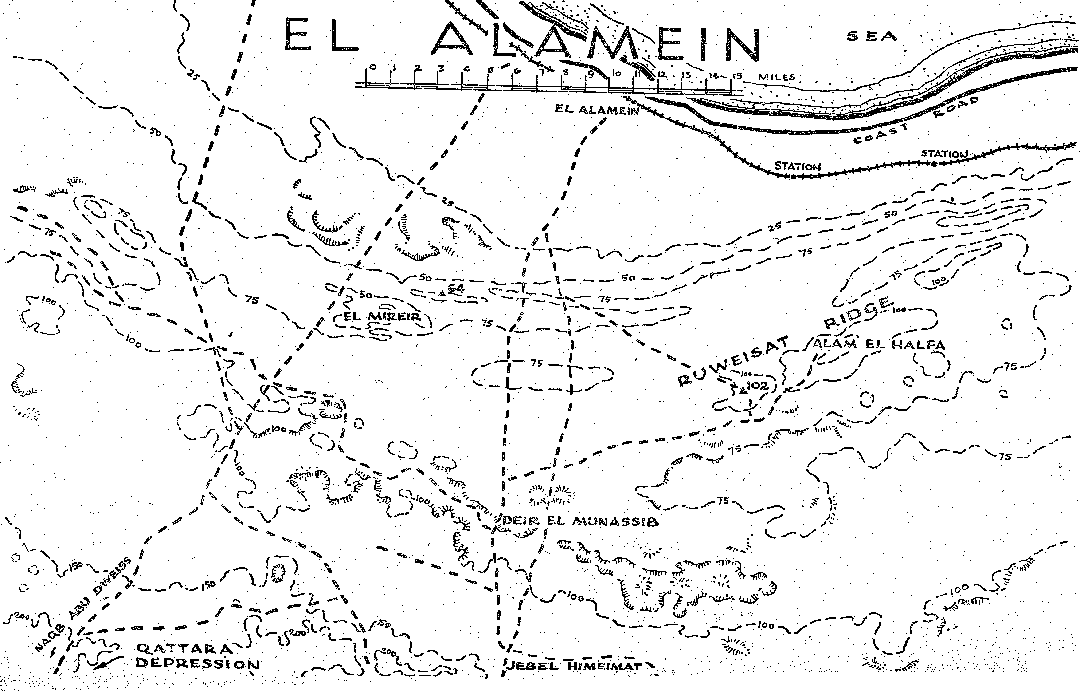
General Auchinleck, finding that the enemy was preparing to attack the northern part of the Alamein defences, held by the First South African Division, decided to relieve pressure here and to regain the initiative by counter-attacking from the south against the enemy's flank. For this the New Zealanders and what remained of the Fifth Indian Division were used. Our northward. thrust went in on July 3. Part of the El Mreir feature as occupied by the New Zealanders. The Italian Ariete Armoured Division was forced to retire with the loss of over forty guns and many prisoners. Our troops drew near to Deir el Shein, which had been taken by the Germans on the 1st.
Then the enemy, though battered by the Royal Air Force, hurriedly reinforced his southern front with tanks and infantry. At once his opposition stiffened. As we had no reserves with which to further the attack, our advance from the south came to a halt. This operation neither destroyed the enemy, nor outflanked him, much less brought us to the coast. But it did force him to regroup, and so relieved pressure against the South Africans. And it gained time for tank reinforcements and the Ninth Australian Division to arrive in the line.
During the first days of July General Briggs formed three new mobile columns, controlled from a small headquarters. The 2nd West Yorkshires, who had been withdrawn to the Nile Delta to refit after the June battles, supplied the nucleus of 'Langcol,' led by Lieutenant-Colonel W. H. Langran, M.C. The other two columns were named 'Gleecol' and 'Scotcol.' These three moved westwards in the formation of two up and one in reserve. To each column came similar experiences, and we take those of 'Langcol' as typical.
Langran had under his command an infantry company of less than fifty men, seven 25-pounder guns in the charge of the distinguished mountaineer, Major H. W. Tilman, and one troop of light anti-aircraft guns. The second and third columns were of similar strength and composition.
'Langcol' moved westwards to Jebel Himeimat; for the troops engaged, this proved a novel experience. They had grown accustomed to retreating in the opposite direction. The column's task was to harass enemy 'soft' transport and gun positions; and the method, to establish guns in a good battery position, with one protecting platoon of infantry on either flank. Two observation posts were then sent forward under escort, until they could see enemy vehicles. Meanwhile, Bofors guns were placed round the perimeter to engage any hostile planes that flew over.
At night Langran's column leaguered in four lines of vehicles, facing in a predetermined direction, and ready to move off should hostilities break out. On the morning of July 9 two Messerschmitts flew over 'Langcol' at a height of three hundred feet. The leading plane was hit, and crash-landed between our two observation posts, a thousand yards in front of the gun positions. The second German plane landed, picked up the crew of the crashed aircraft, and took off again, in full view of Tilman's seven guns and all the Bren gunners, who, as though petrified, just watched the rescue and took no action. Then a South African armoured car did open up with the anti-tank rifle in its turret, but this had no effect.
Later in the day thirty German tanks approached Langran's position. While one tank acted as an observation post, the others stayed out of sight and fired their guns. Again and again our Gunners located these tanks and shelled them. But 'Langcol' was slowly forced back towards the Alamein line. There was no time for digging; the infantry sat around the guns; our sole target was the hull of a lone tank. That evening 'Langcol' reached the area near Fortress 'B ,' and when about to leaguer was dive-bombed by Stuka planes. Further casualties were sustained. Under cover of night Langran brought his column east to the Jebel Himeimat area once more, and although on the two following days our guns were in action against enemy transport, on the 13th 'Langcol' drove back to the Barrel Track. Three days later it rejoined the rest of the 2nd West Yorkshires, now returning from the Delta.
Meanwhile, the Ninth Australian Division had concentrated by the coast. On July 10 it launched an attack to capture Tel el Eisa, on the railway west of El Alamein. Supported by the First South African Division, this attack succeeded and the ground gained was held despite heavy enemy counter-attacks. Shortage of reserves again prevented us from exploiting success. The enemy's resistance was strong. But the new salient was important by virtue of its threat to Rommel's positions further south.
Then, four days later, the New Zealand Division, which had already incurred more than a thousand casualties since it first entered the battle, was ordered to advance six miles north-west and to capture part of the Ruweisat Ridge. This vital feature ran west and east into the centre of the Eighth Army's positions. Its possession would be of great tactical importance. The Ridge was narrow, and its average height some two hundred feet: on the map the altitude was marked in metres---an example is Point 64. Russell's Five Brigade, attacking on the right flank of two New Zealand brigades, was to seize the eastern stretch of the ridge. This night assault was also designed to break through the enemy's centre and thereby destroy his forces east of the track running south-west from El Alamein to Naqb Abu Dweiss.
Russell's battalions, the 3/10th Baluch and 4/6th Rajputana Rifles, gained the larger part of their objective, Point 64. The Brigade overran two battalions of the Italian Brescia Division, and took nearly a thousand prisoners. When, next morning, Rommel put in a counter-attack, this was dispersed by our field artillery and by the 6-pounder anti-tank guns that had just arrived. Thereafter, many derelict enemy tanks and lorries lay strewn across this quarter of the Desert.
The New Zealanders became engaged in heavy fighting; support from the tanks had not been co-ordinated; the 4th Brigade was overrun when counter-attacked in daylight by the German 15th Panzer Division; they lost nearly 1,500 men, and took a similar number of prisoners, though this total would have been far greater had not the German tanks rescued large numbers of prisoners from our hands. The New Zealand brigades were forced to withdraw, and took up positions some 1,200 yards south of Ruweisat Ridge. They faced north, with their left flank against El Mreir.
Then, on July 17, Langran's West Yorkshires were ordered to pass through Five Brigade and to attack westwards along Ruweisat Ridge to capture Point 63. This lay 12,000 yards ahead of our forward positions. Already that day the enemy had made two vain and costly counter-attacks. Now he was digging in, having been reinforced by fresh troops that had just arrived from Crete. By contrast, the strength of the West Yorkshires at this time was a mere 250: no reinforcements were available in the Nile Delta, and Langran's strongest rifle company numbered fifty men. But the artillery support for this operation was very powerful, for a medium regiment had been added to the guns of the New Zealand, South African and Fifth Indian Divisions. The resulting barrage provided a memorable spectacle.
Dunlop's 'C' Company led the West Yorkshire attack along the southern slopes of the Ridge, while 'D' Company trudged forward along the northern side; O'Hara and Osborn followed with their two companies. When our men had gone several hundred yards the enemy troops suddenly left their positions and retreated west; some even gave themselves up. Then, because the advance had been too rapid, 'D' Company walked into our own artillery barrage. The objective was not well marked, and our infantry merely pushed ahead until the opposition became too strong. In this way 'C' and 'D' companies went a mile too far and had to be recalled to Point 63 by Langran. Lieutenant J. R. Barton's platoon overshot the battalion's objective by three thousand yards, but retired when counter-attacked by German tanks.
Our troops suffered frequent casualties from enemy shelling and machine-gun fire, and in the platoon led by Sergeant-Major Neville every man was killed or wounded except Neville himself. He went forward alone. By now the strongest company could muster no more than fifteen men. The advanced dressing station had received a direct hit, and Langran's regimental aid post was overcrowded with casualties.
At last light the battalion found it impossible to dig in, because the Ridge here was formed of solid slabs of rock. Instead, the men built up the rocks to complete a number of sangars abandoned by the enemy; only our anti-tank guns could be dug down a little. Later that evening, when German tanks attacked, they did not press, but were pulled out after twenty minutes and leaguered a thousand yards to the north. Then a section of 20 Field Company drove up to lay a minefield around the battalion's position. One three-ton lorry was at once illuminated by enemy flares; a burst of medium machine-gun fire caused this lorry-load of hundreds of mines to blow up with a tremendous explosion.
Next day, July 18, the 2nd West Yorkshires were troubled by accurate enemy sniping and shelling. At ten o'clock Stukas dive-bombed our position, and one bomb wrecked Langran's truck. The battalion held its position for two days until the total strength was under a hundred. Then, on July 20, the weary Yorkshiremen were relieved by the 1/4th Essex.
On the same day 161 Indian Motor Brigade joined the Division. Now commanded by Brigadier F. E. C. Hughes, this brigade had, after leaving Cyprus, been in Qatatba under direct command of G.H.Q. Its battalions were the 1/1st Punjab (Lieutenant-Colonel M. H. W. Wilson, who was killed by a shell within a few days), the 3/7th Rajputs (Lieutenant-Colonel G. F. M. Stray), and the 1/2nd Punjab (Lieutenant-Colonel D. Barker).
161 Brigade was ready to play its part in attacking. against the centre of the enemy's line. This fresh attack was designed to sever the enemy's communications, to force him to extend his front and disperse his reserves, and having done this, to roll up the northern part of his force. And so, at last light on July 21, Hughes' brigade advanced along Ruweisat Ridge, while the 6th New Zealand Brigade attacked northwards across the El Mreir depression. They aimed to make a breach through which the 23rd Armoured Brigade could pass. Despite strong enemy resistance and shelling in darkness, and heavy casualties, the 1/2nd Punjab and 3/7th Rajputs made good initial progress.
The 1/1st Punjab of 161 Brigade attacked along the Ruweisat Ridge and made progress, though failing to reach as far as had been expected. The Sappers and Miners of 2 Field Company assisted by the New Zealanders, began to clear the minefield, but this proved a very difficult task, for the men were under continuous fire. The enemy then counter-attacked, and the 6th New Zealand Brigade was disastrously overrun by German tanks.
General Gott now ordered the newly arrived and inexperienced 23rd Armoured Brigade forward, to carry out the second phase of the operation. The tanks charged through such gaps in the minefield as had been made, pressed on through intense fire, and came on to another minefield. The armoured thrust was defeated with very considerable losses in tanks. And although the attack was renewed later in the day by the 2nd Armoured Brigade, our main assault had failed to split the enemy forces. Valuable ground had been gained, but at great expense.
General Briggs returned to his headquarters late in the afternoon of July 22 to learn that orders had come from Corps for an attack on the Deir el Shein depression, by dawn the next morning, This attack would be in conjunction with advances by the New Zealanders and tanks on the Division's left flank. The depression was at this time held by the 15th Panzer Division.
Briggs telephoned to General Gott at Corps Headquarters, and stated that this attack was too large, the time too short. He added that, if the urgency warranted it, he would limit the assault to an attempt to seize the end of the Ridge, so as to allow 161 Brigade to widen its base and dominate the El Mreir depression with fire. It would thus be made untenable to the enemy. 'Strafer' Gott agreed to this proposal.
Briggs decided that Fletcher's Nine Brigade should make this attack. Nine Brigade had spent July 22 in column in lorries, waiting for news. About four o'clock that afternoon General Briggs sent for Fletcher and showed him on a map the positions thought to be occupied by our troops. Briggs asked Fletcher whether he thought he could mount a night attack to gain certain objectives beyond the point on Ruweisat Ridge gained by 161 Brigade. Three hours remained for reconnaissance. The attack was to be made in the dark, from starting lines that had not yet been reconnoitred. It was therefore decided to make the attack "silent without artillery."
At this time Nine Brigade consisted only of the 2nd West Yorkshires, who had already had a very difficult time, and the 3/14th Punjab (Lieutenant-Colonel W. A. Putnam), who had recently joined from Qatatba. Although this battalion had fought in Eritrea with the Fourth Indian Division it had not yet been in action in the Desert. Fletcher decided to carry out the attack with the 3/14th, and to move up the West Yorkshires when the objectives had been captured. An anti-tank battery was placed under command.
Then Fletcher set out with Colonel Putnam and the reconnaissance groups to make certain where our own front line was. They had to find a start line, point out objectives, and take compass bearings. On the way forward this party was delayed by a Stuka raid, which badly disorganized the anti-tank battery. As Fletcher and his companions approached our front, they abandoned their trucks and walked across the sand of Ruweisat Ridge, passed through 161 Brigade's forward defences on foot, and came under machine-gun fire. A point on the ridge was found from which Fletcher was able to point out to Putnam what his objectives were. Then darkness fell. The company commanders of the 3/14th Punjab had not seen their objectives, and Fletcher wanted to postpone the attack until the following night, thus enabling the battalion to dig in in front of 161 Brigade. But it was essential that the attack be launched without delay. So Colonel Putnam. established his headquarters on the southern slope of the Ridge, and the companies were ordered up to the start line before the moon set at 2 a.m.
Unfortunately the whole area through which the men had to advance was studded with vehicles., criss-crossed with telephone cables, and dotted with packets of men belonging to 161 Brigade and supporting units. And the sepoys had to pick their way through a minefield. The moon set at the appointed time, but the 3/14th were not ready. For Fletcher and Putnam it was an anxious time. When a ground mist rose the companies literally vanished into the darkness and the mist. No firing was heard. Touch with the advancing companies was lost. Putnam walked forward to investigate. About eight o'clock he reported back that he had made touch with his company commanders; the attempt to advance by night had led to confusion, and some reorganization had proved necessary. But he had now ordered a fresh advance to be made at nine o'clock. At this time the 3/14th Punjab attacked in lines with great gallantry and reached Point 63. The sepoys tried to consolidate, but were unable to dig in on the stony surface. Heavy casualties were suffered from enemy fire. German tanks that were dug into the sand engaged the Indian infantry with disastrous results. Colonel Putnam and his leading company commander were killed. And when the Germans counter-attacked, the battalion suddenly broke, and fell back through 161 Brigade's positions.
Nine Brigade was taken into reserve once more, and Lieutenant-Colonel W. H. Langran took over command from Brigadier I. Fletcher.
During the rest of the month a lull intervened along the front. The Fifth Indian Division had orders to cause the enemy to expect an attack south of Ruweisat Ridge, and our artillery harassed the German and Italian positions in the Deir el Shein. Throughout this period a grave shortage of transport and controlled stores within the Division led to constant juggling and improvisation. The remnants of 29 Brigade had been almost literally 'milked' of everything to make the 2nd West Yorkshires mobile and capable of functioning, though on a reduced scale. So grievously had 161 Brigade suffered in attacks on Point 63 and the Deir el Shein that two battalions had to be replaced. The 4/7th Rajputs (Lieutenant-Colonel J. A. Salomons), which had left the Brigade in Cyprus, came from the Sudan to relieve the 3/7th Rajputs; while the 1/2nd Punjab gave place to the 1st Argyll and Sutherland Highlanders (Lieutenant-Colonel R. J. F. McAlister).
And this feeling was reflected in an appreciation of the situation, written on July 27 by General Auchinleck, who decided that the Eighth Army required re-equipping and training before it would be fit for further offensive operations. We were strongly placed for a defensive battle, but lacked the strength to deliver an attack sufficient to dislodge the enemy from his strongly-held front.
Auchinleck estimated that unless we made a serious mistake the Germans would, during the first half of August, have no defensive superiority in troops. Though they held a greater strength of armour, their artillery was inferior, our air strength greatly superior. The Eighth Army was obliged to husband its ammunition; its transport deficiencies were mounting rather than decreasing; none of its formations was adequately trained for offensive battles. The great need was to provide an Army reserve. Two courses lay before us: either to persist with attacks in the hope that the enemy would crack before he was reinforced by fresh troops, or to adopt a defensive policy until we were strong enough to attack with every hope of success.
Auchinleck did not believe the Eighth Army could be made ready for a full-scale assault before the middle of September, whereas the Germans and Italians might be ready as early as the last week of August. It was decided that our best course was "the defensive, combined with offensive gestures from time to time, including raiding."
Accordingly, the month of August was spent by the Fifth Indian Division, which had suffered 3,000 casualties during July, in reorganizing its defences on Ruweisat Ridge, in extensive minelaying, artillery shoots, and active patrolling---including a number of strong raiding parties.
On Ruweisat Ridge were to be found most of the characteristics of static war and life in the Desert. It was an underground existence for the infantry, overlooked as they were by the Germans and Italians. Often the ground was too hard to dig, and so sangars had to be built of stones and rocks. No one in the forward positions could move with safety during daylight, nor could vehicles approach without drawing fire upon themselves. So the men sat in their trenches, or lay down at the bottom on a blanket, cleaning and oiling their weapons. A piece of mosquito netting was stretched across the opening of the trench.
In the beginning many officers tried to construct fly-proof trenches with these nets, but a net made the trench very hot to sit in. And even with its aid, and that of an arsenic trap which deposited a black carpet of dead flies on the sand, it was impossible to deal with the flies. They were vicious throughout each day, and never ceased to torment those who dwelt on the Ridge. If you so much as moistened your lips, twenty flies would be clinging to them. A drop of tea in a mug attracted flies in hundreds. You had to shield the mug all the way to your lips, otherwise the tea was undrinkable. And it was the same with a plate of food. The side of a lorry that formed one wall of a certain officers' mess was permanently black with flies by day, and a similar horde swarmed and buzzed around after food either on the table or on men's faces. One British officer who had been ill was in such a poor state that he remained oblivious of the flies crawling in the corners of his mouth and eyes. It was not a pretty sight.
Then there was the sickening odour wafted across by the breeze from former Italian positions in front of our trenches---a horrible stink of unburied corpses, and of burnt-out tanks that rose like blackened tombs from the dazzling sands.
At times, when little happened, life was boring. But the men in the line lived on anticipation, on the certain knowledge that something was bound to happen sooner or later. German planes flew over most nights to drop flares and bombs. The bombs crumped in the sand, and the dazzling flares gave men a sense of nakedness. In daylight Stukas would come to dive-bomb our positions, or to attack the congested and dust-cloaked 'C' Track. The Royal Air Force and the Luftwaffe fought each other over the heads of the divisions between El Alamein and the Qattara Depression, and to see pilots swinging beneath a white parachute was not uncommon. Our fighters made frequent raids over the enemy's back areas, and would fly home very low and often be caught by Messerschmitts that waited high above. Sometimes our men saw smoking German planes struggling to reach their own lines before making a forced landing.
Once again sundown was the best time of the whole day. Soon after dark the battalion Quartermaster would arrive up the dusty track with his ration convoy. They drove through a minefield gap, maybe, or over an empty stretch of Desert, or up a shallow valley between two ridges, bringing hot meals in dixies for the troops. In this case the lorries were able to go right up to the forward companies. Sundown was also the time for sick parade, when a large proportion of each unit might attend. Under different circumstances many of these men would have been in hospital, but with the great shortage of soldiers in the line, a man had, as Wiberg expressed it, to be on the verge of rigor mortis before he was permitted to become a casualty through illness.
Dusk and nightfall were the moments for men to take exercise and to stretch their limbs that had been cramped in the narrow trenches. For those who had dysentery the end of the day was a lull during which they could in safety empty the tins that they needed with such painful frequency. At night, infantry patrols crept forward to report upon the enemy in his dispositions and activities, and to shoot up enemy mine-laying parties. Sometimes they caused German tracer to whip across the dark sky, though a greater danger lay in treading on a mine when walking through minefield gaps.
And the Sappers would be out, improving the minefields, putting down more mines, erecting barbed wire. And across the sands walked Signals linemen, who searched for a break in a frail cable. In dugouts and in vehicles wireless operators kept a listening watch, and sent or received messages. Constantly alert was the operator on the telephone switchboard; hard at work would be found cipher operators who encoded and decoded messages. In every command vehicle a duty staff officer was awake, ready to deal with each urgent piece of news. And so it went on, night after night.
During the day, notable for the searing glare and an atmosphere that was clear save when the wind blew up or a mirage appeared, units remained widely dispersed against air attack. No two vehicles were parked together. Camouflage nets hung everywhere in evidence. Little trenches had been dug beside each vehicle. It was possible to stand in the centre of Divisional Headquarters and not to realize that you were there. No unity seemed to exist between the scattered office lorries, staff cars, caravans, jeeps, trucks with side shelters outspread, between the tiny greenish bivouac tents, khaki figures trudging across the sand, and many little signboards that indicated the occupant of each office.
One track looked like every other track, and the wire netting that the Sappers had staked into the sand hardly aided a driver in distinguishing one from another. Occasionally, if you stood on the upper ridges and looked towards the northern skyline, you could glimpse the slim blue streak of the Mediterranean. All else was Desert and men at war. On every side the sands stretched on and on towards a horizon that was broken by no feature but columns of black smoke rising from smouldering tanks, trucks and aircraft, by funnels of dust, and by the few rocky points. Into the hazy distance rolled the ridges and hollows; over the hot and gritty sand trudged the men about their business; and against particles of sand and the fierce glare of the sun overhead, strained eyes were puckered. Countless wheel and track marks criss-crossed on the ruffled surface of this Desert. Men and lorries and tanks that passed later would blur the outline of these tracks, and so would the wind. And across the Desert's face lay mile upon mile of single and twisted cable, half-buried by the loose sand, ripped by tank tracks, followed and repaired by Indian linemen, followed too, by trucks and soldiers who had lost their way and firmly believed that a telephone cable must lead to some unit or formation headquarters.
And the hollows of all these tyre marks and boot tracks were filled with dark shadows when the sun sank low. The evening turned cool, the dust was stilled, the surface of the sand took on a reddish light that swiftly faded, leaving the sand matt and tinged with grey. Eyes that were bloodshot and weary opened wider. Stars shone and twinkled in the heavens. And no white puffs from anti-aircraft shells could spoil the long-awaited evening peace.
It was in the middle of August that General Auchinleck handed over command of the Eighth Army to 'Strafer' Gott. Gott was to have a few days' leave before taking up his new post; he set off for Cairo, but the plane in which he flew was shot down, and the new Army Commander killed. In this way command of the Eighth Army fell to a successor from England, Lieutenant-General B. L. Montgomery. And, as a result of Mr. Churchill's visit to the Desert, Auchinleck returned to India, and Alexander replaced him as Commander-in-Chief in the Middle East.
The Prime Minister had stated that this was now to be a decisive theatre of war; an open mandate for equipment and reinforcements was given; the Army would make ready to defeat the enemy in Egypt and Libya. An aggressive and offensive spirit was to be instilled into every man. As a token of this resolve, all troop-carrying transport was sent back a long distance. Alternative positions were no longer mentioned. The term; 'box' and 'consolidation' were abolished. The first word was apt to mean that the troops were shut in and unable to operate outside; the second term implied the defensive spirit. Nobody would use the expression 'in the bag' to mean 'captured' or 'a prisoner of war.' All orders referring to withdrawal from, or thinning out of, our present positions were cancelled.
A new spirit went abroad through the Eighth Army. Hope sprang high. Fresh divisions and American tanks began to arrive. Morale rose all round. On his arrival in the Middle East, General Alexander had found the Army, to quote Mr. Churchill's alliterative phrase, "brave but baffled." Now all was changing. But let it be remembered that those who had struggled in the bewilderment and butchery of the Cauldron, who had fought a rearguard action day after day to delay the enemy from El Adem to Fuka, who had seen battalions decimated, brigades overrun, headquarters captured, armoured forces destroyed, transport hurrying towards Egypt---they had played their gallant part in paving the way for the new offensive. Without those early attacks from the Alamein Line, without those day-to-day columns and raids, without the crippling losses, the hundreds of prisoners captured from the enemy, without the untiring handling by commanders and staff, and the valiant fighting of the troops of Great Britain, Australia, New Zealand, South Africa and India----without all this and more, there would have been no line of defence at El Alamein from which the fresh Eighth Army might sally forth to drive the enemy back and back and still further back beyond Benghazi, beyond Agheila, to Tunis.
It was with this eventual onslaught in mind that Alexander directed Montgomery, on August 19, in these words: "Your .prime and immediate task is to prepare for an offensive action against the German-Italian forces with a view to destroying it at the earliest possible moment. Whilst preparing this attack you must hold your present positions, and on no account allow the enemy to penetrate east of them."
The newly arrived 44th Division entered the Alamein Line and took up positions on the Alam el Halfa ridge. A further immediate addition to the Army's strength was the Tenth Armoured Division, which established itself on the western edge of the same ridge, between the 44th and the New Zealand Divisions. Thus, on this important ridge we had ranged, in artillery alone, as a threat to the flank of any advance the enemy might make against the southern part of the line, some sixteen medium, 240 field, and 200 anti-tank guns, to say nothing of the guns of nearly four hundred tanks.
From information received of Rommel's plans, it was expected that he would attack about August 25, the night of a full moon. His shortage of fuel, largely due to our successful sinking of tankers in the Mediterranean, delayed the final attack; but his increased concentration of forces towards the south gave us clear indications that one was impending, and of the direction it would eventually take. Rommel's plan---similar to that executed so successfully at Gazala three months before---was to break through on our southern flank, turn north, and advance towards the sea behind Thirty Corps, thus encircling our centre and right. The enemy's main striking force was to consist of the German Afrika Korps, with the 15th and 21st Panzer Divisions.
And what of our own side? This was to be Montgomery's first Desert battle. Our preparations were made, our moves completed, our hopes high. There had been no hurry, no lack of co-ordination, no want of proper co-operation, such as had characterized many of the recent engagements.
It was in the early hours of August 31 that the enemy's offensive started. Diversionary attacks were made against the northern part of the line. On Ruweisat Ridge a German parachute battalion overran the forward company of the 2nd West Yorkshires; our wire was crossed, and one company dislodged from its defences. But by the time the 1/4th Essex and some tanks arrived up to counter-attack, the position had been restored.
Then, soon after midnight on the 31st, Rommel's main thrust moved against our southern minefield between Deir el Munassib and Himeimat. In order to make a gap for the armour to go through, our minefields had to be lifted. And this lengthy operation gave the New Zealand and Seventh Armoured Divisions an excellent target for enfilading fire.
Next morning a dust-storm frustrated bombing efforts by the Royal Air Force, but when the two German armoured divisions moved cautiously north and north-east against our 22nd Armoured Brigade near Point 102 at the western end of the Alam el Halfa ridge, the artillery fire brought upon them was so concentrated that at least a quarter of the enemy's tanks were disabled. His striking force retired. All night our aircraft dropped flares and bombed the German tank leaguers, while the New Zealanders sent out raiding parties to prevent the 90th Light Division from digging itself in.
On the morning of September 1 the enemy again tried to push on to the ridge. Again he suffered heavy losses. And his lack of success during these first two days of Rommel's last fling against the Alamein Line constituted in itself a success for the Eighth Army. Next day Rommel changed his tactics. He did his best to tempt us into counter-attacking him, but our forces did not accept the bait. Moreover, while his troop concentrations were steadily bombed by our aircraft and hammered by our artillery, his fuel situation became critical, and by the evening of September 2 Rommel must have realized that his push was doomed to failure. To remain in his advanced position was out of the question; withdrawal was the sole alternative.
On the following night---the third anniversary of the outbreak of war---the 5th New Zealand Brigade, with 132 Brigade from 44th Division, attacked south to close the minefield gap. During that day the enemy had shown signs of withdrawing slightly to the south-west, though our commanders could not be certain whether this was merely a feint to lure our tanks into a counter-attack, or whether it really was the beginning of a final withdrawal. The attack by the New Zealanders was no more than a partial success; and 132 Brigade incurred very heavy casualties. All the enemy counter-attacks next day were repulsed, and the German columns bombed and harassed by our mobile parties.
The evening of September 5 found the enemy back beside our minefields. Rommel had thus gained a small amount of ground---some five miles of Desert---and he showed his firm intention of holding on to these paltry gains. Accordingly, General Montgomery called off our attack on the 7th, leaving the enemy holding a line on the southern flank from the eastern end of Deir el Munassib to the peak of Himeimat.
The battle of Alam el Halfa not only cost the Germans and Italians severe losses in tanks, men, and motor vehicles; it was their last opportunity of victory before the Eighth Army reached its full strength. On the other hand, by this repulse of a serious offensive, we had regained our morale, and forced the enemy once again on to the defensive.
Three hundred Sherman tanks had arrived in the Middle East on September 3; new divisions were now ready to enter the line; other divisions were drawn out to refit and reorganize. And it was in this process of building up the Army's offensive strength that the hard-fought and weakened Fifth Indian Division was relieved by General Tuker's Fourth. Only Headquarters, Signals, and Langran's Nine Brigade, who had all been fighting continuously since the last week of May, left the Alamein Line. Russell's Five Brigade returned to the Fourth Indian Division to which it really belonged. 161 Brigade, with two fresh battalions, settled into the defences vacated by Nine Brigade, and stayed to fight in Montgomery's October battle of El Alamein.
On September 9 the Fifth Indian Division, which had been but involved in Rommel's last onslaught, handed over to Tuker's command not only its positions on Ruweisat Ridge, but its battle-worn vehicles and some of its stoutest troops. Then Briggs led out from the Desert those units that were to leave. The column headed for Mena and a sight of the Pyramids.
And so it was that the Fifth Indian Division quitted the continent of Africa. No longer would the Division fight against Italians and Germans. No longer would it serve in Middle East Forces. It was bound for the newly constituted Persia and Iraq Force. Cairo would not be its base and leave centre, nor the Nile its most familiar river. The Division was to cross Nile, Jordan, Euphrates, to settle beside the waters of Tigris.
A YEAR had passed since the Division drove through Baghdad on its way to Kirkuk and back. Now it returned to Iraq, and settled among the dusty wastes of Quetta Camp, a mile to the west of the capital. At this time the German advance towards the Caucasus was at its height. The Russians might be overwhelmed and brought to collapse. And there waited the Anglo-lranian and American oilfields as a tempting bait, which would doubtless prove irresistible to the Germans. It was to prepare against an enemy attack southwards through Persia as well as through Turkey that Persia and Iraq Force was formed under General Sir Henry Maitland Wilson in the summer of 1942.
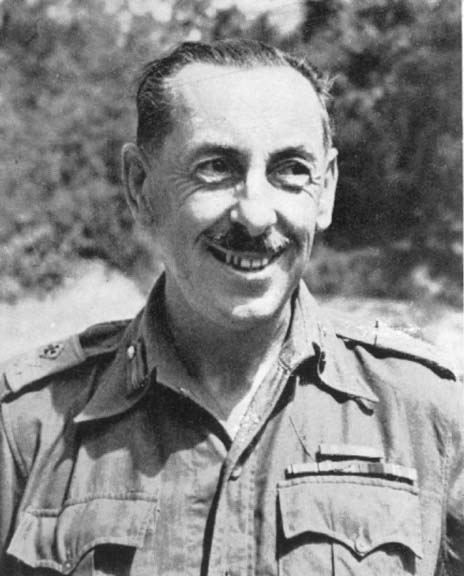
Wilson had at his disposal General Quinan's Tenth Army in Persia, and, in Iraq, the Polish Corps under General Anders. The Fifth Indian Division arrived to constitute a strong G.H.Q. reserve, which General Wilson could move to either country in a mobile role. In order to play this part the Division was reorganized with two infantry brigades, Nine and 161, when the latter came over from the Eighth Army in December, and the veteran Seventh Armoured Brigade, led by Brigadier J. K. Anstice. This brigade comprised the 2nd Royal Tank Regiment, the 6th Royal Tank Regiment, the 7th Hussars, the 14th Royal Horse Artillery, and the 14th Sherwood Foresters. It had fought with the "Desert Rats" in the early battles of North Africa, and its bold actions in Burma had enabled General Alexander to extricate our army from the Rangoon-Pegu area.
Also under command of the Division were the armoured cars of the Guides Cavalry, a fine and picturesque unit from the North-West Frontier of India.
It was not until the end of December that Hughes' 161 Brigade rejoined the Division after its three months with the Fourth Indian Division. At first it had patrolled south of Ruweisat Ridge and prepared for the great day of October 23, the Battle of Alamein.
During this assault, that was to be a turning-point in the war, 161 Brigade made diversionary attacks, raids, and bluffing noises, as did the rest of the Fourth Indian Division, while the main battle raged further north along the front. Then, in November, it had the task of clearing the battlefield and rounding up the hundreds of Italian prisoners.
When, on December 10, the Fourth Indian Division moved up to El Adem, 161 Brigade left its command and returned to Egypt, on its way to Iraq. The British battalion changed, and the 1st Argyll and Sutherland Highlanders were replaced by the 4th Royal West Kent Regiment.
This was a period of flickering local interest, but robbed of any purpose that could finally satisfy the men. There were many who fretted under the lack of action, under the frustration of training and living in so bleak and inhospitable a land. To read of the Eighth Army's all-conquering progress across the north of Africa was but to emphasize the inaction. News from other battlefields only served to magnify the sense of being in a backwater of the war. No doubt the threat of an attack by German armies from the Caucasus through Persia and Iraq was ever present, so long as the Russians were on the defensive or retiring towards the east. But a threat of possible attack could not impress with the same stern reality as could a known and present danger.
And the country itself did nothing to dispel the sense of waiting, of incipient boredom, of futility. The dusty, earthen fields of Quetta Camp, devoid of grass, but prickly with thorns and bumpy from worn banks and ridges, were monotonous and without character. True it is that the rows and rows of square white tents that housed Divisional Headquarters and Nine Brigade were bright with fluttering unit flags and pennants. But the only greenery to relieve the brown tones of the landscape was provided by a roadside hedge and several groups of dusty palms.
And wind swirled up the dust, blew in beneath the tent walls, chilled men's fingers, and added its discomfort to the sting of driving dust particles. If few trains puffed and rattled down the line that skirted one end of the camp, the motor traffic passing. along the main road to Baghdad was constant and noisy. But beyond this railway appeared one bright patch: the Palace of the Roses---home of the boy King of Iraq---the white walls and red roof of which could be seen above the trees of the garden. In every other direction the eye met buff and brown, puffs of dust, straggly bushes, tents and lorries.
Nor did Baghdad itself provide much relief. All the troops were disappointed. The city of Haroun al Rashid contained no Eastern glamour, and its only mystery was provided by the acres of narrow, dirty alleys and side streets that were out of bounds. A glimpse of a sunlit courtyard, the blue or golden gleam of some mosque, and the slender grace of a minaret against the sky brought pleasure amid so much squalor and dilapidation, where poverty, dirt and disease lurked round corners. Yet the sight of the outspread city from the Maude Bridge was impressive, though the waterfront itself could not be so described. Many small boats plied on the muddy waters of Tigris, and in the narrow lanes that ran up from the river bank lean, unkempt pi-dogs barked. And the bridge itself seldom stopped from shuddering beneath the rumbling flow of military and civilian traffic.
Many there were who visited Ur of the Chaldees and clambered on the ziggurat and down into deep chambers; who walked beneath the immense unsupported arch of Ctesiphon and photographed the ruins of Babylon. Others went north to the spiral mosque of Samarra, or south to the site of the Tower of Babel, and to other historic cities of the past. The response of the men, both British and Indian, to such expeditions far exceeded the expectations of many of the commanding officers. And Baghdad attracted by its bazaars where collectors of carpets and copperwork, of silver and brassware, of Arab head-dresses and robes, of inlaid boxes and other oriental objects could prowl at will and bargain with the local men who sat behind their goods and gossiped or smoked the hookah.
Though watered by Tigris and Euphrates, though believed to be the site of the Garden of Eden, the country's dominant impression was of dust, or of mud when the rains fell, of uncomfortable winds and lack of green in the bleak landscape. And Quetta Camp at moments recalled some factory town, on account of the smudges of thick and oily smoke that coiled above the tents and dirtied everything. A severe shortage of wood had made it necessary for the Divisional Sappers to build into all office and mess tents a brick stove which fired on one drip of oil to two drips of water falling into a flashpan. If the heat provided, was excellent, the danger to the tent canvas where this touched the chimneys was constant, and hardly a week passed without several tents catching fire.
 |
 |
 |
It was during the spring that most camps in the Division were plagued by 'loosewallahs'---thieves who stole in by night from the villages to steal such kit, arms and equipment as they could make away with. It must be conceded that they were devilish successful and cunning, for they could remove every object inside a tent, except the bedding and camp bed, without waking anyone sleeping in that tent. Belief had it that the loosewallahs could even strike a tent and carry it away, and still the occupants would sleep on undisturbed. So bad did the situation become that units on the edge of every camp were obliged to post guards and man machine-guns. Seldom were the night hours unbroken by the sudden crackling of a gun. Few dawns lit the sky without disclosing a corpse, though the vultures were quick to circle and descend, should the human eye have failed to pick out the dead marauder. To recover stolen property was all but impossible, for women and boys waited among the dunes outside our camps while their men folk crept in and stole. Then the booty was laden on donkeys and taken to a village or to some obscure hiding-place.
For those who had money, the hotels of Baghdad provided meals and drinks at high prices. The shops were unattractive, and poorly stocked. But units organized their own entertainments, concert parties, discussion groups and hockey, matches. The chaplains were leading spirits in such work. At Divisional Headquarters in Quetta Camp the Senior Chaplain, the Rev. Christopher Perowne, started a branch of Toc H, and in the Church tent some activity was arranged for almost every night of the week. Lectures were given by Freya Stark, by the head of the Baghdad Police, by a banker, by an expert on irrigation; other lecturers spoke on devil worship or the antiquities of Iraq. Games, debates and community singing took their turn in beguiling the frequent empty evenings. Many of the men borrowed books from the Chaplain's personal library. The Polish Corps in Iraq presented outstanding concerts of music, singing, and folk-dancing in native costumes. The Baghdad cinemas were filled; and in Quetta Camp mobile cinema units provided films for the Indian ranks, who sat on the grass on either side of the open-air screen and enjoyed films in their own language.
Many events at once varied and important to the Division occurred during this winter and spring spent in Iraq. General Briggs lectured on 'The mixed Infantry and Armoured Division' that the Fifth had become. Demonstrations were given by several battalions; battle inoculation was provided for new members of the Division;. courses on demolitions were organized by the Sappers. Round sand-table models officers worked out and discussed tactics, and tactical exercises without troops (more familiar under the title of TEWTS) occupied the thoughts and ingenuity both of planners and of those under instruction.
Speed was essential in becoming battleworthy in the new role allotted to the Division. Infantry and artillery units had to learn how to co-operate fully with the Seventh Armoured Brigade, while at the same time they reorganized, re-equipped and trained in their own weapons. Commanders and staff officers at all levels were sent out to reconnoitre the possible theatre of war in the northern parts of Iraq, and both on the ground and on scale models the detailed employment of the Division in each type of fighting was explored and practised.
At a certain bridging demonstration an amusing incident took place that might well have been extremely serious. The Iraq Levies asked to drop parachutists to attack the bridge. To witness this attack, about ninety senior officers from G.H.Q., Paiforce, assembled, and stood round a jeep on a 'bund.' The two transport planes, capable of a speed of little more than fifty m.p.h. and dating from the First World War, dropped their parachutists without mishap. But the pilots then decided to demonstrate a dive-bombing attack on the assembled 'brass-hats.' These were seen to fall in haste from the bund. And this showed their wisdom, for the first aircraft hit the jeep fair and square, and crashed. One rather 'broad' brigadier lay flat on the bund, but as his breadth was out of all proportion to his height, he only escaped by rolling down it. He was seen rushing at speed to report the matter to the Air Officer Commanding.
On the last day of February it was arranged that the young King of Iraq should visit the Seventh Armoured Brigade at Latifiya, thirty miles south of Baghdad. Lieutenant- Colonel F. B. B. Noble, being deputed to fetch the King, reported to the palace, and wore his Highland Light Infantry trousers of the Mackenzie tartan. He had been warned that if the King expressed a liking for anything, he would expect to be given it. On reaching the palace Noble was ushered into a reception room and given a cup of coffee.
Very soon the boy King walked in. Noble was presented. The King sat down beside him, placed his arm round Noble's shoulders, and said, "Will you tell me a story, please ?" Noble, nonplussed by this unexpected request, was unable to improvise. But at once the King expressed great admiration for the tartan trousers, and Noble had several moments of acute embarrassment, wondering whether this was his cue to take off his trousers and present them to the King. His fears were relieved and all went well.
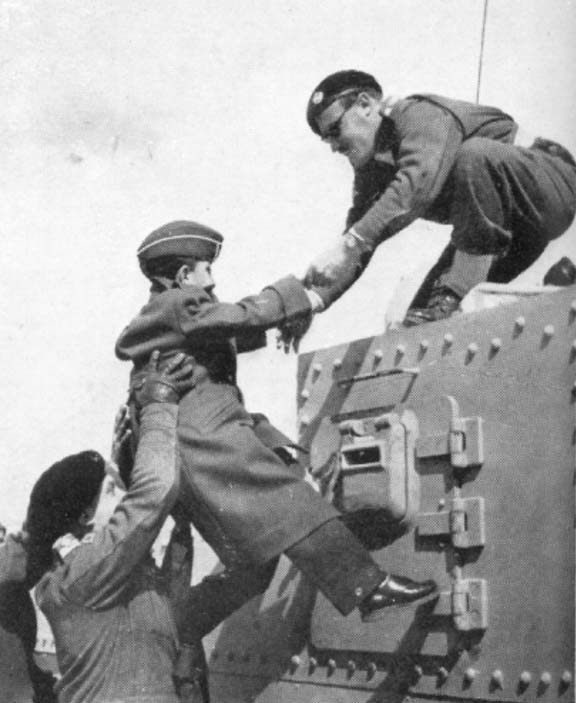
On arrival at Latifiya, the King shook hands sedately with General Briggs and Brigadier Anstice. Then he was taken up into the turret of a tank by Colonel Liardet, commanding the 6th Royal Tank Regiment. He watched one squadron rumble past and fire their guns, but seemed a little uncertain as to whether he liked this display or not. But on noticing a jeep, he at once asked to be driven about in it, and was so delighted with the ride that it was a long time before he could be persuaded to get out of the jeep again. Afterwards the King was presented with a jeep and a model tank for himself.
In the early spring General Briggs held a full-scale exercise called 'Forbid' that was to last ten days at full war pressure. The Division made a night move by road and as dawn broke was seen in full Desert formation ready to advance again. Led by the Armoured Brigade, a manœuvre was carried out with the object of seizing a feature vital to the enemy's communications. These were then raided so as to oblige the enemy to attack the Division on its own ground. Enemy tanks, represented by our own tank transporters, supported by units of the Iraq Army, launched their attack but failed to penetrate the brigade position behind which the Seventh Armoured Brigade was held in support, ready to launch the necessary counter-attack against the enemy's flanks. Then the Division followed up and found the enemy back in a defended position.
Our infantry cleared a minefield and formed a bridgehead, thus enabling the second infantry brigade and the tanks to overwhelm the position.
For such an exercise the troops moved out of their dusty camps, and felt themselves back once more in the Desert. They were on the move, camping out in the open, camouflaging their vehicles, and watching the mirages of glistening water and of sandbanks in the air.
Lighter entertainment was the order of the day when the Division organized a gymkhana on the sands by Latifiya. The sideshows attracted great crowds: cocoanut shies and roulette and a greasy pole, weight-guessing contests, and darts. Close upon the heels of a camel race followed a wild donkey race, which was slow but entertaining, though hard on the donkeys. A jeep race over a most difficult course provided greater excitement, for the hairpin bends, marked out on the sand with strips of camouflage material, and the humpbacked sand ridges tested the competitors to the utmost. Spectators jumped for their lives as drivers, wearing goggles and half blinded by dust, steered their jeeps round corners in a scream of roaring engines and a cloud of sand.
Team races and tugs-of-war were won and lost; competitions were held for dismounting tanks from transporters, and for running out and setting up field guns. Brown-skinned Indian soldiers wearing scarlet shorts wrestled over the sand, heaving and grunting in their efforts to force their opponents flat on their backs. As evening approached, fifty Pathans from the Guides Cavalry, with grey shirts hanging outside their trousers and a red sash round their waists, danced the Khattak dances. By the light of a great wood fire that was constantly replenished with fuel, these tall men danced to the strange music of three pipes and three small drums beaten with the fingers. The dancers shouted and swayed, waving red streamers in their hands. When other dancers came forward, this time with swords, the blades flashed in the firelight. And the dancers' energy never flagged. Indeed, it mounted towards a memorable finale with instruments playing, swords glinting, bodies jumping, bending and twisting. And the huge fire crackled and leaped in the centre.
It was a sight to remember, both for its own sake and because of its rarity in war time. This was one of the very few occasions on which the Division played together, carefree, eager for enjoyment, bounding with health. At other times, when the units were resting and re-equipping, they were split up, or too busy training, or engaged on defence digging, or in some manner occupied. But the end of Exercise 'Forbid' had found the Division united, and ready to relax. And this the men, British and Indian, did with a will. As they walked away in the gathering darkness, the haunting music of the Khattak dances still sounded in their ears.
After six months of constant training in the new role, the Division was never giver, an opportunity of operating in battle with the Seventh Armoured Brigade. Persistent demands were made by India for the Division to be sent to take part in the war against Japan. India was short of war-experienced formations. The jungle frontiers of Burma did not lend themselves to large armoured formations, but there was a shortage of tanks in the Middle East, and that was where the Seventh Armoured Brigade moved. It was with regret that the Division parted with Brigadier Anstice and his men, for the Brigade was already an integral part of the Fifth Indian Division. Co-operation had been smooth, mutual pride enhanced, and close ties of friendship formed.
And so, during May 1943, the units packed their kits, loaded their equipment and stores, and travelled by road and rail through Ur of the Chaldees to Basra. Here they boarded ships that brought them in a week to Bombay, the Gateway of India. The Indian ranks were overjoyed at the prospect and reality of leave in their homes, from the North-West Frontier to the Malabar coast and Madras. For those who had never before set foot in the vast continent, there was a wealth of unending new scenes and people to watch and absorb. And the veterans who had known India before the war could revive old memories and perhaps discover fresh aspects of a fathomless world.