
MASSAWA had fallen. The Italians withdrew their remnants from Eritrea along the two main roads that led southwards from Asmara to Amba Alagi and to Gondar, in northern Abyssinia. Although these forces were no longer in a condition to threaten the Sudan, and had little hope of success if they made a counter-offensive to recapture Eritrea, their presence in the south constituted a source of nuisance. It was determined that they should be destroyed or brought to surrender. The task of attacking the immense position of Amba Alagi was entrusted to the Fifth Indian Division.
Amba Alagi lies 235 miles south of Asmara. The strength of the enemy there was estimated at between five and seven thousand troops. These men were reported to be ready to make a last-ditch stand. However, there were some optimists among our commanders, as General Mayne has recorded, who thought that the Italians, after Keren, Ad Teclesan and Massawa, had little fight left in them, and that they would hoist a thousand white flags the moment we made an ugly enough face at them. Others, on the contrary, after hearing from local informers and the first prisoners we took how elaborate were the honeycomb defences which had been carved into the cliffs and crags---already formidable enough in themselves---expected the enemy to fight stubbornly and well under the royal eye of their Viceroy, the Duke of Aosta. When General Cunningham's troops from the south took Addis Ababa on April 5, the Duke moved his headquarters from there and chose Amba Alagi of the three rallying points for the Italian soldiers.
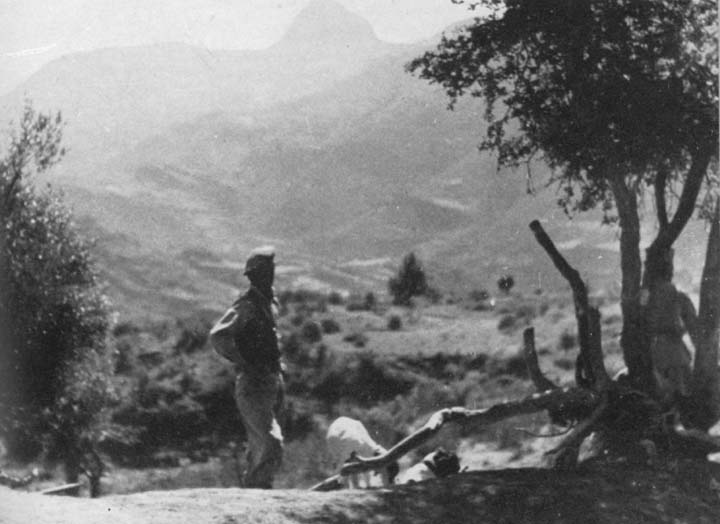
The battle was a hard one, though less costly in lives than Keren had been. The first sight of Amba Alagi gave the beholder a shock. Shaped like a cone, it was the highest mountain encountered during the campaign: close on 11,000 feet. The hills, higher than those at Keren, were just as steep. Moreover, the great problem of maintenance over such a distance from Asmara imposed a heavy burden upon the service units and administrative staff, and compelled General Mayne to reduce his forces to a minimum. In any case, though he would have wished to have his whole Division for the assault, Mayne was required to leave behind four battalions for internal security and to garrison Asmara. As we have seen, Rees' Ten Brigade was selected for this work, with the 2nd West Yorkshires under command in place of the Garhwal Rifles.
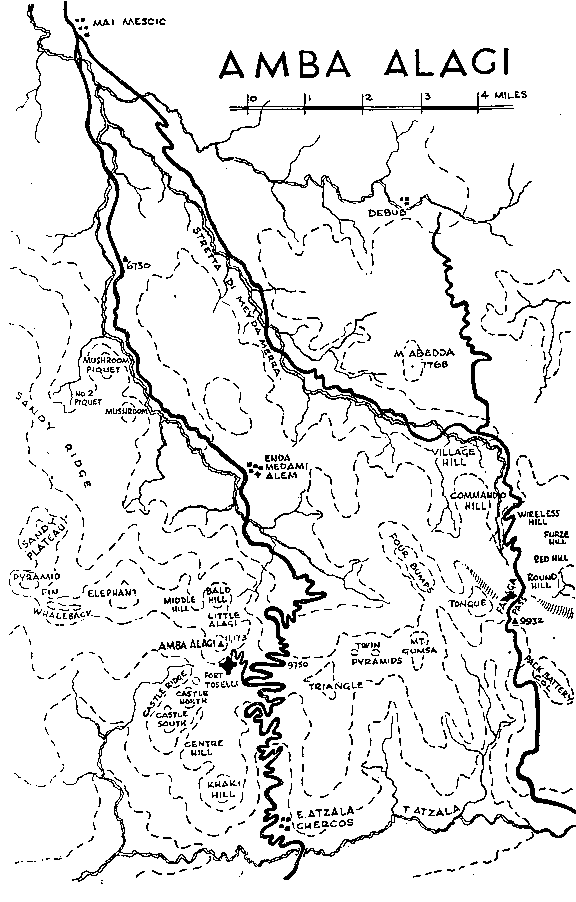
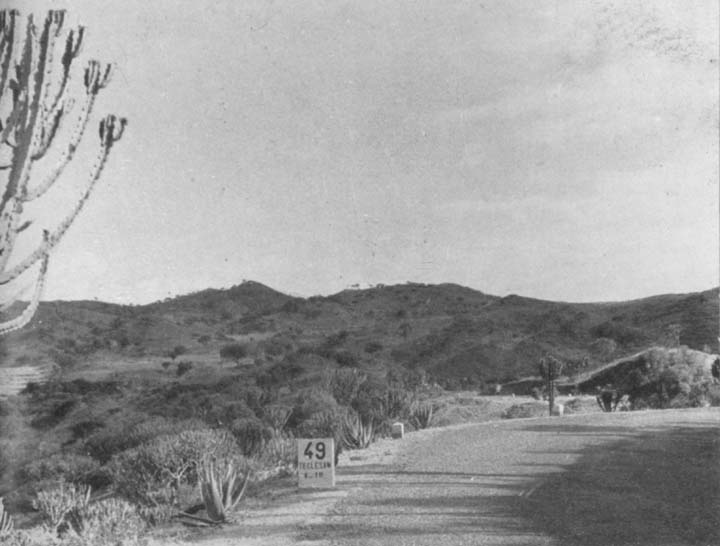
By Amba Alagi the road into Abyssinia crosses a spur of this mountain at the Toselli Pass, defended by a fort that bears the same name. These are called after an Italian, Major Toselli, whose force was overwhelmed at Amba Alagi by the Abyssinian Army in December 1895. A little chapel to his memory stands on the summit of the peak. The approach from the north winds steeply for some miles through. a narrow valley, overlooked on both sides by commanding heights. North-west of Amba Alagi itself is a long ridge, of which prominent features became household words for the Division: Little Alagi, Middle Hill, Elephant, Pinnacle, and Sandy Ridge. South-west from Amba Alagi runs the narrow Castle Ridge which ends in Castle Hill. Some ten thousand yards to the east of Amba Alagi lies the Falaga Pass, the approach to which is a rough road, the Stretta di Meyda Merra, leading from Mai Mescic, where the Division concentrated, to the Pass where the road finishes abruptly.
Though the dumping of food and ammunition began at once, transport was not plentiful, and not all of it could be allotted for the ferrying of supplies. Certain infantry units had to be sent forward early to make reconnaissance; the artillery needed to range on likely targets; the tasks awaiting the Sappers were innumerable. In this way supply and maintenance once more became major factors in deciding the earliest date on which our offensive could be staged.
It proved impossible to concentrate the force before the last day of April, so May 3 was chosen as the date for attack. But later, owing to difficulties of organizing donkey transport, the offensive was postponed by one day.
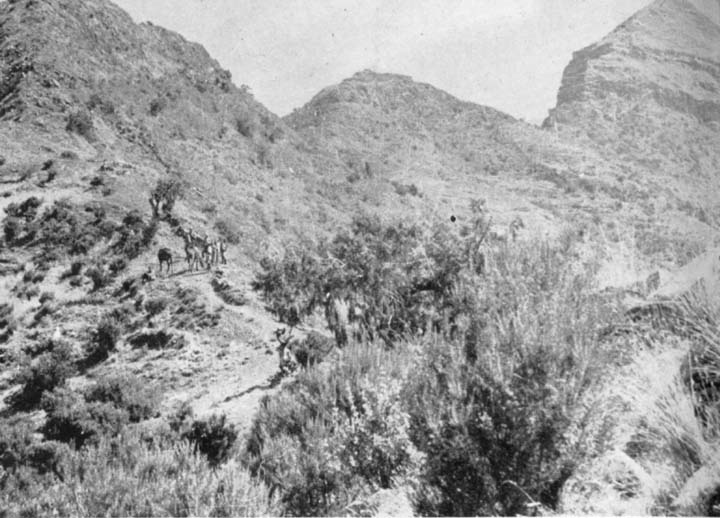
At Amba Alagi, though the distance and height from the forward troops to truckhead were considerably greater---six miles and over 3,000 feet---than at Keren, the routes were on the whole easier. But it still took up to eight hours for porters and donkeys to reach the leading companies. The Sappers made a special track up the mountain, marked with white stones. Initially, dumps were established as far forward as possible by fighting troops, aided by two companies from a reserve battalion. This time neither Cypriot mules---there was no transport to ferry them forward---nor men from a Labour Company were available to assist, but a number of local Abyssinian donkeys were impressed each day. The Division gave up listening to promises by the local headmen that were never kept and rounded up the donkeys by its own exertions. The animals were collected by Bimbashi Martin Harvey. D.S.O., M.C. (an officer of the Sudan Defence Force), who was doing duty as interpreter and topographical expert with 29 Brigade. He had lived for many years in the Sudan as a cotton planter at Wadi Halfa. He was aided by a small detachment from the S.D.F. They scoured the countryside in trucks and roped in all the likely-looking donkeys. In all, between eight and nine hundred were collected in this manner. But, owing to sore backs and to desertions at night, never more than six hundred were in use at one time. Between two and three hundred captured Italian saddles were brought from Asmara, together with a quantity of rope for slings; but there were never enough saddles to go round, and units had to improvise methods of loading their animal transport.
Though great trouble in supplying our infantry with water was anticipated during the battle, several good springs were found high up the mountain sides, and these shortened considerably the carriage of water to the forward troops.
Meanwhile, the 1st South African Brigade, commanded by Brigadier Dan Pienaar, had on April 28 captured Dessie away to the south. The Italian forces still operating between that place and Amba Alagi were thus marooned. But when General Mayne was making his plans, the South Africans were still two hundred miles away, and he could make no provision for their co-operation in his attack; while road-blocks and enemy opposition might well make it impossible for them to assist at all. Abyssinian patriots were exerting pressure against outlying Italian posts in the south. Mayne, considering both the formidable nature of the country as shown by detailed reconnaissance and the enemy's immensely strong positions with posts hewn into the sheer rock, was not fully confident that his plan would succeed with the forces at his disposal. A final appeal for at least one more battalion was turned down by the Kaid. He would not spare it in view of the internal situation at Asmara, Massawa, and elsewhere. But General Platt did take control of operations on the Gondar front, so that Mayne was free to devote his full attention to Amba Alagi.
There were three possible ways of attacking the Italian forces, who had for months been making tremendous fortifications in the Amba Alagi-Toselli position, who had dug large tunnels into the mountainside, and had built up stocks of food and ammunition sufficient to withstand a siege of many months' duration: to the east by way of the Falaga Pass; astride the road straight at the enemy stronghold; or from the right, along the ridge from Sandy Hill to Amba Alagi itself. The enemy, as at Keren, had a double advantage: he held ground which he himself had selected as being naturally almost impregnable; and he had magnificent observation of our movements from the heights he commanded.
But the position had one exploitable weakness: it extended over a distance of more than ten miles, and this made a very wide front for some five thousand men to hold. The enemy could not be strong at all points. From deserters it appeared that Amba Alagi was guarded mostly by Italian troops, in the proportion of four Italian to two Colonial.
General Mayne's plan aimed at threatening the enemy at three points, and consisted of a double feint. Noteworthy is the fact that the Kaid obtained a copy of a book written by Marshal Badoglio about the Italian campaign against Abyssinia in 1935-36. This volume contained a lengthy account of the Amba Alagi district and, more particularly, of Badoglio's own attack against the Falaga Pass. The Marshal contended that this was the best way of attacking Amba Alagi. After careful study, Mayne felt sure that many of the Italian staff officers would have read Badoglio's book, and that they would consequently expect an onslaught against this Pass. Thus the first bluff was to send a force against this flank to demonstrate just where the enemy was especially susceptible to threat. A new Fletcher Force was created for this task.
In the centre Murray's 3/18th Royal Garhwal Rifles, with a detachment of Sappers and Miners, would advance astride the main road and demonstrate boldly throughout the night that preceded our attack. They were to simulate the first steps of a full brigade assault.
And the main attack was to be carried out by Marriott's 29 Brigade at first light on May 4 against the enemy's western flank, advancing along Sandy Ridge. Secrecy for this move was essential. Yet the starting areas were in full view of Amba Alagi. So, too, was the truckhead some miles away. Forward from here no transport was allowed to move. The maps provided for the Division were very bad, and the Italian sheets made from aerial photographs stopped short, tantalizingly, at the Toselli Pass. Detailed knowledge, therefore, of the country south of this line remained meagre until our own photographs could be made available, and it was incomplete until the arrival of the South Africans.
General Mayne relates an incident when, during the preliminaries before the battle proper started, it was brought home to him---not for the first, and certainly not the last, time---how very close, even affectionate, were the ties between the British and Indian troops in the Division.
"I had puffed and panted my way to the top of a sheer peak which afforded the best available observation of the enemy's position at Toselli. The Garhwali tactical headquarters were there, and so was an important O.P. from the 28th Field Regiment. As I arrived exhausted at my destination, a party of British gunners caught me up and were hailed with obvious enthusiasm by some Garhwali signallers, who were brewing tea in a dugout. I stopped for a breather before scaling the last fifty feet to the look-out, and saw out of the tail of my eye much hand-shaking and then the Englishmen squatting down beside the Indians and accepting the tea and cigarettes that they offered.
"Having finished my own business in half an hour or so, I began stumbling down the hill again, only to be stopped by the same Garhwali signallers and led into the dugout. There I, too, was given tea, biscuits, and a cigarette. I took them thankfully, but with mild protest, knowing that every half-pint of water and morsel of everything else had to be carried by hand from a water point over a mile away and nearly a thousand feet lower down, and I asked the Garhwalis whether it was their habit to entertain every Tom, Dick and Harry who came their way. Their answer was a flat denial. Not a bit of it. It was business enough to keep their own tummies full, and normal hospitality had to go hang. But in my case it was different. I was, after all, the Divisional Commander and a very old man too! Then what about the British soldiers, I asked. 'Oh, that's quite different,' they replied, 'they belong to the 28th. They belong to us.' "
The new Fletcher Force was formed on April 29. It consisted of Skinner's Horse (Lieutenant-Colonel I. F. Hossack), 51 Middle East Commando, 'B' Company of the 3/12th Frontier Force Regiment, under Major A. J. W. McLeod, D.S.O., and one section of 2 Field Company. This Commando, led by Lieutenant-Colonel Miller, was formed of 60 per cent. Palestine Jews and 40 per cent Palestine Arabs, and included in its ranks Spaniards, Egyptians, Czechs, Armenians, Germans and Circassians. Its officers had been seconded from British regiments. (The artillery allowed to the force was one troop of 6-inch howitzers from 244 Medium Battery, 'B' and another troop of 25-pounders from 28 Field Regiment, and 'A' Troop's 3.7-inch howitzers from the Sudan Regiment.)
Skinner's Horse had already secured Village Hill on April 27 with, fortunately, but few casualties from the Italian pack-artillery fire. This was surprising, as the valley at this point was so narrow that there was no opportunity of escape, and the enemy artillery fire had been at an intense rate.
The one feature which dominated the whole Stretta di Meyda Merra was Commando Hill. This looked straight up the valley with a clear view for mile after mile of the Mai Mescic track. At some points the track was hidden behind a spur, only to emerge clearly a few hundred yards farther on. The enemy appeared to have all the ammunition he needed, and used to amuse himself by sniping at individuals. The individuals concerned promptly left the track and walked along the stream bed, hoping to remain unobserved. Not that the enemy fire stopped. The Italian gunners merely shortened their range every few minutes. For this reason, a visit to Skinner's Horse was likely to be exciting. Possession of Commando Hill and the fact that until April 29 we had no artillery available on the Falaga Pass side made the enemy careless. Men were sometimes to be seen walking on the skyline; thin wisps of grey-blue smoke showed that the Italians were cooking food.
A Commando patrol reported that the north-east slopes of the hill named after them were almost unclimbable. As Colonel Fletcher later wrote in his report: "So they were, but the northwest slopes, which were subsequently climbed, were even steeper. "
Fletcher now made his plan for the capture of Commando Hill. The enemy guns were to be driven back by our 25-pounders, which could engage them from well out of range. Then the Italian posts would be shelled by concentrations from our combined artillery, to force their withdrawal from the forward slopes. And in order to make certain that these posts were not reoccupied by night, our Gunners were to put down a further series of concentrations, starting at midnight. McLeod's Frontier Force company had instructions to take up a covering position on the spurs running north from Commando Hill at dusk on April 30. From here they were to support 51 Commando should these men be unable to surmount the feature. Besides, they would be well placed to go on top themselves if 51 Commando needed help in holding the hill. At midnight on the same date 51 Commando were to begin their climb. Dawn on May 1 would see the crest line of Commando Hill assaulted.
The plan worked. On April 30 our 25-pounder guns silenced the enemy artillery and made them change their positions. Miller's Commando had an uneventful approach march to the foot of their hill, which was found to be even steeper than expected. Near the top rose an almost vertical step. Up this step most of the men had to be pulled or pushed. In the darkness few could climb it unaided. But fortunately the time allowed for reaching the crest had been generous. When at length the summit was reached, the enemy infantry posts were found to have been abandoned.
The large flat top of Commando Hill had been ploughed ready for the rains. From the centre of this plateau rose a small mound with a cluster of trees; otherwise the top was without cover. The entire feature, being overlooked by the enemy on a hill called Tongue, was subjected to mortar, machine-gun and artillery fire from pack guns firing over open sights. For this reason 51 Commando held only the bare edge, where they could suffer no counter-attack except on their extreme right. To meet this possible threat, McLeod's company climbed the hill and took up positions. All that night the Italians fired on the track, and in the early morning light flashes of their pack guns could be clearly seen.
The capture of Commando Hill changed the tactical situation. Fletcher Force could now move about in the Stretta with reasonable freedom. Fletcher decided to make a further advance on the following morning, May 2.
Meanwhile, our observation post on Commando Hill noticed a wisp of smoke rising from the foremost fringe of Wireless Hill. Through the glasses were spotted first one, and then another, of the enemy's trenches and breast-works hidden under camouflaged waterproof sheets. They were engaged with 6-inch howitzers to good effect, as a patrol later found. Strips of white cloth had been hung up on rough stakes. The enemy had evacuated his position. And by three o'clock that afternoon Wireless Hill was securely in our possession.
Work was now started on the track leading up to this hill. It had to be made fit for steady traffic by 15-cwt. trucks, because hitherto an excessive strain had been put on all units to maintain themselves. The tufts of grass, which had served as hand and foot holds on the steepest part of Commando Hill, had quickly been pulled out and the only way it was now possible to climb the western face was by means of a rope let down from a tree on the summit. Inevitably, evacuation of casualties had become a matter of extreme difficulty.
Fletcher Force had to maintain pressure on the Falaga Pass until at least midnight on May 3-4. One effect of our artillery fire and of the operations which had already taken place was to cause several hundred Colonial troops to desert to our lines. These men reported that the enemy's defences were very weak. There were, they said, only about thirty Italians on the Falaga front. So Fletcher decided that the moment had come for a bold stroke to capture Falaga Pass. The enemy must be persuaded that our pressure in this direction was no mere feint but a serious threat to his flank and rear.
Accordingly, Skinner's Horse was ordered to secure a ridge, that numbered among its peaks Red and Furze Hills. Miller's Commandos were to advance over the top of Commando Hill, move along its two slopes, cross the north-east flank of Tongue, and secure the Falaga Pass. They would also capture small hills named Step and Rump, which controlled this Pass. The attack had to be made. at night because the long approach was overlooked from Tongue.
51 Commando's attack did succeed in securing both Step and Rump, but as the approach march took longer than anticipated, these two features were occupied an hour after Skinner's Horse attacked Red Hill. The Commando came under such heavy mortar fire that Colonel Miller judged that, while he could hold his positions by night, he would certainly be unable to stay there in daylight. For this reason he ordered his men to withdraw.
Meanwhile, the enemy moved along the top of Tongue and tried to push down the spur which ran on to Commando Hill. But here they were met by McLeod's Frontier Force company. An engagement was fought until dawn, when the Italians retired. Fletcher noted: "The last which was seen of this battle was a party of some ten Italians running back up the forward slope of the hill while three shells from our 25-pounders burst neatly amongst them."
By this time one squadron of Skinner's Horse on our left flank had reached Furze Hill unopposed. But so stiff was the opposition met by the right-hand squadron in its efforts to capture Round and Red Hills, that one troop leader was wounded very early in the action and the squadron suffered numerous casualties. Eventually the squadron, which had numbered only forty men at the outset, had to be withdrawn by Lieutenant-Colonel Hossack.
Then, late on May 4, Fletcher received orders to continue to exercise pressure on the Falaga Pass. This was no easy order to carry out, for full pressure had already been maintained on the enemy for a day longer than originally intended, and now this pressure had ended with an unsuccessful attack. His men were thoroughly tired.
We must look for a moment at the centre of the Amba Alagi front. On the afternoon of May 3 the 3/18th Garhwal Rifles made their feint. While their carriers entered the Enda Medami Alem valley and occupied it before half-past five, the rifle companies seized, one after the other, the hills west of the village.
And so the last thing the enemy saw before darkness fell was a steady advance towards his positions. After dark our bluff was kept up by active patrolling; one patrol even scaled the precipitous Bald Hill, and this bold enterprise so enhanced the realism of our threat that the Italians thought they had repelled a determined attack. In the background, carefully controlled signs of activity and a display of lights gave the impression that we were arranging preliminaries for a further and more powerful advance later that night.
If the failure on the Falaga front may have seemed a setback to those immediately engaged, it certainly was not so in actual fact, as was realized at the time by Divisional Headquarters and afterwards fully endorsed by the enemy.
The Duke of Aosta later told General Mayne that the Italians had expected our attack to come from the Falaga direction, and had taken it for granted that this was so when we started that way with Fletcher Force. Then, during the night before our main assault, when the Garhwalis made their realistic feint against his centre, the Duke and his generals felt that they must have been wrong in their ideas about our Falaga Advance. It must have been a bluff. So they reinforced their centre during the night at the expense of their left. Great was their discomfort when, at dawn, Brigadier Marriott with his brigade attacked the depleted left flank and rolled it back as far as the inner defences of Amba Alagi itself.
General Mayne wrote in his report on the operations: "When looking back from the enemy's point of view on the Alagi feature, it seems incredible that he should not have known of the concentration near Sandy Ridge; yet we have it on good authority that he did not. He failed to carry out any reconnaissance and he had no aircraft."
During the night of May 4 the two attacking battalions of 29 Brigade, the 6/13th Frontier Force Rifles and 3/2nd Punjab, moved to their forming-up positions in the dip north of Sandy Village, while the 1st Worcestershires established themselves in the nullah north of Sandy Ridge. At 4.15 a.m. our artillery concentration opened. The infantry followed close behind. By five o'clock Colonel Malden's Frontier Force Rifles had taken Sandy Ridge and Hill. When the shelling ceased, 'D' Company, who had felt their way to the foot of Pyramid and had found two single tracks on the north and north-east sides of this rocky feature, scrambled to the summit too quickly for the shaken enemy to stop their advance. The officer commanding the left sector of the Italian defences was captured with all his staff officers, 110 other ranks and much war material.
Then the 3/2nd Punjab moved through and by five-thirty had taken Whale Back. An hour later Whale Head was seized and the battalion continued at great speed up the very steep hill named Elephant. This was reached within fifty minutes. just after half past seven, 'B' Company moved through the bushes on the north face of Elephant and occupied a ridge of the same name.
Later that morning the commander of the 3/2nd Punjab reported that the route to his next objective, Middle Hill, lay along a narrow undulating ridge devoid of cover and dominated by both Bald Hill and Alagi. Brigadier Marriott's reconnaissance showed that an advance straight down to the main road south of Alagi was impossible because of the vastness of the country. As further progress in daylight would be too expensive, he postponed the next attack until the early hours of May 5. The maps issued to the Division had given little idea of the extreme steepness and narrowness of the ridges now facing 29 Brigade.
At 4.15 next morning the attack on Middle Hill went in. 'A' Company of the 3/2nd Punjab captured the hill after a fight with grenade and bayonet. The first line of attacking troops had to bomb the enemy out of his caves and dugouts, which were many and deep. We suffered no casualties, and twelve prisoners were made.
Half an hour later Captain F. E. Baker led the Worcestershires through towards their objective, Little Alagi. They were late. Already the light of day was on the hilltops. They might have got across in, darkness, though to have remained in position would have been extremely hard. But now Baker's men were stopped by barbed wire and by heavy machine-gun fire from Little Alagi and Bald Hill. One platoon did penetrate the enemy wire, but the whole company was pinned to the ground, unable to move., Eight men were killed and twenty-eight wounded.
No further daylight progress was possible owing to the narrowness of the front, which lay within five hundred yards of twelve Italian machine-guns. The Worcestershires were ordered to hold the ground they had gained, for the battalion could not be extricated by day. There had been fifty casualties by now, and our wounded were obliged to wait until darkness before they could be carried back. Baker's troops had the misfortune to be bombed and machine-gunned from the air by our own planes during that day; but at six o'clock they were successfully withdrawn to the ground north of Whale Back.
It seemed that 29 Brigade was definitely checked between Middle Hill and Little Alagi. Any further attempt here would have proved too costly.
In the meantime, we may look to the other side of Amba Alagi, to the south and east. Pienaar's South African Brigade had made good progress from Dessie, and was now placed under Mayne's command to complete the encirclement of the Italians and to assist in finishing them off.
It had also become clear that still greater pressure would have to be exerted on our left flank by Falaga Pass, but for this purpose Fletcher Force needed more infantry. General Platt agreed that, as our lines of communication in Eritrea were now more secure, the 3/12th Frontier Force Regiment could be spared from garrison duty. Accordingly, this battalion joined Fletcher Force. So, too, did the 3/18th Royal Garhwal Rifles, who relieved Skinner's Horse.
Marriott's Brigade now prepared to attack on May 8. The plan had been for the Worcestershires to make a second attempt against Little Alagi, but after receiving the patrol reports from the 3/2nd Punjab about the wire and defences there, Marriott was doubtful. He spoke to Mayne, and made it clear that to attack there would be, inadvisable. Mayne asked whether the 6/13th could attack Castle Ridge and Hill. The Brigadier agreed that this could be done on the 8th. They were to execute an outflanking movement, while Fletcher Force would attack the Falaga Pass. A further demonstration on the main road would also be made. The 6/13th, with one company of Worcestershires under command, gathered at the Togora Pass on the evening of May 7. They had orders to carry out a silent attack at first light, their objectives being Khaki and Centre Hills, and Castle Ridge.
Throughout that night, in heavy rain and over extremely difficult country, this body moved to within assaulting distance of Castle Ridge. The men had to descend two thousand feet into a narrow valley. From here they climbed up to their starting line. The approach along this steep and unreconnoitred route had taken eight hours. Their attack was launched silently a few minutes after four o'clock on the morning of May 8. For deception purposes the 28th and 144th Field Regiments put down an artillery concentration so as to give the impression that our troops were about to make a fresh attack on Little Alagi and Bald Hill.
By a quarter past five Khaki Hill and Centre Hill had been captured without opposition by 'B' and 'C' Companies of the 6/13th, led by Lieutenant Sadiq Ullah Khan and Second-Lieutenant G. B. Singh respectively. Then, just before six o'clock, 'A' Company of this battalion, commanded by Major Vidya Dhar Jayal, was seen from the observation post to be fighting its way with bayonet and bomb up the southern escarpment of Castle Hill. The Italians could be seen throwing grenades profusely. These were followed by accurate mortar fire. When our forward platoon forced its way on top of this feature, a strong enemy company was observed to be collecting on the northern end of Castle Hill. At once a thick mist came down for half an hour and observation was difficult. An attempt was made to bring fire on the gathering enemy to break up the coming counter-attack. But owing to the lack of previous registration---this had been deliberate in order to preserve secrecy and surprise---to the extreme range at which our guns were firing, and to the difficult shape of the. ground, effective fire could not be brought down in time.
On the left of Castle Ridge some of the enemy put out the white flag as a signal of surrender. When Major Vidya Dhar Jayal sent a platoon to occupy the enemy's defences it was greeted with a shower of bombs, and suffered many casualties. Our attack came temporarily to a halt. General Mayne asked that world-wide publicity be given to this disgraceful episode of treachery, and a protest was dropped on the Duke of Aosta's headquarters. Mayne wrote: "Your Excellency. It has been brought to my notice that, during the engagement on the morning of May 8, certain Italian troops, after putting up the white flag in token of surrender, fired and inflicted casualties on my troops as they advanced to make prisoners of war. I prefer to leave the matter of the punishment of these offenders to your sense of duty, and write rather to warn you of the reprisals that 1 shall feel compelled to take in the event of any repetition of this treacherous breach of the laws of civilized warfare."
 |  |
 |
 |
Thanks largely to the gallantry of Sepoy Saudagar Singh, the position was finally taken. He was found lying dead on top of the body of an Italian soldier, whose chest the Sikh had pierced with the bayonet. Four other Italians, who had met a like fate, were stretched out beside them. Earlier in the attack the section commander had been killed. Saudagar Singh took control. When the section was held up he charged forward with his bayonet, even though he had been wounded. Thick scrub tore off his puggree. With his long, uncut black hair flying loose, he must have looked like some demon scaling the hill. Inspired by his example, the rest of the Sikhs followed up the slope and captured Castle Ridge. Sepoy Saudagar Singh was recommended for the Victoria Cross, but was awarded, posthumously, the Indian Order of Merit.
Very soon, when the mist lifted, an Italian counter-attack came in. This first attack was checked with heavy losses. A second advance with stronger forces succeeded after the Sikh company had held on resolutely until they had sustained over seventy per cent. casualties and had run out of ammunition. The wounded alone numbered sixty-two, though most of these were walking cases. Then the remnants of the company were given permission to withdraw. At half past eight our Gunners fired a heavy concentration on Castle Ridge. Half an hour later, owing to maintenance difficulties and to the possibility of it becoming isolated, the Frontier Force company on Khaki Hill was recalled. It would have been possible neither to reinforce it nor to maintain it effectively in the event of yet another enemy counter-attack. W Company had suffered no less than sixty-seven casualties on Castle Hill.
Brigadier Marriott decided to hold all the ground gained, even though Centre Hill was overlooked from the Castle feature. And he sent this message to the 6/13th Frontier Force Rifles: "Will you please convey to all ranks my admiration for the action carried out by the battalion. How they reached their objective is beyond my comprehension. I very much regret the casualties incurred after such a magnificent effort. I am indeed proud to have your battalion under my command."
Meanwhile, the demonstrations by the Garhwalis in the centre had continued to keep the Italians apprehensive of an advance there, and the amount of fire that the enemy put down in this area was indeed impressive.
And what of Fletcher Force? Colonel Fletcher had made a suggestion: now that the Italians were withdrawing troops from his front to resist 29 Brigade's attack on the right, there was a good hope of breaking through. Accordingly, General Mayne decided to replace Fletcher Force by a reconstituted Nine Brigade. Fletcher was promoted to Brigadier---Messervy having been transferred to the command of the Fourth Indian Division---and remained in command of the Force. It had been arranged that the Sikh company of the 3/12th should assault Red Hill at two o'clock on the morning of May 8. They did so with success. The enemy found himself trapped. At a cost of ten men wounded, we captured seven Italian officers and 113 other ranks. Both Red and Round Hills fell into our possession.
Then, as the sun rose, our troops saw for the first time the ridge that ran west from Green Hill to Rump. Beyond this was a deep ravine. On the far side could be seen a higher ridge on which the enemy had established a battery of pack guns. It was obvious that 51 Commando would have great difficulty in raiding these guns. Fletcher planned for them to advance at dusk along the two ring contours towards Rump. Throughout that day our 25-pounders kept up harassing fire on the hill. The Italians were being given no peace, and at three o'clock that afternoon, when an officer of the 3/12th fired a burst from his machine-gun into the opening of an enemy shelter on Rump, they reached the end of their tether. At once small white flags began to appear all over the hillside. Our men were cautious. They beckoned to the Italians to walk over. With some reluctance an enemy officer and forty other ranks did so. It now appeared that the enemy had either been pushed off the Falaga Pass or were finally evicted that night.
Then fresh instructions came from General Mayne. The motorized part of Nine Brigade was to try to penetrate behind the enemy down in the Atzala Valley, while the infantry would fight their way up on to Mount Gumsa, nearly 11,400 feet above the sea. The night of May 8/9 was bitterly cold and wet. 51 Commando tried to advance along the escarpment of Tongue towards the ridge below the enemy pack guns. They lost their direction in the clouds and darkness. By the time, they and Dean's 3/12th Frontier Force Regiment had reached Pack Battery Col---the name of the ridge---the Italians had left. Next morning, by nine o'clock, 'B' Company of the 3/12th had occupied Tongue and mopped up all resistance there. It was found that beyond Rump the Falaga Pass road had never been finished. it was thus impossible to send our motorized units through to the Atzala Valley.
On the morning of May 10, another of Colonel Dean's companies moved forward from Tongue and captured a feature known as Four Bumps, from which, on the previous day, the enemy had fired on our troops with machine-guns and mortars. The company then advanced farther towards a hill that rose to the north of Gumsa, and caught sight of some two hundred Italians disappearing on the farther slopes of this hill. Four pack guns were found abandoned and partially dismantled.
The 3/12th had now been fighting for six days with scarcely any sleep and with only three of its companies present. So that afternoon a company of the Garhwal Rifles was sent through to occupy Mount Gumsa. Although on a fine, windless day it might be quite warm at noon, it became bitterly cold on a windy night. Fletcher considered it impossible to ask his troops to operate on these heights without their blankets; in fact., he asked that the men should have extra blankets. As a result, it took three days to get the Garhwalis completely into action on Gumsa. The weather broke and added to the difficulties. So slippery did the road up to the Falaga Pass become that it could no longer he used by trucks or cars. This fact added a further four and a half miles to the mule lift. Some idea of the time and distance is given by the fact that it took six hours to walk from the bottom of Wireless Hill to the crest of Gumsa.
It was from this crest that Nine Brigade had its first sight of Amba Alagi. Fletcher saw that any advance forward from Gumsa would have to be made along a ridge that resembled the edge of a saw. As the Brigadier expressed it: "Each serration of the saw was held by little posts built up with stones and manned by machineguns, and there seemed no possibility of advancing this way. "
Prisoners taken during these days stated that preparations for the defence of Amba Alagi had been started six months earlier, and included many deep shelters and several minefields. These bomb- and shell-proof shelters were to be found mostly in the final peak of Amba Alagi, some way below the church on the summit. The garrison, said these prisoners, had sufficient food and ammunition for several months, but only one source of water, a spring that our Gunners were able to harass by night. It appeared that the presence of the Duke of Aosta with the garrison had had a salutary effect upon the Italian officers. The Duke's headquarters were in a rock gallery between Amba Alagi and Little Alagi. Not that the Duke tied himself to the cover of his gallery. He was frequently out visiting his troops in the forward areas.
Meanwhile, heartening news had been coming in from the South African Brigade which had advanced quickly northwards from Dessie. So far, concerted planning. with Brigadier Pienaar had been impossible, but Mayne now sent an officer across by air to establish liaison. The report showed that our Divisional staff had been a trifle optimistic. The South Africans had not advanced as far as had been thought, and direct assistance from them was not to be expected before May 11. On that same day General Mayne flew over to meet Pienaar and to carry out a close reconnaissance of the Amba Alagi massif from the south.
General Mayne has related his experiences that day.
"I was really frightened when I flew high over the battlefield to make first contact with Dan Pienaar's brigade. It wasn't so much the journey over enemy-held territory that frightened me as the foreboding I had that the South Africans would resent being put under an Indian Divisional Commander, and might be rather difficult to deal with. They would object, perhaps, to tasks I might give them to do and, may be, appeal against them to their own South African Headquarters at Addis Ababa.
"Never were anyone's forebodings so utterly confounded. From the moment I met Dan Pienaar-he came to the strip where I landed---I knew from his open and cordial welcome that he was glad to see me. And after half an hour's talk in his car on our way forward to his headquarters, there was no doubt in my mind that I was dealing with a man who was an ardent patriot, an enthusiast, an indefatigable thruster, a highly qualified professional soldier, and one who had a fund of battle experience and was trusted, respected and loved by every single soul under his command.
"When I took him---or, more correctly, when he took me---right forward to view the battlefield from the back, Dan Pienaar asked me innumerable questions, each one constructive and dead to the point. His artillery and infantry commanders were equally inquisitive, and sound in what they wanted to know. Due to their eagerness to see more clearly everything that there was to be seen, we went forward a little bit too far, and just over the crest of the hill which was our selected viewpoint. The Italians from the summit of Amba Alagi, eight to ten thousand yards away across the foothills, valleys and ravines, were quick to react to our mistake. We were well within range of their anti-aircraft guns, traversed down for ground targets, and we had to scatter very hurriedly indeed, luckily without worse damage than a few scratches."
It seemed to Mayne clear that the approach to Amba Alagi was easier from the south than from any other direction. And the capture of the feature named Triangle immediately east of Amba Alagi appeared to be an essential prelude to the final assault on the enemy's inner fortress. Accordingly, the South African Brigade was ordered to seize this hill. Support was promised to them both from our artillery and from Fletcher's Nine Brigade.
Now, quite unsolicited, the Abyssinian Patriots took a hand. Throughout this stage of the battle they proved a mixed blessing. To control them was difficult. Besides the real Patriots, who obeyed the orders of Ras Seyoum, the chief who had been placed in command of all Patriots in that area, there were large numbers of local inhabitants---robbers, looters and even murderers---who joined in for what they could gain. These had no leaders; they ignored requests from British officers, and gave constant trouble to ourselves, the South Africans, and the Italians. The prospect of loot and massacre tended to divide the Patriots' attention, and Mayne issued orders that every endeavour should be made to keep them out of the battle. But before these orders could be enforced, the Patriots had started interfering in the Triangle area.
Entirely without warning to our forces, Ras Seyoum's men stormed two pyramid-shaped hills. Their line of approach was not along the saw edge which would have been Nine Brigade's axis of advance, but rather up the southern and almost precipitous slopes of these two pyramids. The Italians resisted stoutly on Pyramid West, but were overwhelmed. The Patriots then endeavoured to push forward to Triangle, but the ridge up which they had to advance was barred by two double-apron fences of barbed wire, and by many fascines, all of them covered by numerous machine-gun posts. Our Gunners did their utmost to knock out these posts. But they were too well dug in. As a result, the Patriots failed in their gallant effort to cross this heavily defended defile. They fell back to Pyramid West, only to be caught between pack guns and machine-guns from north and south. They were obliged to take refuge on the lower slopes between the two pyramids. On May 12 the 1st Royal Natal Carabineers had established themselves on Khaki Hill and the adjoining crest to the east in order to clear the valley between Khaki and Centre Hills. Contact was made by 29 Brigade with the South Africans here, and a telephone cable laid by Captain Brian Gomm, Marriott's Signals Officer, and his Sikh linemen. Then, on the following day, a patrol found that the enemy had slipped away. This now enabled the Transvaal Scottish to assault their first objective, Triangle, despite heavy and continuous rain throughout the night.
On May 14 they set out. deliberately up Triangle. This, like most of the neighbouring hills, began with a fairly easy slope. But then followed a series of cliffs some sixty feet in height, strongly wired on top, and interspersed with comparatively gentle grass slopes that covered a hundred yards or more. The faces of these cliffs, were honeycombed with caves, in which the Italians had hidden machine-gun posts and riflemen.
After being checked by machine-gun fire and driven back slightly by one counter-attack when the Italians disgorged from their caves, the South Africans that evening reached a point five hundred yards from the summit. On the grounds of safety, they had refused artillery assistance from the Division. And air targets were now limited to Amba Alagi itself, and to the neighbourhood of Toselli Fort. Brigadier Pienaar came to the conclusion that the objective was too formidable for his brigade to capture on its own. Co-operation was arranged accordingly.
During the night of May 13/14 the 3/18th Garhwal Rifles had occupied Twin Pyramids. so now, on ground practically level with Triangle, but at right-angles to the line of Pienaar's advance, was a battalion which could provide support. It had been hoped that the Garhwalis would remain unobserved so that they could open surprise fire in the event of an Italian counter-attack developing. But so many Patriots had joined them that all idea of secrecy had to be abandoned. It was now arranged that as the South Africans approached the summit of Triangle, the Garhwalis would make a noisy diversion and help to the best of their ability with cross-fire. Further, between seven and eight o'clock on the morning of May 15, the Divisional artillery would strafe Triangle prior to the final assault.
In support of the South African attack, Sappers of 20 Field Company with Nine Brigade successfully blew lanes in the two rows of barbed wire between Pyramid West and Triangle. This occurred at three in the morning. At dawn the Garhwalis sent forward a patrol which found an Italian straggler. He stated that his company had left the hill during the night, and he proceeded to explain to the patrol the lay-out of the defences. The artillery bombardment was cancelled.
Let General Mayne take up the story.
"The time came when the Italians realized that Triangle was lost. The South Africans were scaling the heights on a fairly broad front, and the troops on the left, directed against the crest of the hills on the Amba Alagi side of Triangle, were making quicker progress than the troops on the centre and right, heading for Triangle itself. So, before South African met Italian man to man, the Italians, thinking discretion the better part of valour, bolted to Amba Alagi, leaving behind their casualties and much booty.
"The moment the Italian fire started to fade away the Garhwalis hurried on, picking their way through the mines and making gaps through the wire with Bangalore torpedoes. The South Africans, too, finding things suddenly very quiet, with less bullets humming about, raced up the last few hundred feet of the precipitous slope as fast as their active legs could carry them. Thus the Scottish from the Transvaal and the highlanders from Garhwal arrived at Triangle at about the same moment.
"Unknown to most if not all of us, the Garhwalis, having seen the Sudanese who were fairly black and the Ethiopians, who were blacker still, expected that the Springboks, whom they had never set eyes on but who sprang, as they knew, from a country very much farther south than the Sudan or Ethiopia, would be quite black!
"On their part, most of the South Africans, never having seen the Indian Army, imagined the Sepoy would look the counterpart of the Indian coolie, with whom they were only too familiar in their own country. Not very much of a man, and certainly not a fighter!
"Astonishment when they met was mutual and profound, but what capped it all was when Lieutenant-Colonel Hartshorne, commanding the Transvaal Scottish, rushed forward and spoke to the Garhwalis in their own, little-known language. The South Africans were fairly surprised, and happily surprised, at what they saw---sturdy brown highlanders, bulging with muscles, who smiled and looked them straight in the face. But the Garhwalis could hardly believe either what they saw or what they heard. Here were people from the far south who were not ebony black at all, but just bronzed, and obviously as white as their own British officers. How could it possibly happen ? And, mystery upon mystery, apparently they talked Garhwal, too. But, unhappily, that was not quite true. It was only Hartshorne who talked it. After having lost an arm while fighting with a British battalion in Gallipoli, he took a regular commission, was posted to the Indian Army, and served for some years with the Garhwalis before deciding to retire and seek his fortune in South Africa.
"It must have been a happy little episode up there on the top of Triangle. And the Italian behaved himself. He did not trouble to shell the scene of this first battlefield meeting between Indian and South African. He probably thought that some of his own men were still there. And they were, his dead and wounded. So there was a lull in the battle and a little time for the Springboks and Himalayans to introduce themselves to each other."